

- Market Size (2026)
- USD 758.6 Mn
- Forecast (2036)
- USD 980.6 Mn
- CAGR (2026 to 2036)
- 2.6%
How big is the Silent Scan Technology Market in 2026?
USD 758.6 million in 2026, reaching USD 980.6 million by 2036 at a 2.6% CAGR
The silent scan technology market was valued at USD 739.4 million in 2025. The market is set to reach USD 758.6 million by 2026-end and grow at a CAGR of 2.6% between 2026-2036 to reach USD 980.6 million by 2036. 1.5T MRI Scanners will dominate with a 57.0% share, while Hospitals will lead with a 64.0% share.
Silent scan technology procurement is shaped by patient comfort requirements, pediatric imaging demands, and hospital MRI suite upgrade cycles. Acoustic noise during MRI examinations causes patient anxiety, scan abandonment, and sedation requirements, particularly among pediatric and claustrophobic populations. Buyers include hospital radiology departments, diagnostic imaging centre managers, and medical equipment procurement teams evaluating noise reduction performance, image quality, and system upgrade compatibility.
Growth reflects sustained investment in patient-centric MRI technology that reduces acoustic noise without sacrificing diagnostic image quality. WHO reported in 2025 that medical imaging utilization continued to increase globally, with MRI scan volumes growing across neurology, orthopedic, and cardiovascular applications. That utilization trend supports procurement of noise-reduced MRI platforms.
What separates suppliers here is noise reduction capability measured in decibel reduction, AI-assisted image reconstruction, and retrofit compatibility with installed MRI systems. Siemens Healthineers and GE Healthcare compete on comprehensive silent MRI platform portfolios, and Philips and Canon Medical gain preference where patient comfort positioning and imaging centre workflow optimization drive procurement.
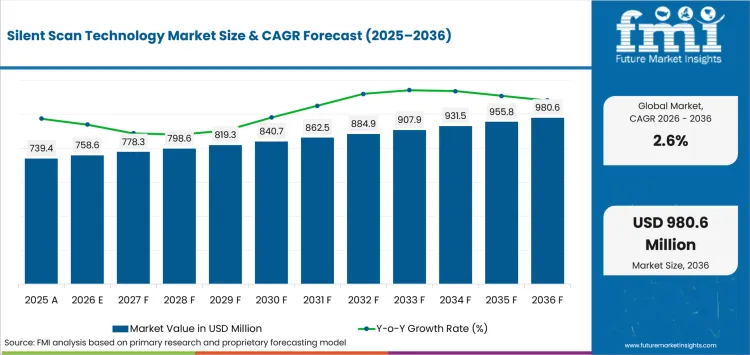
Key Takeaways of Silent Scan Technology Market
- Patient comfort requirements and scan completion rates are expected to sustain silent scan MRI procurement across hospitals and imaging centres.
- 1.5T MRI Scanners is expected to account for 57.0% of product type demand in 2026 because 1.5T systems represent the largest installed base with the broadest clinical application range.
- Hospitals is projected to hold 64.0% of end-user demand in 2026, driven by radiology department equipment upgrades and patient experience improvement programs.
- Neurology Imaging is anticipated to represent 43.5% of application demand in 2026, supported by brain MRI scan volumes and noise sensitivity in neurological examination protocols.
- India leads with a 7.8% CAGR through 2036 as private healthcare investment and MRI capacity expansion sustain silent scan procurement.
- Siemens Healthineers and GE Healthcare are expected to compete through comprehensive silent MRI platform portfolios.
Analyst Perspective
"Buyers are expected to judge 1.5T MRI scanners on performance and total cost of ownership rather than headline price. Silent scan technology adoption is expected to depend on patient comfort metrics and pediatric imaging sedation reduction outcomes. Suppliers that combine noise reduction with AI-assisted image reconstruction and retrofit compatibility are likely to secure hospital MRI upgrade contracts. Market success is projected to depend on reducing acoustic noise while maintaining diagnostic image quality across neurology, orthopedic, and cardiovascular applications."
- Anurag Sharma, Principal Consultant at Future Market Insights
Why is the Silent Scan Technology Market growing?
Rising 1.5T MRI Scanners and Hospitals demand across healthcare end users
- Silent-MRI demand follows patient-comfort mandates and pediatric and neuro imaging caseloads, not blanket scanner replacement.
- India leads growth at 7.8% CAGR as private healthcare investment and MRI capacity expansion sustain silent scan procurement.
- Hospitals holds 64.0% of end-user revenue, indicating where standardization is concentrating buyer spend.
Because acoustic-noise reduction differentiates the scan experience, silent-MRI spend concentrates with vendors whose low-noise sequences integrate into existing high-field MRI platforms and workflows.
How is the Silent Scan Technology Market segmented?
The silent scan technology industry is segmented by product type, end user, application, technology, patient type, and region.
The silent scan technology market is segmented by product type, end user, application, technology, patient type, and region. By product type, the market covers 1.5T MRI scanners and 3T MRI scanners. By end user, the market covers hospitals, diagnostic imaging centres, and ambulatory surgical centres. By application, the market covers neurology imaging, orthopedic imaging, and cardiovascular imaging. By technology, the market covers noise reduction technology, AI integrated MRI systems, and advanced gradient technology. By patient type, the market covers adult patients, pediatric patients, and critical care patients. Regions include North America, Latin America, Western Europe, Eastern Europe, East Asia, South Asia and Pacific, and the Middle East and Africa.
How do 1.5T MRI scanners shape demand within the product type category?
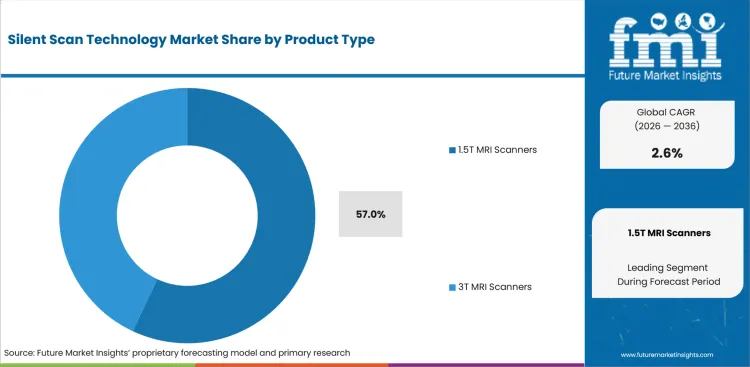
Product type selection determines clinical application range and system cost. 1.5T MRI scanners represent the largest installed base and serve the broadest range of diagnostic imaging protocols.
- 1.5T MRI Scanners is expected to account for 57.0% of product type demand in 2026.
- Noise Reduction Technology is projected to hold 47.0% of technology demand in 2026 as acoustic noise management remains the primary silent scan feature driving procurement.
What supports demand for hospitals within the end-user category?
End-user selection determines clinical fit, workflow efficiency, and procurement priority across care settings. Hospitals anchors the category, keeping buyer spend concentrated where qualification and service support are already established. Demand concentrates here because radiology departments generate the highest MRI scan volumes.
- Hospitals is projected to hold 64.0% of end-user demand in 2026 because radiology departments generate the highest MRI scan volumes.
- Neurology Imaging is forecast to represent 43.5% of application demand as brain MRI protocols are noise-sensitive.
How do technology and patient type shape procurement?
Technology and patient type decide who controls the purchase and how the product reaches the account; together they determine clinical fit, workflow efficiency, and procurement priority across care settings. Demand concentrates here because acoustic noise management is the primary patient comfort feature.
- Noise Reduction Technology is expected to hold 47.0% of technology demand in 2026 because acoustic noise management is the primary patient comfort feature.
- Adult Patients is anticipated to represent 61.7% of patient type demand because adult scan volumes exceed pediatric and critical care, though pediatric sedation reduction is a key adoption driver.
What are the drivers, restraints, and opportunities in the Silent Scan Technology Market?
Near-term procurement is shaped by patient comfort priorities, pediatric sedation reduction, and MRI suite upgrade cycles.
- Driver: Patient comfort requirements and scan completion rates are expected to push hospitals toward silent scan MRI procurement as patient experience metrics gain importance.
- Restraint: High capital costs for new silent MRI platforms are likely to slow adoption if hospital equipment budgets prioritize other imaging modality upgrades.
- Opportunity: Retrofit noise reduction kits for installed MRI systems are expected to open supplier access if hospitals can reduce acoustic noise without full system replacement.
Patient comfort priorities are expected to increase silent scan procurement across hospital radiology departments. Siemens Healthineers reported in 2025 that its silent MRI technology platform maintained clinical adoption across neurology and pediatric imaging applications.
Capital cost barriers are expected to limit adoption if hospitals face competing equipment budget priorities for CT, ultrasound, and interventional imaging. CMS confirmed in 2025 that MRI reimbursement rates remained stable, affecting hospital return-on-investment calculations for silent MRI platform upgrades.
Retrofit noise reduction creates a practical route by allowing hospitals to upgrade installed 1.5T systems without full replacement. GE Healthcare reported in 2025 that its quiet MRI technology was available as software and hardware upgrade packages for existing MRI installations.
Which country CAGRs are profiled in the Silent Scan Technology Market?
India 7.8%, China 6.9%, Germany 4.6%, USA 3.1%, UK 2.2% through 2036
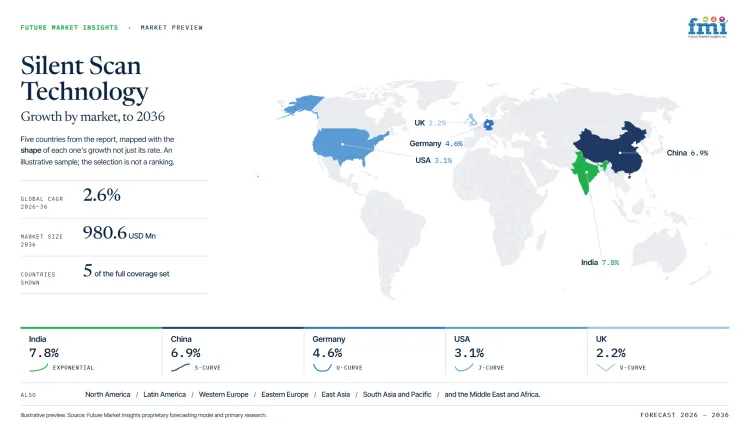
| Country | CAGR (2026 to 2036) |
|---|---|
| India | 7.8% |
| China | 6.9% |
| Germany | 4.6% |
| USA | 3.1% |
| UK | 2.2% |
Source: FMI's proprietary forecasting model and primary research. 5 of the countries covered in the full report are shown here as a representative subset.
How do country-level CAGRs compare in the Silent Scan Technology Market?
The country comparison spans 5.8 percentage points and reveals three distinct growth groups across the Silent Scan Technology Market. India leads at 7.8%, while Germany and China form a middle group based on the available figures. The United States and the United Kingdom remain at the lower end, with their supplied CAGR figures incomplete and requiring confirmation before precise ranking.
- India leads the comparison at a 7.8% CAGR through 2036, supported by private hospital-chain expansion, tertiary-care investment and cost-sensitive public procurement, which broaden the addressable imaging base.
- China records a CAGR of 6.9% through 2036, remaining 0.9 percentage points below India. Capital-cost sensitivity can slow silent-MRI adoption outside premium diagnostic chains, increasing the importance of financing-aligned pricing, technologist training and service coverage.
- Germany grows at a 4.6% CAGR through 2036, creating a 1.4-percentage-point gap from China. Engineering-led specifications, structured hospital procurement and replacement of an established imaging equipment base support quality-focused demand.
- The United States has an incomplete CAGR figure in the supplied data. Accreditation-led procurement and budget discipline shape system evaluation, while documented image quality, service contracts and compliance capabilities influence supplier selection.
- The United Kingdom also has an incomplete CAGR figure in the supplied data. Outpatient-imaging competition and evidence requirements influence adoption, while GPO access, comfort-outcome evidence and dependable upgrade services support supplier positioning.
Comparable CAGRs can still produce different market conditions. Differences in hospital investment, imaging infrastructure, procurement structures, capital-cost sensitivity, installed equipment bases and evidence requirements influence silent-scan technology adoption across countries. The United States and United Kingdom figures should be confirmed before calculating their exact position in the country comparison.
Country-wise Analysis
- Indian providers buy silent scan technology across expanding private hospital chains and cost-sensitive public tenders. Framework listing and patient-experience evidence gate access. Suppliers need framework positions and responsive service to convert NHS tender wins into installed base.
- Chinese hospitals procure silent scan technology through centralized purchasing programs that reward registered, competitively priced products. Demand draws on patient comfort requirements and scan completion rates. Adoption in China is estimated to expand at a 6.9% CAGR through 2036, supported by tertiary hospital expansion and county-level facility upgrades. Capital-cost sensitivity slows silent-MRI uptake outside premium diagnostic chains. Centralized procurement pressures pricing even as scan volumes rise. Suppliers need local registration, competitive tenders, and provincial service to convert experience-led demand.
- German hospitals procure silent scan technology through engineering-led, specification-driven tenders. In Germany, demand is predicted to advance at a 4.6% CAGR through 2036, supported by structured hospital procurement and a large installed equipment base. Centralized procurement pressures pricing even as scan volumes rise. Suppliers need local registration, competitive tenders, and provincial service to convert experience-led demand.
- US providers procure silent scan technology through GPO contracts against a large installed base on replacement cycles. The Silent Scan Technology Market in the United States is projected to record a 3.1% CAGR during the assessment period, supported by replacement cycles across a large installed base and GPO contracting. Framework listing and patient-experience evidence gate access. Suppliers need framework positions and responsive service to convert NHS tender wins into installed base.
- UK providers procure silent scan technology through NHS frameworks and structured tender cycles. Sales in the United Kingdom are forecast to expand at a 2.2% CAGR by 2036, supported by NHS procurement frameworks and structured tender demand. Outpatient-imaging competition and evidence requirements shape access. Suppliers protect share with GPO access, comfort-outcome evidence, and dependable upgrade service.
Who are the notable companies in the Silent Scan Technology Market?
Siemens Healthineers, GE Healthcare, Philips Healthcare, Canon Medical Systems, Fujifilm Healthcare, United Imaging Healthcare (UIH), and Aspect Imaging are the notable companies shaping this market.
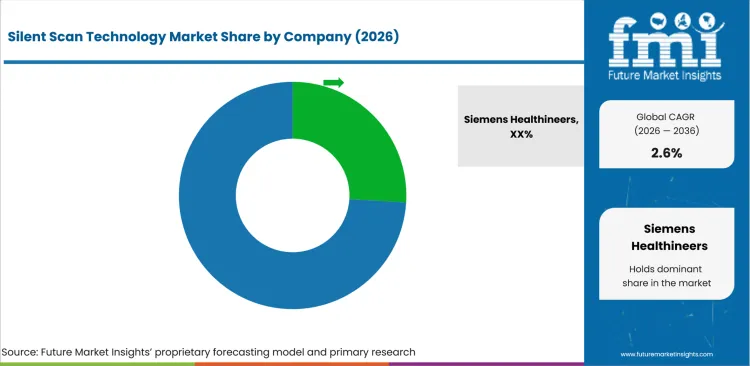
The field concentrates around imaging majors that pair silent-MRI sequence expertise with high-field platform installed bases and service networks. Global MRI system manufacturers compete across Silent MRI technology pioneer, Quiet MRI platforms and Patient comfort MRI systems throughout established accounts. Advanced imaging and healthcare technology companies emphasize Advanced imaging systems and Diagnostic imaging, while specialty mri and compact imaging companies serve regional demand through Compact silent MRI. A workable entry is a low-noise sequence or patient-comfort niche, or a regional service model. Growth depends on regulatory clearance, technologist training, and service coverage across each launch market. Breadth pays off through clinical teams that keep silent sequences integrated with installed high-field MRI platforms.
- Siemens Healthineers and GE Healthcare combine Silent MRI technology pioneer and Quiet MRI platforms across multiple national markets. Philips Healthcare adds Patient comfort MRI systems through established account relationships. Their edge comes from silent-sequence expertise on installed high-field platforms.
- Fujifilm Healthcare and United Imaging Healthcare (UIH) follow focused routes across Advanced imaging systems, Diagnostic imaging and MRI system manufacturing. Their commercial edge comes from patient-comfort and low-noise niches rather than one standardized scanner.
- Aspect Imaging and Hyperfine Research provide regional coverage through Compact silent MRI. These firms compete on a targeted comfort-imaging strengths, though reach trails the imaging majors.
Competitive Benchmarking: Silent Scan Technology Market
| Company | Portfolio Relevance | MRI Focus | Account Access | Service Reach |
|---|---|---|---|---|
| Siemens Healthineers | High | Silent MRI technology pioneer | Strong | Global |
| GE Healthcare | High | Quiet MRI platforms | Strong | Global |
| Philips Healthcare | High | Patient comfort MRI systems | Strong | Global |
| Canon Medical Systems | Medium | Low-noise MRI solutions | Strong | Global |
| Fujifilm Healthcare | Medium | Advanced imaging systems | Moderate | Global |
| United Imaging Healthcare (UIH) | Medium | MRI system manufacturing | Moderate | Regional |
| Aspect Imaging | Medium | Compact silent MRI | Moderate | Regional |
Source: Future Market Insights competitive analysis, 2026. Ratings reflect relative portfolio relevance, workflow or project fit, service capability, and geographic reach.
Key Developments in the Silent Scan Technology Market
In January 2025, Siemens Healthineers confirmed continued clinical adoption of its silent MRI technology across hospital neurology and pediatric imaging programs globally.
In February 2025, GE Healthcare reported availability of quiet MRI upgrade packages for installed 1.5T and 3T systems across North American and European hospital networks.
Key Players in the Silent Scan Technology Market
Global MRI system manufacturers
- Siemens Healthineers
- GE Healthcare
- Philips Healthcare
- Canon Medical Systems
Advanced imaging and healthcare technology companies
- Fujifilm Healthcare
- United Imaging Healthcare (UIH)
Specialty MRI and compact imaging companies
- Aspect Imaging
- Hyperfine Research
Silent Scan Technology Market: Report Scope
| Coverage field | Report scope |
|---|---|
| Market breakdown | Product type, end user, application, technology, patient type, and region. |
| Quantitative Units | Revenue in USD million and CAGR in %. |
| Market Definition | Silent scan technology includes noise-reduced MRI systems, acoustic noise reduction software, advanced gradient technology, and AI-integrated imaging platforms used across hospitals and diagnostic centres for neurology, orthopedic, and cardiovascular imaging applications. |
| Regions Covered | North America, Latin America, Western Europe, Eastern Europe, East Asia, South Asia and Pacific, and the Middle East and Africa. |
| Countries Covered | United States, China, India, Germany, United Kingdom, Japan, and Brazil. |
| Key Companies Profiled | Siemens Healthineers, GE Healthcare, Philips Healthcare, Canon Medical Systems, Fujifilm Healthcare, United Imaging Healthcare (UIH), Aspect Imaging. |
| Forecast Period | 2026 to 2036. |
| Approach | FMI used primary interviews, source validation, company authentication, and proprietary demand modeling to estimate market size, segment shares, country CAGRs, and competitive positioning. |
Source: Future Market Insights, analysis driven by proprietary forecasting models and primary research
Silent Scan Technology Market: Research Methodology
| Method | Approach |
|---|---|
| Primary Research | FMI interviewed silent scan technology suppliers, institutional and retail buyers, distributors, and procurement leads. Inputs tested adoption triggers, product preferences, and replacement cycle patterns. |
| Desk Research | Desk research used government releases, regulator updates, standards-body references, company filings, and official product pages restricted to public sources. |
| Market Sizing and Forecasting | The forecast model linked 2026 revenue anchors to demand drivers, distribution reach, penetration rates, and country-specific conditions. Segment shares were cross-checked against product, application, and end-user patterns. |
| Data Validation | Data validation reconciled every external statistic against its source title, date, and reported figure. Forecast values were checked against the ten-year CAGR formula. |
Source: Future Market Insights (FMI) analysis, based on proprietary forecasting model and primary research
Market Segmentation Analysis
Silent Scan Technology Market Segmented by Product Type:
- 1.5T MRI Scanners
- Closed Bore 1.5T MRI Systems
- Reduced Acoustic Noise Levels
- Enhanced Patient Comfort
- Open 1.5T MRI Scanners
- Improved Claustrophobic Patient Support
- Efficient Routine Imaging Applications
- Closed Bore 1.5T MRI Systems
- 3T MRI Scanners
- High Resolution 3T MRI Systems
- Advanced Neuro Imaging Capability
- Improved Diagnostic Accuracy
- Silent High Speed 3T MRI Platforms
- Enhanced Scan Efficiency
- Reduced Patient Anxiety
- High Resolution 3T MRI Systems
Silent Scan Technology Market Segmented by End User:
- Hospitals
- Multi Specialty Hospitals
- Advanced Diagnostic Imaging Infrastructure
- High Patient Examination Volume
- Tertiary Care Hospitals
- Comprehensive Radiology Services
- Enhanced Critical Care Imaging
- Multi Specialty Hospitals
- Diagnostic Imaging Centres
- Independent Imaging Facilities
- Outpatient MRI Scan Services
- Quick Diagnostic Turnaround
- Specialized Radiology Centres
- High Precision Imaging Support
- Improved Patient Accessibility
- Independent Imaging Facilities
- Ambulatory Surgical Centres
- Day Care Surgical Facilities
- Pre Operative Imaging Support
- Reduced Hospital Stay Duration
- Minimally Invasive Care Centres
- Efficient Diagnostic Workflow
- Improved Patient Convenience
- Day Care Surgical Facilities
Silent Scan Technology Market Segmented by Application:
- Neurology Imaging
- Brain Tumor Imaging
- High Resolution Neural Scanning
- Reduced Motion Artifacts
- Functional Brain MRI Applications
- Enhanced Neurological Assessment
- Improved Patient Comfort During Scans
- Brain Tumor Imaging
- Orthopedic Imaging
- Spine And Joint Imaging
- Detailed Musculoskeletal Visualization
- Improved Diagnostic Precision
- Sports Injury MRI Applications
- Enhanced Soft Tissue Evaluation
- Reduced Scan Related Discomfort
- Spine And Joint Imaging
- Cardiovascular Imaging
- Cardiac MRI Examinations
- Improved Heart Structure Visualization
- Enhanced Blood Flow Assessment
- Vascular Imaging Applications
- High Precision Angiography Support
- Reduced Acoustic Stress For Patients
- Cardiac MRI Examinations
Silent Scan Technology Market Segmented by Technology:
- Noise Reduction Technology
- Acoustic Quiet MRI Systems
- Reduced Scan Noise Emissions
- Enhanced Patient Relaxation
- Sound Dampening Hardware Solutions
- Improved Imaging Environment
- Enhanced Clinical Workflow
- Acoustic Quiet MRI Systems
- AI Integrated MRI Systems
- AI Assisted Image Reconstruction
- Faster Image Processing
- Improved Diagnostic Accuracy
- Smart Scan Optimization Platforms
- Automated Scan Adjustments
- Reduced Examination Time
- AI Assisted Image Reconstruction
- Advanced Gradient Technology
- High Performance Gradient Coils
- Improved Imaging Speed
- Enhanced Scan Precision
- Low Vibration MRI Components
- Reduced Mechanical Noise
- Enhanced Patient Experience
- High Performance Gradient Coils
Silent Scan Technology Market Segmented by Patient Type:
- Adult Patients
- Routine Diagnostic Imaging
- Enhanced Comfort During Long Scans
- Improved Imaging Compliance
- Geriatric Imaging Applications
- Reduced Anxiety During Procedures
- Improved Diagnostic Accessibility
- Routine Diagnostic Imaging
- Pediatric Patients
- Child Friendly MRI Imaging
- Reduced Sedation Requirements
- Enhanced Patient Cooperation
- Neonatal MRI Applications
- Low Noise Imaging Environment
- Improved Pediatric Safety
- Child Friendly MRI Imaging
- Critical Care Patients
- Emergency Diagnostic Imaging
- Rapid Scan Capabilities
- Improved Clinical Decision Support
- ICU Compatible MRI Procedures
- Enhanced Monitoring Integration
- Reduced Patient Disturbance
- Emergency Diagnostic Imaging
Silent Scan Technology Market by Region:
- North America
- USA
- Canada
- Mexico
- Latin America
- Brazil
- Chile
- Rest of Latin America
- Western Europe
- Germany
- UK
- Italy
- Spain
- France
- Nordic
- BENELUX
- Rest of Western Europe
- Eastern Europe
- Russia
- Poland
- Hungary
- Balkan & Baltic
- Rest of Eastern Europe
- East Asia
- China
- Japan
- South Korea
- South Asia and Pacific
- India
- ASEAN
- Australia & New Zealand
- Rest of South Asia and Pacific
- Middle East & Africa
- Kingdom of Saudi Arabia
- Other GCC Countries
- Türkiye
- South Africa
- Other African Union
- Rest of Middle East & Africa
Research Sources and Bibliography
- World Health Organization. (2025). Medical Imaging Utilization and MRI Scan Volume Trends.
- Centers for Medicare and Medicaid Services. (2025). MRI Reimbursement and Hospital Equipment Assessment.
- Siemens Healthineers. (2025). Silent MRI Technology Clinical Adoption Report.
- Philips Healthcare. (2025). Patient Comfort MRI Platform Portfolio Update.
- National Health Commission of China. (2025). Hospital Radiology Equipment Standardization.
- Pharmaceutical and Medical Devices Agency Japan. (2025). MRI System Approval and Post-Market Guidance.
- European Medicines Agency. (2025). EU MDR Compliance: Diagnostic Imaging Equipment.
- Press Information Bureau India. (2025). Ayushman Bharat Diagnostic Coverage Expansion.
- Canon Medical Systems. (2025). Low-Noise MRI Solutions Performance Report.
This bibliography is provided for reader reference and uses primary government sources plus standards-body sources. Company sources are included.
This Report Answers
- What is the estimated 2026 value of the silent scan technology market?
- What market value is projected by 2036?
- What CAGR is forecast from 2026 to 2036?
- Which product type is expected to account for a notable 2026 share?
- Which countries are profiled for CAGR comparison?
- Which companies are notable in the competitive landscape?
Frequently Asked Questions
How big is the Silent Scan Technology Market in 2026?
The Silent Scan Technology Market is valued at USD 758.6 million in 2026 and is forecast to reach USD 980.6 million by 2036, expanding at a 2.6% CAGR. The Silent Scan Technology Market grew from USD 739.4 million in 2025, with 1.5T MRI Scanners holding 57.0% of product type demand in 2026.
What is the CAGR of the Silent Scan Technology Market from 2026 to 2036?
The Silent Scan Technology Market is projected to grow at a CAGR of 2.6% between 2026 and 2036, supported by sustained investment in patient-centric MRI technology that reduces acoustic noise without sacrificing diagnostic image quality. 1.5T MRI Scanners holds 57.0% of Silent Scan Technology Market product type demand in 2026, while Hospitals leads end user with 64.0% in 2026.
Which product type leads the Silent Scan Technology Market?
1.5T MRI Scanners accounts for 57.0% of the Silent Scan Technology Market by product type in 2026, driven by sustained investment in patient-centric MRI technology that reduces acoustic noise without sacrificing diagnostic image. The Silent Scan Technology Market grows at a 2.6% CAGR through 2036, while Hospitals leads end user with 64.0% in 2026.
How much will the Silent Scan Technology Market add between 2026 and 2036?
The Silent Scan Technology Market is set to add USD 222.0 million between 2026 and 2036, growing from USD 758.6 million to USD 980.6 million at a 2.6% CAGR. Hospitals leads end user with 64.0% of Silent Scan Technology Market revenue in 2026, anchoring that incremental demand.
Who are the leading companies in the Silent Scan Technology Market?
The Silent Scan Technology Market profiles 8 key companies in 2026, led by Siemens Healthineers, GE Healthcare, Philips Healthcare, Canon Medical Systems, and Fujifilm Healthcare. These suppliers compete across product type, where 1.5T MRI Scanners holds 57.0% of Silent Scan Technology Market demand in 2026.
Preview the report firsthand - request a free sample
Get SampleGet the brochure for pricing and purchase details.
Get PDFTable of Content
- Key Takeaways
- Market Size and CAGR
- Top Growth Driver
- Fastest Growing Segment
- Leading Region
- Key Companies
- Emerging Opportunities
- Executive Summary
- Global Market Outlook
- Demand-side Trends
- Supply-side Trends
- Technology Roadmap Analysis
- Analysis and Recommendations
- Analyst Perspective (What is happening? Why now? What should investors know?)
- Key Questions Answered
- How large is the market?
- What is the CAGR?
- What are key trends?
- Which region dominates?
- Who are the leaders?
- Market Overview
- Market Coverage / Taxonomy
- Market Definition / Scope / Limitations
- Research Methodology
- Chapter Orientation
- Analytical Lens and Working Hypotheses
- Market Structure, Signals, and Trend Drivers
- Benchmarking and Cross-market Comparability
- Market Sizing, Forecasting, and Opportunity Mapping
- Research Design and Evidence Framework
- Desk Research Programme (Secondary Evidence)
- Expert Input and Fieldwork (Primary Evidence)
- Tooling, Models, and Reference Databases
- Data Engineering and Model Build
- Quality Assurance and Audit Trail
- Market Background
- Market Dynamics (Drivers, Restraints, Opportunity, Trends)
- Scenario Forecast (Optimistic, Likely, Conservative)
- Impact Analysis
- AI Impact
- Sustainability Impact
- Regulatory Impact
- Technology Impact
- Consumer / Buyer Analysis
- Purchase Drivers
- Adoption Barriers
- Buyer Journey
- Opportunity Map Analysis
- Product Life Cycle Analysis
- Supply Chain Analysis
- Investment Feasibility Matrix
- Value Chain Analysis
- PESTLE and Porter's Analysis
- Regulatory Landscape
- Regional Parent Market Outlook
- Production and Consumption Statistics
- Import and Export Statistics
- Global Market Analysis and Forecast, 2021 to 2036
- Historical Market Size Value (USD Million) Analysis, 2021 to 2025
- Current and Future Market Size Value (USD Million) Projections, 2026 to 2036
- Y-o-Y Growth Trend Analysis
- Absolute $ Opportunity Analysis
- Global Market Pricing Analysis, 2021 to 2036
- Global Market Analysis and Forecast, By Product Type, 2021 to 2036
- Introduction / Key Findings
- Historical Market Size Value (USD Million) Analysis By Product Type, 2021 to 2025
- Current and Future Market Size Value (USD Million) Analysis and Forecast By Product Type, 2026 to 2036
- 1.5T MRI Scanners
- Closed Bore 1.5T MRI Systems
- Open 1.5T MRI Scanners
- 3T MRI Scanners
- High Resolution 3T MRI Systems
- Silent High Speed 3T MRI Platforms
- 1.5T MRI Scanners
- Y-o-Y Growth Trend Analysis By Product Type, 2021 to 2025
- Absolute $ Opportunity Analysis By Product Type, 2026 to 2036
- Global Market Analysis and Forecast, By End User, 2021 to 2036
- Introduction / Key Findings
- Historical Market Size Value (USD Million) Analysis By End User, 2021 to 2025
- Current and Future Market Size Value (USD Million) Analysis and Forecast By End User, 2026 to 2036
- Hospitals
- Multi Specialty Hospitals
- Tertiary Care Hospitals
- Diagnostic Imaging Centres
- Independent Imaging Facilities
- Specialized Radiology Centres
- Ambulatory Surgical Centres
- Day Care Surgical Facilities
- Minimally Invasive Care Centres
- Hospitals
- Y-o-Y Growth Trend Analysis By End User, 2021 to 2025
- Absolute $ Opportunity Analysis By End User, 2026 to 2036
- Global Market Analysis and Forecast, By Application, 2021 to 2036
- Introduction / Key Findings
- Historical Market Size Value (USD Million) Analysis By Application, 2021 to 2025
- Current and Future Market Size Value (USD Million) Analysis and Forecast By Application, 2026 to 2036
- Neurology Imaging
- Brain Tumor Imaging
- Functional Brain MRI Applications
- Orthopedic Imaging
- Spine And Joint Imaging
- Sports Injury MRI Applications
- Cardiovascular Imaging
- Cardiac MRI Examinations
- Vascular Imaging Applications
- Neurology Imaging
- Y-o-Y Growth Trend Analysis By Application, 2021 to 2025
- Absolute $ Opportunity Analysis By Application, 2026 to 2036
- Global Market Analysis and Forecast, By Technology, 2021 to 2036
- Introduction / Key Findings
- Historical Market Size Value (USD Million) Analysis By Technology, 2021 to 2025
- Current and Future Market Size Value (USD Million) Analysis and Forecast By Technology, 2026 to 2036
- Noise Reduction Technology
- Acoustic Quiet MRI Systems
- Sound Dampening Hardware Solutions
- AI Integrated MRI Systems
- AI Assisted Image Reconstruction
- Smart Scan Optimization Platforms
- Advanced Gradient Technology
- High Performance Gradient Coils
- Low Vibration MRI Components
- Noise Reduction Technology
- Y-o-Y Growth Trend Analysis By Technology, 2021 to 2025
- Absolute $ Opportunity Analysis By Technology, 2026 to 2036
- Global Market Analysis and Forecast, By Patient Type, 2021 to 2036
- Introduction / Key Findings
- Historical Market Size Value (USD Million) Analysis By Patient Type, 2021 to 2025
- Current and Future Market Size Value (USD Million) Analysis and Forecast By Patient Type, 2026 to 2036
- Adult Patients
- Routine Diagnostic Imaging
- Geriatric Imaging Applications
- Pediatric Patients
- Child Friendly MRI Imaging
- Neonatal MRI Applications
- Critical Care Patients
- Emergency Diagnostic Imaging
- ICU Compatible MRI Procedures
- Adult Patients
- Y-o-Y Growth Trend Analysis By Patient Type, 2021 to 2025
- Absolute $ Opportunity Analysis By Patient Type, 2026 to 2036
- Global Market Analysis and Forecast, By Region, 2021 to 2036
- Introduction
- Historical Market Size Value (USD Million) Analysis By Region, 2021 to 2025
- Current Market Size Value (USD Million) Analysis and Forecast By Region, 2026 to 2036
- North America
- Latin America
- Western Europe
- Eastern Europe
- East Asia
- South Asia and Pacific
- Middle East & Africa
- Market Attractiveness Analysis By Region
- North America Market Analysis and Forecast, By Country, 2021 to 2036
- Historical Market Size Value (USD Million) Trend Analysis By Market Taxonomy, 2021 to 2025
- Market Size Value (USD Million) Forecast By Market Taxonomy, 2026 to 2036
- By Country
- USA
- Canada
- By Product Type
- By End User
- By Application
- By Technology
- By Patient Type
- By Country
- Market Attractiveness Analysis
- By Country
- By Product Type
- By End User
- By Application
- By Technology
- By Patient Type
- Key Takeaways
- Latin America Market Analysis and Forecast, By Country
- Historical Market Size Value (USD Million) Trend Analysis By Market Taxonomy, 2021 to 2025
- Market Size Value (USD Million) Forecast By Market Taxonomy, 2026 to 2036
- By Country
- Brazil
- Mexico
- Chile
- Rest of Latin America
- By Product Type
- By End User
- By Application
- By Technology
- By Patient Type
- By Country
- Market Attractiveness Analysis
- By Country
- By Product Type
- By End User
- By Application
- By Technology
- By Patient Type
- Key Takeaways
- Western Europe Market Analysis and Forecast, By Country
- Historical Market Size Value (USD Million) Trend Analysis By Market Taxonomy, 2021 to 2025
- Market Size Value (USD Million) Forecast By Market Taxonomy, 2026 to 2036
- By Country
- Germany
- UK
- Italy
- Spain
- France
- Nordic
- BENELUX
- Rest of Western Europe
- By Product Type
- By End User
- By Application
- By Technology
- By Patient Type
- By Country
- Market Attractiveness Analysis
- By Country
- By Product Type
- By End User
- By Application
- By Technology
- By Patient Type
- Key Takeaways
- Eastern Europe Market Analysis and Forecast, By Country
- Historical Market Size Value (USD Million) Trend Analysis By Market Taxonomy, 2021 to 2025
- Market Size Value (USD Million) Forecast By Market Taxonomy, 2026 to 2036
- By Country
- Russia
- Poland
- Hungary
- Balkan & Baltic
- Rest of Eastern Europe
- By Product Type
- By End User
- By Application
- By Technology
- By Patient Type
- By Country
- Market Attractiveness Analysis
- By Country
- By Product Type
- By End User
- By Application
- By Technology
- By Patient Type
- Key Takeaways
- East Asia Market Analysis and Forecast, By Country
- Historical Market Size Value (USD Million) Trend Analysis By Market Taxonomy, 2021 to 2025
- Market Size Value (USD Million) Forecast By Market Taxonomy, 2026 to 2036
- By Country
- China
- Japan
- South Korea
- By Product Type
- By End User
- By Application
- By Technology
- By Patient Type
- By Country
- Market Attractiveness Analysis
- By Country
- By Product Type
- By End User
- By Application
- By Technology
- By Patient Type
- Key Takeaways
- South Asia and Pacific Market Analysis and Forecast, By Country
- Historical Market Size Value (USD Million) Trend Analysis By Market Taxonomy, 2021 to 2025
- Market Size Value (USD Million) Forecast By Market Taxonomy, 2026 to 2036
- By Country
- India
- ASEAN
- Australia & New Zealand
- Rest of South Asia and Pacific
- By Product Type
- By End User
- By Application
- By Technology
- By Patient Type
- By Country
- Market Attractiveness Analysis
- By Country
- By Product Type
- By End User
- By Application
- By Technology
- By Patient Type
- Key Takeaways
- Middle East & Africa Market Analysis and Forecast, By Country
- Historical Market Size Value (USD Million) Trend Analysis By Market Taxonomy, 2021 to 2025
- Market Size Value (USD Million) Forecast By Market Taxonomy, 2026 to 2036
- By Country
- Kingdom of Saudi Arabia
- Other GCC Countries
- Türkiye
- South Africa
- Other African Union
- Rest of Middle East & Africa
- By Product Type
- By End User
- By Application
- By Technology
- By Patient Type
- By Country
- Market Attractiveness Analysis
- By Country
- By Product Type
- By End User
- By Application
- By Technology
- By Patient Type
- Key Takeaways
- Key Countries Market Analysis
- USA
- Pricing Analysis
- Market Share Analysis, 2025
- By Product Type
- By End User
- By Application
- By Technology
- By Patient Type
- Canada
- Pricing Analysis
- Market Share Analysis, 2025
- By Product Type
- By End User
- By Application
- By Technology
- By Patient Type
- Mexico
- Pricing Analysis
- Market Share Analysis, 2025
- By Product Type
- By End User
- By Application
- By Technology
- By Patient Type
- Brazil
- Pricing Analysis
- Market Share Analysis, 2025
- By Product Type
- By End User
- By Application
- By Technology
- By Patient Type
- Chile
- Pricing Analysis
- Market Share Analysis, 2025
- By Product Type
- By End User
- By Application
- By Technology
- By Patient Type
- Germany
- Pricing Analysis
- Market Share Analysis, 2025
- By Product Type
- By End User
- By Application
- By Technology
- By Patient Type
- UK
- Pricing Analysis
- Market Share Analysis, 2025
- By Product Type
- By End User
- By Application
- By Technology
- By Patient Type
- Italy
- Pricing Analysis
- Market Share Analysis, 2025
- By Product Type
- By End User
- By Application
- By Technology
- By Patient Type
- Spain
- Pricing Analysis
- Market Share Analysis, 2025
- By Product Type
- By End User
- By Application
- By Technology
- By Patient Type
- France
- Pricing Analysis
- Market Share Analysis, 2025
- By Product Type
- By End User
- By Application
- By Technology
- By Patient Type
- India
- Pricing Analysis
- Market Share Analysis, 2025
- By Product Type
- By End User
- By Application
- By Technology
- By Patient Type
- ASEAN
- Pricing Analysis
- Market Share Analysis, 2025
- By Product Type
- By End User
- By Application
- By Technology
- By Patient Type
- Australia & New Zealand
- Pricing Analysis
- Market Share Analysis, 2025
- By Product Type
- By End User
- By Application
- By Technology
- By Patient Type
- China
- Pricing Analysis
- Market Share Analysis, 2025
- By Product Type
- By End User
- By Application
- By Technology
- By Patient Type
- Japan
- Pricing Analysis
- Market Share Analysis, 2025
- By Product Type
- By End User
- By Application
- By Technology
- By Patient Type
- South Korea
- Pricing Analysis
- Market Share Analysis, 2025
- By Product Type
- By End User
- By Application
- By Technology
- By Patient Type
- Russia
- Pricing Analysis
- Market Share Analysis, 2025
- By Product Type
- By End User
- By Application
- By Technology
- By Patient Type
- Poland
- Pricing Analysis
- Market Share Analysis, 2025
- By Product Type
- By End User
- By Application
- By Technology
- By Patient Type
- Hungary
- Pricing Analysis
- Market Share Analysis, 2025
- By Product Type
- By End User
- By Application
- By Technology
- By Patient Type
- Kingdom of Saudi Arabia
- Pricing Analysis
- Market Share Analysis, 2025
- By Product Type
- By End User
- By Application
- By Technology
- By Patient Type
- Türkiye
- Pricing Analysis
- Market Share Analysis, 2025
- By Product Type
- By End User
- By Application
- By Technology
- By Patient Type
- South Africa
- Pricing Analysis
- Market Share Analysis, 2025
- By Product Type
- By End User
- By Application
- By Technology
- By Patient Type
- USA
- Market Structure Analysis
- Competition Dashboard
- Competition Benchmarking
- Market Share Analysis of Top Players
- By Regional
- By Product Type
- By End User
- By Application
- By Technology
- By Patient Type
- Emerging Startups
- Innovation Benchmarking
- Competition Analysis
- Competition Deep Dive
- Siemens Healthineers
- Overview
- Product Portfolio
- Profitability by Market Segments
- Sales Footprint
- Strategy Overview
- Marketing Strategy
- Product Strategy
- Channel Strategy
- GE Healthcare
- Philips Healthcare
- Canon Medical Systems
- Fujifilm Healthcare
- Hitachi Healthcare
- United Imaging Healthcare (UIH)
- Aspect Imaging
- Hyperfine Research
- Siemens Healthineers
- Case Studies
- Success Stories
- Recent Developments
- Competition Deep Dive
- Assumptions & Acronyms Used


