

- Industry Size (2026)
- USD 1654.4 Mn
- Forecast (2036)
- USD 4200.4 Mn
- CAGR (2026 to 2036)
- 8.8%
Helium Free MRI Scanners Market Size, Market Forecast and Outlook By FMI
In 2026, the helium free MRI scanners market was valued at USD 1,800.0 million. Based on Future Market Insights analysis, demand for helium free MRI scanners is estimated to grow to USD 4200.4 million by 2036. FMI projects a CAGR of 8.8% during the forecast period.
Absolute dollar growth of USD 2400.4 million over the decade points to structural expansion rather than a routine replacement cycle. As per FMI, demand is expected to be supported by growing interest in MRI platforms that reduce dependence on helium logistics and simplify siting requirements, while capital approval cycles, installed-base inertia, and cautious protocol migration are expected to keep adoption paced in mature imaging networks. "This investment represents a pivotal step in our ongoing mission to provide accessible, accurate and affordable diagnostic solutions to all Indians, by partnering with Siemens Healthineers, we are equipping our new centers with the latest helium-free MRI technology, ensuring both superior image quality and a sustainable approach to healthcare delivery. We are confident that this expansion will empower clinicians with the critical information they need to provide timely and effective patient care." said Dr Prasanna Vignesh, Executive Director and Radiologist, Aarthi Scans and Labs.
Summary of Helium Free MRI Scanners Market
- Market Definition
- The market covers MRI scanner systems designed to operate without conventional liquid helium dependence, helping imaging providers reduce cooling-related complexity, site infrastructure burden, and long-term service exposure. These systems are being adopted across hospitals, diagnostic centers, and other imaging settings where uptime, installation flexibility, and lifecycle operating efficiency are becoming increasingly important in scanner procurement decisions.
- Demand Drivers in the Market
- Rising pressure on imaging providers to reduce operating complexity and service dependency is supporting interest in helium free MRI platforms across both mature and emerging markets.
- Hospitals and imaging centers are looking for scanner systems that simplify installation requirements and improve site planning flexibility, especially in space-constrained environments.
- Growing focus on lifecycle cost control, equipment uptime, and sustainable imaging infrastructure is strengthening demand for alternatives to conventional helium-reliant MRI systems.
- Key Segments Analyzed in the FMI Report
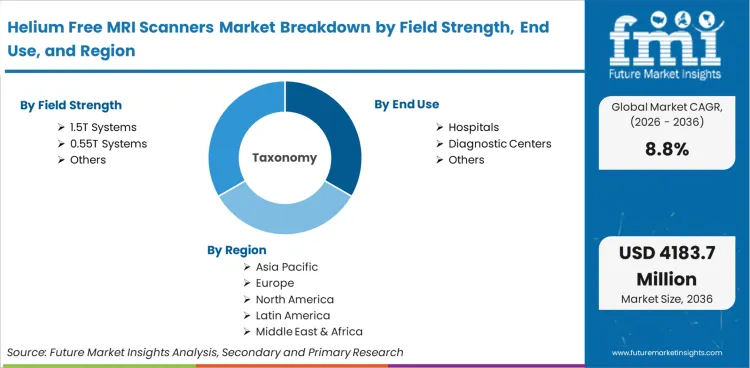
- By Field Strength: 1.5T systems lead at 50% share in 2026, followed by 0.55T systems at 35% share.
- By End User: Hospitals lead at 60% share in 2026, followed by diagnostic centers at 30% share.
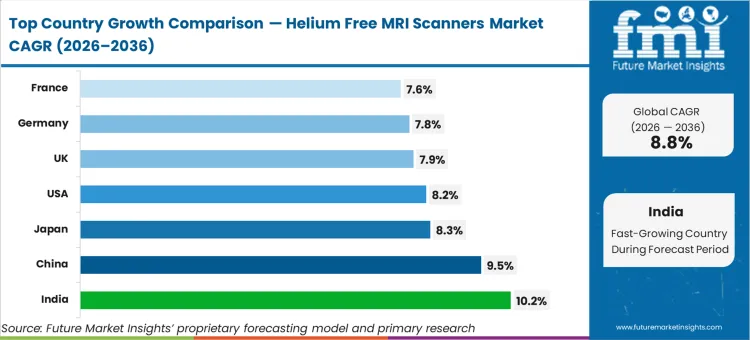
- Geography: India and China show the fastest growth at 10.2% and 9.5% CAGR, supported by expanding imaging infrastructure, rising hospital procurement, and increasing interest in simplified MRI deployment models.
- Analyst Opinion at FMI
- Anurag Sharma, Principal Consultant at Future Market Insights, opines, “Buyer preference is increasingly being shaped by installation simplicity, service resilience, and long-term operating efficiency, as healthcare providers seek MRI systems that can deliver dependable imaging performance without the infrastructure and supply concerns traditionally associated with helium-dependent platforms.”
- Strategic Implications and Executive Takeaways
- Position helium free systems around lifecycle efficiency, easier siting, and lower infrastructure dependency, especially for providers modernizing installed imaging fleets.
- Prioritize 1.5T opportunities where clinical familiarity, broad application coverage, and procurement comfort support faster commercial adoption.
- Build growth plans around hospitals and fast-developing healthcare markets where scanner replacement cycles and capacity expansion are driving new procurement decisions.
- Methodology
- As per FMI, sizing and splits were reconciled using company-level product mapping, installed-base assessment, and end-user demand allocation across key imaging settings.
- Segment shares were validated by linking field strength preference with clinical usage breadth, procurement practicality, and deployment suitability by site of care.
- Pricing sensitivity was stress tested under field strength mix and end-user mix shifts to confirm revenue response under realistic scanner purchasing scenarios.
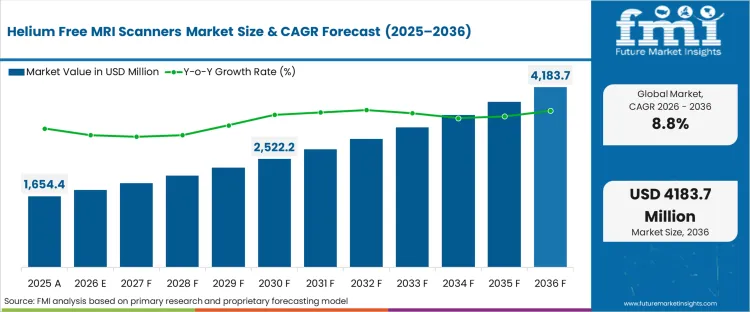
Procurement is being shaped by operating cost discipline and infrastructure planning, with buyers giving weight to magnet design, service support, footprint suitability, and lifecycle cost visibility. Permanent installs continue to anchor demand in large hospital systems, while mobile systems are gaining attention where imaging providers want greater deployment flexibility and lower barriers to extending MRI access into underserved or distributed care environments.
India (10.2% CAGR, supported by imaging capacity expansion and infrastructure-conscious procurement) and China (9.5% CAGR, driven by broader MRI access planning and hospital modernization) are expected to lead growth. Japan (8.3% CAGR) is expected to remain supported by technology adoption and replacement activity in advanced imaging settings. The USA (8.2% CAGR) is expected to remain the largest market due to broad institutional demand and ongoing equipment refresh. Mature markets including the UK (7.9%), Germany (7.8%), and France (7.6%) are expected to contribute more through replacement purchases, constrained by budget review cycles and installed-site transition planning.
Helium Free MRI Scanners Market Definition
The market covers MRI scanner systems designed to operate with little to no reliance on conventional liquid helium refill models, helping reduce cooling complexity and exposure to helium supply constraints. These systems are used in hospitals, diagnostic centers, and other imaging settings that require dependable MRI performance with lower infrastructure burden. The market includes 0.55T systems, 1.5T systems, and other field strength categories, supplied in permanent and mobile installation formats. Demand is shaped by imaging access goals, site readiness, operating cost considerations, and service support requirements, with purchasing influenced by both clinical utility and long-term equipment management priorities.
Helium Free MRI Scanners Market Inclusions
The report includes global and regional market sizing and a 10-year forecast for 2026 to 2036. Segment-level sizing is provided by field strength, installation type, and end user, with country-level CAGR comparisons across key markets. Coverage also includes assessment of replacement demand, site planning priorities, and procurement considerations such as footprint, cooling independence, and deployment flexibility, alongside competitive positioning of major MRI system suppliers, based on FMI analysis.
Helium Free MRI Scanners Market Exclusions
The scope excludes conventional MRI scanners sold under standard helium-dependent operating models without helium free positioning as a core system characteristic. It also omits revenue from MRI room construction, shielding work, contrast agents, coils sold separately, and service-only contracts not tied to scanner system value. Refurbished legacy MRI units are excluded unless they are marketed within the helium free scanner category. The focus remains on helium free MRI scanner systems aligned to the listed field strength categories, installation types, and end users.
Helium Free MRI Scanners Market Research Methodology
- Primary Research: Interviews were conducted with hospital imaging administrators, radiology department leaders, procurement teams, diagnostic center operators, and supplier commercial teams to validate replacement timing, siting priorities, and buying criteria.
- Desk Research: Public information was reviewed from regulators, health system publications, standards references, and company primary disclosures to benchmark MRI infrastructure trends, deployment patterns, and supplier positioning.
- Market-Sizing and Forecasting: A hybrid model was applied using installed imaging capacity and replacement logic by end user and installation type, then reconciled through segment shares across field strength and deployment format.
- Data Validation and Update Cycle: Outputs were checked through consistency review across segment totals and country growth rates, with variance review applied before finalization.
Segmental Analysis
Helium Free MRI Scanners Market Analysis by Field Strength
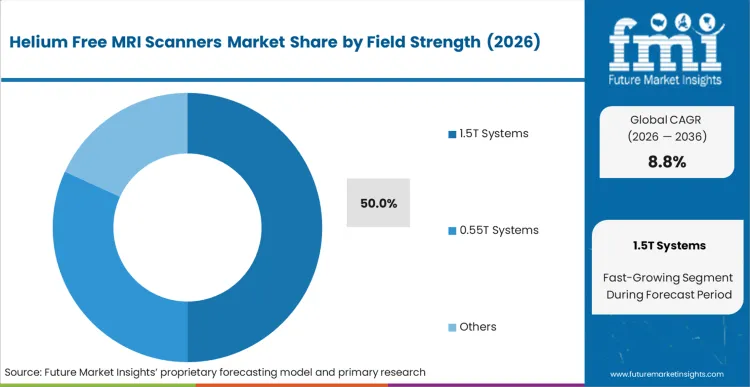
Based on FMI’s report, 1.5T systems are estimated to hold 50% share in 2026. This leading position is supported by their balance of clinical versatility, established physician familiarity, and suitability across a wide range of routine imaging applications. While 0.55T systems account for 35% share and other systems contribute 15%, 1.5T remains the preferred field strength because it offers a practical midpoint between performance expectations and procurement confidence. Its leadership is also reinforced by the fact that many healthcare providers are more comfortable adopting new helium free architecture when it is paired with a field strength already embedded in mainstream MRI workflows.
- Established Clinical Standard: 1.5T remains the current clinical standard in MRI, which lowers buyer hesitation when adopting helium-free platforms because radiologists, technologists, and administrators are already familiar with its workflow, protocols, and diagnostic role.
- Proven All-Round Diagnostic Utility: Comparative reviews show 1.5T and 3T are often equivalent across many routine diagnostic applications, while 1.5T can remain highly effective for broad everyday imaging rather than only niche high-end use cases.
- Established Market Fit: 1.5T systems lead because they offer a well-accepted and widely suitable imaging format that aligns with everyday provider needs, making them the most practical choice when healthcare facilities evaluate newer helium-free MRI platforms.
Helium Free MRI Scanners Market Analysis by End User
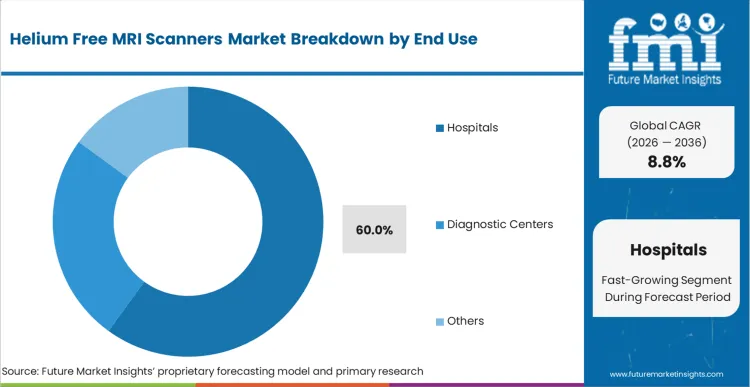
Hospitals account for 60% share in 2026, based on FMI’s report, reflecting their position as the primary buyers of advanced diagnostic imaging infrastructure. Their lead is supported by higher patient throughput, broader modality requirements, and stronger capital allocation for strategic imaging upgrades. Diagnostic centers hold 30% share as outpatient imaging expands, while other end users represent 10% of demand. Hospitals remain the dominant segment because they manage more complex diagnostic pathways, handle a wider mix of clinical cases, and are more likely to invest in MRI systems that improve uptime, simplify operations, and fit long-term infrastructure planning goals.
- Higher-Acuity Imaging Demand: Hospitals manage broader inpatient, emergency, and specialty imaging workloads than most standalone sites, which makes dependable MRI uptime and scalable diagnostic capacity more important in hospital settings. [4]
- Stronger Capital Equipment Purchasing Capacity: High-cost imaging systems are typically purchased through structured hospital procurement processes, reflecting hospitals’ stronger ability to evaluate, approve, and fund large diagnostic equipment investments over long replacement cycles. [5]
- Comprehensive Healthcare Infrastructure Advantage: Hospitals lead due to their ability to manage complex imaging needs, support continuous diagnostic workflows, and invest in advanced technologies, making them the primary adopters of MRI systems that align with long-term operational efficiency and infrastructure modernization goals.
Helium Free MRI Scanners Market Drivers, Restraints, and Opportunities
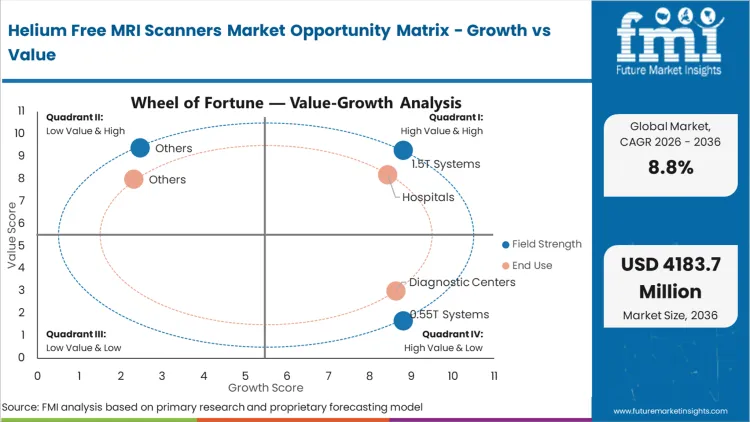
Future Market Insights analysis indicates that this market is evolving as providers reassess how MRI systems are installed, operated, and maintained under tighter cost and infrastructure constraints. Estimated valuation in 2026 is being supported by interest in scanner platforms that reduce helium dependency, simplify site planning, and improve resilience against service and supply-related disruption. Demand is being shaped by the need to expand imaging access without carrying the same operational burden historically associated with conventional MRI systems, especially in healthcare settings that are scaling capacity or replacing aging installed equipment.
At the same time, market expansion is being moderated by conservative capital purchasing behavior, long replacement cycles, and the need for clinical confidence in newer platform architectures. Growth remains supported, however, by hospital modernization, broader MRI adoption in developing healthcare systems, and continued interest in equipment designs that lower infrastructure dependency. Based on FMI’s report, the outlook reflects a market where field strength familiarity supports adoption, hospitals remain the largest buying group, and supplier advantage increasingly depends on practical deployment value rather than only technical specification.
- Infrastructure Simplification: Demand is being supported as imaging providers seek MRI systems that reduce cooling complexity, site preparation burden, and service dependency.
- Capital Cycle: Adoption can be slowed by high equipment costs and long procurement cycles, particularly where existing MRI fleets are still operational.
- Emerging Market Expansion: Demand is being supported as healthcare systems in high-growth countries invest in easier-to-deploy MRI platforms to expand diagnostic capacity.
Regional Analysis
Based on the regional analysis, helium free MRI scanners market is segmented into North America, East Asia, South Asia & Pacific, and Western Europe across 40+ countries. Regional performance is interpreted through replacement of legacy MRI infrastructure, preference for sealed magnet architecture, and adoption across hospitals and diagnostic centres, as per FMI. The full report also offers market attractiveness analysis based on regional trends.
.webp "Top Country Growth Comparison Helium Free Mri Scanners Market Cagr (2026 2036)")
| Country | CAGR |
|---|---|
| USA | 8.2% |
| Germany | 7.8% |
| France | 7.6% |
| UK | 7.9% |
| Japan | 8.3% |
| China | 9.5% |
| India | 10.2% |
Source: Future Market Insights (FMI) analysis and primary research
North America Helium Free MRI Scanners Market Analysis
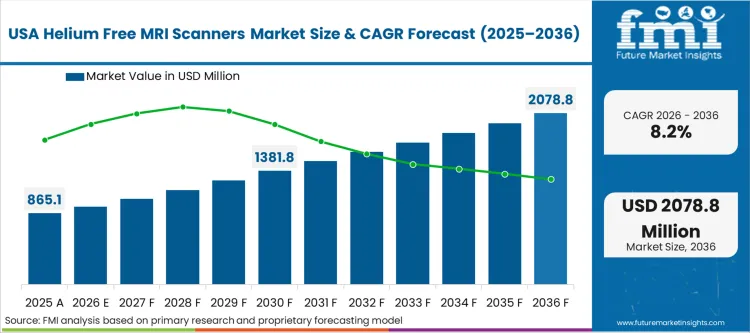
North America remains a replacement-led market, where hospitals are rethinking MRI ownership around operating cost, helium dependence, and siting flexibility. Siemens Healthineers holds a strong position through broad MRI placement and established hospital relationships. GE HealthCare and Philips Healthcare remain active where health systems are balancing installed-base continuity with lower service complexity. FMI analysts note that permanent install systems account for the bulk of demand, while compact operating models continue to improve the case for helium free platforms.
- USA: In the USA, helium free MRI scanners are expected to expand at 8.2% CAGR through 2036, supported by replacement of aging systems in community hospitals and rising interest in scanners that reduce helium-related service risk. Growth is also being helped by facilities that want easier room planning and lower lifecycle cost for permanent installations.
FMI’s report includes a detailed analysis of the growth in the North American region, along with a country-wise assessment that includes the USA, Canada and Mexico. Readers can also find regional trends, regulations, and market growth based on different segments and countries in the North America region.
East Asia Helium Free MRI Scanners Market Analysis
East Asia is a capacity-building region, where MRI expansion is being shaped by hospital modernisation, growing diagnostic access, and stronger interest in systems that reduce operational dependence on helium logistics. Fujifilm Healthcare, Canon Medical, and United Imaging remain relevant in competitive placement discussions where compact footprint, installation flexibility, and value positioning matter. FMI is of the opinion that demand in this region is being supported by a mix of new-site additions and selective replacement of older scanners in established institutions.
- China: China leads among the countries assessed at 9.5% CAGR through 2036, with growth tied to broader diagnostic infrastructure build-out and a rising preference for MRI systems that can be deployed with lower operational complexity. Permanent installations account for most volume, especially in larger hospitals, while mobile deployment remains more selective and location-specific. 0.55T and 1.5T platforms both find space in the market, though buying decisions are often influenced by budget discipline, service reach, and throughput expectations.
- Japan: Japan is projected to rise at 8.3% CAGR through 2036, supported by steady replacement demand and strong interest in dependable imaging systems with lower maintenance uncertainty. The market is more measured than in fast-build geographies, since providers often favour proven performance and careful transition planning. 1.5T systems continue to hold relevance where workflow breadth matters, while helium free alternatives gain traction in facilities that value service simplicity and installation practicality.
FMI’s report includes a detailed analysis of the growth in the East Asia region, along with a country-wise assessment that includes China, Japan and South Korea. Readers can also find regional trends, regulations, and market growth based on different segments and countries in the East Asia region.
South Asia & Pacific Helium Free MRI Scanners Market Analysis
South Asia & Pacific is moving from selective adoption to broader consideration, with providers placing greater weight on ownership economics, site readiness, and easier deployment in growing hospital networks. Siemens Healthineers, GE HealthCare, and emerging regional competitors are shaping decisions where hospitals compare upfront investment with long-term service burden. FMI analysts note that the appeal of helium free systems is particularly strong in markets where infrastructure constraints and service logistics can slow conventional MRI expansion.
- India: India is forecast at 10.2% CAGR through 2036, making it the fastest-growing country among those assessed. Growth is being driven by hospital expansion, wider imaging demand in urban centres, and greater interest in MRI systems that are easier to install and operate without complex helium management. Permanent installations remain the preferred route, especially in hospitals building long-term imaging capacity, though mobile formats may attract attention where access models are still evolving.
FMI’s report includes a detailed analysis of the growth in the South Asia & Pacific region, along with a country-wise assessment that includes India, ASEAN Countries, Australia & New Zealand and Rest of South Asia. Readers can also find regional trends, regulations, and market growth based on different segments and countries in the South Asia & Pacific region.
Western Europe Helium Free MRI Scanners Market Analysis
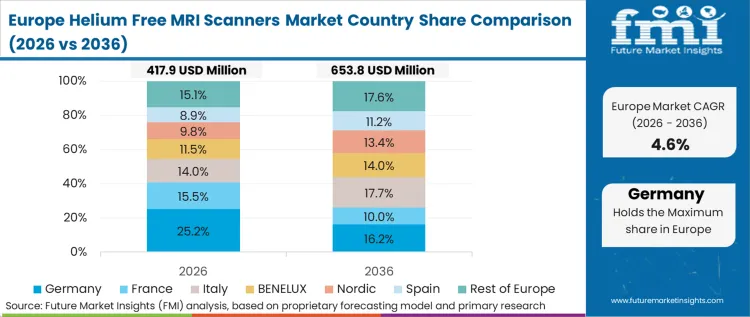
Western Europe is shaped by structured replacement cycles and close evaluation of total cost of ownership, where hospitals increasingly consider helium free MRI in the context of energy use, service continuity, and facility constraints. Siemens Healthineers maintains strong visibility through its MRI portfolio and institutional relationships, while GE HealthCare and Philips Healthcare remain important participants in tender-driven environments. FMI opines that the region is not moving on volume urgency alone, but on practical operational value over the scanner life cycle.
- Germany: Germany is expected to expand at 7.8% CAGR through 2036, supported by replacement demand in hospitals that are reassessing scanner economics and infrastructure requirements. Based on FMI’s report, hospitals remain the central demand base, with diagnostic centres participating where imaging providers update installed fleets.
- France: France is set to grow at 7.6% CAGR through 2036, with demand supported by gradual fleet renewal and growing attention to lower-complexity MRI ownership models. The market favours permanent installations, and hospitals remain the main route to scale, while non-hospital settings contribute more selectively. Growth is moderated by cautious capital allocation and long evaluation cycles, which can stretch decision-making even when operating benefits are clear.
- UK: The UK is anticipated to post 7.9% CAGR through 2036, shaped by equipment renewal needs and stronger interest in systems that simplify site planning and reduce dependency on helium servicing. Permanent install units continue to dominate the market, while mobile systems are assessed where service access and deployment flexibility support specific use cases.
FMI’s analysis of helium free MRI scanners market in Western Europe consists of country-wise assessment that includes Germany, UK, France, Italy, Spain, BENELUX, Nordic Countries and Rest of Western Europe. Readers can know various regulations and latest trends in the regional market.
Competitive aligners for market players
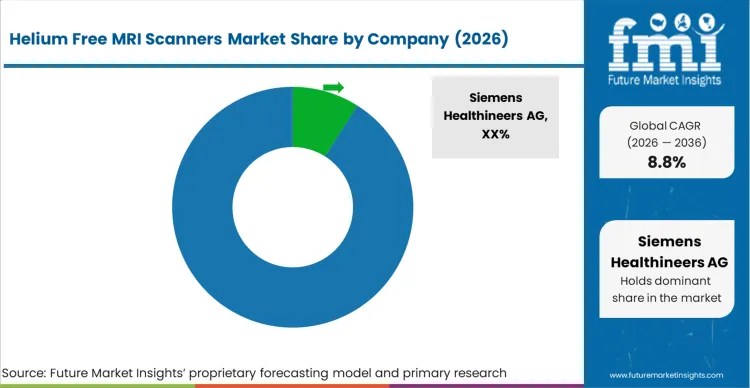
Market structure remains fragmented, yet practical competition is concentrated among a limited set of MRI OEMs that can deliver proven zero boil off designs, support multiyear service commitments, and secure hospital approval for mission critical imaging assets. FMI analysis indicates a clear scale leader at about 18.5% share, while the remaining demand is spread across a small group of global scanner manufacturers. The main competitive factor is uptime certainty and lifecycle operating cost, not short-cycle pricing, because scanner selection is tied to long depreciation cycles and tight radiology schedules. Field strength positioning influences rivalry, because demand is weighted toward 1.5T systems and a growing 0.55T installed base that competes on access and total operating burden, as per FMI.
Companies with structural advantages typically combine broad installed bases, mature service networks, and platform ecosystems that support protocol standardisation across sites. Suppliers with strong 1.5T portfolios benefit where hospitals want a direct replacement path with minimal protocol disruption, while low field offerings gain traction where siting constraints, power draw, and ease of installation affect procurement. Permanent installations dominate because hospitals prioritize predictable throughput and scheduling, so vendors with faster commissioning, stable gradient performance, and responsive parts logistics tend to retain accounts through renewal cycles. Smaller or newer entrants face higher conversion friction because buyers require reference sites, service readiness, and long-term reliability evidence before fleet standardisation decisions are made, based on FMI’s report.
Customer concentration reinforces buyer leverage. Hospitals remain the primary buyers and commonly manage supplier dependency through competitive tenders, multi-vendor evaluations, and staged procurement across campuses so performance can be benchmarked before large orders. Diagnostic centers apply similar discipline through uptime clauses, response time commitments, and service penalties that protect scanning schedules. Mobile deployments are often used to flex capacity or reach remote catchments, which increases the weight placed on installation speed and support responsiveness. This purchasing behavior limits pricing power for core systems, while measured premiums are retained mainly where helium-free operation reduces downtime risk and removes refill logistics that can disrupt imaging throughput, Future Market Insights analysis.
Recent Developments
The report includes full coverage of key trends from competitive benchmarking. Some of the recent developments covered in the reports:
- In January 2026, Siemens Healthineers has received Food and Drug Administration clearance for the 70cm bore Magnetom Flow. platform, a 1.5 tesla (T) platform for magnetic resonance (MR) imaging with a closed helium circuit and no quench pipe, which reduces helium dependency and annual energy consumption. The upgradable platform covers the entire range of MR applications. [6]
- In February 2026, Fujifilm Healthcare Europe unveiled its ECHELON® ZeroHelium MRI at ECR 2026 in Vienna, introducing a helium-free imaging system. The technology replaces traditional liquid helium cooling with a copper-based system operating at -269°C, enhancing sustainability and reducing costs. Integrated deep learning improves image clarity and scan speed, while ECO Mode Plus optimizes energy consumption, positioning the system as a next-generation, efficient MRI solution.
- In November 2025, Royal Philips, a global leader in health technology, unveiled BlueSeal Horizon, an entirely new 3.0T MRI innovation platform that includes the world’s first helium-free 3.0T magnet at RSNA 2025. A pivotal advance in MRI innovation, helium-free 3.0T is a major scientific achievement set to have significant impact for health providers and patients. [7]
Key players in Helium free MRI scanners market
- Siemens Healthineers AG
- GE HealthCare Technologies Inc.
- Koninklijke Philips N.V.
- Canon Medical Systems Corporation
- FUJIFILM Holdings Corporation
- United Imaging Healthcare Co., Ltd.
- Neusoft Medical Systems Co., Ltd.
- Hitachi, Ltd.
- Samsung Medison Co., Ltd.
- Aspect Imaging Ltd
Scope of the report
| Metric | Value |
|---|---|
| Quantitative Units | USD 1,800.0 Mn (2026) to USD 4,200.4 Mn (2036), at a CAGR of 8.8% |
| Market Definition | The helium free MRI scanners market comprises the global production and trade of MRI systems designed to operate with sealed or near zero helium architectures, reducing reliance on helium refills and related service logistics, where demand is shaped by hospital uptime expectations, site sustainability targets, and replacement cycles for 1.5T and low field systems. |
| Field Strength Segmentation | 0.55T Systems, 1.5T Systems, Others |
| Installation Type Segmentation | Permanent Install, Mobile Systems |
| End User Coverage | Hospitals, Diagnostic Centers, Others |
| Regions Covered | North America, Latin America, East Asia, South Asia & Pacific, Western Europe, Eastern Europe, and Middle East & Africa. |
| Countries Covered | United States, Canada, Mexico, Brazil, Argentina, Germany, France, United Kingdom, Italy, Spain, China, India, Japan, South Korea, Indonesia, Australia and 40+ countries |
| Key Companies Profiled | Siemens Healthineers AG, GE HealthCare Technologies Inc., Koninklijke Philips N.V., Canon Medical Systems Corporation, FUJIFILM Holdings Corporation, United Imaging Healthcare Co., Ltd., Neusoft Medical Systems Co., Ltd., Hitachi, Ltd., Samsung Medison Co., Ltd., Aspect Imaging Ltd |
| Forecast Period | 2026 to 2036 |
| Approach | Hybrid top down and bottom up market modeling validated through primary interviews with imaging service operators and OEM channel partners, supported by installed base triangulation and capital replacement benchmarking, as per FMI. |
Helium free MRI Scanners Market Analysis by Segments
Field Strength:
- 0.55T Systems
- 1.5T Systems
- Others
Installation Type:
- Permanent Install
- Mobile Systems
End user:
- Hospitals
- Diagnostic Centers
- Others
Region:
- North America
- USA
- Canada
- Mexico
- Latin America
- Brazil
- Argentina
- Rest of Latin America
- East Asia
- China
- Japan
- South Korea
- South Asia & Pacific
- India
- ASEAN Countries
- Australia & New Zealand
- Rest of South Asia
- Western Europe
- Germany
- UK
- France
- Italy
- Spain
- BENELUX
- Nordic Countries
- Rest of Western Europe
- Eastern Europe
- Russia
- Hungary
- Poland
- Rest of Eastern Europe
- Middle East & Africa
- Saudi Arabia
- Türkiye
- South Africa
- Other African Union
- Rest of Middle East & Africa
Bibliography
- [1] Aarthi Scans & Labs (2025). Aarthi Scans & Labs Invests Rs100+ Crore in Siemens Helium-Free MRI Technology, Expanding Access to Advanced Diagnostics Across India.
- [2] Frontiers in Human Neuroscience (2025). Advancing 1.5T MR imaging: toward achieving 3T quality through deep learning super-resolution techniques.
- [3] NIH (2011). 1.5 Tesla Magnetic Resonance Imaging Scanners Compared with 3.0 Tesla Magnetic Resonance Imaging Scanners: Systematic Review of Clinical Effectiveness: Pilot Project
- [4] PubMed Central (2026). Inpatient Imaging Utilization and Radiology Workload: Trends of the Past Decade and Through the COVID-19 Pandemic.
- [5] PubMed Central (2022). Purchasing high-cost medical devices and equipment in hospitals: a systematic review
- [6] Siemens Healthineers (2026). Siemens Healthineers Receives FDA Clearance for 70cm Magnetom Flow. 1.5 Tesla Magnetic Resonance Platform for Virtually Helium-Free Imaging.
- [7] Royal Philips (2025) Royal Philips unveils BlueSeal Horizon, world’s first helium-free 3.0T MRI platform
This bibliography is provided for reader reference and is not exhaustive. The full report contains the complete reference list and detailed citations.
Frequently Asked Questions
How large is the demand for Helium Free MRI Scanners in the global market in 2026?
Demand for Helium Free MRI Scanners in the global market is estimated to be valued at USD 1,800.0 Mn in 2026, as per FMI.
What will be the market size of Helium Free MRI Scanners in the global market by 2036?
Market size for Helium Free MRI Scanners is projected to reach USD 4,200.4 Mn by 2036.
What is the expected demand growth for Helium Free MRI Scanners in the global market between 2026 and 2036?
Demand for Helium Free MRI Scanners in the global market is expected to grow at a CAGR of 8.8% between 2026 and 2036.
Which field strength is poised to lead global demand by 2026?
1.5T Systems are expected to be the dominant field strength, capturing 50% share in 2026.
Which installation type is expected to account for the largest share in 2026?
Permanent Install is expected to hold the highest share at 70% in 2026.
How significant is hospital demand in the 2026 end user mix?
Hospitals are projected to account for 60% share of end user demand in 2026.
Preview the report firsthand - request a free sample
Get SampleGet the brochure for pricing and purchase details.
Get PDFTable of Content
- Executive Summary
- Global Market Outlook
- Demand-side Trends
- Supply-side Trends
- Technology Roadmap Analysis
- Analysis and Recommendations
- Market Overview
- Market Coverage / Taxonomy
- Market Definition / Scope / Limitations
- Research Methodology
- Chapter Orientation
- Analytical Framework
- Market Structure, Signals, and Trend Drivers
- Benchmarking and Cross-market Comparability
- Market Sizing, Forecasting, and Opportunity Mapping
- Research Design and Evidence Framework
- Desk Research Programme (Secondary Evidence)
- Company Annual and Sustainability Reports
- Peer-reviewed Journals and Academic Literature
- Corporate Websites, Product Literature, and Technical Notes
- Earnings Decks and Investor Briefings
- Government Statistics Portals and Public Data Releases
- Press Releases and Reputable Media Coverage
- Specialist Newsletters and Curated Briefings
- Sector Databases and Reference Repositories
- FMI Proprietary Databases and Historical Market Data
- Subscription Datasets and Paid Sources
- Social Channels, Communities, and Digital Listening Inputs
- Additional Desk Sources
- Expert Input and Fieldwork (Primary Evidence)
- Primary Modes
- Qualitative Interviews and Expert Elicitation
- Quantitative Surveys and Structured Data Capture
- Blended Approach
- Why Primary Evidence is Used
- Field Techniques
- Interviews
- Surveys
- Focus Groups
- Observational and In-context Research
- Social and Community Interactions
- Stakeholder Universe Engaged
- C-suite Leaders
- Board Members
- Presidents and Vice Presidents
- R&D and Innovation Heads
- Technical Specialists
- Domain Subject-matter Experts
- Scientists
- Physicians and Other Healthcare Professionals
- Governance, Ethics, and Data Stewardship
- Research Ethics
- Data Integrity and Handling
- Primary Modes
- Research Methods and Reference Sources
- Desk Research Programme (Secondary Evidence)
- Market Data Analysis and Forecast Development
- Data Collection
- Data Review and Validation
- Synthesis, Triangulation, and Analysis
- Research Quality and Validation
- Market Background
- Market Dynamics
- Drivers
- Restraints
- Opportunity
- Trends
- Scenario Forecast
- Demand in Optimistic Scenario
- Demand in Likely Scenario
- Demand in Conservative Scenario
- Opportunity Map Analysis
- Product Life Cycle Analysis
- Supply Chain Analysis
- Investment Feasibility Matrix
- Value Chain Analysis
- PESTLE and Porter’s Analysis
- Regulatory Landscape
- Regional Parent Market Outlook
- Production and Consumption Statistics
- Import and Export Statistics
- Market Dynamics
- Global Market Analysis 2021 to 2025 and Forecast, 2026 to 2036
- Historical Market Size Value (USD Million) Analysis, 2021 to 2025
- Current and Future Market Size Value (USD Million) Projections, 2026 to 2036
- Y-o-Y Growth Trend Analysis
- Absolute $ Opportunity Analysis
- Global Market Pricing Analysis 2021 to 2025 and Forecast 2026 to 2036
- Global Market Analysis 2021 to 2025 and Forecast 2026 to 2036, By Field Strength
- Introduction / Key Findings
- Historical Market Size Value (USD Million) Analysis By Field Strength , 2021 to 2025
- Current and Future Market Size Value (USD Million) Analysis and Forecast By Field Strength , 2026 to 2036
- 1.5T Systems
- 0.55T Systems
- Others
- 1.5T Systems
- Y-o-Y Growth Trend Analysis By Field Strength , 2021 to 2025
- Absolute $ Opportunity Analysis By Field Strength , 2026 to 2036
- Global Market Analysis 2021 to 2025 and Forecast 2026 to 2036, By End Use
- Introduction / Key Findings
- Historical Market Size Value (USD Million) Analysis By End Use, 2021 to 2025
- Current and Future Market Size Value (USD Million) Analysis and Forecast By End Use, 2026 to 2036
- Hospitals
- Diagnostic Centers
- Others
- Hospitals
- Y-o-Y Growth Trend Analysis By End Use, 2021 to 2025
- Absolute $ Opportunity Analysis By End Use, 2026 to 2036
- Global Market Analysis 2021 to 2025 and Forecast 2026 to 2036, By Region
- Introduction
- Historical Market Size Value (USD Million) Analysis By Region, 2021 to 2025
- Current Market Size Value (USD Million) Analysis and Forecast By Region, 2026 to 2036
- North America
- Latin America
- Western Europe
- Eastern Europe
- East Asia
- South Asia and Pacific
- Middle East & Africa
- Market Attractiveness Analysis By Region
- North America Market Analysis 2021 to 2025 and Forecast 2026 to 2036, By Country
- Historical Market Size Value (USD Million) Trend Analysis By Market Taxonomy, 2021 to 2025
- Market Size Value (USD Million) Forecast By Market Taxonomy, 2026 to 2036
- By Country
- USA
- Canada
- Mexico
- By Field Strength
- By End Use
- By Country
- Market Attractiveness Analysis
- By Country
- By Field Strength
- By End Use
- Key Takeaways
- Latin America Market Analysis 2021 to 2025 and Forecast 2026 to 2036, By Country
- Historical Market Size Value (USD Million) Trend Analysis By Market Taxonomy, 2021 to 2025
- Market Size Value (USD Million) Forecast By Market Taxonomy, 2026 to 2036
- By Country
- Brazil
- Chile
- Rest of Latin America
- By Field Strength
- By End Use
- By Country
- Market Attractiveness Analysis
- By Country
- By Field Strength
- By End Use
- Key Takeaways
- Western Europe Market Analysis 2021 to 2025 and Forecast 2026 to 2036, By Country
- Historical Market Size Value (USD Million) Trend Analysis By Market Taxonomy, 2021 to 2025
- Market Size Value (USD Million) Forecast By Market Taxonomy, 2026 to 2036
- By Country
- Germany
- UK
- Italy
- Spain
- France
- Nordic
- BENELUX
- Rest of Western Europe
- By Field Strength
- By End Use
- By Country
- Market Attractiveness Analysis
- By Country
- By Field Strength
- By End Use
- Key Takeaways
- Eastern Europe Market Analysis 2021 to 2025 and Forecast 2026 to 2036, By Country
- Historical Market Size Value (USD Million) Trend Analysis By Market Taxonomy, 2021 to 2025
- Market Size Value (USD Million) Forecast By Market Taxonomy, 2026 to 2036
- By Country
- Russia
- Poland
- Hungary
- Balkan & Baltic
- Rest of Eastern Europe
- By Field Strength
- By End Use
- By Country
- Market Attractiveness Analysis
- By Country
- By Field Strength
- By End Use
- Key Takeaways
- East Asia Market Analysis 2021 to 2025 and Forecast 2026 to 2036, By Country
- Historical Market Size Value (USD Million) Trend Analysis By Market Taxonomy, 2021 to 2025
- Market Size Value (USD Million) Forecast By Market Taxonomy, 2026 to 2036
- By Country
- China
- Japan
- South Korea
- By Field Strength
- By End Use
- By Country
- Market Attractiveness Analysis
- By Country
- By Field Strength
- By End Use
- Key Takeaways
- South Asia and Pacific Market Analysis 2021 to 2025 and Forecast 2026 to 2036, By Country
- Historical Market Size Value (USD Million) Trend Analysis By Market Taxonomy, 2021 to 2025
- Market Size Value (USD Million) Forecast By Market Taxonomy, 2026 to 2036
- By Country
- India
- ASEAN
- Australia & New Zealand
- Rest of South Asia and Pacific
- By Field Strength
- By End Use
- By Country
- Market Attractiveness Analysis
- By Country
- By Field Strength
- By End Use
- Key Takeaways
- Middle East & Africa Market Analysis 2021 to 2025 and Forecast 2026 to 2036, By Country
- Historical Market Size Value (USD Million) Trend Analysis By Market Taxonomy, 2021 to 2025
- Market Size Value (USD Million) Forecast By Market Taxonomy, 2026 to 2036
- By Country
- Kingdom of Saudi Arabia
- Other GCC Countries
- Turkiye
- South Africa
- Other African Union
- Rest of Middle East & Africa
- By Field Strength
- By End Use
- By Country
- Market Attractiveness Analysis
- By Country
- By Field Strength
- By End Use
- Key Takeaways
- Key Countries Market Analysis
- USA
- Pricing Analysis
- Market Share Analysis, 2025
- By Field Strength
- By End Use
- Canada
- Pricing Analysis
- Market Share Analysis, 2025
- By Field Strength
- By End Use
- Mexico
- Pricing Analysis
- Market Share Analysis, 2025
- By Field Strength
- By End Use
- Brazil
- Pricing Analysis
- Market Share Analysis, 2025
- By Field Strength
- By End Use
- Chile
- Pricing Analysis
- Market Share Analysis, 2025
- By Field Strength
- By End Use
- Germany
- Pricing Analysis
- Market Share Analysis, 2025
- By Field Strength
- By End Use
- UK
- Pricing Analysis
- Market Share Analysis, 2025
- By Field Strength
- By End Use
- Italy
- Pricing Analysis
- Market Share Analysis, 2025
- By Field Strength
- By End Use
- Spain
- Pricing Analysis
- Market Share Analysis, 2025
- By Field Strength
- By End Use
- France
- Pricing Analysis
- Market Share Analysis, 2025
- By Field Strength
- By End Use
- India
- Pricing Analysis
- Market Share Analysis, 2025
- By Field Strength
- By End Use
- ASEAN
- Pricing Analysis
- Market Share Analysis, 2025
- By Field Strength
- By End Use
- Australia & New Zealand
- Pricing Analysis
- Market Share Analysis, 2025
- By Field Strength
- By End Use
- China
- Pricing Analysis
- Market Share Analysis, 2025
- By Field Strength
- By End Use
- Japan
- Pricing Analysis
- Market Share Analysis, 2025
- By Field Strength
- By End Use
- South Korea
- Pricing Analysis
- Market Share Analysis, 2025
- By Field Strength
- By End Use
- Russia
- Pricing Analysis
- Market Share Analysis, 2025
- By Field Strength
- By End Use
- Poland
- Pricing Analysis
- Market Share Analysis, 2025
- By Field Strength
- By End Use
- Hungary
- Pricing Analysis
- Market Share Analysis, 2025
- By Field Strength
- By End Use
- Kingdom of Saudi Arabia
- Pricing Analysis
- Market Share Analysis, 2025
- By Field Strength
- By End Use
- Turkiye
- Pricing Analysis
- Market Share Analysis, 2025
- By Field Strength
- By End Use
- South Africa
- Pricing Analysis
- Market Share Analysis, 2025
- By Field Strength
- By End Use
- USA
- Market Structure Analysis
- Competition Dashboard
- Competition Benchmarking
- Market Share Analysis of Top Players
- By Regional
- By Field Strength
- By End Use
- Competition Analysis
- Competition Deep Dive
- Siemens Healthineers AG
- Overview
- Product Portfolio
- Profitability by Market Segments (Product/Age /Sales Channel/Region)
- Sales Footprint
- Strategy Overview
- Marketing Strategy
- Product Strategy
- Channel Strategy
- GE HealthCare Technologies Inc.
- Koninklijke Philips N.V.
- Canon Medical Systems Corporation
- FUJIFILM Holdings Corporation
- Value (USD Million)ed Imaging Healthcare Co., Ltd.
- Neusoft Medical Systems Co., Ltd.
- Hitachi, Ltd.
- Samsung Medison Co., Ltd.
- Aspect Imaging Ltd
- Siemens Healthineers AG
- Competition Deep Dive
- Assumptions & Acronyms Used


