

- Industry Size (2026)
- USD 90.0 Mn
- Forecast (2036)
- USD 260.0 Mn
- CAGR (2026 to 2036)
- 11.2%
Neonatal MRI Systems Market Size, Market Forecast and Outlook By FMI
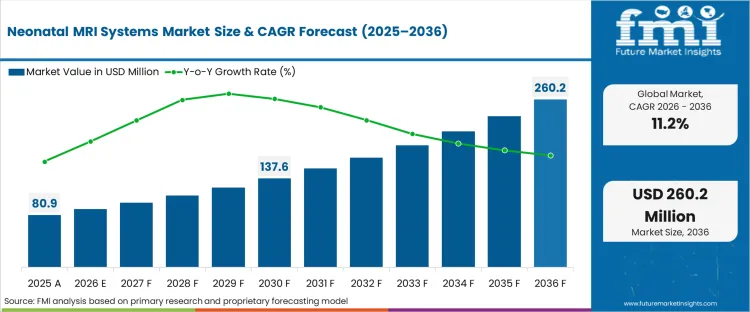
In 2026, the neonatal MRI systems market was valued at USD 90.0 million. Based on Future Market Insights analysis, demand for neonatal MRI systems is estimated to grow to USD 260.0 million by 2036. FMI projects a CAGR of 11.2% during the forecast period.
Absolute dollar growth of USD 170.0 million over the decade signals an adoption-led buildout rather than a replacement-driven cycle. As per FMI, growth is expected to be supported by wider use of MRI in neonatal brain injury and HIE assessment pathways, while capital budget constraints, site readiness, and staffing and training requirements are expected to pace deployment outside leading tertiary centers. "With portability, low infrastructure requirements, and affordability relative to conventional MRI, the Swoop system is particularly well-suited for India’s diverse healthcare landscape." said Maria Sainz, President and Chief Executive Officer of Hyperfine. [1]
Procurement behaviour is being shaped by NICU safety governance and service-backed uptime requirements, with buyers prioritising low-risk workflows, reliable monitoring compatibility, and installation fit within neonatal care environments. Multi-year service agreements are being used to stabilise uptime and response coverage, while purchasing decisions are being aligned to case volume, referral patterns, and escalation pathways into pediatric radiology.
Summary of Neonatal MRI Systems Market
- Neonatal MRI Systems Market Definition
- The industry covers MRI systems designed for neonatal imaging, including NICU-installed dedicated scanners and bedside mobile configurations used to support neonatal neuro and congenital assessment workflows.
- Demand Drivers in The Market
- NICUs are adopting MRI access to reduce transport risk and enable earlier neurological assessment in clinically fragile neonates.
- Growth in neonatal neuro monitoring is sustaining demand for systems that fit monitoring constraints and NICU workflow requirements.
- Hospitals are strengthening neonatal care pathways where imaging supports HIE assessment, IVH evaluation, and outcome tracking.
- Key Segments Analyzed in The FMI Report
- By System Type: Dedicated Neonatal MRI (NICU-installed) leads at 67% share in 2026, followed by Bedside Mobile Low-Field MRI at 33% share.
- By Application: Brain Injury and IVH leads by 44% share in 2026, followed by Congenital Anomalies at 20% share.
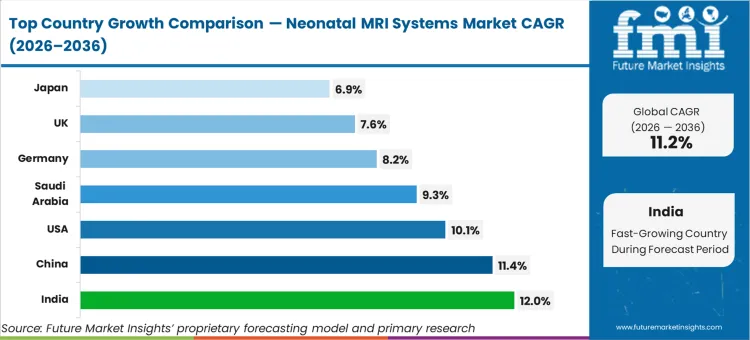
- By Geography: India and China show the fastest growth at 12.0% and 11.4% CAGR, supported by NICU expansion and rising investment in neonatal care infrastructure.
- Analyst Opinion at FMI
- Anurag Sharma, Principal Consultant at Future Market Insights, opines, ‘Adoption is being shaped by transport-risk reduction, scan completion under NICU monitoring constraints, and workflow fit inside intensive care, since neonatal imaging decisions are bounded by safety protocols and staff readiness.’
- Strategic Implications and Executive Takeaways
- Prioritize NICU-installed and bedside system deployments with training and service models built around neonatal handling protocols.
- Build clinical pathway positioning around brain injury, IVH, and congenital anomaly use cases to support protocol adoption and repeat use.
- Strengthen coverage in faster-growing markets with installation and uptime support, since downtime directly disrupts neonatal decision windows.
- Methodology
- As per FMI, sizing and splits were triangulated using company primary disclosures, installed-base mapping, and site-of-care adoption logic by system type.
- Segment shares were validated by linking application demand to NICU pathway intensity and referral patterns in neonatal neuro and congenital care.
- Sensitivity checks were run across system-type mix and application shifts to confirm revenue movement under realistic deployment scenarios.
India (12.0% CAGR, supported by expanding tertiary neonatal care capacity) and China (11.4% CAGR, driven by hospital infrastructure upgrades and higher neonatal imaging demand) are expected to lead growth. The USA (10.1% CAGR) is expected to expand through adoption in high-acuity NICUs and children’s hospital networks. Saudi Arabia (9.3% CAGR) is expected to grow through tertiary hospital investment. Mature markets including Germany (8.2%), the UK (7.6%), and Japan (6.9%) are expected to contribute more through measured expansion, constrained by capex approval cycles and conservative protocol change governance.
Neonatal MRI Systems Market Definition
The market covers MRI systems and related configurations designed or adapted for imaging newborns, with workflows tailored to NICU safety and neonatal handling needs. It includes dedicated NICU-installed neonatal MRI, bedside mobile low-field MRI systems, and retrofit incubator or coil solutions used with standard MRI scanners. Systems are purchased by NICUs, radiology departments supporting neonatal pathways, children’s hospitals, and academic or research centers to support indications such as brain injury or IVH, congenital anomalies, and HIE assessment. Demand is shaped by transport risk management, need for timely imaging, and site capability for neonatal monitoring, with revenue generated through system sales and associated service support.
Neonatal MRI Systems Market Inclusions
The report includes global and regional market sizes and a 10-year forecast for 2026 to 2036. Segment-level sizing is provided by system type, field strength, application, and end user, with country-level CAGR comparisons across key markets. Coverage includes assessment of procurement drivers such as NICU workflow integration, safety governance, service coverage, and clinical pathway adoption, alongside competitive positioning of major system providers, as per FMI analysis.
Neonatal MRI Systems Market Exclusions
The scope excludes general MRI systems sold without neonatal-specific workflows or hardware configurations, as well as neonatal ultrasound systems and CT systems used in neonatal imaging. It also omits revenue from imaging services, radiologist interpretation fees, and hospital procedure charges. Sedation drugs and neonatal monitoring devices sold independently from MRI systems are excluded. The focus remains on neonatal MRI system configurations aligned to the stated system types, field strengths, applications, and end users.
Neonatal MRI Systems Market Research Methodology
- Primary Research: Interviews were conducted with NICU directors, neonatal neurologists, pediatric radiology leads, biomedical engineering teams, and OEM commercial teams to validate workflow needs and buying criteria.
- Desk Research: Public information was reviewed from regulators, health system publications, professional societies, and company primary disclosures to benchmark neonatal imaging pathway adoption and safety requirements.
- Market-Sizing and Forecasting: A hybrid bottom -up and top-down model was applied using installed-base adoption by system type and end user, then reconciled through segmental sales of Neonatal MRI by field strength and application.
- Data Validation and Update Cycle: Outputs were checked through internal consistency screening across segment totals and country growth rates, with variance review applied prior to release.
Segmental Analysis
Neonatal MRI Systems Market Analysis by System Type
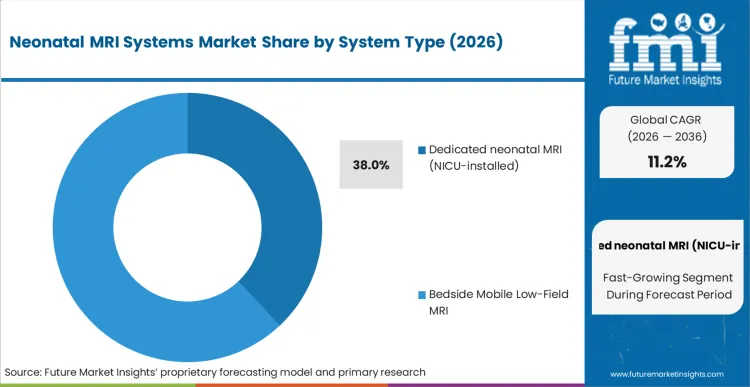
Based on FMI’s report, dedicated neonatal MRI (NICU-installed) is estimated to hold 38% share in 2026, followed by bedside mobile low-field MRI at 34% share. NICU-installed systems lead because they reduce transfers to radiology departments and enable MRI under continuous neonatal monitoring, supporting earlier imaging in unstable infants. Bedside mobile systems follow where infrastructure and construction constraints delay fixed installations, while transport avoidance remains a strong clinical driver.
- Dedicated NICU MRI Reduces Transport Risk: Studies show in-unit MRI minimizes physiological instability and adverse events associated with transporting critical neonates to radiology, making NICU-installed systems clinically preferred for unstable infants.[2]
- Continuous Monitoring Improves Safety: Technical reviews note that neonatal imaging within the NICU allows uninterrupted cardiorespiratory support and vital sign monitoring during scanning, which enhances applicability for very preterm or medically fragile babies.[3]
- Standard-of-Care Integration Supports Institutional Adoption: Dedicated NICU-installed MRI systems are increasingly embedded into tertiary neonatal centers as part of advanced neuroimaging programs, enabling routine pre-discharge brain assessment in preterm infants and structured follow-up pathways, which sustains higher capital investment and utilization rates compared with ad-hoc mobile solutions.
Neonatal MRI Systems Market Analysis by Application
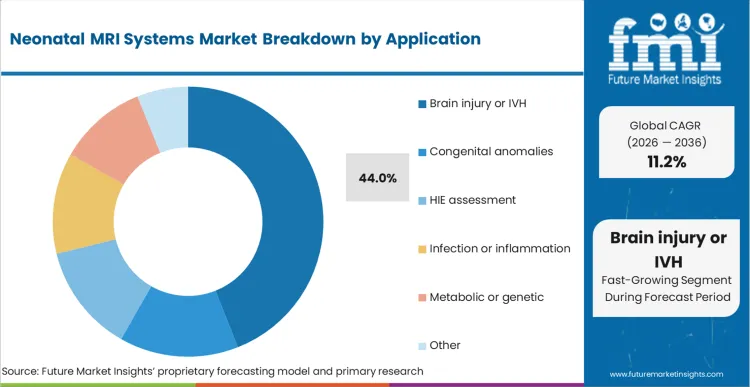
Brain injury and IVH accounts for 44% share in 2026, followed by congenital anomalies at 20%, based on FMI’s report. Brain injury and IVH lead because imaging is used early to guide management in prematurity-linked complications and neonatal encephalopathy pathways, driving repeat use where monitoring and follow-up scans are required. Congenital anomaly imaging follows through targeted referral volumes, with demand shaped by case complexity and specialist availability.
- High Prevalence in Preterm Populations Drives Routine Imaging Demand: Intraventricular hemorrhage (IVH) and hypoxic-ischemic brain injury remain among the most common neurological complications in very preterm infants, with IVH occurring in up to 20–30% of extremely low birth weight neonates, sustaining consistent imaging needs in NICUs. [4]
- Government and Clinical Guidelines Support Early Neuroimaging in Encephalopathy: Clinical guidelines for neonatal encephalopathy recommend MRI within the first week of life to assess hypoxic-ischemic injury patterns and guide prognosis, embedding brain injury imaging into standard neonatal care pathways. [5]
- Prognostic Value Supports Repeat and Longitudinal Imaging: Brain injury and IVH assessment using MRI provides critical information on neurodevelopmental prognosis, helping stratify long-term risk for motor and cognitive impairment. This drives follow-up imaging protocols and sustained utilization within neonatal neurodevelopment monitoring programs.
Neonatal MRI Systems Market Drivers, Restraints, And Opportunities
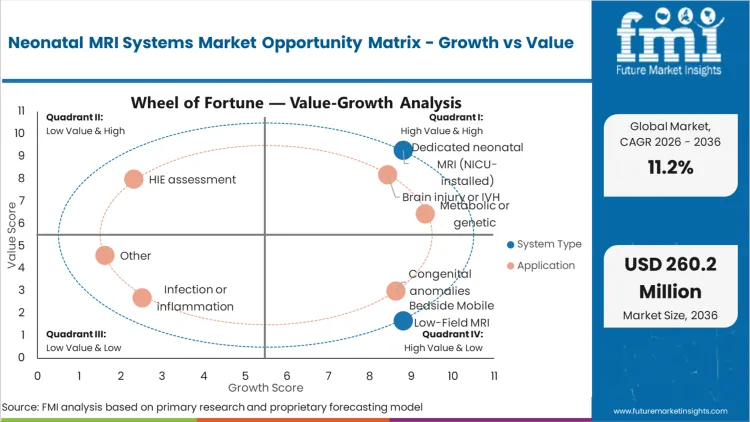
Future Market Insights analysis that historical patterns point at a care-pathway-driven imaging category where demand is anchored in neonatal neuro assessment and transport-risk reduction inside intensive care settings. Current demand is being shaped by NICU expansion and rising emphasis on earlier neurological characterization in prematurity and encephalopathy pathways, as per FMI.
While adoption is being restrained by capital budgets, staffing and training requirements, and facility readiness for neonatal-safe imaging workflows, growth is being supported by bedside and NICU-installed deployments that reduce transfer burden and shorten decision timelines. Based on FMI’s report, purchasing decisions are increasingly being filtered by workflow fit, service coverage, and safety protocol compliance rather than by scanner specifications alone.
- Workflow-Led Adoption: Growth is shifting toward systems that keep imaging within NICU pathways and reduce transport-related risk.
- Training and Capex Restraint: Limited trained teams and capital planning cycles slow deployment outside tertiary centers.
- Pathway Expansion Mechanism: Neuro monitoring programs are widening use in brain injury and IVH pathways, increasing utilization where systems are installed.
Regional Analysis
.webp "Top Country Growth Comparison Neonatal Mri Systems Market Cagr (2026 2036)")
Based on the regional analysis, neonatal MRI systems market is segmented into North America, Latin America, East Asia, South Asia & Pacific, Western Europe, Eastern Europe and Middle East & Africa across 40+ countries. Regional performance is interpreted through NICU expansion, adoption of bedside and dedicated neonatal MRI, and hospital investment in neurocritical care pathways for newborns, as per FMI. The full report also offers market attractiveness analysis based on regional trends.
| Country | CAGR |
|---|---|
| USA | 10.1% |
| Germany | 8.2% |
| UK | 7.6% |
| Japan | 6.9% |
| China | 11.4% |
| India | 12.0% |
| Saudi Arabia | 9.3% |
Source: Future Market Insights (FMI) analysis, based on proprietary forecasting model and primary research
North America Neonatal MRI Systems Market Analysis
North America is driven by NICU neuroimaging pathways and investment in safer transport alternatives, where demand is shaped by interest in bedside imaging and by adoption of dedicated neonatal MRI installed inside the NICU. Aspect Imaging (Embrace) holds strong visibility in neonatal focused MRI systems designed for NICU use. Hyperfine supports bedside imaging adoption where point-of-care access is prioritized. Siemens Healthineers and GE HealthCare remain relevant where hospitals continue to invest in conventional MRI suites and neonatal coils. FMI analysts note that NICUs remain the dominant end users, with children’s hospitals acting as reference sites.
- United States.: In the United States., neonatal MRI systems are expected to grow at 10.1% CAGR through 2036, supported by higher emphasis on neurodevelopment outcomes and growing use of imaging for brain injury and IVH assessment. Dedicated NICU installed MRI gains traction where hospitals aim to reduce transport risk for fragile neonates, while bedside mobile systems are used in settings that prioritize rapid access and workflow flexibility.
FMI’s report includes a detailed analysis of the growth in the North American region, along with a country-wise assessment that includes the USA, Canada and Mexico. Readers can also find regional trends, regulations, and market growth based on different segments and countries in the North America region.
East Asia Neonatal MRI Systems Market Analysis
East Asia is characterised by rising tertiary neonatal care capacity and broader investment in paediatric neuroimaging, with demand shaped by hospital modernization and larger birth cohorts in selected markets. Siemens Healthineers, GE HealthCare and Philips participate through conventional MRI ecosystems that support neonatal imaging with specialised coils and protocols. Emerging bedside and NICU installed solutions gain attention where transport risk reduction is a priority. FMI is of the opinion that adoption remains concentrated in high volume referral centres.
- China: China leads at 11.4% CAGR through 2036, driven by expanding NICU capacity in large urban hospitals and increased use of MRI for HIE assessment and congenital anomaly workups. Dedicated neonatal MRI interest is rising in top tier centres, while most installations remain linked to conventional MRI suites with neonatal pathways managed by radiology departments.
- Japan: Japan is expected to post 6.9% CAGR through 2036, reflecting mature hospital infrastructure and steady investment in neonatal neuroimaging protocols. Growth is supported by replacement and upgrade cycles and by preference for reliable mid field and conventional MRI setups where workflow integration is established.
FMI’s report includes a detailed analysis of the growth in the East Asia region, along with a country-wise assessment that includes China, Japan and South Korea. Readers can also find regional trends, regulations, and market growth based on different segments and countries in the East Asia region.
South Asia & Pacific Neonatal MRI Systems Market Analysis
South Asia & Pacific is a high growth build-out region, where investments in neonatal critical care and imaging infrastructure are rising from a smaller installed base. Hospitals and private provider networks expand NICU capacity and invest in diagnostic differentiation, supporting adoption of neonatal imaging pathways. FMI analysts note that adoption remains concentrated in tertiary hospitals.
- India: India is forecast at 12.0% CAGR through 2036, supported by expansion of level III NICUs and growing demand for brain injury and HIE assessment in high risk newborns. Conventional MRI remains the primary route, but interest in NICU installed or bedside systems increases in top private hospitals seeking transport risk reduction and faster access.
FMI’s report includes a detailed analysis of the growth in the South Asia & Pacific region, along with a country-wise assessment that includes India, ASEAN Countries, Australia & New Zealand and Rest of South Asia. Readers can also find regional trends, regulations, and market growth based on different segments and countries in the South Asia & Pacific region.
Western Europe Neonatal MRI Systems Market Analysis
Western Europe is a pathway driven market, where adoption depends on hospital capital budgeting and the strength of neonatal neurology pathways in children’s hospitals. Siemens Healthineers and Philips maintain strong presence through conventional MRI placements and neonatal workflow support. Bedside and NICU installed concepts are evaluated in select centres where transport avoidance and scheduling pressure in central radiology departments are material concerns. FMI is of the opinion that growth is steady, led by flagship paediatric centres.
- Germany: Germany posts 8.2% CAGR through 2036, supported by strong tertiary care capability and continued investment in paediatric imaging infrastructure. Demand is driven by brain injury and IVH evaluation, with adoption centred in children’s hospitals and academic NICUs.
- United Kingdom: The United Kingdom is projected to expand at 7.6% CAGR through 2036, shaped by children’s hospital investment cycles and rising focus on neonatal neuroimaging for HIE and congenital anomalies. Most imaging remains routed through radiology departments, while bedside solutions are explored where transport avoidance and workflow speed are prioritized.
FMI’s analysis of neonatal MRI systems market in Western Europe consists of country-wise assessment that includes Germany, UK, France, Italy, Spain, BENELUX, Nordic Countries and Rest of Western Europe. Readers can know various regulations and latest trends in the regional market.
Middle East & Africa Neonatal MRI Systems Market Analysis
Middle East & Africa is driven by flagship hospital projects and expansion of high acuity neonatal services, where adoption is concentrated in large tertiary centres with paediatric subspecialty coverage. Niche bedside systems may be adopted selectively in centres that prioritise transport risk reduction. FMI opines that uptake remains limited outside major cities.
- Saudi Arabia: Saudi Arabia is expected to rise at 9.3% CAGR through 2036, supported by investment in tertiary hospitals and growing focus on neonatal neurocritical care pathways. Conventional MRI suites remain the main access point, while NICU linked approaches gain interest in large hospitals aiming to reduce transport risk for fragile neonates.
FMI’s analysis of neonatal MRI systems market in Middle East & Africa consists of country-wise assessment that includes Saudi Arabia, Türkiye, South Africa, Other African Union and Rest of Middle East & Africa. Readers can know various regulations and latest trends in the regional market.
Competitive Aligners for Market Players
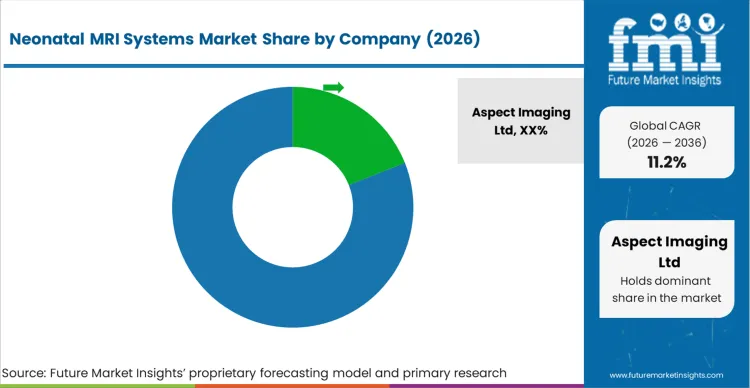
Market structure remains fragmented, yet practical competition is concentrated among a limited set of suppliers that can meet NICU-grade safety and shielding expectations, support clinical adoption with protocol and training enablement, and maintain high uptime through responsive service. Competition is shaped by clinical workflow fit and installation feasibility rather than short-cycle pricing, since procurement is tied to capital approval cycles and long equipment life. System type and field strength choices also shape rivalry because buyers balance dedicated NICU-installed systems against bedside mobile low-field options, and evaluate whether image quality, footprint, and operational burden align to neonatal pathways, as per FMI.
Companies with structural advantages tend to combine installed base credibility in MRI with strong clinical support, service reach, and the ability to integrate with hospital infrastructure and neonatal care workflows. Dedicated neonatal systems benefit where hospitals want imaging at the bedside to avoid transport risk, while retrofit incubator and coil approaches can be used where a conventional MRI suite is already in place and workflow can be managed through scheduling and transport protocols. Suppliers that can deliver standardized protocols for brain injury, IVH, and hypoxic ischemic assessment, while supporting quality assurance and staff training, are better positioned for repeat placements across children’s hospitals and larger networks. Smaller platform providers often rely on fewer reference sites, which can slow adoption in risk-sensitive NICU procurement, based on FMI’s report.
Customer concentration reinforces buyer leverage. NICUs and children’s hospitals often run structured evaluations, involve neonatology and radiology stakeholders, and maintain alternates through multi-vendor comparisons before committing capex. Procurement teams use staged rollout planning, service level clauses, and uptime guarantees to reduce dependency and manage lifecycle cost. Academic and research centers can adopt earlier for protocol development, yet they still manage supplier risk through pilot placements and performance-based acceptance. This behavior constrains pricing power for standard configurations, while measured premiums are retained mainly where bedside imaging reduces transport risk and improves workflow certainty for time-sensitive neonatal cases, Future Market Insights analysis.
Recent Developments
The report includes full coverage of key trends from competitive benchmarking. Some of the recent developments covered in the reports:
- In February 2026, Eyas Medical Imaging, Inc. has received USA Food and Drug Administration (FDA) 510(k) clearance for its Ascent3T Neonatal Magnetic Resonance Imaging (MRI) System, a whole-body magnetic resonance scanner designed and optimized specifically for neonate and infant anatomy, including head, body, and extremities. [6]
- In November 2025, Hyperfine, Inc. the groundbreaking health technology company that has redefined brain imaging with the first FDA-cleared AI-powered portable MRI system for the brain the Swoop® system announced the strengthening of the company’s initiatives to improve global brain health in underserved settings through a Gates Foundation grant of USD 3.7 million. [7]
Key Players in Neonatal MRI Systems Market
- Aspect Imaging Ltd
- Hyperfine, Inc.
- Eyas Medical Imaging, Inc.
- Time Medical International Ventures India
- Neoscan Solutions GmbH
Scope of the Report
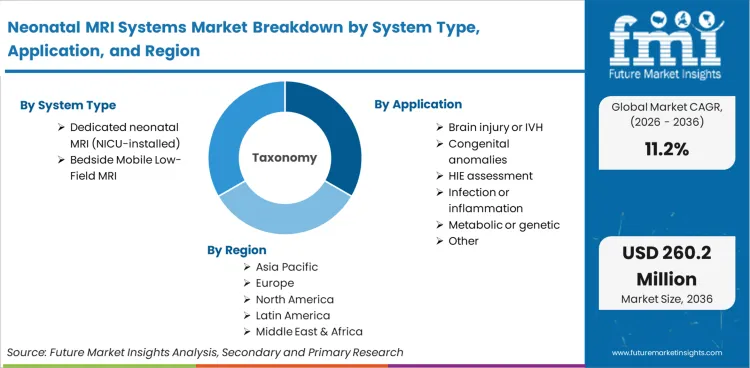
| Metric | Value |
|---|---|
| Quantitative Units | USD 90.0 Mn (2026) to USD 260.0 Mn (2036), at a CAGR of 11.2% |
| Market Definition | The neonatal MRI systems market comprises the global production and trade of MRI systems and accessories configured for neonatal and NICU-adjacent imaging, including dedicated neonatal scanners and bedside mobile low-field platforms, where demand is shaped by NICU imaging access, transport risk reduction priorities, and clinical need for early brain injury and congenital anomaly assessment. |
| System Type Segmentation | Dedicated neonatal MRI (NICU-installed), Bedside Mobile Low-Field MRI |
| Field Strength Segmentation | ≤0.1T (ultra-low field), 0.5T (mid-field), 1.5T, 3T |
| Application Coverage | Brain injury or IVH, Congenital anomalies, HIE assessment, Infection or inflammation, Metabolic or genetic, Other |
| End User Coverage | NICU, Radiology dept (neonatal pathway), Children’s hospitals, Academic or research centers |
| Regions Covered | North America, Latin America, East Asia, South Asia & Pacific, Western Europe, Eastern Europe, and Middle East & Africa. |
| Countries Covered | United States, Canada, Mexico, Brazil, Argentina, Germany, France, United Kingdom, Italy, Spain, China, India, Japan, South Korea, Indonesia, Australia and 40+ countries |
| Key Companies Profiled | Aspect Imaging Ltd, Hyperfine, Inc., Eyas Medical Imaging, Inc., Time Medical International Ventures India, Neoscan Solutions GmbH |
| Forecast Period | 2026 to 2036 |
| Approach | Hybrid top down and bottom up market modeling validated through primary interviews with NICU and radiology stakeholders and OEMs, supported by installed base triangulation and capital procurement benchmarking, as per FMI. |
Neonatal MRI Systems Market Analysis by Segments
By System
- Dedicated neonatal MRI (NICU-installed)
- Bedside Mobile Low-Field MRI
Field Strength
- ≤0.1T (ultra-low field)
- 0.5T (mid-field)
- 1.5T
- 3T
Application
- Brain injury or IVH
- Congenital anomalies
- HIE assessment
- Infection or inflammation
- Metabolic or genetic
- Other
End User
- Hospital NICU
- Radiology Units
- Ambulatory Surgical Centers
- Academic and Research Institutes
Region
- North America
- USA
- Canada
- Mexico
- Latin America
- Brazil
- Argentina
- Rest of Latin America
- East Asia
- China
- Japan
- South Korea
- South Asia & Pacific
- India
- ASEAN Countries
- Australia & New Zealand
- Rest of South Asia
- Western Europe
- Germany
- UK
- France
- Italy
- Spain
- BENELUX
- Nordic Countries
- Rest of Western Europe
- Eastern Europe
- Russia
- Hungary
- Poland
- Rest of Eastern Europe
- Middle East & Africa
- Saudi Arabia
- Türkiye
- South Africa
- Other African Union
- Rest of Middle East & Africa
Bibliography
- [1] Hyperfine, Inc. (2025). Hyperfine’s portable MRI system receives regulatory approval in India.
- [2] PubMed Central (2022). Clinical experience with an in-NICU magnetic resonance imaging system.
- [3] Radiology Key, MR Imaging of the Newborn: A Technical Perspective.
- [4] Medline Plus, Intraventricular hemorrhage of the newborn
- [5] AAP Publication (2014), Brain Injury and Altered Brain Growth in Preterm Infants: Predictors and Prognosis
- [6] Eyas Medical Imaging (2026). Eyas™ Medical Imaging Receives FDA 510(k) Clearance for the Ascent3T Neonatal Magnetic Resonance Imaging System.
- [7] Hyperfine, Inc. (2025) Hyperfine Awarded $3.7 Million Grant to Advance Global Brain Health.
This report addresses
- Market intelligence to enable structured decision making across neonatal imaging access planning and NICU pathway expansion
- Market size estimation and 10-year revenue forecasts from 2026 to 2036 for neonatal MRI system demand
- Growth opportunity mapping across system type, field strength, application, and end user demand pools
- Segment and regional revenue forecasts aligned to the stated taxonomy and covered geographies
- Competition strategy assessment including platform positioning, workflow fit, and service coverage benchmarking
- Product and compliance tracking focused on MRI safety standards, installation readiness, and documentation discipline for regulated procurement
- Regulatory impact analysis covering MR device safety expectations and clinical pathway governance affecting adoption planning
- Market report delivery in PDF, Excel, PPT, and interactive dashboard formats for executive and operational use
Frequently Asked Questions
How large is the demand for Neonatal MRI systems in the global market in 2026?
Demand for Neonatal MRI systems in the global market is estimated to be valued at USD 90.0 Million in 2026, as per FMI.
What will be the market size of Neonatal MRI systems in the global market by 2036?
Market size for Neonatal MRI systems is projected to reach USD 260.0 Million by 2036.
What is the expected demand growth for Neonatal MRI systems in the global market between 2026 and 2036?
Demand for Neonatal MRI systems in the global market is expected to grow at a CAGR of 11.2% between 2026 and 2036.
Which field strength is poised to lead global demand by 2026?
1.5T is expected to be the dominant field strength, capturing 40.0% share in 2026.
Which application is expected to account for the largest share in 2026?
Brain injury or IVH is expected to hold the highest share at 44.0% in 2026.
How significant is NICU end user demand in 2026?
NICU is projected to account for 52.0% share of end user demand in 2026.
Preview the report firsthand - request a free sample
Get SampleGet the brochure for pricing and purchase details.
Get PDFTable of Content
- Executive Summary
- Global Market Outlook
- Demand-side Trends
- Supply-side Trends
- Technology Roadmap Analysis
- Analysis and Recommendations
- Market Overview
- Market Coverage / Taxonomy
- Market Definition / Scope / Limitations
- Research Methodology
- Chapter Orientation
- Analytical Lens and Working Hypotheses
- Market Structure, Signals, and Trend Drivers
- Benchmarking and Cross-market Comparability
- Market Sizing, Forecasting, and Opportunity Mapping
- Research Design and Evidence Framework
- Desk Research Programme (Secondary Evidence)
- Company Annual and Sustainability Reports
- Peer-reviewed Journals and Academic Literature
- Corporate Websites, Product Literature, and Technical Notes
- Earnings Decks and Investor Briefings
- Statutory Filings and Regulatory Disclosures
- Technical White Papers and Standards Notes
- Trade Journals, Industry Magazines, and Analyst Briefs
- Conference Proceedings, Webinars, and Seminar Materials
- Government Statistics Portals and Public Data Releases
- Press Releases and Reputable Media Coverage
- Specialist Newsletters and Curated Briefings
- Sector Databases and Reference Repositories
- FMI Internal Proprietary Databases and Historical Market Datasets
- Subscription Datasets and Paid Sources
- Social Channels, Communities, and Digital Listening Inputs
- Additional Desk Sources
- Expert Input and Fieldwork (Primary Evidence)
- Primary Modes
- Qualitative Interviews and Expert Elicitation
- Quantitative Surveys and Structured Data Capture
- Blended Approach
- Why Primary Evidence is Used
- Field Techniques
- Interviews
- Surveys
- Focus Groups
- Observational and In-context Research
- Social and Community Interactions
- Stakeholder Universe Engaged
- C-suite Leaders
- Board Members
- Presidents and Vice Presidents
- R&D and Innovation Heads
- Technical Specialists
- Domain Subject-matter Experts
- Scientists
- Physicians and Other Healthcare Professionals
- Governance, Ethics, and Data Stewardship
- Research Ethics
- Data Integrity and Handling
- Primary Modes
- Tooling, Models, and Reference Databases
- Desk Research Programme (Secondary Evidence)
- Data Engineering and Model Build
- Data Acquisition and Ingestion
- Cleaning, Normalisation, and Verification
- Synthesis, Triangulation, and Analysis
- Quality Assurance and Audit Trail
- Market Background
- Market Dynamics
- Drivers
- Restraints
- Opportunity
- Trends
- Scenario Forecast
- Demand in Optimistic Scenario
- Demand in Likely Scenario
- Demand in Conservative Scenario
- Opportunity Map Analysis
- Product Life Cycle Analysis
- Supply Chain Analysis
- Investment Feasibility Matrix
- Value Chain Analysis
- PESTLE and Porter’s Analysis
- Regulatory Landscape
- Regional Parent Market Outlook
- Production and Consumption Statistics
- Import and Export Statistics
- Market Dynamics
- Global Market Analysis 2021 to 2025 and Forecast, 2026 to 2036
- Historical Market Size Value (USD Million) Analysis, 2021 to 2025
- Current and Future Market Size Value (USD Million) Projections, 2026 to 2036
- Y-o-Y Growth Trend Analysis
- Absolute $ Opportunity Analysis
- Global Market Pricing Analysis 2021 to 2025 and Forecast 2026 to 2036
- Global Market Analysis 2021 to 2025 and Forecast 2026 to 2036, By System Type
- Introduction / Key Findings
- Historical Market Size Value (USD Million) Analysis By System Type , 2021 to 2025
- Current and Future Market Size Value (USD Million) Analysis and Forecast By System Type , 2026 to 2036
- Dedicated neonatal MRI (NICU-installed)
- Bedside Mobile Low-Field MRI
- Dedicated neonatal MRI (NICU-installed)
- Y-o-Y Growth Trend Analysis By System Type , 2021 to 2025
- Absolute $ Opportunity Analysis By System Type , 2026 to 2036
- Global Market Analysis 2021 to 2025 and Forecast 2026 to 2036, By Application
- Introduction / Key Findings
- Historical Market Size Value (USD Million) Analysis By Application, 2021 to 2025
- Current and Future Market Size Value (USD Million) Analysis and Forecast By Application, 2026 to 2036
- Brain injury or IVH
- Congenital anomalies
- HIE assessment
- Infection or inflammation
- Metabolic or genetic
- Other
- Brain injury or IVH
- Y-o-Y Growth Trend Analysis By Application, 2021 to 2025
- Absolute $ Opportunity Analysis By Application, 2026 to 2036
- Global Market Analysis 2021 to 2025 and Forecast 2026 to 2036, By Region
- Introduction
- Historical Market Size Value (USD Million) Analysis By Region, 2021 to 2025
- Current Market Size Value (USD Million) Analysis and Forecast By Region, 2026 to 2036
- North America
- Latin America
- Western Europe
- Eastern Europe
- East Asia
- South Asia and Pacific
- Middle East & Africa
- Market Attractiveness Analysis By Region
- North America Market Analysis 2021 to 2025 and Forecast 2026 to 2036, By Country
- Historical Market Size Value (USD Million) Trend Analysis By Market Taxonomy, 2021 to 2025
- Market Size Value (USD Million) Forecast By Market Taxonomy, 2026 to 2036
- By Country
- USA
- Canada
- Mexico
- By System Type
- By Application
- By Country
- Market Attractiveness Analysis
- By Country
- By System Type
- By Application
- Key Takeaways
- Latin America Market Analysis 2021 to 2025 and Forecast 2026 to 2036, By Country
- Historical Market Size Value (USD Million) Trend Analysis By Market Taxonomy, 2021 to 2025
- Market Size Value (USD Million) Forecast By Market Taxonomy, 2026 to 2036
- By Country
- Brazil
- Chile
- Rest of Latin America
- By System Type
- By Application
- By Country
- Market Attractiveness Analysis
- By Country
- By System Type
- By Application
- Key Takeaways
- Western Europe Market Analysis 2021 to 2025 and Forecast 2026 to 2036, By Country
- Historical Market Size Value (USD Million) Trend Analysis By Market Taxonomy, 2021 to 2025
- Market Size Value (USD Million) Forecast By Market Taxonomy, 2026 to 2036
- By Country
- Germany
- UK
- Italy
- Spain
- France
- Nordic
- BENELUX
- Rest of Western Europe
- By System Type
- By Application
- By Country
- Market Attractiveness Analysis
- By Country
- By System Type
- By Application
- Key Takeaways
- Eastern Europe Market Analysis 2021 to 2025 and Forecast 2026 to 2036, By Country
- Historical Market Size Value (USD Million) Trend Analysis By Market Taxonomy, 2021 to 2025
- Market Size Value (USD Million) Forecast By Market Taxonomy, 2026 to 2036
- By Country
- Russia
- Poland
- Hungary
- Balkan & Baltic
- Rest of Eastern Europe
- By System Type
- By Application
- By Country
- Market Attractiveness Analysis
- By Country
- By System Type
- By Application
- Key Takeaways
- East Asia Market Analysis 2021 to 2025 and Forecast 2026 to 2036, By Country
- Historical Market Size Value (USD Million) Trend Analysis By Market Taxonomy, 2021 to 2025
- Market Size Value (USD Million) Forecast By Market Taxonomy, 2026 to 2036
- By Country
- China
- Japan
- South Korea
- By System Type
- By Application
- By Country
- Market Attractiveness Analysis
- By Country
- By System Type
- By Application
- Key Takeaways
- South Asia and Pacific Market Analysis 2021 to 2025 and Forecast 2026 to 2036, By Country
- Historical Market Size Value (USD Million) Trend Analysis By Market Taxonomy, 2021 to 2025
- Market Size Value (USD Million) Forecast By Market Taxonomy, 2026 to 2036
- By Country
- India
- ASEAN
- Australia & New Zealand
- Rest of South Asia and Pacific
- By System Type
- By Application
- By Country
- Market Attractiveness Analysis
- By Country
- By System Type
- By Application
- Key Takeaways
- Middle East & Africa Market Analysis 2021 to 2025 and Forecast 2026 to 2036, By Country
- Historical Market Size Value (USD Million) Trend Analysis By Market Taxonomy, 2021 to 2025
- Market Size Value (USD Million) Forecast By Market Taxonomy, 2026 to 2036
- By Country
- Kingdom of Saudi Arabia
- Other GCC Countries
- Turkiye
- South Africa
- Other African Union
- Rest of Middle East & Africa
- By System Type
- By Application
- By Country
- Market Attractiveness Analysis
- By Country
- By System Type
- By Application
- Key Takeaways
- Key Countries Market Analysis
- USA
- Pricing Analysis
- Market Share Analysis, 2025
- By System Type
- By Application
- Canada
- Pricing Analysis
- Market Share Analysis, 2025
- By System Type
- By Application
- Mexico
- Pricing Analysis
- Market Share Analysis, 2025
- By System Type
- By Application
- Brazil
- Pricing Analysis
- Market Share Analysis, 2025
- By System Type
- By Application
- Chile
- Pricing Analysis
- Market Share Analysis, 2025
- By System Type
- By Application
- Germany
- Pricing Analysis
- Market Share Analysis, 2025
- By System Type
- By Application
- UK
- Pricing Analysis
- Market Share Analysis, 2025
- By System Type
- By Application
- Italy
- Pricing Analysis
- Market Share Analysis, 2025
- By System Type
- By Application
- Spain
- Pricing Analysis
- Market Share Analysis, 2025
- By System Type
- By Application
- France
- Pricing Analysis
- Market Share Analysis, 2025
- By System Type
- By Application
- India
- Pricing Analysis
- Market Share Analysis, 2025
- By System Type
- By Application
- ASEAN
- Pricing Analysis
- Market Share Analysis, 2025
- By System Type
- By Application
- Australia & New Zealand
- Pricing Analysis
- Market Share Analysis, 2025
- By System Type
- By Application
- China
- Pricing Analysis
- Market Share Analysis, 2025
- By System Type
- By Application
- Japan
- Pricing Analysis
- Market Share Analysis, 2025
- By System Type
- By Application
- South Korea
- Pricing Analysis
- Market Share Analysis, 2025
- By System Type
- By Application
- Russia
- Pricing Analysis
- Market Share Analysis, 2025
- By System Type
- By Application
- Poland
- Pricing Analysis
- Market Share Analysis, 2025
- By System Type
- By Application
- Hungary
- Pricing Analysis
- Market Share Analysis, 2025
- By System Type
- By Application
- Kingdom of Saudi Arabia
- Pricing Analysis
- Market Share Analysis, 2025
- By System Type
- By Application
- Turkiye
- Pricing Analysis
- Market Share Analysis, 2025
- By System Type
- By Application
- South Africa
- Pricing Analysis
- Market Share Analysis, 2025
- By System Type
- By Application
- USA
- Market Structure Analysis
- Competition Dashboard
- Competition Benchmarking
- Market Share Analysis of Top Players
- By Regional
- By System Type
- By Application
- Competition Analysis
- Competition Deep Dive
- Aspect Imaging Ltd
- Overview
- Product Portfolio
- Profitability by Market Segments (Product/Age /Sales Channel/Region)
- Sales Footprint
- Strategy Overview
- Marketing Strategy
- Product Strategy
- Channel Strategy
- Hyperfine, Inc.
- Eyas Medical Imaging, Inc.
- Time Medical International Ventures India
- Neoscan Solutions GmbH
- Aspect Imaging Ltd
- Competition Deep Dive
- Assumptions & Acronyms Used


