

- Industry Size (2026)
- USD 0.5 Bn
- Forecast (2036)
- USD 2.06 Bn
- CAGR (2026 to 2036)
- 14.80%
Photon-Counting CT Scanner Technology Market Size, Market Forecast and Outlook By FMI
The photon-counting CT scanner market size was valued at USD 0.4 billion in 2025. The sector is expected to cross USD 0.5 billion in 2026 at a CAGR of 14.80% during the forecast period. Continuing financial commitments are steering the photon‑counting CT market toward a projected value of USD 2.06 billion by 2036, as advanced healthcare networks retire traditional energy‑integrating detectors to overcome long‑standing spatial‑resolution challenges in cardiovascular and oncology imaging.
Department heads are no longer deciding whether to upgrade their computed tomography fleets but rather deciding whether to skip the dual-energy generation entirely and jump straight to direct-conversion architectures. This decision rests on eliminating electronic noise at the detector level, a shift that redefines what qualifies as a diagnostic-grade scan for high-plaque coronary assessments. Delaying this transition risks marginalizing a facility'smarginalisingng cardiologists increasingly demand the precision that only the spectral photon-counting CT market can provide. The actual limitation constraining photon-counting CT adoption trends is not scanner cost, but the ability of existing hospital IT infrastructure to handle the massive data volumes these systems generate per rotation.
Summary of Photon-Counting CT Scanner Technology Market
- Photon-Counting CT Scanner Technology Market Definition
- The market covers direct-conversion computed tomography systems that measure individual x-ray photons. By eliminating the scintillator layer, these platforms remove electronic noise, offering unprecedented spatial resolution and intrinsic spectral data for advanced diagnostics.
- Demand Drivers in the Market
- The inability of legacy energy-integrating detectors to clearly visualize heavily calcified coronary arteries forces radiology departments to seek non-invasive, high-resolution alternatives.
- Intense competition among tertiary care networks obligates hospital administrators to acquire flagship diagnostic technology to attract lucrative specialist referrals.
- The high radiation burden of repeated conventional scans compels pediatric imaging directors to adopt dose-efficient direct-conversion platforms.
- Key Segments Analyzed in the FMI Report
- Whole-body photon-counting CT systems: Whole-body photon-counting CT systems are expected to hold 61.0% share in 2026, as comprehensive clinical utility justifies the massive photon-counting CT capital equipment cost required for installation.
- Cadmium telluride (CdTe): Cadmium telluride (CdTe) is projected to garner 54.0% share in 2026, driven by its established manufacturing maturity and optimal atomic number for x-ray absorption.
- Cardiovascular imaging: Cardiovascular imaging is poised to grab 28.0% share in 2026, as direct photon conversion is the only architecture capable of reliably eliminating calcium blooming artifacts.
- Academic medical centers and tertiary hospitals: Academic medical centers and tertiary hospitals are anticipated to capture 49.0% share in 2026, owing to their capacity to absorb initial premium pricing and leverage dedicated research budgets.
- India: 17.4% compound growth, as hospital networks bypass older technologies to install the latest standards during aggressive greenfield expansion.
- Analyst Opinion at FMI
- Anurag Sharma, Principal Analyst, Healthcare, at FMI, states, "Hospital procurement boards evaluating the photon-counting CT ROI for hospitals assume the primary barrier to adoption is the exorbitant hardware cost. However, the actual bottleneck is downstream IT infrastructure. These direct-conversion detectors generate data volumes that overwhelm legacy picture archiving and communication systems. The facilities successfully transitioning are those that overhaul their server architecture twelve months before the scanner even arrives."
- Strategic Implications / Executive Takeaways
- Photon-counting CT detector suppliers must scale high-yield CdTe crystal production to prevent supply chain bottlenecks as commercial system approvals multiply.
- Hospital Chief Information Officers should upgrade network bandwidth and storage arrays to avoid data throttling from ultra-high-resolution spectral imaging.
- Competing original equipment manufacturers face a shrinking window to secure regulatory clearances before early adopters lock into exclusive service contracts with the current market leader.
- Methodology
- Primary Research: Interviews with radiology chiefs and healthcare procurement officers to map capital expenditure priorities.
- Desk Research: Aggregation of regulatory clearances, clinical outcome studies, and component import records.
- Market-Sizing and Forecasting: Anchored to verifiable photon-counting CT installed base metrics and confirmed hospital expansion tenders.
- Data Validation and Update Cycle: Triangulation of manufacturer shipment reports against independent medical device registries.
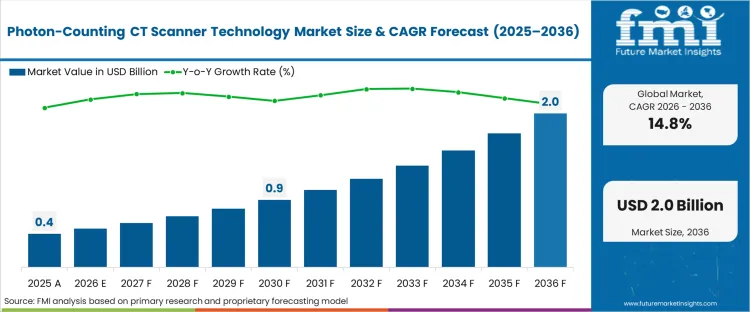
Photon-Counting CT Scanner Technology Market Key Takeaways
| Metric | Details |
|---|---|
| Industry Size (2026) | USD 0.5 billion |
| Industry Value (2036) | USD 2.06 billion |
| CAGR (2026-2036) | 14.80% |
Source: Future Market Insights (FMI) analysis, based on proprietary forecasting model and primary research
The gate for accelerated photon-counting CT commercialization timeline execution is the standardization of reimbursement codes specifically for ultra-high-resolution, spectral-ready dual and multi energy equivalents. Once clinical societies formally integrate direct-conversion detector metrics into their baseline diagnostic guidelines, the justification for purchasing legacy equipment dissolves. This shift effectively forces competing vendors to accelerate their own FDA submissions to prevent early movers from monopolizing the hospital imaging technology upgrades replacement cycle.
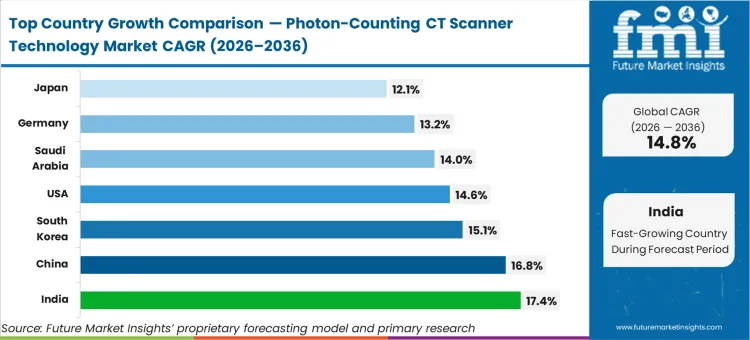
India leads with a 17.4% CAGR, as premium CT systems market fleets expand through greenfield hospital projects. China tracks closely at 16.8%, driven by aggressive domestic medical infrastructure modernization. South Korea is estimated to expand at 15.1%, while the United States photon-counting CT market is poised to register 14.6% as early commercial adoption transitions into broader clinical fleet replacements. Saudi Arabia is anticipated to advance at 14.0%. Germany and Japan are forecast to post 13.2% and 12.1% respectively, reflecting their mature, dense installed bases where demand relies entirely on cyclical hardware displacement rather than initial geographic penetration.
Photon-Counting CT Scanner Technology Market Definition
The photon-counting computed tomography market encompasses diagnostic imaging systems that utilize direct-conversion detectors, rather than traditional scintillator-based energy-integrating detectors. When addressing what is photon-counting CT, it is defined by the hardware architecture of the detector that measures individual x-ray photons and their respective energy levels, eliminating electronic noise and dramatically improving spatial resolution.
Photon-Counting CT Scanner Technology Market Inclusions
This market includes full-room clinical systems, specialized point of care ct units designed with direct-conversion capabilities, and the semiconductor materials,such as cadmium telluride and cadmium zinc telluride,that enable the technology. It also covers the proprietary image reconstruction software necessary to translate quantum-level photon data into diagnostic visuals. Integrated cooling arrays explicitly built for these specific sensor geometries fall strictly within this scope.
Photon-Counting CT Scanner Technology Market Exclusions
Standard energy-integrating diagnostic x ray system architectures and conventional dual-source CT platforms are explicitly excluded. While legacy systems offer simulated spectral capabilities, they rely on indirect conversion methods that fail to eliminate electronic noise at the fundamental level. Add-on software designed to simulate high-resolution outputs on older scintillator hardware is also excluded, as the boundary requires the physical presence of a direct-conversion detector array.
Photon-Counting CT Scanner Technology Market Research Methodology
- Primary Research: Chief of Radiology directors, hospital procurement heads, and principal investigators at translational imaging labs across tertiary care networks.
- Desk Research: FDA 510(k) clearance databases, clinical trial registries assessing photon-counting CT clinical evidence, and detector material supply chain import manifests.
- Market-Sizing and Forecasting: Baseline anchored to verifiable installations of premium tier diagnostic systems across the top 500 global healthcare institutions.
- Data Validation and Update Cycle: Equipment lifecycle replacement modeling cross-validated against public procurement tenders in single-payer healthcare systems.
Segmental Analysis
Photon-Counting CT Scanner Technology Market Analysis by Technology Type
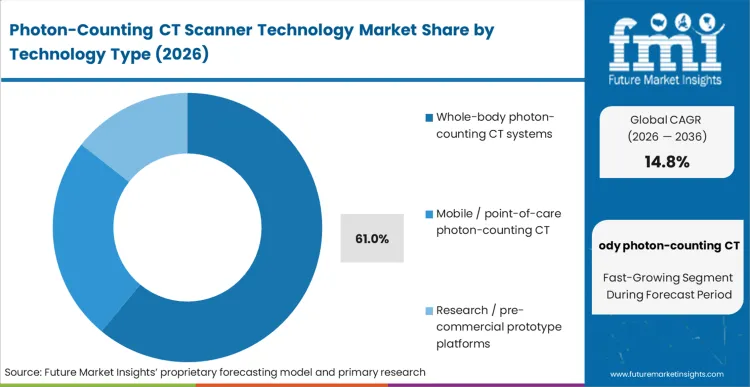
Traditional energy-integrating detectors fail to isolate material signatures without complex dual-source configurations, a key limitation that whole-body systems bypass entirely. This advantage explains why whole-body photon-counting CT systems secure a dominant 61.0% share in 2026. According to FMI's estimates, facility directors are willing to absorb the premium cost of these overarching platforms because they consolidate multiple specialized scan types into a single machine, maximizing photon-counting CT workflow benefits. Rather than maintaining separate hardware for spectral and high-resolution needs, comprehensive mobile computed tomography layouts and dedicated suites are being evaluated against the overarching capability of direct-conversion arrays. When a hospital commits to this architecture, it alters patient throughput economics, reducing the need for follow-up scans and lowering overall radiation burdens. Procurement teams who compromise on limited-field-of-view prototypes face severe utilization bottlenecks as clinical demand for high-resolution cardiovascular scans outpaces niche system capabilities.
- Broad clinical utility: Whole-body gantries accommodate diverse patient sizes and complex emergency presentations. Radiology directors use this versatility to justify the massive return on investment across neurology, oncology, and cardiology departments.
- Diagnostic validation: The ability to retrospectively extract spectral data from a standard protocol scan confirms the system's value during clinical qualification. This reassures hospital administrators that the technology improves diagnostic confidence without slowing daily throughput.
- Workflow integration: Standardizing a single high-end platform reduces technologist training variability. Institutional buyers renew service contracts and expand fleet installations because the operational predictability offsets the initial capital anxiety.
Photon-Counting CT Scanner Technology Market Analysis by Detector Material
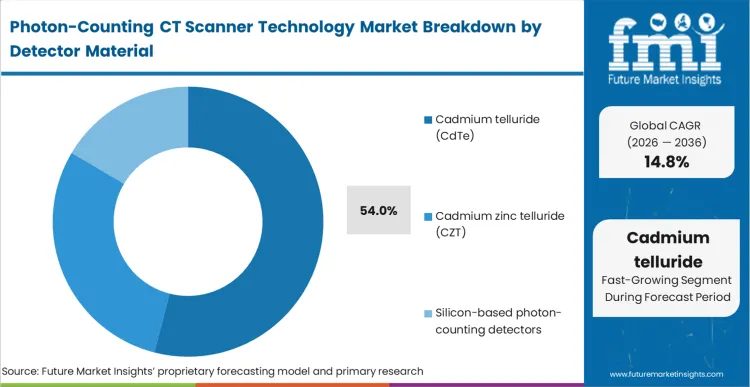
Cadmium telluride (CdTe) commands a 54.0% share in 2026 as it represents the only semiconductor material currently capable of sustaining high flux rates at commercial manufacturing scales. FMI analysts estimate that while silicon-based alternatives exist, they require impractically deep sensor arrays to absorb high-energy x-rays, making CdTe the prerequisite for clinical-grade ct guided biopsy and advanced diagnostics. The atomic number of cadmium and tellurium provides the precise stopping power needed to capture photons efficiently without excessive scatter. As photon-counting CT companies scale production, the yield rates of these difficult-to-grow crystals dictate the broader market's expansion pace. Vendors unable to secure reliable, high-purity CdTe or CZT supply chains face multi-year launch delays, forcing them to cede early-adopter market share to incumbents with vertically integrated detector manufacturing capabilities.
- Crystal yield optimization: Growing defect-free CdTe boules is a notoriously low-yield process that dominates the detector's bill of materials. Procurement officers indirectly pay for this complexity, which establishes a high price floor for the final clinical system.
- Cooling infrastructure: These direct-conversion sensors require active thermal stabilization to prevent dark current noise. The energy consumption and maintenance of specialized cooling arrays create hidden operational costs that facilities must model over the hardware's decade-long lifespan.
- Lifecycle durability: The sensor material degrades under continuous high-energy radiation bombardment. A total lifecycle comparison reveals that the cost of detector array replacement contracts heavily influences which vendor a hospital selects for long-term partnership.
Photon-Counting CT Scanner Technology Market Analysis by Clinical Application
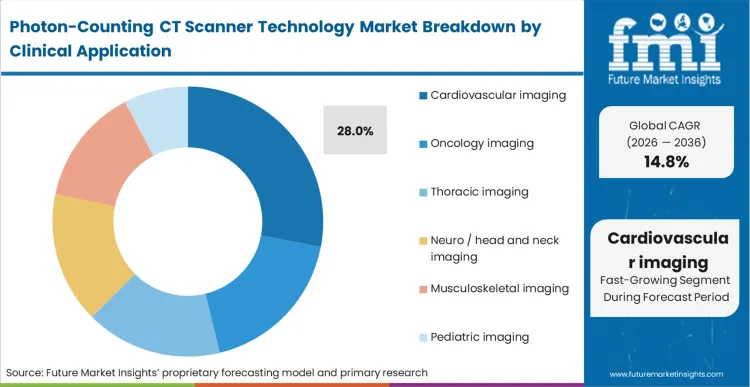
Cardiology department heads evaluating photon-counting CT for cardiac imaging are currently deciding whether to continue referring heavily calcified patients to invasive angiography or invest in non-invasive imaging that actually sees through the plaque. This exact decision propels cardiovascular imaging to a 28.0% share in 2026. As per FMI's projection, the intrinsic spatial resolution of direct photon conversion eliminates the calcium blooming artifacts that render standard non contrast ct inconclusive for complex coronary artery disease. By separating photons by energy level, the system digitally subtracts the calcium, leaving a clear view of the vessel lumen. This capability shifts the diagnostic pathway, allowing outpatient centers to confidently rule out stenoses without hospital admission. Delaying the adoption of these systems means cardiovascular practices will continue to accept a high rate of non-diagnostic scans, ultimately losing patient referrals to better-equipped regional competitors.
- Blooming artifact suppression: Direct conversion eliminates the spatial blurring inherent in scintillator flashes. Cardiologists avoid the dangerous failure mode of overestimating stenosis severity, preventing unnecessary invasive catheterizations.
- Motion artifact vulnerability: Even with exceptional spatial resolution, these systems remain sensitive to rapid or irregular heart rates. The residual risk requires clinical teams to maintain rigorous patient preparation and beta-blocker protocols to guarantee diagnostic image quality.
- Data extraction mastery: The raw spectral data is useless if not properly reconstructed. Radiologists must operationally master advanced post-processing software to fully realize the iodine mapping and virtual non-contrast benefits these applications promise.
Photon-Counting CT Scanner Technology Market Analysis by End User
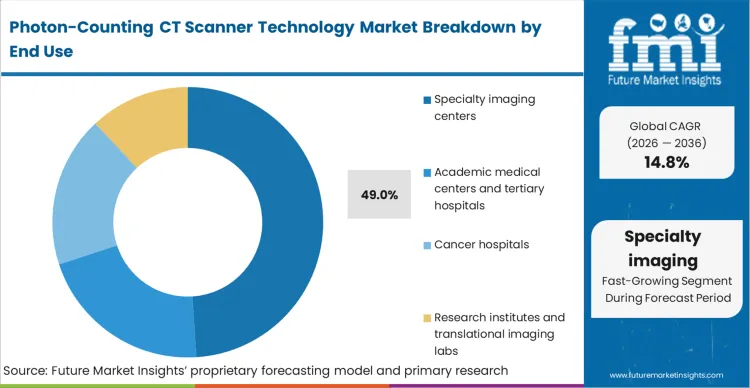
Hospitals that cannot provide definitive tumor characterization in a single visit using photon-counting CT for oncology imaging face leaking their most profitable oncology referrals to specialised regional hubs. This commercial consequence explains why academic medical centers and tertiary hospitals account for 49.0% of the market in 2026. Based on FMI's assessment, these massive institutions are the only entities currently equipped with the capital budget and the complex IT backbone required to integrate ct guided intervention suites powered by photon-counting arrays. They act as the proving ground, establishing the clinical protocols that will eventually trickle down to community settings. By installing these systems, tertiary centres reshape local healthcare dynamics, effectively setting a new standard of care that independent imaging centers struggle to match. Administrators who defer this upgrade find their research grant applications weakened and their ability to recruit top-tier radiology talent severely compromised.
- Research-driven pioneers: Academic centers absorb the initial hardware expense using specialized research endowments and capital campaigns. They adopt first because their core mission requires publishing data on novel spectral imaging techniques.
- Tertiary network followers: Major hospital networks follow once the photon-counting CT reimbursement outlook stabilizes. Their operations shift from experimental protocols to high-throughput clinical workflows that leverage the system's rapid scan times.
- Specialty imaging centers: Independent diagnostic facilities convert last, waiting for secondary market availability or lower-tier commercial models. They finally upgrade when referring physicians begin explicitly writing orders that mandate direct-conversion image quality.
Photon-Counting CT Scanner Technology Market Drivers, Restraints, and Opportunities
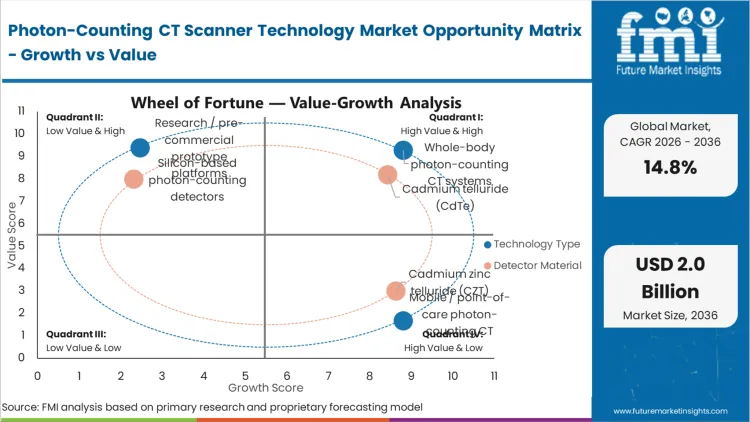
The necessity to extract diagnostic certainty from patients with challenging physiological presentations forces chief medical officers to reconsider their entire radiology fleet strategy. Traditional x ray device physics cannot overcome the noise floor inherent to scintillator-based detectors, leaving obese patients and those with heavy coronary calcification with inconclusive results. This pressure compels procurement teams to qualify direct-conversion technology not as an iterative upgrade, but as a mandatory capability for complex diagnostic pathways. Failing to secure these systems means accepting a high rate of repeat scans, increasing radiation exposure, and degrading the commercial efficiency of the radiology department.
When analyzing the photon-counting CT challenges and limitations, the single biggest operational friction slowing global adoption is the immense data payload generated by direct-conversion digital radiography sensor equivalents inside the CT gantry. A routine spectral scan produces gigabytes of raw data, choking standard hospital networks and rapidly exhausting local server storage. This is a barrier because it requires a parallel, highly expensive IT infrastructure overhaul alongside the scanner purchase. While cloud-based reconstruction algorithms are emerging as a partial solution, their reliance on continuous, massive bandwidth limits their utility in hospitals with older networking backbones.
Opportunities in the Photon-Counting CT Scanner Technology Market
- Pediatric dose reduction: The exceptional dose efficiency of photon-counting detectors eliminates the noise penalty at low radiation levels. Pediatric hospitals can capture this opportunity by marketing ultra-low-dose scanning protocols, reassuring parents and dominating regional pediatric referrals.
- Contrast media optimization: The inherent spectral sensitivity of CdTe detectors amplifies the signal of iodine at lower concentrations. Procurement directors can leverage this to reduce contrast media volume per patient, cutting pharmacy costs and mitigating risks for renally impaired demographics.
- Multi-omics data integration: The clean, high-resolution datasets generated provide an ideal foundation for advanced artificial intelligence analysis. Translational research labs build proprietary radiomic models on this data, securing exclusive pharmaceutical partnerships for oncology drug trials.
Regional Analysis
Based on the regional analysis, the Photon-Counting CT Scanner Technology Market is segmented into North America, Europe, Asia Pacific, and Middle East & Africa across 40 plus countries.
.webp "Top Country Growth Comparison Photon Counting Ct Scanner Technology Market Cagr (2026 2036)")
| Country | CAGR (2026 to 2036) |
|---|---|
| India | 17.4% |
| China | 16.8% |
| South Korea | 15.1% |
| United States | 14.6% |
| Saudi Arabia | 14.0% |
| Germany | 13.2% |
| Japan | 12.1% |
Source: Future Market Insights (FMI) analysis, based on proprietary forecasting model and primary research
North America Photon-Counting CT Scanner Technology Market Analysis
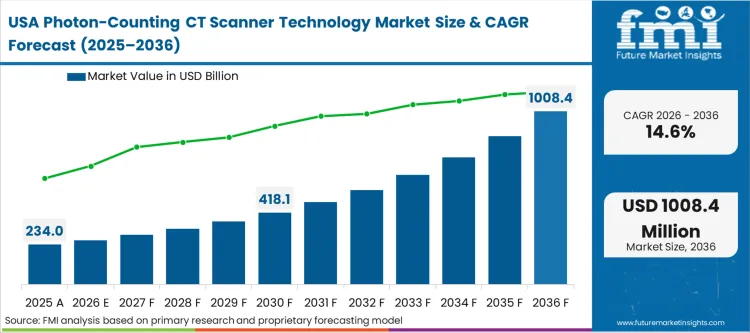
The aggressive pursuit of early commercial adoption in North America is shaped heavily by FDA clearance pathways and the competitive density of premier healthcare networks. In FMI's view, the regulatory validation of specific direct-conversion architectures has opened the floodgates for academic centers to leverage these systems as primary marketing tools for cardiovascular excellence. The environment is not defined by government mandates, but by the relentless pressure to secure advantageous reimbursement rates for high-complexity spectral imaging. This dynamic forces rival hospital systems to rapidly match the technological capabilities of their regional peers or risk losing lucrative outpatient diagnostic volumes to centers equipped with micro ct scanners and full-room equivalents.
- United States: The United States photon-counting CT market is poised for a CAGR of 14.6%. The presence of an already established clinical base from early Siemens installations forces competing vendors to aggressively fast-track their own FDA submissions. American hospital administrators face intense pressure to acquire this technology to maintain their status in national hospital rankings. Early adopters in this landscape capture a distinct commercial opportunity, locking in lucrative specialist referrals from cardiology practices before local competitors can secure the necessary capital approval.
Asia Pacific Photon-Counting CT Scanner Technology Market Analysis
Across the Asia Pacific, the trajectory of premium medical imaging is dictated by the ongoing transition from legacy analog infrastructure to state-of-the-art digital hospital networks. Rather than incrementally upgrading existing fleets, newly constructed healthcare cities are skipping an entire generation of flat panel detectors to install direct-conversion systems as baseline architecture. According to FMI's estimates, this leapfrogging behavior is concentrated in areas where government-backed infrastructure funds intersect with a rapidly expanding middle class demanding premier diagnostic services.
- India: The India photon-counting CT market premium imaging fleets are still deepening, allowing vendors to target massive greenfield replacement opportunities in tier-1 city corporate hospital chains. The market for photon-counting systems in India is forecast to register a CAGR of 17.4%. Beneath this rapid growth lies a practitioner reality: radiologists in these high-volume centers are utilizing the technology to drastically reduce scan times, compensating for severe patient overloads that would otherwise crash a conventional radiology department schedule.
- China: The aggressive centralization of complex diagnostics into mega-hospitals creates an imperative for ultra-high-throughput, high-resolution scanners. China photon-counting CT market is expected to see its sector grow at a compound annual rate of 16.8%. This momentum establishes a clear trajectory, shifting the domestic procurement standard so completely that local original equipment manufacturers are now forced to develop indigenous direct-conversion detectors to remain relevant in state-sponsored tenders.
- South Korea: Over the forecast period, photon-counting technology in South Korea is set for a CAGR of 15.1%. A fiercely competitive private healthcare sector drives South Korean hospitals to aggressively adopt the latest medical technologies to attract premium health tourism. Facilities that rapidly integrate these advanced imaging modalities capture a significant commercial opportunity, drawing high-margin oncology and cardiovascular patients from across the broader Asian region.
- Japan: Japan landscape is set to achieve a CAGR of 12.1%, as the country already operates one of the densest CT infrastructures globally, which shifts the domestic dynamic away from first-time penetration and entirely toward cyclical hardware displacement. For hospital operations directors, adopting photon-counting architecture results in a profound operational outcome, allowing them to consolidate multiple specialised imaging rooms into a single, hyper-efficient diagnostic suite that maximises limited urban floor space.
Europe and Middle East Photon-Counting CT Scanner Technology Market Analysis
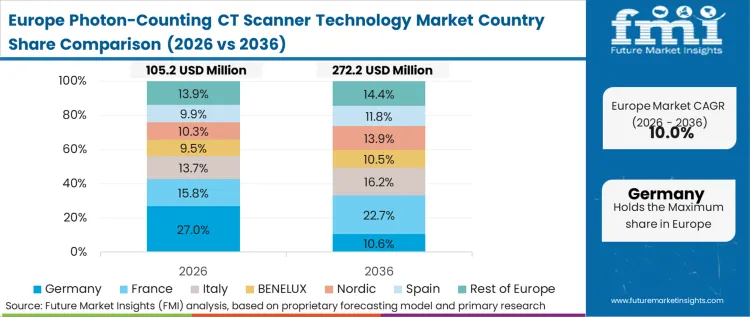
In European and Middle Eastern markets, adoption is heavily influenced by centralized healthcare budgeting and state-driven modernization initiatives. FMI analysts suggests that single-payer systems carefully weigh the exorbitant upfront capital cost of digital x ray equivalents against the long-term economic benefits of reduced downstream hospitalizations. When national health technology assessment bodies validate the cost-efficiency of avoiding unnecessary angiograms, bulk procurement tenders are triggered, rapidly altering the technological landscape of entire regions.
- Germany: The German market relies on meticulous health economic evaluations before approving widespread clinical rollout across its dense, mature installed base. A CAGR of 13.2% is expected for photon-counting systems in Germany over the forecast period. This rigorous qualification process creates powerful competitive positioning; German research institutions that master spectral data extraction set the clinical protocols that the rest of the European Union eventually adopts.
- Saudi Arabia: Demand for advanced imaging in Saudi Arabia is estimated to expand at a CAGR of 14.0%. Massive sovereign wealth investments under national vision programs are directly funding the acquisition of cutting-edge diagnostic equipment for newly built specialty hospitals. For the newly appointed radiology chiefs in these facilities, the operational outcome is immediate: they bypass the legacy learning curve entirely and instantly establish world-class diagnostic workflows capable of handling complex oncology cases domestically.
FMI's report includes extensive modeling of emerging economies in Latin America and Southeast Asia. These secondary markets demonstrate a delayed adoption curve, heavily dependent on the eventual availability of refurbished systems or the introduction of scaled-down image guided systems powered by tier-two manufacturers.
Competitive Aligners for Market Players
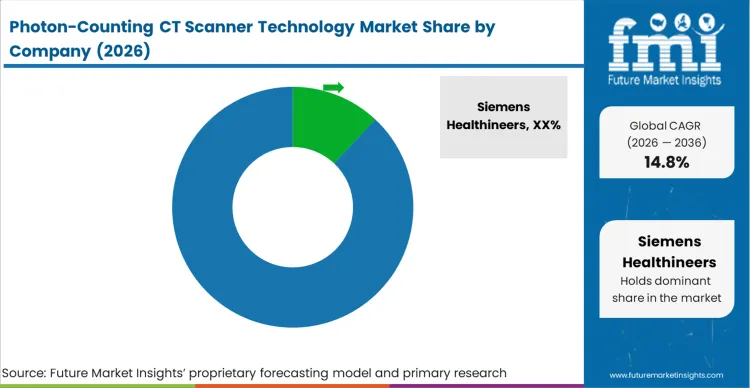
The market's extreme concentration stems directly from the immense capital and proprietary material science required to manufacture clinical-grade direct-conversion sensors. Buyers evaluating photon-counting CT scanner suppliers do not select vendors based on minor software features; they qualify partners based on proven detector stability and FDA clearance status. Companies such as the Philips spectral photon counting CT are actively racing to validate their own proprietary architectures. Procurement committees use established regulatory clearance as the absolute threshold, immediately disqualifying any vendor unable to provide verifiable, large-scale clinical trial data supporting their specific sensor geometry.
Incumbents hold a distinct advantage rooted in their vertical integration of detector material supply chains. Companies like Siemens, through strategic acquisitions and internal development, control the complex, low-yield growth processes for CdTe crystals. Challengers must build or acquire equivalent material science capabilities to ensure they are not bottlenecked by third-party sensor shortages. Integrating imaging markers and advanced reconstruction software is secondary; if a vendor cannot guarantee the long-term supply and replacement of the physical detector array, large hospital networks will refuse to commit to a ten-year service agreement.
Reviewing photon-counting CT scanner technology trends 2026 and looking toward 2036, the tension between hospital IT limitations and vendor data generation will define competitive trajectories. Large buying networks fiercely resist being locked into proprietary, closed-ecosystem post-processing software that forces them to buy expensive server upgrades directly from the scanner manufacturer. The market will become slightly less concentrated as new entrants like Shanghai United Imaging Healthcare introduce alternative sensor technologies and open-architecture data handling. Vendors who successfully decouple their high-resolution image reconstruction from proprietary server requirements will systematically dismantle the incumbent's current dominance in tertiary hospital renewals.
Key Players in Photon-Counting CT Scanner Technology Market
- Siemens Healthineers
- Canon Medical Systems
- NeuroLogica (Samsung Electronics)
- GE HealthCare
- Philips
- Redlen Technologies
- Shanghai United Imaging Healthcare
Scope of the Report
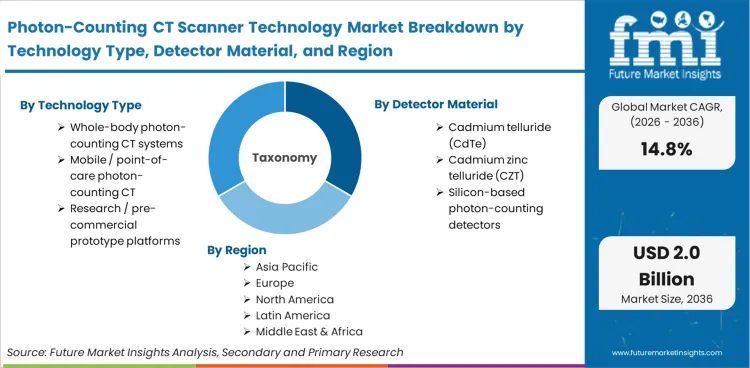
| Metric | Value |
|---|---|
| Quantitative Units | USD 0.5 billion to USD 2.06 billion, at a CAGR of 14.80% |
| Market Definition | The market encompasses diagnostic imaging systems utilizing direct-conversion detectors to measure individual x-ray photons and energy levels, eliminating electronic noise for unprecedented spatial resolution. |
| Technology Type Segmentation | Whole-body photon-counting CT systems, Mobile / point-of-care photon-counting CT, Research / pre-commercial prototype platforms |
| Detector Material Segmentation | Cadmium telluride (CdTe), Cadmium zinc telluride (CZT), Silicon-based photon-counting detectors |
| Clinical Application Segmentation | Cardiovascular imaging, Oncology imaging, Thoracic imaging, Neuro / head and neck imaging, Musculoskeletal imaging, Pediatric imaging |
| End User Segmentation | Academic medical centers and tertiary hospitals, Specialty imaging centers, Cancer hospitals, Research institutes and translational imaging labs |
| Regions Covered | North America, Europe, Asia Pacific, Middle East & Africa |
| Countries Covered | United States, Germany, Japan, China, India, South Korea, Saudi Arabia, and 40 plus countries |
| Key Companies Profiled | Siemens Healthineers, Canon Medical Systems, NeuroLogica (Samsung Electronics), GE HealthCare, Philips, Redlen Technologies, Shanghai United Imaging Healthcare |
| Forecast Period | 2026 to 2036 |
| Approach | Primary research engaged hospital procurement heads and radiology chiefs to determine capital expenditure timelines. The baseline was anchored to verifiable installations of premium tier systems across major medical networks. Forecasts were cross-validated using public tender records and regulatory clearance databases. |
Source: Future Market Insights (FMI) analysis, based on proprietary forecasting model and primary research
Photon-Counting CT Scanner Technology Market Analysis by Segments
Technology Type:
- Whole-body photon-counting CT systems
- Mobile / point-of-care photon-counting CT
- Research / pre-commercial prototype platforms
Detector Material:
- Cadmium telluride (CdTe)
- Cadmium zinc telluride (CZT)
- Silicon-based photon-counting detectors
Clinical Application:
- Cardiovascular imaging
- Oncology imaging
- Thoracic imaging
- Neuro / head and neck imaging
- Musculoskeletal imaging
- Pediatric imaging
End User:
- Academic medical centers and tertiary hospitals
- Specialty imaging centers
- Cancer hospitals
- Research institutes and translational imaging labs
Region:
- North America
- United States
- Canada
- Europe
- Germany
- United Kingdom
- France
- Italy
- Spain
- Asia Pacific
- China
- Japan
- South Korea
- Taiwan
- Singapore
- Latin America
- Brazil
- Mexico
- Argentina
- Middle East & Africa
- GCC Countries
- South Africa
Bibliography
- Food and Drug Administration. (2025, February 12). K243523: NAEOTOM CT scanner systems.
- Siemens Healthineers. (2025, March 10). Siemens Healthineers receives FDA clearance for Naeotom Alpha class of photon-counting computed tomography scanners.
- Koninklijke Philips N.V. (2026, February 10). Diagnosis & Treatment [Investor presentation].
- van der Bie, J., van der Laan, T., van Straten, M., Booij, R., Bos, D., Dijkshoorn, M. L., Hirsch, A., Oei, E. H. G., & Budde, R. P. J. (2025). Photon-counting CT: An updated review of clinical results. European Journal of Radiology, 188, 112189.
- Hagen, F., Soschynski, M., Weis, M., Grunz, J.-P., Menges, A.-L., Flohr, T., Alkadhi, H., Schmidt, B., & Euler, A. (2024). Photon-counting computed tomography - clinical application in oncological, cardiovascular, and pediatric radiology. RoFo, 196(1), 25-35.
- Onishi, H., Okamura, Y., Kawaguchi, S., De Smet, E., & Jinzaki, M. (2024). Photon-counting CT: technical features and clinical impact in abdominal imaging. Abdominal Radiology.
This bibliography is provided for reader reference. The full FMI report contains the complete reference list with primary source documentation.
This Report Addresses
- Market intelligence to support strategic decision making across direct-conversion detectors and specialized reconstruction software categories
- Market size estimation and 10-year revenue forecasts from 2026 to 2036, supported by equipment lifecycle replacement modeling cross-validated against public procurement tenders
- Growth opportunity mapping across detector materials and clinical applications with emphasis on the standardization of reimbursement codes for spectral-ready equivalents
- Segment and regional revenue forecasts covering whole-body systems and cardiovascular imaging across highly centralized single-payer health networks
- Competition strategy assessment including vertical integration of CdTe supply chains and open-architecture data handling
- Technology development tracking including direct-conversion sensors, active thermal stabilization, and multi-omics data integration capabilities
- Market access analysis covering FDA 510(k) clearances and national health technology assessment validations
- Market report delivery in PDF, Excel, PPT, and interactive dashboard formats for executive strategy, hospital IT network planning, and operational benchmarking use
Frequently Asked Questions
How big is the photon-counting CT scanner technology market in 2026?
The market size reaches USD 0.5 billion in 2026. This figure indicates the initial wave of tertiary hospital installations as institutions secure the capital required to replace their legacy imaging suites.
What will it be valued at by 2036?
The valuation expands to USD 2.06 billion by 2036. This growth trajectory reflects the inevitable transition from early academic adoption to widespread clinical standard-of-care as interventional radiology demands higher resolution.
What CAGR is projected?
A compound annual growth rate of 14.80% is anticipated over the decade. This rate is heavily dictated by the manufacturing scale-up of CdTe detector crystals rather than pure clinical demand, which already outpaces supply.
What is photon-counting CT and why is it different from conventional CT?
Conventional CT utilizes energy-integrating detectors that first convert x-rays to light, creating electronic noise that blurs fine details. Photon-counting CT uses semiconductor detectors to measure individual x-ray photons directly, eliminating this intermediate step to deliver unprecedented spatial resolution and intrinsic spectral data.
How is photon-counting CT different from conventional CT operationally?
Operationally, it requires facilities to manage exponentially larger raw datasets per scan. While the patient experience remains similar with faster scan times, the IT backend must be entirely overhauled to handle gigabytes of data generated by a single direct-conversion rotation.
How does photon-counting CT compare with dual-energy CT?
When analyzing photon-counting CT vs dual-energy CT, dual-energy systems rely on two different x-ray tube voltages (or rapid switching) to capture material signatures, which still suffers from scintillator noise. Photon-counting architectures inherently capture spectral data across multiple energy bins simultaneously from a single x-ray source, removing spatial misalignment and drastically improving image sharpness.
Which companies are leading the photon-counting CT scanner market?
The market is highly concentrated, led by Siemens Healthineers, which holds a commanding 57.0% share. To answer which companies make photon-counting CT scanners looking forward: Canon Medical Systems, NeuroLogica, GE HealthCare, Philips, and Shanghai United Imaging Healthcare are all aggressively developing competitive platforms.
Why is Siemens ahead in photon-counting CT commercialization?
Siemens secured a massive first-mover advantage by successfully clearing the FDA regulatory pathway early with its Naeotom Alpha system. Their dominance is maintained by their vertical integration and control over the complex, low-yield manufacturing supply chain for cadmium telluride (CdTe) detector crystals.
Does photon-counting CT reduce radiation dose?
Yes, the direct-conversion architecture inherently filters out electronic background noise, meaning the system requires far fewer x-ray photons to generate a diagnostic-quality image. This exceptional dose efficiency allows radiologists to run ultra-low-dose protocols, making it highly advantageous for pediatric and routine screening applications.
Which countries are adopting photon-counting CT the fastest?
India and China are adopting the technology fastest, tracking at 17.4% and 16.8% CAGRs respectively. These markets are bypassing incremental upgrades, installing direct-conversion systems as baseline architecture during the rapid construction of massive, greenfield corporate hospital networks.
What are the main barriers to hospital adoption?
The primary barrier is not the upfront capital cost of the scanner itself, but the massive IT infrastructure overhaul required to support it. The gigabytes of raw spectral data generated by these systems quickly overwhelm legacy picture archiving and communication system (PACS) networks, forcing costly server and bandwidth upgrades.
How should buyers evaluate ROI for a photon-counting CT system?
Buyers should calculate ROI based on patient throughput consolidation and the elimination of downstream invasive procedures. Because the system's high resolution prevents inconclusive scans in heavily calcified patients, facilities avoid the cost of repeat imaging and secure highly profitable, complex referrals from specialized cardiology and oncology practices.
What applications benefit most from photon-counting CT today?
Cardiovascular and oncology imaging benefit immediately due to the technology's ability to digitally subtract calcium blooming artifacts and precisely map iodine uptake. This allows clinicians to clearly visualize stent lumens and characterize minute tumor variations without requiring overlapping single photon emission scans.
Which Technology Type segment leads?
Whole-body photon-counting CT systems dominate with a 61.0% share. Hospital administrators approve these comprehensive systems over niche prototypes because they can absorb the caseloads of multiple departments, maximizing daily utilization rates.
Which Detector Material segment leads?
Cadmium telluride (CdTe) captures 54.0% of the market. It remains the only semiconductor material that manufacturers can produce at the commercial yields necessary to fulfill global original equipment manufacturer backorders.
What drives rapid growth?
The inability of older scintillator technology to overcome the noise floor forces an upgrade. When hospitals cannot provide definitive oncology or cardiology reads without structured reporting automation delays, they risk losing highly profitable referrals to better-equipped regional hubs.
What is the primary restraint?
The massive data volumes generated per scan cripple existing hospital server infrastructure. Facilities cannot deploy these scanners effectively unless they simultaneously undertake multimillion-dollar overhauls of their storage and networking backbones.
How does the standardization of reimbursement codes impact adoption?
When clinical societies establish specific billing codes for ultra-high-resolution spectral imaging, it creates a direct revenue stream that offsets the hardware cost. Without these codes, facilities must bill photon-counting scans at standard rates, severely extending the capital break-even timeline.
Why is the transition to direct-conversion sensors a shift rather than an iterative upgrade?
Scintillator detectors require an intermediate step of turning x-rays into light, which inherently scatters and blurs the image. Direct conversion measures the photon directly, removing the physical limitation of electronic noise entirely, which alters what a positron emission tomography equivalent or CT can visualize.
What makes the United States a critical market for early commercialization?
The USA healthcare landscape is defined by intense competition between private tertiary networks striving for top national rankings. These institutions weaponize FDA-cleared flagship technology to attract premier specialists and secure exclusive regional cardiovascular referrals.
Why is Japan's growth rate slightly lower despite its advanced healthcare system?
Japan already operates one of the highest densities of CT scanners per capita in the world. Consequently, demand is entirely reliant on the natural cyclical retirement of existing hardware, rather than the rapid expansion of new imaging centers seen in developing regions.
How are tertiary networks utilizing these systems to consolidate their market position?
By installing photon-counting CT vs spectral CT capable arrays, academic centers create a diagnostic standard that smaller community hospitals simply cannot match. This forces complex cases into the tertiary network, ensuring the larger institution controls the downstream surgical and oncology revenues.
What hidden costs emerge in the operational phase of running these advanced scanners?
Beyond the initial purchase, facilities must budget for the continuous active thermal stabilization required by the detector arrays. The energy consumption and routine replacement of these specialized cooling components add significant overhead over the system's ten-year lifespan.
How does the atomic number of CdTe influence the detector's operational efficacy?
The high atomic number provides exceptional stopping power, allowing the sensor to efficiently capture high-energy x-ray photons in a very thin layer of material. This thinness is crucial for maintaining spatial resolution without the signal bleeding into adjacent pixels.
Preview the report firsthand - request a free sample
Get SampleGet the brochure for pricing and purchase details.
Get PDFTable of Content
- Executive Summary
- Global Market Outlook
- Demand-side Trends
- Supply-side Trends
- Technology Roadmap Analysis
- Analysis and Recommendations
- Market Overview
- Market Coverage / Taxonomy
- Market Definition / Scope / Limitations
- Research Methodology
- Chapter Orientation
- Analytical Lens and Working Hypotheses
- Market Structure, Signals, and Trend Drivers
- Benchmarking and Cross-market Comparability
- Desk Research Programme (Secondary Evidence)
- Company Annual and Sustainability Reports
- Peer-reviewed Journals and Academic Literature
- Corporate Websites, Product Literature, and Technical Notes
- Earnings Decks and Investor Briefings
- Statutory Filings and Regulatory Disclosures
- Technical White Papers and Standards Notes
- Trade Journals, Industry Magazines, and Analyst Briefs
- Conference Proceedings, Webinars, and Seminar Materials
- Government Statistics Portals and Public Data Releases
- Press Releases and Reputable Media Coverage
- Specialist Newsletters and Curated Briefings
- Sector Databases and Reference Repositories
- FMI Internal Proprietary Databases and Historical Market Datasets
- Subscription Datasets and Paid Sources
- Social Channels, Communities, and Digital Listening Inputs
- Additional Desk Sources
- Expert Input and Fieldwork (Primary Evidence)
- Primary Modes
- Qualitative Interviews and Expert Elicitation
- Quantitative Surveys and Structured Data Capture
- Blended Approach
- Why Primary Evidence is Used
- Field Techniques
- Interviews
- Surveys
- Technical Specialists
- Domain Subject-matter Experts
- Scientists
- Physicians and Other Healthcare Professionals
- Governance, Ethics, and Data Stewardship
- Research Ethics
- Data Integrity and Handling
- Primary Modes
- Tooling, Models, and Reference Databases
- Data Engineering and Model Build
- Data Acquisition and Ingestion
- Cleaning, Normalisation, and Verification
- Synthesis, Triangulation, and Analysis
- Quality Assurance and Audit Trail
- Market Background
- Market Dynamics
- Drivers
- Restraints
- Opportunity
- Trends
- Scenario Forecast
- Demand in Optimistic Scenario
- Demand in Likely Scenario
- Demand in Conservative Scenario
- Opportunity Map Analysis
- Product Life Cycle Analysis
- Supply Chain Analysis
- Investment Feasibility Matrix
- Value Chain Analysis
- PESTLE and Porter’s Analysis
- Regulatory Landscape
- Regional Parent Market Outlook
- Production and Consumption Statistics
- Import and Export Statistics
- Market Dynamics
- Global Market Analysis 2021 to 2025 and Forecast, 2026 to 2036
- Historical Market Size Value (USD Million) Analysis, 2021 to 2025
- Current and Future Market Size Value (USD Million) Projections, 2026 to 2036
- Y-o-Y Growth Trend Analysis
- Absolute $ Opportunity Analysis
- Global Market Pricing Analysis 2021 to 2025 and Forecast 2026 to 2036
- Global Market Analysis 2021 to 2025 and Forecast 2026 to 2036, By Technology Type
- Introduction / Key Findings
- Historical Market Size Value (USD Million) Analysis By Technology Type , 2021 to 2025
- Current and Future Market Size Value (USD Million) Analysis and Forecast By Technology Type , 2026 to 2036
- Whole-body photon-counting CT systems
- Mobile / point-of-care photon-counting CT
- Research / pre-commercial prototype platforms
- Whole-body photon-counting CT systems
- Y-o-Y Growth Trend Analysis By Technology Type , 2021 to 2025
- Absolute $ Opportunity Analysis By Technology Type , 2026 to 2036
- Global Market Analysis 2021 to 2025 and Forecast 2026 to 2036, By Detector Material
- Introduction / Key Findings
- Historical Market Size Value (USD Million) Analysis By Detector Material, 2021 to 2025
- Current and Future Market Size Value (USD Million) Analysis and Forecast By Detector Material, 2026 to 2036
- Cadmium telluride (CdTe)
- Cadmium zinc telluride (CZT)
- Silicon-based photon-counting detectors
- Cadmium telluride (CdTe)
- Y-o-Y Growth Trend Analysis By Detector Material, 2021 to 2025
- Absolute $ Opportunity Analysis By Detector Material, 2026 to 2036
- Global Market Analysis 2021 to 2025 and Forecast 2026 to 2036, By Clinical Application
- Introduction / Key Findings
- Historical Market Size Value (USD Million) Analysis By Clinical Application, 2021 to 2025
- Current and Future Market Size Value (USD Million) Analysis and Forecast By Clinical Application, 2026 to 2036
- Cardiovascular imaging
- Oncology imaging
- Thoracic imaging
- Neuro / head and neck imaging
- Musculoskeletal imaging
- Pediatric imaging
- Cardiovascular imaging
- Y-o-Y Growth Trend Analysis By Clinical Application, 2021 to 2025
- Absolute $ Opportunity Analysis By Clinical Application, 2026 to 2036
- Global Market Analysis 2021 to 2025 and Forecast 2026 to 2036, By End Use
- Introduction / Key Findings
- Historical Market Size Value (USD Million) Analysis By End Use, 2021 to 2025
- Current and Future Market Size Value (USD Million) Analysis and Forecast By End Use, 2026 to 2036
- Specialty imaging centers
- Academic medical centers and tertiary hospitals
- Cancer hospitals
- Research institutes and translational imaging labs
- Specialty imaging centers
- Y-o-Y Growth Trend Analysis By End Use, 2021 to 2025
- Absolute $ Opportunity Analysis By End Use, 2026 to 2036
- Global Market Analysis 2021 to 2025 and Forecast 2026 to 2036, By Region
- Introduction
- Historical Market Size Value (USD Million) Analysis By Region, 2021 to 2025
- Current Market Size Value (USD Million) Analysis and Forecast By Region, 2026 to 2036
- North America
- Latin America
- Western Europe
- Eastern Europe
- East Asia
- South Asia and Pacific
- Middle East & Africa
- Market Attractiveness Analysis By Region
- North America Market Analysis 2021 to 2025 and Forecast 2026 to 2036, By Country
- Historical Market Size Value (USD Million) Trend Analysis By Market Taxonomy, 2021 to 2025
- Market Size Value (USD Million) Forecast By Market Taxonomy, 2026 to 2036
- By Country
- USA
- Canada
- Mexico
- By Technology Type
- By Detector Material
- By Clinical Application
- By End Use
- By Country
- Market Attractiveness Analysis
- By Country
- By Technology Type
- By Detector Material
- By Clinical Application
- By End Use
- Key Takeaways
- Latin America Market Analysis 2021 to 2025 and Forecast 2026 to 2036, By Country
- Historical Market Size Value (USD Million) Trend Analysis By Market Taxonomy, 2021 to 2025
- Market Size Value (USD Million) Forecast By Market Taxonomy, 2026 to 2036
- By Country
- Brazil
- Chile
- Rest of Latin America
- By Technology Type
- By Detector Material
- By Clinical Application
- By End Use
- By Country
- Market Attractiveness Analysis
- By Country
- By Technology Type
- By Detector Material
- By Clinical Application
- By End Use
- Key Takeaways
- Western Europe Market Analysis 2021 to 2025 and Forecast 2026 to 2036, By Country
- Historical Market Size Value (USD Million) Trend Analysis By Market Taxonomy, 2021 to 2025
- Market Size Value (USD Million) Forecast By Market Taxonomy, 2026 to 2036
- By Country
- Germany
- UK
- Italy
- Spain
- France
- Nordic
- BENELUX
- Rest of Western Europe
- By Technology Type
- By Detector Material
- By Clinical Application
- By End Use
- By Country
- Market Attractiveness Analysis
- By Country
- By Technology Type
- By Detector Material
- By Clinical Application
- By End Use
- Key Takeaways
- Eastern Europe Market Analysis 2021 to 2025 and Forecast 2026 to 2036, By Country
- Historical Market Size Value (USD Million) Trend Analysis By Market Taxonomy, 2021 to 2025
- Market Size Value (USD Million) Forecast By Market Taxonomy, 2026 to 2036
- By Country
- Russia
- Poland
- Hungary
- Balkan & Baltic
- Rest of Eastern Europe
- By Technology Type
- By Detector Material
- By Clinical Application
- By End Use
- By Country
- Market Attractiveness Analysis
- By Country
- By Technology Type
- By Detector Material
- By Clinical Application
- By End Use
- Key Takeaways
- East Asia Market Analysis 2021 to 2025 and Forecast 2026 to 2036, By Country
- Historical Market Size Value (USD Million) Trend Analysis By Market Taxonomy, 2021 to 2025
- Market Size Value (USD Million) Forecast By Market Taxonomy, 2026 to 2036
- By Country
- China
- Japan
- South Korea
- By Technology Type
- By Detector Material
- By Clinical Application
- By End Use
- By Country
- Market Attractiveness Analysis
- By Country
- By Technology Type
- By Detector Material
- By Clinical Application
- By End Use
- Key Takeaways
- South Asia and Pacific Market Analysis 2021 to 2025 and Forecast 2026 to 2036, By Country
- Historical Market Size Value (USD Million) Trend Analysis By Market Taxonomy, 2021 to 2025
- Market Size Value (USD Million) Forecast By Market Taxonomy, 2026 to 2036
- By Country
- India
- ASEAN
- Australia & New Zealand
- Rest of South Asia and Pacific
- By Technology Type
- By Detector Material
- By Clinical Application
- By End Use
- By Country
- Market Attractiveness Analysis
- By Country
- By Technology Type
- By Detector Material
- By Clinical Application
- By End Use
- Key Takeaways
- Middle East & Africa Market Analysis 2021 to 2025 and Forecast 2026 to 2036, By Country
- Historical Market Size Value (USD Million) Trend Analysis By Market Taxonomy, 2021 to 2025
- Market Size Value (USD Million) Forecast By Market Taxonomy, 2026 to 2036
- By Country
- Kingdom of Saudi Arabia
- Other GCC Countries
- Turkiye
- South Africa
- Other African Union
- Rest of Middle East & Africa
- By Technology Type
- By Detector Material
- By Clinical Application
- By End Use
- By Country
- Market Attractiveness Analysis
- By Country
- By Technology Type
- By Detector Material
- By Clinical Application
- By End Use
- Key Takeaways
- Key Countries Market Analysis
- USA
- Pricing Analysis
- Market Share Analysis, 2025
- By Technology Type
- By Detector Material
- By Clinical Application
- By End Use
- Canada
- Pricing Analysis
- Market Share Analysis, 2025
- By Technology Type
- By Detector Material
- By Clinical Application
- By End Use
- Mexico
- Pricing Analysis
- Market Share Analysis, 2025
- By Technology Type
- By Detector Material
- By Clinical Application
- By End Use
- Brazil
- Pricing Analysis
- Market Share Analysis, 2025
- By Technology Type
- By Detector Material
- By Clinical Application
- By End Use
- Chile
- Pricing Analysis
- Market Share Analysis, 2025
- By Technology Type
- By Detector Material
- By Clinical Application
- By End Use
- Germany
- Pricing Analysis
- Market Share Analysis, 2025
- By Technology Type
- By Detector Material
- By Clinical Application
- By End Use
- UK
- Pricing Analysis
- Market Share Analysis, 2025
- By Technology Type
- By Detector Material
- By Clinical Application
- By End Use
- Italy
- Pricing Analysis
- Market Share Analysis, 2025
- By Technology Type
- By Detector Material
- By Clinical Application
- By End Use
- Spain
- Pricing Analysis
- Market Share Analysis, 2025
- By Technology Type
- By Detector Material
- By Clinical Application
- By End Use
- France
- Pricing Analysis
- Market Share Analysis, 2025
- By Technology Type
- By Detector Material
- By Clinical Application
- By End Use
- India
- Pricing Analysis
- Market Share Analysis, 2025
- By Technology Type
- By Detector Material
- By Clinical Application
- By End Use
- ASEAN
- Pricing Analysis
- Market Share Analysis, 2025
- By Technology Type
- By Detector Material
- By Clinical Application
- By End Use
- Australia & New Zealand
- Pricing Analysis
- Market Share Analysis, 2025
- By Technology Type
- By Detector Material
- By Clinical Application
- By End Use
- China
- Pricing Analysis
- Market Share Analysis, 2025
- By Technology Type
- By Detector Material
- By Clinical Application
- By End Use
- Japan
- Pricing Analysis
- Market Share Analysis, 2025
- By Technology Type
- By Detector Material
- By Clinical Application
- By End Use
- South Korea
- Pricing Analysis
- Market Share Analysis, 2025
- By Technology Type
- By Detector Material
- By Clinical Application
- By End Use
- Russia
- Pricing Analysis
- Market Share Analysis, 2025
- By Technology Type
- By Detector Material
- By Clinical Application
- By End Use
- Poland
- Pricing Analysis
- Market Share Analysis, 2025
- By Technology Type
- By Detector Material
- By Clinical Application
- By End Use
- Hungary
- Pricing Analysis
- Market Share Analysis, 2025
- By Technology Type
- By Detector Material
- By Clinical Application
- By End Use
- Kingdom of Saudi Arabia
- Pricing Analysis
- Market Share Analysis, 2025
- By Technology Type
- By Detector Material
- By Clinical Application
- By End Use
- Turkiye
- Pricing Analysis
- Market Share Analysis, 2025
- By Technology Type
- By Detector Material
- By Clinical Application
- By End Use
- South Africa
- Pricing Analysis
- Market Share Analysis, 2025
- By Technology Type
- By Detector Material
- By Clinical Application
- By End Use
- USA
- Market Structure Analysis
- Competition Dashboard
- Competition Benchmarking
- Market Share Analysis of Top Players
- By Regional
- By Technology Type
- By Detector Material
- By Clinical Application
- By End Use
- Competition Analysis
- Competition Deep Dive
- Siemens Healthineers
- Overview
- Product Portfolio
- Profitability by Market Segments (Product/Age /Sales Channel/Region)
- Sales Footprint
- Strategy Overview
- Marketing Strategy
- Product Strategy
- Channel Strategy
- Canon Medical Systems
- NeuroLogica (Samsung Electronics)
- GE HealthCare
- Philips
- Redlen Technologies
- Shanghai Value (USD Million)ed Imaging Healthcare
- Siemens Healthineers
- Competition Deep Dive
- Assumptions & Acronyms Used


