

- Market Size (2026)
- USD 7043.6 Mn
- Forecast (2036)
- USD 13221.8 Mn
- CAGR (2026 to 2036)
- 6.5%
Actinic Keratosis Treatment Market Size, Market By FMI
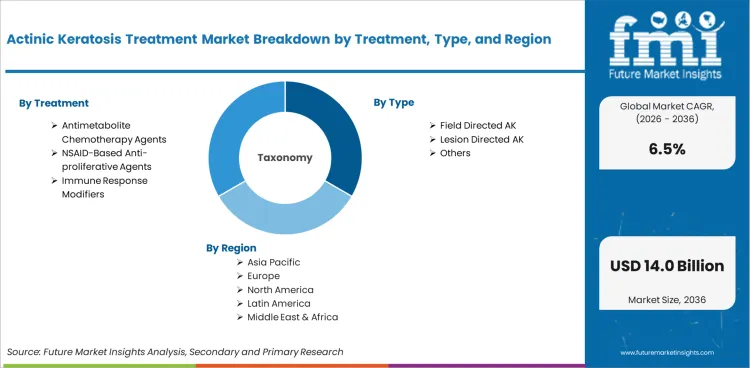
The global actinic keratosis treatment market was worth USD 7,043.6 million in 2026. According to Future Market Insights' analysis, the global actinic keratosis treatment demand will reach USD 13,221.8 million by 2036. The CAGR for this period, as predicted by FMI, will be around 6.5%.
Summary of Actinic Keratosis Treatment Market
- Actinic Keratosis Treatment Market Definition
- The industry covers therapeutic products used to manage actinic keratosis lesions across hospital, clinic, and prescription-led dermatology care pathways.
- Demand Drivers in the Market
- Increasing cases of skin pre-cancers caused by sun exposure are fuelling repetitive demands for dermatological treatments.
- Increased usage of lesion-based and field-based approaches demands the utilization of treatments through topical and procedures.
- Growing activities from dermatologists for screening and intervention purposes are leading to increased demand for reliable actinic keratosis treatment solutions, according to FMI.
- Key Segments Analyzed in the FMI Report
- By Treatment: Antimetabolite Chemotherapy Agents lead at 43.6% share in 2026.
- By Type: Field Directed AK Leads at 46.2% share in 2026.
- Geography: China and Germany show the fastest growth at 7.9% and 7.7% CAGR, supported by stronger dermatology treatment uptake and broader lesion-management demand.
- Analyst opinion at FMI
- Sabyasachi Ghosh, Principal Consultant at Future Market Insights, opines, ‘Buyer preference is being shaped by treatment tolerability, field-management suitability, and prescribing confidence, as dermatology providers place greater value on lesion clearance, recurrence control, and dependable therapy access across routine clinical care.’
- Strategic implications and executive takeaways
- Strengthen buyer contracting with lesion- and field-management support, tolerability-focused product positioning, and channel reliability aligned to dermatology treatment demand.
- Build growth plans around clinic-led and prescription-supported care pathways where recurring lesion management supports repeat therapy demand.
- Protect approved supplier positions through prescribing familiarity and treatment consistency, since validated actinic keratosis pathways are not switched easily once embedded into clinical routines.
- Methodology
- As per FMI, sizing and segment splits were reconciled using company primary disclosures and demand mapping by treatment class, lesion-management type, and dermatology sales setting.
- Treatment and type shares were validated by linking actinic keratosis demand patterns to clinical diagnosis volumes and recurring lesion-management intensity.
- Pricing sensitivity was stress tested under sales-channel and treatment-mix scenarios to confirm revenue response under realistic dermatology care conditions.
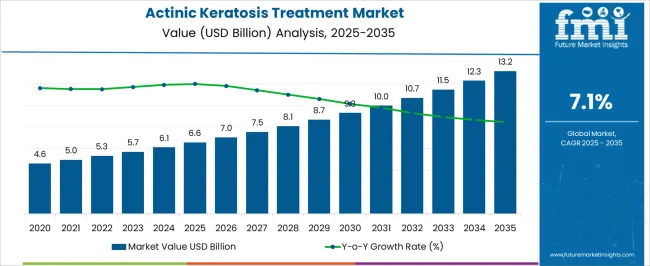
An absolute growth value of USD 6,178.2 million in a decade denotes consistent growth without a reset of demand. Demand for actinic keratosis treatments will continue to remain driven by higher diagnosis rates of precancerous spots resulting from exposure to the sun, increased screening activity, and the ongoing application of topically applied as well as lesion-directed medicines among aged patients. At the same time, differences in toleration, recurrence rate, and prescription practice will shape market evolution within established skincare systems “Actinic keratosis is a common precancerous skin condition that results from chronic sun exposure and can potentially lead to skin cancer if left untreated. It’s estimated that 58 million Americans have one or more AKs. We are grateful to Almirall and Biofrontera for their support of our efforts to educate the public about the prevention, warning signs, and treatment options of this condition.” said Deborah S. Sarnoff, MD, president of Skin Cancer Foundation.
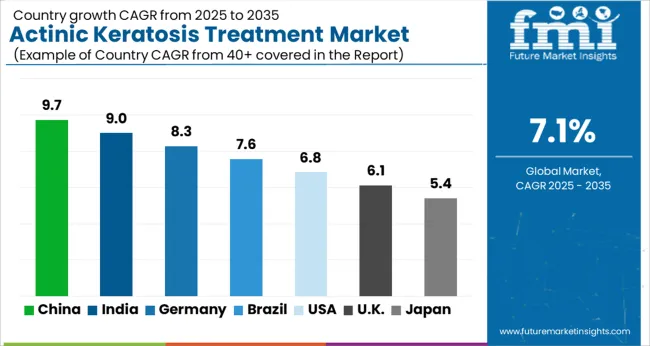
As per the findings of FMI, it is evident that China (CAGR at 7.9%), Germany (CAGR at 7.7%), and the US (CAGR at 7.6%) are likely to dominate owing to improved dermatology access, increased treatment demands, and greater clinical involvement among the sun-affected population. The countries like India (CAGR at 7.5%) and Japan (CAGR at 6.8%) are likely to witness solid growth owing to increasing awareness about lesion management along with improved access to specialty care facilities.
Key Takeaways, Market Size, and Forecast
- Actinic Keratosis Treatment Market is projected to grow from USD 7,043.6 million in 2026 to USD 13,221.8 million by 2036, at a CAGR of 6.5%.
- The global actinic keratosis treatment market was valued at USD 7,043.6 million in 2026.
- By 2036, the Actinic Keratosis Treatment Market is expected to be worth USD 13,221.8 million.
- During 2026 to 2036, the market is anticipated to expand at a CAGR of 6.5%.
- The market is predicted to create an incremental opportunity of USD 6,178.2 million between 2026 and 2036.
- In 2026, Antimetabolite Chemotherapy Agents are expected to account for 43.6% of the treatment segment.
- China (7.9%) and Germany (7.7%) are projected to be two of the fastest growing markets.
Actinic Keratosis Treatment Market Definition
The market includes therapeutic products and treatment approaches used to manage actinic keratosis lesions across dermatology-led clinical settings. These products are supplied through hospital based dermatology settings, dermatology clinics, aesthetic and laser clinics, retail pharmacy chains, and online sales channels to support lesion-directed and field-directed treatment where visible, subclinical, or recurrent actinic keratosis requires medical intervention.
The market includes Antimetabolite Chemotherapy Agents, NSAID-Based Anti-proliferative Agents, and immune response modifiers delivered through topical creams, solutions, light-activated agents, and related dosage forms across varying disease presentations. The market is driven by lesion burden, dermatology consultation volumes, treatment tolerability, recurrence management needs, and patient preference for office-based and prescription-led care. The revenue stream is derived from sales of actinic keratosis treatment products across regulated dermatology and retail-linked care environments.
Actinic Keratosis Treatment Market Inclusions
The report provides global and regional market sizing, as well as a 10-year forecast from 2026 to 2036. The report also provides market sizing by treatment, type, dosage forms, and sales channel, with country-level CAGR comparisons across key markets. The report also provides analysis on competitive positioning of key suppliers, dermatology treatment dynamics, and the influence of lesion response, field-management suitability, and channel accessibility on supplier choice, as per FMI.
Actinic Keratosis Treatment Market Exclusions
The scope does not include basal cell carcinoma therapies, melanoma treatments, cosmetic skin care products, sunscreens, general dermatology diagnostics, or unrelated photoprotection products. Surgical tools, pathology services, and non-actinic keratosis dermatology therapeutics are also excluded. The scope also does not include non-therapeutic skin management products not used in structured actinic keratosis treatment pathways, but only treatment products and related care approaches used for lesion management.
Actinic Keratosis Treatment Market Research Methodology
- Primary Research: Interviews were conducted with dermatologists, specialist clinic attendees, prescribers, distributors, and supplier’s commercial teams in order to validate purchasing behavior and demand patterns.
- Desk Research: Public data from regulatory bodies, company materials, dermatology publications, prescription-treatment references, and skin disease management sources were analyzed to compare product use trends and market positioning.
- Market Sizing and Forecasting: A hybrid approach was created based on treatment-led demand mapping, lesion management mix, and sales-channel utilization patterns, and then harmonized through volume and price triangulation.
- Data Validation and Update Cycle: Results were filtered for variance, tested for internal consistency, and assessed through structured peer review before distribution.
Segmental analysis
Actinic Keratosis Treatment Market Analysis by Treatment
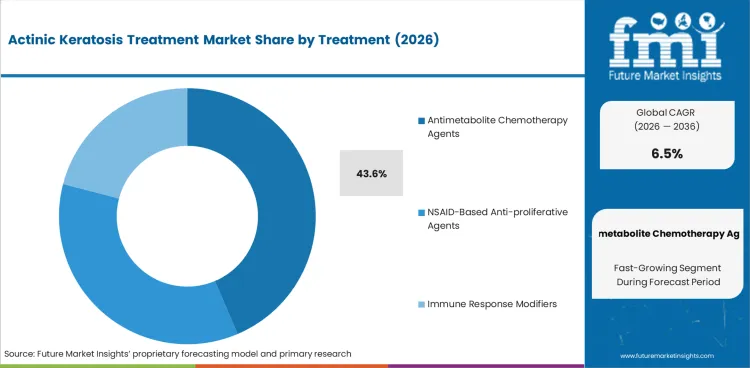
Based on FMI’s report, Antimetabolite Chemotherapy Agents are estimated to hold 43.6% share in 2026. This lead position is supported by their long-standing role in topical lesion management, broad physician familiarity, and continued use across lesion-directed and field-directed treatment pathways where established clinical response remains important. Their larger share is being reinforced by strong dermatology prescribing familiarity, recurring use in outpatient care, and continued alignment with routine actinic keratosis management across supervised treatment settings.
- Broad Field Cancerization Relevance: Published guidance and recent reviews show that 5-fluorouracil is used not only for visible lesions but also for field cancerization, making Antimetabolite Chemotherapy Agents relevant across broader sun-damaged treatment areas rather than only isolated lesion-directed intervention.
- Established Topical Treatment Relevance: Antimetabolite Chemotherapy Agents continue to hold the highest share because they remain deeply embedded in routine actinic keratosis management, supported by broad dermatologist familiarity, relevance across lesion-directed and field-based treatment pathways, and continued use in outpatient skin-directed care settings.
- Strong alignment with routine care: Antimetabolite Chemotherapy Agents continue to maintain a leading share in treatment use due to their long-standing role in standard actinic keratosis care, where consistent prescribing familiarity, repeat outpatient use, and broad applicability across common clinical presentations support sustained demand.
Actinic Keratosis Treatment Market Analysis by Type
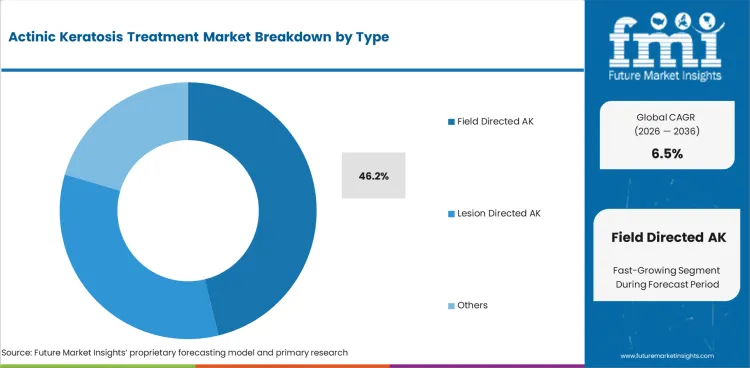
Field directed AK accounts for 46.2% share in 2026, based on FMI’s report, reflecting its role as the leading treatment type within actinic keratosis management. This leading position is supported by the frequent presence of visible and subclinical lesions across sun-damaged skin areas, along with broader clinical preference for treating the affected field rather than isolated lesions alone. Demand is therefore being concentrated in field directed AK where recurrence control and wider lesion coverage remain important.
- Treats Visible and Hidden Lesions: Recent guideline and review literature continues to emphasize that actinic keratosis often occurs within field cancerization, where both visible and subclinical lesions are present across sun-damaged skin, making field-directed treatment more relevant than isolated lesion-only management.
- Fits Routine Dermatology Practice: Recent studies continue to describe field-directed modalities such as photodynamic therapy and topical therapies as effective options for extensive facial and scalp AK, with one 2025 study reporting lesion counts falling from 12.33 to 1.98 after treatment, supporting their fit in routine outpatient dermatology workflows.
- Broader Disease-Management Relevance: Field-directed actinic keratosis continues to hold the highest share because it remains better aligned with the wider treatment needs of sun-damaged skin, where broader coverage, ongoing lesion burden management, and routine use in specialist dermatology care support stronger overall adoption.
Actinic Keratosis Treatment Market Drivers, Restraints, and Opportunities
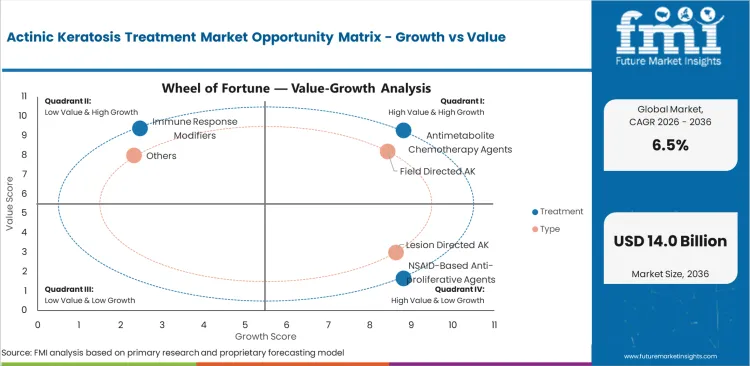
Future Market Insights analysis indicates that historical patterns point to a dermatology-focused skin lesion management category where demand is anchored in lesion clearance, recurrence reduction, and broader intervention across chronically sun-damaged skin. Estimated valuation in 2026 is being supported by increasing diagnosis of actinic keratosis, stronger dermatology consultation rates, and continued reliance on topical and office-based treatment approaches across aging and at-risk populations, as per FMI.
While category demand is being restrained by treatment discomfort, variable adherence in long-course topical regimens, and recurrence concerns across some patient groups, value is being supported by rising awareness of precancerous lesion care, broader field-treatment adoption, and stronger integration of dermatology-led management into outpatient pathways. Based on FMI’s report, the forecast trajectory reflects a market where Antimetabolite Chemotherapy Agents remain the leading treatment class, while suppliers are differentiated by tolerability, treatment fit, and channel access.
- Dermatology-Backed: Demand is being supported as providers continue to treat actinic keratosis earlier and more consistently across specialist care settings.
- Adherence-Led: Growth is being moderated where treatment discomfort and regimen duration affect completion and repeat use.
- Field-Care Opportunity: Demand is being supported as broader skin-area management is being adopted for more comprehensive lesion control.
Regional Analysis
.webp "Top Country Growth Comparison Actinic Keratosis Treatment Market Cagr (2026 2036)")
Based on the regional analysis, actinic keratosis treatment market is segmented into North America, Latin America, East Asia, South Asia & Pacific, Western Europe, Eastern Europe, and Middle East & Africa across 40+ countries. Regional performance is assessed using country-level demand signals tied to dermatology access, skin lesion diagnosis, treatment adoption, and sales-channel depth, as per FMI. The full report also offers market attractiveness analysis based on regional trends.
| Country | CAGR |
|---|---|
| United States | 7.6% |
| Canada | 6.5% |
| South Korea | 1.1% |
| China | 7.9% |
| Japan | 6.8% |
| India | 7.5% |
| Germany | 7.7% |
| United Kingdom | 7.3% |
| France | 6.4% |
| Italy | 5.2% |
Source: Future Market Insights (FMI) analysis, based on proprietary forecasting model and primary research
North America Actinic Keratosis Treatment Market Analysis
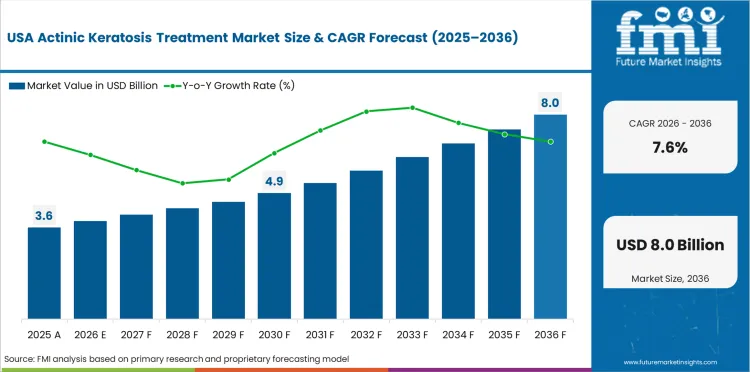
North America is shaped by strong dermatology access, broad outpatient lesion management, and recurring prescription demand across aging patient populations, where product choice is influenced by tolerability, treatment coverage, and familiarity within specialist skin-care workflows. Almirall holds strong placement through dermatology focus, prescription treatment relevance, and broad specialist alignment. Sun Pharmaceutical Industries and Dr. Reddy’s Laboratories compete through treatment portfolio visibility and continued relevance across prescription-led lesion care pathways. Based on FMI’s report, demand remains anchored in dermatologist-driven treatment and recurring outpatient lesion management.
- United States: In terms of actinic keratosis treatment demand within the United States, there is anticipated growth in terms of a CAGR of 7.6% between 2036. This will be based on widespread dermatology diagnosis prevalence, high prevalence of prescription treatment utilization, and sustained lesion management requirements within outpatient settings.
- Canada: Demand for actinic keratosis treatment in Canada is projected to rise at 6.5% CAGR through 2036. Growth is supported by stable specialist treatment demand, growing lesion-management awareness, and continued use of dermatology-prescribed therapy across structured care environments.
FMI’s report includes a detailed analysis of the growth in the North American region, along with a country-wise assessment that includes the United States and Canada. Readers can also find regional trends, regulations, and market growth based on different segments and countries in the North America region
East Asia Actinic Keratosis Treatment Market Analysis
For East Asia, the prospects for the dermatology wound dressings market continue to look bright, owing to increasing dermatological consultations, growing knowledge about the treatment of sun damage and lesions, and more advanced lesion management techniques. The positioning of players in East Asia is based on treatment availability, tolerability, and the potential to enable outpatient and prescription-based procedures. This is according to the insights offered in the FMI report.
- China: The projected CAGR for the market size for actinic keratosis treatment in China will grow by 7.9% in the coming years between 2036. This growth is expected due to wider availability of dermatological treatments, increase in number of lesions diagnosed, and increasing use of structured treatment approaches.
- Japan: The market for treatment of actinic keratosis in Japan is predicted to increase with a CAGR of 6.8% from 2036. The key factors driving this trend include consistent specialty drug requirement, availability of dermatology care, and persistent dependence on ambulatory lesion management treatment.
- South Korea: In the South Korean market, the requirement for treatments for actinic keratosis is forecasted to witness growth with a CAGR of 1.1% over the period from 2036. This is primarily due to the stability in the usage by specialists and the persistence in the need for lesion management.
Complete analysis of the actinic keratosis treatment market is provided by the report for the East Asian region between 2021 and 2036. The study identifies trends which determine demand and purchasing practices in the region comprising China, Japan, South Korea, and other regions around the world.
South Asia & Pacific Actinic Keratosis Treatment Market Analysis
South Asia & Pacific is being shaped by improving dermatology access, rising awareness of chronic lesion management, and broader use of outpatient treatment pathways across specialist care environments. Supplier positioning in the region is influenced by affordability, treatment usability, and ability to support prescription-led lesion management in growing dermatology settings. Based on FMI’s report, demand remains supported by stronger specialist diagnosis and expanding access to structured skin-lesion treatment.
- India: Treatment of Actinic Keratosis in India will see a steady growth of 7.5% CAGR until 2036. Factors such as increase in dermatology visits, growing treatment options, and prescription medication usage in lesion management will contribute to the above-mentioned growth.
The full study provides a detailed analysis of the actinic keratosis treatment market in South Asia & Pacific between 2021 to 2036 including price, trends, and growth factors for India, ASEAN Countries, Australia & New Zealand, and Rest of South Asia.
Western Europe Actinic Keratosis Treatment Market Analysis
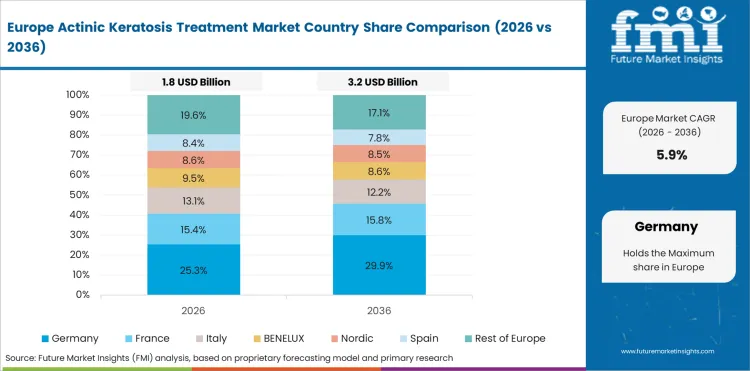
In Western Europe, there is an emphasis on quality and specialization, where the demand for therapy is determined by the presence of well-structured outpatient dermatology practices, recurrent lesion care, and proper prescription of skin medications in regulated healthcare institutions. The companies of interest, namely Almirall, Sun Pharmaceutical Industries, and LEO Pharma, remain current by focusing on dermatological treatments, familiarity with therapeutic options, and staying in line with specialist lesion care protocols. Prescribing will be affected by tolerability expectations, relevance in field therapy, and good outpatient prescription coverage.
- Germany: Demand for actinic keratosis treatment in Germany will see a CAGR of 7.7% over the coming years up to 2036. This growth rate is driven by the high accessibility of dermatologists, demand for lesion management amongst specialists, and continued prescription use for treatment.
- United Kingdom: The CAGR in terms of demand for actinic keratosis treatment in the United Kingdom is forecast to be 7.3% through 2036. Demand stability from specialists, lesion management use, and outpatient dermatology are key factors driving this growth rate.
- France: The demand for actinic keratosis treatments in France is forecast to increase at a CAGR of 6.4% from 2036. This growth will be fueled by the increasing demand for dermatological treatment, stable outpatient care, and increased adoption of lesion- and field-oriented treatment options in specialist practices.
- Italy: The demand for actinic keratosis treatments in Italy is forecast to increase at a CAGR of 5.2% from 2036. This growth will be supported by stable lesion management demand, but will be dampened by the use of prescribed treatments in dermatology clinics and stable markets.
FMI’s analysis of actinic keratosis treatment market in Western Europe consists of country-wise assessment that includes Germany, the United Kingdom, France, Italy, Spain, BENELUX, Nordic Countries, and Rest of Western Europe. Readers can know various regulations and latest trends in the regional market.
Competitive Aligners for Market Players
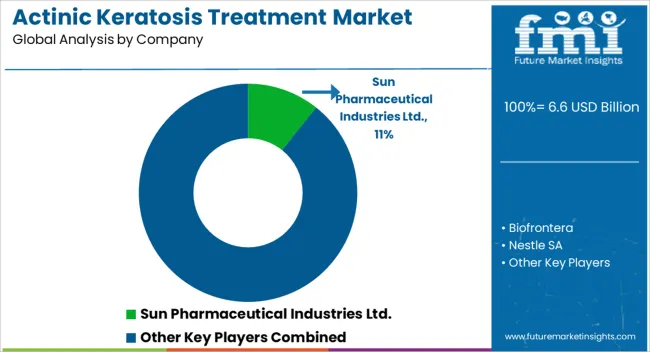
The market structure remains moderately concentrated, with effective competition centered on suppliers capable of supporting treatment tolerability, lesion-management effectiveness, and dependable dermatology channel access across specialist care environments. The data provided shows the presence of established dermatology-focused and generic pharmaceutical participants, with the rest of demand distributed across a focused set of prescription skin-care suppliers. The key competitive factor is treatment usability aligned to lesion-control need, as supplier qualification is filtered through dermatologist confidence, prescription familiarity, and ability to support recurring outpatient care. The product portfolio also reflects this emphasis, as Antimetabolite Chemotherapy Agents account for the leading share in the supplied segmentation, as indicated by FMI.
Companies with established dermatology treatment portfolios, strong outpatient channel reach, and broad prescription relevance carry structural advantages because buyer qualification is governed by treatment consistency, clinical tolerability, and confidence in recurring lesion-management performance across specialist pathways. Scale leaders benefit from deeper dermatologist access, wider product breadth, and the ability to support multiple treatment forms under the same commercial framework. Portfolio breadth across topical, light-activated, and solution-based approaches helps protect account positions when specialists standardize around known lesion-management suppliers. Companies that have limited operational scope often rely on selective geography, price sensitivity, or dermatological specialization for competitive advantage, which may put them at a disadvantage in the systematic supplier assessment process.
Higher customer concentration will increase buyer power. The segment with the largest pool of sales channels is dermal clinics. Retail pharmacy chains, dermatology services in hospitals, aesthetic/laser clinics, and online sales channels are the other leading segments. Major specialist networks tend to maintain a relationship with selected suppliers who have products matching the existing lesion management process, and those whose supply chain is reliable for repetitive demand. This will ensure that pricing power will be curtailed in the regular actinic keratosis treatment category except in cases where tolerance, sales channel, or prescription strength provides an edge.
Recent Developments
- In March 2026, Torqur AG and Lonza announced a partnership for the clinical supply of **bimiralisib**, a dual PI3K/mTOR inhibitor under phase 2 evaluation for actinic keratosis (AK). Lonza will provide technology transfer, process optimization, and cGMP manufacturing at facilities in China and Switzerland, supporting Torqur’s advancement of this high-potential therapy.
- In December 2025, Vidac Pharma Holdings Plc., a clinical-stage biopharmaceutical company announced the initiation of its Phase 2B* clinical trial evaluating a novel targeted therapeutic approach for the treatment of highly proliferative lesions of Actinic Keratosis (AK) with its Tuvatexib ointment. This milestone follows receipt of clearance from the European Medicines Agency (EMA) to proceed with the study.
- In May 2025, Sun Pharma Announces FDA Approval of Next Generation BLU-U Blue Light Photodynamic Therapy Illuminator for Actinic Keratosis.
- In June 2024, Almirall, a global pharmaceutical company dedicated to medical dermatology, announced that the USA Food and Drug Administration (FDA) has approved Almirall’s recent supplemental New Drug Application (sNDA) to expand the use area for its drug, Klisyri, to up to 100 cm2. Klisyri, a microtubule inhibitor ointment, is now approved in a 350 mg package size and is a 5-day topical field treatment for actinic keratosis (AK) of the face or scalp.
Key Players in Actinic Keratosis Treatment Market
- Almirall
- Sun Pharmaceutical Industries
- Glenmark Pharmaceuticals
- Dr. Reddy’s Laboratories
- Cipla
- Zydus Lifesciences
- Aurobindo Pharma
- Lupin
- Intas Pharmaceuticals
- Biorontera
Scope of the Report
| Metric | Value |
|---|---|
| Quantitative Units | USD 7,043.6 million (2026) to USD 13,221.8 million (2036), at a CAGR of 6.5% |
| Market Definition | The actinic keratosis treatment market comprises therapeutic products used to manage precancerous sun-related skin lesions across dermatology-led care settings, where demand is shaped by lesion burden, treatment tolerability, and dependence on specialist prescription pathways across outpatient and hospital-based skin care environments. |
| Treatment Segmentation | Antimetabolite Chemotherapy Agents, NSAID-Based Anti-proliferative Agents, Immune Response Modifiers |
| Type Segmentation | Lesion Directed AK, Field Directed AK, Graded Clinical Severity |
| Dosage Forms Segmentation | Topical Creams, Solutions, Light-Activated Agents, Others |
| Sales Channel Segmentation | Hospital Based Dermatology Settings, Dermatology Clinics, Aesthetic & Laser Clinics, Retail Pharmacy Chains, Online Sales Channel |
| Regions Covered | North America, Latin America, East Asia, South Asia & Pacific, Western Europe, Eastern Europe, and Middle East & Africa |
| Countries Covered | United States, Canada, United Kingdom, Germany, France, China, Japan, South Korea, Brazil, Australia, India, and 40+ countries |
| Key Companies Profiled | Almirall, Sun Pharmaceutical Industries, Glenmark Pharmaceuticals, Dr. Reddy’s Laboratories, Cipla, Zydus Lifesciences, Aurobindo Pharma, Lupin, Intas Pharmaceuticals, Biorontera |
| Forecast Period | 2026 to 2036 |
| Approach | Hybrid top down and bottom up market modeling validated through primary interviews with dermatology and channel stakeholders, supported by demand triangulation across lesion volumes, treatment mix, and sales-channel adoption patterns, as per FMI. |
Key Segments
By Drug Therapy
- Antimetabolite Chemotherapy Agents
- 5-Fluorouracil (5-FU) 0.5% formulations
- 5-Fluorouracil (5-FU) 1% formulations
- 5-Fluorouracil (5-FU) 2% formulations
- 5-Fluorouracil (5-FU) 5% formulations
- NSAID-Based Anti-proliferative Agents
- Immune Response Modifiers
- Microtubule Inhibitors
Photodynamic Therapy
- Aminolevulinic Acid (ALA)-Based PDT
- Methyl Aminolevulinate (MAL)-Based PDT
Device-Based Treatments
- Cryotherapy
- Electrotherapy
- Laser-Based Ablation
By Type
- Lesion Directed AK
- Field Directed AK
- Graded Clinical Severity
- Grade I
- Grade II
- Grade III
By Therapy Route
- Topical Creams
- Solutions
- Light-Activated Agents
- Procedure-Based
By Sales Channel
- Hospital Based Dermatology Settings
- Dermatology Clinics
- Aesthetic & Laser Clinics
- Retail Pharmacy Chains
- Online Sales Channel
Region
- North America
- USA
- Canada
- Mexico
- Latin America
- Brazil
- Argentina
- Rest of Latin America
- East Asia
- China
- Japan
- South Korea
- South Asia & Pacific
- India
- ASEAN Countries
- Australia & New Zealand
- Rest of South Asia
- Western Europe
- Germany
- UK
- France
- Italy
- Spain
- BENELUX
- Nordic Countries
- Rest of Western Europe
- Eastern Europe
- Russia
- Hungary
- Poland
- Rest of Eastern Europe
- Middle East & Africa
- Saudi Arabia
- Türkiye
- South Africa
- Other African Union
- Rest of Middle East & Africa
Bibliography
- [1] Biofrontera (2025), Biofrontera and Almirall Launch Social Media Campaign for Actinic Keratosis.
- [2] ScienceDirect (2024), Pre-treatment with topical 5-fluorouracil increases the efficacy of daylight photodynamic therapy for actinic keratoses – A randomized controlled trial.
- [3] Wiley- Online Library (2023), S3 guideline „actinic keratosis and cutaneous squamous cell carcinoma “– update 2023, part 1: treatment of actinic keratosis, actinic cheilitis, cutaneous squamous cell carcinoma in situ (Bowen's disease), occupational disease and structures of care.
- [4] ScienceDirect (2025), Photodynamic therapy combined with curettage for actinic keratosis on the face and scalp: An efficient treatment for field cancerization of the skin
- [5] Vidac Pharma Holdings Plc. (2025), Vidac Pharma Holdings Plc Announces Initiation of Phase 2B* Clinical Trial for Targeted Treatment of Highly Proliferative Actinic Keratosis Lesions
- [6] Sun Pharmaceutical Industries Limited (2025), Sun Pharma Announces FDA Approval of Next Generation BLU-U Blue Light Photodynamic Therapy Illuminator for Actinic Keratosis.
- [7] Almirall (2024), FDA approves Almirall’s Klisyri (tirbanibulin) for the treatment of actinic keratosis on expanded area of face or scalp up to 100 cm2.
This Report Addresses
- Market intelligence to enable structured strategic decision making across dermatology treatment expansion and lesion-management portfolio planning
- Market size estimation and 10-year revenue forecasts from 2026 to 2036 for actinic keratosis treatment demand
- Growth opportunity mapping across treatment classes and type-based lesion-management pools
- Segment and regional revenue forecasts aligned to the stated taxonomy and covered geographies
- Competition strategy assessment including supplier positioning, portfolio fit, and dermatology channel coverage benchmarking
- Product and compliance tracking focused on treatment tolerability, lesion-management standards, and specialist-led quality expectations
- Regulatory impact analysis covering therapy-led product selection and provider-level protocol adoption in regulated care settings
- Market report delivery in PDF, Excel, PPT, and interactive dashboard formats for executive and operational use
Frequently Asked Questions
How large is the demand for Actinic Keratosis Treatment in the global market in 2026?
Demand for Actinic Keratosis Treatment in the global market is estimated to be valued at USD 7,043.6 million in 2026, as per FMI.
What will be the market size of Actinic Keratosis Treatment in the global market by 2036?
Market size for Actinic Keratosis Treatment is projected to reach USD 13,221.8 million by 2036.
What is the expected demand growth for Actinic Keratosis Treatment in the global market between 2026 and 2036?
Demand for Actinic Keratosis Treatment in the global market is expected to grow at a CAGR of 6.5% between 2026 and 2036.
Which treatment is poised to lead global sales by 2026?
Antimetabolite Chemotherapy Agents are expected to be the dominant treatment, capturing 43.6% share in 2026.
How significant is the role of field directed AK in driving type demand in 2026?
Field directed AK is projected to hold 46.2% share of type demand in 2026.
Which country is expected to record the fastest growth during the forecast period?
China is projected to grow at a CAGR of 7.9% during 2026 to 2036 among the listed countries.
Preview the report firsthand - request a free sample
Get SampleGet the brochure for pricing and purchase details.
Get PDFTable of Content
- Executive Summary
- Global Market Outlook
- Demand-side Trends
- Supply-side Trends
- Technology Roadmap Analysis
- Analysis and Recommendations
- Market Overview
- Market Coverage / Taxonomy
- Market Definition / Scope / Limitations
- Research Methodology
- Chapter Orientation
- Analytical Lens and Working Hypotheses
- Market Structure, Signals, and Trend Drivers
- Benchmarking and Cross-market Comparability
- Market Sizing, Forecasting, and Opportunity Mapping
- Research Design and Evidence Framework
- Desk Research Programme (Secondary Evidence)
- Company Annual and Sustainability Reports
- Peer-reviewed Journals and Academic Literature
- Corporate Websites, Product Literature, and Technical Notes
- Earnings Decks and Investor Briefings
- Statutory Filings and Regulatory Disclosures
- Technical White Papers and Standards Notes
- Trade Journals, Industry Magazines, and Analyst Briefs
- Conference Proceedings, Webinars, and Seminar Materials
- Government Statistics Portals and Public Data Releases
- Press Releases and Reputable Media Coverage
- Specialist Newsletters and Curated Briefings
- Sector Databases and Reference Repositories
- FMI Internal Proprietary Databases and Historical Market Datasets
- Subscription Datasets and Paid Sources
- Social Channels, Communities, and Digital Listening Inputs
- Additional Desk Sources
- Expert Input and Fieldwork (Primary Evidence)
- Primary Modes
- Qualitative Interviews and Expert Elicitation
- Quantitative Surveys and Structured Data Capture
- Blended Approach
- Why Primary Evidence is Used
- Field Techniques
- Interviews
- Surveys
- Focus Groups
- Observational and In-context Research
- Social and Community Interactions
- Stakeholder Universe Engaged
- C-suite Leaders
- Board Members
- Presidents and Vice Presidents
- R&D and Innovation Heads
- Technical Specialists
- Domain Subject-matter Experts
- Scientists
- Physicians and Other Healthcare Professionals
- Governance, Ethics, and Data Stewardship
- Research Ethics
- Data Integrity and Handling
- Primary Modes
- Tooling, Models, and Reference Databases
- Desk Research Programme (Secondary Evidence)
- Data Engineering and Model Build
- Data Acquisition and Ingestion
- Cleaning, Normalisation, and Verification
- Synthesis, Triangulation, and Analysis
- Quality Assurance and Audit Trail
- Market Background
- Market Dynamics
- Drivers
- Restraints
- Opportunity
- Trends
- Scenario Forecast
- Demand in Optimistic Scenario
- Demand in Likely Scenario
- Demand in Conservative Scenario
- Opportunity Map Analysis
- Product Life Cycle Analysis
- Supply Chain Analysis
- Investment Feasibility Matrix
- Value Chain Analysis
- PESTLE and Porter’s Analysis
- Regulatory Landscape
- Regional Parent Market Outlook
- Production and Consumption Statistics
- Import and Export Statistics
- Market Dynamics
- Global Market Analysis 2021 to 2025 and Forecast, 2026 to 2036
- Historical Market Size Value (USD Million) Analysis, 2021 to 2025
- Current and Future Market Size Value (USD Million) Projections, 2026 to 2036
- Y-o-Y Growth Trend Analysis
- Absolute $ Opportunity Analysis
- Global Market Pricing Analysis 2021 to 2025 and Forecast 2026 to 2036
- Global Market Analysis 2021 to 2025 and Forecast 2026 to 2036, By Treatment
- Introduction / Key Findings
- Historical Market Size Value (USD Million) Analysis By Treatment , 2021 to 2025
- Current and Future Market Size Value (USD Million) Analysis and Forecast By Treatment , 2026 to 2036
- Antimetabolite Chemotherapy Agents
- NSAID-Based Anti-proliferative Agents
- Immune Response Modifiers
- Antimetabolite Chemotherapy Agents
- Y-o-Y Growth Trend Analysis By Treatment , 2021 to 2025
- Absolute $ Opportunity Analysis By Treatment , 2026 to 2036
- Global Market Analysis 2021 to 2025 and Forecast 2026 to 2036, By Type
- Introduction / Key Findings
- Historical Market Size Value (USD Million) Analysis By Type, 2021 to 2025
- Current and Future Market Size Value (USD Million) Analysis and Forecast By Type, 2026 to 2036
- Field Directed AK
- Lesion Directed AK
- Others
- Field Directed AK
- Y-o-Y Growth Trend Analysis By Type, 2021 to 2025
- Absolute $ Opportunity Analysis By Type, 2026 to 2036
- Global Market Analysis 2021 to 2025 and Forecast 2026 to 2036, By Region
- Introduction
- Historical Market Size Value (USD Million) Analysis By Region, 2021 to 2025
- Current Market Size Value (USD Million) Analysis and Forecast By Region, 2026 to 2036
- North America
- Latin America
- Western Europe
- Eastern Europe
- East Asia
- South Asia and Pacific
- Middle East & Africa
- Market Attractiveness Analysis By Region
- North America Market Analysis 2021 to 2025 and Forecast 2026 to 2036, By Country
- Historical Market Size Value (USD Million) Trend Analysis By Market Taxonomy, 2021 to 2025
- Market Size Value (USD Million) Forecast By Market Taxonomy, 2026 to 2036
- By Country
- USA
- Canada
- Mexico
- By Treatment
- By Type
- By Country
- Market Attractiveness Analysis
- By Country
- By Treatment
- By Type
- Key Takeaways
- Latin America Market Analysis 2021 to 2025 and Forecast 2026 to 2036, By Country
- Historical Market Size Value (USD Million) Trend Analysis By Market Taxonomy, 2021 to 2025
- Market Size Value (USD Million) Forecast By Market Taxonomy, 2026 to 2036
- By Country
- Brazil
- Chile
- Rest of Latin America
- By Treatment
- By Type
- By Country
- Market Attractiveness Analysis
- By Country
- By Treatment
- By Type
- Key Takeaways
- Western Europe Market Analysis 2021 to 2025 and Forecast 2026 to 2036, By Country
- Historical Market Size Value (USD Million) Trend Analysis By Market Taxonomy, 2021 to 2025
- Market Size Value (USD Million) Forecast By Market Taxonomy, 2026 to 2036
- By Country
- Germany
- UK
- Italy
- Spain
- France
- Nordic
- BENELUX
- Rest of Western Europe
- By Treatment
- By Type
- By Country
- Market Attractiveness Analysis
- By Country
- By Treatment
- By Type
- Key Takeaways
- Eastern Europe Market Analysis 2021 to 2025 and Forecast 2026 to 2036, By Country
- Historical Market Size Value (USD Million) Trend Analysis By Market Taxonomy, 2021 to 2025
- Market Size Value (USD Million) Forecast By Market Taxonomy, 2026 to 2036
- By Country
- Russia
- Poland
- Hungary
- Balkan & Baltic
- Rest of Eastern Europe
- By Treatment
- By Type
- By Country
- Market Attractiveness Analysis
- By Country
- By Treatment
- By Type
- Key Takeaways
- East Asia Market Analysis 2021 to 2025 and Forecast 2026 to 2036, By Country
- Historical Market Size Value (USD Million) Trend Analysis By Market Taxonomy, 2021 to 2025
- Market Size Value (USD Million) Forecast By Market Taxonomy, 2026 to 2036
- By Country
- China
- Japan
- South Korea
- By Treatment
- By Type
- By Country
- Market Attractiveness Analysis
- By Country
- By Treatment
- By Type
- Key Takeaways
- South Asia and Pacific Market Analysis 2021 to 2025 and Forecast 2026 to 2036, By Country
- Historical Market Size Value (USD Million) Trend Analysis By Market Taxonomy, 2021 to 2025
- Market Size Value (USD Million) Forecast By Market Taxonomy, 2026 to 2036
- By Country
- India
- ASEAN
- Australia & New Zealand
- Rest of South Asia and Pacific
- By Treatment
- By Type
- By Country
- Market Attractiveness Analysis
- By Country
- By Treatment
- By Type
- Key Takeaways
- Middle East & Africa Market Analysis 2021 to 2025 and Forecast 2026 to 2036, By Country
- Historical Market Size Value (USD Million) Trend Analysis By Market Taxonomy, 2021 to 2025
- Market Size Value (USD Million) Forecast By Market Taxonomy, 2026 to 2036
- By Country
- Kingdom of Saudi Arabia
- Other GCC Countries
- Turkiye
- South Africa
- Other African Union
- Rest of Middle East & Africa
- By Treatment
- By Type
- By Country
- Market Attractiveness Analysis
- By Country
- By Treatment
- By Type
- Key Takeaways
- Key Countries Market Analysis
- USA
- Pricing Analysis
- Market Share Analysis, 2025
- By Treatment
- By Type
- Canada
- Pricing Analysis
- Market Share Analysis, 2025
- By Treatment
- By Type
- Mexico
- Pricing Analysis
- Market Share Analysis, 2025
- By Treatment
- By Type
- Brazil
- Pricing Analysis
- Market Share Analysis, 2025
- By Treatment
- By Type
- Chile
- Pricing Analysis
- Market Share Analysis, 2025
- By Treatment
- By Type
- Germany
- Pricing Analysis
- Market Share Analysis, 2025
- By Treatment
- By Type
- UK
- Pricing Analysis
- Market Share Analysis, 2025
- By Treatment
- By Type
- Italy
- Pricing Analysis
- Market Share Analysis, 2025
- By Treatment
- By Type
- Spain
- Pricing Analysis
- Market Share Analysis, 2025
- By Treatment
- By Type
- France
- Pricing Analysis
- Market Share Analysis, 2025
- By Treatment
- By Type
- India
- Pricing Analysis
- Market Share Analysis, 2025
- By Treatment
- By Type
- ASEAN
- Pricing Analysis
- Market Share Analysis, 2025
- By Treatment
- By Type
- Australia & New Zealand
- Pricing Analysis
- Market Share Analysis, 2025
- By Treatment
- By Type
- China
- Pricing Analysis
- Market Share Analysis, 2025
- By Treatment
- By Type
- Japan
- Pricing Analysis
- Market Share Analysis, 2025
- By Treatment
- By Type
- South Korea
- Pricing Analysis
- Market Share Analysis, 2025
- By Treatment
- By Type
- Russia
- Pricing Analysis
- Market Share Analysis, 2025
- By Treatment
- By Type
- Poland
- Pricing Analysis
- Market Share Analysis, 2025
- By Treatment
- By Type
- Hungary
- Pricing Analysis
- Market Share Analysis, 2025
- By Treatment
- By Type
- Kingdom of Saudi Arabia
- Pricing Analysis
- Market Share Analysis, 2025
- By Treatment
- By Type
- Turkiye
- Pricing Analysis
- Market Share Analysis, 2025
- By Treatment
- By Type
- South Africa
- Pricing Analysis
- Market Share Analysis, 2025
- By Treatment
- By Type
- USA
- Market Structure Analysis
- Competition Dashboard
- Competition Benchmarking
- Market Share Analysis of Top Players
- By Regional
- By Treatment
- By Type
- Competition Analysis
- Competition Deep Dive
- Almirall
- Overview
- Product Portfolio
- Profitability by Market Segments (Product/Age /Sales Channel/Region)
- Sales Footprint
- Strategy Overview
- Marketing Strategy
- Product Strategy
- Channel Strategy
- Sun Pharmaceutical Industries
- Glenmark Pharmaceuticals
- Dr. Reddy’s Laboratories
- Cipla
- Zydus Lifesciences
- Aurobindo Pharma
- Lupin
- Almirall
- Competition Deep Dive
- Assumptions & Acronyms Used


