

- Industry Size (2026)
- USD 980.0 Mn
- Forecast (2036)
- USD 1680.0 Mn
- CAGR (2026 to 2036)
- 5.5%
CT-Guided Biopsy Market Size, Market Forecast and Outlook
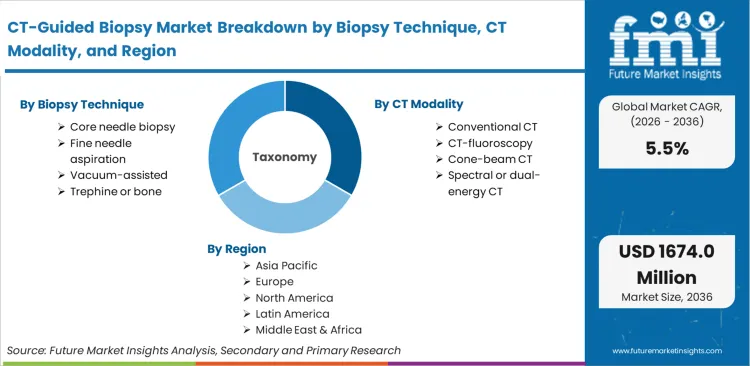
In 2026, the CT-guided biopsy market was valued at USD 980.0 million. Based on Future Market Insights analysis, demand for CT-guided biopsy is estimated to grow to USD 1,680.0 million by 2036. FMI projects a CAGR of 5.5% during the forecast period.
Absolute dollar growth of USD 700.0 million over the decade signals steady expansion rather than a rapid technology replacement cycle. As per FMI, growth is expected to be supported by rising image-guided tissue sampling volumes for lung and other internal lesions of the body, while reimbursement controls, procedure scheduling constraints, and complication-risk governance are expected to limit rapid value expansion in mature systems. “This is a major step forward compared to other possible solutions,” said Guobao Wang, professor of radiology and principal investigator. “We’re using the PET scan’s own data to create a second, high-energy CT image. When combined with the regular CT scan, it enables dual-energy imaging that provides a much clearer picture and more detailed information about tissue composition.”
Summary of CT-Guided Biopsy Market
- CT-Guided Biopsy Market Definition
- The industry covers needle-based tissue sampling procedures performed under CT guidance, including device sets and workflows used in interventional radiology suites and imaging centers.
- Demand Drivers in the Market
- Imaging-led detection of suspicious lesions is increasing demand for confirmatory tissue sampling under CT guidance.
- Preference for minimally invasive diagnosis is sustaining use of needle-based biopsy workflows versus surgical sampling.
- Oncology care pathways are driving repeat biopsy use for diagnosis confirmation and treatment planning.
- Key Segments Analyzed in the FMI Report
- By Biopsy Technique: core needle biopsy leads at 58.0% share in 2026, followed by fine needle aspiration at 22.0% share.
- By CT Modality: conventional CT leads at 46.0% share in 2026, followed by CT-fluoroscopy at 32.0% share.
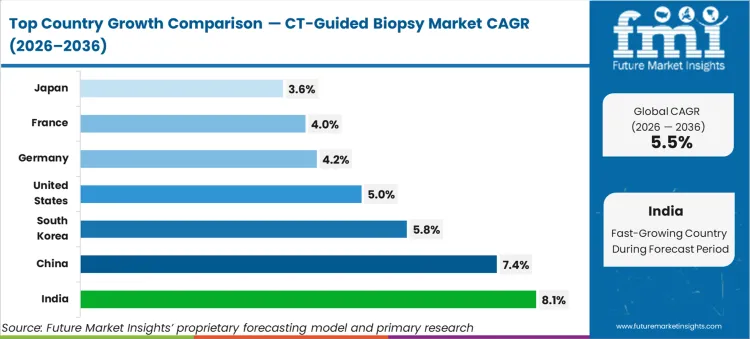
- Geography: China and South Korea show the fastest growth at 7.4% and 5.8% CAGR, supported by expanding CT capacity and higher diagnostic throughput.
- Analyst Opinion at FMI
- Sabyasachi Ghosh, Principal Consultant at Future Market Insights, opines, ‘Preference is being decided by first-pass diagnostic yield, complication control, and procedure time, since imaging suite throughput and repeat-biopsy rates directly affect site economics.’
- Strategic Implications and Executive Takeaways
- Strengthen core needle biopsy kits with coaxial compatibility and needle options that support yield while limiting repeat passes.
- Support CT-fluoroscopy workflows with training and standardized set components that reduce procedure time variability across operators.
- Build service coverage for hospitals and imaging centers with fast replenishment, since procedure schedules depend on uninterrupted kit availability.
- Methodology
- As per FMI, sizing and splits were reconciled using company primary disclosures and workflow-level mapping across CT-guided biopsy settings.
- Shares were validated by linking modality use and technique choice to typical interventional radiology purchasing patterns.
- Sensitivity checks were run across kit mix and device set composition to confirm revenue movement under realistic utilization shifts.
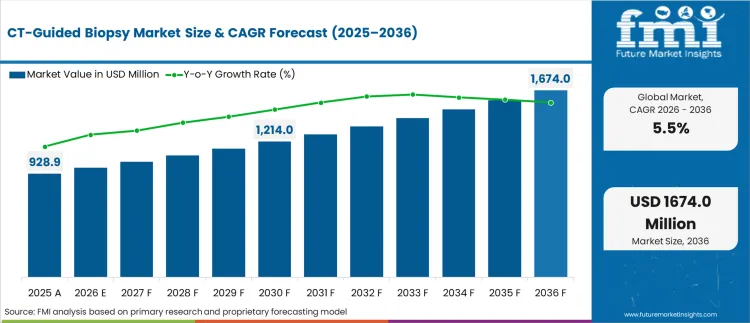
Procurement behaviour is being shaped by standardisation of interventional kits and preference for reliable needle performance, with buyers prioritising sampling consistency, ergonomic handling, and compatibility with CT-fluoroscopy and conventional CT workflows. Multi-vendor sourcing is being maintained in larger hospitals to avoid supply disruption, while product selection is being narrowed to a limited set of proven coaxial and core biopsy configurations aligned to target-organ protocols.
China (7.4% CAGR, supported by expanding interventional radiology capacity and rising oncology work-up volumes) and India (8.1% CAGR, driven by higher diagnostic throughput and broader access to CT-guided interventions) are expected to lead growth. South Korea (5.8% CAGR) is expected to follow through high utilisation in advanced imaging centers. The U.S. (5.0% CAGR) is expected to expand through steady procedural volumes and standardised kits. Mature markets including Germany (4.2%), France (4.0%), and Japan (3.6%) are expected to contribute more through replacement demand, constrained by scheduling capacity and conservative utilisation governance.
CT-Guided Biopsy Market Definition
The market covers devices and consumables used to perform tissue sampling procedures under CT guidance for diagnostic confirmation of suspected disease. It includes needle systems and related biopsy tools used across lung, liver, kidney, bone, pancreas, and other targets, using modalities such as conventional CT, CT-fluoroscopy, cone-beam CT, and spectral or dual-energy CT. Buyers include hospitals, imaging centers, and ambulatory surgical centers that perform interventional radiology procedures requiring precise lesion targeting and controlled sampling. Demand is shaped by oncology and chronic disease work-up volumes, procedure safety protocols, and throughput requirements, with revenue generated through sales of biopsy needle systems and supporting configurations.
CT-Guided Biopsy Market Inclusions
The report includes global and regional market sizes and a 10-year forecast for 2026 to 2036. Segment-level sizing is provided by target organ, biopsy technique, CT modality, end user, and needle system, along with country-level CAGR comparisons across key markets. Coverage includes analysis of procurement and standardisation practices in interventional radiology, kit adoption patterns, and how safety and yield targets influence needle system selection, based on FMI analysis.
CT-Guided Biopsy Market Exclusions
The scope excludes CT scanners and associated capital imaging hardware, radiology information systems, and navigation software sold as standalone categories. It also omits pathology testing revenue, procedure fees, and hospital service income linked to biopsy delivery. Ultrasound-guided and MRI-guided biopsy devices are excluded unless used specifically for CT-guided workflows. The focus remains on CT-guided biopsy needle systems and related consumables aligned to the stated target organs, techniques, modalities, and end users.
CT-Guided Biopsy Market Research Methodology
- Primary Research: Interviews were conducted with interventional radiologists, radiology department procurement leads, cath lab and IR nursing staff, and supplier commercial teams to validate workflow preferences and buying criteria.
- Desk Research: Public information from regulators, professional associations, health system publications, and company primary disclosures was reviewed to benchmark procedural practice and safety considerations.
- Market-Sizing and Forecasting: A hybrid bottom-up and top-down model was developed using installed base of CT Systems and analyzing the procedure volume by target organ across end user facilities, then reconciled using segment shares across biopsy technique and needle systems.
- Data Validation and Update Cycle: Outputs were checked through internal consistency screening and variance review across segments and countries prior to release.
Segmental Analysis
CT-Guided Biopsy Market Analysis by Biopsy Technique
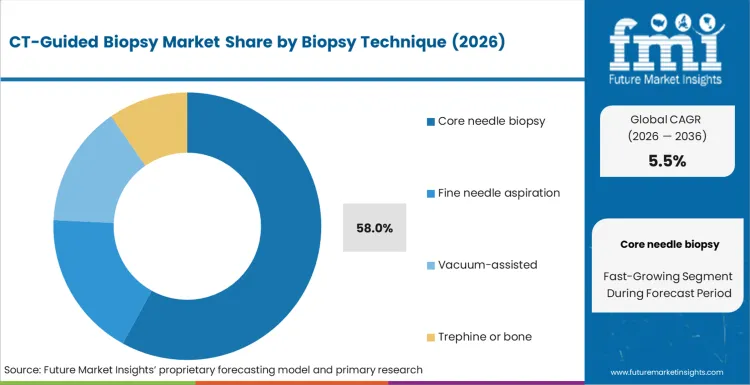
Based on FMI’s report, core needle biopsy is estimated to hold 58.0% share in 2026, followed by fine needle aspiration at 22.0% share. Core needle leadership is supported by its ability to provide tissue architecture for histology, which reduces repeat procedures in many oncology pathways and supports downstream testing needs. Fine needle aspiration remains important where cytology is sufficient or a less invasive approach is preferred, yet share is lower because diagnostic sufficiency can vary by lesion type and sampling adequacy.
- Diagnostic Sufficiency Advantage: Multiple studies in CT-guided lung biopsy show higher sample adequacy for CNB versus FNAB, supporting more consistent definitive pathology and lowering the odds of a non-diagnostic result.[2]
- Histology and Downstream Testing Readiness: In CT-guided transthoracic lung biopsy practice, core needle biopsy is described as the preferred approach over fine-needle aspiration because it better supports histologic assessment and tissue requirements typical of modern care pathways. [3]
- Workflow Efficiency Advantage: Core Needle Biopsy is favored in CT-guided suites because higher first-pass adequacy reduces same-day re-sampling and downstream re-bookings, protecting scanner time and interventional radiology throughput in high-volume hospital settings.
CT-Guided Biopsy Market Analysis by CT modality
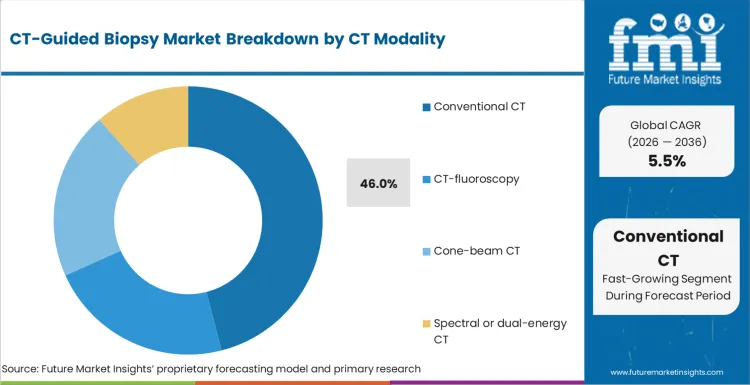
Conventional CT accounts for 46.0% share in 2026, followed by CT-fluoroscopy at 32.0% share, based on FMI’s report. Conventional CT leadership reflects wide availability and established workflow familiarity across interventional radiology, which supports stable adoption across hospitals. CT-fluoroscopy demand is supported by real-time guidance needs in technically challenging access pathways, where procedural control and needle placement precision can reduce adjustments and shorten procedure time, yet uptake is paced by training requirements and radiation management practices.
- Installed Base Pull: Conventional CT is described as the most widely used guidance method in clinical practice, reflecting broad availability and routine IR workflow fit, which naturally concentrates procedure volume in standard CT rooms rather than specialized real-time setups.[4]
- Workflow Standardization Advantage: Conventional CT supports predictable, repeatable stepwise needle-advance checks, making it easier for sites to run consistent protocols across operators and shifts, which tends to keep it as the routine choice for most biopsy lists.
- Lower Implementation Burden: Conventional CT-guided biopsy can be executed using existing scanner configurations and standard room practices, while real-time CT-fluoroscopy often demands tighter radiation-control routines, operator training, and workflow redesign, which limits everyday adoption.
CT-Guided Biopsy Market Drivers, Restraints, and Opportunities
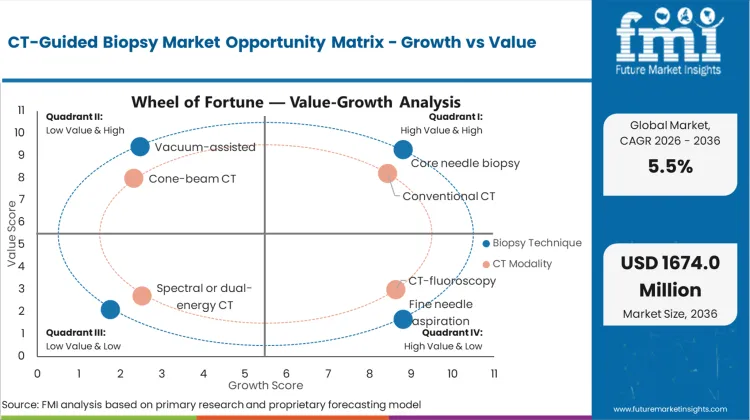
Future Market Insights analysis that historical patterns point at a procedure-driven interventional diagnostics category where demand is anchored in imaging-led lesion detection and oncology confirmation pathways. Estimated valuation in 2026 is being supported by repeat referrals for tissue confirmation and preference for minimally invasive sampling under CT guidance, as per FMI.
While growth is being restrained by CT suite scheduling constraints, operator dependence, and complication risk management that can limit throughput, expansion is being supported by wider access to CT-guided interventions and continued preference for core biopsy techniques that reduce repeat sampling. Based on FMI’s report, procurement is increasingly being filtered by kit completeness, ease of use, and ability to standardize technique and modality workflows across sites.
- Yield-led Technique Shift: Growth is being sustained by preference for core needle biopsy where histology requirements reduce repeat procedures.
- Capacity and Safety Restraint: CT room availability and complication management requirements limit daily procedure throughput in high-volume sites.
- Workflow Standardization Mechanism: Adoption is moving toward modality-technique combinations that reduce procedure time variability and improve scheduling predictability.
Regional Analysis
Based on the regional analysis, CT-guided biopsy market is segmented into North America, Latin America, Western Europe, Eastern Europe East Asia, South Asia, and Middle East & Africa across 40+ countries. Regional performance is assessed using country-level demand signals linked to cancer diagnosis volumes, interventional radiology capacity, reimbursement design, and availability of CT and cone-beam CT suites, as per FMI. The full report also offers market attractiveness analysis based on regional trends.
.webp "Top Country Growth Comparison Ct Guided Biopsy Market Cagr (2026 2036)")
| Country | CAGR |
|---|---|
| United States | 5.0% |
| China | 7.4% |
| Germany | 4.2% |
| France | 4.0% |
| Japan | 3.6% |
| India | 8.1% |
| South Korea | 5.8% |
Source: Future Market Insights (FMI) analysis, based on proprietary forecasting model and primary research
North America CT-Guided Biopsy Market Analysis
North America is shaped by high interventional radiology throughput and guideline-led cancer workups, where procurement is driven by hospital standardisation and device preference for coaxial systems in lung and liver biopsies. BD (Bard) holds strong positioning in biopsy needles and coaxial access systems used in routine CT-guided procedures. Boston Scientific participates through interventional portfolios that align with image-guided access workflows. Cook Medical competes through specialty needles and procedural tools supported by hospital accounts. FMI analysts note that hospitals remain the primary end user, with imaging centers contributing selective volume.
- United States: Demand for CT-guided biopsy in the United States is projected to rise at 5.0% CAGR through 2036. Growth is supported by steady oncology diagnostic volume and continued use of CT guidance for lung, liver, and kidney lesion workups, with core needle biopsy remaining the dominant technique in routine practice. Demand is also reinforced by hospital preference for coaxial systems that reduce repeated pleural puncture in lung procedures and improve sampling efficiency.
FMI’s report includes a detailed analysis of the growth in the North American region, along with a country-wise assessment that includes the United States. Readers can also find regional trends, regulations, and market growth based on different segments and countries in the North America region.
Asia Pacific CT-Guided Biopsy Market Analysis
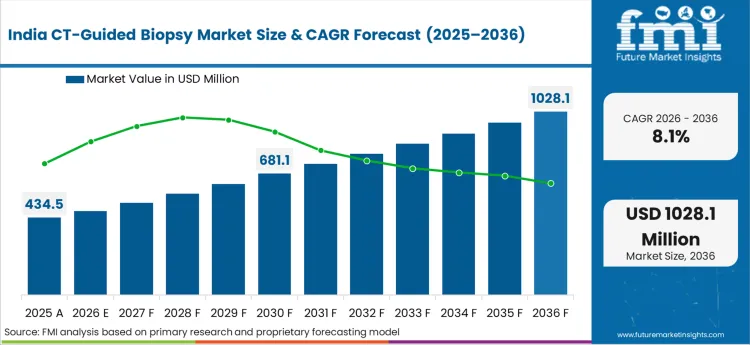
Asia Pacific remains the highest growth region, supported by expanding cancer screening and diagnosis activity, rising availability of CT and CT-fluoroscopy in tertiary hospitals, and increasing investment in interventional radiology infrastructure. BD (Bard) maintains relevance through broad biopsy access portfolios. Terumo and Merit Medical participate through interventional device ecosystems used in hospital procedure suites. Cook Medical remains present through specialty needles and accessories. Future Market Insights analysis links growth to higher lung and liver biopsy volumes and increasing adoption of semi-automated biopsy devices in high-throughput centers.
- China: China’s CT-guided biopsy market is expected to grow at 7.4% CAGR till 2036. This is driven by the increasing number of cancer diagnoses and the growing number of interventional radiology procedures in major public hospitals, where CT-guided core needle biopsy is being increasingly used for lung and liver lesions. This is driven by the increasing use of CT fluoroscopy in major hospitals, which allows for quicker needle placement.
- India: The Indian CT-guided biopsy market is expected to grow at 8.1% CAGR till 2036. This is driven by the increasing cancer diagnosis load and the continued expansion of tertiary care hospitals and private imaging facilities to offer CT-guided procedures. The market remains dominated by core needle biopsy procedures for lung lesions, with an increasing use of coaxial techniques to enhance sampling efficiency.
- Japan: Demand for CT-guided biopsy in Japan is projected to rise at 3.6% CAGR through 2036. Growth is supported by stable oncology workup volumes and mature interventional radiology workflows, with strong reliance on conventional CT guidance and controlled protocol adoption. Volume expansion is moderated by mature infrastructure and high procedural governance, while value is supported by preference for reliable, high-quality biopsy systems.
- South Korea: Demand for CT-guided biopsy in South Korea is projected to rise at 5.8% CAGR through 2036. Growth is supported by high diagnostic intensity and strong hospital-based IR capacity, with CT-guided core biopsy used routinely for thoracic and abdominal lesions. Demand is reinforced by advanced imaging availability in major hospitals, while constraint is created by procedure scheduling pressure and preference for high utilization of CT suites across diagnostic and interventional work.
The full report analyze the CT-guided biopsy market across East and South Asia from 2021-2036, covering pricing, trends, and growth drivers in China, Japan, South Korea, India, Indonesia, Malaysia, and Thailand. The assessment highlights trends that dictate regional demand and procurement behaviour.
Europe CT-Guided Biopsy Market Analysis
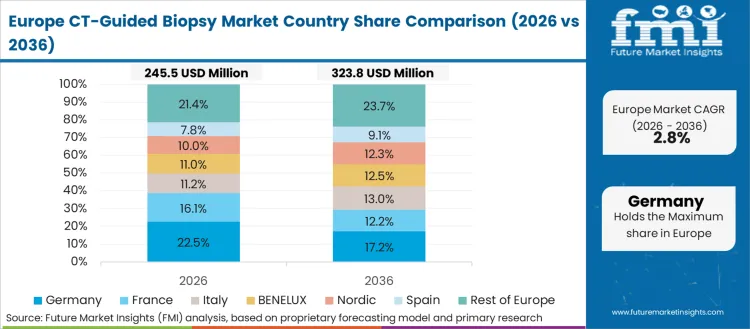
Europe is tender-led and protocol-driven, where CT-guided biopsy demand is shaped by diagnostic pathways, hospital procurement, and increasing emphasis on minimally invasive tissue diagnosis. BD (Bard) remains strongly placed through biopsy needles and access systems. B. Braun and Hologic maintain relevance through procedural devices and related portfolios used in interventional suites. Boston Scientific competes through interventional offerings aligned to hospital demand. FMI opines that demand remains anchored in hospitals, with imaging centers contributing selective case volume.
- Germany: Demand for CT-guided biopsy in Germany is projected to rise at 4.2% CAGR through 2036. Growth is supported by steady oncology diagnostics and continued hospital utilisation of CT-guided core biopsy for lung and abdominal lesions, with procurement governed by tender discipline and protocol standardisation.
- France: Demand for CT-guided biopsy in France is projected to rise at 4.0% CAGR through 2036. Growth is supported by stable hospital throughput and continued preference for minimally invasive tissue diagnosis under CT guidance, while uptake of advanced CT modalities remains concentrated in larger centers.
FMI’s analysis of CT-guided biopsy market in Europe consists of country-wise assessment that includes the Germany, Italy, France, UK, Spain, Russia, Nordic, Benelux and Rest of Europe. Readers can know various regulations and latest trends in the regional market.
Competitive Aligners for Market Players
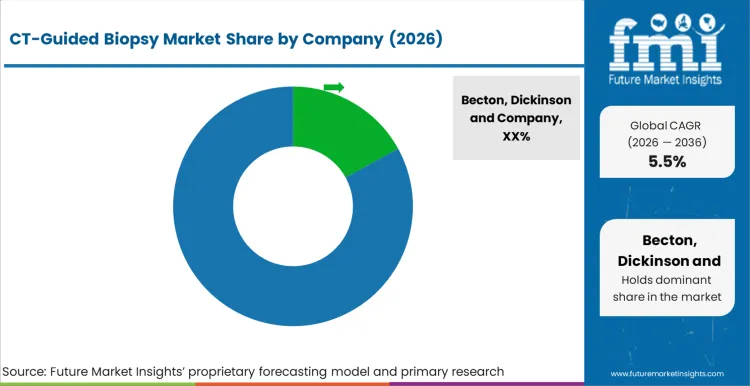
Market structure remains fragmented, yet practical competition is concentrated among a limited set of suppliers that can deliver qualification-ready systems, maintain repeatable low temperature process control, and support device maker audit needs across regulated production. Competition is shaped by validation depth, material compatibility evidence, and throughput reliability, rather than short-cycle price movement, because switching into this modality requires documented change control and performance acceptance. Providers that can support both equipment deployment and service-based access tend to influence adoption by reducing transition burden for medical device manufacturers, as per FMI.
Companies with structural advantages typically combine installed base reach, proven sterilization engineering support, and the capability to produce consistent sterility assurance outcomes across polymers, elastomers, and complex device configurations. Suppliers that can demonstrate tight residue management, repeatable cycle outcomes, and stable process parameters are better positioned when customers expand from pilot runs into routine production. Manufacturers with narrower platform maturity or limited validation support tend to face slower adoption because customers must carry more internal qualification work, which can delay scale-up and increase program risk, based on FMI’s report.
Customer concentration reinforces buyer leverage. Medical device manufacturers often manage supplier dependency by qualifying more than one route or provider, using staged validations, and writing performance clauses tied to cycle acceptance, lead times, and deviation closure. In-house use is preferred where schedule control and confidentiality are required, while outsourced access is selected to avoid capex and to tap validated capacity for complex devices. This behavior constrains pricing power for standard programs, while measured premiums are retained mainly where low temperature compatibility reduces rework risk and protects high value device yields, Future Market Insights analysis.
Recent Developments
The report includes full coverage of key trends from competitive benchmarking. Some of the recent developments covered in the reports:
- In February 2026, PGIMER has pioneered PET/CT-guided prostate biopsy, marking a major advance in precision oncology. The technique delivers a reported 95% diagnostic success rate with a single puncture, significantly reducing rectal exposure and infection risk compared to conventional approaches. By targeting viable tumor tissue through functional imaging, clinicians improve accuracy, minimize repeat biopsies, and lower patient complications positioning PGIMER at the forefront of innovation in prostate cancer diagnostics.
- In July 2025, The VERITAS trial has demonstrated that navigational bronchoscopy (NB) is noninferior to CT-guided transthoracic needle biopsy (TTNB) for diagnosing peripheral lung nodules, offering comparable accuracy with significantly fewer complications. In the multicenter randomized study, NB achieved a diagnostic accuracy of 79.0% versus 73.6% for TTNB, meeting noninferiority criteria. Notably, pneumothorax occurred in just 3.3% of NB cases compared with 28.3% for TTNB. Experts highlight NB’s superior safety profile and ability to enable staging in a single procedure as practice-changing advantages.
- In Sept 2025, On PubMed Central, a recent ex vivo study benchmarked newly available biopsy needles in Japan. Merit Medical’s semi-automatic TEMNO Elite produced the heaviest specimens across both test materials, while its full-core CorVocet showed higher sample weight with longer throw lengths, supporting higher-yield core sampling.[2]
- In May 2024, Hologic announced the availability of Brevera Breast Biopsy System 7-gauge needle in Europe. This addition expands the suite of Brevera disposable biopsy needles and provides radiologists with more options for their biopsy procedures. The Brevera system was the world’s first vacuum-assisted breast biopsy solution to integrate tissue acquisition, real-time imaging and verification and post-biopsy handling.[5]
Key players in CT-guided Biopsy Market
- Becton, Dickinson and Company
- Cook Medical LLC
- Boston Scientific Corporation
- Argon Medical Devices, Inc.
- Merit Medical Systems, Inc.
- Terumo Corporation
- Medtronic plc
- B. Braun Melsungen AG
- Hologic, Inc.
- Cardinal Health, Inc.
Scope of the Report
| Metric | Value |
|---|---|
| Quantitative units | USD 980.0 Mn (2026) to USD 1,680.0 Mn (2036), at a CAGR of 5.5% |
| Market definition | The CT-guided biopsy market comprises global production and trade of percutaneous biopsy devices and procedure enabling consumables used under CT guidance to obtain tissue samples for diagnosis, staging, and therapy planning, where demand is tied to imaging guided intervention volumes, lesion accessibility, and protocol driven sampling practices in hospitals and imaging centers. |
| Target organ segmentation | Lung, Liver, Kidney, Bone, Pancreas, Other |
| Biopsy technique segmentation | Core needle biopsy, Fine needle aspiration, Vacuum-assisted, Trephine or bone |
| CT modality coverage | Conventional CT, CT-fluoroscopy, Cone-beam CT, Spectral or dual-energy CT |
| End user coverage | Hospitals, Imaging centers, ASCs |
| Needle system coverage | Coaxial systems, Non-coaxial, Semi-automated, Fully automated |
| Regions covered | North America, Latin America, East Asia, South Asia & Pacific, Western Europe, Eastern Europe, and Middle East & Africa. |
| Countries covered | United States, Canada, Mexico, Brazil, Argentina, Germany, France, United Kingdom, Italy, Spain, China, India, Japan, South Korea, Indonesia, Australia and 40+ countries |
| Key companies profiled | Becton, Dickinson and Company, Cook Medical LLC, Boston Scientific Corporation, Argon Medical Devices, Inc., Merit Medical Systems, Inc., Terumo Corporation, Medtronic plc, B. Braun Melsungen AG, Hologic, Inc., Cardinal Health, Inc. |
| Forecast period | 2026 to 2036 |
| Approach | Hybrid top down and bottom up market modeling validated through primary interviews with interventional radiology stakeholders and device suppliers, supported by procedure volume triangulation and regulatory pathway review, as per FMI. |
CT-guided Biopsy Market Analysis by Segments
Target Organ:
- Lung
- Liver
- Kidney
- Bone
- Pancreas
- Other
Biopsy Technique:
- Core needle biopsy
- Fine needle aspiration
- Vacuum-assisted
- Trephine or bone
CT Modality:
- Conventional CT
- CT-fluoroscopy
- Cone-beam CT
- Spectral or dual-energy CT
Needle System:
- Coaxial systems
- Non-coaxial
- Semi-automated
- Fully automated
End User:
- Hospitals
- Imaging centers
- ASCs
Region:
- North America
- USA
- Canada
- Mexico
- Latin America
- Brazil
- Argentina
- Rest of Latin America
- East Asia
- China
- Japan
- South Korea
- South Asia & Pacific
- India
- ASEAN Countries
- Australia & New Zealand
- Rest of South Asia
- Western Europe
- Germany
- UK
- France
- Italy
- Spain
- BENELUX
- Nordic Countries
- Rest of Western Europe
- Eastern Europe
- Russia
- Hungary
- Poland
- Rest of Eastern Europe
- Middle East & Africa
- Saudi Arabia
- Türkiye
- South Africa
- Other African Union
- Rest of Middle East & Africa
Bibliography
- [1] UC DAVIS Health, 2025 New hybrid imaging breakthrough could transform detection of cancer and other diseases
- [2] PubMed, National Library of Medicine, (2022), Comparison between computed tomography-guided core and fine needle lung biopsy- A meta-analysis
- [3] RSNA, (2025), How I Do It: CT-guided Percutaneous Transthoracic Lung Biopsy.
- [4] PubMed, (2024), Conventional versus cone-beam computed tomography in lung biopsy: diagnostic performance, risks, and the advantages of tract embolization with gelfoam particle suspension
- [5] Hologic, (2024), Hologic launches new 7-gauge disposable needle for Brevera Breast Biopsy System in Europe.
This bibliography is provided for reader reference and is not exhaustive. The full report contains the complete reference list and detailed citations.
This Report Addresses
- Market intelligence to enable structured strategic decision making across image guided intervention demand and device portfolio planning
- Market size estimation and 10-year revenue forecasts from 2026 to 2036 for CT-guided biopsy procedures and device demand
- Growth opportunity mapping across target organ, biopsy technique, CT modality, end user, and needle system demand pools
- Segment and regional revenue forecasts aligned to the stated taxonomy and covered geographies
- Competition strategy assessment including portfolio positioning, workflow fit, and channel coverage benchmarking
- Product and compliance tracking focused on sterile labeling, device documentation needs, and quality system expectations
- Regulatory impact analysis covering device submission requirements and clinical evidence expectations affecting adoption planning
- Market report delivery in PDF, Excel, PPT, and interactive dashboard formats for executive and operational use
Frequently Asked Questions
How large is the demand for CT-guided biopsy in the global market in 2026?
Demand for CT-guided biopsy in the global market is estimated to be valued at USD 980.0 Million in 2026, as per FMI.
What will be the market size of CT-guided biopsy in the global market by 2036?
Market size for CT-guided biopsy is projected to reach USD 1,680.0 Million by 2036.
What is the expected demand growth for CT-guided biopsy in the global market between 2026 and 2036?
Demand for CT-guided biopsy in the global market is expected to grow at a CAGR of 5.5% between 2026 and 2036.
Which biopsy technique is poised to lead global demand by 2026?
Core needle biopsy is expected to be the dominant technique, capturing 58.0% share in 2026.
How significant is the role of hospitals in driving CT-guided biopsy adoption in 2026?
Hospitals are projected to hold 72.0% share of end user demand in 2026.
Which target organ contributes the largest share of CT-guided biopsy demand in 2026?
Lung is projected to account for 34.0% share of the target organ split in 2026.
Preview the report firsthand - request a free sample
Get SampleGet the brochure for pricing and purchase details.
Get PDFTable of Content
- Executive Summary
- Global Market Outlook
- Demand-side Trends
- Supply-side Trends
- Technology Roadmap Analysis
- Analysis and Recommendations
- Market Overview
- Market Coverage / Taxonomy
- Market Definition / Scope / Limitations
- Research Methodology
- Chapter Orientation
- Analytical Lens and Working Hypotheses
- Market Structure, Signals, and Trend Drivers
- Benchmarking and Cross-market Comparability
- Market Sizing, Forecasting, and Opportunity Mapping
- Research Design and Evidence Framework
- Desk Research Programme (Secondary Evidence)
- Company Annual and Sustainability Reports
- Peer-reviewed Journals and Academic Literature
- Corporate Websites, Product Literature, and Technical Notes
- Earnings Decks and Investor Briefings
- Statutory Filings and Regulatory Disclosures
- Technical White Papers and Standards Notes
- Trade Journals, Industry Magazines, and Analyst Briefs
- Conference Proceedings, Webinars, and Seminar Materials
- Government Statistics Portals and Public Data Releases
- Press Releases and Reputable Media Coverage
- Specialist Newsletters and Curated Briefings
- Sector Databases and Reference Repositories
- FMI Internal Proprietary Databases and Historical Market Datasets
- Subscription Datasets and Paid Sources
- Social Channels, Communities, and Digital Listening Inputs
- Additional Desk Sources
- Expert Input and Fieldwork (Primary Evidence)
- Primary Modes
- Qualitative Interviews and Expert Elicitation
- Quantitative Surveys and Structured Data Capture
- Blended Approach
- Why Primary Evidence is Used
- Field Techniques
- Interviews
- Surveys
- Focus Groups
- Observational and In-context Research
- Social and Community Interactions
- Stakeholder Universe Engaged
- C-suite Leaders
- Board Members
- Presidents and Vice Presidents
- R&D and Innovation Heads
- Technical Specialists
- Domain Subject-matter Experts
- Scientists
- Physicians and Other Healthcare Professionals
- Governance, Ethics, and Data Stewardship
- Research Ethics
- Data Integrity and Handling
- Primary Modes
- Tooling, Models, and Reference Databases
- Desk Research Programme (Secondary Evidence)
- Data Engineering and Model Build
- Data Acquisition and Ingestion
- Cleaning, Normalisation, and Verification
- Synthesis, Triangulation, and Analysis
- Quality Assurance and Audit Trail
- Market Background
- Market Dynamics
- Drivers
- Restraints
- Opportunity
- Trends
- Scenario Forecast
- Demand in Optimistic Scenario
- Demand in Likely Scenario
- Demand in Conservative Scenario
- Opportunity Map Analysis
- Product Life Cycle Analysis
- Supply Chain Analysis
- Investment Feasibility Matrix
- Value Chain Analysis
- PESTLE and Porter’s Analysis
- Regulatory Landscape
- Regional Parent Market Outlook
- Production and Consumption Statistics
- Import and Export Statistics
- Market Dynamics
- Global Market Analysis 2021 to 2025 and Forecast, 2026 to 2036
- Historical Market Size Value (USD Million) Analysis, 2021 to 2025
- Current and Future Market Size Value (USD Million) Projections, 2026 to 2036
- Y-o-Y Growth Trend Analysis
- Absolute $ Opportunity Analysis
- Global Market Pricing Analysis 2021 to 2025 and Forecast 2026 to 2036
- Global Market Analysis 2021 to 2025 and Forecast 2026 to 2036, By Biopsy Technique
- Introduction / Key Findings
- Historical Market Size Value (USD Million) Analysis By Biopsy Technique , 2021 to 2025
- Current and Future Market Size Value (USD Million) Analysis and Forecast By Biopsy Technique , 2026 to 2036
- Core needle biopsy
- Fine needle aspiration
- Vacuum-assisted
- Trephine or bone
- Core needle biopsy
- Y-o-Y Growth Trend Analysis By Biopsy Technique , 2021 to 2025
- Absolute $ Opportunity Analysis By Biopsy Technique , 2026 to 2036
- Global Market Analysis 2021 to 2025 and Forecast 2026 to 2036, By CT Modality
- Introduction / Key Findings
- Historical Market Size Value (USD Million) Analysis By CT Modality, 2021 to 2025
- Current and Future Market Size Value (USD Million) Analysis and Forecast By CT Modality, 2026 to 2036
- Conventional CT
- CT-fluoroscopy
- Cone-beam CT
- Spectral or dual-energy CT
- Conventional CT
- Y-o-Y Growth Trend Analysis By CT Modality, 2021 to 2025
- Absolute $ Opportunity Analysis By CT Modality, 2026 to 2036
- Global Market Analysis 2021 to 2025 and Forecast 2026 to 2036, By Region
- Introduction
- Historical Market Size Value (USD Million) Analysis By Region, 2021 to 2025
- Current Market Size Value (USD Million) Analysis and Forecast By Region, 2026 to 2036
- North America
- Latin America
- Western Europe
- Eastern Europe
- East Asia
- South Asia and Pacific
- Middle East & Africa
- Market Attractiveness Analysis By Region
- North America Market Analysis 2021 to 2025 and Forecast 2026 to 2036, By Country
- Historical Market Size Value (USD Million) Trend Analysis By Market Taxonomy, 2021 to 2025
- Market Size Value (USD Million) Forecast By Market Taxonomy, 2026 to 2036
- By Country
- USA
- Canada
- Mexico
- By Biopsy Technique
- By CT Modality
- By Country
- Market Attractiveness Analysis
- By Country
- By Biopsy Technique
- By CT Modality
- Key Takeaways
- Latin America Market Analysis 2021 to 2025 and Forecast 2026 to 2036, By Country
- Historical Market Size Value (USD Million) Trend Analysis By Market Taxonomy, 2021 to 2025
- Market Size Value (USD Million) Forecast By Market Taxonomy, 2026 to 2036
- By Country
- Brazil
- Chile
- Rest of Latin America
- By Biopsy Technique
- By CT Modality
- By Country
- Market Attractiveness Analysis
- By Country
- By Biopsy Technique
- By CT Modality
- Key Takeaways
- Western Europe Market Analysis 2021 to 2025 and Forecast 2026 to 2036, By Country
- Historical Market Size Value (USD Million) Trend Analysis By Market Taxonomy, 2021 to 2025
- Market Size Value (USD Million) Forecast By Market Taxonomy, 2026 to 2036
- By Country
- Germany
- UK
- Italy
- Spain
- France
- Nordic
- BENELUX
- Rest of Western Europe
- By Biopsy Technique
- By CT Modality
- By Country
- Market Attractiveness Analysis
- By Country
- By Biopsy Technique
- By CT Modality
- Key Takeaways
- Eastern Europe Market Analysis 2021 to 2025 and Forecast 2026 to 2036, By Country
- Historical Market Size Value (USD Million) Trend Analysis By Market Taxonomy, 2021 to 2025
- Market Size Value (USD Million) Forecast By Market Taxonomy, 2026 to 2036
- By Country
- Russia
- Poland
- Hungary
- Balkan & Baltic
- Rest of Eastern Europe
- By Biopsy Technique
- By CT Modality
- By Country
- Market Attractiveness Analysis
- By Country
- By Biopsy Technique
- By CT Modality
- Key Takeaways
- East Asia Market Analysis 2021 to 2025 and Forecast 2026 to 2036, By Country
- Historical Market Size Value (USD Million) Trend Analysis By Market Taxonomy, 2021 to 2025
- Market Size Value (USD Million) Forecast By Market Taxonomy, 2026 to 2036
- By Country
- China
- Japan
- South Korea
- By Biopsy Technique
- By CT Modality
- By Country
- Market Attractiveness Analysis
- By Country
- By Biopsy Technique
- By CT Modality
- Key Takeaways
- South Asia and Pacific Market Analysis 2021 to 2025 and Forecast 2026 to 2036, By Country
- Historical Market Size Value (USD Million) Trend Analysis By Market Taxonomy, 2021 to 2025
- Market Size Value (USD Million) Forecast By Market Taxonomy, 2026 to 2036
- By Country
- India
- ASEAN
- Australia & New Zealand
- Rest of South Asia and Pacific
- By Biopsy Technique
- By CT Modality
- By Country
- Market Attractiveness Analysis
- By Country
- By Biopsy Technique
- By CT Modality
- Key Takeaways
- Middle East & Africa Market Analysis 2021 to 2025 and Forecast 2026 to 2036, By Country
- Historical Market Size Value (USD Million) Trend Analysis By Market Taxonomy, 2021 to 2025
- Market Size Value (USD Million) Forecast By Market Taxonomy, 2026 to 2036
- By Country
- Kingdom of Saudi Arabia
- Other GCC Countries
- Turkiye
- South Africa
- Other African Union
- Rest of Middle East & Africa
- By Biopsy Technique
- By CT Modality
- By Country
- Market Attractiveness Analysis
- By Country
- By Biopsy Technique
- By CT Modality
- Key Takeaways
- Key Countries Market Analysis
- USA
- Pricing Analysis
- Market Share Analysis, 2025
- By Biopsy Technique
- By CT Modality
- Canada
- Pricing Analysis
- Market Share Analysis, 2025
- By Biopsy Technique
- By CT Modality
- Mexico
- Pricing Analysis
- Market Share Analysis, 2025
- By Biopsy Technique
- By CT Modality
- Brazil
- Pricing Analysis
- Market Share Analysis, 2025
- By Biopsy Technique
- By CT Modality
- Chile
- Pricing Analysis
- Market Share Analysis, 2025
- By Biopsy Technique
- By CT Modality
- Germany
- Pricing Analysis
- Market Share Analysis, 2025
- By Biopsy Technique
- By CT Modality
- UK
- Pricing Analysis
- Market Share Analysis, 2025
- By Biopsy Technique
- By CT Modality
- Italy
- Pricing Analysis
- Market Share Analysis, 2025
- By Biopsy Technique
- By CT Modality
- Spain
- Pricing Analysis
- Market Share Analysis, 2025
- By Biopsy Technique
- By CT Modality
- France
- Pricing Analysis
- Market Share Analysis, 2025
- By Biopsy Technique
- By CT Modality
- India
- Pricing Analysis
- Market Share Analysis, 2025
- By Biopsy Technique
- By CT Modality
- ASEAN
- Pricing Analysis
- Market Share Analysis, 2025
- By Biopsy Technique
- By CT Modality
- Australia & New Zealand
- Pricing Analysis
- Market Share Analysis, 2025
- By Biopsy Technique
- By CT Modality
- China
- Pricing Analysis
- Market Share Analysis, 2025
- By Biopsy Technique
- By CT Modality
- Japan
- Pricing Analysis
- Market Share Analysis, 2025
- By Biopsy Technique
- By CT Modality
- South Korea
- Pricing Analysis
- Market Share Analysis, 2025
- By Biopsy Technique
- By CT Modality
- Russia
- Pricing Analysis
- Market Share Analysis, 2025
- By Biopsy Technique
- By CT Modality
- Poland
- Pricing Analysis
- Market Share Analysis, 2025
- By Biopsy Technique
- By CT Modality
- Hungary
- Pricing Analysis
- Market Share Analysis, 2025
- By Biopsy Technique
- By CT Modality
- Kingdom of Saudi Arabia
- Pricing Analysis
- Market Share Analysis, 2025
- By Biopsy Technique
- By CT Modality
- Turkiye
- Pricing Analysis
- Market Share Analysis, 2025
- By Biopsy Technique
- By CT Modality
- South Africa
- Pricing Analysis
- Market Share Analysis, 2025
- By Biopsy Technique
- By CT Modality
- USA
- Market Structure Analysis
- Competition Dashboard
- Competition Benchmarking
- Market Share Analysis of Top Players
- By Regional
- By Biopsy Technique
- By CT Modality
- Competition Analysis
- Competition Deep Dive
- Becton, Dickinson and Company
- Overview
- Product Portfolio
- Profitability by Market Segments (Product/Age /Sales Channel/Region)
- Sales Footprint
- Strategy Overview
- Marketing Strategy
- Product Strategy
- Channel Strategy
- Cook Medical LLC
- Boston Scientific Corporation
- Argon Medical Devices, Inc.
- Merit Medical Systems, Inc.
- Terumo Corporation
- Medtronic plc
- B. Braun Melsungen AG
- Hologic, Inc.
- Cardinal Health, Inc.
- Becton, Dickinson and Company
- Competition Deep Dive
- Assumptions & Acronyms Used


