

- Industry Size (2026)
- USD 1220 Mn
- Forecast (2036)
- USD 4160 Mn
- CAGR (2026 to 2036)
- 13.1%
Sleeve Packaging for Extrusions Market Forecast and Outlook 2026 to 2036
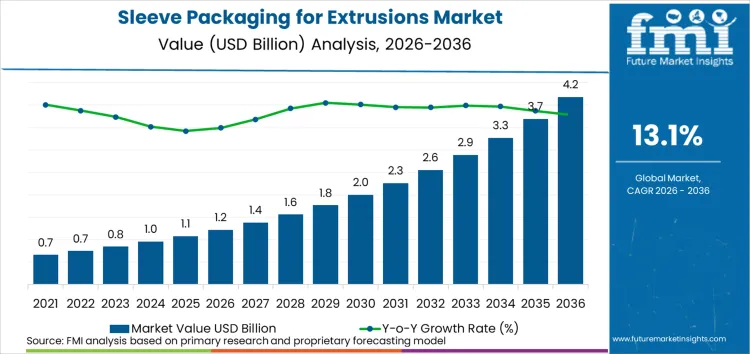
The global sleeve packaging for extrusions market is forecast to reach a valuation of USD 1,220 million in 2026 and is projected to expand to USD 4,160 million by 2036, registering a CAGR of 13.1% during the forecast period. This expansion reflects a structural transition in how extrusion manufacturers, fabricators, and downstream OEMs perceive packaging, not as a low-value consumable, but as surface-critical quality infrastructure and a compliance-enabling system within increasingly regulated and traceability-driven supply chains.
Sleeve packaging is becoming indispensable as extrusions serve higher-value, finish-sensitive applications across electric vehicles, renewable energy systems, architectural curtain walls, and precision industrial equipment. Anodized aluminum, fluoropolymer-coated profiles, corrosion-sensitive steel channels, and engineered PVC extrusions now operate under zero-tolerance defect regimes, where even minor scratches, dents, or water staining can invalidate performance warranties or trigger full component rejection.
As extrusion lengths extend beyond six meters and components traverse multi-node logistics pathways, extrusion press, surface treatment, secondary machining, export consolidation, and jobsite staging, the probability-weighted cost of surface damage has risen sharply, elevating engineered sleeving into a mandatory specification rather than a discretionary upgrade.
The market’s growth trajectory is also reinforced by industrial automation and serialization mandates. Electric vehicle platforms, solar frame manufacturing, and medical-grade extrusion supply chains increasingly require component-level traceability, contamination control, and standardized handling histories.
Summary of Sleeve Packaging for Extrusions Market
- The sleeve packaging for extrusions market comprises engineered tubular and wraparound protective packaging systems designed to preserve surface integrity, prevent corrosion, enable component identification, and ensure damage-free storage, handling, and transportation of linear extruded products.
- Within FMI’s defined scope, the market focuses exclusively on dedicated extrusion sleeving systems engineered for long-length linear geometries and validated for specific substrate sensitivities and logistics environments. The scope explicitly excludes general-purpose stretch wrap, pallet-level unitization films, non-extrusion industrial packaging, and downstream logistics or installation services.
- FMI projects the market to expand at a 13.1% CAGR between 2026 and 2036, growing from USD 1,220 million in 2026 to USD 4,160 million by 2036. This growth is underpinned by electric vehicle lightweighting trajectories, renewable energy deployment, premium architectural finish specifications, and the institutionalization of traceability and damage-free delivery requirements across global extrusion supply chains.
- Structurally, the sector is undergoing a decisive transition away from commoditized polyethylene sleeves and paper wraps toward application-engineered, substrate-validated, and compliance-ready protection architectures. Competitive advantage increasingly accrues to suppliers capable of aligning materials science, structural design, automation compatibility, and sustainability documentation within a single offering.
- Europe currently represents the largest regional market by value, while China is the fastest-growing country market, reflecting its scale in EV and renewable energy manufacturing. Germany and the United States follow closely, driven by automotive supply chain compliance and advanced manufacturing investment respectively.
Sleeve packaging formats, particularly corrugated and film sleeves with integrated QR codes or RFID functionality, are emerging as the most practical carriers of this traceability layer. This transforms sleeves from passive protective barriers into data-bearing assets, linking physical surface protection with digital quality documentation.
Regulatory alignment further accelerates adoption. The European Union’s PPWR, becoming legally binding in August 2026, introduces enforceable design-for-recycling criteria that materially restrict non-recyclable, mixed-material protective formats. Export-oriented extrusion manufacturers supplying EU markets are therefore transitioning rapidly toward mono-material corrugated sleeves and all-polyethylene film systems that can be clearly documented under EN 13430 recyclability frameworks.
Parallel pressure is evident in China under the 14th Five-Year Plan and Low-Carbon Development Promotion mandates, as well as in select U.S. states through eco-modulated EPR fee structures. These frameworks collectively reinforce the shift away from commodity wraps toward engineered, compliant sleeve architectures.
Sleeve Packaging for Extrusions Market Key Takeaways
| Metric | Value |
|---|---|
| Market Size (2026E) | USD 1,220 million |
| Market Size (2036F) | USD 4,160 million |
| CAGR (2026-2036) | 13.1% |
Source: Future Market Insights (FMI)
Why is the Sleeve Packaging for Extrusions Market Growing?
Growth in sleeve packaging demand is being propelled by the convergence of electric vehicle manufacturing expansion, renewable energy infrastructure deployment, architectural finish premiumization, and regulatory enforcement of circular economy principles. Across these end-use domains, extrusions are no longer treated as semi-finished commodities but as high-value, surface-critical components whose integrity must be preserved from press exit to final installation.
Electric vehicle manufacturing represents the single most powerful accelerator. Battery enclosures, structural rails, crash management systems, and thermal management profiles require absolute surface integrity to ensure weld quality, coating adhesion, and long-term durability. As EV platforms scale globally, OEMs are institutionalizing serialized sleeve packaging with documented handling histories, shifting liability for in-transit damage upstream to extruders and their packaging systems.
Renewable energy infrastructure reinforces similar dynamics. Solar photovoltaic frames and wind turbine structural components must withstand extended ocean freight and jobsite staging. Corrosion-preventive, impact-resistant sleeve packaging validated for humid and high-vibration environments has therefore become standard specification rather than optional enhancement.
Architectural construction further elevates surface quality expectations. Curtain wall and façade systems increasingly specify Class I anodized finishes that are not field-repairable. Any visible surface aberration discovered at installation triggers full component replacement, making certified sleeving an economic necessity. Finally, regulatory frameworks such as EU PPWR and China’s low-carbon mandates reinforce adoption by disincentivizing non-recyclable mixed-material formats and favoring mono-material corrugated and polyethylene sleeve systems.
How is the Sleeve Packaging for Extrusions Market Segmented?
The sleeve packaging for extrusions market is segmented by extrusion type, sleeve format, and material, reflecting the fact that packaging requirements are driven by a combination of surface sensitivity, geometry length, and downstream handling complexity. Unlike pallet-level or bulk industrial packaging, sleeve systems are specified at the individual component level, where even localized surface abrasion, denting, or moisture ingress can render an extrusion unfit for use. As a result, segmentation outcomes closely track the dominant failure modes associated with each extrusion class and the environments through which they move.
The market is also shaped by a clear shift from generic protective wraps toward application-engineered sleeving architectures. Buyers increasingly specify sleeve solutions validated for extrusion length, alloy or polymer chemistry, surface treatment, and logistics duration. This has raised the average value per unit of packaging and concentrated demand around suppliers capable of delivering standardized yet configurable sleeve systems that scale across production volumes while maintaining consistent protection performance.
Why do Aluminum Extrusions represent the largest demand segment?
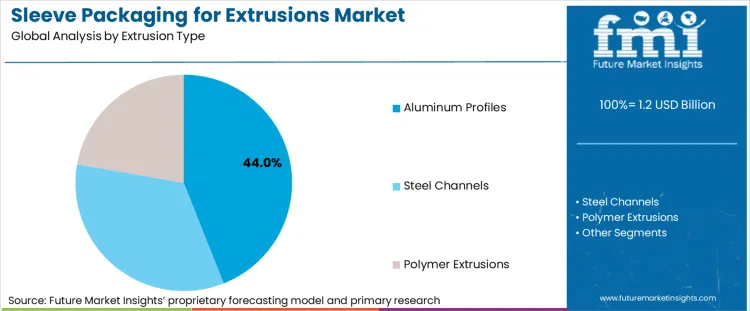
Aluminum extrusions account for 44% of total market demand, making them the largest extrusion-type segment. This dominance reflects aluminum’s central role in electric vehicles, architectural façades, solar mounting systems, and lightweight industrial frameworks. In these applications, extrusions are increasingly finished with anodized or fluoropolymer coatings that exhibit extreme sensitivity to abrasion, point impact, and moisture staining, necessitating continuous surface protection from press exit through installation.
Operationally, aluminum extrusions often move through long, multi-stage supply chains involving extrusion, surface finishing, secondary machining, export consolidation, and site-level staging. Each transfer increases exposure to handling damage, especially for long-length profiles exceeding six meters. Sleeve packaging mitigates this risk by providing continuous coverage, controlled friction during stacking, and optional corrosion barriers, making it a default specification for premium aluminum extrusion programs rather than a discretionary add-on.
How are Corrugated Sleeves emerging as the dominant sleeve format?
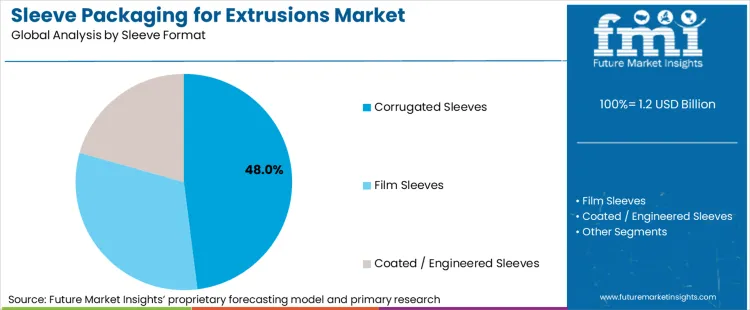
Corrugated sleeves hold an estimated 48% share of sleeve format demand, driven by their ability to deliver structural protection, stack stability, and recyclability within a single mono-material architecture. Corrugated formats provide rigidity that resists bending and edge impacts, particularly important for thin-walled extrusions that rely on geometry rather than mass for stiffness. This structural benefit makes corrugated sleeves especially suitable for long-length aluminum and steel profiles transported in horizontal racks or bundled stacks.
From a compliance and sustainability perspective, corrugated sleeves offer a clear advantage. They align with established fiber recycling systems and are readily documented under design-for-recycling criteria, reducing regulatory ambiguity for exporters and multinational manufacturers. As regulatory enforcement around packaging waste tightens, corrugated sleeves are increasingly favored over mixed-material or plastic-heavy alternatives, reinforcing their leadership position across multiple end-use sectors.
Why does Corrugated Board dominate the material landscape?
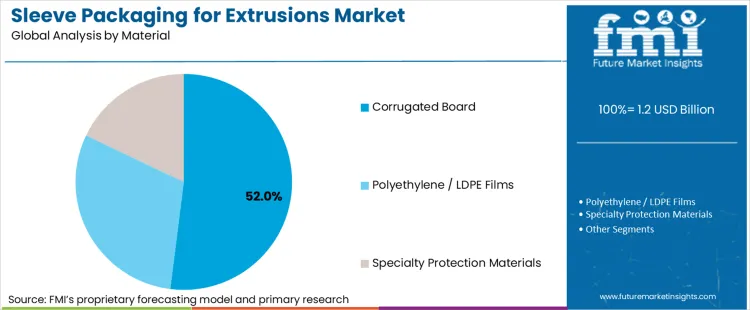
Corrugated board accounts for approximately 52% of total material usage, reflecting its versatility across extrusion types and logistics conditions. Corrugated board provides a balance of cushioning, rigidity, and breathability, enabling it to protect against both mechanical damage and moisture-related corrosion when properly specified. In many applications, it can be combined with coatings or liners to enhance moisture resistance without compromising recyclability.
Economically, corrugated board also benefits from scalability and supply-chain familiarity. Extrusion manufacturers and packaging suppliers are deeply integrated into corrugated sourcing ecosystems, enabling predictable pricing, rapid customization, and high-volume availability. As sleeve packaging becomes institutionalized within extrusion programs, procurement teams favor materials that offer consistent quality, low compliance risk, and compatibility with automation, criteria that corrugated board continues to meet effectively.
What Drivers, Restraints, Opportunities, and Trends Shape the Sleeve Packaging for Extrusions Market?
Drivers
A primary driver is the premiumization of extrusion end-use applications, particularly in electric vehicles, renewable energy, and architectural construction. As extrusions take on structural and aesthetic roles, tolerance for surface defects approaches zero. Sleeve packaging becomes essential for preserving finish integrity, reducing rework, and avoiding warranty disputes, making it a non-negotiable element of production planning.
Another significant driver is the extension of extrusion supply chains. Export-oriented manufacturing, centralized finishing hubs, and just-in-time delivery models increase handling frequency and transit duration. Sleeve packaging reduces cumulative damage probability across these nodes, delivering measurable reductions in scrap rates and field rejections—benefits that outweigh incremental packaging costs.
Restraints
One of the main restraints is SKU and geometry complexity. Extrusions vary widely in cross-section, length, and surface treatment, complicating sleeve design and inventory management. Custom sleeve dimensions and tooling can increase upfront costs, particularly for manufacturers with extensive die libraries or short production runs.
A second restraint is cost sensitivity in lower-value extrusion segments, such as basic construction profiles or commodity industrial channels. In these segments, buyers may resist higher-spec sleeve solutions if immediate ROI is not apparent, slowing adoption until regulatory or customer requirements mandate upgraded protection.
Opportunities
A major opportunity lies in integrated sleeve systems that combine protection with traceability. Corrugated or film sleeves incorporating printed QR codes, batch identifiers, or RFID features enable packaging to serve as a data carrier, supporting quality documentation and recall readiness—capabilities increasingly valued in EV and renewable energy supply chains.
Another opportunity is the replacement of non-recyclable protective formats. As regulations and corporate sustainability targets tighten, suppliers that can convert customers from plastic-heavy or mixed-material wraps to recyclable mono-material sleeve systems stand to capture long-term contracts and preferred-supplier status.
Trends
A defining trend is the shift toward standardized sleeve platforms. Rather than designing unique sleeves for every extrusion, manufacturers are consolidating designs into modular size families that can accommodate multiple profiles. This reduces tooling complexity, simplifies inventory, and supports automation in sleeve application.
Another important trend is the integration of sleeve packaging into automated handling systems. As extrusion plants invest in automation, sleeves must be compatible with robotic loading, bundling, and scanning processes. This favors suppliers that can deliver consistent tolerances, predictable friction properties, and automation-ready designs.
Analysis of Sleeve Packaging for Extrusions Market by Key Countries
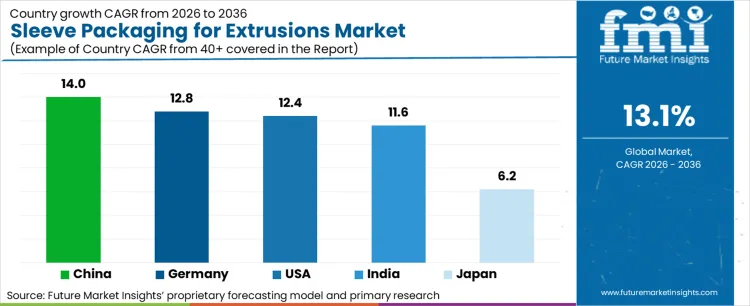
| Country | CAGR (2026-2036) |
|---|---|
| China | 14.0% |
| Germany | 12.8% |
| United States | 12.4% |
| India | 11.6% |
| Japan | 6.2% |
Source: Future Market Insights (FMI), proprietary forecasting model and primary research
Why Is China the Fastest-Growing Market for Sleeve Packaging for Extrusions?
China is projected to expand at a 14.0% CAGR between 2026 and 2036, making it the fastest-growing national market for sleeve packaging for extrusions. This growth is fundamentally anchored in China’s dominance across electric vehicle manufacturing, solar photovoltaic module framing, and large-scale infrastructure projects—all of which rely heavily on long-length aluminum and steel extrusions with stringent surface-quality requirements. As extrusion output scales, so does exposure to handling damage across multiple nodes, including centralized finishing plants, export consolidation hubs, and extended domestic logistics corridors.
A second structural driver behind China’s expansion is the rapid professionalization of extrusion packaging standards. Chinese manufacturers supplying international OEMs are increasingly required to demonstrate damage-free delivery, traceability, and recyclability alignment. Sleeve packaging has become a preferred solution because it provides surface protection while also enabling batch-level identification and easier compliance documentation. This transition from ad hoc wrapping to standardized sleeve systems underpins sustained above-average growth.
How does Germany’s Manufacturing Discipline Sustain Strong Growth in a Mature Market?
Germany is forecast to grow at a 12.8% CAGR over the forecast period, reflecting a value-led expansion rather than volume-driven growth. German extrusion markets are characterized by engineering-led procurement, tight dimensional tolerances, and high finish sensitivity, particularly in automotive structures, industrial automation, and architectural systems. In these environments, surface damage is not treated as cosmetic loss but as a quality non-conformance, pushing manufacturers toward engineered sleeve packaging validated for abrasion resistance, moisture control, and stack stability.
Germany’s growth is further reinforced by regulatory clarity and sustainability alignment. Packaging systems that are clearly recyclable and compliant with European waste-handling frameworks are favored in supplier qualification. As a result, extrusion manufacturers are replacing mixed-material or plastic-heavy protective formats with corrugated and mono-polyethylene sleeve architectures, driving steady growth even in a structurally mature manufacturing base.
What is Driving Consistent Expansion of Sleeve Packaging Demand in USA?
USA is expected to expand at a 12.4% CAGR from 2026 to 2036, supported by continued investment in electric vehicles, advanced manufacturing, and commercial construction. USA-based extrusion supply chains are increasingly centralized, meaning extrusions travel longer distances between production, finishing, and installation points. This logistics reality amplifies the cost of damage discovered late in the process, strengthening the business case for continuous sleeve protection.
Another contributor to the USA market’s growth is the institutionalization of quality documentation. OEM-linked supply chains, particularly in automotive and renewable energy, require packaging solutions that support consistent handling, traceability, and standardized removal procedures. Sleeve packaging fits these requirements by providing component-level protection while serving as a carrier for identification and inspection protocols, reinforcing adoption across high-value extrusion programs.
Why Is India Emerging as a Rapidly Growing Market for Extrusion Sleeving Solutions?
India is projected to grow at an 11.6% CAGR during the forecast period, driven by infrastructure expansion, metro rail projects, renewable energy installations, and the gradual shift toward organized extrusion manufacturing. While cost sensitivity remains high in certain segments, the share of premium, finish-sensitive extrusion applications is rising, particularly in export-oriented manufacturing clusters and Tier-1 city construction markets.
As extrusion components move across longer domestic distances and pass through multiple subcontractors, damage risk increases and on-site remediation becomes more costly. Sleeve packaging offers a practical risk-mitigation solution that can be scaled progressively, from basic corrugated sleeves to more advanced foam-lined or coated formats, supporting India’s steady but structurally grounded growth trajectory.
Why does Japan Exhibit Moderate Growth despite High Quality Expectations?
Japan is expected to expand at a 6.2% CAGR through 2036, reflecting a mature market where disciplined handling practices and protective packaging are already widely adopted. Japanese extrusion supply chains emphasize cleanliness, precision, and standardized workflows, limiting the scope for rapid volume expansion in sleeve packaging consumption.
Nevertheless, incremental growth persists as manufacturers seek to reduce labor effort, simplify unpacking, and minimize waste generation. Upgrades toward lighter, easier-to-handle sleeve designs and improved recyclability documentation support continued value growth, even as overall market expansion remains more restrained compared with faster-developing regions.
What Is the Competition Outlook for Sleeve Packaging for Extrusions Market?
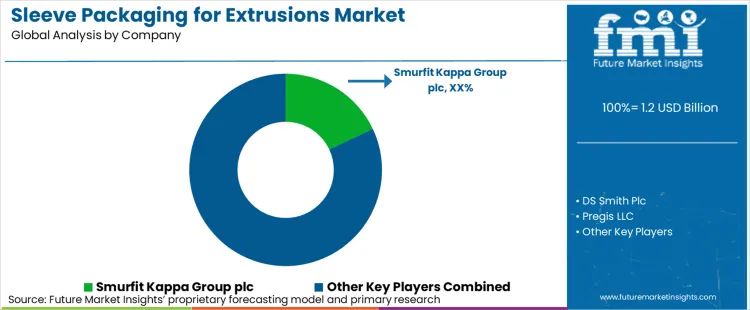
Competition in the sleeve packaging for extrusions market is increasingly determined by engineering capability and program execution reliability, not simply by the availability of corrugated sleeves or film wraps. As extrusions move into finish-critical EV, renewable energy, and architectural applications, buyers are shifting from transactional purchasing to qualified-supplier programs where sleeves must meet defined performance thresholds: abrasion control, edge-impact resistance, moisture tolerance, and removability/handling ergonomics. This shift raises the value of suppliers that can document performance and support customers with standardized application protocols that reduce handling variance across production lines and downstream warehouses.
A key differentiator is the ability to deliver application-engineered sleeve architectures rather than single-material offerings. Leading suppliers compete by offering modular sleeve families that cover multiple extrusion geometries while maintaining tight tolerance control and consistent friction behavior for stacking and automated movement. These suppliers also invest in value-added features such as internal liners, optional foam interfaces, or surface-protection co-designs that prevent micro-abrasion in vibration environments, an increasingly important requirement for long-distance and export-oriented extrusion flows. In this market, product differentiation is less visible to the end-user but highly visible to quality engineers, because sleeve design decisions directly influence scrap rate, rework frequency, and jobsite rejection risk.
Sustainability and compliance credibility have become “gatekeeper” criteria. As exporters and multinational supply chains seek to reduce packaging compliance ambiguity, sleeve solutions that are mono-material or clearly separable gain procurement preference. This is reshaping competition by pushing suppliers to offer recyclability documentation and to reduce reliance on complex mixed-material constructions. Over time, this will concentrate share among suppliers that can simultaneously achieve protection performance, automation compatibility, and compliance defensibility at scale.
Key Players Profiled in the Sleeve Packaging for Extrusions Market
- Smurfit Kappa Group plc
- DS Smith Plc
- Pregis LLC
- Intertape Polymer Group
- Berry Global Group, Inc.
- Nitto Denko Corporation
Market Definition
The sleeve packaging for extrusions market comprises engineered protective sleeve solutions used to protect long-length extruded components from surface abrasion, edge impacts, moisture exposure, and handling damage during storage, transportation, and staging. Sleeves covered in this market include corrugated sleeves, film sleeves, coated sleeves, and sleeve systems that may incorporate protective interfaces (such as liners or cushioning layers) to preserve finish quality and reduce scrap and rework.
Extrusions within scope include aluminum profiles, steel channels, and polymer extrusions used in electric vehicles, renewable energy infrastructure, architectural façades, and industrial applications. The scope excludes pallet-level stretch wrap, general-purpose bundling films, non-sleeve packaging formats, and downstream logistics or installation services.
Scope of the Report
| Attribute | Details |
|---|---|
| Base Year | 2026 |
| Forecast Period | 2026-2036 |
| Market Size (2026) | USD 1,220 million |
| Market Size (2036) | USD 4,160 million |
| CAGR | 13.1% |
| Key Extrusion Types | Aluminum profiles, Steel channels, Polymer extrusions |
| Key Sleeve Formats | Corrugated sleeves, Film sleeves, Coated/engineered sleeves |
| Key Materials | Corrugated board, LDPE/PE films, specialty protective materials |
| Regions Covered | North America, Europe, East Asia, South Asia, Japan, Rest of the World |
| Countries Covered | China, Germany, United States, India, Japan |
Source: Future Market Insights (FMI)
Sleeve Packaging for Extrusions Market Key Segments
By Extrusion Type
- Aluminum Profiles
- Steel Channels
- Polymer Extrusions
By Sleeve Format
- Corrugated Sleeves
- Film Sleeves
- Coated / Engineered Sleeves
By Material
- Corrugated Board
- Polyethylene / LDPE Films
- Specialty Protection Materials
By Region
- North America
- Europe
- East Asia
- South Asia
- Japan
- Rest of the World
Bibliography
- International Organization for Standardization. (2025). ISO 18604: Packaging and the environment — Material recycling. ISO.
- European Union. (2024). Regulation on packaging and packaging waste (Packaging and Packaging Waste Regulation). Official Journal of the European Union.
- European Aluminium. (2025). Aluminium in building and transport applications: Surface finish and handling considerations. European Aluminium.
- International Aluminium Institute. (2024). Aluminium extrusion applications and value-chain performance requirements. IAI.
Frequently Asked Questions
What is the growth outlook for the sleeve packaging for extrusions market?
The market is projected to expand at a 13.1% CAGR from 2026 to 2036, driven by higher finish sensitivity in EV, renewable energy, and architectural extrusion applications.
How large will the sleeve packaging for extrusions market be by 2036?
FMI forecasts the market will reach USD 4,160 million by 2036, up from USD 1,220 million in 2026.
Which extrusion type accounts for the largest share of demand?
Aluminum profiles lead demand due to their widespread use across EV structures, solar frames, and architectural curtain wall systems, where surface finish protection is critical.
Which sleeve format dominates the market?
Corrugated sleeves dominate due to their combined structural protection, stack stability, and recyclability alignment, making them suitable for long-length logistics and export staging.
Which country is expected to grow the fastest?
China leads growth with a 14.0% CAGR, supported by EV and renewable energy manufacturing scale and supply-chain standardization toward damage-free delivery.
Preview the report firsthand - request a free sample
Get SampleGet the brochure for pricing and purchase details.
Get PDFTable of Content
- Executive Summary
- Global Market Outlook
- Demand-side Trends
- Supply-side Trends
- Technology Roadmap Analysis
- Analysis and Recommendations
- Market Overview
- Market Coverage / Taxonomy
- Market Definition / Scope / Limitations
- Research Methodology
- Chapter Orientation
- Analytical Lens and Working Hypotheses
- Market Structure, Signals, and Trend Drivers
- Benchmarking and Cross-market Comparability
- Market Sizing, Forecasting, and Opportunity Mapping
- Research Design and Evidence Framework
- Desk Research Programme (Secondary Evidence)
- Company Annual and Sustainability Reports
- Peer-reviewed Journals and Academic Literature
- Corporate Websites, Product Literature, and Technical Notes
- Earnings Decks and Investor Briefings
- Statutory Filings and Regulatory Disclosures
- Technical White Papers and Standards Notes
- Trade Journals, Industry Magazines, and Analyst Briefs
- Conference Proceedings, Webinars, and Seminar Materials
- Government Statistics Portals and Public Data Releases
- Press Releases and Reputable Media Coverage
- Specialist Newsletters and Curated Briefings
- Sector Databases and Reference Repositories
- FMI Internal Proprietary Databases and Historical Market Datasets
- Subscription Datasets and Paid Sources
- Social Channels, Communities, and Digital Listening Inputs
- Additional Desk Sources
- Expert Input and Fieldwork (Primary Evidence)
- Primary Modes
- Qualitative Interviews and Expert Elicitation
- Quantitative Surveys and Structured Data Capture
- Blended Approach
- Why Primary Evidence is Used
- Field Techniques
- Interviews
- Surveys
- Focus Groups
- Observational and In-context Research
- Social and Community Interactions
- Stakeholder Universe Engaged
- C-suite Leaders
- Board Members
- Presidents and Vice Presidents
- R&D and Innovation Heads
- Technical Specialists
- Domain Subject-matter Experts
- Scientists
- Physicians and Other Healthcare Professionals
- Governance, Ethics, and Data Stewardship
- Research Ethics
- Data Integrity and Handling
- Primary Modes
- Tooling, Models, and Reference Databases
- Desk Research Programme (Secondary Evidence)
- Data Engineering and Model Build
- Data Acquisition and Ingestion
- Cleaning, Normalisation, and Verification
- Synthesis, Triangulation, and Analysis
- Quality Assurance and Audit Trail
- Market Background
- Market Dynamics
- Drivers
- Restraints
- Opportunity
- Trends
- Scenario Forecast
- Demand in Optimistic Scenario
- Demand in Likely Scenario
- Demand in Conservative Scenario
- Opportunity Map Analysis
- Product Life Cycle Analysis
- Supply Chain Analysis
- Investment Feasibility Matrix
- Value Chain Analysis
- PESTLE and Porter’s Analysis
- Regulatory Landscape
- Regional Parent Market Outlook
- Production and Consumption Statistics
- Import and Export Statistics
- Market Dynamics
- Global Market Analysis 2021 to 2025 and Forecast, 2026 to 2036
- Historical Market Size Value (USD Million) Analysis, 2021 to 2025
- Current and Future Market Size Value (USD Million) Projections, 2026 to 2036
- Y-o-Y Growth Trend Analysis
- Absolute $ Opportunity Analysis
- Global Market Pricing Analysis 2021 to 2025 and Forecast 2026 to 2036
- Global Market Analysis 2021 to 2025 and Forecast 2026 to 2036, By Extrusion Type
- Introduction / Key Findings
- Historical Market Size Value (USD Million) Analysis By Extrusion Type , 2021 to 2025
- Current and Future Market Size Value (USD Million) Analysis and Forecast By Extrusion Type , 2026 to 2036
- Aluminum Profiles
- Steel Channels
- Polymer Extrusions
- Aluminum Profiles
- Y-o-Y Growth Trend Analysis By Extrusion Type , 2021 to 2025
- Absolute $ Opportunity Analysis By Extrusion Type , 2026 to 2036
- Global Market Analysis 2021 to 2025 and Forecast 2026 to 2036, By Sleeve Format
- Introduction / Key Findings
- Historical Market Size Value (USD Million) Analysis By Sleeve Format, 2021 to 2025
- Current and Future Market Size Value (USD Million) Analysis and Forecast By Sleeve Format, 2026 to 2036
- Corrugated Sleeves
- Film Sleeves
- Coated / Engineered Sleeves
- Corrugated Sleeves
- Y-o-Y Growth Trend Analysis By Sleeve Format, 2021 to 2025
- Absolute $ Opportunity Analysis By Sleeve Format, 2026 to 2036
- Global Market Analysis 2021 to 2025 and Forecast 2026 to 2036, By Material
- Introduction / Key Findings
- Historical Market Size Value (USD Million) Analysis By Material, 2021 to 2025
- Current and Future Market Size Value (USD Million) Analysis and Forecast By Material, 2026 to 2036
- Corrugated Board
- Polyethylene / LDPE Films
- Specialty Protection Materials
- Corrugated Board
- Y-o-Y Growth Trend Analysis By Material, 2021 to 2025
- Absolute $ Opportunity Analysis By Material, 2026 to 2036
- Global Market Analysis 2021 to 2025 and Forecast 2026 to 2036, By Region
- Introduction
- Historical Market Size Value (USD Million) Analysis By Region, 2021 to 2025
- Current Market Size Value (USD Million) Analysis and Forecast By Region, 2026 to 2036
- North America
- Latin America
- Western Europe
- Eastern Europe
- East Asia
- South Asia and Pacific
- Middle East & Africa
- Market Attractiveness Analysis By Region
- North America Market Analysis 2021 to 2025 and Forecast 2026 to 2036, By Country
- Historical Market Size Value (USD Million) Trend Analysis By Market Taxonomy, 2021 to 2025
- Market Size Value (USD Million) Forecast By Market Taxonomy, 2026 to 2036
- By Country
- USA
- Canada
- Mexico
- By Extrusion Type
- By Sleeve Format
- By Material
- By Country
- Market Attractiveness Analysis
- By Country
- By Extrusion Type
- By Sleeve Format
- By Material
- Key Takeaways
- Latin America Market Analysis 2021 to 2025 and Forecast 2026 to 2036, By Country
- Historical Market Size Value (USD Million) Trend Analysis By Market Taxonomy, 2021 to 2025
- Market Size Value (USD Million) Forecast By Market Taxonomy, 2026 to 2036
- By Country
- Brazil
- Chile
- Rest of Latin America
- By Extrusion Type
- By Sleeve Format
- By Material
- By Country
- Market Attractiveness Analysis
- By Country
- By Extrusion Type
- By Sleeve Format
- By Material
- Key Takeaways
- Western Europe Market Analysis 2021 to 2025 and Forecast 2026 to 2036, By Country
- Historical Market Size Value (USD Million) Trend Analysis By Market Taxonomy, 2021 to 2025
- Market Size Value (USD Million) Forecast By Market Taxonomy, 2026 to 2036
- By Country
- Germany
- UK
- Italy
- Spain
- France
- Nordic
- BENELUX
- Rest of Western Europe
- By Extrusion Type
- By Sleeve Format
- By Material
- By Country
- Market Attractiveness Analysis
- By Country
- By Extrusion Type
- By Sleeve Format
- By Material
- Key Takeaways
- Eastern Europe Market Analysis 2021 to 2025 and Forecast 2026 to 2036, By Country
- Historical Market Size Value (USD Million) Trend Analysis By Market Taxonomy, 2021 to 2025
- Market Size Value (USD Million) Forecast By Market Taxonomy, 2026 to 2036
- By Country
- Russia
- Poland
- Hungary
- Balkan & Baltic
- Rest of Eastern Europe
- By Extrusion Type
- By Sleeve Format
- By Material
- By Country
- Market Attractiveness Analysis
- By Country
- By Extrusion Type
- By Sleeve Format
- By Material
- Key Takeaways
- East Asia Market Analysis 2021 to 2025 and Forecast 2026 to 2036, By Country
- Historical Market Size Value (USD Million) Trend Analysis By Market Taxonomy, 2021 to 2025
- Market Size Value (USD Million) Forecast By Market Taxonomy, 2026 to 2036
- By Country
- China
- Japan
- South Korea
- By Extrusion Type
- By Sleeve Format
- By Material
- By Country
- Market Attractiveness Analysis
- By Country
- By Extrusion Type
- By Sleeve Format
- By Material
- Key Takeaways
- South Asia and Pacific Market Analysis 2021 to 2025 and Forecast 2026 to 2036, By Country
- Historical Market Size Value (USD Million) Trend Analysis By Market Taxonomy, 2021 to 2025
- Market Size Value (USD Million) Forecast By Market Taxonomy, 2026 to 2036
- By Country
- India
- ASEAN
- Australia & New Zealand
- Rest of South Asia and Pacific
- By Extrusion Type
- By Sleeve Format
- By Material
- By Country
- Market Attractiveness Analysis
- By Country
- By Extrusion Type
- By Sleeve Format
- By Material
- Key Takeaways
- Middle East & Africa Market Analysis 2021 to 2025 and Forecast 2026 to 2036, By Country
- Historical Market Size Value (USD Million) Trend Analysis By Market Taxonomy, 2021 to 2025
- Market Size Value (USD Million) Forecast By Market Taxonomy, 2026 to 2036
- By Country
- Kingdom of Saudi Arabia
- Other GCC Countries
- Turkiye
- South Africa
- Other African Union
- Rest of Middle East & Africa
- By Extrusion Type
- By Sleeve Format
- By Material
- By Country
- Market Attractiveness Analysis
- By Country
- By Extrusion Type
- By Sleeve Format
- By Material
- Key Takeaways
- Key Countries Market Analysis
- USA
- Pricing Analysis
- Market Share Analysis, 2025
- By Extrusion Type
- By Sleeve Format
- By Material
- Canada
- Pricing Analysis
- Market Share Analysis, 2025
- By Extrusion Type
- By Sleeve Format
- By Material
- Mexico
- Pricing Analysis
- Market Share Analysis, 2025
- By Extrusion Type
- By Sleeve Format
- By Material
- Brazil
- Pricing Analysis
- Market Share Analysis, 2025
- By Extrusion Type
- By Sleeve Format
- By Material
- Chile
- Pricing Analysis
- Market Share Analysis, 2025
- By Extrusion Type
- By Sleeve Format
- By Material
- Germany
- Pricing Analysis
- Market Share Analysis, 2025
- By Extrusion Type
- By Sleeve Format
- By Material
- UK
- Pricing Analysis
- Market Share Analysis, 2025
- By Extrusion Type
- By Sleeve Format
- By Material
- Italy
- Pricing Analysis
- Market Share Analysis, 2025
- By Extrusion Type
- By Sleeve Format
- By Material
- Spain
- Pricing Analysis
- Market Share Analysis, 2025
- By Extrusion Type
- By Sleeve Format
- By Material
- France
- Pricing Analysis
- Market Share Analysis, 2025
- By Extrusion Type
- By Sleeve Format
- By Material
- India
- Pricing Analysis
- Market Share Analysis, 2025
- By Extrusion Type
- By Sleeve Format
- By Material
- ASEAN
- Pricing Analysis
- Market Share Analysis, 2025
- By Extrusion Type
- By Sleeve Format
- By Material
- Australia & New Zealand
- Pricing Analysis
- Market Share Analysis, 2025
- By Extrusion Type
- By Sleeve Format
- By Material
- China
- Pricing Analysis
- Market Share Analysis, 2025
- By Extrusion Type
- By Sleeve Format
- By Material
- Japan
- Pricing Analysis
- Market Share Analysis, 2025
- By Extrusion Type
- By Sleeve Format
- By Material
- South Korea
- Pricing Analysis
- Market Share Analysis, 2025
- By Extrusion Type
- By Sleeve Format
- By Material
- Russia
- Pricing Analysis
- Market Share Analysis, 2025
- By Extrusion Type
- By Sleeve Format
- By Material
- Poland
- Pricing Analysis
- Market Share Analysis, 2025
- By Extrusion Type
- By Sleeve Format
- By Material
- Hungary
- Pricing Analysis
- Market Share Analysis, 2025
- By Extrusion Type
- By Sleeve Format
- By Material
- Kingdom of Saudi Arabia
- Pricing Analysis
- Market Share Analysis, 2025
- By Extrusion Type
- By Sleeve Format
- By Material
- Turkiye
- Pricing Analysis
- Market Share Analysis, 2025
- By Extrusion Type
- By Sleeve Format
- By Material
- South Africa
- Pricing Analysis
- Market Share Analysis, 2025
- By Extrusion Type
- By Sleeve Format
- By Material
- USA
- Market Structure Analysis
- Competition Dashboard
- Competition Benchmarking
- Market Share Analysis of Top Players
- By Regional
- By Extrusion Type
- By Sleeve Format
- By Material
- Competition Analysis
- Competition Deep Dive
- Smurfit Kappa Group plc
- Overview
- Product Portfolio
- Profitability by Market Segments (Product/Age /Sales Channel/Region)
- Sales Footprint
- Strategy Overview
- Marketing Strategy
- Product Strategy
- Channel Strategy
- DS Smith Plc
- Pregis LLC
- Intertape Polymer Group
- Berry Global Group, Inc.
- Nitto Denko Corporation
- Smurfit Kappa Group plc
- Competition Deep Dive
- Assumptions & Acronyms Used


