

- Market Size (2026)
- USD 14.4 Bn
- Forecast (2036)
- USD 58.3 Bn
- CAGR (2026 to 2036)
- 15.0%
How big is the Soft-Tissue Surgical Robots (Multi-Port Laparoscopic) Market size?
USD 14.4 billion in 2026 and USD 58.3 billion by 2036 at a 15.0% CAGR.
Sales of soft-tissue surgical robots (multi-port laparoscopic) are estimated to rise at 15.0% CAGR through 2036, increasing valuation from USD 14.4 billion in 2026 to USD 58.3 billion by 2036. Intuitive Surgical announcements in April 2026 recorded 431 da Vinci systems placed during the first quarter of 2026. This steady capacity expansion highlights how prominently increasing medical centers are adopting advanced laparoscopic devices for complex surgical programs. Integrating such platforms, clinical administrators favor systems offering repeatable multi-quadrant access alongside familiar laparoscopic workflows. European health systems closely compare mobile-arm layouts with fixed-cart configurations to maximize flexibility across mixed operating rooms.
Hospital sourcing priorities shift based on regional training models and local service networks. Medical centers in the United States and Japan emphasize validated instrument families and maintaining surgeon-training continuity. Healthcare providers in China and South Korea prioritize local platform access and highly responsive technical service. An Intuitive Surgical report from January 2026 highlighted an estimated 3,153,000 da Vinci procedures completed during 2025, representing a sharp 18% annual increase in global robotic utilization. This deliberate scaling up of automated operating rooms translates into massive operational volumes worldwide.
-market-value-analysis.webp "Soft Tissue Surgical Robots (multi Port Laparoscopic) Market Value Analysis")
Key Takeaways of Soft-Tissue Surgical Robots (Multi-Port Laparoscopic) Market
- Demand for soft-tissue surgical robots is driven by hospital interest in multi-port platforms that support familiar minimally invasive procedures across several soft-tissue specialties, with clinical teams examining procedure evidence and training access.
- By end user, hospitals are expected to lead with 74.0% share in 2026, led by dedicated operating rooms and trained multidisciplinary teams.
- Multi-port platforms are the dominant product segment, projected to hold 72.0% share in 2026, aided by multi-quadrant reach and established surgeon familiarity.
- Capital purchase is estimated to lead the business model category with 52.0% share in 2026, guided by hospital ownership preferences and long equipment-use horizons.
- Docking time, room turnover, and credentialing requirements remain critical to adoption, as urology, general surgery, and gynecology teams weigh instrument control against training needs.
- China, South Korea, and the European Union are expected to form the higher-growth region tier, advancing at 18.0%, 17.0%, and 16.0% CAGR respectively through 2036, with East Asian health systems expanding faster than established United States programs.
- Competition centers on established vendors, modular platform companies, and development-stage entrants, with differentiation through installed-base familiarity and instrument depth, mobile arm configurations, and emerging general surgery platform capability.
Analyst Perspective
"Investment in multi-port robotic surgical systems is increasingly evaluated as a long-term clinical service strategy rather than an individual equipment purchase. Health systems are assessing whether a platform can support multiple surgical specialties, maintain consistent utilization across procedure volumes, and justify ongoing operating costs through improved workflow efficiency. Vendors that help hospitals expand surgeon proficiency, streamline program implementation, and sustain high system availability will gain stronger traction as robotic surgery programs continue to mature."
- Anurag Sharma, Principal Consultant for Healthcare at Future Market Insights
Source: Future Market Insights analysis, 2026.
How is Soft-Tissue Surgical Robots (Multi-Port Laparoscopic) Market segmented?
The soft-tissue surgical robots (multi-port laparoscopic) market is segmented by application, port approach, component, end user, business model and region.
The soft-tissue surgical robots (multi-port laparoscopic) sector is segmented by application, port approach, component, end user, business model and region. Application coverage includes general surgery, urology, gynecology, thoracic surgery, colorectal surgery and other procedures. Port approach coverage includes multi-port platforms and single-port platforms. Component coverage includes systems, instruments and accessories alongside services. End-user coverage includes hospitals, ambulatory surgical centers and specialty centers. Business-model coverage includes capital purchase, usage-based leasing, managed service and placement programs. Regional coverage includes North America and Latin America alongside Europe, East Asia, South Asia and Pacific, Middle East and Africa.
Why does general surgery lead application demand?
-market-analysis-by-application.webp "Soft Tissue Surgical Robots (multi Port Laparoscopic) Market Analysis By Application")
General surgery leads application activity driven by repeat cholecystectomy and hernia case pathways. Hospitals often begin robotic programs with procedures offering steady volumes and transferable laparoscopic skills. CMR Surgical’s October 2024 announcement recorded more than 26,000 Versius procedures globally, demonstrating established use across general surgical programs and AI-based surgical robots evaluation.
- General surgery is expected to secure 34.0% share in 2026, helped by cholecystectomy and hernia volumes across hospital robotic programs. Surgical teams favor applications offering repeat scheduling and transferable multi-port skills.
- Urology and gynecology sustain platform use through prostatectomy and hysterectomy programs. Thoracic and colorectal procedures expand through stronger indication evidence and specialist training.
How do multi-port platforms shape port approach selection?
-market-analysis-by-port-approach.webp "Soft Tissue Surgical Robots (multi Port Laparoscopic) Market Analysis By Port Approach")
Ronovo Surgical’s March 2025 announcement recorded Chinese approval for Carina across four surgical specialties, reinforcing modular multi-port evaluation across general surgery and thoracic surgery. Multi-port platforms guide port approach selection based on independent arm positioning and multi-quadrant reach. Surgical teams preserve familiar trocar placement and bedside access during complex abdominal procedures.
- Based on port approach, multi-port platforms are anticipated to represent 72.0% share in 2026 owing to established instrument triangulation and adaptable arm placement. Hospital teams examine collision control and patient-side access during platform trials.
- Single-port platforms serve procedures requiring fewer incisions or narrow anatomical access. Multi-port configurations cover more specialties through familiar laparoscopic layouts.
Why do systems lead component demand?
-market-analysis-by-component.webp "Soft Tissue Surgical Robots (multi Port Laparoscopic) Market Analysis By Component")
Systems dominate component need since new installations require consoles and imaging architecture. Installed-base expansion creates extended service needs and recurring accessory requirements. Intuitive Surgical’s January 2026 earnings release placed its da Vinci installed base at 11,106 systems at year-end 2025, reflecting recurring requirements for automated suturing devices and procedural accessories.
- Systems are estimated to hold 44.0% share of component in 2026, driven by hospital capacity expansion and platform replacement cycles. Purchasing reviews examine room footprint and clinical indication coverage during capital assessment.
- Instruments and accessories generate recurring value through case utilization and replacement schedules. Service programs protect equipment uptime through maintenance and clinical assistance.
Why do hospitals lead end-user demand?
-market-analysis-by-end-user.webp "Soft Tissue Surgical Robots (multi Port Laparoscopic) Market Analysis By End User")
American Hospital Association figures released for 2026 listed 6,093 United States hospitals, highlighting a substantial institutional base for operating room equipment and robotic service-line planning. Hospitals hold prominent share within end-user activity led by dedicated operating rooms and sterile-processing capacity. Multidisciplinary credentialing and anesthesia resources favor larger care sites managing complex procedures.
- By end-user, hospitals are projected to capture 74.0% share in 2026 as it is backed by specialist teams and capital planning across tertiary and academic sites. Robotic committees assess utilization targets and training capacity during installation planning.
- Ambulatory surgical centers and specialty centers expand participation through compact layouts and selective indications. Hospitals retain end-user strength due to complex case mixes and continuous support resources.
How does capital purchase retain business-model strength?
-market-analysis-by-business-model.webp "Soft Tissue Surgical Robots (multi Port Laparoscopic) Market Analysis By Business Model")
Capital purchase retains business-model strength among health systems seeking asset control and predictable use. Leasing offers flexibility for sites testing utilization or preserving initial budgets. Intuitive Surgical’s April 2026 filing recorded 243 first-quarter placements under operating leases, demonstrating greater flexibility across outpatient surgery centers and hospital acquisition programs.
- In 2026, capital purchase is estimated to represent 52.0% share since it is led by hospital ownership policies and multi-year utilization plans. Finance teams compare depreciation schedules and service obligations across vendors.
- Usage-based leasing and managed service reduce initial commitments for hospital programs. Placement agreements suit accounts offering dependable procedure volumes and agreed instrument consumption.
What are drivers, restraints, and opportunities in Soft-Tissue Surgical Robots (Multi-Port Laparoscopic) Market?
Platform selection advances through expanding indication evidence and rising procedure capacity. Capital intensity and credentialing effort may delay decisions outside large hospital systems.
- Driver: Surgical departments are expected to expand robotic programs as multi-port systems cover general surgery and specialist procedures.
- Restraint: High capital requirements and lengthy team training may limit installations across smaller sites.
- Opportunity: Leasing and managed-service structures may support hospitals seeking staged robotic program development.
Clinical evidence supporting competing multi-port platforms are anticipated to account as drivers for the sector. Medtronic’s April 2025 study update listed 137 patients across United States centers, providing hospital committees with structured safety and effectiveness evidence for urologic platform review.
Restraint pressure is reflected by equipment investment and recurring service obligations. Intuitive Surgical’s April 2025 filing placed da Vinci system prices between USD 0.7 million and USD 3.1 million, encouraging finance teams to test utilization plans prior to approving new robotic rooms.
Potential for expansion is likely to improve based on outpatient payment stability and compact robotic programs. Centers for Medicare and Medicaid Services proposed in July 2024 a 2.6% update to 2025 outpatient surgery center rates, supporting planning conditions for selected minimally invasive procedures across outpatient settings.
What country CAGRs are profiled in Soft-Tissue Surgical Robots (Multi-Port Laparoscopic) Market?
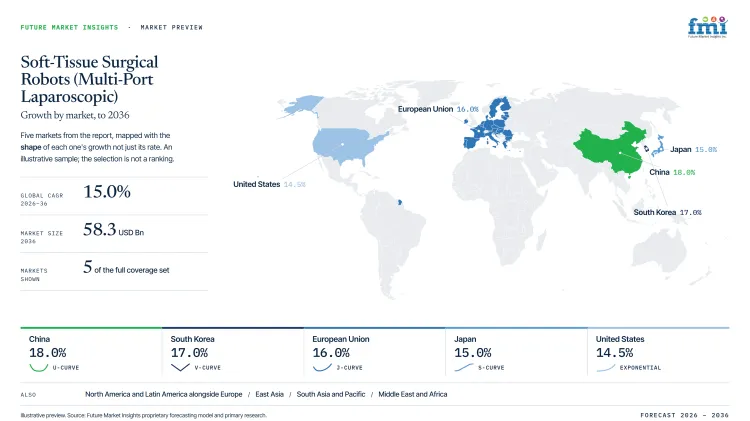
| Country | CAGR |
|---|---|
| China | 18.0% |
| South Korea | 17.0% |
| European Union | 16.0% |
| Japan | 15.0% |
| United States | 14.5% |
Source: Future Market Insights analysis, 2026.
How do country-level CAGRs compare in the Soft-Tissue Surgical Robots (Multi-Port Laparoscopic) Market?
The country comparison spans 3.5 percentage points and reveals three well-defined growth tiers across the soft-tissue surgical robots (multi-port laparoscopic) market. China and South Korea occupy the leading tier with only a 1.0-point difference. The European Union and Japan form a closely aligned middle group, also separated by 1.0 percentage point, while the United States follows just 0.5 percentage points behind Japan. The relatively narrow spread reflects broad interest in robotic-assisted laparoscopic surgery, although hospital investment priorities and clinical adoption differ across markets.
- China leads the comparison with a CAGR of 18.0%. Hospitals are expanding evaluation of multi-port robotic systems for minimally invasive procedures as surgical departments seek greater precision, workflow consistency and higher utilization of advanced operating room technologies.
- South Korea follows at 17.0%, remaining 1.0 percentage point behind China. Adoption is supported by continued investment in digital operating rooms and robotic-assisted surgery, where healthcare providers are integrating advanced platforms into complex laparoscopic procedures.
- The European Union records a CAGR of 16.0%, standing 1.0 percentage point below South Korea. Medical centers across the region continue assessing robotic systems for soft-tissue surgery to improve procedural accuracy and surgical planning. Adoption differs among member states because healthcare funding models, capital equipment budgets and clinical priorities are not uniform.
- Japan posts a CAGR of 15.0%, only 1.0 percentage point behind the European Union. Healthcare providers are incorporating robotic-assisted laparoscopic platforms into selected surgical specialties where precision, ergonomic benefits and minimally invasive techniques remain important considerations.
- The United States completes the comparison with a CAGR of 14.5%, trailing Japan by just 0.5 percentage points. Hospitals continue investing in robotic-assisted surgery as part of broader operating room modernization strategies, with purchasing decisions shaped by clinical utilization, surgeon training and long-term equipment management.
Comparable CAGRs do not necessarily translate into identical commercial opportunities. Differences in hospital infrastructure, reimbursement frameworks, surgeon adoption, capital investment cycles and healthcare regulations influence purchasing decisions and long-term supplier positioning. The full report provides country-level CAGR analysis across North America, Latin America, Europe, East Asia, South Asia, Oceania and the Middle East and Africa.
Country-wise Analysis
- Soft-tissue surgical robots (multi-port laparoscopic) sector in China are anticipated to expand at 18.0% CAGR from 2026 to 2036, led by hospital investment and locally developed modular platforms. Extensive hospital coverage provides a practical base for robotic program deployment across major care networks. A September 2025 United States International Trade Administration guide listed over 40,000 Chinese hospitals during 2024, providing an extensive institutional base for robotic surgery programs.
- Organization for Economic Co-operation and Development’s November 2025 review listed 12.6 hospital beds per 1,000 people in South Korea, supporting concentrated specialist capacity and complex surgical service lines. Dense tertiary care infrastructure supports wider evaluation of multi-port systems across specialist departments. Industry in South Korea is expected to expand at 17.0% CAGR during the forecast period, backed by hospital specialization and metropolitan surgical concentration.
- National coverage expansion across European Union countries is likely to strengthen multi-port installations, reflecting a projected 16.0% CAGR from 2026 to 2036. Established inpatient infrastructure supports robotic service-line planning across national health systems. Eurostat reported in June 2026 an average of 507 hospital beds per 100,000 inhabitants during 2024, indicating substantial inpatient infrastructure for robotic service-line development.
- Japan Statistics Bureau’s 2025 population release placed people aged 65 years or older at 29.3% of total population during 2024, reinforcing clinical need across oncology and age-related surgery. Age-linked surgical demand supports hospital evaluation of systems suited to complex minimally invasive procedures. Robot-assisted procedures across Japan are estimated to progress by 2036 at a 15.0% CAGR, reflected by established hospital technology use and specialist training.
- Adoption in the United States is estimated to scale at 14.5% CAGR during the assessment period, aided by platform replacement and indication expansion. Large procedure volumes support recurring robotic capacity reviews across several surgical specialties. National Cancer Institute stated in May 2025 an estimated 2,041,910 new cancer cases were expected during 2025, sustaining procedure demand across urology, gynecology and colorectal surgery.
Who are notable companies in Soft-Tissue Surgical Robots (Multi-Port Laparoscopic) Market?
Intuitive Surgical, Inc. and Medtronic plc are expected to shape multi-port platform direction. CMR Surgical Ltd. and Distalmotion SA add modular systems across hospital and outpatient settings. Johnson & Johnson MedTech and Ronovo Surgical, Inc. are anticipated to strengthen platform choice. Medicaroid Corporation, SS Innovations International, Inc., Edge Medical Robotics Co., Ltd. and Shanghai MicroPort MedBot (Group) Co., Ltd. support regional system development.
-market-analysis-by-company.webp "Soft Tissue Surgical Robots (multi Port Laparoscopic) Market Analysis By Company")
Competition in soft-tissue surgical robots (multi-port laparoscopic) is anticipated to center on indication coverage and operating-room integration alongside endoscopy video systems compatibility. Hospital account teams are likely to compare companies based on platform mobility and training support prior to final selection.
- Intuitive Surgical, Inc. and Medtronic plc are expected to gain account attention based on multi-port system depth and surgeon familiarity. Hospital relationships are likely to support programs requiring instrument continuity and dependable service.
- CMR Surgical Ltd. and Distalmotion SA are anticipated to compete due to modular configurations suited to mixed operating rooms. Johnson & Johnson MedTech is projected to influence vendor review through its integrated surgical portfolio.
- Ronovo Surgical, Inc. and Medicaroid Corporation are forecast to support demand depending on adaptable multi-arm platforms. Regional hospital access is expected to improve vendor consideration across Asian surgical programs.
- SS Innovations International, Inc., Edge Medical Robotics Co., Ltd. and Shanghai MicroPort MedBot (Group) Co., Ltd. are estimated to gain review strength led by locally developed surgical systems. Account attention is likely to improve as hospitals seek service access and procedure training.
Competitive Benchmarking: Soft-Tissue Surgical Robots (Multi-Port Laparoscopic) Market
| Company | Portfolio Depth | Procedure Match | Service Support | Service Reach |
|---|---|---|---|---|
| Intuitive Surgical, Inc. | High | High | High | Global |
| Medtronic plc | High | High | High | Global |
| CMR Surgical Ltd. | High | High | High | Europe, United States and global |
| Distalmotion SA | Medium | High | High | United States and Europe |
| Johnson & Johnson MedTech | High | High | High | Global |
| Ronovo Surgical, Inc. | Medium | High | Medium | China and global |
| Medicaroid Corporation | Medium | High | High | Japan, Europe and Asia |
| SS Innovations International, Inc. | Medium | High | Medium | India and global |
| Edge Medical Robotics Co., Ltd. | Medium | High | Medium | China and Asia |
| Shanghai MicroPort MedBot (Group) Co., Ltd. | High | High | High | China and global |
Source: Future Market Insights competitive analysis, 2026.
Key Developments in Soft-Tissue Surgical Robots (Multi-Port Laparoscopic) Market
- In December 2025, Medtronic plc announced United States clearance for Hugo across prostatectomy, nephrectomy and cystectomy. Medtronic plc stated those procedures represented about 230,000 annual United States surgeries, increasing multi-port choice across urology programs.
- In December 2025, CMR Surgical Ltd. announced United States clearance for Versius Plus in cholecystectomy. CMR Surgical Ltd. stated clearance supported 2026 commercialization, adding another modular multi-port option for general surgery departments.
- In January 2026, Johnson & Johnson MedTech announced submission of OTTAVA for United States De Novo classification across upper-abdominal general surgery procedures. Johnson & Johnson MedTech stated its application used investigational study evidence, creating a future challenger for integrated surgical stapling devices and multi-port workflows.
Key Players in Soft-Tissue Surgical Robots (Multi-Port Laparoscopic) Market
Established multi-port platform companies
- Intuitive Surgical, Inc.
- Medtronic plc
- CMR Surgical Ltd.
- Johnson & Johnson MedTech
Modular and outpatient-oriented robotic companies
- Distalmotion SA
- Ronovo Surgical, Inc.
- SS Innovations International, Inc.
Asia-centered robotic surgery companies
- Medicaroid Corporation
- Edge Medical Robotics Co., Ltd.
- Shanghai MicroPort MedBot (Group) Co., Ltd.
Soft-Tissue Surgical Robots (Multi-Port Laparoscopic) Market - Report Scope
-market-breakdown-by-application,-port-approach,-and-region.webp "Soft Tissue Surgical Robots (multi Port Laparoscopic) Market Breakdown By Application, Port Approach, And Region")
| Coverage field | Report scope |
|---|---|
| Market breakdown | Soft-Tissue Surgical Robots (Multi-Port Laparoscopic) Market breakdown by application alongside port approach, component, end user, business model and region |
| Quantitative Units | Revenue in USD Million, CAGR in %. |
| Market Definition | Soft-tissue surgical robots (multi-port laparoscopic) include robotic platforms using several instrument access ports and articulated arms for minimally invasive general, urologic, gynecologic, thoracic and colorectal procedures. |
| Regions Covered | North America and Latin America alongside Europe, East Asia, South Asia and Pacific, Middle East and Africa |
| Countries Covered | United States and China alongside South Korea, Japan, Germany, United Kingdom, France, Italy, Spain, Canada, Brazil, Mexico, India, ASEAN, Australia, New Zealand, GCC countries, South Africa and Türkiye |
| Key Companies Profiled | Intuitive Surgical, Inc. and Medtronic plc alongside CMR Surgical Ltd., Johnson & Johnson MedTech, Distalmotion SA, Ronovo Surgical, Inc., Medicaroid Corporation, SS Innovations International, Inc., Edge Medical Robotics Co., Ltd. and Shanghai MicroPort MedBot (Group) Co., Ltd. |
| Forecast Period | 2026 to 2036 |
| Approach | Hybrid bottom-up and top-down methodology using segment share, country CAGR, hospital capacity, procedure activity, platform portfolio depth and service exposure |
Source: Future Market Insights analysis, 2026.
Soft-Tissue Surgical Robots (Multi-Port Laparoscopic) Market - Research Methodology
| Method | Approach |
|---|---|
| Primary Research | FMI analysts gathered input from manufacturers, service providers, technology developers, distributors, end users, sourcing teams, and subject-matter experts. Interviews examined purchasing decisions, product or service evaluation, adoption barriers, approval requirements, pricing considerations, and expectations for technical or commercial support. Respondents were also asked what evidence is required before a trial, pilot, or initial order develops into regular purchasing. |
| Desk Research | Desk research covered government statistics, regulatory publications, trade data, industry associations, technical literature, standards, company filings, product information, and official corporate announcements. Sources were reviewed for relevance, publication date, geographic coverage, and consistency with the defined market scope. Claims relating to performance, applications, approvals, capacity, investment, and commercial activity were retained only when supported by credible public evidence. |
| Market Sizing and Forecasting | The market model combined the baseline value with historical performance, segment structure, pricing and volume indicators, adoption levels, company participation, and country-level demand conditions. Forecast assumptions considered economic activity, investment trends, regulatory developments, technology adoption, purchasing cycles, supply availability, and barriers to wider market use. Segment and regional estimates were reconciled before the final market total was calculated. |
| Data Validation | Estimates were checked against multiple independent indicators, including public data, company activity, trade patterns, industry developments, and findings from primary interviews. Validation also tested whether products, services, applications, and company revenues fell within the defined market boundaries. Adjacent categories, unsupported claims, overlapping revenues, and activities without direct market relevance were excluded to reduce double counting and maintain consistency across segments and countries. |
Source: Future Market Insights analysis, 2026.
Soft-Tissue Surgical Robots (Multi-Port Laparoscopic) Market by Segments
Soft-Tissue Surgical Robots (Multi-Port Laparoscopic) Market segmented by Application:
- General surgery
- Urology
- Gynecology
- Thoracic surgery
- Colorectal surgery
- Other procedures
Soft-Tissue Surgical Robots (Multi-Port Laparoscopic) Market segmented by Port Approach:
- Multi-port platforms
- Single-port platforms
Soft-Tissue Surgical Robots (Multi-Port Laparoscopic) Market segmented by Component:
- Systems
- Instruments and accessories
- Services
Soft-Tissue Surgical Robots (Multi-Port Laparoscopic) Market segmented by End User:
- Hospitals
- Ambulatory surgical centers
- Specialty centers
Soft-Tissue Surgical Robots (Multi-Port Laparoscopic) Market segmented by Business Model:
- Capital purchase
- Usage-based leasing
- Managed service
- Placement programs
Soft-Tissue Surgical Robots (Multi-Port Laparoscopic) Market by Region:
- North America
- United States
- Canada
- Latin America
- Brazil
- Mexico
- Argentina
- Europe
- Germany
- United Kingdom
- France
- Italy
- Spain
- East Asia
- China
- Japan
- South Korea
- South Asia and Pacific
- India
- ASEAN
- Australia and New Zealand
- Middle East and Africa
- GCC countries
- South Africa
- Türkiye
Research Sources and Bibliography
- American Hospital Association. (2026, February 5). Fast facts on USA hospitals, 2026.
- Centers for Medicare & Medicaid Services. (2024, July 10). CY 2025 Medicare Hospital Outpatient Prospective Payment System and Ambulatory Surgical Center proposed rule.
- CMR Surgical Ltd. (2024, October 14). CMR Surgical receives USA FDA marketing authorization for next-generation Versius Surgical System.
- CMR Surgical Ltd. (2025, December 16). CMR Surgical secures 510(k) clearance of its Versius Plus robotic surgical system.
- Eurostat. (2026, June). Healthcare resource statistics: Beds.
- Intuitive Surgical, Inc. (2025, April 22). Quarterly report for the period ended March 31, 2025.
- Intuitive Surgical, Inc. (2026, January 14). Intuitive announces preliminary fourth-quarter and full-year 2025 results.
- Intuitive Surgical, Inc. (2026, January 22). Intuitive announces fourth-quarter earnings.
- Intuitive Surgical, Inc. (2026, April 21). Intuitive announces first-quarter earnings.
- Intuitive Surgical, Inc. (2026, April 22). Quarterly report for the period ended March 31, 2026.
- Statistics Bureau of Japan. (2025). Current population estimates as of October 1, 2024.
- Johnson & Johnson. (2026, January 7). Johnson & Johnson submits OTTAVA robotic surgical system to the USA Food and Drug Administration.
- Medtronic plc. (2025, April 26). Expand URO USA clinical trial meets safety and effectiveness primary endpoints for Hugo robotic-assisted surgery system.
- Medtronic plc. (2025, December 3). Medtronic announces FDA clearance of Hugo robotic-assisted surgery system for urologic surgical procedures.
- National Cancer Institute. (2025, May 7). Cancer statistics.
- Organisation for Economic Co-operation and Development. (2025, November 13). Hospital beds and occupancy: Health at a Glance 2025.
- Ronovo Surgical, Inc. (2025, March 6). NMPA approves China’s first modular robotic platform for four surgical specialties.
- USA Department of Commerce, International Trade Administration. (2025, September 25). China: Healthcare.
This bibliography is provided for reader reference and is not exhaustive. The full report contains the complete reference list and detailed citations.
This Report Answers
- What segments shape soft-tissue surgical robot demand across application, port approach, component, end user and business model?
- How do hospital teams evaluate multi-port platforms during robotic-program expansion?
- How do country CAGRs differ across profiled healthcare systems?
- What companies compete through indication depth and operating-room support?
- How are forecasts validated through hybrid bottom-up and top-down analysis?
- What factors do hospital committees address during wider platform deployment?
- How do instrument families and port layouts influence system selection?
- What limits return on investment for hospitals adding robotic surgery capacity?
- How do credentialing records and service coverage influence account approval?
- What vendor capabilities improve long-term hospital confidence?
Frequently Asked Questions
What supports demand in soft-tissue surgical robots (multi-port laparoscopic) market?
Demand is likely to be supported by hospitals expanding minimally invasive procedure capacity across general surgery and specialist services. Platform evidence and team-training access are expected to guide vendor review.
Who are key players in soft-tissue surgical robots (multi-port laparoscopic) market?
Key companies are anticipated to include Intuitive Surgical, Inc. and Medtronic plc alongside CMR Surgical Ltd., Distalmotion SA and Johnson & Johnson MedTech. Competition is likely to focus on indication coverage and hospital support.
What restraint affects soft-tissue surgical robots (multi-port laparoscopic) market?
Primary restraint is combined burden of capital equipment investment and multidisciplinary credentialing across hospital teams. Smaller sites may delay installation if projected case volume does not support equipment and service commitments.
Why do executives track soft-tissue surgical robots (multi-port laparoscopic) market?
Executives are expected to track robotic surgery as platform choice affects operating-room capacity and recurring instrument planning. Procedure expansion and vendor service strength shape capital reviews.
What business problem does soft-tissue surgical robots (multi-port laparoscopic) market address?
Soft-tissue surgical robots address operational need for controlled instrument articulation during complex minimally invasive procedures across several specialties. Hospitals seek systems supporting repeatable access and dependable clinical support.
What do account teams evaluate during vendor selection?
Account teams are likely to evaluate indication breadth and training requirements alongside instrument availability. Room compatibility and service response are expected to guide final vendor review.
What limits return on investment for purchasing teams?
Return on investment weakens if case utilization or surgeon participation stays below approved operating plan. Extended room setup and low instrument standardization may reduce projected efficiency gains.
How do vendors build long-term account confidence?
Vendors build account confidence through consistent system uptime and evidence aligned with soft-tissue procedures. Credentialing support and responsive technical service are anticipated to influence repeat installations.
Preview the report firsthand - request a free sample
Get SampleGet the brochure for pricing and purchase details.
Get PDFTable of Content
- Key Takeaways
- Market Size and CAGR
- Top Growth Driver
- Fastest Growing Segment
- Leading Region
- Key Companies
- Emerging Opportunities
- Executive Summary
- Global Market Outlook
- Demand-side Trends
- Supply-side Trends
- Technology Roadmap Analysis
- Analysis and Recommendations
- Analyst Perspective (What is happening? Why now? What should investors know?)
- Key Questions Answered
- How large is the market?
- What is the CAGR?
- What are key trends?
- Which region dominates?
- Who are the leaders?
- Market Overview
- Market Coverage / Taxonomy
- Market Definition / Scope / Limitations
- Research Methodology
- Chapter Orientation
- Analytical Lens and Working Hypotheses
- Market Structure, Signals, and Trend Drivers
- Benchmarking and Cross-market Comparability
- Market Sizing, Forecasting, and Opportunity Mapping
- Research Design and Evidence Framework
- Desk Research Programme (Secondary Evidence)
- Expert Input and Fieldwork (Primary Evidence)
- Tooling, Models, and Reference Databases
- Data Engineering and Model Build
- Quality Assurance and Audit Trail
- Market Background
- Market Dynamics (Drivers, Restraints, Opportunity, Trends)
- Scenario Forecast (Optimistic, Likely, Conservative)
- Impact Analysis
- AI Impact
- Sustainability Impact
- Regulatory Impact
- Technology Impact
- Consumer / Buyer Analysis
- Purchase Drivers
- Adoption Barriers
- Buyer Journey
- Opportunity Map Analysis
- Product Life Cycle Analysis
- Supply Chain Analysis
- Investment Feasibility Matrix
- Value Chain Analysis
- PESTLE and Porter's Analysis
- Regulatory Landscape
- Regional Parent Market Outlook
- Production and Consumption Statistics
- Import and Export Statistics
- Global Market Analysis and Forecast, 2021 to 2036
- Historical Market Size Value (USD Bn) Analysis, 2021 to 2025
- Current and Future Market Size Value (USD Bn) Projections, 2026 to 2036
- Y-o-Y Growth Trend Analysis
- Absolute $ Opportunity Analysis
- Global Market Pricing Analysis, 2021 to 2036
- Global Market Analysis and Forecast, By Application, 2021 to 2036
- Introduction / Key Findings
- Historical Market Size Value (USD Bn) Analysis By Application, 2021 to 2025
- Current and Future Market Size Value (USD Bn) Analysis and Forecast By Application, 2026 to 2036
- General surgery
- Urology
- Gynecology
- Thoracic
- Colorectal & others
- General surgery
- Y-o-Y Growth Trend Analysis By Application, 2021 to 2025
- Absolute $ Opportunity Analysis By Application, 2026 to 2036
- Global Market Analysis and Forecast, By Port Approach, 2021 to 2036
- Introduction / Key Findings
- Historical Market Size Value (USD Bn) Analysis By Port Approach, 2021 to 2025
- Current and Future Market Size Value (USD Bn) Analysis and Forecast By Port Approach, 2026 to 2036
- Multi-port platforms
- Single-port platforms
- Multi-port platforms
- Y-o-Y Growth Trend Analysis By Port Approach, 2021 to 2025
- Absolute $ Opportunity Analysis By Port Approach, 2026 to 2036
- Global Market Analysis and Forecast, By Component, 2021 to 2036
- Introduction / Key Findings
- Historical Market Size Value (USD Bn) Analysis By Component, 2021 to 2025
- Current and Future Market Size Value (USD Bn) Analysis and Forecast By Component, 2026 to 2036
- Systems
- Instruments & accessories
- Services
- Systems
- Y-o-Y Growth Trend Analysis By Component, 2021 to 2025
- Absolute $ Opportunity Analysis By Component, 2026 to 2036
- Global Market Analysis and Forecast, By End User, 2021 to 2036
- Introduction / Key Findings
- Historical Market Size Value (USD Bn) Analysis By End User, 2021 to 2025
- Current and Future Market Size Value (USD Bn) Analysis and Forecast By End User, 2026 to 2036
- Hospitals
- Ambulatory surgery centers
- Specialty centers
- Hospitals
- Y-o-Y Growth Trend Analysis By End User, 2021 to 2025
- Absolute $ Opportunity Analysis By End User, 2026 to 2036
- Global Market Analysis and Forecast, By Business Model, 2021 to 2036
- Introduction / Key Findings
- Historical Market Size Value (USD Bn) Analysis By Business Model, 2021 to 2025
- Current and Future Market Size Value (USD Bn) Analysis and Forecast By Business Model, 2026 to 2036
- Capital purchase
- Leasing - usage-based
- Managed service
- Placement programs
- Capital purchase
- Y-o-Y Growth Trend Analysis By Business Model, 2021 to 2025
- Absolute $ Opportunity Analysis By Business Model, 2026 to 2036
- Global Market Analysis and Forecast, By Region, 2021 to 2036
- Introduction
- Historical Market Size Value (USD Bn) Analysis By Region, 2021 to 2025
- Current Market Size Value (USD Bn) Analysis and Forecast By Region, 2026 to 2036
- North America
- Latin America
- Western Europe
- Eastern Europe
- East Asia
- South Asia and Pacific
- Middle East & Africa
- Market Attractiveness Analysis By Region
- North America Market Analysis and Forecast, By Country, 2021 to 2036
- Historical Market Size Value (USD Bn) Trend Analysis By Market Taxonomy, 2021 to 2025
- Market Size Value (USD Bn) Forecast By Market Taxonomy, 2026 to 2036
- By Country
- USA
- Canada
- By Application
- By Port Approach
- By Component
- By End User
- By Business Model
- By Country
- Market Attractiveness Analysis
- By Country
- By Application
- By Port Approach
- By Component
- By End User
- By Business Model
- Key Takeaways
- Latin America Market Analysis and Forecast, By Country
- Historical Market Size Value (USD Bn) Trend Analysis By Market Taxonomy, 2021 to 2025
- Market Size Value (USD Bn) Forecast By Market Taxonomy, 2026 to 2036
- By Country
- Brazil
- Mexico
- Chile
- Rest of Latin America
- By Application
- By Port Approach
- By Component
- By End User
- By Business Model
- By Country
- Market Attractiveness Analysis
- By Country
- By Application
- By Port Approach
- By Component
- By End User
- By Business Model
- Key Takeaways
- Western Europe Market Analysis and Forecast, By Country
- Historical Market Size Value (USD Bn) Trend Analysis By Market Taxonomy, 2021 to 2025
- Market Size Value (USD Bn) Forecast By Market Taxonomy, 2026 to 2036
- By Country
- Germany
- UK
- Italy
- Spain
- France
- Nordic
- BENELUX
- Rest of Western Europe
- By Application
- By Port Approach
- By Component
- By End User
- By Business Model
- By Country
- Market Attractiveness Analysis
- By Country
- By Application
- By Port Approach
- By Component
- By End User
- By Business Model
- Key Takeaways
- Eastern Europe Market Analysis and Forecast, By Country
- Historical Market Size Value (USD Bn) Trend Analysis By Market Taxonomy, 2021 to 2025
- Market Size Value (USD Bn) Forecast By Market Taxonomy, 2026 to 2036
- By Country
- Russia
- Poland
- Hungary
- Balkan & Baltic
- Rest of Eastern Europe
- By Application
- By Port Approach
- By Component
- By End User
- By Business Model
- By Country
- Market Attractiveness Analysis
- By Country
- By Application
- By Port Approach
- By Component
- By End User
- By Business Model
- Key Takeaways
- East Asia Market Analysis and Forecast, By Country
- Historical Market Size Value (USD Bn) Trend Analysis By Market Taxonomy, 2021 to 2025
- Market Size Value (USD Bn) Forecast By Market Taxonomy, 2026 to 2036
- By Country
- China
- Japan
- South Korea
- By Application
- By Port Approach
- By Component
- By End User
- By Business Model
- By Country
- Market Attractiveness Analysis
- By Country
- By Application
- By Port Approach
- By Component
- By End User
- By Business Model
- Key Takeaways
- South Asia and Pacific Market Analysis and Forecast, By Country
- Historical Market Size Value (USD Bn) Trend Analysis By Market Taxonomy, 2021 to 2025
- Market Size Value (USD Bn) Forecast By Market Taxonomy, 2026 to 2036
- By Country
- India
- ASEAN
- Australia & New Zealand
- Rest of South Asia and Pacific
- By Application
- By Port Approach
- By Component
- By End User
- By Business Model
- By Country
- Market Attractiveness Analysis
- By Country
- By Application
- By Port Approach
- By Component
- By End User
- By Business Model
- Key Takeaways
- Middle East & Africa Market Analysis and Forecast, By Country
- Historical Market Size Value (USD Bn) Trend Analysis By Market Taxonomy, 2021 to 2025
- Market Size Value (USD Bn) Forecast By Market Taxonomy, 2026 to 2036
- By Country
- Kingdom of Saudi Arabia
- Other GCC Countries
- Türkiye
- South Africa
- Other African Union
- Rest of Middle East & Africa
- By Application
- By Port Approach
- By Component
- By End User
- By Business Model
- By Country
- Market Attractiveness Analysis
- By Country
- By Application
- By Port Approach
- By Component
- By End User
- By Business Model
- Key Takeaways
- Key Countries Market Analysis
- USA
- Pricing Analysis
- Market Share Analysis, 2025
- By Application
- By Port Approach
- By Component
- By End User
- By Business Model
- Canada
- Pricing Analysis
- Market Share Analysis, 2025
- By Application
- By Port Approach
- By Component
- By End User
- By Business Model
- Mexico
- Pricing Analysis
- Market Share Analysis, 2025
- By Application
- By Port Approach
- By Component
- By End User
- By Business Model
- Brazil
- Pricing Analysis
- Market Share Analysis, 2025
- By Application
- By Port Approach
- By Component
- By End User
- By Business Model
- Chile
- Pricing Analysis
- Market Share Analysis, 2025
- By Application
- By Port Approach
- By Component
- By End User
- By Business Model
- Germany
- Pricing Analysis
- Market Share Analysis, 2025
- By Application
- By Port Approach
- By Component
- By End User
- By Business Model
- UK
- Pricing Analysis
- Market Share Analysis, 2025
- By Application
- By Port Approach
- By Component
- By End User
- By Business Model
- Italy
- Pricing Analysis
- Market Share Analysis, 2025
- By Application
- By Port Approach
- By Component
- By End User
- By Business Model
- Spain
- Pricing Analysis
- Market Share Analysis, 2025
- By Application
- By Port Approach
- By Component
- By End User
- By Business Model
- France
- Pricing Analysis
- Market Share Analysis, 2025
- By Application
- By Port Approach
- By Component
- By End User
- By Business Model
- India
- Pricing Analysis
- Market Share Analysis, 2025
- By Application
- By Port Approach
- By Component
- By End User
- By Business Model
- ASEAN
- Pricing Analysis
- Market Share Analysis, 2025
- By Application
- By Port Approach
- By Component
- By End User
- By Business Model
- Australia & New Zealand
- Pricing Analysis
- Market Share Analysis, 2025
- By Application
- By Port Approach
- By Component
- By End User
- By Business Model
- China
- Pricing Analysis
- Market Share Analysis, 2025
- By Application
- By Port Approach
- By Component
- By End User
- By Business Model
- Japan
- Pricing Analysis
- Market Share Analysis, 2025
- By Application
- By Port Approach
- By Component
- By End User
- By Business Model
- South Korea
- Pricing Analysis
- Market Share Analysis, 2025
- By Application
- By Port Approach
- By Component
- By End User
- By Business Model
- Russia
- Pricing Analysis
- Market Share Analysis, 2025
- By Application
- By Port Approach
- By Component
- By End User
- By Business Model
- Poland
- Pricing Analysis
- Market Share Analysis, 2025
- By Application
- By Port Approach
- By Component
- By End User
- By Business Model
- Hungary
- Pricing Analysis
- Market Share Analysis, 2025
- By Application
- By Port Approach
- By Component
- By End User
- By Business Model
- Kingdom of Saudi Arabia
- Pricing Analysis
- Market Share Analysis, 2025
- By Application
- By Port Approach
- By Component
- By End User
- By Business Model
- Türkiye
- Pricing Analysis
- Market Share Analysis, 2025
- By Application
- By Port Approach
- By Component
- By End User
- By Business Model
- South Africa
- Pricing Analysis
- Market Share Analysis, 2025
- By Application
- By Port Approach
- By Component
- By End User
- By Business Model
- USA
- Market Structure Analysis
- Competition Dashboard
- Competition Benchmarking
- Market Share Analysis of Top Players
- By Regional
- By Application
- By Port Approach
- By Component
- By End User
- By Business Model
- Emerging Startups
- Innovation Benchmarking
- Competition Analysis
- Competition Deep Dive
- Intuitive Surgical (US)
- Overview
- Product Portfolio
- Profitability by Market Segments
- Sales Footprint
- Strategy Overview
- Marketing Strategy
- Product Strategy
- Channel Strategy
- Medtronic Hugo (US-IE)
- CMR Versius (UK)
- Distalmotion (CH)
- Intuitive Surgical (US)
- Case Studies
- Success Stories
- Recent Developments
- Competition Deep Dive
- Assumptions & Acronyms Used


