

- Market Size (2026)
- USD 60.0 Mn
- Forecast (2036)
- USD 160.0 Mn
- CAGR (2026 to 2036)
- 10.3%
Portable Ultrasound Workflow Guidance Software Market Size, Market Forecast and Outlook By FMI
USD 60.0 million in 2026 and USD 160.0 million by 2036 at a 10.3% CAGR.
The portable ultrasound workflow guidance software industry value is forecast to grow from USD 54.4 million in 2025 to USD 160.0 million by 2036 at 10.3% CAGR as hospitals and distributed care teams shift from informal handheld scanning toward guided acquisition and reviewable image workflows. Software is forecast to represent 64.0% share in 2026 as scan coaching, quality prompts, workflow routing, and structured capture carry the main buyer value. Embedded modules are expected to secure 48.0% share in 2026, led by buyer preference for guidance tools built into compatible ultrasound platforms.
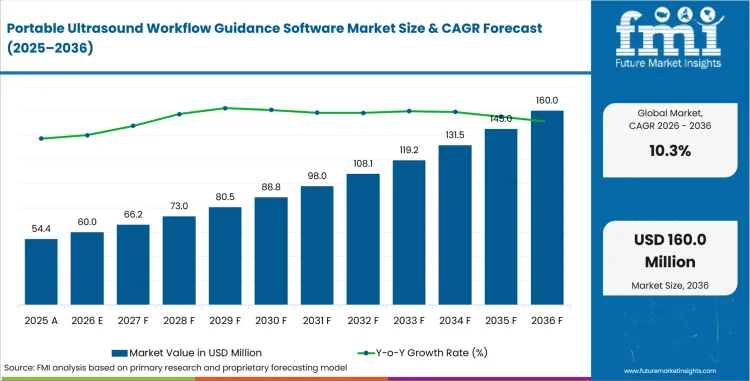
Portable Ultrasound Workflow Guidance Software Market Overview: Size and Forecast
- 2026 Market Size: USD 60.0 million
- 2036 Market Size: USD 160.0 million
- Forecast CAGR: 10.3% from 2026 to 2036
- Leading Product Type: Software
- Software Share in 2026: 64.0%
- Leading Delivery Model: Embedded Module
- Embedded Module Share in 2026: 48.0%
- Fastest-growing Country: India
- India CAGR: 12.8% by 2036
Summary of the Portable Ultrasound Workflow Guidance Software Market
- Demand and Growth Drivers
- Hospital teams are using portable ultrasound guidance to reduce failed scans and improve bedside image capture.
- Emergency and critical care clinicians need guided workflows that support faster triage without full radiology dependence.
- Regulatory visibility is improving as cleared AI-enabled ultrasound tools define user groups and intended workflows.
- Product and Segment View
- Software is forecast to represent 64.0% share in 2026, led by guided acquisition and scan-quality prompts.
- Embedded modules are projected to hold 48.0% share in 2026, influenced by platform compatibility and procurement confidence.
- Hospital care settings are expected to secure 46.0% share in 2026, supported by credentialing, cybersecurity review, and image storage requirements.
- Geography and Competitive Outlook
- India is projected to record 12.8% CAGR by 2036, backed by diagnostic access gaps and distributed care needs.
- China is expected to expand at 12.0% CAGR by 2036 through county-level hospital digitization and local AI device regulation.
- GE HealthCare and Butterfly Network compete through handheld ultrasound platforms and software-guided workflow tools.
- Clarius Mobile Health, UltraSight, DESKi, ThinkSono, and Exo Imaging focus on AI-enabled acquisition, vascular guidance, and workflow automation.
- Analyst Opinion
- Anurag Sharma, Principal Consultant at Future Market Insights, observes, "Portable ultrasound workflow guidance software is becoming a trust layer for bedside imaging. Hospitals are not buying these tools only to move a probe more easily. They are buying them to reduce failed scans, support supervised non-specialist use, and make portable imaging reviewable. Suppliers with clear intended use, strong device compatibility, and proven workflow integration should gain stronger enterprise adoption."
- Which factors support expansion in the portable ultrasound workflow guidance software market?
- Guided scan capture, software attachment, and hospital governance support market value across portable ultrasound workflows.
- Market value is supported by software modules that convert portable ultrasound from informal bedside use into managed clinical workflows.
- Supplier pricing reflects guided acquisition, quality scoring, software support, and integration with approved ultrasound platforms.
- Revenue improves as hospitals add workflow guidance to handheld ultrasound fleets used across emergency and inpatient departments.
- Buyer trust rises when vendors document compatible probes, user groups, scan types, and review pathways before rollout.
Quality assurance is becoming the main pressure point for portable ultrasound guidance software as hospitals review clinical risk, software claims, and user responsibility. NHS England reported 49.9 million imaging tests in 2024/25, including 11.5 million ultrasound tests, showing why workflow control matters in high-volume diagnostic systems. FDA records show GE HealthCare's July 2025 clearance expanded Caption Guidance for use with the Vscan Air SL probe. FDA also cleared Butterfly Network's gestational age tool in March 2026 for singleton intrauterine pregnancies presumed between 16 weeks and 37 weeks. Suppliers with defined clinical claims and compatible device pathways can gain stronger hospital approval.
Why is the portable ultrasound workflow guidance software market growing?
Non-specialist scan support is expanding as clinicians need faster bedside image capture with clearer prompts and safer review.
Growth outlook is becoming more structured because hospitals are separating cleared clinical guidance from training-only ultrasound software. FDA's AI-enabled medical device list includes devices that have met applicable premarket requirements and gives buyers access to public decision information. OECD reported in 2025 that Korea had 12.6 hospital beds per 1,000 population, while Japan had 12.5 hospital beds per 1,000 population. This hospital density supports bedside imaging demand in advanced inpatient systems. The result is a market where workflow evidence and device compatibility matter more than broad AI positioning.
How is the portable ultrasound workflow guidance software market segmented?
The portable ultrasound workflow guidance software industry is segmented by product type, care setting, application, end user, and delivery model.
- Software is projected to secure 64.0% share in 2026, led by guided acquisition, quality scoring, structured capture, and hospital-level software governance.
- Hospital care settings are anticipated to hold 46.0% share in 2026 since enterprise buyers need credentialing, cybersecurity checks, scan storage, and responsibility controls.
- Workflow automation is expected to capture 39.0% share in 2026 due to scan step prompts, routing rules, and structured capture needs across portable ultrasound workflows.
- Hospital end users are estimated to represent 43.0% share in 2026, reflected by centralized approval, imaging oversight, and enterprise control over clinical software.
- Embedded modules are forecast to account for 48.0% share in 2026, supported by buyer preference for guidance software built into compatible ultrasound devices.
Why does software dominate the portable ultrasound workflow guidance software market?
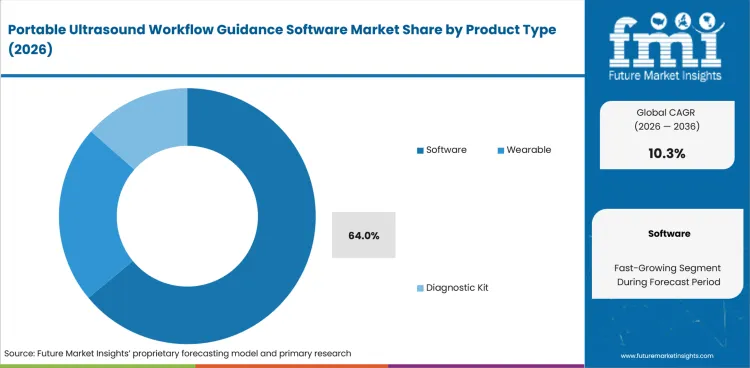
- Software is projected to account for 64.0% share in 2026, influenced by guided acquisition, scan-quality assessment, user prompts, workflow routing, and structured reporting across portable probes.
- Device accessories support portable workflows while software carries higher clinical value because it guides users during acquisition and creates reviewable outputs for hospitals.
Which care setting leads the portable ultrasound workflow guidance software market?
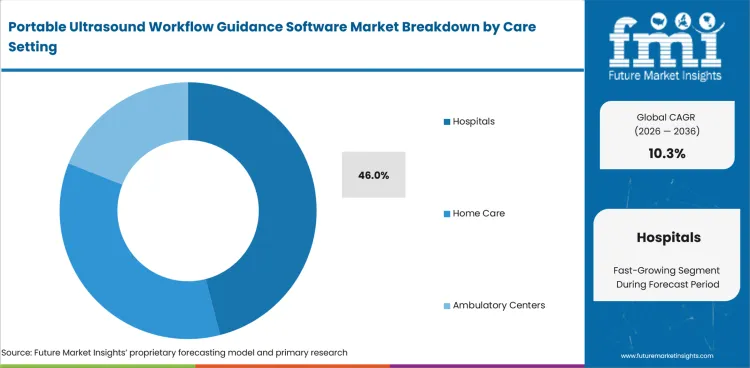
- Hospital care settings are estimated to hold 46.0% share in 2026, supported by emergency care, intensive care, cardiology, obstetrics, and inpatient imaging teams using portable ultrasound under governance.
- Ambulatory centers gain adoption as procedural and triage workflows need portable imaging, although hospital-led approvals continue to shape wider software acceptance.
Which application leads the portable ultrasound workflow guidance software market?
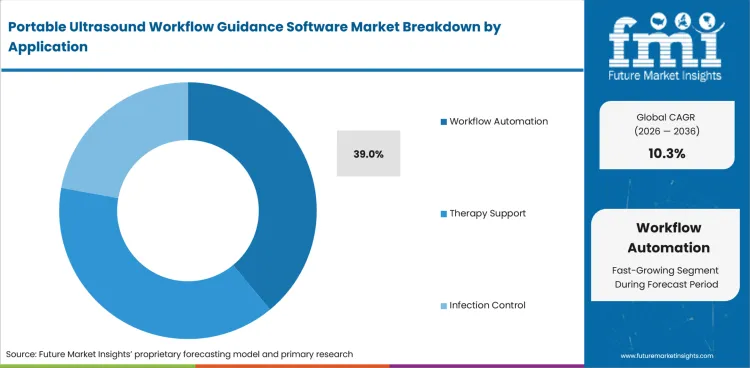
- Workflow automation is anticipated to secure 39.0% share in 2026, guided by scan protocols, capture checks, image routing, and review steps that reduce workflow variation.
- Diagnosis support gains importance when software links image acquisition to defined clinical tasks, although vendors must keep claims aligned with approved use boundaries.
Which end user leads the portable ultrasound workflow guidance software market?
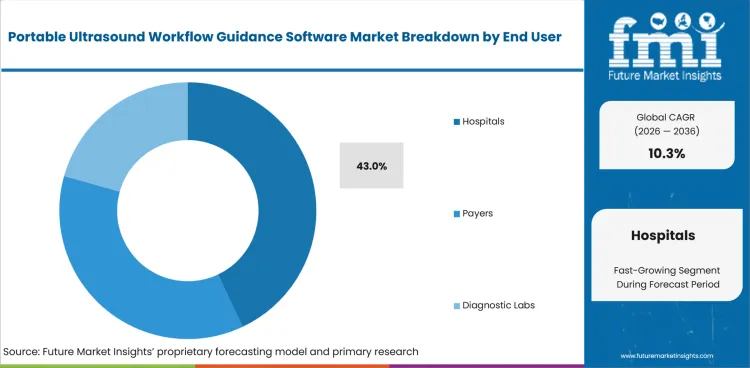
- Hospital end users are expected to represent 43.0% share in 2026, led by enterprise imaging teams that control device fleets, software approval, patient data, and review responsibility.
- Medtech firms use guidance software to extend scanner value, but hospitals remain the main revenue base because routine deployment requires institutional approval.
Which delivery model leads the portable ultrasound workflow guidance software market?
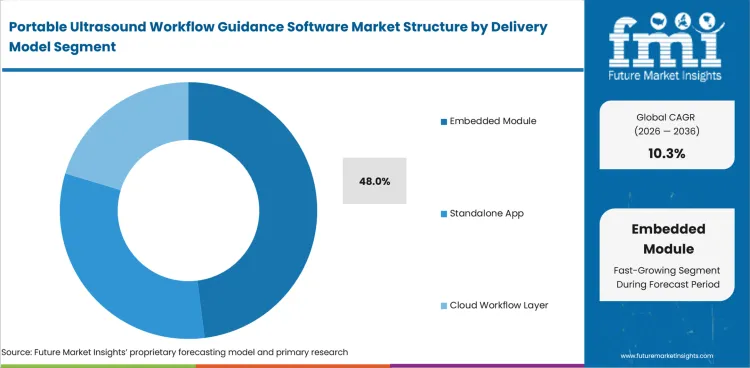
- Embedded modules are forecast to capture 48.0% share in 2026, shaped by compatibility control, approved device pairing, and simpler procurement through existing ultrasound platforms.
- Standalone applications gain attention when they work across several devices, although validation and liability concerns can slow hospital approval outside controlled bundles.
What are the driver, restraints, and opportunities in the portable ultrasound workflow guidance software market?
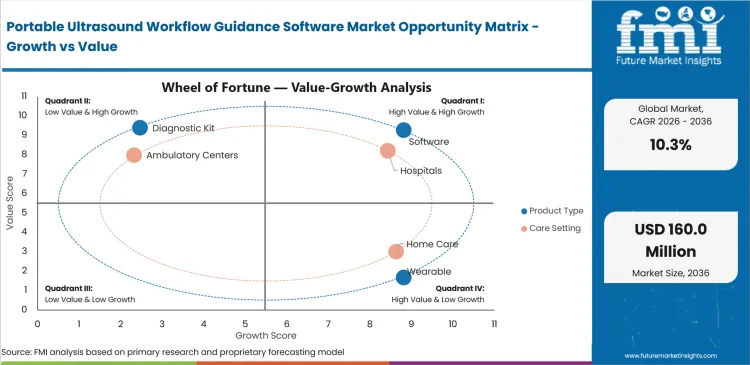
Guided capture and enterprise governance support adoption while compatibility limits and clinical responsibility slow wider rollout.
- Driver: Cardiac scan coaching creates early demand as standard view capture remains difficult for many non-sonographer users.
- Restraint: Compatibility limits slow adoption when software works only with selected probes, tablets, applications, or scan modes.
- Opportunity: Vascular, obstetric, and procedure workflows can expand revenue once clinical evidence improves.
Portable Ultrasound Workflow Guidance Software Market Demand Outlook
Demand outlook is moving toward guided bedside imaging that can prove safety, compatibility, and clinical workflow value before wider hospital deployment. FDA's July 2025 clearance for GE HealthCare's expanded Caption Guidance workflow on Vscan Air SL shows how textual guidance, graphical navigation, and reference images can support cardiac acquisition. This gives hospitals a defined use case instead of a broad AI promise. Suppliers that name the scan type, user group, compatible device, and review boundary can build stronger enterprise pilots.
Compatibility and Clinical Responsibility Analysis
Compatibility limits remain a restraint because hospitals cannot scale software that works unpredictably across probes, tablets, or application versions. FDA's March 2026 clearance for Butterfly Network's gestational age tool specifies use with compatible iQ+ and iQ3 systems and a defined pregnancy window of 16 weeks to 37 weeks. These boundaries protect safety but narrow the addressable pool until more probes and workflows are validated. Enterprise buyers will continue to ask which device, anatomy, scan mode, and user group are covered before approval.
Vascular and Procedure Workflow Opportunity Analysis
Vascular guidance creates a strong opportunity because DVT assessment and bedside procedure planning often need faster scanning outside radiology. Clarius and ThinkSono introduced an AI-guided ultrasound system in April 2024 for DVT assessment by non-ultrasound-trained staff. The system is positioned to reduce diagnostic waiting from hours to as little as 15 minutes in selected pathways. Vendors that combine portable scanner access with guided workflow software can reach urgent care, emergency, and outpatient sites more effectively.
Who are the leading companies in the portable ultrasound workflow guidance software market?
GE HealthCare, Butterfly Network, Clarius Mobile Health, UltraSight, and DESKi.
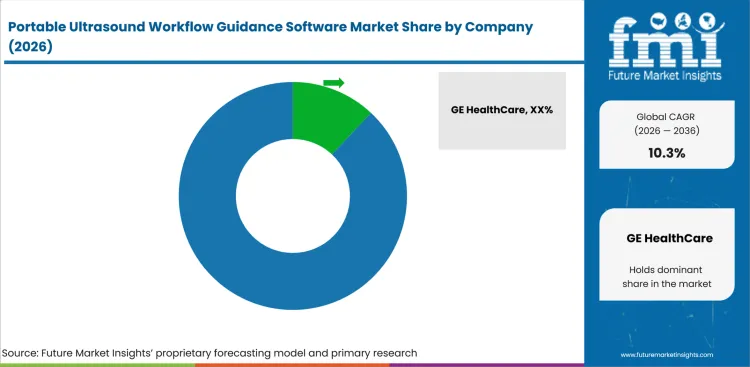
- Established imaging companies hold an advantage through hospital relationships, installed ultrasound platforms, and service networks.
- Specialist software firms gain attention by offering workflow guidance for cardiac, vascular, obstetric, and emergency scan use cases.
- Scanner platform companies gain value when software partners expand portable ultrasound use without requiring new hardware categories.
- Enterprise-ready documentation supports adoption through clear intended use, compatible devices, cybersecurity review, and image routing.
Portable ultrasound workflow guidance software companies compete by combining regulated device evidence with practical bedside usability. GE HealthCare has a strong position through Vscan Air SL and Caption Guidance. Butterfly Network competes through handheld ultrasound software and AI-enabled workflow tools. Clarius Mobile Health uses scanner partnerships to support guided vascular workflows. UltraSight and DESKi focus on cardiac guidance where standard view capture is a clear challenge for less-expert users.
Competition is also shaped by how vendors define clinical responsibility. Hospitals need software that fits scan governance, data routing, user training, and review protocols. Philips, Siemens Healthineers, Canon Medical, Fujifilm, Samsung Medison, Mindray, and SonoScape have platform reach that can support workflow guidance adoption. Smaller AI specialists can win when they prove one workflow clearly and integrate with trusted scanner platforms.
The strongest suppliers will combine approved claims, scan-specific guidance, hardware compatibility, and enterprise workflow support. Companies that prove repeatable image capture and safe review pathways should gain stronger hospital pilots. Vendors relying only on broad AI claims should face slower procurement and higher clinical review barriers.
How do top portable ultrasound workflow guidance software companies compare?
GE HealthCare and Butterfly Network score strongest on platform visibility while specialist firms lead narrow workflow guidance.
| Company | Relevance to Market Title | Guidance Software Depth | Portable Ultrasound Fit | Clinical Workflow Proof | Channel Reach | Geographic Footprint |
|---|---|---|---|---|---|---|
| GE HealthCare | Very High | Very Strong | Very Strong | Very Strong | Very Strong | Global |
| Butterfly Network | Very High | Strong | Very Strong | Strong | Strong | Global |
| Clarius Mobile Health | High | Strong | Very Strong | Strong | Strong | North America and Europe |
| UltraSight | High | Very Strong | Strong | Strong | Moderate | United States and Europe |
| DESKi | High | Very Strong | Moderate | Strong | Moderate | Europe and United States |
| Philips | High | Moderate | Strong | Strong | Very Strong | Global |
| Siemens Healthineers | Moderate to High | Moderate | Strong | Strong | Very Strong | Global |
| Canon Medical Systems | Moderate | Moderate | Strong | Moderate | Strong | Global |
| Fujifilm Healthcare | Moderate | Moderate | Strong | Moderate | Strong | Asia and Global |
| Mindray Medical International | Moderate to High | Moderate | Strong | Moderate | Very Strong | China and Global |
Source: Future Market Insights competitive analysis, 2026.
Who are the key players in the portable ultrasound workflow guidance software market?
GE HealthCare, Butterfly Network, Clarius Mobile Health, UltraSight, and DESKi are listed with Philips and Siemens Healthineers among other suppliers.
Key global companies leading the portable ultrasound workflow guidance software market include:
- GE HealthCare
- Butterfly Network
- Exo Imaging
- Clarius Mobile Health
- ThinkSono
- UltraSight
- DESKi
- Philips
- Siemens Healthineers
- Canon Medical Systems
- Fujifilm Healthcare
- Samsung Medison
- Mindray Medical International
- SonoScape Medical
- United Imaging Healthcare
Key Developments in Portable Ultrasound Workflow Guidance Software Market
- In July 2025, FDA cleared GE HealthCare's expanded Caption Guidance workflow for use with the Vscan Air SL probe, supporting guided cardiac acquisition through textual guidance, graphical navigation, and reference images.
- In April 2024, Clarius Mobile Health and ThinkSono introduced an AI-guided ultrasound system for DVT assessment, pairing Clarius scanners with ThinkSono Guidance for bedside vascular workflow support.
- In March 2026, FDA cleared Butterfly Network's gestational age tool for use with compatible handheld ultrasound systems, supporting guided fetal measurement in a defined clinical workflow.
Key Players in the Portable Ultrasound Workflow Guidance Software Market
Global Imaging Platform Companies
- GE HealthCare
- Philips
- Siemens Healthineers
- Canon Medical Systems
- Fujifilm Healthcare
- Samsung Medison
Portable Ultrasound and AI Software Specialists
- Butterfly Network
- Exo Imaging
- Clarius Mobile Health
- ThinkSono
- UltraSight
- DESKi
Regional and Device Ecosystem Companies
- Mindray Medical International
- SonoScape Medical
- United Imaging Healthcare
- Trivitron Healthcare
- Local medtech distributors
Which countries are growing fastest in the portable ultrasound workflow guidance software market?
India 12.8% CAGR, China 12.0% CAGR, South Korea 11.2% CAGR, United States 10.1% CAGR, United Kingdom 9.5% CAGR, Germany 9.0% CAGR, France 8.8% CAGR, and Japan 8.6% CAGR through 2036.
.webp "Top Country Growth Comparison Portable Ultrasound Workflow Guidance Software Market Cagr (2026 2036)")
| Country | CAGR |
|---|---|
| India | 12.8% |
| China | 12.0% |
| South Korea | 11.2% |
| United States | 10.1% |
| United Kingdom | 9.5% |
| Germany | 9.0% |
| France | 8.8% |
| Japan | 8.6% |
Source: Future Market Insights, 2026.
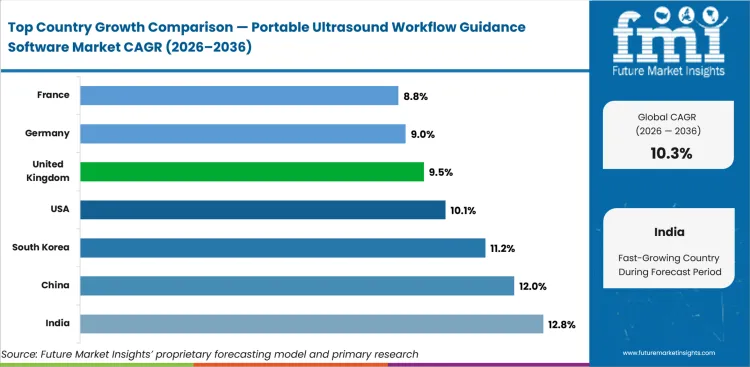
How do country-level CAGRs compare in the portable ultrasound workflow guidance software market?
India leads country growth while Japan records the most measured adoption outlook among profiled markets.
- India is forecast to record 12.8% CAGR by 2036 as diagnostic access gaps support guided portable imaging.
- China is expected to expand at 12.0% CAGR from 2026 to 2036 due to county hospital digitization and regulated AI medical product direction.
- South Korea is projected to grow at 11.2% CAGR through 2036 as hospital infrastructure and machine-learning device guidance support adoption.
- The United States is estimated to rise at 10.1% CAGR by 2036 with FDA-cleared AI ultrasound tools shaping enterprise buying.
- The United Kingdom is expected to advance at 9.5% CAGR over the forecast period as diagnostic capacity pressure supports guided imaging pathways.
- Germany is forecast to grow at 9.0% CAGR through 2036 as physician-led ultrasound culture adopts workflow support in selected settings.
- France is projected to post 8.8% CAGR by 2036 as local ultrasound AI firms and hospital innovation programs test guided imaging.
- Japan is expected to expand at 8.6% CAGR by 2036 as portable guidance fits aging care, emergency use, and disciplined hospital procurement.
How fast is the portable ultrasound workflow guidance software market growing in India?
A 12.8% CAGR through 2036 reflects district-level diagnostic access gaps and rising need for guided bedside imaging.
| Parameter | Value |
|---|---|
| Market Size in 2025 (Value) | USD 2.4 million |
| Market Size in 2026 (Value) | USD 2.7 million |
| Market Forecast in 2036 (Value) | USD 9.0 million |
| CAGR (2026 to 2036) | 12.8% |
| Years Considered | 2021 to 2036 |
| Base Year | 2025 |
| Forecast Period | 2026 to 2036 |
| Units Considered | Value (USD million) |
| Leading Sub-Region | South and West hospital corridors |
India Portable Ultrasound Workflow Guidance Software Market Outlook
India portable ultrasound workflow guidance software demand is shaped by distributed diagnostic needs and uneven specialist access across public and private care systems. Portable guidance can support non-specialist scan capture when district hospitals, ambulatory centers, and outreach teams need clearer acquisition prompts.
Hospital groups and medtech distributors are expected to favor tools that reduce training pressure and support reviewable imaging. Vendors with local service support, compatible hardware, and simple workflow screens should gain stronger adoption.
Key Growth Drivers
- District hospitals need guided imaging tools that can support frontline clinicians outside specialist radiology rooms. India reported 32,574 PM-JAY empanelled hospitals as of December 1, 2025.
- Large population coverage increases demand for scalable diagnostic workflows. World Bank data placed India's total population at about 1.451 billion in 2024.
- Private hospital groups can accelerate software pilots when guided scanning reduces repeat imaging and makes portable ultrasound easier to supervise.
- Public health programs can support portable workflow adoption when diagnostic services move closer to communities through primary and district-level care.
Key Restraints
- Rural connectivity and device maintenance gaps can limit cloud-based guidance tools in smaller facilities.
- Budget pressure can slow subscription adoption because many hospitals continue to prioritize basic imaging capacity before advanced software layers.
- Operational scale creates rollout complexity. India had 1,82,944 Ayushman Arogya Mandirs operationalized as of December 31, 2025.
What makes India unique
India is unique due to its large access gap, fast private hospital expansion, and need for guided diagnostics beyond metro imaging centers.
Key Companies
- GE HealthCare
- Philips
- Siemens Healthineers
- Fujifilm India
- Trivitron Healthcare
- Mindray India
- Butterfly Network
- Clarius Mobile Health
Sales & Marketing Channels
- Direct hospital enterprise sales
- Medtech distributor networks
- Public procurement programs
- Diagnostic chain partnerships
- Emergency medicine training programs
- Private hospital group pilots
Country Segment Breakdown Table
| Segment | Sub-Segments |
|---|---|
| By Product Type | Software · Wearable · Diagnostic Kit · Consumable · Device Accessory |
| By Care Setting | Hospitals · Home Care · Ambulatory Centers · Retail Clinics · Decentralized Trial Sites |
| By Application | Monitoring · Diagnosis · Workflow Automation · Therapy Support · Infection Control |
| By End User | Hospitals · Payers · Diagnostic Labs · Medtech Firms · Patients |
| By Delivery Model | Embedded Module · Standalone App · Cloud Workflow Layer · OEM Bundle · Third-Party App |
| Key Sub-Regions Covered, Hospital and Diagnostic Corridors | South India · West India · North India · East India · Tier-2 hospital clusters · Metro diagnostic networks |
Frequently Asked Questions
How fast is India portable ultrasound workflow guidance software market growing?
Sales in India are ready to scale at 12.8% CAGR from 2026 to 2036, guided by distributed diagnostic access needs.
Who leads India portable ultrasound workflow guidance software market?
GE HealthCare, Philips, Siemens Healthineers, Fujifilm, Trivitron, Mindray, Butterfly Network, and Clarius compete through portable imaging channels.
What is driving adoption in India portable ultrasound workflow guidance software market?
Diagnostic access gaps and hospital workflow pressure are moving buyers toward guided portable ultrasound systems.
What is the portable ultrasound workflow guidance software market outlook in China?
A 12.0% CAGR through 2036 is supported by county-level care expansion and regulated AI medical product direction.
| Parameter | Value |
|---|---|
| Market Size in 2025 (Value) | USD 6.3 million |
| Market Size in 2026 (Value) | USD 7.1 million |
| Market Forecast in 2036 (Value) | USD 22.0 million |
| CAGR (2026 to 2036) | 12.0% |
| Years Considered | 2021 to 2036 |
| Base Year | 2025 |
| Forecast Period | 2026 to 2036 |
| Units Considered | Value (USD million) |
| Leading Sub-Region | Eastern coastal hospital networks |
China Portable Ultrasound Workflow Guidance Software Market Outlook
China portable ultrasound workflow guidance software demand is shaped by hospital scale, county-level care needs, and stronger attention to regulated medical AI. Portable ultrasound guidance can help local care teams standardize scan capture when specialist imaging capacity is uneven across regions.
Domestic ultrasound suppliers have an advantage when guidance modules are embedded into local hardware channels. Foreign suppliers need localization, data governance readiness, and regulatory documentation before wide-scale access.
Key Growth Drivers
- County-level hospitals need guided imaging tools that can support frontline teams outside top-tier urban medical centers. China had 1.092 million medical and health institutions at the end of 2024.
- Technology investment supports domestic AI medical software development. China invested RMB 3,632.68 billion in R&D in 2024.
- Domestic ultrasound makers can bundle guidance tools into existing device channels and reduce adoption friction for provincial hospital buyers.
- Public hospital digitization supports guided portable ultrasound when software fits local data rules and clinical documentation pathways.
Key Restraints
- Imported guidance software faces registration, localization, cybersecurity, and data governance barriers before broader hospital deployment.
- Provincial procurement differences can fragment pricing and slow national rollout of software-enabled portable ultrasound solutions.
- Hospital infrastructure complexity can slow standardization. China had over 40,000 hospitals in 2024, making software deployment uneven across tiers.
What makes China unique
China is unique due to its large hospital network, local ultrasound manufacturing strength, and active policy focus on AI-powered medical products.
Key Companies
- Mindray Medical International
- SonoScape Medical
- GE HealthCare China
- Philips China
- Siemens Healthineers China
- United Imaging Healthcare
- Butterfly Network
- Clarius Mobile Health
Sales & Marketing Channels
- Provincial tender channels
- Direct tertiary hospital sales
- Domestic ultrasound distributor networks
- County hospital procurement
- OEM software partnerships
- Clinical training centers
Country Segment Breakdown Table
| Segment | Sub-Segments |
|---|---|
| By Product Type | Software · Wearable · Diagnostic Kit · Consumable · Device Accessory |
| By Care Setting | Hospitals · Home Care · Ambulatory Centers · Retail Clinics · Decentralized Trial Sites |
| By Application | Monitoring · Diagnosis · Workflow Automation · Therapy Support · Infection Control |
| By End User | Hospitals · Payers · Diagnostic Labs · Medtech Firms · Patients |
| By Delivery Model | Embedded Module · Standalone App · Cloud Workflow Layer · OEM Bundle · Third-Party App |
| Key Sub-Regions Covered, Public Hospital and Device Corridors | Yangtze River Delta · Greater Bay Area · Beijing-Tianjin-Hebei · Chengdu-Chongqing · Central China · Northeast hospital clusters |
Frequently Asked Questions
How fast is China portable ultrasound workflow guidance software market growing?
Demand in China is ready to scale at 12.0% CAGR from 2026 to 2036 with county hospital digitization and local AI device regulation.
Who leads China portable ultrasound workflow guidance software market?
Mindray, SonoScape, United Imaging, GE HealthCare, Philips, and Siemens Healthineers compete through imaging platforms and local channels.
What is driving adoption in China portable ultrasound workflow guidance software market?
County-level access needs and regulated AI medical software direction are moving hospitals toward guided portable imaging tools.
How is the portable ultrasound workflow guidance software market performing in South Korea?
An 11.2% CAGR through 2036 reflects advanced hospital infrastructure and machine-learning medical device guidance.
| Parameter | Value |
|---|---|
| Market Size in 2025 (Value) | USD 2.8 million |
| Market Size in 2026 (Value) | USD 3.1 million |
| Market Forecast in 2036 (Value) | USD 9.0 million |
| CAGR (2026 to 2036) | 11.2% |
| Years Considered | 2021 to 2036 |
| Base Year | 2025 |
| Forecast Period | 2026 to 2036 |
| Units Considered | Value (USD million) |
| Leading Sub-Region | Seoul Capital Area hospital networks |
South Korea Portable Ultrasound Workflow Guidance Software Market Outlook
South Korea portable ultrasound workflow guidance software demand is influenced by digitally advanced hospitals and strong medical technology review systems. Portable guidance tools can support emergency, cardiac, vascular, and outpatient imaging when hospitals need safer distributed scan capture.
Adoption is expected to move through hospital demonstrations, regulatory documentation, and specialist endorsement. Suppliers that localize user interfaces and clarify software responsibility should gain better acceptance.
Key Growth Drivers
- Digitally advanced hospitals create a supportive setting for AI-guided scan workflows and portable ultrasound integration. Korea had 12.6 hospital beds per 1,000 population in 2023.
- Diagnostic technology intensity supports software-enabled imaging. Korea had 87 CT, MRI, and PET scanners per million population in 2023.
- Machine-learning medical device guidance can help vendors frame clinical validation, user limits, and post-market review for ultrasound software.
- University hospitals provide early trial settings for guided cardiac, vascular, and emergency ultrasound workflows.
Key Restraints
- Hospital buyers may require local clinical validation before allowing guided scans into routine care pathways.
- Procurement can move slowly when software responsibility crosses radiology, emergency medicine, cardiology, and hospital IT teams.
- Demographic pressure can intensify cost review. World Bank data placed Korea's population aged 65 years and above at 19.27% in 2024.
What makes South Korea unique
South Korea is unique due to high diagnostic technology intensity, advanced hospitals, and formal guidance for machine-learning medical devices.
Key Companies
- Samsung Medison
- GE HealthCare Korea
- Philips Korea
- Siemens Healthineers Korea
- Canon Medical Systems Korea
- Butterfly Network
- Clarius Mobile Health
- UltraSight
Sales & Marketing Channels
- Direct hospital sales
- University hospital pilots
- Specialist society demonstrations
- Scanner vendor bundles
- Medtech distributor channels
- Emergency care training programs
Country Segment Breakdown Table
| Segment | Sub-Segments |
|---|---|
| By Product Type | Software · Wearable · Diagnostic Kit · Consumable · Device Accessory |
| By Care Setting | Hospitals · Home Care · Ambulatory Centers · Retail Clinics · Decentralized Trial Sites |
| By Application | Monitoring · Diagnosis · Workflow Automation · Therapy Support · Infection Control |
| By End User | Hospitals · Payers · Diagnostic Labs · Medtech Firms · Patients |
| By Delivery Model | Embedded Module · Standalone App · Cloud Workflow Layer · OEM Bundle · Third-Party App |
| Key Sub-Regions Covered, Hospital and Medtech Clusters | Seoul Capital Area · Busan · Daegu · Daejeon · Gwangju · Incheon medical corridors |
Frequently Asked Questions
How fast is South Korea portable ultrasound workflow guidance software market growing?
Industry in South Korea is projected to increase at 11.2% CAGR from 2026 to 2036 through advanced hospital imaging workflows.
Who leads South Korea portable ultrasound workflow guidance software market?
Samsung Medison, GE HealthCare, Philips, Siemens Healthineers, Canon Medical, Butterfly Network, and UltraSight compete through advanced imaging channels.
What is driving adoption in South Korea portable ultrasound workflow guidance software market?
Hospital digital readiness and machine-learning medical device guidance are moving buyers toward guided ultrasound workflow tools.
What is the portable ultrasound workflow guidance software market forecast for the United States?
A 10.1% CAGR through 2036 is supported by FDA-cleared AI ultrasound tools and enterprise hospital buying.
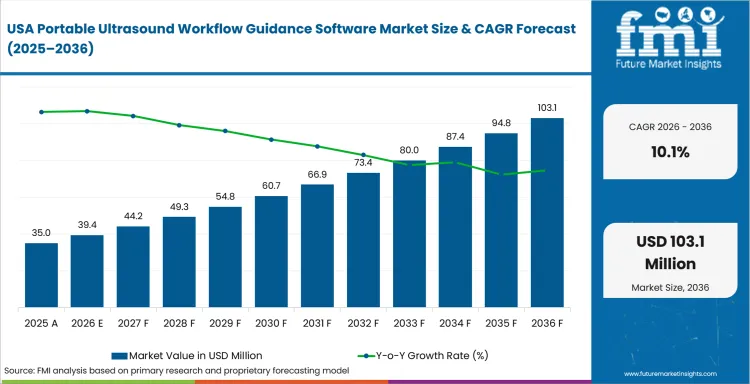
| Parameter | Value |
|---|---|
| Market Size in 2025 (Value) | USD 18.8 million |
| Market Size in 2026 (Value) | USD 20.7 million |
| Market Forecast in 2036 (Value) | USD 54.3 million |
| CAGR (2026 to 2036) | 10.1% |
| Years Considered | 2021 to 2036 |
| Base Year | 2025 |
| Forecast Period | 2026 to 2036 |
| Units Considered | Value (USD million) |
| Leading Sub-Region | Northeast and West Coast hospital networks |
United States Portable Ultrasound Workflow Guidance Software Market Outlook
United States portable ultrasound workflow guidance software demand is shaped by FDA-cleared software visibility and enterprise hospital governance. Guided portable ultrasound adoption often starts in emergency medicine, cardiology, critical care, and obstetric workflows.
Hospital buyers are expected to prioritize software with documented intended use, device compatibility, and cybersecurity readiness. Vendors with strong clinical evidence and integration support should gain the clearest route to system-level contracts.
Key Growth Drivers
- FDA-cleared guidance modules support enterprise buying by giving hospitals a clearer basis for software review. FDA's K252148 summary states the Butterfly Gestational Age Tool supports pregnancies between 16 weeks and 37 weeks.
- Aging and chronic-care needs expand bedside imaging demand. The United States had 60,977,581 people aged 65 years and above in 2024.
- Scanner software ecosystems can help guidance applications reach installed portable ultrasound users through validated platform partnerships.
- Emergency and critical care teams can use guided workflows when rapid cardiac, lung, vascular, or obstetric scans influence triage decisions.
Key Restraints
- Hospital credentialing policies can limit non-sonographer use even when software support is available.
- Liability concerns can slow adoption when clinical decisions depend on novice image capture and local review rules.
- Cost scrutiny remains high because the United States spent USD 14,885 per capita on health in 2024, above the OECD average.
What makes the United States unique
The United States is unique due to visible FDA pathways and large enterprise hospital systems that can convert cleared workflows into wider contracts.
Key Companies
- GE HealthCare
- Butterfly Network
- Exo Imaging
- Clarius Mobile Health
- UltraSight
- DESKi
- Philips
- Siemens Healthineers
Sales & Marketing Channels
- Direct enterprise hospital sales
- Integrated scanner software stores
- Emergency medicine education programs
- Cardiology pilot projects
- Distributor-supported clinic sales
- Group purchasing organization evaluations
Country Segment Breakdown Table
| Segment | Sub-Segments |
|---|---|
| By Product Type | Software · Wearable · Diagnostic Kit · Consumable · Device Accessory |
| By Care Setting | Hospitals · Home Care · Ambulatory Centers · Retail Clinics · Decentralized Trial Sites |
| By Application | Monitoring · Diagnosis · Workflow Automation · Therapy Support · Infection Control |
| By End User | Hospitals · Payers · Diagnostic Labs · Medtech Firms · Patients |
| By Delivery Model | Embedded Module · Standalone App · Cloud Workflow Layer · OEM Bundle · Third-Party App |
| Key Sub-Regions Covered, Enterprise Hospital Corridors | Northeast · California · Texas · Midwest · Pacific Northwest · Southeast hospital networks |
Frequently Asked Questions
How fast is United States portable ultrasound workflow guidance software market growing?
Sector in the United States is anticipated to grow at 10.1% CAGR from 2026 to 2036, reflecting FDA-cleared workflow tools.
Who leads United States portable ultrasound workflow guidance software market?
GE HealthCare, Butterfly Network, Exo Imaging, Clarius, UltraSight, DESKi, Philips, and Siemens Healthineers compete through portable imaging platforms.
What is driving adoption in United States portable ultrasound workflow guidance software market?
FDA-cleared AI ultrasound tools and enterprise imaging governance are moving hospitals toward portable workflow guidance software.
What is driving portable ultrasound workflow guidance software growth in the United Kingdom?
A 9.5% CAGR through 2036 is supported by diagnostic capacity pressure and community imaging pathway development.
| Parameter | Value |
|---|---|
| Market Size in 2025 (Value) | USD 5.2 million |
| Market Size in 2026 (Value) | USD 5.7 million |
| Market Forecast in 2036 (Value) | USD 14.1 million |
| CAGR (2026 to 2036) | 9.5% |
| Years Considered | 2021 to 2036 |
| Base Year | 2025 |
| Forecast Period | 2026 to 2036 |
| Units Considered | Value (USD million) |
| Leading Sub-Region | England community diagnostic corridors |
United Kingdom Portable Ultrasound Workflow Guidance Software Market Outlook
United Kingdom portable ultrasound workflow guidance software demand is shaped by NHS diagnostic pressure and the movement of selected imaging services closer to patients. Portable guidance tools can help community and urgent care teams capture better scans under supervision.
Suppliers must prove pathway value rather than only technical novelty. NHS buyers are expected to prioritize workflow evidence, information governance, and support for local clinical training.
Key Growth Drivers
- NHS diagnostic pressure creates demand for guided capture in community, urgent care, and hospital-adjacent imaging pathways. England reported 49.9 million imaging tests in 2024/25.
- Ultrasound volume creates a practical workflow target. NHS England recorded 11.5 million ultrasound tests in 2024/25.
- DVT, cardiac triage, and women's health workflows suit guided scanning when specialist appointments create delays.
- Community diagnostic pathways support portable workflow adoption when scans move beyond main hospital imaging departments.
Key Restraints
- NHS budget scrutiny limits software adoption unless suppliers prove shorter waits, fewer repeat scans, or better pathway productivity.
- Workforce rules make it harder to expand scanning tasks without formal training and supervision.
- Integration pressure remains high because the NHS diagnostic dataset covers 15 key diagnostic tests and procedures, requiring consistent reporting across services.
What makes the United Kingdom unique
The United Kingdom is unique because adoption depends on service redesign, measurable pathway impact, and NHS information governance readiness.
Key Companies
- GE HealthCare UK
- Philips UK
- Siemens Healthineers UK
- Clarius Mobile Health
- ThinkSono
- Butterfly Network
- UltraSight
- DESKi
Sales & Marketing Channels
- NHS trust procurement
- Community diagnostic center pilots
- Clinical education partnerships
- Scanner-vendor bundles
- Framework purchasing routes
- Academic hospital evaluations
Country Segment Breakdown Table
| Segment | Sub-Segments |
|---|---|
| By Product Type | Software · Wearable · Diagnostic Kit · Consumable · Device Accessory |
| By Care Setting | Hospitals · Home Care · Ambulatory Centers · Retail Clinics · Decentralized Trial Sites |
| By Application | Monitoring · Diagnosis · Workflow Automation · Therapy Support · Infection Control |
| By End User | Hospitals · Payers · Diagnostic Labs · Medtech Firms · Patients |
| By Delivery Model | Embedded Module · Standalone App · Cloud Workflow Layer · OEM Bundle · Third-Party App |
| Key Sub-Regions Covered, NHS Diagnostic Corridors | London · Manchester · Birmingham · Leeds · Glasgow · Bristol community diagnostic networks |
Frequently Asked Questions
How fast is United Kingdom portable ultrasound workflow guidance software market growing?
Demand in the United Kingdom is ready to rise at 9.5% CAGR from 2026 to 2036 with diagnostic pathway pressure.
Who leads United Kingdom portable ultrasound workflow guidance software market?
GE HealthCare, Philips, Siemens Healthineers, Clarius, ThinkSono, Butterfly Network, UltraSight, and DESKi compete through workflow partnerships.
What is driving adoption in United Kingdom portable ultrasound workflow guidance software market?
Community diagnostic pathways and ultrasound capacity pressure are moving buyers toward guided portable imaging workflows.
How is the portable ultrasound workflow guidance software market performing in Germany?
A 9.0% CAGR through 2036 reflects physician-led ultrasound culture and selective hospital workflow adoption.
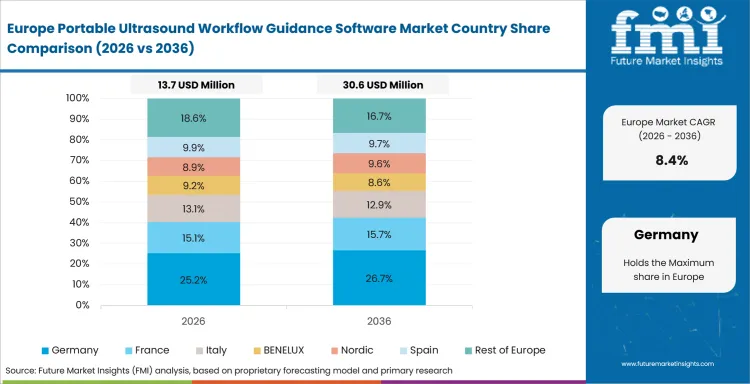
| Parameter | Value |
|---|---|
| Market Size in 2025 (Value) | USD 4.8 million |
| Market Size in 2026 (Value) | USD 5.2 million |
| Market Forecast in 2036 (Value) | USD 12.3 million |
| CAGR (2026 to 2036) | 9.0% |
| Years Considered | 2021 to 2036 |
| Base Year | 2025 |
| Forecast Period | 2026 to 2036 |
| Units Considered | Value (USD million) |
| Leading Sub-Region | Bavaria and North Rhine-Westphalia hospital corridors |
Germany Portable Ultrasound Workflow Guidance Software Market Outlook
Germany portable ultrasound workflow guidance software demand is shaped by strong clinical imaging culture and physician-led ultrasound practice. Portable guidance tools must support expert standards rather than appear as a substitute for specialist skill.
Adoption is expected in emergency departments, internal medicine, cardiology, and specialist outpatient practices. Suppliers need German-language workflows, EU MDR documentation, and clear training support.
Key Growth Drivers
- Hospital emergency departments need faster bedside cardiac and lung assessment when unstable patients cannot be moved easily. Germany has roughly 1,900 hospitals providing inpatient care.
- Aging pressure supports bedside imaging demand. Destatis expects one person in four in Germany to be aged 67 years or older in 2035.
- Specialist outpatient practices can use guided workflows for staff training, scan consistency, and controlled documentation.
- EU MDR documentation can favor suppliers with clear intended use, post-market support, and stronger software governance.
Key Restraints
- Established physician scanning culture can slow adoption among users who trust manual ultrasound skill and specialist-led acquisition.
- Data protection and hospital IT review can lengthen software buying cycles before any bedside imaging application is approved.
- Cost oversight remains strict because Germany's health expenditure reached EUR 538,207 million in 2024.
What makes Germany unique
Germany is unique because portable guidance software must support high-quality physician-led ultrasound practice and strict documentation expectations.
Key Companies
- Siemens Healthineers
- GE HealthCare Germany
- Philips Germany
- Canon Medical Systems Germany
- Clarius Mobile Health
- UltraSight
- DESKi
- Butterfly Network
Sales & Marketing Channels
- Direct hospital imaging sales
- Specialist practice distributors
- University hospital pilots
- EU MDR documentation review
- Clinical society training routes
- Scanner platform partnerships
Country Segment Breakdown Table
| Segment | Sub-Segments |
|---|---|
| By Product Type | Software · Wearable · Diagnostic Kit · Consumable · Device Accessory |
| By Care Setting | Hospitals · Home Care · Ambulatory Centers · Retail Clinics · Decentralized Trial Sites |
| By Application | Monitoring · Diagnosis · Workflow Automation · Therapy Support · Infection Control |
| By End User | Hospitals · Payers · Diagnostic Labs · Medtech Firms · Patients |
| By Delivery Model | Embedded Module · Standalone App · Cloud Workflow Layer · OEM Bundle · Third-Party App |
| Key Sub-Regions Covered, Specialist Imaging Corridors | Bavaria · North Rhine-Westphalia · Baden-Württemberg · Berlin-Brandenburg · Hamburg · Saxony clinical clusters |
Frequently Asked Questions
How fast is Germany portable ultrasound workflow guidance software market growing?
Industry in Germany is projected to increase at 9.0% CAGR from 2026 to 2036 through hospital and specialist workflow adoption.
Who leads Germany portable ultrasound workflow guidance software market?
Siemens Healthineers, GE HealthCare, Philips, Canon Medical, Clarius, UltraSight, DESKi, and Butterfly Network compete through platform and specialist channels.
What is driving adoption in Germany portable ultrasound workflow guidance software market?
Emergency workflow needs and physician-led imaging quality standards are moving selected buyers toward guided ultrasound software.
What is the portable ultrasound workflow guidance software market outlook in France?
An 8.8% CAGR through 2036 is supported by local ultrasound AI capability and hospital innovation pathways.
| Parameter | Value |
|---|---|
| Market Size in 2025 (Value) | USD 3.9 million |
| Market Size in 2026 (Value) | USD 4.2 million |
| Market Forecast in 2036 (Value) | USD 9.8 million |
| CAGR (2026 to 2036) | 8.8% |
| Years Considered | 2021 to 2036 |
| Base Year | 2025 |
| Forecast Period | 2026 to 2036 |
| Units Considered | Value (USD million) |
| Leading Sub-Region | Ile-de-France and Rhone-Alpes hospital networks |
France Portable Ultrasound Workflow Guidance Software Market Outlook
France portable ultrasound workflow guidance software demand is shaped by local ultrasound AI activity and cautious reimbursement review. Guided portable ultrasound can gain adoption when it reduces specialist bottlenecks in emergency, cardiac, and obstetric pathways.
Public hospitals are expected to move through clinical pilots and evidence review. Private clinics can adopt faster when software improves throughput, training, or quality assurance.
Key Growth Drivers
- French ultrasound AI companies create local proof points for cardiac and obstetric guided workflows. France recorded EUR 120.8 billion in hospital care expenditure in 2024.
- Aging care needs support cardiac and chronic-care imaging. INSEE reported people aged 60 years or above represented 28.1% of France's population in 2025.
- Private clinic networks can adopt software when guided workflows reduce specialist bottlenecks and make scan review more consistent.
- University hospitals provide clinical testing routes for AI-guided acquisition, education, and portable ultrasound workflow validation.
Key Restraints
- Reimbursement uncertainty makes software value harder to prove outside pilots and innovation-funded programs.
- Public hospital buying cycles can slow scale even when local software firms provide strong clinical references.
- Budget review remains strict because public hospital care accounted for EUR 93.7 billion within France's 2024 hospital expenditure.
What makes France unique
France is unique due to local ultrasound AI companies and a reimbursement environment that demands proof of workflow value.
Key Companies
- DESKi
- Sonio
- Samsung Medison
- GE HealthCare France
- Philips France
- Siemens Healthineers France
- Clarius Mobile Health
- UltraSight
Sales & Marketing Channels
- Public hospital innovation programs
- Private clinic purchasing groups
- University hospital studies
- Scanner vendor sales channels
- Cardiology training networks
- Obstetric imaging partnerships
Country Segment Breakdown Table
| Segment | Sub-Segments |
|---|---|
| By Product Type | Software · Wearable · Diagnostic Kit · Consumable · Device Accessory |
| By Care Setting | Hospitals · Home Care · Ambulatory Centers · Retail Clinics · Decentralized Trial Sites |
| By Application | Monitoring · Diagnosis · Workflow Automation · Therapy Support · Infection Control |
| By End User | Hospitals · Payers · Diagnostic Labs · Medtech Firms · Patients |
| By Delivery Model | Embedded Module · Standalone App · Cloud Workflow Layer · OEM Bundle · Third-Party App |
| Key Sub-Regions Covered, Clinical Innovation Corridors | Ile-de-France · Auvergne-Rhone-Alpes · Provence-Alpes-Cote d'Azur · Occitanie · Nouvelle-Aquitaine · Grand Est |
Frequently Asked Questions
How fast is France portable ultrasound workflow guidance software market growing?
Sales in France are ready to scale at 8.8% CAGR from 2026 to 2036, guided by local ultrasound AI and hospital pilots.
Who leads France portable ultrasound workflow guidance software market?
DESKi, Sonio, Samsung Medison, GE HealthCare, Philips, Siemens Healthineers, Clarius, and UltraSight compete through AI imaging and platform channels.
What is driving adoption in France portable ultrasound workflow guidance software market?
Local ultrasound AI strength and hospital workflow pilots are moving buyers toward guided portable imaging.
What is the portable ultrasound workflow guidance software market forecast for Japan?
An 8.6% CAGR through 2036 reflects aging care, disciplined procurement, and strong diagnostic imaging capability.
| Parameter | Value |
|---|---|
| Market Size in 2025 (Value) | USD 4.0 million |
| Market Size in 2026 (Value) | USD 4.4 million |
| Market Forecast in 2036 (Value) | USD 10.0 million |
| CAGR (2026 to 2036) | 8.6% |
| Years Considered | 2021 to 2036 |
| Base Year | 2025 |
| Forecast Period | 2026 to 2036 |
| Units Considered | Value (USD million) |
| Leading Sub-Region | Tokyo and Kansai hospital corridors |
Japan Portable Ultrasound Workflow Guidance Software Market Outlook
Japan portable ultrasound workflow guidance software demand is tied to aging care, high service expectations, and strong diagnostic imaging capability. Portable guidance tools can support emergency, home-visit, and inpatient workflows when hospitals require reliable local support.
Adoption will depend on Japanese-language prompts, compatible hardware, and trusted distribution partners. Suppliers that work with established imaging brands should have a stronger path into routine clinical use.
Key Growth Drivers
- Aging-related cardiac and chronic disease needs create demand for bedside ultrasound workflows. Japan's population aged 65 years and above was 36,243 thousand in 2024.
- Diagnostic technology capability supports software-enabled imaging. Japan had 184 CT, MRI, and PET scanners per million population in 2023.
- Domestic imaging expertise can support guided ultrasound adoption when software fits disciplined clinical routines and local service standards.
- Home-visit and remote island care pathways create use cases for compact guided imaging outside large hospital departments.
Key Restraints
- Conservative hospital procurement slows adoption of software that changes clinical responsibility or user training requirements.
- Language localization and domestic validation add cost for foreign software suppliers entering Japanese hospital channels.
- Hospital integration can be complex because Japan had 12.5 hospital beds per 1,000 population in 2023.
What makes Japan unique
Japan is unique because software-led workflow guidance must fit a highly capable imaging environment and disciplined clinical service culture.
Key Companies
- GE HealthCare Japan
- Fujifilm Healthcare
- Canon Medical Systems
- Philips Japan
- Siemens Healthineers Japan
- Clarius Mobile Health
- Butterfly Network
- UltraSight
Sales & Marketing Channels
- Hospital imaging departments
- Emergency care pilots
- Domestic distributor networks
- Home-care provider trials
- Academic medical centers
- OEM software partnerships
Country Segment Breakdown Table
| Segment | Sub-Segments |
|---|---|
| By Product Type | Software · Wearable · Diagnostic Kit · Consumable · Device Accessory |
| By Care Setting | Hospitals · Home Care · Ambulatory Centers · Retail Clinics · Decentralized Trial Sites |
| By Application | Monitoring · Diagnosis · Workflow Automation · Therapy Support · Infection Control |
| By End User | Hospitals · Payers · Diagnostic Labs · Medtech Firms · Patients |
| By Delivery Model | Embedded Module · Standalone App · Cloud Workflow Layer · OEM Bundle · Third-Party App |
| Key Sub-Regions Covered, Hospital and Home-Care Corridors | Tokyo · Kansai · Chubu · Kyushu · Hokkaido · Tohoku care networks |
Frequently Asked Questions
How fast is Japan portable ultrasound workflow guidance software market growing?
Demand in Japan is projected to grow at 8.6% CAGR from 2026 to 2036 with aging care and portable imaging workflows.
Who leads Japan portable ultrasound workflow guidance software market?
GE HealthCare, Fujifilm, Canon Medical, Philips, Siemens Healthineers, Clarius, Butterfly Network, and UltraSight compete through imaging channels.
What is driving adoption in Japan portable ultrasound workflow guidance software market?
Aging care needs and strong diagnostic imaging capability are moving buyers toward guided portable ultrasound workflows.
Portable Ultrasound Workflow Guidance Software Market - Report Scope
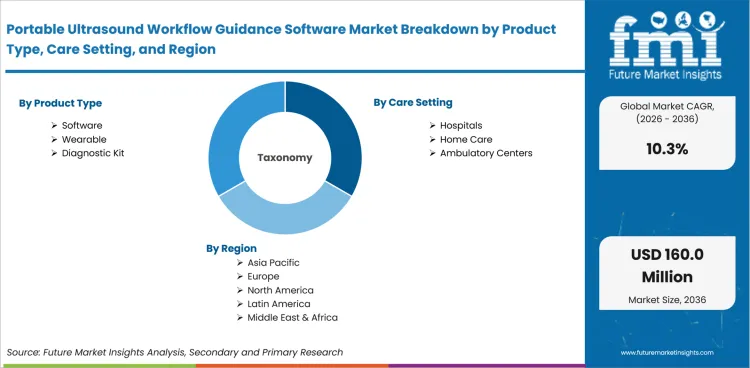
| Parameter | Details |
|---|---|
| Market size by 2036 | USD 160.0 million |
| Growth rate | 10.3% CAGR from 2026 to 2036 |
| Forecast period | 2026 to 2036 |
| Base year value (2025) | USD 54.4 million |
| By product type | Software, wearable, diagnostic kit, consumable, device accessory |
| By care setting | Hospitals, home care, ambulatory centers, retail clinics, decentralized trial sites |
| By application | Monitoring, diagnosis, workflow automation, therapy support, infection control |
| By end user | Hospitals, payers, diagnostic labs, medtech firms, patients |
| By delivery model | Embedded module, standalone app, cloud workflow layer, OEM bundle, third-party app |
| Regions covered | North America, Latin America, Europe, East Asia, South Asia and Pacific, Middle East and Africa |
| Countries covered | India, China, South Korea, United States, United Kingdom, Germany, France, Japan |
| Key companies profiled | GE HealthCare, Butterfly Network, Clarius Mobile Health, UltraSight, DESKi, Philips, Siemens Healthineers, Canon Medical Systems |
| Approach | Bottom-up software-boundary approach using eligible module revenue, installed portable ultrasound base, software attachment, clinical workflow readiness, and country-level adoption |
Source: Future Market Insights, 2026.
Portable Ultrasound Workflow Guidance Software Market - Scope & Definition
| Attribute | Detail |
|---|---|
| Market Definition | Software that guides portable ultrasound image acquisition, scan workflow, quality review, routing, and structured reporting on handheld or portable ultrasound systems. |
| Functions Covered | Probe guidance, scan coaching, image quality scoring, workflow prompts, exam routing, user oversight, structured capture, and review support. |
| Applications Covered | Monitoring, diagnosis, workflow automation, therapy support, infection control, emergency triage, cardiac acquisition, vascular assessment, and obstetric support. |
| End-Use Industries | Hospitals, diagnostic services, emergency care, ambulatory care, home care, clinical trials, medtech companies, and payer-linked care networks. |
| Formats Covered | Software modules, wearable-linked workflows, diagnostic kits, consumables tied to guided workflows, and device accessories connected to portable ultrasound. |
| Inclusions | All commercially available portable ultrasound workflow guidance software sold as embedded modules, standalone applications, cloud workflow layers, OEM bundles, or third-party applications. |
| Exclusions | Conventional cart ultrasound systems without workflow guidance, generic PACS software, radiology dictation tools without acquisition support, therapeutic ultrasound devices, and consumer wellness applications not regulated for clinical ultrasound use. |
Portable Ultrasound Workflow Guidance Software Market - Research Methodology
| Method | Description |
|---|---|
| Primary Research | FMI analyst interviews with emergency physicians, point-of-care ultrasound leads, hospital imaging teams, medtech channel partners, and diagnostic service providers across key markets. |
| Desk Research | Review of regulatory data from FDA, NHS England, OECD, NMPA, MFDS, national statistics agencies, company technical documents, and public health system sources related to portable ultrasound and AI medical software. |
| Market Sizing & Forecasting | Bottom-up software-boundary approach using portable ultrasound installed-base growth, paid software attachment rates, subscription values, country-level readiness, and regulated AI adoption patterns. |
| Data Validation | Cross-verification using device clearances, hospital infrastructure statistics, diagnostic workload data, vendor portfolios, and country-level procurement constraints. |
Portable Ultrasound Workflow Guidance Software Market Breakdown by Product Type, Care Setting, Application, End User, Delivery Model, and Region
Portable Ultrasound Workflow Guidance Software Market Segmented by Product Type
- Software
- Wearable
- Diagnostic Kit
- Consumable
- Device Accessory
Portable Ultrasound Workflow Guidance Software Market Segmented by Care Setting
- Hospitals
- Home Care
- Ambulatory Centers
- Retail Clinics
- Decentralized Trial Sites
Portable Ultrasound Workflow Guidance Software Market Segmented by Application
- Monitoring
- Diagnosis
- Workflow Automation
- Therapy Support
- Infection Control
Portable Ultrasound Workflow Guidance Software Market Segmented by End User
- Hospitals
- Payers
- Diagnostic Labs
- Medtech Firms
- Patients
Portable Ultrasound Workflow Guidance Software Market Segmented by Delivery Model
- Embedded Module
- Standalone App
- Cloud Workflow Layer
- OEM Bundle
- Third-Party App
Portable Ultrasound Workflow Guidance Software Market by Region
- North America
- Latin America
- Europe
- East Asia
- South Asia and Pacific
- Middle East and Africa
Research Sources and Bibliography
- Butterfly Network, Inc. (2026, April 30). Butterfly Network reports first quarter 2026 financial results.
- Clarius Mobile Health. (2024, April 5). Clarius and ThinkSono introduce a new AI-guided ultrasound system to accelerate DVT diagnosis.
- Destatis. (2025, December 11). By 2035, one quarter of Germany's population will be aged 67 or over.
- DREES. (2025, October 27). Health expenditure in 2024: Results of the health accounts.
- Federal Ministry of Health. (2025, December). Everything you need to know about the healthcare system in Germany.
- GE HealthCare. (2024, November). GE HealthCare highlights new solutions including AI-enabled innovations to drive precision care at RSNA 2024.
- INSEE. (2026, January 14). Population estimates: Share of 60 years old or over in France.
- Ministry of Food and Drug Safety. (2024, December 11). Guiding principles for conducting clinical trials for machine learning-enabled medical devices.
- National Bureau of Statistics of China. (2025, February 28). Statistical communique of the People's Republic of China on the 2024 national economic and social development.
- National Bureau of Statistics of China. (2025, September 29). Communique on national expenditures on science and technology in 2024.
- National Health Authority. (2025, December). PM-JAY empanelled hospital statistics.
- National Medical Products Administration. (2025, October 14). China to strengthen registration guidance for AI-powered medical products.
- NHS England. (2025, November 27). Diagnostic Imaging Dataset annual statistical release 2024/25.
- OECD. (2025, November 13). Health at a Glance 2025: OECD indicators.
- Press Information Bureau, Government of India. (2026, January 1). Initiatives and achievements 2025.
- Statistics Bureau of Japan. (2025). Current population estimates as of October 1, 2024.
- USA Food and Drug Administration. (2025, July 25). K251322: GE Medical Systems Ultrasound and Primary Care Diagnostics 510(k) summary.
- USA Food and Drug Administration. (2026, March 27). K252148: Butterfly Network, Inc. 510(k) summary.
- USA Food and Drug Administration. (2026, June 17). Artificial intelligence-enabled medical devices.
- World Bank. (2025, July 2). Population ages 65 and above, total.
- World Bank. (2025, July 2). Population, total: India.
- World Bank. (2025, July 2). Population ages 65 and above (% of total population): Korea, Rep.
This bibliography is provided for reader reference and is not exhaustive. The full report contains the complete reference list and detailed citations.
This Report Answers
- Market size estimates for 2026 and forecasts through 2036 for the portable ultrasound workflow guidance software market.
- Insights across regional and country-level markets, including high-growth healthcare systems and mature imaging markets.
- Analysis of demand drivers, workflow adoption patterns, user training needs, and purchasing behavior.
- Evaluation of leading product types, care settings, applications, end users, and delivery models.
- Assessment of regulatory frameworks, AI-enabled medical device clearances, and software compatibility requirements.
- Identification of opportunities across cardiac acquisition, vascular assessment, obstetric workflows, emergency care, and distributed diagnostics.
- Evaluation of supply chain dynamics, scanner platform partnerships, software integration trends, and hospital procurement criteria.
- Country-level growth analysis covering India, China, South Korea, United States, United Kingdom, Germany, France, and Japan.
- Assessment of the competitive landscape, including leading imaging companies, portable ultrasound suppliers, and workflow guidance specialists.
- Analysis of buyer preferences, hospital governance needs, clinical workflow limitations, and emerging adoption opportunities.
- Regional outlooks across North America, Europe, East Asia, South Asia and Pacific, Latin America, and Middle East and Africa.
- Delivery of market data, forecasts, and supporting analysis in PDF and Excel formats.
Frequently Asked Questions
What is the portable ultrasound workflow guidance software market size in 2026?
The portable ultrasound workflow guidance software market size is anticipated to cross USD 60.0 million in 2026.
What is the portable ultrasound workflow guidance software market forecast for 2036?
The portable ultrasound workflow guidance software industry revenue is predicted to reach USD 160.0 million by 2036 as guided acquisition expands across bedside and distributed care workflows.
What is the portable ultrasound workflow guidance software market CAGR?
The portable ultrasound workflow guidance software sector is projected to expand at 10.3% CAGR from 2026 to 2036.
What segment leads the portable ultrasound workflow guidance software market?
Software is likely to capture 64.0% share in 2026 due to guided acquisition, workflow routing, and image-quality support.
What country grows fastest in the portable ultrasound workflow guidance software market?
India is set to record 12.8% CAGR by 2036, driven by distributed diagnostic access needs and portable imaging workflow adoption.
Preview the report firsthand - request a free sample
Get SampleGet the brochure for pricing and purchase details.
Get PDFTable of Content
- Executive Summary
- Global Market Outlook
- Demand to side Trends
- Supply to side Trends
- Technology Roadmap Analysis
- Analysis and Recommendations
- Market Overview
- Market Coverage / Taxonomy
- Market Definition / Scope / Limitations
- Research Methodology
- Chapter Orientation
- Analytical Lens and Working Hypotheses
- Market Structure, Signals, and Trend Drivers
- Benchmarking and Cross-market Comparability
- Market Sizing, Forecasting, and Opportunity Mapping
- Research Design and Evidence Framework
- Desk Research Programme (Secondary Evidence)
- Company Annual and Sustainability Reports
- Peer-reviewed Journals and Academic Literature
- Corporate Websites, Product Literature, and Technical Notes
- Earnings Decks and Investor Briefings
- Statutory Filings and Regulatory Disclosures
- Technical White Papers and Standards Notes
- Trade Journals, Industry Magazines, and Analyst Briefs
- Conference Proceedings, Webinars, and Seminar Materials
- Government Statistics Portals and Public Data Releases
- Press Releases and Reputable Media Coverage
- Specialist Newsletters and Curated Briefings
- Sector Databases and Reference Repositories
- FMI Internal Proprietary Databases and Historical Market Datasets
- Subscription Datasets and Paid Sources
- Social Channels, Communities, and Digital Listening Inputs
- Additional Desk Sources
- Expert Input and Fieldwork (Primary Evidence)
- Primary Modes
- Qualitative Interviews and Expert Elicitation
- Quantitative Surveys and Structured Data Capture
- Blended Approach
- Why Primary Evidence is Used
- Field Techniques
- Interviews
- Surveys
- Focus Groups
- Observational and In-context Research
- Social and Community Interactions
- Stakeholder Universe Engaged
- C-suite Leaders
- Board Members
- Presidents and Vice Presidents
- R&D and Innovation Heads
- Technical Specialists
- Domain Subject-matter Experts
- Scientists
- Physicians and Other Healthcare Professionals
- Governance, Ethics, and Data Stewardship
- Research Ethics
- Data Integrity and Handling
- Primary Modes
- Tooling, Models, and Reference Databases
- Desk Research Programme (Secondary Evidence)
- Data Engineering and Model Build
- Data Acquisition and Ingestion
- Cleaning, Normalisation, and Verification
- Synthesis, Triangulation, and Analysis
- Quality Assurance and Audit Trail
- Market Background
- Market Dynamics
- Drivers
- Restraints
- Opportunity
- Trends
- Scenario Forecast
- Demand in Optimistic Scenario
- Demand in Likely Scenario
- Demand in Conservative Scenario
- Opportunity Map Analysis
- Product Life Cycle Analysis
- Supply Chain Analysis
- Investment Feasibility Matrix
- Value Chain Analysis
- PESTLE and Porter’s Analysis
- Regulatory Landscape
- Regional Parent Market Outlook
- Production and Consumption Statistics
- Import and Export Statistics
- Market Dynamics
- Global Market Analysis 2021 to 2025 and Forecast, 2026 to 2036
- Historical Market Size Value (USD Million) Analysis, 2021 to 2025
- Current and Future Market Size Value (USD Million) Projections, 2026 to 2036
- Y to o to Y Growth Trend Analysis
- Absolute $ Opportunity Analysis
- Global Market Pricing Analysis 2021 to 2025 and Forecast 2026 to 2036
- Global Market Analysis 2021 to 2025 and Forecast 2026 to 2036, By Product Type
- Introduction / Key Findings
- Historical Market Size Value (USD Million) Analysis By Product Type , 2021 to 2025
- Current and Future Market Size Value (USD Million) Analysis and Forecast By Product Type , 2026 to 2036
- Software
- Wearable
- Diagnostic Kit
- Software
- Y to o to Y Growth Trend Analysis By Product Type , 2021 to 2025
- Absolute $ Opportunity Analysis By Product Type , 2026 to 2036
- Global Market Analysis 2021 to 2025 and Forecast 2026 to 2036, By Care Setting
- Introduction / Key Findings
- Historical Market Size Value (USD Million) Analysis By Care Setting, 2021 to 2025
- Current and Future Market Size Value (USD Million) Analysis and Forecast By Care Setting, 2026 to 2036
- Hospitals
- Home Care
- Ambulatory Centers
- Hospitals
- Y to o to Y Growth Trend Analysis By Care Setting, 2021 to 2025
- Absolute $ Opportunity Analysis By Care Setting, 2026 to 2036
- Global Market Analysis 2021 to 2025 and Forecast 2026 to 2036, By Application
- Introduction / Key Findings
- Historical Market Size Value (USD Million) Analysis By Application, 2021 to 2025
- Current and Future Market Size Value (USD Million) Analysis and Forecast By Application, 2026 to 2036
- Workflow Automation
- Therapy Support
- Infection Control
- Workflow Automation
- Y to o to Y Growth Trend Analysis By Application, 2021 to 2025
- Absolute $ Opportunity Analysis By Application, 2026 to 2036
- Global Market Analysis 2021 to 2025 and Forecast 2026 to 2036, By End User
- Introduction / Key Findings
- Historical Market Size Value (USD Million) Analysis By End User, 2021 to 2025
- Current and Future Market Size Value (USD Million) Analysis and Forecast By End User, 2026 to 2036
- Hospitals
- Payers
- Diagnostic Labs
- Hospitals
- Y to o to Y Growth Trend Analysis By End User, 2021 to 2025
- Absolute $ Opportunity Analysis By End User, 2026 to 2036
- Global Market Analysis 2021 to 2025 and Forecast 2026 to 2036, By Delivery Model
- Introduction / Key Findings
- Historical Market Size Value (USD Million) Analysis By Delivery Model, 2021 to 2025
- Current and Future Market Size Value (USD Million) Analysis and Forecast By Delivery Model, 2026 to 2036
- Embedded Module
- Standalone App
- Cloud Workflow Layer
- Embedded Module
- Y to o to Y Growth Trend Analysis By Delivery Model, 2021 to 2025
- Absolute $ Opportunity Analysis By Delivery Model, 2026 to 2036
- Global Market Analysis 2021 to 2025 and Forecast 2026 to 2036, By Region
- Introduction
- Historical Market Size Value (USD Million) Analysis By Region, 2021 to 2025
- Current Market Size Value (USD Million) Analysis and Forecast By Region, 2026 to 2036
- North America
- Latin America
- Western Europe
- Eastern Europe
- East Asia
- South Asia and Pacific
- Middle East & Africa
- Market Attractiveness Analysis By Region
- North America Market Analysis 2021 to 2025 and Forecast 2026 to 2036, By Country
- Historical Market Size Value (USD Million) Trend Analysis By Market Taxonomy, 2021 to 2025
- Market Size Value (USD Million) Forecast By Market Taxonomy, 2026 to 2036
- By Country
- USA
- Canada
- Mexico
- By Product Type
- By Care Setting
- By Application
- By End User
- By Delivery Model
- By Country
- Market Attractiveness Analysis
- By Country
- By Product Type
- By Care Setting
- By Application
- By End User
- By Delivery Model
- Key Takeaways
- Latin America Market Analysis 2021 to 2025 and Forecast 2026 to 2036, By Country
- Historical Market Size Value (USD Million) Trend Analysis By Market Taxonomy, 2021 to 2025
- Market Size Value (USD Million) Forecast By Market Taxonomy, 2026 to 2036
- By Country
- Brazil
- Chile
- Rest of Latin America
- By Product Type
- By Care Setting
- By Application
- By End User
- By Delivery Model
- By Country
- Market Attractiveness Analysis
- By Country
- By Product Type
- By Care Setting
- By Application
- By End User
- By Delivery Model
- Key Takeaways
- Western Europe Market Analysis 2021 to 2025 and Forecast 2026 to 2036, By Country
- Historical Market Size Value (USD Million) Trend Analysis By Market Taxonomy, 2021 to 2025
- Market Size Value (USD Million) Forecast By Market Taxonomy, 2026 to 2036
- By Country
- Germany
- UK
- Italy
- Spain
- France
- Nordic
- BENELUX
- Rest of Western Europe
- By Product Type
- By Care Setting
- By Application
- By End User
- By Delivery Model
- By Country
- Market Attractiveness Analysis
- By Country
- By Product Type
- By Care Setting
- By Application
- By End User
- By Delivery Model
- Key Takeaways
- Eastern Europe Market Analysis 2021 to 2025 and Forecast 2026 to 2036, By Country
- Historical Market Size Value (USD Million) Trend Analysis By Market Taxonomy, 2021 to 2025
- Market Size Value (USD Million) Forecast By Market Taxonomy, 2026 to 2036
- By Country
- Russia
- Poland
- Hungary
- Balkan & Baltic
- Rest of Eastern Europe
- By Product Type
- By Care Setting
- By Application
- By End User
- By Delivery Model
- By Country
- Market Attractiveness Analysis
- By Country
- By Product Type
- By Care Setting
- By Application
- By End User
- By Delivery Model
- Key Takeaways
- East Asia Market Analysis 2021 to 2025 and Forecast 2026 to 2036, By Country
- Historical Market Size Value (USD Million) Trend Analysis By Market Taxonomy, 2021 to 2025
- Market Size Value (USD Million) Forecast By Market Taxonomy, 2026 to 2036
- By Country
- China
- Japan
- South Korea
- By Product Type
- By Care Setting
- By Application
- By End User
- By Delivery Model
- By Country
- Market Attractiveness Analysis
- By Country
- By Product Type
- By Care Setting
- By Application
- By End User
- By Delivery Model
- Key Takeaways
- South Asia and Pacific Market Analysis 2021 to 2025 and Forecast 2026 to 2036, By Country
- Historical Market Size Value (USD Million) Trend Analysis By Market Taxonomy, 2021 to 2025
- Market Size Value (USD Million) Forecast By Market Taxonomy, 2026 to 2036
- By Country
- India
- ASEAN
- Australia & New Zealand
- Rest of South Asia and Pacific
- By Product Type
- By Care Setting
- By Application
- By End User
- By Delivery Model
- By Country
- Market Attractiveness Analysis
- By Country
- By Product Type
- By Care Setting
- By Application
- By End User
- By Delivery Model
- Key Takeaways
- Middle East & Africa Market Analysis 2021 to 2025 and Forecast 2026 to 2036, By Country
- Historical Market Size Value (USD Million) Trend Analysis By Market Taxonomy, 2021 to 2025
- Market Size Value (USD Million) Forecast By Market Taxonomy, 2026 to 2036
- By Country
- Kingdom of Saudi Arabia
- Other GCC Countries
- Turkiye
- South Africa
- Other African Union
- Rest of Middle East & Africa
- By Product Type
- By Care Setting
- By Application
- By End User
- By Delivery Model
- By Country
- Market Attractiveness Analysis
- By Country
- By Product Type
- By Care Setting
- By Application
- By End User
- By Delivery Model
- Key Takeaways
- Key Countries Market Analysis
- USA
- Pricing Analysis
- Market Share Analysis, 2025
- By Product Type
- By Care Setting
- By Application
- By End User
- By Delivery Model
- Canada
- Pricing Analysis
- Market Share Analysis, 2025
- By Product Type
- By Care Setting
- By Application
- By End User
- By Delivery Model
- Mexico
- Pricing Analysis
- Market Share Analysis, 2025
- By Product Type
- By Care Setting
- By Application
- By End User
- By Delivery Model
- Brazil
- Pricing Analysis
- Market Share Analysis, 2025
- By Product Type
- By Care Setting
- By Application
- By End User
- By Delivery Model
- Chile
- Pricing Analysis
- Market Share Analysis, 2025
- By Product Type
- By Care Setting
- By Application
- By End User
- By Delivery Model
- Germany
- Pricing Analysis
- Market Share Analysis, 2025
- By Product Type
- By Care Setting
- By Application
- By End User
- By Delivery Model
- UK
- Pricing Analysis
- Market Share Analysis, 2025
- By Product Type
- By Care Setting
- By Application
- By End User
- By Delivery Model
- Italy
- Pricing Analysis
- Market Share Analysis, 2025
- By Product Type
- By Care Setting
- By Application
- By End User
- By Delivery Model
- Spain
- Pricing Analysis
- Market Share Analysis, 2025
- By Product Type
- By Care Setting
- By Application
- By End User
- By Delivery Model
- France
- Pricing Analysis
- Market Share Analysis, 2025
- By Product Type
- By Care Setting
- By Application
- By End User
- By Delivery Model
- India
- Pricing Analysis
- Market Share Analysis, 2025
- By Product Type
- By Care Setting
- By Application
- By End User
- By Delivery Model
- ASEAN
- Pricing Analysis
- Market Share Analysis, 2025
- By Product Type
- By Care Setting
- By Application
- By End User
- By Delivery Model
- Australia & New Zealand
- Pricing Analysis
- Market Share Analysis, 2025
- By Product Type
- By Care Setting
- By Application
- By End User
- By Delivery Model
- China
- Pricing Analysis
- Market Share Analysis, 2025
- By Product Type
- By Care Setting
- By Application
- By End User
- By Delivery Model
- Japan
- Pricing Analysis
- Market Share Analysis, 2025
- By Product Type
- By Care Setting
- By Application
- By End User
- By Delivery Model
- South Korea
- Pricing Analysis
- Market Share Analysis, 2025
- By Product Type
- By Care Setting
- By Application
- By End User
- By Delivery Model
- Russia
- Pricing Analysis
- Market Share Analysis, 2025
- By Product Type
- By Care Setting
- By Application
- By End User
- By Delivery Model
- Poland
- Pricing Analysis
- Market Share Analysis, 2025
- By Product Type
- By Care Setting
- By Application
- By End User
- By Delivery Model
- Hungary
- Pricing Analysis
- Market Share Analysis, 2025
- By Product Type
- By Care Setting
- By Application
- By End User
- By Delivery Model
- Kingdom of Saudi Arabia
- Pricing Analysis
- Market Share Analysis, 2025
- By Product Type
- By Care Setting
- By Application
- By End User
- By Delivery Model
- Turkiye
- Pricing Analysis
- Market Share Analysis, 2025
- By Product Type
- By Care Setting
- By Application
- By End User
- By Delivery Model
- South Africa
- Pricing Analysis
- Market Share Analysis, 2025
- By Product Type
- By Care Setting
- By Application
- By End User
- By Delivery Model
- USA
- Market Structure Analysis
- Competition Dashboard
- Competition Benchmarking
- Market Share Analysis of Top Players
- By Regional
- By Product Type
- By Care Setting
- By Application
- By End User
- By Delivery Model
- Competition Analysis
- Competition Deep Dive
- GE HealthCare
- Overview
- Product Portfolio
- Profitability by Market Segments (Product/Age /Sales Channel/Region)
- Sales Footprint
- Strategy Overview
- Marketing Strategy
- Product Strategy
- Channel Strategy
- Butterfly Network
- Exo Imaging
- Clarius Mobile Health
- ThinkSono
- UltraSight
- DESKi
- Philips
- GE HealthCare
- Competition Deep Dive
- Assumptions & Acronyms Used


