

- Industry Size (2026)
- USD 1.3 Bn
- Forecast (2036)
- USD 4.9 Bn
- CAGR (2026 to 2036)
- 13.6%
Sol-Gel Hard Coating Market Forecast and Outlook 2026 to 2036
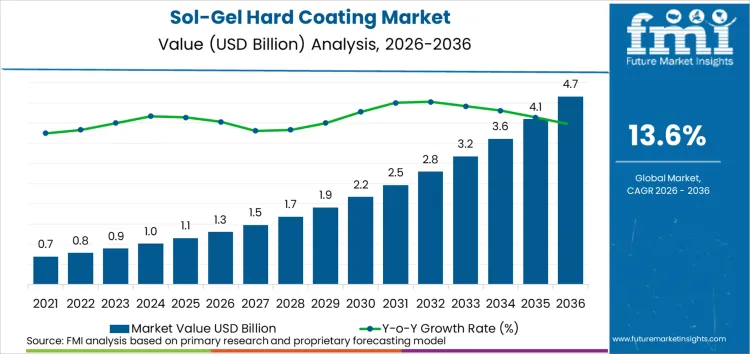
The sol-gel hard coating market is forecasted to total USD 1.3 billion in 2026, and is expected to increase further to USD 4.9 billion by 2036. As per projections, demand is slated to progress at a CAGR of 13.6% from 2026 to 2036. Structural realignment toward sustainable, high-performance surface solutions is accelerating across automotive OEMs, consumer electronics manufacturers, and industrial equipment fabricators in response to EV lightweighting imperatives, miniaturization trends, and the global phase-out of PFAS-based coatings .
The electric vehicle transition has fundamentally elevated sol-gel hard coatings from optional enhancement to critical enabler. EV battery housings, power electronics enclosures, and structural components require corrosion protection and thermal management without the weight penalties of traditional thick-film coatings.
Sol-gel’s ability to deliver ceramic-like hardness (up to 9H) in sub-5μm layers while withstanding 1,000+ hours salt spray testing provides lightweighting solutions that conventional coatings cannot match. Additionally, the shift to curved display cover windows in automotive cockpits demands optical-grade transparent coatings with 5H+ pencil hardness and anti-fouling properties—specifications met by organic-inorganic hybrid sol-gel formulations .
Summary of Sol-Gel Hard Coating Market
- The sol-gel hard coating market comprises organic-inorganic hybrid formulations engineered to provide ceramic-like hardness (5H–9H), optical transparency, corrosion resistance, and anti-fouling properties on heat-sensitive substrates including PET, PC, PMMA, and various engineering plastics .
- The defined scope is structured under FMI taxonomy with segmentation across application, coating approach, base material, and region, focusing exclusively on coatings utilizing sol-gel processing chemistry and excluding conventional hard coatings applied via PVD, CVD, or thermal spray.
- The sol-gel hard coating market is projected to grow at a CAGR of 13.6% from 2026 to 2036, expanding from USD 1.3 billion in 2026 to USD 4.9 billion by 2036, based on proprietary forecasting integrating EV production trajectories, consumer electronics miniaturization cycles, and global PFAS regulatory timelines .
- The sector is undergoing a structural transition from laboratory-scale specialty formulations to industrial-scale, application-engineered coating systems, as major automotive OEMs, consumer electronics brands, and medical device manufacturers institutionalize sol-gel specifications within component qualification protocols.
- India is projected to be the fastest-growing country with a CAGR of 15.4% through 2036, followed by China at 14.8%, the United States at 13.6%, Germany at 12.4%, and Japan at 10.2%. Key players profiled include Sol-Gel Technologies, AkzoNobel, Toray, and Asian Paints.
The proliferation of foldable smartphones, ultra-thin wearables, and high-resolution touchscreens has created unprecedented demand for ultra-thin, scratch-resistant films that maintain optical clarity. Sol-gel’s dip and spin coating capabilities enable uniform nanostructured layers on complex geometries, delivering 9H hardness ratings on touchscreens while preserving transparency above 92%. With foldable device sales exceeding 80 million units annually, coatings that survive 200,000+ folding cycles without crack propagation have transitioned from premium differentiator to baseline specification .
The global regulatory shift away from PFAS-based and solvent-heavy chemistries represents a structural market transformation. Sol-gel technology produces significantly fewer volatile organic compounds than conventional coatings and requires lower energy inputs than PVD or CVD processes. This alignment with ESG goals, combined with the technology’s inherent compatibility with heat-sensitive polymer substrates (PET, PC, PMMA), positions sol-gel hard coatings as the primary beneficiary of the multi-billion-dollar regulatory-driven reformulation wave.
Sol-Gel Hard Coating Market Key Takeaways
| Metrics | Values |
|---|---|
| Expected Value (2026E) | USD 1.3 billion |
| Projected Value (2036F) | USD 4.9 billion |
| CAGR (2026-2036) | 13.6% |
Source: FMI analysis, based on proprietary forecasting model and primary research
Why is the Sol-Gel Hard Coating Market Growing?
Expansion of sol-gel hard coating demand is propelled by electric vehicle lightweighting, consumer electronics durability requirements, PFAS regulatory phase-out, and the demonstrated compatibility of sol-gel formulations with heat-sensitive polymer substrates. Institutional procurement specifications from global automotive OEMs and electronics manufacturers are forcing immediate qualification of sol-gel-coated components .
Electric Vehicle Lightweighting and Corrosion Protection
The economic imperative to extend EV range while controlling battery costs has intensified demand for lightweight protective coatings. Traditional anti-corrosion systems add significant mass; sol-gel coatings achieve equivalent or superior protection at 80-90% lower film thickness. For battery pack enclosures—typically fabricated from aluminum or coated steel—sol-gel primers provide exceptional adhesion and barrier properties while enabling 15-25% mass reduction. With global EV production projected to reach 30 million units by 2030, the addressable automotive coating market represents substantial growth runway .
Display Durability in Premium Electronics
Curved display cover windows for smartphones, monitors, and automotive infotainment systems require optical clarity (≥92% transmission at 550nm) combined with 5H+ pencil hardness and anti-fouling behavior. Sol-gel hybrid coatings formulated with decyltrimethoxysilane and phenyltrimethoxysilane achieve water contact angles of 95° and surface roughness below 2.2nm RMS—performance metrics that commodity hard coatings cannot simultaneously satisfy .
Substrate Compatibility Enabling Design Freedom
Unlike PVD/CVD processes requiring high-temperature deposition incompatible with polymer substrates, sol-gel coatings cure at 120-150°C, enabling direct application to PET, PC, and PMMA without dimensional distortion or degradation. This low-temperature compatibility has unlocked applications previously impossible with conventional hard coatings, including flexible displays, lightweight automotive glazing, and thin-wall electronic housings .
How is Sol-Gel Hard Coating Market Segmented?
Why do Automotive Components represent the dominant application segment?
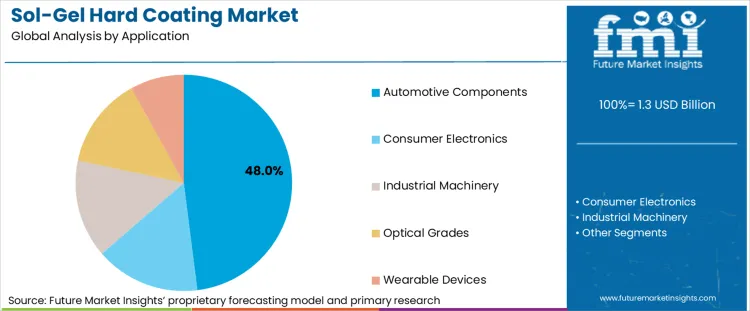
Automotive components account for 48% of the sol-gel hard coating market, reflecting the sector’s convergence of lightweighting imperatives, corrosion protection requirements, and the rapid adoption of coated plastic glazing and display covers. EV battery housings, power electronics, and sensor enclosures require barrier protection without weight penalties—sol-gel’s thin-film architecture delivers 1,000+ hour salt spray resistance at 3-5μm thickness, versus 25-50μm for conventional e-coat or powder systems. Additionally, the migration to curved, bonded display cockpits demands optical-grade hard coatings on PC substrates; sol-gel formulations achieve the requisite 5H+ pencil hardness while maintaining the impact resistance essential for automotive safety compliance .
Why does Sol-Gel Layering maintain leadership in coating approach preferences?
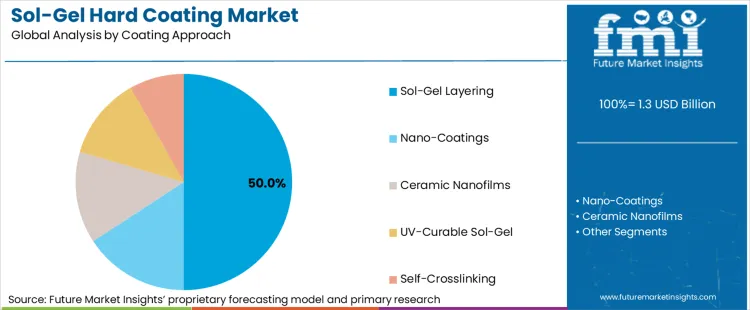
Sol-Gel Layering holds 50% of coating approach demand because it enables precise control over film thickness, composition uniformity, and nanostructure architecture across large surface areas. Dip coating and spin coating—the dominant application methods—produce defect-free films with thickness tolerances of ±5nm, critical for optical applications where interference patterns are unacceptable. The approach’s versatility extends from 60nm anatase films on PET to thicker hybrid coatings on automotive extrusions, all derived from the same fundamental alkoxide precursor chemistry .
Nano-Coatings (28% share) represent the premium subsegment, delivering enhanced hardness (up to 9H) and anti-fouling performance through engineered nanoparticle dispersions. Ceramic Nanofilms (14%) address extreme wear applications in industrial machinery. UV-Curable Sol-Gel (8%) enables high-speed roll-to-roll processing for high-volume consumer electronics laminates.
How does PET Film as the Primary Base Material drive Market Volume?
PET films constitute 52% of base material consumption, driven by their exceptional balance of optical clarity (≥90% transmission), dimensional stability, and compatibility with sol-gel adhesion mechanisms. Research demonstrates that PET’s carbonyl (C=O) and ether (C-O) functional groups facilitate robust chemical bonding with sol-gel-derived titania and hybrid films, achieving high transfer efficiency and cross-cut adhesion classification.
Unlike polyolefins (PE, PP) which lack these oxygen-containing surface groups and consequently exhibit poor film adhesion without UV-ozone pretreatment, PET accepts sol-gel coatings directly with minimal surface preparation. This adhesion reliability, combined with established converting infrastructure and favorable economics, sustains PET’s 52% share .
PC films (24%) dominate automotive interior display applications where impact resistance and thermal stability up to 150°C are mandatory. PE films (16%) serve cost-sensitive industrial packaging applications. Acrylic films (8%) address outdoor signage and marine displays requiring exceptional UV stability.
What Drivers, Restraints, Opportunities, and Trends Prevail in the Sol-Gel Hard Coating Market?
Drivers
EV Lightweighting Economics: Each kilogram of mass reduction extends EV range approximately 0.6-0.8km. Sol-gel coatings enable 15-25% weight reduction in battery enclosure systems versus conventional anti-corrosion coatings, delivering 15-25km additional range per 100kg of structural mass. With battery pack costs at USD 100-120/kWh (2026), this range extension translates to USD 150-300 in battery cost avoidance per vehicle—sufficient economic incentive to drive specification across mass-market EV platforms .
Display Durability Requirements: Smartphone manufacturers report that scratch resistance is the third-most-frequent purchase criterion after camera performance and battery life. Sol-gel hard coatings achieving 9H pencil hardness—approaching the scratch resistance of mineral glass—enable device differentiation while eliminating the thickness and weight penalties of reinforced glass. The technology’s compatibility with foldable form factors (withstanding 200,000+ cycles without crack propagation) addresses the fastest-growing premium device category .
PFAS Regulatory Phase-Out: The EU’s proposed universal PFAS restriction, expected finalization 2026-2027, would effectively ban non-essential fluoropolymer uses including conventional anti-fingerprint and easy-clean coatings. Sol-gel hybrid coatings achieve water contact angles of 95° and oil repellency without fluorinated chemistry, positioning the technology as the primary PFAS-free alternative for consumer electronics and automotive interior applications .
Restraints
Raw Material Cost Volatility: Specialty alkoxide precursors (TEOS, GPTMS, titanium isopropoxide) exhibit price fluctuations of 15-30% annually, reflecting their dependence on silicon and titanium metal markets. For high-volume automotive applications where coating cost must remain below USD 5/m², this volatility complicates long-term supply agreements and favors vertically integrated suppliers with precursor manufacturing capabilities .
Cure Speed Limitations: Conventional thermal sol-gel processing requires 30-90 minute cure cycles at 120-150°C—acceptable for batch processing but incompatible with high-speed (100+ m/min) roll-to-roll converting. UV-curable sol-gel formulations address this limitation but currently achieve only 6-7H pencil hardness versus 8-9H for thermally-cured systems, creating a performance-throughput trade-off that segments the market .
Substrate Adhesion Challenges: While PET, PC, and PMMA accept sol-gel coatings with excellent adhesion, polyolefin substrates (PE, PP) widely used in industrial packaging applications require UV-ozone or corona pretreatment to achieve acceptable transfer and cross-cut performance. This additional processing step increases system cost and complexity, limiting sol-gel penetration in high-volume polyethylene applications .
Opportunity 1: PFAS-Free Optical Coatings
The intersection of PFAS regulation and premium display demand creates substantial opportunity for sol-gel anti-fingerprint coatings achieving ≥95° water contact angle without fluorinated chemistry. Current sol-gel hydrophobic formulations achieve 95° WCA versus 110-115° for legacy fluoropolymer benchmarks; closing this 15-20° gap through nano-textured surface engineering represents a USD 400-600 million addressable opportunity .
Opportunity 2: Wearable Device Coatings
The wearable device category—smartwatches, fitness trackers, AR/VR glasses—requires ultra-thin (1-3μm) hard coatings on curved, miniaturized polymer substrates. Sol-gel dip coating conformally covers 3D geometries at thickness tolerances unattainable with spray or sputter processes. As AR/VR device volumes scale from 15 million units (2026) to 80+ million (2036), coating area per device (two lenses plus external surfaces) will drive substantial incremental demand.
Opportunity 3: Self-Healing Formulations
Research initiatives targeting sol-gel coatings with microcapsule-encapsulated healing agents that repair sub-10μm scratches upon UV or thermal stimulus are transitioning from laboratory to pilot scale. Commercialization would extend coated component service life 3-5×, fundamentally altering replacement economics in automotive and industrial machinery applications .
Trend 1: Organic-Inorganic Hybrid Optimization
The market is rapidly migrating from pure inorganic (silica, titania, alumina) coatings toward organic-inorganic hybrids incorporating GPTMS, DTMS, and PTMS modifiers. These hybrids deliver the hardness of ceramics (5H-7H) with the flexibility and adhesion of polymers, enabling application to flexible displays and curved automotive surfaces. The hybrid segment is projected to grow at 16%+ CAGR—significantly outpacing the broader market .
Trend 2: Low-Temperature Cure Process Intensification
Advancements in NIR-assisted and microwave-assisted thermal processing are reducing sol-gel cure cycles from 60 minutes to under 10 minutes while maintaining 8H+ hardness. This process intensification enables sol-gel integration into continuous production lines previously restricted to UV-curable chemistries, expanding addressable volume in high-throughput converting applications.
Trend 3: Regional Production Localization
Industrial policy in India (PLI scheme), United States (CHIPS Act), and European Union (Green Deal Industrial Plan) is accelerating domestic coating capacity expansion. India’s electronics manufacturing localization requirements are projected to increase domestic sol-gel coating capacity 300% by 2030, with Asian Paints scaling production for smartphone and EV component applications. China’s GB 30981 VOC standards continue pushing domestic manufacturers toward sol-gel alternatives .
Analysis of Sol-Gel Hard Coating Market by Key Countries
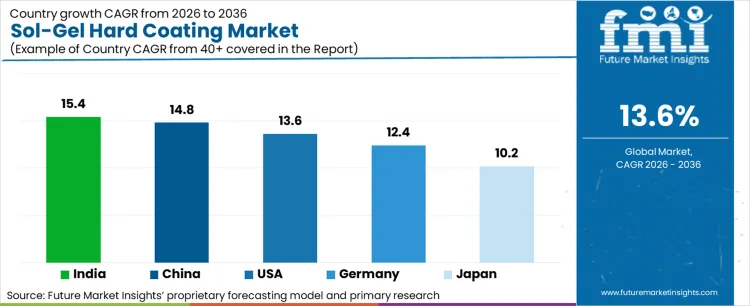
| Country | CAGR (2026-2036) |
|---|---|
| India | 15.4% |
| China | 14.8% |
| United States | 13.6% |
| Germany | 12.4% |
| Japan | 10.2% |
Source: FMI analysis, based on proprietary forecasting model and primary research
What industrial policy catalyst is accelerating India’s sol-gel hard coating market at 15.4% CAGR?
India exhibits the highest market acceleration with a CAGR of 15.4% through 2036, propelled by the Production Linked Incentive scheme’s electronics manufacturing localization requirements. Apple, Samsung, and Foxconn have expanded assembly operations in India, with contract manufacturers required to achieve 50-60% domestic value addition to qualify for production incentives.
Premium smartphone assembly requires anti-fingerprint and hard coatings with validated optical and durability specifications—historically imported from Japan and Korea. Asian Paints, leveraging its dominant domestic distribution network and raw material supply chains, is scaling sol-gel coating capacity to serve electronics manufacturing clusters in Chennai and Noida. Concurrently, India’s EV transition—dominated by two-wheelers and three-wheelers—requires ruggedized, optically clear displays with 5H+ hardness for digital instrument clusters operating in high-UV, high-vibration environments .
How is automotive manufacturing scale driving China’s 14.8% CAGR?
China’s market expands at 14.8% CAGR, driven by the world’s largest EV manufacturing ecosystem and aggressive VOC emission standards (GB 30981 series). Chinese domestic coating manufacturers have scaled sol-gel production capacity to serve BYD, NIO, and XPeng’s EV battery housing and display coating requirements, achieving cost positions 20-30% below imported alternatives while meeting GB compliance standards.
Additionally, China’s dominance in foldable smartphone displays—70% of global production through BOE, CSOT, and Visionox—requires sol-gel hard coatings validated for flexible substrates and 200,000+ folding cycles. Domestic suppliers now command 35-40% of this high-growth segment .
What drives United States market growth at 13.6% CAGR?
The United States expands at 13.6% CAGR, supported by IRA-stimulated EV battery gigafactory construction (BlueOval City, Metaplant Georgia, Toyota NC battery facility) requiring domestic sourcing of coated components for tax credit qualification. Sol-gel’s lightweighting economics—15-25% mass reduction versus conventional e-coat—directly addresses OEM range optimization targets. Additionally, U.S. leadership in aerospace and defense electronics sustains demand for high-reliability sol-gel conformal coatings qualified to MIL-spec standards.
How does German automotive engineering leadership influence 12.4% growth?
Germany advances at 12.4% CAGR, led by premium automotive OEM specifications requiring combined optical clarity (≥92% transmission), scratch resistance (5H+ pencil hardness), and extreme durability (1,000h 85°C/85% RH aging) for curved cockpit displays. Sol-gel hybrid coatings on PC substrates have achieved full qualification across Mercedes-Benz, BMW, and Audi platforms, displacing previously dominant hard-coated acrylics. German engineering preferences favor solutions validated to OEM-specific protocols (DBL 5406, PV 3952); suppliers with dedicated qualification laboratories co-located with German automotive engineering centers capture substantial price premiums .
How does Japan’s advanced materials sector shape its 10.2% trajectory?
Japan develops at 10.2% CAGR, reflecting mature industrial coating consumption concentrated in high-value optical and precision electronics segments. Toray Industries leverages PET film leadership to develop ultra-thin (2-5μm) sol-gel hard-coated films for foldable displays and medical imaging monitors, maintaining 40%+ gross margins through proprietary formulation expertise. While unit volumes are stable, continuous specification escalation—from 6H to 8H hardness requirements, from 30μm to 15μm thickness targets—sustains value growth. Japan’s super-aging society drives specialized healthcare applications, including antimicrobial sol-gel coatings for hospital touchscreens .
What is the Competition Outlook for Sol-Gel Hard Coating Market?
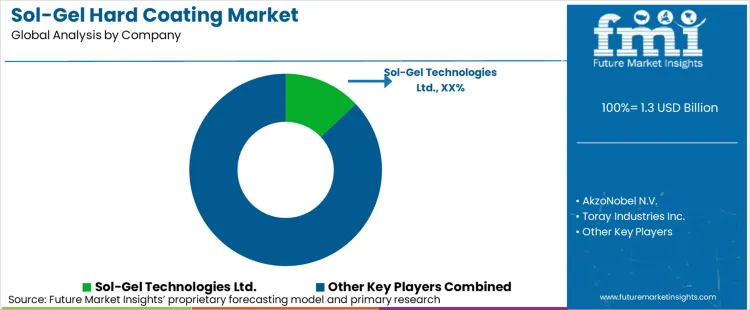
The competitive landscape is undergoing fundamental transformation from laboratory-scale specialty formulators to industrial-scale, application-engineered coating suppliers. Procurement consolidation favors vertically integrated corporations with proprietary precursor chemistry, precision coating application technology, and multi-regional regulatory compliance dossiers.
Competitive Differentiation Vectors
PFAS-Free Formulation Velocity: Suppliers with validated sol-gel formulations achieving ≥95° water contact angle and ≥70° oil contact angle without fluorinated chemistry are securing long-term agreements with brand owners facing 2028-2030 PFAS phase-out deadlines. Sol-Gel Technologies and AkzoNobel lead through dual-track portfolio strategies .
Flexible Substrate Qualification: Only four suppliers globally have validated sol-gel coatings surviving 200,000+ folding cycles on transparent polyimide. Toray and Asian Paints have leveraged display supply chain relationships to achieve early qualification with Samsung Display and BOE, creating substantial switching costs.
Automotive Durability Validation: Suppliers with IATF 16949 certification, PV 3952/DBL 5406 test data, and 10-year weathering projections command 3-5× price premiums. AkzoNobel’s Resicoat line for EV battery components exemplifies this differentiation.
Key Players Profiled
- Sol-Gel Technologies Ltd.
- AkzoNobel N.V.
- Toray Industries Inc.
- Asian Paints Ltd.
- 3M Company
- BASF SE
- Covestro AG
- Nippon Paint Holdings Co. Ltd.
Market Definition
The sol-gel hard coating market comprises revenues generated from organic-inorganic hybrid coating formulations synthesized via hydrolysis and condensation of metal alkoxide precursors, engineered to provide ceramic-like hardness (≥5H pencil hardness), optical transparency, corrosion resistance, and anti-fouling functionality on heat-sensitive polymer substrates including PET, PC, PMMA, and related engineering plastics.
The scope includes sol-gel hard coating systems categorized by application segment (automotive components, consumer electronics, industrial machinery, optical grades, wearable devices), coating approach (sol-gel layering, nano-coatings, ceramic nanofilms, UV-curable sol-gel, self-crosslinking), and base material (PET films, PC films, PE films, acrylic films, nanocomposite polymers). Products within scope are engineered specifically for protective hard coating functionality and are designed to achieve validated performance metrics including pencil hardness (ASTM D3363), optical transmission (ASTM D1003), Taber abrasion resistance (ASTM D1044), and cross-cut adhesion (ASTM D3359).
The scope excludes revenues from the manufacture of substrates receiving sol-gel coatings; conventional hard coatings applied via PVD, CVD, or thermal spray; non-protective sol-gel applications (catalysts, membranes, sensors); and downstream lamination, assembly, or installation services.
Formulations failing to achieve minimum 5H pencil hardness on intended substrate, optical transmission below 90% for transparent grades, or lacking applicable automotive/electronics durability validation documentation fall outside the defined market boundary.
Scope of Report
| Items | Values |
|---|---|
| Quantitative Units (2026) | USD 1.3 billion |
| Application Segment | Automotive Components, Consumer Electronics, Industrial Machinery, Optical Grades, Wearable Devices |
| Coating Approach | Sol-Gel Layering, Nano-Coatings, Ceramic Nanofilms, UV-Curable Sol-Gel, Self-Crosslinking |
| Base Material | PET Films, PC Films, PE Films, Acrylic Films, Nanocomposite Polymers |
| Regions Covered | North America, Europe, East Asia, Japan, Rest of World |
| Countries Covered | United States, Germany, China, Japan, India, Canada, Mexico, United Kingdom, France, Italy, Spain, South Korea, Brazil, and additional regional markets |
| Key Companies Profiled | Sol-Gel Technologies, AkzoNobel, Toray, Asian Paints |
Sol-Gel Hard Coating Market Key Segments
By Application Segment
- Automotive Components
- Consumer Electronics
- Industrial Machinery
- Optical Grades
- Wearable Devices
By Coating Approach
- Sol-Gel Layering
- Nano-Coatings
- Ceramic Nanofilms
- UV-Curable Sol-Gel
- Self-Crosslinking
By Base Material
- PET Films
- PC Films
- PE Films
- Acrylic Films
- Nanocomposite Polymers
By Region
- North America
- Europe
- East Asia
- Japan
- Rest of the World
Bibliography
- AkzoNobel N.V. (2025). Resicoat EV battery coating solutions: Dielectric powder and sol-gel systems. AkzoNobel Investor Relations.
- Amano, N., et al. (2017). Transferability and adhesion of sol-gel-derived crystalline TiO2 thin films to different types of plastic substrates. Langmuir, 33(4), 947-953.
- Cho, S., Kwon, S. I., Kim, S. W., Lee, J. S., Kim, S. H., & Kim, J. H. (2025). Fabrication of organic-inorganic hybrid thin films using sol-gel method to improve scratch resistance and anti-fouling of plastic substrates. SSRN.
Frequently Asked Questions
What is the projected global growth rate for the sol-gel hard coating market?
The global market is projected to expand at a 13.6% CAGR from 2026 to 2036, from USD 1.3 billion to USD 4.9 billion, reflecting structural convergence of EV lightweighting economics, foldable display commercialization, and PFAS regulatory phase-out .
Which application segment and coating approach dominate market demand?
Automotive components account for 48% of demand, driven by EV battery housing corrosion protection, power electronics thermal management, and curved display coatings requiring 5H+ hardness with optical clarity. Sol-gel layering holds 50% share, enabling precise thickness control (tolerance ±5nm) and uniform nanostructure across large areas via dip and spin coating .
Which base material accounts for the largest market share?
PET films account for 52% of base material consumption. Dominance is driven by carbonyl/ether surface functionality enabling robust sol-gel adhesion without pretreatment, optical clarity ≥90%, dimensional stability, and established converting infrastructure-advantages validated through transfer efficiency and cross-cut adhesion studies demonstrating PET’s superior compatibility versus polyolefins .
Which regions and countries are expected to lead market expansion?
India is the fastest-growing country at 15.4% CAGR, propelled by PLI scheme electronics localization and Asian Paints’ domestic capacity expansion. China follows at 14.8% CAGR, driven by EV production scale and foldable display coating qualification. The United States expands at 13.6% CAGR, supported by IRA-stimulated EV gigafactory construction. Germany advances at 12.4% CAGR, led by premium automotive display specifications. Japan develops at 10.2% CAGR, shaped by Toray’s ultra-thin optical film leadership
Preview the report firsthand - request a free sample
Get SampleGet the brochure for pricing and purchase details.
Get PDFTable of Content
- Executive Summary
- Global Market Outlook
- Demand-side Trends
- Supply-side Trends
- Technology Roadmap Analysis
- Analysis and Recommendations
- Market Overview
- Market Coverage / Taxonomy
- Market Definition / Scope / Limitations
- Research Methodology
- Chapter Orientation
- Analytical Lens and Working Hypotheses
- Market Structure, Signals, and Trend Drivers
- Desk Research Programme (Secondary Evidence)
- Company Annual and Sustainability Reports
- Peer-reviewed Journals and Academic Literature
- Corporate Websites, Product Literature, and Technical Notes
- Earnings Decks and Investor Briefings
- Statutory Filings and Regulatory Disclosures
- Technical White Papers and Standards Notes
- Trade Journals, Industry Magazines, and Analyst Briefs
- Conference Proceedings, Webinars, and Seminar Materials
- Government Statistics Portals and Public Data Releases
- Press Releases and Reputable Media Coverage
- Specialist Newsletters and Curated Briefings
- Sector Databases and Reference Repositories
- FMI Internal Proprietary Databases and Historical Market Datasets
- Subscription Datasets and Paid Sources
- Social Channels, Communities, and Digital Listening Inputs
- Additional Desk Sources
- Expert Input and Fieldwork (Primary Evidence)
- Primary Modes
- Qualitative Interviews and Expert Elicitation
- Quantitative Surveys and Structured Data Capture
- Blended Approach
- Why Primary Evidence is Used
- Field Techniques
- Interviews
- Surveys
- Focus Groups
- Observational and In-context Research
- Social and Community Interactions
- Stakeholder Universe Engaged
- C-suite Leaders
- Board Members
- Presidents and Vice Presidents
- R&D and Innovation Heads
- Technical Specialists
- Domain Subject-matter Experts
- Scientists
- Physicians and Other Healthcare Professionals
- Governance, Ethics, and Data Stewardship
- Research Ethics
- Data Integrity and Handling
- Primary Modes
- Tooling, Models, and Reference Databases
- Data Engineering and Model Build
- Data Acquisition and Ingestion
- Cleaning, Normalisation, and Verification
- Synthesis, Triangulation, and Analysis
- Quality Assurance and Audit Trail
- Market Background
- Market Dynamics
- Drivers
- Restraints
- Opportunity
- Trends
- Scenario Forecast
- Demand in Optimistic Scenario
- Demand in Likely Scenario
- Demand in Conservative Scenario
- Opportunity Map Analysis
- Product Life Cycle Analysis
- Supply Chain Analysis
- Investment Feasibility Matrix
- Value Chain Analysis
- PESTLE and Porter’s Analysis
- Regulatory Landscape
- Regional Parent Market Outlook
- Production and Consumption Statistics
- Import and Export Statistics
- Market Dynamics
- Global Market Analysis 2021 to 2025 and Forecast, 2026 to 2036
- Historical Market Size Value (USD Million) Analysis, 2021 to 2025
- Current and Future Market Size Value (USD Million) Projections, 2026 to 2036
- Y-o-Y Growth Trend Analysis
- Absolute $ Opportunity Analysis
- Global Market Pricing Analysis 2021 to 2025 and Forecast 2026 to 2036
- Global Market Analysis 2021 to 2025 and Forecast 2026 to 2036, By Application
- Introduction / Key Findings
- Historical Market Size Value (USD Million) Analysis By Application , 2021 to 2025
- Current and Future Market Size Value (USD Million) Analysis and Forecast By Application , 2026 to 2036
- Automotive Components
- Consumer Electronics
- Industrial Machinery
- Optical Grades
- Wearable Devices
- Automotive Components
- Y-o-Y Growth Trend Analysis By Application , 2021 to 2025
- Absolute $ Opportunity Analysis By Application , 2026 to 2036
- Global Market Analysis 2021 to 2025 and Forecast 2026 to 2036, By Coating Approach
- Introduction / Key Findings
- Historical Market Size Value (USD Million) Analysis By Coating Approach, 2021 to 2025
- Current and Future Market Size Value (USD Million) Analysis and Forecast By Coating Approach, 2026 to 2036
- Sol-Gel Layering
- Nano-Coatings
- Ceramic Nanofilms
- UV-Curable Sol-Gel
- Self-Crosslinking
- Sol-Gel Layering
- Y-o-Y Growth Trend Analysis By Coating Approach, 2021 to 2025
- Absolute $ Opportunity Analysis By Coating Approach, 2026 to 2036
- Global Market Analysis 2021 to 2025 and Forecast 2026 to 2036, By Region
- Introduction
- Historical Market Size Value (USD Million) Analysis By Region, 2021 to 2025
- Current Market Size Value (USD Million) Analysis and Forecast By Region, 2026 to 2036
- North America
- Latin America
- Western Europe
- Eastern Europe
- East Asia
- South Asia and Pacific
- Middle East & Africa
- Market Attractiveness Analysis By Region
- North America Market Analysis 2021 to 2025 and Forecast 2026 to 2036, By Country
- Historical Market Size Value (USD Million) Trend Analysis By Market Taxonomy, 2021 to 2025
- Market Size Value (USD Million) Forecast By Market Taxonomy, 2026 to 2036
- By Country
- USA
- Canada
- Mexico
- By Application
- By Coating Approach
- By Country
- Market Attractiveness Analysis
- By Country
- By Application
- By Coating Approach
- Key Takeaways
- Latin America Market Analysis 2021 to 2025 and Forecast 2026 to 2036, By Country
- Historical Market Size Value (USD Million) Trend Analysis By Market Taxonomy, 2021 to 2025
- Market Size Value (USD Million) Forecast By Market Taxonomy, 2026 to 2036
- By Country
- Brazil
- Chile
- Rest of Latin America
- By Application
- By Coating Approach
- By Country
- Market Attractiveness Analysis
- By Country
- By Application
- By Coating Approach
- Key Takeaways
- Western Europe Market Analysis 2021 to 2025 and Forecast 2026 to 2036, By Country
- Historical Market Size Value (USD Million) Trend Analysis By Market Taxonomy, 2021 to 2025
- Market Size Value (USD Million) Forecast By Market Taxonomy, 2026 to 2036
- By Country
- Germany
- UK
- Italy
- Spain
- France
- Nordic
- BENELUX
- Rest of Western Europe
- By Application
- By Coating Approach
- By Country
- Market Attractiveness Analysis
- By Country
- By Application
- By Coating Approach
- Key Takeaways
- Eastern Europe Market Analysis 2021 to 2025 and Forecast 2026 to 2036, By Country
- Historical Market Size Value (USD Million) Trend Analysis By Market Taxonomy, 2021 to 2025
- Market Size Value (USD Million) Forecast By Market Taxonomy, 2026 to 2036
- By Country
- Russia
- Poland
- Hungary
- Balkan & Baltic
- Rest of Eastern Europe
- By Application
- By Coating Approach
- By Country
- Market Attractiveness Analysis
- By Country
- By Application
- By Coating Approach
- Key Takeaways
- East Asia Market Analysis 2021 to 2025 and Forecast 2026 to 2036, By Country
- Historical Market Size Value (USD Million) Trend Analysis By Market Taxonomy, 2021 to 2025
- Market Size Value (USD Million) Forecast By Market Taxonomy, 2026 to 2036
- By Country
- China
- Japan
- South Korea
- By Application
- By Coating Approach
- By Country
- Market Attractiveness Analysis
- By Country
- By Application
- By Coating Approach
- Key Takeaways
- South Asia and Pacific Market Analysis 2021 to 2025 and Forecast 2026 to 2036, By Country
- Historical Market Size Value (USD Million) Trend Analysis By Market Taxonomy, 2021 to 2025
- Market Size Value (USD Million) Forecast By Market Taxonomy, 2026 to 2036
- By Country
- India
- ASEAN
- Australia & New Zealand
- Rest of South Asia and Pacific
- By Application
- By Coating Approach
- By Country
- Market Attractiveness Analysis
- By Country
- By Application
- By Coating Approach
- Key Takeaways
- Middle East & Africa Market Analysis 2021 to 2025 and Forecast 2026 to 2036, By Country
- Historical Market Size Value (USD Million) Trend Analysis By Market Taxonomy, 2021 to 2025
- Market Size Value (USD Million) Forecast By Market Taxonomy, 2026 to 2036
- By Country
- Kingdom of Saudi Arabia
- Other GCC Countries
- Turkiye
- South Africa
- Other African Union
- Rest of Middle East & Africa
- By Application
- By Coating Approach
- By Country
- Market Attractiveness Analysis
- By Country
- By Application
- By Coating Approach
- Key Takeaways
- Key Countries Market Analysis
- USA
- Pricing Analysis
- Market Share Analysis, 2025
- By Application
- By Coating Approach
- Canada
- Pricing Analysis
- Market Share Analysis, 2025
- By Application
- By Coating Approach
- Mexico
- Pricing Analysis
- Market Share Analysis, 2025
- By Application
- By Coating Approach
- Brazil
- Pricing Analysis
- Market Share Analysis, 2025
- By Application
- By Coating Approach
- Chile
- Pricing Analysis
- Market Share Analysis, 2025
- By Application
- By Coating Approach
- Germany
- Pricing Analysis
- Market Share Analysis, 2025
- By Application
- By Coating Approach
- UK
- Pricing Analysis
- Market Share Analysis, 2025
- By Application
- By Coating Approach
- Italy
- Pricing Analysis
- Market Share Analysis, 2025
- By Application
- By Coating Approach
- Spain
- Pricing Analysis
- Market Share Analysis, 2025
- By Application
- By Coating Approach
- France
- Pricing Analysis
- Market Share Analysis, 2025
- By Application
- By Coating Approach
- India
- Pricing Analysis
- Market Share Analysis, 2025
- By Application
- By Coating Approach
- ASEAN
- Pricing Analysis
- Market Share Analysis, 2025
- By Application
- By Coating Approach
- Australia & New Zealand
- Pricing Analysis
- Market Share Analysis, 2025
- By Application
- By Coating Approach
- China
- Pricing Analysis
- Market Share Analysis, 2025
- By Application
- By Coating Approach
- Japan
- Pricing Analysis
- Market Share Analysis, 2025
- By Application
- By Coating Approach
- South Korea
- Pricing Analysis
- Market Share Analysis, 2025
- By Application
- By Coating Approach
- Russia
- Pricing Analysis
- Market Share Analysis, 2025
- By Application
- By Coating Approach
- Poland
- Pricing Analysis
- Market Share Analysis, 2025
- By Application
- By Coating Approach
- Hungary
- Pricing Analysis
- Market Share Analysis, 2025
- By Application
- By Coating Approach
- Kingdom of Saudi Arabia
- Pricing Analysis
- Market Share Analysis, 2025
- By Application
- By Coating Approach
- Turkiye
- Pricing Analysis
- Market Share Analysis, 2025
- By Application
- By Coating Approach
- South Africa
- Pricing Analysis
- Market Share Analysis, 2025
- By Application
- By Coating Approach
- USA
- Market Structure Analysis
- Competition Dashboard
- Competition Benchmarking
- Market Share Analysis of Top Players
- By Regional
- By Application
- By Coating Approach
- Competition Analysis
- Competition Deep Dive
- Sol-Gel Technologies Ltd.
- Overview
- Product Portfolio
- Profitability by Market Segments (Product/Age /Sales Channel/Region)
- Sales Footprint
- Strategy Overview
- Marketing Strategy
- Product Strategy
- Channel Strategy
- AkzoNobel N.V.
- Toray Industries Inc.
- Asian Paints Ltd.
- 3M Company
- BASF SE
- Covestro AG
- Nippon Paint Holdings Co. Ltd.
- Sol-Gel Technologies Ltd.
- Competition Deep Dive
- Assumptions & Acronyms Used


