
- Market Size (2026)
- USD 1.3 Bn
- Forecast (2036)
- USD 2.1 Bn
- CAGR (2026 to 2036)
- 4.9%
How big is the Solvent Dyes Market in 2026?
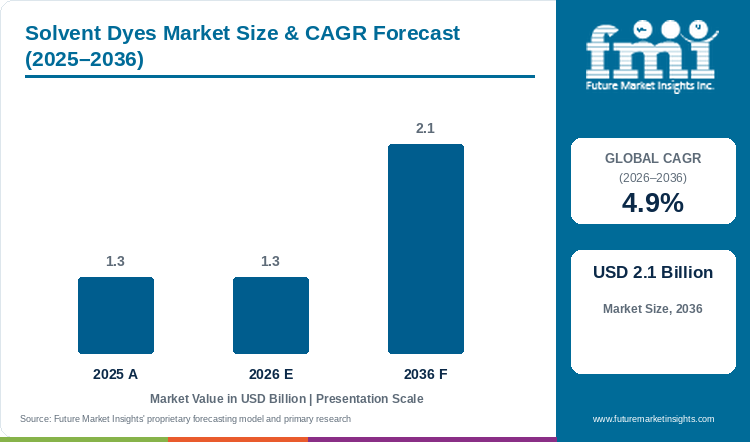
The Solvent Dyes Market is projected to reach USD 2.1 billion by 2036, growing at a 4.9% CAGR from 2026 to 2036. The market is estimated at USD 1.3 billion in 2026. The market was valued at USD 1.3 billion in 2025. Plastics is the largest application for solvent dyes, because they colour polymers by dissolving in them. Solvent dyes dissolve in the polymer, so the colour is clear and does not sit as particles. Global plastics production reached 430.9 million tonnes in 2024, up 4.1% on the year [21][22]. In China, the value added of rubber and plastic products rose 6.5% year on year in June 2026 and in January to June 2026 [23]. LANXESS used K 2025 to present its Macrolex solvent dyes. The show was held in Duesseldorf from 8 to 15 October 2025, and LANXESS presented a new blue grade, Macrolex Blue TP LXS 51151 [1].
Plastics buyers set the dye specification. Heat stability, lightfastness and purity limits for toys and food contact decide what they buy [2]. Governments set the specification in fuels. The United States requires diesel and kerosene sold free of tax for off-road use to carry Solvent Red 164 [15]. The European Union replaced Solvent Yellow 124 with a colourless marker as its common fiscal marker from 19 January 2024 [16][17]. Brazil's regulator fixed a red dye for S500 diesel at 20 mg/L in Resolution 968 of 30 April 2024 [19]. A dye named in law can lose its role quickly, so a rule change moves fuel-dye volume faster than fuel additives or lubricant additives demand does.
Key Market Trends & Insights
- In Europe, fuel marking is moving away from a dye marker. Commission Implementing Decision (EU) 2022/197 of 17 January 2022 made ACCUTRACE PLUS, a colourless butoxybenzene marker, the common fiscal marker for gas oils and kerosene. Solvent Yellow 124 was allowed only until the transitional period ended on 18 January 2024. The decision is to be reviewed by 31 December 2028 at the latest [16][17].
- Brazil is widening its dyed-fuel rules. On 11 April 2024 the national oil regulator ANP approved a revision. It requires violet dye in marine diesel sold in the North region, so it can be told apart from road S10 diesel [20]. Resolution 968 of 30 April 2024 keeps red dye mandatory in S500 diesel and bans dye in S10 [19].
- Electric vehicle components create a niche for plastics colorants. LANXESS presented Macrolex Orange HT at K 2025 in October 2025. The dye permanently colours plastics in RAL 2003 orange, the colour used to mark high-voltage components [1].
Regional Highlights
- Asia Pacific: the value added of China's rubber and plastic products rose 6.5% in January to June 2026 [23]. Kunshan Organic Chemical Factory runs solvent dye plants in Jiangxi, China and in Myanmar [13].
- North America: the US standard for untaxed diesel and kerosene names Solvent Red 164 [15]. Sunbelt Colors makes liquid petroleum dyes in Rock Hill, South Carolina [4].
- Europe: German chemical-pharmaceutical production fell 3% in the first half of 2026 [24]. The EU fiscal marker for gas oil changed in January 2024 [16][17].
Solvent Dyes Market Size and Forecast
Table 1: Solvent Dyes Market Size and Forecast
| Market size and forecast | Value |
|---|---|
| Market size in 2025 | USD 1.3 billion |
| Estimated market size in 2026 | USD 1.3 billion |
| Projected market size by 2036 | USD 2.1 billion |
| CAGR from 2026 to 2036 | 4.9% |
Source: Future Market Insights analysis of the solvent dyes market, 2026.
Analyst Perspective
“Solvent dyes are bought on a specification, not on a price list. A plastics compounder asks whether the dye survives processing temperature. It also asks whether the dye passes toy and food-contact rules. A fuel blender asks whether the dye meets the marking law of the country it ships to. Suppliers that can document both will hold their accounts when volumes soften. The riskier position is a dye whose role depends on one regulation, because a marker change can remove it from a market within one transition period. Buyers should hold a second approved source for any dye named in a fuel rule.”
- Nikhil Kaitwade, Principal Consultant, FMI
How is the Solvent Dyes Market segmented?
- By application: Plastics & Polymers, Printing Inks, Paints & Coatings, Fuels, Lubricants & Greases and Other Applications
- By region: Asia Pacific, North America, Europe and Latin America
Why does Plastics & Polymers lead by Application in the Solvent Dyes Market in 2026?
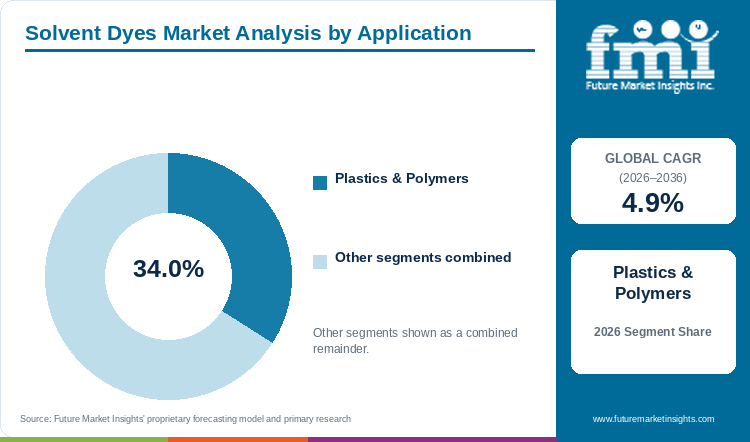
Plastics & Polymers is estimated to account for 34.0% of the Solvent Dyes Market by application in 2026. LANXESS says its Macrolex range has been developed for plastics since the 1960s and suits mainly amorphous thermoplastics such as PS, ABS, SAN, PMMA, PC, PVC-U and PET [2]. Kunshan Organic Chemical Factory, founded in 1976, describes itself as one of the earliest solvent dye producers in China [13]. World plastics production was 430.9 million tonnes in 2024 [22], which gives the segment a large base of potential customers. Specification matters as much as volume. Taiwan Dyestuffs & Pigments Corp. lists heat resistance by resin in its product table, with a figure of up to 350 degrees Celsius for Solvent Red 207, an anthraquinone type [14]. LANXESS states that its Macrolex dyes meet EN 71-3 and EN 71-9 for toys, while Macrolex Yellow 3G is not recommended under EN 71-9 [2]. Dyes that pass these toy tests can be specified for toy parts. Food-contact use needs separate confirmation for each grade and jurisdiction [2].
Table 2: Application, 2026 Share
| Leading Share | 2026 market share |
|---|---|
| Plastics & Polymers | 34.0% |
| All Other Segments Combined Share | 66.0% |
Source: Future Market Insights analysis of the solvent dyes market, 2026.
What are the key drivers, restraints and opportunities?
Driver
Engineering plastics and electric vehicles. High-voltage components are marked in RAL 2003 orange. LANXESS offers Macrolex Orange HT for that orange, and Macrolex Black types for deep gloss black on car interiors and exteriors [1]. The company says Macrolex Orange HT suits demanding engineering plastics that need high processing temperatures [1]. LANXESS lists automotive, toys, detergent containers and engineering thermoplastics among its Macrolex uses [3].
Fuel and lubricant identification. Tax and quality rules rely on dye. The US standard in 26 CFR 48.4082-1 names Solvent Red 164 as the dye for untaxed diesel and kerosene [15]. Sunbelt Colors sells Navipol liquid dyes for regulatory compliance and brand identification in petroleum products. It also supplies dyes for transmission fluid, 2-cycle oil, grease and engine oil [4].
Restraint
Marker substitution. A dye named in law can be replaced by a different chemistry. Solvent Yellow 124 stopped being the EU common fiscal marker after the transitional period ended on 18 January 2024. The decision describes its replacement, ACCUTRACE PLUS, as colourless [16]. The Court of Justice of the EU ruled on 13 March 2025, in case C-137/23. The ruling says refusing an excise exemption solely for a marker shortage, without evidence of fraud, goes beyond what is necessary [17]. Authorities therefore have less room to enforce on marker concentration alone.
Weak industrial demand and use limits. The industry association VCI cut its full-year German production forecast to a 1.5% fall [24]. In China, crude oil processing was 51.24 million tonnes in June 2026, down 17.7% from a year earlier [23]. Lower crude processing may weigh on near-term fuel-dye volume. Some dyes also face restrictions. LANXESS does not recommend Macrolex Yellow 3G for toys. Macrolex Yellow 3G and Black 2B are not recommended for food contact in Europe [2].
Opportunity
Lower-carbon liquid dyes. Sunbelt Colors sells Low Carbon Liquid Dyes made to replace traditional hydrocarbon solvent systems. The line aims to reduce the lifecycle carbon intensity of liquid fuels. Sunbelt also sells a patented line of dyes in soybean oil [4]. Producers that pair a documented solvent system with the fuel dye specification may reach fuel buyers who report on carbon.
Inks and writing instruments. Sunbelt Colors says its Morfast liquid dyes are used worldwide in markers and ink jet inks [4]. Readers who follow continuous inkjet inks and masterbatch can compare how each end use buys colour.
Solvent Dyes Market by Country (2026 to 2036)
Table 3: Solvent Dyes Market Country Growth Forecast
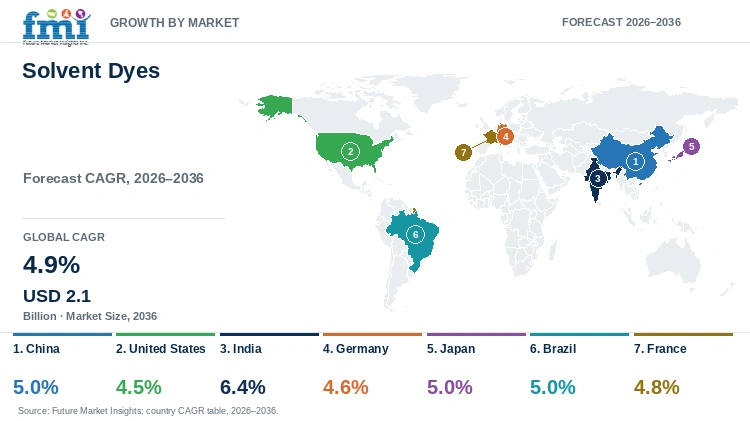
| Country | CAGR, 2026 to 2036 |
|---|---|
| China | 5.0% |
| United States | 4.5% |
| India | 6.4% |
| Germany | 4.6% |
| Japan | 5.0% |
| Brazil | 5.0% |
| France | 4.8% |
Source: Future Market Insights analysis of the solvent dyes market, 2026.
China
The National Bureau of Statistics reported that the value added of rubber and plastic products rose 6.5% year on year in June 2026 and in January to June 2026. It also reported a 5.0% rise in raw chemical materials and chemical products in the first half [23].
Kunshan Organic Chemical Factory was established in 1976. It merged with Kunshan Yuanyuan Plastic Pigments in 1999. It moved its Kunshan production to Jiujiang, Jiangxi province, in 2009, and the new plant started production in 2010. A Myanmar plant started production in 2019. The company now lists four facilities: its headquarters in Kunshan, a Guangzhou sales branch, the Jiujiang plant and the Myanmar plant [13].
Fuel-linked demand is softer. Crude oil processing was 343.87 million tonnes in January to June 2026, down 4.9% [23]. LANXESS cites China's GB 9685 as the hygiene standard for additives in food containers and packaging that applies to Macrolex dyes [2]. Chinese dye makers that can document food-contact compliance are better placed to supply exporters.
United States
The tax rule sets the fuel market. Under 26 CFR 48.4082-1, diesel fuel and kerosene qualify for the dyed-fuel exemption only if they carry Solvent Red 164. The concentration must be spectrally equivalent to at least 3.9 pounds of Solvent Red 26 per thousand barrels. Another dye qualifies if the Commissioner has approved it [15]. The rule also sets registration and approved terminals as separate conditions [15].
Sunbelt Colors, headquartered in Rock Hill, South Carolina, makes Navipol petroleum dyes and Morfast dyes for markers and ink jet inks. It also makes Navipol HF dyes for marking boreholes in mining, and dyes for candles. It reports sales activity in the US, Canada, Latin America, Asia, Australia and Europe [4].
Other US producers cover plastics, inks and defence. Orient Corporation of America makes nigrosine (Solvent Black 7) in Seaford, Delaware [9]. Nation Ford Chemical in Fort Mill, South Carolina, has made solvent dyes since 1994. When SOCMA reported on it in January 2015, it was the only domestic supplier of four coloured smoke-grenade dyes for the US Army [12]. Royce Global, founded in 1929, says it runs one of the few remaining dyestuff synthesis facilities in the United States [7]. US buyers therefore have domestic options for some dye types.
India
Mansi Chemicals began producing solvent dyes in 1999 and sells them as the Meghapon brand from a single unit in Vatva, Ahmedabad, Gujarat. It is part of the Meghmani group, which also makes phthalocyanine pigments, carbazole pigments, reactive dyes and agrochemicals [5][6].
The company lists yellows, oranges, reds, blacks, blues, greens, violets and browns, with uses in coatings, printing inks, leather dyeing, paints and wood stains [5]. A wide shade range suits buyers in leather, wood and ink who choose by shade and price.
The Economic Survey 2025 to 2026 shows selected major chemicals production in India rising from 45,638 thousand tonnes in FY16 to 58,617 thousand tonnes in FY25. It puts chemicals and petrochemicals at 8.1% of manufacturing gross value added in FY2024 [25]. In November 2010 the government told the Lok Sabha that a launderable marker in kerosene for the public distribution system had been discontinued from 31 December 2008. The new marker must be compatible with blue dyed kerosene [26]. Kerosene marker volume therefore depends on public procurement, not on blender choice.
Germany
VCI reported that German chemical-pharmaceutical production fell 3% in the first half of 2026. Sales fell 1% to EUR 106 billion, and investment in plant fell for the third year in a row [24].
LANXESS, based in Cologne, is the main solvent dye supplier in this report. It exhibited at K 2025 in Duesseldorf from 8 to 15 October 2025. There it presented Macrolex Orange HT, Macrolex Black types and Macrolex Blue TP LXS 51151 (Solvent Blue 122). It said its colorant portfolio covers around 150 products [1].
Macrolex dyes are tested against EN 71-3 and EN 71-9 for toys, the packaging directive's 100 ppm limit on lead, cadmium, mercury and hexavalent chromium, and the RoHS directive 2011/65/EU [2]. Germany, as an EU member state, is also bound by Decision (EU) 2022/197, which ended Solvent Yellow 124 as the common fiscal marker after 18 January 2024 [16]. German buyers are likely to weigh audit-ready documents above the lowest price while plant output is weak.
Japan
Orient Chemical Industries, headquartered in Osaka, was founded in 1917. Its US subsidiary, Orient Corporation of America, says its colorants serve inkjet inks, writing inks, paints, electrographic toners and plastics [9].
The VALIFAST range is described as solvent-soluble dyestuffs with brilliant colour in alcohols, glycol ethers, esters and ketones [10]. It is offered for inkjet inks, writing inks, gravure printing inks, transparent foil lacquers, wood stains, plastics and leather [10]. That portfolio leans toward printing and writing, not fuel marking.
Food-contact rules apply to plastics exports. LANXESS notes that Japan's JCII requires colorants in food-contact use to stay within 100 ppm lead, 50 ppm mercury and 100 ppm cadmium [2]. Since 1 April 2021, the Food Contact Materials Safety Center within JCII has handled polymer and additive certification, a role formerly held by JHOSPA [2]. Dye suppliers into Japanese food-contact plastics should therefore have certification documents ready.
Brazil
ANP Resolution 968 of 30 April 2024, published on 1 May 2024, sets the specifications for diesel oils. The producer or importer must add red dye to S500 diesel before delivery to the distributor, at 20 mg/L. Adding dye to S10 diesel is prohibited [19].
Table 3 of the resolution specifies the red dye as a liquid with a Color Index of Solvent Red and an intense red colour. Its specific mass is 990 to 1,020 kg per cubic metre at 20 degrees Celsius [19]. On 11 April 2024 the ANP board approved a revision of Resolution 903 of 2022. It makes violet dye mandatory in marine diesel in the North region and optional elsewhere, so that the diesel can be told apart from road S10 diesel [20].
Two dye rules now sit side by side: red for S500 and violet for northern marine diesel. Sunbelt Colors says its sales and marketing reach Latin America [4]. A dye supplier selling into Brazil will need the Table 3 red grade and a separate violet grade for northern marine diesel.
France
The order of 10 November 2011 was published in the Journal officiel on 3 January 2012. It required non-road gas oil and domestic heating oil to carry a scarlet red colourant, RED 24 at 1 g per hectolitre or RED 19 at 0.5 g per hectolitre. The order also required the tracer Solvent Yellow 124 at 0.6 g per hectolitre [18].
The tracer part of that approach has changed at EU level. Decision (EU) 2022/197 made ACCUTRACE PLUS, a colourless marker, the common fiscal marker. The transitional period for Solvent Yellow 124 ended on 18 January 2024 [16]. The red dye is the visible check and the marker is the laboratory check. A change in the marker therefore does not remove the red dye check.
The Court of Justice of the EU delivered its ruling in case C-137/23 on 13 March 2025. It concerned a Dutch skipper whose gas oil carried less marker than required. The court held that the exemption could not be refused for that shortage alone without evidence of fraud [17]. For French dye suppliers, the red dye still serves as the visible control. The marker alone carries less enforcement weight after this ruling.
Who are the notable companies in the Solvent Dyes Market?
Notable companies in the Solvent Dyes Market include LANXESS AG, Orient Chemical Industries, Mansi Chemicals, Nation Ford Chemical, Royce Global, Kunshan Organic Chemical Factory Co., Ltd., Taiwan Dyestuffs & Pigments Corp. and Sunbelt Colors.
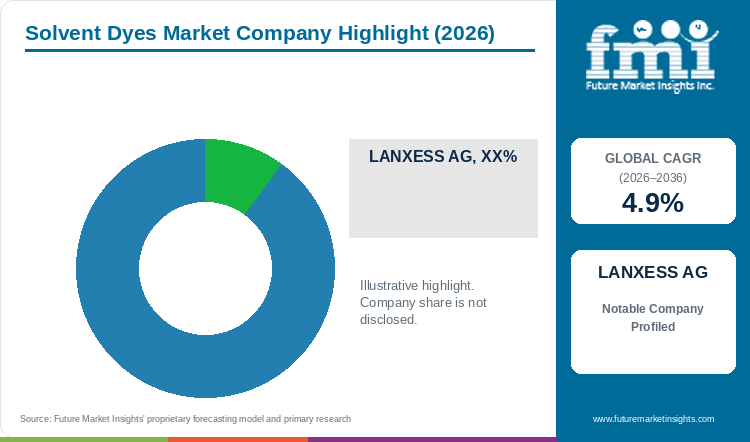
The main differentiator in this market is the specification a dye is built to meet. LANXESS holds 11.5% of the market in 2026. It concentrates on plastics, where Macrolex dyes are sold as granulates, fine granulates and powder and are tested for toy and food-contact use [2]. Kunshan Organic Chemical Factory (5.3%) and Taiwan Dyestuffs & Pigments Corp. (4.7%) also sell plastics-grade solvent dyes. Taiwan Dyestuffs publishes resin-by-resin heat resistance and light fastness in its product table [13][14].
Fuel and lubricant identification sets a different test. Sunbelt Colors (4.1%) makes Navipol liquid dyes for regulatory compliance and brand identification, with plant and headquarters in Rock Hill, South Carolina [4]. This work is tied to rules such as 26 CFR 48.4082-1 and Brazil's Resolution 968, so qualification depends on matching a named dye and concentration [15][19].
Other suppliers compete on solvent system and breadth of shades. Orient Chemical Industries (8.9%) offers VALIFAST dyes for alcohol, glycol ether, ester and ketone systems used in inks [10]. Mansi Chemicals (7.8%) lists many Meghapon shades for coatings, inks, leather and wood stains [5]. Royce Global (6.1%) lists polymer-soluble colorants with Colour Index names for engineering plastics, oils and waxes [8]. Nation Ford Chemical (6.9%) lists liquid and solid solvent dyes among its manufacturing capabilities and has supplied smoke dyes to the US military [11][12].
Key Developments in the Solvent Dyes Market
- On 8 to 15 October 2025, LANXESS exhibited its plastics colorants at K 2025 in Duesseldorf, including Macrolex Orange HT for high-voltage e-mobility components and the newer Macrolex Blue TP LXS 51151 (Solvent Blue 122) [1].
- On 13 March 2025, the Court of Justice of the European Union ruled in case C-137/23 that an excise exemption for gas oil cannot be refused solely because of a shortage of the fiscal marker, absent evidence of fraud [17].
- On 30 April 2024, ANP issued Resolution 968, which requires red dye in S500 diesel at 20 mg/L and prohibits dye in S10 diesel, and on 11 April 2024 the ANP board approved violet dye for marine diesel in the North region [19][20].
- From 19 January 2024, ACCUTRACE PLUS replaced Solvent Yellow 124 as the EU common fiscal marker for gas oils and kerosene under Decision (EU) 2022/197 [16][17].
Key Players in the Solvent Dyes Market
- LANXESS AG
- Orient Chemical Industries Co., Ltd.
- Mansi Chemicals
- Nation Ford Chemical Co.
- Royce Global
- Kunshan Organic Chemical Factory Co., Ltd.
- Taiwan Dyestuffs & Pigments Corp.
- Sunbelt Colors
Solvent Dyes Market Report Scope
Table 4: Solvent Dyes Market Report Scope
| Coverage field | Report scope |
|---|---|
| Market definition | Organic dyes that dissolve in organic solvents, oils, waxes and polymers instead of in water, measured by value of sales to end-use applications |
| Application | Plastics & Polymers, Printing Inks, Paints & Coatings, Fuels, Lubricants & Greases, Other Applications |
| Regions and profiled countries | Asia Pacific, North America, Europe and Latin America (China, United States, India, Germany, Japan, Brazil, France) |
| Companies covered | LANXESS AG, Orient Chemical Industries Co., Ltd., Mansi Chemicals, Nation Ford Chemical Co., Royce Global, Kunshan Organic Chemical Factory Co., Ltd., Taiwan Dyestuffs & Pigments Corp., Sunbelt Colors |
| Forecast period | 2026 to 2036, with 2025 as the historical base year |
| Quantitative Units | USD billion |
Source: Future Market Insights analysis of the solvent dyes market, 2026.
Solvent Dyes Market by Segments
Solvent Dyes Market segmented by Application:
- Plastics & Polymers
- Printing Inks
- Paints & Coatings
- Fuels
- Lubricants & Greases
- Other Applications
Solvent Dyes Market by Region
- Asia Pacific
- North America
- Europe
- Latin America
- China
- United States
- India
- Germany
- Japan
- Brazil
- France
Research Sources and Bibliography
- [1] LANXESS. (2025, October 3). LANXESS at K 2025: Focus on additives, colorants and pigments. https://lanxess.com/en/media/press-releases/2025/09/lanxess-at-k-2025-focus-on-additives-colorants-and-pigments
- [2] LANXESS. (n.d.). Macrolex Solvent Dyes. https://lanxess.com/en/products-and-solutions/brands/macrolex
- [3] LANXESS. (n.d.). Colorants. https://lanxess.com/en/Products-and-Solutions/Industries/Colorants
- [4] Sunbelt Colors. (n.d.). Sunbelt Colors: Dye Applications Made in USA. https://sunbeltcolors.com/
- [5] Mansi Chemicals. (n.d.). Mansi Chemicals: Manufacturer and Exporter of Solvent Dyes. https://www.mansichemicals.com/
- [6] Mansi Chemicals. (n.d.). About Us. https://www.mansichemicals.com/about-us
- [7] Royce Global. (n.d.). Royce Global home page. https://royceglobal.com/
- [8] Royce Global. (n.d.). Solvent Dyes. https://www.royceglobal.com/colorants/solvent-dyes
- [9] Orient Corporation of America. (n.d.). Orient Corporation of America. https://www.orient-usa.com/
- [10] Orient Corporation of America. (n.d.). VALIFAST Color Series. https://www.orient-usa.com/valifast-color-series
- [11] Nation Ford Chemical. (n.d.). Toll Manufacturing. https://nationfordchem.com/plant-equipment/
- [12] Society of Chemical Manufacturers and Affiliates. (2015, January 8). Nation Ford Chemical Supports Troops by Making Colorants for Smoke Grenades. https://www.socma.org/nation-ford-chemical-supports-troops-by-making-colorants-for-smoke-grenades/
- [13] Kunshan Organic Chemical Factory Co., Ltd. (n.d.). About Us. https://www.yysolventdyes.com/wap_about_en.html
- [14] Taiwan Dyestuffs & Pigments Corp. (n.d.). Solvent Dye. https://www.tdpctw.com/en/2-1977-36857/product/Solvent-Dye-id201480.html
- [15] U.S. Department of the Treasury. (n.d.). 26 CFR 48.4082-1, dye standard for diesel fuel and kerosene. https://www.law.cornell.edu/cfr/text/26/48.4082-1
- [16] European Commission. (2022, January 17). Commission Implementing Decision (EU) 2022/197 establishing a common fiscal marker for gas oils and kerosene. https://eur-lex.europa.eu/eli/dec_impl/2022/197/oj/eng
- [17] Fairway advocaten. (2025, March 28). Court of Justice EU rules on red gas oil: a shortage of Solvent Yellow 124 does not always lead to retrospective taxation. https://fairwayadvocaten.nl/en/news/article/85-court-of-justice-eu-rules-on-red-gas-oil-a-shortage-of-solvent-yellow-124-does-not-always-lead-to-retrospective-taxation
- [18] Direction generale des douanes et droits indirects. (2012, January 3). Arrete du 10 novembre 2011 (NOR BCRD1131063A), Journal officiel de la Republique francaise, texte 19 sur 131. https://www.douane.gouv.fr/sites/default/files/dana/files/F2_13-027.pdf
- [19] Agencia Nacional do Petroleo, Gas Natural e Biocombustiveis. (2024, April 30). Resolucao ANP n. 968, de 30 de abril de 2024. https://www.legisweb.com.br/legislacao/?legislacao=458461
- [20] Associacao Brasileira de Agencias Reguladoras. (2024, April 11). ANP aprova adicao obrigatoria de corante ao oleo diesel maritimo na Regiao Norte. https://abar.org.br/anp-aprova-adicao-obrigatoria-de-corante-ao-oleo-diesel-maritimo-na-regiao-norte/
- [21] Plastics Europe. (2025, October 8). Plastics the Fast Facts 2025. https://plasticseurope.org/knowledge-hub/plastics-the-fast-facts-2025/
- [22] Plastics Europe. (2025, September). Plastics the Fast Facts 2025, key figures. https://plasticseurope.org/wp-content/uploads/2025/09/PE_TheFacts_25_digital-1pager-scrollable.pdf
- [23] National Bureau of Statistics of China. (2026, July 16). Industrial Production Operation in June 2026. https://www.stats.gov.cn/english/PressRelease/202607/t20260717_1964159.html
- [24] Die Zeit. (2026, July 16). Deutsche Chemieindustrie schrumpft weiter. https://www.zeit.de/wirtschaft/2026-07/chemieindustrie-deutschland-vci-krise
- [25] Press Information Bureau, Government of India. (2026, January 30). Economic Survey 2025-26 Highlights Steady Growth of Chemicals and Petrochemicals Sector. https://www.pib.gov.in/PressReleasePage.aspx?PRID=2220980®=1&lang=1
- [26] Press Information Bureau, Government of India. (2010, November 25). Markers on Kerosene. https://www.pib.gov.in/newsite/PrintRelease.aspx?relid=67618
Table of Content
Table of Content
- Key Takeaways
- Market Size and CAGR
- Top Growth Driver
- Fastest Growing Segment
- Leading Region
- Key Companies
- Emerging Opportunities
- Executive Summary
- Global Market Outlook
- Demand-side Trends
- Supply-side Trends
- Technology Roadmap Analysis
- Analysis and Recommendations
- Analyst Perspective (What is happening? Why now? What should investors know?)
- Key Questions Answered
- How large is the market?
- What is the CAGR?
- What are key trends?
- Which region dominates?
- Who are the leaders?
Read More...
- Market Overview
- Market Coverage / Taxonomy
- Market Definition / Scope / Limitations
- Research Methodology
- Chapter Orientation
- Analytical Lens and Working Hypotheses
- Market Structure, Signals, and Trend Drivers
- Benchmarking and Cross-market Comparability
- Market Sizing, Forecasting, and Opportunity Mapping
- Research Design and Evidence Framework
- Desk Research Programme (Secondary Evidence)
- Expert Input and Fieldwork (Primary Evidence)
- Tooling, Models, and Reference Databases
- Data Engineering and Model Build
- Quality Assurance and Audit Trail
- Market Background
- Market Dynamics (Drivers, Restraints, Opportunity, Trends)
- Scenario Forecast (Optimistic, Likely, Conservative)
- Impact Analysis
- AI Impact
- Sustainability Impact
- Regulatory Impact
- Technology Impact
- Consumer / Buyer Analysis
- Purchase Drivers
- Adoption Barriers
- Buyer Journey
- Opportunity Map Analysis
- Product Life Cycle Analysis
- Supply Chain Analysis
- Investment Feasibility Matrix
- Value Chain Analysis
- PESTLE and Porter's Analysis
- Regulatory Landscape
- Regional Parent Market Outlook
- Production and Consumption Statistics
- Import and Export Statistics
- Global Market Analysis and Forecast, 2021 to 2036
- Historical Market Size Value (USD Billion) Analysis, 2021 to 2025
- Current and Future Market Size Value (USD Billion) Projections, 2026 to 2036
- Y-o-Y Growth Trend Analysis
- Absolute $ Opportunity Analysis
- Global Market Pricing Analysis, 2021 to 2036
- Global Market Analysis and Forecast, By Application, 2021 to 2036
- Introduction / Key Findings
- Historical Market Size Value (USD Billion) Analysis By Application, 2021 to 2025
- Current and Future Market Size Value (USD Billion) Analysis and Forecast By Application, 2026 to 2036
- Plastics & Polymers
- Printing Inks
- Paints & Coatings
- Fuels
- Lubricants & Greases
- Other Applications
- Y-o-Y Growth Trend Analysis By Application, 2021 to 2025
- Absolute $ Opportunity Analysis By Application, 2026 to 2036
- Global Market Analysis and Forecast, By Region, 2021 to 2036
- Introduction
- Historical Market Size Value (USD Billion) Analysis By Region, 2021 to 2025
- Current Market Size Value (USD Billion) Analysis and Forecast By Region, 2026 to 2036
- Asia Pacific
- North America
- Europe
- Latin America
- Market Attractiveness Analysis By Region
- Asia Pacific Market Analysis and Forecast, By Country
- Historical Market Size Value (USD Billion) Trend Analysis By Market Taxonomy, 2021 to 2025
- Market Size Value (USD Billion) Forecast By Market Taxonomy, 2026 to 2036
- By Country
- By Application
- Market Attractiveness Analysis
- By Country
- By Application
- Key Takeaways
- North America Market Analysis and Forecast, By Country, 2021 to 2036
- Historical Market Size Value (USD Billion) Trend Analysis By Market Taxonomy, 2021 to 2025
- Market Size Value (USD Billion) Forecast By Market Taxonomy, 2026 to 2036
- By Country
- By Application
- Market Attractiveness Analysis
- By Country
- By Application
- Key Takeaways
- Europe Market Analysis and Forecast, By Country
- Historical Market Size Value (USD Billion) Trend Analysis By Market Taxonomy, 2021 to 2025
- Market Size Value (USD Billion) Forecast By Market Taxonomy, 2026 to 2036
- By Country
- By Application
- Market Attractiveness Analysis
- By Country
- By Application
- Key Takeaways
- Latin America Market Analysis and Forecast, By Country
- Historical Market Size Value (USD Billion) Trend Analysis By Market Taxonomy, 2021 to 2025
- Market Size Value (USD Billion) Forecast By Market Taxonomy, 2026 to 2036
- By Country
- China
- United States
- India
- Germany
- Japan
- Brazil
- France
- By Application
- By Country
- Market Attractiveness Analysis
- By Country
- By Application
- Key Takeaways
- Key Countries Market Analysis
- United States
- Pricing Analysis
- Market Share Analysis, 2025
- By Application
- Brazil
- Pricing Analysis
- Market Share Analysis, 2025
- By Application
- Germany
- Pricing Analysis
- Market Share Analysis, 2025
- By Application
- France
- Pricing Analysis
- Market Share Analysis, 2025
- By Application
- India
- Pricing Analysis
- Market Share Analysis, 2025
- By Application
- China
- Pricing Analysis
- Market Share Analysis, 2025
- By Application
- Japan
- Pricing Analysis
- Market Share Analysis, 2025
- By Application
- United States
- Market Structure Analysis
- Competition Dashboard
- Competition Benchmarking
- Market Share Analysis of Top Players
- By Regional
- By Application
- Emerging Startups
- Innovation Benchmarking
- Competition Analysis
- Competition Deep Dive
- LANXESS AG
- Overview
- Product Portfolio
- Profitability by Market Segments
- Sales Footprint
- Strategy Overview
- Marketing Strategy
- Product Strategy
- Channel Strategy
- Orient Chemical Industries Co., Ltd.
- Mansi Chemicals
- Nation Ford Chemical Co.
- Royce Global
- Kunshan Organic Chemical Factory Co., Ltd.
- Taiwan Dyestuffs & Pigments Corp.
- Sunbelt Colors
- LANXESS AG
- Case Studies
- Success Stories
- Recent Developments
- Competition Deep Dive
- Assumptions & Acronyms Used
List of Tables
- Table 1: Global Market Value (USD Billion) Forecast by Region, 2021 to 2036
- Table 2: Global Market Value (USD Billion) Forecast by Application, 2021 to 2036
- Table 3: Asia Pacific Market Value (USD Billion) Forecast by Country, 2021 to 2036
- Table 4: Asia Pacific Market Value (USD Billion) Forecast by Application, 2021 to 2036
- Table 5: North America Market Value (USD Billion) Forecast by Country, 2021 to 2036
- Table 6: North America Market Value (USD Billion) Forecast by Application, 2021 to 2036
- Table 7: Europe Market Value (USD Billion) Forecast by Country, 2021 to 2036
- Table 8: Europe Market Value (USD Billion) Forecast by Application, 2021 to 2036
- Table 9: Latin America Market Value (USD Billion) Forecast by Country, 2021 to 2036
- Table 10: Latin America Market Value (USD Billion) Forecast by Application, 2021 to 2036
List of Figures
- Figure 1: Global Market Pricing Analysis
- Figure 2: Global Market Value (USD Billion) Forecast 2021-2036
- Figure 3: Global Market Value Share and BPS Analysis by Application, 2026 and 2036
- Figure 4: Global Market Y-o-Y Growth Comparison by Application, 2026-2036
- Figure 5: Global Market Attractiveness Analysis by Application
- Figure 6: Global Market Value (USD Billion) Share and BPS Analysis by Region, 2026 and 2036
- Figure 7: Global Market Y-o-Y Growth Comparison by Region, 2026-2036
- Figure 8: Global Market Attractiveness Analysis by Region
- Figure 9: Asia Pacific Market Incremental Dollar Opportunity, 2026-2036
- Figure 10: North America Market Incremental Dollar Opportunity, 2026-2036
- Figure 11: Europe Market Incremental Dollar Opportunity, 2026-2036
- Figure 12: Latin America Market Incremental Dollar Opportunity, 2026-2036
- Figure 13: Asia Pacific Market Value Share and BPS Analysis by Country, 2026 and 2036
- Figure 14: Asia Pacific Market Value Share and BPS Analysis by Application, 2026 and 2036
- Figure 15: Asia Pacific Market Y-o-Y Growth Comparison by Application, 2026-2036
- Figure 16: Asia Pacific Market Attractiveness Analysis by Application
- Figure 17: North America Market Value Share and BPS Analysis by Country, 2026 and 2036
- Figure 18: North America Market Value Share and BPS Analysis by Application, 2026 and 2036
- Figure 19: North America Market Y-o-Y Growth Comparison by Application, 2026-2036
- Figure 20: North America Market Attractiveness Analysis by Application
- Figure 21: Europe Market Value Share and BPS Analysis by Country, 2026 and 2036
- Figure 22: Europe Market Value Share and BPS Analysis by Application, 2026 and 2036
- Figure 23: Europe Market Y-o-Y Growth Comparison by Application, 2026-2036
- Figure 24: Europe Market Attractiveness Analysis by Application
- Figure 25: Latin America Market Value Share and BPS Analysis by Country, 2026 and 2036
- Figure 26: Latin America Market Value Share and BPS Analysis by Application, 2026 and 2036
- Figure 27: Latin America Market Y-o-Y Growth Comparison by Application, 2026-2036
- Figure 28: Latin America Market Attractiveness Analysis by Application
- Figure 29: Global Market - Tier Structure Analysis
- Figure 30: Global Market - Company Share Analysis
Frequently Asked Questions
How big is the solvent dyes market in 2026?
The Solvent Dyes Market is estimated at USD 1.3 billion in 2026, with 2025 also at USD 1.3 billion. It is projected to reach USD 2.1 billion by 2036, a 4.9% CAGR from 2026 to 2036.
Which application leads the solvent dyes market?
Plastics & Polymers leads with 34.0% of the market in 2026. LANXESS says Macrolex solvent dyes have been developed for plastics since the 1960s and suit amorphous thermoplastics such as PS, ABS, PMMA and PC [2]. World plastics production reached 430.9 million tonnes in 2024 [22].
Which other applications matter?
Printing Inks hold 20.0%, Paints & Coatings 15.0%, Fuels 12.0%, Lubricants & Greases 10.0% and Other Applications 9.0%. Orient lists VALIFAST dyes for inkjet, writing and gravure inks [10], and Sunbelt Colors lists dyes for fuels, lubricants, candles and mining [4].
Which profiled country is forecast to grow fastest?
India has the highest forecast CAGR of the seven profiled countries at 6.4% from 2026 to 2036, ahead of China, Japan and Brazil at 5.0% each. India's selected major chemicals production rose from 45,638 thousand tonnes in FY16 to 58,617 thousand tonnes in FY25 [25]. Mansi Chemicals, one of the Indian producers profiled, has made solvent dyes in Vatva, Gujarat since 1999 [5][6].
What rules are changing demand for fuel dyes?
In the EU, Decision 2022/197 made colourless ACCUTRACE PLUS the common fiscal marker, and Solvent Yellow 124 could be used only until 18 January 2024 [16]. In Brazil, Resolution 968 of 30 April 2024 requires red dye at 20 mg/L in S500 diesel and bans dye in S10 [19]. In the United States, 26 CFR 48.4082-1 names Solvent Red 164 for the dyed-fuel exemption [15].
What should a buyer check when choosing a solvent dye?
Check the resin or solvent system first. Taiwan Dyestuffs & Pigments Corp. lists solubility in acetone, butyl acetate, toluene, dichloromethane and ethyl alcohol, and heat resistance by resin [14]. Then check the compliance claims that apply to the end use, such as EN 71-9 for toys or the JCII limits for food contact in Japan [2].
Preview the report firsthand - request a free sample
Get SampleGet the brochure for pricing and purchase details.
Get PDF
