

- Industry Size (2026)
- USD 384.19 Mn
- Forecast (2036)
- USD 516.32 Mn
- CAGR (2026 to 2036)
- 3.0%
Continuous Inkjet Inks Market Size, Market Forecast and Outlook By FMI
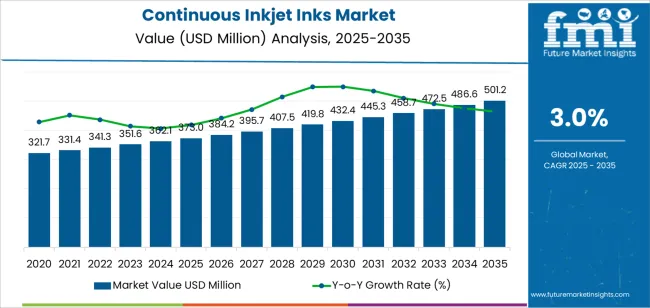
The continuous inkjet inks market was valued at USD 373.00 Million in 2025, projected to reach USD 384.19 Million in 2026, and is forecast to expand to USD 516.32 Million by 2036 at a 3.0% CAGR. Industrial coding requirements mandated by food safety and pharmaceutical traceability regulations ensure a baseline demand floor that remains resilient across economic cycles.
Summary of Continuous Inkjet Inks Market
- Market Snapshot
- The continuous inkjet inks market is valued at USD Million 373.00 million in 2025 and is projected to reach USD Million 516.32 million by 2036.
- The industry is expected to grow at a 3.0% CAGR from 2026 to 2036, creating an incremental opportunity of USD Million 132.13 million.
- The market is a mature, substrate-driven consumables category where ink chemistry compatibility, print speed requirements, and regulatory compliance for food-contact packaging define competitive positioning.
- Demand and Growth Drivers
- Demand is driven by mandatory industrial coding and marking requirements enforced through food safety, pharmaceutical serialization, and product traceability regulations.
- Reformulation toward water-based and UV curable ink chemistries is accelerating as VOC emission regulations tighten across packaging manufacturing facilities.
- Growth is supported by expanding packaged goods production volumes in emerging economies and increasing coding line speeds requiring high-performance ink formulations.
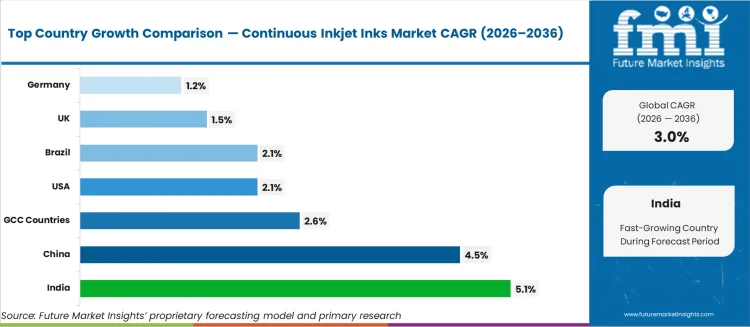
- Among key countries, India at 5.1%, China at 4.5%, GCC Countries at 2.6%, USA at 2.1%, Brazil at 2.1%, UK at 1.5%, Germany at 1.2%.
- Product and Segment View
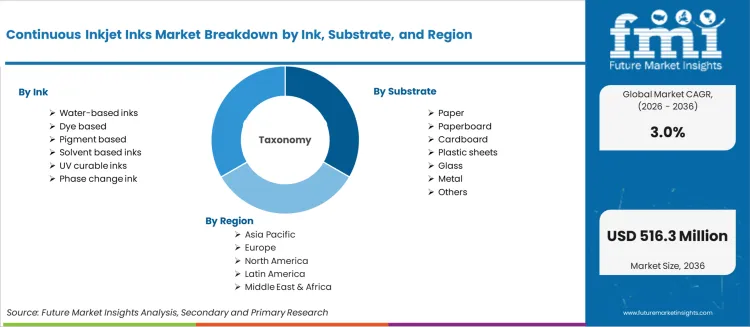
- The market covers Ink types include water-based, solvent-based, UV curable, dye-based, pigment-based, and phase change formulations.
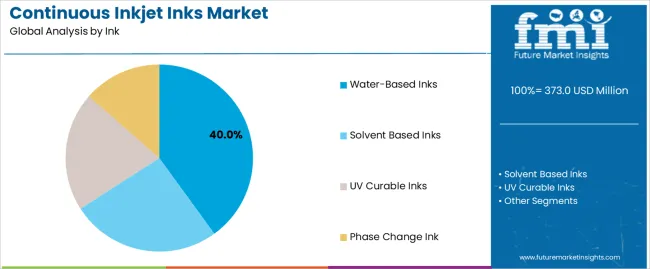
- Water-based inks leads by Ink with 47.7% share in 2026.
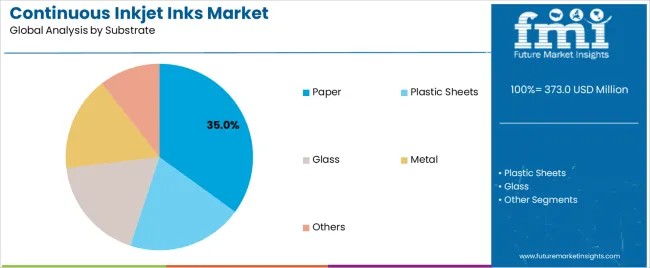
- Paper leads by Substrate with 50.1% share in 2026.
- Market scope includes all ink formulations designed for CIJ printers, covering consumable ink cartridges, bulk ink supplies, and make-up fluids.
- The scope excludes drop-on-demand (DOD) inkjet inks, thermal inkjet cartridges, wide-format printing inks, and inks designed for office or desktop printers.
- Geography and Competitive Outlook
- India and China are the fastest-growing markets, while UK and Germany represent mature demand bases with steady replacement cycles.
- Competition is shaped by a fragmented vendor landscape, with key players including Sun Chemical, Eastman Kodak Company, Needham Inks Ltd., Squid Ink., Kao Collins Inc., Triton GmbH, Linx Printing Technologies..
- Sun Chemical holds approximately 27% market share, positioning it as the category leader.
- Analyst Opinion at FMI
- Ismail Sutaria, Principal Consultant, opines: 'In my analysis, I have observed that the true competitive differentiator in continuous inkjet inks is not price per litre but substrate adhesion reliability at high line speeds. Packaging lines operating above 300 metres per minute face ink failure rates that directly translate into production downtime and compliance risk. Ink suppliers unable to certify adhesion performance across mixed substrate environments will face progressive delisting from tier-1 FMCG procurement panels.'
- Strategic Implications / Executive Takeaways
- Ink manufacturers must invest in substrate-specific adhesion testing laboratories to certify performance across the expanding range of packaging materials.
- Packaging line engineers should standardize on multi-substrate ink platforms to reduce changeover times and inventory complexity.
- Procurement managers must evaluate total cost of ownership including downtime costs, rather than per-litre pricing, when selecting CIJ ink suppliers.
FMI analysts observe a gradual reformulation shift within the ink category, where solvent-based formulations face increasing regulatory pressure from volatile organic compound (VOC) emission standards. Water-based and UV curable inks are gaining share as manufacturers seek compliance with tightening environmental regulations without sacrificing print adhesion or line speed performance.
All major markets reflect differentiated growth trajectories. India at 5.1% CAGR, China at 4.5% CAGR, GCC Countries at 2.6% CAGR, USA at 2.1% CAGR, Brazil at 2.1% CAGR, UK at 1.5% CAGR, Germany at 1.2% CAGR. Each country path is shaped by local regulatory frameworks, healthcare infrastructure maturity, and industrial demand patterns specific to the region.
Continuous Inkjet Inks Market Key Takeaways
| Metric | Details |
|---|---|
| Industry Size (2026) | USD 384.19 Million |
| Industry Value (2036) | USD 516.32 Million |
| CAGR (2026-2036) | 3.0% |
Source: Future Market Insights, 2026
Continuous Inkjet Inks Market Definition
The Continuous Inkjet Inks Market covers specialty inks formulated for continuous inkjet (CIJ) printing systems used in industrial coding and marking applications. Ink types include water-based, solvent-based, UV curable, dye-based, pigment-based, and phase change formulations. These inks are applied to substrates such as paper, paperboard, plastics, glass, and metals across food, beverage, pharmaceutical, and electronics packaging lines.
Continuous Inkjet Inks Market Inclusions
Market scope includes all ink formulations designed for CIJ printers, covering consumable ink cartridges, bulk ink supplies, and make-up fluids. Global and regional market sizes for the forecast period 2026 to 2036 are covered, segmented by ink type, substrate, and end use.
Continuous Inkjet Inks Market Exclusions
The scope excludes drop-on-demand (DOD) inkjet inks, thermal inkjet cartridges, wide-format printing inks, and inks designed for office or desktop printers. Printer hardware and maintenance services are also excluded.
Continuous Inkjet Inks Market Research Methodology
- Primary Research: Analysts conducted interviews with packaging line engineers, ink procurement managers, and CIJ printer OEM representatives across major manufacturing regions.
- Desk Research: Data collection included food-contact material regulatory databases, industrial ink specification standards, and packaging industry association publications.
- Market-Sizing and Forecasting: Baseline values derive from a bottom-up aggregation of CIJ printer installed base data, applying ink consumption rates per print-hour across substrate categories to project market volumes.
- Data Validation and Update Cycle: Projections are cross-validated against publicly available revenue data from leading industrial ink manufacturers and printer OEM consumable sales disclosures.
Key Industry Highlights
High Performance and Ability to Adhere on Non-Porous Surfaces
These continuous inkjet inks find most of their applications such as printing across various end-use industries. One of the major uses of these inks is in the building and construction industry for printing necessary information such as product specifications providing the compositions of the product, its suitability towards different chemicals or substrates and many others on tiles, plastic pipes and glass panels.
These inkjet inks are known for their consistent performance ensuring smooth and uninterrupted printing and strong adhesion properties. Printing over non-porous surfaces is a great challenge due to its smooth nature. But continuous inkjet inks are designed to interact with various non-porous surfaces such as glass, plastic and ceramics without causing any damage or adverse reactions.
This is due to the presence of specific additives or surface-active agents that prevent wetting and ink from spreading over these surfaces.
As per the survey of Invest India, the construction sector is showing lucrative growth in India and is expected to generate 70% of the country’s GDP by 2036. As the construction industry is growing and continuous inkjet inks have several applications, the continuous inkjet inks market is expected to have great demand over the forecast period
Reasonable Continuous Inkjet Inks Prices Leading to its High Demand
The affordability of continuous inkjet inks is one of the major reasons for their high demand in case of high-volume printing requirements and industries focusing on cost-cutting in their production processes. In the past few years, there has been a rise in the number of startups, and small and medium-sized businesses across various sectors.
According to the Ministry of Commerce and Industry of India, the country is exhibiting a rise in the number of startups recording around 117,254 startups till 2026. As these businesses are in their starting phase, they don’t hold high revenues for investments and also focus on bringing cost-effectiveness to their operations. Whether the business is small-scale or large-scale, it requires printing during its storage and delivery stage.
These continuous inkjet inks have a low upfront cost and lesser consumption of ink and at the same time produce larger print sizes as compared to laser printers or thermal inkjet printers. Continuous inkjet inks are versatile, suitable for a variety of ink formulations, and adaptable to different printing applications and several surfaces, including non-porous surfaces.
Due to this, continuous inkjet inks are preferred by small-scale and medium-sized businesses to lower their operational expense and offer high-quality prints. Thus, a less expensive nature and high performance will pose a catalyst in boosting the demand for continuous inkjet inks in the upcoming years.
Utilizing Eco-friendly Continuous Inkjet Inks in Printers
The traditional inks that are used in inkjet printers such as dye-based inks may contain the four heavy metals mercury, lead, cadmium, and hexavalent chromium which are banned under EU regulations. These heavy metals can cause water and soil pollution. The ink contains various other petroleum and chemical additives to dry onto the substrate rapidly. These additives cause a volatile impact on the environment.
The CIJ inks manufacturers are now using eco-friendly inks also called as agri-based inks which are made from vegetable oil and can provide an alternative to petroleum-based inks. Besides, the vegetable-oil-based inks are renewable unlike the petroleum-based inks and are now being widely preferred by the key players in the CIJ ink market.
This has huge benefits because of its environment friendliness and minimal impact on the environment, thus many manufacturers are adopting the use of eco-friendly continuous inkjet inks in the upcoming years.
Makeup Fluids Constitute For Substantial Portion of Expenses
The makeup fluids are the most crucial part of the continuous inkjet ink printing process to ensure optimal printing quality and high print head performance. These makeup fluids account for high investment right from its procurement, storage and disposal as compared to other printing technologies that use toner cartridges and fixed print heads.
Thus, continuous inkjet inks hold a considerably high cost compared to standard inks used in other printing methods. Due to this reason, the continuous inkjet ink market may hamper in the assessment period.
2021 to 2025 Global Continuous Inkjet Inks Sales Outlook Compared to Demand Forecast from 2026 to 2036
Due to the rising demand for printing applications in the food and beverage industry, the continuous inkjet ink market is indicating high growth. Various packaging materials are required for food and beverages to maintain quality and integrity.
Continuous inkjet inks are used for printing these necessary information such as manufacturing date, expiry date, and specification related to consumption and storage in terms of desired temperature, etc. on bottles, cans, cartons, meat packaging and ready meals.
The use of solvent-based continuous inkjet inks is projected to rise amid its versatility for various substrates and resistance to chemicals, water and anti-fading properties over long periods. They are used majorly for coding and marking in automotive, electrical, pharmaceutical and electronics industries.
Solvent-based continuous inkjet inks show compatibility with multiple printing equipment. These inks produce prints with sharp edges and attractive colors thus offering the desired aesthetic as per the consumer demand. As these inks possess distinct characteristics and benefits, manufacturers all over the globe are putting efforts into innovation to meet the demands of end users.
Market Concentration
Tier 1 companies comprise market leaders with a market revenue of above USD 14 million capturing significant market share of 25% to 35% in global market. These market leaders are characterized by high production capacity and a wide product portfolio. These market leaders are distinguished by their extensive expertise in manufacturing across multiple packaging formats and a broad geographical reach, underpinned by a robust consumer base.
They provide a wide range of series including recycling and manufacturing utilizing the latest technology and meeting the regulatory standards providing the highest quality. Prominent companies within tier 1 include Linx Printing Technologies, Eastman Kodak Company, Sun Chemical and Videojet Technologies, Inc.
Tier 2 companies include mid-size players with revenue of USD 3 to 14 million having presence in specific regions and highly influencing the local market. These are characterized by a strong presence overseas and strong market knowledge. These market players have good technology and ensure regulatory compliance but may not have advanced technology and wide global reach.
Prominent companies in tier 2 include Kao Collins Inc., ARMOR-IIMAK, Tritron GmbH, Needham Inks Ltd. and some other players.
Tier 3 includes the majority of small-scale companies operating at the local presence and serving niche markets having revenue below USD 150 million. These companies are notably oriented towards fulfilling local market demands and are consequently classified within the tier 3 share segment. They are small-scale players and have limited geographical reach.
Tier 3, within this context, is recognized as an unorganized market, denoting a sector characterized by a lack of extensive structure and formalization when compared to organized competitors.
Country-wise Insights
The section below covers the future forecast for duct tapes market in terms of countries. Information on key countries in several parts of the globe, including North America, Latin America, East Asia, South Asia, Europe, Oceania and MEA is provided. India is anticipated to remain at the forefront in South Asia, with a CAGR of 5.1% through 2036. In East Asia, China is projected to witness a CAGR of 4.5% by 2036.
.webp "Top Country Growth Comparison Continuous Inkjet Inks Market Cagr (2026 2036)")
| Countries | Value CAGR (2026 to 2036) |
|---|---|
| USA | 2.1% |
| UK | 1.5% |
| Germany | 1.2% |
| Brazil | 2.1% |
| China | 4.5% |
| India | 5.1% |
| GCC Countries | 2.6% |
Ascending Electronic Industry in Brazil to Boost the Continuous Inkjet Inks Market
According to the International Trade Administration, USA Department of Commerce, the Brazilian information technology market accounts for 36.5% of the Latin American market generating a valuation of USD 373 billion in 2026, showing a growth of 3% from 2024.
With consistent innovations in the electronics industry, there has been a huge demand for various electronic products in Brazil.
Apart from basic applications such as product packaging, labelling, coding and printed circuit board marking for identifying different products throughout the supply chain continuous inkjet inks play one more key role in this industry of seamlessly integrating continuous inkjet ink printing solutions in its manufacturing methods.
With this, the manufacturers can customize their printing solutions by printing product specifications and brand logos efficiently, thus differentiating their products from the other competitors.
Development across Pharmaceutical Industry in India
As per the survey of India Brand Equity Foundation (IBEF), the Indian pharmaceutical industry is one of the leading producer of generic drugs and growing at a CAGR 9.43% and expected to reach USD 501.2 billion till 2036.
Among several types of continuous inkjet inks such as water-based, solvent-based, phase change inks, etc. UV curable inks are used more often in the pharmaceutical industry due to their fast drying ability and high durability for different medicine packaging solutions which include prints on blister packaging of medicines and vaccine ampoules and vials.
These UV curable inks consist of photo-initiators that are responsible for offering their quick drying feature. These inks show resistance towards chemicals and scratching, thus ensuring the print is sustained for a longer period. Due to the great importance of information printing on pharmaceutical products, continuous inkjet inks are expected to propel in the upcoming years.
Increased Demand for Secured Packaging in Beverage Industry in USA
USA is projected to showcase a CAGR OF 2.1% in the forecast period. The increasing need for secured packaging in beverage industry is anticipated to play a significant role in pushing the demand for continuous inkjet inks market.
There has been a rise in the consumption of beverages across all age groups in USA. But consumption of spoiled and contaminated beverages may lead to severe illness such as food-borne diseases. As reported by the Center for Disease Control and Prevention (CDC), more than 1, 00,000 people are hospitalized and around 3,000 people die every year because of consuming contaminated drinks.
Thus, there is a necessity for effective packaging solutions with the objective that packaged beverages reach the customers pure in quality and safe.
Continuous water-based inkjet inks are used because of superior adhesion, color vibrancy and resistance to abrasion. Water-based inkjet inks play a major role in this by offering prints conveying necessary information about instruction related to the storage of beverage to avoid its spoilage due to exposure to unwanted conditions and mentioning the expiry dates so that the expired beverages are disposed and not consumed by anyone.
With aim of curb the diseases spread due to consumption of expired drinks, the need for continuous water-based inkjet inks is expected to increase.
Category-wise Insights
The section contains information about the leading segments in the industry. In terms of ink, water-based inks is estimated to account for a share of 47.7% by 2036. By substrate, paper segment is projected to dominate by holding a share of 501.2% by the end 2036.
Better Color Quality Compared to Other Inks
| Ink | Water-based Inks |
|---|---|
| Value CAGR (2036) | 3.4% |
Water-based inks among other inks is expected to lead the continuous inkjet inks market during the forecast period. Water-baes inks is anticipated to rise at a CAGR of 3.4%, generating an incremental growth opportunity worth USD 501.2 million by 2036.
The water-based inks consist of dye-based inks and pigment-based inks, both of them exceptional benefits across various industries. The dye-based possesses the absorbing ability of the molecular structures of dyes across broad spectrum wavelengths and offers bright colors with better optical density.
The pigment-based inks the solid particles of the pigments offer strong color saturation, providing prints with attractive colors and high contrast. Due to its high color quality, these inks are used most often for branding purposes by highlighting its product with the competitors..
Growing demand for Eco-friendly Printing Solutions
| Substrate | Paper |
|---|---|
| Value CAGR (2036) | 2.9% |
The paper as a substrate is estimated to lead the continuous inkjet inks industry. It is anticipated to hold around 2.9% CAGR value share in 2036.
Various types of substrates are utilized for continuous inkjet printing consisting of paper, plastic sheets, glass, metal and other fabrics. Amongst all these, paper is the most widely used substrate because of the high usage of paperboard across end-use industries such as packaged food packaging, and cardboards for secondary packaging of medicines, electrical and electronics.
Those businesses focusing on cost-sensitive product processes utilize paper for packaging instead of glass and metal, due to its less expensive nature. Also paper is an eco-friendly material as it is sourced from renewable sources like trees, thus fulfilling the environmental and sustainability considerations. Due to its cost-effective and eco-friendly nature, paper is used on a large scale as a substrate for continuous inkjet inks.
Competitive Landscape
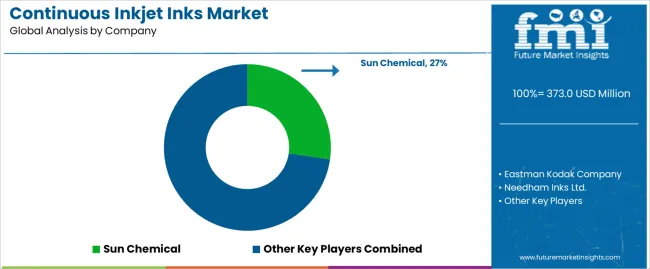
Key players of continuous inkjet inks industry are developing and launching new products in the market. They are integrating with different firms and extending their geographical presence. Few of them are also collaborating and partnering with local brands and start-up companies for new product development.
Key Developments in Continuous Inkjet Inks Market:
- In March 2025, Sun Chemical, producer of printing inks and pigments launched Xennia Jade, a pigment ink to meet the escalating demands of the direct-to-film (DTF) market.
- In Jan 2025, Needham Inks Ltd. introduced a new MEK ink, suited for alcohol resistance with the aim of expanding its continuous inkjet inks product portfolio.
- In May 2025, Eastman Kodak Company acquired Graphic Systems Services Inc. (GSS), a leading provider of web inkjet press transport systems and other print-related components and engineering services to strengthen its inkjet capabilities.
Scope of the Report
| Metric | Value |
|---|---|
| Quantitative Units | USD Million 384.19 to USD Million 516.32 million, at a CAGR of 3.0% |
| Market Definition | The Continuous Inkjet Inks Market covers specialty inks formulated for continuous inkjet (CIJ) printing systems used in industrial coding and marking applications. Ink types include water-based, solvent-based, UV curable, dye-based, pigment-based, and phase change formulations. |
| Segmentation | Ink: Water-based inks, Dye based, Pigment based, Solvent based inks, UV curable inks, Phase change ink; Substrate: Paper, Paperboard, Cardboard, Plastic sheets, Glass, Metal, Others; End Use: Food, Beverage, Pharmaceuticals, Electrical and Electronics, Others |
| Regions Covered | North America, Latin America, Europe, East Asia, South Asia, Oceania, Middle East & Africa |
| Countries Covered | USA, UK, Germany, Brazil, China, India, GCC Countries, and 40 plus countries |
| Key Companies Profiled | Sun Chemical, Eastman Kodak Company, Needham Inks Ltd., Squid Ink., Kao Collins Inc., Triton GmbH, Linx Printing Technologies., Videojet Technologies, Inc. |
| Forecast Period | 2026 to 2036 |
| Approach | Baseline values derive from a bottom-up aggregation of CIJ printer installed base data, applying ink consumption rates per print-hour across substrate categories to project market volumes. |
Continuous Inkjet Inks Market Segmentation
By Ink:
In terms of ink, the industry is divided into water-based inks, solvent based inks, UV curable inks and phase change ink. The water-based inks segment is further categorized into dye based and pigment based.
By Substrate:
Few of the important substrate include paper, plastic sheets, glass, metal, others (fabrics, etc.). The paper substrates are further divided into paperboard and card board.
By End Use:
Some of end users related to continuous inkjet inks market include food, beverage, pharmaceuticals, electrical and electronics and others
By Region:
Key countries of North America, Latin America, East Asia, South Asia, Europe, Oceania, Middle East and Africa are covered.
Bibliography
- 1. European Commission. (2024). Regulation on packaging and packaging waste (PPWR). European Commission.
- 2. USA Food and Drug Administration. (2024). Guidance on food-contact material compliance for printing inks. FDA.
- 3. International Organization for Standardization. (2024). ISO 12647 update: Process control for the production of printing inks. ISO.
- 4. Organisation for Economic Co-operation and Development. (2024). Environmental policy review: VOC emission standards for industrial applications. OECD.
- 5. Sun Chemical Corporation. (2025). 2024 annual sustainability report. Sun Chemical.
This bibliography is provided for reader reference. The full Future Market Insights report contains the complete reference list with primary research documentation.
Frequently Asked Questions
How large is the demand for Continuous Inkjet Inks Market in the global market in 2026?
Demand for continuous inkjet inks market in the global market is estimated to be valued at USD Million 384.19 million in 2026.
What will be the market size of Continuous Inkjet Inks Market in the global market by 2036?
Market size for continuous inkjet inks market is projected to reach USD Million 516.32 million by 2036.
What is the expected demand growth for Continuous Inkjet Inks Market between 2026 and 2036?
Demand for continuous inkjet inks market is expected to grow at a CAGR of 3.0% between 2026 and 2036.
Which Ink segment is poised to lead global sales by 2026?
Water-based inks accounts for 47.7% of ink share in 2026.
Which Substrate segment is poised to lead global sales by 2026?
Paper accounts for 50.1% of substrate share in 2026.
What is driving demand in India?
India is projected to grow at a CAGR of 5.1% during 2026 to 2036, supported by local regulatory developments and expanding end-use demand.
What is Continuous Inkjet Inks Market and what is it mainly used for?
The Continuous Inkjet Inks Market covers specialty inks formulated for continuous inkjet (CIJ) printing systems used in industrial coding and marking applications. Ink types include water-based, solvent-based, UV curable, dye-based, pigment-based, and phase change formulations.
How does FMI build and validate the Continuous Inkjet Inks Market forecast?
Baseline values derive from a bottom-up aggregation of CIJ printer installed base data, applying ink consumption rates per print-hour across substrate categories to project market volumes. Projections are cross-validated against publicly available revenue data from leading industrial ink manufacturers and printer OEM consumable sales disclosures.
Preview the report firsthand - request a free sample
Get SampleGet the brochure for pricing and purchase details.
Get PDFTable of Content
- Executive Summary
- Global Market Outlook
- Demand-side Trends
- Supply-side Trends
- Technology Roadmap Analysis
- Analysis and Recommendations
- Market Overview
- Market Coverage / Taxonomy
- Market Definition / Scope / Limitations
- Research Methodology
- Chapter Orientation
- Analytical Lens and Working Hypotheses
- Market Structure, Signals, and Trend Drivers
- Benchmarking and Cross-market Comparability
- Market Sizing, Forecasting, and Opportunity Mapping
- Research Design and Evidence Framework
- Desk Research Programme (Secondary Evidence)
- Company Annual and Sustainability Reports
- Peer-reviewed Journals and Academic Literature
- Corporate Websites, Product Literature, and Technical Notes
- Earnings Decks and Investor Briefings
- Statutory Filings and Regulatory Disclosures
- Technical White Papers and Standards Notes
- Trade Journals, Industry Magazines, and Analyst Briefs
- Conference Proceedings, Webinars, and Seminar Materials
- Government Statistics Portals and Public Data Releases
- Press Releases and Reputable Media Coverage
- Specialist Newsletters and Curated Briefings
- Sector Databases and Reference Repositories
- FMI Internal Proprietary Databases and Historical Market Datasets
- Subscription Datasets and Paid Sources
- Social Channels, Communities, and Digital Listening Inputs
- Additional Desk Sources
- Expert Input and Fieldwork (Primary Evidence)
- Primary Modes
- Qualitative Interviews and Expert Elicitation
- Quantitative Surveys and Structured Data Capture
- Blended Approach
- Why Primary Evidence is Used
- Field Techniques
- Interviews
- Surveys
- Focus Groups
- Observational and In-context Research
- Social and Community Interactions
- Stakeholder Universe Engaged
- C-suite Leaders
- Board Members
- Presidents and Vice Presidents
- R&D and Innovation Heads
- Technical Specialists
- Domain Subject-matter Experts
- Scientists
- Physicians and Other Healthcare Professionals
- Governance, Ethics, and Data Stewardship
- Research Ethics
- Data Integrity and Handling
- Primary Modes
- Tooling, Models, and Reference Databases
- Desk Research Programme (Secondary Evidence)
- Data Engineering and Model Build
- Data Acquisition and Ingestion
- Cleaning, Normalisation, and Verification
- Synthesis, Triangulation, and Analysis
- Quality Assurance and Audit Trail
- Market Background
- Market Dynamics
- Drivers
- Restraints
- Opportunity
- Trends
- Scenario Forecast
- Demand in Optimistic Scenario
- Demand in Likely Scenario
- Demand in Conservative Scenario
- Opportunity Map Analysis
- Product Life Cycle Analysis
- Supply Chain Analysis
- Investment Feasibility Matrix
- Value Chain Analysis
- PESTLE and Porter’s Analysis
- Regulatory Landscape
- Regional Parent Market Outlook
- Production and Consumption Statistics
- Import and Export Statistics
- Market Dynamics
- Global Market Analysis 2021 to 2025 and Forecast, 2026 to 2036
- Historical Market Size Value (USD Million) Analysis, 2021 to 2025
- Current and Future Market Size Value (USD Million) Projections, 2026 to 2036
- Y-o-Y Growth Trend Analysis
- Absolute $ Opportunity Analysis
- Global Market Pricing Analysis 2021 to 2025 and Forecast 2026 to 2036
- Global Market Analysis 2021 to 2025 and Forecast 2026 to 2036, By Ink
- Introduction / Key Findings
- Historical Market Size Value (USD Million) Analysis By Ink , 2021 to 2025
- Current and Future Market Size Value (USD Million) Analysis and Forecast By Ink , 2026 to 2036
- Water-based inks
- Dye based
- Pigment based
- Solvent based inks
- UV curable inks
- Phase change ink
- Water-based inks
- Y-o-Y Growth Trend Analysis By Ink , 2021 to 2025
- Absolute $ Opportunity Analysis By Ink , 2026 to 2036
- Global Market Analysis 2021 to 2025 and Forecast 2026 to 2036, By Substrate
- Introduction / Key Findings
- Historical Market Size Value (USD Million) Analysis By Substrate, 2021 to 2025
- Current and Future Market Size Value (USD Million) Analysis and Forecast By Substrate, 2026 to 2036
- Paper
- Paperboard
- Cardboard
- Plastic sheets
- Glass
- Metal
- Others
- Paper
- Y-o-Y Growth Trend Analysis By Substrate, 2021 to 2025
- Absolute $ Opportunity Analysis By Substrate, 2026 to 2036
- Global Market Analysis 2021 to 2025 and Forecast 2026 to 2036, By End Use
- Introduction / Key Findings
- Historical Market Size Value (USD Million) Analysis By End Use, 2021 to 2025
- Current and Future Market Size Value (USD Million) Analysis and Forecast By End Use, 2026 to 2036
- Food
- Beverage
- Pharmaceuticals
- Electrical and Electronics
- Others
- Food
- Y-o-Y Growth Trend Analysis By End Use, 2021 to 2025
- Absolute $ Opportunity Analysis By End Use, 2026 to 2036
- Global Market Analysis 2021 to 2025 and Forecast 2026 to 2036, By Region
- Introduction
- Historical Market Size Value (USD Million) Analysis By Region, 2021 to 2025
- Current Market Size Value (USD Million) Analysis and Forecast By Region, 2026 to 2036
- North America
- Latin America
- Western Europe
- Eastern Europe
- East Asia
- South Asia and Pacific
- Middle East & Africa
- Market Attractiveness Analysis By Region
- North America Market Analysis 2021 to 2025 and Forecast 2026 to 2036, By Country
- Historical Market Size Value (USD Million) Trend Analysis By Market Taxonomy, 2021 to 2025
- Market Size Value (USD Million) Forecast By Market Taxonomy, 2026 to 2036
- By Country
- USA
- Canada
- Mexico
- By Ink
- By Substrate
- By End Use
- By Country
- Market Attractiveness Analysis
- By Country
- By Ink
- By Substrate
- By End Use
- Key Takeaways
- Latin America Market Analysis 2021 to 2025 and Forecast 2026 to 2036, By Country
- Historical Market Size Value (USD Million) Trend Analysis By Market Taxonomy, 2021 to 2025
- Market Size Value (USD Million) Forecast By Market Taxonomy, 2026 to 2036
- By Country
- Brazil
- Chile
- Rest of Latin America
- By Ink
- By Substrate
- By End Use
- By Country
- Market Attractiveness Analysis
- By Country
- By Ink
- By Substrate
- By End Use
- Key Takeaways
- Western Europe Market Analysis 2021 to 2025 and Forecast 2026 to 2036, By Country
- Historical Market Size Value (USD Million) Trend Analysis By Market Taxonomy, 2021 to 2025
- Market Size Value (USD Million) Forecast By Market Taxonomy, 2026 to 2036
- By Country
- Germany
- UK
- Italy
- Spain
- France
- Nordic
- BENELUX
- Rest of Western Europe
- By Ink
- By Substrate
- By End Use
- By Country
- Market Attractiveness Analysis
- By Country
- By Ink
- By Substrate
- By End Use
- Key Takeaways
- Eastern Europe Market Analysis 2021 to 2025 and Forecast 2026 to 2036, By Country
- Historical Market Size Value (USD Million) Trend Analysis By Market Taxonomy, 2021 to 2025
- Market Size Value (USD Million) Forecast By Market Taxonomy, 2026 to 2036
- By Country
- Russia
- Poland
- Hungary
- Balkan & Baltic
- Rest of Eastern Europe
- By Ink
- By Substrate
- By End Use
- By Country
- Market Attractiveness Analysis
- By Country
- By Ink
- By Substrate
- By End Use
- Key Takeaways
- East Asia Market Analysis 2021 to 2025 and Forecast 2026 to 2036, By Country
- Historical Market Size Value (USD Million) Trend Analysis By Market Taxonomy, 2021 to 2025
- Market Size Value (USD Million) Forecast By Market Taxonomy, 2026 to 2036
- By Country
- China
- Japan
- South Korea
- By Ink
- By Substrate
- By End Use
- By Country
- Market Attractiveness Analysis
- By Country
- By Ink
- By Substrate
- By End Use
- Key Takeaways
- South Asia and Pacific Market Analysis 2021 to 2025 and Forecast 2026 to 2036, By Country
- Historical Market Size Value (USD Million) Trend Analysis By Market Taxonomy, 2021 to 2025
- Market Size Value (USD Million) Forecast By Market Taxonomy, 2026 to 2036
- By Country
- India
- ASEAN
- Australia & New Zealand
- Rest of South Asia and Pacific
- By Ink
- By Substrate
- By End Use
- By Country
- Market Attractiveness Analysis
- By Country
- By Ink
- By Substrate
- By End Use
- Key Takeaways
- Middle East & Africa Market Analysis 2021 to 2025 and Forecast 2026 to 2036, By Country
- Historical Market Size Value (USD Million) Trend Analysis By Market Taxonomy, 2021 to 2025
- Market Size Value (USD Million) Forecast By Market Taxonomy, 2026 to 2036
- By Country
- Kingdom of Saudi Arabia
- Other GCC Countries
- Turkiye
- South Africa
- Other African Union
- Rest of Middle East & Africa
- By Ink
- By Substrate
- By End Use
- By Country
- Market Attractiveness Analysis
- By Country
- By Ink
- By Substrate
- By End Use
- Key Takeaways
- Key Countries Market Analysis
- USA
- Pricing Analysis
- Market Share Analysis, 2025
- By Ink
- By Substrate
- By End Use
- Canada
- Pricing Analysis
- Market Share Analysis, 2025
- By Ink
- By Substrate
- By End Use
- Mexico
- Pricing Analysis
- Market Share Analysis, 2025
- By Ink
- By Substrate
- By End Use
- Brazil
- Pricing Analysis
- Market Share Analysis, 2025
- By Ink
- By Substrate
- By End Use
- Chile
- Pricing Analysis
- Market Share Analysis, 2025
- By Ink
- By Substrate
- By End Use
- Germany
- Pricing Analysis
- Market Share Analysis, 2025
- By Ink
- By Substrate
- By End Use
- UK
- Pricing Analysis
- Market Share Analysis, 2025
- By Ink
- By Substrate
- By End Use
- Italy
- Pricing Analysis
- Market Share Analysis, 2025
- By Ink
- By Substrate
- By End Use
- Spain
- Pricing Analysis
- Market Share Analysis, 2025
- By Ink
- By Substrate
- By End Use
- France
- Pricing Analysis
- Market Share Analysis, 2025
- By Ink
- By Substrate
- By End Use
- India
- Pricing Analysis
- Market Share Analysis, 2025
- By Ink
- By Substrate
- By End Use
- ASEAN
- Pricing Analysis
- Market Share Analysis, 2025
- By Ink
- By Substrate
- By End Use
- Australia & New Zealand
- Pricing Analysis
- Market Share Analysis, 2025
- By Ink
- By Substrate
- By End Use
- China
- Pricing Analysis
- Market Share Analysis, 2025
- By Ink
- By Substrate
- By End Use
- Japan
- Pricing Analysis
- Market Share Analysis, 2025
- By Ink
- By Substrate
- By End Use
- South Korea
- Pricing Analysis
- Market Share Analysis, 2025
- By Ink
- By Substrate
- By End Use
- Russia
- Pricing Analysis
- Market Share Analysis, 2025
- By Ink
- By Substrate
- By End Use
- Poland
- Pricing Analysis
- Market Share Analysis, 2025
- By Ink
- By Substrate
- By End Use
- Hungary
- Pricing Analysis
- Market Share Analysis, 2025
- By Ink
- By Substrate
- By End Use
- Kingdom of Saudi Arabia
- Pricing Analysis
- Market Share Analysis, 2025
- By Ink
- By Substrate
- By End Use
- Turkiye
- Pricing Analysis
- Market Share Analysis, 2025
- By Ink
- By Substrate
- By End Use
- South Africa
- Pricing Analysis
- Market Share Analysis, 2025
- By Ink
- By Substrate
- By End Use
- USA
- Market Structure Analysis
- Competition Dashboard
- Competition Benchmarking
- Market Share Analysis of Top Players
- By Regional
- By Ink
- By Substrate
- By End Use
- Competition Analysis
- Competition Deep Dive
- Sun Chemical
- Overview
- Product Portfolio
- Profitability by Market Segments (Product/Age /Sales Channel/Region)
- Sales Footprint
- Strategy Overview
- Marketing Strategy
- Product Strategy
- Channel Strategy
- Eastman Kodak Company
- Needham Inks Ltd.
- Squid Ink.
- Kao Collins Inc.
- Triton GmbH
- Linx Printing Technologies.
- Videojet Technologies, Inc.
- ARMOR - IIMAK
- CODING & MARKING SERVICES Sarl
- InkJet, Inc.
- PrintJet USA
- Palco Industrial Marking & Labeling, Inc
- Jet Inks Private Limited.
- Sun Chemical
- Competition Deep Dive
- Assumptions & Acronyms Used


