

- Industry Size (2026)
- USD 41.0 Bn
- Forecast (2036)
- USD 99.9 Bn
- CAGR (2026 to 2036)
- 9.3%
Nutraceuticals Outlook in Southeast Asia 2026 to 2036
Demand for nutraceuticals in Southeast Asia is projected at USD 41.0 billion in 2026 and is expected to reach USD 99.9 billion by 2036, progressing at a 9.3% CAGR. Expansion is being shaped by how brands, healthcare retailers, and direct-selling networks convert prevention-led buying into repeat purchase cycles. Category momentum is reinforced by portfolio upgrades in functional foods, mass-premium supplement ranges, and targeted daily-use solutions that support routine compliance rather than one-time trial.
As per FMI, the strongest revenue build comes from scalable formats that fit everyday consumption habits and carry strong trust cues at shelf level. Pharmacies, drugstores, and modern trade are increasingly used as credibility anchors, while online channels drive discovery and broader access to niche formulations. FMI thinks the competitive advantage is shifting toward companies that can maintain consistent product quality, secure stable ingredient supply, and execute rapid line extensions without diluting the flagship portfolio.
FMI is of the opinion that demand acceleration over the next decade will follow stronger regional manufacturing depth, sharper claim governance by regulators, and expanding distribution coverage beyond tier-one cities into secondary urban clusters. Larger brand owners are also aligning nutraceutical launches with healthcare-oriented retail strategies, which raises the value of dependable channel partnerships and predictable replenishment cycles.
Quick Stats for Nutraceuticals Demand in Southeast Asia
- Nutraceuticals Valuation in Southeast Asia (2026): USD 41.0 billion
- Nutraceuticals Forecast Valuation in Southeast Asia (2036): USD 99.9 billion
- Nutraceuticals Forecast CAGR (2026-2036): 9.3%
- Leading Growth Country: Vietnam (10.1%)
- Leading Product Type: Functional Food (35.5% share)
- Leading Application: Immunity (41.1% share)
- Leading Sales Channel: Pharmacies and Drugstores (40.0% share)
- Key Companies Profiled: Nestlé S.A.; Abbott Laboratories; Amway Corp (Nutrilite); Herbalife Nutrition Ltd.; GlaxoSmithKline plc
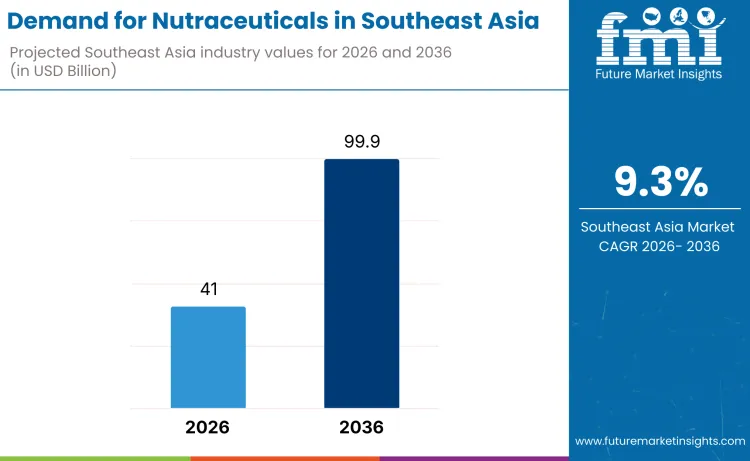
Macro-level food and health consumption patterns influencing nutraceuticals sales in Southeast Asia
Across Southeast Asia, food and wellness portfolios are being reshaped by daily preventive routines, rising demand for immune-support positioning, and stronger acceptance of functional formats that sit between food and healthcare. Immunity-led line extensions are expanding beyond seasonal peaks, becoming year-round offerings with higher repeat rates.
Digestive health and metabolic positioning are also gaining stronger visibility as brands target long-cycle usage programs. Retail dynamics continue to shift toward pharmacy trust-led conversion, supported by modern trade merchandising for functional foods and online discovery for supplements.
Beauty-from-within ranges are expanding where premium personal care overlaps with ingestible wellness, particularly in urban centers with higher discretionary spending. These shifts favor producers that can support compliant claims, consistent sensory performance in functional foods and beverages, and reliable supply continuity for region-wide distribution.
Nutraceuticals Industry in Southeast Asia Key Takeaways
| Metric | Value |
|---|---|
| Industry Value (2026) | USD 41.0 billion |
| Industry Forecast Value (2036) | USD 99.9 billion |
| Forecast CAGR (2026 to 2036) | 9.3% |
Source: Future Market Insights’ proprietary forecasting model and primary research
FMI thinks long-term category planning in Southeast Asia increasingly aligns product pipelines, channel strategy, and prevention-led positioning across major countries, trends which closely align with the global nutraceuticals industry.
Why is Southeast Asia Building Strong Demand for Nutraceuticals?
Southeast Asia’s growth trajectory is supported by expanding middle-income consumption, stronger health management behavior, and retailer confidence in wellness categories that can generate stable repeat purchase patterns. Pharmacy-led conversion remains central because it offers a high-trust environment for consumers, while direct-selling organizations continue to push structured subscription-style buying through community-led acquisition.
As per FMI, a key demand catalyst is the widening of functional food consumption, where everyday formats can carry health positioning without requiring a major behavior change. This creates a high-volume base that supports scale economics, then supplements and clinical nutrition products capture higher-value requirements tied to specific health goals.
Brand owners also increasingly treat product renovation as a regional playbook, where top-performing formulations are quickly replicated across multiple countries with localized claim language and channel mix. The shift toward more specialized product stacks is also raising the importance of ingredient governance, which is closely connected with how companies evaluate inputs and formulation feasibility using references such as nutraceutical ingredients.
How is Nutraceuticals Demand Segmented by Product Type, Application, and Sales Channel?
Southeast Asia’s nutraceuticals landscape reflects a blend of high-volume functional formats and targeted health solutions that compete on credibility, distribution reach, and repeat compliance.
Why does functional food remain the dominant product type?
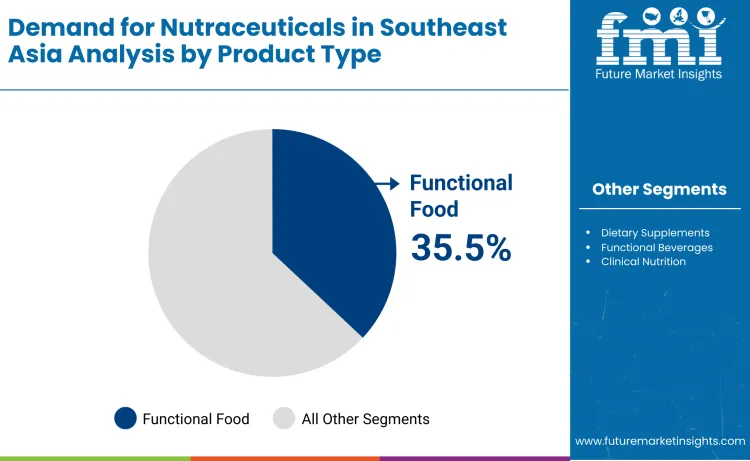
Functional food holds a 35.5% share, supported by its ability to scale through daily eating and drinking occasions. This segment benefits from broader mass acceptance, easier sampling, and stronger placement across modern trade, while still carrying enough wellness identity to justify premium pricing.
How do dietary supplements and clinical nutrition compete for value growth?
Dietary supplements expand through targeted need states such as immunity, digestive health, and healthy aging, while clinical nutrition remains more structured around medically adjacent usage and higher trust requirements. These segments tend to benefit from pharmacy conversion and professional influence, especially where brand equity is already established.
Why does immunity lead application demand in Southeast Asia?
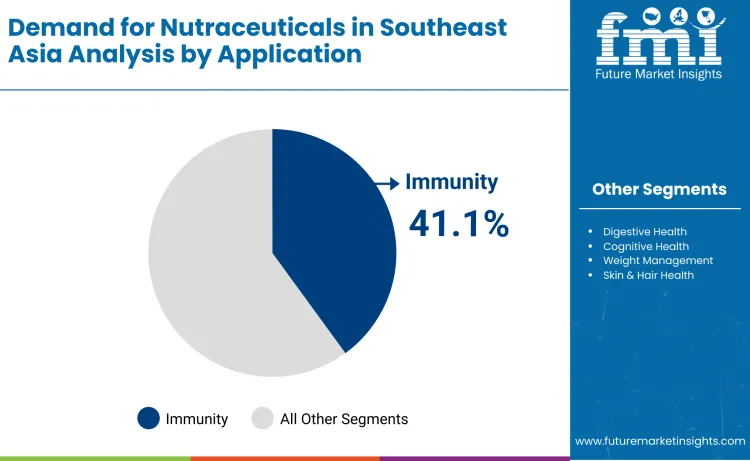
Immunity accounts for a 41.1% share, reflecting sustained consumer focus on preventive routines and everyday resilience. FMI is of the opinion that immunity programs will remain the primary demand engine because they allow brands to maintain year-round consumption cycles and repeated replenishment.
How is the sales channel mix shaping distribution economics?
Pharmacies and drugstores contribute a 40.0% share, keeping them as the most influential channel for trust-led conversion. Supermarkets and hypermarkets support functional food throughput, online retail improves discovery and niche targeting, and direct selling maintains consistent volumes through structured customer relationships.
What are the Dynamics, Restraints, Opportunities, and Threats Shaping this Space?
What Dynamics are Supporting Sustained Expansion across Countries?
Scale-building is supported by a stronger pipeline of immunity-led launches, wider adoption of functional foods, and increasing consumer comfort with structured wellness routines. FMI thinks channel partners are also becoming more proactive in merchandising wellness categories, which improves visibility and basket integration.
What restraints slow faster adoption in selected segments?
Regulatory scrutiny on claims, product registration timelines, and compliance documentation can slow rollout speed, especially for newer health positioning. Supply inconsistency in critical inputs can also create service risk in multi-country distribution programs.
Where are the Strongest Opportunities for Manufacturers and Brand Owners?
Beauty-from-within and metabolic positioning are gaining momentum in premium urban clusters, while healthy aging is expanding as companies target long-term daily usage habits. Companies with strong production scalability and portfolio discipline will win shelf space as retailers consolidate assortments and prioritize higher velocity products. Packaging credibility also plays a role in consumer conversion, which is aligned with expectations reflected in nutraceutical packaging.
What threats can disrupt competitive stability?
Competitive pressure is intensifying across online channels where pricing transparency is high and imitation is fast. Counterfeit risk and inconsistent product standards can also weaken consumer confidence if governance and enforcement vary across countries.
How is Nutraceuticals Demand Evolving across Key Countries in Southeast Asia?
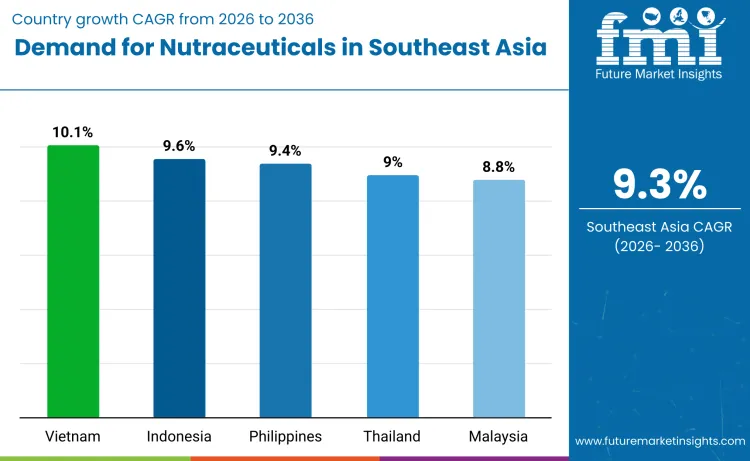
| Country | CAGR (2026-2036) |
|---|---|
| Indonesia | 9.6% |
| Vietnam | 10.1% |
| Thailand | 9.0% |
| Philippines | 9.4% |
| Malaysia | 8.8% |
Source: FMI analysis based on primary research and proprietary forecasting model
Why is Vietnam Emerging as the Fastest-Growing Consumption Hub in Southeast Asia?
Vietnam records the highest expansion pace at 10.1%, supported by stronger penetration of prevention-led buying behavior across urban consumers and a widening retail footprint for supplements and functional foods. Immunity programs and digestive health solutions are among the most visible demand anchors, as brand owners focus on repeat purchase discipline rather than one-time trial.
Pharmacies, modern trade, and online retail together create an effective channel mix for consumer acquisition, which allows premium lines to scale beyond niche audiences. Vietnam also benefits from faster portfolio refresh cycles, as companies push new variants and packaging formats more frequently to maintain shelf momentum.
How does Indonesia Sustain Scale While Expanding Product Accessibility?
Indonesia advances at 9.6%, acting as the scale backbone for Southeast Asia due to its large consumer base and widening distribution reach across pharmacies and modern retail. Functional food programs that fit everyday routines, while supplement stacks rise where consumers seek targeted outcomes such as immunity, metabolic balance, and healthy aging support volume strength.
Direct selling remains strategically important in Indonesia, not only for volume stability but also for structured conversion programs that sustain repeat purchase and support higher basket sizes. As per FMI, companies that can maintain pricing discipline while ensuring supply continuity are better positioned to defend share across both metro and secondary cities.
What Keeps Thailand’s Demand Expansion Stable despite a Slightly Lower Growth Rate?
Thailand progresses at 9.0%, reflecting a more mature wellness environment where product differentiation depends on trust cues, formulation credibility, and channel execution rather than rapid category novelty. Premium functional beverages and beauty-from-within positioning perform well in urban retail, while pharmacies maintain a strong role in supplement conversion.
Thailand also shows clear demand pockets for weight management and skin-health solutions, particularly where brands invest in consistent merchandising and repeat consumption formats. Steady growth is supported by stronger brand discipline and more controlled portfolio expansion, which helps avoid dilution across too many SKUs.
Why is the Philippines Showing Strong Momentum across Mixed Channel Formats?
The Philippines grows at 9.4%, supported by a diversified route-to-consumer environment where online retail, pharmacies, and direct selling each contribute meaningful volume. As per FMI, immunity remains the primary conversion driver, while cognitive health and digestive positioning are building stronger visibility in premium segments.
Online channel expansion supports discovery-led conversion, particularly for targeted supplements and beauty-from-within stacks that benefit from influencer-driven consumer education. FMI thinks players that combine digital acquisition with trusted offline availability are better placed to scale demand beyond early adopters.
How does Malaysia Maintain Progress through Premium Positioning and Compliance Discipline?
Malaysia advances at an 8.8% CAGR, reflecting steady expansion where product governance, claim discipline, and premium positioning shape the category structure. As per FMI, pharmacies and modern trade remain important for trust-led conversion, while specialty stores build visibility for higher-value wellness lines.
Skin and hair health programs and healthy aging stacks show stronger traction where consumers are willing to sustain daily routines and pay for differentiated positioning. Malaysia’s performance rewards suppliers and brand owners that can demonstrate quality consistency, documentation readiness, and stable inventory planning, particularly for higher-spec formulations.
What Defines the Competitive Landscape for Nutraceuticals in Southeast Asia?
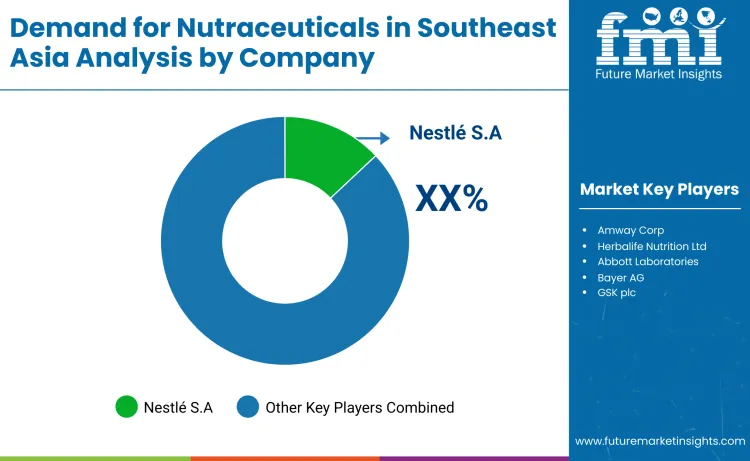
Competition is shaped by portfolio breadth, compliance readiness, channel strength, and repeat purchase economics. Large multinationals compete through strong trust signals, deep distribution coverage, and established clinical-adjacent ranges, while direct-selling leaders sustain volume through structured consumer programs and relationship-driven conversion.
Nestlé S.A., Abbott Laboratories, Amway Corp (Nutrilite), Herbalife Nutrition Ltd., and GlaxoSmithKline plc remain prominent across the region due to brand credibility and distribution access. Ingredient-focused players and beverage-led groups also contribute to competitive depth, especially where functional foods and beverages become strategic volume drivers. FMI is of the opinion that the next phase of advantage will be driven by tighter claim discipline, faster commercialization cycles, and supply reliability that can support multi-country rollout without quality deviation.
Key Industry Participants
- Nestlé S.A.
- Abbott Laboratories
- Amway Corp (Nutrilite)
- Herbalife Nutrition Ltd.
- GlaxoSmithKline plc
- Glanbia Nutritionals
- Otsuka Holdings Co., Ltd.
- Pfizer Inc.
- Suntory Holdings Ltd.
- CTC Group Indonesia
Scope of Report
| Items | Values |
|---|---|
| Quantitative Units | USD Billion |
| Product Type | Functional Food; Dietary Supplements; Functional Beverages; Clinical Nutrition; Beauty-from-Within |
| Application | Immunity; Digestive Health; Cognitive Health; Weight Management; Skin and Hair Health; Metabolic Disorders; Cardiac Health; Healthy Aging |
| Sales Channel | Pharmacies and Drugstores; Supermarkets/Hypermarkets; Online Retail; Specialty Stores; Direct Selling |
| Countries Covered | Indonesia; Vietnam; Thailand; Philippines; Malaysia |
| Key Companies Profiled | Nestlé S.A.; Abbott Laboratories; Amway Corp (Nutrilite); Herbalife Nutrition Ltd.; GlaxoSmithKline plc |
Nutraceuticals Demand in Southeast Asia by Segments
By Product Type
- Functional Food
- Dietary Supplements
- Functional Beverages
- Clinical Nutrition
- Beauty-from-Within
By Application
- Immunity
- Digestive Health
- Cognitive Health
- Weight Management
- Skin and Hair Health
- Metabolic Disorders
- Cardiac Health
- Healthy Aging
By Sales Channel
- Pharmacies and Drugstores
- Supermarkets/Hypermarkets
- Online Retail
- Specialty Stores
- Direct Selling
By Country
- Indonesia
- Vietnam
- Thailand
- Philippines
- Malaysia
Bibliography
- Codex Alimentarius Commission. (2013). Guidelines for use of nutrition and health claims (CXG 23-1997). FAO/WHO Codex Alimentarius.
- Codex Alimentarius Commission. (2018). General standard for the labelling of prepackaged foods (CXS 1-1985, latest revision). FAO/WHO Codex Alimentarius.
- International Organization for Standardization. (2018). ISO 22000:2018-Food safety management systems-Requirements for any organization in the food chain. ISO.
- Association of Southeast Asian Nations (ASEAN). (n.d.). ASEAN guidelines and publications on health supplements and good manufacturing practice. ASEAN Secretariat.
- Indonesian Food and Drug Authority (BPOM). (2022). Regulation of the Indonesian Food and Drug Authority on criteria and procedures for health supplement registration (Regulation No. 32/2022). BPOM.
- Vietnam Ministry of Health. (2023). Circular 29/2023 on nutritional labeling for pre-packaged foods (effective from January 1, 2026). Ministry of Health, Vietnam.
- Singapore Health Sciences Authority (HSA). (2025). Guidelines for manufacturing standards of health supplements and traditional medicines. Health Sciences Authority.
Frequently Asked Questions
What is the outlook for nutraceuticals demand in Southeast Asia for 2026?
In 2026, nutraceuticals demand in Southeast Asia is likely to total USD 41.0 billion.
What is the expected valuation for nutraceuticals demand in Southeast Asia for 2036?
Nutraceuticals demand in Southeast Asia is forecasted to reach USD 99.9 billion by 2036.
At what rate will nutraceuticals demand expand in Southeast Asia from 2026 to 2036?
Nutraceuticals demand in Southeast Asia is expected to progress at a 9.3% CAGR from 2026 to 2036.
Which product type leads nutraceuticals consumption in Southeast Asia?
Functional food leads consumption in Southeast Asia, holding a 35.5% share.
Which application leads nutraceuticals consumption in Southeast Asia?
Immunity remains the leading application in Southeast Asia, accounting for 41.1% of total demand.
Which sales channel leads nutraceuticals sales in Southeast Asia?
Pharmacies and drugstores represent the leading sales channel in Southeast Asia, capturing a 40.0% share.
Preview the report firsthand - request a free sample
Get SampleGet the brochure for pricing and purchase details.
Get PDFTable of Content
- Executive Summary
- Industry Introduction, including Taxonomy and Market Definition
- Trends and Success Factors
- Macro-economic Factors
- Market Dynamics
- Recent Industry Developments
- Southeast Asia Demand Analysis 2021 to 2025 and Forecast 2026 to 2036
- Historical Analysis (2021-2025)
- Future Projections (2026-2036)
- Pricing Analysis
- Southeast Asia Market Analysis 2021 to 2025 and Forecast 2026 to 2036
- Product Type
- Application
- Sales Channel
- Country
- By Product Type
- Functional Food
- Dietary Supplements
- Functional Beverages
- Clinical Nutrition
- Beauty-from-Within
- By Application
- Immunity
- Digestive Health
- Cognitive Health
- Weight Management
- Skin and Hair Health
- Metabolic Disorders
- Cardiac Health
- Healthy Aging
- By Sales Channel
- Pharmacies and Drugstores
- Supermarkets/Hypermarkets
- Online Retail
- Specialty Stores
- Direct Selling
- By Country
- Indonesia
- Vietnam
- Thailand
- Philippines
- Malaysia
- Indonesia Sales Analysis 2021 to 2025 and Forecast 2026 to 2036
- By Key Segments
- Vietnam Sales Analysis 2021 to 2025 and Forecast 2026 to 2036
- By Key Segments
- Thailand Sales Analysis 2021 to 2025 and Forecast 2026 to 2036
- By Key Segments
- Philippines Sales Analysis 2021 to 2025 and Forecast 2026 to 2036
- By Key Segments
- Malaysia Sales Analysis 2021 to 2025 and Forecast 2026 to 2036
- By Key Segments
- Sales Forecast to 2036
- By Product Type
- By Application
- By Sales Channel
- By Country
- Competitive Assessment
- Company Share Analysis by Key Players
- Competition Dashboard
- Company Profile
- Nestlé S.A.
- Abbott Laboratories
- Amway Corp (Nutrilite)
- Herbalife Nutrition Ltd.
- GlaxoSmithKline plc
- Other Players


