

- Industry Size (2026)
- USD 2.4 Bn
- Forecast (2036)
- USD 5.5 Bn
- CAGR (2026 to 2036)
- 8.6%
Nutraceuticals Demand in Romania Forecast and Outlook 2026 to 2036
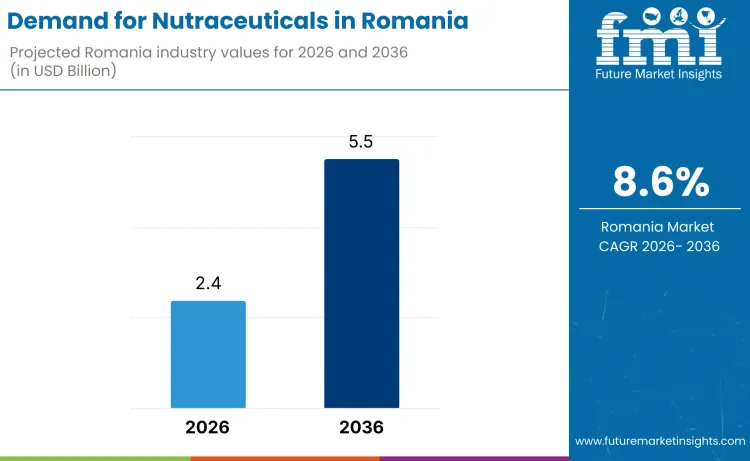
Nutraceuticals demand in Romania is projected to reach USD 2.4 billion in 2026, supported by rising consumer focus on everyday health routines and a steady shift toward prevention-led wellness spending. Growth is expected to progress at an 8.6% CAGR through 2036, lifting total category value to USD 5.5 billion by the end of the assessment period.
Romanian consumers are becoming more structured in how they build daily wellness stacks across immunity, digestion, weight management, and healthy aging. Routine usage is strengthening repeat purchase cycles, particularly in formats that are easy to consume consistently and simple to replenish through pharmacy chains, specialist stores, and online retail. Tablets and capsules remain the strongest form because they provide dosing predictability, stable storage performance, and better alignment with long-term regimen behavior.
Value growth is increasingly shaped by premiumization within core categories, especially where efficacy perception, ingredient sourcing, and brand trust influence purchasing. Clean and plant-forward positioning is strengthening across certain sub-categories, while taste-driven formats such as gummies are expanding among younger consumers and first-time users who prefer convenient and pleasant consumption experiences. Functional foods continue to lead by product type because they integrate into everyday eating behavior, lowering friction for repeat consumption and supporting household-level participation.
Product innovation is also shifting from generic formulas to more targeted outcomes. Immunity remains the strongest application driver because it is relevant across age groups and is frequently purchased for both individual and family use. Weight management and metabolic balance are gaining traction as routine priorities, while beauty-from-within and skin and hair health lines support premium add-on baskets in urban centers. Clinical nutrition is expanding gradually through higher awareness of protein-forward support and recovery-led consumption needs.
Quick Stats for Nutraceuticals Demand in Romania
- Nutraceuticals Demand Value (2026): USD 2.4 Billion
- Nutraceuticals Forecast Value (2036): USD 5.5 Billion
- Nutraceuticals Forecast CAGR (2026 to 2036): 8.6%
- Nutraceuticals Leading Product Type: Functional Food (45.0%)
- Nutraceuticals Leading Application: Immunity (50.0%)
- Nutraceuticals Leading Form: Tablets and Capsules (48.9%)
- Nutraceuticals Key Growth Regions: Bucharest Ilfov, North-West Cluj-led, West Timis-led, Center Brasov Sibiu corridor, North-East
- Nutraceuticals Key Players: Fiterman Pharma S.R.L., Alevia S.R.L., Dacia Plant, Fares, Herbagetica, PlantExtrakt, Secom Healthcare, Biofarm S.A., Prisum Healthcare SRL, Nestle Romania SRL
Food and Beverage Trends Likely to Influence Nutraceutical Demand in Romania
Health-led reformulation is expected to shape how nutraceutical brands position daily-use formats in Romania. As consumers become more label-aware, products that align with reduced sugar preferences and simplified ingredient expectations are likely to gain stronger shelf traction across pharmacies and modern retail. This trend supports stronger uptake of tablets and capsules for daily routines, while also improving the conversion rate for sugar-managed functional beverages and gummies.
Premiumization in functional foods is also reinforcing growth pathways for fortified everyday options, especially those tied to immunity and healthy aging. Romanian consumers increasingly prefer solutions that fit into breakfast, snacking, and routine beverage habits without adding complexity. This strengthens functional food leadership and expands opportunities for product platforms built around repeatable nutrition habits rather than seasonal spending.
Three impacts are expected to be most visible. First, functional beverages will gain more traction when they deliver clear benefits with disciplined sugar positioning. Second, household-level functional foods will remain strong when they fit routine consumption occasions. Third, premium supplements will continue expanding where brand trust and consistency influence repeat purchasing over extended cycles.
Nutraceuticals Demand in Romania Key Takeaways
| Metric | Value |
|---|---|
| Category Size (2026) | USD 2.4 Billion |
| Category Value (2036) | USD 5.5 Billion |
| CAGR (2026 to 2036) | 8.6% |
Source: Future Market Insights analysis, based on proprietary forecasting model and primary research.
What Drivers Are Accelerating Preventive Health Spending in Romania?
Preventive health behavior is becoming a core demand engine in Romania because consumers increasingly treat wellness routines as part of everyday life management. Rising health awareness, stronger pharmacy-led credibility, and wider access to targeted products are strengthening repeat purchase cycles across immunity, digestive support, weight management, and healthy aging. Romania is also aligning with broader category expansion patterns seen globally in prevention-led nutrition and repeat consumer behavior.
Functional foods are expanding because they reduce friction in daily intake by embedding wellness benefits into familiar consumption habits. Romanian buyers are more likely to adopt everyday fortified options when they fit regular meals and do not require additional routine planning. Everyday-format nutrition scales fastest where it blends into normal eating patterns without adding regimen complexity.
Online replenishment models, targeted bundles, and increasing consumer comfort with multi-product stacks also strengthen channel momentum. Buyers are combining immunity-led products with digestion or beauty add-ons to improve perceived outcome coverage, which raises basket value and improves repeat purchasing. This stacking behavior is reinforcing supplement-driven conversion pathways reinforcing supplement-driven conversion pathways across modern retail baskets.
How is the Nutraceuticals Landscape in Romania Segmented?
Romania demand is structured by product type, application focus, and form preference. The segmentation framework matters because buying decisions differ based on whether a product fits into daily meals, supports a preventive stack, or targets an outcome-led routine such as weight management or skin health.
Why does Functional Food Maintain Leadership by Product Type?
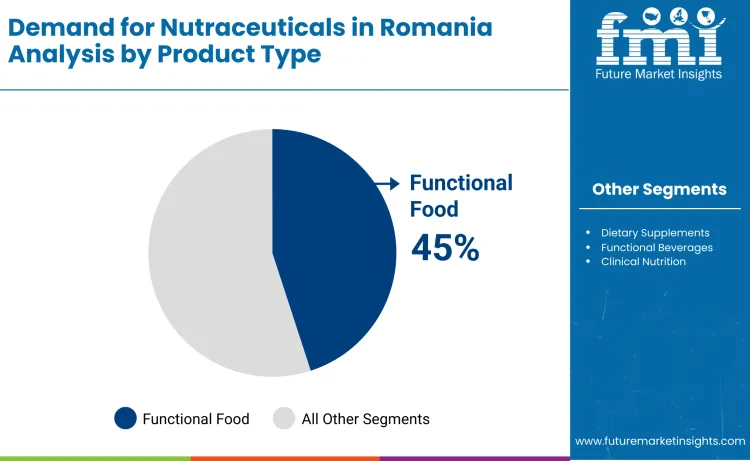
Functional food holds a 45.0% share because it integrates into routine eating behavior and enables consistent usage without relying on strict supplement schedules. Fortified everyday options support repeat consumption across households and help brands scale through wider accessibility in modern retail and pharmacy-adjacent channels.
Why does Immunity Lead Applications in Romania?
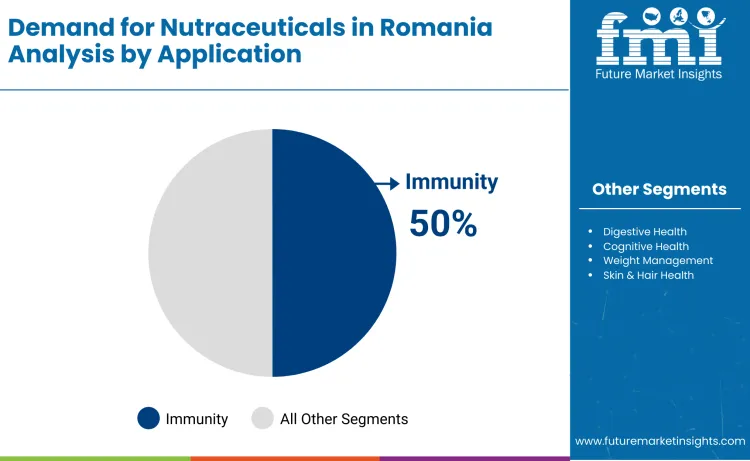
Immunity leads with a 50.0% share because it remains universally relevant and is often purchased for both individual and family use. It also acts as an entry category that enables cross-selling into digestion, healthy aging, and skin support stacks, raising basket size and improving retention.
How will Product Formats Evolve Through 2036?
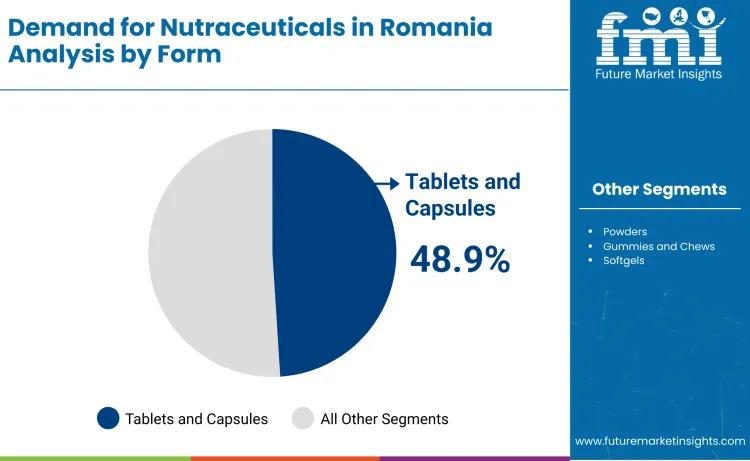
Tablets and capsules remain the leading form at 48.9% due to dosing stability, portability, and easier long-term adherence. This dominance is expected to continue because Romania buyers prioritize predictable intake routines for immunity and healthy aging categories where regimen continuity directly influences repurchase rates.
Powders are expected to expand in performance-led and flexibility-driven routines, particularly where consumers prefer adjustable dosage. Gummies and chews will strengthen further in lifestyle and beauty-from-within categories where taste and convenience increase compliance. Liquids and shots will remain relevant for fast-consumption preferences, especially in weight management and functional beverage adjacencies.
As more brands push for simplified composition and clearer label narratives, formulation discipline is likely to become a more visible success factor. Supporting ingredient choices that preserve stability while maintaining label simplicity are becoming more important for product differentiation.
How Will Regional Consumption Patterns Evolve Across Romania?
Romania shows differentiated growth intensity across key regions based on income concentration, pharmacy access, retail modernization, and wellness adoption maturity. Bucharest Ilfov leads expansion due to premiumization and stronger demand for targeted stacks.
North-West and West regions maintain strong momentum due to urban growth corridors and higher purchasing confidence in wellness categories. The Center corridor continues expanding through steady household consumption patterns and pharmacy penetration, while North-East grows through value-led routines anchored in immunity and digestion needs.
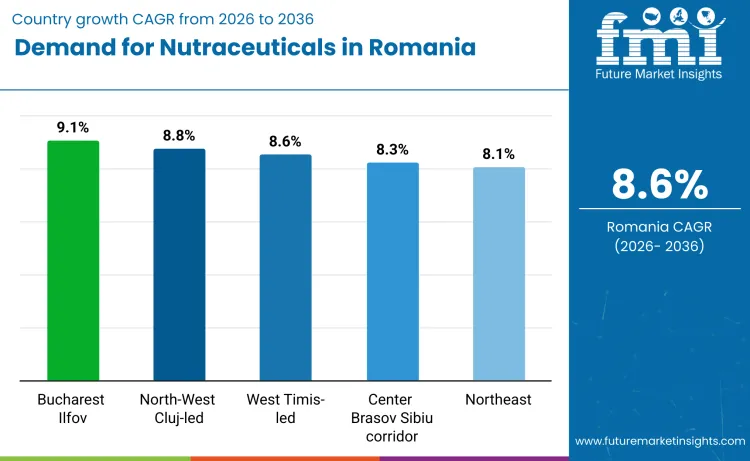
| Region | CAGR (2026 to 2036) |
|---|---|
| Bucharest Ilfov | 9.1% |
| North-West Cluj-led | 8.8% |
| West Timis-led | 8.6% |
| Center Brasov Sibiu corridor | 8.3% |
| Northeast | 8.1% |
Source: Future Market Insights - analysis driven by proprietary forecasting models and primary research
Why does Bucharest Ilfov Lead Nutraceuticals Demand Growth?
Bucharest Ilfov is expected to record the fastest expansion at a 9.1% CAGR because it concentrates premium retail availability, higher disposable income households, and stronger adoption of outcome-focused wellness routines.
Consumers are more likely to purchase targeted stacks for immunity, cognitive support, weight management, and healthy aging, which strengthens multi-product basket behavior. Tablets and capsules dominate because they align with structured daily intake and subscription-friendly replenishment cycles through pharmacies and online retail.
How is North-West Cluj-led Strengthening Repeat Purchase Behavior?
North-West Cluj-led is projected to expand at an 8.8% CAGR, supported by a growing urban consumer base and strong conversion for routine preventive spending. Demand is anchored by functional food and daily supplement formats tied to immunity and digestive health, where repurchase is driven by habit formation and affordability-balanced value. Gummies and chews are gaining traction among lifestyle-led consumers, particularly in beauty-from-within and skin and hair health segments where compliance drives volume growth.
What Makes West Timis-led a Stable Expansion Zone Through 2036?
West Timis-led is forecast to grow at an 8.6% CAGR because consumers increasingly prioritize practical wellness outcomes that fit daily life without complex routines. The region shows consistent uptake of tablets and capsules for immunity and healthy aging, while powders expand through performance-led consumption preferences. Retail accessibility supports steady replenishment behavior, keeping demand resilient even when discretionary spending cycles tighten.
Why is Center Brasov Sibiu Corridor developing into a Balanced Consumption Cluster?
The Center Brasov Sibiu corridor is expected to grow at an 8.3% CAGR, supported by steady household purchasing and broader acceptance of preventive nutrition routines. Immunity and weight management demand are expanding, while beauty and cognitive support categories rise through premium add-on purchases in urban pockets. Form preferences remain strongly anchored in tablets and capsules, reflecting trust in consistent dosage formats and repeatable purchasing behavior.
How will Northeast Romania Sustain Growth despite Value-Led Consumption Patterns?
Northeast Romaina is projected to expand at an 8.1% CAGR, driven by consistent demand for everyday wellness formats and practical health priorities. Immunity and digestive health remain the strongest anchors, supported by tablets and capsules that offer affordability, dosing predictability, and easy compliance. As retail access and online purchase comfort expand, multi-SKU baskets are expected to grow gradually through add-on categories such as skin support and healthy aging.
What Is the Competitive Outlook for Nutraceuticals Demand in Romania?
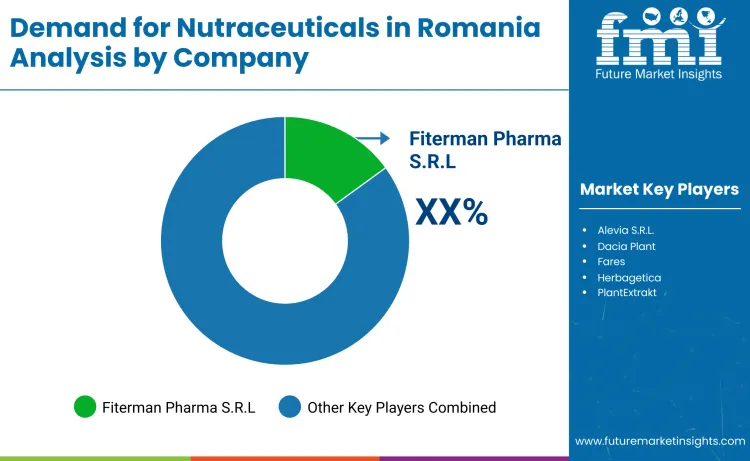
Competition in Romania is increasingly shaped by trust, regimen retention, and portfolio discipline rather than short-term novelty launches. Brands that win tend to deliver consistent quality, reliable dosing formats, and clear benefit positioning, which supports repeat purchasing across immunity, digestion, and healthy aging categories.
Product strategies are shifting toward multi-SKU systems where consumers can build structured stacks, improving retention and increasing basket value. Immunity formats often function as an entry point, followed by digestion or beauty add-ons that strengthen long-term regimen behavior.
Retail presence remains a key differentiator. Companies that balance pharmacy visibility with online replenishment capabilities are better positioned to capture steady expansion through 2036. Domestic producers benefit from brand familiarity and distribution depth, while multinational portfolios add competitive pressure through scale, structured innovation pipelines, and broader consumer touchpoints.
Key Players in Nutraceuticals Demand in Romania
- Fiterman Pharma S.R.L.
- Alevia S.R.L.
- Dacia Plant
- Fares
- Herbagetica
- PlantExtrakt
- Secom Healthcare
- Biofarm S.A.
- Prisum Healthcare SRL
- Nestle Romania SRL
Scope of Report
| Items | Values |
|---|---|
| Quantitative Units | USD Billion |
| Product Type | Functional Food, Dietary Supplements, Functional Beverages, Clinical Nutrition |
| Application | Immunity, Digestive Health, Cognitive Health, Weight Management, Beauty-from-Within, Skin and Hair Health, Metabolic Disorders, Cardiac Health, Healthy Aging |
| Form | Tablets and Capsules, Powders, Gummies and Chews, Liquids and Shots, Softgels |
| Regions | Bucharest Ilfov, North-West Cluj-led, West Timis-led, Center Brasov Sibiu corridor, North-East |
Nutraceuticals Demand in Romania by Segments
Product Type:
- Functional Food
- Dietary Supplements
- Functional Beverages
- Clinical Nutrition
Application:
- Immunity
- Digestive Health
- Cognitive Health
- Weight Management
- Beauty-from-Within
- Skin and Hair Health
- Metabolic Disorders
- Cardiac Health
- Healthy Aging
Form:
- Tablets and Capsules
- Powders
- Gummies and Chews
- Liquids and Shots
- Softgels
Region:
- Bucharest-Ilfov
- North-West (Cluj-led)
- West (Timiș-led)
- Center (Brașov-Sibiu corridor)
- Northeast
Bibliography
- European Commission. (2002). Directive 2002/46/EC of the European Parliament and of the Council of 10 June 2002 on the approximation of the laws of the Member States relating to food supplements. Official Journal of the European Union.
- European Commission. (2006). Regulation (EC) No 1924/2006 of the European Parliament and of the Council of 20 December 2006 on nutrition and health claims made on foods. Official Journal of the European Union.
- European Commission, Directorate-General for Health and Food Safety. (n.d.). Food supplements. European Commission.
- European Commission, Directorate-General for Health and Food Safety. (n.d.). Nutrition and health claims. European Commission.
- Parliament of Romania. (2024). Law no. 205/2024 establishing the legal framework regarding food supplements. Official Gazette of Romania.
- European Food Safety Authority. (2023). Food supplements and health claims: Scientific and regulatory resources. EFSA.
Frequently Asked Questions
How large is nutraceuticals demand in Romania expected to be in 2026?
Nutraceuticals demand in Romania is estimated to be valued at USD 2.4 billion in 2026.
What will be the total category value in Romania by 2036?
Total category value is projected to reach USD 5.5 billion by 2036.
What is the expected growth rate for nutraceuticals demand in Romania between 2026 and 2036?
Nutraceuticals demand in Romania is expected to grow at a CAGR of 8.6% between 2026 and 2036.
Which product type is poised to lead sales by 2026?
Functional food is expected to lead sales, capturing approximately 45.0% share due to strong integration into daily consumption routines.
Which form is expected to hold the strongest share in Romania through 2036?
Tablets and capsules are expected to remain the leading form, accounting for approximately 48.9% share due to dosing stability and higher regimen retention.
Preview the report firsthand - request a free sample
Get SampleGet the brochure for pricing and purchase details.
Get PDFTable of Content
- Executive Summary
- Industry Introduction, including Taxonomy and Market Definition
- Trends and Success Factors, including Macro-economic Factors, Market Dynamics, and Recent Industry Developments
- Romania Demand Analysis 2021 to 2025 and Forecast 2026 to 2036, including Historical Analysis and Future Projections
- Pricing Analysis
- Romania Analysis 2021 to 2025 and Forecast 2026 to 2036
- Product Type
- Application
- Form
- Region
- By Product Type
- Functional Food
- Dietary Supplements
- Functional Beverages
- Clinical Nutrition
- By Application
- Immunity
- Digestive Health
- Cognitive Health
- Weight Management
- Beauty-from-Within
- Skin and Hair Health
- Metabolic Disorders
- Cardiac Health
- Healthy Aging
- By Form
- Tablets and Capsules
- Powders
- Gummies and Chews
- Liquids and Shots
- Softgels
- 1By Region
- Bucharest-Ilfov
- North-West (Cluj-led)
- West (Timiș-led)
- Center (Brașov-Sibiu corridor)
- Northeast
- Bucharest-Ilfov Sales Analysis 2021 to 2025 and Forecast 2026 to 2036, by Key Segments
- North-West (Cluj-led) Sales Analysis 2021 to 2025 and Forecast 2026 to 2036, by Key Segments
- West (Timiș-led) Sales Analysis 2021 to 2025 and Forecast 2026 to 2036, by Key Segments
- Center (Brașov-Sibiu corridor) Sales Analysis 2021 to 2025 and Forecast 2026 to 2036, by Key Segments
- North-East Sales Analysis 2021 to 2025 and Forecast 2026 to 2036, by Key Segments
- Sales Forecast to 2036 by Product Type, Application, Form, and Region
- Competitive Assessment, Company Share Analysis by Key Players, and Competition Dashboard
- Company Profile
- Fiterman Pharma S.R.L.
- Alevia S.R.L.
- Dacia Plant
- FaresHerbagetica
- PlantExtrakt
- Secom Healthcare
- Biofarm S.A.
- Prisum Healthcare SRL
- Nestle Romania SRL
- Other Players


