

- Industry Size (2025)
- USD 168.3 Mn
- Forecast (2035)
- USD 316.1 Mn
- CAGR (2025 to 2035)
- 6.5%
Spherical Silica Market Forecast and Outlook 2025 to 2035
In 2025, the spherical silica market is valued at USD 168.3 million and is projected to reach USD 316.1 million by 2035 at a CAGR of 6.5%. Consumer demand shifts shape early growth through rising use in cosmetics, personal care powders, and precision electronics where surface smoothness and flow control are critical. Beauty brands increase reliance on spherical silica for soft focus effects, oil absorption, and matte finishes in face powders and primers. Electronics demand is tied to polishing slurries and thermal interface materials for compact devices. Pricing through 2030 follows a gradual upward path driven by purity requirements, energy input costs, and yield sensitivity in sol gel production routes.
After 2030, pricing and distribution patterns become more structurally defined. Market value rises from about USD 236.0 million in 2030 toward USD 316.1 million by 2035 as higher grades gain volume in semiconductors, coatings, and advanced composites. Contract pricing replaces spot purchasing across cosmetic and electronics supply chains to secure consistency of particle size and surface area. Distribution shifts toward direct manufacturer to formulator supply for high grade material, while distributors retain a role in standard cosmetic grades. Regional warehousing grows to reduce lead times for electronics customers. Long-term demand strength is shaped by tighter formulation tolerances, device miniaturization, and premium cosmetic performance standards rather than broad commodity volume expansion.
Quick Stats of the Spherical Silica Market
- Spherical Silica Market Value (2025): USD 168.3 million
- Spherical Silica Market Forecast Value (2035): USD 316.1 million
- Spherical Silica Market Forecast CAGR (2025–2035): 6.5%
- Leading Product Form in Spherical Silica Market: Powder (17.0%)
- Key Growth Regions in Spherical Silica Market: Asia Pacific, Europe
- Top Players in Spherical Silica Market: BASF SE, Croda International, Evonik Industries, Symrise (incl. IFF/Givaudan actives), Dow / Dow Inc., Ashland, Clariant, Seppic
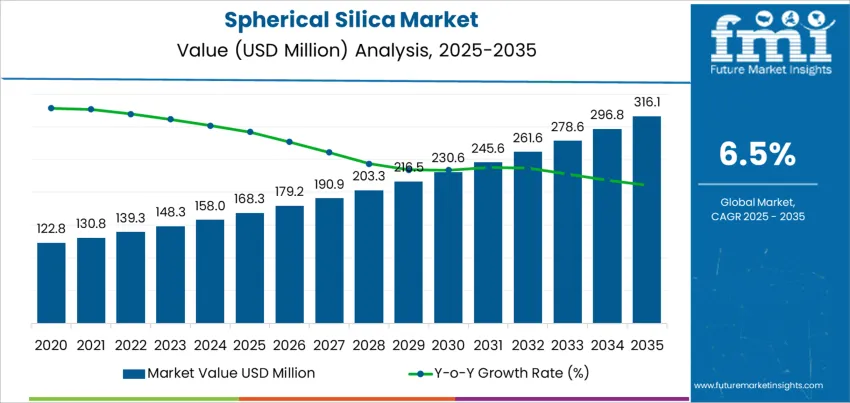
What is the Growth Forecast for the Spherical Silica Market through 2035?
The global spherical silica market expands from USD 168.3 million in 2025 to USD 227.0 million by 2030, generating an absolute increase of USD 58.7 million in the first half of the forecast period. This phase is shaped by strong impulse demand from electronics packaging, semiconductor encapsulation, thermal interface materials, and high-performance coatings where particle uniformity and flow control are technically critical. Impulse buying is primarily triggered by short-cycle capacity additions in chip packaging and rapid qualification of new filler systems in encapsulants and mold compounds. Pricing during this phase remains stratified, with industrial-grade material occupying the lower band and high-purity, narrow-size-distribution spherical silica commanding substantially higher premiums. Growth remains application-led rather than volume commoditized.
From 2030 to 2035, the market accelerates from USD 227.0 million to USD 316.1 million, adding USD 89.1 million in the second half of the decade. This back-weighted expansion reflects sharper impulse demand linked to advanced semiconductor nodes, electric vehicle power electronics, and high-density substrate packaging where thermal conductivity and dielectric control intensify filler usage per unit. Pricing ranges widen further as ultra-high-purity grades for electronics and optical applications lift average realizations. Growth outlook in this phase is structurally strong, driven by sustained miniaturization, rising heat management requirements, and tighter performance tolerances that favor spherical silica over conventional irregular fillers, materially strengthening long-term market value.
Spherical Silica Industry Key Takeaways
| Metric | Value |
|---|---|
| Industry Value (2025) | USD 168.3 million |
| Forecast Value (2035) | USD 316.1 million |
| Forecast CAGR (2025–2035) | 6.5% |
How Is the Spherical Silica Market Developing Across Electronics, Coatings, and Precision Material Applications?
The spherical silica market developed from the need for highly uniform, mechanically stable particles that behave predictably under heat, pressure, and electrical stress. Early demand came from electronics manufacturing, where spherical silica is used as a filler in semiconductor encapsulants to control thermal expansion, improve insulation, and protect delicate circuits during high temperature operations. Its perfectly rounded geometry reduced resin viscosity and enabled higher filler loading without flow defects. Outside electronics, coatings, inks, and specialty plastics adopted spherical silica to improve abrasion resistance, surface smoothness, and optical consistency. Unlike irregular ground silica, spherical grades allowed tight control over rheology and dispersion, which made them essential in precision driven manufacturing environments rather than commodity filler markets.
Future growth of the spherical silica market will be shaped by chip miniaturization, advanced packaging technologies, and rising demand for high reliability electronic components. As semiconductor devices become smaller and thermal loads increase, filler materials that offer consistent particle size and low stress behavior will gain further relevance. Expansion is also expected in lithium battery separators, high performance coatings, and additive manufacturing powders where flowability and packing density are critical. Barriers include energy intensive production processes, high purity requirements that limit supplier entry, and cost sensitivity in non electronic applications. Environmental pressure on mining and high temperature processing will also influence supply economics. Long term expansion will depend on how effectively producers scale ultra fine spherical grades while controlling cost and impurity risk.
How Are End Use Application and Product Form Structuring the Demand for Spherical Silica?
The demand for spherical silica is structured by end use application and product form. Skin care represents 9.3% of total demand, followed by body care, hair care, sun care, color cosmetics, men grooming, baby and kids care, and dermocosmetic and professional care. By product form, powder accounts for 17.0% of total consumption, followed by granules and agglomerates, flakes, pellets and prills, liquid solutions, high active concentrates, dispersions and suspensions, emulsions, pastes, gels, wax or solid block formats, and oils. Demand behavior is shaped by surface area control, oil adsorption efficiency, rheology modification capability, and compatibility with both water based and anhydrous formulation systems.
Why Does Skin Care Lead the Spherical Silica End Use Demand?
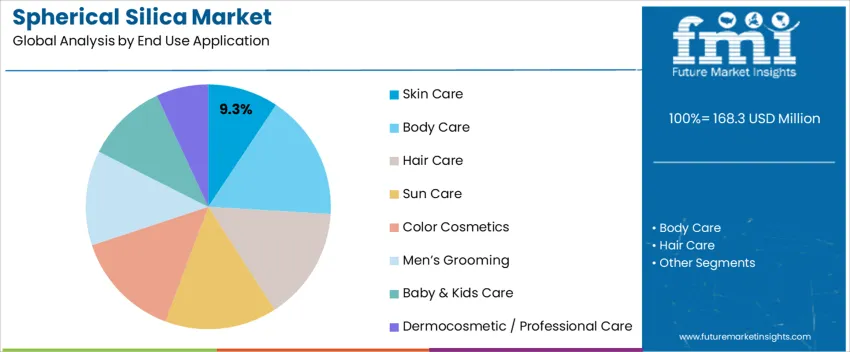
Skin care accounts for 9.3% of total spherical silica demand due to its dual function as a texture modifier and an oil control agent. Spherical silica particles absorb surface sebum while maintaining a smooth glide across the skin, which supports their use in mattifying creams, pore refining serums, daily moisturizers, and oil balance treatments. Their round morphology reduces abrasive feel compared with irregular mineral fillers, allowing repeated daily use without surface irritation.
Skin care formulators rely on spherical silica to control tackiness in high humectant systems and to stabilize sensory profiles in long wear products. It also improves dispersion of active ingredients by maintaining uniform microstructure within emulsions and gels. These oil management properties, sensorial optimization functions, and stability enhancement effects sustain skin care as the leading end use segment within the spherical silica market.
Why Does Powder Lead the Spherical Silica Product Form Demand?
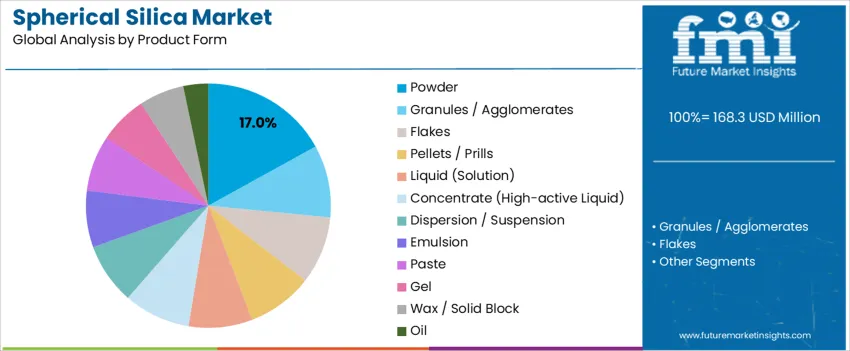
Powder accounts for 17.0% of total spherical silica demand due to its high surface activity, uniform particle geometry, and ease of functional control during formulation. Powdered spherical silica allows formulators to fine tune oil absorption, slip, and soft focus performance with low inclusion rates. This precision is essential in premium skin care and cosmetic products where texture consistency must be maintained across large production volumes.
Powder form also offers superior storage stability because spherical silica is chemically inert and non-hygroscopic under controlled conditions. It disperses evenly in both dry blending and wet phase processing without creating sedimentation issues encountered in liquid dispersions. Its compatibility with pressed powders, loose powders, emulsions, and hybrid systems broadens processing flexibility. These handling reliability, performance control, and structural stability advantages position powder as the leading product form within spherical silica demand.
Why Is Spherical Silica Treated as a Surface-Engineering Medium Rather Than a Basic Mineral Filler?
Spherical silica is valued because its geometry reshapes how surfaces behave under friction, pressure, and light. Unlike irregular mineral fillers, its uniform round structure reduces abrasion while maintaining spacing between contacting surfaces. In coatings, it fine-tunes slip and scratch resistance without thickening the film. In cosmetics, it alters tactile glide and optical diffusion without absorbing active ingredients. In electronic pastes, it controls dielectric spacing at micro-scale tolerances. Demand is therefore driven by its ability to engineer surface interaction with mathematical predictability rather than by its silica chemistry alone.
How Does Manufacturing Precision Define Its Market More Than Raw Material Availability?
The spherical silica market is governed by process control rather than by access to silicon dioxide. Particle size distribution, sphericity accuracy, and porosity directly determine whether the output behaves as a lubricant modifier, spacer, light diffuser, or reinforcement agent. Flame synthesis, sol-gel routes, and spray-drying each yield different internal structures and density profiles. Even slight deviation in roundness alters packing behavior and flow resistance. Buyers specify performance by microns, not by chemical grade. This shifts the market from mineral supply toward precision particle engineering.
Why Do Dust Control, Respiratory Standards, and Dispersion Failure Limit High-Volume Adoption?
Spherical silica introduces handling and safety constraints that quiet its expansion into very large-volume commodity products. Fine particle grades require dust suppression systems to meet respiratory exposure controls. Poor dispersion leads to particle clustering, which defeats optical and flow-control performance. In high-solids systems, it can destabilize viscosity if not properly surface-treated. These process dependencies increase rejection rates in mass manufacturing environments. As a result, spherical silica remains dominant where dispersion discipline and worker protection infrastructure already exist, rather than in low-control bulk production lines.
How Is Demand Migrating Toward Optical Control, Battery Interfaces, and Soft-Touch Systems?
Future demand for spherical silica is shifting toward three performance territories. In displays and coatings, it provides haze control and anti-glare effects without clouding transparency. In lithium battery systems, it manages electrode spacing and ionic flow stability under thermal stress. In soft-touch coatings and elastomers, it creates controlled surface drag without rubberization. These roles do not overlap with standard fillers or waxes. They reflect narrow performance gaps where only spherical geometry and inert surface chemistry solve the functional equation.
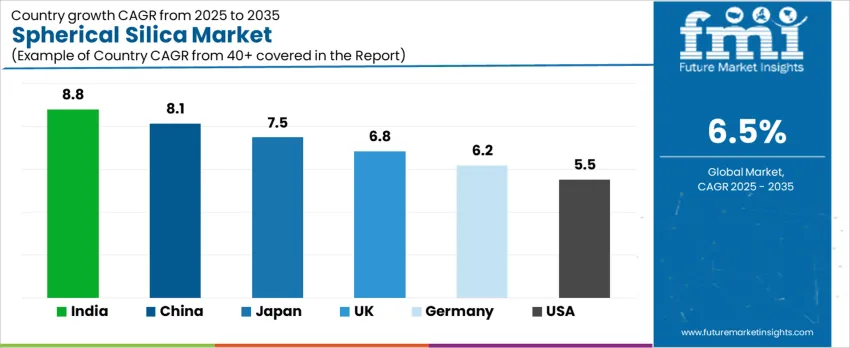
What Is the Global Growth Outlook for the Spherical Silica Industry by Country?
| Country | CAGR (%) |
|---|---|
| India | 8.7 |
| China | 8.1 |
| Japan | 7.5 |
| UK | 6.8 |
| Germany | 6.2 |
| USA | 5.5 |
The spherical silica industry is showing steady global expansion across advanced electronics, coatings, and specialty materials markets, with India at an 8.7% CAGR. Growth in India is supported by rising demand from electronics manufacturing, battery materials, and specialty coatings used in industrial and consumer applications. China follows at 8.1%, driven by large-scale semiconductor packaging, flat panel display production, and a strong domestic supply of advanced inorganic fillers. Japan at 7.5% reflects stable demand from precision electronics, automotive components, and high-performance coatings. The UK and Germany record 6.8% and 6.2% growth, supported by technical ceramics, industrial coatings, and advanced material research activity. The USA at 5.5% reflects a mature but steadily advancing market driven by semiconductor fabrication, specialty chemicals, and battery material applications.
What Is Driving Spherical Silica Demand Growth Across Electronics and Coatings in India?
Expansion in India is progressing at a CAGR of 8.7% through 2035 for spherical silica demand, driven by rising electronics assembly, paint and coating production, and composite material manufacturing. Surface treatment chemicals and encapsulation materials use spherical silica for flow control and thermal stability. The growth of domestic semiconductor packaging and LED manufacturing supports technical grade demand. Imports dominate high purity electronic grades, while mid grade material serves coatings and plastics. Demand remains application driven and industrially anchored, shaped by expanding electronics imports substitution, steady infrastructure coatings demand, and rising use of lightweight fillers in specialty polymers.
- Electronics packaging drives precision grade silica demand
- Paint and coatings sustain bulk industrial consumption
- Composite materials support lightweight filler usage
- Import dependence dominates high purity supply
How Is China Scaling Large Scale Spherical Silica Manufacturing?
Growth in China reflects a CAGR of 8.1% through 2035 for spherical silica utilization, supported by large scale semiconductor packaging, battery materials production, and advanced coatings manufacturing. Spherical silica is used in electronic encapsulants, lithium battery separators, and industrial surface coatings. Domestic silica processing plants ensure high volume output and cost control. Export oriented suppliers serve global electronics and material science companies. Demand remains production driven and volume oriented, aligned with battery supply chain expansion, semiconductor materials output, and continuous growth in advanced industrial coatings.
- Semiconductor packaging anchors electronic grade demand
- Battery materials support consistent technical usage
- Domestic processing stabilizes high volume supply
- Export shipments sustain large scale production economics
Why Does Japan Sustain High Specification Spherical Silica Demand?
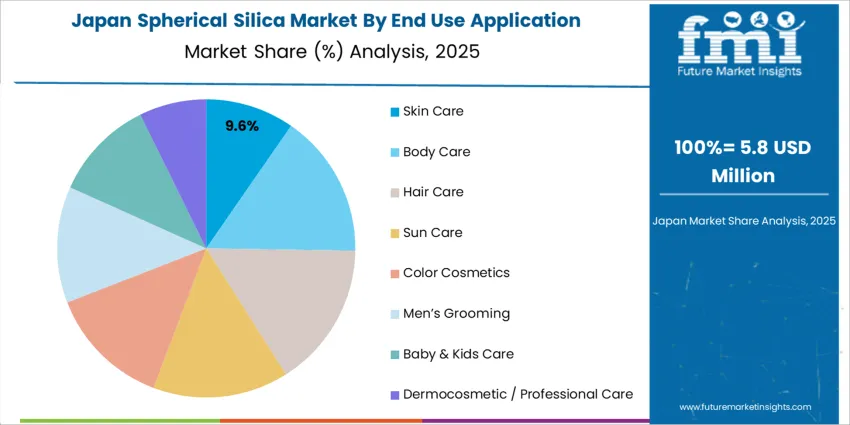
Demand in Japan is increasing at a CAGR of 7.5% through 2035 for spherical silica usage, supported by precision electronics, optical materials, and high performance coatings. Spherical silica is applied in semiconductor photoresists, chip encapsulation, and optical diffusion films. Ultra tight particle size tolerance drives preference for premium grades. Domestic suppliers focus on purity and dispersion stability. Demand stays quality driven and technology focused, supported by advanced semiconductor manufacturing, continuous optical device innovation, and strict performance standards across electronic and photonic materials production.
- Semiconductor photoresists drive ultra fine grade demand
- Optical diffusion films support electronics display usage
- Tight particle tolerance controls material qualification
- Domestic producers stabilize precision grade supply
What Is Supporting Spherical Silica Market Expansion in the United Kingdom?
Growth in the UK is advancing at a CAGR of 6.8% through 2035 for spherical silica demand, supported by specialty coatings, medical device materials, and electronics research applications. Spherical silica appears in matte coatings, biomedical polymers, and sensor substrates. Research laboratories and surface engineering firms drive steady technical consumption. Imports dominate high specification material sourcing. Demand remains research driven and formulation focused, shaped by stable public research funding, steady growth in specialty surface treatments, and controlled expansion of advanced polymer composites.
- Specialty surface coatings anchor industrial demand
- Medical polymers support regulated material usage
- Research laboratories sustain technical grade consumption
- Imported sourcing dominates precision supply
How Is Germany Integrating Spherical Silica into Advanced Manufacturing Systems?
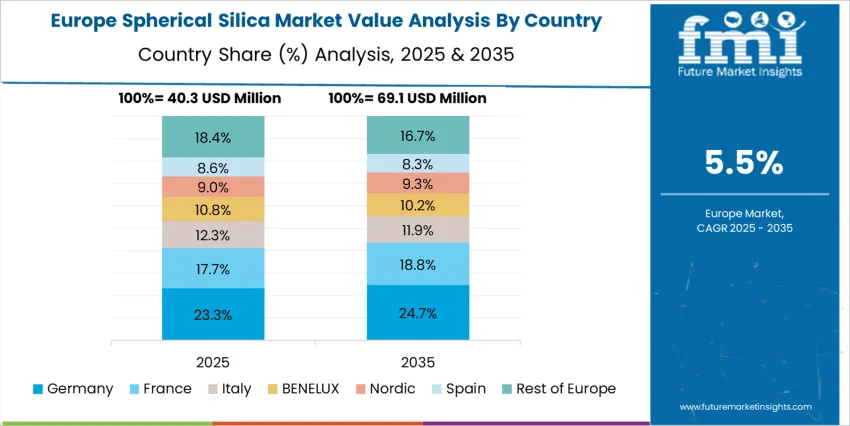
Growth in Germany reflects a CAGR of 6.2% through 2035 for spherical silica consumption, driven by automotive lightweight composites, industrial coatings, and regulated electronics materials. Spherical silica is used in battery pack coatings, powder coatings, and thermal interface materials. Strict material testing and process certification govern supplier qualification. Imports remain relevant for ultra-high purity grades. Demand stays quality focused and regulation aligned, supported by precision engineering traditions, battery system development, and steady adoption of performance fillers across advanced industrial manufacturing chains.
- Battery pack coatings drive technical filler demand
- Powder coatings support large scale industrial usage
- Certification standards shape material approval
- Precision manufacturing sustains long term consumption
What Is Driving Measured Spherical Silica Growth in the United States?
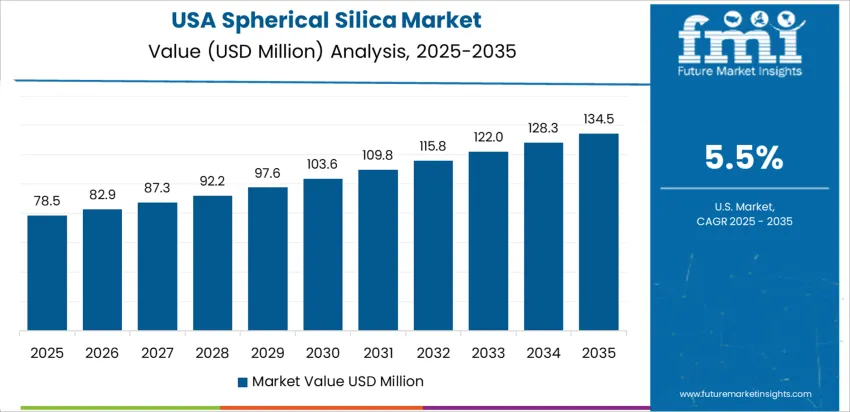
Expansion in the United States is moving at a CAGR of 5.5% through 2035 for spherical silica demand, supported by semiconductor research, aerospace coatings, and specialty polymer compounding. Spherical silica appears in chip packaging materials, thermal barrier coatings, and rheology control additives. Defense and aerospace programs support steady high performance material uptake. Imports supply most ultra-fine electronic grades. Demand remains application driven and technically supported, shaped by stable research funding, consistent aerospace manufacturing activity, and steady use of precision fillers in advanced polymer and coating systems.
- Semiconductor research drives electronic grade usage
- Aerospace coatings support thermal protection demand
- Specialty polymer compounding sustains filler consumption
- Import reliance dominates ultra-fine grade sourcing
What Is Driving the Global Demand for Spherical Silica and Who Are the Key Suppliers Supplying It
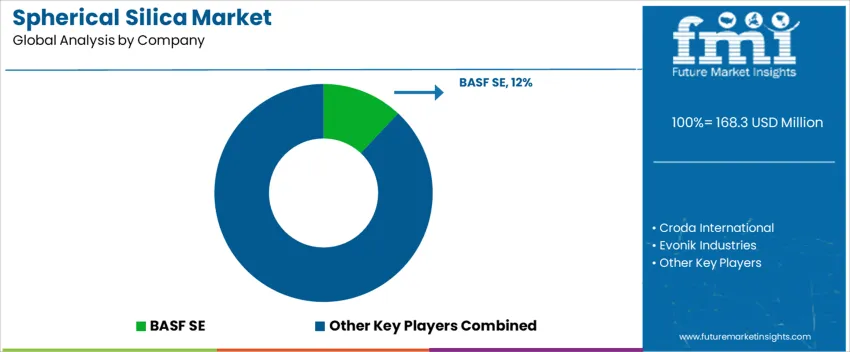
Global demand for spherical silica is rising as manufacturers across cosmetics, personal care, coatings, pharmaceuticals, electronics, and industrial materials seek uniform, high performance particulate materials with controlled size, purity, and functionality. Spherical silica offers benefits such as a smooth skin feel, oil absorption, mattifying effects, good dispersibility, and improved texture in formulations. In coatings and plastics, spherical silica contributes to controlled viscosity, enhanced mechanical stability, improved scratch resistance, and light diffusion or opacity effects depending on grade. In pharmaceutical and biomedical uses, uniform silica spheres support controlled release drug delivery, microencapsulation, and filler applications. The expanding demand for high performance, multifunctional, and formulation ready materials across industries drives growth in spherical silica adoption worldwide.
Major global suppliers positioned to deliver spherical silica and related microsphere products include BASF SE, Croda International, Evonik Industries, Symrise (including IFF/Givaudan actives), Dow Inc., Ashland, Clariant, and specialized ingredient and materials firms such as Seppic, Lubrizol, Lonza, and Inolex. Leading chemical and specialty materials firms supply bulk and standardized grades suited for mass market applications in cosmetics, coatings, plastics, and electronics. Smaller or niche companies often offer tailored, high purity, or modified surface variants optimized for sensitive uses such as drug delivery, biomedical devices, or premium personal care products. This multi tiered supplier structure ensures availability of spherical silica across a wide range of quality, regulatory, and application requirements globally.
Key Players in the Spherical Silica Market
- BASF SE
- Croda International
- Evonik Industries
- Symrise (incl. IFF/Givaudan actives)
- Dow / Dow Inc.
- Ashland
- Clariant
- Seppic
- Others
Scope of the report
| Items | Values |
|---|---|
| Quantitative Units (2025) | USD million |
| End-Use Applications | Skin Care, Body Care, Hair Care, Sun Care, Color Cosmetics, Men’s Grooming, Baby & Kids Care, Dermocosmetic / Professional Care |
| Product Forms | Powder, Granules/Agglomerates, Flakes, Pellets/Prills, Liquid (Solution), Concentrate (High-active Liquid), Dispersion/Suspension, Emulsion, Paste, Gel, Wax / Solid Block, Oil |
| Regions Covered | Asia Pacific, Europe, North America, Latin America, Middle East & Africa |
| Countries Covered | China, Japan, South Korea, India, Australia & New Zealand, ASEAN, Germany, United Kingdom, France, Italy, Spain, Nordic, BENELUX, USA, Canada, Mexico, Brazil, Chile, Saudi Arabia, Turkey, South Africa, plus 40+ additional countries globally |
| Key Companies Profiled | BASF SE, Croda International, Evonik Industries, Symrise (incl. IFF/Givaudan actives), Dow Inc., Ashland, Clariant, Seppic, Lubrizol, Lonza, Inolex |
| Additional Attributes | Dollar by sales breakdown by region, country, end-use, and product form; global growth projections; multi-sector adoption (cosmetic, nutraceutical, functional food); extract bioactivity profiling; iodine and polyphenol standardization; contract harvesting; vertical integration; supply chain stability; regulatory compliance; sensory and bioavailability performance |
Spherical Silica Market Segmentation
End Use Application:
- Skin Care
- Body Care
- Hair Care
- Sun Care
- Color Cosmetics
- Men’s Grooming
- Baby & Kids Care
- Dermocosmetic / Professional Care
Product Form:
- Powder
- Granules / Agglomerates
- Flakes
- Pellets / Prills
- Liquid (Solution)
- Concentrate (High-active Liquid)
- Dispersion / Suspension
- Emulsion
- Paste
- Gel
- Wax / Solid Block
- Oil
Region
- Asia Pacific
- China
- Japan
- South Korea
- India
- Australia & New Zealand
- ASEAN
- Rest of Asia Pacific
- Europe
- Germany
- United Kingdom
- France
- Italy
- Spain
- Nordic
- BENELUX
- Rest of Europe
- North America
- United States
- Canada
- Mexico
- Latin America
- Brazil
- Chile
- Rest of Latin America
- Middle East & Africa
- Kingdom of Saudi Arabia
- Other GCC Countries
- Turkey
- South Africa
- Other African Union
- Rest of Middle East & Africa
Frequently Asked Questions
How big is the spherical silica market in 2025?
The global spherical silica market is estimated to be valued at USD 168.3 million in 2025.
What will be the size of spherical silica market in 2035?
The market size for the spherical silica market is projected to reach USD 316.1 million by 2035.
How much will be the spherical silica market growth between 2025 and 2035?
The spherical silica market is expected to grow at a 6.5% CAGR between 2025 and 2035.
What are the key product types in the spherical silica market?
The key product types in spherical silica market are skin care, body care, hair care, sun care, color cosmetics, men’s grooming, baby & kids care and dermocosmetic / professional care.
Which product form segment to contribute significant share in the spherical silica market in 2025?
In terms of product form , powder segment to command 17.0% share in the spherical silica market in 2025.
Preview the report firsthand - request a free sample
Get SampleGet the brochure for pricing and purchase details.
Get PDFTable of Content
- Executive Summary
- Global Market Outlook
- Demand-side Trends
- Supply-side Trends
- Technology Roadmap Analysis
- Analysis and Recommendations
- Market Overview
- Market Coverage / Taxonomy
- Market Definition / Scope / Limitations
- Market Background
- Market Dynamics
- Drivers
- Restraints
- Opportunity
- Trends
- Scenario Forecast
- Demand in Optimistic Scenario
- Demand in Likely Scenario
- Demand in Conservative Scenario
- Opportunity Map Analysis
- Product Life Cycle Analysis
- Supply Chain Analysis
- Investment Feasibility Matrix
- Value Chain Analysis
- PESTLE and Porter’s Analysis
- Regulatory Landscape
- Regional Parent Market Outlook
- Production and Consumption Statistics
- Import and Export Statistics
- Market Dynamics
- Global Market Analysis 2020 to 2024 and Forecast, 2025 to 2035
- Historical Market Size Value (USD Million) Analysis, 2020 to 2024
- Current and Future Market Size Value (USD Million) Projections, 2025 to 2035
- Y-o-Y Growth Trend Analysis
- Absolute $ Opportunity Analysis
- Global Market Pricing Analysis 2020 to 2024 and Forecast 2025 to 2035
- Global Market Analysis 2020 to 2024 and Forecast 2025 to 2035, By End Use Application
- Introduction / Key Findings
- Historical Market Size Value (USD Million) Analysis By End Use Application , 2020 to 2024
- Current and Future Market Size Value (USD Million) Analysis and Forecast By End Use Application , 2025 to 2035
- Skin Care
- Body Care
- Hair Care
- Sun Care
- Color Cosmetics
- Men’s Grooming
- Baby & Kids Care
- Dermocosmetic / Professional Care
- Y-o-Y Growth Trend Analysis By End Use Application , 2020 to 2024
- Absolute $ Opportunity Analysis By End Use Application , 2025 to 2035
- Global Market Analysis 2020 to 2024 and Forecast 2025 to 2035, By Product Form
- Introduction / Key Findings
- Historical Market Size Value (USD Million) Analysis By Product Form, 2020 to 2024
- Current and Future Market Size Value (USD Million) Analysis and Forecast By Product Form, 2025 to 2035
- Powder
- Granules / Agglomerates
- Flakes
- Pellets / Prills
- Liquid (Solution)
- Concentrate (High-active Liquid)
- Dispersion / Suspension
- Emulsion
- Paste
- Gel
- Wax / Solid Block
- Y-o-Y Growth Trend Analysis By Product Form, 2020 to 2024
- Absolute $ Opportunity Analysis By Product Form, 2025 to 2035
- Global Market Analysis 2020 to 2024 and Forecast 2025 to 2035, By Region
- Introduction
- Historical Market Size Value (USD Million) Analysis By Region, 2020 to 2024
- Current Market Size Value (USD Million) Analysis and Forecast By Region, 2025 to 2035
- North America
- Latin America
- Western Europe
- Eastern Europe
- East Asia
- South Asia and Pacific
- Middle East & Africa
- Market Attractiveness Analysis By Region
- North America Market Analysis 2020 to 2024 and Forecast 2025 to 2035, By Country
- Historical Market Size Value (USD Million) Trend Analysis By Market Taxonomy, 2020 to 2024
- Market Size Value (USD Million) Forecast By Market Taxonomy, 2025 to 2035
- By Country
- USA
- Canada
- Mexico
- By End Use Application
- By Product Form
- By Country
- Market Attractiveness Analysis
- By Country
- By End Use Application
- By Product Form
- Key Takeaways
- Latin America Market Analysis 2020 to 2024 and Forecast 2025 to 2035, By Country
- Historical Market Size Value (USD Million) Trend Analysis By Market Taxonomy, 2020 to 2024
- Market Size Value (USD Million) Forecast By Market Taxonomy, 2025 to 2035
- By Country
- Brazil
- Chile
- Rest of Latin America
- By End Use Application
- By Product Form
- By Country
- Market Attractiveness Analysis
- By Country
- By End Use Application
- By Product Form
- Key Takeaways
- Western Europe Market Analysis 2020 to 2024 and Forecast 2025 to 2035, By Country
- Historical Market Size Value (USD Million) Trend Analysis By Market Taxonomy, 2020 to 2024
- Market Size Value (USD Million) Forecast By Market Taxonomy, 2025 to 2035
- By Country
- Germany
- UK
- Italy
- Spain
- France
- Nordic
- BENELUX
- Rest of Western Europe
- By End Use Application
- By Product Form
- By Country
- Market Attractiveness Analysis
- By Country
- By End Use Application
- By Product Form
- Key Takeaways
- Eastern Europe Market Analysis 2020 to 2024 and Forecast 2025 to 2035, By Country
- Historical Market Size Value (USD Million) Trend Analysis By Market Taxonomy, 2020 to 2024
- Market Size Value (USD Million) Forecast By Market Taxonomy, 2025 to 2035
- By Country
- Russia
- Poland
- Hungary
- Balkan & Baltic
- Rest of Eastern Europe
- By End Use Application
- By Product Form
- By Country
- Market Attractiveness Analysis
- By Country
- By End Use Application
- By Product Form
- Key Takeaways
- East Asia Market Analysis 2020 to 2024 and Forecast 2025 to 2035, By Country
- Historical Market Size Value (USD Million) Trend Analysis By Market Taxonomy, 2020 to 2024
- Market Size Value (USD Million) Forecast By Market Taxonomy, 2025 to 2035
- By Country
- China
- Japan
- South Korea
- By End Use Application
- By Product Form
- By Country
- Market Attractiveness Analysis
- By Country
- By End Use Application
- By Product Form
- Key Takeaways
- South Asia and Pacific Market Analysis 2020 to 2024 and Forecast 2025 to 2035, By Country
- Historical Market Size Value (USD Million) Trend Analysis By Market Taxonomy, 2020 to 2024
- Market Size Value (USD Million) Forecast By Market Taxonomy, 2025 to 2035
- By Country
- India
- ASEAN
- Australia & New Zealand
- Rest of South Asia and Pacific
- By End Use Application
- By Product Form
- By Country
- Market Attractiveness Analysis
- By Country
- By End Use Application
- By Product Form
- Key Takeaways
- Middle East & Africa Market Analysis 2020 to 2024 and Forecast 2025 to 2035, By Country
- Historical Market Size Value (USD Million) Trend Analysis By Market Taxonomy, 2020 to 2024
- Market Size Value (USD Million) Forecast By Market Taxonomy, 2025 to 2035
- By Country
- Kingdom of Saudi Arabia
- Other GCC Countries
- Turkiye
- South Africa
- Other African Union
- Rest of Middle East & Africa
- By End Use Application
- By Product Form
- By Country
- Market Attractiveness Analysis
- By Country
- By End Use Application
- By Product Form
- Key Takeaways
- Key Countries Market Analysis
- USA
- Pricing Analysis
- Market Share Analysis, 2024
- By End Use Application
- By Product Form
- Canada
- Pricing Analysis
- Market Share Analysis, 2024
- By End Use Application
- By Product Form
- Mexico
- Pricing Analysis
- Market Share Analysis, 2024
- By End Use Application
- By Product Form
- Brazil
- Pricing Analysis
- Market Share Analysis, 2024
- By End Use Application
- By Product Form
- Chile
- Pricing Analysis
- Market Share Analysis, 2024
- By End Use Application
- By Product Form
- Germany
- Pricing Analysis
- Market Share Analysis, 2024
- By End Use Application
- By Product Form
- UK
- Pricing Analysis
- Market Share Analysis, 2024
- By End Use Application
- By Product Form
- Italy
- Pricing Analysis
- Market Share Analysis, 2024
- By End Use Application
- By Product Form
- Spain
- Pricing Analysis
- Market Share Analysis, 2024
- By End Use Application
- By Product Form
- France
- Pricing Analysis
- Market Share Analysis, 2024
- By End Use Application
- By Product Form
- India
- Pricing Analysis
- Market Share Analysis, 2024
- By End Use Application
- By Product Form
- ASEAN
- Pricing Analysis
- Market Share Analysis, 2024
- By End Use Application
- By Product Form
- Australia & New Zealand
- Pricing Analysis
- Market Share Analysis, 2024
- By End Use Application
- By Product Form
- China
- Pricing Analysis
- Market Share Analysis, 2024
- By End Use Application
- By Product Form
- Japan
- Pricing Analysis
- Market Share Analysis, 2024
- By End Use Application
- By Product Form
- South Korea
- Pricing Analysis
- Market Share Analysis, 2024
- By End Use Application
- By Product Form
- Russia
- Pricing Analysis
- Market Share Analysis, 2024
- By End Use Application
- By Product Form
- Poland
- Pricing Analysis
- Market Share Analysis, 2024
- By End Use Application
- By Product Form
- Hungary
- Pricing Analysis
- Market Share Analysis, 2024
- By End Use Application
- By Product Form
- Kingdom of Saudi Arabia
- Pricing Analysis
- Market Share Analysis, 2024
- By End Use Application
- By Product Form
- Turkiye
- Pricing Analysis
- Market Share Analysis, 2024
- By End Use Application
- By Product Form
- South Africa
- Pricing Analysis
- Market Share Analysis, 2024
- By End Use Application
- By Product Form
- USA
- Market Structure Analysis
- Competition Dashboard
- Competition Benchmarking
- Market Share Analysis of Top Players
- By Regional
- By End Use Application
- By Product Form
- Competition Analysis
- Competition Deep Dive
- BASF SE
- Overview
- Product Portfolio
- Profitability by Market Segments (Product/Age /Sales Channel/Region)
- Sales Footprint
- Strategy Overview
- Marketing Strategy
- Product Strategy
- Channel Strategy
- Croda International
- Evonik Industries
- Symrise (incl. IFF/Givaudan actives)
- Dow / Dow Inc.
- Ashland
- Clariant
- Seppic
- Others
- BASF SE
- Competition Deep Dive
- Assumptions & Acronyms Used
- Research Methodology


