

- Industry Size (2025)
- USD 23.6 Mn
- Forecast (2035)
- USD 59.2 Mn
- CAGR (2025 to 2035)
- 9.6%
Spirulina Platensis Market Forecast and Outlook 2025 to 2035
In 2025, the spirulina platensis market is valued at USD 23.6 million and is expected to reach USD 59.2 million by 2035 at a CAGR of 9.6%. Under a compound absolute growth analysis, the market generates a cumulative absolute addition of USD 35.6 million over the full forecast window. The initial growth block from 2025 to 2030 contributes about USD 13.8 million, reflecting expansion from nutrition supplements, fortified beverages, and animal feed premixes. Tablets, powders, and encapsulated formats dominate early deliveries due to standardized dosage requirements. Procurement during this phase is shaped by controlled pond-cultivation output, drying capacity, and pigment-preservation efficiency rather than by retail demand volatility.
From 2030 to 2035, the second growth block adds a larger absolute value of about USD 21.8 million, accounting for the dominant share of total market expansion. This later acceleration reflects deeper penetration into sports nutrition, clinical nutrition, and functional food systems, where higher inclusion rates drive volume per formulation. Cosmetic and personal care uses also contribute incremental value through natural colorant and antioxidant functions. Product developers raise spirulina concentration levels to support protein enrichment and phycocyanin recovery. Supplier strategy centers on yield optimization, temperature-stable drying, and uniform biomass profiling. The compounding effect of rising dosage intensity and broader application conversion defines the later-phase value creation curve.
Quick Stats of the Spirulina Platensis Market
- Spirulina Platensis Market Value (2025): USD 23.6 million
- Spirulina Platensis Market Forecast Value (2035): USD 59.2 million
- Spirulina Platensis Market Forecast CAGR (2025 to 2035): 9.6%
- Leading Product Form in Spirulina Platensis Market: Powder (14.7%)
- Key Growth Regions in Spirulina Platensis Market: Asia Pacific, Europe
- Top Players in Spirulina Platensis Market: BASF SE, Croda International, Evonik Industries, Symrise (incl. IFF/Givaudan actives), Dow / Dow Inc., Ashland, Clariant, Seppic
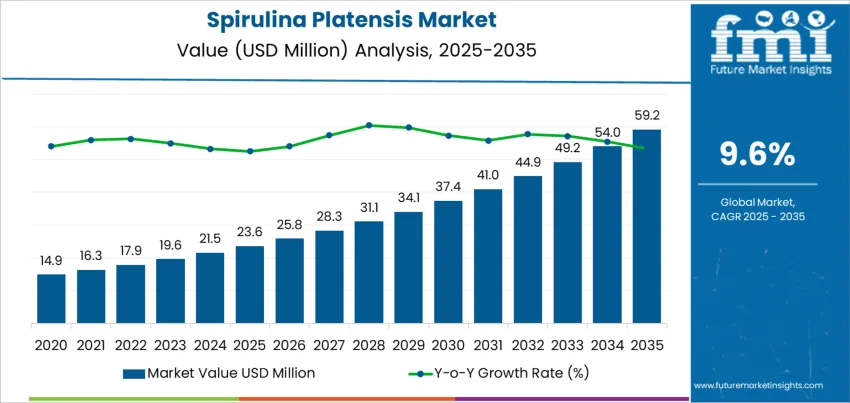
What is the Growth Forecast for the Spirulina Platensis Market through 2035?
From 2025 to 2030, the Spirulina platensis market expands from USD 23.6 million to USD 34.1 million, adding USD 10.5 million in absolute value. During this phase, market share gains are concentrated among vertically integrated cultivators and processors that control cultivation, drying, and extract standardization in-house. These players steadily take share from fragmented small-scale producers that rely on open-pond cultivation with inconsistent purity and yield. Gains are also evident among suppliers aligned with sports nutrition, tablet supplements, and functional beverage brands, where consistent protein content and phycocyanin stability are required. At the same time, lower-grade bulk spirulina used in animal feed faces mild share erosion as buyers shift toward higher-spec human-grade material with documented traceability and tighter contaminant thresholds.
From 2030 to 2035, the market grows from USD 34.1 million to USD 59.2 million, adding USD 25.1 million, with market share redistribution intensifying. Photobioreactor-based producers and pharmaceutical-grade extract manufacturers gain disproportionately as demand shifts toward high-purity spirulina for clinical nutrition, immune health formulations, and natural blue colorant applications. Traditional commodity-grade spirulina suppliers experience accelerating share erosion due to pricing pressure, regulatory tightening, and buyer preference for standardized bioactive content. Share gains also concentrate among exporters serving functional food and supplement manufacturers in North America and Europe. By 2035, market control is increasingly consolidated around technically advanced producers rather than volume-driven commodity suppliers.
Spirulina Platensis Industry Key Takeaways
| Metric | Value |
|---|---|
| Industry Value (2025) | USD 23.6 million |
| Forecast Value (2035) | USD 59.2 million |
| Forecast CAGR (2025 to 2035) | 9.6% |
How Is the Spirulina Platensis Market Developing Across Nutrition, Feed, and Functional Ingredient Applications?
The Spirulina platensis market developed from its early use as a concentrated nutritional supplement positioned around protein density, micronutrient content, and natural pigment value. Initial demand came from health focused consumers seeking plant based protein and from supplement brands formulating tablets and powders for daily nutrition. As cultivation and drying technologies improved, spirulina moved into broader formats including beverage mixes, snack fortification, and functional food ingredients. Its natural blue green pigment also supported adoption in food coloring and cosmetic formulations. In parallel, aquaculture and animal feed producers began using spirulina as a nutrient enhancer to improve feed efficiency and pigmentation, which expanded commercial demand beyond human nutrition.
Future growth of the Spirulina platensis market will be shaped by rising interest in alternative proteins, clean label ingredients, and bio based nutritional inputs. Expansion is expected across sports nutrition, medical nutrition, fortified beverages, plant based foods, and aquaculture feed. Demand is also supported by interest in natural colorants that replace synthetic dyes. Barriers include relatively high cultivation and processing cost, sensitivity of spirulina to contamination, and taste and odor challenges that restrict formulation flexibility. Regulatory scrutiny around purity, heavy metal content, and health claims will continue to influence market expansion. Long term growth will depend on production scale efficiency, quality consistency, and broader consumer acceptance across everyday food categories.
How Are End Use Application and Product Form Structuring the Demand for Spirulina Platensis?
The demand for Spirulina platensis is structured by end use application and product form. Skin care accounts for 12.0% of total demand, followed by body care, hair care, sun care, color cosmetics, men grooming, baby and kids care, and dermocosmetic and professional care. By product form, powder represents 14.7% of total consumption, followed by granules and agglomerates, flakes, pellets and prills, liquid solutions, high active concentrates, dispersions and suspensions, emulsions, pastes, gels, wax or solid blocks, and oils. Demand behavior is shaped by pigment stability, protein retention, antioxidant performance, moisture sensitivity, and compatibility with cosmetic and personal care manufacturing systems.
Why Does Skin Care Lead the Spirulina Platensis End Use Demand?
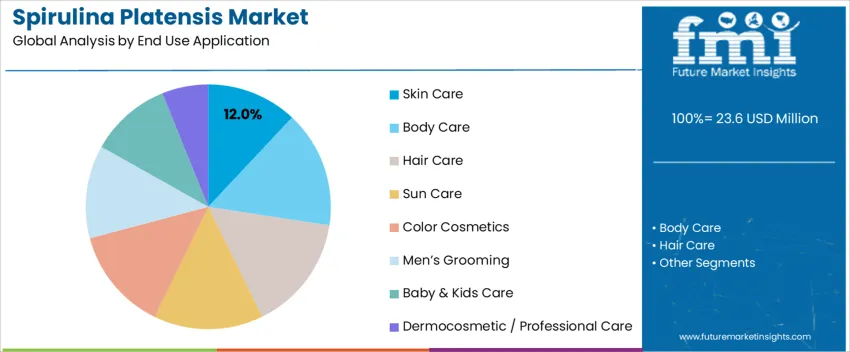
Skin care accounts for 12.0% of total Spirulina platensis demand due to its high concentration of phycocyanin, amino acids, essential fatty acids, and trace minerals that support antioxidant defense and skin conditioning. Spirulina is commonly used in anti pollution creams, detoxifying masks, brightening serums, and hydrating formulations where oxidative stress control and skin tone improvement are central formulation objectives. Its natural blue green pigment also supports botanical positioning in clean label personal care ranges.
Skin care producers favor spirulina for its predictable functional contribution across both rinse off and leave on formats. It integrates effectively into emulsions and gel systems without destabilizing viscosity when properly standardized. Its protein profile supports barrier repair positioning in compromised skin formulations. These functional performance properties, visual identity contribution, and formulation adaptability sustain skin care as the leading end use segment within Spirulina platensis demand.
Why Does Powder Lead the Spirulina Platensis Product Form Demand?
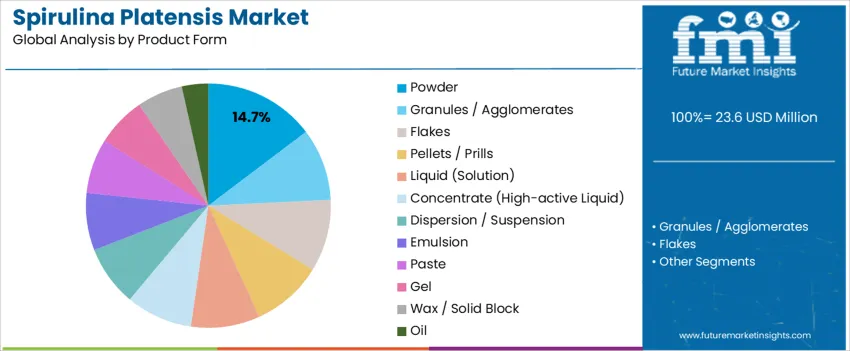
Powder accounts for 14.7% of total Spirulina platensis demand due to its strong stability profile, efficient handling characteristics, and precise concentration control during formulation. Powdered spirulina allows accurate dosing of pigments, proteins, and antioxidants across cosmetic and personal care production lines. Low moisture content reduces degradation risk and supports long shelf life under standard warehousing conditions, which is critical for manufacturers operating extended production planning cycles.
Powder form also supports uniform dispersion during high shear mixing used in creams, masks, and cleansing products. It enables standardized color intensity and consistent bioactive delivery across batches. Packaging in moisture barrier bags and sealed drums preserves pigment integrity and nutrient activity during transport. These formulation accuracy, storage reliability, and logistics efficiency advantages position powder as the leading product form within Spirulina platensis demand.
Why Has Spirulina Platensis Become a Protein-Security Input Rather Than a Niche Wellness Ingredient?
Global demand for spirulina platensis is increasingly tied to protein access stability rather than lifestyle nutrition trends alone. Spirulina offers complete amino acid coverage with minimal land, water, and feed input compared with animal protein systems. This makes it attractive in regions facing agricultural stress, import dependence, and rising protein costs. Governments, aid programs, and fortified food producers apply spirulina as a compact nutrient density solution for malnutrition prevention. Its demand now grows as part of structural nutrition planning rather than as a retail-driven “superfood” supplement category.
How Do Open-Pond Farming and Climate Dependency Shape Supply Volatility?
Spirulina platensis production depends heavily on open-pond cultivation in warm, high-sunlight regions. Temperature swings, rainfall imbalance, and contamination risk directly affect yield stability. Unlike closed bioreactors, open systems are vulnerable to algae competition, microbial intrusion, and evaporation loss. Water quality shifts rapidly alter pigment and protein concentration. These biological exposure risks create uneven global output and batch inconsistency. As a result, spirulina supply expands through geographic diversification rather than simple capacity scaling, which keeps pricing sensitive to regional climate cycles.
What Taste Barriers, Color Intensity, and Regulatory Controls Restrict Mainstream Food Integration?
Spirulina faces persistent formulation resistance due to its marine taste notes and deep blue-green pigmentation. These attributes limit its use in neutral-flavored foods and visually conventional products. Color instability under heat and acidic processing further restricts bakery and beverage integration. Regulatory limits on daily intake in some countries also cap fortification levels. Heavy metal testing adds compliance cost for food-grade classification. These sensory and regulatory constraints block spirulina from becoming a hidden mass ingredient and keep it concentrated in visibly “green” health-positioned formats.
How Are Blue Pigment Extraction, Medical Nutrition, and Carbon Capture Reframing Demand?
Future spirulina demand is shifting toward non-protein functional uses. Phycocyanin extraction supports growth in natural blue food color markets for confectionery and beverages. Medical nutrition programs apply spirulina for anemia management and immune suppression recovery diets. Industrial research also explores spirulina for carbon dioxide absorption and bio-oxygen generation in closed systems. These applications detach spirulina from simple dietary supplementation and reposition it as a multi-functional biological platform serving food, health, and environmental engineering objectives.
What Is the Global Growth Outlook for the Spirulina Platensis Industry by Country?
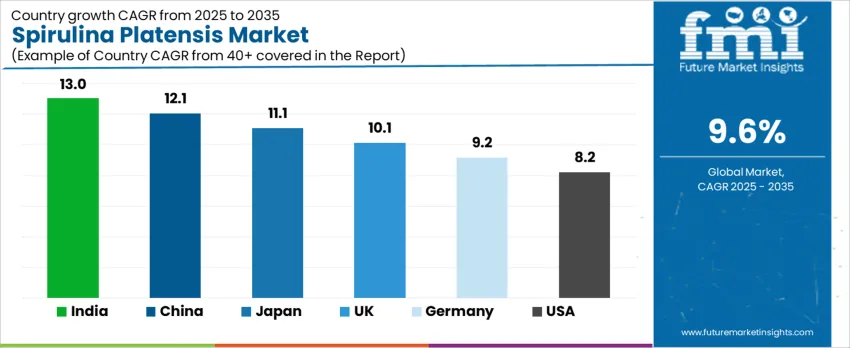
| Country | CAGR (%) |
|---|---|
| India | 13.02 |
| China | 12.06 |
| Japan | 11.09 |
| UK | 10.13 |
| Germany | 9.16 |
| USA | 8.20 |
The Spirulina platensis industry is expanding strongly across global markets, with India leading at a 13.02% CAGR. Growth in India is supported by rising demand for algae based dietary supplements, plant protein ingredients, and immunity focused nutrition products across urban and semi urban populations. China follows at 12.06%, driven by large scale spirulina cultivation, export oriented processing, and growing domestic nutraceutical consumption. Japan at 11.09% reflects steady use of spirulina in functional foods, beverages, and specialty supplements rooted in long established microalgae consumption. The UK and Germany record 10.13% and 9.16% growth, supported by clean label nutrition, plant based diets, and sports nutrition adoption. The USA shows comparatively moderate growth at 8.20%, reflecting a mature but steadily expanding functional ingredient and wellness supplement industry.
What Is Driving Strong Spirulina Adoption in India?
Expansion in India is progressing at a CAGR of 13.02% through 2035 for Spirulina platensis demand, driven by rapid growth in plant based protein supplements, immunity focused nutrition, and preventive healthcare products. Urban consumers adopt spirulina powders and tablets for energy support, micronutrient intake, and detox positioning. Government backed nutrition programs also apply spirulina in school and maternal health initiatives. Domestic cultivation is expanding, though imports still supplement supply in premium segments. Demand remains formulation led and public health supported, shaped by rising wellness awareness, expanding fitness culture, and strong growth in online nutrition product retail.
- Immunity and protein supplements anchor primary demand
- Public nutrition programs increase structured consumption
- Expanding domestic cultivation supports supply stability
- Ecommerce channels strengthen national product reach
How Is China Scaling Industrial Spirulina Production?
Growth in China reflects a CAGR of 12.06% through 2035 for Spirulina platensis utilization, supported by large scale algae farming, animal nutrition integration, and functional food manufacturing. Spirulina is processed into tablets, feed additives, beverage powders, and cosmetic ingredients. Extensive photobioreactor and open pond cultivation ensures cost efficiency and volume reliability. Export oriented producers supply global nutraceutical and feed brands. Demand remains production driven and volume oriented, aligned with controlled algae farming economics, strong export throughput, and steady expansion of algae based inputs across food, feed, and personal care manufacturing.
- Large scale farms stabilize high volume production
- Animal feed applications add consistent industrial demand
- Export processing supports global distribution capacity
- Cosmetic formulations add non food consumption volume
Why Does Japan Maintain Steady Leadership in Spirulina Consumption?
Demand in Japan is increasing at a CAGR of 11.09% through 2035 for Spirulina platensis usage, sustained by long standing supplement habits, pharmacy based distribution, and preventive healthcare orientation. Spirulina is widely consumed in tablets, beverage shots, and clinical nutrition products. Elderly care and recovery nutrition programs also incorporate spirulina for micronutrient support. Domestic controlled cultivation maintains consistent quality. Demand stays consumption driven and clinically anchored, supported by aging population nutrition needs, physician guided supplementation, and strong consumer trust in algae based wellness products.
- Pharmacy distribution underpins recurring retail demand
- Elderly care nutrition sustains long term consumption
- Clinical recovery products support therapeutic usage
- Domestic controlled cultivation stabilizes quality supply
What Is Supporting Spirulina Market Expansion in the United Kingdom?
Growth in the UK is advancing at a CAGR of 10.13% through 2035 for Spirulina platensis demand, supported by vegan diet adoption, detox nutrition trends, and premium supplement retail growth. Spirulina is used in green powders, smoothie blends, and plant protein mixes. Fitness communities and wellness retailers support consistent product turnover. Imports dominate sourcing due to limited domestic algae cultivation. Demand remains retail driven and lifestyle oriented, shaped by rising preventive health focus, steady gym membership growth, and strong online supplement sales across urban consumer markets.
- Vegan nutrition trends drive plant based demand
- Smoothie and green powder blends support daily intake
- Fitness retail anchors steady product movement
- Import reliance dominates raw material sourcing
How Is Germany Integrating Spirulina into Regulated Wellness Nutrition?
Growth in Germany reflects a CAGR of 9.16% through 2035 for Spirulina platensis consumption, driven by organic supplement manufacturing, pharmacy grade functional foods, and regulated detox nutrition products. Spirulina is applied in certified capsules, immune blends, and micronutrient formulations. Strict ingredient testing and labeling rules guide sourcing decisions. Imports remain the primary supply route. Demand stays quality focused and regulation aligned, supported by preventive healthcare traditions, controlled dosage supplementation, and steady penetration of algae based nutrition across pharmacy and organic retail distribution networks.
- Certified organic supplements anchor regulated demand
- Detox and immune blends drive steady capsule usage
- Testing standards shape supplier selection processes
- Pharmacy distribution supports predictable retail turnover
What Is Driving Measured Spirulina Growth in the United States?
Expansion in the United States is moving at a CAGR of 8.20% through 2035 for Spirulina platensis demand, supported by functional beverage development, sports nutrition integration, and immune support supplement consumption. Spirulina appears in superfood powders, energy drinks, protein blends, and wellness capsules. Coastal wellness markets lead early adoption, with steady expansion into mass market retail. Imports supply most raw material. Demand remains innovation driven and application diverse, shaped by green nutrition trends, steady wellness brand activity, and broader consumer acceptance of algae based superfoods.
- Superfood powders anchor primary retail demand
- Energy drinks and blends support liquid applications
- Sports nutrition adds steady protein blend inclusion
- Import dependence dominates raw material procurement
What Is Driving the Global Demand for Spirulina Platensis and Who Are the Key Suppliers Shaping the Market?
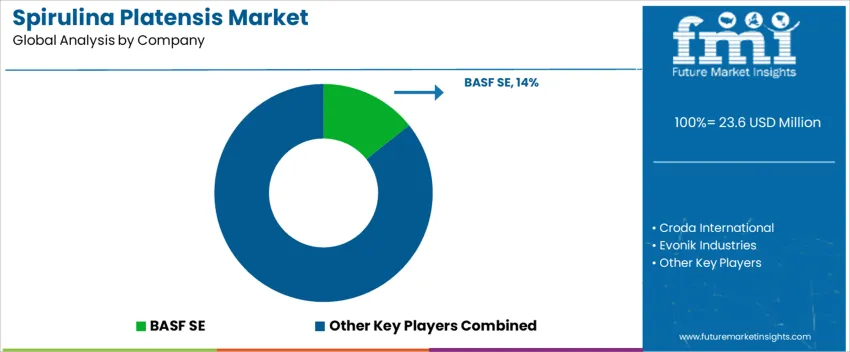
Global demand for Spirulina platensis is rising as consumers and manufacturers increasingly prioritize nutrient-dense, plant-based, and sustainable food sources. Spirulina is rich in protein, essential amino acids, vitamins, minerals, antioxidants, and pigments, which support nutrition, immune health, and overall wellness. Demand is further fueled by growth in vegan, vegetarian, and flexitarian diets, along with preferences for clean-label and minimally processed foods. Spirulina’s versatility in powder, tablets, beverages, snacks, functional foods, and cosmetic applications expands its adoption across dietary supplements, food and beverage, and wellness sectors. Advances in controlled-environment cultivation and purification methods have improved product quality and consistency, enabling broader acceptance in regulated markets.
Key global suppliers of Spirulina platensis include BASF SE, Croda International, Evonik Industries, Symrise including IFF/Givaudan actives, Dow Inc., Ashland, Clariant, and specialty firms such as Seppic, Lubrizol, Lonza, and Inolex. These companies provide high-volume spirulina biomass, purified extracts, and formulation-ready ingredients for food, beverage, nutraceutical, and cosmetic applications. Large producers ensure reliable supply, standardized quality, and scalability, while specialty ingredient companies offer customized extracts for premium or functional products. Together, these firms form a diverse supply base supporting global adoption across multiple end-use segments.
Key Players in the Spirulina Platensis Market
- BASF SE
- Croda International
- Evonik Industries
- Symrise (incl. IFF/Givaudan actives)
- Dow / Dow Inc.
- Ashland
- Clariant
- Seppic
- Others
Scope of the Report
| Items | Values |
|---|---|
| Quantitative Units (2025) | USD million |
| End-Use Applications | Skin Care, Body Care, Hair Care, Sun Care, Color Cosmetics, Men’s Grooming, Baby & Kids Care, Dermocosmetic / Professional Care |
| Product Forms | Powder, Granules/Agglomerates, Flakes, Pellets/Prills, Liquid (Solution), Concentrate (High-active Liquid), Dispersion/Suspension, Emulsion, Paste, Gel, Wax / Solid Block, Oil |
| Regions Covered | Asia Pacific, Europe, North America, Latin America, Middle East & Africa |
| Countries Covered | China, Japan, South Korea, India, Australia & New Zealand, ASEAN, Germany, United Kingdom, France, Italy, Spain, Nordic, BENELUX, USA, Canada, Mexico, Brazil, Chile, Saudi Arabia, Turkey, South Africa, plus 40+ additional countries globally |
| Key Companies Profiled | BASF SE, Croda International, Evonik Industries, Symrise (incl. IFF/Givaudan actives), Dow Inc., Ashland, Clariant, Seppic, Lubrizol, Lonza, Inolex |
| Additional Attributes | Dollar by sales breakdown by region, country, end-use, and product form; global growth projections; multi-sector adoption (cosmetic, nutraceutical, functional food); extract bioactivity profiling; iodine and polyphenol standardization; contract harvesting; vertical integration; supply chain stability; regulatory compliance; sensory and bioavailability performance |
Spirulina Platensis Market Segmentation
End Use Application:
- Skin Care
- Body Care
- Hair Care
- Sun Care
- Color Cosmetics
- Men’s Grooming
- Baby & Kids Care
- Dermocosmetic / Professional Care
Product Form:
- Powder
- Granules / Agglomerates
- Flakes
- Pellets / Prills
- Liquid (Solution)
- Concentrate (High-active Liquid)
- Dispersion / Suspension
- Emulsion
- Paste
- Gel
- Wax / Solid Block
- Oil
Region
- Asia Pacific
- China
- Japan
- South Korea
- India
- Australia & New Zealand
- ASEAN
- Rest of Asia Pacific
- Europe
- Germany
- United Kingdom
- France
- Italy
- Spain
- Nordic
- BENELUX
- Rest of Europe
- North America
- United States
- Canada
- Mexico
- Latin America
- Brazil
- Chile
- Rest of Latin America
- Middle East & Africa
- Kingdom of Saudi Arabia
- Other GCC Countries
- Turkey
- South Africa
- Other African Union
- Rest of Middle East & Africa
Frequently Asked Questions
How big is the spirulina platensis market in 2025?
The global spirulina platensis market is estimated to be valued at USD 23.6 million in 2025.
What will be the size of spirulina platensis market in 2035?
The market size for the spirulina platensis market is projected to reach USD 59.2 million by 2035.
How much will be the spirulina platensis market growth between 2025 and 2035?
The spirulina platensis market is expected to grow at a 9.6% CAGR between 2025 and 2035.
What are the key product types in the spirulina platensis market?
The key product types in spirulina platensis market are skin care, body care, hair care, sun care, color cosmetics, men’s grooming, baby & kids care and dermocosmetic / professional care.
Which product form segment to contribute significant share in the spirulina platensis market in 2025?
In terms of product form , powder segment to command 14.7% share in the spirulina platensis market in 2025.
Preview the report firsthand - request a free sample
Get SampleGet the brochure for pricing and purchase details.
Get PDFTable of Content
- Executive Summary
- Global Market Outlook
- Demand-side Trends
- Supply-side Trends
- Technology Roadmap Analysis
- Analysis and Recommendations
- Market Overview
- Market Coverage / Taxonomy
- Market Definition / Scope / Limitations
- Market Background
- Market Dynamics
- Drivers
- Restraints
- Opportunity
- Trends
- Scenario Forecast
- Demand in Optimistic Scenario
- Demand in Likely Scenario
- Demand in Conservative Scenario
- Opportunity Map Analysis
- Product Life Cycle Analysis
- Supply Chain Analysis
- Investment Feasibility Matrix
- Value Chain Analysis
- PESTLE and Porter’s Analysis
- Regulatory Landscape
- Regional Parent Market Outlook
- Production and Consumption Statistics
- Import and Export Statistics
- Market Dynamics
- Global Market Analysis 2020 to 2024 and Forecast, 2025 to 2035
- Historical Market Size Value (USD Million) Analysis, 2020 to 2024
- Current and Future Market Size Value (USD Million) Projections, 2025 to 2035
- Y-o-Y Growth Trend Analysis
- Absolute $ Opportunity Analysis
- Global Market Pricing Analysis 2020 to 2024 and Forecast 2025 to 2035
- Global Market Analysis 2020 to 2024 and Forecast 2025 to 2035, By End Use Application
- Introduction / Key Findings
- Historical Market Size Value (USD Million) Analysis By End Use Application , 2020 to 2024
- Current and Future Market Size Value (USD Million) Analysis and Forecast By End Use Application , 2025 to 2035
- Skin Care
- Body Care
- Hair Care
- Sun Care
- Color Cosmetics
- Men’s Grooming
- Baby & Kids Care
- Dermocosmetic / Professional Care
- Y-o-Y Growth Trend Analysis By End Use Application , 2020 to 2024
- Absolute $ Opportunity Analysis By End Use Application , 2025 to 2035
- Global Market Analysis 2020 to 2024 and Forecast 2025 to 2035, By Product Form
- Introduction / Key Findings
- Historical Market Size Value (USD Million) Analysis By Product Form, 2020 to 2024
- Current and Future Market Size Value (USD Million) Analysis and Forecast By Product Form, 2025 to 2035
- Powder
- Granules / Agglomerates
- Flakes
- Pellets / Prills
- Liquid (Solution)
- Concentrate (High-active Liquid)
- Dispersion / Suspension
- Emulsion
- Paste
- Gel
- Wax / Solid Block
- Y-o-Y Growth Trend Analysis By Product Form, 2020 to 2024
- Absolute $ Opportunity Analysis By Product Form, 2025 to 2035
- Global Market Analysis 2020 to 2024 and Forecast 2025 to 2035, By Region
- Introduction
- Historical Market Size Value (USD Million) Analysis By Region, 2020 to 2024
- Current Market Size Value (USD Million) Analysis and Forecast By Region, 2025 to 2035
- North America
- Latin America
- Western Europe
- Eastern Europe
- East Asia
- South Asia and Pacific
- Middle East & Africa
- Market Attractiveness Analysis By Region
- North America Market Analysis 2020 to 2024 and Forecast 2025 to 2035, By Country
- Historical Market Size Value (USD Million) Trend Analysis By Market Taxonomy, 2020 to 2024
- Market Size Value (USD Million) Forecast By Market Taxonomy, 2025 to 2035
- By Country
- USA
- Canada
- Mexico
- By End Use Application
- By Product Form
- By Country
- Market Attractiveness Analysis
- By Country
- By End Use Application
- By Product Form
- Key Takeaways
- Latin America Market Analysis 2020 to 2024 and Forecast 2025 to 2035, By Country
- Historical Market Size Value (USD Million) Trend Analysis By Market Taxonomy, 2020 to 2024
- Market Size Value (USD Million) Forecast By Market Taxonomy, 2025 to 2035
- By Country
- Brazil
- Chile
- Rest of Latin America
- By End Use Application
- By Product Form
- By Country
- Market Attractiveness Analysis
- By Country
- By End Use Application
- By Product Form
- Key Takeaways
- Western Europe Market Analysis 2020 to 2024 and Forecast 2025 to 2035, By Country
- Historical Market Size Value (USD Million) Trend Analysis By Market Taxonomy, 2020 to 2024
- Market Size Value (USD Million) Forecast By Market Taxonomy, 2025 to 2035
- By Country
- Germany
- UK
- Italy
- Spain
- France
- Nordic
- BENELUX
- Rest of Western Europe
- By End Use Application
- By Product Form
- By Country
- Market Attractiveness Analysis
- By Country
- By End Use Application
- By Product Form
- Key Takeaways
- Eastern Europe Market Analysis 2020 to 2024 and Forecast 2025 to 2035, By Country
- Historical Market Size Value (USD Million) Trend Analysis By Market Taxonomy, 2020 to 2024
- Market Size Value (USD Million) Forecast By Market Taxonomy, 2025 to 2035
- By Country
- Russia
- Poland
- Hungary
- Balkan & Baltic
- Rest of Eastern Europe
- By End Use Application
- By Product Form
- By Country
- Market Attractiveness Analysis
- By Country
- By End Use Application
- By Product Form
- Key Takeaways
- East Asia Market Analysis 2020 to 2024 and Forecast 2025 to 2035, By Country
- Historical Market Size Value (USD Million) Trend Analysis By Market Taxonomy, 2020 to 2024
- Market Size Value (USD Million) Forecast By Market Taxonomy, 2025 to 2035
- By Country
- China
- Japan
- South Korea
- By End Use Application
- By Product Form
- By Country
- Market Attractiveness Analysis
- By Country
- By End Use Application
- By Product Form
- Key Takeaways
- South Asia and Pacific Market Analysis 2020 to 2024 and Forecast 2025 to 2035, By Country
- Historical Market Size Value (USD Million) Trend Analysis By Market Taxonomy, 2020 to 2024
- Market Size Value (USD Million) Forecast By Market Taxonomy, 2025 to 2035
- By Country
- India
- ASEAN
- Australia & New Zealand
- Rest of South Asia and Pacific
- By End Use Application
- By Product Form
- By Country
- Market Attractiveness Analysis
- By Country
- By End Use Application
- By Product Form
- Key Takeaways
- Middle East & Africa Market Analysis 2020 to 2024 and Forecast 2025 to 2035, By Country
- Historical Market Size Value (USD Million) Trend Analysis By Market Taxonomy, 2020 to 2024
- Market Size Value (USD Million) Forecast By Market Taxonomy, 2025 to 2035
- By Country
- Kingdom of Saudi Arabia
- Other GCC Countries
- Turkiye
- South Africa
- Other African Union
- Rest of Middle East & Africa
- By End Use Application
- By Product Form
- By Country
- Market Attractiveness Analysis
- By Country
- By End Use Application
- By Product Form
- Key Takeaways
- Key Countries Market Analysis
- USA
- Pricing Analysis
- Market Share Analysis, 2024
- By End Use Application
- By Product Form
- Canada
- Pricing Analysis
- Market Share Analysis, 2024
- By End Use Application
- By Product Form
- Mexico
- Pricing Analysis
- Market Share Analysis, 2024
- By End Use Application
- By Product Form
- Brazil
- Pricing Analysis
- Market Share Analysis, 2024
- By End Use Application
- By Product Form
- Chile
- Pricing Analysis
- Market Share Analysis, 2024
- By End Use Application
- By Product Form
- Germany
- Pricing Analysis
- Market Share Analysis, 2024
- By End Use Application
- By Product Form
- UK
- Pricing Analysis
- Market Share Analysis, 2024
- By End Use Application
- By Product Form
- Italy
- Pricing Analysis
- Market Share Analysis, 2024
- By End Use Application
- By Product Form
- Spain
- Pricing Analysis
- Market Share Analysis, 2024
- By End Use Application
- By Product Form
- France
- Pricing Analysis
- Market Share Analysis, 2024
- By End Use Application
- By Product Form
- India
- Pricing Analysis
- Market Share Analysis, 2024
- By End Use Application
- By Product Form
- ASEAN
- Pricing Analysis
- Market Share Analysis, 2024
- By End Use Application
- By Product Form
- Australia & New Zealand
- Pricing Analysis
- Market Share Analysis, 2024
- By End Use Application
- By Product Form
- China
- Pricing Analysis
- Market Share Analysis, 2024
- By End Use Application
- By Product Form
- Japan
- Pricing Analysis
- Market Share Analysis, 2024
- By End Use Application
- By Product Form
- South Korea
- Pricing Analysis
- Market Share Analysis, 2024
- By End Use Application
- By Product Form
- Russia
- Pricing Analysis
- Market Share Analysis, 2024
- By End Use Application
- By Product Form
- Poland
- Pricing Analysis
- Market Share Analysis, 2024
- By End Use Application
- By Product Form
- Hungary
- Pricing Analysis
- Market Share Analysis, 2024
- By End Use Application
- By Product Form
- Kingdom of Saudi Arabia
- Pricing Analysis
- Market Share Analysis, 2024
- By End Use Application
- By Product Form
- Turkiye
- Pricing Analysis
- Market Share Analysis, 2024
- By End Use Application
- By Product Form
- South Africa
- Pricing Analysis
- Market Share Analysis, 2024
- By End Use Application
- By Product Form
- USA
- Market Structure Analysis
- Competition Dashboard
- Competition Benchmarking
- Market Share Analysis of Top Players
- By Regional
- By End Use Application
- By Product Form
- Competition Analysis
- Competition Deep Dive
- BASF SE
- Overview
- Product Portfolio
- Profitability by Market Segments (Product/Age /Sales Channel/Region)
- Sales Footprint
- Strategy Overview
- Marketing Strategy
- Product Strategy
- Channel Strategy
- Croda International
- Evonik Industries
- Symrise (incl. IFF/Givaudan actives)
- Dow / Dow Inc.
- Ashland
- Clariant
- Seppic
- Others
- BASF SE
- Competition Deep Dive
- Assumptions & Acronyms Used
- Research Methodology


