

- Industry Size (2026)
- USD 143.1 Mn
- Forecast (2036)
- USD 256.3 Mn
- CAGR (2026 to 2036)
- 6.0%
Demand for Spirulina Extract Size, Market Forecast and Outlook By FMI
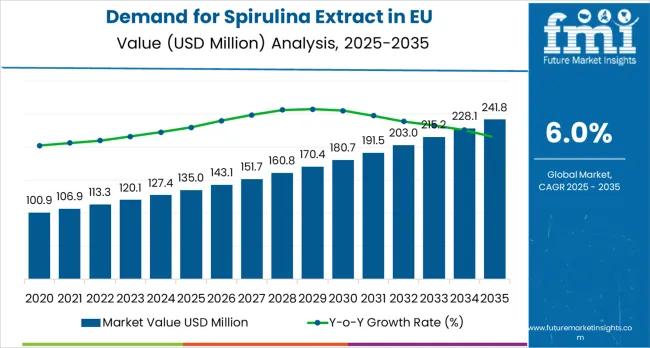
The demand for spirulina extract was valued at USD 50.5 million in 2025, projected to reach USD 143.1 million in 2026, and is forecast to expand to USD 256.3 million by 2036 at a 6.0% CAGR. The absolute dollar expansion over the forecast period reflects dual-application growth: spirulina extract as a nutritional ingredient in supplements and functional foods, and spirulina-derived phycocyanin as a natural blue colorant replacing synthetic alternatives. Powder format dominates at 55% share, preferred for its stability, dosing flexibility, and compatibility with tablet, capsule, and food formulation processes. The nutraceuticals segment leads at over 42% share, but food and beverage applications are growing faster as natural colorant demand accelerates.
As per FMI, the spirulina extract supply chain is anchored by spirulina cultivation in open raceway ponds and closed photobioreactors, with major production concentrated in China, India, and the United States. EU-based production is limited, creating import dependency for European manufacturers. Organic certification under EU Regulation 2018/848 adds a price premium tier that organic spirulina producers in India and the United States are positioned to supply.
Summary of Demand for Spirulina Extract
- Demand for Spirulina Extract Definition
- Spirulina extract is a concentrated preparation derived from the cyanobacterium Arthrospira platensis (spirulina), supplied in powder, liquid, and tablet/capsule formats for use in nutraceuticals, dietary supplements, functional foods, beverages, cosmetics, and animal feed applications. The extract contains phycocyanin (blue pigment), protein, vitamins, minerals, and essential fatty acids.
- Demand Drivers in the Market
- Natural blue colorant substitution: European food and beverage manufacturers are replacing synthetic Blue 1 (Brilliant Blue FCF) with spirulina-derived phycocyanin to meet clean-label specifications.
- Protein-dense superfood positioning: Spirulina extract is positioned as a plant-based protein source with complete amino acid profiles, iron, B-vitamins, and antioxidant compounds.
- Organic spirulina certification demand: EU consumer demand for organic-certified spirulina is growing as health food retailers expand organic supplement and superfood assortments.
- Key Segments Analyzed in the FMI Report
- Conventional: 63.0% share in 2026 by Nature.
- Powder: 55.0% share in 2026 by Product Type.
- Spain: 6.2% compound growth, the fastest among tracked markets.
- Analyst Opinion at FMI
- Nandini Roy Choudhury, Principal Consultant for Food & Beverage analysts observe that, the EU spirulina extract market has two growth engines running simultaneously: the established nutritional supplement application and the emerging natural colorant application. The colorant vector is the higher-margin opportunity because phycocyanin extracts with standardized colour strength command premium pricing that commodity spirulina powder cannot access. Producers who invest in phycocyanin purification and colour standardization capability position themselves for the largest incremental demand pool. The supply risk is quality consistency: spirulina biomass composition varies with cultivation conditions, and EU food and cosmetic manufacturers require batch-to-batch consistency that only controlled photobioreactor production can reliably deliver.
- Strategic Implications / Executive Takeaways
- Procurement directors must secure diversified supply agreements to mitigate origin-concentration risk and seasonal availability gaps.
- Product development teams should evaluate format premiumization opportunities where processing and packaging capture value above commodity ingredient pricing.
- Regulatory affairs teams must map compliance pathways across EU member states, as classification and labelling requirements vary by intended application.
Demand for Spirulina Extract Key Takeaways
| Metric | Details |
|---|---|
| Industry Size (2026) | USD 143.1 million |
| Industry Value (2036) | USD 256.3 million |
| CAGR (2026 to 2036) | 6.0% |
Source: Future Market Insights, 2026
All major markets reflect differentiated growth. Spain at 6.2%, Netherlands at 6.1%, Italy at 6.0%, France at 5.9%, Germany at 5.8%. Spain sets the pace, while Germany registers steadier growth.
Demand for Spirulina Extract Definition
Spirulina extract is a concentrated preparation derived from the cyanobacterium Arthrospira platensis (spirulina), supplied in powder, liquid, and tablet/capsule formats for use in nutraceuticals, dietary supplements, functional foods, beverages, cosmetics, and animal feed applications. The extract contains phycocyanin (blue pigment), protein, vitamins, minerals, and essential fatty acids.
Demand for Spirulina Extract Inclusions
The report covers EU regional market sizes for spirulina extract from 2026 to 2036. Segment analysis includes product type (powder, liquid, tablet/capsule), application (nutraceuticals, food and beverage, cosmetics and personal care, animal feed), distribution channel (supermarkets/hypermarkets, specialty stores, online retail), and nature (conventional, organic). Country coverage includes Spain, Netherlands, Italy, France, and Germany.
Demand for Spirulina Extract Exclusions
The scope excludes whole dried spirulina sold as a bulk food ingredient without extraction or concentration. Chlorella and other microalgae species are excluded. Spirulina cultivation equipment and photobioreactor systems fall outside the analytical boundary.
Demand for Spirulina Extract Research Methodology
- Primary Research: Structured interviews with procurement directors, formulation engineers, and channel managers mapping decision triggers and supplier qualification.
- Desk Research: Aggregated regulatory filings, trade publications, company reports, and public procurement records for market sizing.
- Market-Sizing and Forecasting: Bottom-up aggregation of production, trade flows, and end-use consumption with regional pricing adjustments.
- Data Validation: Cross-validated against company financial disclosures and quarterly trade data from statistical agencies.
Demand for Spirulina Extract in EU in EU: Key Takeaways
This phase of growth will be shaped by accelerating superfood trends across European wellness markets, increasing consumer awareness of spirulina health benefits and nutritional density, growing adoption of natural protein supplements, and expansion of health food retail infrastructure in Eastern European economies. Manufacturers are developing innovative product formulations including enhanced bioavailability varieties, organic certifications, premium quality grades, and sustainable packaging solutions to address evolving European consumer preferences for transparency, nutritional potency, product purity, and environmental responsibility.
The period is expected to be characterized by widespread adoption of spirulina extract across mainstream European retail channels, integration of advanced extraction technologies for enhanced product development, development of application-specific formulations targeting nutraceutical and cosmetic markets, and expansion of premium organic and sustainable product segments. The growing emphasis on preventive healthcare in European wellness systems, increasing professional nutritionist recommendations for spirulina supplementation, stringent EU regulations supporting supplement safety and quality standards, and rising health consciousness across European consumer segments will drive sustained demand for high-quality, bioavailable, and sustainably produced spirulina extract solutions.
Between 2021 and 2026, the Demand for Spirulina Extract in EU in EU experienced robust expansion, driven by accelerating superfood trends that positioned spirulina extract as essential components for comprehensive wellness programs, nutritional supplementation, and natural health applications. The market developed as European retailers and health-conscious consumers recognized commercial and nutritional opportunities in high-quality, bioavailable, and specialty spirulina extract formats that appealed to wellness-focused consumers and nutrition professionals seeking optimal nutritional density and health benefits for their supplement applications. Major international superfood producers expanded distribution capacity through strategic retail partnerships in European markets, while regional players developed specialized formulations addressing specific health requirements and quality standards across diverse national markets within the European Union.
Why is the Demand for Spirulina Extract in EU Growing in EU?
Market expansion is being supported by the fundamental shift in consumer attitudes toward natural health supplements and preventive nutrition across European societies, with spirulina extract increasingly regarded as superior nutritional supplements deserving premium positioning, natural production methods, and overall health benefits comparable to pharmaceutical-grade nutritional products while providing unique superfood advantages. Modern European consumers and health professionals consistently prioritize ingredient purity, nutritional density, bioavailability, and sustainable sourcing when selecting superfood supplements, driving demand for specialty spirulina extract formulations that deliver superior nutritional performance, natural processing methods, exceptional health benefits, and organic certifications compared to synthetic nutritional supplements. Even minor concerns about nutritional deficiencies, wellness optimization, or natural health requirements can drive comprehensive adoption of specialized premium spirulina extract products designed to maintain optimal health status, support specific wellness applications, and enhance overall consumer satisfaction throughout all health categories.
The growing complexity of nutritional science and increasing awareness of spirulina-specific health benefits are driving demand for professionally formulated spirulina extract products from certified European manufacturers with appropriate quality certifications, extraction capabilities, technical expertise, and compliance with stringent EU supplement regulations. Regulatory authorities across European Union member states are increasingly establishing comprehensive guidelines for spirulina extract manufacturing, health claim accuracy, quality standards, and supplement safety requirements to ensure product effectiveness and consumer safety. Scientific research studies and clinical trials conducted at European nutrition research institutions are providing evidence supporting spirulina extract interventions for common health challenges including antioxidant support, immune system enhancement, protein supplementation, and overall wellness maintenance, requiring specialized extraction expertise and quality-controlled production processes that meet EU supplement standards.
Segmental Analysis
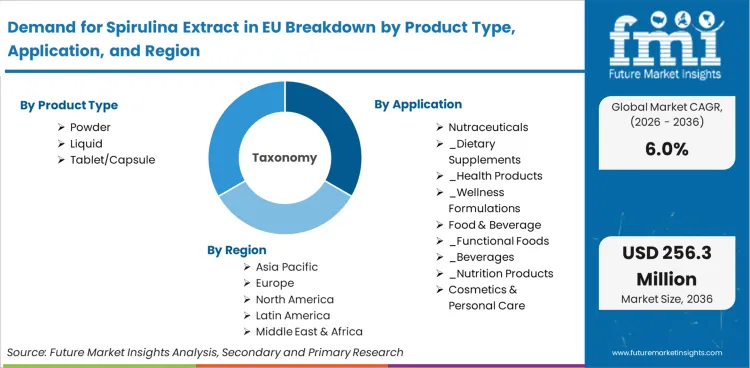
The market is segmented by product type, application, distribution channel, nature, and sales region. By product type, the market is divided into powder, liquid, and tablet/capsule formulations. Based on application, the market is categorized into nutraceuticals (including dietary supplements, health products, and wellness subsegments), food & beverage (including functional foods, beverages, and nutrition subsegments), cosmetics & personal care, and animal feed applications. By distribution channel, the market spans online retail (e-commerce platforms, direct-to-consumer websites), specialty stores (health food retailers, nutrition stores), and supermarkets/hypermarkets. In terms of nature, the market is segmented into conventional and organic products. Regionally, the market covers Germany, France, Italy, Spain, Netherlands, and Rest of Europe.
By Product Type, Powder Segment Accounts for 55.0% Market Share
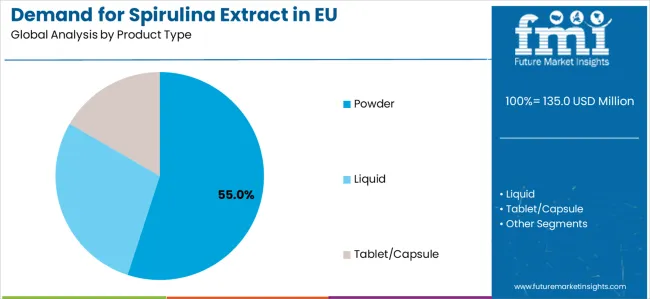
Powder segment is projected to account for 55.0% of the Demand for Spirulina Extract in EU in EU in 2026, establishing itself as the dominant product category across European health food and supplement facilities. This commanding market position is fundamentally supported by the widespread adoption of powder formulations for versatile supplement applications, convenient dosage customization, and specialized wellness formulations that deliver exceptional stability, consistent potency, and superior handling properties throughout large-scale commercial operations across EU member states. Spirulina extract powder products provide European supplement manufacturers with unparalleled formulation flexibility, precise dosage control during manufacturing processes, enhanced shelf stability, and seamless integration with various delivery formats that comply with stringent EU supplement safety directives.
This product sophistication enables European extraction companies to achieve optimal production economics while maintaining rigorous quality protocols mandated by European Food Safety Authority (EFSA) regulations, comprehensive traceability systems required under EU law, and consistent nutritional performance across millions of individual supplement applications produced annually. The segment derives substantial competitive advantages from established European powder processing infrastructure offering specialized drying solutions, comprehensive technical support services, and continuous product innovation that incorporates enhanced bioavailability technologies, improved solubility characteristics, and advanced formulation capabilities aligned with modern supplement standards. The powder systems deliver superior versatility particularly important in customizable supplement markets, enhanced formulation options, improved consumer convenience, and superior regulatory compliance with EU supplement manufacturing standards.
- Manufacturing efficiency advantages include established spray-drying infrastructure, optimized powder handling systems, and comprehensive quality testing protocols
- Formulation flexibility benefits through standardized processing methods, consistent particle size distribution, and extensive shelf stability characteristics
- Economic advantages from bulk packaging opportunities, reduced transportation costs, and enhanced production scalability across diverse supplement applications
By Application, Nutraceuticals Segment Accounts for 42.0% Market Share
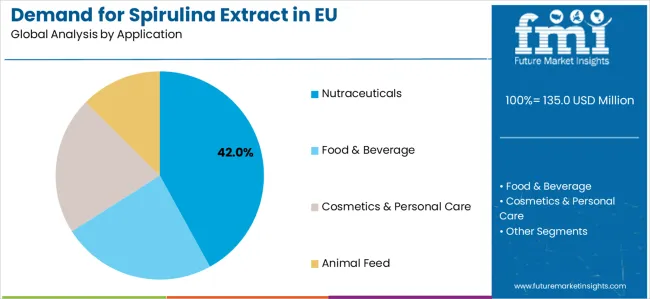
Nutraceuticals applications are positioned to represent 42.0% of total European spirulina extract demand in 2026, reflecting the segment's dominant position within the overall market ecosystem and the substantially larger supplement consumption patterns compared to other application categories across most European countries. This substantial market share directly demonstrates the exceptionally high adoption rates of spirulina extract among European supplement manufacturers and the continuously expanding population of health-conscious consumers and wellness professionals across both Western and Eastern European markets.
Modern European nutraceutical spirulina extract applications are increasingly featuring sophisticated formulations that deliver enhanced bioavailability profiles, targeted health benefits, and specialized functional properties specifically designed to address common wellness challenges including antioxidant support, immune system enhancement, energy optimization, and overall health maintenance. European supplement manufacturers consistently demonstrate willingness to invest substantially in premium spirulina extract that delivers visible health benefits, support optimal wellness outcomes, comply with EU supplement safety standards, and provide consistent results for both commercial supplement production and consumer health applications. Within the nutraceuticals segment, dietary supplements applications command 25% share, health products represent 12%, and wellness formulations account for 5%, reflecting comprehensive application segmentation strategies tailored to European wellness market preferences.
- Product innovation opportunities through bioavailability enhancement technologies, targeted health formulations, and specialized wellness ingredients
- Premium positioning strategies leveraging European health traditions and superfood messaging emphasizing natural nutrition and scientific validation
- Distribution advantages through established supplement manufacturer relationships across EU markets and expanding health food presence
What are the Drivers, Restraints, and Key Trends?
The Demand for Spirulina Extract in EU in EU is advancing steadily due to intensifying superfood trends and growing recognition of spirulina health benefits across EU member states. The market faces challenges including fluctuating raw material costs for premium spirulina cultivation, complex quality control requirements across diverse European markets, varying bioavailability characteristics across different extraction methods, competition from other superfoods including chlorella and wheatgrass alternatives, and varying consumer awareness levels across different EU countries despite growing wellness trends. Innovation initiatives, organic certification programs, bioavailability enhancement solutions, and personalized nutrition platforms continue to influence product development strategies and market evolution patterns across European markets.
Rapid Growth of Preventive Healthcare and Wellness Consciousness
The rapidly accelerating adoption of preventive healthcare approaches and wellness consciousness is fundamentally enabling broader market penetration across European countries, enhanced health positioning among consumers particularly regarding natural nutrition and disease prevention, and significantly improved product acceptance through mainstream wellness integration. Advanced wellness education programs operated by specialized health organizations, professional nutritionists, and major supplement retailers equipped with comprehensive health benefit information in multiple European languages, scientific research documentation, usage guides, and personalized recommendations provide extensive educational resources while dramatically expanding product visibility across diverse health-conscious segments and geographic markets throughout the European Union. These wellness trends prove particularly valuable for spirulina extract products that require detailed health benefit explanations, scientific validation documentation, and targeted marketing approaches to effectively communicate complex nutritional benefits and justify premium pricing positions across sophisticated European health-conscious segments. Preventive healthcare adoption also enables sophisticated consumer health analytics, personalized wellness recommendations based on individual health goals and nutritional needs, direct consumer feedback collection that informs product development, and subscription models that ensure predictable revenue streams while reducing customer acquisition costs across fragmented European wellness markets.
Integration of Advanced Extraction Technologies and Quality Enhancement
Progressive European spirulina extract manufacturers are systematically incorporating innovative extraction technologies including bioavailability enhancement, potency optimization, purity improvement, and quality standardization that address growing European consumer demands for superior nutritional profiles, consistent quality, and enhanced health benefits in superfood supplements. Strategic integration of these advanced extraction technologies, combined with rigorous quality testing and validation protocols conducted at European nutrition research institutions, enables manufacturers to develop differentiated product propositions that appeal to quality-conscious European consumers while maintaining essential nutritional performance and safety characteristics. These technological initiatives also support development of specialized formulations for specific health applications increasingly recognized across European markets, enhanced potency options for targeted wellness applications recommended by European health professionals, and scientifically-validated products that resonate with evidence-based consumer segments particularly prevalent in Nordic and Western European countries. Technology investments in extraction enhancement facilities established in Netherlands and Germany, precision quality control capabilities, and advanced spirulina processing technologies enable European manufacturers to explore next-generation superfoods while maintaining competitive positioning in premium and ultra-premium market segments.
Emphasis on Organic Certification and Sustainable Sourcing
European consumers and supplement manufacturers are increasingly prioritizing organic certifications and sustainable sourcing when selecting spirulina extract products, driving fundamental changes in sourcing strategies across the European superfood industry. Companies are implementing comprehensive organic production systems using certified organic cultivation methods, reducing environmental impact through sustainable farming technologies, and developing fully traceable supply chains that align with EU organic directives and environmental responsibility regulations. This trend is particularly pronounced across Nordic countries, Germany, Netherlands, and France where consumers demonstrate exceptional environmental consciousness and willingness to pay premiums for products with verified organic certifications and sustainable sourcing credentials.
Manufacturers are responding by developing partnerships with certified organic spirulina farms, implementing sustainable cultivation programs, obtaining multiple organic certifications including EU Organic and sustainable production standards, and providing transparent environmental impact information that differentiates their products in increasingly competitive European markets emphasizing environmental responsibility and organic authenticity commitments.
Demand Analysis of Spirulina Extract in EU by Key Countries
The Demand for Spirulina Extract in EU in EU is projected to grow from USD 143.1 million in 2026 to USD 256.3 million by 2036, registering a CAGR of 6.0% over the forecast period. Germany is expected to maintain its leadership with a 30.4% share in 2026, supported by its expansive health supplement infrastructure and strong tradition of natural wellness product consumption.
France follows with a 20.7% market share, attributed to growing demand for premium and organic superfood products. Italy contributes 16.3% of the market, driven by increasing adoption in wellness and dietary supplement applications. Spain accounts for 9.6% of the market, while Netherlands represents 6.7%. The Rest of Europe region holds the remaining market share, encompassing Nordic countries, Eastern Europe, and other EU member states with emerging Demand for Spirulina Extract in EU products.
Demand Analysis of Spirulina Extract in EU by Key Countries
.webp "Top Country Growth Comparison Demand For Spirulina Extract In Eu Cagr (2026 2036)")
| Country | CAGR (2026-2036) |
|---|---|
| Spain | 6.2% |
| Netherlands | 6.1% |
| Italy | 6.0% |
| France | 5.9% |
| Germany | 5.8% |
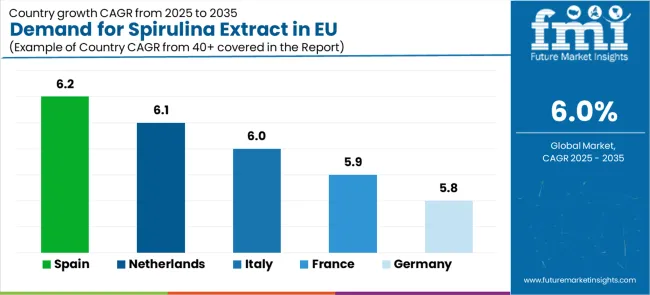
The Demand for Spirulina Extract in EU in EU demonstrates consistent growth across major economies, with Rest of Europe leading at a 6.3% CAGR through 2036, driven by emerging wellness markets and expanding superfood adoption. Spain follows at 6.2%, supported by growing health consciousness culture and Mediterranean wellness traditions. Netherlands grows at 6.1%, integrating spirulina extract into advanced wellness practices. Italy and France record 6.0% and 5.9% respectively, emphasizing quality standards and organic wellness applications. Germany maintains steady growth at 5.8%, leveraging its established health supplement infrastructure. Overall, Germany maintains its leadership position while Rest of Europe emerges as a fast-growing market for premium spirulina extract adoption.
Germany Leads European Market with Established Health Supplement Culture
The spirulina extract industry in Germany is projected to exhibit steady growth with a CAGR of 5.8% through 2036, driven by exceptionally strong consumer tradition in natural health supplements and wellness products, comprehensively well-established distribution networks for organic and specialty nutritional products, and sophisticated regulatory frameworks supporting supplement quality standards throughout the country. Germany's advanced supplement regulations and internationally recognized quality standards through organizations including German Nutrition Society are creating substantial demand for certified organic and specialty spirulina extract products across diverse professional and consumer segments. Major health supplement companies including German wellness brands, specialized superfood retailers including health food chains, and professional distribution networks are systematically establishing extensive product portfolios serving both health-conscious consumers and wellness professionals throughout German urban centers, suburban areas, and rural communities. The German market benefits from exceptionally high consumer awareness of nutritional supplementation, substantial health food retail presence, strong private label programs delivering quality at accessible price points, and cultural emphasis on natural health solutions that naturally support premium spirulina extract adoption.
- Regulatory environment emphasizing comprehensive quality standards and transparent supplement labeling requirements
- Strong health supplement distribution networks capturing substantial market share through scientific validation and quality assurance
- Consumer sophistication driving demand for organic certifications and detailed nutritional information
France Demonstrates Strong Growth with Wellness Integration
The spirulina extract industry in France is expanding at a steady CAGR of 5.9%, substantially supported by increasing French consumer preference for premium wellness products and natural health solutions, growing awareness of superfood benefits, and sophisticated appreciation for nutritional excellence reflecting French health culture. France's well-established wellness tradition and premium positioning strategies across health sectors are systematically driving demand for high-quality spirulina extract across diverse wellness and supplement segments. Specialized health food suppliers including French wellness companies, traditional natural health retailers, major pharmacy chains (Pharmacia, health-focused hypermarkets), and professional wellness practitioners are establishing comprehensive product ranges featuring premium imported and French-distributed spirulina extract emphasizing organic certification and health benefits. The French market particularly benefits from strong cultural emphasis on health quality traditions, natural wellness techniques, and preventive health methods that align perfectly with spirulina extract positioning as essential wellness components for superior health results.
- Wellness industry development programs creating opportunities for professional spirulina extract knowledge advancement
- Professional health practitioner training and expert recommendations enhancing spirulina extract expertise and market penetration
- Cultural emphasis on health excellence supporting higher-value spirulina extract positioning strategies
Italy Maintains Strong Growth with Traditional Wellness Integration
The spirulina extract industry in Italy is growing at a consistent CAGR of 6.0%, fundamentally driven by increasing integration of spirulina extract into traditional Italian wellness patterns, growing recognition of superfood health enhancement benefits, and strong Italian cultural appreciation for natural ingredients and traditional wellness values. Italy's deeply established wellness culture is gradually incorporating specialty spirulina extract to enhance traditional health approaches, improve nutritional profiles, and modernize classic Italian wellness methods while maintaining authentic regional characteristics. Professional wellness manufacturers, specialized supplement distributors including Italian suppliers, leading pharmacy retailers (major Italian wellness groups), and traditional health suppliers are strategically investing in education programs and wellness demonstrations addressing growing Italian interest in superfood solutions. The Italian market particularly benefits from strong cultural appreciation for ingredient naturalness, traditional family-oriented wellness approaches reflecting close cultural health traditions, and growing wellness capacity particularly in Northern Italian regions supporting premium supplement adoption.
- Wellness industry innovation programs facilitating spirulina extract integration in traditional Italian health products
- Professional wellness training programs enhancing technical knowledge among industry providers and wellness specialists
- Regional wellness development incorporating Mediterranean health ingredients and traditional Italian wellness methods
Spain Focuses on Innovation and Mediterranean Wellness Growth
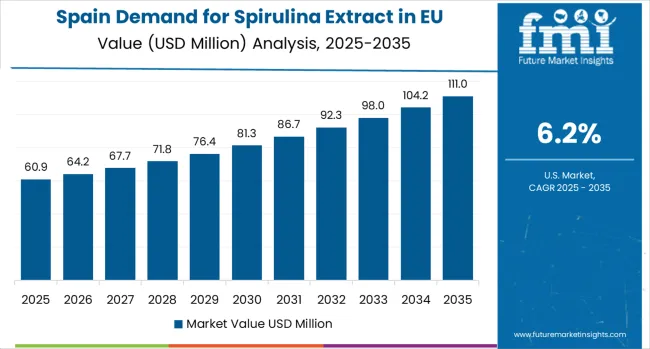
Demand for Spirulina Extract in EU in Spain is projected to grow at a strong CAGR of 6.2%, substantially supported by rapidly expanding wellness sector that actively promotes superfood applications, increasing Spanish consumer awareness of health benefits, and growing health consciousness particularly in major metropolitan areas including Madrid, Barcelona, Valencia, and Seville. Spanish wellness sector is experiencing significant modernization with expansion of health supplement retailers, premium superfood suppliers, and major pharmacy distributors systematically increasing spirulina extract category investments and introducing premium wellness capabilities. The Spanish market is increasingly characterized by wellness trends reflecting broader European patterns, growing interest in spirulina extract formulations addressing specific health applications, and increasing acceptance of higher investment levels for quality superfoods delivering visible health benefits. Spain's substantial health and wellness focus, strong cultural appreciation for natural health solutions reflecting Mediterranean values, and expanding wellness manufacturing capacity create favorable conditions for spirulina extract market expansion.
- Health and wellness industry investments prioritizing superfood applications for health-conscious consumers and wellness innovation
- Professional wellness certification programs ensuring technical expertise among service providers and health specialists
- Export market development leveraging Spain's position in Mediterranean and Latin American wellness relationships
Netherlands Emphasizes Innovation and Organic Leadership
Demand for Spirulina Extract in EU in the Netherlands is expanding at a robust CAGR of 6.1%, fundamentally driven by exceptionally strong Dutch commitment to organic health products, premium superfood solutions, and wellness consciousness that positions Netherlands among European organic health leaders. Dutch consumers and wellness professionals are increasingly selecting spirulina extract based on comprehensive organic credentials, verified sustainable production through European standards, and complete documentation demonstrating health benefits and quality profiles throughout development processes. The Netherlands market significantly benefits from exceptionally well-developed organic health research infrastructure including major wellness companies, specialized superfood suppliers, and professional health distributors, combined with demonstrated willingness to invest substantial resources in spirulina extract with verified organic certifications and quality standards. Dutch regulatory environment actively supports organic health innovation, superfood research development, transparent health claim requirements, and quality validation initiatives that enhance consumer confidence and market development.
- Organic leadership driving consumer demand for scientifically validated premium spirulina extract products
- Research infrastructure supporting comprehensive organic product development and professional health access
- Quality excellence emphasis encouraging development of organic validation and wellness advancement practices
Competitive Landscape
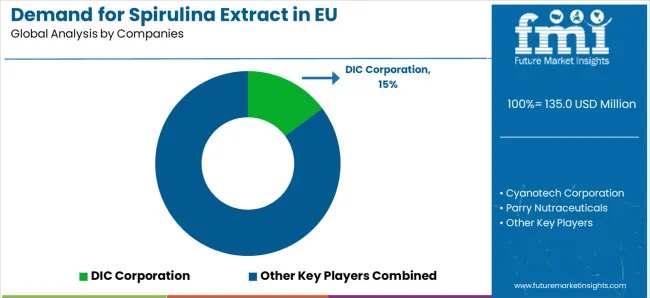
The Demand for Spirulina Extract in EU in EU is defined by intense competition among multinational superfood corporations, regional European manufacturers, specialized organic producers, and wellness companies from major health supplement suppliers. Companies are investing in European production capacity expansion, advanced extraction technologies, organic spirulina sourcing development through European sustainability centers, quality enhancement solutions aligned with EU supplement directives, and direct-to-consumer distribution platforms serving diverse European health-conscious markets. Strategic acquisitions, product portfolio expansion, geographic market penetration across Eastern European growth markets, professional wellness practitioner partnership programs, and organic certifications are central to strengthening market position and capturing share in this dynamic European category.
Major market participants include DIC Corporation with significant European market presence through large-scale production solutions and comprehensive spirulina extract capabilities distributed through European health channels. Cyanotech Corporation maintains substantial European market leadership through Hawaiian premium quality positioning and diverse applications across specialty wellness sectors including professional and consumer markets. Parry Nutraceuticals emphasizes cost-effective supply and technical support services for professional supplement manufacturers across European markets. Sensient Technologies represents significant European natural nutrition processing with specialized color and nutrition solutions and comprehensive wellness technologies.
Regional European producers and specialized organic brands are establishing significant market presence through premium organic positioning, EU organic certifications, specialty spirulina extract formulations including enhanced bioavailability alternatives and sustainable options, and direct-to-consumer business models. Organic wellness programs from major European health initiatives including established superfood programs provide naturally sourced alternatives supporting market development, capturing meaningful market share particularly in sustainability-driven wellness markets. European co-processing specialists including specialized extraction processors operate comprehensive production facilities serving both branded manufacturers and wellness customers, representing critical infrastructure enabling market expansion and product innovation across European health supplement markets.
Key Players in the Demand for Spirulina Extract in EU in EU
- DIC Corporation
- Cyanotech Corporation
- Parry Nutraceuticals
- Sensient Technologies
- Fuqing King Dnarmsa
- DDW The Color House
- European Regional Producers
- Organic Wellness Brands
- Specialty Extract Manufacturers
- Health Supplement Innovators
Scope of the Report
| Metric | Value |
|---|---|
| Quantitative Units | USD 143.1 million to USD 256.3 million, CAGR 6.0% |
| Market Definition | Spirulina extract is a concentrated preparation derived from the cyanobacterium Arthrospira platensis (spirulina), supplied in powder, liquid, and tablet/capsule formats for use in nutraceuticals, dietary supplements, functional foods, beverages, cosmetics, and animal feed applications. The extract contains phycocyanin (blue pigment), protein, vitamins, minerals, and essential fatty acids. |
| Segmentation | Product Type (Powder, Liquid, Tablet/Capsule), Application (Nutraceuticals, Dietary Supplements, Health Products, Wellness Formulations, Food & Beverage, Functional Foods, Beverages, Nutrition Products, Cosmetics & Personal Care, Animal Feed), Distribution Channel (Supermarkets/Hypermarkets, Specialty Stores, Health Food Retailers, Nutrition Stores, Online Retail, E-commerce Platforms, Direct-to-Consumer Websites), Nature (Conventional, Organic) |
| Regions Covered | Europe (EU member states) |
| Countries Covered | Spain, Netherlands, Italy, France, Germany |
| Key Companies Profiled | DIC Corporation, Cyanotech Corporation, Parry Nutraceuticals, Sensient Technologies, Fuqing King Dnarmsa, DDW The Color House, Organic Wellness Brands, Specialty Extract Manufacturers, Health Supplement Innovators |
| Forecast Period | 2026 to 2036 |
| Approach | Hybrid bottom-up methodology using production, trade flow, and consumption metrics, cross-validated against company disclosures. |
Key Segments
Product Type:
- Powder
- Liquid
- Tablet/Capsule
Application:
- Nutraceuticals
- Dietary Supplements
- Health Products
- Wellness Formulations
- Food & Beverage
- Functional Foods
- Beverages
- Nutrition Products
- Cosmetics & Personal Care
- Animal Feed
Distribution Channel:
- Online Retail
- E-commerce Platforms
- Direct-to-Consumer Websites
- Specialty Stores
- Health Food Retailers
- Nutrition Stores
- Supermarkets/Hypermarkets
Nature:
- Conventional
- Organic
Countries:
- Germany
- France
- Italy
- Spain
- Netherlands
- Rest of Europe
Bibliography
- European Commission. (2024). Regulation (EC) No 1333/2008 on Food Additives: Colouring Foodstuffs Guidance, Updated 2024. EUR-Lex.
- European Food Safety Authority (EFSA). (2024). Scientific Opinion on the Safety of Phycocyanin from Spirulina as a Food Colourant. EFSA Journal.
- European Commission. (2024). Regulation (EU) 2018/848 on Organic Production: Microalgae Cultivation Standards. EUR-Lex.
- DIC Corporation. (2024). Annual Report 2024: Health and Nutrition Division, Spirulina Business. DIC.
- Food and Agriculture Organization of the United Nations (FAO). (2024). Review of Microalgae for Food and Feed: Production, Processing, and Safety. FAO.
This bibliography is provided for reader reference. The full FMI report contains the complete reference list with primary research documentation.
This Report Addresses
- Market sizing and forecast metrics for spirulina extract across EU end-use sectors through 2036.
- Segmentation analysis mapping adoption velocity and regulatory factors driving product migration.
- Country-level intelligence comparing growth across major EU markets.
- Regulatory compliance assessment analyzing EU safety, labelling, and classification standards.
- Competitive posture evaluation tracking supplier dynamics and margin structures.
- Strategic procurement guidance defining supply agreement and inventory management parameters.
- Supply chain vulnerability analysis identifying origin-concentration and import dependency risks.
- Custom data delivery: interactive dashboards, raw Excel datasets, and PDF narrative reports.
Frequently Asked Questions
How large is the EU demand for Spirulina Extract in 2026?
EU demand is estimated at USD 143.1 million in 2026.
What will be the EU market size by 2036?
Projected to reach USD 256.3 million by 2036.
What is the expected CAGR between 2026 and 2036?
Expected CAGR of 6.0% between 2026 and 2036.
Which Nature leads by 2026?
Conventional accounts for 63.0% share in 2026.
How is Powder positioned in 2026?
Powder holds 55.0% segment share in 2026.
Which country leads growth?
Spain grows at 6.2% CAGR through 2036.
What is the Germany outlook?
Germany expands at 5.8% CAGR during 2026 to 2036.
What does the forecast represent?
A model-based projection built on production, consumption, and trade flow assumptions, cross-validated by FMI against company disclosures and EU trade statistics.
Preview the report firsthand - request a free sample
Get SampleGet the brochure for pricing and purchase details.
Get PDFTable of Content
- Executive Summary
- Global Market Outlook
- Demand-side Trends
- Supply-side Trends
- Technology Roadmap Analysis
- Analysis and Recommendations
- Market Overview
- Market Coverage / Taxonomy
- Market Definition / Scope / Limitations
- Research Methodology
- Chapter Orientation
- Analytical Lens and Working Hypotheses
- Market Structure, Signals, and Trend Drivers
- Benchmarking and Cross-market Comparability
- Market Sizing, Forecasting, and Opportunity Mapping
- Research Design and Evidence Framework
- Desk Research Programme (Secondary Evidence)
- Company Annual and Sustainability Reports
- Peer-reviewed Journals and Academic Literature
- Corporate Websites, Product Literature, and Technical Notes
- Earnings Decks and Investor Briefings
- Statutory Filings and Regulatory Disclosures
- Technical White Papers and Standards Notes
- Trade Journals, Industry Magazines, and Analyst Briefs
- Conference Proceedings, Webinars, and Seminar Materials
- Government Statistics Portals and Public Data Releases
- Press Releases and Reputable Media Coverage
- Specialist Newsletters and Curated Briefings
- Sector Databases and Reference Repositories
- FMI Internal Proprietary Databases and Historical Market Datasets
- Subscription Datasets and Paid Sources
- Social Channels, Communities, and Digital Listening Inputs
- Additional Desk Sources
- Expert Input and Fieldwork (Primary Evidence)
- Primary Modes
- Qualitative Interviews and Expert Elicitation
- Quantitative Surveys and Structured Data Capture
- Blended Approach
- Why Primary Evidence is Used
- Field Techniques
- Interviews
- Surveys
- Focus Groups
- Observational and In-context Research
- Social and Community Interactions
- Stakeholder Universe Engaged
- C-suite Leaders
- Board Members
- Presidents and Vice Presidents
- R&D and Innovation Heads
- Technical Specialists
- Domain Subject-matter Experts
- Scientists
- Physicians and Other Healthcare Professionals
- Governance, Ethics, and Data Stewardship
- Research Ethics
- Data Integrity and Handling
- Primary Modes
- Tooling, Models, and Reference Databases
- Desk Research Programme (Secondary Evidence)
- Data Engineering and Model Build
- Data Acquisition and Ingestion
- Cleaning, Normalisation, and Verification
- Synthesis, Triangulation, and Analysis
- Quality Assurance and Audit Trail
- Market Background
- Market Dynamics
- Drivers
- Restraints
- Opportunity
- Trends
- Scenario Forecast
- Demand in Optimistic Scenario
- Demand in Likely Scenario
- Demand in Conservative Scenario
- Opportunity Map Analysis
- Product Life Cycle Analysis
- Supply Chain Analysis
- Investment Feasibility Matrix
- Value Chain Analysis
- PESTLE and Porter’s Analysis
- Regulatory Landscape
- Regional Parent Market Outlook
- Production and Consumption Statistics
- Import and Export Statistics
- Market Dynamics
- Global Market Analysis 2021 to 2025 and Forecast, 2026 to 2036
- Historical Market Size Value (USD Million) Analysis, 2021 to 2025
- Current and Future Market Size Value (USD Million) Projections, 2026 to 2036
- Y-o-Y Growth Trend Analysis
- Absolute $ Opportunity Analysis
- Global Market Pricing Analysis 2021 to 2025 and Forecast 2026 to 2036
- Global Market Analysis 2021 to 2025 and Forecast 2026 to 2036, By Product Type
- Introduction / Key Findings
- Historical Market Size Value (USD Million) Analysis By Product Type , 2021 to 2025
- Current and Future Market Size Value (USD Million) Analysis and Forecast By Product Type , 2026 to 2036
- Powder
- Liquid
- Tablet/Capsule
- Powder
- Y-o-Y Growth Trend Analysis By Product Type , 2021 to 2025
- Absolute $ Opportunity Analysis By Product Type , 2026 to 2036
- Global Market Analysis 2021 to 2025 and Forecast 2026 to 2036, By Application
- Introduction / Key Findings
- Historical Market Size Value (USD Million) Analysis By Application, 2021 to 2025
- Current and Future Market Size Value (USD Million) Analysis and Forecast By Application, 2026 to 2036
- Nutraceuticals
- Dietary Supplements
- Health Products
- Wellness Formulations
- Food & Beverage
- Functional Foods
- Beverages
- Nutrition Products
- Cosmetics & Personal Care
- Animal Feed
- Nutraceuticals
- Y-o-Y Growth Trend Analysis By Application, 2021 to 2025
- Absolute $ Opportunity Analysis By Application, 2026 to 2036
- Global Market Analysis 2021 to 2025 and Forecast 2026 to 2036, By Distribution Channel
- Introduction / Key Findings
- Historical Market Size Value (USD Million) Analysis By Distribution Channel, 2021 to 2025
- Current and Future Market Size Value (USD Million) Analysis and Forecast By Distribution Channel, 2026 to 2036
- Supermarkets/Hypermarkets
- Specialty Stores
- Health Food Retailers
- Nutrition Stores
- Online Retail
- E-commerce Platforms
- Direct-to-Consumer Websites
- Supermarkets/Hypermarkets
- Y-o-Y Growth Trend Analysis By Distribution Channel, 2021 to 2025
- Absolute $ Opportunity Analysis By Distribution Channel, 2026 to 2036
- Global Market Analysis 2021 to 2025 and Forecast 2026 to 2036, By Nature
- Introduction / Key Findings
- Historical Market Size Value (USD Million) Analysis By Nature, 2021 to 2025
- Current and Future Market Size Value (USD Million) Analysis and Forecast By Nature, 2026 to 2036
- Conventional
- Organic
- Conventional
- Y-o-Y Growth Trend Analysis By Nature, 2021 to 2025
- Absolute $ Opportunity Analysis By Nature, 2026 to 2036
- Global Market Analysis 2021 to 2025 and Forecast 2026 to 2036, By Region
- Introduction
- Historical Market Size Value (USD Million) Analysis By Region, 2021 to 2025
- Current Market Size Value (USD Million) Analysis and Forecast By Region, 2026 to 2036
- North America
- Latin America
- Western Europe
- Eastern Europe
- East Asia
- South Asia and Pacific
- Middle East & Africa
- Market Attractiveness Analysis By Region
- North America Market Analysis 2021 to 2025 and Forecast 2026 to 2036, By Country
- Historical Market Size Value (USD Million) Trend Analysis By Market Taxonomy, 2021 to 2025
- Market Size Value (USD Million) Forecast By Market Taxonomy, 2026 to 2036
- By Country
- USA
- Canada
- Mexico
- By Product Type
- By Application
- By Distribution Channel
- By Nature
- By Country
- Market Attractiveness Analysis
- By Country
- By Product Type
- By Application
- By Distribution Channel
- By Nature
- Key Takeaways
- Latin America Market Analysis 2021 to 2025 and Forecast 2026 to 2036, By Country
- Historical Market Size Value (USD Million) Trend Analysis By Market Taxonomy, 2021 to 2025
- Market Size Value (USD Million) Forecast By Market Taxonomy, 2026 to 2036
- By Country
- Brazil
- Chile
- Rest of Latin America
- By Product Type
- By Application
- By Distribution Channel
- By Nature
- By Country
- Market Attractiveness Analysis
- By Country
- By Product Type
- By Application
- By Distribution Channel
- By Nature
- Key Takeaways
- Western Europe Market Analysis 2021 to 2025 and Forecast 2026 to 2036, By Country
- Historical Market Size Value (USD Million) Trend Analysis By Market Taxonomy, 2021 to 2025
- Market Size Value (USD Million) Forecast By Market Taxonomy, 2026 to 2036
- By Country
- Germany
- UK
- Italy
- Spain
- France
- Nordic
- BENELUX
- Rest of Western Europe
- By Product Type
- By Application
- By Distribution Channel
- By Nature
- By Country
- Market Attractiveness Analysis
- By Country
- By Product Type
- By Application
- By Distribution Channel
- By Nature
- Key Takeaways
- Eastern Europe Market Analysis 2021 to 2025 and Forecast 2026 to 2036, By Country
- Historical Market Size Value (USD Million) Trend Analysis By Market Taxonomy, 2021 to 2025
- Market Size Value (USD Million) Forecast By Market Taxonomy, 2026 to 2036
- By Country
- Russia
- Poland
- Hungary
- Balkan & Baltic
- Rest of Eastern Europe
- By Product Type
- By Application
- By Distribution Channel
- By Nature
- By Country
- Market Attractiveness Analysis
- By Country
- By Product Type
- By Application
- By Distribution Channel
- By Nature
- Key Takeaways
- East Asia Market Analysis 2021 to 2025 and Forecast 2026 to 2036, By Country
- Historical Market Size Value (USD Million) Trend Analysis By Market Taxonomy, 2021 to 2025
- Market Size Value (USD Million) Forecast By Market Taxonomy, 2026 to 2036
- By Country
- China
- Japan
- South Korea
- By Product Type
- By Application
- By Distribution Channel
- By Nature
- By Country
- Market Attractiveness Analysis
- By Country
- By Product Type
- By Application
- By Distribution Channel
- By Nature
- Key Takeaways
- South Asia and Pacific Market Analysis 2021 to 2025 and Forecast 2026 to 2036, By Country
- Historical Market Size Value (USD Million) Trend Analysis By Market Taxonomy, 2021 to 2025
- Market Size Value (USD Million) Forecast By Market Taxonomy, 2026 to 2036
- By Country
- India
- ASEAN
- Australia & New Zealand
- Rest of South Asia and Pacific
- By Product Type
- By Application
- By Distribution Channel
- By Nature
- By Country
- Market Attractiveness Analysis
- By Country
- By Product Type
- By Application
- By Distribution Channel
- By Nature
- Key Takeaways
- Middle East & Africa Market Analysis 2021 to 2025 and Forecast 2026 to 2036, By Country
- Historical Market Size Value (USD Million) Trend Analysis By Market Taxonomy, 2021 to 2025
- Market Size Value (USD Million) Forecast By Market Taxonomy, 2026 to 2036
- By Country
- Kingdom of Saudi Arabia
- Other GCC Countries
- Turkiye
- South Africa
- Other African Union
- Rest of Middle East & Africa
- By Product Type
- By Application
- By Distribution Channel
- By Nature
- By Country
- Market Attractiveness Analysis
- By Country
- By Product Type
- By Application
- By Distribution Channel
- By Nature
- Key Takeaways
- Key Countries Market Analysis
- USA
- Pricing Analysis
- Market Share Analysis, 2025
- By Product Type
- By Application
- By Distribution Channel
- By Nature
- Canada
- Pricing Analysis
- Market Share Analysis, 2025
- By Product Type
- By Application
- By Distribution Channel
- By Nature
- Mexico
- Pricing Analysis
- Market Share Analysis, 2025
- By Product Type
- By Application
- By Distribution Channel
- By Nature
- Brazil
- Pricing Analysis
- Market Share Analysis, 2025
- By Product Type
- By Application
- By Distribution Channel
- By Nature
- Chile
- Pricing Analysis
- Market Share Analysis, 2025
- By Product Type
- By Application
- By Distribution Channel
- By Nature
- Germany
- Pricing Analysis
- Market Share Analysis, 2025
- By Product Type
- By Application
- By Distribution Channel
- By Nature
- UK
- Pricing Analysis
- Market Share Analysis, 2025
- By Product Type
- By Application
- By Distribution Channel
- By Nature
- Italy
- Pricing Analysis
- Market Share Analysis, 2025
- By Product Type
- By Application
- By Distribution Channel
- By Nature
- Spain
- Pricing Analysis
- Market Share Analysis, 2025
- By Product Type
- By Application
- By Distribution Channel
- By Nature
- France
- Pricing Analysis
- Market Share Analysis, 2025
- By Product Type
- By Application
- By Distribution Channel
- By Nature
- India
- Pricing Analysis
- Market Share Analysis, 2025
- By Product Type
- By Application
- By Distribution Channel
- By Nature
- ASEAN
- Pricing Analysis
- Market Share Analysis, 2025
- By Product Type
- By Application
- By Distribution Channel
- By Nature
- Australia & New Zealand
- Pricing Analysis
- Market Share Analysis, 2025
- By Product Type
- By Application
- By Distribution Channel
- By Nature
- China
- Pricing Analysis
- Market Share Analysis, 2025
- By Product Type
- By Application
- By Distribution Channel
- By Nature
- Japan
- Pricing Analysis
- Market Share Analysis, 2025
- By Product Type
- By Application
- By Distribution Channel
- By Nature
- South Korea
- Pricing Analysis
- Market Share Analysis, 2025
- By Product Type
- By Application
- By Distribution Channel
- By Nature
- Russia
- Pricing Analysis
- Market Share Analysis, 2025
- By Product Type
- By Application
- By Distribution Channel
- By Nature
- Poland
- Pricing Analysis
- Market Share Analysis, 2025
- By Product Type
- By Application
- By Distribution Channel
- By Nature
- Hungary
- Pricing Analysis
- Market Share Analysis, 2025
- By Product Type
- By Application
- By Distribution Channel
- By Nature
- Kingdom of Saudi Arabia
- Pricing Analysis
- Market Share Analysis, 2025
- By Product Type
- By Application
- By Distribution Channel
- By Nature
- Turkiye
- Pricing Analysis
- Market Share Analysis, 2025
- By Product Type
- By Application
- By Distribution Channel
- By Nature
- South Africa
- Pricing Analysis
- Market Share Analysis, 2025
- By Product Type
- By Application
- By Distribution Channel
- By Nature
- USA
- Market Structure Analysis
- Competition Dashboard
- Competition Benchmarking
- Market Share Analysis of Top Players
- By Regional
- By Product Type
- By Application
- By Distribution Channel
- By Nature
- Competition Analysis
- Competition Deep Dive
- DIC Corporation
- Overview
- Product Portfolio
- Profitability by Market Segments (Product/Age /Sales Channel/Region)
- Sales Footprint
- Strategy Overview
- Marketing Strategy
- Product Strategy
- Channel Strategy
- Cyanotech Corporation
- Parry Nutraceuticals
- Sensient Technologies
- Fuqing King Dnarmsa
- DDW The Color House
- European Regional Producers
- Organic Wellness Brands
- Specialty Extract Manufacturers
- Health Supplement Innovators
- DIC Corporation
- Competition Deep Dive
- Assumptions & Acronyms Used


