

- Industry Size (2026)
- USD 174.0 Mn
- Forecast (2036)
- USD 389.8 Mn
- CAGR (2026 to 2036)
- 8.4%
Eucommia Leaf Extract Market Size, Market Forecast and Outlook By FMI
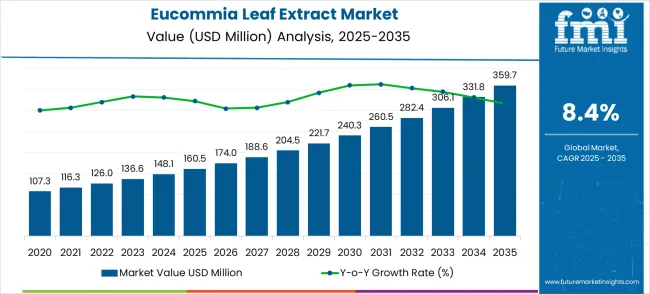
The eucommia leaf extract market was valued at USD 160.5 million in 2025, projected to reach USD 174.0 million in 2026, and is forecast to expand to USD 389.8 million by 2036 at a 8.4% CAGR. The Eucommia leaf extract market is expanding as clinical and preclinical research continues to validate the bioactive properties of chlorogenic acid, the primary phenolic compound in Eucommia leaves.
Animal feed applications are an emerging growth area, with Eucommia leaf extract used as a natural growth promoter and immune modulator in poultry and swine diets. Chinese livestock feed manufacturers are incorporating CGA-rich extracts as alternatives to antibiotic growth promoters, aligning with national antimicrobial reduction targets. Cosmetic applications use Eucommia leaf extract for its antioxidant and skin-protective properties in anti-ageing serums and sun care formulations. The 98% high-purity CGA grade serves pharmaceutical and research applications where standardised active ingredient content is required.
All major consumption markets reflect differentiated growth trajectories. China sets a 11.3% CAGR, India sets a 10.5% CAGR, Germany sets a 9.7% CAGR, Brazil sets a 8.8% CAGR, USA sets a 8.0% CAGR, UK sets a 7.1% CAGR, and Japan registers a 6.3% pace through the forecast period.
Summary of Eucommia Leaf Extract Market
- Eucommia Leaf Extract Market Definition
- The Eucommia leaf extract market covers the production, processing, and distribution of bioactive extracts derived from the leaves of Eucommia ulmoides (Du Zhong), a deciduous tree native to China. The primary active compound is chlorogenic acid (CGA), with commercial extracts standardised at 5%, 25%, and 98% CGA concentrations.
- Demand Drivers in the Market
- Chlorogenic Acid Clinical Evidence Base Expansion: Published clinical studies documenting CGA effects on blood pressure, glucose metabolism, and antioxidant status are expanding the credible evidence base for health product claims.
- Animal Feed Antibiotic Alternative Demand: Chinese national antimicrobial reduction targets for livestock production are creating demand for natural feed additives with documented growth-promoting and immune-modulating properties.
- Functional Food Ingredient Adoption: Functional food manufacturers in Japan and China are incorporating Eucommia leaf extract into beverages, snack bars, and tea products targeting health-conscious consumers.
- Key Segments Analyzed in the FMI Report
- 25% Chlorogenic Acid (Purity Level): 46.0% share in 2026.
- Health Products (Application): 42.0% share in 2026.
- China: 11.3% compound growth, the fastest among tracked countries.
- Analyst Opinion at FMI
- Based on Nandini Roy Choudhury, Principal Consultant for Food & Beverage analysis, the Eucommia leaf extract market is transitioning from a TCM-niche botanical ingredient to a clinically positioned bioactive compound with multi-sector applications. Manufacturers that invest in high-purity CGA extraction capacity (25% and 98% grades) and clinical data documentation will capture the premium pricing tiers in health products and pharmaceutical intermediates.
- Strategic Implications / Executive Takeaways
- Extract manufacturers should invest in chromatographic purification capacity to produce 98% CGA pharmaceutical-grade product and capture premium pricing in research and drug intermediate markets.
- Health product companies should fund clinical trials documenting blood pressure and metabolic health effects of standardised CGA formulations to support regulatory claims in the EU, United States, and Japan.
- Animal feed additive producers should develop standardised Eucommia leaf extract inclusion protocols with documented growth performance data to compete in the antibiotic-alternative feed ingredient market.
- Methodology
- Primary Research: FMI conducted technical interviews with production managers, procurement leads, and supply chain directors across 40 countries to validate adoption timelines and market sizing assumptions.
- Desk Research: Analysts aggregated public trade databases, regulatory filings, and production statistics from government and multilateral sources.
- Data Validation and Update Cycle: Segment forecasts undergo cross-validation against trade volumes, production data, and corporate revenue disclosures.
Eucommia Leaf Extract Market Key Takeaways
| Metric | Details |
|---|---|
| Industry Size (2026) | USD 174.0 Million |
| Industry Value (2036) | USD 389.8 Million |
| CAGR (2026-2036) | 8.4% |
Source: Future Market Insights, 2026
Eucommia Leaf Extract Market Definition
The Eucommia leaf extract market covers the production, processing, and distribution of bioactive extracts derived from the leaves of Eucommia ulmoides (Du Zhong), a deciduous tree native to China. The primary active compound is chlorogenic acid (CGA), with commercial extracts standardised at 5%, 25%, and 98% CGA concentrations. Applications span health products (dietary supplements targeting blood pressure and joint health), functional foods, cosmetics, animal feed additives, and pharmaceutical intermediates.
Eucommia Leaf Extract Market Inclusions
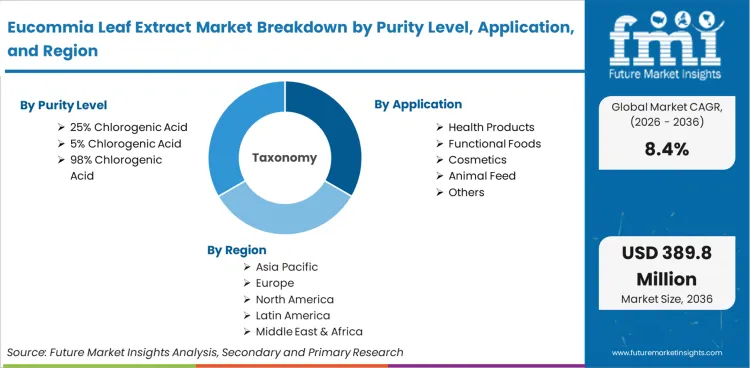
Market scope covers Eucommia leaf extracts by purity level (5% chlorogenic acid, 25% chlorogenic acid, 98% chlorogenic acid) and by application (health products, functional foods, cosmetics, animal feed, others). Global and regional market sizing, chlorogenic acid standardisation analysis, and end-use application mapping are included.
Eucommia Leaf Extract Market Exclusions
The scope excludes Eucommia bark extract (the traditional TCM product Du Zhong Pi), Eucommia rubber (gutta-percha extracted from bark and leaves for industrial use), and synthetic chlorogenic acid produced via chemical synthesis. Raw dried Eucommia leaves sold without extraction processing fall outside the defined boundary.
Eucommia Leaf Extract Market Research Methodology
- Primary Research: Analysts engaged with procurement specialists, production managers, and supply chain directors to map decision gates and adoption timelines across key consumption regions.
- Desk Research: Data collection aggregated trade statistics, regulatory filings, production capacity databases, and national standards ratification schedules from government and multilateral sources.
- Market-Sizing and Forecasting: Baseline values derive from a hybrid top-down and bottom-up aggregation of trade volumes, production data, and consumption estimates, applying region-specific growth curves to project forecast-period trajectory.
- Data Validation and Update Cycle: Projections are cross-validated against publicly reported production volumes, trade data, and corporate financial disclosures on an annual update cycle.
Why is the Eucommia Leaf Extract Market Growing?
Market expansion is being supported by the rapid increase in consumer demand for natural health products worldwide and the corresponding need for standardized botanical extracts that provide documented health benefits and superior antioxidant properties in modern nutraceutical and functional food formulations. Modern supplement manufacturers rely on eucommia leaf extracts to deliver consistent bioactive compound concentrations and comprehensive quality assurance including dietary supplements, functional beverages, and cosmetic formulations. Even minor standardization inconsistencies can require comprehensive formulation adjustments to maintain optimal product efficacy and regulatory compliance.
The growing complexity of nutraceutical formulation requirements and increasing demand for evidence-based botanical ingredients are driving demand for eucommia leaf extracts from certified extract manufacturers with appropriate standardization capabilities and phytochemical expertise. Supplement companies and functional food manufacturers are increasingly requiring documented chlorogenic acid content and bioactivity validation to maintain product quality and marketing claim substantiation. Industry specifications and regulatory standards are establishing standardized extract procedures that require specialized extraction technologies and trained phytochemical analysts.
Opportunity Pathway -- Eucommia Leaf Extract Market
Eucommia Leaf Extract Market Opportunity Pools
The Eucommia Leaf Extract market is entering a new phase of robust growth, driven by demand for natural antioxidants, functional ingredients, and evolving nutraceutical standards. By 2036, these pathways together can unlock USD 75-95 million in incremental revenue opportunities beyond baseline growth.
Pathway A -- Health Products Excellence (Nutraceutical Applications) The health products segment already holds the largest share due to proven antioxidant and metabolic benefits. Expanding clinical research, evidence-based formulations, and personalized nutrition applications can consolidate leadership. Opportunity pool: USD 25-32 million.
Pathway B -- Premium Standardization Leadership (High-Purity Extracts) High standardization levels offer superior bioactivity and premium positioning. Enhanced 25% and 98% chlorogenic acid extracts with validated bioavailability create substantial growth opportunities. Opportunity pool: USD 18-25 million.
Pathway C -- Functional Foods Integration (Food & Beverage Applications) Functional foods represent growing demand for natural antioxidants in everyday products. Enhanced extract solutions for beverages, dairy, and bakery applications offer substantial potential. Opportunity pool: USD 12-18 million.
Pathway D -- Cosmetic Applications Expansion (Anti-Aging Products) Cosmetic applications require natural antioxidants for anti-aging and skin health. Specialized extracts for topical applications and cosmeceuticals create premium market segments. Opportunity pool: USD 10-15 million.
Pathway E -- Bioavailability Enhancement Innovation (Advanced Formulations) Enhanced bioavailability technologies improve efficacy and enable premium positioning. Advanced delivery systems and nano-formulations offer substantial value creation opportunities. Opportunity pool: USD 8-12 million.
Pathway F -- Animal Nutrition Applications (Feed Additives) Animal feed applications require natural antioxidants for livestock health. Enhanced extract solutions for poultry, swine, and aquaculture create growing market opportunities. Opportunity pool: USD 6-9 million.
Pathway G -- Emerging Market Penetration (Global Health Awareness) Developing countries are expanding natural health product adoption. Cost-effective extract solutions for emerging markets create volume growth opportunities. Opportunity pool: USD 4-6 million.
Pathway H -- Sustainable Sourcing and Certification Sustainability certifications and ethical sourcing create premium positioning. Organic, fair-trade, and sustainably sourced extracts offer advanced market differentiation. Opportunity pool: USD 3-5 million.
Segmental Analysis
The market is segmented by purity level, application, and region. By purity level, the market is divided into 5% chlorogenic acid, 25% chlorogenic acid, 98% chlorogenic acid, and others. Based on application, the market is categorized into health products, functional foods, cosmetics, animal feed, and others. Regionally, the market is divided into North America, Europe, East Asia, South Asia & Pacific, Latin America, and Middle East & Africa.
By Purity Level, 25% Chlorogenic Acid Segment Accounts for 46% Market Share
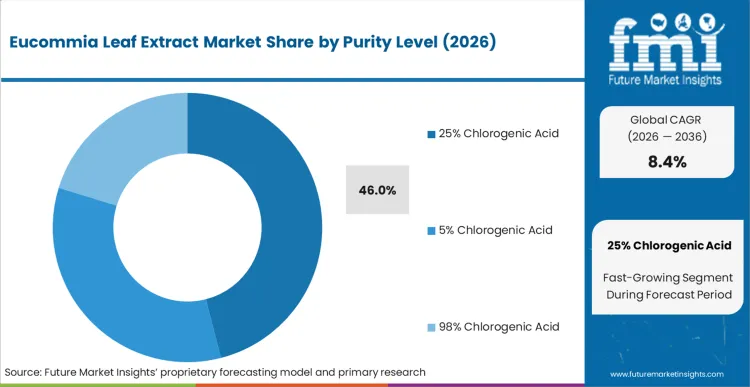
In 2026, the 25% chlorogenic acid eucommia leaf extract segment is projected to capture around 46% of the total market share, making it the leading purity category. This dominance is largely driven by the widespread adoption of standardized extract concentrations that provide optimal balance between bioactivity and cost-effectiveness, catering to a wide variety of nutraceutical and functional food applications with diverse formulation requirements. 25% chlorogenic acid extract technology is particularly favored for its ability to deliver significant antioxidant benefits while maintaining reasonable production costs and formulation compatibility. Supplement manufacturers, functional food producers, cosmetic companies, and nutraceutical formulators increasingly prefer this standardization level, as it meets efficacy requirements without imposing excessive raw material costs or complex processing procedures.
The availability of well-established extraction protocols, along with comprehensive analytical methods and technical documentation from leading botanical extract manufacturers, further reinforces the segment's market position. Additionally, this purity category benefits from consistent demand across regions, as it is considered a practical high-performance solution for manufacturers requiring proven bioactivity with commercial viability. The combination of proven efficacy, cost optimization, and formulation flexibility makes 25% chlorogenic acid eucommia leaf extracts a preferred choice, ensuring their continued popularity in the botanical extract market.
By Application, Health Products Segment Accounts for 42% Market Share
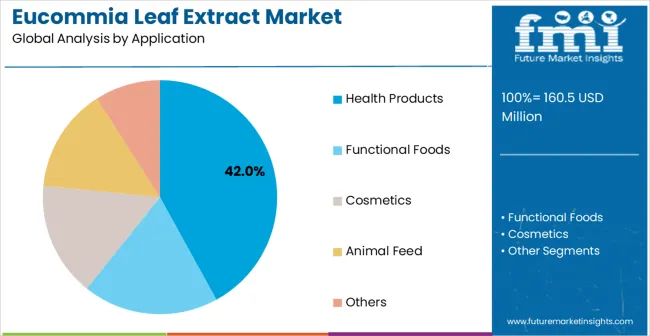
The health products segment is expected to represent 42% of eucommia leaf extract demand in 2026, highlighting its position as the most significant application sector. This dominance stems from the unique operational needs of the nutraceutical industry, where natural antioxidant ingredients and proven health benefits are critical to product differentiation and consumer acceptance. Health product manufacturing often features complex formulation requirements that extend throughout lengthy product development cycles, demanding reliable and standardized botanical ingredients. Eucommia leaf extracts are particularly well-suited to these applications due to their ability to provide consistent chlorogenic acid content with documented antioxidant and metabolic health benefits, even in challenging formulation matrices. As supplement companies globally advance toward evidence-based natural ingredients and clean label formulations, the demand for standardized botanical extracts continues to rise.
The segment also benefits from increased consumer interest in metabolic health and antioxidant supplementation programs, where manufacturers are increasingly prioritizing natural ingredient sourcing and bioactivity validation as essential product features. With health product companies investing in premium natural ingredients and scientific substantiation programs, eucommia leaf extracts provide an essential solution to deliver superior product efficacy. The growth of personalized nutrition, functional supplements, and evidence-based natural health products, coupled with increased focus on botanical ingredient standardization, ensures that health products will remain the largest and most stable demand driver for eucommia leaf extracts in the forecast period.
What are the Drivers, Restraints, and Key Trends of the Eucommia Leaf Extract Market?
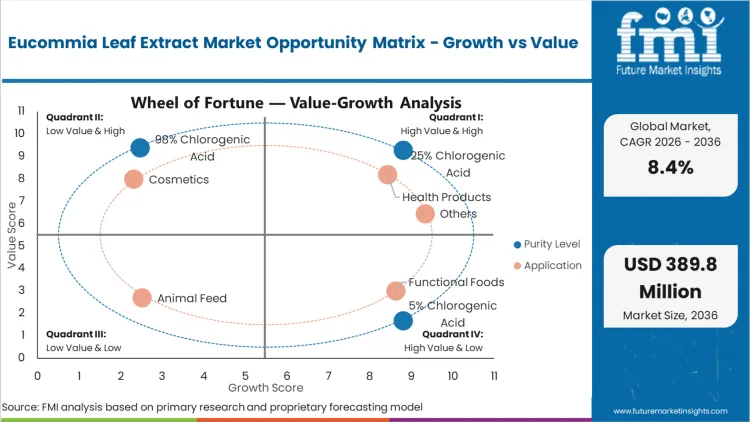
The Eucommia Leaf Extract market is advancing steadily due to increasing consumer interest in natural health products and growing recognition of chlorogenic acid benefits over synthetic antioxidants in nutraceutical applications. However, the market faces challenges including seasonal supply variations affecting raw material availability, complex standardization requirements for different bioactive compounds, and varying regulatory classifications across different geographic regions. Performance optimization efforts and extraction technology advancement programs continue to influence processing methods and market adoption patterns.
Advancement of Extraction Technology Optimization
The growing development of advanced extraction technologies is enabling enhanced bioactive compound recovery with improved purity levels and reduced processing costs. Advanced extraction methods and purification techniques provide superior chlorogenic acid yields while maintaining cost-effective production scalability. These technologies are particularly valuable for botanical extract manufacturers and supplement companies who require reliable extraction processes that can support diverse product requirements with consistent quality performance.
Integration of Bioavailability Enhancement Technologies
Modern eucommia leaf extract manufacturers are incorporating advanced bioavailability enhancement techniques and formulation technologies that improve absorption and biological activity. Integration of nano-encapsulation systems and bioavailability enhancers enables superior product efficacy and comprehensive formulation capabilities. Advanced enhancement features support application in diverse nutraceutical environments while meeting various efficacy requirements and formulation specifications.
Analysis of Eucommia Leaf Extract Market by Key Country
.webp "Top Country Growth Comparison Eucommia Leaf Extract Market Cagr (2026 2036)")
| Country | CAGR |
|---|---|
| China | 11.3% |
| India | 10.5% |
| Germany | 9.7% |
| Brazil | 8.8% |
| United States | 8.0% |
| United Kingdom | 7.1% |
| Japan | 6.3% |
Source: FMI analysis based on primary research and proprietary forecasting model
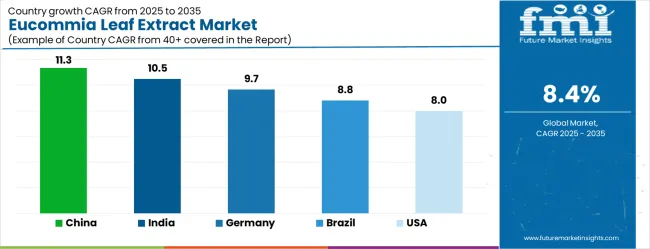
The eucommia leaf extract market is experiencing strong growth, with China leading at an 11.3% CAGR through 2036, driven by extensive traditional medicine integration and increasing adoption of standardized herbal extracts across nutraceutical manufacturing, functional food production, and traditional Chinese medicine modernization sectors. India follows at 10.5%, supported by rising Ayurvedic and herbal medicine industry growth and growing demand for natural antioxidant ingredients in health product manufacturing. Germany grows robustly at 9.7%, integrating eucommia leaf extract technology into its established phytopharmaceutical and nutraceutical manufacturing infrastructure. Brazil records 8.8%, emphasizing natural product industry modernization and botanical extract development initiatives. The United States shows substantial growth at 8.0%, focusing on dietary supplement innovation and functional food advancement. The United Kingdom demonstrates strong progress at 7.1%, maintaining established nutraceutical applications and botanical research leadership. Japan records 6.3% growth, concentrating on premium natural ingredient manufacturing and ultra-high quality extract standards.
The report covers an in-depth analysis of 40+ countries, the top-performing countries are highlighted below.
In-depth Review of Eucommia Leaf Extract Market in China
The eucommia leaf extract market in China is projected to exhibit the highest growth rate with a CAGR of 11.3% through 2036, driven by extensive traditional Chinese medicine modernization programs and increasing demand for standardized herbal extracts across nutraceutical manufacturing, functional food production, and pharmaceutical applications. The country's rich botanical heritage and growing domestic health product capabilities are creating significant demand for advanced eucommia leaf extract systems. Major herbal extract manufacturers and nutraceutical companies are establishing comprehensive standardization facilities to support the increasing requirements of domestic and international markets across major traditional medicine development zones.
National traditional medicine development initiatives are supporting establishment of world-class botanical extraction facilities and phytochemical research centers, driving demand for advanced extract processing equipment throughout major herbal medicine industrial parks. Traditional medicine modernization programs are facilitating adoption of standardized extraction technologies that enhance product quality and international market competitiveness across herbal medicine supply chains.
- Traditional medicine expansion programs promote advanced extract standardization adoption among herbal manufacturers throughout key botanical development zones nationwide
- Herbal modernization initiatives support extraction technology integration and quality enhancement for traditional medicine development centers
Revenue Prospects for Eucommia Leaf Extract Market in India
The eucommia leaf extract market in India is expanding at a CAGR of 10.5%, supported by increasing Ayurvedic and herbal medicine industry development and growing awareness of natural antioxidant benefits for health product applications. The country's expanding traditional medicine sector and rising natural product export standards are driving demand for advanced eucommia leaf extract solutions. Ayurvedic companies and herbal product manufacturers are gradually implementing standardized extraction processes to maintain international quality standards and export competitiveness.
Ayurvedic industry growth and global market integration are creating opportunities for extract suppliers that can support diverse formulation requirements and international quality specifications. Professional training and development programs are building technical expertise among herbal processing professionals, enabling effective utilization of standardized extract technology that meets international standards and regulatory requirements.
- Ayurvedic industry development programs facilitate adoption of standardized extract technology that supports international quality standards across herbal product sectors
- Professional training initiatives enhance extraction capabilities among herbal professionals, enabling effective eucommia leaf extract utilization throughout Ayurvedic establishments
Market Assessment for Eucommia Leaf Extract Market in Germany
The eucommia leaf extract market in Germany is projected to grow at a CAGR of 9.7%, supported by the country's emphasis on phytopharmaceutical quality standards and advanced botanical extract manufacturing adoption. German nutraceutical companies and phytopharmaceutical manufacturers are implementing cutting-edge eucommia leaf extract systems that meet stringent regulatory requirements and international quality specifications. The market is characterized by focus on extract standardization, bioactivity validation, and compliance with comprehensive pharmaceutical engineering standards.
Phytopharmaceutical industry investments are prioritizing advanced extraction technology that demonstrates superior bioactive compound recovery and regulatory compliance while meeting German quality and international pharmaceutical standards. Professional certification programs are ensuring comprehensive technical expertise among botanical extraction engineers and phytochemical specialists, enabling specialized extract processing capabilities that support diverse pharmaceutical applications and regulatory requirements.
- Phytopharmaceutical excellence programs emphasize advanced extract standardization adoption and quality standards that maintain German technical and regulatory requirements
- Professional training initiatives develop comprehensive botanical extraction expertise among engineers, supporting specialized eucommia leaf extract capabilities throughout phytopharmaceutical sectors
Market Penetration Analysis for Eucommia Leaf Extract Market in Brazil
The eucommia leaf extract market in Brazil is growing at a CAGR of 8.8%, driven by increasing natural product industry modernization and growing recognition of botanical extract advantages for nutraceutical and functional food applications. The country's expanding herbal product sector is gradually integrating advanced extraction equipment to enhance product standardization and international market access. Natural product companies and botanical manufacturers are investing in eucommia leaf extract technology to address evolving quality expectations and export competitiveness.
Natural product modernization is facilitating adoption of advanced extraction technologies that support comprehensive botanical manufacturing capabilities across production regions. Professional development programs are enhancing technical capabilities among botanical processing professionals, enabling effective eucommia leaf extract utilization that meets evolving quality standards and international requirements.
- Natural product modernization initiatives promote advanced extraction technology adoption that enhances botanical manufacturing capabilities and international competitiveness across herbal sectors
- Professional development programs build botanical processing capabilities among professionals, enabling specialized eucommia leaf extract integration skills throughout natural product establishments
Opportunity Analysis for Eucommia Leaf Extract Market in United States
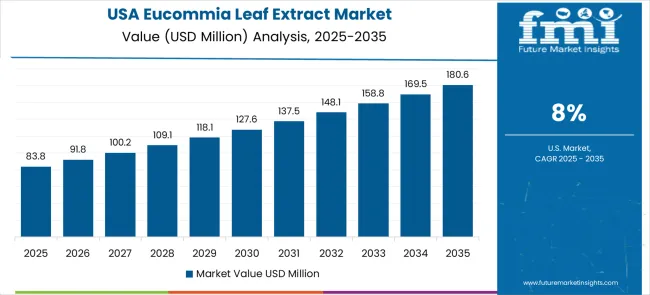
The eucommia leaf extract market in the USA is expanding at a CAGR of 8.0%, driven by established dietary supplement industry leadership and growing emphasis on natural ingredient innovation and functional food advancement. Large supplement companies and functional food manufacturers are implementing comprehensive eucommia leaf extract capabilities to serve diverse nutraceutical and food application requirements. The market benefits from established botanical extract networks and professional training programs that support various supplement and functional food applications.
Dietary supplement industry leadership is enabling standardized extract utilization across multiple product types, providing consistent bioactivity and comprehensive quality coverage throughout regional nutraceutical markets. Professional development and certification programs are building specialized technical expertise among supplement formulators and food technologists, enabling effective eucommia leaf extract utilization that supports evolving product development requirements.
- Dietary supplement innovation integration facilitates standardized extract workflows across product types, providing consistent quality standards and comprehensive bioactivity coverage throughout regional markets
- Professional certification programs develop specialized nutraceutical expertise among formulators, enabling advanced extract capabilities that support diverse supplement and functional food requirements
Growth Outlook for Eucommia Leaf Extract Market in United Kingdom
The eucommia leaf extract market in the UK is projected to grow at a CAGR of 7.1%, supported by established nutraceutical research sectors and growing emphasis on botanical ingredient innovation capabilities. British supplement companies and functional food providers are implementing eucommia leaf extract solutions that meet industry quality standards and international regulatory requirements. The market benefits from established botanical research infrastructure and comprehensive training programs for nutraceutical professionals.
Nutraceutical research investments are prioritizing advanced botanical extraction systems that support diverse health product applications while maintaining established quality and regulatory standards. Professional development programs are building botanical expertise among research personnel, enabling specialized eucommia leaf extract operation capabilities that meet evolving institutional requirements and nutraceutical technology standards.
- Nutraceutical research enhancement programs support advanced extract technology adoption that maintains quality standards and research effectiveness throughout botanical sectors
- Professional training initiatives build comprehensive botanical skills among research personnel, enabling specialized eucommia leaf extract operation capabilities throughout nutraceutical and botanical establishments
Demand Assessment for Eucommia Leaf Extract Market in Japan
The eucommia leaf extract market in Japan is growing at a CAGR of 6.3%, driven by the country's focus on premium natural ingredient manufacturing innovation and ultra-high quality botanical extract applications. Japanese nutraceutical companies and botanical manufacturers are implementing advanced eucommia leaf extract systems that demonstrate superior purity reliability and operational excellence. The market is characterized by emphasis on technological perfection, quality assurance, and integration with established natural ingredient manufacturing workflows.
Natural ingredient industry investments are prioritizing innovative extraction solutions that combine advanced eucommia leaf processing with precision engineering while maintaining Japanese quality and reliability standards. Professional development programs are ensuring comprehensive technical expertise among botanical engineers and quality specialists, enabling specialized precision extraction capabilities that support diverse nutraceutical applications and quality requirements.
- Precision innovation programs promote advanced eucommia leaf extract development and quality enhancement features that maintain Japanese natural ingredient accuracy and reliability standards
- Professional certification initiatives develop comprehensive botanical expertise among engineers, supporting advanced extraction capabilities and natural ingredient quality assurance requirements
Europe Market Split by Country
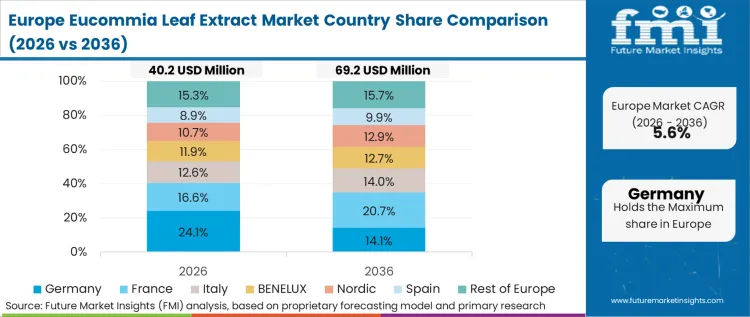
The eucommia leaf extract market in Europe is forecast to expand from USD 41.9 million in 2026 to USD 94.0 million by 2036, registering a CAGR of 8.4%. Germany will remain the largest market, holding 33.0% share in 2026, easing to 32.5% by 2036, supported by strong phytopharmaceutical infrastructure and advanced botanical extract manufacturing capabilities. The United Kingdom follows, rising from 27.5% in 2026 to 28.0% by 2036, driven by nutraceutical research innovation and botanical ingredient advancement. France is expected to maintain stability around 22.0%, reflecting steady natural product investment patterns. Italy maintains stability at around 11.0%, supported by nutraceutical manufacturing and herbal product growth, while Spain grows from 4.5% to 5.0% with expanding botanical infrastructure and natural product modernization. BENELUX markets ease from 1.8% to 1.7%, while the remainder of Europe hovers near 0.2%-0.3%, balancing emerging Eastern European botanical development against mature Nordic natural ingredient markets.
Competitive Landscape of Eucommia Leaf Extract Market
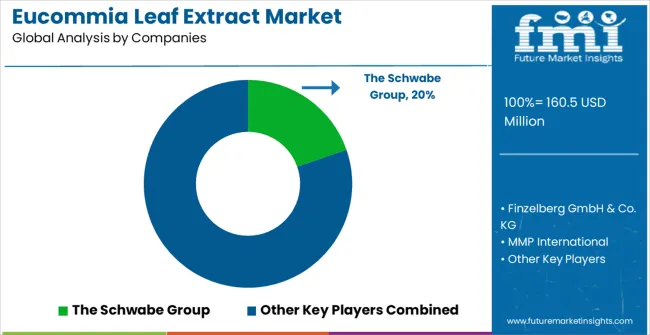
The Eucommia Leaf Extract market is defined by competition among specialized botanical extract manufacturers, phytochemical companies, and natural ingredient solution providers. Companies are investing in advanced extraction technology development, standardization optimization, bioactivity enhancement improvements, and comprehensive application capabilities to deliver reliable, standardized, and cost-effective botanical extract solutions. Strategic partnerships, technological innovation, and market expansion are central to strengthening product portfolios and market presence.
The Schwabe Group offers comprehensive phytopharmaceutical solutions with established botanical extraction expertise and standardization capabilities. Finzelberg GmbH & Co. KG provides specialized botanical extract manufacturing with focus on pharmaceutical-grade standardization and quality assurance. MMP International delivers advanced natural ingredient technology with emphasis on nutraceutical applications and international market supply. Wellgreen Technology specializes in herbal extract manufacturing with comprehensive standardization integration.
Xi'an Tianguangyuan Biotechnology offers botanical extraction solutions with focus on traditional Chinese medicine applications and modern standardization processes. Naturalin Bio-Resources provides natural ingredient manufacturing with emphasis on international quality standards and export markets. Shaanxi Huachen Biotechnology delivers botanical processing with comprehensive extraction capabilities. Shanghai YiYi Biotechnology, Xi'an Rainbow Biotech, Changsha Staherb Natural Ingredients, Shandong Longchang Animal Health Products, and Shaanxi Muyun Biotech offer specialized botanical expertise, extraction reliability, and comprehensive product development across global and regional natural ingredient market segments.
Key Players in the Eucommia Leaf Extract Market
- The Schwabe Group
- Finzelberg GmbH & Co. KG
- MMP International
- Wellgreen Technology
- Xi'an Tianguangyuan Biotechnology
- Naturalin Bio-Resources
- Shaanxi Huachen Biotechnology
- Shanghai YiYi Biotechnology
- Xi'an Rainbow Biotech
- Changsha Staherb Natural Ingredients
- Shandong Longchang Animal Health Products
- Shaanxi Muyun Biotech
Scope of the Report
| Metric | Value |
|---|---|
| Quantitative Units | USD 174.0 Mn to USD 389.8 Mn, at a CAGR of 8.4% |
| Market Definition | The Eucommia leaf extract market covers the production, processing, and distribution of bioactive extracts derived from the leaves of Eucommia ulmoides (Du Zhong), a deciduous tree native to China. The primary active compound is chlorogenic acid (CGA), with commercial extracts standardised at 5%, 25%, and 98% CGA concentrations. |
| Purity Level Segmentation | 5% Chlorogenic Acid, 25% Chlorogenic Acid, 98% Chlorogenic Acid |
| Application Segmentation | Health Products, Functional Foods, Cosmetics, Animal Feed, Others |
| Regions Covered | North America, Latin America, Europe, East Asia, South Asia, Oceania, Middle East & Africa |
| Countries Covered | China, India, Germany, Brazil, USA, UK, Japan, and 40 plus countries |
| Key Companies Profiled | The Schwabe Group, Finzelberg GmbH & Co. KG, MMP International, Wellgreen Technology, Xi'an Tianguangyuan Biotechnology, Naturalin Bio-Resources, Shaanxi Huachen Biotechnology, Shanghai YiYi Biotechnology, Xi'an Rainbow Biotech, Changsha Staherb Natural Ingredients, Shandong Longchang Animal Health Products, Shaanxi Muyun Biotech |
| Forecast Period | 2026 to 2036 |
| Approach | Hybrid top-down and bottom-up modelling starting with trade volumes, production data, and consumption estimates, cross-validated against primary interviews and public financial disclosures. |
Eucommia Leaf Extract Market by Segments
Purity Level:
- 5% Chlorogenic Acid
- 25% Chlorogenic Acid
- 98% Chlorogenic Acid
Application:
- Health Products
- Functional Foods
- Cosmetics
- Animal Feed
- Others
Region:
- North America
- United States
- Canada
- Mexico
- Europe
- Germany
- United Kingdom
- France
- Italy
- Spain
- Nordic
- BENELUX
- Rest of Europe
- East Asia
- China
- Japan
- South Korea
- South Asia & Pacific
- India
- ASEAN
- Australia & New Zealand
- Rest of South Asia & Pacific
- Latin America
- Brazil
- Chile
- Rest of Latin America
- Middle East & Africa
- Kingdom of Saudi Arabia
- Other GCC Countries
- Turkiye
- South Africa
- Other African Union
- Rest of Middle East & Africa
Bibliography
- 1. Food and Agriculture Organization of the United Nations. (2024). FAOSTAT Statistical Database. FAO.
- 2. World Health Organization. (2024). Global Health Observatory Data Repository. WHO.
- 3. Organisation for Economic Co-operation and Development. (2024). OECD-FAO Agricultural Outlook 2024-2033. OECD Publishing.
- 4. European Commission, Directorate-General for Health and Food Safety. (2024). EU Regulatory Framework for Food and Feed Safety. European Commission.
- 5. United States Food and Drug Administration. (2024). CFSAN Guidance Documents. FDA.
- 6. International Organization for Standardization. (2024). ISO 22000 Food Safety Management Systems. ISO.
- 7. United States Department of Agriculture. (2024). Global Agricultural Trade System. USDA Foreign Agricultural Service.
This bibliography is provided for reader reference. The full FMI report contains the complete reference list with primary research documentation.
Frequently Asked Questions
How large is the demand for Eucommia Leaf Extract in the global market in 2026?
Demand for Eucommia Leaf Extract in the global market is estimated to be valued at USD 174.0 million in 2026.
What will be the market size of Eucommia Leaf Extract in the global market by 2036?
Market size for Eucommia Leaf Extract is projected to reach USD 389.8 million by 2036.
What is the expected demand growth for Eucommia Leaf Extract in the global market between 2026 and 2036?
Demand for Eucommia Leaf Extract is expected to grow at a CAGR of 8.4% between 2026 and 2036.
Which Purity Level is poised to lead global sales by 2026?
25% Chlorogenic Acid accounts for 46.0% share in 2026 based on FMI analysis.
How is the role of Health Products in driving Eucommia Leaf Extract adoption in 2026?
Health Products represents 42.0% of application segment share in 2026.
What is driving demand in China?
China leads with a 11.3% CAGR through 2036, driven by expanding domestic consumption, production capacity, and favourable regulatory dynamics.
What is the India growth outlook in this report?
India is projected to grow at a CAGR of 10.5% during 2026 to 2036.
Why is North America described as a priority region in this report?
North American markets are characterized by mature distribution infrastructure, stringent quality requirements, and sustained institutional demand that anchors a stable revenue base for industry participants.
Does the report cover USA in its regional analysis?
Yes, USA is included within North America under the regional scope of analysis.
Does the report cover Germany in its regional analysis?
Yes, Germany is included within Europe under the regional coverage framework.
What is Eucommia Leaf Extract and what is it mainly used for?
The Eucommia leaf extract market covers the production, processing, and distribution of bioactive extracts derived from the leaves of Eucommia ulmoides (Du Zhong), a deciduous tree native to China. The primary active compound is chlorogenic acid (CGA), with commercial extracts standardised at 5%, 25%, and 98% CGA concentrations.
What is included in the scope of this Eucommia Leaf Extract Market report?
Market scope covers Eucommia leaf extracts by purity level (5% chlorogenic acid, 25% chlorogenic acid, 98% chlorogenic acid) and by application (health products, functional foods, cosmetics, animal feed, others). Global and regional market sizing, chlorogenic acid standardisation analysis, and end-use application mapping are included.
What is excluded from the scope of this report?
The scope excludes Eucommia bark extract (the traditional TCM product Du Zhong Pi), Eucommia rubber (gutta-percha extracted from bark and leaves for industrial use), and synthetic chlorogenic acid produced via chemical synthesis. Raw dried Eucommia leaves sold without extraction processing fall outside the defined boundary.
How does FMI build and validate the Eucommia Leaf Extract forecast?
Forecasting models apply a hybrid top-down and bottom-up methodology starting with trade data, production volumes, and consumption estimates, cross-validated against primary interviews and publicly reported industry data.
What does zero reliance on speculative third-party market research mean here?
Primary interviews, verified public data sources, and official regulatory and trade registries are used exclusively instead of unverified syndicated estimates.
Preview the report firsthand - request a free sample
Get SampleGet the brochure for pricing and purchase details.
Get PDFTable of Content
- Executive Summary
- Global Market Outlook
- Demand-side Trends
- Supply-side Trends
- Technology Roadmap Analysis
- Analysis and Recommendations
- Market Overview
- Market Coverage / Taxonomy
- Market Definition / Scope / Limitations
- Research Methodology
- Chapter Orientation
- Analytical Lens and Working Hypotheses
- Market Structure, Signals, and Trend Drivers
- Benchmarking and Cross-market Comparability
- Market Sizing, Forecasting, and Opportunity Mapping
- Research Design and Evidence Framework
- Desk Research Programme (Secondary Evidence)
- Company Annual and Sustainability Reports
- Peer-reviewed Journals and Academic Literature
- Corporate Websites, Product Literature, and Technical Notes
- Earnings Decks and Investor Briefings
- Statutory Filings and Regulatory Disclosures
- Technical White Papers and Standards Notes
- Trade Journals, Industry Magazines, and Analyst Briefs
- Conference Proceedings, Webinars, and Seminar Materials
- Government Statistics Portals and Public Data Releases
- Press Releases and Reputable Media Coverage
- Specialist Newsletters and Curated Briefings
- Sector Databases and Reference Repositories
- FMI Internal Proprietary Databases and Historical Market Datasets
- Subscription Datasets and Paid Sources
- Social Channels, Communities, and Digital Listening Inputs
- Additional Desk Sources
- Expert Input and Fieldwork (Primary Evidence)
- Primary Modes
- Qualitative Interviews and Expert Elicitation
- Quantitative Surveys and Structured Data Capture
- Blended Approach
- Why Primary Evidence is Used
- Field Techniques
- Interviews
- Surveys
- Focus Groups
- Observational and In-context Research
- Social and Community Interactions
- Stakeholder Universe Engaged
- C-suite Leaders
- Board Members
- Presidents and Vice Presidents
- R&D and Innovation Heads
- Technical Specialists
- Domain Subject-matter Experts
- Scientists
- Physicians and Other Healthcare Professionals
- Governance, Ethics, and Data Stewardship
- Research Ethics
- Data Integrity and Handling
- Primary Modes
- Tooling, Models, and Reference Databases
- Desk Research Programme (Secondary Evidence)
- Data Engineering and Model Build
- Data Acquisition and Ingestion
- Cleaning, Normalisation, and Verification
- Synthesis, Triangulation, and Analysis
- Quality Assurance and Audit Trail
- Market Background
- Market Dynamics
- Drivers
- Restraints
- Opportunity
- Trends
- Scenario Forecast
- Demand in Optimistic Scenario
- Demand in Likely Scenario
- Demand in Conservative Scenario
- Opportunity Map Analysis
- Product Life Cycle Analysis
- Supply Chain Analysis
- Investment Feasibility Matrix
- Value Chain Analysis
- PESTLE and Porter’s Analysis
- Regulatory Landscape
- Regional Parent Market Outlook
- Production and Consumption Statistics
- Import and Export Statistics
- Market Dynamics
- Global Market Analysis 2021 to 2025 and Forecast, 2026 to 2036
- Historical Market Size Value (USD Million) Analysis, 2021 to 2025
- Current and Future Market Size Value (USD Million) Projections, 2026 to 2036
- Y-o-Y Growth Trend Analysis
- Absolute $ Opportunity Analysis
- Global Market Pricing Analysis 2021 to 2025 and Forecast 2026 to 2036
- Global Market Analysis 2021 to 2025 and Forecast 2026 to 2036, By Purity Level
- Introduction / Key Findings
- Historical Market Size Value (USD Million) Analysis By Purity Level , 2021 to 2025
- Current and Future Market Size Value (USD Million) Analysis and Forecast By Purity Level , 2026 to 2036
- 25% Chlorogenic Acid
- 5% Chlorogenic Acid
- 98% Chlorogenic Acid
- 25% Chlorogenic Acid
- Y-o-Y Growth Trend Analysis By Purity Level , 2021 to 2025
- Absolute $ Opportunity Analysis By Purity Level , 2026 to 2036
- Global Market Analysis 2021 to 2025 and Forecast 2026 to 2036, By Application
- Introduction / Key Findings
- Historical Market Size Value (USD Million) Analysis By Application, 2021 to 2025
- Current and Future Market Size Value (USD Million) Analysis and Forecast By Application, 2026 to 2036
- Health Products
- Functional Foods
- Cosmetics
- Animal Feed
- Others
- Health Products
- Y-o-Y Growth Trend Analysis By Application, 2021 to 2025
- Absolute $ Opportunity Analysis By Application, 2026 to 2036
- Global Market Analysis 2021 to 2025 and Forecast 2026 to 2036, By Region
- Introduction
- Historical Market Size Value (USD Million) Analysis By Region, 2021 to 2025
- Current Market Size Value (USD Million) Analysis and Forecast By Region, 2026 to 2036
- North America
- Latin America
- Western Europe
- Eastern Europe
- East Asia
- South Asia and Pacific
- Middle East & Africa
- Market Attractiveness Analysis By Region
- North America Market Analysis 2021 to 2025 and Forecast 2026 to 2036, By Country
- Historical Market Size Value (USD Million) Trend Analysis By Market Taxonomy, 2021 to 2025
- Market Size Value (USD Million) Forecast By Market Taxonomy, 2026 to 2036
- By Country
- USA
- Canada
- Mexico
- By Purity Level
- By Application
- By Country
- Market Attractiveness Analysis
- By Country
- By Purity Level
- By Application
- Key Takeaways
- Latin America Market Analysis 2021 to 2025 and Forecast 2026 to 2036, By Country
- Historical Market Size Value (USD Million) Trend Analysis By Market Taxonomy, 2021 to 2025
- Market Size Value (USD Million) Forecast By Market Taxonomy, 2026 to 2036
- By Country
- Brazil
- Chile
- Rest of Latin America
- By Purity Level
- By Application
- By Country
- Market Attractiveness Analysis
- By Country
- By Purity Level
- By Application
- Key Takeaways
- Western Europe Market Analysis 2021 to 2025 and Forecast 2026 to 2036, By Country
- Historical Market Size Value (USD Million) Trend Analysis By Market Taxonomy, 2021 to 2025
- Market Size Value (USD Million) Forecast By Market Taxonomy, 2026 to 2036
- By Country
- Germany
- UK
- Italy
- Spain
- France
- Nordic
- BENELUX
- Rest of Western Europe
- By Purity Level
- By Application
- By Country
- Market Attractiveness Analysis
- By Country
- By Purity Level
- By Application
- Key Takeaways
- Eastern Europe Market Analysis 2021 to 2025 and Forecast 2026 to 2036, By Country
- Historical Market Size Value (USD Million) Trend Analysis By Market Taxonomy, 2021 to 2025
- Market Size Value (USD Million) Forecast By Market Taxonomy, 2026 to 2036
- By Country
- Russia
- Poland
- Hungary
- Balkan & Baltic
- Rest of Eastern Europe
- By Purity Level
- By Application
- By Country
- Market Attractiveness Analysis
- By Country
- By Purity Level
- By Application
- Key Takeaways
- East Asia Market Analysis 2021 to 2025 and Forecast 2026 to 2036, By Country
- Historical Market Size Value (USD Million) Trend Analysis By Market Taxonomy, 2021 to 2025
- Market Size Value (USD Million) Forecast By Market Taxonomy, 2026 to 2036
- By Country
- China
- Japan
- South Korea
- By Purity Level
- By Application
- By Country
- Market Attractiveness Analysis
- By Country
- By Purity Level
- By Application
- Key Takeaways
- South Asia and Pacific Market Analysis 2021 to 2025 and Forecast 2026 to 2036, By Country
- Historical Market Size Value (USD Million) Trend Analysis By Market Taxonomy, 2021 to 2025
- Market Size Value (USD Million) Forecast By Market Taxonomy, 2026 to 2036
- By Country
- India
- ASEAN
- Australia & New Zealand
- Rest of South Asia and Pacific
- By Purity Level
- By Application
- By Country
- Market Attractiveness Analysis
- By Country
- By Purity Level
- By Application
- Key Takeaways
- Middle East & Africa Market Analysis 2021 to 2025 and Forecast 2026 to 2036, By Country
- Historical Market Size Value (USD Million) Trend Analysis By Market Taxonomy, 2021 to 2025
- Market Size Value (USD Million) Forecast By Market Taxonomy, 2026 to 2036
- By Country
- Kingdom of Saudi Arabia
- Other GCC Countries
- Turkiye
- South Africa
- Other African Union
- Rest of Middle East & Africa
- By Purity Level
- By Application
- By Country
- Market Attractiveness Analysis
- By Country
- By Purity Level
- By Application
- Key Takeaways
- Key Countries Market Analysis
- USA
- Pricing Analysis
- Market Share Analysis, 2025
- By Purity Level
- By Application
- Canada
- Pricing Analysis
- Market Share Analysis, 2025
- By Purity Level
- By Application
- Mexico
- Pricing Analysis
- Market Share Analysis, 2025
- By Purity Level
- By Application
- Brazil
- Pricing Analysis
- Market Share Analysis, 2025
- By Purity Level
- By Application
- Chile
- Pricing Analysis
- Market Share Analysis, 2025
- By Purity Level
- By Application
- Germany
- Pricing Analysis
- Market Share Analysis, 2025
- By Purity Level
- By Application
- UK
- Pricing Analysis
- Market Share Analysis, 2025
- By Purity Level
- By Application
- Italy
- Pricing Analysis
- Market Share Analysis, 2025
- By Purity Level
- By Application
- Spain
- Pricing Analysis
- Market Share Analysis, 2025
- By Purity Level
- By Application
- France
- Pricing Analysis
- Market Share Analysis, 2025
- By Purity Level
- By Application
- India
- Pricing Analysis
- Market Share Analysis, 2025
- By Purity Level
- By Application
- ASEAN
- Pricing Analysis
- Market Share Analysis, 2025
- By Purity Level
- By Application
- Australia & New Zealand
- Pricing Analysis
- Market Share Analysis, 2025
- By Purity Level
- By Application
- China
- Pricing Analysis
- Market Share Analysis, 2025
- By Purity Level
- By Application
- Japan
- Pricing Analysis
- Market Share Analysis, 2025
- By Purity Level
- By Application
- South Korea
- Pricing Analysis
- Market Share Analysis, 2025
- By Purity Level
- By Application
- Russia
- Pricing Analysis
- Market Share Analysis, 2025
- By Purity Level
- By Application
- Poland
- Pricing Analysis
- Market Share Analysis, 2025
- By Purity Level
- By Application
- Hungary
- Pricing Analysis
- Market Share Analysis, 2025
- By Purity Level
- By Application
- Kingdom of Saudi Arabia
- Pricing Analysis
- Market Share Analysis, 2025
- By Purity Level
- By Application
- Turkiye
- Pricing Analysis
- Market Share Analysis, 2025
- By Purity Level
- By Application
- South Africa
- Pricing Analysis
- Market Share Analysis, 2025
- By Purity Level
- By Application
- USA
- Market Structure Analysis
- Competition Dashboard
- Competition Benchmarking
- Market Share Analysis of Top Players
- By Regional
- By Purity Level
- By Application
- Competition Analysis
- Competition Deep Dive
- The Schwabe Group
- Overview
- Product Portfolio
- Profitability by Market Segments (Product/Age /Sales Channel/Region)
- Sales Footprint
- Strategy Overview
- Marketing Strategy
- Product Strategy
- Channel Strategy
- Finzelberg GmbH & Co. KG
- MMP International
- Wellgreen Technology
- Xi'an Tianguangyuan Biotechnology
- Naturalin Bio-Resources
- Shaanxi Huachen Biotechnology
- Shanghai YiYi Biotechnology
- Xi'an Rainbow Biotech
- Changsha Staherb Natural Ingredients
- Shandong Longchang Animal Health Products
- Shaanxi Muyun Biotech
- The Schwabe Group
- Competition Deep Dive
- Assumptions & Acronyms Used


