

- Industry Size (2025)
- USD 129.9 Mn
- Forecast (2035)
- USD 265.4 Mn
- CAGR (2025 to 2035)
- 7.4%
Squalane Market Forecast and Outlook 2025 to 2035
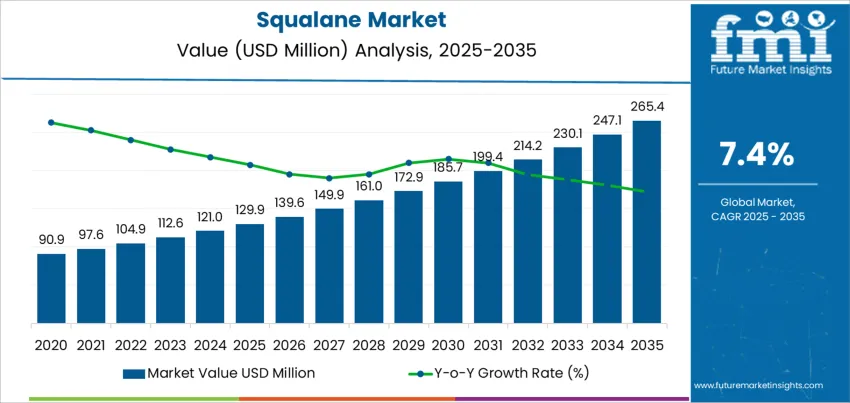
The squalane market is valued at USD 129.9 million in 2025 and is expected to reach USD 265.4 million by 2035, growing at a CAGR of 7.4%. Early growth comes from its use in facial oils, serums, moisturizers, and makeup bases where a light, non-greasy feel is important. More brands are moving from older mineral-based emollients to plant-derived squalane. Until 2030, growth mainly comes from adding more squalane into each formula, not from many new products. Most demand stays focused on leave-on skincare, lip products, and hair oils. Supply depends on sugarcane and olive sources, and available hydrogenation capacity decides how much can be produced in the near term.
After 2030, demand increases as squalane is used more in sun care, clinic-style skincare, and hydration products linked to barrier repair. The value rises from about USD 185.7 million in 2030 to USD 265.4 million by 2035 as brands increase usage to support stronger moisture claims. Baby care and sensitive-skin products add extra growth with fragrance-free and high-purity formulas. Makeup products also use more squalane in foundations, concealers, and creamy color cosmetics. Higher value comes from better cosmetic grades, not from large bulk volumes. Long-term growth depends on feedstock costs, efficient production, and continuous preference for lightweight, stable emollients in skincare and haircare.
Quick Stats of the Squalane Market
- Squalane Market Value (2025): USD 129.9 million
- Squalane Market Forecast Value (2035): USD 265.4 million
- Squalane Market Forecast CAGR (2025–2035): 7.4%
- Leading Product Form in Squalane Market: Powder (14.5%)
- Key Growth Regions in Squalane Market: Asia Pacific, Europe
- Top Players in Squalane Market: BASF SE, Croda International, Evonik Industries, Symrise (incl. IFF/Givaudan actives), Dow / Dow Inc., Ashland, Clariant, Seppic / Others
What is the Growth Forecast for the Squalane Market through 2035?
The global squalane market expands from USD 129.9 million in 2025 to USD 172.9 million by 2030, delivering an absolute increase of USD 43.0 million in the first half of the forecast period. The sales ramp during this phase follows a progressive acceleration pattern rather than a sharp inflection. Annual value additions move from USD 9.7 million between 2025 and 2026 to nearly USD 12.0 million by 2029 to 2030, showing a smooth upward slope in demand conversion. This ramp is driven by expanding baseline adoption across facial oils, moisturizers, sunscreens, and dermatology-grade skincare, with biofermentation-based squalane replacing animal-derived sources. Volume scaling is steady as brand reformulations and line extensions compound year over year.
From 2030 to 2035, the market advances from USD 172.9 million to USD 265.4 million, generating a stronger absolute gain of USD 92.5 million and a visibly steeper sales ramp curve. Annual value additions rise from about USD 12.8 million in the early 2030s to more than USD 18.3 million by the final years of the forecast window. This sharper ramp reflects deeper loading of squalane into multi-step skincare routines, hybrid skincare-makeup products, professional dermatology lines, and premium scalp care systems. Higher formulation intensity, greater penetration into mass-premium categories, and stable bio-based supply economics collectively steepen the long-term sales trajectory through 2035.
Squalane Industry Key Takeaways
| Metric | Value |
|---|---|
| Industry Value (2025) | USD 129.9 million |
| Forecast Value (2035) | USD 265.4 million |
| Forecast CAGR (2025–2035) | 7.4% |
How Is the Squalane Market Expanding Across Skincare, Hair Care, and Functional Beauty Applications?
The squalane market developed from the shift away from animal derived emollients toward stable, plant sourced alternatives that deliver high skin affinity and oxidation resistance. Early use centered on premium facial oils and serums where lightweight moisture retention and non greasy after feel were critical. As formulation science improved, squalane moved into cleansers, sunscreens, makeup, and hair care products due to its ability to dissolve actives, enhance spreadability, and strengthen barrier performance without clogging pores. Its chemical similarity to natural skin lipids supported broad dermatological acceptance. Over time, mass market brands adopted squalane as production scale improved and price barriers gradually declined, expanding its presence beyond prestige formulations.
Future growth of the squalane market will be shaped by skin barrier repair positioning, minimalist ingredient trends, and expansion of hybrid skincare makeup formats. As consumers prioritize long term skin resilience over short term cosmetic effects, squalane will gain further relevance in daily maintenance products rather than only treatment serums. Increased use is expected in scalp care, body care, and baby care where low irritation potential is valued. Barriers include feedstock dependency on sugar and olive derived supply chains, competition from hemisqualane and other light esters, and cost sensitivity in entry level beauty categories. Long term expansion will depend on stable bio derived sourcing, consistent purity control, and continued preference for lightweight non occlusive moisturization across global personal care markets.
How Are End Use Application and Product Form Structuring the Demand for Squalane?
The demand for squalane is structured by end use application and product form. Skin care represents 8.6% of total demand, followed by body care, hair care, sun care, color cosmetics, men grooming, baby and kids care, and dermocosmetic and professional care. By product form, powder accounts for 14.5% of total consumption, followed by granules and agglomerates, flakes, pellets and prills, liquid solutions, high active concentrates, dispersions and suspensions, emulsions, pastes, gels, wax or solid block formats, and oils. Demand behavior is shaped by lipid biomimicry performance, oxidative stability, non-comedogenic profile, sensory neutrality, and compatibility with both water-based and anhydrous formulation systems.
Why Does Skin Care Lead the Squalane End Use Demand?
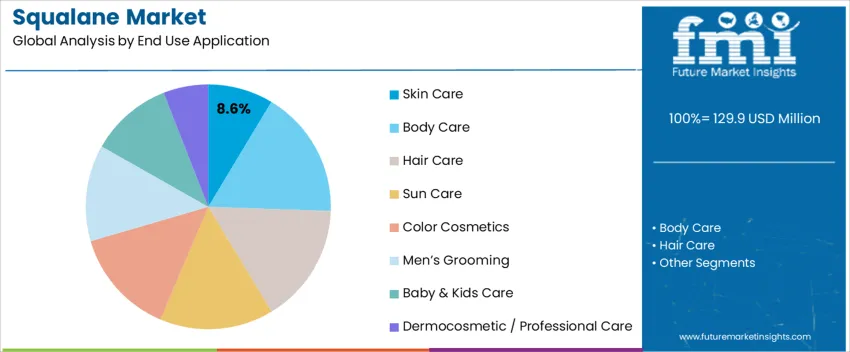
Skin care accounts for 8.6% of total squalane demand due to its close structural similarity to natural human sebum and its ability to restore lipid balance without clogging pores. Squalane forms a breathable emollient layer that improves skin softness and elasticity while limiting moisture loss. These traits support wide use in facial oils, serums, moisturizers, and barrier repair treatments targeting dehydrated, sensitive, and compromised skin conditions.
Skin care formulators favor squalane for its stable, non-rancid behavior and compatibility with active ingredients such as retinoids, ceramides, and botanical extracts. Its fast absorption profile allows comfortable daytime application without surface shine. The absence of fragrance and color further supports integration into dermatology-positioned and baby-safe products. These biomimetic lipid properties, oxidative resistance, and universal skin compatibility sustain skin care as the leading end use segment within squalane demand.
Why Does Powder Lead the Squalane Product Form Demand?
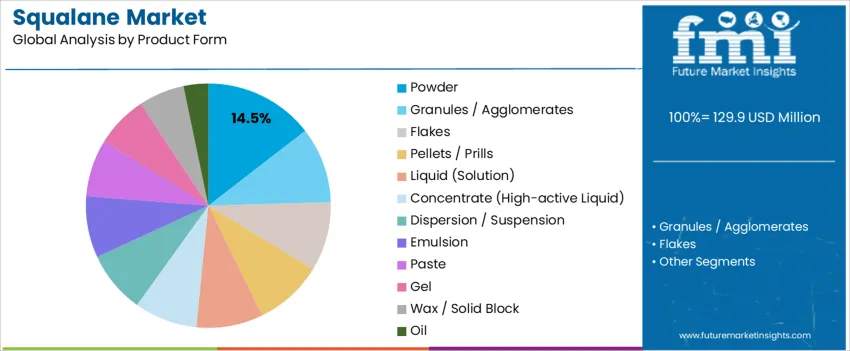
Powder accounts for 14.5% of total squalane demand due to its superior handling control, enhanced storage stability, and suitability for structured blending systems used in advanced cosmetic manufacturing. Powdered squalane allows precise modulation of emollience and slip across creams, gels, powders, and solid cosmetic formats without the flow variability associated with liquid oils. Low moisture exposure reduces oxidation risk and preserves consistent sensory performance during extended warehousing.
Powder form also integrates efficiently into pressed powders, sticks, balms, and hybrid formulations where oil migration must be controlled. It enables formulators to fine-tune skin feel without altering bulk viscosity. Packaging in moisture-barrier containers preserves free-flow characteristics during transport. These processing reliability, formulation flexibility, and shelf-life advantages position powder as the leading product form within the squalane demand structure.
Why Has Squalane Become the Benchmark for “Skin-Identical” Oil Performance Rather Than a Trend Emollient?
Squalane demand is anchored in its near-perfect compatibility with natural skin lipids rather than in novelty appeal. Its molecular structure closely mirrors components already present in human sebum, which allows it to spread evenly without disrupting barrier balance. It does not oxidize, thicken, or form surface films that interfere with breathability. This makes it suitable for compromised skin, post-procedure recovery, and long-term daily use. Its role is not to decorate the formula with shine or richness, but to stabilize moisture movement at the skin interface with minimal biological friction.
How Does Feedstock Origin Quietly Influence Brand Positioning and Supply Discipline?
Squalane is chemically identical regardless of whether it originates from sugarcane fermentation, olive byproducts, or synthetic routes, yet source identity quietly shapes market behavior. Sugar-based routes align with traceability and renewable narratives, which influences adoption in premium skincare. Olive-derived supply depends on agricultural byproduct volume and refining yield. Synthetic routes offer tight consistency but face perception barriers in certain regions. These parallel supply paths create segmentation not by performance, but by sourcing philosophy, certification frameworks, and long-term procurement stability rather than short-term price movement.
What Functional Limits Prevent Squalane from Replacing Every Oil in A Formula?
Despite its versatility, squalane cannot replace all lipid roles. It provides slip and softness but lacks the occlusive weight required for deep barrier-lock creams in harsh climates. It carries no inherent antioxidant or sensory richness on its own, which means it must be paired with actives or heavier lipids in performance-driven products. In haircare, it delivers shine but limited hold or repair structure. These boundaries keep squalane positioned as a structural stabilizer rather than a complete lipid system, preventing it from becoming a universal oil substitute.
Where Is Demand Quietly Expanding as Product Architecture Becomes More Skin-Responsive?
Demand for squalane is moving into skin-responsive formats that adjust to environment and physiology rather than imposing a fixed sensory profile. Adaptive moisturizers use it to balance hydration without trapping heat. Barrier-repair serums rely on it for lipid supplementation without congestion. Scalp care adopts it to normalize surface moisture without oil loading. In makeup, it maintains spread and blend time without influencing finish density. These shifts show squalane evolving into a modulation oil that responds to skin behavior instead of dominating it.
What Is the Global Growth Outlook for the Squalane Industry by Country?
| Country | CAGR (%) |
|---|---|
| India | 10.0 |
| China | 9.3 |
| Japan | 8.5 |
| UK | 7.8 |
| Germany | 7.0 |
| USA | 6.3 |
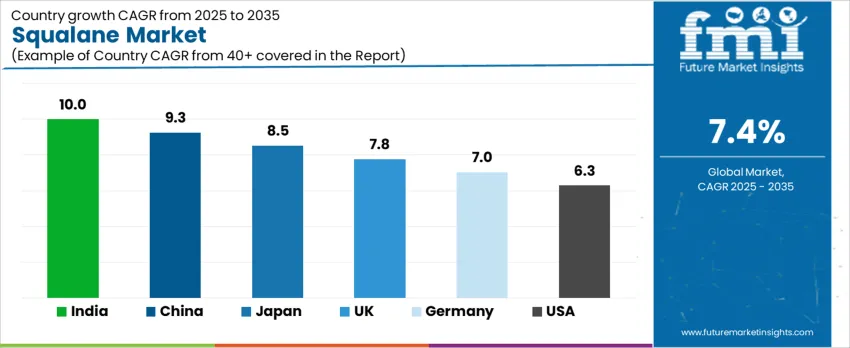
The squalane industry is expanding steadily across global personal care and cosmetic manufacturing markets, with India at a 10.0% CAGR. Growth in India is supported by rising demand for lightweight, plant-derived emollients in skincare, hair care, and hybrid cosmetic formulations, along with expanding domestic ingredient production. China follows at 9.3%, driven by large-scale cosmetic manufacturing, export-oriented formulation activity, and rising use of silicone alternative conditioning agents. Japan at 8.5% reflects stable adoption in premium skincare and dermatology focused products emphasizing barrier repair and hydration. The UK and Germany record 7.8% and 7.0% growth, supported by clean label cosmetic trends and demand for biodegradable emollients. The USA at 6.3% reflects a mature but steadily advancing market driven by premium beauty brands and multifunctional formulation demand.
What Is Accelerating Squalane Adoption in India Personal Care Manufacturing?
Expansion in India is progressing at a CAGR of 10.0% through 2035 for squalane demand, driven by rising production of lightweight skincare oils, sunscreen formulations, and premium hair care products. Domestic beauty brands use squalane for moisturizers, facial serums, and anti aging creams due to its fast absorption and non greasy skin feel. Dermatology aligned formulations also increase usage in sensitive skin applications. Imports dominate high purity supply as domestic hydrogenation capacity remains limited. Demand remains formulation led and retail aligned, shaped by clean beauty growth, expanding urban skincare routines, and rapid development of online cosmetic retail channels.
- Facial serums and moisturizers anchor primary demand
- Sunscreen formulations support seasonal volume growth
- Import based sourcing dominates cosmetic grade supply
- Ecommerce platforms expand national product visibility
How Is China Scaling Industrial Squalane Consumption Across Cosmetics?
Growth in China reflects a CAGR of 9.3% through 2035 for squalane utilization, supported by large scale personal care manufacturing, private label beauty expansion, and export focused skincare production. Squalane appears in facial oils, foundations, makeup removers, and hair conditioning products. Domestic plant based squalane processing ensures stable supply and pricing control. Export oriented cosmetic manufacturers sustain continuous offtake for global brands. Demand remains production driven and volume oriented, aligned with mass skincare output, rapid private brand turnover, and steady adoption of lightweight emollients across decorative and functional cosmetics.
- Mass skincare production sustains bulk squalane usage
- Makeup removers and conditioners support repeat demand
- Domestic processing stabilizes high volume availability
- Export oriented production strengthens continuous offtake
Why Does Japan Maintain Premium Demand for High Purity Squalane?
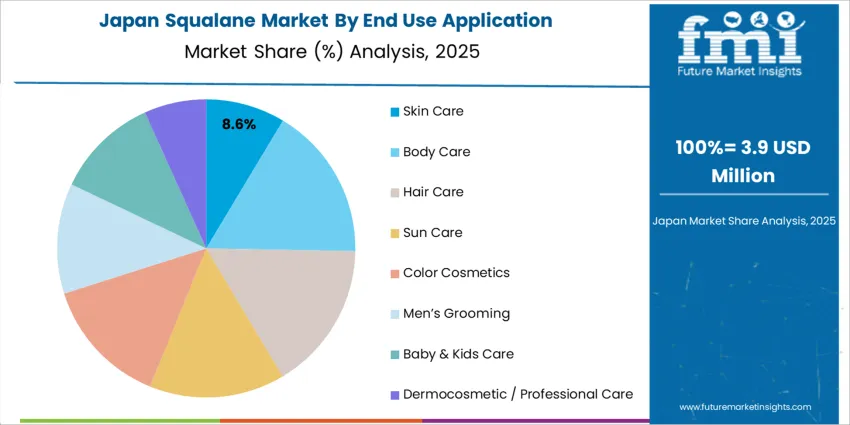
Demand in Japan is increasing at a CAGR of 8.5% through 2035 for squalane usage, sustained by premium skincare innovation, dermatology aligned cosmetics, and preference for minimal texture formulations. Squalane is applied in essence lotions, barrier repair creams, and sensitive skin emulsions. Domestic suppliers emphasize ultra-high purity and oxidation stability. Clinical beauty brands favor squalane for low irritation performance across daily skincare routines. Demand stays quality driven and performance focused, supported by aging population skincare requirements, continuous product refinement, and strong consumer trust in high purity cosmetic emollients.
- Essence lotions drive daily facial care usage
- Sensitive skin products sustain regulated consumption
- Domestic refinement stabilizes tight purity control
- Dermatology aligned brands strengthen premium uptake
What Is Supporting Squalane Market Expansion in the United Kingdom?
Growth in the UK is advancing at a CAGR of 7.8% through 2035 for squalane demand, supported by clean beauty product growth, vegan skincare adoption, and premium facial oil consumption. Squalane appears in glow serums, makeup primers, lip oils, and lightweight moisturizers. Independent beauty brands and salon distributed skincare lines drive steady product penetration. Imports dominate sourcing due to the limited presence of domestic squalane hydrogenation facilities. Demand remains retail driven and ingredient focused, shaped by rising preference for plant derived emollients and strong growth in premium online beauty retail.
- Vegan skincare supports steady ingredient substitution
- Glow serums and lip oils drive cosmetic demand
- Salon distributed brands sustain professional usage
- Imported sourcing dominates national supply structure
How Is Germany Integrating Squalane into Regulated Skincare and Dermaceuticals?
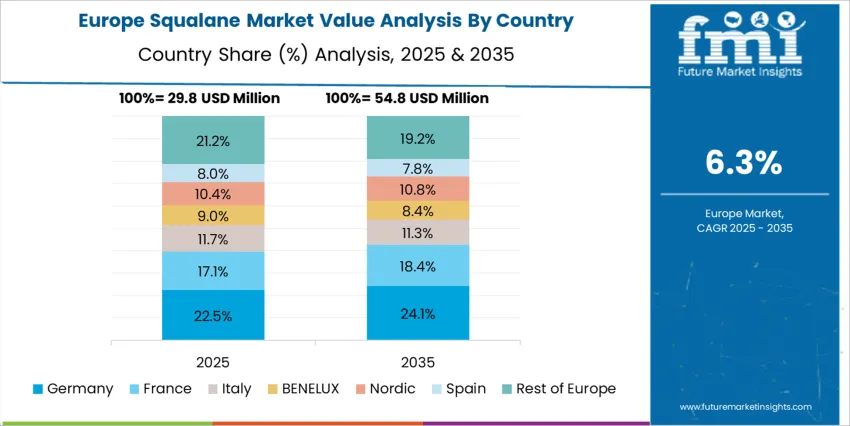
Growth in Germany reflects a CAGR of 7.0% through 2035 for squalane consumption, driven by pharmacy grade cosmetics, certified natural skincare, and regulated dermaceutical production. Squalane is used in barrier repair creams, post treatment lotions, and fragrance free moisturizers. Strict testing and documentation standards guide ingredient approval and supplier selection. Imports remain the primary supply route for cosmetic grade material. Demand stays quality focused and regulation aligned, supported by preventive skin health practices, controlled cosmetic usage, and steady expansion of certified skincare products across pharmacy and organic retail networks.
- Pharmacy grade products anchor regulated demand
- Post treatment lotions support clinical skincare usage
- Compliance standards shape ingredient qualification
- Organic and pharmacy retail stabilize long term turnover
What Is Driving Measured Squalane Growth in the United States?
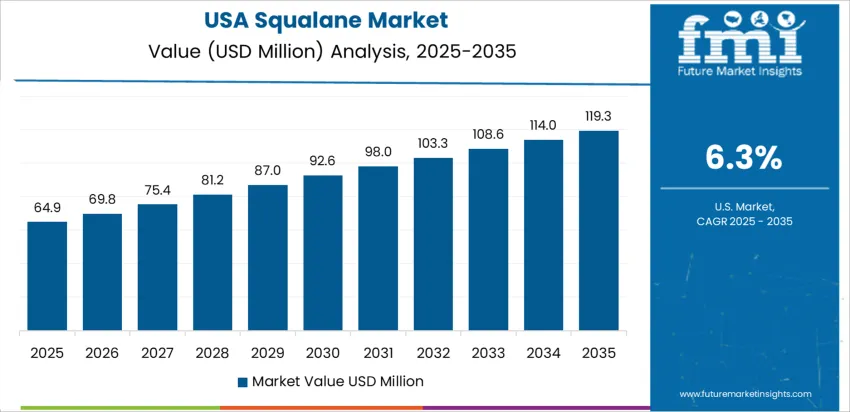
Expansion in the United States is moving at a CAGR of 6.3% through 2035 for squalane demand, supported by clean beauty brand development, hybrid skincare oils, and premium moisturization products. Squalane appears in face oils, foundation bases, lip treatments, and anti-aging skincare lines. Coastal wellness markets lead early adoption, with steady expansion into mass specialty beauty retailers. Imports supply most high purity material. Demand remains application driven and formulation diverse, shaped by preference for silicone alternatives, steady growth in premium skincare spending, and consistent innovation across clean beauty portfolios.
- Face oils and foundations anchor daily cosmetic demand
- Lip treatments support repeat consumer usage
- Clean beauty brands drive early adoption
- Import dependence dominates high purity sourcing
How Are Strategic Control Dynamics Shaping the Global Squalane Market?
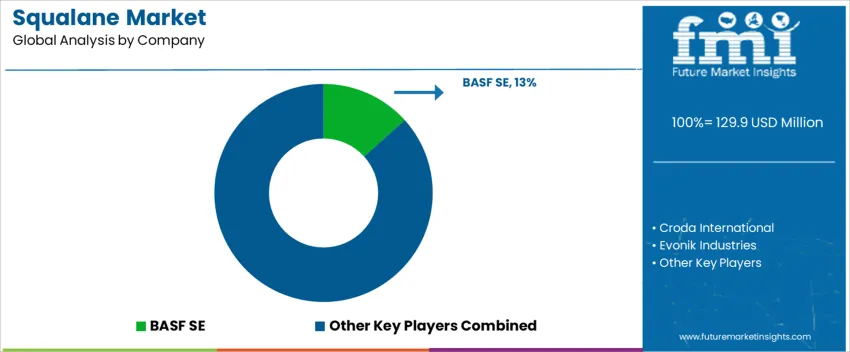
Competition in the global squalane market is strongly influenced by strategic control dynamics, where supplier strength and market attractiveness intersect. Large integrated players such as BASF SE, Croda International, and Evonik Industries occupy the high-strength, high-attractiveness quadrant. Their scale, global sourcing, regulatory compliance, and ability to supply multiple product grades give them significant leverage over pricing and distribution. These companies can buffer raw material fluctuations, offer consistent quality, and maintain long-term contracts with major cosmetics, personal-care, and nutraceutical brands. Their comprehensive portfolios and formulation support services further reinforce market control, enabling them to shape demand trends and secure high-value contracts across geographies and applications.
Mid-tier and niche suppliers occupy quadrants reflecting medium or specialized control. Firms such as Seppic, Lubrizol, Lonza, and Inolex often target premium, certified, or specialized grades of squalane, serving luxury, natural, or eco-conscious product segments. While they lack scale to dominate globally, their technical expertise and ability to offer customized solutions give them strategic influence within niche applications. Smaller suppliers with limited reach or non-integrated supply chains face weaker control, with pricing largely dictated by feedstock costs and market conditions. Overall, the market’s strategic control matrix demonstrates a layered structure: dominant large suppliers maintain overall market leverage, while mid-tier and niche players compete on differentiation, specialization, and regional or product-specific focus.
Key Players in the Squalane Market
- BASF SE
- Croda International
- Evonik Industries
- Symrise (incl. IFF/Givaudan actives)
- Dow / Dow Inc.
- Ashland
- Clariant
- Seppic
- Others
Scope of the report
| Items | Values |
|---|---|
| Quantitative Units (2025) | USD million |
| End-Use Applications | Skin Care, Body Care, Hair Care, Sun Care, Color Cosmetics, Men’s Grooming, Baby & Kids Care, Dermocosmetic / Professional Care |
| Product Forms | Powder, Granules/Agglomerates, Flakes, Pellets/Prills, Liquid (Solution), Concentrate (High-active Liquid), Dispersion/Suspension, Emulsion, Paste, Gel, Wax / Solid Block, Oil |
| Regions Covered | Asia Pacific, Europe, North America, Latin America, Middle East & Africa |
| Countries Covered | China, Japan, South Korea, India, Australia & New Zealand, ASEAN, Germany, United Kingdom, France, Italy, Spain, Nordic, BENELUX, USA, Canada, Mexico, Brazil, Chile, Saudi Arabia, Turkey, South Africa, plus 40+ additional countries globally |
| Key Companies Profiled | BASF SE, Croda International, Evonik Industries, Symrise (incl. IFF/Givaudan actives), Dow Inc., Ashland, Clariant, Seppic, Lubrizol, Lonza, Inolex |
| Additional Attributes | Dollar by sales breakdown by region, country, end-use, and product form; global growth projections; multi-sector adoption (cosmetic, nutraceutical, functional food); extract bioactivity profiling; iodine and polyphenol standardization; contract harvesting; vertical integration; supply chain stability; regulatory compliance; sensory and bioavailability performance |
Squalane Market Segmentation
End Use Application:
- Skin Care
- Body Care
- Hair Care
- Sun Care
- Color Cosmetics
- Men’s Grooming
- Baby & Kids Care
- Dermocosmetic / Professional Care
Product Form:
- Powder
- Granules / Agglomerates
- Flakes
- Pellets / Prills
- Liquid (Solution)
- Concentrate (High-active Liquid)
- Dispersion / Suspension
- Emulsion
- Paste
- Gel
- Wax / Solid Block
- Oil
Region
- Asia Pacific
- China
- Japan
- South Korea
- India
- Australia & New Zealand
- ASEAN
- Rest of Asia Pacific
- Europe
- Germany
- United Kingdom
- France
- Italy
- Spain
- Nordic
- BENELUX
- Rest of Europe
- North America
- United States
- Canada
- Mexico
- Latin America
- Brazil
- Chile
- Rest of Latin America
- Middle East & Africa
- Kingdom of Saudi Arabia
- Other GCC Countries
- Turkey
- South Africa
- Other African Union
- Rest of Middle East & Africa
Frequently Asked Questions
How big is the squalane market in 2025?
The global squalane market is estimated to be valued at USD 129.9 million in 2025.
What will be the size of squalane market in 2035?
The market size for the squalane market is projected to reach USD 265.4 million by 2035.
How much will be the squalane market growth between 2025 and 2035?
The squalane market is expected to grow at a 7.4% CAGR between 2025 and 2035.
What are the key product types in the squalane market?
The key product types in squalane market are skin care, body care, hair care, sun care, color cosmetics, men’s grooming, baby & kids care and dermocosmetic / professional care.
Which product form segment to contribute significant share in the squalane market in 2025?
In terms of product form , powder segment to command 14.5% share in the squalane market in 2025.
Preview the report firsthand - request a free sample
Get SampleGet the brochure for pricing and purchase details.
Get PDFTable of Content
- Executive Summary
- Global Market Outlook
- Demand-side Trends
- Supply-side Trends
- Technology Roadmap Analysis
- Analysis and Recommendations
- Market Overview
- Market Coverage / Taxonomy
- Market Definition / Scope / Limitations
- Market Background
- Market Dynamics
- Drivers
- Restraints
- Opportunity
- Trends
- Scenario Forecast
- Demand in Optimistic Scenario
- Demand in Likely Scenario
- Demand in Conservative Scenario
- Opportunity Map Analysis
- Product Life Cycle Analysis
- Supply Chain Analysis
- Investment Feasibility Matrix
- Value Chain Analysis
- PESTLE and Porter’s Analysis
- Regulatory Landscape
- Regional Parent Market Outlook
- Production and Consumption Statistics
- Import and Export Statistics
- Market Dynamics
- Global Market Analysis 2020 to 2024 and Forecast, 2025 to 2035
- Historical Market Size Value (USD Million) Analysis, 2020 to 2024
- Current and Future Market Size Value (USD Million) Projections, 2025 to 2035
- Y-o-Y Growth Trend Analysis
- Absolute $ Opportunity Analysis
- Global Market Pricing Analysis 2020 to 2024 and Forecast 2025 to 2035
- Global Market Analysis 2020 to 2024 and Forecast 2025 to 2035, By End Use Application
- Introduction / Key Findings
- Historical Market Size Value (USD Million) Analysis By End Use Application , 2020 to 2024
- Current and Future Market Size Value (USD Million) Analysis and Forecast By End Use Application , 2025 to 2035
- Skin Care
- Body Care
- Hair Care
- Sun Care
- Color Cosmetics
- Men’s Grooming
- Baby & Kids Care
- Dermocosmetic / Professional Care
- Y-o-Y Growth Trend Analysis By End Use Application , 2020 to 2024
- Absolute $ Opportunity Analysis By End Use Application , 2025 to 2035
- Global Market Analysis 2020 to 2024 and Forecast 2025 to 2035, By Product Form
- Introduction / Key Findings
- Historical Market Size Value (USD Million) Analysis By Product Form, 2020 to 2024
- Current and Future Market Size Value (USD Million) Analysis and Forecast By Product Form, 2025 to 2035
- Powder
- Granules / Agglomerates
- Flakes
- Pellets / Prills
- Liquid (Solution)
- Concentrate (High-active Liquid)
- Dispersion / Suspension
- Emulsion
- Paste
- Gel
- Wax / Solid Block
- Y-o-Y Growth Trend Analysis By Product Form, 2020 to 2024
- Absolute $ Opportunity Analysis By Product Form, 2025 to 2035
- Global Market Analysis 2020 to 2024 and Forecast 2025 to 2035, By Region
- Introduction
- Historical Market Size Value (USD Million) Analysis By Region, 2020 to 2024
- Current Market Size Value (USD Million) Analysis and Forecast By Region, 2025 to 2035
- North America
- Latin America
- Western Europe
- Eastern Europe
- East Asia
- South Asia and Pacific
- Middle East & Africa
- Market Attractiveness Analysis By Region
- North America Market Analysis 2020 to 2024 and Forecast 2025 to 2035, By Country
- Historical Market Size Value (USD Million) Trend Analysis By Market Taxonomy, 2020 to 2024
- Market Size Value (USD Million) Forecast By Market Taxonomy, 2025 to 2035
- By Country
- USA
- Canada
- Mexico
- By End Use Application
- By Product Form
- By Country
- Market Attractiveness Analysis
- By Country
- By End Use Application
- By Product Form
- Key Takeaways
- Latin America Market Analysis 2020 to 2024 and Forecast 2025 to 2035, By Country
- Historical Market Size Value (USD Million) Trend Analysis By Market Taxonomy, 2020 to 2024
- Market Size Value (USD Million) Forecast By Market Taxonomy, 2025 to 2035
- By Country
- Brazil
- Chile
- Rest of Latin America
- By End Use Application
- By Product Form
- By Country
- Market Attractiveness Analysis
- By Country
- By End Use Application
- By Product Form
- Key Takeaways
- Western Europe Market Analysis 2020 to 2024 and Forecast 2025 to 2035, By Country
- Historical Market Size Value (USD Million) Trend Analysis By Market Taxonomy, 2020 to 2024
- Market Size Value (USD Million) Forecast By Market Taxonomy, 2025 to 2035
- By Country
- Germany
- UK
- Italy
- Spain
- France
- Nordic
- BENELUX
- Rest of Western Europe
- By End Use Application
- By Product Form
- By Country
- Market Attractiveness Analysis
- By Country
- By End Use Application
- By Product Form
- Key Takeaways
- Eastern Europe Market Analysis 2020 to 2024 and Forecast 2025 to 2035, By Country
- Historical Market Size Value (USD Million) Trend Analysis By Market Taxonomy, 2020 to 2024
- Market Size Value (USD Million) Forecast By Market Taxonomy, 2025 to 2035
- By Country
- Russia
- Poland
- Hungary
- Balkan & Baltic
- Rest of Eastern Europe
- By End Use Application
- By Product Form
- By Country
- Market Attractiveness Analysis
- By Country
- By End Use Application
- By Product Form
- Key Takeaways
- East Asia Market Analysis 2020 to 2024 and Forecast 2025 to 2035, By Country
- Historical Market Size Value (USD Million) Trend Analysis By Market Taxonomy, 2020 to 2024
- Market Size Value (USD Million) Forecast By Market Taxonomy, 2025 to 2035
- By Country
- China
- Japan
- South Korea
- By End Use Application
- By Product Form
- By Country
- Market Attractiveness Analysis
- By Country
- By End Use Application
- By Product Form
- Key Takeaways
- South Asia and Pacific Market Analysis 2020 to 2024 and Forecast 2025 to 2035, By Country
- Historical Market Size Value (USD Million) Trend Analysis By Market Taxonomy, 2020 to 2024
- Market Size Value (USD Million) Forecast By Market Taxonomy, 2025 to 2035
- By Country
- India
- ASEAN
- Australia & New Zealand
- Rest of South Asia and Pacific
- By End Use Application
- By Product Form
- By Country
- Market Attractiveness Analysis
- By Country
- By End Use Application
- By Product Form
- Key Takeaways
- Middle East & Africa Market Analysis 2020 to 2024 and Forecast 2025 to 2035, By Country
- Historical Market Size Value (USD Million) Trend Analysis By Market Taxonomy, 2020 to 2024
- Market Size Value (USD Million) Forecast By Market Taxonomy, 2025 to 2035
- By Country
- Kingdom of Saudi Arabia
- Other GCC Countries
- Turkiye
- South Africa
- Other African Union
- Rest of Middle East & Africa
- By End Use Application
- By Product Form
- By Country
- Market Attractiveness Analysis
- By Country
- By End Use Application
- By Product Form
- Key Takeaways
- Key Countries Market Analysis
- USA
- Pricing Analysis
- Market Share Analysis, 2024
- By End Use Application
- By Product Form
- Canada
- Pricing Analysis
- Market Share Analysis, 2024
- By End Use Application
- By Product Form
- Mexico
- Pricing Analysis
- Market Share Analysis, 2024
- By End Use Application
- By Product Form
- Brazil
- Pricing Analysis
- Market Share Analysis, 2024
- By End Use Application
- By Product Form
- Chile
- Pricing Analysis
- Market Share Analysis, 2024
- By End Use Application
- By Product Form
- Germany
- Pricing Analysis
- Market Share Analysis, 2024
- By End Use Application
- By Product Form
- UK
- Pricing Analysis
- Market Share Analysis, 2024
- By End Use Application
- By Product Form
- Italy
- Pricing Analysis
- Market Share Analysis, 2024
- By End Use Application
- By Product Form
- Spain
- Pricing Analysis
- Market Share Analysis, 2024
- By End Use Application
- By Product Form
- France
- Pricing Analysis
- Market Share Analysis, 2024
- By End Use Application
- By Product Form
- India
- Pricing Analysis
- Market Share Analysis, 2024
- By End Use Application
- By Product Form
- ASEAN
- Pricing Analysis
- Market Share Analysis, 2024
- By End Use Application
- By Product Form
- Australia & New Zealand
- Pricing Analysis
- Market Share Analysis, 2024
- By End Use Application
- By Product Form
- China
- Pricing Analysis
- Market Share Analysis, 2024
- By End Use Application
- By Product Form
- Japan
- Pricing Analysis
- Market Share Analysis, 2024
- By End Use Application
- By Product Form
- South Korea
- Pricing Analysis
- Market Share Analysis, 2024
- By End Use Application
- By Product Form
- Russia
- Pricing Analysis
- Market Share Analysis, 2024
- By End Use Application
- By Product Form
- Poland
- Pricing Analysis
- Market Share Analysis, 2024
- By End Use Application
- By Product Form
- Hungary
- Pricing Analysis
- Market Share Analysis, 2024
- By End Use Application
- By Product Form
- Kingdom of Saudi Arabia
- Pricing Analysis
- Market Share Analysis, 2024
- By End Use Application
- By Product Form
- Turkiye
- Pricing Analysis
- Market Share Analysis, 2024
- By End Use Application
- By Product Form
- South Africa
- Pricing Analysis
- Market Share Analysis, 2024
- By End Use Application
- By Product Form
- USA
- Market Structure Analysis
- Competition Dashboard
- Competition Benchmarking
- Market Share Analysis of Top Players
- By Regional
- By End Use Application
- By Product Form
- Competition Analysis
- Competition Deep Dive
- BASF SE
- Overview
- Product Portfolio
- Profitability by Market Segments (Product/Age /Sales Channel/Region)
- Sales Footprint
- Strategy Overview
- Marketing Strategy
- Product Strategy
- Channel Strategy
- Croda International
- Evonik Industries
- Symrise (incl. IFF/Givaudan actives)
- Dow / Dow Inc.
- Ashland
- Clariant
- Seppic
- Others
- BASF SE
- Competition Deep Dive
- Assumptions & Acronyms Used
- Research Methodology


