

- Market Size (2026)
- USD 640.6 Mn
- Forecast (2036)
- USD 1125.8 Mn
- CAGR (2026 to 2036)
- 5.8%
How big is the Stone Honing Tools Market in 2026?
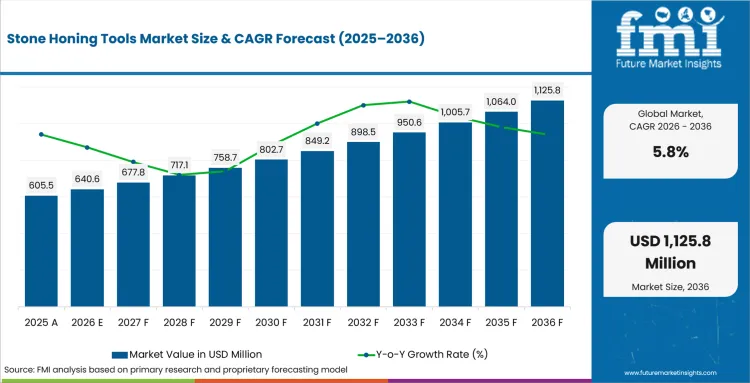
USD 640.6 million in 2026 and USD 1125.8 million by 2036 at a 5.8% CAGR.
The Stone Honing Tools Market was valued at USD 605.5 million in 2025 and reached USD 640.6 million in 2026. It is forecast to reach USD 1125.8 million by 2036 at a 5.8% CAGR. The forecast covers more than 30 markets, including the USA, Germany, Japan, Italy and Spain.
Honing creates a controlled low-sheen or textured surface rather than the high gloss associated with final polishing. Diamond pads, abrasive brushes, resin tools and metal-bond tools remove the previous scratch pattern in stages until the specified matte, satin or leathered finish is reached.
The target finish must be defined before the first abrasive stage because the same grit can behave differently on marble, granite and engineered stone. Wet operation can reduce dust, but the supplied occupational-hygiene evidence shows that water alone does not control mist, slurry, residual dust or poor work practices. A complete honing system combines the tool with water delivery, housekeeping and finish inspection.
Key Takeaways of Stone Honing Tools Market
- Demand is forecast to rise from USD 640.6 million in 2026 to USD 1125.8 million by 2036 at a 5.8% CAGR, supported by new low-sheen finishes and recurring restoration work.
- Diamond Honing Pads are forecast to account for 29.0% of 2026 sales because their cutting hardness and flexible format support controlled correction on flat surfaces, edges and local repairs.
- Matte / Honed Finish is expected to represent 41.0% of Finish Type demand in 2026 because it is specified in new interiors and later restoration.
- Countertops are projected to account for 32.0% of Application demand in 2026, with tool use spanning flat areas, edges, sink cut-outs and local repairs.
- Marble is forecast to hold 29.0% of Stone Type demand in 2026, supported by original fabrication and restoration across floors, walls and interior surfaces.
- Fabricator Supply Houses are expected to handle 38.0% of 2026 sales because honing work depends on complete grit progressions and access to several tool formats.
- Wet use does not automatically control silica, mist or slurry, and different stones can reach the target texture at different rates.
- Notable companies include Tenax, KGS Diamond, Husqvarna, Tyrolit, Saint-Gobain Norton, Weha, Alpha Professional Tools, GranQuartz, FILA Solutions and Stone Pro.
What is the analyst perspective on the Stone Honing Tools Market?
"Define the target sheen before choosing the abrasive sequence. Record results separately for marble, granite and engineered stone. Check mist, slurry and housekeeping alongside water delivery, then retain a process record so later repairs can reproduce the same texture."
- Nikhil Kaitwade, Principal Analyst, Future Market Insights
Source: Future Market Insights' proprietary forecasting model and primary research
How is the Stone Honing Tools Market segmented?
The market is segmented by Tool Type, Finish Type, Application, Stone Type, Sales Channel and Region.
By Tool Type, the market covers Diamond Honing Pads, Resin Honing Tools, Metal Bond Honing Segments, Abrasive Honing Brushes and Floor Honing Discs. Finish Type includes Matte / Honed Finish, Satin Finish, Leathered Finish and Restoration Finish. Application covers Countertops, Stone Floors, Wall Cladding, Monuments and Restoration Work. Stone Type includes Marble, Granite, Limestone, Travertine and Engineered Stone. Sales Channel covers Fabricator Supply Houses, Floor Care Distributors, Direct Manufacturer and Online / Catalog suppliers.
Why do countertops lead the application category?
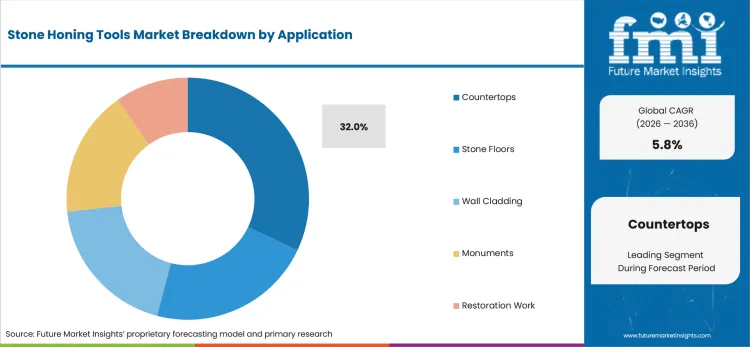
Countertop work combines a visible finish with edge work, sink cut-outs and local repairs. Dense granite and engineered stone also place sustained load on the tool and require direct control of water, slurry and silica exposure.
- Countertops are expected to generate 32.0% of Application demand in 2026 because new fabrication and surface renewal create separate tool-use cycles.
- Suppliers need stable results on edges and flat areas because a mismatch in sheen or texture remains visible on the finished worktop.
Why do diamond Honing Pads lead the tool type category?
Diamond honing pads provide the cutting hardness needed to remove an earlier scratch pattern from dense stone without turning the process into uncontrolled grinding. Flexible pad formats also let the same grit sequence reach flat surfaces, edges and local repair areas.
- Diamond Honing Pads are expected to account for 29.0% of market sales in 2026 because they support a controlled move from surface correction to a repeatable low-sheen finish across several stone types.
- Approval should state the target sheen and material because identical grit labels can produce different results on marble, granite and engineered stone.
Why does matte / honed finish lead the finish type category?
A honed surface has a deliberately lower sheen and a more open visual texture than polished stone. It is specified in new interiors and restoration work, so buyers should treat it as a defined finish rather than an unfinished version of a glossy surface.
- Matte / Honed Finish is projected to represent 41.0% of Finish Type demand in 2026 because it receives demand from original fabrication and later restoration.
- Maintenance plans should reflect the more open finish because staining, etching and local wear can appear differently than on polished stone.
Why does marble lead the stone type category?
Honed finishes are common across marble floors, walls and interior surfaces, but the stone does not respond uniformly. Mineral structure and composition change the rate at which gloss and roughness develop.
- Marble is projected to account for 29.0% of Stone Type demand in 2026, supported by the installed base of honed marble and recurring restoration work.
- Operators should inspect the surface at each stage because a standard time setting cannot account for differences between marble types.
Why do fabricator supply houses lead the sales channel category?
Honing jobs need complete grit progressions and several tool formats, including pads, brushes, backing products and chemicals. Fabricator supply houses help translate a named finish such as honed or leathered into a repeatable sequence.
- Fabricator Supply Houses are expected to handle 38.0% of 2026 sales because stock depth and application guidance reduce interruptions during fabrication or repair.
- Floor Care Distributors remain important for installed-stone restoration, while Direct Manufacturer supply is more relevant to high-volume automated lines. Online / Catalog purchasing works best for repeat orders after the process has been established.
What are the drivers, restraints and opportunities in the Stone Honing Tools Market?
Design and restoration support demand. Exposure control and stone variability create risk. Documented texture systems provide the clearest premium opportunity.
- Driver: Matte, satin and leathered finishes create repeated tool use during fabrication and later restoration.
- Restraint: Wet operation alone may leave silica exposure uncontrolled and may not produce the same finish across different stones.
- Opportunity: Documented texture systems that reproduce a named finish across natural and engineered stone can support premium pricing and service revenue.
Demand is created by the deliberate specification of low-sheen and textured stone. The same surface may later require local repair or full restoration, extending tool use beyond the original installation. Diamond brushes, flexible pads and resin tools serve different stages, so the buyer needs a defined sequence rather than one general-purpose product.
Silica exposure and stone variability are the main operating limits. NIOSH has documented task-dependent exposure during wet grinding and polishing, while British Occupational Hygiene Society guidance requires water suppression, extraction, mist control, housekeeping and respiratory protection to work together. Different marble types also reach the target roughness and sheen at different rates.
Suppliers can build recurring revenue around a recorded texture system. The package can include the grit ladder, tool speed, water settings, inspection points and an example of the finished surface. When a local repair is needed later, the same process record helps the service team reproduce the original texture instead of guessing.
How do country-level CAGRs compare in the Stone Honing Tools Market?
| Country | CAGR |
|---|---|
| USA | 4.9% |
| Germany | 4.6% |
| Japan | 4.2% |
| Italy | 5.6% |
| Spain | 5.2% |
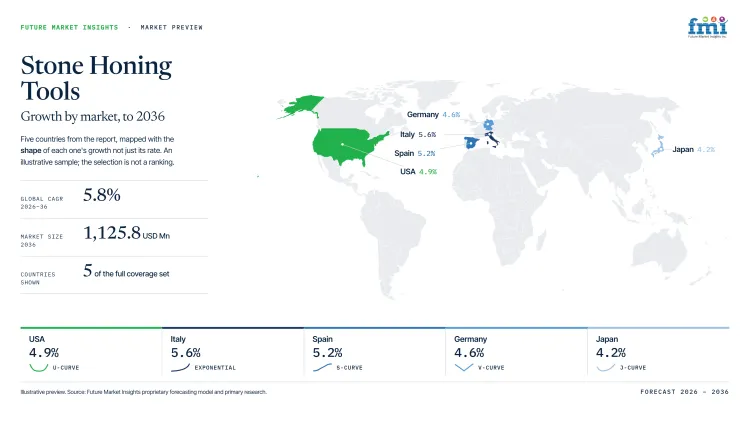
The country outlook spans 1.4 percentage points across the five profiled markets. Italy is projected to lead growth at 5.6%, followed by Spain at 5.2% and the USA at 4.9%. Germany and Japan are forecast at 4.6% and 4.2%. These rates describe forecast pace and do not measure current market size or installed volume.
- Italy offers the strongest direct stone-finishing base and supports specialist tools for marble, granite and automated lines.
- Spain has a credible natural-stone sector, but suppliers should confirm downstream fabrication and restoration activity rather than rely on quarry output alone.
- The USA combines a large countertop market with explicit government attention to grinding, polishing and engineered-stone exposure controls.
- Germany remains active where restoration quality, multi-material tools and dependable professional distribution matter.
- Japan favours compact tool compatibility and repeatable appearance, with lower forecast growth than the other profiled countries.
Comparable CAGRs can produce different market-entry conditions. Country opportunity depends on finish mix, the age of installed stone and local control requirements, alongside the quality of the distribution and service channel.
What does the country-wise analysis show for the Stone Honing Tools Market?
- USA: The USA market is projected to grow at a 4.9% CAGR from 2026 to 2036. Countertop fabrication and restoration provide the demand base, while OSHA and NIOSH guidance make wet-process design, housekeeping and exposure control part of product approval. Suppliers should sell the honing sequence and the control method together.
- Germany: Germany is forecast to expand at a 4.6% CAGR through 2036. Renovation and installed-stone maintenance support recurring professional demand. Floor-care and restoration distributors offer the clearest route, especially for multi-material pad sets and less common grits.
- Japan: Japan is expected to record a 4.2% CAGR over the forecast period. Buyers place a premium on controlled workmanship, compact tool compatibility and repeatable appearance. Product positioning should focus on stable texture and low rework rather than broad universal-use claims.
- Italy: Italy is projected to lead the five countries at a 5.6% CAGR. ISTAT recognises stone cutting, shaping and finishing as a distinct industrial activity, giving suppliers a direct fabricator base. The market supports marble and granite tools as well as consumables used on automated finishing lines.
- Spain: Spain is forecast to grow at a 5.2% CAGR from 2026 to 2036. Natural-stone extraction provides an upstream base, but the strongest opportunity appears where quarry activity connects with downstream fabrication and restoration. Regional channel support is important for complete grit sequences and finish-specific advice.
Who are the notable companies in the Stone Honing Tools Market?
Tenax, KGS Diamond, Husqvarna, Tyrolit, Saint-Gobain Norton, Weha, Alpha Professional Tools, GranQuartz, FILA Solutions and Stone Pro are notable companies serving this market.
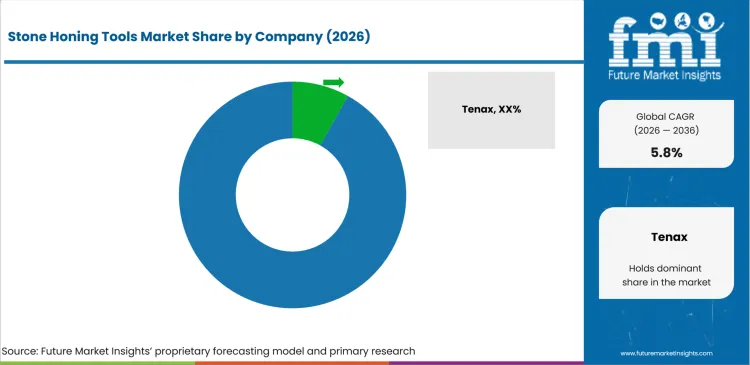
Competition includes specialist stone-finish brands, global abrasive and equipment groups, and fabricator-focused channels. Buyers compare the ability to reproduce a named texture, cover several stones, supply the full grit sequence and support wet-process controls. A large catalogue alone does not prove that a supplier can match an existing honed or leathered surface.
- Tenax, KGS Diamond and Alpha Professional Tools compete through stone-specific pads, brushes and flexible finishing products. Tenax offers diamond and tungsten-carbide brushes for textured surfaces, while KGS covers natural and engineered stone across grinding, honing and polishing.
- Husqvarna, Tyrolit and Saint-Gobain Norton connect honing consumables with broader surface-preparation, abrasive and equipment systems. Their advantage is strongest where the buyer wants machines, tooling and process support from a smaller supplier set.
- Weha, GranQuartz and Stone Pro add value through fabricator and restoration channels. Their role becomes important when a shop needs an uncommon grit, backing product, brush or replacement tool quickly enough to keep a repair consistent with the surrounding surface.
- FILA Solutions is included among the notable companies in the source article; however, its public product range centers on stone sealers, cleaners and polishing chemicals rather than honing pads, brushes or discs, so its fit with the defined Tool Type segmentation should be reviewed.
How do notable companies compare in the Stone Honing Tools Market?
| Company | Honing Tool Breadth | Countertop Fit | Floor Restoration Fit | Geographic Reach |
|---|---|---|---|---|
| Tenax | High | High | High | Global |
| KGS Diamond | High | High | High | Global |
| Husqvarna | High | Medium | High | Global |
| Tyrolit | High | High | High | Global |
| Saint-Gobain Norton | High | High | High | Global |
| Weha | High | High | Medium | North America and Europe |
| Alpha Professional Tools | High | High | Medium | Global |
| GranQuartz | High | High | High | North America |
Scoring basis: High indicates broad documented coverage for the criterion in the supplied source article. Medium indicates partial or adjacent documented coverage. Geographic Reach records the regions stated in the source. This table compares capabilities and is not a market-share ranking.
What are the key developments in the Stone Honing Tools Market?
- In June 2024, the British Occupational Hygiene Society issued a managers toolkit for engineered-stone silica. The guidance required a layered approach using water suppression, extraction, mist control, housekeeping, respiratory protection and health surveillance rather than reliance on a wet tool alone.
- In May 2026, the UK Health and Safety Executive issued its first engineered-stone COSHH guidance and began a programme of more than 1,000 inspections. The package confirmed on-tool water suppression, mist control, respiratory protection and health surveillance as enforceable expectations.
What does the Stone Honing Tools Market report cover?
| Coverage field | Report scope |
|---|---|
| Market breakdown | Tool Type, Finish Type, Application, Stone Type, Sales Channel and Region. |
| Quantitative Units | Revenue in USD Million, CAGR in %. |
| Market Definition | Pads, brushes, discs and abrasive systems used to create or restore honed, satin, matte and leathered finishes on natural or engineered stone. Engine-cylinder honing tools are outside scope. |
| Regions Covered | North America, Latin America, Western Europe, Eastern Europe, South Asia & Pacific, East Asia, Central Asia, Russia & Belarus, and Middle East & Africa. |
| Countries Covered | USA, Germany, Japan, Italy and Spain, with more than 30 markets covered in the full report. |
| Key Companies Profiled | Tenax, KGS Diamond, Husqvarna, Tyrolit, Saint-Gobain Norton, Weha, Alpha Professional Tools, GranQuartz, FILA Solutions and Stone Pro. |
| Forecast Period | 2026 to 2036. |
| Approach | Hybrid bottom-up and top-down market sizing supported by primary interviews and official desk research. |
How was the Stone Honing Tools Market research conducted?
| Method | Approach |
|---|---|
| Primary Research | FMI analysts gathered input from manufacturers, service providers, technology developers, distributors, end users, procurement teams and subject-matter experts. Interviews examined purchasing decisions, product or service evaluation, adoption barriers, approval requirements, pricing considerations and expectations for technical or commercial support. Respondents were also asked what evidence is required before a trial, pilot or initial order develops into regular purchasing. |
| Desk Research | Desk research covered government statistics, regulatory publications, trade data, industry associations, technical literature, standards, company filings, product information and official corporate announcements. Sources were reviewed for relevance, publication date, geographic coverage and consistency with the defined market scope. Claims relating to performance, applications, approvals, capacity, investment and commercial activity were retained only when supported by credible public evidence. |
| Market Sizing and Forecasting | The market model combined the baseline value with historical performance, segment structure, pricing and volume indicators, adoption levels, company participation and country-level demand conditions. Forecast assumptions considered economic activity, investment trends, regulatory developments, technology adoption, purchasing cycles, supply availability and barriers to wider market use. Segment and regional estimates were reconciled before the final market total was calculated. |
| Data Validation | Estimates were checked against multiple independent indicators, including public data, company activity, trade patterns, industry developments and findings from primary interviews. Validation also tested whether products, services, applications and company revenues fell within the defined market boundaries. Adjacent categories, unsupported claims, overlapping revenues and activities without direct market relevance were excluded to reduce double counting and maintain consistency across segments and countries. |
What is the segmentation taxonomy for the Stone Honing Tools Market?
Stone Honing Tools Market segmented by Tool Type:
- Diamond Honing Pads
- Resin Honing Tools
- Metal Bond Honing Segments
- Abrasive Honing Brushes
- Floor Honing Discs
Stone Honing Tools Market segmented by Finish Type:
- Matte / Honed Finish
- Satin Finish
- Leathered Finish
- Restoration Finish
Stone Honing Tools Market segmented by Application:
- Countertops
- Stone Floors
- Wall Cladding
- Monuments
- Restoration Work
Stone Honing Tools Market segmented by Stone Type:
- Marble
- Granite
- Limestone
- Travertine
- Engineered Stone
Stone Honing Tools Market segmented by Sales Channel:
- Fabricator Supply Houses
- Floor Care Distributors
- Direct Manufacturer
- Online / Catalog
Stone Honing Tools Market segmented by Region:
- North America
- United States
- Canada
- Latin America
- Brazil
- Mexico
- Argentina
- Chile
- Western Europe
- Germany
- France
- United Kingdom
- Italy
- Spain
- BENELUX
- Nordic
- Eastern Europe
- Poland
- Czech Republic
- Hungary
- Romania
- Balkan & Baltics
- South Asia & Pacific
- India
- ASEAN
- Oceania
- East Asia
- China
- Japan
- South Korea
- Central Asia
- Kazakhstan
- Kyrgyzstan
- Tajikistan
- Turkmenistan
- Uzbekistan
- Russia & Belarus
- Middle East & Africa
- GCC Countries
- Türkiye
- Israel
- South Africa
Which sources support the Stone Honing Tools Market analysis?
- Tenax USA, accessed 2026. Diamond brushes are designed to create textured or honed finishes on dense granite and engineered stone.
- Tenax, accessed 2026. Industrial stone-finishing portfolios combine diamond brushes, tungsten-carbide brushes, magnesite abrasives and metal-bond roughing tools.
- Tenax4You, accessed 2026. Commercial stone-tool catalogues explicitly separate honing and leather or texturing applications.
- Husqvarna Construction, accessed 2026. Resin pads and pucks are sold to remove scratches and polish concrete, terrazzo and natural stone.
- Miles Supply, 2018. Granite honing commonly progresses through multiple wet grits rather than stopping after one abrasive stage.
- US Occupational Safety and Health Administration, current. Honing and grinding silica-containing stone create respirable crystalline silica risk.
- National Institute for Occupational Safety and Health, Health Hazard Evaluation. Wet grinding and polishing may still exceed exposure limits when water delivery and work practices are poor.
- Bulletin of Materials Science, 2011. Abrasive flow and water pressure can change granite surface roughness during abrasive-water finishing.
- Applied Sciences, 2024. Different marble types respond differently to diamond-pad polishing time and contact conditions.
- Natural Stone Institute, 2007. Honed marble, limestone and travertine are recognised finish classes with distinct maintenance needs.
- KGS Diamond, accessed 2026. Flexible diamond products address grinding, honing and polishing of natural and engineered stone.
- US Geological Survey, current. Dimension-stone production provides a measurable base for new fabrication and later restoration.
- ISTAT, 2025. Italy officially records cutting, shaping and finishing of stone as an industrial activity.
- Spanish Ministry of Economy, classification document. Spain officially recognises ornamental-stone extraction and related stone activities in its economic classification.
- Destatis, current. Repair, renovation and construction activity creates a downstream installed-stone maintenance base.
- OSHA and NIOSH, 2015. Countertop fabrication controls are documented in direct government guidance.
- US Occupational Safety and Health Administration, September 22, 2023. OSHA launched a focused inspection initiative for respirable crystalline silica in engineered-stone fabrication and installation, including grinding and polishing.
- British Occupational Hygiene Society, June 2024. BOHS issued a managers toolkit covering water suppression, extraction, mist control, housekeeping, respiratory protection and health surveillance for engineered-stone work.
- Health and Safety Executive, May 11, 2026. HSE issued engineered-stone COSHH guidance and announced more than 1,000 inspections across Great Britain.
This bibliography is provided for reader reference and is not exhaustive. The full report contains the complete reference list and detailed citations.
What questions does this report answer?
- How large is the Stone Honing Tools Market in 2026 and 2036?
- Which design and restoration needs support demand?
- Why do Diamond Honing Pads hold 29.0% share in 2026?
- What makes Matte / Honed Finish the leading Finish Type?
- Why do Countertops account for 32.0% of Application demand?
- How do the USA, Germany, Japan, Italy and Spain compare?
- Which companies provide specialist honing and texture systems?
- How do silica exposure and stone variability limit wider use?
- How should buyers validate a repeatable honed finish?
Frequently Asked Questions
How big is the Stone Honing Tools Market in 2026?
The stone honing tools market is valued at USD 640.6 million in 2026 and is forecast to reach USD 1125.8 million by 2036. Growth is supported by matte and honed finish specifications in new interiors alongside recurring restoration work across countertops, floors and wall cladding worldwide.
What is the CAGR of the Stone Honing Tools Market from 2026 to 2036?
The stone honing tools market grows at a CAGR of 5.8% between 2026 and 2036, supported by repeated tool use across original fabrication and later restoration as buyers specify matte, satin and leathered finishes on natural and engineered stone surfaces.
Which application leads the Stone Honing Tools Market?
Countertops account for 32.0% of the stone honing tools market by application in 2026, driven by tool use spanning flat areas, edges, sink cut-outs and local repairs that create separate demand cycles from new fabrication and surface renewal.
How much will the Stone Honing Tools Market add between 2026 and 2036?
The stone honing tools market is set to add USD 485.2 million between 2026 and 2036, growing from USD 640.6 million to USD 1125.8 million as documented texture systems extend across countertop fabrication, floor restoration and wall cladding applications worldwide.
Who are the leading companies in the Stone Honing Tools Market?
Ten companies lead the stone honing tools market consistently, including Tenax, KGS Diamond, Husqvarna, Tyrolit, Saint-Gobain Norton, Weha, Alpha Professional Tools, GranQuartz, FILA Solutions and Stone Pro, competing through honing tool breadth, countertop fit and floor restoration fit worldwide.
Preview the report firsthand - request a free sample
Get SampleGet the brochure for pricing and purchase details.
Get PDFTable of Content
- Key Takeaways
- Market Size and CAGR
- Top Growth Driver
- Fastest Growing Segment
- Leading Region
- Key Companies
- Emerging Opportunities
- Executive Summary
- Global Market Outlook
- Demand-side Trends
- Supply-side Trends
- Technology Roadmap Analysis
- Analysis and Recommendations
- Analyst Perspective (What is happening? Why now? What should investors know?)
- Key Questions Answered
- How large is the market?
- What is the CAGR?
- What are key trends?
- Which region dominates?
- Who are the leaders?
- Market Overview
- Market Coverage / Taxonomy
- Market Definition / Scope / Limitations
- Research Methodology
- Chapter Orientation
- Analytical Lens and Working Hypotheses
- Market Structure, Signals, and Trend Drivers
- Benchmarking and Cross-market Comparability
- Market Sizing, Forecasting, and Opportunity Mapping
- Research Design and Evidence Framework
- Desk Research Programme (Secondary Evidence)
- Expert Input and Fieldwork (Primary Evidence)
- Tooling, Models, and Reference Databases
- Data Engineering and Model Build
- Quality Assurance and Audit Trail
- Market Background
- Market Dynamics (Drivers, Restraints, Opportunity, Trends)
- Scenario Forecast (Optimistic, Likely, Conservative)
- Impact Analysis
- AI Impact
- Sustainability Impact
- Regulatory Impact
- Technology Impact
- Consumer / Buyer Analysis
- Purchase Drivers
- Adoption Barriers
- Buyer Journey
- Opportunity Map Analysis
- Product Life Cycle Analysis
- Supply Chain Analysis
- Investment Feasibility Matrix
- Value Chain Analysis
- PESTLE and Porter's Analysis
- Regulatory Landscape
- Regional Parent Market Outlook
- Production and Consumption Statistics
- Import and Export Statistics
- Global Market Analysis and Forecast, 2021 to 2036
- Historical Market Size Value (USD Million) Analysis, 2021 to 2025
- Current and Future Market Size Value (USD Million) Projections, 2026 to 2036
- Y-o-Y Growth Trend Analysis
- Absolute $ Opportunity Analysis
- Global Market Pricing Analysis, 2021 to 2036
- Global Market Analysis and Forecast, By Tool Type, 2021 to 2036
- Introduction / Key Findings
- Historical Market Size Value (USD Million) Analysis By Tool Type, 2021 to 2025
- Current and Future Market Size Value (USD Million) Analysis and Forecast By Tool Type, 2026 to 2036
- Diamond Honing Pads
- Resin Honing Tools
- Metal Bond Honing Segments
- Abrasive Honing Brushes
- Floor Honing Discs
- Diamond Honing Pads
- Y-o-Y Growth Trend Analysis By Tool Type, 2021 to 2025
- Absolute $ Opportunity Analysis By Tool Type, 2026 to 2036
- Global Market Analysis and Forecast, By Finish Type, 2021 to 2036
- Introduction / Key Findings
- Historical Market Size Value (USD Million) Analysis By Finish Type, 2021 to 2025
- Current and Future Market Size Value (USD Million) Analysis and Forecast By Finish Type, 2026 to 2036
- Matte / Honed Finish
- Satin Finish
- Leathered Finish
- Restoration Finish
- Matte / Honed Finish
- Y-o-Y Growth Trend Analysis By Finish Type, 2021 to 2025
- Absolute $ Opportunity Analysis By Finish Type, 2026 to 2036
- Global Market Analysis and Forecast, By Application, 2021 to 2036
- Introduction / Key Findings
- Historical Market Size Value (USD Million) Analysis By Application, 2021 to 2025
- Current and Future Market Size Value (USD Million) Analysis and Forecast By Application, 2026 to 2036
- Countertops
- Stone Floors
- Wall Cladding
- Monuments
- Restoration Work
- Countertops
- Y-o-Y Growth Trend Analysis By Application, 2021 to 2025
- Absolute $ Opportunity Analysis By Application, 2026 to 2036
- Global Market Analysis and Forecast, By Stone Type, 2021 to 2036
- Introduction / Key Findings
- Historical Market Size Value (USD Million) Analysis By Stone Type, 2021 to 2025
- Current and Future Market Size Value (USD Million) Analysis and Forecast By Stone Type, 2026 to 2036
- Marble
- Granite
- Limestone
- Travertine
- Engineered Stone
- Marble
- Y-o-Y Growth Trend Analysis By Stone Type, 2021 to 2025
- Absolute $ Opportunity Analysis By Stone Type, 2026 to 2036
- Global Market Analysis and Forecast, By Sales Channel, 2021 to 2036
- Introduction / Key Findings
- Historical Market Size Value (USD Million) Analysis By Sales Channel, 2021 to 2025
- Current and Future Market Size Value (USD Million) Analysis and Forecast By Sales Channel, 2026 to 2036
- Fabricator Supply Houses
- Floor Care Distributors
- Direct Manufacturer
- Online / Catalog
- Fabricator Supply Houses
- Y-o-Y Growth Trend Analysis By Sales Channel, 2021 to 2025
- Absolute $ Opportunity Analysis By Sales Channel, 2026 to 2036
- Global Market Analysis and Forecast, By Region, 2021 to 2036
- Introduction
- Historical Market Size Value (USD Million) Analysis By Region, 2021 to 2025
- Current Market Size Value (USD Million) Analysis and Forecast By Region, 2026 to 2036
- North America
- Latin America
- Western Europe
- Eastern Europe
- East Asia
- South Asia and Pacific
- Middle East & Africa
- Market Attractiveness Analysis By Region
- North America Market Analysis and Forecast, By Country, 2021 to 2036
- Historical Market Size Value (USD Million) Trend Analysis By Market Taxonomy, 2021 to 2025
- Market Size Value (USD Million) Forecast By Market Taxonomy, 2026 to 2036
- By Country
- USA
- Canada
- By Tool Type
- By Finish Type
- By Application
- By Stone Type
- By Sales Channel
- By Country
- Market Attractiveness Analysis
- By Country
- By Tool Type
- By Finish Type
- By Application
- By Stone Type
- By Sales Channel
- Key Takeaways
- Latin America Market Analysis and Forecast, By Country
- Historical Market Size Value (USD Million) Trend Analysis By Market Taxonomy, 2021 to 2025
- Market Size Value (USD Million) Forecast By Market Taxonomy, 2026 to 2036
- By Country
- Brazil
- Mexico
- Chile
- Rest of Latin America
- By Tool Type
- By Finish Type
- By Application
- By Stone Type
- By Sales Channel
- By Country
- Market Attractiveness Analysis
- By Country
- By Tool Type
- By Finish Type
- By Application
- By Stone Type
- By Sales Channel
- Key Takeaways
- Western Europe Market Analysis and Forecast, By Country
- Historical Market Size Value (USD Million) Trend Analysis By Market Taxonomy, 2021 to 2025
- Market Size Value (USD Million) Forecast By Market Taxonomy, 2026 to 2036
- By Country
- Germany
- UK
- Italy
- Spain
- France
- Nordic
- BENELUX
- Rest of Western Europe
- By Tool Type
- By Finish Type
- By Application
- By Stone Type
- By Sales Channel
- By Country
- Market Attractiveness Analysis
- By Country
- By Tool Type
- By Finish Type
- By Application
- By Stone Type
- By Sales Channel
- Key Takeaways
- Eastern Europe Market Analysis and Forecast, By Country
- Historical Market Size Value (USD Million) Trend Analysis By Market Taxonomy, 2021 to 2025
- Market Size Value (USD Million) Forecast By Market Taxonomy, 2026 to 2036
- By Country
- Russia
- Poland
- Hungary
- Balkan & Baltic
- Rest of Eastern Europe
- By Tool Type
- By Finish Type
- By Application
- By Stone Type
- By Sales Channel
- By Country
- Market Attractiveness Analysis
- By Country
- By Tool Type
- By Finish Type
- By Application
- By Stone Type
- By Sales Channel
- Key Takeaways
- East Asia Market Analysis and Forecast, By Country
- Historical Market Size Value (USD Million) Trend Analysis By Market Taxonomy, 2021 to 2025
- Market Size Value (USD Million) Forecast By Market Taxonomy, 2026 to 2036
- By Country
- China
- Japan
- South Korea
- By Tool Type
- By Finish Type
- By Application
- By Stone Type
- By Sales Channel
- By Country
- Market Attractiveness Analysis
- By Country
- By Tool Type
- By Finish Type
- By Application
- By Stone Type
- By Sales Channel
- Key Takeaways
- South Asia and Pacific Market Analysis and Forecast, By Country
- Historical Market Size Value (USD Million) Trend Analysis By Market Taxonomy, 2021 to 2025
- Market Size Value (USD Million) Forecast By Market Taxonomy, 2026 to 2036
- By Country
- India
- ASEAN
- Australia & New Zealand
- Rest of South Asia and Pacific
- By Tool Type
- By Finish Type
- By Application
- By Stone Type
- By Sales Channel
- By Country
- Market Attractiveness Analysis
- By Country
- By Tool Type
- By Finish Type
- By Application
- By Stone Type
- By Sales Channel
- Key Takeaways
- Middle East & Africa Market Analysis and Forecast, By Country
- Historical Market Size Value (USD Million) Trend Analysis By Market Taxonomy, 2021 to 2025
- Market Size Value (USD Million) Forecast By Market Taxonomy, 2026 to 2036
- By Country
- Kingdom of Saudi Arabia
- Other GCC Countries
- Türkiye
- South Africa
- Other African Union
- Rest of Middle East & Africa
- By Tool Type
- By Finish Type
- By Application
- By Stone Type
- By Sales Channel
- By Country
- Market Attractiveness Analysis
- By Country
- By Tool Type
- By Finish Type
- By Application
- By Stone Type
- By Sales Channel
- Key Takeaways
- Key Countries Market Analysis
- USA
- Pricing Analysis
- Market Share Analysis, 2025
- By Tool Type
- By Finish Type
- By Application
- By Stone Type
- By Sales Channel
- Canada
- Pricing Analysis
- Market Share Analysis, 2025
- By Tool Type
- By Finish Type
- By Application
- By Stone Type
- By Sales Channel
- Mexico
- Pricing Analysis
- Market Share Analysis, 2025
- By Tool Type
- By Finish Type
- By Application
- By Stone Type
- By Sales Channel
- Brazil
- Pricing Analysis
- Market Share Analysis, 2025
- By Tool Type
- By Finish Type
- By Application
- By Stone Type
- By Sales Channel
- Chile
- Pricing Analysis
- Market Share Analysis, 2025
- By Tool Type
- By Finish Type
- By Application
- By Stone Type
- By Sales Channel
- Germany
- Pricing Analysis
- Market Share Analysis, 2025
- By Tool Type
- By Finish Type
- By Application
- By Stone Type
- By Sales Channel
- UK
- Pricing Analysis
- Market Share Analysis, 2025
- By Tool Type
- By Finish Type
- By Application
- By Stone Type
- By Sales Channel
- Italy
- Pricing Analysis
- Market Share Analysis, 2025
- By Tool Type
- By Finish Type
- By Application
- By Stone Type
- By Sales Channel
- Spain
- Pricing Analysis
- Market Share Analysis, 2025
- By Tool Type
- By Finish Type
- By Application
- By Stone Type
- By Sales Channel
- France
- Pricing Analysis
- Market Share Analysis, 2025
- By Tool Type
- By Finish Type
- By Application
- By Stone Type
- By Sales Channel
- India
- Pricing Analysis
- Market Share Analysis, 2025
- By Tool Type
- By Finish Type
- By Application
- By Stone Type
- By Sales Channel
- ASEAN
- Pricing Analysis
- Market Share Analysis, 2025
- By Tool Type
- By Finish Type
- By Application
- By Stone Type
- By Sales Channel
- Australia & New Zealand
- Pricing Analysis
- Market Share Analysis, 2025
- By Tool Type
- By Finish Type
- By Application
- By Stone Type
- By Sales Channel
- China
- Pricing Analysis
- Market Share Analysis, 2025
- By Tool Type
- By Finish Type
- By Application
- By Stone Type
- By Sales Channel
- Japan
- Pricing Analysis
- Market Share Analysis, 2025
- By Tool Type
- By Finish Type
- By Application
- By Stone Type
- By Sales Channel
- South Korea
- Pricing Analysis
- Market Share Analysis, 2025
- By Tool Type
- By Finish Type
- By Application
- By Stone Type
- By Sales Channel
- Russia
- Pricing Analysis
- Market Share Analysis, 2025
- By Tool Type
- By Finish Type
- By Application
- By Stone Type
- By Sales Channel
- Poland
- Pricing Analysis
- Market Share Analysis, 2025
- By Tool Type
- By Finish Type
- By Application
- By Stone Type
- By Sales Channel
- Hungary
- Pricing Analysis
- Market Share Analysis, 2025
- By Tool Type
- By Finish Type
- By Application
- By Stone Type
- By Sales Channel
- Kingdom of Saudi Arabia
- Pricing Analysis
- Market Share Analysis, 2025
- By Tool Type
- By Finish Type
- By Application
- By Stone Type
- By Sales Channel
- Türkiye
- Pricing Analysis
- Market Share Analysis, 2025
- By Tool Type
- By Finish Type
- By Application
- By Stone Type
- By Sales Channel
- South Africa
- Pricing Analysis
- Market Share Analysis, 2025
- By Tool Type
- By Finish Type
- By Application
- By Stone Type
- By Sales Channel
- USA
- Market Structure Analysis
- Competition Dashboard
- Competition Benchmarking
- Market Share Analysis of Top Players
- By Regional
- By Tool Type
- By Finish Type
- By Application
- By Stone Type
- By Sales Channel
- Emerging Startups
- Innovation Benchmarking
- Competition Analysis
- Competition Deep Dive
- Tenax
- Overview
- Product Portfolio
- Profitability by Market Segments
- Sales Footprint
- Strategy Overview
- Marketing Strategy
- Product Strategy
- Channel Strategy
- KGS Diamond
- Husqvarna
- Tyrolit
- Saint-Gobain Norton
- Weha
- Alpha Professional Tools
- GranQuartz
- FILA Solutions
- Stone Pro
- Tenax
- Case Studies
- Success Stories
- Recent Developments
- Competition Deep Dive
- Assumptions & Acronyms Used


