

- Market Size (2026)
- USD 520.7 Mn
- Forecast (2036)
- USD 906.4 Mn
- CAGR (2026 to 2036)
- 5.7%
How big is the Stone Lapping Tools Market in 2026?
USD 520.7 million in 2026 and USD 906.4 million by 2036 at a 5.7% CAGR.
The Stone Lapping Tools Market was valued at USD 492.6 million in 2025 and is forecast to rise from USD 520.7 million in 2026 to USD 906.4 million by 2036 at a 5.7% CAGR. The clearest documented use is resurfacing precision granite plates that serve as reference surfaces for dimensional inspection.
A lapping job is accepted only when measured flatness is restored across the working area. Demand is therefore tied to wear, recertification and the installed base of precision stone surfaces. Large plates may be relapped at the customer site because transport is difficult and can interrupt inspection work. The wider market also includes edge correction, restoration and other precision stone components, although public evidence is strongest where lapping ends with traceable calibration.
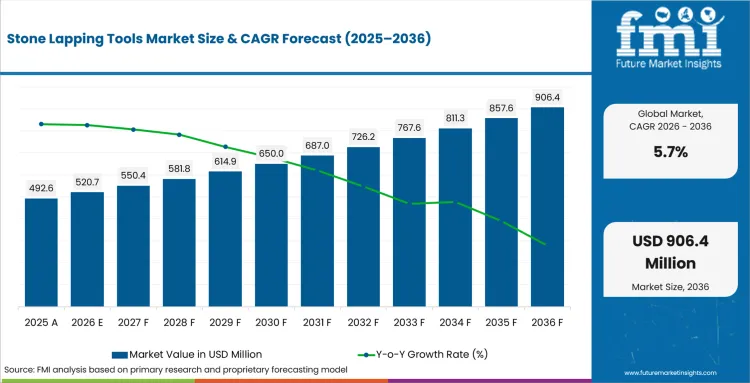
Key Takeaways of Stone Lapping Tools Market
- Precision granite surfaces create repeat demand when wear moves local or overall flatness outside tolerance.
- Diamond Lapping Discs lead Tool Type with a 31.0% share in 2026 because the disc format supports controlled correction of local high spots.
- Diamond leads the Abrasive category with a 42.0% share in 2026 as graded particles support controlled removal and refinement on hard stone.
- Surface Flattening accounts for 31.0% of 2026 demand because the finished surface can be assessed against overall and local flatness limits.
- Process skill and flatness verification limit casual adoption because a smooth-looking surface may still be outside tolerance.
- Notable providers include Kemet International, Lapmaster Wolters, Engis, Saint-Gobain Norton, KGS Diamond, Buehler, Logitech Ltd., SpeedFam and UKAM Industrial Superhard Tools.
Analyst Perspective
“Approve each lapping job on measured flatness rather than visual smoothness. Commercial value is earned when the supplier records the starting condition, controls abrasive contamination and returns the surface to service with traceable calibration.”
- Nikhil Kaitwade, Principal Analyst, Future Market Insights
Source: Future Market Insights' proprietary forecasting model and primary research
How is the Stone Lapping Tools Market segmented?
The market is segmented by tool type, abrasive, application, stone type, sales channel and region.
The Stone Lapping Tools Market is segmented by Tool Type into Diamond Lapping Discs, Lapping Plates, Loose Abrasive Lapping Kits, Lapping Pads and Precision Lapping Fixtures. By Abrasive, the market includes Diamond, Silicon Carbide, Aluminum Oxide and Cerium Oxide / Specialty. Application covers Surface Flattening, Edge Finishing, Restoration / Repair, Optical / Decorative Stone and Precision Stone Components. By Stone Type, the market is divided into Granite, Marble, Quartz, Slate / Limestone and Engineered Stone. Sales Channel includes Stone Tool Distributors, Direct Manufacturer and E-commerce / Catalog.
Why do diamond lapping discs hold the largest share within the tool type category?
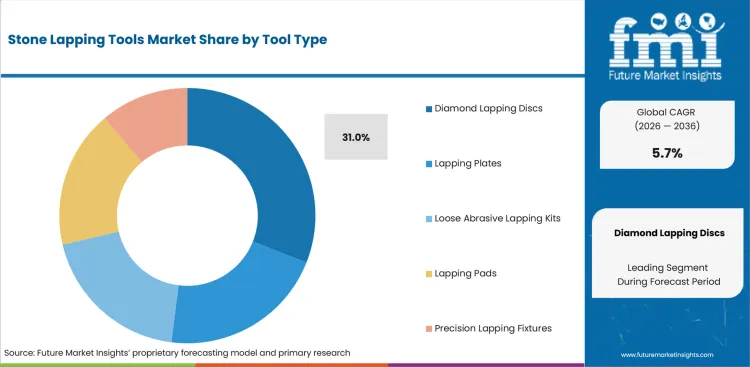
Diamond provides controlled cutting points for hard and brittle surfaces. The disc format lets the operator correct local high spots without removing material indiscriminately across the full surface. Lapping Plates, Loose Abrasive Lapping Kits, Lapping Pads and Precision Lapping Fixtures remain relevant where buyers need a different contact format or a controlled setup.
- By Tool Type, Diamond Lapping Discs are forecast to represent 31.0% in 2026 as they provide a defined removal rate for precision correction rather than aggressive grinding.
- Approval should include a flatness map after lapping as a smooth appearance does not prove that the geometry has been restored.
Why does diamond retain the largest share within the abrasive category?
Diamond abrasives provide the hardness needed for controlled removal from granite and other resistant stone. Graded particle sizes let the operator move from correction to refinement without losing dimensional control. Silicon Carbide, Aluminum Oxide and Cerium Oxide / Specialty abrasives remain alternatives where the required cutting action or surface response differs.
- Diamond is set to lead the Abrasive category with a 42.0% share in 2026 because it combines material removal with low roughness and measurable final geometry.
- Price comparisons are meaningful only after particle grade, carrier fluid, lapping plate and starting surface condition are held constant.
How does surface flattening support demand within the application category?
Surface Flattening has a clear acceptance test: the working surface must meet specified overall and local flatness limits after resurfacing. Edge Finishing, Restoration / Repair, Optical / Decorative Stone and Precision Stone Components extend demand beyond full-surface correction.
- By Application, Surface Flattening is estimated to hold 31.0% in 2026 because the result can be accepted against defined flatness limits.
- ASME B89.3.7 covers recertification after resurfacing, linking the lapping process directly with calibration and traceability. A service contract should state the starting condition, removal plan, measurement method and final accuracy grade.
Why does granite lead the stone type category?
Granite is dimensionally stable, resistant to corrosion and widely used as a reference surface in inspection and metrology. Wear usually creates a resurfacing and recertification cycle rather than immediate replacement. Marble, Quartz, Slate / Limestone and Engineered Stone remain in scope, but each requires product-level compatibility checks.
- Granite is projected to account for 28.0% of demand in 2026 because precision plates and related components generate repeat work when local wear or damage moves the surface outside tolerance.
- Stone compatibility should be confirmed at product level because a compound or plate designed for another material can embed abrasive or remove stock unevenly.
Why do stone tool distributors lead the sales channel category?
A lapping job often requires the abrasive, plate or disc, carrier, fixtures and measurement accessories to work together. Buyers without an in-house specialist rely on distributors to match those parts and direct the finished surface toward calibration. Direct Manufacturer supply remains relevant for engineered support, while E-commerce / Catalog purchasing suits repeat consumables after a method is established.
- Stone Tool Distributors are expected to handle 45.0% of market sales in 2026 because they can supply the complete process and identify when a calibration service must take over.
- Catalogue purchasing is best suited to repeat consumables after the buyer has established a stable and verified lapping method.
What are the drivers, restraints and opportunities in the Stone Lapping Tools Market?
Recertification supports repeat demand. Process skill and verification limit casual adoption. On-site lapping with calibration creates the clearest service opportunity.
- Driver: Precision granite surfaces require periodic correction when wear moves local or overall flatness outside tolerance.
- Restraint: An unverified process can remove material without restoring the geometry needed for inspection work.
- Opportunity: Bundled on-site resurfacing and calibration can reduce downtime while capturing tool, service and measurement revenue together.
Recurring demand comes from reference surfaces that must remain inside a defined accuracy limit. ASME B89.3.7 covers recertification after a granite plate is resurfaced. Each service cycle consumes abrasive and tooling capacity, then requires measurement before the plate can return to use.
The process is technically narrow. A plate may look clean and smooth while still failing local or overall flatness. Uneven removal can also change the relationship between the working surface, threaded inserts and support points. Buyers may outsource the work when they cannot control contamination or verify the result internally.
On-site service offers the clearest route to higher value. Large granite plates are difficult to move and can stop inspection activity while they are away. A supplier that brings lapping tools and measurement equipment to the facility can document the starting condition, restore the surface and issue the final calibration during one service programme.
Which country CAGRs are profiled in the Stone Lapping Tools Market?
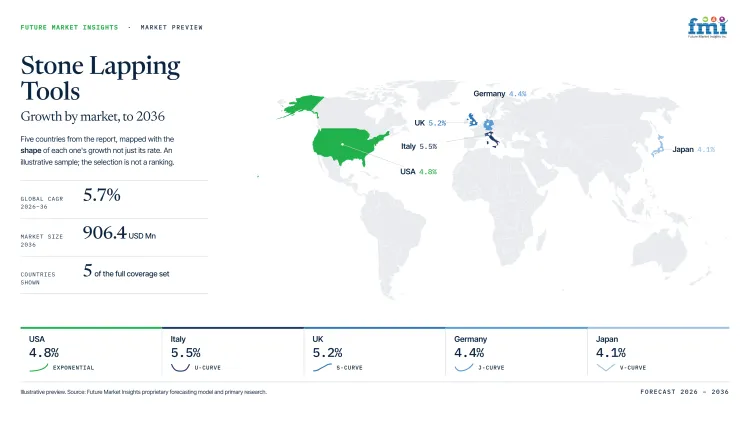
| Country | CAGR |
|---|---|
| USA | 4.8% |
| Germany | 4.4% |
| Japan | 4.1% |
| Italy | 5.5% |
| UK | 5.2% |
How do country-level CAGRs compare in the Stone Lapping Tools Market?
The country outlook spans 1.4 percentage points across the five profiled markets. Italy leads at 5.5%, followed by the UK at 5.2% and the USA at 4.8%. Germany and Japan are forecast at 4.4% and 4.1%. These rates describe forecast pace and do not measure current revenue or installed volume.
- USA: Resurfacing can be tied to a recognised standard and traceable calibration, creating a clear route to recurring service contracts.
- Germany: Precision engineering users rely on specialist equipment, service and calibration channels for controlled surface correction.
- Japan: Lapping-finished granite reference surfaces and a quality-sensitive metrology base support repeatable, lower-volume demand.
- Italy: A broad stone-processing base supports specialist skills and equipment, although the opportunity is strongest in precision stone components and metrology.
- UK: Specialist lapping and repair channels support direct technical service, with Kemet providing a domestic base for lapping plates and process support.
Country entry should begin with the installed base of precision granite, named service providers and calibration demand. General construction output is a weak substitute. The full report provides country-level analysis across North America, Latin America, Western Europe, Eastern Europe, South Asia & Pacific, East Asia, Central Asia, Russia & Belarus, and Middle East & Africa.
Country-wise Analysis
- USA: The US market is projected to grow at a 4.8% CAGR from 2026 to 2036. ASME B89.3.7 and government calibration research provide a direct technical basis for resurfacing and recertification. Suppliers can build repeat contracts around on-site lapping, measured flatness and traceable return to service.
- Germany: Germany is forecast to expand at a 4.4% CAGR through 2036. Precision manufacturing and dimensional inspection support demand for controlled surface correction. The most credible route is through metrology service firms and precision-component users rather than broad stone or construction channels.
- Japan: Japan is expected to record a 4.1% CAGR over the forecast period. Obishi documents granite measuring plates with lapping-finished surfaces, showing a direct use for the process. Suppliers need precision-tool distribution and calibration relationships, with emphasis on repeatability rather than volume.
- Italy: Italy is projected to lead the five countries at a 5.5% CAGR. Its established stone-cutting and finishing base creates a pool of specialist skills and equipment. The lapping opportunity is strongest in precision stone components, surface correction and service work, not mass architectural finishing.
- UK: The UK market is forecast to grow at a 5.2% CAGR from 2026 to 2036. Kemet provides a domestic base for lapping plates and process support, while repair activity sustains specialist service demand. Direct technical support helps bridge the gap between general lapping equipment and stone-specific application.
Who are the notable companies in the Stone Lapping Tools Market?
Kemet International, Lapmaster Wolters, Engis, Saint-Gobain Norton, KGS Diamond, Buehler, Logitech Ltd., SpeedFam and UKAM Industrial Superhard Tools are the notable companies serving this market.
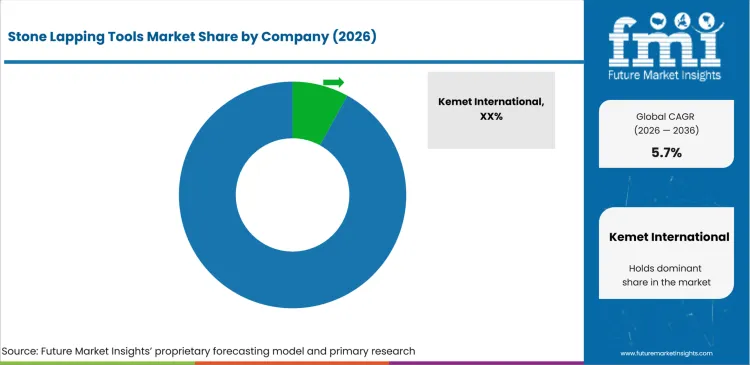
Competition includes core lapping-system providers. Diamond and superabrasive suppliers form a second group, while precision-finishing equipment companies serve adjacent workflows. Buyers need to know whether a supplier can control removal, maintain plate condition and verify the finished geometry. A broad lapping catalogue is insufficient when stone compatibility or calibration support is missing.
- Kemet International, Lapmaster Wolters and Engis compete through lapping plates, compounds, machines and process support. Kemet offers different plate materials for controlled abrasive behaviour, while Engis links diamond lapping with precise dimensions and low roughness.
- Saint-Gobain Norton, KGS Diamond and UKAM Industrial Superhard Tools contribute abrasive and superabrasive capability. Their relevance is strongest when the buyer already has a stable machine and measurement process and needs a stone-compatible cutting medium.
- Buehler, Logitech Ltd., SpeedFam and Hyprez serve adjacent precision-finishing workflows through equipment and consumables. Buyers should confirm direct stone evidence because performance on ceramics, metals or semiconductor materials does not automatically transfer to granite.
How do suppliers compare in the Stone Lapping Tools Market?
| Company | Stone-Compatible Tools | Flatness and Calibration Link | Diamond Process Depth | Geographic Reach |
|---|---|---|---|---|
| Kemet International | High | Medium | High | Global |
| Lapmaster Wolters | High | Medium | High | Global |
| Engis | High | High | High | Global |
| Saint-Gobain Norton | Medium | Low | High | Global |
| KGS Diamond | High | Low | High | Global |
| Buehler | Medium | Medium | High | Global |
| Logitech Ltd. | Medium | Medium | High | Global |
| SpeedFam | Medium | Low | High | Global |
Scoring basis: High indicates broad documented coverage or direct evidence for the criterion. Medium indicates partial coverage or a narrower evidence base. Low indicates limited documented coverage. Geographic reach records the active scope stated in the source. The table is not a market-share ranking.
What are the key developments in the Stone Lapping Tools Market?
- In 2023, ASME reaffirmed B89.3.7 for granite surface plates. The reaffirmed standard continued to cover field recertification and recertification after resurfacing, preserving a formal acceptance route for professional granite lapping services.
- In May 2024, Starrett completed its merger with an affiliate of MiddleGround Capital and became privately held. Starrett remains a provider of precision granite plates, calibration and resurfacing services, making the ownership change relevant to the supplier base for granite reference surfaces.
What is covered in the Stone Lapping Tools Market report?
| Coverage field | Report scope |
|---|---|
| Market breakdown | By tool type, abrasive, application, stone type, sales channel and region. |
| Quantitative Units | Revenue in USD Million, CAGR in %. |
| Market Definition | Lapping discs, plates, pads, fixtures and loose-abrasive systems used to flatten or precision-finish natural or engineered stone. The clearest documented use is the resurfacing of precision granite reference surfaces. |
| Regions Covered | North America, Latin America, Western Europe, Eastern Europe, South Asia & Pacific, East Asia, Central Asia, Russia & Belarus, and Middle East & Africa. |
| Countries Covered | USA, Germany, Japan, Italy and the UK, with more than 30 markets covered in the full report. |
| Key Companies Profiled | Kemet International, Lapmaster Wolters, Engis, Saint-Gobain Norton, KGS Diamond, Buehler, Logitech Ltd., SpeedFam, Hyprez, UKAM Industrial Superhard Tools |
| Forecast Period | 2026 to 2036. |
| Approach | Hybrid bottom-up and top-down market sizing supported by primary interviews and official desk research. |
How was the Stone Lapping Tools Market assessed?
| Method | Approach |
|---|---|
| Primary Research | FMI analysts gathered input from manufacturers, service providers, technology developers, distributors, end users, procurement teams and subject-matter experts. Interviews examined purchasing decisions, product or service evaluation, adoption barriers, approval requirements, pricing considerations and expectations for technical or commercial support. Respondents were also asked what evidence is required before a trial, pilot or initial order develops into regular purchasing. |
| Desk Research | Desk research covered government statistics, regulatory publications, trade data, industry associations, technical literature, standards, company filings, product information and official corporate announcements. Sources were reviewed for relevance, publication date, geographic coverage and consistency with the defined market scope. Claims relating to performance, applications, approvals, capacity, investment and commercial activity were retained only when supported by credible public evidence. |
| Market Sizing and Forecasting | The market model combined the baseline value with historical performance, segment structure, pricing and volume indicators, adoption levels, company participation and country-level demand conditions. Forecast assumptions considered economic activity, investment trends, regulatory developments, technology adoption, purchasing cycles, supply availability and barriers to wider market use. Segment and regional estimates were reconciled before the final market total was calculated. |
| Data Validation | Estimates were checked against multiple independent indicators, including public data, company activity, trade patterns, industry developments and findings from primary interviews. Validation also tested whether products, services, applications and company revenues fell within the defined market boundaries. Adjacent categories, unsupported claims, overlapping revenues and activities without direct market relevance were excluded to reduce double counting and maintain consistency across segments and countries. |
How is the Stone Lapping Tools Market classified by segment?
Stone Lapping Tools Market segmented by Tool Type:
- Diamond Lapping Discs
- Lapping Plates
- Loose Abrasive Lapping Kits
- Lapping Pads
- Precision Lapping Fixtures
Stone Lapping Tools Market segmented by Abrasive:
- Diamond
- Silicon Carbide
- Aluminum Oxide
- Cerium Oxide / Specialty
Stone Lapping Tools Market segmented by Application:
- Surface Flattening
- Edge Finishing
- Restoration / Repair
- Optical / Decorative Stone
- Precision Stone Components
Stone Lapping Tools Market segmented by Stone Type:
- Granite
- Marble
- Quartz
- Slate / Limestone
- Engineered Stone
Stone Lapping Tools Market segmented by Sales Channel:
- Stone Tool Distributors
- Direct Manufacturer
- E-commerce / Catalog
Stone Lapping Tools Market segmented by Region:
- North America
- United States
- Canada
- Latin America
- Brazil
- Mexico
- Argentina
- Chile
- Western Europe
- Germany
- France
- United Kingdom
- Italy
- Spain
- BENELUX
- Nordic
- Eastern Europe
- Poland
- Czech Republic
- Hungary
- Romania
- Balkan & Baltics
- South Asia & Pacific
- India
- ASEAN
- Oceania
- East Asia
- China
- Japan
- South Korea
- Central Asia
- Kazakhstan
- Kyrgyzstan
- Tajikistan
- Turkmenistan
- Uzbekistan
- Russia & Belarus
- Middle East & Africa
- GCC Countries
- Türkiye
- Israel
- South Africa
Which sources support the Stone Lapping Tools Market analysis?
- ASME B89.3.7, current catalogue. Granite surface plates are governed by a dimensional-metrology standard that covers specification, calibration and recertification after resurfacing.
- ANSI/ASME B89.3.7-2013 (R2023). The current reaffirmed standard explicitly applies when a granite plate is resurfaced and returned to service.
- Mitutoyo technical bulletin. Granite surface plates are sold and calibrated to AA, A and B accuracy grades with both overall and local flatness limits.
- US Department of Energy/OSTI report. Calibration of granite surface plates requires systematic measurement of flatness across the working surface.
- Engis, accessed 2026. Precision granite products are sold together with lapping and calibration capabilities.
- Precision Surfacing Solutions, accessed 2026. Lapping plates are engineered in multiple materials to control abrasive embedding, flatness and removal behaviour.
- Precision Surfacing Solutions, accessed 2026. Precision-surfacing suppliers explicitly list granite surface plates among served applications.
- Kemet International, accessed 2026. Kemet supplies purpose-designed lapping plates used with controlled abrasive systems.
- Engis technical paper. Diamond lapping is used when hard, brittle surfaces require precise dimensions and low roughness.
- Obishi Keiki, accessed 2026. Some precision granite surface plates are explicitly described as lapping-finished.
- Wade O Design, accessed 2026. Practitioner methods use graded diamond powder and a cast-iron lap to correct granite flatness.
- TQ Systems catalogue. Precision granite catalogues pair surface plates with calibration, resurfacing and accessory services.
- Starrett catalogue. Established metrology brands offer calibration and resurfacing support for granite plates.
- ISTAT, 2025. Italy officially identifies stone cutting, shaping and finishing as a separate activity.
- Office for National Statistics, May 2026. UK construction repair and maintenance provide a general stone-restoration demand base, but precision lapping is not separately reported.
- ASME B89.3.7-2013 (R2023). The standard was reaffirmed in 2023 and continues to cover recertification after resurfacing.
- US Securities and Exchange Commission, 23 May 2024. Starrett completed its merger with an affiliate of MiddleGround Capital and became a wholly owned subsidiary.
This bibliography is provided for reader reference and is not exhaustive. The full report contains the complete reference list and detailed citations.
What questions does this report answer?
- How large is the Stone Lapping Tools Market in 2026 and 2036?
- Which precision and recertification needs support demand?
- Why do Diamond Lapping Discs hold 31.0% share in 2026?
- Why does Diamond lead the Abrasive category?
- How does Surface Flattening create a measurable service market?
- How do the USA, Germany, Japan, Italy and the UK compare?
- Which companies provide lapping systems or stone-compatible tools?
- What skill and verification limits restrict wider use?
- How can on-site lapping create additional service value?
Frequently Asked Questions
How big is the Stone Lapping Tools Market in 2026?
The stone lapping tools market is valued at USD 520.7 million in 2026 and is forecast to reach USD 906.4 million by 2036. Growth is supported by recertification cycles for precision granite reference surfaces that wear outside flatness tolerance across dimensional inspection and metrology programs.
What is the CAGR of the Stone Lapping Tools Market from 2026 to 2036?
The stone lapping tools market grows at a CAGR of 5.7% between 2026 and 2036, supported by recurring resurfacing and calibration cycles as precision granite reference surfaces move outside overall or local flatness limits across metrology and inspection installations worldwide.
Which tool type leads the Stone Lapping Tools Market?
Diamond lapping discs account for 31.0% of the stone lapping tools market by tool type in 2026, driven by controlled correction of local high spots that lets operators restore flatness without removing material indiscriminately across the working surface.
How much will the Stone Lapping Tools Market add between 2026 and 2036?
The stone lapping tools market is set to add USD 385.7 million between 2026 and 2036, growing from USD 520.7 million to USD 906.4 million as recertification-linked resurfacing work expands across precision granite reference surfaces in inspection and metrology settings.
Who are the leading companies in the Stone Lapping Tools Market?
Ten companies lead the stone lapping tools market consistently, including Kemet International, Lapmaster Wolters, Engis, Saint-Gobain Norton, KGS Diamond, Buehler, Logitech Ltd., SpeedFam, Hyprez and UKAM Industrial Superhard Tools, competing through stone-compatible tooling, calibration linkage and diamond process depth worldwide.
Preview the report firsthand - request a free sample
Get SampleGet the brochure for pricing and purchase details.
Get PDFTable of Content
- Key Takeaways
- Market Size and CAGR
- Top Growth Driver
- Fastest Growing Segment
- Leading Region
- Key Companies
- Emerging Opportunities
- Executive Summary
- Global Market Outlook
- Demand-side Trends
- Supply-side Trends
- Technology Roadmap Analysis
- Analysis and Recommendations
- Analyst Perspective (What is happening? Why now? What should investors know?)
- Key Questions Answered
- How large is the market?
- What is the CAGR?
- What are key trends?
- Which region dominates?
- Who are the leaders?
- Market Overview
- Market Coverage / Taxonomy
- Market Definition / Scope / Limitations
- Research Methodology
- Chapter Orientation
- Analytical Lens and Working Hypotheses
- Market Structure, Signals, and Trend Drivers
- Benchmarking and Cross-market Comparability
- Market Sizing, Forecasting, and Opportunity Mapping
- Research Design and Evidence Framework
- Desk Research Programme (Secondary Evidence)
- Expert Input and Fieldwork (Primary Evidence)
- Tooling, Models, and Reference Databases
- Data Engineering and Model Build
- Quality Assurance and Audit Trail
- Market Background
- Market Dynamics (Drivers, Restraints, Opportunity, Trends)
- Scenario Forecast (Optimistic, Likely, Conservative)
- Impact Analysis
- AI Impact
- Sustainability Impact
- Regulatory Impact
- Technology Impact
- Consumer / Buyer Analysis
- Purchase Drivers
- Adoption Barriers
- Buyer Journey
- Opportunity Map Analysis
- Product Life Cycle Analysis
- Supply Chain Analysis
- Investment Feasibility Matrix
- Value Chain Analysis
- PESTLE and Porter's Analysis
- Regulatory Landscape
- Regional Parent Market Outlook
- Production and Consumption Statistics
- Import and Export Statistics
- Global Market Analysis and Forecast, 2021 to 2036
- Historical Market Size Value (USD Million) Analysis, 2021 to 2025
- Current and Future Market Size Value (USD Million) Projections, 2026 to 2036
- Y-o-Y Growth Trend Analysis
- Absolute $ Opportunity Analysis
- Global Market Pricing Analysis, 2021 to 2036
- Global Market Analysis and Forecast, By Tool Type, 2021 to 2036
- Introduction / Key Findings
- Historical Market Size Value (USD Million) Analysis By Tool Type, 2021 to 2025
- Current and Future Market Size Value (USD Million) Analysis and Forecast By Tool Type, 2026 to 2036
- Diamond Lapping Discs
- Lapping Plates
- Loose Abrasive Lapping Kits
- Lapping Pads
- Precision Lapping Fixtures
- Diamond Lapping Discs
- Y-o-Y Growth Trend Analysis By Tool Type, 2021 to 2025
- Absolute $ Opportunity Analysis By Tool Type, 2026 to 2036
- Global Market Analysis and Forecast, By Abrasive, 2021 to 2036
- Introduction / Key Findings
- Historical Market Size Value (USD Million) Analysis By Abrasive, 2021 to 2025
- Current and Future Market Size Value (USD Million) Analysis and Forecast By Abrasive, 2026 to 2036
- Diamond
- Silicon Carbide
- Aluminum Oxide
- Cerium Oxide / Specialty
- Diamond
- Y-o-Y Growth Trend Analysis By Abrasive, 2021 to 2025
- Absolute $ Opportunity Analysis By Abrasive, 2026 to 2036
- Global Market Analysis and Forecast, By Application, 2021 to 2036
- Introduction / Key Findings
- Historical Market Size Value (USD Million) Analysis By Application, 2021 to 2025
- Current and Future Market Size Value (USD Million) Analysis and Forecast By Application, 2026 to 2036
- Surface Flattening
- Edge Finishing
- Restoration / Repair
- Optical / Decorative Stone
- Precision Stone Components
- Surface Flattening
- Y-o-Y Growth Trend Analysis By Application, 2021 to 2025
- Absolute $ Opportunity Analysis By Application, 2026 to 2036
- Global Market Analysis and Forecast, By Stone Type, 2021 to 2036
- Introduction / Key Findings
- Historical Market Size Value (USD Million) Analysis By Stone Type, 2021 to 2025
- Current and Future Market Size Value (USD Million) Analysis and Forecast By Stone Type, 2026 to 2036
- Granite
- Marble
- Quartz
- Slate / Limestone
- Engineered Stone
- Granite
- Y-o-Y Growth Trend Analysis By Stone Type, 2021 to 2025
- Absolute $ Opportunity Analysis By Stone Type, 2026 to 2036
- Global Market Analysis and Forecast, By Sales Channel, 2021 to 2036
- Introduction / Key Findings
- Historical Market Size Value (USD Million) Analysis By Sales Channel, 2021 to 2025
- Current and Future Market Size Value (USD Million) Analysis and Forecast By Sales Channel, 2026 to 2036
- Stone Tool Distributors
- Direct Manufacturer
- E-commerce / Catalog
- Stone Tool Distributors
- Y-o-Y Growth Trend Analysis By Sales Channel, 2021 to 2025
- Absolute $ Opportunity Analysis By Sales Channel, 2026 to 2036
- Global Market Analysis and Forecast, By Region, 2021 to 2036
- Introduction
- Historical Market Size Value (USD Million) Analysis By Region, 2021 to 2025
- Current Market Size Value (USD Million) Analysis and Forecast By Region, 2026 to 2036
- North America
- Latin America
- Western Europe
- Eastern Europe
- East Asia
- South Asia and Pacific
- Middle East & Africa
- Market Attractiveness Analysis By Region
- North America Market Analysis and Forecast, By Country, 2021 to 2036
- Historical Market Size Value (USD Million) Trend Analysis By Market Taxonomy, 2021 to 2025
- Market Size Value (USD Million) Forecast By Market Taxonomy, 2026 to 2036
- By Country
- USA
- Canada
- By Tool Type
- By Abrasive
- By Application
- By Stone Type
- By Sales Channel
- By Country
- Market Attractiveness Analysis
- By Country
- By Tool Type
- By Abrasive
- By Application
- By Stone Type
- By Sales Channel
- Key Takeaways
- Latin America Market Analysis and Forecast, By Country
- Historical Market Size Value (USD Million) Trend Analysis By Market Taxonomy, 2021 to 2025
- Market Size Value (USD Million) Forecast By Market Taxonomy, 2026 to 2036
- By Country
- Brazil
- Mexico
- Chile
- Rest of Latin America
- By Tool Type
- By Abrasive
- By Application
- By Stone Type
- By Sales Channel
- By Country
- Market Attractiveness Analysis
- By Country
- By Tool Type
- By Abrasive
- By Application
- By Stone Type
- By Sales Channel
- Key Takeaways
- Western Europe Market Analysis and Forecast, By Country
- Historical Market Size Value (USD Million) Trend Analysis By Market Taxonomy, 2021 to 2025
- Market Size Value (USD Million) Forecast By Market Taxonomy, 2026 to 2036
- By Country
- Germany
- UK
- Italy
- Spain
- France
- Nordic
- BENELUX
- Rest of Western Europe
- By Tool Type
- By Abrasive
- By Application
- By Stone Type
- By Sales Channel
- By Country
- Market Attractiveness Analysis
- By Country
- By Tool Type
- By Abrasive
- By Application
- By Stone Type
- By Sales Channel
- Key Takeaways
- Eastern Europe Market Analysis and Forecast, By Country
- Historical Market Size Value (USD Million) Trend Analysis By Market Taxonomy, 2021 to 2025
- Market Size Value (USD Million) Forecast By Market Taxonomy, 2026 to 2036
- By Country
- Russia
- Poland
- Hungary
- Balkan & Baltic
- Rest of Eastern Europe
- By Tool Type
- By Abrasive
- By Application
- By Stone Type
- By Sales Channel
- By Country
- Market Attractiveness Analysis
- By Country
- By Tool Type
- By Abrasive
- By Application
- By Stone Type
- By Sales Channel
- Key Takeaways
- East Asia Market Analysis and Forecast, By Country
- Historical Market Size Value (USD Million) Trend Analysis By Market Taxonomy, 2021 to 2025
- Market Size Value (USD Million) Forecast By Market Taxonomy, 2026 to 2036
- By Country
- China
- Japan
- South Korea
- By Tool Type
- By Abrasive
- By Application
- By Stone Type
- By Sales Channel
- By Country
- Market Attractiveness Analysis
- By Country
- By Tool Type
- By Abrasive
- By Application
- By Stone Type
- By Sales Channel
- Key Takeaways
- South Asia and Pacific Market Analysis and Forecast, By Country
- Historical Market Size Value (USD Million) Trend Analysis By Market Taxonomy, 2021 to 2025
- Market Size Value (USD Million) Forecast By Market Taxonomy, 2026 to 2036
- By Country
- India
- ASEAN
- Australia & New Zealand
- Rest of South Asia and Pacific
- By Tool Type
- By Abrasive
- By Application
- By Stone Type
- By Sales Channel
- By Country
- Market Attractiveness Analysis
- By Country
- By Tool Type
- By Abrasive
- By Application
- By Stone Type
- By Sales Channel
- Key Takeaways
- Middle East & Africa Market Analysis and Forecast, By Country
- Historical Market Size Value (USD Million) Trend Analysis By Market Taxonomy, 2021 to 2025
- Market Size Value (USD Million) Forecast By Market Taxonomy, 2026 to 2036
- By Country
- Kingdom of Saudi Arabia
- Other GCC Countries
- Türkiye
- South Africa
- Other African Union
- Rest of Middle East & Africa
- By Tool Type
- By Abrasive
- By Application
- By Stone Type
- By Sales Channel
- By Country
- Market Attractiveness Analysis
- By Country
- By Tool Type
- By Abrasive
- By Application
- By Stone Type
- By Sales Channel
- Key Takeaways
- Key Countries Market Analysis
- USA
- Pricing Analysis
- Market Share Analysis, 2025
- By Tool Type
- By Abrasive
- By Application
- By Stone Type
- By Sales Channel
- Canada
- Pricing Analysis
- Market Share Analysis, 2025
- By Tool Type
- By Abrasive
- By Application
- By Stone Type
- By Sales Channel
- Mexico
- Pricing Analysis
- Market Share Analysis, 2025
- By Tool Type
- By Abrasive
- By Application
- By Stone Type
- By Sales Channel
- Brazil
- Pricing Analysis
- Market Share Analysis, 2025
- By Tool Type
- By Abrasive
- By Application
- By Stone Type
- By Sales Channel
- Chile
- Pricing Analysis
- Market Share Analysis, 2025
- By Tool Type
- By Abrasive
- By Application
- By Stone Type
- By Sales Channel
- Germany
- Pricing Analysis
- Market Share Analysis, 2025
- By Tool Type
- By Abrasive
- By Application
- By Stone Type
- By Sales Channel
- UK
- Pricing Analysis
- Market Share Analysis, 2025
- By Tool Type
- By Abrasive
- By Application
- By Stone Type
- By Sales Channel
- Italy
- Pricing Analysis
- Market Share Analysis, 2025
- By Tool Type
- By Abrasive
- By Application
- By Stone Type
- By Sales Channel
- Spain
- Pricing Analysis
- Market Share Analysis, 2025
- By Tool Type
- By Abrasive
- By Application
- By Stone Type
- By Sales Channel
- France
- Pricing Analysis
- Market Share Analysis, 2025
- By Tool Type
- By Abrasive
- By Application
- By Stone Type
- By Sales Channel
- India
- Pricing Analysis
- Market Share Analysis, 2025
- By Tool Type
- By Abrasive
- By Application
- By Stone Type
- By Sales Channel
- ASEAN
- Pricing Analysis
- Market Share Analysis, 2025
- By Tool Type
- By Abrasive
- By Application
- By Stone Type
- By Sales Channel
- Australia & New Zealand
- Pricing Analysis
- Market Share Analysis, 2025
- By Tool Type
- By Abrasive
- By Application
- By Stone Type
- By Sales Channel
- China
- Pricing Analysis
- Market Share Analysis, 2025
- By Tool Type
- By Abrasive
- By Application
- By Stone Type
- By Sales Channel
- Japan
- Pricing Analysis
- Market Share Analysis, 2025
- By Tool Type
- By Abrasive
- By Application
- By Stone Type
- By Sales Channel
- South Korea
- Pricing Analysis
- Market Share Analysis, 2025
- By Tool Type
- By Abrasive
- By Application
- By Stone Type
- By Sales Channel
- Russia
- Pricing Analysis
- Market Share Analysis, 2025
- By Tool Type
- By Abrasive
- By Application
- By Stone Type
- By Sales Channel
- Poland
- Pricing Analysis
- Market Share Analysis, 2025
- By Tool Type
- By Abrasive
- By Application
- By Stone Type
- By Sales Channel
- Hungary
- Pricing Analysis
- Market Share Analysis, 2025
- By Tool Type
- By Abrasive
- By Application
- By Stone Type
- By Sales Channel
- Kingdom of Saudi Arabia
- Pricing Analysis
- Market Share Analysis, 2025
- By Tool Type
- By Abrasive
- By Application
- By Stone Type
- By Sales Channel
- Türkiye
- Pricing Analysis
- Market Share Analysis, 2025
- By Tool Type
- By Abrasive
- By Application
- By Stone Type
- By Sales Channel
- South Africa
- Pricing Analysis
- Market Share Analysis, 2025
- By Tool Type
- By Abrasive
- By Application
- By Stone Type
- By Sales Channel
- USA
- Market Structure Analysis
- Competition Dashboard
- Competition Benchmarking
- Market Share Analysis of Top Players
- By Regional
- By Tool Type
- By Abrasive
- By Application
- By Stone Type
- By Sales Channel
- Emerging Startups
- Innovation Benchmarking
- Competition Analysis
- Competition Deep Dive
- Kemet International
- Overview
- Product Portfolio
- Profitability by Market Segments
- Sales Footprint
- Strategy Overview
- Marketing Strategy
- Product Strategy
- Channel Strategy
- Lapmaster Wolters
- Engis
- Saint-Gobain Norton
- KGS Diamond
- Buehler
- Logitech Ltd.
- SpeedFam
- Hyprez
- UKAM Industrial Superhard Tools
- Kemet International
- Case Studies
- Success Stories
- Recent Developments
- Competition Deep Dive
- Assumptions & Acronyms Used


