

- Market Size (2026)
- USD 0.5 Bn
- Forecast (2036)
- USD 2.8 Bn
- CAGR (2026 to 2036)
- 18.8%
Synthetic Nicotine Pouches Market Size, Market Forecast and Outlook By FMI
The synthetic nicotine pouches market is anticipated to rise from USD 0.4 billion in 2025 to USD 2.8 billion by 2036 at 18.8% CAGR, driven by adult movement toward tobacco-free oral formats and tighter product-review paths for nicotine from any source. 20-pouch cans are expected to secure 69.2% share in 2026, supported by familiar oral pouch counts and simpler shelf handling. Fully synthetic pouches are projected to hold 63.4% share in 2026, led by cleaner source positioning and lower tobacco-leaf exposure.
Summary of Synthetic Nicotine Pouches Market
- Demand and Growth Drivers
- Adult oral nicotine users are moving toward tobacco-free pouch formats as cans allow discreet use and repeat purchase planning.
- Online retail networks are gaining share as verified adult accounts support repeat orders and controlled pack communication.
- Fully synthetic pouch makers are using nicotine-source claims to separate product positioning from leaf-based oral formats.
- Product and Segment View
- 20-pouch cans are expected to secure 69.2% share in 2026, supported by familiar oral pouch counts and shelf handling.
- Fully synthetic pouches are projected to hold 63.4% share in 2026, influenced by non-tobacco source positioning.
- Online retail is forecast to represent 54.7% share in 2026, led by adult account checks and repeat can ordering.
- Geography and Competitive Outlook
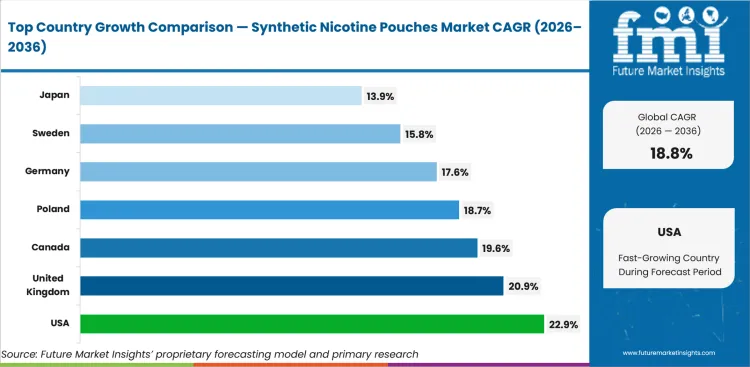
- United States is projected to record 22.9% CAGR by 2036, backed by FDA product-review discipline and pouch manufacturing investment.
- United Kingdom is expected to expand at 20.9% CAGR by 2036 as planned nicotine pouch rules reshape adult retail access.
- Next Generation Labs and Lucy Goods compete around synthetic nicotine identity and verified ingredient positioning.
- Philip Morris International and Altria Group compete through scale and retail access. British American Tobacco competes through oral pouch brand depth.
- Analyst Opinion
- Nandini Roy Choudhury, Principal Consultant for Food and Beverage at FMI, observes, “Synthetic nicotine pouches are moving from novelty positioning into controlled adult retail planning. Adult users compare source clarity first and flavor consistency next. Suppliers pairing compliant can design with verified adult sale routes are expected to defend repeat sales more effectively.”
- Synthetic Nicotine Pouches Market Value Analysis
- Market value centers on finished pouch cans as device-free use and channel access add incremental revenue.
- Supplier pricing reflects nicotine source cost and pouch material choice before regulatory review shapes retail shelf price.
- Revenue improves as adult users shift part of routine nicotine spend from cigarettes and vapor formats into repeat pouch cans.
- Retail trust rises as can labels make nicotine strength and pouch count easier for adult users to compare.
Unauthorized pouch listings are becoming a major risk for synthetic nicotine pouch expansion. FDA’s January 2025 Import Alert 98-06 update said unauthorized NOIS and LYFT nicotine pouches can be detained without physical inspection. Importers need to check authorization status before sending purchase orders across borders. Pharmacy-style control is another pressure point in markets treating oral nicotine as a cessation product. Health Canada’s guidance stated, buccal nicotine pouches were not listed for self-selection at the order publication date. Sellers in such markets need pharmacy-linked sale routes and tighter flavor planning before wider shelf access. Product formulation is becoming a key separator for premium brands. EP4162927B1 stated in December 2025 reporting pouch composition can include synthetic nicotine at 0.1% to 5.0% by weight. Brands controlling nicotine level and pH can deliver steadier user feel and support clearer product files across smokeless cigarettes alternatives. Compliance-focused can design also raises the need for tobacco packaging systems reflecting strength and adult-use warnings clearly.
Synthetic Nicotine Pouches Market Definition
Synthetic Nicotine Pouches Market covers oral pouches using lab-made nicotine or verified non-tobacco nicotine inputs. Scope includes fully synthetic pouches and S-isomer pouches. Blended-source pouches and low-dose pouches are covered for adult nicotine users. Premium synthetic pouches are included as a separate format. Revenue includes finished pouch cans sold through online adult channels and tobacco stores. Convenience stores and pharmacies are covered if product rules permit sale. Duty-free outlets are included only under authorized adult access.
Synthetic Nicotine Pouches Market Inclusions
Market scope covers all commercially traded synthetic nicotine pouch products categorized by nicotine format, including fully synthetic pouches and S-isomer pouches; strength level, including low strength, medium strength, high strength, extra strength, and trial strength; flavor profile, including mint flavor, fruit flavor, menthol flavor, coffee flavor, and unflavored formats; pack type, including 20-pouch cans, 10-pouch cans, multipacks, trial packs, and duty-free packs; and sales channel, including online retail, tobacco stores, convenience stores, pharmacies, and duty-free stores. Revenue scope covers 2026 to 2036. The key stakeholders include synthetic nicotine suppliers, pouch brand owners, oral nicotine manufacturers, can and pouch material suppliers, flavor houses, contract manufacturers, tobacco retailers, online adult-verification platforms, convenience chains, pharmacy retailers, distributors, compliance service providers, testing laboratories, customs authorities, tobacco regulators, and public health agencies.
Synthetic Nicotine Pouches Market Exclusions
Scope excludes combustible cigarettes and loose smokeless tobacco. Nicotine gum and medicinal lozenges are outside scope unless sold as separate comparison formats. Vapor liquids and disposable e-cigarettes are excluded. Tobacco-derived pouch revenue is excluded unless supplier filings or product labels clearly assign synthetic nicotine value. Device hardware revenue is not applicable to this oral pouch scope.
Synthetic Nicotine Pouches Market Research Methodology
- Primary Research: FMI analysts reviewed synthetic nicotine supplier portfolios and adult retail channel checks across major regulated nicotine markets.
- Desk Research: Public data from FDA and CDC were checked against pouch evidence. Health Canada and Swedish authority data were reviewed separately. UK Parliament records and official company releases were checked next.
- Market Sizing and Forecasting: Estimated using a bottom-up product-boundary approach. Eligible SKU revenue and channel presence were used to construct the 2026 market estimate. Retail pricing and product positioning were used for cross-checks. Country-level adoption formed the final check.
- Data Validation: Forecast checks compared product authorization and country sale controls. Pouch capacity investment and age-verification rules were reviewed separately. Active supplier portfolios formed the final check.
Why is the Synthetic Nicotine Pouches Market Growing?
- Adult nicotine use is moving toward tobacco-free oral formats that offer discreet use and clear strength choice.
- Suppliers are placing more focus on compliant pouch files as regulators tighten controls on nicotine source and access.
- Retailers and verified online stores are giving more attention to pouch cans that support adult-only sale and repeat ordering.
Forward outlook is moving toward regulated pouch scale rather than loose online listing. CDC Foundation retail data show USA nicotine pouch dollar sales rose from USD 145.5 million to USD 446.8 million between January 2023 and April 2025, up 207.0%. Such sales shift points to faster shelf replenishment and stronger retailer interest around nicotine pouch formats. PLOS One’s 2025 UK adult survey found 2.9% current pouch use and 10.1% trial among adults surveyed in May and June 2024. It also reported 60.7% mint or menthol use among adults who had ever used pouches. Flavor and strength planning therefore remain central to repeat purchase across smokeless cigarettes alternatives. WHO stated in May 2026 reporting retail sales of nicotine pouches reached over 23 billion units in 2024. This global volume raises the need for tobacco packaging systems with clear strength labels and adult-use controls.
Market Segmentation Analysis
- Fully synthetic pouches are projected to secure 63.4% share in 2026 due to clearer non-tobacco source positioning and cleaner ingredient communication.
- Medium strength is forecast to hold 41.8% share in 2026, led by repeat adult users seeking balance between taste control and nicotine delivery.
- Mint flavor is expected to capture 48.6% share in 2026, driven by strong adult preference for cooling formats and retail comfort with familiar profiles.
- 20-pouch cans are anticipated to hold 69.2% share in 2026 as familiar can counts support online subscriptions and store inventory planning.
- Online retail is expected to represent 54.7% share in 2026, influenced by adult account checks and recurring order tools.
The synthetic nicotine pouches sector is divided by nicotine format and strength level. Flavor profile and pack type complete the structure. Sales channel analysis provides the final view. Nicotine format includes fully synthetic pouches and S-isomer pouches. Blended-source pouches and low-dose pouches complete most of the range. Premium synthetic pouches extend the format set. Strength level covers low strength and medium strength. High strength and extra strength cover stronger pouch needs. Trial strength completes the range. Flavor profile covers mint flavor and fruit flavor. Menthol flavor and coffee flavor serve smaller adult groups. Unflavored formats complete the range. Pack type covers 20-pouch cans and multipacks. Sales channel analysis covers online retail and tobacco stores. Convenience stores and pharmacies complete most of the channel range. Duty-free stores apply under travel retail rules.
Insights into Synthetic Nicotine Pouches Market by Nicotine Format
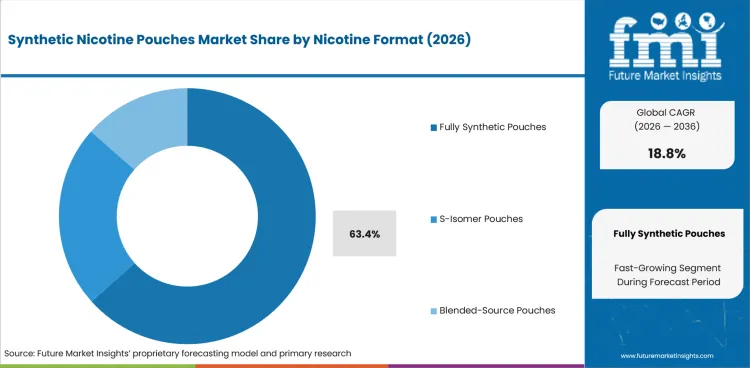
- Fully synthetic pouches are projected to account for 63.4% share in 2026, influenced by cleaner nicotine-source claims and supplier control over input purity.
- S-isomer pouches gain use among brands seeking precise sensory performance and more consistent pouch strength than mixed-source formats.
Insights into Synthetic Nicotine Pouches Market by Strength Level
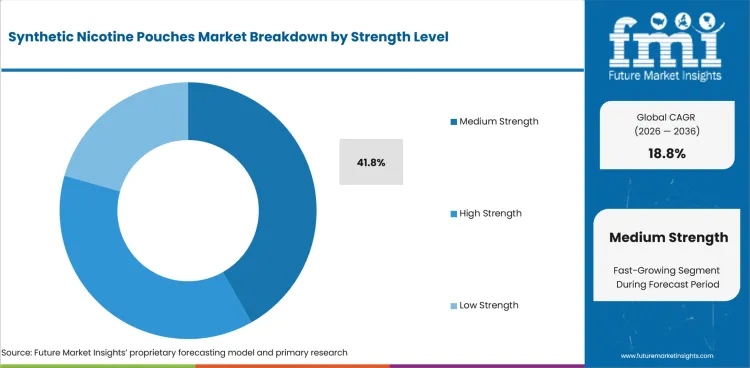
- Medium strength is estimated to hold 41.8% share in 2026 through repeat adult use and reduced risk of harsh taste at higher nicotine levels.
- Low strength pouches gain attention among trial buyers who compare can labels with nicotine gums and mints before moving into routine pouch buying.
Insights into Synthetic Nicotine Pouches Market by Flavor Profile
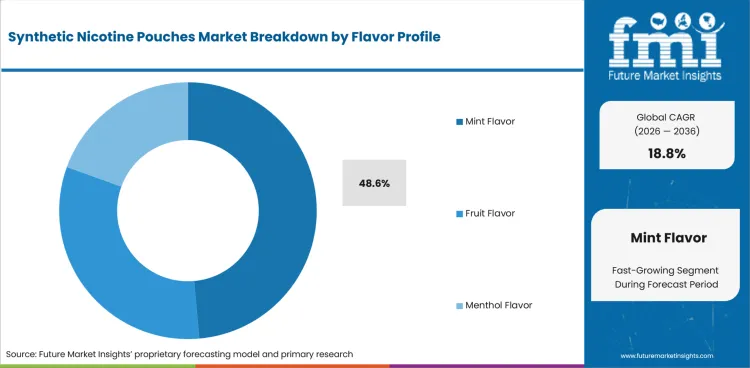
- Mint flavor is forecast to secure 48.6% share in 2026, led by familiar sensory cues and regulator comfort with non-youth-oriented positioning.
- Fruit flavor faces closer review in several countries, shifting some launches toward menthol and unflavored cans with cleaner adult communication.
Insights into Synthetic Nicotine Pouches Market by Pack Type
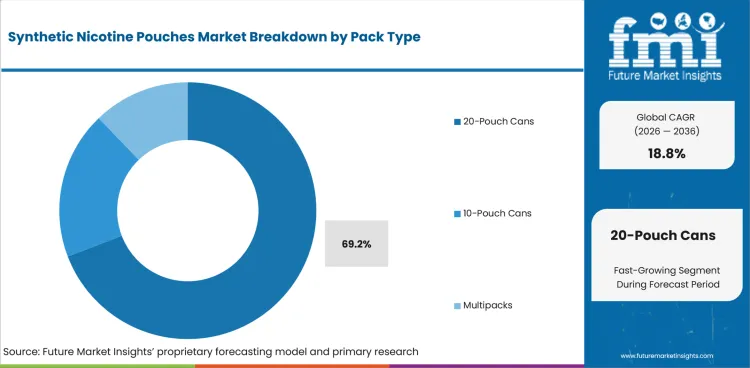
- 20-pouch cans are anticipated to represent 69.2% share in 2026, supported by familiar counts and simpler inventory handling for store counters.
- Trial packs gain value in verified online channels as brands test strength ladders without overloading adult users with large can orders.
Insights into Synthetic Nicotine Pouches Market by Sales Channel
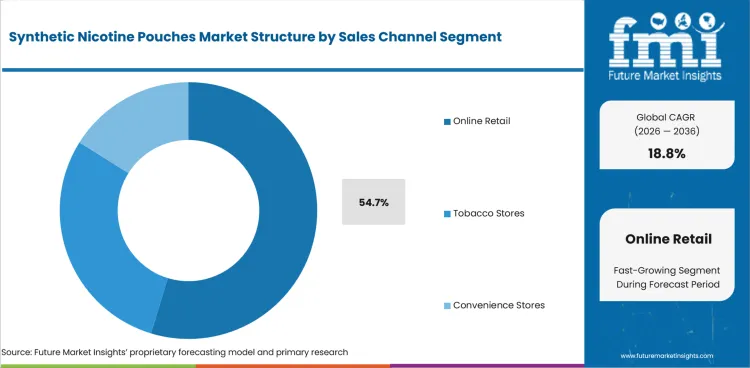
- Online retail is expected to garner 54.7% share in 2026, driven by adult verification and recurring can-order tools for repeat buyers.
- Tobacco stores keep value in dense urban retail corridors as clerks explain strength levels and can labels alongside smokeless tobacco alternatives.
Synthetic Nicotine Pouches Market Drivers, Restraints, and Opportunities
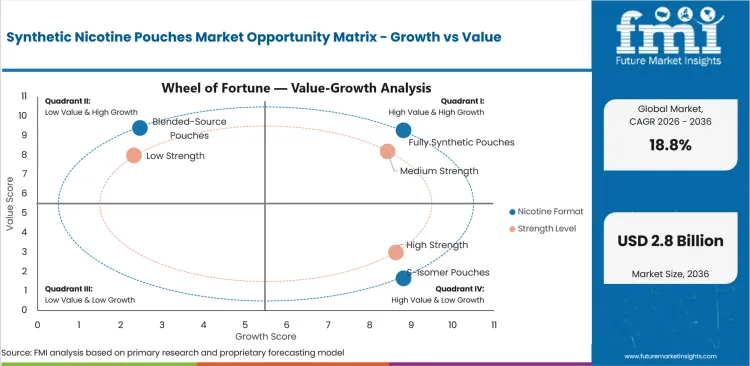
- Driver: Non-tobacco nicotine sourcing is moving adult oral pouch brands toward clearer product files and stronger source documentation.
- Restraint: Unauthorized listings and youth-appealing product features can slow access across regulated oral nicotine channels.
- Opportunity: Flavor discipline and pack-count design are creating more structured routes for verified adult repeat purchase.
The growth outlook is moving toward compliance-led pouch expansion across nicotine pouches and adjacent smokeless cigarettes formats. FDA stated in May 2026 that nicotine pouch products without premarket authorization remain subject to enforcement when they lack proper PMTA status. This leaves suppliers needing stronger authorization planning before retail or import activity. Product design has become equally important for repeat purchase. A July 2025 Nicotine & Tobacco Research study reviewed 1,689 oral nicotine pouch products from 19 brands and found synthetic claims on 8.0% of products. It also found 46.0% of products in the 5 mg to under 10 mg nicotine range. These findings show why source claims and strength-ladder clarity will guide supplier selection. Great Britain data published in December 2025 found current pouch use among adults rose to 1.0% in March 2025. Adult use growth makes verified channels more important for compliant pouch brands.
Product Attribute and Claim Preference Analysis
Product attribute planning is likely to movefrom broad flavor range toward measured flavor and claim testing. A 2025 Tobacco Control randomized trial of47 young adults aged 21 to 34 using inhalable nicotine tested four 3 mg ZYN pouch flavors and found mint appeal at 55.9 compared with smooth at 37.6. Such gap suggests brands need disciplined flavor ladders more than novelty-led launches. Modified-risk wording needs careful compliance control before it is used on tobacco packaging or digital product pages. For synthetic nicotine pouch suppliers and strength wording are likely to carry the most value when they support adult choice and repeat can selection across nicotine pouches and smokeless cigarettes alternatives.
Regional and Demographic Demand Analysis
Regional and demographic demand planning is likely to focus on young adult concentration and retailer controls. A 2025 BMJ Public Health study analyzed 44,736 youth and young adults in Canada, England, the USA and New Zealand and found 2024 youth ever-use near 5% in Canada, the USA and New Zealand and 10% in England. Young adult ever-use ranged from 9.1% in Canada to 18.7% in England. Past-30-day use ranged from 3.0% in New Zealand to 7.9% in the USA. Such variation shows that suppliers should build city and cohort plans around adult age checks and channel maturity across nicotine pouches.
Competitive Landscape and Strategic Positioning
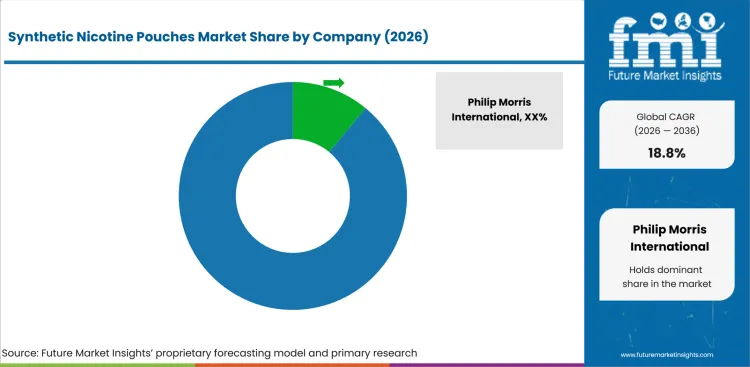
- Established tobacco companies hold an advantage depending on adult-only retail access and nicotine pouch regulatory filing depth.
- Synthetic nicotine suppliers gain stronger attention by offering verified nicotine origin and cleaner input documentation.
- Specialist oral nicotine brands gain shelf space by pouch comfort and adult-use packaging.
- Retail-ready cans support repeat trial based on clear strength labels and pouch-count information.
Competition in the industry is influenced by tobacco groups combining regulatory filings and adult-only retail execution. Philip Morris International holds the strongest oral pouch position through Swedish Match and ZYN. Altria Group and Helix Innovations gained a second USA authorization route after FDA authorized on! PLUS products in December 2025. British American Tobacco is more directly tied to synthetic nicotine pouches through Velo Plus and its Reynolds American route. Retailers assess legal status and strength clarity before giving pouch shelf space.
Manufacturing scale has become a competitive separator as oral nicotine demand moves beyond small test volumes. PMI’s Aurora facility shows how pouch capacity planning is shifting into USA oral nicotine supply. Next Generation Labs competes as a synthetic nicotine input specialist rather than a pouch brand. Lucy Goods and Rogue Holdings compete with adult-only oral nicotine formats and direct retail execution. Scale alone is not enough if product claims or retail checks fail.
Smaller and regional players can win through local format knowledge and faster flavor adjustment. Sweden-facing and Canada-facing firms can build around country rules that favor oral formats or pharmacy access. Germany and Japan create harder conditions, since legal uncertainty or therapeutic treatment can block wide shelf placement. Companies with adult-user evidence and conservative pack design should gain more durable listing decisions. Brands relying only on novelty flavors are expected to face weaker acceptance in regulated markets.
Key Companies in the Synthetic Nicotine Pouches Market
Competitive structure is differentiated by global tobacco groups, synthetic nicotine specialists and adult oral nicotine brands.
- Global Tobacco Groups: Philip Morris International, Altria Group, British American Tobacco, Japan Tobacco International and Imperial Brands compete based on regulatory filing capacity and oral nicotine portfolios.
- Synthetic Nicotine and Input Specialists: Next Generation Labs, Lucy Goods, 2ONE Labs and Beni Oral Nicotine compete through product-file readiness and adult-only product positioning.
- Oral Nicotine Brand Operators: Helix Innovations, Rogue Holdings, Swisher and Swedish Match North America compete based on pouch comfort and adult retail reach.
Competitive Benchmarking: Synthetic Nicotine Pouches Market
| Company | Synthetic Nicotine Depth | Oral Pouch Portfolio | Adult-only Channel Control | Regulatory Filing Depth | Geographic Footprint |
|---|---|---|---|---|---|
| Philip Morris International | Moderate | Very Strong | Very Strong | Very Strong | Global |
| Swedish Match North America | Moderate | Very Strong | Very Strong | Very Strong | United States and Sweden |
| Altria Group | Moderate | Strong | Very Strong | Very Strong | United States |
| Helix Innovations | Moderate | Strong | Strong | Very Strong | United States |
| British American Tobacco | Strong | Strong | Strong | Strong | Global |
| Next Generation Labs | Very Strong | Moderate | Moderate | Strong | United States and export supply |
| Lucy Goods | Strong | Strong | Moderate | Moderate | United States |
| Rogue Holdings | Moderate | Strong | Strong | Moderate | United States |
| Swisher | Moderate | Strong | Strong | Moderate | United States |
| Japan Tobacco International | Low | Strong | Strong | Moderate | Europe and Japan |
Source: Future Market Insights competitive analysis, 2026.
Key Developments in Synthetic Nicotine Pouches Market
- In July 2024, British American Tobacco acquired Beni Oral Nicotine LLC, a USA company owning rights to tobacco-free oral-use synthetic nicotine pouches, for USD 30.0 million upfront and deferred contingent consideration of up to USD 200.0 million.
- In October 2024, British American Tobacco said Velo Plus would launch in the United States and confirmed it as a synthetic nicotine product.
- In December 2025, FDA authorized six on! PLUS nicotine pouch products through the PMTA pathway and said the decisions came from its nicotine-pouch review pilot.
Key Players in the Synthetic Nicotine Pouches Market
- Philip Morris International
- Swedish Match North America
- Altria Group
- Helix Innovations
- British American Tobacco
- Next Generation Labs
- Lucy Goods
- Rogue Holdings
- Swisher
- Japan Tobacco International
Analysis of Synthetic Nicotine Pouches Market by Key Countries
.webp "Top Country Growth Comparison Synthetic Nicotine Pouches Market Cagr (2026 2036)")
| Country | CAGR |
|---|---|
| United States | 22.9% |
| United Kingdom | 20.9% |
| Canada | 19.6% |
| Poland | 18.7% |
| Germany | 17.6% |
| Sweden | 15.8% |
| Japan | 13.9% |
Source: Future Market Insights, 2026.
Sales Outlook for Synthetic Nicotine Pouches Market in the United States
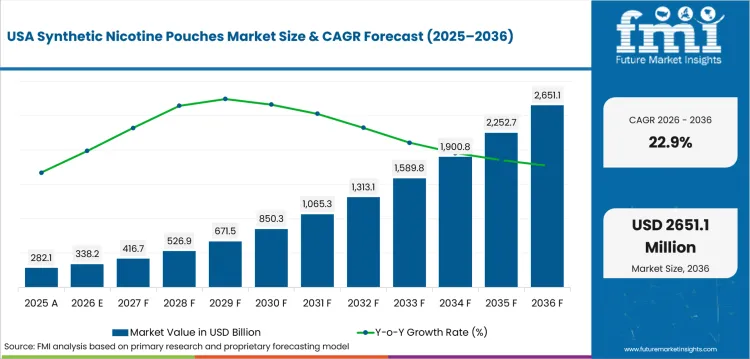
FDA-reviewed pouch pathway and verified adult retail center · 2026 to 2036
Country Market Snapshot Table
| Parameter | Value |
|---|---|
| Market Size in 2025 (Value) | USD 138.3 million |
| Market Size in 2026 (Value) | USD 170.0 million |
| Market Forecast in 2036 (Value) | USD 1,336.5 million |
| CAGR (2026 to 2036) | 22.9% |
| Years Considered | 2021 to 2036 |
| Base Year | 2025 |
| Forecast Period | 2026 to 2036 |
| Units Considered | Value (USD million) |
| Leading Sub-Region | Texas and Colorado pouch manufacturing corridors |
United States Synthetic Nicotine Pouches Market Outlook
United States synthetic nicotine pouch sales are reflected by product-review discipline and verified adult retail channels. Adult consumers enter the segment through controlled oral nicotine brands and age-gated sale points.
City-level launch planning is expected to precede wider chain placement. Suppliers with strong dossiers and online verification capacity should gain early refill advantages.
Key Growth Drivers
- FDA authorization creates a direct product-review reference for adult oral pouch dossiers. In January 2025, FDA authorized 20 ZYN nicotine pouch products through the PMTA pathway.
- Adult switching potential remains sizable across smoke and vapor routines. NCHS reported 9.9% adult cigarette use and 7.0% adult e-cigarette use in 2024.
- Synthetic pouch brands can use verified adult accounts to build repeat can orders before national store placement expands.
- Domestic pouch manufacturing interest can support steadier can filling and stronger supply planning for regulated retail partners.
Key Restraints
- Youth-use scrutiny can tighten pack and flavor checks. CDC reported 1.8% current nicotine pouch use among middle and high school students in 2024.
- Product-file review can extend launch timing for synthetic nicotine brands seeking national retail access.
- Flavor presentation may face closer review if can design or naming appears aimed at underage buyers.
What makes United States unique
United States is unique due to FDA product authorization and a large verified online adult nicotine channel.
Key Companies
- Next Generation Labs
- Lucy Goods
- Philip Morris International
- Altria Group
- British American Tobacco
- Turning Point Brands
- Swisher International
Sales & Marketing Channels
- Online retail
- Tobacco stores
- Convenience stores
- Pharmacies
- Duty-free stores
- Specialty adult outlets
Country Segment Breakdown Table
| Segment | Sub-Segments |
|---|---|
| By Nicotine Format | Fully Synthetic Pouches · S-Isomer Pouches · Blended-Source Pouches · Low-Dose Pouches · Premium Synthetic Pouches |
| By Strength Level | Low Strength · Medium Strength · High Strength · Extra Strength · Trial Strength |
| By Flavor Profile | Mint Flavor · Fruit Flavor · Menthol Flavor · Coffee Flavor · Unflavored |
| By Pack Type | 20-Pouch Cans · 10-Pouch Cans · Multipacks · Trial Packs · Duty-Free Packs |
| By Sales Channel | Online Retail · Tobacco Stores · Convenience Stores · Pharmacies · Duty-Free Stores |
| Key Sub-Regions Covered, Adult Retail Areas | Texas · Colorado · Florida · California · New York · North Carolina |
Frequently Asked Questions
How fast is United States synthetic nicotine pouches market growing?
Sales in the United States are ready to scale at 22.9% CAGR from 2026 to 2036 through FDA-reviewed access and repeat adult can purchase.
Who leads United States synthetic nicotine pouches market?
Synthetic nicotine suppliers and pouch brand owners compete through source clarity and product-review readiness. Retail access and adult communication guide execution.
What is driving adoption in United States synthetic nicotine pouches market?
Adult smoker transition and source-specific pouch positioning are moving the country toward repeat purchases through age-gated retail channels.
Demand Outlook for Synthetic Nicotine Pouches Market in the United Kingdom
Planned pouch rules and smoke-free policy center · 2026 to 2036
Country Market Snapshot Table
| Parameter | Value |
|---|---|
| Market Size in 2025 (Value) | USD 43.0 million |
| Market Size in 2026 (Value) | USD 52.0 million |
| Market Forecast in 2036 (Value) | USD 346.9 million |
| CAGR (2026 to 2036) | 20.9% |
| Years Considered | 2021 to 2036 |
| Base Year | 2025 |
| Forecast Period | 2026 to 2036 |
| Units Considered | Value (USD million) |
| Leading Sub-Region | London and South East adult convenience corridors |
United Kingdom Synthetic Nicotine Pouches Market Outlook
United Kingdom synthetic nicotine pouch demand is shaped by smoke-free policy debate and planned controls on pouch sale. Adult oral pouch brands can benefit from clearer rules if youth access is restricted.
Retailers are expected to favor plain adult positioning and moderate strength ranges. Online sale will need age proof and cleaner product communication.
Key Growth Drivers
- Policy attention is creating clearer rulemaking for adult pouch sale. A UK parliamentary answer in March 2025 referenced planned 18+ age sale restrictions for nicotine pouches.
- Cigarette use leaves a clear adult switching pool. ONS reported around 5.3 million adult smokers and 10.6% adult smoking prevalence in 2024.
- Supermarkets and specialist tobacco stores can prepare for adult shelf communication as future display powers develop.
- Verified online stores can support repeat can ordering under future adult-check expectations.
Key Restraints
- Youth awareness creates policy pressure on flavor and pack design. ASH reported awareness among 11 to 17 year-olds rising from 38.0% in 2024 to 43.0% in 2025.
- Future pouch rules may tighten display and product communication before synthetic brands reach wide national access.
- Medical nicotine products remain established alternatives, which can slow trial for non-medicinal pouch formats.
What makes United Kingdom unique
United Kingdom is unique due to active nicotine pouch policy debate and mature online adult retail infrastructure.
Key Companies
- British American Tobacco
- Nordic Spirit UK
- Philip Morris Limited
- Altria Group
- Lucy Goods
- Next Generation Labs
- Imperial Brands
Sales & Marketing Channels
- Online retail
- Tobacco stores
- Convenience stores
- Supermarkets
- Pharmacies
- Duty-free stores
Country Segment Breakdown Table
| Segment | Sub-Segments |
|---|---|
| By Nicotine Format | Fully Synthetic Pouches · S-Isomer Pouches · Blended-Source Pouches · Low-Dose Pouches · Premium Synthetic Pouches |
| By Strength Level | Low Strength · Medium Strength · High Strength · Extra Strength · Trial Strength |
| By Flavor Profile | Mint Flavor · Fruit Flavor · Menthol Flavor · Coffee Flavor · Unflavored |
| By Pack Type | 20-Pouch Cans · 10-Pouch Cans · Multipacks · Trial Packs · Duty-Free Packs |
| By Sales Channel | Online Retail · Tobacco Stores · Convenience Stores · Pharmacies · Duty-Free Stores |
| Key Sub-Regions Covered, Adult Retail Areas | London · South East · Manchester · Birmingham · Scotland · Wales |
Frequently Asked Questions
How fast is United Kingdom synthetic nicotine pouches market growing?
Demand in the United Kingdom is likely to rise at 20.9% CAGR from 2026 to 2036, led by planned rules and repeat adult oral pouch use.
Who leads United Kingdom synthetic nicotine pouches market?
Global tobacco firms and specialist pouch brands compete through adult retail access and compliant pack wording. Online verification remains central to execution.
What is driving adoption in United Kingdom synthetic nicotine pouches market?
Adult smoker transition and planned pouch regulation are moving the country toward controlled non-combustion oral nicotine sale.
Growth Outlook for Synthetic Nicotine Pouches Market in Canada
Pharmacy controls and adult harm-reduction debate center · 2026 to 2036
Country Market Snapshot Table
| Parameter | Value |
|---|---|
| Market Size in 2025 (Value) | USD 22.6 million |
| Market Size in 2026 (Value) | USD 27.0 million |
| Market Forecast in 2036 (Value) | USD 161.7 million |
| CAGR (2026 to 2036) | 19.6% |
| Years Considered | 2021 to 2036 |
| Base Year | 2025 |
| Forecast Period | 2026 to 2036 |
| Units Considered | Value (USD million) |
| Leading Sub-Region | Ontario and Quebec pharmacy retail corridors |
Canada Synthetic Nicotine Pouches Market Outlook
Canada synthetic nicotine pouch sales are driven by pharmacy placement and federal product controls. Brands must build adult access around health-system retail norms instead of open convenience sale.
Channel design is expected to matter more than early flavor spread. Suppliers able to work under pharmacy-style sale rules will gain cleaner access.
Key Growth Drivers
- Smoking cessation policy keeps adult alternatives in scope. Health Canada said tobacco use is responsible for over 45,000 preventable deaths in Canada each year.
- Adult nicotine exposure remains large enough to support controlled oral alternatives. Statistics Canada reported that 11.4% of Canadian adults smoked cigarettes daily or occasionally in 2023.
- Adult oral product education can improve under pharmacist oversight, which may support compliant synthetic pouch positioning.
- Border-adjacent online demand can build repeat purchases if sellers meet Canadian labeling and age-verification rules.
Key Restraints
- Strength variation can raise pharmacist explanation needs. Canadian Pharmacists Association noted pouch nicotine concentration may range from 2 mg to 15 mg.
- Pharmacy-only access can slow impulse purchase compared with convenience and tobacco store sale.
- Medical classification debate may restrict promotional wording and brand communication for non-tobacco pouch formats.
What makes Canada unique
Canada is unique due to pharmacy-counter control and federal guidance that directly shapes pouch placement.
Key Companies
-
Imperial Tobacco Canada
- Philip Morris International
- Altria Group
- Next Generation Labs
- Lucy Goods
- British American Tobacco
- Turning Point Brands
Sales & Marketing Channels
- Pharmacies
- Online retail
- Tobacco stores
- Convenience stores
- Supermarkets
- Duty-free stores
Country Segment Breakdown Table
| Segment | Sub-Segments |
|---|---|
| By Nicotine Format | Fully Synthetic Pouches · S-Isomer Pouches · Blended-Source Pouches · Low-Dose Pouches · Premium Synthetic Pouches |
| By Strength Level | Low Strength · Medium Strength · High Strength · Extra Strength · Trial Strength |
| By Flavor Profile | Mint Flavor · Fruit Flavor · Menthol Flavor · Coffee Flavor · Unflavored |
| By Pack Type | 20-Pouch Cans · 10-Pouch Cans · Multipacks · Trial Packs · Duty-Free Packs |
| By Sales Channel | Online Retail · Tobacco Stores · Convenience Stores · Pharmacies · Duty-Free Stores |
| Key Sub-Regions Covered, Adult Retail Areas | Ontario · Quebec · British Columbia · Alberta · Manitoba · Nova Scotia |
Frequently Asked Questions
How fast is Canada synthetic nicotine pouches market growing?
Canada synthetic nicotine pouch sales are expected to grow at 19.6% CAGR from 2026 to 2036 as controlled adult channels expand.
Who leads Canada synthetic nicotine pouches market?
Global tobacco firms and specialist pouch suppliers compete by pharmacy access and compliant packaging. Retail approval discipline guides supplier strength.
What is driving adoption in Canada synthetic nicotine pouches market?
Adult smoker transition and pharmacy controls are creating a measured path for nicotine pouch sales.
Demand Analysis for Synthetic Nicotine Pouches Market in Poland
EU flavor transition and Central Europe retail center · 2026 to 2036
Country Market Snapshot Table
| Parameter | Value |
|---|---|
| Market Size in 2025 (Value) | USD 28.6 million |
| Market Size in 2026 (Value) | USD 34.0 million |
| Market Forecast in 2036 (Value) | USD 188.8 million |
| CAGR (2026 to 2036) | 18.7% |
| Years Considered | 2021 to 2036 |
| Base Year | 2025 |
| Forecast Period | 2026 to 2036 |
| Units Considered | Value (USD million) |
| Leading Sub-Region | Warsaw and southern convenience retail corridors |
Poland Synthetic Nicotine Pouches Market Outlook
Poland synthetic nicotine pouch demand is influenced by Central Europe retail density and EU nicotine policy debate. Adult users compare oral pouches with heated tobacco and cigarettes in convenience channels.
Retailers are expected to test moderate strength cans before extending flavor ranges. EU-level tax and product rules can shift supplier plans quickly.
Key Growth Drivers
- Adult smoking behavior gives pouch brands a direct trial pool. A 2024 nationwide survey found 30.4% past-month smoking and 24.5% daily smoking among Polish adults.
- Smoking prevalence remains sizable enough to support adult oral format testing. GSTHR reported 6.9 million adult current smokers and 21.2% adult smoking prevalence in 2024.
- Central Europe retail networks give pouch brands a fast test route before cross-border expansion into nearby EU markets.
- Online sale can help brands test subscription patterns before pushing into petrol station and convenience networks.
Key Restraints
- Excise uncertainty can affect pouch price ladders. The European Commission proposed a minimum nicotine pouch excise duty of 25.0% of the retail selling price or EUR 71.5 per kilogram from 2030, rising to 50.0% or EUR 143.0 per kilogram from 2032.
- Price-sensitive adult consumers may compare pouches against cigarettes and heated tobacco before accepting premium synthetic nicotine cans.
- Smaller brands may struggle with retailer confidence if product files do not explain nicotine source and strength consistency.
What makes Poland unique
Poland is unique due to Central Europe retail reach and fast policy sensitivity across nicotine formats.
Key Companies
- British American Tobacco Poland
- Philip Morris Polska
- Japan Tobacco International Poland
- Imperial Brands Poland
- Next Generation Labs
- Lucy Goods
- Altria Group
Sales & Marketing Channels
- Online retail
- Tobacco stores
- Convenience stores
- Petrol station retail
- Supermarkets
- Travel retail
Country Segment Breakdown Table
| Segment | Sub-Segments |
|---|---|
| By Nicotine Format | Fully Synthetic Pouches · S-Isomer Pouches · Blended-Source Pouches · Low-Dose Pouches · Premium Synthetic Pouches |
| By Strength Level | Low Strength · Medium Strength · High Strength · Extra Strength · Trial Strength |
| By Flavor Profile | Mint Flavor · Fruit Flavor · Menthol Flavor · Coffee Flavor · Unflavored |
| By Pack Type | 20-Pouch Cans · 10-Pouch Cans · Multipacks · Trial Packs · Duty-Free Packs |
| By Sales Channel | Online Retail · Tobacco Stores · Convenience Stores · Pharmacies · Duty-Free Stores |
| Key Sub-Regions Covered, Adult Retail Areas | Warsaw · Kraków · Wrocław · Poznań · Gdańsk · Łódź |
Frequently Asked Questions
How fast is Poland synthetic nicotine pouches market growing?
Demand in Poland is ready to scale at 18.7% CAGR from 2026 to 2036 due to adult oral pouch testing and Central Europe retail coverage.
Who leads Poland synthetic nicotine pouches market?
Global nicotine firms and specialist pouch suppliers compete through retail access and source documentation. Flavor and strength discipline guide execution.
What is driving adoption in Poland synthetic nicotine pouches market?
Adult smoker transition and convenience retail testing are moving the country toward repeat pouch purchases.
Sales Outlook for Synthetic Nicotine Pouches Market in Germany
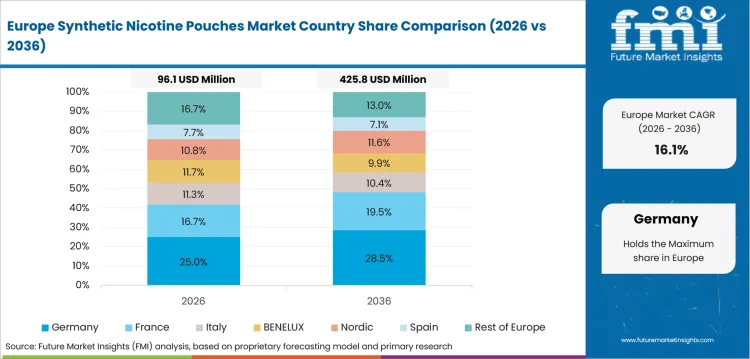
Regulated tobacco retail and nicotine policy center · 2026 to 2036
Country Market Snapshot Table
| Parameter | Value |
|---|---|
| Market Size in 2025 (Value) | USD 34.9 million |
| Market Size in 2026 (Value) | USD 41.0 million |
| Market Forecast in 2036 (Value) | USD 207.4 million |
| CAGR (2026 to 2036) | 17.6% |
| Years Considered | 2021 to 2036 |
| Base Year | 2025 |
| Forecast Period | 2026 to 2036 |
| Units Considered | Value (USD million) |
| Leading Sub-Region | Berlin and western retail corridors |
Germany Synthetic Nicotine Pouches Market Outlook
Germany synthetic nicotine pouch demand is influenced by a large taxed tobacco pool and strict product communication norms. Adult users compare pouch cans with cigarettes and heated tobacco before shifting routine spending.
Regulated channels create a measured expansion path for synthetic nicotine suppliers. Premium positioning will need price clarity as tobacco price pressure persists.
Key Growth Drivers
- Germany’s cigarette market gives synthetic pouches a defined switching pool. Destatis reported 66.4 billion taxed cigarettes in Germany during 2025.
- Adult smoking prevalence leaves a defined target group for lower-smoke nicotine alternatives. Tobacco Atlas placed Germany adult smoking prevalence at 16.1% in 2025.
- Online age checks can support adult pouch access while advertising limits keep public-facing messaging narrow.
- Retail price comparison remains active at tobacco counters as adult users weigh pouch cans against cigarettes.
Key Restraints
- Retail legality remains a core barrier for synthetic pouch sellers. A 2025 global policy scan listed Germany among 10 countries with sale prohibited by law.
- Advertising limits reduce new product explanation as suppliers have fewer public routes to explain synthetic nicotine source differences.
- EU tax reform could narrow pack-price gaps between pouches and other nicotine formats during the assessment period.
What makes Germany unique
Germany is unique due to large taxed tobacco volume and disciplined retail controls for price-sensitive adult users.
Key Companies
- British American Tobacco Germany
- Philip Morris GmbH
- Japan Tobacco International Germany
- Imperial Brands Germany
- Next Generation Labs
- Lucy Goods
- Altria Group
Sales & Marketing Channels
- Tobacco stores
- Online retail
- Convenience stores
- Supermarkets
- Pharmacies
- Duty-free stores
Country Segment Breakdown Table
| Segment | Sub-Segments |
|---|---|
| By Nicotine Format | Fully Synthetic Pouches · S-Isomer Pouches · Blended-Source Pouches · Low-Dose Pouches · Premium Synthetic Pouches |
| By Strength Level | Low Strength · Medium Strength · High Strength · Extra Strength · Trial Strength |
| By Flavor Profile |
Mint Flavor · Fruit Flavor · Menthol Flavor · Coffee Flavor · Unflavored |
| By Pack Type | 20-Pouch Cans · 10-Pouch Cans · Multipacks · Trial Packs · Duty-Free Packs |
| By Sales Channel | Online Retail · Tobacco Stores · Convenience Stores · Pharmacies · Duty-Free Stores |
| Key Sub-Regions Covered, Adult Retail Areas | Berlin · Hamburg · North Rhine-Westphalia · Bavaria · Hesse · Saxony |
Frequently Asked Questions
How fast is Germany synthetic nicotine pouches market growing?
Germany synthetic nicotine pouch demand is forecast to expand at 17.6% CAGR from 2026 to 2036 through regulated adult retail and online channels.
Who leads Germany synthetic nicotine pouches market?
Global nicotine firms and specialist pouch brands compete based on adult channel access and compliant pack wording. Retail discipline shapes execution.
What is driving adoption in Germany synthetic nicotine pouches market?
Adult smoker switching and product-source clarity are moving Germany toward controlled oral pouch adoption.
Opportunity Analysis for Synthetic Nicotine Pouches Market in Sweden
Snus familiarity and oral nicotine culture center · 2026 to 2036
Country Market Snapshot Table
| Parameter | Value |
|---|---|
| Market Size in 2025 (Value) | USD 38.9 million |
| Market Size in 2026 (Value) | USD 45.0 million |
| Market Forecast in 2036 (Value) | USD 195.1 million |
| CAGR (2026 to 2036) | 15.8% |
| Years Considered | 2021 to 2036 |
| Base Year | 2025 |
| Forecast Period | 2026 to 2036 |
| Units Considered | Value (USD million) |
| Leading Sub-Region | Stockholm and Gothenburg oral nicotine corridors |
Sweden Synthetic Nicotine Pouches Market Outlook
Sweden synthetic nicotine pouch demand is backed by long oral tobacco familiarity and high consumer knowledge of pouch formats. Adult users understand can counts and strength cues before synthetic nicotine positioning is introduced.
Snus culture creates a clear oral-use pathway but can slow full conversion to synthetic nicotine pouches. Brands need source clarity and differentiated flavors to move beyond existing habits.
Key Growth Drivers
- Oral nicotine familiarity supports synthetic pouch trial. Sweden’s public health agency reported 5.0% daily nicotine pouch use in 2024.
- Nordic oral-use habits make pouch comparison easier for adult buyers. Norden reported 13.6% daily adult use of snuff or nicotine pouches across the region in 2024.
- Retailers understand oral nicotine can handling, which lowers training needs for synthetic pouch placement.
- Premium synthetic formats can appeal to adult users seeking tobacco-free labels while keeping familiar mouth-held use.
Key Restraints
- Entrenched snus habits can slow synthetic pouch conversion. Cancerfonden stated daily snus use among women aged 16 to 29 reached 18.0% in 2024.
- Youth-adjacent flavor control can restrict sweet product names and bright can design across adult oral nicotine channels.
- High oral nicotine familiarity raises expectations for pouch feel and flavor stability, which can expose weaker synthetic formulations.
What makes Sweden unique
Sweden is unique due to established oral nicotine routines and strong consumer understanding of pouch strength.
Key Companies
- Swedish Match
- British American Tobacco Sweden
- Haypp Group
- Next Generation Labs
- Lucy Goods
- Philip Morris International
- Altria Group
Sales & Marketing Channels
- Online retail
- Tobacco stores
- Convenience stores
- Supermarkets
- Pharmacies
- Travel retail
Country Segment Breakdown Table
| Segment | Sub-Segments |
|---|---|
| By Nicotine Format | Fully Synthetic Pouches · S-Isomer Pouches · Blended-Source Pouches · Low-Dose Pouches · Premium Synthetic Pouches |
| By Strength Level | Low Strength · Medium Strength · High Strength · Extra Strength · Trial Strength |
| By Flavor Profile | Mint Flavor · Fruit Flavor · Menthol Flavor · Coffee Flavor · Unflavored |
| By Pack Type | 20-Pouch Cans · 10-Pouch Cans · Multipacks · Trial Packs · Duty-Free Packs |
| By Sales Channel | Online Retail · Tobacco Stores · Convenience Stores · Pharmacies · Duty-Free Stores |
| Key Sub-Regions Covered, Adult Retail Areas | Stockholm · Gothenburg · Malmö · Uppsala · Västerås · Linköping |
Frequently Asked Questions
How fast is Sweden synthetic nicotine pouches market growing?
Sales in Sweden are predicted to grow at 15.8% CAGR from 2026 to 2036, influenced by oral pouch familiarity and tobacco-free positioning.
Who leads Sweden synthetic nicotine pouches market?
Swedish Match and specialist pouch sellers compete through can quality and adult retail access. Synthetic nicotine suppliers compete through source identity.
What is driving adoption in Sweden synthetic nicotine pouches market?
Oral nicotine familiarity and tobacco-free pouch preference are moving Sweden toward premium synthetic nicotine formats.
Demand Outlook for Synthetic Nicotine Pouches Market in Japan
Strict retail controls and low-smoke nicotine transition center · 2026 to 2036
Country Market Snapshot Table
| Parameter | Value |
|---|---|
| Market Size in 2025 (Value) | USD 14.9 million |
| Market Size in 2026 (Value) | USD 17.0 million |
| Market Forecast in 2036 (Value) | USD 62.5 million |
| CAGR (2026 to 2036) | 13.9% |
| Years Considered | 2021 to 2036 |
| Base Year | 2025 |
| Forecast Period | 2026 to 2036 |
| Units Considered | Value (USD million) |
| Leading Sub-Region | Tokyo and Osaka adult retail corridors |
Japan Synthetic Nicotine Pouches Market Outlook
Japan synthetic nicotine pouch demand is shaped by strict tobacco retail practice and high familiarity with non-combustion nicotine systems. Adult users already compare nicotine products through device and format differences.
Synthetic pouches need patient channel development in Japan. Suppliers must explain oral use and source identity against heated tobacco products that already have strong consumer recognition.
Key Growth Drivers
- Non-combustion familiarity supports interest in alternative nicotine formats. JT launched Ploom AURA and EVO in Japan on 27 May 2025.
- Adult smoker volume gives oral formats a defined switching pool. GSTHR reported 16.9 million current smokers and 15.4% adult smoking prevalence in 2024.
- Convenience retail discipline gives pouch suppliers a controlled route if product registration and adult communication are clear.
- Premium can design can appeal to urban adult users who already compare pack formats across non-combustion products.
Key Restraints
- Pharmaceutical classification limits open retail entry for pouch brands. A 2025 global policy scan listed Japan among 6 countries regulating nicotine pouches as medicinal or pharmaceutical products with no approved products.
- Heated tobacco products already command attention, which can slow oral pouch trial among adult users accustomed to device-based routines.
- Oral pouch habits are less established than in Nordic countries, so suppliers need more education before routine purchases develop.
What makes Japan unique
Japan is unique due to strong heated tobacco familiarity and strict adult retail practice.
Key Companies
- Japan Tobacco Inc.
- Philip Morris Japan
- British American Tobacco Japan
- Next Generation Labs
- Lucy Goods
- Altria Group
- Imperial Brands Japan
Sales & Marketing Channels
- Tobacco stores
- Online retail
- Convenience stores
- Pharmacies
- Duty-free stores
- Brand stores
Country Segment Breakdown Table
| Segment | Sub-Segments |
|---|---|
| By Nicotine Format | Fully Synthetic Pouches · S-Isomer Pouches · Blended-Source Pouches · Low-Dose Pouches · Premium Synthetic Pouches |
| By Strength Level | Low Strength · Medium Strength · High Strength · Extra Strength · Trial Strength |
| By Flavor Profile | Mint Flavor · Fruit Flavor · Menthol Flavor · Coffee Flavor · Unflavored |
| By Pack Type | 20-Pouch Cans · 10-Pouch Cans · Multipacks · Trial Packs · Duty-Free Packs |
| By Sales Channel | Online Retail · Tobacco Stores · Convenience Stores · Pharmacies · Duty-Free Stores |
| Key Sub-Regions Covered, Adult Retail Areas | Tokyo · Osaka · Nagoya · Fukuoka · Sapporo · Yokohama |
Frequently Asked Questions
How fast is Japan synthetic nicotine pouches market growing?
Demand in Japan is expected to expand at 13.9% CAGR from 2026 to 2036 since adult retail testing improves.
Who leads Japan synthetic nicotine pouches market?
Japan Tobacco and global nicotine firms compete through regulated retail access and product education. Specialist synthetic suppliers compete through source claims.
What is driving adoption in Japan synthetic nicotine pouches market?
Non-combustion nicotine familiarity and urban adult retail discipline are guiding early pouch testing.
Synthetic Nicotine Pouches Market - Report Scope
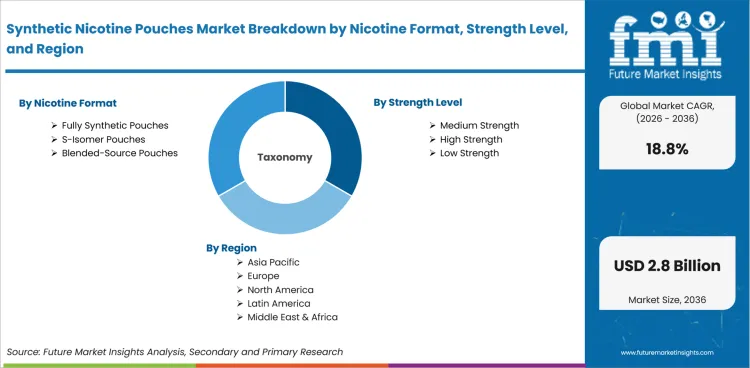
| Parameter | Details |
|---|---|
| Market forecast by 2036 | USD 2.8 billion |
| Growth rate | 18.8% CAGR from 2026 to 2036 |
| Forecast period | 2026 to 2036 |
| Base year value (2025) | USD 0.4 billion |
| By nicotine format | Fully synthetic pouches, S-isomer pouches, blended-source pouches, low-dose pouches, premium synthetic pouches |
| By strength level | Low strength, medium strength, high strength, extra strength, trial strength |
| By flavor profile | Mint flavor, fruit flavor, menthol flavor, coffee flavor, unflavored |
| By pack type | 20-pouch cans, 10-pouch cans, multipacks, trial packs, duty-free packs |
| By sales channel | Online retail, tobacco stores, convenience stores, pharmacies, duty-free stores |
| Regions covered | North America, Latin America, Europe, East Asia, South Asia and Pacific, Middle East and Africa |
| Countries covered | United States, United Kingdom, Canada, Poland, Germany, Sweden, Japan |
| Key companies profiled | PMI, Swedish Match North America, Altria, Helix, BAT, Next Generation Labs, Lucy Goods, Rogue Holdings, Swisher, JTI |
| Approach | Bottom-up product-boundary approach using eligible SKU revenue, channel presence, retail pricing, product positioning and country-level adoption |
Source: Future Market Insights, 2026.
Synthetic Nicotine Pouches Market Breakdown by Nicotine Format, Strength Level, Flavor Profile, Pack Type, Sales Channel, and Region
By Nicotine Format
- Fully Synthetic Pouches
- S-Isomer Pouches
- Blended-Source Pouches
- Low-Dose Pouches
- Premium Synthetic Pouches
By Strength Level
- Low Strength
- Medium Strength
- High Strength
- Extra Strength
- Trial Strength
By Flavor Profile
- Mint Flavor
- Fruit Flavor
- Menthol Flavor
- Coffee Flavor
- Unflavored
By Pack Type
- 20-Pouch Cans
- 10-Pouch Cans
- Multipacks
- Trial Packs
- Duty-Free Packs
By Sales Channel
- Online Retail
- Tobacco Stores
- Convenience Stores
- Pharmacies
- Duty-Free Stores
By Region
- North America
- Latin America
- Europe
- East Asia
- South Asia and Pacific
- Middle East and Africa
Research Sources and Bibliography
- Action on Smoking and Health. (2025, June 16). ASH calls for swift legislation on nicotine pouches as new data shows surge in youth awareness.
- Altria Group, Inc. (2025, October 30). Altria reports 2025 third-quarter and nine-months results; announces expanded share repurchase program; narrows 2025 full-year earnings guidance.
- Altria Group, Inc. (2026, March 23). on! PLUS expands nationwide retail availability.
- American Cancer Society. (2025, November). Germany. The Tobacco Atlas.
- British American Tobacco p.l.c. (2024, October 16). Capital Markets Day 2024 event transcript.
- British American Tobacco p.l.c. (2026, February 11). 2025 Annual Report and Accounts. USA Securities and Exchange Commission.
- Canadian Pharmacists Association. (2026, February). Nicotine pouches: A guide for pharmacists.
- CDC Foundation. (2025, August). Monitoring sales: Nicotine pouch trends: Data brief, April 2025. Tobacco Product Sales Monitoring.
- Centers for Disease Control and Prevention. (2026, March 26). Cigarette and electronic cigarette use among adults by urbanization level: United States, 2024. National Center for Health Statistics.
- CORESTA. (2025). Technical guide for nicotine pouch safety and quality.
- East, K., Tattan-Birch, H., & Taylor, E. (2025, October 24). What are the characteristics of people who use nicotine pouches and what types of pouches are being used? Data from an online cross-sectional survey of UK adults. PLOS ONE, 20(10), Article e0332962.
- European Commission. (2025, July 16). Proposal for a Council Directive on the structure and rates of excise duty applied to tobacco and tobacco related products.
- European Commission. (2025, July 16). Revision of the Tobacco Taxation Directive proposal.
- European Patent Office. (2025, December 3). Nicotine pouch composition (EP4162927B1). Google Patents.
- Federal Statistical Office. (2026, January 23). Sales of tobacco products in 2025: Cigarette tax revenue up 0.2% on a year earlier. Destatis.
- Food and Drug Administration. (2025, January 3). FDA updates import alerts to reinforce that all unauthorized e-cigarettes may be detained without physical examination.
- Food and Drug Administration. (2025, January 16). FDA authorizes marketing of 20 ZYN nicotine pouch products after extensive scientific review.
- Food and Drug Administration. (2025, December 19). FDA authorizes 6 nicotine pouch products, completing review in record time.
- Food and Drug Administration. (2026, May 8). FDA issues guidance on enforcement priorities for unauthorized ENDS and nicotine pouch products.
- Food and Drug Administration. (2026, May). Advisory and enforcement actions against industry for unauthorized tobacco products.
- Global State of Tobacco Harm Reduction. (2025, December 11). Tobacco smoking in Japan.
- Global State of Tobacco Harm Reduction. (2025, December 11). Tobacco smoking in Poland.
- Hardin, A., Ahn, S., Ma, S., Thai, V., Berman, M., Mays, D., Chen, J., Paskett, E. D., Wagener, T. L., & Shang, C. (2025). The association between product attributes and oral nicotine pouch preference: Evidence from online stores. Nicotine & Tobacco Research, 28(2), 298-303.
- Health Canada. (2025, July 4). Guidance on additions to the list of Nicotine Replacement Therapy dosage forms: Overview.
- Health Canada. (2026, January 14). Notice of amendment: Revisions to the Prescription Drug List for nicotine buccal pouches.
- International Legal Consortium at the Campaign for Tobacco-Free Kids. (2025, October). Global regulatory scenario of nicotine pouches.
- Jankowski, M., Grudziąż-Sękowska, J., Kamińska, A., Sękowski, K., Wrześniewska-Wal, I., Moczeniat, G., Gujski, M., Kaleta, D., & Ostrowski, J. (2024, June 14). A 2024 nationwide cross-sectional survey to assess the prevalence of cigarette smoking, e-cigarette use and heated tobacco use in Poland. International Journal of Occupational Medicine and Environmental Health, 37(3), 271-286.
- Nordic Council of Ministers. (2025). NORMO 2025: Nordic monitoring 2014-2024: Smoking, snuff, nicotine pouches, and e-cigarettes.
- Office for National Statistics. (2025, November 4). Adult smoking habits in the UK: 2024.
- Reid, J. L., Burkhalter, R., Ball, J., Cummings, K. M., East, K., Edwards, R., Fong, G. T., Hyland, A., O’Connor, R., & Hammond, D. (2025). Awareness and use of oral nicotine pouches among youth and young adults, 2022-2024: Repeat cross-sectional surveys in Canada, England, the USA and New Zealand. BMJ Public Health, 3(2), Article e003457.
- Statistics Canada. (2025, March 5). Key findings from the Health of Canadians report, 2024.
- Tattan-Birch, H., Jackson, S. E., Shahab, L., Buss, V., Sun, T., Read, D., Taylor, E., & Brown, J. (2026). Oral nicotine pouch use in Great Britain: A repeat cross-sectional study, 2020-25. The Lancet Public Health, 11(1), e26-e34.
- Therapeutic Goods Administration. (2024, June 24). Nicotine pouches. Australian Government Department of Health, Disability and Ageing.
- UK Parliament. (2025, April 2). Nicotine: Flavourings and packaging: Question for Department of Health and Social Care.
- Vogel, E. A., Tackett, A. P., Unger, J. B., Gonzalez, M. J., Peraza, N., Jafarzadeh, N. S., Page, M. K., Goniewicz, M. L., Wong, M., & Leventhal, A. M. (2025). Effects of flavour and modified risk claims on nicotine pouch perceptions and use intentions among young adults who use inhalable nicotine and tobacco products: A randomised controlled trial. Tobacco Control, 34(3), 315-322.
- World Health Organization. (2026, May 15). WHO warns nicotine pouch brands targeting youth as sales surge.
This bibliography is provided for reader reference and is not exhaustive. The full report contains the complete reference list and detailed citations.
This Report Answers
- What is the 2026 value and 2036 forecast for synthetic nicotine pouches market?
- What nicotine format is projected to hold the leading share during the forecast period?
- What sales channel is expected to account for the leading 2026 share?
- How do FDA review and adult-only retail checks affect synthetic nicotine pouch rollout?
- What companies compete in synthetic nicotine pouches?
Frequently Asked Questions
What is the synthetic nicotine pouches market size in 2026?
The synthetic nicotine pouches market size is anticipated to cross USD 0.5 billion in 2026.
What is the synthetic nicotine pouches market forecast for 2036?
The synthetic nicotine pouches industry revenue is predicted to reach USD 2.8 billion by 2036 as adult-only oral nicotine formats expand.
What is the synthetic nicotine pouches market CAGR?
The synthetic nicotine pouches sector is projected to expand at 18.8% CAGR from 2026 to 2036.
What segment leads the synthetic nicotine pouches market?
20-pouch cans are forecast to capture 69.2% share in 2026 as familiar can counts support shelf handling and repeat ordering.
What country grows fastest in the synthetic nicotine pouches market?
The United States is forecast to record 22.9% CAGR by 2036, driven by FDA review discipline and verified adult retail channels.
Preview the report firsthand - request a free sample
Get SampleGet the brochure for pricing and purchase details.
Get PDFTable of Content
- Executive Summary
- Global Market Outlook
- Demand to side Trends
- Supply to side Trends
- Technology Roadmap Analysis
- Analysis and Recommendations
- Market Overview
- Market Coverage / Taxonomy
- Market Definition / Scope / Limitations
- Research Methodology
- Chapter Orientation
- Analytical Lens and Working Hypotheses
- Market Structure, Signals, and Trend Drivers
- Benchmarking and Cross-market Comparability
- Market Sizing, Forecasting, and Opportunity Mapping
- Research Design and Evidence Framework
- Desk Research Programme (Secondary Evidence)
- Company Annual and Sustainability Reports
- Peer-reviewed Journals and Academic Literature
- Corporate Websites, Product Literature, and Technical Notes
- Earnings Decks and Investor Briefings
- Statutory Filings and Regulatory Disclosures
- Technical White Papers and Standards Notes
- Trade Journals, Industry Magazines, and Analyst Briefs
- Conference Proceedings, Webinars, and Seminar Materials
- Government Statistics Portals and Public Data Releases
- Press Releases and Reputable Media Coverage
- Specialist Newsletters and Curated Briefings
- Sector Databases and Reference Repositories
- FMI Internal Proprietary Databases and Historical Market Datasets
- Subscription Datasets and Paid Sources
- Social Channels, Communities, and Digital Listening Inputs
- Additional Desk Sources
- Expert Input and Fieldwork (Primary Evidence)
- Primary Modes
- Qualitative Interviews and Expert Elicitation
- Quantitative Surveys and Structured Data Capture
- Blended Approach
- Why Primary Evidence is Used
- Field Techniques
- Interviews
- Surveys
- Focus Groups
- Observational and In-context Research
- Social and Community Interactions
- Stakeholder Universe Engaged
- C-suite Leaders
- Board Members
- Presidents and Vice Presidents
- R&D and Innovation Heads
- Technical Specialists
- Domain Subject-matter Experts
- Scientists
- Physicians and Other Healthcare Professionals
- Governance, Ethics, and Data Stewardship
- Research Ethics
- Data Integrity and Handling
- Primary Modes
- Tooling, Models, and Reference Databases
- Desk Research Programme (Secondary Evidence)
- Data Engineering and Model Build
- Data Acquisition and Ingestion
- Cleaning, Normalisation, and Verification
- Synthesis, Triangulation, and Analysis
- Quality Assurance and Audit Trail
- Market Background
- Market Dynamics
- Drivers
- Restraints
- Opportunity
- Trends
- Scenario Forecast
- Demand in Optimistic Scenario
- Demand in Likely Scenario
- Demand in Conservative Scenario
- Opportunity Map Analysis
- Product Life Cycle Analysis
- Supply Chain Analysis
- Investment Feasibility Matrix
- Value Chain Analysis
- PESTLE and Porter’s Analysis
- Regulatory Landscape
- Regional Parent Market Outlook
- Production and Consumption Statistics
- Import and Export Statistics
- Market Dynamics
- Global Market Analysis 2021 to 2025 and Forecast, 2026 to 2036
- Historical Market Size Value (USD Million) Analysis, 2021 to 2025
- Current and Future Market Size Value (USD Million) Projections, 2026 to 2036
- Y to o to Y Growth Trend Analysis
- Absolute $ Opportunity Analysis
- Global Market Pricing Analysis 2021 to 2025 and Forecast 2026 to 2036
- Global Market Analysis 2021 to 2025 and Forecast 2026 to 2036, By Modification Type
- Introduction / Key Findings
- Historical Market Size Value (USD Million) Analysis By Modification Type , 2021 to 2025
- Current and Future Market Size Value (USD Million) Analysis and Forecast By Modification Type , 2026 to 2036
- Physically Modified
- Chemically Modified
- Enzymatically Modified
- Physically Modified
- Y to o to Y Growth Trend Analysis By Modification Type , 2021 to 2025
- Absolute $ Opportunity Analysis By Modification Type , 2026 to 2036
- Global Market Analysis 2021 to 2025 and Forecast 2026 to 2036, By Source
- Introduction / Key Findings
- Historical Market Size Value (USD Million) Analysis By Source, 2021 to 2025
- Current and Future Market Size Value (USD Million) Analysis and Forecast By Source, 2026 to 2036
- Corn
- Cassava
- Potato
- Corn
- Y to o to Y Growth Trend Analysis By Source, 2021 to 2025
- Absolute $ Opportunity Analysis By Source, 2026 to 2036
- Global Market Analysis 2021 to 2025 and Forecast 2026 to 2036, By Form
- Introduction / Key Findings
- Historical Market Size Value (USD Million) Analysis By Form, 2021 to 2025
- Current and Future Market Size Value (USD Million) Analysis and Forecast By Form, 2026 to 2036
- Dry
- Liquid
- Granular
- Dry
- Y to o to Y Growth Trend Analysis By Form, 2021 to 2025
- Absolute $ Opportunity Analysis By Form, 2026 to 2036
- Global Market Analysis 2021 to 2025 and Forecast 2026 to 2036, By Function
- Introduction / Key Findings
- Historical Market Size Value (USD Million) Analysis By Function, 2021 to 2025
- Current and Future Market Size Value (USD Million) Analysis and Forecast By Function, 2026 to 2036
- Thickening
- Stabilizing
- Binding
- Thickening
- Y to o to Y Growth Trend Analysis By Function, 2021 to 2025
- Absolute $ Opportunity Analysis By Function, 2026 to 2036
- Global Market Analysis 2021 to 2025 and Forecast 2026 to 2036, By End Use
- Introduction / Key Findings
- Historical Market Size Value (USD Million) Analysis By End Use, 2021 to 2025
- Current and Future Market Size Value (USD Million) Analysis and Forecast By End Use, 2026 to 2036
- Food
- Paper
- Textiles
- Food
- Y to o to Y Growth Trend Analysis By End Use, 2021 to 2025
- Absolute $ Opportunity Analysis By End Use, 2026 to 2036
- Global Market Analysis 2021 to 2025 and Forecast 2026 to 2036, By Region
- Introduction
- Historical Market Size Value (USD Million) Analysis By Region, 2021 to 2025
- Current Market Size Value (USD Million) Analysis and Forecast By Region, 2026 to 2036
- North America
- Latin America
- Western Europe
- Eastern Europe
- East Asia
- South Asia and Pacific
- Middle East & Africa
- Market Attractiveness Analysis By Region
- North America Market Analysis 2021 to 2025 and Forecast 2026 to 2036, By Country
- Historical Market Size Value (USD Million) Trend Analysis By Market Taxonomy, 2021 to 2025
- Market Size Value (USD Million) Forecast By Market Taxonomy, 2026 to 2036
- By Country
- USA
- Canada
- Mexico
- By Modification Type
- By Source
- By Form
- By Function
- By End Use
- By Country
- Market Attractiveness Analysis
- By Country
- By Modification Type
- By Source
- By Form
- By Function
- By End Use
- Key Takeaways
- Latin America Market Analysis 2021 to 2025 and Forecast 2026 to 2036, By Country
- Historical Market Size Value (USD Million) Trend Analysis By Market Taxonomy, 2021 to 2025
- Market Size Value (USD Million) Forecast By Market Taxonomy, 2026 to 2036
- By Country
- Brazil
- Chile
- Rest of Latin America
- By Modification Type
- By Source
- By Form
- By Function
- By End Use
- By Country
- Market Attractiveness Analysis
- By Country
- By Modification Type
- By Source
- By Form
- By Function
- By End Use
- Key Takeaways
- Western Europe Market Analysis 2021 to 2025 and Forecast 2026 to 2036, By Country
- Historical Market Size Value (USD Million) Trend Analysis By Market Taxonomy, 2021 to 2025
- Market Size Value (USD Million) Forecast By Market Taxonomy, 2026 to 2036
- By Country
- Germany
- UK
- Italy
- Spain
- France
- Nordic
- BENELUX
- Rest of Western Europe
- By Modification Type
- By Source
- By Form
- By Function
- By End Use
- By Country
- Market Attractiveness Analysis
- By Country
- By Modification Type
- By Source
- By Form
- By Function
- By End Use
- Key Takeaways
- Eastern Europe Market Analysis 2021 to 2025 and Forecast 2026 to 2036, By Country
- Historical Market Size Value (USD Million) Trend Analysis By Market Taxonomy, 2021 to 2025
- Market Size Value (USD Million) Forecast By Market Taxonomy, 2026 to 2036
- By Country
- Russia
- Poland
- Hungary
- Balkan & Baltic
- Rest of Eastern Europe
- By Modification Type
- By Source
- By Form
- By Function
- By End Use
- By Country
- Market Attractiveness Analysis
- By Country
- By Modification Type
- By Source
- By Form
- By Function
- By End Use
- Key Takeaways
- East Asia Market Analysis 2021 to 2025 and Forecast 2026 to 2036, By Country
- Historical Market Size Value (USD Million) Trend Analysis By Market Taxonomy, 2021 to 2025
- Market Size Value (USD Million) Forecast By Market Taxonomy, 2026 to 2036
- By Country
- China
- Japan
- South Korea
- By Modification Type
- By Source
- By Form
- By Function
- By End Use
- By Country
- Market Attractiveness Analysis
- By Country
- By Modification Type
- By Source
- By Form
- By Function
- By End Use
- Key Takeaways
- South Asia and Pacific Market Analysis 2021 to 2025 and Forecast 2026 to 2036, By Country
- Historical Market Size Value (USD Million) Trend Analysis By Market Taxonomy, 2021 to 2025
- Market Size Value (USD Million) Forecast By Market Taxonomy, 2026 to 2036
- By Country
- India
- ASEAN
- Australia & New Zealand
- Rest of South Asia and Pacific
- By Modification Type
- By Source
- By Form
- By Function
- By End Use
- By Country
- Market Attractiveness Analysis
- By Country
- By Modification Type
- By Source
- By Form
- By Function
- By End Use
- Key Takeaways
- Middle East & Africa Market Analysis 2021 to 2025 and Forecast 2026 to 2036, By Country
- Historical Market Size Value (USD Million) Trend Analysis By Market Taxonomy, 2021 to 2025
- Market Size Value (USD Million) Forecast By Market Taxonomy, 2026 to 2036
- By Country
- Kingdom of Saudi Arabia
- Other GCC Countries
- Turkiye
- South Africa
- Other African Union
- Rest of Middle East & Africa
- By Modification Type
- By Source
- By Form
- By Function
- By End Use
- By Country
- Market Attractiveness Analysis
- By Country
- By Modification Type
- By Source
- By Form
- By Function
- By End Use
- Key Takeaways
- Key Countries Market Analysis
- USA
- Pricing Analysis
- Market Share Analysis, 2025
- By Modification Type
- By Source
- By Form
- By Function
- By End Use
- Canada
- Pricing Analysis
- Market Share Analysis, 2025
- By Modification Type
- By Source
- By Form
- By Function
- By End Use
- Mexico
- Pricing Analysis
- Market Share Analysis, 2025
- By Modification Type
- By Source
- By Form
- By Function
- By End Use
- Brazil
- Pricing Analysis
- Market Share Analysis, 2025
- By Modification Type
- By Source
- By Form
- By Function
- By End Use
- Chile
- Pricing Analysis
- Market Share Analysis, 2025
- By Modification Type
- By Source
- By Form
- By Function
- By End Use
- Germany
- Pricing Analysis
- Market Share Analysis, 2025
- By Modification Type
- By Source
- By Form
- By Function
- By End Use
- UK
- Pricing Analysis
- Market Share Analysis, 2025
- By Modification Type
- By Source
- By Form
- By Function
- By End Use
- Italy
- Pricing Analysis
- Market Share Analysis, 2025
- By Modification Type
- By Source
- By Form
- By Function
- By End Use
- Spain
- Pricing Analysis
- Market Share Analysis, 2025
- By Modification Type
- By Source
- By Form
- By Function
- By End Use
- France
- Pricing Analysis
- Market Share Analysis, 2025
- By Modification Type
- By Source
- By Form
- By Function
- By End Use
- India
- Pricing Analysis
- Market Share Analysis, 2025
- By Modification Type
- By Source
- By Form
- By Function
- By End Use
- ASEAN
- Pricing Analysis
- Market Share Analysis, 2025
- By Modification Type
- By Source
- By Form
- By Function
- By End Use
- Australia & New Zealand
- Pricing Analysis
- Market Share Analysis, 2025
- By Modification Type
- By Source
- By Form
- By Function
- By End Use
- China
- Pricing Analysis
- Market Share Analysis, 2025
- By Modification Type
- By Source
- By Form
- By Function
- By End Use
- Japan
- Pricing Analysis
- Market Share Analysis, 2025
- By Modification Type
- By Source
- By Form
- By Function
- By End Use
- South Korea
- Pricing Analysis
- Market Share Analysis, 2025
- By Modification Type
- By Source
- By Form
- By Function
- By End Use
- Russia
- Pricing Analysis
- Market Share Analysis, 2025
- By Modification Type
- By Source
- By Form
- By Function
- By End Use
- Poland
- Pricing Analysis
- Market Share Analysis, 2025
- By Modification Type
- By Source
- By Form
- By Function
- By End Use
- Hungary
- Pricing Analysis
- Market Share Analysis, 2025
- By Modification Type
- By Source
- By Form
- By Function
- By End Use
- Kingdom of Saudi Arabia
- Pricing Analysis
- Market Share Analysis, 2025
- By Modification Type
- By Source
- By Form
- By Function
- By End Use
- Turkiye
- Pricing Analysis
- Market Share Analysis, 2025
- By Modification Type
- By Source
- By Form
- By Function
- By End Use
- South Africa
- Pricing Analysis
- Market Share Analysis, 2025
- By Modification Type
- By Source
- By Form
- By Function
- By End Use
- USA
- Market Structure Analysis
- Competition Dashboard
- Competition Benchmarking
- Market Share Analysis of Top Players
- By Regional
- By Modification Type
- By Source
- By Form
- By Function
- By End Use
- Competition Analysis
- Competition Deep Dive
- Ingredion Incorporated
- Overview
- Product Portfolio
- Profitability by Market Segments (Product/Age /Sales Channel/Region)
- Sales Footprint
- Strategy Overview
- Marketing Strategy
- Product Strategy
- Channel Strategy
- Cargill Incorporated
- Roquette Frères
- Tate & Lyle PLC
- ADM
- Royal Avebe
- Emsland Group
- Ingredion Incorporated
- Competition Deep Dive
- Assumptions & Acronyms Used


