

- Market Size (2026)
- USD 2.0 Bn
- Forecast (2036)
- USD 3.4 Bn
- CAGR (2026 to 2036)
- 5.4%
Dissolvable Tobacco Products Market Size, Forecast and Outlook By FMI
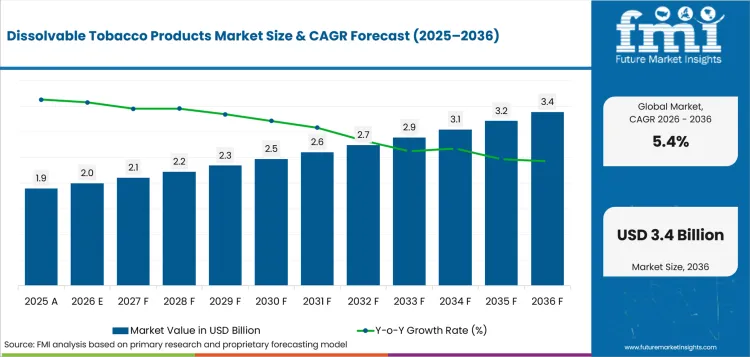
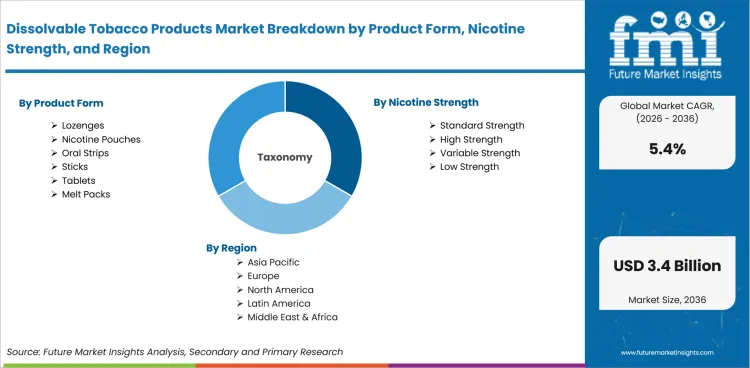
The dissolvable tobacco products industry value is forecast to grow from USD 1.9 billion in 2025 to USD 3.4 billion by 2036 at 5.4% CAGR as adult users shift toward discreet smoke-free oral formats and retailers give more focus to compliant nicotine alternatives. Adult tobacco users are forecast to represent 64.2% share in 2026 because existing smokers and smokeless tobacco users form the main switching pool. Offline tobacco retail is expected to secure 53.7% share in 2026, led by age checks and controlled counter placement.
Key Takeaways, Market Size, and Forecast
- 2026 Market Size: USD 2.0 billion
- 2036 Market Size: USD 3.4 billion
- Forecast CAGR: 5.4% from 2026 to 2036
- Leading Consumer Group: Adult Tobacco Users
- Adult Tobacco Users Share in 2026: 64.2%
- Leading Sales Channel: Offline Tobacco Retail
- Offline Tobacco Retail Share in 2026: 53.7%
- Fastest-growing Country: Sweden
- Sweden CAGR: 6.7% by 2036
Summary of Dissolvable Tobacco Products Marke
- Demand and Growth Drivers
- Adult smokers are shifting toward discreet oral formats designed for smoke-free use.
- Retailers are giving more attention to products with clear age checks and strength labeling.
- Brand owners are extending smoke-free portfolios through lozenges and melt formats.
- Product and Segment View
- Adult tobacco users are forecast to represent 64.2% share in 2026, led by switching from cigarettes and moist smokeless products.
- Offline tobacco retail is projected to hold 53.7% share in 2026, influenced by age-gated access and counter control.
- Lozenges are expected to secure 36.8% share in 2026, supported by familiar handling and simple dose communication.
- Geography and Competitive Outlook
- Sweden is projected to record 6.7% CAGR by 2036, backed by oral nicotine familiarity and snus culture.
- United States is expected to expand at 6.3% CAGR by 2036 through authorized oral nicotine products and national retail scale.
- Philip Morris International and Altria compete by authorized pouch products and controlled retail access.
- British American Tobacco and Japan Tobacco International compete through modern oral brands and country-specific distribution programs.
- Analyst Opinion
- Nandini Roy Choudhury, Principal Consultant for Food and Beverage at FMI, observes, “Dissolvable tobacco products are now more than an extension of smokeless tobacco. Adult-only access and pack discipline will decide which suppliers gain retailer trust. Brands treating compliance as product design should gain stronger repeat listing.”
- Dissolvable Tobacco Products Market Value Analysis
- Market value is supported by finished oral nicotine SKU revenue before pharmacy and online channels add incremental sales.
- Supplier pricing reflects nicotine input and pack safety before flavor systems affect repeat buying.
- Revenue improves as brands convert adult cigarette and smokeless users into controlled oral format users.
- Retail trust rises as pack labels make strength, age restriction, and disposal instructions easier to compare.
Quality control is the main pressure point for dissolvable tobacco products as retailers and regulators review controlled oral nicotine formats. CORESTA stated in December 2025 that its nicotine pouch guide covers minimum safety practices along with packaging and labeling considerations. Documented checks matter before new tablets or nicotine pouches reach distributors. Product design is also moving beyond basic flavor choice.
Fertin Pharma’s March 2025 patent describes an orally disintegrating nicotine tablet that disintegrates within 60 seconds in vitro. That gives formulators a clearer reason to compete on speed of use and controlled placement across the nicotine gums and mints space. Commercial planning is also tightening as Altria reported total oral industry volume growth of 14% for the six months ended December 31, 2025. Suppliers with tested product formats and compliant tobacco packaging can secure shelf space more easily
Dissolvable Tobacco Products Market Definition
The dissolvable tobacco products market covers oral products containing tobacco-derived or synthetic nicotine that dissolve inside the mouth. Scope includes lozenges, oral strips, sticks, tablets, and melt packs sold for adult use. Revenue includes finished branded and private label products sold through tobacco retail, pharmacy channels, online adult-only stores, convenience stores, and specialty outlets.
Dissolvable Tobacco Products Market Inclusions
Market scope covers commercially sold dissolvable tobacco and oral nicotine products by product form such as lozenges and strips. Nicotine strength coverage includes low strength and standard strength formats. Flavor profile analysis includes mint and tobacco taste systems. Sales channel analysis includes offline tobacco retail and pharmacy retail. Consumer group analysis includes adult tobacco users and adult nicotine users. Revenue scope covers market activity from 2026 to 2036 across finished oral nicotine products and controlled retail formats. Key participants include tobacco companies, oral nicotine brand owners, contract manufacturers, packaging suppliers, pharmacy distributors, and age-gated retail networks.
Dissolvable Tobacco Products Market Exclusions
Scope excludes combustible cigarettes, cigars, heated tobacco sticks, vaping devices, and loose moist smokeless tobacco. Medical nicotine replacement therapies are excluded unless sold as pouch, lozenge, strip, or melt formats under consumer oral nicotine programs. Packaging revenue is counted only if used inside finished dissolvable tobacco products.
Dissolvable Tobacco Products Market Research Methodology
- Primary Research: FMI analysts reviewed adult oral nicotine brand portfolios and retail availability checks across major tobacco markets.
- Desk Research: Public data from FDA, CDC, WHO, Health Canada, Sweden’s Public Health Agency, UK GOV, TGA, and official company releases were checked against dissolvable tobacco evidence.
- Market Sizing and Forecasting: Estimated using a bottom-up product-boundary approach. Eligible SKU revenue, channel presence, retail pricing, product positioning, and country-level adoption were used to estimate.
- Data Validation: Forecast checks compared oral nicotine authorization, adult-use patterns, retail channel rules, and active supplier portfolios. Official product filings were reviewed across dissolvable tobacco demand.
Why is the Dissolvable Tobacco Products Market Growing?
- Adult nicotine users are moving toward oral formats supporting discreet use without smoke or device handling.
- Brand owners are building stronger smoke-free portfolios through products with clearer dose control and repeatable mouth placement.
- Retailers are giving more space to oral nicotine formats combining legal authorization with safer pack design.
Growth outlook has become more structured as oral nicotine products move from trial-led sales into regulated adult-use programs. BAT stated in December 2025 that Velo gained 460 basis points to reach 15.9% volume share of total oral in top markets. Velo also reached 31.8% volume share of modern oral in those markets. This indicates pouch-adjacent formats are gaining measurable retail traction and building a stronger base for lozenges and melt packs. Altria stated in April 2026 that the U.S. nicotine pouch category grew to 58.1% of the U.S. oral tobacco category. That supports wider shelf planning for adult oral products across nicotine pouches and nicotine gums and mints. FDA stated in December 2025 that authorized on! PLUS products use certified child-resistant cans and safety lids. Compliant tobacco packaging is therefore a practical requirement for future listings.
Market Segmentation Analysis
- Lozenges are projected to secure 36.8% share in 2026, led by adult users recognizing tablet-style handling and retailers explaining mouth-dissolving formats without long education.
- Standard strength products are anticipated to hold 45.9% share in 2026 since controlled dosing supports adult-only retail programs and lowers friction around high-strength formats.
- Mint flavor is expected to capture 42.6% share in 2026 due to clean taste cues promoting repeat use among adult oral nicotine users.
- Offline tobacco retail is forecast to represent 53.7% share in 2026, guided by age checks and established counter control.
- Adult tobacco users are projected to account for 64.2% share in 2026, reflected by current smokers and smokeless users form the main switching pool.
The dissolvable tobacco products industry is segmented by product form, nicotine strength, flavor profile, sales channel, consumer group, and region. Product form includes lozenges, nicotine pouches, oral strips, sticks, tablets, and melt packs. Nicotine strength covers low strength, standard strength, high strength, and variable strength. Flavor profile covers mint, tobacco, fruit, herbal, and unflavored products. Sales channel covers offline tobacco retail, pharmacy retail, online retail, convenience stores, and specialty stores. Consumer group covers adult tobacco users, adult nicotine users, cessation-oriented adults, and dual-product users.
Insights into Dissolvable Tobacco Products Market by Product Form
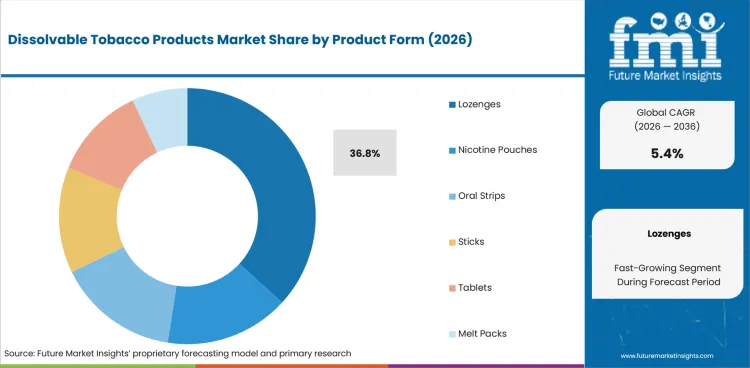
- Lozenges are projected to account for 36.8% share in 2026, influenced by familiar tablet handling and simple dosing language.
- Oral strips gain use as thin formats support discreet placement and lower pack bulk for adult users.
Insights into Dissolvable Tobacco Products Market by Nicotine Strength
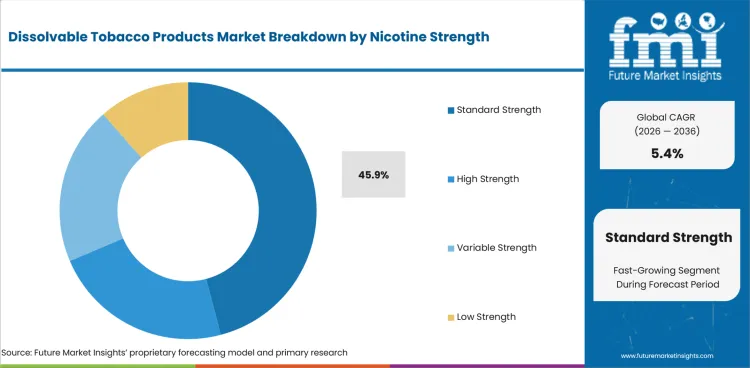
- Standard strength is anticipated to hold 45.9% share in 2026 through balanced dosage positioning and easier retail explanation.
- High strength products need tighter placement control as regulators review youth appeal and product intensity.
Insights into Dissolvable Tobacco Products Market by Flavor Profile
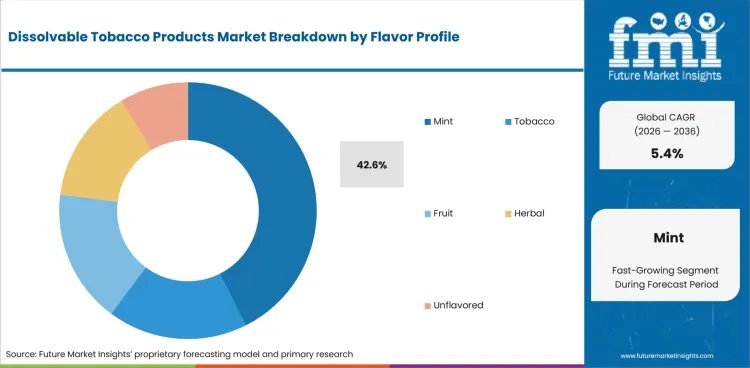
- Mint flavor is forecast to secure 42.6% share in 2026, reflected by taste familiarity and cleaner after-use perception.
- Tobacco flavor gains value in regulated markets restricting sweet or youth-oriented flavor cues.
Insights into Dissolvable Tobacco Products Market by Sales Channel
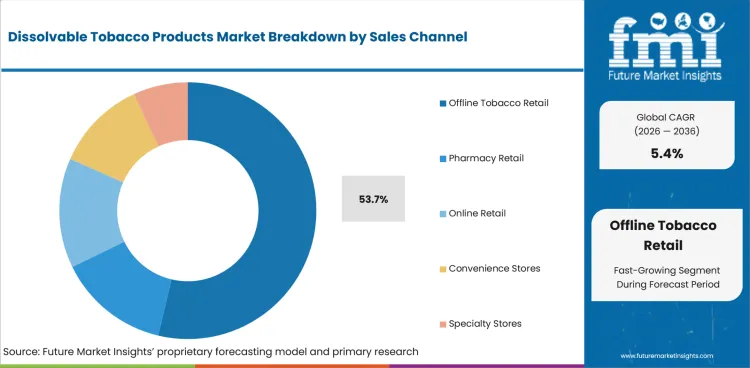
- Offline tobacco retail is expected to represent 53.7% share in 2026, shaped by controlled counter access and age verification.
- Pharmacy retail gains importance in Canada-style frameworks treating some oral nicotine products as cessation-linked formats.
Insights into Dissolvable Tobacco Products Market by Consumer Group
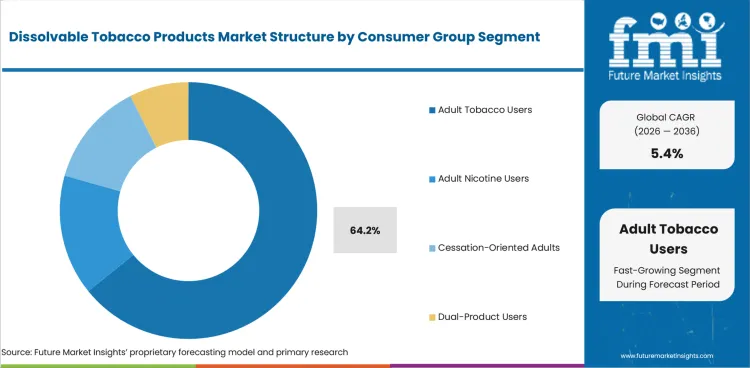
- Adult tobacco users are projected to account for 64.2% share in 2026, led by switching from cigarettes and moist smokeless tobacco.
- Adult nicotine users create added trial through pouch and lozenge familiarity across smoke-free product portfolios.
Dissolvable Tobacco Products Market Drivers, Restraints, and Opportunities
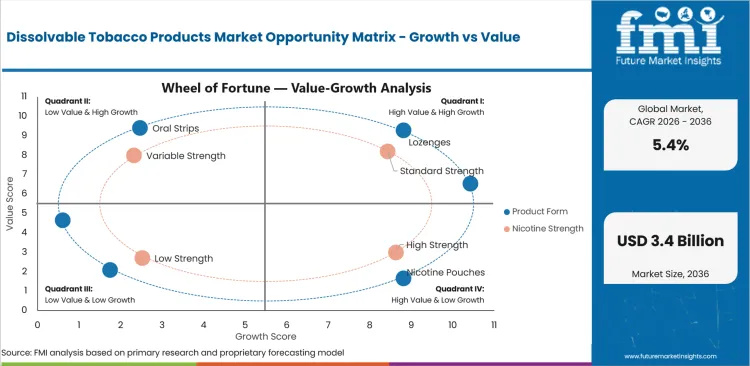
- Driver: Adult smokers and smokeless tobacco users are moving toward oral formats that avoid combustion and device charging.
- Restraint: Regulators can restrict flavors, retail placement, and health claims if youth appeal concerns increase.
- Opportunity: Authorized oral nicotine products can create safer retail footing for brands that invest early in compliance.
Growth outlook is moving toward products combining adult-only access and controlled dose design. CDC reported in September 2024, 1.8% of U.S. middle and high school students currently used nicotine pouches. Youth use creates a direct restraint on flavor and channel expansion. FDA’s December 2025 authorization of on! PLUS products shows a different route for approved oral nicotine. Companies serving nicotine gums and mints can learn from that stricter review pattern.
Consumer Segmentation and Purchase Behavior Analysis
Consumer segmentation is expected to center on adult users who already smoke or vape. Repeat use will depend on flavor familiarity and strength clarity. A 2025 PLOS One survey of 2,967 UK adults found that 2.9% currently used nicotine pouches and 10.1% had tried them. Ever use was most common among males and current vapers or smokers. Among adults who had used pouches, 34.6% used 11 mg to 20 mg nicotine content and 19.5% used them daily. The data suggests dissolvable tobacco products should be positioned around adult nicotine users who want familiar oral formats and clear strength communication.
Voice of Customer and Decision-driver Analysis
Purchase decisions are expected to depend more on flavor and price-per-pouch clarity as consumers compare oral nicotine formats online and in stores. A 2025 Nicotine & Tobacco Research study reviewed 1,689 oral nicotine pouch products from 19 brands across 4 online stores. It found that products averaged USD 0.20 per pouch and 19 pouches per can. Mint flavor was associated with higher consumer ratings. Larger product size was associated with lower ratings. For dissolvable tobacco products, these findings point to simple pack counts and familiar flavor cues. Consistent brand messaging can reduce purchase friction and support repeat selection.
Analysis of Dissolvable Tobacco Products Market by Key Countries
.webp "Top Country Growth Comparison Dissolvable Tobacco Products Market Cagr (2026 2036)")
| Country | CAGR |
|---|---|
| Sweden | 6.7% |
| United States | 6.3% |
| Canada | 5.9% |
| United Kingdom | 5.7% |
| Japan | 5.0% |
| Australia | 4.8% |
| Germany | 4.6% |
Source: Future Market Insights, 2026.
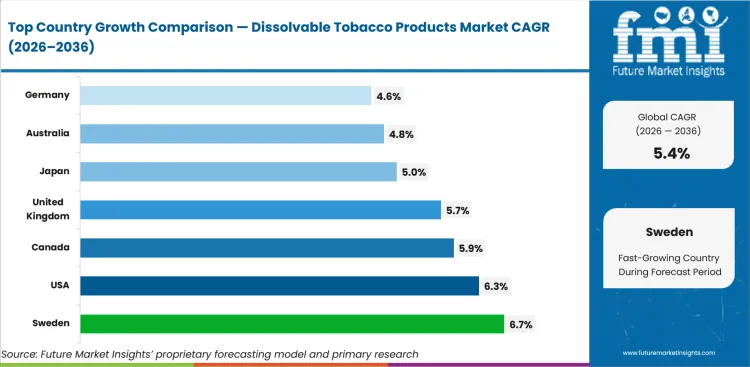
Dissolvable Tobacco Products Market CAGR Analysis by Country
- Sweden is forecast to record 6.7% CAGR by 2036 as snus culture supports faster oral-format trial.
- The United States is expected to expand at 6.3% CAGR from 2026 to 2036 due to FDA authorization and retail scale.
- Canada is projected to grow at 5.9% CAGR through 2036 as pharmacy control supports compliant oral nicotine access.
- The United Kingdom is estimated to rise at 5.7% CAGR by 2036 with nicotine pouch regulation shaping adult-only sales.
- Japan is expected to advance at 5.0% CAGR over the forecast period as convenience retail supports new oral launches.
- Australia is forecast to grow at 4.8% CAGR through 2036 as therapeutic goods controls keep access pharmacy centered.
- Germany is projected to post 4.6% CAGR by 2036 as cautious regulation narrows product rollout speed.
Sales Outlook for Dissolvable Tobacco Products Market in Sweden
Oral nicotine familiarity and snus retail center 2026 to 2036
Country Market Snapshot Table
| Parameter | Value |
|---|---|
| Market Size in 2025 (Value) | USD 192.1 million |
| Market Size in 2026 (Value) | USD 205.0 million |
| Market Forecast in 2036 (Value) | USD 392.1 million |
| CAGR (2026 to 2036) | 6.7% |
| Years Considered | 2021 to 2036 |
| Base Year | 2025 |
| Forecast Period | 2026 to 2036 |
| Units Considered | Value (USD million) |
| Leading Sub-Region | Stockholm and southern retail corridors |
Sweden Dissolvable Tobacco Products Market Outlook
- Sweden dissolvable tobacco product demand is influenced by oral nicotine familiarity and established snus purchasing habits. Adult users already understand mouth-held formats, making lozenges and melt packs easier to explain at retail.
- Retailers are expected to support adult-only oral formats keeping strength labels clear and avoid youth-oriented cues. Brands with clean disposal instructions and controlled flavor naming should gain early retail confidence.
Key Growth Drivers
- Oral nicotine familiarity gives dissolvable lozenges a clear trial setting among adult users. Sweden’s public health agency reported daily nicotine pouch use among the population at 5.0% in 2024.
- Occasional oral tobacco use supports trial beyond daily users. Public health data placed occasional snus use among people aged 16 to 84 at 4.0% in 2024.
- Snus use keeps adult mouth-held product habits active across retail. Public health evidence reflects oral tobacco remaining embedded in Sweden’s adult nicotine routines.
- Younger adult women are already familiar with modern oral nicotine formats. Sweden’s public health reporting shows rising acceptance of nicotine pouches among younger adult users.
Key Restraints
- Youth-adjacent flavor control can restrict sweet product names. Public health evidence shows that nicotine pouch use among younger women has increased in Sweden, keeping flavor naming under closer review.
- Traditional snus can slow lozenge conversion among habitual users. Sweden’s public health reporting reflects established tobacco use remaining a part of adult nicotine routines, limiting faster switching into newer dissolvable formats.
- Specialty oral formats need price discipline against familiar snus tins. Sweden reported occasional tobacco smoking at 6.0% in 2024, limiting the pool for smoke-free conversion.
What makes Sweden unique
Sweden is unique due to snus culture and faster user acceptance of smoke-free oral formats.
Key Companies
- Swedish Match AB
- Skruf Snus AB
- Nordic Snus AB
- GN Tobacco Sweden AB
- Another Snus Factory AB
- XQS International AB
- Haypp Group AB
Sales & Marketing Channels
- Tobacco stores
- Grocery chains
- Online adult-only stores
- Convenience retail
- Pharmacy-adjacent channels
- Service stations
Market Taxonomy and Sub-Regions Covered
| Segment | Sub-Segments |
|---|---|
| By Product Form | Lozenges Nicotine Pouches Oral strips Sticks Tablets Melt Packs |
| By Nicotine Strength | Low Strength Standard Strength High Strength Variable Strength |
| By Flavor Profile | Mint Tobacco Fruit Herbal Unflavored |
| By Sales Channel | Offline Tobacco Retail Pharmacy Retail Online Retail Convenience Stores Specialty Stores |
| By Consumer Group | Adult Tobacco Users Adult Nicotine Users Cessation-Oriented Adults Dual-Product Users |
| Key Sub-Regions Covered, Urban Retail Clusters | Stockholm Gothenburg Malmö Uppsala Västerås Örebro |
Frequently Asked Questions
How fast is Sweden dissolvable tobacco products market growing?
Sales in Sweden are ready to scale at 6.7% CAGR from 2026 to 2036, guided by oral nicotine familiarity.
Who leads Sweden dissolvable tobacco products market?
Swedish Match, Skruf Snus, Nordic Snus, and GN Tobacco Sweden compete based on local oral nicotine manufacturing.
What is driving adoption in Sweden dissolvable tobacco products market?
Snus culture and pouch familiarity are moving adult users toward lozenges and oral melt formats.
Demand Outlook for Dissolvable Tobacco Products Market in the United States
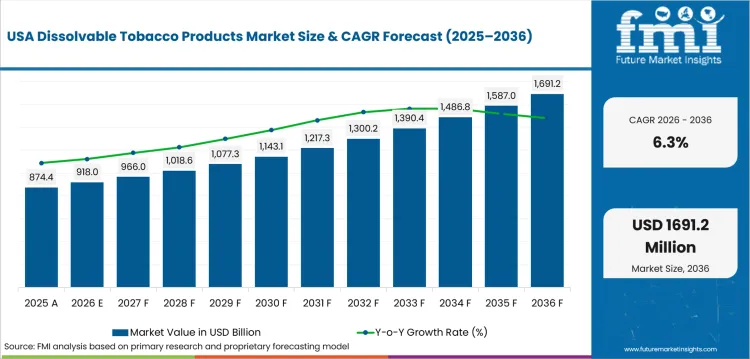
Authorized oral nicotine and retail scale center 2026 to 2036
Country Market Snapshot Table
| Parameter | Value |
|---|---|
| Market Size in 2025 (Value) | USD 696.1 million |
| Market Size in 2026 (Value) | USD 740.0 million |
| Market Forecast in 2036 (Value) | USD 1,363.2 million |
| CAGR (2026 to 2036) | 6.3% |
| Years Considered | 2021 to 2036 |
| Base Year | 2025 |
| Forecast Period | 2026 to 2036 |
| Units Considered | Value (USD million) |
| Leading Sub-Region | South Atlantic and national tobacco retail networks |
United States Dissolvable Tobacco Products Market Outlook
- United States dissolvable tobacco product demand is shaped by FDA authorization and national tobacco retail coverage. Authorized products give retailers a cleaner route to stock oral nicotine formats under adult-only rules.
- Regulatory scrutiny is high due to youth nicotine pouch use and flavor appeal. Brands with compliant claims and responsible disposal features should gain better shelf stability.
Key Growth Drivers
- FDA authorization gives oral nicotine suppliers a clearer commercial route. FDA authorized 20 ZYN nicotine pouch products through the PMTA pathway in January 2025.
- Scale investment supports better supply reliability for oral nicotine. PMI announced USD 600.0 million for a ZYN facility in Aurora, Colorado in July 2024.
- Legal product lists improve retail confidence in adult-only oral nicotine sales by giving retailers a clearer basis to evaluate which products can be stocked with controlled placement and responsible category management.
- National rollout can move authorized oral nicotine products beyond early test markets by helping suppliers build wider shelf access and support repeat availability across convenience and tobacco retail channels.
Key Restraints
- Youth use can slow flavor and channel expansion. CDC estimated 480,000 U.S. middle and high school students currently used nicotine pouches in 2024.
- Flavor oversight can limit sweet-positioned oral nicotine products because regulators and retailers are expected to review youth appeal more closely before allowing wider shelf placement.
- Frequent youth use can raise review pressure for adult oral brands by making product claims and channel controls more important during retail expansion.
What makes the United States unique
United States is unique due to FDA product authorization, national tobacco retail networks, and large-scale oral nicotine manufacturing investment.
Key Companies
- Swedish Match North America LLC
- Helix Innovations LLC
- U.S. Smokeless Tobacco Company LLC
- Swisher International Inc.
- Rogue Holdings LLC
- Turning Point Brands Inc.
- American Snuff Company LLC
Sales & Marketing Channels
- Tobacco stores
- Convenience stores
- Mass retail
- Online adult-only stores
- Pharmacy channels
- Service stations
Market Taxonomy and Sub-Regions Covered
| Segment | Sub-Segments |
|---|---|
| By Product Form | Lozenges Nicotine Pouches Oral Strips Sticks Tablets Melt Packs |
| By Nicotine Strength | Low Strength Standard Strength High Strength Variable Strength |
| By Flavor Profile | Mint Tobacco Fruit Herbal Unflavored |
| By Sales Channel | Offline Tobacco Retail Pharmacy Retail Online Retail Convenience Stores Specialty Stores |
| By Consumer Group | Adult Tobacco Users Adult Nicotine Users Cessation-Oriented Adults Dual-Product Users |
| Key Sub-Regions Covered, Tobacco Retail Networks | Southeast Midwest Texas California New York Pacific Northwest |
Frequently Asked Questions
How fast is United States dissolvable tobacco products market growing?
Sector in the United States is anticipated to grow at 6.3% CAGR from 2026 to 2036 reflecting authorized oral nicotine.
Who leads United States dissolvable tobacco products market?
Swedish Match North America, Helix, Swisher, and Rogue compete based on authorized products and national retail reach.
What is driving adoption in United States dissolvable tobacco products market?
FDA-authorized pouch products and tobacco retail scale are moving adult users toward dissolvable oral formats.
Opportunity Analysis for Dissolvable Tobacco Products Market in Canada
Pharmacy-controlled access and cessation positioning center 2026 to 2036
Country Market Snapshot Table
| Parameter | Value |
|---|---|
| Market Size in 2025 (Value) | USD 111.4 million |
| Market Size in 2026 (Value) | USD 118.0 million |
| Market Forecast in 2036 (Value) | USD 209.3 million |
| CAGR (2026 to 2036) | 5.9% |
| Years Considered | 2021 to 2036 |
| Base Year | 2025 |
| Forecast Period | 2026 to 2036 |
| Units Considered | Value (USD million) |
| Leading Sub-Region | Ontario and Quebec pharmacy corridors |
Canada Dissolvable Tobacco Products Market Outlook
- Canada demand is shaped by pharmacy control and strict product positioning for nicotine replacement formats. Controlled access can support adult cessation-linked oral products, although it limits convenience-store scale.
- Brands must present clear adult-use instructions and avoid youth-oriented flavor cues. Pharmacy staff may become a gatekeeper for product explanation, use timing, and warning placement.
Key Growth Drivers
- Pharmacy placement creates a trusted route for adult users seeking controlled oral formats. Health Canada introduced 5 new NRT controls on August 22, 2024.
- Mint and menthol products can continue under tighter rules. A 2025 PLOS One survey found that 60.7% of UK adults who had used nicotine pouches most often used mint or menthol flavors, reflecting as such profiles remaining the clearest adult-use flavor route when regulators restrict sweeter options.
- Label controls can improve adult-use clarity by helping brands present nicotine warnings and product instructions in a more direct way.
- Pharmacy staff can support safer product explanation at counter level by guiding adult users on product handling and responsible purchase decisions.
Key Restraints
- Convenience retail loses direct access when pharmacy-only rules move oral nicotine products away from open shelf and counter-led tobacco retail channels.
- Flavor limits reduce adult choice across oral formats. A 2025 nicotine pouch sales brief found that mint accounted for 62.1% of U.S. nicotine pouch dollar sales as of April 2025, while other flavors such as candy and drinks accounted for 23.2%.
- Package review can slow new SKU entry by requiring brands to refine label language and youth-appeal safeguards before launch.
What makes Canada unique
Canada is unique due to pharmacy-controlled nicotine pouch access and public health framing around adult cessation.
Key Companies
- Imperial Tobacco Canada Limited
- Nicoventures Canada Inc.
- Haleon Canada ULC
- Kenvue Canada Inc.
- Rothmans Benson & Hedges Inc.
- JTI-Macdonald Corp.
- Pharmascience Inc.
Sales & Marketing Channels
- Pharmacy counters
- Pharmacist-supervised retail
- Online pharmacy access
- Adult-only tobacco stores
- Health product distributors
- Provincial retail networks
Market Taxonomy and Sub-Regions Covered
| Segment | Sub-Segments |
|---|---|
| By Product Form | Lozenges Nicotine Pouches Oral Strips Sticks Tablets Melt Packs |
| By Nicotine Strength | Low Strength Standard Strength High Strength Variable Strength |
| By Flavor Profile | Mint Tobacco Fruit Herbal Unflavored |
| By Sales Channel | Offline Tobacco Retail Pharmacy Retail Online Retail Convenience Stores Specialty Stores |
| By Consumer Group | Adult Tobacco Users Adult Nicotine Users Cessation-Oriented Adults Dual-Product Users |
| Key Sub-Regions Covered, Pharmacy Retail Areas | Ontario Quebec British Columbia Alberta Manitoba Saskatchewan |
Frequently Asked Questions
How fast is Canada dissolvable tobacco products market growing?
Demand in Canada is ready to rise at 5.9% CAGR from 2026 to 2036 with pharmacy-controlled adult access.
Who leads Canada dissolvable tobacco products market?
Imperial Tobacco Canada, Nicoventures Canada, Haleon Canada, and Kenvue Canada compete through pharmacy-facing nicotine formats.
What is driving adoption in Canada dissolvable tobacco products market?
Pharmacy oversight and adult cessation positioning are moving controlled oral nicotine products toward regulated retail channels.
Growth Outlook for Dissolvable Tobacco Products Market in the United Kingdom
Nicotine pouch regulation and convenience retail center 2026 to 2036
Country Market Snapshot Table
| Parameter | Value |
|---|---|
| Market Size in 2025 (Value) | USD 165.6 million |
| Market Size in 2026 (Value) | USD 175.0 million |
| Market Forecast in 2036 (Value) | USD 304.6 million |
| CAGR (2026 to 2036) | 5.7% |
| Years Considered | 2021 to 2036 |
| Base Year | 2025 |
| Forecast Period | 2026 to 2036 |
| Units Considered | Value (USD million) |
| Leading Sub-Region | London and national convenience retail chains |
United Kingdom Dissolvable Tobacco Products Market Outlook
- United Kingdom dissolvable tobacco product demand is supported by convenience retail and adult interest in pouch-style alternatives. Policy changes are expected to define flavor and age-gated access.
- Retailers can test adult oral formats if product claims stay controlled and pack design avoids youth appeal. Brands with clear dosage and responsible merchandising should gain stronger shelf acceptance.
Key Growth Drivers
- Adult oral nicotine brands can benefit from a clearer legal framework. A 2026 Great Britain study covering 127,793 people found adult nicotine pouch use having reached 1.0% by March 2025, showing a measurable base for regulated oral nicotine products.
- Generational tobacco controls can push adult suppliers toward compliant smoke-free portfolios. ASH reported in June 2025 stating awareness of nicotine pouches among under-18s in Great Britain increased from 38.0% to 43.0%, while nearly 4.0% had tried them.
- Product registration can create a clearer route for compliant nicotine products by helping suppliers align ingredient details and pack information before wider retail placement.
- Retail licensing plans can improve adult-only channel control by placing online and in-person sellers under stronger oversight for tobacco and nicotine product sales.
Key Restraints
- High-strength products could face stronger scrutiny. UK evidence material noted pouch nicotine strengths can reach 150 mg in some products.
- Product registration can raise entry work for smaller suppliers. Proposed information requirements include ingredient reasons and producer operations.
- Flavor naming may face stricter review as regulators and retailers pay closer attention to sweet or youth-oriented descriptions before allowing wider product placement.
What makes the United Kingdom unique
United Kingdom is unique due to planned nicotine pouch regulation and strong convenience-store access for adult oral formats.
Key Companies
- British American Tobacco UK Limited
- Nicoventures Trading Limited
- Imperial Tobacco Limited
- Japan Tobacco International UK Limited
- Philip Morris Limited
- Supreme PLC
- Haypp UK Limited
Sales & Marketing Channels
- Convenience stores
- Tobacco specialists
- Grocery chains
- Online adult-only stores
- Pharmacy counters
- Service stations
Market Taxonomy and Sub-Regions Covered
| Segment | Sub-Segments |
|---|---|
| By Product Form | Lozenges Nicotine Pouches Oral Strips Sticks Tablets Melt Packs |
| By Nicotine Strength | Low Strength Standard Strength High Strength Variable Strength |
| By Flavor Profile | Mint Tobacco Fruit Herbal Unflavored |
| By Sales Channel | Offline Tobacco Retail Pharmacy Retail Online Retail Convenience Stores Specialty Stores |
| By Consumer Group | Adult Tobacco Users Adult Nicotine Users Cessation-Oriented Adults Dual-Product Users |
| Key Sub-Regions Covered, Convenience Retail Clusters | London Manchester Birmingham Leeds Glasgow Bristol |
Frequently Asked Questions
How fast is United Kingdom dissolvable tobacco products market growing?
Industry in the United Kingdom is projected to increase at 5.7% CAGR from 2026 to 2036 through regulated oral nicotine retail.
Who leads United Kingdom dissolvable tobacco products market?
BAT UK, Nicoventures, JTI UK, and Imperial Tobacco compete based on modern oral portfolios and retail access.
What is driving adoption in United Kingdom dissolvable tobacco products market?
Planned age checks and convenience retail access are moving adult users toward controlled dissolvable tobacco products.
Demand Analysis for Dissolvable Tobacco Products Market in Japan
Convenience retail and new oral nicotine launch center 2026 to 2036
Country Market Snapshot Table
| Parameter | Value |
|---|---|
| Market Size in 2025 (Value) | USD 106.7 million |
| Market Size in 2026 (Value) | USD 112.0 million |
| Market Forecast in 2036 (Value) | USD 182.4 million |
| CAGR (2026 to 2036) | 5.0% |
| Years Considered | 2021 to 2036 |
| Base Year | 2025 |
| Forecast Period | 2026 to 2036 |
| Units Considered | Value (USD million) |
| Leading Sub-Region | Tokyo and convenience retail corridors |
Japan Dissolvable Tobacco Products Market Outlook
- Japan demand is expected to build from convenience retail discipline and adult familiarity with smoke-free formats. Oral nicotine remains newer than heated tobacco, so education and access will shape early uptake.
- Local tobacco company involvement gives retailers more confidence in pouch-style placement. Dissolvable lozenges can develop if stores support clear product explanation and adult-only controls.
Key Growth Drivers
- Pack count clarity supports controlled trial. Japan Tobacco’s launch format used 14 pouches at a retail price of 500 yen.
- Convenience chains give oral nicotine products a rapid test channel. Japan’s rollout route covered 3 major retail networks, helping oral nicotine products gain faster visibility across high-frequency purchase points.
- Online presale can support early adult user testing before store expansion by helping brands assess product interest and repeat purchase signals before wider retail placement.
- Product variety gives store staff a clearer trial message by allowing adult users to compare taste profiles and choose formats that fit familiar smoke-free routines.
Key Restraints
- Flavor positioning can draw regulatory attention. Cola Fizz Medium and Berry Mix Medium create 2 sweet taste cues that need strict adult-only safeguards.
- New pouch formats need careful consumer education because adult users may require clearer guidance on flavor expectations and responsible use before repeat buying develops.
- Product scale can develop slowly outside metros. Nationwide retail access followed online presale and a phased April 2026 store rollout.
What makes Japan unique
Japan is unique due to disciplined convenience retail and a large domestic tobacco company entering oral nicotine.
Key Companies
- Japan Tobacco Inc.
- JT International Japan
- Philip Morris Japan G.K.
- British American Tobacco Japan Ltd.
- Imperial Tobacco Japan K.K.
- Tsurumi Tobacco Co. Ltd.
- Nippon Leaf Tobacco Development Co. Ltd.
Sales & Marketing Channels
- Convenience stores
- Online adult-only stores
- Tobacco retailers
- Drugstores
- Railway retail
- Service stations
Market Taxonomy and Sub-Regions Covered
| Segment | Sub-Segments |
|---|---|
| By Product Form | Lozenges Nicotine Pouches Oral Strips Sticks Tablets Melt Packs |
| By Nicotine Strength | Low Strength Standard Strength High Strength Variable Strength |
| By Flavor Profile | Mint Tobacco Fruit Herbal Unflavored |
| By Sales Channel | Offline Tobacco Retail Pharmacy Retail Online Retail Convenience Stores Specialty Stores |
| By Consumer Group | Adult Tobacco Users Adult Nicotine Users Cessation-Oriented Adults Dual-Product Users |
| Key Sub-Regions Covered, Convenience Retail Areas | Tokyo Osaka Yokohama Nagoya Fukuoka Sapporo |
Frequently Asked Questions
How fast is Japan dissolvable tobacco products market growing?
Sector in Japan is projected at 5.0% CAGR from 2026 to 2036 as convenience retail tests oral nicotine.
Who leads Japan dissolvable tobacco products market?
Japan Tobacco, JT International Japan, PMI Japan, and BAT Japan compete through local smoke-free retail programs.
What is driving adoption in Japan dissolvable tobacco products market?
Convenience-store discipline and smoke-free product familiarity are supporting early oral nicotine trial among adult users.
Opportunity Analysis for Dissolvable Tobacco Products Market in Australia
Therapeutic goods control and pharmacy access center 2026 to 2036
Country Market Snapshot Table
| Parameter | Value |
|---|---|
| Market Size in 2025 (Value) | USD 85.9 million |
| Market Size in 2026 (Value) | USD 90.0 million |
| Market Forecast in 2036 (Value) | USD 143.9 million |
| CAGR (2026 to 2036) | 4.8% |
| Years Considered | 2021 to 2036 |
| Base Year | 2025 |
| Forecast Period | 2026 to 2036 |
| Units Considered | Value (USD million) |
| Leading Sub-Region | New South Wales and Victoria pharmacy corridors |
Australia Dissolvable Tobacco Products Market Outlook
- Australia demand is limited by therapeutic goods rules and tighter enforcement around nicotine products. Legal access depends on approval pathways rather than open tobacco retail expansion.
- Adult oral nicotine formats can gain only through compliant pharmacy-centered routes. Brands without approved status face high enforcement risk and weak retail acceptance.
Key Growth Drivers
- Therapeutic goods classification creates a formal approval route for oral nicotine. Australian Bureau of Statistics reported that nicotine consumption in Australia increased by almost 40% from 2017 to 2025, showing why regulated access routes are becoming more important.
- Pharmacy framing can support controlled adult access after approval by giving adult users a supervised route for product explanation and responsible purchase decisions.
- Import rules can direct adult users toward legal medical routes. Australian Border Force made 23,097 illicit tobacco detections in FY2024 to FY2025, showing how stricter border checks can push nicotine products toward compliant channels.
- Approved products can benefit from a clear adult-use route by helping suppliers separate lawful oral nicotine access from informal retail supply and unapproved online sales.
Key Restraints
- Legal supply is blocked without approval because unapproved nicotine pouch products have limited access to formal retail and pharmacy channels.
- Illegal product checks can reduce informal retail supply. Australian authorities seized more than 10,000 nicotine pouches in an enforcement operation, showing how compliance action can restrict unauthorized market circulation.
- Enforcement pressure remains high across nicotine products as regulators continue to monitor unapproved sales and non-compliant retail distribution.
What makes Australia unique
Australia is unique due to therapeutic goods classification and a pharmacy-centered route for any future oral nicotine access.
Key Companies
- Kenvue Australia Pty Ltd
- Haleon Australia Pty Ltd
- Perrigo Australia
- iNova Pharmaceuticals Australia
- PharmaCare Laboratories Pty Ltd
- Ego Pharmaceuticals Pty Ltd
- Imperial Brands Australasia
Sales & Marketing Channels
- Pharmacy counters
- Medical access channels
- Online pharmacy systems
- Specialist adult retail
- Health product distributors
- Compliance-led wholesale
Country Segment Breakdown Table
| Segment | Sub-Segments |
|---|---|
| By Product Form | Lozenges Nicotine Pouches Oral Strips Sticks Tablets Melt Packs |
| By Nicotine Strength | Low Strength Standard Strength High Strength Variable Strength |
| By Flavor Profile | Mint Tobacco Fruit Herbal Unflavored |
| By Sales Channel | Offline Tobacco Retail Pharmacy Retail Online Retail Convenience Stores Specialty Stores |
| By Consumer Group | Adult Tobacco Users Adult Nicotine Users Cessation-Oriented Adults Dual-Product Users |
| Key Sub-Regions Covered, Pharmacy Retail Areas | Sydney Melbourne Brisbane Perth Adelaide Canberr |
Frequently Asked Questions
How fast is Australia dissolvable tobacco products market growing?
Australia is expected to expand at 4.8% CAGR from 2026 to 2036, reflected by controlled therapeutic access.
Who leads Australia dissolvable tobacco products market?
Kenvue Australia, Haleon Australia, Perrigo Australia, and iNova compete through pharmacy-facing nicotine product access.
What is driving adoption in Australia dissolvable tobacco products market?
Therapeutic goods controls and pharmacy access are shaping limited adult oral nicotine product development.
Sales Analysis for Dissolvable Tobacco Products Market in Germany
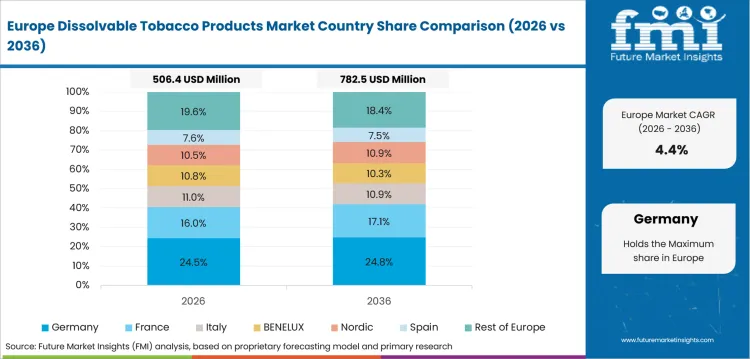
Regulatory caution and adult tobacco retail center 2026 to 2036
Country Market Snapshot Table
| Parameter | Value |
|---|---|
| Market Size in 2025 (Value) | USD 124.3 million |
| Market Size in 2026 (Value) | USD 130.0 million |
| Market Forecast in 2036 (Value) | USD 203.8 million |
| CAGR (2026 to 2036) | 4.6% |
| Years Considered | 2021 to 2036 |
| Base Year | 2025 |
| Forecast Period | 2026 to 2036 |
| Units Considered | Value (USD million) |
| Leading Sub-Region | North Rhine-Westphalia and southern retail clusters |
Germany Dissolvable Tobacco Products Market Outlook
- Germany presents a cautious outlook due to strict treatment of nicotine pouches and close regulatory review. Adult tobacco retail remains organized, although pouch-style formats face stronger limits than Sweden or the United States.
- Dissolvable tobacco products can progress through tobacco-flavored and lower-strength formats if rules become clearer. Retailers will favor products with stronger legal certainty and less youth appeal.
Key Growth Drivers
- Adult tobacco retail gives compliant oral products a starting route. Germany had about 13.9 million current adult smokers in 2024 according to a country tobacco profile.
- Switching interest can support controlled oral formats. Germany’s 2024 adult smoking prevalence was estimated at 19.3% in the same country profile.
- Male adult users create a larger first-switching pool for nicotine alternatives since established tobacco habits can support trial of discreet oral formats.
- Female adult smokers create an added addressable pool for discreet formats as brands position lower-friction oral products around convenience and controlled use.
Key Restraints
- Legal uncertainty can restrict shelf access by making retailers cautious about adding oral nicotine formats before product rules are clearly defined.
- Food-law classification limits product placement by creating uncertainty around where nicotine pouch and dissolvable oral formats can be sold.
- European policy review can keep suppliers cautious. A 2025 regulatory review found that 47.0% of covered countries regulated nicotine pouches as tobacco or related products.
What makes Germany unique
Germany is unique due to strict classification debate and organized tobacco retail that can scale only after legal clarity improves.
Key Companies
- Reemtsma Cigarettenfabriken GmbH
- British American Tobacco Germany GmbH
- Philip Morris GmbH
- JT International Germany GmbH
- Pöschl Tabak GmbH & Co. KG
- Joh. Wilh. von Eicken GmbH
- Arnold André GmbH & Co. KG
Sales & Marketing Channels
- Tobacco specialists
- Kiosks
- Online adult-only stores
- Service stations
- Pharmacy-adjacent retail
- Supermarket tobacco counters
Country Segment Breakdown Table
| Segment | Sub-Segments |
|---|---|
| By Product Form | Lozenges Nicotine Pouches Oral Strips Sticks Tablets Melt Packs |
| By Nicotine Strength | Low Strength Standard Strength High Strength Variable Strength |
| By Flavor Profile | Mint Tobacco Fruit Herbal Unflavored |
| By Sales Channel | Offline Tobacco Retail Pharmacy Retail Online Retail Convenience Stores Specialty Stores |
| By Consumer Group | Adult Tobacco Users Adult Nicotine Users Cessation-Oriented Adults Dual-Product Users |
| Key Sub-Regions Covered, Tobacco Retail Areas | North Rhine-Westphalia Bavaria Baden-Württemberg Berlin Hamburg Hesse |
Frequently Asked Questions
How fast is Germany dissolvable tobacco products market growing?
Industry in Germany is expected to rise at 4.6% CAGR from 2026 to 2036 led by cautious oral nicotine testing.
Who leads Germany dissolvable tobacco products market?
Reemtsma, BAT Germany, PMI GmbH, JTI Germany, and Pöschl Tabak compete through local tobacco retail access.
What is driving adoption in Germany dissolvable tobacco products market?
Adult smoking prevalence and tobacco retail access are supporting cautious dissolvable tobacco product trial.
Competitive Landscape and Strategic Positioning
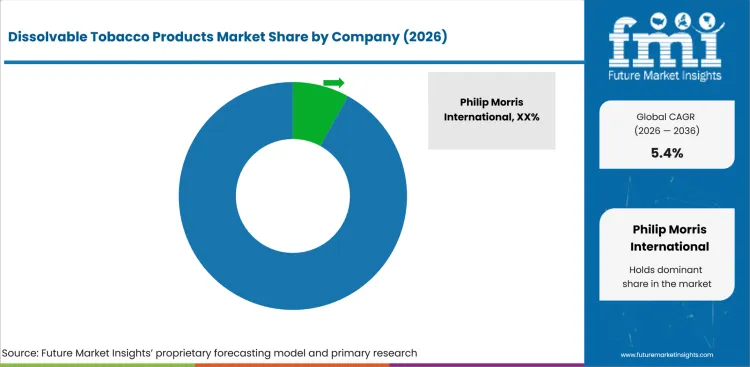
- Established tobacco companies hold an advantage through adult-only retail access and oral nicotine manufacturing depth.
- Specialist oral nicotine brands gain shelf space by offering pack comfort and flavor discipline.
- Pharmacy-facing products gain better acceptance in countries treating pouches or lozenges as cessation-linked formats.
- Retail-ready packaging supports trial through clear strength labels and unit-count information.
Tobacco groups in the market compete by combining regulatory filings with adult-only retail execution. PMI and Swedish Match gained a stronger U.S. position after FDA authorized ZYN nicotine pouch products in January 2025. Altria and Helix gained a second U.S. authorization route after FDA authorized on! PLUS products in December 2025. BAT, JTI and Imperial Brands compete across modern oral brands linked to snus and pouch-adjacent formats. Retailers assess legal status and strength clarity before giving shelf space.
Manufacturing scale has become a competitive separator as oral nicotine demand moves beyond small test volumes. PMI’s Aurora facility and its Kentucky expansion show how capacity planning is shifting into U.S. oral nicotine. Swisher and Rogue compete with product variety and adult-only brand positioning. Suppliers tied to tobacco films and small pack materials can gain from higher need for controlled oral nicotine packaging. Scale alone is not enough if product claims or retail checks fail.
Smaller and regional players can win through local format knowledge and faster flavor adjustment. Sweden-based and Canada-facing firms can build around country rules that favor oral formats or pharmacy access. Germany and Australia create harder conditions, since legal uncertainty or therapeutic rules can block wide shelf placement. Companies with adult-user evidence and conservative pack design should gain more durable listing decisions. Brands relying only on novelty flavors are expected to face weaker acceptance in regulated markets.
Key Companies in the Dissolvable Tobacco Products Market
Competition differs across global tobacco groups and oral nicotine specialists. Regional controlled-retail companies add local channel depth.
- Global Tobacco Groups: Philip Morris International and Altria Group compete through regulatory filing capacity. British American Tobacco, Japan Tobacco International and Imperial Brands add smoke-free product portfolios.
- Oral Nicotine Specialists: Swedish Match and Helix Innovations compete based on pouch or lozenge platforms. Rogue Holdings and Skruf add product strength choice and pack disposal.
- Regional Controlled-Retail Companies: Imperial Tobacco Canada and GN Tobacco Sweden compete through local channel knowledge. Japan Tobacco, Reemtsma and Kenvue Australia add country-specific compliance depth.
Competitive Benchmarking: Dissolvable Tobacco Products Market
| Company | Relevance to Market Title Regulatory Filing Depth | Oral Format Portfolio | Adult-only Channel Control | Channel Reach | Geographic Footprint | |
|---|---|---|---|---|---|---|
| Philip Morris International | Very High | Very Strong | Very Strong | Very Strong | Very Strong | Global |
| Swedish Match North America | Very High | Very Strong | Very Strong | Strong | Strong | United States |
| Altria Group | Very High | Very Strong | Strong | Very Strong | Very Strong | United States |
| Helix Innovations | Very High | Very Strong | Strong | Strong | Strong | United States |
| British American Tobacco | High | Strong | Strong | Strong | Very Strong | Global |
| Japan Tobacco International | High | Moderate | Strong | Strong | Strong | Europe and Japan |
| Imperial Brands | High | Moderate | Strong | Moderate | Strong | Europe and Americas |
| Swisher | Moderate to High | Moderate | Moderate | Strong | Moderate | United States |
| Rogue Holdings | High | Moderate | Strong | Moderate | Moderate | United States |
| Reemtsma Cigarettenfabriken | Moderate | Low to Moderate | Moderate | Strong | Moderate | Germany |
Source: Future Market Insights competitive analysis, 2026.
Key Developments in Dissolvable Tobacco Products Market
- In April 2025, the European Patent Office published patent application EP4529918A1 for a nicotine oral film agent with a pH range of 3 to 6 and nicotine salt content of 2% to 14% of dry film weight.
- In July 2025, the International Journal of Applied Pharmaceutics published a study on mouth-dissolving oral films of nicotine using a Quality by Design approach.
- In August 2025, Rapid Dose Therapeutics submitted its QuickStrip nicotine oral film products to Health Canada for approval. The filing covered 1 mg and 2 mg formats. It also covered 3 mg and 4 mg formats.
Key Players in the Dissolvable Tobacco Products Market
- Philip Morris International
- Swedish Match North America
- Altria Group
- Helix Innovations
- British American Tobacco
- Japan Tobacco International
- Imperial Brands
- Swisher
- Rogue Holdings
- Reemtsma Cigarettenfabriken
Dissolvable Tobacco Products Market - Report Scope
| Item | Value |
|---|---|
| Market size by 2036 | USD 3.4 billion |
| Growth rate | 5.4% CAGR from 2026 to 2036 |
| Forecast period | 2026 to 2036 |
| Base year value (2025) | USD 1.9 billion |
| By product form | Lozenges, nicotine pouches, oral strips, sticks, tablets, melt packs |
| By nicotine strength | Low strength, standard strength, high strength, variable strength |
| By flavor profile | Mint, tobacco, fruit, herbal, unflavored |
| By sales channel | Offline tobacco retail, pharmacy retail, online retail, convenience stores, specialty stores |
| By consumer group | Adult tobacco users, adult nicotine users, cessation-oriented adults, dual-product users |
| Regions covered | North America, Latin America, Europe, East Asia, South Asia and Pacific, Middle East and Africa |
| Countries covered | Sweden, United States, Canada, United Kingdom, Japan, Australia, Germany |
| Key companies profiled | PMI, Swedish Match North America, Altria, Helix, BAT, JTI, Imperial Brands, Swisher |
| Approach | Bottom-up product-boundary approach using eligible SKU revenue, channel presence, retail pricing, product positioning, and country-level adoption |
Source: Future Market Insights, 2026.
Dissolvable Tobacco Products Market Breakdown by Product Form, Nicotine Strength, Flavor Profile, Sales Channel, Consumer Group, and Region
Dissolvable Tobacco Products Market Segmented by Product Form
- Lozenges
- Nicotine Pouches
- Oral Strips
- Sticks
- Tablets
- Melt Packs
Dissolvable Tobacco Products Market Segmented by Nicotine Strength
- Low Strength
- Standard Strength
- High Strength
- Variable Strength
Dissolvable Tobacco Products Market Segmented by Flavor Profile
- Mint
- Tobacco
- Fruit
- Herbal
- Unflavored
Dissolvable Tobacco Products Market Segmented by Sales Channel
- Offline Tobacco Retail
- Pharmacy Retail
- Online Retail
- Convenience Stores
- Specialty Stores
Dissolvable Tobacco Products Market Segmented by Consumer Group
- Adult Tobacco Users
- Adult Nicotine Users
- Cessation-Oriented Adults
- Dual-Product Users
Dissolvable Tobacco Products Market by Region
- North America
- Latin America
- Europe
- East Asia
- South Asia and Pacific
- Middle East and Africa
Research Sources and Bibliography
- Action on Smoking and Health. (2025, June 16). ASH calls for swift legislation on nicotine pouches as new data shows surge in youth awareness.
- Altria Group, Inc. (2026, January 29). Altria reports 2025 fourth-quarter and full-year results; provides 2026 earnings guidance.
- Altria Group, Inc. (2026, April 30). Altria reports 2026 first-quarter results; reaffirms full-year guidance.
- Australian Border Force. (2025, July 29). Tobacco takedown: New data reveals a historic high in illicit hauls.
- Australian Bureau of Statistics. (2026, June 3). Household consumption of illicit tobacco and nicotine products.
- British American Tobacco p.l.c. (2025, December 9). 2025 full year pre-close trading update.
- British American Tobacco p.l.c. (2026, February 12). Preliminary results for the year ended 31 December 2025.
- CDC Foundation. (2025, July). Monitoring sales: Nicotine pouch trends: Data brief, April 2025. Tobacco Product Sales Monitoring.
- Centers for Disease Control and Prevention. (2024, September 5). Notes from the field: E-cigarette and nicotine pouch use among middle and high school students, United States, 2024. Morbidity and Mortality Weekly Report, 73(35), 774–778.
- Cooperation Centre for Scientific Research Relative to Tobacco. (2025, December). No. 35: Technical guide for nicotine pouch safety and quality. CORESTA.
- Department of Health and Social Care. (2025, October 29). Tobacco and vapes: Evidence to support legislation. GOV.UK.
- East, K., Tattan-Birch, H., & Taylor, E. (2025, October 24). What are the characteristics of people who use nicotine pouches and what types of pouches are being used? Data from an online cross-sectional survey of UK adults. PLOS One, 20(10), e0332962.
- European Patent Office. (2025, April 2). Nicotine oral film agent and preparation method therefor (EP4529918A1).
- Fertin Pharma A/S. (2025, March 20). Orally disintegrating nicotine tablet for use under lip (WO2025056129A1). Google Patents.
- Grilo, G., Carrington, D., Hartmuller, R., Albuquerque, B., Muggli, M., & Welding, K. (2025, October 6). Global regulatory scenario for nicotine pouches. Institute for Global Tobacco Control, Johns Hopkins Bloomberg School of Public Health; International Legal Consortium; Campaign for Tobacco-Free Kids.
- Hardin, A., Ahn, S., Ma, S., Thai, V., Berman, M., Mays, D., Chen, J., Paskett, E. D., Wagener, T. L., & Shang, C. (2025, July 1). The association between product attributes and oral nicotine pouch preference: Evidence from online stores available for purchase. Nicotine & Tobacco Research, 28(2), 298–303.
- Health Canada. (2024, August 22). Health Canada introduces new measures to help prevent harms to youth from nicotine replacement therapies.
- Health Canada. (2025, July 4). Guidance on additions to the list of nicotine replacement therapy dosage forms: Overview.
- Pawar, S. D., Shinde, N., Ravi, G., & Kalyankar, T. (2025). Formulation and evaluation of mouth-dissolving oral film of nicotine using Quality by Design approach. International Journal of Applied Pharmaceutics, 17(4).
- Philip Morris International. (2024, July 16). Philip Morris International U.S. affiliate to create 500 jobs investing $600 million in Aurora, Colorado manufacturing facility.
- Public Health Agency of Sweden. (2024, December 12). Use of tobacco and nicotine products.
- Rapid Dose Therapeutics Corp. (2025, August 4). Rapid Dose Therapeutics submits QuickStrip nicotine product for Health Canada approval.
- Tattan-Birch, H., Jackson, S. E., Shahab, L., Buss, V., Sun, T., Read, D., Taylor, E., & Brown, J. (2026). Oral nicotine pouch use in Great Britain: A repeat cross-sectional study, 2020–25. The Lancet Public Health, 11(1), e26–e34.
- Therapeutic Goods Administration. (2024, June 24). Nicotine pouches.
- Therapeutic Goods Administration. (2024, August 2). TGA and Queensland authorities seize alleged illicit vaping goods and nicotine pouches in joint enforcement operation.
- USA Food and Drug Administration. (2025, January 16). FDA authorizes marketing of 20 ZYN nicotine pouch products after extensive scientific review.
- USA Food and Drug Administration. (2025, December 19). FDA authorizes 6 nicotine pouch products, completing review in record time.
- USA Food and Drug Administration. (2026, May 6). Tobacco products marketing orders.
- World Health Organization. (2026, May 15). WHO warns nicotine pouch brands targeting youth as sales surge.
This bibliography is provided for reader reference and is not exhaustive. The full report contains the complete reference list and detailed citations.
This Report Answers
- What is the 2026 value and 2036 forecast for dissolvable tobacco products market?
- What consumer group is projected to hold the leading share during the forecast period?
- What sales channel is expected to account for the leading 2026 share?
- How do authorization and pharmacy controls affect oral nicotine rollout?
- What companies compete in dissolvable tobacco products?
Frequently Asked Questions
What is the dissolvable tobacco products market size in 2026?
The dissolvable tobacco products market size is anticipated to cross USD 2.0 billion in 2026.
What is the dissolvable tobacco products market forecast for 2036?
The dissolvable tobacco products industry revenue is predicted to reach USD 3.4 billion by 2036 as controlled oral formats expand.
What is the dissolvable tobacco products market CAGR?
The dissolvable tobacco products sector is projected to expand at 5.4% CAGR from 2026 to 2036.
What segment leads the dissolvable tobacco products market?
Adult tobacco users are likely to capture 64.2% share in 2026 due to switching from cigarettes and smokeless products.
What country grows fastest in the dissolvable tobacco products market?
Sweden is set to record 6.7% CAGR by 2036, driven by oral nicotine familiarity and snus culture.
Preview the report firsthand - request a free sample
Get SampleGet the brochure for pricing and purchase details.
Get PDFTable of Content
- Key Takeaways
- Market Size and CAGR
- Top Growth Driver
- Fastest Growing Segment
- Leading Region
- Key Companies
- Emerging Opportunities
- Executive Summary
- Global Market Outlook
- Demand-side Trends
- Supply-side Trends
- Technology Roadmap Analysis
- Analysis and Recommendations
- Analyst Perspective (What is happening? Why now? What should investors know?)
- Key Questions Answered
- How large is the market?
- What is the CAGR?
- What are key trends?
- Which region dominates?
- Who are the leaders?
- Market Overview
- Market Coverage / Taxonomy
- Market Definition / Scope / Limitations
- Research Methodology
- Chapter Orientation
- Analytical Lens and Working Hypotheses
- Market Structure, Signals, and Trend Drivers
- Benchmarking and Cross-market Comparability
- Market Sizing, Forecasting, and Opportunity Mapping
- Research Design and Evidence Framework
- Desk Research Programme (Secondary Evidence)
- Expert Input and Fieldwork (Primary Evidence)
- Tooling, Models, and Reference Databases
- Data Engineering and Model Build
- Quality Assurance and Audit Trail
- Market Background
- Market Dynamics (Drivers, Restraints, Opportunity, Trends)
- Scenario Forecast (Optimistic, Likely, Conservative)
- Impact Analysis
- AI Impact
- Sustainability Impact
- Regulatory Impact
- Technology Impact
- Consumer / Buyer Analysis
- Purchase Drivers
- Adoption Barriers
- Buyer Journey
- Opportunity Map Analysis
- Product Life Cycle Analysis
- Supply Chain Analysis
- Investment Feasibility Matrix
- Value Chain Analysis
- PESTLE and Porter's Analysis
- Regulatory Landscape
- Regional Parent Market Outlook
- Production and Consumption Statistics
- Import and Export Statistics
- Global Market Analysis and Forecast, 2021 to 2036
- Historical Market Size Value (USD Billion) & Volume (Unit) Analysis, 2021 to 2025
- Current and Future Market Size Value (USD Billion) & Volume (Unit) Projections, 2026 to 2036
- Y-o-Y Growth Trend Analysis
- Absolute $ Opportunity Analysis
- Global Market Pricing Analysis, 2021 to 2036
- Global Market Analysis and Forecast, By Product Form, 2021 to 2036
- Introduction / Key Findings
- Historical Market Size Value (USD Billion) & Volume (Unit) Analysis By Product Form, 2021 to 2025
- Current and Future Market Size Value (USD Billion) & Volume (Unit) Analysis and Forecast By Product Form, 2026 to 2036
- Lozenges
- Nicotine Pouches
- Oral Strips
- Sticks
- Tablets
- Melt Packs
- Lozenges
- Y-o-Y Growth Trend Analysis By Product Form, 2021 to 2025
- Absolute $ Opportunity Analysis By Product Form, 2026 to 2036
- Global Market Analysis and Forecast, By Nicotine Strength, 2021 to 2036
- Introduction / Key Findings
- Historical Market Size Value (USD Billion) & Volume (Unit) Analysis By Nicotine Strength, 2021 to 2025
- Current and Future Market Size Value (USD Billion) & Volume (Unit) Analysis and Forecast By Nicotine Strength, 2026 to 2036
- Standard Strength
- High Strength
- Variable Strength
- Low Strength
- Standard Strength
- Y-o-Y Growth Trend Analysis By Nicotine Strength, 2021 to 2025
- Absolute $ Opportunity Analysis By Nicotine Strength, 2026 to 2036
- Global Market Analysis and Forecast, By Flavor Profile, 2021 to 2036
- Introduction / Key Findings
- Historical Market Size Value (USD Billion) & Volume (Unit) Analysis By Flavor Profile, 2021 to 2025
- Current and Future Market Size Value (USD Billion) & Volume (Unit) Analysis and Forecast By Flavor Profile, 2026 to 2036
- Mint
- Tobacco
- Fruit
- Herbal
- Unflavored
- Mint
- Y-o-Y Growth Trend Analysis By Flavor Profile, 2021 to 2025
- Absolute $ Opportunity Analysis By Flavor Profile, 2026 to 2036
- Global Market Analysis and Forecast, By Sales Channel, 2021 to 2036
- Introduction / Key Findings
- Historical Market Size Value (USD Billion) & Volume (Unit) Analysis By Sales Channel, 2021 to 2025
- Current and Future Market Size Value (USD Billion) & Volume (Unit) Analysis and Forecast By Sales Channel, 2026 to 2036
- Offline Tobacco Retail
- Pharmacy Retail
- Online Retail
- Convenience Stores
- Specialty Stores
- Offline Tobacco Retail
- Y-o-Y Growth Trend Analysis By Sales Channel, 2021 to 2025
- Absolute $ Opportunity Analysis By Sales Channel, 2026 to 2036
- Global Market Analysis and Forecast, By Consumer Group, 2021 to 2036
- Introduction / Key Findings
- Historical Market Size Value (USD Billion) & Volume (Unit) Analysis By Consumer Group, 2021 to 2025
- Current and Future Market Size Value (USD Billion) & Volume (Unit) Analysis and Forecast By Consumer Group, 2026 to 2036
- Adult Tobacco Users
- Adult Nicotine Users
- Cessation-Oriented Adults
- Dual-Product Users
- Adult Tobacco Users
- Y-o-Y Growth Trend Analysis By Consumer Group, 2021 to 2025
- Absolute $ Opportunity Analysis By Consumer Group, 2026 to 2036
- Global Market Analysis and Forecast, By Region, 2021 to 2036
- Introduction
- Historical Market Size Value (USD Billion) & Volume (Unit) Analysis By Region, 2021 to 2025
- Current Market Size Value (USD Billion) & Volume (Unit) Analysis and Forecast By Region, 2026 to 2036
- North America
- Latin America
- Western Europe
- Eastern Europe
- East Asia
- South Asia and Pacific
- Middle East & Africa
- Market Attractiveness Analysis By Region
- North America Market Analysis and Forecast, By Country, 2021 to 2036
- Historical Market Size Value (USD Billion) & Volume (Unit) Trend Analysis By Market Taxonomy, 2021 to 2025
- Market Size Value (USD Billion) & Volume (Unit) Forecast By Market Taxonomy, 2026 to 2036
- By Country
- USA
- Canada
- Mexico
- By Product Form
- By Nicotine Strength
- By Flavor Profile
- By Sales Channel
- By Consumer Group
- By Country
- Market Attractiveness Analysis
- By Country
- By Product Form
- By Nicotine Strength
- By Flavor Profile
- By Sales Channel
- By Consumer Group
- Key Takeaways
- Latin America Market Analysis and Forecast, By Country
- Historical Market Size Value (USD Billion) & Volume (Unit) Trend Analysis By Market Taxonomy, 2021 to 2025
- Market Size Value (USD Billion) & Volume (Unit) Forecast By Market Taxonomy, 2026 to 2036
- By Country
- Brazil
- Chile
- Rest of Latin America
- By Product Form
- By Nicotine Strength
- By Flavor Profile
- By Sales Channel
- By Consumer Group
- By Country
- Market Attractiveness Analysis
- By Country
- By Product Form
- By Nicotine Strength
- By Flavor Profile
- By Sales Channel
- By Consumer Group
- Key Takeaways
- Western Europe Market Analysis and Forecast, By Country
- Historical Market Size Value (USD Billion) & Volume (Unit) Trend Analysis By Market Taxonomy, 2021 to 2025
- Market Size Value (USD Billion) & Volume (Unit) Forecast By Market Taxonomy, 2026 to 2036
- By Country
- Germany
- UK
- Italy
- Spain
- France
- Nordic
- BENELUX
- Rest of Western Europe
- By Product Form
- By Nicotine Strength
- By Flavor Profile
- By Sales Channel
- By Consumer Group
- By Country
- Market Attractiveness Analysis
- By Country
- By Product Form
- By Nicotine Strength
- By Flavor Profile
- By Sales Channel
- By Consumer Group
- Key Takeaways
- Eastern Europe Market Analysis and Forecast, By Country
- Historical Market Size Value (USD Billion) & Volume (Unit) Trend Analysis By Market Taxonomy, 2021 to 2025
- Market Size Value (USD Billion) & Volume (Unit) Forecast By Market Taxonomy, 2026 to 2036
- By Country
- Russia
- Poland
- Hungary
- Balkan & Baltic
- Rest of Eastern Europe
- By Product Form
- By Nicotine Strength
- By Flavor Profile
- By Sales Channel
- By Consumer Group
- By Country
- Market Attractiveness Analysis
- By Country
- By Product Form
- By Nicotine Strength
- By Flavor Profile
- By Sales Channel
- By Consumer Group
- Key Takeaways
- East Asia Market Analysis and Forecast, By Country
- Historical Market Size Value (USD Billion) & Volume (Unit) Trend Analysis By Market Taxonomy, 2021 to 2025
- Market Size Value (USD Billion) & Volume (Unit) Forecast By Market Taxonomy, 2026 to 2036
- By Country
- China
- Japan
- South Korea
- By Product Form
- By Nicotine Strength
- By Flavor Profile
- By Sales Channel
- By Consumer Group
- By Country
- Market Attractiveness Analysis
- By Country
- By Product Form
- By Nicotine Strength
- By Flavor Profile
- By Sales Channel
- By Consumer Group
- Key Takeaways
- South Asia and Pacific Market Analysis and Forecast, By Country
- Historical Market Size Value (USD Billion) & Volume (Unit) Trend Analysis By Market Taxonomy, 2021 to 2025
- Market Size Value (USD Billion) & Volume (Unit) Forecast By Market Taxonomy, 2026 to 2036
- By Country
- India
- ASEAN
- Australia & New Zealand
- Rest of South Asia and Pacific
- By Product Form
- By Nicotine Strength
- By Flavor Profile
- By Sales Channel
- By Consumer Group
- By Country
- Market Attractiveness Analysis
- By Country
- By Product Form
- By Nicotine Strength
- By Flavor Profile
- By Sales Channel
- By Consumer Group
- Key Takeaways
- Middle East & Africa Market Analysis and Forecast, By Country
- Historical Market Size Value (USD Billion) & Volume (Unit) Trend Analysis By Market Taxonomy, 2021 to 2025
- Market Size Value (USD Billion) & Volume (Unit) Forecast By Market Taxonomy, 2026 to 2036
- By Country
- Kingdom of Saudi Arabia
- Other GCC Countries
- Türkiye
- South Africa
- Other African Union
- Rest of Middle East & Africa
- By Product Form
- By Nicotine Strength
- By Flavor Profile
- By Sales Channel
- By Consumer Group
- By Country
- Market Attractiveness Analysis
- By Country
- By Product Form
- By Nicotine Strength
- By Flavor Profile
- By Sales Channel
- By Consumer Group
- Key Takeaways
- Key Countries Market Analysis
- USA
- Pricing Analysis
- Market Share Analysis, 2025
- By Product Form
- By Nicotine Strength
- By Flavor Profile
- By Sales Channel
- By Consumer Group
- Canada
- Pricing Analysis
- Market Share Analysis, 2025
- By Product Form
- By Nicotine Strength
- By Flavor Profile
- By Sales Channel
- By Consumer Group
- Mexico
- Pricing Analysis
- Market Share Analysis, 2025
- By Product Form
- By Nicotine Strength
- By Flavor Profile
- By Sales Channel
- By Consumer Group
- Brazil
- Pricing Analysis
- Market Share Analysis, 2025
- By Product Form
- By Nicotine Strength
- By Flavor Profile
- By Sales Channel
- By Consumer Group
- Chile
- Pricing Analysis
- Market Share Analysis, 2025
- By Product Form
- By Nicotine Strength
- By Flavor Profile
- By Sales Channel
- By Consumer Group
- Germany
- Pricing Analysis
- Market Share Analysis, 2025
- By Product Form
- By Nicotine Strength
- By Flavor Profile
- By Sales Channel
- By Consumer Group
- UK
- Pricing Analysis
- Market Share Analysis, 2025
- By Product Form
- By Nicotine Strength
- By Flavor Profile
- By Sales Channel
- By Consumer Group
- Italy
- Pricing Analysis
- Market Share Analysis, 2025
- By Product Form
- By Nicotine Strength
- By Flavor Profile
- By Sales Channel
- By Consumer Group
- Spain
- Pricing Analysis
- Market Share Analysis, 2025
- By Product Form
- By Nicotine Strength
- By Flavor Profile
- By Sales Channel
- By Consumer Group
- France
- Pricing Analysis
- Market Share Analysis, 2025
- By Product Form
- By Nicotine Strength
- By Flavor Profile
- By Sales Channel
- By Consumer Group
- India
- Pricing Analysis
- Market Share Analysis, 2025
- By Product Form
- By Nicotine Strength
- By Flavor Profile
- By Sales Channel
- By Consumer Group
- ASEAN
- Pricing Analysis
- Market Share Analysis, 2025
- By Product Form
- By Nicotine Strength
- By Flavor Profile
- By Sales Channel
- By Consumer Group
- Australia & New Zealand
- Pricing Analysis
- Market Share Analysis, 2025
- By Product Form
- By Nicotine Strength
- By Flavor Profile
- By Sales Channel
- By Consumer Group
- China
- Pricing Analysis
- Market Share Analysis, 2025
- By Product Form
- By Nicotine Strength
- By Flavor Profile
- By Sales Channel
- By Consumer Group
- Japan
- Pricing Analysis
- Market Share Analysis, 2025
- By Product Form
- By Nicotine Strength
- By Flavor Profile
- By Sales Channel
- By Consumer Group
- South Korea
- Pricing Analysis
- Market Share Analysis, 2025
- By Product Form
- By Nicotine Strength
- By Flavor Profile
- By Sales Channel
- By Consumer Group
- Russia
- Pricing Analysis
- Market Share Analysis, 2025
- By Product Form
- By Nicotine Strength
- By Flavor Profile
- By Sales Channel
- By Consumer Group
- Poland
- Pricing Analysis
- Market Share Analysis, 2025
- By Product Form
- By Nicotine Strength
- By Flavor Profile
- By Sales Channel
- By Consumer Group
- Hungary
- Pricing Analysis
- Market Share Analysis, 2025
- By Product Form
- By Nicotine Strength
- By Flavor Profile
- By Sales Channel
- By Consumer Group
- Kingdom of Saudi Arabia
- Pricing Analysis
- Market Share Analysis, 2025
- By Product Form
- By Nicotine Strength
- By Flavor Profile
- By Sales Channel
- By Consumer Group
- Türkiye
- Pricing Analysis
- Market Share Analysis, 2025
- By Product Form
- By Nicotine Strength
- By Flavor Profile
- By Sales Channel
- By Consumer Group
- South Africa
- Pricing Analysis
- Market Share Analysis, 2025
- By Product Form
- By Nicotine Strength
- By Flavor Profile
- By Sales Channel
- By Consumer Group
- USA
- Market Structure Analysis
- Competition Dashboard
- Competition Benchmarking
- Market Share Analysis of Top Players
- By Regional
- By Product Form
- By Nicotine Strength
- By Flavor Profile
- By Sales Channel
- By Consumer Group
- Emerging Startups
- Innovation Benchmarking
- Competition Analysis
- Competition Deep Dive
- Philip Morris International
- Overview
- Product Portfolio
- Profitability by Market Segments (Product/Region/Sales Channel)
- Sales Footprint
- Strategy Overview
- Marketing Strategy
- Product Strategy
- Channel Strategy
- Swedish Match North America
- Altria Group
- Helix Innovations
- British American Tobacco
- Japan Tobacco International
- Imperial Brands
- Swisher
- Rogue Holdings
- Reemtsma Cigarettenfabriken
- Philip Morris International
- Case Studies
- Success Stories
- Recent Developments
- Competition Deep Dive
- Assumptions & Acronyms Used


