

- Market Size (2026)
- USD 47.5 Bn
- Forecast (2036)
- USD 82.0 Bn
- CAGR (2026 to 2036)
- 5.6%
Tobacco Heating Sticks Market Size, Market Forecast and Outlook By FMI
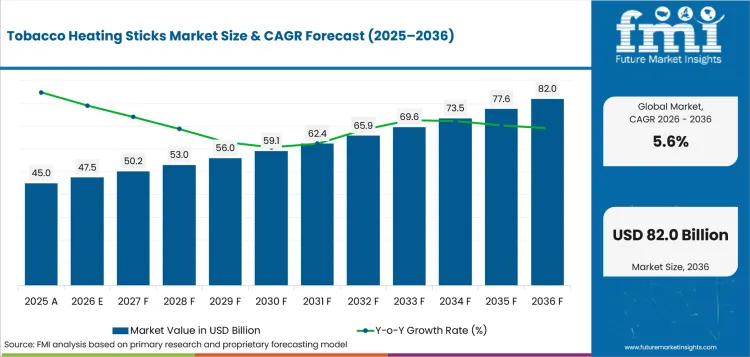
The tobacco heating sticks industry value is anticipated to scale from USD 45.0 billion in 2025 to USD 82.0 billion by 2036 at 5.6% CAGR, influenced by rising adult adoption of heated tobacco systems and wider placement of regulated stick packs through tobacco stores. Offline retail is projected to represent 82.1% share in 2026 as regulated adult channels control access and age checks. Closed-system sticks are expected to secure 72.6% share in 2026, led by proprietary devices and refill control.
Key Takeaways, Market Size, and Forecast
- 2026 Market Size: USD 47.5 billion
- 2036 Market Size: USD 82.0 billion
- Forecast CAGR: 5.6% from 2026 to 2036
- Leading Sales Channel: Offline Retail
- Offline Retail Share in 2026: 82.1%
- Leading Device Compatibility: Closed-System Sticks
- Closed-System Sticks Share in 2026: 72.6%
- Fastest-growing Country: United States
- United States CAGR: 8.9% by 2036
Summary of Tobacco Heating Sticks Market
- Demand and Growth Drivers
- Adult smokers are shifting part of routine nicotine spending toward heated sticks as devices create repeat stick purchases.
- Offline retail networks are gaining share since regulated counters support age checks and product explanation.
- Closed-system sticks are strengthening repeat use as device makers control stick format and refill path.
- Product and Segment View
- Offline retail is forecast to represent 82.1% share in 2026, led by regulated access and store-based adult verification.
- Closed-system sticks are projected to hold 72.6% share in 2026, influenced by device-specific stick design.
- 20-stick packs are expected to secure 68.4% share in 2026, supported by familiar pack size and tax handling.
- Geography and Competitive Outlook
- United States is projected to record 8.9% CAGR by 2036, backed by FDA-authorized IQOS renewal and selected city rollout.
- Poland is expected to expand at 7.2% CAGR by 2036 as flavor rules shift brands toward tobacco-flavor sticks.
- Philip Morris International and Japan Tobacco Inc. compete based on device-stick systems and premium stick upgrades.
- British American Tobacco and KT&G Corporation compete depending on regional heated ranges and local retail strength.
- Analyst Opinion
- Ronak Shah, Principal Consultant for Food and Beverage at FMI, observes, “Tobacco heating sticks represent a repeat-use product built around device control. Adult smokers compare taste first and device reliability second. Suppliers pairing compliant stick packs with stable device access are likely to defend repeat sales more effectively.”
- Tobacco Heating Sticks Market Value Analysis
- Market value is tied to heated stick pack revenue before device margin and accessory spending add incremental income.
- Supplier pricing reflects tobacco blend cost and pack compliance before tax treatment shapes retail shelf price.
- Revenue improves as adult smokers convert part of cigarette spending into repeat stick purchases after device trial.
- Retail trust rises as pack labels make stick count and device compatibility easier for adult consumers to compare.
Repeat sales are the main pressure point for heated stick suppliers as device owners guide users toward branded refills. Philip Morris International reported smoke-free products at 41.5% of 2025 net revenues. It reflects why refill packs are now central to revenue planning across the smokeless cigarettes space. Japan Tobacco Inc. placed Ploom in markets representing close to 75.0% of global heated tobacco volume. The rollout pattern shows, suppliers are entering countries with proven adult use before lower-volume markets. British American Tobacco’s glo Hilo heats sticks in five seconds. Faster start time and matching stick design are raising premium competition beyond basic device access. European tax pressure is adding another channel challenge. European Commission stated, 26 European countries are already tax heated tobacco products. Distributors will need stronger pack-price control across tobacco packaging as duty rules become more aligned. Device compatibility and tax planning will separate large suppliers from smaller entrants during the next launch cycle.
Tobacco Heating Sticks Market Definition
Tobacco Heating Sticks Market covers tobacco-containing consumables designed for heated tobacco devices. Scope includes standard sticks and slim sticks. Capsule sticks, herbal sticks and premium sticks are covered for adult tobacco users. Revenue includes finished stick packs sold through tobacco stores and convenience stores. Supermarkets, online adult channels and duty-free stores are covered.
Tobacco Heating Sticks Market Inclusions
Market scope covers commercially sold heated tobacco sticks by product format and flavor profile. Device compatibility covers closed-system and dual-system stick formats. Pack type analysis includes 20-stick packs and multipacks. Sales channel analysis includes tobacco stores and convenience stores. Revenue scope covers market activity from 2026 to 2036 across finished heated stick products and authorized adult retail formats. Key participants include tobacco manufacturers and device owners. Pack converters, retail chains and compliance technology providers serve tobacco product channels.
Tobacco Heating Sticks Market Exclusions
Scope excludes combustible cigarettes and loose smoking tobacco. E-cigarette liquids and oral nicotine products are outside scope unless sold as separate comparison segments. Device hardware revenue is excluded unless bundled pricing clearly assigns value to heated sticks.
Tobacco Heating Sticks Market Research Methodology
- Primary Research: FMI analysts reviewed heated tobacco brand portfolios and adult retail channel checks across major regulated tobacco markets.
- Desk Research: Public data from FDA, WHO, European Commission, GOV.UK, ONS, Destatis, KDCA, and official company releases were checked against heated stick evidence.
- Market Sizing and Forecasting: Estimated using a bottom-up product-boundary approach. Eligible SKU revenue, channel presence, retail pricing, product positioning, and country-level adoption were used to construct the 2026 market estimate.
- Data Validation: Forecast checks compared tobacco excise treatment, authorized product access, device ecosystem activity, and active supplier portfolios.
Why is the Tobacco Heating Sticks Market Growing?
- Adult smokers are using heated sticks as refill packs keep the nicotine routine close to cigarettes.
- Device owners are linking stick taste and device performance more tightly to protect repeat pack sales.
- Adult retail counters are giving compliant heated stick packs more space as tax rules and product rules become clearer.
Forward outlook is improving as heated sticks move deeper into refill-led adult nicotine planning. Philip Morris International reported heated tobacco unit shipments of 155.1 billion units in 2025, up from 139.7 billion units in 2024. The increase shows how stick refills are becoming a repeat revenue pool across the smokeless cigarettes space. BAT reported 30.5 million consumers of smokeless brands by June 2025, and smokeless products reached 18.2% of Group revenue. The shift supports more counter space for regulated non-combustion products. BAT also stated in December 2025 that glo Hilo launched in Japan in September, Poland in October and Italy in November. Premium device launches now need matching stick ranges and clear tobacco packaging controls before retail expansion.
Market Segmentation Analysis
- Standard sticks are projected to secure 61.7% share in 2026 due to familiar draw format and core tobacco taste promoting repeat purchases.
- Tobacco flavor is forecast to hold 54.2% share in 2026, led by flavor rules and adult preference keeping core tobacco blends central.
- Closed-system sticks are expected to capture 72.6% share in 2026, driven by device makers controlling heating format and refill compatibility.
- 20-stick packs are anticipated to hold 68.4% share in 2026 as familiar pack sizing supports tax marking and adult retail handling.
- Offline retail is expected to represent 82.1% share in 2026, influenced by age-gated counters and product explanation needs.
The tobacco heating sticks sector is divided by product format and flavor profile. Device compatibility, pack type and sales channel complete the structure. Product format includes standard sticks and slim sticks. Capsule sticks, herbal sticks and premium sticks complete the range. Flavor profile covers tobacco flavor and menthol flavor. Fruit flavor, herbal flavor and capsule flavor complete the range. Device compatibility covers closed-system sticks and dual-system sticks. Pack type covers 20-stick packs and multipacks. Sales channel analysis covers tobacco stores and convenience stores. Supermarkets, online retail and duty-free stores complete the channel range.
Insights into Tobacco Heating Sticks Market by Product Format
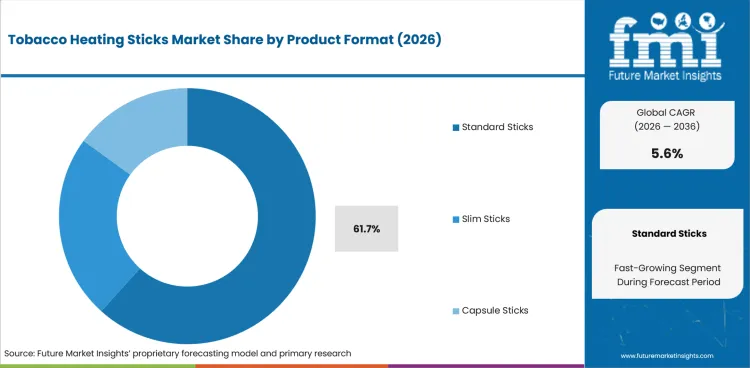
- Standard sticks are projected to account for 61.7% share in 2026, influenced by familiar cigarette-like length and established stick manufacturing lines.
- Slim sticks gain use among premium device owners seeking lighter pack formats and smaller storage needs.
Insights into Tobacco Heating Sticks Market by Flavor Profile
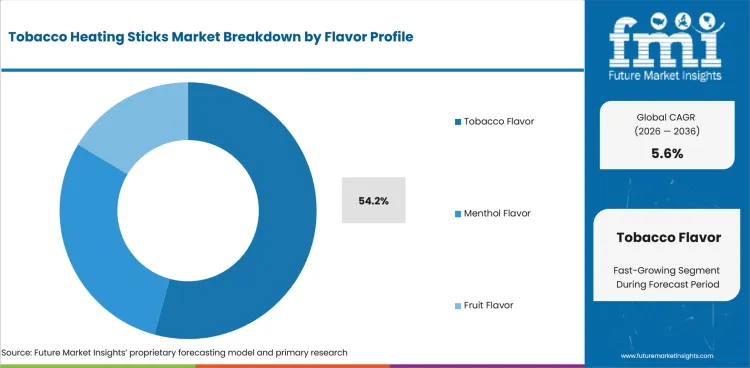
- Tobacco flavor is forecast to hold 54.2% share in 2026 through regulatory acceptance and adult familiarity with core tobacco taste.
- Menthol flavor faces uneven rules across countries, shifting some launches toward tobacco-forward capsule variants and flavour capsule cigarettes.
Insights into Tobacco Heating Sticks Market by Device Compatibility
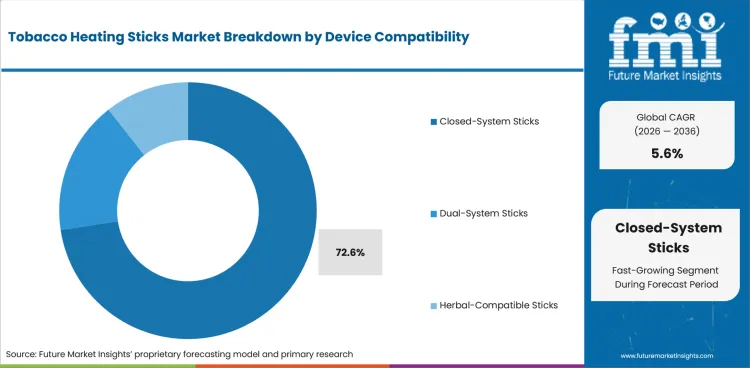
- Closed-system sticks are expected to hold 72.6% share in 2026 due to brand-controlled device matching and authorized refill channels.
- Dual-system sticks gain attention among regional sellers seeking adult users already owning more than one device type.
Insights into Tobacco Heating Sticks Market by Pack Type
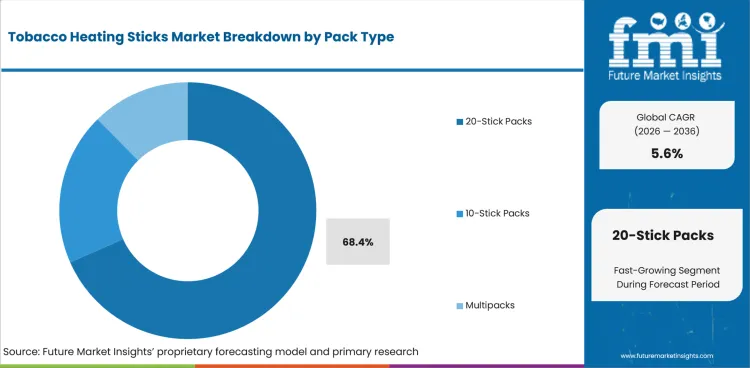
- 20-stick packs are projected to secure 68.4% share in 2026, led by retail counters and duty systems already handling familiar pack counts.
- Multipacks gain value in duty-free stores and premium retail programs targeting repeat adult purchases.
Insights into Tobacco Heating Sticks Market by Sales Channel
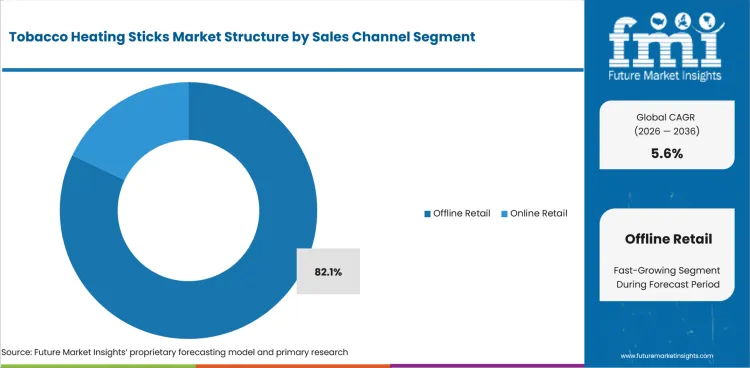
- Offline retail is anticipated to garner 82.1% share in 2026, driven by age checks and product explanation at tobacco counters.
- Online retail gains limited share through verified adult accounts and repeat ordering in markets permitting digital sale.
Tobacco Heating Sticks Market Drivers, Restraints and Opportunities
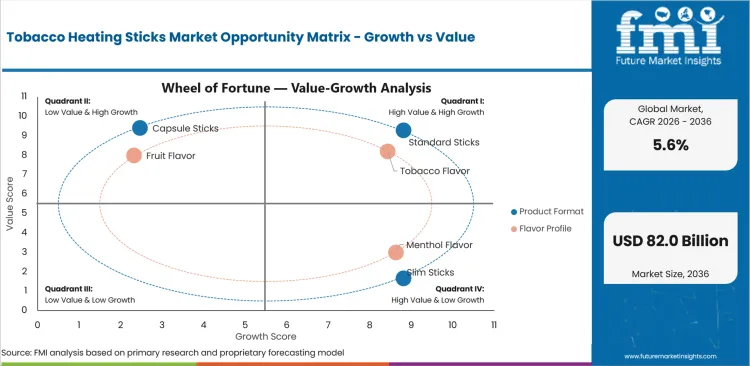
- Driver: Device-stick systems are turning adult smoker trial into repeat refill purchases through controlled product matching.
- Restraint: Authorization reviews and flavor rules can delay launches across regulated adult nicotine channels.
- Opportunity: Premium heated devices and matching stick formats are creating more defined shelf choices for adult retail.
Growth outlook is moving toward controlled device systems and repeat stick replenishment. Altria stated in October 2025, Horizon submitted a combined PMTA and MRTP application to FDA for Ploom and Marlboro heated tobacco sticks in August 2025. The filing shows that USA entry is likely to rely on product-review readiness before national retail scale can expand. Imperial Brands reported in May 2025, heated tobacco share rose by 90 bps across six European markets through February 2025. It also planned the Pulze 3.0 launch for the second half of 2025, with a smaller all-in-one device and improved taste delivery. Premium stick systems therefore need clear authorization files and compliant tobacco packaging before suppliers expand beyond early adult users in the smokeless cigarettes space.
Retail Price and Pack-price Architecture Analysis
Retail price planning for tobacco heating sticks is becoming more sensitive to tax schedules and pack-price gaps. Philip Morris ČR reported that Czech heated tobacco product tax rose from CZK 3,450 per kg of tobacco in 2024 to CZK 3,970 in 2025, with a scheduled rise to CZK 4,570 in 2026. Such tax movement makes pack-price ladders more important for suppliers selling through adult tobacco stores and convenience channels. Brands will need clearer price tiers across standard sticks and multipacks so adult users can compare heated refills against cigarettes and other smokeless cigarettes without weakening premium positioning.
Consumer Segmentation and Purchase Behavior Analysis
Consumer targeting is centered on adult users who already understand tobacco routines and refill-based formats. A 2025 BMJ Open study on Germany reported that current heated tobacco users consumed an average of 7.3 tobacco sticks per day, while 56.0% used heated tobacco products with aroma technologies. The same study found higher heated tobacco use among younger males in urban areas. Such patterns show that suppliers need sharper city-level retail execution and clearer device education across tobacco packaging formats before expanding beyond early adult adopters.
Competitive Landscape and Strategic Positioning
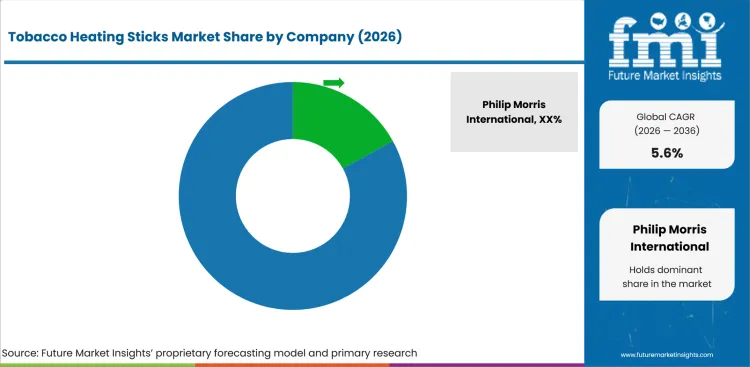
- Established heated tobacco suppliers hold an advantage depending on proprietary devices and approved stick systems.
- Regional firms gain shelf space by matching local tobacco taste and price ladders.
- Packaging specialists support stick packs through tax marking and warning-label compliance.
- Retail-ready packs support trial led by clear stick count and device compatibility labeling.
Heated stick competition is concentrated among tobacco groups owning both devices and refill portfolios. Retail entry is shaped by authorization files and flavor compliance before pack execution and price promotion begin. Competitive structure is led by device-system owners and regulated tobacco groups. Philip Morris International competes through IQOS and TEREA systems. Japan Tobacco Inc. builds its position led by Ploom and EVO sticks. British American Tobacco uses glo and glo Hilo work to defend premium heated product profit pools. KT&G gains from lil systems in South Korea and selected export channels. Retailers assess device compatibility and refill availability before expanding heated stick space.
Supplier advantage will come from taste consistency and credible compliance work. Larger companies are best placed to secure tobacco stores through regulatory files and retail education. Regional firms can profit in selected markets if they solve local taste expectations and pack-price pressure. Companies with device ownership and stick manufacturing depth are best positioned to secure repeat purchases across roll-your-own tobacco products comparison channels.
Key Companies in the Tobacco Heating Sticks Market
Competitive structure is grouped by global device-system owners, regional tobacco suppliers, and channel-focused companies.
- Global Device-System Owners: Philip Morris International, Japan Tobacco Inc., British American Tobacco, and KT&G Corporation compete led by proprietary heating platforms and dedicated stick portfolios.
- Regional Tobacco Suppliers: Imperial Brands and China National Tobacco Corporation compete based on established retail access and country-specific tobacco portfolios.
- Channel-Focused Companies: Altria Group and selected distributors compete through adult retail coverage and compliant channel execution.
Competitive Benchmarking: Tobacco Heating Sticks Market
| Company | Device-Stick Control | Flavor Compliance Depth | Adult Retail Access | Pack Compliance Execution | Geographic Footprint |
|---|---|---|---|---|---|
| Philip Morris International | Very Strong | Very Strong | Very Strong | Very Strong | Global |
| Japan Tobacco Inc. | Strong | Very Strong | Strong | Strong | Japan and Europe |
| British American Tobacco | Strong | Strong | Strong | Strong | Global |
| KT&G Corporation | Strong | Strong | Strong | Strong | South Korea and exports |
| Imperial Brands | Moderate | Moderate | Strong | Strong | Europe |
| Altria Group | Moderate | Moderate | Strong | Strong | United States |
| China National Tobacco Corporation | Moderate | Moderate | Strong | Moderate | China |
Source: Future Market Insights competitive analysis, 2026.
Key Developments in Tobacco Heating Sticks Market
- In May 2026, Imperial Brands stated that its refreshed range of iD heat sticks was well received by consumers across Italy, Greece, Poland, and Czechia.
- In April 2026, Philip Morris ČR stated that a new line of DELIA tobacco sticks was introduced in the Czech Republic with four different flavour profiles.
- In September 2025, Philip Morris ČR stated that TEREA Fuse Line sticks were launched in Slovakia as part of its smoke-free alternatives portfolio.
Key Players in the Tobacco Heating Sticks Market
- Philip Morris International
- Japan Tobacco Inc.
- British American Tobacco
- KT&G Corporation
- Imperial Brands
- Altria Group
- China National Tobacco Corporation
Analysis of Tobacco Heating Sticks Market by Key Countries
.webp "Top Country Growth Comparison Tobacco Heating Sticks Market Cagr (2026 2036)")
| Country | CAGR |
|---|---|
| United States | 8.9% |
| Poland | 7.2% |
| Italy | 6.4% |
| Germany | 5.8% |
| United Kingdom | 5.3% |
| South Korea | 4.9% |
| Japan | 4.5% |
Source: Future Market Insights, 2026.
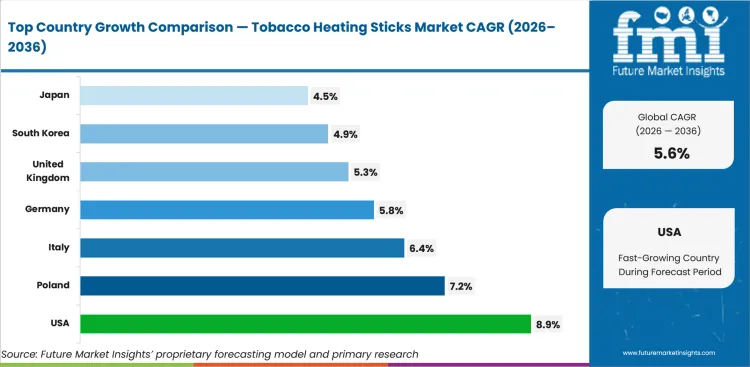
Tobacco Heating Sticks Market CAGR Analysis by Country
- United States is forecast to achieve an 8.9% CAGR by 2036 as phased city rollouts are supported by FDA-authorized access.
- Poland is projected to expand at a CAGR of 7.2% over the forecast period as retail strategies continue to rely on tobacco-flavor sticks due to flavor-rule changes.
- Italy is forecast to grow at 6.4% CAGR through 2036 as strong familiarity with heated tobacco encourages deeper premium stick assortments.
- Germany is expected to advance at 5.8% CAGR by 2036 as pack-price comparisons remain active due to the scale of taxed tobacco.
- United Kingdom is projected to rise at 5.3% CAGR through 2036 as pricing tiers are influenced by duty schedules across adult convenience retail.
- South Korea is forecast to post a 4.9% CAGR during the assessment period as consistent domestic supply is supported by KT&G’s market presence.
- Japan is expected to grow at 4.5% CAGR by 2036 as ongoing device upgrades and convenience retail drive steady refill purchases.
Sales Outlook for Tobacco Heating Sticks Market in the United States
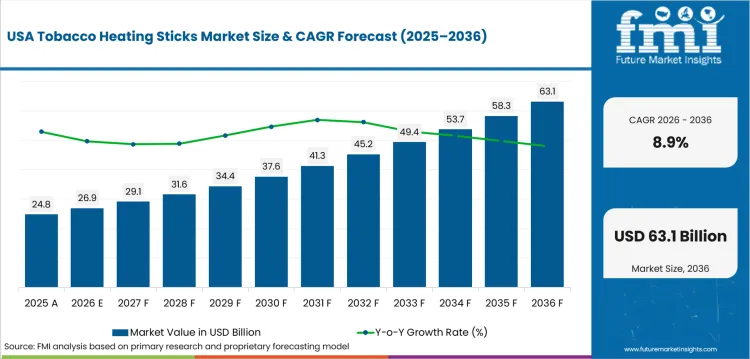
FDA-authorized launch and adult retail center · 2026 to 2036
Country Market Snapshot Table
| Parameter | Value |
|---|---|
| Market Size in 2025 (Value) | USD 2.5 billion |
| Market Size in 2026 (Value) | USD 2.7 billion |
| Market Forecast in 2036 (Value) | USD 6.3 billion |
| CAGR (2026 to 2036) | 8.9% |
| Years Considered | 2021 to 2036 |
| Base Year | 2025 |
| Forecast Period | 2026 to 2036 |
| Units Considered | Value (USD billion) |
| Leading Sub-Region | Texas and selected city adult retail corridors |
United States Tobacco Heating Sticks Market Outlook
United States tobacco heating stick sales are driven by FDA authorization and phased retail access. Adult consumers enter the segment through controlled product launches and age-gated sale points.
City-level launch work is expected to precede wider chain placement. Suppliers with regulatory dossiers and retail education capacity should gain early refill advantages.
Key Growth Drivers
- FDA renewal creates a defined compliance route for IQOS sticks. In April 2026, FDA renewed modified risk orders for five IQOS products.
- City-based launch work gives suppliers a measured channel entry. PMI reported, IQOS 3.0 sales began in Austin on March 27, 2025.
- Adult smoker conversion gives heated sticks a sizable addressable pool. NCHS reported, 9.9% of USA adults currently smoked cigarettes in 2024.
- Federal product framing supports clear separation from open vapor systems. FDA listed heated tobacco under non-combusted cigarettes in May 2026.
Key Restraints
- Open vapor products compete for adult nicotine switching. Gallup reported that 8.0% of USA adults vaped in the past week as of July 2025, showing e-cigarettes to remain a direct competing nicotine routine for heated stick adoption.
- Product-file review can extend launch timing. FDA set December 8, 2025, as the public comment deadline for IQOS MRTP renewal applications.
- Narrow authorization scope can limit range expansion. FDA renewal covered specific IQOS holders and HeatSticks rather than every heated stick format.
What makes United States unique
United States is unique due to FDA product authorization and city-level launch discipline across adult retail chains.
Key Companies
- Philip Morris International
- Altria Group
- British American Tobacco
- Japan Tobacco Inc.
- Swedish Match North America
- Reynolds American
- Turning Point Brands
Sales & Marketing Channels
- Tobacco stores
- Convenience stores
- Selected supermarkets
- Age-verified online retail
- Duty-free stores
- Specialty adult outlets
Country Segment Breakdown Table
| Segment | Sub-Segments |
|---|---|
| By Product Format | Standard Sticks · Slim Sticks · Capsule Sticks · Herbal Sticks · Premium Sticks |
| By Flavor Profile | Tobacco Flavor · Menthol Flavor · Fruit Flavor · Herbal Flavor · Capsule Flavor |
| By Device Compatibility | Closed-System Sticks · Dual-System Sticks · Herbal-Compatible Sticks · Disposable-Compatible Sticks · Multi-Brand Sticks |
| By Pack Type | 20-Stick Packs · 10-Stick Packs · Multipacks · Trial Packs · Duty-Free Packs |
| By Sales Channel | Tobacco Stores · Convenience Stores · Supermarkets · Online Retail · Duty-Free Stores |
| Key Sub-Regions Covered, Adult Retail Areas | Texas · Georgia · Virginia · Florida · North Carolina · California |
Frequently Asked Questions
How fast is United States tobacco heating sticks market growing?
Sales in the United States are forecast to expand at 8.9% CAGR from 2026 to 2036 through regulated adult retail access and repeat stick purchase.
Who leads United States tobacco heating sticks market?
Philip Morris International and Altria lead early USA access through IQOS rights. BAT and Japan Tobacco remain relevant through global heated portfolios.
What is driving adoption in United States tobacco heating sticks market?
FDA authorization and Austin launch work are driving early adoption through controlled adult retail channels.
Demand Outlook for Tobacco Heating Sticks Market in Poland
Flavor-rule transition and Central Europe retail center · 2026 to 2036
Country Market Snapshot Table
| Parameter | Value |
|---|---|
| Market Size in 2025 (Value) | USD 1.5 billion |
| Market Size in 2026 (Value) | USD 1.6 billion |
| Market Forecast in 2036 (Value) | USD 3.2 billion |
| CAGR (2026 to 2036) | 7.2% |
| Years Considered | 2021 to 2036 |
| Base Year | 2025 |
| Forecast Period | 2026 to 2036 |
| Units Considered | Value (USD billion) |
| Leading Sub-Region | Warsaw and southern convenience retail corridors |
Poland Tobacco Heating Sticks Market Outlook
Poland tobacco heating stick demand is shaped by adult nicotine migration and European flavor rules. Tobacco-flavor sticks gain importance as flavor restrictions reshape product planning.
Central Europe placement gives Poland value for suppliers planning cross-border brand changes. Retailers should favor compliant core tobacco blends before expanding premium variants.
Key Growth Drivers
- Regulatory clarity supports tobacco-flavor planning. For instance, Poland’s 2025 amendment added point 20a to define a heated tobacco product.
- Flavor compliance is moving assortment design toward core tobacco sticks. Poland’s 2025 amendment revised Article 7e paragraph 1 for characteristic aroma restrictions.
- Cigarette pressure gives heated sticks a switching route. PMI reported Poland shipment volume down 14.4% in Europe during first quarter 2025.
- EU tax reform creates a clearer future pricing path. European Commission proposed new minimum taxes for heated tobacco in July 2025.
Key Restraints
- Adult tobacco volume weakness can limit refill scale. Tobacco Atlas reported 17.0% adult smoking prevalence in Poland in 2025, indicating a narrower adult combustible-smoker base for heated stick refill conversion.
- Full-year shipment softness raises caution for range expansion as suppliers may delay new stick variants until adult retail demand becomes more stable.
- Flavor limits can remove trial-led variants. Poland’s 2025 law moved characteristic aroma controls into the heated tobacco product framework.
What makes Poland unique
Poland is unique due to EU flavor-rule pressure and large convenience retail networks that respond quickly to excise changes.
Key Companies
- Philip Morris Polska
- British American Tobacco Poland
- Japan Tobacco International Poland
- Imperial Brands Poland
- KT&G Europe
- Ploom Poland
- BAT Rothmans Poland
- Pulze Poland
Sales & Marketing Channels
- Tobacco stores
- Convenience stores
- Supermarkets
- Petrol station retail
- Age-verified online retail
- Travel retail
Country Segment Breakdown Table
| Segment | Sub-Segments |
|---|---|
| By Product Format | Standard Sticks · Slim Sticks · Capsule Sticks · Herbal Sticks · Premium Sticks |
| By Flavor Profile | Tobacco Flavor · Menthol Flavor · Fruit Flavor · Herbal Flavor · Capsule Flavor |
| By Device Compatibility | Closed-System Sticks · Dual-System Sticks · Herbal-Compatible Sticks · Disposable-Compatible Sticks · Multi-Brand Sticks |
| By Pack Type | 20-Stick Packs · 10-Stick Packs · Multipacks · Trial Packs · Duty-Free Packs |
| By Sales Channel | Tobacco Stores · Convenience Stores · Supermarkets · Online Retail · Duty-Free Stores |
| Key Sub-Regions Covered, Adult Retail Areas | Warsaw · Kraków · Wrocław · Poznań · Gdańsk · Łódź |
Frequently Asked Questions
How fast is Poland tobacco heating sticks market growing?
Demand in Poland is forecast to grow at 7.2% CAGR from 2026 to 2036, driven by regulated adult retail access and repeat stick purchase.
Who leads Poland tobacco heating sticks market?
Philip Morris Polska and BAT Poland compete through tobacco-flavor ranges. Imperial Brands Poland and JTI Poland support broader retail coverage.
What is driving adoption in Poland tobacco heating sticks market?
Flavor-rule compliance and tobacco-flavor assortment planning are guiding adoption across convenience and petrol-station channels.
Growth Outlook for Tobacco Heating Sticks Market in Italy
Premium heated product and excise center · 2026 to 2036
Country Market Snapshot Table
| Parameter | Value |
|---|---|
| Market Size in 2025 (Value) | USD 6.0 billion |
| Market Size in 2026 (Value) | USD 6.4 billion |
| Market Forecast in 2036 (Value) | USD 11.9 billion |
| CAGR (2026 to 2036) | 6.4% |
| Years Considered | 2021 to 2036 |
| Base Year | 2025 |
| Forecast Period | 2026 to 2036 |
| Units Considered | Value (USD billion) |
| Leading Sub-Region | Milan and Rome adult retail corridors |
Italy Tobacco Heating Sticks Market Outlook
Italy tobacco heating stick sector is supported by early heat-not-burn familiarity and premium adult retail access. Brands compete through device upgrades and tobacco-flavor stick depth.
Retailers have experience handling heated tobacco packs at scale. Suppliers can defend repeat purchases through device compatibility and clear pack ladders.
Key Growth Drivers
- Premium heated products have a tested adult consumer core in Italy. PMI reported Italy up 8.5% in first quarter 2025 cigarette and HTU shipment volume.
- Adult heated-product use provides a clear consumer pool. Scala et al. reported that 4.5% of Italian adults used heated tobacco products in 2024.
- Full-year volume performance supports refill planning as suppliers can use stable adult demand to guide stick assortment and pack-price planning.
- Device-stick ecosystems can use premium retail presentation. IQOS launched first in Japan and Italy, giving suppliers long operating experience in Italian adult channels.
Key Restraints
- Combustible smoking remains a large competitor for routine spending. Possenti et al. reported, 26.6% of Italian adults were current conventional cigarette smokers in 2024.
- Flavor and health scrutiny can narrow product claims. The Italian drug addictions report noted higher risk perception issues for heated tobacco products in 2025.
- EU tax reform can reshape pack price gaps. European Commission proposed extending minimum tax coverage to heated tobacco in July 2025.
What makes Italy unique
Italy is unique due to early heated product scale and premium store presentation across dense urban tobacco retail coverage.
Key Companies
- Philip Morris Italia
- British American Tobacco Italia
- Japan Tobacco International Italia
- Imperial Brands Italia
- KT&G Italia
- Manifatture Sigaro Toscano
- Ploom Italia
Sales & Marketing Channels
- Tobacco shops
- Convenience stores
- Supermarkets
- Duty-free stores
- Age-verified online retail
- Brand stores
Country Segment Breakdown Table
| Segment | Sub-Segments |
|---|---|
| By Product Format | Standard Sticks · Slim Sticks · Capsule Sticks · Herbal Sticks · Premium Sticks |
| By Flavor Profile | Tobacco Flavor · Menthol Flavor · Fruit Flavor · Herbal Flavor · Capsule Flavor |
| By Device Compatibility | Closed-System Sticks · Dual-System Sticks · Herbal-Compatible Sticks · Disposable-Compatible Sticks · Multi-Brand Sticks |
| By Pack Type | 20-Stick Packs · 10-Stick Packs · Multipacks · Trial Packs · Duty-Free Packs |
| By Sales Channel | Tobacco Stores · Convenience Stores · Supermarkets · Online Retail · Duty-Free Stores |
| Key Sub-Regions Covered, Adult Retail Areas | Milan · Rome · Turin · Naples · Bologna · Florence |
Frequently Asked Questions
How fast is Italy tobacco heating sticks market growing?
The sector in Italy is forecast to grow at 6.4% CAGR from 2026 to 2036 as heated stick demand benefits from dense tobacco retail coverage and continued consumer movement toward device-linked refill formats.
Who leads Italy tobacco heating sticks market?
Global tobacco firms and local device owners compete based on device compatibility and stick taste. Retail access and compliant adult communication guide execution.
What is driving adoption in Italy tobacco heating sticks market?
Early heat-not-burn familiarity and premium tobacco retail coverage are supporting repeat stick purchases.
Demand Analysis for Tobacco Heating Sticks Market in Germany
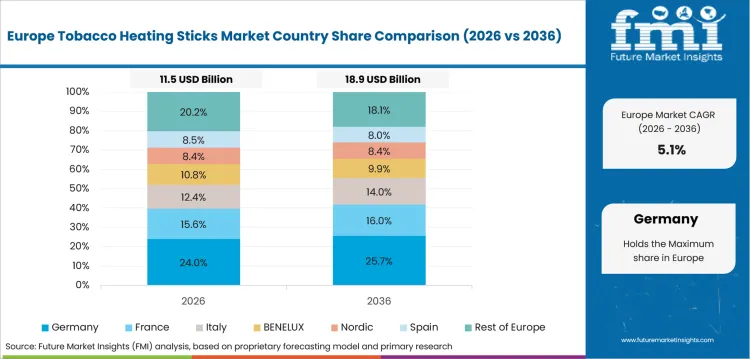
Taxed tobacco scale and regulated retail center · 2026 to 2036
Country Market Snapshot Table
| Parameter | Value |
|---|---|
| Market Size in 2025 (Value) | USD 5.2 billion |
| Market Size in 2026 (Value) | USD 5.5 billion |
| Market Forecast in 2036 (Value) | USD 9.7 billion |
| CAGR (2026 to 2036) | 5.8% |
| Years Considered | 2021 to 2036 |
| Base Year | 2025 |
| Forecast Period | 2026 to 2036 |
| Units Considered | Value (USD billion) |
| Leading Sub-Region | Berlin and western retail corridors |
Germany Tobacco Heating Sticks Market Outlook
Germany tobacco heating stick demand is influenced by a large taxed tobacco pool and careful adult retail controls. Consumers compare heated sticks with cigarettes and fine-cut tobacco before shifting routine spending.
Regulated channels create a measured expansion path for heated stick suppliers. Premium positioning will need price clarity as tobacco price pressure persists.
Key Growth Drivers
- A large cigarette pool gives heated sticks a major switching pool. Destatis reported 66.4 billion taxed cigarettes in Germany during 2025.
- Retail price comparison remains active in tobacco counters as adult consumers continue to weigh heated stick packs against cigarettes and other nicotine formats.
- Heated product awareness has room to rise as suppliers build clearer product education and repeat-purchase support across regulated retail channels.
- Pack communication must support strict retail rules. EU health-warning rules require combined warnings to cover 65.0% of front and back package surfaces for key smoking products.
Key Restraints
- German adoption remains limited against cigarette scale. GSTHR reported that adult heated tobacco product use in Germany stood at 0.9%, while 1.7% of the population had tried heated tobacco products at least once.
- Daily use remains narrow and may slow refill frequency as many adult users continue to treat heated sticks as an occasional alternative rather than a full replacement routine.
- Advertising limits reduce new product explanation as suppliers have fewer public-facing routes to communicate stick compatibility and device-use differences.
What makes Germany unique
Germany is unique due to large taxed tobacco volume and disciplined retail controls for price-sensitive adult consumers.
Key Companies
- Reemtsma Cigarettenfabriken GmbH
- Philip Morris GmbH
- British American Tobacco Germany GmbH
- JT International Germany GmbH
- Imperial Brands Deutschland GmbH
- Ploom Germany
Sales & Marketing Channels
- Tobacco stores
- Convenience stores
- Supermarkets
- Petrol station shops
- Age-verified online retail
- Duty-free stores
Country Segment Breakdown Table
| Segment | Sub-Segments |
|---|---|
| By Product Format | Standard Sticks · Slim Sticks · Capsule Sticks · Herbal Sticks · Premium Sticks |
| By Flavor Profile | Tobacco Flavor · Menthol Flavor · Fruit Flavor · Herbal Flavor · Capsule Flavor |
| By Device Compatibility | Closed-System Sticks · Dual-System Sticks · Herbal-Compatible Sticks · Disposable-Compatible Sticks · Multi-Brand Sticks |
| By Pack Type | 20-Stick Packs · 10-Stick Packs · Multipacks · Trial Packs · Duty-Free Packs |
| By Sales Channel | Tobacco Stores · Convenience Stores · Supermarkets · Online Retail · Duty-Free Stores |
| Key Sub-Regions Covered, Adult Retail Areas | Berlin · Hamburg · Munich · North Rhine-Westphalia · Frankfurt · Stuttgart |
Frequently Asked Questions
How fast is Germany tobacco heating sticks market growing?
Industry in Germany is anticipated to grow at 5.8% CAGR from 2026 to 2036, reflected by price-sensitive adult smokers comparing heated sticks with cigarettes while regulated retail channels support repeat refill buying.
Who leads Germany tobacco heating sticks market?
Global tobacco firms and local device owners compete by device compatibility and stick taste. Retail access and compliant adult communication guide execution.
What is driving adoption in Germany tobacco heating sticks market?
Pack-price comparison and regulated tobacco counters are shaping adoption among adult smokers.
Opportunity Analysis for Tobacco Heating Sticks Market in the United Kingdom
Duty-rate and controlled retail center · 2026 to 2036
Country Market Snapshot Table
| Parameter | Value |
|---|---|
| Market Size in 2025 (Value) | USD 3.0 billion |
| Market Size in 2026 (Value) | USD 3.1 billion |
| Market Forecast in 2036 (Value) | USD 5.2 billion |
| CAGR (2026 to 2036) | 5.3% |
| Years Considered | 2021 to 2036 |
| Base Year | 2025 |
| Forecast Period | 2026 to 2036 |
| Units Considered | Value (USD billion) |
| Leading Sub-Region | London and national convenience retail corridors |
United Kingdom Tobacco Heating Sticks Market Outlook
Growth in the United Kingdom tobacco heating stick market is reflected by duty-rate movement and adult convenience retail. Retailers must explain price differences across cigarettes and other nicotine alternatives.
Pack affordability will guide repeat refill buying. Brands with clear tax-inclusive price ladders should defend adult consumer retention.
Key Growth Drivers
- Duty schedules give suppliers time to adjust pack-price ladders. HM Revenue & Customs listed tobacco for heating at £426.47 per kg from October 2026.
- Adult smoker conversion remains commercially meaningful. ONS reported around 4.9 million current smokers in Great Britain during 2024.
- Heated stick pricing can be planned around published duty schedules as suppliers adjust pack-price ladders before retail execution.
- Store counters can target smokers considering alternatives as adult tobacco users compare heated sticks with cigarettes and other nicotine formats.
Key Restraints
- E-cigarette use competes for adult switching spend. Action on Smoking and Health reported that 10.4% of adults in Great Britain currently vaped in 2025, equal to about 5.5 million people, showing vapor products remain a major competing route for adult nicotine users.
- Duty increases can pressure pack affordability as higher tax-linked costs may narrow the price gap between heated sticks and other nicotine formats.
- Enforcement costs can affect retail confidence as compliance checks and product controls add operating pressure for tobacco retailers.
What makes United Kingdom unique
United Kingdom is unique due to transparent duty schedules and clear tobacco tax reporting across national convenience chains.
Key Companies
- Imperial Brands PLC
- Imperial Tobacco Ltd
- British American Tobacco UK Ltd
- JTI UK
- Philip Morris Limited
- Ploom Great Britain
Sales & Marketing Channels
- Convenience stores
- Tobacco counters
- Supermarkets
- Petrol station shops
- Age-verified online retail
- Travel retail
Country Segment Breakdown Table
| Segment | Sub-Segments |
|---|---|
| By Product Format | Standard Sticks · Slim Sticks · Capsule Sticks · Herbal Sticks · Premium Sticks |
| By Flavor Profile | Tobacco Flavor · Menthol Flavor · Fruit Flavor · Herbal Flavor · Capsule Flavor |
| By Device Compatibility | Closed-System Sticks · Dual-System Sticks · Herbal-Compatible Sticks · Disposable-Compatible Sticks · Multi-Brand Sticks |
| By Pack Type | 20-Stick Packs · 10-Stick Packs · Multipacks · Trial Packs · Duty-Free Packs |
| By Sales Channel | Tobacco Stores · Convenience Stores · Supermarkets · Online Retail · Duty-Free Stores |
| Key Sub-Regions Covered, Adult Retail Areas | London · Manchester · Birmingham · Leeds · Glasgow · Bristol |
Frequently Asked Questions
How fast is United Kingdom tobacco heating sticks market growing?
The United Kingdom tobacco heating sticks market is set to increase at 5.3% CAGR from 2026 to 2036, backed by duty-led pack-price planning and adult convenience retail access promoting steady refill purchases.
Who leads United Kingdom tobacco heating sticks market?
Imperial Brands and BAT UK hold strong retail reach. Philip Morris Limited and JTI UK compete through heated product education and refill supply.
What is driving adoption in United Kingdom tobacco heating sticks market?
Published duty schedules and convenience retail access are driving pack-price planning for repeat purchase.
Sales Outlook for Tobacco Heating Sticks Market in South Korea
Local brand strength and heated product adoption center · 2026 to 2036
Country Market Snapshot Table
| Parameter | Value |
|---|---|
| Market Size in 2025 (Value) | USD 4.7 billion |
| Market Size in 2026 (Value) | USD 4.9 billion |
| Market Forecast in 2036 (Value) | USD 7.9 billion |
| CAGR (2026 to 2036) | 4.9% |
| Years Considered | 2021 to 2036 |
| Base Year | 2025 |
| Forecast Period | 2026 to 2036 |
| Units Considered | Value (USD billion) |
| Leading Sub-Region | Seoul and national convenience retail corridors |
South Korea Tobacco Heating Sticks Market Outlook
South Korea tobacco heating stick demand is shaped by local supplier strength and convenience retail density. Adult consumers already know heated product systems through IQOS and glo ranges.
Local competition keeps device pricing active and puts pressure on stick taste quality. Suppliers need reliable retail execution across convenience chains and brand stores.
Key Growth Drivers
- Stick-scale activity supports local supplier credibility. KT&G reported 1.478 billion stick sales volume as of 2025.
- Public health trends can shift adult nicotine routines. KDCA reported the current smoking rate decreased by 1.4 percentage points from the previous year in 2024.
- Local brand strength supports South Korea’s heated-product base as adult consumers remain familiar with device-linked stick formats and repeat retail purchases.
- Established tobacco retail networks give heated stick suppliers a stronger base for assortment planning and portfolio expansion.
Key Restraints
- Packaging cost can rise when material grades fall short. Korea Environment Corporation stated that difficult-to-recycle packaging can face a 10.0% to 20.0% surcharge. Its waste-charge materials also showed annual charges near KRW 200.0 billion.
- Pack material changes require process discipline as suppliers must align stick packaging with manufacturing speed and shelf handling needs.
- Stick and frame redesign can affect manufacturing planning as producers adjust material use and line compatibility without disrupting retail supply.
What makes South Korea unique
South Korea is unique due to KT&G’s domestic role and convenience retail depth among adults familiar with heated devices.
Key Companies
- KT&G Corporation
- Philip Morris Korea
- British American Tobacco Korea
- Japan Tobacco International Korea
- Imperial Brands Korea
- Lil Korea
- Ploom Korea
Sales & Marketing Channels
- Convenience stores
- Tobacco stores
- Supermarkets
- Brand stores
- Age-verified online retail
- Duty-free stores
Country Segment Breakdown Table
| Segment | Sub-Segments |
|---|---|
| By Product Format | Standard Sticks · Slim Sticks · Capsule Sticks · Herbal Sticks · Premium Sticks |
| By Flavor Profile | Tobacco Flavor · Menthol Flavor · Fruit Flavor · Herbal Flavor · Capsule Flavor |
| By Device Compatibility | Closed-System Sticks · Dual-System Sticks · Herbal-Compatible Sticks · Disposable-Compatible Sticks · Multi-Brand Sticks |
| By Pack Type | 20-Stick Packs · 10-Stick Packs · Multipacks · Trial Packs · Duty-Free Packs |
| By Sales Channel | Tobacco Stores · Convenience Stores · Supermarkets · Online Retail · Duty-Free Stores |
| Key Sub-Regions Covered, Adult Retail Areas | Seoul · Busan · Incheon · Daegu · Daejeon · Gwangju |
Frequently Asked Questions
How fast is South Korea tobacco heating sticks market growing?
Demand in South Korea is forecast to grow at 4.9% CAGR from 2026 to 2036 as local brand familiarity and established heated-device use support steady refill demand.
Who leads South Korea tobacco heating sticks market?
KT&G leads local competition through lil and stick availability. Philip Morris Korea and BAT Korea compete through imported device systems.
What is driving adoption in South Korea tobacco heating sticks market?
Local device familiarity and convenience-chain access are supporting repeat stick availability.
Demand Outlook for Tobacco Heating Sticks Market in Japan
Device upgrade and premium stick center · 2026 to 2036
Country Market Snapshot Table
| Parameter | Value |
|---|---|
| Market Size in 2025 (Value) | USD 15.5 billion |
| Market Size in 2026 (Value) | USD 16.2 billion |
| Market Forecast in 2036 (Value) | USD 25.2 billion |
| CAGR (2026 to 2036) | 4.5% |
| Years Considered | 2021 to 2036 |
| Base Year | 2025 |
| Forecast Period | 2026 to 2036 |
| Units Considered | Value (USD billion) |
| Leading Sub-Region | Tokyo and Osaka convenience retail corridors |
Japan Tobacco Heating Sticks Market Outlook
Japan tobacco heating stick demand is led by device upgrades and deep adult familiarity with heat-not-burn systems. Stick portfolios compete on taste delivery and device matching.
Premium launches can gain early attention through brand stores and convenience chains. Repeat purchase will depend on refill availability and flavor rules.
Key Growth Drivers
- Japan remains a key device-upgrade center as adult users continue to compare newer heated systems based on stick taste and refill availability.
- Convenience stores provide a high-frequency refill route as established retail access supports repeat stick purchases and quick product replenishment.
- Ploom demand moved upward after device renewal. Tobacco Asia reported that Ploom’s domestic sales volume grew by 34.7% in Q1 2024, reaching 11.0% share of Japan’s heated tobacco sticks segment, up 1.6 percentage points year-to-date.
- Heated product stick growth accelerated inside JT’s portfolio. JTI reported Ploom volume growth of 57.0% in first quarter 2026.
Key Restraints
- Forecast revisions show pricing sensitivity in tobacco planning. JT revised full-year 2025 core revenue upward by JPY 168.0 billion in October 2025 due to volume assumptions and pricing.
- Premium device cost can slow trial among price-sensitive adults as higher upfront spending may delay movement from cigarettes to heated stick systems.
- Tax-linked buying can distort refill timing as adult consumers may adjust pack purchases around expected price changes and retail promotions.
What makes Japan unique
Japan is unique due to early heat-not-burn scale and dense convenience retail serving frequent device upgrades.
Key Companies
- Japan Tobacco Inc.
- Philip Morris Japan
- British American Tobacco Japan
- Imperial Brands Japan
- KT&G Japan
- Ploom Japan
- IQOS Japan
Sales & Marketing Channels
- Convenience stores
- Brand stores
- Tobacco counters
- Supermarkets
- Age-verified online retail
- Duty-free stores
Country Segment Breakdown Table
| Segment | Sub-Segments |
|---|---|
| By Product Format | Standard Sticks · Slim Sticks · Capsule Sticks · Herbal Sticks · Premium Sticks |
| By Flavor Profile | Tobacco Flavor · Menthol Flavor · Fruit Flavor · Herbal Flavor · Capsule Flavor |
| By Device Compatibility | Closed-System Sticks · Dual-System Sticks · Herbal-Compatible Sticks · Disposable-Compatible Sticks · Multi-Brand Sticks |
| By Pack Type | 20-Stick Packs · 10-Stick Packs · Multipacks · Trial Packs · Duty-Free Packs |
| By Sales Channel | Tobacco Stores · Convenience Stores · Supermarkets · Online Retail · Duty-Free Stores |
| Key Sub-Regions Covered, Adult Retail Areas | Tokyo · Osaka · Nagoya · Yokohama · Fukuoka · Sapporo |
Frequently Asked Questions
How fast is Japan tobacco heating sticks market growing?
Sales in Japan are forecast to grow at 4.5% CAGR from 2026 to 2036 led by adult consumers continuing to rely on brand-led stick assortments and familiar heated tobacco routines.
Who leads Japan tobacco heating sticks market?
Japan Tobacco leads through Ploom stick depth. Philip Morris Japan and BAT Japan compete through IQOS and glo device ecosystems.
What is driving adoption in Japan tobacco heating sticks market?
Device renewal and dense convenience retail are supporting frequent refill purchases.
Tobacco Heating Sticks Market - Report Scope
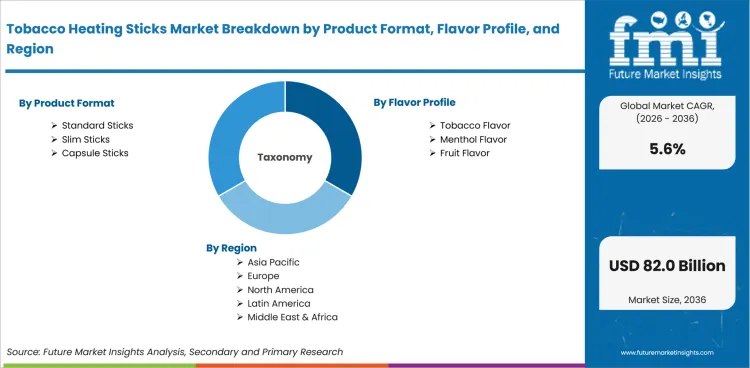
| Parameter | Details |
|---|---|
| Market size by 2036 | USD 82.0 billion |
| Growth rate | 5.6% CAGR from 2026 to 2036 |
| Forecast period | 2026 to 2036 |
| Base year value (2025) | USD 45.0 billion |
| By product format | Standard sticks, slim sticks, capsule sticks, herbal sticks, premium sticks |
| By flavor profile | Tobacco flavor, menthol flavor, fruit flavor, herbal flavor, capsule flavor |
| By device compatibility | Closed-system sticks, dual-system sticks, herbal-compatible sticks, disposable-compatible sticks, multi-brand sticks |
| By pack type | 20-stick packs, 10-stick packs, multipacks, trial packs, duty-free packs |
| By sales channel | Tobacco stores, convenience stores, supermarkets, online retail, duty-free stores |
| Regions covered | North America, Latin America, Europe, East Asia, South Asia and Pacific, Middle East and Africa |
| Countries covered | United States, Poland, Italy, Germany, United Kingdom, South Korea, Japan |
| Key companies profiled | Philip Morris International, Japan Tobacco Inc., British American Tobacco, KT&G Corporation, Imperial Brands, Altria Group, China National Tobacco Corporation |
| Approach | Bottom-up product-boundary approach using eligible SKU revenue, channel presence, retail pricing, product positioning, and country-level adoption |
Source: Future Market Insights, 2026.
Tobacco Heating Sticks Market Breakdown by Product Format, Flavor Profile, Device Compatibility, Pack Type, Sales Channel, and Region
By Product Format
- Standard Sticks
- Slim Sticks
- Capsule Sticks
- Herbal Sticks
- Premium Sticks
By Flavor Profile
- Tobacco Flavor
- Menthol Flavor
- Fruit Flavor
- Herbal Flavor
- Capsule Flavor
By Device Compatibility
- Closed-System Sticks
- Dual-System Sticks
- Herbal-Compatible Sticks
- Disposable-Compatible Sticks
- Multi-Brand Sticks
By Pack Type
- 20-Stick Packs
- 10-Stick Packs
- Multipacks
- Trial Packs
- Duty-Free Packs
By Sales Channel
- Tobacco Stores
- Convenience Stores
- Supermarkets
- Online Retail
- Duty-Free Stores
By Region
- North America
- Latin America
- Europe
- East Asia
- South Asia and Pacific
- Middle East and Africa
Research Sources and Bibliography
- Action on Smoking and Health. (2025, September 15). Use of vapes among adults in Great Britain.
- Altria Group. (2025, October 30). Altria reports 2025 third-quarter and nine-months results
- British American Tobacco. (2025, June 9). BAT launches glo™ Hilo - a new premium device featuring revolutionary TurboStart™ technology - in Japan.
- British American Tobacco. (2025, July 31). Half-year report for the six months to 30 June 2025.
- British American Tobacco. (2025, December 9). 2025 full-year pre-close trading update.
- Centers for Disease Control and Prevention, National Center for Health Statistics. (2026, February 17). Cigarette smoking and electronic cigarette use.
- European Commission. (2025, July 16). Proposal for a Council Directive on the structure and rates of excise duty applied to tobacco and tobacco related products.
- European Commission. (2026, April). Evaluation of the legislative framework for tobacco control.
- Federal Statistical Office of Germany. (2026, January 23). Sales of tobacco products in 2025: Cigarette tax revenue up 0.2% on a year earlier.
- Gallup. (2025, September 8). What percentage of Americans vape?
- HM Revenue & Customs. (2025, November 26). Tobacco Products Duty rates.
- Imperial Brands PLC. (2025, May 14). Half year results: 14 May 2025.
- Imperial Brands PLC. (2026, May 12). 2026 half year results.
- Japan Tobacco Inc. (2025). Business and strategies: Tobacco business. In Integrated report 2025.
- Japan Tobacco Inc. (2025, October 30). 2025 third quarter results.
- Japan Tobacco International. (2026, May). Financial results for Q1 2026.
- Keller, A. M., Klosterhalfen, S., Kastaun, S., & Kotz, D. (2025). Heated tobacco product use prevalence and temporal trends among the German population: A series of representative cross-sectional household surveys, 2018-2023. BMJ Open, 15, Article e094610.
- Korea Disease Control and Prevention Agency. (2025). 2024 KDCA white paper.
- Korea Environment Corporation. (2025, October 21). K-Circular Economy: Turning waste into resources. World Bank Korea Green Growth Trust Fund.
- KT&G Corporation. (2025). Global business highlights.
- Office for National Statistics. (2025, November 4). Adult smoking habits in the UK: 2024.
- Philip Morris ČR a.s. (2025, September 29). Mid-year financial report 2025.
- Philip Morris ČR a.s. (2026, April 27). Annual financial report 2025.
- Philip Morris International. (2025, April 23). Philip Morris International reports 2025 first-quarter results.
- Philip Morris International. (2026, March 10). 2025 annual report.
- Possenti, I., Scala, M., Odone, A., Smits, L. J. M., Gallus, S., & Lugo, A. (2025). Prevalence of cigarette smoking and secondhand smoke exposure in Italy in 2024. Tumori, 111(6), 478-486.
- Scala, M., Possenti, I., Lugo, A., Odone, A., Smits, L., & Gallus, S. (2025). Prevalence and patterns of electronic cigarette and heated tobacco product use among Italian adults in 2024: A cross-sectional study. Tobacco Prevention & Cessation, 11, Article 57.
- Schmid, T. (2024, July 16). Japan, the world’s most dynamic HTP market. Tobacco Asia.
- Tobacco Atlas. (2025). Poland.
- Tobacco Control Laws. (2025, April). Poland 2025 tobacco control amendment.
- USA Food and Drug Administration. (2025, November 6). FDA establishes closing date for public comments on MRTP renewal applications for IQOS products.
- USA Food and Drug Administration. (2026, April 17). FDA renews authorization for five IQOS products to be marketed with exposure modification claims.
- USA Food and Drug Administration. (2026, May 6). Nicotine is why tobacco products are addictive.
- World Health Organization. (2025, June 25). Tobacco.
- Global State of Tobacco Harm Reduction. (2026, May 26). Smoking, vaping, HTP, NRT and snus in Germany.
This bibliography is provided for reader reference and is not exhaustive. The full report contains the complete reference list and detailed citations.
This Report Answers
- What is the 2026 value and 2036 forecast for tobacco heating sticks market?
- What sales channel is projected to hold the leading share during the forecast period?
- What device compatibility format is expected to account for the leading 2026 share?
- How do tobacco-flavor rules and device ecosystems affect stick demand?
- What companies compete in tobacco heating sticks?
Frequently Asked Questions
What is the tobacco heating sticks market size in 2026?
The tobacco heating sticks market size is expected to cross USD 47.5 billion in 2026 across regulated adult retail channels.
What is the tobacco heating sticks market forecast for 2036?
The tobacco heating sticks industry revenue is forecast to reach USD 82.0 billion by 2036 as repeat stick buying expands.
What is the tobacco heating sticks market CAGR?
The tobacco heating sticks sector is projected to expand at 5.6% CAGR from 2026 to 2036 across regulated adult channels.
What segment leads the tobacco heating sticks market?
Offline retail is likely to capture 82.1% share in 2026 due to age checks and controlled product explanation.
What country grows fastest in the tobacco heating sticks market?
United States is forecast to record 8.9% CAGR by 2036, driven by FDA-authorized access and phased city launches.
Preview the report firsthand - request a free sample
Get SampleGet the brochure for pricing and purchase details.
Get PDFTable of Content
- Key Takeaways
- Market Size and CAGR
- Top Growth Driver
- Fastest Growing Segment
- Leading Region
- Key Companies
- Emerging Opportunities
- Executive Summary
- Global Market Outlook
- Demand-side Trends
- Supply-side Trends
- Technology Roadmap Analysis
- Analysis and Recommendations
- Analyst Perspective (What is happening? Why now? What should investors know?)
- Key Questions Answered
- How large is the market?
- What is the CAGR?
- What are key trends?
- Which region dominates?
- Who are the leaders?
- Market Overview
- Market Coverage / Taxonomy
- Market Definition / Scope / Limitations
- Research Methodology
- Chapter Orientation
- Analytical Lens and Working Hypotheses
- Market Structure, Signals, and Trend Drivers
- Benchmarking and Cross-market Comparability
- Market Sizing, Forecasting, and Opportunity Mapping
- Research Design and Evidence Framework
- Desk Research Programme (Secondary Evidence)
- Expert Input and Fieldwork (Primary Evidence)
- Tooling, Models, and Reference Databases
- Data Engineering and Model Build
- Quality Assurance and Audit Trail
- Market Background
- Market Dynamics (Drivers, Restraints, Opportunity, Trends)
- Scenario Forecast (Optimistic, Likely, Conservative)
- Impact Analysis
- AI Impact
- Sustainability Impact
- Regulatory Impact
- Technology Impact
- Consumer / Buyer Analysis
- Purchase Drivers
- Adoption Barriers
- Buyer Journey
- Opportunity Map Analysis
- Product Life Cycle Analysis
- Supply Chain Analysis
- Investment Feasibility Matrix
- Value Chain Analysis
- PESTLE and Porter's Analysis
- Regulatory Landscape
- Regional Parent Market Outlook
- Production and Consumption Statistics
- Import and Export Statistics
- Global Market Analysis and Forecast, 2021 to 2036
- Historical Market Size Value (USD Billion) & Volume (Unit) Analysis, 2021 to 2025
- Current and Future Market Size Value (USD Billion) & Volume (Unit) Projections, 2026 to 2036
- Y-o-Y Growth Trend Analysis
- Absolute $ Opportunity Analysis
- Global Market Pricing Analysis, 2021 to 2036
- Global Market Analysis and Forecast, By Product Format, 2021 to 2036
- Introduction / Key Findings
- Historical Market Size Value (USD Billion) & Volume (Unit) Analysis By Product Format, 2021 to 2025
- Current and Future Market Size Value (USD Billion) & Volume (Unit) Analysis and Forecast By Product Format, 2026 to 2036
- Standard Sticks
- Slim Sticks
- Capsule Sticks
- Herbal Sticks
- Premium Sticks
- Standard Sticks
- Y-o-Y Growth Trend Analysis By Product Format, 2021 to 2025
- Absolute $ Opportunity Analysis By Product Format, 2026 to 2036
- Global Market Analysis and Forecast, By Flavor Profile, 2021 to 2036
- Introduction / Key Findings
- Historical Market Size Value (USD Billion) & Volume (Unit) Analysis By Flavor Profile, 2021 to 2025
- Current and Future Market Size Value (USD Billion) & Volume (Unit) Analysis and Forecast By Flavor Profile, 2026 to 2036
- Tobacco Flavor
- Menthol Flavor
- Fruit Flavor
- Herbal Flavor
- Capsule Flavor
- Tobacco Flavor
- Y-o-Y Growth Trend Analysis By Flavor Profile, 2021 to 2025
- Absolute $ Opportunity Analysis By Flavor Profile, 2026 to 2036
- Global Market Analysis and Forecast, By Device Compatibility, 2021 to 2036
- Introduction / Key Findings
- Historical Market Size Value (USD Billion) & Volume (Unit) Analysis By Device Compatibility, 2021 to 2025
- Current and Future Market Size Value (USD Billion) & Volume (Unit) Analysis and Forecast By Device Compatibility, 2026 to 2036
- Closed-System Sticks
- Dual-System Sticks
- Herbal-Compatible Sticks
- Disposable-Compatible Sticks
- Multi-Brand Sticks
- Closed-System Sticks
- Y-o-Y Growth Trend Analysis By Device Compatibility, 2021 to 2025
- Absolute $ Opportunity Analysis By Device Compatibility, 2026 to 2036
- Global Market Analysis and Forecast, By Pack Type, 2021 to 2036
- Introduction / Key Findings
- Historical Market Size Value (USD Billion) & Volume (Unit) Analysis By Pack Type, 2021 to 2025
- Current and Future Market Size Value (USD Billion) & Volume (Unit) Analysis and Forecast By Pack Type, 2026 to 2036
- 20-Stick Packs
- 10-Stick Packs
- Multipacks
- Trial Packs
- Duty-Free Packs
- 20-Stick Packs
- Y-o-Y Growth Trend Analysis By Pack Type, 2021 to 2025
- Absolute $ Opportunity Analysis By Pack Type, 2026 to 2036
- Global Market Analysis and Forecast, By Sales Channel, 2021 to 2036
- Introduction / Key Findings
- Historical Market Size Value (USD Billion) & Volume (Unit) Analysis By Sales Channel, 2021 to 2025
- Current and Future Market Size Value (USD Billion) & Volume (Unit) Analysis and Forecast By Sales Channel, 2026 to 2036
- Offline
- Online Retail
- Offline
- Y-o-Y Growth Trend Analysis By Sales Channel, 2021 to 2025
- Absolute $ Opportunity Analysis By Sales Channel, 2026 to 2036
- Global Market Analysis and Forecast, By Region, 2021 to 2036
- Introduction
- Historical Market Size Value (USD Billion) & Volume (Unit) Analysis By Region, 2021 to 2025
- Current Market Size Value (USD Billion) & Volume (Unit) Analysis and Forecast By Region, 2026 to 2036
- North America
- Latin America
- Western Europe
- Eastern Europe
- East Asia
- South Asia and Pacific
- Middle East & Africa
- Market Attractiveness Analysis By Region
- North America Market Analysis and Forecast, By Country, 2021 to 2036
- Historical Market Size Value (USD Billion) & Volume (Unit) Trend Analysis By Market Taxonomy, 2021 to 2025
- Market Size Value (USD Billion) & Volume (Unit) Forecast By Market Taxonomy, 2026 to 2036
- By Country
- USA
- Canada
- Mexico
- By Product Format
- By Flavor Profile
- By Device Compatibility
- By Pack Type
- By Sales Channel
- By Country
- Market Attractiveness Analysis
- By Country
- By Product Format
- By Flavor Profile
- By Device Compatibility
- By Pack Type
- By Sales Channel
- Key Takeaways
- Latin America Market Analysis and Forecast, By Country
- Historical Market Size Value (USD Billion) & Volume (Unit) Trend Analysis By Market Taxonomy, 2021 to 2025
- Market Size Value (USD Billion) & Volume (Unit) Forecast By Market Taxonomy, 2026 to 2036
- By Country
- Brazil
- Chile
- Rest of Latin America
- By Product Format
- By Flavor Profile
- By Device Compatibility
- By Pack Type
- By Sales Channel
- By Country
- Market Attractiveness Analysis
- By Country
- By Product Format
- By Flavor Profile
- By Device Compatibility
- By Pack Type
- By Sales Channel
- Key Takeaways
- Western Europe Market Analysis and Forecast, By Country
- Historical Market Size Value (USD Billion) & Volume (Unit) Trend Analysis By Market Taxonomy, 2021 to 2025
- Market Size Value (USD Billion) & Volume (Unit) Forecast By Market Taxonomy, 2026 to 2036
- By Country
- Germany
- UK
- Italy
- Spain
- France
- Nordic
- BENELUX
- Rest of Western Europe
- By Product Format
- By Flavor Profile
- By Device Compatibility
- By Pack Type
- By Sales Channel
- By Country
- Market Attractiveness Analysis
- By Country
- By Product Format
- By Flavor Profile
- By Device Compatibility
- By Pack Type
- By Sales Channel
- Key Takeaways
- Eastern Europe Market Analysis and Forecast, By Country
- Historical Market Size Value (USD Billion) & Volume (Unit) Trend Analysis By Market Taxonomy, 2021 to 2025
- Market Size Value (USD Billion) & Volume (Unit) Forecast By Market Taxonomy, 2026 to 2036
- By Country
- Russia
- Poland
- Hungary
- Balkan & Baltic
- Rest of Eastern Europe
- By Product Format
- By Flavor Profile
- By Device Compatibility
- By Pack Type
- By Sales Channel
- By Country
- Market Attractiveness Analysis
- By Country
- By Product Format
- By Flavor Profile
- By Device Compatibility
- By Pack Type
- By Sales Channel
- Key Takeaways
- East Asia Market Analysis and Forecast, By Country
- Historical Market Size Value (USD Billion) & Volume (Unit) Trend Analysis By Market Taxonomy, 2021 to 2025
- Market Size Value (USD Billion) & Volume (Unit) Forecast By Market Taxonomy, 2026 to 2036
- By Country
- China
- Japan
- South Korea
- By Product Format
- By Flavor Profile
- By Device Compatibility
- By Pack Type
- By Sales Channel
- By Country
- Market Attractiveness Analysis
- By Country
- By Product Format
- By Flavor Profile
- By Device Compatibility
- By Pack Type
- By Sales Channel
- Key Takeaways
- South Asia and Pacific Market Analysis and Forecast, By Country
- Historical Market Size Value (USD Billion) & Volume (Unit) Trend Analysis By Market Taxonomy, 2021 to 2025
- Market Size Value (USD Billion) & Volume (Unit) Forecast By Market Taxonomy, 2026 to 2036
- By Country
- India
- ASEAN
- Australia & New Zealand
- Rest of South Asia and Pacific
- By Product Format
- By Flavor Profile
- By Device Compatibility
- By Pack Type
- By Sales Channel
- By Country
- Market Attractiveness Analysis
- By Country
- By Product Format
- By Flavor Profile
- By Device Compatibility
- By Pack Type
- By Sales Channel
- Key Takeaways
- Middle East & Africa Market Analysis and Forecast, By Country
- Historical Market Size Value (USD Billion) & Volume (Unit) Trend Analysis By Market Taxonomy, 2021 to 2025
- Market Size Value (USD Billion) & Volume (Unit) Forecast By Market Taxonomy, 2026 to 2036
- By Country
- Kingdom of Saudi Arabia
- Other GCC Countries
- Türkiye
- South Africa
- Other African Union
- Rest of Middle East & Africa
- By Product Format
- By Flavor Profile
- By Device Compatibility
- By Pack Type
- By Sales Channel
- By Country
- Market Attractiveness Analysis
- By Country
- By Product Format
- By Flavor Profile
- By Device Compatibility
- By Pack Type
- By Sales Channel
- Key Takeaways
- Key Countries Market Analysis
- USA
- Pricing Analysis
- Market Share Analysis, 2025
- By Product Format
- By Flavor Profile
- By Device Compatibility
- By Pack Type
- By Sales Channel
- Canada
- Pricing Analysis
- Market Share Analysis, 2025
- By Product Format
- By Flavor Profile
- By Device Compatibility
- By Pack Type
- By Sales Channel
- Mexico
- Pricing Analysis
- Market Share Analysis, 2025
- By Product Format
- By Flavor Profile
- By Device Compatibility
- By Pack Type
- By Sales Channel
- Brazil
- Pricing Analysis
- Market Share Analysis, 2025
- By Product Format
- By Flavor Profile
- By Device Compatibility
- By Pack Type
- By Sales Channel
- Chile
- Pricing Analysis
- Market Share Analysis, 2025
- By Product Format
- By Flavor Profile
- By Device Compatibility
- By Pack Type
- By Sales Channel
- Germany
- Pricing Analysis
- Market Share Analysis, 2025
- By Product Format
- By Flavor Profile
- By Device Compatibility
- By Pack Type
- By Sales Channel
- UK
- Pricing Analysis
- Market Share Analysis, 2025
- By Product Format
- By Flavor Profile
- By Device Compatibility
- By Pack Type
- By Sales Channel
- Italy
- Pricing Analysis
- Market Share Analysis, 2025
- By Product Format
- By Flavor Profile
- By Device Compatibility
- By Pack Type
- By Sales Channel
- Spain
- Pricing Analysis
- Market Share Analysis, 2025
- By Product Format
- By Flavor Profile
- By Device Compatibility
- By Pack Type
- By Sales Channel
- France
- Pricing Analysis
- Market Share Analysis, 2025
- By Product Format
- By Flavor Profile
- By Device Compatibility
- By Pack Type
- By Sales Channel
- India
- Pricing Analysis
- Market Share Analysis, 2025
- By Product Format
- By Flavor Profile
- By Device Compatibility
- By Pack Type
- By Sales Channel
- ASEAN
- Pricing Analysis
- Market Share Analysis, 2025
- By Product Format
- By Flavor Profile
- By Device Compatibility
- By Pack Type
- By Sales Channel
- Australia & New Zealand
- Pricing Analysis
- Market Share Analysis, 2025
- By Product Format
- By Flavor Profile
- By Device Compatibility
- By Pack Type
- By Sales Channel
- China
- Pricing Analysis
- Market Share Analysis, 2025
- By Product Format
- By Flavor Profile
- By Device Compatibility
- By Pack Type
- By Sales Channel
- Japan
- Pricing Analysis
- Market Share Analysis, 2025
- By Product Format
- By Flavor Profile
- By Device Compatibility
- By Pack Type
- By Sales Channel
- South Korea
- Pricing Analysis
- Market Share Analysis, 2025
- By Product Format
- By Flavor Profile
- By Device Compatibility
- By Pack Type
- By Sales Channel
- Russia
- Pricing Analysis
- Market Share Analysis, 2025
- By Product Format
- By Flavor Profile
- By Device Compatibility
- By Pack Type
- By Sales Channel
- Poland
- Pricing Analysis
- Market Share Analysis, 2025
- By Product Format
- By Flavor Profile
- By Device Compatibility
- By Pack Type
- By Sales Channel
- Hungary
- Pricing Analysis
- Market Share Analysis, 2025
- By Product Format
- By Flavor Profile
- By Device Compatibility
- By Pack Type
- By Sales Channel
- Kingdom of Saudi Arabia
- Pricing Analysis
- Market Share Analysis, 2025
- By Product Format
- By Flavor Profile
- By Device Compatibility
- By Pack Type
- By Sales Channel
- Türkiye
- Pricing Analysis
- Market Share Analysis, 2025
- By Product Format
- By Flavor Profile
- By Device Compatibility
- By Pack Type
- By Sales Channel
- South Africa
- Pricing Analysis
- Market Share Analysis, 2025
- By Product Format
- By Flavor Profile
- By Device Compatibility
- By Pack Type
- By Sales Channel
- USA
- Market Structure Analysis
- Competition Dashboard
- Competition Benchmarking
- Market Share Analysis of Top Players
- By Regional
- By Product Format
- By Flavor Profile
- By Device Compatibility
- By Pack Type
- By Sales Channel
- Emerging Startups
- Innovation Benchmarking
- Competition Analysis
- Competition Deep Dive
- Philip Morris International
- Overview
- Product Portfolio
- Profitability by Market Segments (Product/Region/Sales Channel)
- Sales Footprint
- Strategy Overview
- Marketing Strategy
- Product Strategy
- Channel Strategy
- Japan Tobacco Inc.
- British American Tobacco
- KT&G Corporation
- Imperial Brands
- Altria Group
- China National Tobacco Corporation
- Philip Morris International
- Case Studies
- Success Stories
- Recent Developments
- Competition Deep Dive
- Assumptions & Acronyms Used


