

- Industry Size (2026)
- USD 8657.5 Mn
- Forecast (2036)
- USD 89430.0 Mn
- CAGR (2026 to 2036)
- 26.3%
Nicotine Pouches Market Forecast and Outlook 2026 to 2036
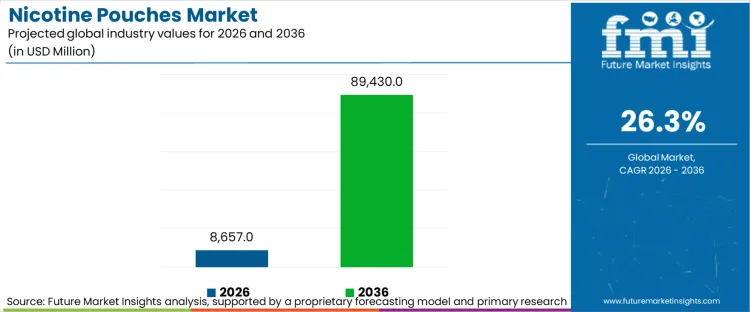
The global nicotine pouches market is estimated at USD 8,657.5 million in 2026 and is projected to reach USD 89,430.0 million by 2036, expanding at a CAGR of 26.3% during the forecast period. According to Future Market Insights, the market’s transformation between 2026 and 2036 will be driven less by overall tobacco consumption trends and more by the restructuring of nicotine portfolios toward smoke-free, non-combustible formats. FMI believes that nicotine pouches are increasingly being positioned as standalone consumer products rather than cigarette substitutes, fundamentally altering brand strategy, regulatory engagement, and distribution models.
A key growth driver, as per FMI’s opinion, is the accelerating regulatory pressure on combustible and vapor products, which is pushing both consumers and manufacturers toward oral nicotine formats that avoid combustion, aerosolization, and second-hand exposure. In parallel, increasing acceptance of synthetic nicotine is enabling broader market access and formulation consistency in regions tightening controls on tobacco-derived inputs, strengthening the scalability of nicotine pouch portfolios.
A second driver highlighted by FMI is the expansion of product differentiation across nicotine strengths, pouch formats, and flavor systems, allowing brands to target smokers transitioning from cigarettes, existing pouch users, and lifestyle consumers simultaneously. Slim and mini pouch designs, controlled-release formats, and diversified flavor profiles are enabling manufacturers to optimize user experience while supporting repeat consumption and brand loyalty.
A third structural driver is the shift in distribution and packaging strategy, with offline retail remaining dominant while online channels, subscriptions, and specialty harm-reduction stores expand reach and consumer engagement. Increasing use of child-resistant and tamper-evident packaging is also elevating compliance costs, reinforcing scale advantages for established manufacturers.
Recent developments reflect this strategic repositioning, including sustained investment by global tobacco companies in non-combustible nicotine platforms and portfolio expansion across oral products. Reflecting the industry’s strategic shift toward smoke-free products, CEO of Altria William Gifford said, “Illicit nicotine pouches are on the rise in US”. "We believe it is critical that the FDA acts decisively to regain control of the oral nicotine pouch category to prevent another widespread illicit market from taking hold," he said.
Summary of Nicotine Pouches Market
What Is Growth Outlook for the Nicotine Pouches Market as per Future Market Insights Projection?
Future Market Insights projects the nicotine pouches market to expand at a robust CAGR of 26.3% from 2026 to 2036, increasing from USD 8,657.5 million in 2026 to USD 89,430.0 million by 2036. This exceptional growth trajectory is driven by accelerated consumer migration away from combustible tobacco products, expanding adoption of smoke-free nicotine alternatives, and rapid geographic and demographic expansion of oral nicotine consumption.
Growth is further supported by widening availability across nicotine strengths, flavor categories, and pouch formats, alongside aggressive commercialization through both offline retail and direct-to-consumer digital channels.
FMI Research Approach: FMI models nicotine pouch demand using historical smokeless tobacco substitution rates, nicotine strength adoption curves, and consumer transition dynamics from cigarettes and vaping products. Forecasts incorporate flavor proliferation, synthetic nicotine penetration, packaging innovation, and channel expansion, with scenario testing for regulatory, taxation, and market-access constraints across major regions through 2036.
How Do FMI Analysts Perceive the Nicotine Pouches Market to Evolve?
FMI analysts observe that the nicotine pouches market is evolving from a niche harm-reduction category into a mass-market nicotine delivery platform characterized by high product differentiation and rapid innovation cycles. Manufacturers are increasingly competing on nicotine strength segmentation, pouch material engineering, flavor complexity, and release kinetics (fast- versus slow-release formats) to target distinct consumer profiles ranging from transitioning smokers to lifestyle and high-intensity nicotine users.
The market is also witnessing a structural shift toward synthetic nicotine and hybrid nicotine blends, enabling greater regulatory flexibility, supply chain control, and formulation consistency. Packaging innovation-including recyclable cans, child-resistant designs, and refill formats-is emerging as a key competitive lever as sustainability and safety expectations rise.
FMI Research Approach: FMI evaluates market evolution by analyzing SKU-level proliferation across nicotine strengths, pouch materials, flavor families, and pouch formats. The analysis integrates consumer segmentation data, product innovation pipelines, and channel-level velocity metrics across offline retail, online platforms, and specialty nicotine outlets.
Which Country Holds Largest Share in Global Nicotine Pouches Market?
Future Market Insights notes that the United States holds the largest share of the global nicotine pouches market by value. Market leadership is supported by high rates of cigarette substitution, rapid acceptance of oral nicotine products, strong retail penetration, and early commercialization of synthetic nicotine-based offerings. The presence of large-scale nicotine brands, advanced distribution infrastructure, and marketing-driven product differentiation further reinforces USA dominance.
FMI Research Approach: Country-level assessment incorporates adult nicotine consumption patterns, retail channel density, regulatory frameworks, pricing structures, and brand penetration across convenience stores, tobacco shops, online platforms, and specialty nicotine retailers.
How Large Will the Nicotine Pouches Market Be by 2036?
The global nicotine pouches market is projected to reach USD 89,430.0 million by 2036, driven by rapid uptake across new consumer segments, aggressive international expansion, and sustained innovation in nicotine delivery formats.
FMI Research Approach: FMI calculates long-term market size by modeling per-user consumption rates across consumer categories, weighted by nicotine strength, pouch type, and distribution channel. Forecasts exclude combustible tobacco products, vaping devices, heated tobacco, and traditional smokeless tobacco to maintain strict scope alignment.
How Are Regulatory Shifts and Harm-Reduction Trends Fueling Nicotine Pouch Adoption?
According to FMI analysts, regulatory pressure on combustible tobacco and vaping products is accelerating adoption of nicotine pouches as a lower-risk, smoke-free alternative. Restrictions on smoking in public spaces, higher excise taxes on cigarettes, and growing consumer awareness of harm-reduction options are reshaping nicotine consumption patterns globally.
At the same time, regulatory scrutiny around flavors, marketing, and youth access is driving manufacturers toward compliant product design, controlled distribution, and transparent labeling. The increasing use of synthetic nicotine reflects industry efforts to adapt to evolving regulatory frameworks while sustaining innovation momentum.
FMI Research Approach: FMI incorporates regulatory developments, taxation trends, public health policy shifts, and harm-reduction adoption metrics into econometric demand models. The analysis evaluates how changes in nicotine regulation influence product formulation, channel strategy, and long-term consumption trajectories.
Nicotine Pouches Market Key Takeaways
| Metric | Value |
|---|---|
| Market Value (2026) | USD 8,657.5 Million |
| Market Forecast Value (2036) | USD 89,430.0 Million |
| Forecast CAGR (2026 to 2036) | 26.3% |
Source: Future Market Insights (FMI) analysis, based on proprietary forecasting model and primary research.
Which Factors Drive Adoption of Nicotine Pouches Market?
Adoption of nicotine pouches is being driven by a structural shift in nicotine consumption toward smoke-free, combustion-free alternatives that prioritize discretion, harm reduction, and regulatory adaptability over traditional tobacco delivery formats. Consumers are increasingly favouring oral nicotine pouches as lifestyle-compatible products that offer controlled nicotine intake without smoke, vapor, or Odor, aligning with evolving social norms and public health pressures. This transition is reinforced by stricter regulations on combustible tobacco products, growing health awareness among adult nicotine users, and rising demand for convenient, on-the-go consumption formats. For example, Swedish Match integrates pharmaceutical-grade nicotine formulations and flavour-controlled pouch technologies across its ZYN portfolio, enabling consistent nicotine delivery while meeting regulatory and consumer expectations across multiple markets.
FMI analysis indicates that nicotine pouch brands supported by standardized dosing formats, clear regulatory positioning, and strong distribution partnerships achieve higher consumer trust and faster repeat adoption. The expanding role of product innovation, such as nicotine-free variants, diversified flavor profiles, and optimized pouch materials is further accelerating uptake by enabling personalization and predictable user experience across demographic segments, positioning nicotine pouches as a core category within the broader smoke-free nicotine ecosystem rather than a transitional substitute product.
How is the Nicotine Pouches Market Segmented?
The nicotine pouches market has been segmented based on nicotine strength, pouch material, nicotine type or source, pouch type, flavour category, packaging type, distribution channel, and consumer type. In terms of nicotine source, the market is divided into synthetic nicotine, tobacco-derived nicotine, and hybrid nicotine blends. By pouch type, the market is segmented into standard pouches, slim or mini pouches, large pouches, fast-release pouches, and slow-release pouches.
By flavour category, nicotine pouches are classified into mint & menthol, fruit Flavors, tobacco-inspired, beverage-inspired, dessert and sweet, and unflavoured variants. Based on packaging type, the market is divided into primary, secondary, and specialty packaging formats. By distribution channel, nicotine pouches are sold through offline retail, online channels, and specialized nicotine retailers. By consumer type, the market includes smokers transitioning from cigarettes, existing nicotine pouch users, lifestyle consumers, heavy nicotine users, and occasional users.
Why Does Synthetic Nicotine Lead the Nicotine Pouches Market?
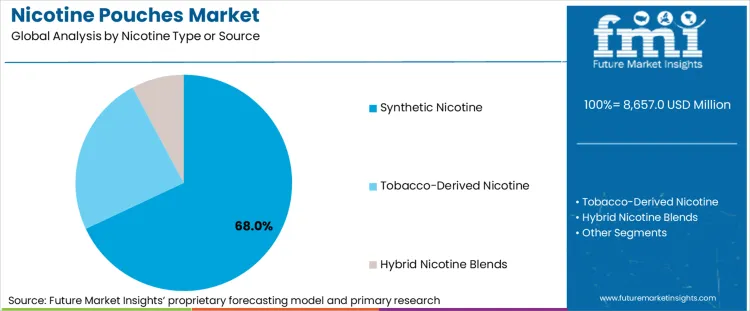
Synthetic nicotine continues to lead the nicotine pouches market, accounting for 68.0% of the total market share in 2026. This dominance is driven by regulatory, formulation, and branding advantages associated with non-tobacco-derived nicotine sources. Synthetic nicotine enables manufacturers to position products as tobacco-free, which improves regulatory flexibility in certain markets and aligns with consumer demand for cleaner, more controlled nicotine delivery systems.
Unlike tobacco-derived nicotine, synthetic nicotine offers higher purity, consistent molecular composition, and reduced risk of trace tobacco alkaloids. This consistency allows manufacturers to deliver predictable nicotine strength, smoother sensory profiles, and improved user experience. As regulatory scrutiny around tobacco products intensifies globally, synthetic nicotine has become the preferred input for premium and mass-market nicotine pouch brands seeking long-term compliance and scalability.
The growing adoption of synthetic nicotine also supports innovation in flavour formulation and pouch design, reinforcing its leadership across both established and emerging nicotine pouch markets.
How Do Pouch Design Preferences Influence Nicotine Pouch Selection?
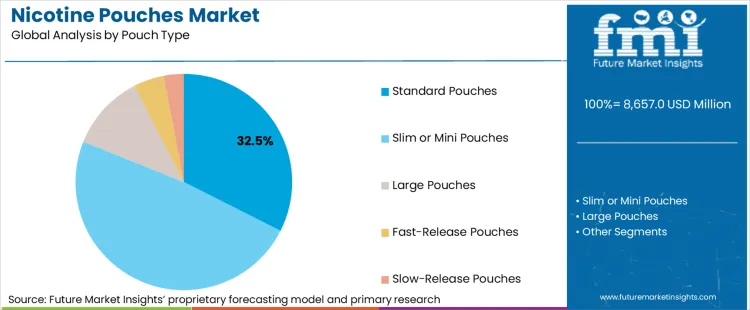
Slim or mini pouches represent the leading pouch type, commanding 48.6% of total market demand. These pouches are favoured due to their discreet form factor, enhanced comfort, and reduced visibility during use. Unlike standard or large pouches, slim and mini variants are designed to fit comfortably under the upper lip, making them especially attractive to first-time users, lifestyle consumers, and smokers transitioning from combustible cigarettes.
Slim pouch designs prioritize user convenience without compromising nicotine delivery efficiency. Their compact size supports controlled release profiles while minimizing irritation and excessive saliva production. This balance has made slim or mini pouches the default choice for daily-use products, particularly in urban and professional settings where discretion is a key purchase driver.
As consumer preferences continue to shift toward unobtrusive, socially acceptable nicotine alternatives, slim or mini pouches remain central to product portfolios, reinforcing their dominant position within the nicotine pouches market.
What Trends Are Shaping Industry Evolution?
Beyond nicotine delivery, manufacturers are increasingly engineering nicotine pouches to balance sensory experience, release control, and regulatory acceptance. Demand is shifting toward precisely calibrated nicotine strengths that support both smoking transition and sustained use across consumer intensity levels. This has accelerated portfolio expansion across low, medium, and high-strength variants, enabling brands to address smokers transitioning away from cigarettes as well as experienced nicotine users seeking stronger, longer-lasting effects. Controlled nicotine kinetics is becoming a core product differentiator rather than a secondary attribute.
Material innovation is reshaping pouch design as brands prioritize oral comfort, moisture balance, and biodegradability. Cellulose-based nonwoven materials and biodegradable substrates are gaining traction as manufacturers respond to sustainability scrutiny and regulatory pressure on single-use consumer products. These materials support improved saliva permeability and nicotine diffusion while reducing irritation, positioning pouch construction as a performance and compliance lever rather than a cost-driven choice.
The shift toward synthetic and hybrid nicotine sources is accelerating as regulatory uncertainty around tobacco-derived nicotine intensifies. Synthetic nicotine offers manufacturers greater control over purity, consistency, and regulatory classification in certain markets, enabling more predictable compliance pathways. This transition is also supporting faster product iteration cycles and cross-border expansion, particularly in regions where tobacco-linked regulations are tightening or unevenly enforced.
Flavor portfolio diversification continues to drive consumer acquisition and retention, particularly as traditional tobacco flavors coexist with mint, fruit, beverage-inspired, and dessert profiles. Mint and menthol variants remain foundational due to broad adult acceptance, while fruit and beverage flavors are expanding usage occasions and attracting lifestyle-oriented consumers. At the same time, unflavored and neutral options are gaining relevance in markets with stricter flavor regulations, reinforcing the need for adaptive, region-specific flavor strategies.
Packaging innovation is emerging as a competitive tool as manufacturers integrate child-resistant features, tamper-evident seals, and recyclable can formats. Brands are balancing premium aesthetics with portability and compliance, particularly for travel-size units and multipack configurations. Refillable and recyclable packaging formats are gaining strategic importance as sustainability commitments and extended producer responsibility frameworks expand across Europe and North America.
Distribution dynamics are evolving rapidly as online channels, subscription models, and specialized harm-reduction retailers gain share alongside traditional convenience and tobacco outlets. Brand-owned e-commerce platforms enable direct consumer engagement, data-driven personalization, and rapid product launches, while offline retail remains critical for discovery and impulse purchase. This omnichannel expansion is reinforcing nicotine pouches as fast-moving consumer products rather than restricted cessation tools.
Emerging markets in Europe, Asia-Pacific, and parts of Latin America are becoming central to long-term growth as regulatory clarity improves and smoking prevalence declines. Countries with progressive harm-reduction frameworks are witnessing rapid uptake across multiple consumer segments, from transitioning smokers to lifestyle users. This geographic expansion is pushing manufacturers to build scalable, compliant portfolios that can adapt quickly to evolving regulatory and consumer landscapes.
How Is the Nicotine Pouches Market Evolving Globally?
The global demand for nicotine pouches is accelerating at a rapidly increasing pace as consumers abandon combustible tobacco and traditional oral nicotine products in favor of smoke-free, discreet, and regulation-compliant alternatives. The demand is fueled by increasing health consciousness, widening harm reduction regulations, and growing acceptance of innovative oral nicotine products in established and emerging markets. Vendors are expanding their flavored, tobacco-free, and strength-diverse pouch offerings to cater to a range of consumer preferences and regulatory frameworks.
Market development is shaped by innovation-driven product development, regional regulatory definitions, and retail channel development, especially in convenience stores, pharmacies, and online platforms. China has a CAGR of 48.6%, Argentina has a CAGR of 22.7%, the Japan has a CAGR of 32.3%, ASEAN has a CAGR of 38.3%, and Italy has a CAGR of 37.6% in the forecast period. Consumer adoption continues to be fueled by the need for smoke-free nicotine use, convenience, and perceived relative safety compared to traditional tobacco products.
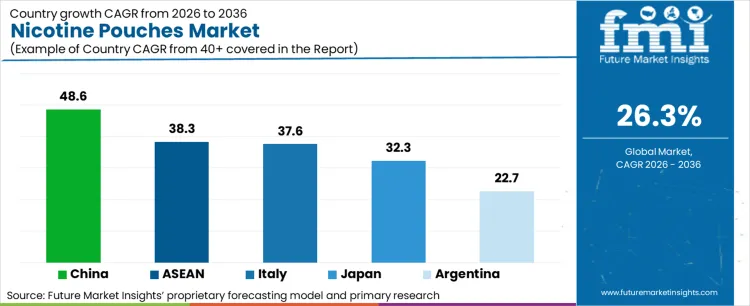
| Country | CAGR (2026-36) |
|---|---|
| China | 48.6% |
| Argentina | 22.7% |
| Japan | 32.3% |
| ASEAN | 38.3% |
| Italy | 37.6% |
Source: Future Market Insights (FMI) analysis, based on proprietary forecasting model and primary research.
China: How Is Regulatory Opening Creating a High-Growth Nicotine Alternative Market?
China represents the fastest-growing nicotine pouches market globally, driven by gradual regulatory openness toward non-combustible nicotine formats and shifting consumer preferences among urban adult populations. While traditional tobacco products remain dominant, rising awareness of smoke-free alternatives and lifestyle-driven demand for discreet nicotine use are accelerating pouch adoption in metropolitan regions.
The Chinese nicotine pouches market is projected to grow at a 48.6% CAGR during the study period. Growth is supported by strong domestic manufacturing capabilities, rapid product iteration, and increasing online retail penetration. Over the next five years, the most significant opportunity lies in compliant, low-nicotine and flavour-regulated pouch offerings positioned for first-time adult nicotine users.
Argentina: Is Harm-Reduction Awareness Driving Rapid Market Expansion?
Argentina’s nicotine pouches market is expanding rapidly as consumers seek alternatives to cigarettes and smokeless tobacco amid rising public health awareness. Increasing exposure to international nicotine brands and growing acceptance of oral nicotine formats have positioned pouches as a viable harm-reduction product in the local market.
Reflecting this momentum, the Argentinian nicotine pouches market is expected to grow at a 22.7% CAGR during the forecast period. Growth is reinforced by affordability, flexible nicotine strengths, and expanding distribution through urban retail outlets. Manufacturers are increasingly tailoring flavour profiles and packaging sizes to suit local consumption patterns and price sensitivity.
Japan: Is Lifestyle Positioning Accelerating Premium Product Adoption?
In Japan, the nicotine pouches market is shaped by a strong premium lifestyle orientation and high adoption of innovative consumer products. Urban consumers, particularly among expatriate and younger adult demographics, are driving demand for discreet, smoke-free nicotine options that align with social and workplace norms.
The Japan nicotine pouches market is projected to grow at a 32.3% CAGR during the study period. Growth is supported by premium branding, modern retail availability, and controlled regulatory frameworks that allow non-combustible nicotine products. High purchasing power enables rapid uptake of premium pouch formats with differentiated flavours and moisture profiles.
ASEAN Nicotine Pouches Market Driven by Regulatory Evolution
ASEAN’s nicotine pouches market is experiencing strong growth as regulatory frameworks evolve to accommodate reduced-risk nicotine alternatives. Public health initiatives aimed at lowering smoking prevalence have indirectly supported consumer interest in smoke-free oral nicotine products.
The ASEAN nicotine pouches market is set to grow at a 38.3% CAGR during the forecast period. Adoption is driven by increasing retail visibility, controlled product education, and discreet consumption advantages. Manufacturers are focusing on compliant labelling, moderate nicotine strengths, and culturally aligned flavour offerings to expand acceptance across adult consumer segments.
Italy: Is Tobacco Harm Reduction Supporting Market Penetration?
Italy’s nicotine pouches market is expanding as part of a broader shift toward tobacco harm-reduction products, including heated tobacco and e-cigarettes. Adult consumers are increasingly open to oral nicotine formats that offer flexibility, discretion, and reduced social restrictions compared to smoking.
The Italian nicotine pouches market is expected to grow at a 37.6% CAGR during the study period. Growth is supported by established tobacco retail networks, increasing consumer education, and the integration of nicotine pouches alongside other reduced-risk products. Regulatory clarity and product standardization are enabling manufacturers to scale distribution beyond niche early adopters into mainstream adult consumer channels.
What Strategic Moves Are Defining the Competitive Landscape?
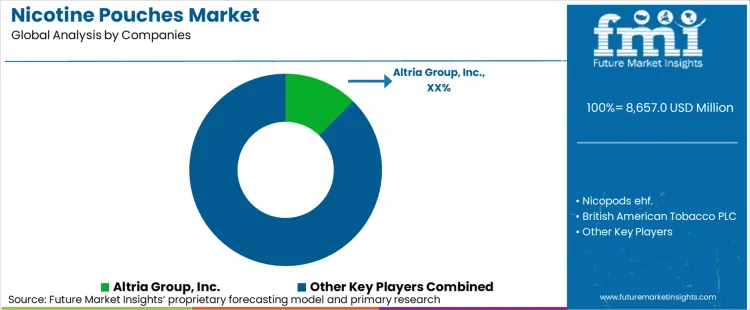
The competitive landscape of the global nicotine pouches market is increasingly defined by product portfolio diversification and regulatory navigation rather than traditional tobacco volume plays. Leading tobacco and alternative-nicotine companies are leveraging their existing distribution networks and harm-reduction platforms to expand non-combustible offerings, positioning nicotine pouches as strategic growth engines amid declining cigarette volumes and shifting consumer preferences toward smoke-free products. Demand for discreet, tobacco-free nicotine delivery has elevated the importance of brand visibility and multi-channel retail placement, reshaping competitive priorities.
Another key strategic move is the focus on regulatory approvals and market authorizations to secure long-term commercial viability in major markets. Firms that successfully obtain regulatory clearance for flavored and adult-oriented nicotine pouch products are better positioned to scale distribution and engage consumers across retail, specialized vape stores, and online channels. This regulatory emphasis is influencing product design, labeling, and compliance investments, while firms without clear authorization risk limited geographic access or promotional restrictions.
The market is also characterized by brand-level differentiation through flavor innovation, nicotine strength segmentation, and discrete consumer experiences. Rather than competing solely on price or traditional retail placement, companies are investing in tailored flavor portfolios, strength variants, and product formats that appeal to diverse adult user segments. This consumer-centric focus supports higher brand loyalty and premium positioning, particularly in regions with strong harm-reduction demand.
Emerging geographic expansion strategies are reshaping competition globally, with growth beyond the USA into Europe, Latin America, and Asia-Pacific where nicotine use dynamics and regulatory frameworks vary. Companies that effectively align with regional regulations and cultural preferences for smokeless alternatives are gaining strategic footholds, thereby enhancing their competitive reach.
These strategic moves collectively shift competition from legacy tobacco sales toward product innovation, regulatory strength, and consumer experience leadership, redefining how market presence and long-term growth are measured in the nicotine pouches market.
Key Industry Developments:
- In 2025, Altria Group, Inc. reported strategic emphasis on its modern oral nicotine pouch portfolio (“on!”), noting strong demand during its 2025 fiscal reporting period, reflecting the company’s pivot toward smoke-free growth categories within its broader harm-reduction strategy.
- In January 2025, the USA Food and Drug Administration authorized marketing for 20 ZYN nicotine pouch products through the PMTA pathway, marking formal regulatory approvals that support expanded distribution and legitimization of nicotine pouches as adult-oriented smoke-free alternatives.
Key Companies
- Altria Group, Inc.
- Nicopods ehf.
- British American Tobacco PLC
- Swisher International Group Inc.
- JTI (Japan Tobacco International)
- Philip Morris International
- Imperial Brands PLC
- GN Tobacco Sweden AB
- Turning Point Brands
- Another Snus Factory
Market Definition
The global nicotine pouches market refers to the ecosystem of smokeless, tobacco-free oral nicotine products designed to deliver controlled nicotine release without combustion, vaporization, or tobacco leaf content. These products are placed between the gum and upper lip and are formulated to provide a discreet, smoke-free nicotine experience while reducing exposure to harmful by-products associated with traditional smoking. The market increasingly emphasizes innovation in nicotine formulation, flavor systems, pouch materials, and strength customization to address evolving adult consumer preferences and regulatory environments.
The market includes nicotine pouches offered in multiple nicotine strengths, pouch sizes, and flavor profiles, supplied through offline retail and digital channels for adult nicotine consumers. It covers products manufactured using synthetic or tobacco-derived nicotine, irrespective of pouch composition, and includes offerings marketed as smoke-free or reduced-risk alternatives to cigarettes and other combustible products.
On the other hand, the market excludes combustible tobacco products such as cigarettes and cigars, vapor-based products including e-cigarettes and heated tobacco devices, and traditional smokeless tobacco products such as snus, chewing tobacco, and snuff. Nicotine replacement therapies intended for medical cessation use, including gums, patches, and lozenges, are also excluded from the market scope.
Scope Of Report
| Items | Values |
|---|---|
| Quantitative Units | USD million |
| By Nicotine Strength | 1-3 mg per pouch; 4-6 mg per pouch; 7-12 mg per pouch; 13-20+ mg per pouch |
| By Product Characteristics | Pouch Material (Cellulose Fiber; Cellulose Nonwoven Fabric; Cellulose Synthetic Fiber Nonwoven; Biodegradable Nonwoven; Specialty Filter Paper); Nicotine Source (Synthetic Nicotine; Tobacco-Derived Nicotine; Hybrid Nicotine Blends); Pouch Type (Standard Pouches; Slim or Mini Pouches; Large Pouches; Fast-Release Pouches; Slow-Release Pouches) |
| By Consumers | Smokers Transitioning from Cigarettes; Existing Nicotine Pouch Users; Lifestyle Consumers; Heavy Nicotine Users; Occasional Users; Clean Nicotine (Velo-style) Consumers |
| Regions Covered | North America, Europe, East Asia, South Asia, Latin America, Middle East & Africa |
| Countries Covered | United States, Sweden, United Kingdom, Germany, Japan, India, and 40+ countries |
| Key Companies Profiled | Philip Morris International; British American Tobacco PLC; Altria Group, Inc.; Japan Tobacco International (JTI); Imperial Brands PLC; Others |
| Additional Attributes | Revenue analysis by nicotine strength, pouch material, nicotine source, pouch type, flavour category, packaging type, and distribution channel; assessment of consumer adoption trends across harm-reduction, lifestyle, and smoking-cessation segments; evaluation of flavours innovation, nicotine delivery efficiency, and product differentiation; analysis of regulatory impact, age-verification compliance, and packaging requirements; procurement and go-to-market dynamics driven by brand positioning, channel expansion, subscription models, and regional regulatory frameworks. |
Source: Future Market Insights (FMI) analysis, based on proprietary forecasting model and primary research.
Nicotine Pouches Market by Segment
By Nicotine Strength
- 1-3 mg per pouch
- 4-6 mg per pouch
- 7-12 mg per pouch
- 13-20+ mg per pouch
By Pouch Material
- Cellulose fiber
- Cellulose nonwoven fabric
- Cellulose synthetic fiber nonwoven
- Biodegradable nonwoven
- Specialty filter paper
By Nicotine Type or Source
- Synthetic Nicotine
- Tobacco-Derived Nicotine
- Hybrid Nicotine Blends
By Pouch Type
- Standard Pouches
- Slim or Mini Pouches
- Large Pouches
- Fast-Release Pouches
- Slow-Release Pouches
By Flavour Category
- Mint & Menthol
- Peppermint
- Spearmint
- Wintergreen
- Ice mint
- Fruit Flavors
- Berry
- Citrus
- Tropical
- Watermelon
- Apple
- Tobacco-Inspired
- Dark blend
- Classic tobacco flavouring
- Smoky and rich profiles
- Beverage-Inspired
- Coffee
- Cola
- Energy drink
- Tea blends
- Dessert and Sweet
- Vanilla
- Caramel
- Cinnamon
- Candy-like flavours
- Unflavoured and Neutral
By Packaging Type
- Primary Packaging
- Plastic cans
- Metal cans
- Recyclable PP cans
- Paper-based canisters
- Secondary Packaging
- Branded paperboard sleeves
- Multipack cartons
- Travel-size units
- Specialty Packaging
- Child-resistant containers
- Tamper-evident sealed cans
- Refill packs
By Distribution Channel
- Offline Retail
- Convenience stores
- Tobacco shops
- Pharmacies
- Supermarkets
- Gas stations
- Online Channels
- Brand-owned e-commerce
- Marketplaces
- Subscription services
- Specialized Nicotine Retailers
- Vape shops
- Snus stores
- Harm-reduction specialty stores
By Consumers
- Smokers transitioning cigarette
- Existing nicotine pouch user
- Lifestyle consumers
- Heavy nicotine users
- Occasional users
- Velo style clean nicotine
Bibliography
- World Health Organization. (2023). WHO Report on the Global Tobacco Epidemic: Addressing New and Emerging Nicotine Products. World Health Organization Press.
- USA Food and Drug Administration (FDA). (2023). Nicotine Pouches and Other Non-Combustible Nicotine Products: Regulatory Status and Scientific Review. Center for Tobacco Products, USA Department of Health and Human Services.
- International Organization for Standardization. (2024). Moisture barrier, sealing integrity, and material safety requirements for packaging of oral nicotine and smokeless pouch products. ISO Packaging Standards Committee.
- European Committee for Standardization (CEN). (2024). Child-resistant, tamper-evident, and product safety packaging requirements for nicotine-containing consumer products. CEN TC 261 - Packaging.
- Flexible Packaging Europe. (2024). High-barrier flexible packaging structures for moisture-sensitive oral nicotine pouch products and shelf-life preservation. FPE.
- PlasticsEurope. (2024). Polypropylene and polyethylene rigid container solutions for oral nicotine pouch packaging: Material performance, sealing, and recyclability. PlasticsEurope.
- Association of Plastics Recyclers. (2024). Recyclability design guidance for small rigid polypropylene packaging used in nicotine pouch and similar consumer product containers. APR.
- ASTM International. (2024). Standard test methods for moisture vapor transmission rate (MVTR), seal strength, and closure integrity in oral nicotine pouch packaging. ASTM Committee D10 on Packaging.
- Sustainable Packaging Coalition. (2024). Design for circularity and recycled content integration in small-format rigid plastic packaging for nicotine pouch products. SPC.
- GS1 Global. (2024). Global identification, traceability, and packaging data standards for regulated nicotine consumer packaged goods. GS1.
Frequently Asked Questions
How big is the nicotine pouches market in 2026?
The global nicotine pouches market is estimated to be valued at USD 8,657.5 million in 2026.
What will be the size of the nicotine pouches market in 2036?
The nicotine pouches market is projected to reach USD 89,430.0 million by 2036.
How much will the nicotine pouches market grow between 2026 and 2036?
The nicotine pouches market is expected to grow at a 26.3% CAGR between 2026 and 2036.
What are the key nicotine strength categories in the nicotine pouches market?
Key nicotine strength categories include 1-3 mg, 4-6 mg, 7-12 mg, and 13-20+ mg per pouch, catering to light, moderate, and heavy nicotine users.
Which nicotine type is widely used in nicotine pouches?
Synthetic nicotine and tobacco-derived nicotine are widely used, with hybrid nicotine blends gaining traction due to regulatory flexibility and consistent purity profiles.
Which distribution channel plays a major role in nicotine pouch sales?
Offline retail channels, including convenience stores, tobacco shops, and pharmacies, continue to dominate sales, while online channels are expanding rapidly through brand-owned e-commerce and subscription models.
Preview the report firsthand - request a free sample
Get SampleGet the brochure for pricing and purchase details.
Get PDFTable of Content
- Executive Summary
- Global Market Outlook
- Demand-side Trends
- Supply-side Trends
- Technology Roadmap Analysis
- Analysis and Recommendations
- Market Overview
- Market Coverage / Taxonomy
- Market Definition / Scope / Limitations
- Research Methodology
- Chapter Orientation
- Analytical Lens and Working Hypotheses
- Market Structure, Signals, and Trend Drivers
- Benchmarking and Cross-market Comparability
- Market Sizing, Forecasting, and Opportunity Mapping
- Research Design and Evidence Framework
- Desk Research Programme (Secondary Evidence)
- Company Annual and Sustainability Reports
- Peer-reviewed Journals and Academic Literature
- Corporate Websites, Product Literature, and Technical Notes
- Earnings Decks and Investor Briefings
- Statutory Filings and Regulatory Disclosures
- Technical White Papers and Standards Notes
- Trade Journals, Industry Magazines, and Analyst Briefs
- Conference Proceedings, Webinars, and Seminar Materials
- Government Statistics Portals and Public Data Releases
- Press Releases and Reputable Media Coverage
- Specialist Newsletters and Curated Briefings
- Sector Databases and Reference Repositories
- FMI Internal Proprietary Databases and Historical Market Datasets
- Subscription Datasets and Paid Sources
- Social Channels, Communities, and Digital Listening Inputs
- Additional Desk Sources
- Expert Input and Fieldwork (Primary Evidence)
- Primary Modes
- Qualitative Interviews and Expert Elicitation
- Quantitative Surveys and Structured Data Capture
- Blended Approach
- Why Primary Evidence is Used
- Field Techniques
- Interviews
- Surveys
- Focus Groups
- Observational and In-context Research
- Social and Community Interactions
- Stakeholder Universe Engaged
- C-suite Leaders
- Board Members
- Presidents and Vice Presidents
- R&D and Innovation Heads
- Technical Specialists
- Domain Subject-matter Experts
- Scientists
- Physicians and Other Healthcare Professionals
- Governance, Ethics, and Data Stewardship
- Research Ethics
- Data Integrity and Handling
- Primary Modes
- Tooling, Models, and Reference Databases
- Desk Research Programme (Secondary Evidence)
- Data Engineering and Model Build
- Data Acquisition and Ingestion
- Cleaning, Normalisation, and Verification
- Synthesis, Triangulation, and Analysis
- Quality Assurance and Audit Trail
- Market Background
- Market Dynamics
- Drivers
- Restraints
- Opportunity
- Trends
- Scenario Forecast
- Demand in Optimistic Scenario
- Demand in Likely Scenario
- Demand in Conservative Scenario
- Opportunity Map Analysis
- Product Life Cycle Analysis
- Supply Chain Analysis
- Investment Feasibility Matrix
- Value Chain Analysis
- PESTLE and Porter’s Analysis
- Regulatory Landscape
- Regional Parent Market Outlook
- Production and Consumption Statistics
- Import and Export Statistics
- Market Dynamics
- Global Market Analysis 2021 to 2025 and Forecast, 2026 to 2036
- Historical Market Size Value (USD Million) Analysis, 2021 to 2025
- Current and Future Market Size Value (USD Million) Projections, 2026 to 2036
- Y-o-Y Growth Trend Analysis
- Absolute $ Opportunity Analysis
- Global Market Pricing Analysis 2021 to 2025 and Forecast 2026 to 2036
- Global Market Analysis 2021 to 2025 and Forecast 2026 to 2036, By Nicotine Type or Source
- Introduction / Key Findings
- Historical Market Size Value (USD Million) Analysis By Nicotine Type or Source , 2021 to 2025
- Current and Future Market Size Value (USD Million) Analysis and Forecast By Nicotine Type or Source , 2026 to 2036
- Synthetic Nicotine
- Tobacco-Derived Nicotine
- Hybrid Nicotine Blends
- Synthetic Nicotine
- Y-o-Y Growth Trend Analysis By Nicotine Type or Source , 2021 to 2025
- Absolute $ Opportunity Analysis By Nicotine Type or Source , 2026 to 2036
- Global Market Analysis 2021 to 2025 and Forecast 2026 to 2036, By Share (%)
- Introduction / Key Findings
- Historical Market Size Value (USD Million) Analysis By Share (%), 2021 to 2025
- Current and Future Market Size Value (USD Million) Analysis and Forecast By Share (%), 2026 to 2036
- 0.324624618025609
- 0.4861581892224
- 0.113815939575257
- 0.0454589567810989
- 0.0299422963956354
- 0.324624618025609
- Y-o-Y Growth Trend Analysis By Share (%), 2021 to 2025
- Absolute $ Opportunity Analysis By Share (%), 2026 to 2036
- Global Market Analysis 2021 to 2025 and Forecast 2026 to 2036, By Region
- Introduction
- Historical Market Size Value (USD Million) Analysis By Region, 2021 to 2025
- Current Market Size Value (USD Million) Analysis and Forecast By Region, 2026 to 2036
- North America
- Latin America
- Western Europe
- Eastern Europe
- East Asia
- South Asia and Pacific
- Middle East & Africa
- Market Attractiveness Analysis By Region
- North America Market Analysis 2021 to 2025 and Forecast 2026 to 2036, By Country
- Historical Market Size Value (USD Million) Trend Analysis By Market Taxonomy, 2021 to 2025
- Market Size Value (USD Million) Forecast By Market Taxonomy, 2026 to 2036
- By Country
- USA
- Canada
- Mexico
- By Nicotine Type or Source
- By Share (%)
- By Country
- Market Attractiveness Analysis
- By Country
- By Nicotine Type or Source
- By Share (%)
- Key Takeaways
- Latin America Market Analysis 2021 to 2025 and Forecast 2026 to 2036, By Country
- Historical Market Size Value (USD Million) Trend Analysis By Market Taxonomy, 2021 to 2025
- Market Size Value (USD Million) Forecast By Market Taxonomy, 2026 to 2036
- By Country
- Brazil
- Chile
- Rest of Latin America
- By Nicotine Type or Source
- By Share (%)
- By Country
- Market Attractiveness Analysis
- By Country
- By Nicotine Type or Source
- By Share (%)
- Key Takeaways
- Western Europe Market Analysis 2021 to 2025 and Forecast 2026 to 2036, By Country
- Historical Market Size Value (USD Million) Trend Analysis By Market Taxonomy, 2021 to 2025
- Market Size Value (USD Million) Forecast By Market Taxonomy, 2026 to 2036
- By Country
- Germany
- UK
- Italy
- Spain
- France
- Nordic
- BENELUX
- Rest of Western Europe
- By Nicotine Type or Source
- By Share (%)
- By Country
- Market Attractiveness Analysis
- By Country
- By Nicotine Type or Source
- By Share (%)
- Key Takeaways
- Eastern Europe Market Analysis 2021 to 2025 and Forecast 2026 to 2036, By Country
- Historical Market Size Value (USD Million) Trend Analysis By Market Taxonomy, 2021 to 2025
- Market Size Value (USD Million) Forecast By Market Taxonomy, 2026 to 2036
- By Country
- Russia
- Poland
- Hungary
- Balkan & Baltic
- Rest of Eastern Europe
- By Nicotine Type or Source
- By Share (%)
- By Country
- Market Attractiveness Analysis
- By Country
- By Nicotine Type or Source
- By Share (%)
- Key Takeaways
- East Asia Market Analysis 2021 to 2025 and Forecast 2026 to 2036, By Country
- Historical Market Size Value (USD Million) Trend Analysis By Market Taxonomy, 2021 to 2025
- Market Size Value (USD Million) Forecast By Market Taxonomy, 2026 to 2036
- By Country
- China
- Japan
- South Korea
- By Nicotine Type or Source
- By Share (%)
- By Country
- Market Attractiveness Analysis
- By Country
- By Nicotine Type or Source
- By Share (%)
- Key Takeaways
- South Asia and Pacific Market Analysis 2021 to 2025 and Forecast 2026 to 2036, By Country
- Historical Market Size Value (USD Million) Trend Analysis By Market Taxonomy, 2021 to 2025
- Market Size Value (USD Million) Forecast By Market Taxonomy, 2026 to 2036
- By Country
- India
- ASEAN
- Australia & New Zealand
- Rest of South Asia and Pacific
- By Nicotine Type or Source
- By Share (%)
- By Country
- Market Attractiveness Analysis
- By Country
- By Nicotine Type or Source
- By Share (%)
- Key Takeaways
- Middle East & Africa Market Analysis 2021 to 2025 and Forecast 2026 to 2036, By Country
- Historical Market Size Value (USD Million) Trend Analysis By Market Taxonomy, 2021 to 2025
- Market Size Value (USD Million) Forecast By Market Taxonomy, 2026 to 2036
- By Country
- Kingdom of Saudi Arabia
- Other GCC Countries
- Turkiye
- South Africa
- Other African Union
- Rest of Middle East & Africa
- By Nicotine Type or Source
- By Share (%)
- By Country
- Market Attractiveness Analysis
- By Country
- By Nicotine Type or Source
- By Share (%)
- Key Takeaways
- Key Countries Market Analysis
- USA
- Pricing Analysis
- Market Share Analysis, 2025
- By Nicotine Type or Source
- By Share (%)
- Canada
- Pricing Analysis
- Market Share Analysis, 2025
- By Nicotine Type or Source
- By Share (%)
- Mexico
- Pricing Analysis
- Market Share Analysis, 2025
- By Nicotine Type or Source
- By Share (%)
- Brazil
- Pricing Analysis
- Market Share Analysis, 2025
- By Nicotine Type or Source
- By Share (%)
- Chile
- Pricing Analysis
- Market Share Analysis, 2025
- By Nicotine Type or Source
- By Share (%)
- Germany
- Pricing Analysis
- Market Share Analysis, 2025
- By Nicotine Type or Source
- By Share (%)
- UK
- Pricing Analysis
- Market Share Analysis, 2025
- By Nicotine Type or Source
- By Share (%)
- Italy
- Pricing Analysis
- Market Share Analysis, 2025
- By Nicotine Type or Source
- By Share (%)
- Spain
- Pricing Analysis
- Market Share Analysis, 2025
- By Nicotine Type or Source
- By Share (%)
- France
- Pricing Analysis
- Market Share Analysis, 2025
- By Nicotine Type or Source
- By Share (%)
- India
- Pricing Analysis
- Market Share Analysis, 2025
- By Nicotine Type or Source
- By Share (%)
- ASEAN
- Pricing Analysis
- Market Share Analysis, 2025
- By Nicotine Type or Source
- By Share (%)
- Australia & New Zealand
- Pricing Analysis
- Market Share Analysis, 2025
- By Nicotine Type or Source
- By Share (%)
- China
- Pricing Analysis
- Market Share Analysis, 2025
- By Nicotine Type or Source
- By Share (%)
- Japan
- Pricing Analysis
- Market Share Analysis, 2025
- By Nicotine Type or Source
- By Share (%)
- South Korea
- Pricing Analysis
- Market Share Analysis, 2025
- By Nicotine Type or Source
- By Share (%)
- Russia
- Pricing Analysis
- Market Share Analysis, 2025
- By Nicotine Type or Source
- By Share (%)
- Poland
- Pricing Analysis
- Market Share Analysis, 2025
- By Nicotine Type or Source
- By Share (%)
- Hungary
- Pricing Analysis
- Market Share Analysis, 2025
- By Nicotine Type or Source
- By Share (%)
- Kingdom of Saudi Arabia
- Pricing Analysis
- Market Share Analysis, 2025
- By Nicotine Type or Source
- By Share (%)
- Turkiye
- Pricing Analysis
- Market Share Analysis, 2025
- By Nicotine Type or Source
- By Share (%)
- South Africa
- Pricing Analysis
- Market Share Analysis, 2025
- By Nicotine Type or Source
- By Share (%)
- USA
- Market Structure Analysis
- Competition Dashboard
- Competition Benchmarking
- Market Share Analysis of Top Players
- By Regional
- By Nicotine Type or Source
- By Share (%)
- Competition Analysis
- Competition Deep Dive
- Altria Group, Inc.
- Overview
- Product Portfolio
- Profitability by Market Segments (Product/Age /Sales Channel/Region)
- Sales Footprint
- Strategy Overview
- Marketing Strategy
- Product Strategy
- Channel Strategy
- Nicopods ehf.
- British American Tobacco PLC
- Swisher International Group Inc
- JTI (Japan Tobacco International)
- Altria Group, Inc.
- Competition Deep Dive
- Assumptions & Acronyms Used


