

- Industry Size (2025)
- USD 357.1 Mn
- Forecast (2035)
- USD 872.6 Mn
- CAGR (2025 to 2035)
- 9.3%
Tetrahydrocurcumin Market Forecast and Outlook 2025 to 2035
The global tetrahydrocurcumin market is valued at USD 357.1 million in 2025 and is expected to reach USD 872.6 million by 2035, recording a CAGR of 9.3%. Growth is influenced by expanding utilization of antioxidant and brightening actives in personal-care formulations and rising preference for ingredients derived from natural sources. Tetrahydrocurcumin is integrated into topical applications targeting hyperpigmentation, uneven tone, and photoaging due to its enhanced stability and bioavailability compared with curcumin. Skin-care formulations lead overall utilization. The compound is incorporated into serums, creams, masks, and body lotions designed to improve skin clarity, reduce dark spots, and support anti-inflammatory benefits. Manufacturers focus on delivery enhancements and controlled-release systems to strengthen performance in leave-on products.
Asia Pacific, Europe, and North America demonstrate the strongest uptake due to the concentration of cosmetic brands, wider product development pipelines, and increased clinical validation supporting functional claims. Regulatory support for plant-derived active ingredients and accelerated product launches in brightening and dermocosmetic categories further reinforce demand. Key suppliers include BASF SE, Croda International, Evonik Industries, Symrise, and Dow. These companies maintain capacity expansion, downstream collaboration with formulators, and ingredient-standardization initiatives to improve consistency, efficacy, and long-term procurement reliability in commercial personal-care applications.
Quick Stats for Global Tetrahydrocurcumin Demand
- Global Tetrahydrocurcumin Sales Value (2025): USD 357.1 million
- Global Tetrahydrocurcumin Forecast Value (2035): USD 872.6 million
- Global Tetrahydrocurcumin Forecast CAGR (2025–2035): 9.3%
- Leading Application in Global Tetrahydrocurcumin Demand: Skin Care
- Key Growth Regions in Global Tetrahydrocurcumin Demand: Asia Pacific, Europe, North America
- Top Players in Global Tetrahydrocurcumin Demand: BASF SE, Croda International, Evonik Industries, Symrise, Dow
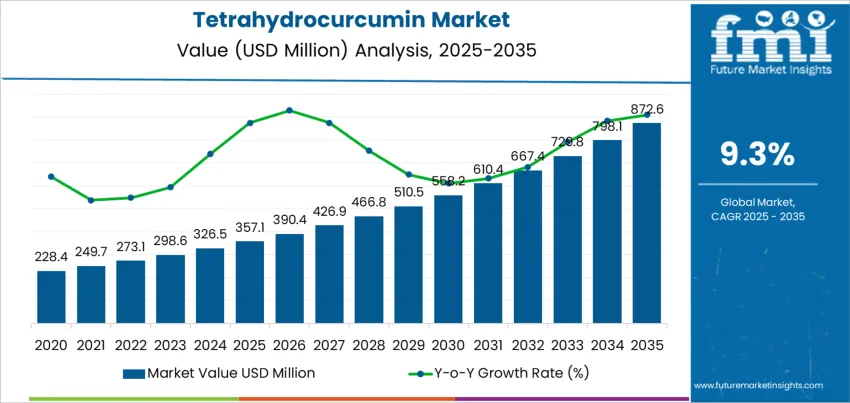
What is the Growth Forecast for the Tetrahydrocurcumin Market through 2035?
A saturation point assessment for the global tetrahydrocurcumin industry indicates that the growth cycle remains in an expanding phase rather than approaching maturity. Adoption is concentrated in skincare, nutraceuticals, and dietary supplements where demand for antioxidant and anti-inflammatory functional ingredients remains strong. Product penetration in cosmetics is still developing, especially in mainstream brands, which shows that current utilization is far from saturation.
Supply scalability supports continued expansion. Ingredient manufacturers are increasing production of hydrogenated curcumin derivatives, improving cost-efficiency and enabling wider formulation use. Scientific validation of bioavailability and skin-brightening benefits contributes to steady growth momentum without structural slowdown signals. Regions such as North America and Europe lead consumption, while Asia Pacific holds significant untapped potential due to a large supplement consumer base. Competitive intensity is rising but not at a level that compresses growth capacity. Synthetic alternatives and traditional curcumin coexist without creating replacement pressure. Innovation pipelines involving encapsulation, controlled release, and pharmaceutical-grade purity extend the lifecycle. Based on current adoption trends and demand drivers in functional beauty, dietary supplements, and therapeutic research, saturation is not expected in the near term.
Tetrahydrocurcumin Market Key Takeaways
| Metric | Value |
|---|---|
| Market Value (2025) | USD 357.1 million |
| Market Forecast Value (2035) | USD 872.6 million |
| Forecast CAGR (2025-2035) | 9.3% |
Why is the Demand for Tetrahydrocurcumin Growing Globally?
Demand for tetrahydrocurcumin is increasing worldwide because cosmetic, nutraceutical and pharmaceutical industries value its strong antioxidant and skin brightening properties. Tetrahydrocurcumin is a hydrogenated derivative of curcumin that offers improved stability and bioavailability, which enhances its effectiveness in topical and oral formulations. Skincare brands use it for hyperpigmentation, uneven tone and environmental stress protection, supporting growth in brightening serums and anti-aging creams. Nutraceutical manufacturers adopt tetrahydrocurcumin to support metabolic health and inflammation control in dietary supplements, especially in regions with growing interest in preventive wellness. Research continues to examine its role in supporting joint health and oxidative balance, encouraging broader product development. Rising consumer preference for natural ingredients strengthens demand for plant-derived actives sourced from turmeric.
Pharmaceutical research explores its therapeutic potential in chronic disease management, which expands collaborations between ingredient suppliers and drug developers. Increased production capacity in Asia and improved extraction technologies support commercial scalability. Constraints include higher production cost compared with standard curcumin and the need for extensive clinical validation to support health claims in regulated markets. Variability in raw material supply may influence pricing and availability for smaller manufacturers.
Which End-Use Applications and Product Forms Lead Global Demand for Tetrahydrocurcumin?
The global tetrahydrocurcumin industry is driven by its expanding role as a high-efficacy antioxidant and brightening ingredient with better stability and skin compatibility than curcumin. It supports pigmentation control, anti-inflammatory protection, and UV-induced skin damage repair. Adoption is particularly strong across premium beauty, wellness, and dermocosmetic brands emphasizing clinically validated natural actives. Regionally, the tetrahydrocurcumin market is divided into Asia Pacific, Europe, North America, and other key regions.
By End-Use Application, Skin Care Represents the Leading Global Share
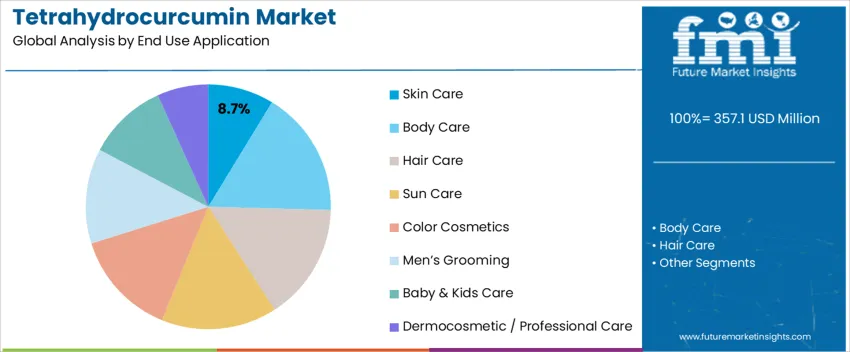
Skin care holds 8.7% of tetrahydrocurcumin demand, reflecting its relevance in serums, brightening creams, and anti-aging formulations addressing melanin regulation. Its reduced staining versus curcumin allows broader usage in leave-on products. Other growing areas include body care for hyperpigmentation on arms and neck, sun care for enhancing UV-resilience, and color cosmetics where stability improves functional performance. Men’s grooming and baby-care categories integrate the ingredient for gentle skin protection with strong anti-oxidative benefits. Dermocosmetic and professional brands continue to expand usage in advanced pigmentation protocols.
Key Points:
- Skin care leads due to strong whitening and anti-aging benefits
- Adoption expanding into personal care formats requiring high stability
- Dermocosmetic sector strengthens clinical positioning and premium pricing
By Product Form, Powder Accounts for the Largest Global Share
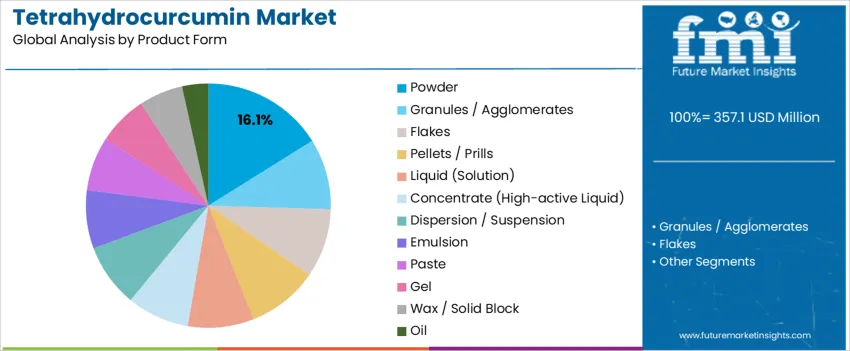
Powder holds 16.1% of global supply due to its stability, concentrated active loading, and compatibility across emulsions, gels, capsules, and solid stick formats. Manufacturers benefit from ease of transport and reduced oxidative degradation compared with liquid forms. Liquids, concentrates, suspensions, emulsions, pastes, gels, waxes, and oils are available for customized texture development, particularly in brightening serums and high-performance skincare. Product-form selection depends on production environment, solubility needs, and delivery-system efficiency. Powder remains central for both mass-market and clinical-grade launches, ensuring extended shelf life and simplified formulation.
Key Points:
- Powder preferred for stability and dose standardization
- Liquids/concentrates used for rapid incorporation in premium serums
- Oils/emulsions support sensorial performance in luxury skincare products
What are the Drivers, Restraints, and Key Trends of the Global Tetrahydrocurcumin Market?
Growth of wellness and nutraceutical demand, increasing interest in anti-inflammatory and antioxidant supplements, and rising elderly population globally are driving demand.
Worldwide, tetrahydrocurcumin an active metabolite of curcumin is gaining traction for its purported benefits such as antioxidant activity, anti-inflammatory effects, and support for joint and metabolic health. Demand increases in markets across North America, Europe and Asia as consumers seek natural supplement alternatives to manage chronic inflammation, oxidative stress and age-related conditions. Nutraceutical manufacturers incorporate tetrahydrocurcumin into capsules, tablets and functional foods. Increased health awareness, aging demographics and rising prevalence of lifestyle diseases support broad uptake. Supplement brands market products to middle-aged and older adults aiming for joint mobility, cardiovascular health and general wellness, supporting stable global consumption growth.
Limited large-scale clinical evidence, regulatory uncertainty in certain markets and competition from established antioxidants and curcumin derivatives restrain growth.
Compared with conventional antioxidants or well-studied curcumin, tetrahydrocurcumin lacks extensive human clinical trials demonstrating definitive efficacy, which may reduce confidence among healthcare professionals and regulatory bodies. In regions with strict regulatory regimes for nutraceutical claims, marketing approval can be complex and time-consuming. Costs of extraction or chemical synthesis can make tetrahydrocurcumin more expensive than generic antioxidant compounds, affecting price competitiveness. Competing ingredients such as curcumin, resveratrol and other polyphenols have stronger brand recognition and research backing. These factors limit aggressive scaling of tetrahydrocurcumin-based products, especially in price-sensitive markets.
Shift toward improved bioavailability formulations, blended antioxidant products and growing interest in functional beverages and skincare applications define key trends.
Manufacturers are developing formulations of tetrahydrocurcumin with enhanced absorption and stability, often using lipid carriers or nano-encapsulation to improve effectiveness and consumer acceptance. Blended products combining multiple antioxidants and supporting nutrients aim to deliver broader health benefits and appeal to holistic wellness consumers. Nutraceutical companies expand offerings into functional beverages and ready-to-drink tonics containing tetrahydrocurcumin. Some cosmetic brands explore topical applications leveraging its antioxidant potential for skin aging and UV protection. These innovations indicate evolving demand beyond supplements, supporting diversified growth across nutrition, wellness and personal care sectors in the global market.
Analysis of the Tetrahydrocurcumin Market by Key Country
The global tetrahydrocurcumin market is advancing through 2035 as skincare, nutraceutical, and pharmaceutical manufacturers increase adoption of this hydrogenated curcumin derivative known for enhanced bioavailability, antioxidant activity, and reduced pigmentation risk factors. India registers growth with 12.6% CAGR, supported by turmeric-processing ecosystems and clinical ingredient exports. China follows at 11.7%, emphasizing functional beauty and ingestible skincare. Japan grows at 10.7%, driven by sensitive-skin compliance and high-quality formulations. The United Kingdom, at 9.8% scales vegan and clean-beauty offerings, while Germany, at 8.9% focuses on scientifically validated cosmeceuticals. The United States grows at 7.9%, reflecting rising dermatology endorsements and hybrid topical-nutritional solutions. Wide application potential in pigmentation, anti-aging, and inflammatory reduction strengthens demand across regulated cosmetic categories.
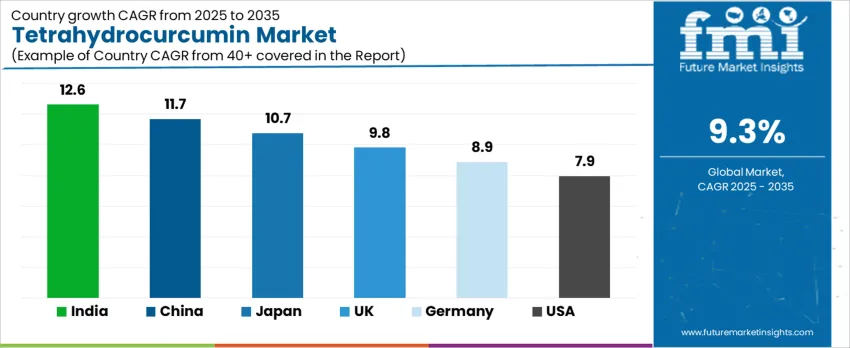
| Country | CAGR (%) |
|---|---|
| India | 12.6% |
| China | 11.7% |
| Japan | 10.7% |
| UK | 9.8% |
| Germany | 8.9% |
| USA | 7.9% |
How is India advancing the Tetrahydrocurcumin Market?
India grows at 12.6% CAGR, supported by strong turmeric cultivation, cost-efficient extraction networks, and continuous innovation in curcuminoid derivatives. Manufacturers improve purification and stabilization processes to meet global pharmaceutical and cosmeceutical standards. Domestic brands develop skin-brightening and complexion-improving serums using tetrahydrocurcumin to address uneven tone and UV-driven melanin concerns. Export-focused ingredient suppliers benefit from international certification pathways such as GRAS and COSMOS approval, enhancing trade credibility. Ayurvedic and nutraceutical sectors merge scientific evidence with traditional wellness positioning to broaden consumer adoption across ingestible and topical formats.
- Abundant turmeric supply ensures competitive production cost
- Export-focused manufacturing meeting global compliance requirements
- Strong demand in brightening and anti-inflammatory product lines
- Evidence-backed Ayurvedic innovation supporting consumer trust
How is China driving demand acceleration?
China posts 11.7% CAGR, aligned with rapid penetration in whitening, tone-correcting, and “inner-outer beauty” categories promoted through major eCommerce channels. Skincare manufacturers incorporate tetrahydrocurcumin into high-clarity serums and emulsions designed for humidity-prone environments, reducing concerns of irritation linked to stronger actives. Research collaborations validate melanin-inhibition and antioxidant performance, influencing procurement strategies among premium beauty brands. Nutricosmetic companies expand capsule and powdered formats marketed for visible glow improvements. Regulatory approvals facilitate swift commercialization cycles for trending actives.
- Whitening and brightening claims driving ingredient adoption
- Growing ingestible beauty category boosting volume demand
- Clinical research anchoring premium positioning
- Digital-first marketing increasing trial uptake
How is Japan supporting clinical-quality growth?
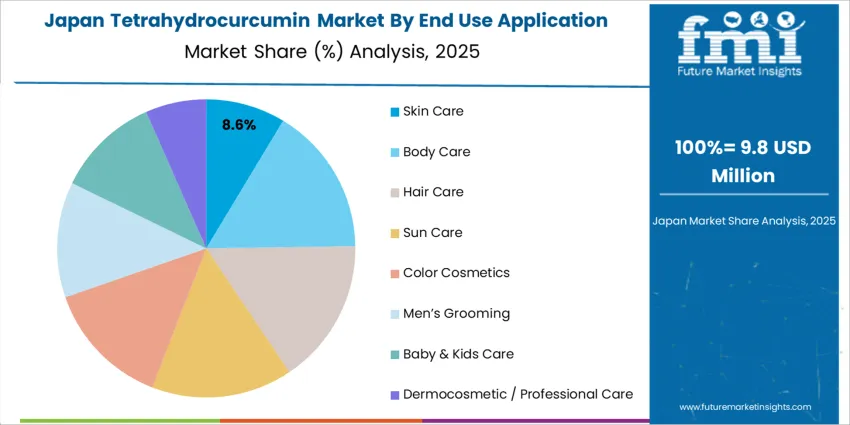
Japan maintains 10.7% CAGR, driven by high standards for skin safety, stability, and texture optimization in dermocosmetics. Tetrahydrocurcumin is utilized in multifunctional brightening and anti-aging lines where controlled-release formulations maximize efficacy within multi-step routines. R&D teams evaluate compatibility with ceramides, peptides, and UV-protection actives to ensure consistent performance under varied climatic conditions. Formulation transparency and clinical data remain critical purchase drivers among mature consumers. Nutraceutical brands highlight gentle antioxidant benefits targeting age-related skin stress.
- Stringent safety and stability criteria guiding product development
- Multifunctional formulations improving routine integration
- Mature consumer base prioritizing proven dermatologic outcomes
- Nutraceutical linkage enhancing holistic beauty positioning
How is the United Kingdom expanding tetrahydrocurcumin adoption?
The United Kingdom grows at 9.8% CAGR, supported by high market visibility for clean-label, vegan, and low-irritation skincare. Indie beauty brands partner with contract manufacturers offering natural pigment-correcting actives backed by validated performance. Retailers promote tetrahydrocurcumin products that satisfy regulatory focus on sustainability and transparency. Growth expands across serums, eye creams, and under-makeup treatment products marketed to address dullness and pollution stress in urban consumers.
- Clean-beauty compliance driving ingredient selection
- Indie brand activity accelerating formulation diversity
- Urban wellness claims supporting market penetration
- Retail transparency expectations strengthening supplier scrutiny
How is Germany shaping scientific adoption patterns?
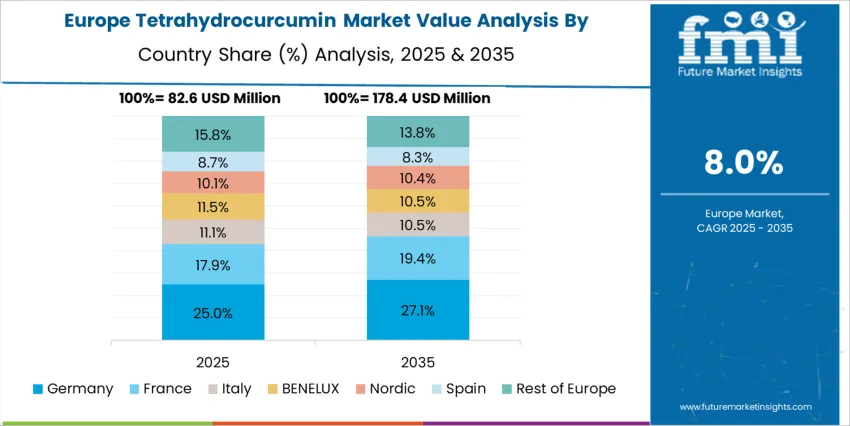
Germany records 8.9% CAGR, influenced by strong pharmacist-led beauty retail and consumer trust in dermatology-supported ingredients. Brands focus on oxidative stress reduction and anti-inflammatory benefits verified via standardized testing. Packaging innovations ensure stability against degradation and color changes during storage. Healthcare-linked distribution channels highlight tetrahydrocurcumin for pigmentation management and anti-aging therapies. Ingredient buyers require detailed safety dossiers and consistent purity in alignment with EU cosmetic regulations.
- Clinical validation emphasizing measurable improvements
- Anti-inflammatory claims enhancing dermatologic relevance
- Stability engineering supporting cosmetic efficacy
- Regulatory compliance guiding supplier approvals
How is the United States strengthening functional innovation?
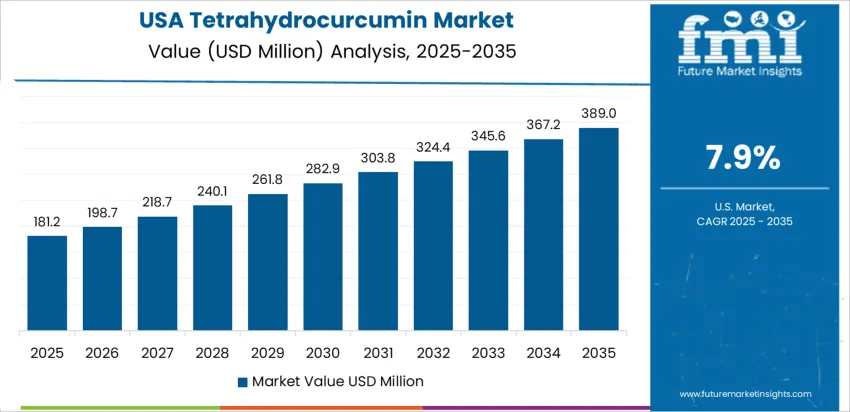
The United States grows at 7.9% CAGR, driven by dermatology endorsements and product launches spanning topical creams and beauty supplements. Consumer messaging focuses on gentle skin-brightening benefits safer for sensitive skin than traditional retinoids or high-strength acids. Cross-category formulations mix tetrahydrocurcumin with probiotics, HA, and botanicals to enhance perceived improvement in radiance and evenness. D2C ecommerce accelerates adoption through targeted campaigns and subscription replenishment. Import scrutiny prioritizes clinical transparency and contamination-free sourcing.
- Derm-guided messaging strengthening product credibility
- Hybrid beauty formats expanding consumption touchpoints
- Subscription and online retail advancing reach
- Compliance verification essential for market access
What does the competitive landscape for tetrahydrocurcumin demand worldwide look like?
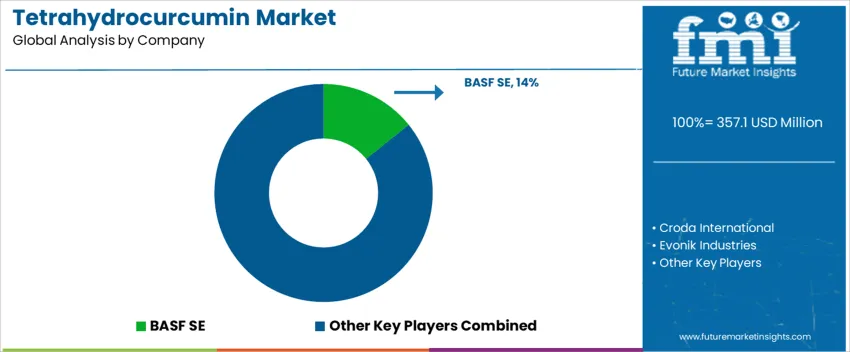
Tetrahydrocurcumin demand worldwide is driven by its use as a skin-brightening, antioxidant, and anti-inflammatory active in dermocosmetics, nutricosmetics, and selected nutraceutical formulations. Brand owners focus on ingredient purity, documented safety, consistent colour and odour, and photostability in leave-on systems. Regulatory readiness and traceable turmeric-derived sourcing influence selection for global personal-care launches.
BASF SE holds an estimated 14.2% share, supported by established relationships with multinational skincare brands and structured technical documentation for brightening and even-tone claims. Croda International supplies tetrahydrocurcumin within broader cosmetic-active portfolios, emphasizing formulation flexibility in emulsions, serums, and gels. Evonik Industries positions the ingredient inside multi-functional skin-care systems linked to antioxidant protection and complexion-uniformity concepts. Symrise and associated actives businesses integrate tetrahydrocurcumin into pigment-control and anti-ageing design frameworks used by global and regional beauty customers. Dow participates as a strategic supplier to large formulators seeking secure long-term access and compatibility with their existing rheology and delivery systems.
Ashland and Clariant compete through differentiated delivery forms such as encapsulated grades and solubility-optimized concentrates. A broad group of speciality suppliers, including Seppic, Lubrizol, Lonza, Inolex and others, serves mid-size and indie brands that require smaller batch sizes, customized claims support, and targeted regional compliance guidance. Competitive performance depends on analytical consistency, clinical-support packages, sustainability narratives, and ability to integrate tetrahydrocurcumin into complete brightening and anti-ageing product ranges.
Key Players in the Tetrahydrocurcumin Market
- BASF SE
- Croda International
- Evonik Industries
- Symrise (incl. IFF/Givaudan actives)
- Dow / Dow Inc.
- Ashland
- Clariant
- Others (Seppic, Lubrizol, Lonza, Inolex etc.)
Scope of the Report
| Items | Values |
|---|---|
| Quantitative Units | USD million |
| End Use Application | Skin Care, Body Care, Hair Care, Sun Care, Color Cosmetics, Men’s Grooming, Baby & Kids Care, Dermocosmetic / Professional Care |
| Product Form | Powder, Granules / Agglomerates, Flakes, Pellets / Prills, Liquid (Solution), Concentrate (High-active Liquid), Dispersion / Suspension, Emulsion, Paste, Gel, Wax / Solid Block, Oil |
| Regions Covered | Asia Pacific, Europe, North America, Latin America, Middle East & Africa |
| Countries Covered | India, China, USA, Germany, South Korea, Japan, Italy, and 40+ countries |
| Key Companies Profiled | BASF SE, Croda International, Evonik Industries, Symrise (incl. IFF/Givaudan actives), Dow / Dow Inc., Ashland, Clariant, Others (Seppic, Lubrizol, Lonza, Inolex etc.) |
| Additional Attributes | Dollar sales by end-use applications and product form categories; regional adoption trends across Asia Pacific, Europe, and North America; competitive analysis of cosmetic ingredient suppliers specializing in antioxidant and skin-brightening actives; demand growth driven by clean-label and plant-derived cosmetic formulations; advancements in nano-delivery, stability enhancement, and bioavailability improvement for curcuminoid derivatives; increasing use in dermocosmetics targeting hyperpigmentation and anti-inflammatory skin care. |
Tetrahydrocurcumin Market by Segment
End Use Application:
- Skin Care
- Body Care
- Hair Care
- Sun Care
- Color Cosmetics
- Men’s Grooming
- Baby & Kids Care
- Dermocosmetic / Professional Care
Product Form:
- Powder
- Granules / Agglomerates
- Flakes
- Pellets / Prills
- Liquid (Solution)
- Concentrate (High-active Liquid)
- Dispersion / Suspension
- Emulsion
- Paste
- Gel
- Wax / Solid Block
- Oil
Region:
- Asia Pacific
- China
- Japan
- South Korea
- India
- Australia & New Zealand
- ASEAN
- Rest of Asia Pacific
- Europe
- Germany
- United Kingdom
- France
- Italy
- Spain
- Nordic
- BENELUX
- Rest of Europe
- North America
- United States
- Canada
- Mexico
- Latin America
- Brazil
- Chile
- Rest of Latin America
- Middle East & Africa
- Kingdom of Saudi Arabia
- Other GCC Countries
- Turkey
- South Africa
- Other African Union
- Rest of Middle East & Africa
Frequently Asked Questions
How big is the tetrahydrocurcumin market in 2025?
The global tetrahydrocurcumin market is estimated to be valued at USD 357.1 million in 2025.
What will be the size of tetrahydrocurcumin market in 2035?
The market size for the tetrahydrocurcumin market is projected to reach USD 872.6 million by 2035.
How much will be the tetrahydrocurcumin market growth between 2025 and 2035?
The tetrahydrocurcumin market is expected to grow at a 9.3% CAGR between 2025 and 2035.
What are the key product types in the tetrahydrocurcumin market?
The key product types in tetrahydrocurcumin market are skin care, body care, hair care, sun care, color cosmetics, men’s grooming, baby & kids care and dermocosmetic / professional care.
Which product form segment to contribute significant share in the tetrahydrocurcumin market in 2025?
In terms of product form, powder segment to command 16.1% share in the tetrahydrocurcumin market in 2025.
Preview the report firsthand - request a free sample
Get SampleGet the brochure for pricing and purchase details.
Get PDFTable of Content
- Executive Summary
- Global Market Outlook
- Demand-side Trends
- Supply-side Trends
- Technology Roadmap Analysis
- Analysis and Recommendations
- Market Overview
- Market Coverage / Taxonomy
- Market Definition / Scope / Limitations
- Market Background
- Market Dynamics
- Drivers
- Restraints
- Opportunity
- Trends
- Scenario Forecast
- Demand in Optimistic Scenario
- Demand in Likely Scenario
- Demand in Conservative Scenario
- Opportunity Map Analysis
- Product Life Cycle Analysis
- Supply Chain Analysis
- Investment Feasibility Matrix
- Value Chain Analysis
- PESTLE and Porter’s Analysis
- Regulatory Landscape
- Regional Parent Market Outlook
- Production and Consumption Statistics
- Import and Export Statistics
- Market Dynamics
- Global Market Analysis 2020 to 2024 and Forecast, 2025 to 2035
- Historical Market Size Value (USD Million) Analysis, 2020 to 2024
- Current and Future Market Size Value (USD Million) Projections, 2025 to 2035
- Y-o-Y Growth Trend Analysis
- Absolute $ Opportunity Analysis
- Global Market Pricing Analysis 2020 to 2024 and Forecast 2025 to 2035
- Global Market Analysis 2020 to 2024 and Forecast 2025 to 2035, By End Use Application
- Introduction / Key Findings
- Historical Market Size Value (USD Million) Analysis By End Use Application , 2020 to 2024
- Current and Future Market Size Value (USD Million) Analysis and Forecast By End Use Application , 2025 to 2035
- Skin Care
- Body Care
- Hair Care
- Sun Care
- Color Cosmetics
- Men’s Grooming
- Baby & Kids Care
- Dermocosmetic / Professional Care
- Y-o-Y Growth Trend Analysis By End Use Application , 2020 to 2024
- Absolute $ Opportunity Analysis By End Use Application , 2025 to 2035
- Global Market Analysis 2020 to 2024 and Forecast 2025 to 2035, By Product Form
- Introduction / Key Findings
- Historical Market Size Value (USD Million) Analysis By Product Form, 2020 to 2024
- Current and Future Market Size Value (USD Million) Analysis and Forecast By Product Form, 2025 to 2035
- Powder
- Granules / Agglomerates
- Flakes
- Pellets / Prills
- Liquid (Solution)
- Concentrate (High-active Liquid)
- Dispersion / Suspension
- Emulsion
- Paste
- Gel
- Wax / Solid Block
- Y-o-Y Growth Trend Analysis By Product Form, 2020 to 2024
- Absolute $ Opportunity Analysis By Product Form, 2025 to 2035
- Global Market Analysis 2020 to 2024 and Forecast 2025 to 2035, By Region
- Introduction
- Historical Market Size Value (USD Million) Analysis By Region, 2020 to 2024
- Current Market Size Value (USD Million) Analysis and Forecast By Region, 2025 to 2035
- North America
- Latin America
- Western Europe
- Eastern Europe
- East Asia
- South Asia and Pacific
- Middle East & Africa
- Market Attractiveness Analysis By Region
- North America Market Analysis 2020 to 2024 and Forecast 2025 to 2035, By Country
- Historical Market Size Value (USD Million) Trend Analysis By Market Taxonomy, 2020 to 2024
- Market Size Value (USD Million) Forecast By Market Taxonomy, 2025 to 2035
- By Country
- USA
- Canada
- Mexico
- By End Use Application
- By Product Form
- By Country
- Market Attractiveness Analysis
- By Country
- By End Use Application
- By Product Form
- Key Takeaways
- Latin America Market Analysis 2020 to 2024 and Forecast 2025 to 2035, By Country
- Historical Market Size Value (USD Million) Trend Analysis By Market Taxonomy, 2020 to 2024
- Market Size Value (USD Million) Forecast By Market Taxonomy, 2025 to 2035
- By Country
- Brazil
- Chile
- Rest of Latin America
- By End Use Application
- By Product Form
- By Country
- Market Attractiveness Analysis
- By Country
- By End Use Application
- By Product Form
- Key Takeaways
- Western Europe Market Analysis 2020 to 2024 and Forecast 2025 to 2035, By Country
- Historical Market Size Value (USD Million) Trend Analysis By Market Taxonomy, 2020 to 2024
- Market Size Value (USD Million) Forecast By Market Taxonomy, 2025 to 2035
- By Country
- Germany
- UK
- Italy
- Spain
- France
- Nordic
- BENELUX
- Rest of Western Europe
- By End Use Application
- By Product Form
- By Country
- Market Attractiveness Analysis
- By Country
- By End Use Application
- By Product Form
- Key Takeaways
- Eastern Europe Market Analysis 2020 to 2024 and Forecast 2025 to 2035, By Country
- Historical Market Size Value (USD Million) Trend Analysis By Market Taxonomy, 2020 to 2024
- Market Size Value (USD Million) Forecast By Market Taxonomy, 2025 to 2035
- By Country
- Russia
- Poland
- Hungary
- Balkan & Baltic
- Rest of Eastern Europe
- By End Use Application
- By Product Form
- By Country
- Market Attractiveness Analysis
- By Country
- By End Use Application
- By Product Form
- Key Takeaways
- East Asia Market Analysis 2020 to 2024 and Forecast 2025 to 2035, By Country
- Historical Market Size Value (USD Million) Trend Analysis By Market Taxonomy, 2020 to 2024
- Market Size Value (USD Million) Forecast By Market Taxonomy, 2025 to 2035
- By Country
- China
- Japan
- South Korea
- By End Use Application
- By Product Form
- By Country
- Market Attractiveness Analysis
- By Country
- By End Use Application
- By Product Form
- Key Takeaways
- South Asia and Pacific Market Analysis 2020 to 2024 and Forecast 2025 to 2035, By Country
- Historical Market Size Value (USD Million) Trend Analysis By Market Taxonomy, 2020 to 2024
- Market Size Value (USD Million) Forecast By Market Taxonomy, 2025 to 2035
- By Country
- India
- ASEAN
- Australia & New Zealand
- Rest of South Asia and Pacific
- By End Use Application
- By Product Form
- By Country
- Market Attractiveness Analysis
- By Country
- By End Use Application
- By Product Form
- Key Takeaways
- Middle East & Africa Market Analysis 2020 to 2024 and Forecast 2025 to 2035, By Country
- Historical Market Size Value (USD Million) Trend Analysis By Market Taxonomy, 2020 to 2024
- Market Size Value (USD Million) Forecast By Market Taxonomy, 2025 to 2035
- By Country
- Kingdom of Saudi Arabia
- Other GCC Countries
- Turkiye
- South Africa
- Other African Union
- Rest of Middle East & Africa
- By End Use Application
- By Product Form
- By Country
- Market Attractiveness Analysis
- By Country
- By End Use Application
- By Product Form
- Key Takeaways
- Key Countries Market Analysis
- USA
- Pricing Analysis
- Market Share Analysis, 2024
- By End Use Application
- By Product Form
- Canada
- Pricing Analysis
- Market Share Analysis, 2024
- By End Use Application
- By Product Form
- Mexico
- Pricing Analysis
- Market Share Analysis, 2024
- By End Use Application
- By Product Form
- Brazil
- Pricing Analysis
- Market Share Analysis, 2024
- By End Use Application
- By Product Form
- Chile
- Pricing Analysis
- Market Share Analysis, 2024
- By End Use Application
- By Product Form
- Germany
- Pricing Analysis
- Market Share Analysis, 2024
- By End Use Application
- By Product Form
- UK
- Pricing Analysis
- Market Share Analysis, 2024
- By End Use Application
- By Product Form
- Italy
- Pricing Analysis
- Market Share Analysis, 2024
- By End Use Application
- By Product Form
- Spain
- Pricing Analysis
- Market Share Analysis, 2024
- By End Use Application
- By Product Form
- France
- Pricing Analysis
- Market Share Analysis, 2024
- By End Use Application
- By Product Form
- India
- Pricing Analysis
- Market Share Analysis, 2024
- By End Use Application
- By Product Form
- ASEAN
- Pricing Analysis
- Market Share Analysis, 2024
- By End Use Application
- By Product Form
- Australia & New Zealand
- Pricing Analysis
- Market Share Analysis, 2024
- By End Use Application
- By Product Form
- China
- Pricing Analysis
- Market Share Analysis, 2024
- By End Use Application
- By Product Form
- Japan
- Pricing Analysis
- Market Share Analysis, 2024
- By End Use Application
- By Product Form
- South Korea
- Pricing Analysis
- Market Share Analysis, 2024
- By End Use Application
- By Product Form
- Russia
- Pricing Analysis
- Market Share Analysis, 2024
- By End Use Application
- By Product Form
- Poland
- Pricing Analysis
- Market Share Analysis, 2024
- By End Use Application
- By Product Form
- Hungary
- Pricing Analysis
- Market Share Analysis, 2024
- By End Use Application
- By Product Form
- Kingdom of Saudi Arabia
- Pricing Analysis
- Market Share Analysis, 2024
- By End Use Application
- By Product Form
- Turkiye
- Pricing Analysis
- Market Share Analysis, 2024
- By End Use Application
- By Product Form
- South Africa
- Pricing Analysis
- Market Share Analysis, 2024
- By End Use Application
- By Product Form
- USA
- Market Structure Analysis
- Competition Dashboard
- Competition Benchmarking
- Market Share Analysis of Top Players
- By Regional
- By End Use Application
- By Product Form
- Competition Analysis
- Competition Deep Dive
- BASF SE
- Overview
- Product Portfolio
- Profitability by Market Segments (Product/Age /Sales Channel/Region)
- Sales Footprint
- Strategy Overview
- Marketing Strategy
- Product Strategy
- Channel Strategy
- Croda International
- Evonik Industries
- Symrise (incl. IFF/Givaudan actives)
- Dow / Dow Inc.
- Ashland
- Clariant
- Others (Seppic, Lubrizol, Lonza, Inolex etc.)
- BASF SE
- Competition Deep Dive
- Assumptions & Acronyms Used
- Research Methodology


