

- Industry Size (2026)
- USD 420.0 Mn
- Forecast (2036)
- USD 1171.2 Mn
- CAGR (2026 to 2036)
- 10.8%
Token Display System Market Forecast and Outlook 2026 to 2036
The token display system market is likely to be valued at USD 420.0 million in 2026 and is forecasted to reach USD 1,171.2 million by 2036 at a CAGR of 10.8%. Value expansion reflects structural reliance on queue visibility and service order enforcement in high-footfall, transaction-driven environments. Token display systems function as operational infrastructure rather than discretionary electronics, with purchasing decisions tied to service volume, counter density, and compliance with standardized service protocols. Capital allocation prioritizes readability, uptime reliability, and integration compatibility, as display failure directly disrupts service sequencing and staff coordination in regulated or high-pressure settings.
Growth behavior is shaped by institutional service modernization and urban service density rather than retail digitization trends. Public hospitals, banks, and government centers scale deployments to manage throughput predictability and auditability, anchoring demand to facility expansion and process formalization cycles. Replacement demand remains persistent due to continuous operation, brightness degradation, and evolving connectivity standards. System scalability is constrained by building layout, cabling limitations, and budget-controlled procurement frameworks, particularly in public sector installations. Competitive intensity limits hardware margin expansion, keeping value growth dependent on deployment volume rather than unit pricing. Adoption momentum remains anchored in operational discipline requirements, reinforcing long-term persistence independent of consumer-facing technology cycles.
Quick Stats for Token Display System Market
- Token Display System Market Value (2026): USD 420.0 million
- Token Display System Market Forecast Value (2036): USD 1,171.2 million
- Token Display System Market Forecast CAGR 2026 to 2036: 10.8%
- Leading Display Format by Demand Share: 7-Segment LED Displays
- Fastest-Growing Countries: India, Indonesia, Vietnam, Saudi Arabia, UAE
- Top Players in Global Demand: Qmatic, Wavetec, Lavi Industries, Advantech, Daktronics, NEC Display Solutions, Samsung Electronics, LG Electronics, Elo Touch Solutions
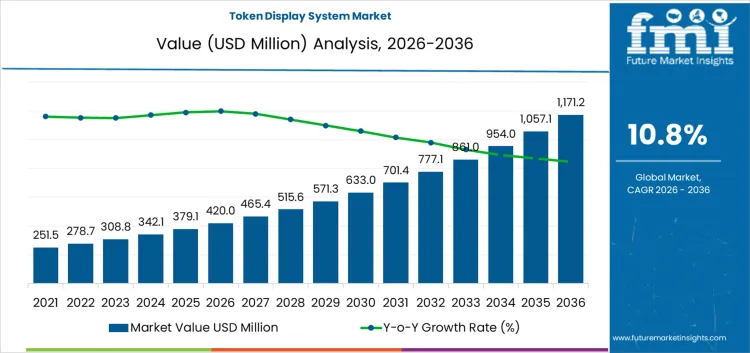
Token Display System Market Key Takeaways
| Metric | Value |
|---|---|
| Market Value (2026) | USD 420.0 million |
| Market Forecast Value (2036) | USD 1,171.2 million |
| Forecast CAGR 2026 to 2036 | 10.8% |
Why is the Demand for Token Display System Growing?
Demand for token display systems is increasing as service oriented environments seek orderly customer flow and reduced perceived wait times. Hospitals, banks, government service centers, and retail outlets specify token display solutions to manage queues by issuing sequential identifiers and showing current service status on visual displays and announcement modules.
Facility planners evaluate integration with check-in kiosks, ticketing terminals, and central service counters to ensure seamless communication between customer entry points and service agents. Procurement teams assess display visibility, software control features, and compatibility with existing network infrastructure to support consistent operation in high traffic zones without compromising facility aesthetics or reliability. Use of token display systems helps service supervisors allocate staff resources based on real time queue statistics and reduces congestion at service desks during peak periods.
Growth in demand for improved customer experience across sectors such as telecommunications stores, utility payment centers, and public transit ticket offices reinforces uptake of token display systems. Operators value solutions that support multiple service categories, customizable numbering sequences, and easy updates without technical complexity. Integration with mobile notifications and touchless check-in workflows supports current expectations for convenience and contactless interaction. Technical support and scalability influence selection because expanding service portfolios require displays and control units that maintain performance without frequent replacement. These application specific priorities are contributing to sustained demand growth for token display systems across diverse service environments.
How Are the Segments Classified in the Token Display System Market?
Demand for token display systems is shaped by queue management efficiency, service transparency, and customer flow optimization across public-facing facilities. Organizations deploy displays to coordinate service counters, reduce wait-time uncertainty, and improve operational discipline. Adoption aligns with digitization of service delivery in banking, healthcare, and government environments. System selection prioritizes readability, uptime reliability, and integration with queue management software. Segment classification reflects differentiation by display format, operational end use, and connectivity architecture. Structure highlights how visual clarity requirements, service context, and network integration influence specification priorities and deployment patterns.
Which Display Format Represents the Largest Share of Demand?
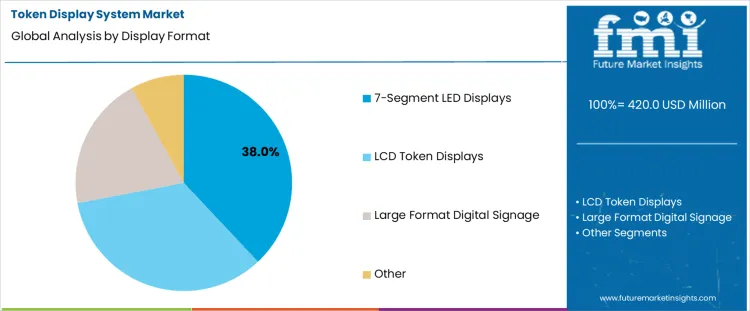
7-segment LED displays hold 38.0%, representing the largest share among display formats due to high visibility and simplicity. Numeric clarity supports rapid recognition of token numbers from distance and varied lighting conditions. Low power consumption and long operational life suit continuous-use environments. Installation and maintenance remain straightforward with minimal software complexity. LCD token displays provide richer information with moderate readability trade-offs. Large format digital signage supports multimedia communication with higher cost and infrastructure needs. Display format segmentation reflects preference for durable, legible solutions optimized for numeric queue communication.
Key Points
- LED segments provide clear numeric visibility.
- Simple architecture supports continuous operation.
- Other formats add information depth or multimedia capability.
Which End Use Accounts for the Highest Share of Demand?
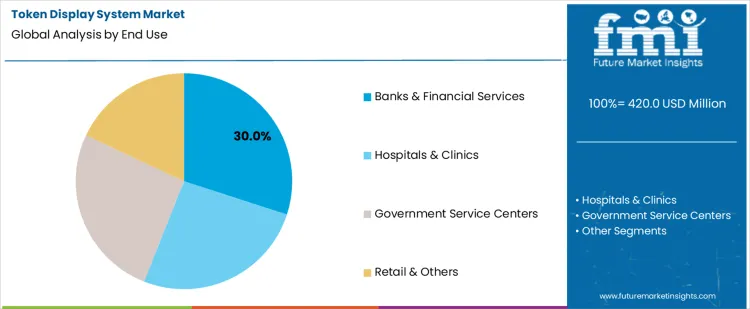
Banks and financial services hold 30.0%, representing the largest share among end-use settings due to structured service workflows. Branch environments rely on token systems to manage teller queues and service prioritization. High customer volumes necessitate clear visual coordination to reduce congestion. Standardized counter layouts support uniform display deployment. Hospitals and clinics apply systems for patient flow coordination with similar volume intensity. Government service centers require displays for document processing queues. End-use segmentation reflects concentration where regulated service processes and customer throughput demand disciplined queue management.
Key Points
- Banking environments manage high customer throughput.
- Structured workflows benefit from visual queue coordination.
- Other sectors apply systems for patient or citizen services.
Which Connectivity Option Drives the Largest Share of Demand?

Wired connectivity using LAN or RS485 holds 40.0%, representing the largest share among connectivity options due to reliability. Fixed wiring supports stable communication with queue controllers and central servers. Latency remains predictable, supporting synchronized display updates. Security considerations favor wired networks in regulated environments. Wi-Fi enables flexible installation with moderate interference risk. Cellular connectivity supports remote or temporary setups with higher operating cost. Connectivity segmentation reflects preference for stable, secure communication where uptime and synchronization accuracy remain critical.
Key Points
- Wired connections ensure stable and predictable communication.
- Security requirements favor fixed network infrastructure.
- Other options support flexibility or remote deployment needs.
What are the Key Dynamics in the Token Display System Market?
Demand for token display systems reflects queue management and service flow control requirements in high-footfall service environments. Adoption concentrates in banks, hospitals, government offices, retail service counters, and transport ticketing facilities. Global scope aligns with organized service delivery and crowd management practices. Usage centers on electronic displays integrated with token issuance and call systems to guide customer movement and reduce service congestion.
How do service throughput management and customer flow control shape adoption?
Service environments handling sequential customer processing require clear visual guidance to maintain order and reduce wait-related friction. Demand increases where manual queue handling leads to crowding, disputes, and inefficiency. Token display systems provide real-time status of active and upcoming service numbers, enabling predictable movement across counters. Healthcare facilities rely on displays to coordinate patient flow across registration, diagnostics, and consultation points. Banks and public offices adopt systems to enforce first-come service discipline and reduce staff intervention. Integration with audio alerts and backend queue software improves responsiveness. Adoption reflects operational need for structured service flow rather than digital customer engagement.
How do infrastructure variability and budget constraints influence market scalability?
Token display deployment depends on availability of power, mounting infrastructure, and line-of-sight visibility across service halls. Demand sensitivity rises where public institutions face fixed capital budgets and slow procurement cycles. Display size, brightness, and durability requirements vary by environment, limiting standardization. Legacy buildings pose cabling and placement challenges. Maintenance exposure affects uptime in high-use settings. Integration complexity increases when interfacing with existing queue or hospital information systems. Price competition remains intense due to low hardware differentiation. Dependence on institutional purchasing cycles constrains consistent volume scalability across regions.
How Is Demand for Token Display Systems Evolving Globally?
Demand for token display systems is expanding globally due to service digitization, queue management standardization, and efficiency requirements across high-footfall facilities. Adoption aligns with hospitals, banks, government offices, retail service counters, and transportation hubs seeking structured customer flow and reduced wait-time uncertainty. Integration with queue management software and display networks supports measurable service performance. Replacement demand emerges where legacy manual systems are phased out. Growth rates in India at 13.6%, Indonesia at 12.4%, Vietnam at 12.1%, Saudi Arabia at 11.4%, and UAE at 10.8% indicate strong expansion driven by public service modernization, urbanization, and institutional service throughput needs.
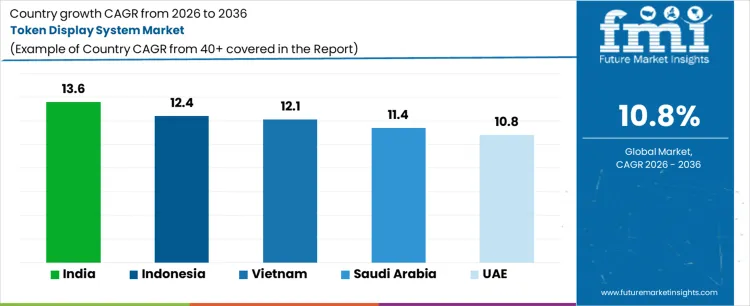
| Country | CAGR (%) |
|---|---|
| India | 13.6% |
| Indonesia | 12.4% |
| Vietnam | 12.1% |
| Saudi Arabia | 11.4% |
| UAE | 10.8% |
What Is Driving Rapid Expansion of Token Display System Demand in India?
India is growing at a CAGR of 13.6%, supported by digitization of public-facing services and high daily visitor volumes. Government service centers, hospitals, and banks adopt electronic queue displays to manage crowd flow. Urban population density increases need for visible, auditable queue progression. Integration with hospital information systems supports patient flow control. Private clinics and retail chains deploy token displays to standardize service experience. Demand growth reflects service efficiency mandates and operational scale rather than discretionary technology upgrades.
- Digitization of government and healthcare service centers
- High urban footfall requiring structured queue flow
- Integration with hospital and banking systems
- Standardization across private clinics and retail chains
Why Is Indonesia Experiencing Strong Growth in Token Display System Adoption?
Token display system demand in Indonesia is expanding at a CAGR of 12.4%, driven by modernization of public services and healthcare facilities. Hospitals implement queue displays to manage outpatient volumes and reduce congestion. Municipal offices adopt token systems to improve service transparency. Retail service centers use displays to organize customer flow during peak hours. Decentralized service delivery increases need for simple, scalable systems. Demand growth reflects public service efficiency priorities and urban service expansion rather than replacement of advanced digital signage.
- Hospital outpatient volume management requirements
- Municipal service transparency initiatives
- Retail service counter crowd organization
- Scalable systems for decentralized facilities
How Is Vietnam Shaping Demand for Token Display Systems?
Vietnam is growing at a CAGR of 12.1%, shaped by healthcare expansion and administrative service reform. Public hospitals deploy display systems to streamline patient queues. Licensing and utility service offices implement token displays to manage daily visitor flow. Private banks and telecom service centers adopt systems for standardized customer handling. Urban service density supports multi-counter display installations. Demand growth reflects institutional process formalization and service capacity expansion rather than consumer-facing digital transformation.
- Expansion of public hospital outpatient services
- Administrative service process formalization
- Adoption by banks and telecom service centers
- High urban service counter density
What Factors Are Supporting Token Display System Demand in Saudi Arabia?
Token display system demand in Saudi Arabia is expanding at a CAGR of 11.4%, supported by public sector modernization and healthcare capacity growth. Government service facilities adopt queue displays to improve operational order and visitor experience. Hospitals integrate token systems to manage appointment and walk-in flows. Retail banking and utility service centers standardize queue handling. Investment in smart public infrastructure sustains procurement. Demand growth reflects institutional modernization programs and service quality benchmarks rather than population-driven usage growth.
- Public sector service modernization initiatives
- Hospital appointment and walk-in flow management
- Standardization in banking and utility services
- Investment in smart public infrastructure
Why Is the UAE Showing Sustained Growth in Token Display System Demand?
The United Arab Emirates is growing at a CAGR of 10.8%, driven by service quality standards and high-volume customer service environments. Government service centers emphasize orderly queue management and digital transparency. Hospitals and clinics deploy displays for multilingual visitor coordination. Retail and transport service points use token systems to manage peak demand efficiently. Strong focus on service experience sustains adoption. Growth reflects quality-driven deployment and operational efficiency targets rather than expansion in basic service access.
- Government-led digital service standardization
- Multilingual queue management in healthcare facilities
- High-volume retail and transport service operations
- Emphasis on measurable service efficiency metrics
What is the competitive landscape of demand for the token display system market globally?
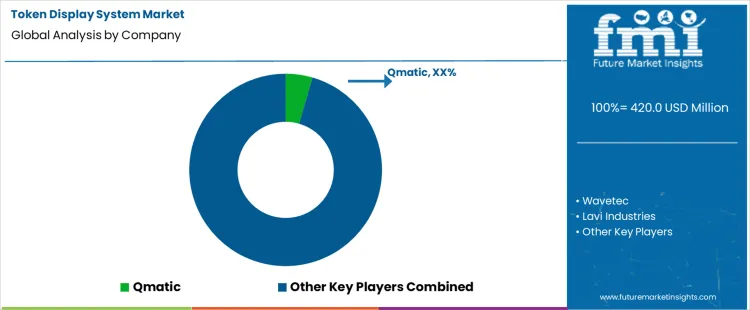
Demand for token display systems is driven by queue management requirements in banks, hospitals, retail service centers, government offices, and transportation hubs seeking orderly customer flow and reduced wait times. These systems integrate display hardware, control software, and token issuance mechanisms to guide customers through service points efficiently.
Buyers evaluate display clarity, integration with queue management software, scalability, network compatibility, ease of installation, and support for multi-language interfaces. Procurement teams prioritize suppliers with proven solutions deployment, global service and support infrastructure, compliance with digital signage standards, and flexibility to integrate with existing IT systems. Trend in the global market reflects increased adoption of digital transformation in customer service environments, emphasis on real-time analytics, and integration of mobile and kiosk-based token issuance.
Qmatic holds leading positioning through comprehensive queue and token display solutions backed by strong global installations, analytics platforms, and service support for diverse customer service environments. Wavetec supports demand with digital signage and token display systems that integrate queue workflows with real-time display and analytics functions.
Lavi Industries participates with display hardware and queue management solutions tailored for high-traffic public and retail spaces. Advantech contributes display platforms and IoT-ready systems that support token and customer information workflows in integrated environments. Daktronics supplies large-format displays and digital signage components that complement token systems in high-visibility public venues. Competitive differentiation depends on display performance, system integration flexibility, ease of deployment, analytics capabilities, and ability to support centralized queue control across multiple service locations.
Key Players in the Token Display System Market
- Qmatic
- Wavetec
- Lavi Industries
- Advantech
- Daktronics
- NEC Display Solutions
- Samsung Electronics
- LG Electronics
- Elo Touch Solutions
Scope of the Report
| Items | Values |
|---|---|
| Quantitative Units | USD million |
| Display Format | 7-Segment LED Displays; LCD Token Displays; Large Format Digital Signage; Other |
| End Use | Banks & Financial Services; Hospitals & Clinics; Government Service Centers; Retail & Others |
| Connectivity | Wired (LAN or RS485); Wi-Fi; Cellular or 4G; Other |
| Sales Channel | Queue Management Providers; System Integrators; Distributors; Other |
| Regions Covered | Asia Pacific, Europe, North America, Latin America, Middle East & Africa |
| Countries Covered | India, Indonesia, Vietnam, Saudi Arabia, UAE, and 40+ countries |
| Key Companies Profiled | Qmatic; Wavetec; Lavi Industries; Advantech; Daktronics; NEC Display Solutions; Samsung Electronics; LG Electronics; Elo Touch Solutions |
| Additional Attributes | Dollar sales by display format, connectivity, and end use; visibility and readability performance under high-ambient-light conditions; latency and synchronization accuracy within queue management workflows; durability and uptime expectations in public service environments; integration compatibility with ticketing software and analytics platforms; procurement patterns favoring system integrator-led projects in healthcare and government facilities and distributor-led supply in retail deployments. |
Token Display System Market by Segment
By Display Format:
- 7-Segment LED Displays
- LCD Token Displays
- Large Format Digital Signage
- Other
By End Use:
- Banks & Financial Services
- Hospitals & Clinics
- Government Service Centers
- Retail & Others
By Connectivity:
- Wired (LAN or RS485)
- Wi-Fi
- Cellular or 4G
- Other
By Sales Channel:
- Queue Management Providers
- System Integrators
- Distributors
- Other
By Region:
- Asia Pacific
- China
- Japan
- South Korea
- India
- Australia & New Zealand
- ASEAN
- Rest of Asia Pacific
- Europe
- Germany
- United Kingdom
- France
- Italy
- Spain
- Nordic
- BENELUX
- Rest of Europe
- North America
- United States
- Canada
- Mexico
- Latin America
- Brazil
- Chile
- Rest of Latin America
- Middle East & Africa
- Kingdom of Saudi Arabia
- Other GCC Countries
- Turkey
- South Africa
- Other African Union
- Rest of Middle East & Africa
Bibliography
- International Organization for Standardization. (2023). ISO/TR 56006: Innovation management-Tools and methods for service system performance monitoring. ISO.
- International Organization for Standardization. (2024). ISO 9241-210: Ergonomics of human-system interaction-Human-centred design for interactive systems (Rev. ed.). ISO.
- Organisation for Economic Co-operation and Development. (2023). Public service delivery and queue management in high-footfall environments. OECD Publishing.
- World Health Organization. (2023). Operational flow management in outpatient and public healthcare facilities. World Health Organization.
Frequently Asked Questions
How big is the token display system market in 2026?
The global token display system market is estimated to be valued at USD 420.0 million in 2026.
What will be the size of token display system market in 2036?
The market size for the token display system market is projected to reach USD 1,171.2 million by 2036.
How much will be the token display system market growth between 2026 and 2036?
The token display system market is expected to grow at a 10.8% CAGR between 2026 and 2036.
What are the key product types in the token display system market?
The key product types in token display system market are 7-segment led displays, lcd token displays, large format digital signage and other.
Which end use segment to contribute significant share in the token display system market in 2026?
In terms of end use, banks & financial services segment to command 30.0% share in the token display system market in 2026.
Preview the report firsthand - request a free sample
Get SampleGet the brochure for pricing and purchase details.
Get PDFTable of Content
- Executive Summary
- Global Market Outlook
- Demand-side Trends
- Supply-side Trends
- Technology Roadmap Analysis
- Analysis and Recommendations
- Market Overview
- Market Coverage / Taxonomy
- Market Definition / Scope / Limitations
- Market Background
- Market Dynamics
- Drivers
- Restraints
- Opportunity
- Trends
- Scenario Forecast
- Demand in Optimistic Scenario
- Demand in Likely Scenario
- Demand in Conservative Scenario
- Opportunity Map Analysis
- Product Life Cycle Analysis
- Supply Chain Analysis
- Investment Feasibility Matrix
- Value Chain Analysis
- PESTLE and Porter’s Analysis
- Regulatory Landscape
- Regional Parent Market Outlook
- Production and Consumption Statistics
- Import and Export Statistics
- Market Dynamics
- Global Market Analysis 2021 to 2025 and Forecast, 2026 to 2036
- Historical Market Size Value (USD Million) Analysis, 2021 to 2025
- Current and Future Market Size Value (USD Million) Projections, 2026 to 2036
- Y-o-Y Growth Trend Analysis
- Absolute $ Opportunity Analysis
- Global Market Pricing Analysis 2021 to 2025 and Forecast 2026 to 2036
- Global Market Analysis 2021 to 2025 and Forecast 2026 to 2036, By Display Format
- Introduction / Key Findings
- Historical Market Size Value (USD Million) Analysis By Display Format , 2021 to 2025
- Current and Future Market Size Value (USD Million) Analysis and Forecast By Display Format , 2026 to 2036
- 7-Segment LED Displays
- LCD Token Displays
- Large Format Digital Signage
- Other
- 7-Segment LED Displays
- Y-o-Y Growth Trend Analysis By Display Format , 2021 to 2025
- Absolute $ Opportunity Analysis By Display Format , 2026 to 2036
- Global Market Analysis 2021 to 2025 and Forecast 2026 to 2036, By End Use
- Introduction / Key Findings
- Historical Market Size Value (USD Million) Analysis By End Use, 2021 to 2025
- Current and Future Market Size Value (USD Million) Analysis and Forecast By End Use, 2026 to 2036
- Banks & Financial Services
- Hospitals & Clinics
- Government Service Centers
- Retail & Others
- Banks & Financial Services
- Y-o-Y Growth Trend Analysis By End Use, 2021 to 2025
- Absolute $ Opportunity Analysis By End Use, 2026 to 2036
- Global Market Analysis 2021 to 2025 and Forecast 2026 to 2036, By Connectivity
- Introduction / Key Findings
- Historical Market Size Value (USD Million) Analysis By Connectivity, 2021 to 2025
- Current and Future Market Size Value (USD Million) Analysis and Forecast By Connectivity, 2026 to 2036
- Wired (LAN or RS485)
- Wi-Fi
- Cellular or 4G
- Other
- Wired (LAN or RS485)
- Y-o-Y Growth Trend Analysis By Connectivity, 2021 to 2025
- Absolute $ Opportunity Analysis By Connectivity, 2026 to 2036
- Global Market Analysis 2021 to 2025 and Forecast 2026 to 2036, By Sales Channel
- Introduction / Key Findings
- Historical Market Size Value (USD Million) Analysis By Sales Channel, 2021 to 2025
- Current and Future Market Size Value (USD Million) Analysis and Forecast By Sales Channel, 2026 to 2036
- Queue Management Providers
- System Integrators
- Distributors
- Other
- Queue Management Providers
- Y-o-Y Growth Trend Analysis By Sales Channel, 2021 to 2025
- Absolute $ Opportunity Analysis By Sales Channel, 2026 to 2036
- Global Market Analysis 2021 to 2025 and Forecast 2026 to 2036, By Region
- Introduction
- Historical Market Size Value (USD Million) Analysis By Region, 2021 to 2025
- Current Market Size Value (USD Million) Analysis and Forecast By Region, 2026 to 2036
- North America
- Latin America
- Western Europe
- Eastern Europe
- East Asia
- South Asia and Pacific
- Middle East & Africa
- Market Attractiveness Analysis By Region
- North America Market Analysis 2021 to 2025 and Forecast 2026 to 2036, By Country
- Historical Market Size Value (USD Million) Trend Analysis By Market Taxonomy, 2021 to 2025
- Market Size Value (USD Million) Forecast By Market Taxonomy, 2026 to 2036
- By Country
- USA
- Canada
- Mexico
- By Display Format
- By End Use
- By Connectivity
- By Sales Channel
- By Country
- Market Attractiveness Analysis
- By Country
- By Display Format
- By End Use
- By Connectivity
- By Sales Channel
- Key Takeaways
- Latin America Market Analysis 2021 to 2025 and Forecast 2026 to 2036, By Country
- Historical Market Size Value (USD Million) Trend Analysis By Market Taxonomy, 2021 to 2025
- Market Size Value (USD Million) Forecast By Market Taxonomy, 2026 to 2036
- By Country
- Brazil
- Chile
- Rest of Latin America
- By Display Format
- By End Use
- By Connectivity
- By Sales Channel
- By Country
- Market Attractiveness Analysis
- By Country
- By Display Format
- By End Use
- By Connectivity
- By Sales Channel
- Key Takeaways
- Western Europe Market Analysis 2021 to 2025 and Forecast 2026 to 2036, By Country
- Historical Market Size Value (USD Million) Trend Analysis By Market Taxonomy, 2021 to 2025
- Market Size Value (USD Million) Forecast By Market Taxonomy, 2026 to 2036
- By Country
- Germany
- UK
- Italy
- Spain
- France
- Nordic
- BENELUX
- Rest of Western Europe
- By Display Format
- By End Use
- By Connectivity
- By Sales Channel
- By Country
- Market Attractiveness Analysis
- By Country
- By Display Format
- By End Use
- By Connectivity
- By Sales Channel
- Key Takeaways
- Eastern Europe Market Analysis 2021 to 2025 and Forecast 2026 to 2036, By Country
- Historical Market Size Value (USD Million) Trend Analysis By Market Taxonomy, 2021 to 2025
- Market Size Value (USD Million) Forecast By Market Taxonomy, 2026 to 2036
- By Country
- Russia
- Poland
- Hungary
- Balkan & Baltic
- Rest of Eastern Europe
- By Display Format
- By End Use
- By Connectivity
- By Sales Channel
- By Country
- Market Attractiveness Analysis
- By Country
- By Display Format
- By End Use
- By Connectivity
- By Sales Channel
- Key Takeaways
- East Asia Market Analysis 2021 to 2025 and Forecast 2026 to 2036, By Country
- Historical Market Size Value (USD Million) Trend Analysis By Market Taxonomy, 2021 to 2025
- Market Size Value (USD Million) Forecast By Market Taxonomy, 2026 to 2036
- By Country
- China
- Japan
- South Korea
- By Display Format
- By End Use
- By Connectivity
- By Sales Channel
- By Country
- Market Attractiveness Analysis
- By Country
- By Display Format
- By End Use
- By Connectivity
- By Sales Channel
- Key Takeaways
- South Asia and Pacific Market Analysis 2021 to 2025 and Forecast 2026 to 2036, By Country
- Historical Market Size Value (USD Million) Trend Analysis By Market Taxonomy, 2021 to 2025
- Market Size Value (USD Million) Forecast By Market Taxonomy, 2026 to 2036
- By Country
- India
- ASEAN
- Australia & New Zealand
- Rest of South Asia and Pacific
- By Display Format
- By End Use
- By Connectivity
- By Sales Channel
- By Country
- Market Attractiveness Analysis
- By Country
- By Display Format
- By End Use
- By Connectivity
- By Sales Channel
- Key Takeaways
- Middle East & Africa Market Analysis 2021 to 2025 and Forecast 2026 to 2036, By Country
- Historical Market Size Value (USD Million) Trend Analysis By Market Taxonomy, 2021 to 2025
- Market Size Value (USD Million) Forecast By Market Taxonomy, 2026 to 2036
- By Country
- Kingdom of Saudi Arabia
- Other GCC Countries
- Turkiye
- South Africa
- Other African Union
- Rest of Middle East & Africa
- By Display Format
- By End Use
- By Connectivity
- By Sales Channel
- By Country
- Market Attractiveness Analysis
- By Country
- By Display Format
- By End Use
- By Connectivity
- By Sales Channel
- Key Takeaways
- Key Countries Market Analysis
- USA
- Pricing Analysis
- Market Share Analysis, 2025
- By Display Format
- By End Use
- By Connectivity
- By Sales Channel
- Canada
- Pricing Analysis
- Market Share Analysis, 2025
- By Display Format
- By End Use
- By Connectivity
- By Sales Channel
- Mexico
- Pricing Analysis
- Market Share Analysis, 2025
- By Display Format
- By End Use
- By Connectivity
- By Sales Channel
- Brazil
- Pricing Analysis
- Market Share Analysis, 2025
- By Display Format
- By End Use
- By Connectivity
- By Sales Channel
- Chile
- Pricing Analysis
- Market Share Analysis, 2025
- By Display Format
- By End Use
- By Connectivity
- By Sales Channel
- Germany
- Pricing Analysis
- Market Share Analysis, 2025
- By Display Format
- By End Use
- By Connectivity
- By Sales Channel
- UK
- Pricing Analysis
- Market Share Analysis, 2025
- By Display Format
- By End Use
- By Connectivity
- By Sales Channel
- Italy
- Pricing Analysis
- Market Share Analysis, 2025
- By Display Format
- By End Use
- By Connectivity
- By Sales Channel
- Spain
- Pricing Analysis
- Market Share Analysis, 2025
- By Display Format
- By End Use
- By Connectivity
- By Sales Channel
- France
- Pricing Analysis
- Market Share Analysis, 2025
- By Display Format
- By End Use
- By Connectivity
- By Sales Channel
- India
- Pricing Analysis
- Market Share Analysis, 2025
- By Display Format
- By End Use
- By Connectivity
- By Sales Channel
- ASEAN
- Pricing Analysis
- Market Share Analysis, 2025
- By Display Format
- By End Use
- By Connectivity
- By Sales Channel
- Australia & New Zealand
- Pricing Analysis
- Market Share Analysis, 2025
- By Display Format
- By End Use
- By Connectivity
- By Sales Channel
- China
- Pricing Analysis
- Market Share Analysis, 2025
- By Display Format
- By End Use
- By Connectivity
- By Sales Channel
- Japan
- Pricing Analysis
- Market Share Analysis, 2025
- By Display Format
- By End Use
- By Connectivity
- By Sales Channel
- South Korea
- Pricing Analysis
- Market Share Analysis, 2025
- By Display Format
- By End Use
- By Connectivity
- By Sales Channel
- Russia
- Pricing Analysis
- Market Share Analysis, 2025
- By Display Format
- By End Use
- By Connectivity
- By Sales Channel
- Poland
- Pricing Analysis
- Market Share Analysis, 2025
- By Display Format
- By End Use
- By Connectivity
- By Sales Channel
- Hungary
- Pricing Analysis
- Market Share Analysis, 2025
- By Display Format
- By End Use
- By Connectivity
- By Sales Channel
- Kingdom of Saudi Arabia
- Pricing Analysis
- Market Share Analysis, 2025
- By Display Format
- By End Use
- By Connectivity
- By Sales Channel
- Turkiye
- Pricing Analysis
- Market Share Analysis, 2025
- By Display Format
- By End Use
- By Connectivity
- By Sales Channel
- South Africa
- Pricing Analysis
- Market Share Analysis, 2025
- By Display Format
- By End Use
- By Connectivity
- By Sales Channel
- USA
- Market Structure Analysis
- Competition Dashboard
- Competition Benchmarking
- Market Share Analysis of Top Players
- By Regional
- By Display Format
- By End Use
- By Connectivity
- By Sales Channel
- Competition Analysis
- Competition Deep Dive
- Qmatic
- Overview
- Product Portfolio
- Profitability by Market Segments (Product/Age /Sales Channel/Region)
- Sales Footprint
- Strategy Overview
- Marketing Strategy
- Product Strategy
- Channel Strategy
- Wavetec
- Lavi Industries
- Advantech
- Daktronics
- NEC Display Solutions
- Samsung Electronics
- LG Electronics
- Elo Touch Solutions
- Qmatic
- Competition Deep Dive
- Assumptions & Acronyms Used
- Research Methodology


