

- Industry Size (2026)
- USD 7860 Mn
- Forecast (2036)
- USD 18437.5 Mn
- CAGR (2026 to 2036)
- 8.9%
Transparent rPET Market for Beverage Category Forecast and Outlook 2026 to 2036
The transparent rPET market for the beverage category is projected to grow at an 8.9% CAGR, expanding from USD 7,860 million in 2026 to USD 18,437.5 million by 2036. Growth quality in this market is closely tied to application concentration rather than broad-based material substitution. Demand is heavily anchored in a narrow set of beverage formats primarily bottled water, carbonated soft drinks, and juices where optical clarity and processing stability are non-negotiable. This concentration creates predictable baseline volumes but also exposes suppliers to brand-specific qualification risk and tight specification windows.
End-use dependency is high, as beverage bottling lines tolerate limited variability in intrinsic viscosity, haze, and color, constraining flexibility in resin sourcing. Volume stability is strongest where long-term bottle-to-bottle programs and deposit-return systems secure consistent feedstock and offtake. Outside these core applications, adoption slows sharply due to performance sensitivity and certification costs. Expansion favors suppliers embedded in high-volume beverage ecosystems with validated clarity performance, rather than those pursuing diversification across fragmented packaging uses.
Quick Stats for Transparent rPET Market for Beverage Category
- Transparent rPET Market Value (2026): USD 7,860 Million
- Transparent rPET Market Forecast Value (2036): USD 18,437.5 Million
- Transparent rPET Market Forecast CAGR 2026 to 2036: 8.9%
- Leading Packaging Type in Transparent rPET Market for Beverage Category: Transparent Bottles & Preforms (46% share)
- Key Growth Regions in Transparent rPET Market for Beverage Category: Asia Pacific, Europe, North America
- Top Key Players in Transparent rPET Market for Beverage Category: Indorama Ventures Public Company Limited, Plastipak Holdings, Inc., ALPLA Werke Alwin Lehner GmbH & Co. KG, Krones AG, Far Eastern New Century Corporation, JEPLAN, Inc., Suntory Holdings Limited
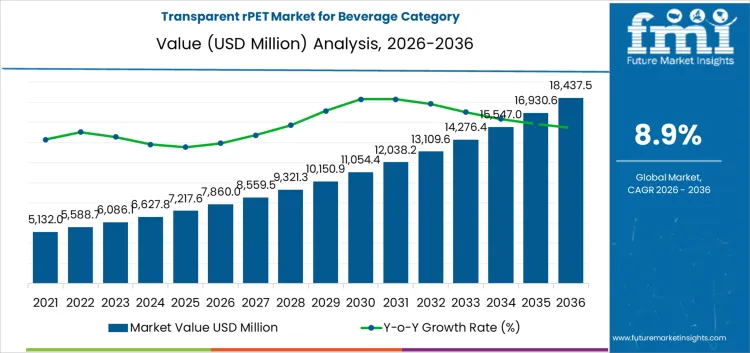
Transparent rPET Market for Beverage Category Key Takeaways
| Metric | Value |
|---|---|
| Transparent rPET Market Value (2026) | USD 7,860 Million |
| Transparent rPET Market Forecast Value (2036) | USD 18,437.5 Million |
| Transparent rPET Market Forecast CAGR 2026 to 2036 | 8.9% |
How are Optical Clarity Requirements and Beverage-Grade Standards Shaping the Transparent rPET Market?
Growth in the transparent rPET market for beverages is being driven by brand mandates to increase recycled content without compromising bottle appearance, shelf appeal, or filling-line performance. Beverage packaging demands high optical clarity, low haze, and consistent color control, making transparent rPET significantly more challenging than non-transparent PCR applications. For resin producers and recyclers, value creation is increasingly tied to advanced sorting, flake purification, and solid-state polymerization processes that deliver near-virgin optical performance at scale.
Qualification and line-compatibility concerns are central to purchasing decisions. Beverage brands and preform manufacturers are evaluating rPET suppliers based on intrinsic viscosity stability, acetaldehyde control, and blow-molding behavior across high-speed filling operations. Even small deviations can impact bottle performance, leading buyers to favor suppliers with proven commercial runs, validated data, and the ability to support plant trials. Long-term supply agreements are becoming common as brands seek volume assurance amid tightening availability of high-quality transparent rPET.
Supply-chain resilience and regional capacity expansion are further influencing market dynamics. Investments in bottle-to-bottle recycling infrastructure in North America, Europe, and Asia Pacific are improving feedstock quality, but competition for clear PET bales remains intense. For suppliers, competitive advantage increasingly depends on securing feedstock access, maintaining optical consistency across batches, and supporting customers through multi-site qualification. Together, brand commitments, stringent performance thresholds, and scaling challenges are sustaining steady growth in the transparent rPET market for beverage applications.
How Is the Transparent rPET Market for Beverage Applications Structured Across Key Segments?
The transparent rPET market for beverage category is segmented by end use and packaging type, reflecting clarity requirements, filling-line compatibility, and volume intensity across beverage formats. By end use, water, CSD, and juice bottles lead the market, supported by high consumption frequency and standardized bottle designs that favor clear packaging. Other end uses include mass beverage applications, premium beverages, bottled water, and soft drinks, each with different clarity and performance expectations. By packaging type, transparent bottles and preforms represent the leading format, while lightweight bottles, high-clarity bottles, and clear bottles serve specific cost, aesthetics, and performance needs.
Why Do Water, CSD, And Juice Bottles Lead End-Use Demand in the Transparent rPET Market For Beverage Category?
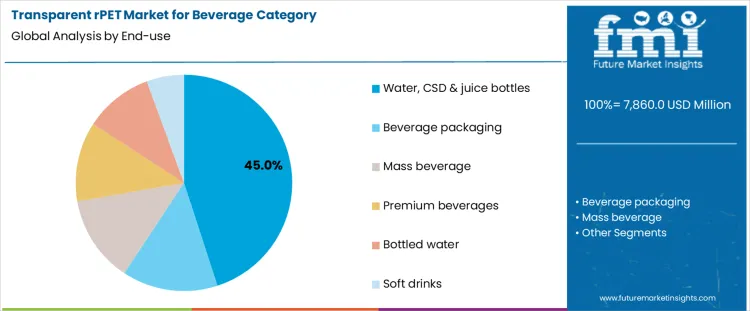
Water, CSD, and juice bottles account for 45% share of the transparent rPET market for beverage category because these products dominate global beverage volumes and rely heavily on clear packaging for product visibility. High-speed bottling lines favor consistent resin behavior and optical clarity to avoid defects and downtime. These categories use standardized bottle shapes and wall thicknesses, enabling faster qualification of transparent rPET at scale. Large retail turnover drives continuous packaging demand across regions. Beverage producers prioritize materials that maintain clarity under carbonation, cold filling, and storage conditions. These volume-driven and processing considerations explain why water, CSD, and juice bottles remain the largest end-use segment.
Why Do Transparent Bottles And Preforms Dominate Packaging Type Adoption?
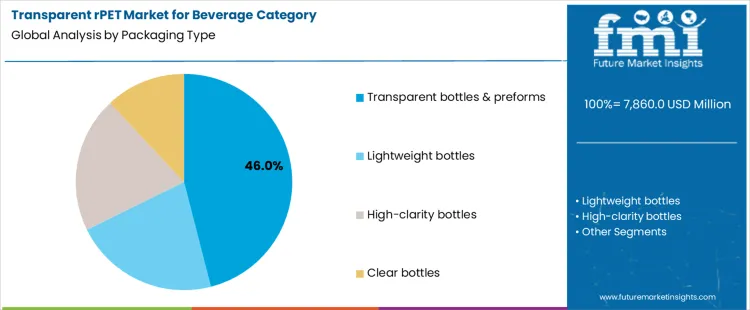
Transparent bottles and preforms hold 46% share of the transparent rPET market for beverage category because they integrate seamlessly into existing injection molding and stretch blow molding operations. Preforms allow centralized production with distributed bottle blowing, supporting logistics efficiency and consistent quality. Clear bottles enhance shelf appeal and allow visual inspection of contents, which is critical for beverages. This format supports lightweighting without compromising rigidity or appearance. Packaging converters value transparent preforms for their predictable processing window and scalability across bottle sizes. These manufacturing and performance advantages position transparent bottles and preforms as the preferred packaging type.
What Are the Key Dynamics of the Transparent rPET Market for Beverage Category?
The transparent rPET market for the beverage category is driven by the need for high-quality recycled PET that delivers clarity, strength, and processability comparable to virgin PET in bottles and drink containers. Beverage producers and packaging converters prioritize optical performance, color consistency, and consistent intrinsic viscosity (IV) to ensure fill-line efficiency, label adhesion, and shelf appeal. For resin suppliers, securing reliable sources of clear post-consumer PET feedstock and implementing robust decontamination and quality control processes are critical to meet tight specification windows. Cost competitiveness against virgin PET and secure supply agreements strongly influence adoption and long-term purchasing strategies.
How Are Quality and Processing Requirements Shaping the Transparent rPET Market?
Quality and processing requirements are shaping the transparent rPET market for beverages by demanding stringent control over intrinsic viscosity, color, haze, and contaminant levels. Beverage bottlers require rPET that can withstand high throughput stretch blow molding without degradation or defect, while also delivering optical transparency that meets brand standards. Suppliers must optimize decontamination processes such as advanced washing, solid-state polymerization (SSP), and filtration to achieve consistent resin quality. Compatibility with existing PET molding equipment and predictable rheological performance are essential for converters to minimize line stoppages and maintain production uptime.
Why Do Feedstock Variability And Certification Standards Restrain Market Growth?
Feedstock variability and certification standards restrain growth in the transparent rPET market for the beverage category. Supply of clear, uncontaminated PET bottles and flake streams fluctuates by region, affecting color, IV, and contaminant profiles of recycled resin. Processing systems must manage these variations without compromising end-use performance; failure to do so can lead to haze, off-colors, or mechanical weaknesses that disqualify the resin for beverage applications. Meeting food-contact compliance, traceability documentation, and third-party certification standards adds complexity and time to product qualification, increasing total cost of ownership and slowing adoption rates among smaller bottlers.
What Is the Country-Wise Outlook for the Transparent rPET Market in Beverage Applications?
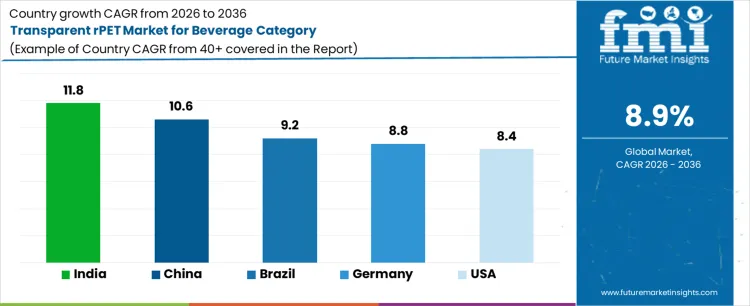
The transparent rPET market for beverages is shaped by recycled-content mandates, bottle-to-bottle recycling targets, and advances in super-clean mechanical recycling. Growth varies by country based on food-contact approvals, availability of clear PET feedstock, collection efficiency, and brand commitments to circular packaging. Mature markets emphasize optical clarity, IV retention, and contamination control to protect shelf appeal, while emerging economies focus on rapid capacity build-out and cost-effective supply. Improvements in hot washing, SSP, melt filtration, and color management are expanding high-clarity rPET availability. Suppliers that ensure certified food-grade quality, stable supply, and application engineering support are best positioned across country markets.
| Country | CAGR (%) |
|---|---|
| India | 11.8 |
| China | 10.6 |
| Brazil | 9.2 |
| Germany | 8.8 |
| United States | 8.4 |
What Is Driving Transparent rPET Adoption in the United States Beverage Market?
Demand for transparent rPET for beverages in the United States, expanding at a CAGR of 8.4% during 2026-2036, is shaped by strong brand commitments to bottle-to-bottle recycling and growing domestic super-clean capacity. Beverage producers require rPET that maintains optical clarity, low acetaldehyde levels, and stable intrinsic viscosity to preserve taste neutrality and shelf appeal. Adoption is supported by upgrades to hot washing, advanced sorting, melt filtration, and solid-state polycondensation lines. Buyers prioritize FDA-compliant processes, supply continuity across multiple regions, and compatibility with high-speed bottling operations. Procurement decisions emphasize scalability, logistics reach, and technical collaboration to minimize line disruptions. Demand spans carbonated soft drinks, bottled water, and ready-to-drink beverages. Volumes are rising steadily, though qualification cycles remain rigorous due to brand protection concerns
How Does Germany Sustain Premium-Quality Transparent rPET for Beverage Bottles?
Sale of transparent rPET for beverages in Germany, growing at a CAGR of 8.8% during 2026-2036, is driven by a mature deposit-return system and strict food-contact compliance requirements. Bottlers and converters demand high-clarity rPET with minimal haze, stable IV, and tight color control to meet premium packaging standards. Adoption is primarily upgrade-led, as recyclers enhance super-clean lines and SSP capacity to increase bottle-grade output from deposit-return feedstock. Buyers emphasize EFSA-compliant processes, traceability, and long-term supply agreements. Qualification cycles are long and specification-intensive, often involving extensive bottle testing and shelf-life validation. Volumes are moderate compared with emerging markets, but unit value remains high due to quality thresholds. Germany rewards suppliers capable of delivering consistent clarity, low odor, and predictable performance aligned with circular packaging targets and national collection systems.
Why Is China emerging as a High-Growth Market for Transparent rPET in Beverages?
The transparent rPET market for beverages in China, expanding at a CAGR of 10.6% during 2026-2036, reflects rapid growth in bottled beverage consumption and large-scale recycling infrastructure development. Buyers focus on high-throughput systems capable of producing increasing volumes of clear rPET from mixed post-consumer feedstock. Domestic recyclers scale capacity quickly, emphasizing cost efficiency and speed of deployment. International technology providers target premium installations requiring improved clarity, lower haze, and better contamination control. Adoption is largely greenfield, supported by recycling parks and policy initiatives encouraging recycled content usage. Procurement decisions prioritize throughput, local service availability, and competitive pricing. Qualification timelines are shorter than in Europe, allowing faster market expansion. China represents a scale-led market where supplier success depends on production capacity, localization, and the ability to progressively enhance clarity and consistency as brand expectations rise.
How Is Brazil Building Momentum for Transparent rPET in Beverage Packaging?
Demand for transparent rPET for beverages in Brazil, growing at a CAGR of 9.2% during 2026-2036, is supported by improving collection rates and growing sustainability commitments from beverage brands. Bottlers seek clear rPET suitable for carbonated and still beverages, emphasizing stable IV, color consistency, and processability on existing lines. Adoption includes both upgrades to existing recycling facilities and selective greenfield projects. Buyers prioritize affordability, supply continuity, and local partnerships to manage feedstock variability. Procurement decisions favor suppliers offering robust super-clean processes, operator training, and technical support. Brazil represents a mid-growth market where reliability, local presence, and gradual quality improvement drive supplier selection.
Why Is India the Fastest-Growing Market for Transparent rPET in Beverages?
Sale of transparent rPET for beverages in India, expanding at a CAGR of 11.8% during 2026-2036, is driven by rapid growth in bottled water and soft drink consumption alongside rising recycling investments. Adoption is largely greenfield-led, with new facilities integrating hot washing, filtration, and SSP from the outset. Buyers emphasize affordability, modular scalability, and ability to improve clarity from heterogeneous feedstock. Qualification cycles are shorter than in developed markets, enabling faster capacity build-out. However, expectations for haze control, odor neutrality, and IV stability are increasing as organized retail and multinational brands expand. India represents a high-growth, early-stage market where suppliers offering adaptable systems, local service support, and phased clarity upgrades can secure long-term positioning in beverage-grade rPET supply chains.
What Sets Competition in the Transparent rPET Market for Beverages?
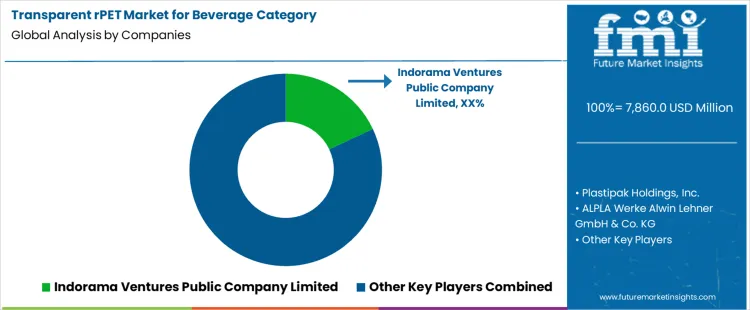
Competition in the transparent rPET market for beverage packaging is anchored in clarity performance, mechanical integrity, and documented compliance with food-contact standards that matter to brand owners, bottlers, and converters. Indorama Ventures Public Company Limited positions its transparent rPET with product literature highlighting high optical clarity, consistent intrinsic viscosity (IV), and food-grade certification. Brochures emphasize closed-loop sourcing partnerships and stable supply commitments to global beverage customers. Plastipak Holdings, Inc. competes through a broad transparent rPET portfolio engineered for high-throughput blow molding; official materials stress uniform melt flow, color consistency, and integration with existing production lines without compromise to barrier performance.
Converters with packaging systems expertise differentiate on end-use readiness. ALPLA Werke Alwin Lehner GmbH & Co. KG combines transparent rPET resins with tailored bottle designs documented in brochures that highlight recyclate content levels, aesthetic clarity, and optimized wall performance for carbonated and still beverages. Krones AG positions its solutions with technical documentation that links rPET resin quality with processing reliability on filling and labeling systems, underscoring efficiency gains and minimized downtime in beverage lines.
Asia-Pacific and innovator brands emphasize localized integration and sustainability narratives. Far Eastern New Century Corporation markets transparent rPET with product guides focused on balanced mechanical strength and thermal stability suitable for returnable and single-use formats. JEPLAN, Inc. competes through advanced recycling technologies that feed high-clarity rPET back into beverage production, with materials underscoring closed-loop system performance. Suntory Holdings Limited differentiates by deploying its branded rPET across global beverage portfolios, supported by documentation on lifecycle impact and PCR traceability. Across suppliers, competitive value is built on brochure-verified clarity metrics, regulatory compliance, and stable supply frameworks rather than cost alone.
Key Players in Transparent rPET Market for Beverage Category
- Indorama Ventures Public Company Limited
- Plastipak Holdings, Inc.
- ALPLA Werke Alwin Lehner GmbH & Co. KG
- Krones AG
- Far Eastern New Century Corporation
- JEPLAN, Inc.
- Suntory Holdings Limited
Scope of Report
| Attribute | Description |
|---|---|
| Quantitative Unit | USD Million |
| End-use | Water, CSD & Juice Bottles, Beverage Packaging, Mass Beverage, Premium Beverages, Bottled Water, Soft Drinks |
| Packaging Type | Transparent Bottles & Preforms, Lightweight Bottles, High-Clarity Bottles, Clear Bottles |
| Countries Covered | China, Japan, South Korea, India, Australia & New Zealand, ASEAN, Rest of Asia Pacific, Germany, United Kingdom, France, Italy, Spain, Nordic, BENELUX, Rest of Europe, United States, Canada, Mexico, Brazil, Chile, Rest of Latin America, Kingdom of Saudi Arabia, Other GCC Countries, Turkey, South Africa, Other African Union, Rest of Middle East & Africa |
| Regions Covered | Asia Pacific, Europe, North America, Latin America, Middle East & Africa |
| Key Companies Profiled | Indorama Ventures Public Company Limited, Plastipak Holdings, Inc., ALPLA Werke Alwin Lehner GmbH & Co. KG, Krones AG, Far Eastern New Century Corporation, JEPLAN, Inc., Suntory Holdings Limited |
| Additional Attributes | Dollar sales by end-use and packaging type are analyzed across beverage bottling and brand packaging systems. The report includes country-level demand assessment, growth projections for 2026-2036, evaluation of clarity retention and IV performance, assessment of food-contact compliance and rPET quality, competitive benchmarking of resin and bottle suppliers, and analysis of sustainability-driven adoption across global beverage value chains. |
Transparent rPET Market for Beverage Category by Key Segments
End-use
- Water, CSD & juice bottles
- Beverage packaging
- Mass beverage
- Premium beverages
- Bottled water
- Soft drinks
Packaging Type
- Transparent bottles & preforms
- Lightweight bottles
- High-clarity bottles
- Clear bottles
Region:
- Asia Pacific
- China
- Japan
- South Korea
- India
- Australia & New Zealand
- ASEAN
- Rest of Asia Pacific
- Europe
- Germany
- United Kingdom
- France
- Italy
- Spain
- Nordic
- BENELUX
- Rest of Europe
- North America
- United States
- Canada
- Mexico
- Latin America
- Brazil
- Chile
- Rest of Latin America
- Middle East & Africa
- Kingdom of Saudi Arabia
- Other GCC Countries
- Turkey
- South Africa
- Other African Union
- Rest of Middle East & Africa
Bibliography
- Organisation for Economic Co-operation and Development. (2024). Circular economy policy approaches for flexible plastic packaging recycling. OECD Publishing.
- United Nations Environment Programme. (2024). Technical guidance for food-grade rPET production and beverage packaging applications. UN Environment Programme.
- International Organization for Standardization. (2024). ISO 15270: Plastics — Guidelines for the recovery and recycling of plastics waste. ISO.
Frequently Asked Questions
How big is the transparent rPET market for beverage category in 2026?
The global transparent rPET market for beverage category is estimated to be valued at USD 7,860.0 million in 2026.
What will be the size of transparent rPET market for beverage category in 2036?
The market size for the transparent rPET market for beverage category is projected to reach USD 18,437.5 million by 2036.
How much will be the transparent rPET market for beverage category growth between 2026 and 2036?
The transparent rPET market for beverage category is expected to grow at a 8.9% CAGR between 2026 and 2036.
What are the key product types in the transparent rPET market for beverage category?
The key product types in transparent rPET market for beverage category are water, csd & juice bottles, beverage packaging, mass beverage, premium beverages, bottled water and soft drinks.
Which packaging type segment to contribute significant share in the transparent rPET market for beverage category in 2026?
In terms of packaging type, transparent bottles & preforms segment to command 46.0% share in the transparent rPET market for beverage category in 2026.
Preview the report firsthand - request a free sample
Get SampleGet the brochure for pricing and purchase details.
Get PDFTable of Content
- Executive Summary
- Global Market Outlook
- Demand-side Trends
- Supply-side Trends
- Technology Roadmap Analysis
- Analysis and Recommendations
- Market Overview
- Market Coverage / Taxonomy
- Market Definition / Scope / Limitations
- Market Background
- Market Dynamics
- Drivers
- Restraints
- Opportunity
- Trends
- Scenario Forecast
- Demand in Optimistic Scenario
- Demand in Likely Scenario
- Demand in Conservative Scenario
- Opportunity Map Analysis
- Product Life Cycle Analysis
- Supply Chain Analysis
- Investment Feasibility Matrix
- Value Chain Analysis
- PESTLE and Porter’s Analysis
- Regulatory Landscape
- Regional Parent Market Outlook
- Production and Consumption Statistics
- Import and Export Statistics
- Market Dynamics
- Global Market Analysis 2021 to 2025 and Forecast, 2026 to 2036
- Historical Market Size Value (USD Million) Analysis, 2021 to 2025
- Current and Future Market Size Value (USD Million) Projections, 2026 to 2036
- Y-o-Y Growth Trend Analysis
- Absolute $ Opportunity Analysis
- Global Market Pricing Analysis 2021 to 2025 and Forecast 2026 to 2036
- Global Market Analysis 2021 to 2025 and Forecast 2026 to 2036, By End-use
- Introduction / Key Findings
- Historical Market Size Value (USD Million) Analysis By End-use , 2021 to 2025
- Current and Future Market Size Value (USD Million) Analysis and Forecast By End-use , 2026 to 2036
- Water, CSD & juice bottles
- Beverage packaging
- Mass beverage
- Premium beverages
- Bottled water
- Soft drinks
- Water, CSD & juice bottles
- Y-o-Y Growth Trend Analysis By End-use , 2021 to 2025
- Absolute $ Opportunity Analysis By End-use , 2026 to 2036
- Global Market Analysis 2021 to 2025 and Forecast 2026 to 2036, By Packaging Type
- Introduction / Key Findings
- Historical Market Size Value (USD Million) Analysis By Packaging Type, 2021 to 2025
- Current and Future Market Size Value (USD Million) Analysis and Forecast By Packaging Type, 2026 to 2036
- Transparent bottles & preforms
- Lightweight bottles
- High-clarity bottles
- Clear bottles
- Transparent bottles & preforms
- Y-o-Y Growth Trend Analysis By Packaging Type, 2021 to 2025
- Absolute $ Opportunity Analysis By Packaging Type, 2026 to 2036
- Global Market Analysis 2021 to 2025 and Forecast 2026 to 2036, By Region
- Introduction
- Historical Market Size Value (USD Million) Analysis By Region, 2021 to 2025
- Current Market Size Value (USD Million) Analysis and Forecast By Region, 2026 to 2036
- North America
- Latin America
- Western Europe
- Eastern Europe
- East Asia
- South Asia and Pacific
- Middle East & Africa
- Market Attractiveness Analysis By Region
- North America Market Analysis 2021 to 2025 and Forecast 2026 to 2036, By Country
- Historical Market Size Value (USD Million) Trend Analysis By Market Taxonomy, 2021 to 2025
- Market Size Value (USD Million) Forecast By Market Taxonomy, 2026 to 2036
- By Country
- USA
- Canada
- Mexico
- By End-use
- By Packaging Type
- By Country
- Market Attractiveness Analysis
- By Country
- By End-use
- By Packaging Type
- Key Takeaways
- Latin America Market Analysis 2021 to 2025 and Forecast 2026 to 2036, By Country
- Historical Market Size Value (USD Million) Trend Analysis By Market Taxonomy, 2021 to 2025
- Market Size Value (USD Million) Forecast By Market Taxonomy, 2026 to 2036
- By Country
- Brazil
- Chile
- Rest of Latin America
- By End-use
- By Packaging Type
- By Country
- Market Attractiveness Analysis
- By Country
- By End-use
- By Packaging Type
- Key Takeaways
- Western Europe Market Analysis 2021 to 2025 and Forecast 2026 to 2036, By Country
- Historical Market Size Value (USD Million) Trend Analysis By Market Taxonomy, 2021 to 2025
- Market Size Value (USD Million) Forecast By Market Taxonomy, 2026 to 2036
- By Country
- Germany
- UK
- Italy
- Spain
- France
- Nordic
- BENELUX
- Rest of Western Europe
- By End-use
- By Packaging Type
- By Country
- Market Attractiveness Analysis
- By Country
- By End-use
- By Packaging Type
- Key Takeaways
- Eastern Europe Market Analysis 2021 to 2025 and Forecast 2026 to 2036, By Country
- Historical Market Size Value (USD Million) Trend Analysis By Market Taxonomy, 2021 to 2025
- Market Size Value (USD Million) Forecast By Market Taxonomy, 2026 to 2036
- By Country
- Russia
- Poland
- Hungary
- Balkan & Baltic
- Rest of Eastern Europe
- By End-use
- By Packaging Type
- By Country
- Market Attractiveness Analysis
- By Country
- By End-use
- By Packaging Type
- Key Takeaways
- East Asia Market Analysis 2021 to 2025 and Forecast 2026 to 2036, By Country
- Historical Market Size Value (USD Million) Trend Analysis By Market Taxonomy, 2021 to 2025
- Market Size Value (USD Million) Forecast By Market Taxonomy, 2026 to 2036
- By Country
- China
- Japan
- South Korea
- By End-use
- By Packaging Type
- By Country
- Market Attractiveness Analysis
- By Country
- By End-use
- By Packaging Type
- Key Takeaways
- South Asia and Pacific Market Analysis 2021 to 2025 and Forecast 2026 to 2036, By Country
- Historical Market Size Value (USD Million) Trend Analysis By Market Taxonomy, 2021 to 2025
- Market Size Value (USD Million) Forecast By Market Taxonomy, 2026 to 2036
- By Country
- India
- ASEAN
- Australia & New Zealand
- Rest of South Asia and Pacific
- By End-use
- By Packaging Type
- By Country
- Market Attractiveness Analysis
- By Country
- By End-use
- By Packaging Type
- Key Takeaways
- Middle East & Africa Market Analysis 2021 to 2025 and Forecast 2026 to 2036, By Country
- Historical Market Size Value (USD Million) Trend Analysis By Market Taxonomy, 2021 to 2025
- Market Size Value (USD Million) Forecast By Market Taxonomy, 2026 to 2036
- By Country
- Kingdom of Saudi Arabia
- Other GCC Countries
- Turkiye
- South Africa
- Other African Union
- Rest of Middle East & Africa
- By End-use
- By Packaging Type
- By Country
- Market Attractiveness Analysis
- By Country
- By End-use
- By Packaging Type
- Key Takeaways
- Key Countries Market Analysis
- USA
- Pricing Analysis
- Market Share Analysis, 2025
- By End-use
- By Packaging Type
- Canada
- Pricing Analysis
- Market Share Analysis, 2025
- By End-use
- By Packaging Type
- Mexico
- Pricing Analysis
- Market Share Analysis, 2025
- By End-use
- By Packaging Type
- Brazil
- Pricing Analysis
- Market Share Analysis, 2025
- By End-use
- By Packaging Type
- Chile
- Pricing Analysis
- Market Share Analysis, 2025
- By End-use
- By Packaging Type
- Germany
- Pricing Analysis
- Market Share Analysis, 2025
- By End-use
- By Packaging Type
- UK
- Pricing Analysis
- Market Share Analysis, 2025
- By End-use
- By Packaging Type
- Italy
- Pricing Analysis
- Market Share Analysis, 2025
- By End-use
- By Packaging Type
- Spain
- Pricing Analysis
- Market Share Analysis, 2025
- By End-use
- By Packaging Type
- France
- Pricing Analysis
- Market Share Analysis, 2025
- By End-use
- By Packaging Type
- India
- Pricing Analysis
- Market Share Analysis, 2025
- By End-use
- By Packaging Type
- ASEAN
- Pricing Analysis
- Market Share Analysis, 2025
- By End-use
- By Packaging Type
- Australia & New Zealand
- Pricing Analysis
- Market Share Analysis, 2025
- By End-use
- By Packaging Type
- China
- Pricing Analysis
- Market Share Analysis, 2025
- By End-use
- By Packaging Type
- Japan
- Pricing Analysis
- Market Share Analysis, 2025
- By End-use
- By Packaging Type
- South Korea
- Pricing Analysis
- Market Share Analysis, 2025
- By End-use
- By Packaging Type
- Russia
- Pricing Analysis
- Market Share Analysis, 2025
- By End-use
- By Packaging Type
- Poland
- Pricing Analysis
- Market Share Analysis, 2025
- By End-use
- By Packaging Type
- Hungary
- Pricing Analysis
- Market Share Analysis, 2025
- By End-use
- By Packaging Type
- Kingdom of Saudi Arabia
- Pricing Analysis
- Market Share Analysis, 2025
- By End-use
- By Packaging Type
- Turkiye
- Pricing Analysis
- Market Share Analysis, 2025
- By End-use
- By Packaging Type
- South Africa
- Pricing Analysis
- Market Share Analysis, 2025
- By End-use
- By Packaging Type
- USA
- Market Structure Analysis
- Competition Dashboard
- Competition Benchmarking
- Market Share Analysis of Top Players
- By Regional
- By End-use
- By Packaging Type
- Competition Analysis
- Competition Deep Dive
- Indorama Ventures Public Company Limited
- Overview
- Product Portfolio
- Profitability by Market Segments (Product/Age /Sales Channel/Region)
- Sales Footprint
- Strategy Overview
- Marketing Strategy
- Product Strategy
- Channel Strategy
- Plastipak Holdings, Inc.
- ALPLA Werke Alwin Lehner GmbH & Co. KG
- Krones AG
- Far Eastern New Century Corporation
- JEPLAN, Inc.
- Suntory Holdings Limited
- Indorama Ventures Public Company Limited
- Competition Deep Dive
- Assumptions & Acronyms Used
- Research Methodology


