

- Industry Size (2026)
- USD 2.6 Bn
- Forecast (2036)
- USD 4.3 Bn
- CAGR (2026 to 2036)
- 5.1%
Tray Dryer Market Forecast and Outlook 2026 to 2036
The tray dryer market is projected to reach USD 4.3 billion by 2036, growing at a CAGR of 5.1% from its 2026 value of USD 2.6 billion. This market holds strategic importance within industries such as pharmaceuticals, food processing, and chemicals, where efficient drying is crucial to product quality and consistency. Control points in the market are influenced by energy efficiency, cost-effective production, and regulatory compliance, as these industries face increasing pressure to meet sustainability targets. Dependency factors include the need for specialized equipment that meets diverse processing requirements across sectors.
Strategic trade-offs will revolve around balancing technological advancements, such as automation and energy efficiency, with the practical need to maintain competitive pricing. Vendors will need to navigate these considerations while also adapting to fluctuating raw material costs and shifts in regulatory standards. Suppliers able to innovate while ensuring reliability will hold a significant advantage in securing long-term, value-driven contracts.
Quick Stats for the Tray Dryer Market
- Tray Dryer Market Value (2026): USD 2.6 billion
- Tray Dryer Market Forecast Value (2036): USD 4.3 billion
- Tray Dryer Market Global Forecast CAGR 2026 to 2036: 5.1%
- Tray Dryer Market Leading Segment: Stainless Steel (SS304/316) (56%)
- Key Growth Regions in Tray Dryer Market: India
- Top Players in Tray Dryer Market: GEA Group, Hosokawa Micron, Bühler Group, SPX FLOW, GMP Engineering, SSP Pvt. Ltd., Rico Scientific, Yamato Scientific, Pope Scientific, Regional Fabricators
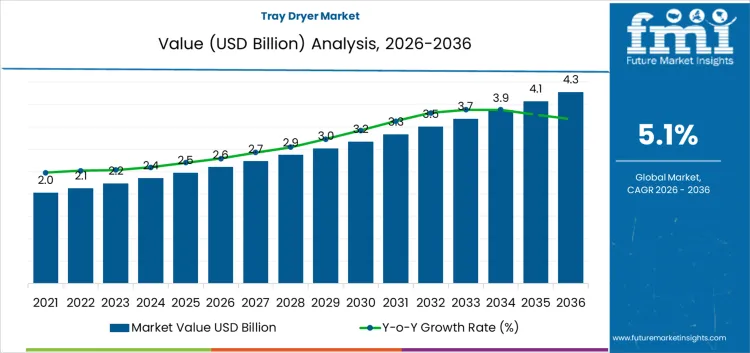
What is the Year-on-Year (YoY) Growth Analysis for the Tray Dryer Market through 2036?
The year-on-year growth analysis for the tray dryer market shows consistent growth over the forecast period, with moderate increases in market value each year. Starting from USD 2.6 billion in 2026, the market will see steady increases, reaching USD 2.8 billion in 2027 and USD 2.9 billion in 2028. This early phase reflects the ongoing demand for drying technology across industries like pharmaceuticals and food processing.
Between 2028 and 2030, the market will experience slightly faster growth, with values rising from USD 2.9 billion in 2028 to USD 3.2 billion in 2030. This period is characterized by the continued adoption of more energy-efficient and advanced drying systems, along with growth in sectors like food processing and pharmaceuticals.
In the later years (2030-2036), the market will continue its steady upward trajectory, reaching USD 4.3 billion by 2036. The growth rate will remain stable, reflecting the increasing need for reliable and efficient tray drying systems. The YoY growth will be driven by the broadening application of tray dryers in multiple industries and the rising demand for consistent, high-quality drying solutions across global markets.
Tray Dryer Market Key Takeaways
| Metric | Value |
|---|---|
| Industry Sales Value (2026) | USD 2.6 billion |
| Industry Forecast Value (2036) | USD 4.3 billion |
| Industry Forecast CAGR 2026 to 2036 | 5.1% |
What Is Driving the Tray Dryer Market?
Historically, the tray dryer market developed as manufacturers across pharmaceuticals, chemicals, food processing, and materials industries sought more reliable methods for removing moisture from solids and semi-solids. Early drying techniques relied heavily on sun drying, basic ambient airflow ovens, or uncontrolled heat sources that delivered uneven moisture removal and inconsistent product quality. As production demands increased and quality standards tightened, tray dryers were introduced to deliver controlled temperature and airflow, enabling uniform drying across multiple stacked trays.
Initial adoption centered on industries where moisture content directly affected product stability, shelf life, and downstream processing, such as active pharmaceutical ingredients, fine chemicals, and dehydrated foods. These early tray dryers provided repeatability and improved batch control, reducing product loss from over-drying or microbial growth. Operators gained better process control through adjustable air distribution systems and regulated heat sources that helped standardize drying cycles. This phase clarified the value of enclosed, temperature-controlled drying chambers with structured tray arrangements, distinguishing tray dryers from less precise drying methods.
Future demand for tray dryers is expected to be shaped by continued expansion of industries that depend on precise moisture removal, stricter quality and safety standards, and integration with digital process controls. Growth drivers include rising pharmaceutical and nutraceutical production worldwide, increasing demand for dried food ingredients, and broader use of tray dryers in chemical intermediates and advanced materials manufacturing. Manufacturers are expected to invest in advanced tray dryer designs that offer uniform airflow distribution, energy-efficient heat recirculation, and automated controls that support programmable drying profiles and recipe management.
Digital sensor integration and process monitoring will enable real-time adjustments to temperature and humidity, reducing cycle times and improving throughput. Sustainability considerations will encourage designs that minimize energy consumption and maximize heat recovery, particularly in high-volume operations. Barriers include the initial capital cost of modern, fully automated tray drying systems and the need for skilled operators to manage complex process variables. Long-term market expansion will depend on how effectively tray dryer suppliers deliver scalable, modular solutions that balance precision, energy efficiency, and integration with broader production workflows across diverse end-use sectors.
What are the Key Segments in the Tray Dryer Market?
The Tray Dryer market is segmented by construction and heat source. Construction types include stainless steel (SS304/316), MS with SS contact parts, fully MS, and others, with stainless steel (SS304/316) holding the largest market share at 56%. Heat sources include steam or hot water, electric, gas-fired, and others, with steam or hot water being the most commonly used heat source at 38%. The market is driven by the increasing demand for efficient drying solutions in various industries, particularly in pharmaceuticals, food processing, and chemicals. The need for reliable, durable, and energy-efficient tray dryers is growing as manufacturing processes become more sophisticated and as industries seek to meet stringent product quality standards. Key regions driving the growth of the market include North America, Europe, and Asia Pacific, where industrial expansion and technological advancements are accelerating the adoption of tray dryers.
What is Driving Growth in the Stainless Steel (SS304/316) Construction Segment?
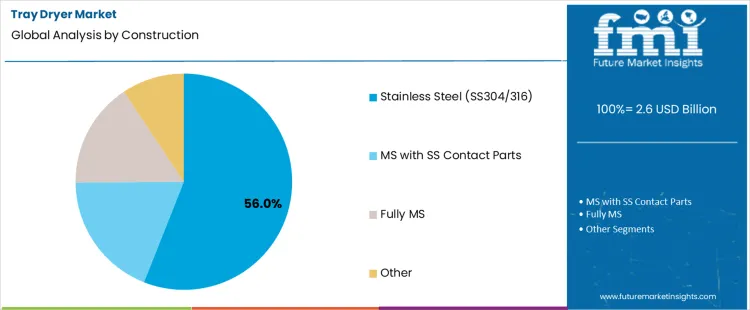
Stainless steel (SS304/316) is the leading construction material in the Tray Dryer market, accounting for 56% of the market share. This growth is primarily driven by the superior properties of stainless steel, including its resistance to corrosion, high durability, and ability to withstand high temperatures, making it ideal for use in drying processes where hygiene and long-term performance are essential. Industries such as pharmaceuticals, food processing, and chemicals, where precise and contamination-free drying is required, prefer stainless steel construction for tray dryers. Additionally, SS304/316 is resistant to chemical corrosion, which is crucial in applications where drying involves substances that could damage other materials. The increasing demand for high-quality, durable equipment in sectors like pharmaceuticals and food production, where compliance with stringent safety and quality standards is necessary, is further propelling the use of stainless steel in tray dryers. As industries continue to focus on reliability, safety, and efficiency, the preference for stainless steel tray dryers is expected to remain strong, particularly in regions like North America and Europe, where industrial standards and regulations are more stringent.
What is Driving the Demand for Steam or Hot Water Heat Source in the Tray Dryer Market?
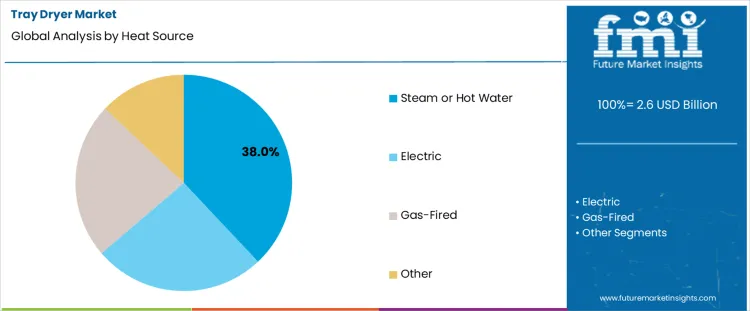
Steam or hot water is the dominant heat source in the Tray Dryer market, holding 38% of the market share. This growth is largely due to the efficiency and effectiveness of steam or hot water in providing consistent, controllable heat for drying applications. Steam is widely used in industries such as pharmaceuticals and food processing because it offers precise temperature control and uniform heat distribution, which is essential for maintaining product quality and preventing overheating or uneven drying. Additionally, steam is readily available in many industrial settings, making it a cost-effective heat source for large-scale operations. In pharmaceutical manufacturing, where maintaining the integrity of active ingredients is crucial, steam or hot water heat sources ensure uniform drying conditions, preventing any potential degradation of sensitive materials. The demand for steam or hot water as a heat source is also driven by its energy efficiency, as it can be integrated into existing industrial heating systems. As industries continue to prioritize energy-efficient and controlled drying processes, the adoption of steam or hot water heat sources is expected to grow, particularly in regions with established industrial infrastructure.
What are the Key Dynamics in the Tray Dryer Market?
The tray dryer market is experiencing growth due to its widespread use in various industries such as pharmaceuticals, food processing, chemicals, and agriculture. Tray dryers are essential for drying heat-sensitive materials, including powders, granules, and wet solids, by using a low-temperature environment and continuous airflow. The market is driven by the increasing demand for dried products, such as food, pharmaceuticals, and chemicals, as well as the need for efficient and energy-saving drying methods. The trend toward automation in industrial drying processes, as well as advancements in tray dryer technology, which offer enhanced energy efficiency, uniform drying, and improved temperature control, are also contributing to the market’s expansion.
What are the Key Drivers of Growth in the Tray Dryer Market?
The growth of the tray dryer market is primarily driven by the increasing demand for dried products across multiple industries. In the pharmaceutical industry, tray dryers are critical for drying granules and powders for tablet and capsule formulations. The food processing industry is another major driver, as the demand for dried fruits, vegetables, spices, and other food products increases. Tray dryers also help preserve the shelf life of these products while maintaining their nutritional value. The demand for energy-efficient and cost-effective drying solutions is also pushing market growth, as tray dryers are often considered a more energy-efficient option compared to other drying methods. Furthermore, advancements in tray dryer technologies, such as the integration of temperature controls, humidity sensors, and automated loading/unloading systems, are enhancing the efficiency and versatility of these machines, driving further adoption.
What are the Key Restraints in the Tray Dryer Market?
Despite the promising growth prospects, the tray dryer market faces several challenges. One of the main restraints is the high initial cost of tray dryer systems, especially those with advanced features such as temperature control, automation, and energy-saving technologies. This can be a barrier for small and medium-sized enterprises that may have budget constraints. Additionally, tray dryers require significant space for installation, which could be a limitation for businesses with limited floor space or smaller production facilities. Another challenge is the longer drying time required for some materials, which could affect overall production efficiency. While tray dryers are generally energy-efficient, some models may still consume significant power during operation, especially for large-scale drying processes, which could result in higher operating costs. Finally, the need for regular maintenance and calibration to ensure the consistent performance of tray dryers adds to the operational costs and can limit their appeal for some manufacturers.
What are the Key Trends in the Tray Dryer Market?
Several key trends are shaping the tray dryer market. One significant trend is the growing focus on energy efficiency, with manufacturers developing tray dryers that consume less energy while providing faster and more uniform drying results. The use of heat recovery systems and advanced air circulation techniques is becoming more common, allowing for greater energy savings. Another trend is the increasing automation of tray dryers, where systems are integrated with sensors and automated controls for more precise drying operations. This reduces human error and improves overall productivity. The development of more compact and modular tray dryers is also a key trend, as these systems can be more easily adapted to smaller production facilities and spaces. Additionally, there is a shift toward sustainable and eco-friendly drying solutions, with the market seeing the emergence of tray dryers that use renewable energy sources or are designed to minimize waste and emissions. Finally, the rise of demand for customized drying solutions, especially in the pharmaceutical and food sectors, is prompting manufacturers to offer more flexible and adaptable tray dryer systems that can meet specific product requirements.
What is the Country-Wise Analysis of the Tray Dryer Market?
The tray dryer market is growing as industries such as pharmaceuticals, food processing, and chemicals require efficient drying solutions to remove moisture from products, ensuring better quality, shelf life, and handling. Tray dryers are widely used for drying bulk materials like powders, granules, and even food items in large quantities. The market is driven by the growing demand for high-quality drying equipment, increased production in various industries, and the need for energy-efficient solutions. Countries like India, China, Vietnam, Indonesia, and Mexico are witnessing growth in this market, influenced by industrial expansion, growing pharmaceutical and food sectors, and a rising focus on energy-efficient technologies in manufacturing processes.
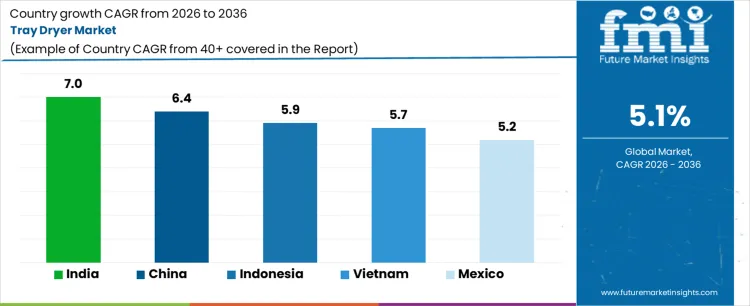
| Country | CAGR (%) |
|---|---|
| India | 7 |
| China | 6.4 |
| Vietnam | 5.7 |
| Indonesia | 5.9 |
| Mexico | 5.2 |
What is Driving the Growth of the Tray Dryer Market in India?
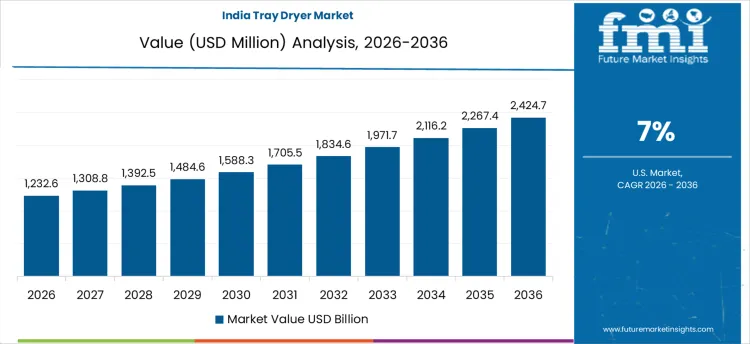
India’s tray dryer market is growing at a CAGR of 7%. The growth is largely driven by the expansion of India’s pharmaceutical, food processing, and chemical industries, all of which rely on drying equipment to ensure product quality. The increasing demand for processed food, along with the growing pharmaceutical manufacturing sector, is driving the need for efficient drying solutions like tray dryers. India’s focus on industrial modernization, along with government initiatives to support manufacturing growth, is further contributing to the demand for drying technologies. As the country’s food and pharmaceutical industries continue to grow, the demand for tray dryers is expected to rise, supporting market growth.
How is the Tray Dryer Market Performing in China?
China’s tray dryer market is growing at a CAGR of 6.4%. China’s industrial expansion, particularly in the pharmaceutical, food, and chemical sectors, is driving the demand for drying solutions. With the country’s large manufacturing base, there is an increasing need for high-quality equipment like tray dryers that can handle bulk drying processes efficiently. The rise in food processing and the expansion of China’s pharmaceutical industry, particularly in producing processed food and medicines, are key factors supporting the demand for tray dryers. As China continues to modernize its manufacturing processes and improve product quality, the market for tray dryers is expected to grow steadily, driven by the increasing focus on efficiency and automation in industrial production.
What Factors are Shaping the Tray Dryer Market in Vietnam?
Vietnam’s tray dryer market is growing at a CAGR of 5.7%. The growth in Vietnam is being driven by the expansion of the pharmaceutical, food processing, and chemical industries, which require efficient drying technologies. With the growing demand for processed food, medicines, and chemicals, the need for high-quality drying equipment is rising. Vietnam’s industrial development, combined with increasing investments in food processing and pharmaceutical manufacturing, is contributing to the market growth. Additionally, the focus on improving production efficiency and product quality in these sectors is pushing demand for advanced drying equipment, including tray dryers. As the country continues to develop its industrial capabilities, the tray dryer market is expected to see continued growth.
How is the Tray Dryer Market Evolving in Indonesia?
Indonesia’s tray dryer market is growing at a CAGR of 5.9%. The market is driven by the growing pharmaceutical and food processing industries, both of which require reliable drying solutions. With increasing demand for high-quality food products and medicines, the need for efficient drying technologies, such as tray dryers, is rising. Indonesia’s industrial sector is undergoing modernization, and as the food processing and pharmaceutical industries expand, there is an increasing focus on upgrading manufacturing processes. Additionally, the government’s support for the development of the manufacturing sector is expected to further boost the demand for advanced drying technologies. As Indonesia continues to grow its industrial and food sectors, the demand for tray dryers is expected to rise steadily.
What is Contributing to the Growth of the Tray Dryer Market in Mexico?
Mexico’s tray dryer market is growing at a CAGR of 5.2%. The growth is driven by Mexico’s expanding food processing, pharmaceutical, and chemical industries. As the demand for processed food, pharmaceuticals, and chemicals increases, the need for efficient drying solutions like tray dryers is also growing. The country’s manufacturing sector is modernizing, and there is increasing adoption of technologies that improve production efficiency and product quality. The demand for tray dryers is further supported by the country’s increasing focus on export-driven industries and industrial growth. As Mexico continues to improve its industrial infrastructure and expand its manufacturing capabilities, the market for tray dryers is expected to continue growing at a steady pace.
What is the Competitive Landscape for the Tray Dryer Market?
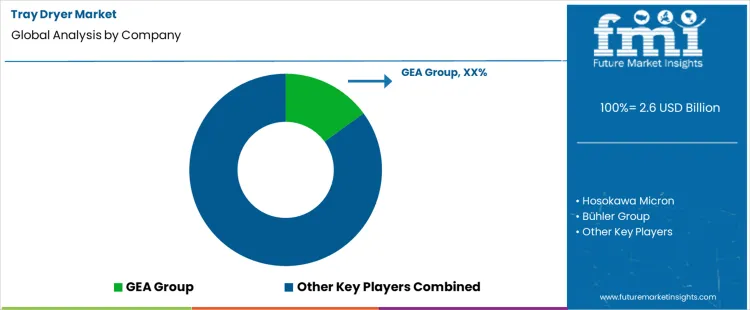
The tray dryer market is growing as industries such as pharmaceuticals, food processing, chemicals, and manufacturing demand efficient and reliable drying solutions for heat-sensitive materials. GEA Group leads the market with its advanced tray dryer systems that offer high efficiency, uniform drying, and precise temperature control. GEA’s systems are widely used across multiple industries, particularly in pharmaceutical and food sectors, due to their reliability and energy efficiency. Hosokawa Micron is another key competitor, providing innovative drying solutions that combine advanced technology with scalability, catering to industries with complex drying requirements. The company focuses on customization and high-performance solutions, which ensure consistent results across various materials. Bühler Group also competes in the market, offering tray dryers that prioritize energy efficiency and gentle drying, making them ideal for food and feed industries.
Bühler’s emphasis on sustainability and process optimization further strengthens its position in the market. SPX FLOW provides reliable drying solutions, including tray dryers that meet the needs of diverse industries, offering flexibility, precision, and ease of use. GMP Engineering specializes in high-performance tray dryers for pharmaceutical and food applications, with an emphasis on compliance with industry regulations and energy-saving features. SSP Pvt. Ltd. offers cost-effective tray drying systems that cater to the needs of smaller-scale operations and emerging markets.
Rico Scientific provides versatile and efficient tray dryers suitable for both laboratory and industrial applications, with an emphasis on durability and ease of operation. Yamato Scientific and Pope Scientific are also key players, offering robust and precise drying equipment, particularly for laboratory-scale operations. Regional Fabricators, focusing on local and customized solutions, contribute to the market by providing flexible, affordable tray dryers for smaller-scale or regional needs.
To stay competitive in the tray dryer market, companies are focusing on technological innovation, energy efficiency, and customization. GEA Group continues to lead by enhancing its tray dryers with advanced control systems, real-time monitoring, and integration capabilities, improving operational efficiency and ensuring consistent drying performance. Hosokawa Micron is advancing its drying systems by incorporating smarter technologies, such as automation and energy optimization, to cater to a broader range of industries. Bühler Group emphasizes sustainability, focusing on reducing energy consumption and minimizing environmental impact while enhancing drying uniformity.
SPX FLOW is expanding its portfolio of tray dryers, incorporating advanced features like variable speed drives and energy recovery systems to offer more efficient drying solutions. GMP Engineering is working on improving the scalability of its systems, offering flexible solutions for both small- and large-scale production environments. SSP Pvt. Ltd. focuses on providing cost-effective solutions while maintaining high-quality standards to serve emerging markets. Rico Scientific continues to innovate with laboratory-grade tray dryers, ensuring high precision and ease of use for smaller-scale applications.
Yamato Scientific and Pope Scientific are enhancing their systems with features that improve drying efficiency and user control. Regional Fabricators are focusing on providing affordable, customized tray dryer solutions tailored to the specific needs of regional customers. These strategies position these companies to lead the growing tray dryer market, meeting the increasing demand for efficient, reliable, and energy-efficient drying systems across industries.
Key Players of the Tray Dryer Market
- GEA Group
- Hosokawa Micron
- Bühler Group
- SPX FLOW
- GMP Engineering
- SSP Pvt. Ltd.
- Rico Scientific
- Yamato Scientific
- Pope Scientific
- Regional Fabricators
Scope of the Report
| Items | Values |
|---|---|
| Quantitative Units (2026) | USD Billion |
| Heat Source | Steam or Hot Water, Electric, Gas-Fired, Other |
| End Use | Pharmaceuticals, Chemicals & Specialty Materials, Food Processing, Others |
| Construction | Stainless Steel (SS304/316), MS with SS Contact Parts, Fully MS, Other |
| Sales Channel | EPC or Project Direct, Direct OEM Sales, Distributors, Other |
| Companies | GEA Group, Hosokawa Micron, Bühler Group, SPX FLOW, GMP Engineering, SSP Pvt. Ltd., Rico Scientific, Yamato Scientific, Pope Scientific, Regional Fabricators |
| Regions Covered | North America, Latin America, Western Europe, Eastern Europe, South Asia and Pacific, East Asia, Middle East & Africa |
| Countries Covered | United States, Canada, Mexico, Brazil, Argentina, Germany, France, United Kingdom, Italy, Spain, Netherlands, China, India, Japan, South Korea, ANZ, GCC Countries, South Africa |
| Additional Attributes | Dollar by sales by heat source, end use, construction, and sales channel. Includes market trends towards energy efficiency, cost-effectiveness, regulatory compliance, and the role of tray dryers in enhancing manufacturing processes across industries. |
Tray Dryer Market Segmentation
By Heat Source:
- Steam or Hot Water
- Electric
- Gas-Fired
- Other
By End Use:
- Pharmaceuticals
- Chemicals & Specialty Materials
- Food Processing
- Others
By Construction:
- Stainless Steel (SS304/316)
- MS with SS Contact Parts
- Fully MS
- Other
By Sales Channel:
- EPC or Project Direct
- Direct OEM Sales
- Distributors
- Other
By Region:
- Asia Pacific
- China
- Japan
- India
- Australia & New Zealand
- ASEAN
- Rest of Asia Pacific
- Europe
- Germany
- United Kingdom
- France
- Italy
- Spain
- Nordic
- BENELUX
- Rest of Europe
- North America
- United States
- Canada
- Mexico
- Latin America
- Brazil
- Argentina
- Rest of Latin America
- Middle East & Africa
- Kingdom of Saudi Arabia
- Other GCC Countries
- South Africa
- Rest of Middle East & Africa
Bibliography
- International Organization for Standardization. (2024). ISO 14644-4: Cleanrooms and associated controlled environments-Design, construction, and start-up of cleanrooms relevant to drying and processing systems. ISO.
- U.S. Food and Drug Administration. (2024). Guidance for industry: Good manufacturing practice for pharmaceutical production equipment, including drying systems. U.S. Department of Health and Human Services.
- European Committee for Standardization. (2023). EN 1539: Dryers and ovens in which flammable substances are released-Safety requirements. CEN.
- World Health Organization. (2023). Annex 2: WHO good manufacturing practices for pharmaceutical products-Main principles (TRS No. 1025). World Health Organization.
- American Society of Mechanical Engineers. (2023). ASME PTC 8.2: Performance test code on industrial dryers. ASME.
Frequently Asked Questions
How big is the tray dryer market in 2026?
The global tray dryer market is estimated to be valued at USD 2.6 billion in 2026.
What will be the size of tray dryer market in 2036?
The market size for the tray dryer market is projected to reach USD 4.3 billion by 2036.
How much will be the tray dryer market growth between 2026 and 2036?
The tray dryer market is expected to grow at a 5.1% CAGR between 2026 and 2036.
What are the key product types in the tray dryer market?
The key product types in tray dryer market are steam or hot water, electric, gas-fired and other.
Which end use segment to contribute significant share in the tray dryer market in 2026?
In terms of end use, pharmaceuticals segment to command 34.0% share in the tray dryer market in 2026.
Preview the report firsthand - request a free sample
Get SampleGet the brochure for pricing and purchase details.
Get PDFTable of Content
- Executive Summary
- Global Market Outlook
- Demand-side Trends
- Supply-side Trends
- Technology Roadmap Analysis
- Analysis and Recommendations
- Market Overview
- Market Coverage / Taxonomy
- Market Definition / Scope / Limitations
- Market Background
- Market Dynamics
- Drivers
- Restraints
- Opportunity
- Trends
- Scenario Forecast
- Demand in Optimistic Scenario
- Demand in Likely Scenario
- Demand in Conservative Scenario
- Opportunity Map Analysis
- Product Life Cycle Analysis
- Supply Chain Analysis
- Investment Feasibility Matrix
- Value Chain Analysis
- PESTLE and Porter’s Analysis
- Regulatory Landscape
- Regional Parent Market Outlook
- Production and Consumption Statistics
- Import and Export Statistics
- Market Dynamics
- Global Market Analysis 2021 to 2025 and Forecast, 2026 to 2036
- Historical Market Size Value (USD Million) Analysis, 2021 to 2025
- Current and Future Market Size Value (USD Million) Projections, 2026 to 2036
- Y-o-Y Growth Trend Analysis
- Absolute $ Opportunity Analysis
- Global Market Pricing Analysis 2021 to 2025 and Forecast 2026 to 2036
- Global Market Analysis 2021 to 2025 and Forecast 2026 to 2036, By Heat Source
- Introduction / Key Findings
- Historical Market Size Value (USD Million) Analysis By Heat Source , 2021 to 2025
- Current and Future Market Size Value (USD Million) Analysis and Forecast By Heat Source , 2026 to 2036
- Steam or Hot Water
- Electric
- Gas-Fired
- Other
- Steam or Hot Water
- Y-o-Y Growth Trend Analysis By Heat Source , 2021 to 2025
- Absolute $ Opportunity Analysis By Heat Source , 2026 to 2036
- Global Market Analysis 2021 to 2025 and Forecast 2026 to 2036, By End Use
- Introduction / Key Findings
- Historical Market Size Value (USD Million) Analysis By End Use, 2021 to 2025
- Current and Future Market Size Value (USD Million) Analysis and Forecast By End Use, 2026 to 2036
- Pharmaceuticals
- Chemicals & Specialty Materials
- Food Processing
- Others
- Pharmaceuticals
- Y-o-Y Growth Trend Analysis By End Use, 2021 to 2025
- Absolute $ Opportunity Analysis By End Use, 2026 to 2036
- Global Market Analysis 2021 to 2025 and Forecast 2026 to 2036, By Construction
- Introduction / Key Findings
- Historical Market Size Value (USD Million) Analysis By Construction, 2021 to 2025
- Current and Future Market Size Value (USD Million) Analysis and Forecast By Construction, 2026 to 2036
- Stainless Steel (SS304/316)
- MS with SS Contact Parts
- Fully MS
- Other
- Stainless Steel (SS304/316)
- Y-o-Y Growth Trend Analysis By Construction, 2021 to 2025
- Absolute $ Opportunity Analysis By Construction, 2026 to 2036
- Global Market Analysis 2021 to 2025 and Forecast 2026 to 2036, By Sales Channel
- Introduction / Key Findings
- Historical Market Size Value (USD Million) Analysis By Sales Channel, 2021 to 2025
- Current and Future Market Size Value (USD Million) Analysis and Forecast By Sales Channel, 2026 to 2036
- EPC or Project Direct
- Direct OEM Sales
- Distributors
- Other
- EPC or Project Direct
- Y-o-Y Growth Trend Analysis By Sales Channel, 2021 to 2025
- Absolute $ Opportunity Analysis By Sales Channel, 2026 to 2036
- Global Market Analysis 2021 to 2025 and Forecast 2026 to 2036, By Region
- Introduction
- Historical Market Size Value (USD Million) Analysis By Region, 2021 to 2025
- Current Market Size Value (USD Million) Analysis and Forecast By Region, 2026 to 2036
- North America
- Latin America
- Western Europe
- Eastern Europe
- East Asia
- South Asia and Pacific
- Middle East & Africa
- Market Attractiveness Analysis By Region
- North America Market Analysis 2021 to 2025 and Forecast 2026 to 2036, By Country
- Historical Market Size Value (USD Million) Trend Analysis By Market Taxonomy, 2021 to 2025
- Market Size Value (USD Million) Forecast By Market Taxonomy, 2026 to 2036
- By Country
- USA
- Canada
- Mexico
- By Heat Source
- By End Use
- By Construction
- By Sales Channel
- By Country
- Market Attractiveness Analysis
- By Country
- By Heat Source
- By End Use
- By Construction
- By Sales Channel
- Key Takeaways
- Latin America Market Analysis 2021 to 2025 and Forecast 2026 to 2036, By Country
- Historical Market Size Value (USD Million) Trend Analysis By Market Taxonomy, 2021 to 2025
- Market Size Value (USD Million) Forecast By Market Taxonomy, 2026 to 2036
- By Country
- Brazil
- Chile
- Rest of Latin America
- By Heat Source
- By End Use
- By Construction
- By Sales Channel
- By Country
- Market Attractiveness Analysis
- By Country
- By Heat Source
- By End Use
- By Construction
- By Sales Channel
- Key Takeaways
- Western Europe Market Analysis 2021 to 2025 and Forecast 2026 to 2036, By Country
- Historical Market Size Value (USD Million) Trend Analysis By Market Taxonomy, 2021 to 2025
- Market Size Value (USD Million) Forecast By Market Taxonomy, 2026 to 2036
- By Country
- Germany
- UK
- Italy
- Spain
- France
- Nordic
- BENELUX
- Rest of Western Europe
- By Heat Source
- By End Use
- By Construction
- By Sales Channel
- By Country
- Market Attractiveness Analysis
- By Country
- By Heat Source
- By End Use
- By Construction
- By Sales Channel
- Key Takeaways
- Eastern Europe Market Analysis 2021 to 2025 and Forecast 2026 to 2036, By Country
- Historical Market Size Value (USD Million) Trend Analysis By Market Taxonomy, 2021 to 2025
- Market Size Value (USD Million) Forecast By Market Taxonomy, 2026 to 2036
- By Country
- Russia
- Poland
- Hungary
- Balkan & Baltic
- Rest of Eastern Europe
- By Heat Source
- By End Use
- By Construction
- By Sales Channel
- By Country
- Market Attractiveness Analysis
- By Country
- By Heat Source
- By End Use
- By Construction
- By Sales Channel
- Key Takeaways
- East Asia Market Analysis 2021 to 2025 and Forecast 2026 to 2036, By Country
- Historical Market Size Value (USD Million) Trend Analysis By Market Taxonomy, 2021 to 2025
- Market Size Value (USD Million) Forecast By Market Taxonomy, 2026 to 2036
- By Country
- China
- Japan
- South Korea
- By Heat Source
- By End Use
- By Construction
- By Sales Channel
- By Country
- Market Attractiveness Analysis
- By Country
- By Heat Source
- By End Use
- By Construction
- By Sales Channel
- Key Takeaways
- South Asia and Pacific Market Analysis 2021 to 2025 and Forecast 2026 to 2036, By Country
- Historical Market Size Value (USD Million) Trend Analysis By Market Taxonomy, 2021 to 2025
- Market Size Value (USD Million) Forecast By Market Taxonomy, 2026 to 2036
- By Country
- India
- ASEAN
- Australia & New Zealand
- Rest of South Asia and Pacific
- By Heat Source
- By End Use
- By Construction
- By Sales Channel
- By Country
- Market Attractiveness Analysis
- By Country
- By Heat Source
- By End Use
- By Construction
- By Sales Channel
- Key Takeaways
- Middle East & Africa Market Analysis 2021 to 2025 and Forecast 2026 to 2036, By Country
- Historical Market Size Value (USD Million) Trend Analysis By Market Taxonomy, 2021 to 2025
- Market Size Value (USD Million) Forecast By Market Taxonomy, 2026 to 2036
- By Country
- Kingdom of Saudi Arabia
- Other GCC Countries
- Turkiye
- South Africa
- Other African Union
- Rest of Middle East & Africa
- By Heat Source
- By End Use
- By Construction
- By Sales Channel
- By Country
- Market Attractiveness Analysis
- By Country
- By Heat Source
- By End Use
- By Construction
- By Sales Channel
- Key Takeaways
- Key Countries Market Analysis
- USA
- Pricing Analysis
- Market Share Analysis, 2025
- By Heat Source
- By End Use
- By Construction
- By Sales Channel
- Canada
- Pricing Analysis
- Market Share Analysis, 2025
- By Heat Source
- By End Use
- By Construction
- By Sales Channel
- Mexico
- Pricing Analysis
- Market Share Analysis, 2025
- By Heat Source
- By End Use
- By Construction
- By Sales Channel
- Brazil
- Pricing Analysis
- Market Share Analysis, 2025
- By Heat Source
- By End Use
- By Construction
- By Sales Channel
- Chile
- Pricing Analysis
- Market Share Analysis, 2025
- By Heat Source
- By End Use
- By Construction
- By Sales Channel
- Germany
- Pricing Analysis
- Market Share Analysis, 2025
- By Heat Source
- By End Use
- By Construction
- By Sales Channel
- UK
- Pricing Analysis
- Market Share Analysis, 2025
- By Heat Source
- By End Use
- By Construction
- By Sales Channel
- Italy
- Pricing Analysis
- Market Share Analysis, 2025
- By Heat Source
- By End Use
- By Construction
- By Sales Channel
- Spain
- Pricing Analysis
- Market Share Analysis, 2025
- By Heat Source
- By End Use
- By Construction
- By Sales Channel
- France
- Pricing Analysis
- Market Share Analysis, 2025
- By Heat Source
- By End Use
- By Construction
- By Sales Channel
- India
- Pricing Analysis
- Market Share Analysis, 2025
- By Heat Source
- By End Use
- By Construction
- By Sales Channel
- ASEAN
- Pricing Analysis
- Market Share Analysis, 2025
- By Heat Source
- By End Use
- By Construction
- By Sales Channel
- Australia & New Zealand
- Pricing Analysis
- Market Share Analysis, 2025
- By Heat Source
- By End Use
- By Construction
- By Sales Channel
- China
- Pricing Analysis
- Market Share Analysis, 2025
- By Heat Source
- By End Use
- By Construction
- By Sales Channel
- Japan
- Pricing Analysis
- Market Share Analysis, 2025
- By Heat Source
- By End Use
- By Construction
- By Sales Channel
- South Korea
- Pricing Analysis
- Market Share Analysis, 2025
- By Heat Source
- By End Use
- By Construction
- By Sales Channel
- Russia
- Pricing Analysis
- Market Share Analysis, 2025
- By Heat Source
- By End Use
- By Construction
- By Sales Channel
- Poland
- Pricing Analysis
- Market Share Analysis, 2025
- By Heat Source
- By End Use
- By Construction
- By Sales Channel
- Hungary
- Pricing Analysis
- Market Share Analysis, 2025
- By Heat Source
- By End Use
- By Construction
- By Sales Channel
- Kingdom of Saudi Arabia
- Pricing Analysis
- Market Share Analysis, 2025
- By Heat Source
- By End Use
- By Construction
- By Sales Channel
- Turkiye
- Pricing Analysis
- Market Share Analysis, 2025
- By Heat Source
- By End Use
- By Construction
- By Sales Channel
- South Africa
- Pricing Analysis
- Market Share Analysis, 2025
- By Heat Source
- By End Use
- By Construction
- By Sales Channel
- USA
- Market Structure Analysis
- Competition Dashboard
- Competition Benchmarking
- Market Share Analysis of Top Players
- By Regional
- By Heat Source
- By End Use
- By Construction
- By Sales Channel
- Competition Analysis
- Competition Deep Dive
- GEA Group
- Overview
- Product Portfolio
- Profitability by Market Segments (Product/Age /Sales Channel/Region)
- Sales Footprint
- Strategy Overview
- Marketing Strategy
- Product Strategy
- Channel Strategy
- Hosokawa Micron
- Bühler Group
- SPX FLOW
- GMP Engineering
- SSP Pvt. Ltd.
- Rico Scientific
- Yamato Scientific
- Pope Scientific
- Regional Fabricators
- GEA Group
- Competition Deep Dive
- Assumptions & Acronyms Used
- Research Methodology


