

- Industry Size (2026)
- USD 1847.2 Mn
- Forecast (2036)
- USD 2924.6 Mn
- CAGR (2026 to 2036)
- 4.7%
Trencher Market Size, Market Forecast and Outlook By FMI
The trencher market is projected to expand from USD 1,847.2 million in 2026 to USD 2,924.6 million by 2036. The market is anticipated to register a 4.7% CAGR during the forecast period. Walk-behind trenchers are likely to lead with a 42.8% share, while construction applications are expected to account for 38.9% of application revenue in 2026.
Summary of the Trencher Market
- Demand and Growth Drivers
- Infrastructure buildout is expected to support trencher use across utility installation and construction excavation work.
- Contractors are likely to increase spending on precision digging equipment as jobsite productivity remains a priority.
- Rental fleet expansion is anticipated to improve access to specialized trenchers for small and mid-scale earthmoving tasks.
- Product and Segment View
- Walk-behind trenchers are expected to lead the machine type segment due to their suitability for compact excavation work.
- Construction applications are likely to remain the main use area as utility placement and drainage work require controlled trench profiles.
- Ride-on trenchers are anticipated to gain stronger interest where higher digging depth and faster project execution are needed.
- Geography and Competitive Outlook
- China is expected to lead country-level expansion as infrastructure development and construction mechanization increase trencher use.
- Canada is likely to show steady gains as utility installation and resource project activity support excavation machinery demand.
- Manufacturers with stronger hydraulic systems and durable cutting chain designs are anticipated to improve their competitive position.
- Analyst Opinion
- Nikhil Kaitwade, Principal Consultant for Industrial Automation at FMI, suggests, “The trencher market is likely to move toward more precise and productivity-focused excavation equipment. Manufacturers with compact machine designs and reliable hydraulic performance are expected to gain advantage as contractors seek faster trenching, lower labor intensity, and better control across utility projects.”
- Trencher Market Value Analysis
- The trencher market is moving from basic excavation equipment toward a more productivity-led construction machinery category.
- Demand is likely to rise as utility contractors replace manual digging with mechanized trenching across defined installation tasks.
- Equipment use is expected to increase as rental companies broaden fleets for construction, landscaping, and utility applications.
- Spending is anticipated to be supported by infrastructure investment, hydraulic system improvements, and wider use of precision excavation methods.
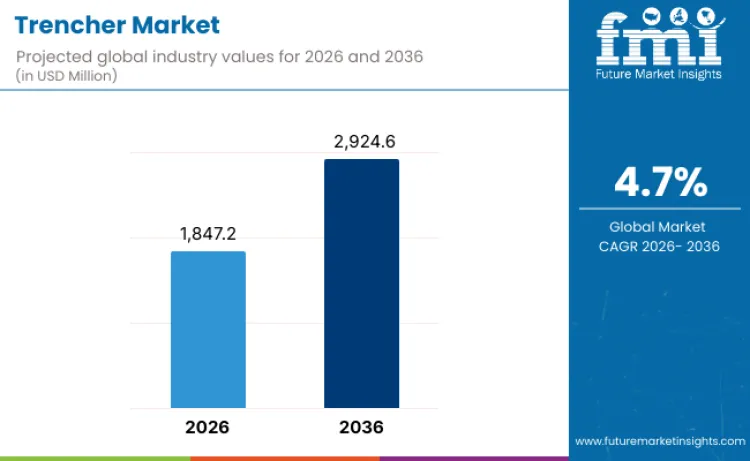
Key Takeaways, Market Size, and Forecast
| Metric | Value |
|---|---|
| Market Size (2026) | USD 1,847.2 Million |
| Market Size (2036) | USD 2,924.6 Million |
| CAGR (2026–2036) | 4.7% |
| Leading Machine Type (2026) | Walk-Behind Trenchers |
| Walk-Behind Trenchers Share (2026) | 42.8% |
| Leading Application (2026) | Construction Applications |
| Construction Applications Share (2026) | 38.9% |
| Fastest-Growing Country | China |
| China CAGR | 6.8% |
Trencher Market Key Takeaways
| Metric | Value |
|---|---|
| Industry Size (2026) | USD 1,847.2 Million |
| Industry Value (2036) | USD 2,924.6 Million |
| CAGR (2026 to 2036) | 4.7% |
Source: Future Market Insights analysis, supported by a proprietary forecasting model and primary research
What Drivers Are Accelerating Walk-behind Trencher Adoption?
Shift toward precision excavation operations is serving as a significant catalyst for broader acceptance of compact trenching equipment systems. Recent breakthroughs in engine miniaturization have complemented digging protocols by preserving cutting power and maneuverability characteristics effectively. This portable approach appeals to contractors seeking evidence-based excavation control protection. Research success of walk-behind systems integration in residential utility installation has expanded application possibilities among diverse property size requirements. Education programs highlighting the role of compact trenchers in confined space excavation are driving construction professional recommendations. Equipment manufacturers are capitalizing on these trends by introducing specialized walk-behind variants for residential landscaping and utility connection management. FMI is of the opinion that integrating ergonomic control systems into comprehensive trenching strategies is becoming standard practice, ensuring optimal operator comfort without compromising digging effectiveness.
How Is the Trencher Market Segmented Across Key Categories?
Global landscape is intricately segmented to address diverse requirements of the excavation equipment industry, categorizing sector by machine type, application area, power source, and regional deployment. Structural division allows stakeholders to identify specific digging targets, such as rising demand for ride-on trenchers in large-scale utility projects or preference for micro-trenchers in fiber optic installation applications. By analyzing these segments, manufacturers can tailor equipment development to meet distinct needs of pipeline construction versus telecommunications trenching requirements. Segmentation also highlights shift from manual digging approaches to targeted mechanized excavation interventions. As industry matures, granular segmentation becomes essential for understanding project pathways and equipment specifications, ensuring trencher development aligns with evolving construction methodology guidelines.
Why Do Walk-behind Trenchers Maintain Dominance?
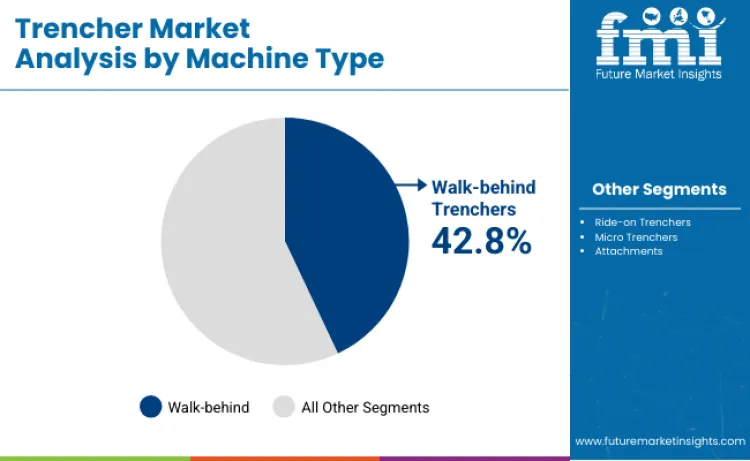
Walk-behind trenchers account for 42.8% of machine type share in 2026, driven by extensive versatility testing supporting compact excavation benefits. Leadership position is underpinned by proven maneuverability characteristics from contractors recognizing accessibility claims. Segment benefits from continuous weight reduction improvements, such as aluminum frame construction enhancing portability specifications. Research focused on compact trenching efficiency is renewing interest among residential contractors. Critical role in managing confined space excavations further solidifies standing, as these machines enable effective digging under restricted access conditions. As construction guidelines prioritize precision excavation strategies, demand for maneuverable concentrates is expected to remain robust.
Why Are Ride-on Trenchers the Fastest Growing Segment?
Ride-on trenchers command 6.2% growth acceleration in 2026, reflecting contractor preference for high-productivity excavation delivery. Growth momentum is linked to superior digging depth compared to walk-behind alternatives. Construction operators rely on tracked chassis systems to ensure effective soil penetration and debris removal. These configurations are essential for managing large-scale utility installations and pipeline trenching, driving innovation status among productivity-focused equipment brands. Relentless pursuit of operational efficiency ensures machines designed for heavy-duty construction conditions remain technology choice. High capacity acceptance necessitates advanced hydraulic systems, bolstering sustained revenue streams for industrial trencher suppliers.
Why Does Construction Lead Application Usage?
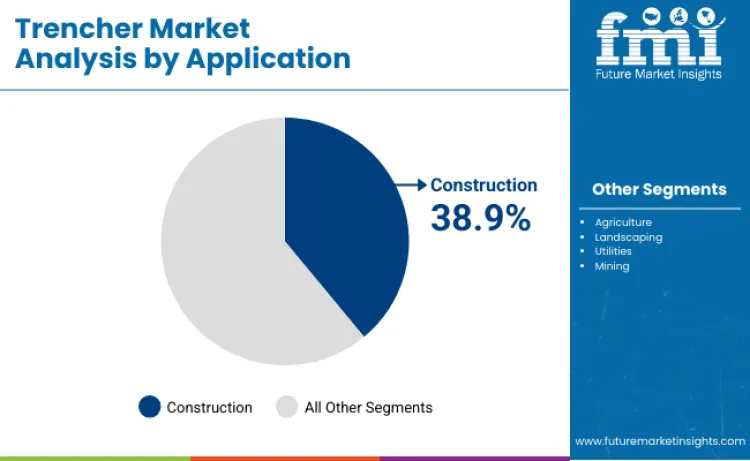
Construction applications capture 38.9% of market share in 2026, owing to widespread utility installation requirements needing precision excavation intervention. Dominance stems from industry guidelines recommending mechanical trenching alongside traditional digging methods for optimal project efficiency. Construction companies prefer these machines for their speed benefits and labor cost optimization. Usage in foundation preparation and drainage installation drives continuous volume growth among construction contractors. Compatibility with various soil conditions allows for integrated solutions across different project categories. Manufacturers focusing on construction-grade durability and high-volume excavation formulations for these demanding applications secure significant loyalty among general contractor practices.
How Will Smart Technology Integration Impact Sales?
Construction industry transition toward connected equipment is set to reshape sales landscapes by demanding IoT-enabled trenching formulations. As per FMI's estimates, digital equipment trends evolve, manufacturers access technologies with enhanced monitoring for complex excavation conditions. Shift toward data-driven construction creates demand for sensor-equipped formulations addressing multiple project management requirements simultaneously. Manufacturers failing to position trenchers as technology-compatible risk losing visibility among progressive contractors. Availability of GPS tracking options for fleet management drives complementary consumption patterns. Rise of predictive maintenance specifications stimulates innovation, with companies differentiating offerings through machine learning integration.
How Will Environmental Regulations Transform Development?
Construction environmental adoption is revolutionizing trencher design by enabling comprehensive emission control protocols. Integration with low-emission engine systems allows real-time monitoring of exhaust output, triggering automated efficiency optimization based on individual site conditions. Environmental consultations are driving specialized trenching applications, with engineers prescribing specific emission formulations through green construction platforms. Construction channels are expanding rapidly, offering environmental compliance and competitive specifications compared to traditional diesel methods. FMI is of the opinion that mobile emission applications featuring fuel consumption tracking and carbon footprint monitoring create sustained engagement with sustainable construction programs.
How Will Infrastructure Investment Affect Market Growth?
Evolving infrastructure spending frameworks are creating both opportunities and challenges for trencher producers. Stricter project efficiency standards demand higher technology investments while improving contractor confidence in equipment productivity. Performance validation approvals from construction organizations enable companies to market specific excavation benefits, differentiating products in competitive markets. International harmonization of construction standards facilitates global market expansion for established brands. Infrastructure project requirements are increasing, forcing manufacturers to invest in capability studies validating trenching effectiveness claims.
How Will the Trencher Industry Evolve in Major Nations?
Global landscape for excavation equipment is characterized by diverse construction frameworks, influenced by infrastructure budgets and development practice standards. Established markets prioritize productivity-based specifications and proven trenching technologies, whereas emerging economies focus on accessible solutions and basic excavation equipment protection. North America is emerging as innovation hub due to increasing infrastructure modernization and expanding construction mechanization awareness. Conversely, Asia-Pacific sectors pivot towards cost-effective systems and scalable deployment protocols. Government initiatives in developing nations supporting infrastructure development ensure sustained demand for proven earthmoving solutions across all construction categories.
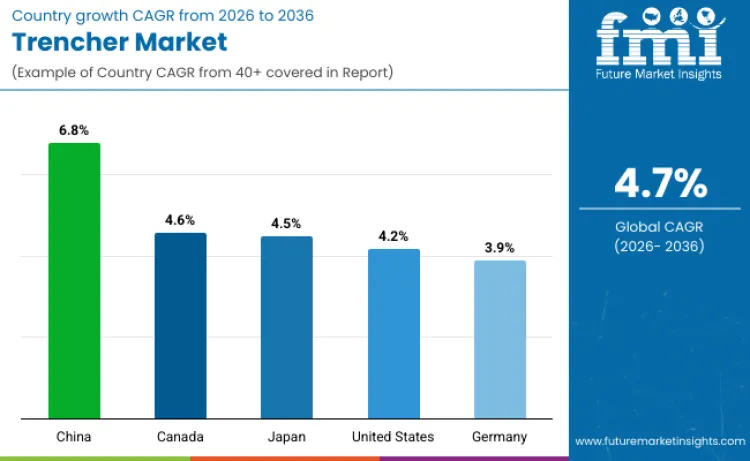
| Country | CAGR (2026 to 2036) |
|---|---|
| United States | 4.2% |
| China | 6.8% |
| Germany | 3.9% |
| Japan | 4.5% |
| Canada | 4.6% |
Source: Future Market Insights’ proprietary forecasting model and primary research
Why is the Trencher Industry in United States Growing?
Sales of excavation equipment in United States are set to grow at 4.2% CAGR through 2036. Expansion is underpinned by established construction infrastructure and increasing trencher modernization requirements among utility contractors. Growth is fueled by federal infrastructure spending reforms emphasizing efficient excavation and underground utility management. Rising construction productivity investment drives specialized equipment adoption per project among performance-focused contractors. As per FMI's projection, presence of major equipment manufacturers establishing advanced hydraulic capabilities streamlines technology development cycles and reduces equipment deployment costs. Emphasis on traditional excavation integration with modern trenching technologies continues to be primary driver, maintaining United States position as critical innovation engine for construction equipment solutions.
Why is the Trencher Sector in China Expanding?
Demand for mechanized excavation in China is projected to rise at 6.8% CAGR during assessment period. Initiatives emphasizing infrastructure development and construction modernization foster favorable environment for trenching platforms. Increasing investment in urban infrastructure creates substantial distribution channels for excavation equipment products. Rising construction volume requiring efficient digging solutions prompts domestic brands to develop cost-effective formulations. Shift is supported by government policies encouraging construction mechanization, accelerating uptake of Chinese trencher brands across development projects and fueling sector expansion through improved manufacturing scalability.
Why is the Trencher Industry in Germany Showing Potential?
Trencher industry in Germany is poised to expand at 3.9% CAGR. Growth is largely attributed to increasing awareness of precision excavation requirements among construction populations. Government focus on infrastructure modernization initiatives addressing efficiency challenges encourages contractors to adopt mechanized measures. FMI is of the opinion that increasing partnerships between local construction companies and international equipment suppliers ensure availability of high-quality trenching systems. Economic stability combined with growing construction technology investment attracts significant resources to advanced excavation products. Strong regulatory framework ensuring equipment safety and operational standards further drives contractor confidence in trenching protocols.
Why is the Trencher Industry in Japan Growing?
Sales of construction excavation equipment in Japan are set to grow at 4.5% CAGR. Expansion is underpinned by mature construction system recognizing mechanized excavation benefits. Growth is fueled by increasing labor costs driving contractors toward efficient solutions. Widespread adoption of automation standards and precision construction monitoring creates steady demand for validated excavation management. High standards of equipment durability and technological integration prompt brands to invest in evidence-based formulations. Emphasis on construction excellence and operational innovation continues to be primary driver, maintaining Japan position as quality leader in construction equipment applications.
Why is the Trencher Sector in Canada Expanding?
Revenue from excavation machinery in Canada is set to grow at 4.6% CAGR. Expansion is underpinned by extensive infrastructure system recognition of trenching benefits. Growth is fueled by increasing awareness of utility installation optimization needs. Moderate adoption of advanced excavation technologies and resource project integration drives revenue generation in construction equipment segments. Presence of established construction companies ensures high-quality equipment demand and operational validation. As per FMI's estimates, emphasis on construction efficiency and technology integration continues to be primary driver, maintaining Canada position as resource-focused market for excavation equipment systems.
What is the Competitive Outlook for the Trencher Market?
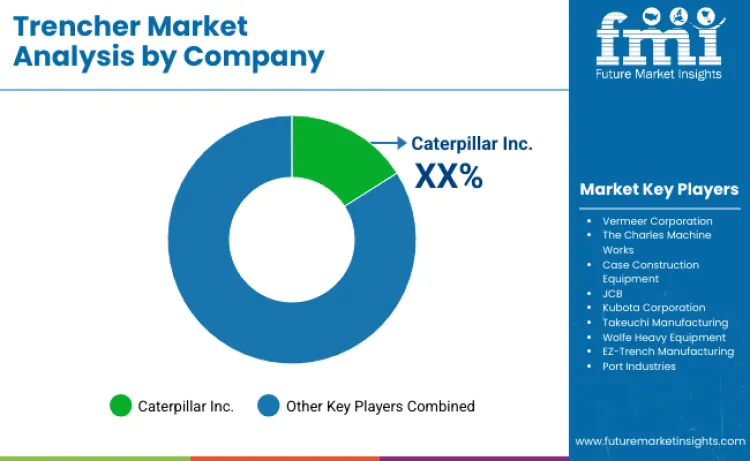
Market participants are increasingly focusing on productivity validation to differentiate their excavation equipment formulations. Leading players like Caterpillar Inc. and Vermeer Corporation are directing investment toward research partnerships with construction institutions for trencher performance studies. Significant trend involves developing specialized hydraulic platforms to customize excavation capabilities based on individual soil composition profiles. Companies actively engage in strategic partnerships with construction contractors to integrate trenchers into earthmoving protocols.
Innovation emerges as competitive frontier, with providers exploring advanced cutting chain systems for enhanced operational reliability. Consolidation activities remain moderate as specialty equipment companies acquire hydraulic component suppliers to control quality and costs against established heavy machinery giants. Caterpillar Inc. holds a significant share, leveraging its global construction network and hydraulic system investments.
Key Players in Trencher Market
- Caterpillar Inc.
- Vermeer Corporation
- The Charles Machine Works
- Case Construction Equipment
- JCB
- Kubota Corporation
- Takeuchi Manufacturing
- Wolfe Heavy Equipment
- EZ-Trench Manufacturing
- Port Industries
Scope of Report
| Items | Values |
|---|---|
| Quantitative Units | USD Million |
| Machine Type Segments | Walk-behind Trenchers; Ride-on Trenchers; Micro Trenchers; Attachments |
| Application Categories | Construction; Agriculture; Landscaping; Utilities; Mining |
| Power Source Categories | Diesel; Gasoline; Electric; Hybrid |
| End-User Categories | Construction Companies; Rental Companies; Utilities; Government Agencies |
| Regional Coverage | North America, Asia-Pacific, Europe, Latin America, Middle East & Africa |
| Key Countries | United States, China, Germany, Japan, Canada |
| Key Companies Profiled | Caterpillar Inc.; Vermeer Corporation; The Charles Machine Works; Case Construction Equipment; JCB; Kubota Corporation; Takeuchi Manufacturing; Wolfe Heavy Equipment; EZ-Trench Manufacturing; Port Industries |
| Additional Attributes | Dollar sales measured for trenching equipment used in excavation and earthmoving applications, specified by machine type (walk-behind, ride-on, micro trenchers), power configuration, operational method preference, end-use focus (construction, utilities, agriculture), soil application (rocky, sandy, clay), and compliance alignment with evolving safety standards and construction equipment regulations. |
Trencher Market by Segments
Machine Type:
- Walk-behind Trenchers
- Ride-on Trenchers
- Micro Trenchers
- Attachments
Application:
- Construction
- Agriculture
- Landscaping
- Utilities
- Mining
Power Source:
- Diesel
- Gasoline
- Electric
- Hybrid
End-User:
- Construction Companies
- Rental Companies
- Utilities
- Government Agencies
Regional Coverage:
- North America
- Asia-Pacific
- Europe
- Latin America
- Middle East & Africa
Bibliography
- Occupational Safety and Health Administration. (2024). 29 CFR Part 1926: Safety and health regulations for construction - Subpart P: Excavations. USA Department of Labor, United States.
- American Society of Civil Engineers. (2024). ASCE Manual 119: Standard guidelines for excavation and trench safety in infrastructure projects. ASCE, United States.
- American National Standards Institute / American Society of Safety Engineers. (2024). ANSI/ASSE A10.12‑2024: Safety requirements for excavation and trenching operations. ANSI/ASSE, United States.
Frequently Asked Questions
How big is the trencher market in 2026?
The trencher industry is valued at USD 1,847.2 million in 2026.
What will be the size of the trencher market in 2036?
The trencher market is projected to reach USD 2,924.6 million by 2036.
How much will the trencher market grow between 2026 and 2036?
The market is expected to expand at a CAGR of 4.7% during the 2026 to 2036 forecast period.
Which machine type segment leads the trencher market?
Walk-behind trenchers lead the machine type category, accounting for 42.8% share in 2026.
Which application segment holds the dominant share in the trencher market?
Construction dominates the application landscape with a 38.9% share in 2026.
Preview the report firsthand - request a free sample
Get SampleGet the brochure for pricing and purchase details.
Get PDFTable of Content
- Executive Summary
- Global Market Outlook
- Demand Side Trends
- Supply Side Trends
- Technology Roadmap Analysis
- Analysis and Recommendations
- Market Overview
- Market Coverage / Taxonomy
- Market Definition / Scope / Limitations
- Research Methodology
- Chapter Orientation
- Analytical Lens and Working Hypotheses
- Market Structure, Signals, and Trend Drivers
- Benchmarking and Cross-market Comparability
- Market Sizing, Forecasting, and Opportunity Mapping
- Research Design and Evidence Framework
- Desk Research Programme (Secondary Evidence)
- Company Annual and Sustainability Reports
- Peer-reviewed Journals and Academic Literature
- Corporate Websites, Product Literature, and Technical Notes
- Earnings Decks and Investor Briefings
- Statutory Filings and Regulatory Disclosures
- Technical White Papers and Standards Notes
- Trade Journals, Industry Magazines, and Analyst Briefs
- Conference Proceedings, Webinars, and Seminar Materials
- Government Statistics Portals and Public Data Releases
- Press Releases and Reputable Media Coverage
- Specialist Newsletters and Curated Briefings
- Sector Databases and Reference Repositories
- Roots Internal Knowledge Base and Historical Datasets
- Subscription Datasets and Paid Sources
- Social Channels, Communities, and Digital Listening Inputs
- Additional Desk Sources
- Expert Input and Fieldwork (Primary Evidence)
- Primary Modes
- Qualitative Interviews and Expert Elicitation
- Quantitative Surveys and Structured Data Capture
- Blended Approach
- Why Primary Evidence is Used
- Field Techniques
- Interviews
- Surveys
- Focus Groups
- Observational and In-context Research
- Social and Community Interactions
- Stakeholder Universe Engaged
- C-suite Leaders
- Board Members
- Presidents and Vice Presidents
- R&D and Innovation Heads
- Technical Specialists
- Domain Subject-matter Experts
- Scientists
- Physicians and Other Healthcare Professionals
- Governance, Ethics, and Data Stewardship
- Research Ethics
- Data Integrity and Handling
- Primary Modes
- Tooling, Models, and Reference Databases
- Desk Research Programme (Secondary Evidence)
- Data Engineering and Model Build
- Data Acquisition and Ingestion
- Cleaning, Normalisation, and Verification
- Synthesis, Triangulation, and Analysis
- Quality Assurance and Audit Trail
- Market Background
- Market Dynamics
- Drivers
- Restraints
- Opportunity
- Trends
- Scenario Forecast
- Demand in Optimistic Scenario
- Demand in Likely Scenario
- Demand in Conservative Scenario
- Opportunity Map Analysis
- Product Life Cycle Analysis
- Supply Chain Analysis
- Investment Feasibility Matrix
- Value Chain Analysis
- PESTLE and Porter's Analysis
- Regulatory Landscape
- Regional Parent Market Outlook
- Production and Consumption Statistics
- Import and Export Statistics
- Market Dynamics
- Global Market Analysis 2021 to 2025 and Forecast, 2026 to 2036
- Historical Market Size Value (USD Million) Analysis, 2021 to 2025
- Current and Future Market Size Value (USD Million) Projections, 2026 to 2036
- Y-o-Y Growth Trend Analysis
- Absolute $ Opportunity Analysis
- Global Market Pricing Analysis 2021 to 2025 and Forecast 2026 to 2036
- Y-o-Y Growth Trend Analysis 2021 to 2025
- Absolute $ Opportunity Analysis 2026 to 2036
- Global Market Analysis 2021 to 2025 and Forecast 2026 to 2036, By Machine Type
- Introduction / Key Findings
- Historical Market Size Value (USD Million) Analysis By Machine Type, 2021 to 2025
- Current and Future Market Size Value (USD Million) Analysis and Forecast By Machine Type, 2026 to 2036
- Walk-behind Trenchers
- Ride-on Trenchers
- Micro Trenchers
- Attachments
- Y-o-Y Growth Trend Analysis By Machine Type, 2021 to 2025
- Absolute $ Opportunity Analysis By Machine Type, 2026 to 2036
- Global Market Analysis 2021 to 2025 and Forecast 2026 to 2036, By Application
- Introduction / Key Findings
- Historical Market Size Value (USD Million) Analysis By Application, 2021 to 2025
- Current and Future Market Size Value (USD Million) Analysis and Forecast By Application, 2026 to 2036
- Construction
- Agriculture
- Landscaping
- Utilities
- Mining
- Y-o-Y Growth Trend Analysis By Application, 2021 to 2025
- Absolute $ Opportunity Analysis By Application, 2026 to 2036
- Global Market Analysis 2021 to 2025 and Forecast 2026 to 2036, By Power Source
- Introduction / Key Findings
- Historical Market Size Value (USD Million) Analysis By Power Source, 2021 to 2025
- Current and Future Market Size Value (USD Million) Analysis and Forecast By Power Source, 2026 to 2036
- Diesel
- Gasoline
- Electric
- Hybrid
- Y-o-Y Growth Trend Analysis By Power Source, 2021 to 2025
- Absolute $ Opportunity Analysis By Power Source, 2026 to 2036
- Global Market Analysis 2021 to 2025 and Forecast 2026 to 2036, By Region
- Introduction
- Historical Market Size Value (USD Million) Analysis By Region, 2021 to 2025
- Current Market Size Value (USD Million) Analysis and Forecast By Region, 2026 to 2036
- North America
- Latin America
- Western Europe
- Eastern Europe
- East Asia
- South Asia and Pacific
- Middle East & Africa
- Market Attractiveness Analysis By Region
- North America Market Analysis 2021 to 2025 and Forecast 2026 to 2036, By Country
- Historical Market Size Value (USD Million) Trend Analysis By Market Taxonomy, 2021 to 2025
- Market Size Value (USD Million) Forecast By Market Taxonomy, 2026 to 2036
- By Country
- USA
- Canada
- Mexico
- By Machine Type
- By Application
- By Power Source
- By Country
- Market Attractiveness Analysis
- By Country
- By Machine Type
- By Application
- By Power Source
- Key Takeaways
- Latin America Market Analysis 2021 to 2025 and Forecast 2026 to 2036, By Country
- Historical Market Size Value (USD Million) Trend Analysis By Market Taxonomy, 2021 to 2025
- Market Size Value (USD Million) Forecast By Market Taxonomy, 2026 to 2036
- By Country
- Brazil
- Chile
- Rest of Latin America
- By Machine Type
- By Application
- By Power Source
- By Country
- Market Attractiveness Analysis
- By Country
- By Machine Type
- By Application
- By Power Source
- Key Takeaways
- Western Europe Market Analysis 2021 to 2025 and Forecast 2026 to 2036, By Country
- Historical Market Size Value (USD Million) Trend Analysis By Market Taxonomy, 2021 to 2025
- Market Size Value (USD Million) Forecast By Market Taxonomy, 2026 to 2036
- By Country
- Germany
- UK
- Italy
- Spain
- France
- Nordic
- BENELUX
- Rest of Western Europe
- By Machine Type
- By Application
- By Power Source
- By Country
- Market Attractiveness Analysis
- By Country
- By Machine Type
- By Application
- By Power Source
- Key Takeaways
- Eastern Europe Market Analysis 2021 to 2025 and Forecast 2026 to 2036, By Country
- Historical Market Size Value (USD Million) Trend Analysis By Market Taxonomy, 2021 to 2025
- Market Size Value (USD Million) Forecast By Market Taxonomy, 2026 to 2036
- By Country
- Russia
- Poland
- Hungary
- Balkan & Baltic
- Rest of Eastern Europe
- By Machine Type
- By Application
- By Power Source
- By Country
- Market Attractiveness Analysis
- By Country
- By Machine Type
- By Application
- By Power Source
- Key Takeaways
- East Asia Market Analysis 2021 to 2025 and Forecast 2026 to 2036, By Country
- Historical Market Size Value (USD Million) Trend Analysis By Market Taxonomy, 2021 to 2025
- Market Size Value (USD Million) Forecast By Market Taxonomy, 2026 to 2036
- By Country
- China
- Japan
- South Korea
- By Machine Type
- By Application
- By Power Source
- By Country
- Market Attractiveness Analysis
- By Country
- By Machine Type
- By Application
- By Power Source
- Key Takeaways
- South Asia and Pacific Market Analysis 2021 to 2025 and Forecast 2026 to 2036, By Country
- Historical Market Size Value (USD Million) Trend Analysis By Market Taxonomy, 2021 to 2025
- Market Size Value (USD Million) Forecast By Market Taxonomy, 2026 to 2036
- By Country
- India
- ASEAN
- Australia & New Zealand
- Rest of South Asia and Pacific
- By Machine Type
- By Application
- By Power Source
- By Country
- Market Attractiveness Analysis
- By Country
- By Machine Type
- By Application
- By Power Source
- Key Takeaways
- Middle East & Africa Market Analysis 2021 to 2025 and Forecast 2026 to 2036, By Country
- Historical Market Size Value (USD Million) Trend Analysis By Market Taxonomy, 2021 to 2025
- Market Size Value (USD Million) Forecast By Market Taxonomy, 2026 to 2036
- By Country
- Kingdom of Saudi Arabia
- Other GCC Countries
- Turkiye
- South Africa
- Other African Union
- Rest of Middle East & Africa
- By Machine Type
- By Application
- By Power Source
- By Country
- Market Attractiveness Analysis
- By Country
- By Machine Type
- By Application
- By Power Source
- Key Takeaways
- Key Countries Market Analysis
- USA
- Pricing Analysis
- Market Share Analysis, 2025
- By Machine Type
- By Application
- By Power Source
- Canada
- Pricing Analysis
- Market Share Analysis, 2025
- By Machine Type
- By Application
- By Power Source
- Mexico
- Pricing Analysis
- Market Share Analysis, 2025
- By Machine Type
- By Application
- By Power Source
- Brazil
- Pricing Analysis
- Market Share Analysis, 2025
- By Machine Type
- By Application
- By Power Source
- Chile
- Pricing Analysis
- Market Share Analysis, 2025
- By Machine Type
- By Application
- By Power Source
- Germany
- Pricing Analysis
- Market Share Analysis, 2025
- By Machine Type
- By Application
- By Power Source
- UK
- Pricing Analysis
- Market Share Analysis, 2025
- By Machine Type
- By Application
- By Power Source
- Italy
- Pricing Analysis
- Market Share Analysis, 2025
- By Machine Type
- By Application
- By Power Source
- Spain
- Pricing Analysis
- Market Share Analysis, 2025
- By Machine Type
- By Application
- By Power Source
- France
- Pricing Analysis
- Market Share Analysis, 2025
- By Machine Type
- By Application
- By Power Source
- India
- Pricing Analysis
- Market Share Analysis, 2025
- By Machine Type
- By Application
- By Power Source
- ASEAN
- Pricing Analysis
- Market Share Analysis, 2025
- By Machine Type
- By Application
- By Power Source
- Australia & New Zealand
- Pricing Analysis
- Market Share Analysis, 2025
- By Machine Type
- By Application
- By Power Source
- China
- Pricing Analysis
- Market Share Analysis, 2025
- By Machine Type
- By Application
- By Power Source
- Japan
- Pricing Analysis
- Market Share Analysis, 2025
- By Machine Type
- By Application
- By Power Source
- South Korea
- Pricing Analysis
- Market Share Analysis, 2025
- By Machine Type
- By Application
- By Power Source
- Russia
- Pricing Analysis
- Market Share Analysis, 2025
- By Machine Type
- By Application
- By Power Source
- Poland
- Pricing Analysis
- Market Share Analysis, 2025
- By Machine Type
- By Application
- By Power Source
- Hungary
- Pricing Analysis
- Market Share Analysis, 2025
- By Machine Type
- By Application
- By Power Source
- Kingdom of Saudi Arabia
- Pricing Analysis
- Market Share Analysis, 2025
- By Machine Type
- By Application
- By Power Source
- Turkiye
- Pricing Analysis
- Market Share Analysis, 2025
- By Machine Type
- By Application
- By Power Source
- South Africa
- Pricing Analysis
- Market Share Analysis, 2025
- By Machine Type
- By Application
- By Power Source
- USA
- Market Structure Analysis
- Competition Dashboard
- Competition Benchmarking
- Market Share Analysis of Top Players
- By Regional
- By Machine Type
- By Application
- By Power Source
- Competition Analysis
- Competition Deep Dive
- Caterpillar Inc.
- Vermeer Corporation
- The Charles Machine Works
- Case Construction Equipment
- JCB
- Kubota Corporation
- Takeuchi Manufacturing
- Wolfe Heavy Equipment
- EZ-Trench Manufacturing
- Port Industries
- Competition Deep Dive
- Assumptions & Acronyms Used


