

- Industry Size (2026)
- USD 520 Mn
- Forecast (2036)
- USD 1420 Mn
- CAGR (2026 to 2036)
- 10.6%
Ultra-Clean Yogurt Filling System Market Forecast and Outlook 2026 to 2036
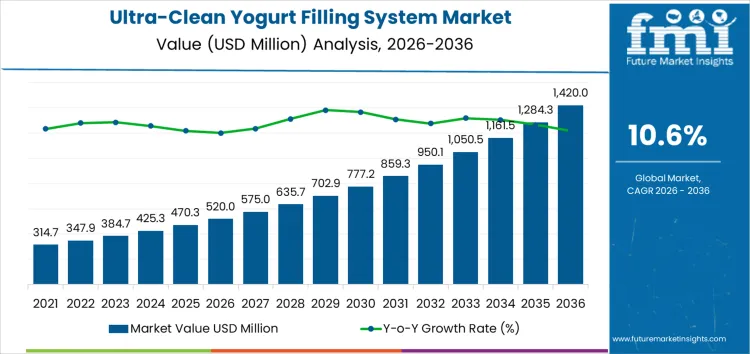
The ultra-clean yogurt filling system market is expected to experience steady growth from 2026 to 2036. In 2026, the market value is projected to be USD 520 million, with consistent growth anticipated, reaching USD 1,420 million by 2036. The compound annual growth rate (CAGR) for the market is forecasted at 10.6%, driven by the increasing demand for hygienic and efficient filling solutions in the dairy industry. As consumer preferences for high-quality, safe, and fresh yogurt products continue to rise, the adoption of ultra-clean filling systems will increase, allowing manufacturers to meet these demands while maintaining product integrity.
The growth of the market is influenced by the need to improve production efficiency, reduce contamination risks, and meet stringent food safety regulations. As the yogurt industry increasingly focuses on maintaining the highest standards of cleanliness and quality, the demand for ultra-clean yogurt filling systems will continue to rise. Over the forecast period, the market is expected to expand steadily, supported by continuous advancements in filling technologies and the growing emphasis on food safety.
Quick Stats of the Ultra-Clean Yogurt Filling System Market
- Ultra-Clean Yogurt Filling System Market Value (2026): USD 520 million
- Ultra-Clean Yogurt Filling System Market Forecast Value (2036): USD 1,420 million
- Ultra-Clean Yogurt Filling System Market Global Forecast CAGR (2026-2036): 10.6%
- Ultra-Clean Yogurt Filling System Market Leading Segment: Technology (HEPA-filtered filling + sterile air) 55%
- Key Growth Regions in Ultra-Clean Yogurt Filling System Market: China
- Top Players in Ultra-Clean Yogurt Filling System Market: Tetra Pak, GEA Group, Newamstar, Nichrome, KHS, Shibuya
What is the Growth Forecast for the Ultra-Clean Yogurt Filling System Market through 2036?
The growth forecast for the ultra-clean yogurt filling system market shows strong and consistent expansion, with a projected CAGR of 10.6%. Starting at USD 520 million in 2026, the market will grow steadily, reaching USD 574.8 million in 2027, USD 635.4 million in 2028, and USD 702.2 million in 2029. By 2030, the market value is projected to rise to USD 776.5 million, continuing the upward trajectory throughout the forecast period.
In the early stages of the forecast, the market will see a more gradual increase, while in the later stages, from 2031 to 2036, growth will gain momentum. By 2031, the market will reach USD 858.3 million, USD 948 million in 2032, and USD 1,047.6 million in 2033. The market will continue to experience steady growth, reaching USD 1,158.6 million in 2034, USD 1,282.3 million in 2035, and USD 1,420 million by 2036. The early vs. late growth curve comparison shows a more gradual increase initially, followed by a faster pace of growth as the market matures and demand for ultra-clean filling systems becomes more widespread.
Ultra-Clean Yogurt Filling System Market Key Takeaways
| Metric | Value |
|---|---|
| Industry Sales Value (2026) | USD 520 million |
| Industry Forecast Value (2036) | USD 1,420 million |
| Industry Forecast CAGR (2026-2036) | 10.6% |
What Is Driving the Demand for the Ultra Clean Yogurt Filling System Market Globally?
The global demand for ultra clean yogurt filling systems is being driven by rising consumption of yogurt and cultured dairy products, increasing food safety expectations, and stricter hygiene standards in dairy processing. Consumers in many regions are shifting toward high protein, probiotic, and functional dairy options, which has increased production volumes and variety of yogurt formats. Ultra clean filling systems maintain sanitary conditions during the transfer of yogurt into packaging by minimising microbial exposure, using aseptic valves, clean in place designs, and controlled environments.
These systems help manufacturers meet food safety regulations and reduce contamination risk, which is critical given the perishability of dairy products and sensitivity to spoilage. Retailers and brand owners also demand longer shelf life and consistency in product quality, reinforcing investment in advanced filling technologies that reduce defects, waste, and product recalls. Growth in ready to eat and single serve yogurt products, particularly in urban and emerging markets where convenience food consumption is expanding, further supports use of ultra clean filling solutions that combine speed with sanitation.
Future demand for ultra clean yogurt filling systems is expected to grow as dairy processors respond to operational efficiency needs, regulatory frameworks, and consumer preferences for cleaner label products. Advances in automation, sensor based monitoring, and real time quality control will make ultra clean systems more reliable and easier to integrate with upstream and downstream processes such as homogenisation, cooling, and packaging. Investments in traceability and digital quality assurance will link filling performance to compliance documentation, helping producers demonstrate adherence to food safety standards worldwide.
Expansion of yogurt product lines, including Greek, strained, organic, and probiotic variants, will maintain pressure on filling technology to handle diverse viscosities and textures without compromise. Manufacturers aiming to reduce product loss and energy use will prioritise systems that support efficient changeovers and reduce downtime between batches. As sustainability considerations increasingly influence facility upgrades and capital planning, ultra clean systems that reduce waste and support cleaner processing footprints will be preferred. Continued growth of modern retail, chilled distribution networks, and consumer demand for safe, high quality yogurt products suggests that adoption of ultra clean filling solutions will expand steadily across global dairy markets.
What are the Leading Segments in the Global Ultra-Clean Yogurt Filling System Market?
The global ultra-clean yogurt filling system market is segmented by filling system type and packaging format. Among filling system types, ultra-clean cup & bottle fillers lead the market, capturing 45% of the share, followed by rotary ultra-clean fillers, high-speed fillers, and inline fillers. Ultra-clean cup & bottle fillers are preferred due to their ability to maintain hygiene and prevent contamination during the filling process, which is crucial in dairy product packaging. On the packaging format side, cups, bottles, pouches dominate the market, accounting for 50% of the share, with cups and bottles being the most common formats used for yogurt packaging. The demand for ultra-clean filling systems in yogurt packaging is driven by the need for high standards of sanitation and efficiency in the dairy industry.
What Drives the Growth of Ultra-Clean Cup & Bottle Fillers in the Ultra-Clean Yogurt Filling System Market?
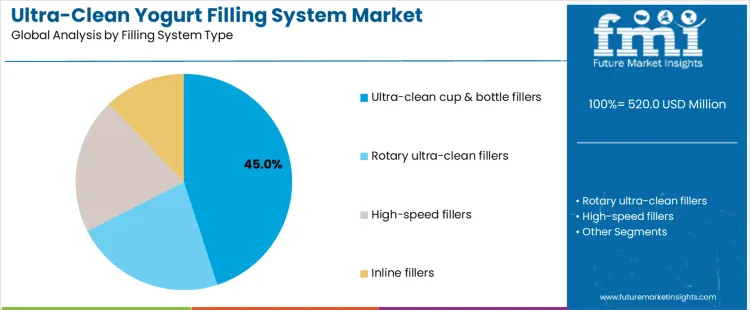
Ultra-clean cup & bottle fillers are the leading filling system type in the ultra-clean yogurt filling system market, holding 45% of the share. These filling systems are highly valued for their ability to provide sterile and hygienic conditions during the filling process, which is essential for ensuring the safety and quality of yogurt products. As yogurt is a perishable dairy product, maintaining a contamination-free filling environment is critical to prolong its shelf life and ensure consumer safety. Ultra-clean cup & bottle fillers are designed to meet stringent industry standards for sanitation, offering features such as advanced sterilization systems, sealed filling chambers, and minimal exposure to air during the filling process. Additionally, the growing consumer demand for high-quality, preservative-free yogurt further drives the need for ultra-clean filling systems. As the dairy industry continues to focus on quality assurance and operational efficiency, ultra-clean cup & bottle fillers are expected to remain a dominant solution in yogurt packaging.
What is Driving the Demand for Cups, Bottles, Pouches in the Ultra-Clean Yogurt Filling System Market?
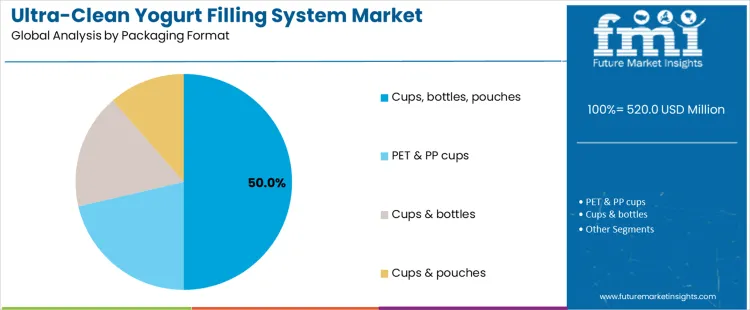
Cups, bottles, and pouches are the leading packaging formats in the ultra-clean yogurt filling system market, capturing 50% of the share. The demand for these formats is driven by their convenience, portability, and suitability for portion-controlled servings, which are increasingly popular among consumers. Cups and bottles are particularly favored in the yogurt industry because they are easy to handle, offer excellent product visibility, and provide a secure sealing option that helps preserve product freshness. Pouches, on the other hand, are growing in popularity due to their lightweight, space-efficient design, making them ideal for on-the-go consumption. As the trend toward convenience and single-serving portions continues to rise, these packaging formats are expected to maintain their dominance in the market. The need for packaging formats that preserve yogurt quality, are easy to use, and align with sustainability goals further boosts the demand for cups, bottles, and pouches in the ultra-clean yogurt filling system market.
What is the Summary of the Global Ultra Clean Yogurt Filling System Market?
The global ultra clean yogurt filling system market is expanding as dairy processors invest in hygienic, reliable equipment that minimises contamination risk and maximises product shelf life. These systems are designed to handle sensitive yogurt textures under controlled sterile conditions, supporting high throughput while meeting stringent food safety standards. Growth is supported by rising demand for yogurt and cultured dairy products globally, expansion of retail dairy consumption, and consumer preference for premium, long lasting fresh foods. Adoption spans large scale dairies and regional processors seeking consistent fill accuracy and quality in packaging formats such as cups, tubs and pouches.
What are the Key Drivers for the Global Ultra Clean Yogurt Filling System Market?
A key driver is increasing consumer demand for fresh, safe and nutritious dairy products, including yogurt, probiotic blends and functional dairy drinks. Manufacturers prioritise ultra clean filling systems that reduce microbial exposure, support extended shelf life, and comply with regulatory food safety requirements. Growth in ready to eat and grab and go food trends boosts production volumes and need for efficient, hygienic equipment. Technological advances in aseptic handling, CIP/SIP cleaning, and servo controlled filling improve operational efficiency and reduce downtime. Expansion of organised retail and cold chain infrastructure in emerging markets encourages investment in advanced filling systems to maintain quality from processing to point of sale.
What are the Restraints for the Global Ultra Clean Yogurt Filling System Market?
One restraint is the high capital expenditure associated with ultra clean filling systems compared with conventional filler equipment, which can deter smaller processors or startups with limited budgets. Implementation often requires facility adaptations, operator training and integration with existing process lines, adding to project complexity and cost. Regulatory compliance for ultra clean food production varies by region and may require extensive validation and documentation that increases preparation time. Some processors may delay upgrades until clear cost benefit comparisons with existing systems are established, especially in price sensitive markets.
What is the Key Trends in the Global Ultra Clean Yogurt Filling System Market?
A key trend is adoption of modular, flexible filling platforms that support multiple product viscosities and packaging formats with rapid changeovers, helping dairies respond to SKU proliferation and seasonal demand. Integration of real time sensors and automation improves process monitoring, fill accuracy and traceability, while reducing waste and rework. There is growing use of advanced clean in place (CIP) and sterilisation technologies that streamline hygiene protocols and reduce manual intervention. Collaboration between equipment OEMs and dairy producers is rising to customise systems for specific product characteristics, packaging materials and throughput requirements. Interest in sustainable operations is also shaping system design with features that reduce water use, energy consumption and product loss.
What is the Country-Wise Analysis of the Ultra-Clean Yogurt Filling System Market?
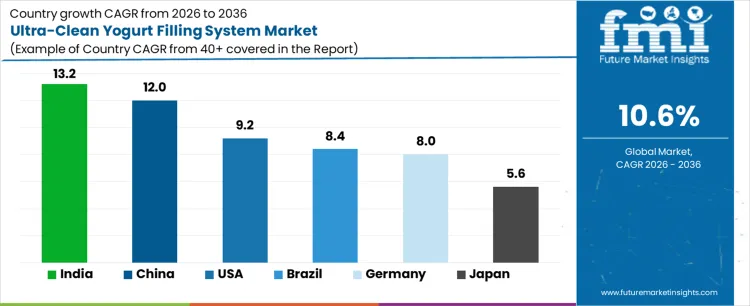
The ultra-clean yogurt filling system market is projected to grow steadily, driven by increasing demand for efficient, hygienic, and high-precision filling solutions in the dairy industry. These systems are essential for ensuring product safety and maintaining quality in yogurt production, particularly in high-volume operations. As consumer preferences for fresh, safe, and high-quality dairy products rise, there is growing demand for advanced filling technologies that preserve product integrity and reduce contamination risks. High-growth markets like China and India are seeing strong demand due to rapid industrialization, expanding dairy sectors, and rising consumer demand for packaged yogurt. Developed markets such as the USA, Germany, and Brazil are also witnessing steady growth, supported by increasing regulatory requirements for food safety and quality in dairy packaging.
| Country | CAGR (%) |
|---|---|
| China | 12 |
| India | 13.2 |
| United States | 9.2 |
| Germany | 8 |
| Brazil | 8.4 |
What is the Growth Outlook for the Ultra-Clean Yogurt Filling System Market in China?
The ultra-clean yogurt filling system market in China is expected to grow at a robust pace, with a projected CAGR of 12%. China’s growing dairy industry, particularly yogurt production, is driving demand for high-precision filling systems that ensure hygienic, efficient, and safe packaging. As consumer demand for fresh and healthy yogurt increases, the need for advanced, ultra-clean filling technologies to meet product safety standards is rising. Additionally, China’s rapidly expanding manufacturing capabilities and increasing focus on automation and food safety are further accelerating market growth. The country’s strong market for packaged dairy products and continued industrialization make it a key player in the ultra-clean yogurt filling system market.
What is the Market Outlook for the Ultra-Clean Yogurt Filling System Market in India?
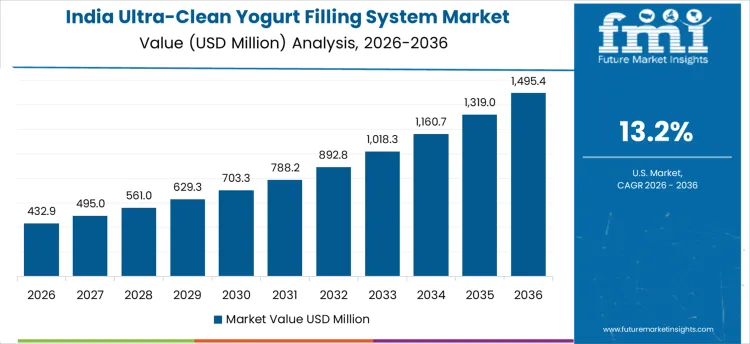
The ultra-clean yogurt filling system market in India is projected to grow at the highest rate, with a projected CAGR of 13.2%. India’s rapidly expanding dairy sector, combined with increasing consumer demand for packaged and hygienically processed yogurt, is driving strong growth in the market for ultra-clean filling systems. As the Indian dairy industry continues to modernize and adopt new technologies, the demand for advanced, high-efficiency filling systems that can maintain the quality and safety of yogurt is rising. The Indian government’s focus on improving food safety standards and the increasing trend of urbanization and disposable income are also supporting market growth. India’s focus on improving dairy product quality and reducing contamination risks positions the country for substantial growth in this market.
What is the Growth Forecast for the Ultra-Clean Yogurt Filling System Market in the United States?
The ultra-clean yogurt filling system market in the United States is expected to grow steadily, with a projected CAGR of 9.2%. The U.S. dairy industry’s demand for hygienic, efficient, and automated filling solutions continues to rise as consumer preferences shift toward high-quality, fresh dairy products. As yogurt consumption increases in the U.S., so does the need for ultra-clean filling technologies that meet stringent food safety standards. Additionally, the growing focus on sustainability and reducing contamination risks in the dairy industry is further driving the adoption of these advanced filling systems. With technological advancements in food processing and packaging, the U.S. market for ultra-clean yogurt filling systems is expected to continue its steady growth.
What is the Market Outlook for the Ultra-Clean Yogurt Filling System Market in Germany?
The ultra-clean yogurt filling system market in Germany is projected to grow at a steady pace, with a projected CAGR of 8%. Germany’s well-established dairy industry, coupled with its strong focus on food safety and sustainability, is driving demand for ultra-clean filling systems. As European food safety regulations become increasingly stringent, the need for high-quality, hygienic yogurt filling solutions is on the rise. Additionally, as German consumers prioritize fresh, healthy, and safe food products, there is growing adoption of advanced filling technologies in the yogurt production sector. With continued advancements in packaging and automation technologies, Germany’s market for ultra-clean yogurt filling systems is expected to grow steadily.
What are the Growth Prospects for the Ultra-Clean Yogurt Filling System Market in Brazil?
The ultra-clean yogurt filling system market in Brazil is expected to grow at a moderate pace, with a projected CAGR of 8.4%. Brazil’s growing dairy sector, fueled by increasing demand for packaged yogurt, is driving the adoption of advanced filling systems that prioritize hygiene, efficiency, and quality. As the Brazilian yogurt industry seeks to modernize its production capabilities, the demand for ultra-clean filling technologies to meet safety and regulatory standards is increasing. The market is also supported by Brazil’s focus on improving food safety and increasing consumer interest in high-quality dairy products. With these trends, the market for ultra-clean yogurt filling systems in Brazil is expected to continue its steady expansion.
What is the Competitive Landscape for the Ultra-Clean Yogurt Filling System Market?
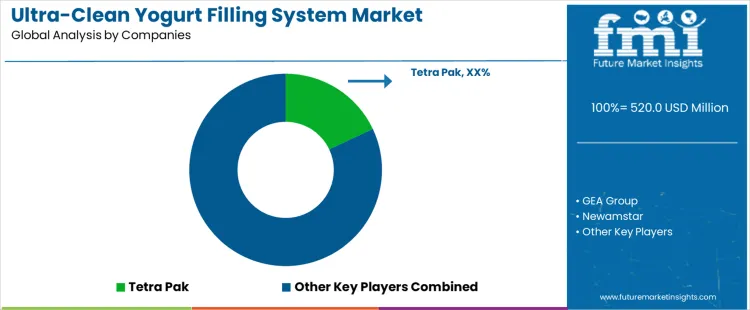
The ultra-clean yogurt filling system market is growing as demand increases for efficient, hygienic, and high-precision systems to meet strict food safety standards in dairy production. Tetra Pak leads the market with its innovative ultra-clean yogurt filling systems, providing high-quality, hygienic solutions designed for maximum efficiency and minimal contamination risk. Their focus on sustainability, automation, and food safety has positioned them as the dominant player in the market. GEA Group, Newamstar, and Nichrome are key competitors, offering specialized systems tailored to yogurt production. GEA Group delivers reliable and efficient filling solutions with a focus on maintaining product quality, while Newamstar and Nichrome focus on customizable and cost-effective filling systems for various production needs.
KHS and Shibuya further contribute to the competitive landscape, offering their own advanced ultra-clean yogurt filling systems. KHS provides high-performance solutions that meet the growing demand for efficiency and product safety in the dairy industry. Shibuya offers flexible and precise filling technologies, catering to a variety of yogurt packaging requirements. These companies compete by focusing on innovation, hygiene standards, and their ability to deliver effective and scalable filling solutions for the yogurt industry.
Key Players of the Ultra-Clean Yogurt Filling System Market
- Tetra Pak
- GEA Group
- Newamstar
- Nichrome
- KHS
- Shibuya
Scope of the Report
| Items | Values |
|---|---|
| Quantitative Units (2025) | USD Million |
| End-use | Yogurt & Fermented Dairy, Drinkable Yogurt, Large Dairy Plants, Value Dairy Brands, Yogurt Exports, Premium Dairy |
| Filling System Type | Ultra-Clean Cup & Bottle Fillers, Rotary Ultra-Clean Fillers, High-Speed Fillers, Inline Fillers |
| Packaging Format | Cups, Bottles, Pouches, PET & PP Cups |
| Technology | HEPA-Filtered Filling + Sterile Air, H₂O₂-Free Sterilisation, Compact Aseptic Modules, Cost-Efficient Ultra-Clean Tech |
| Companies | Tetra Pak, GEA Group, Newamstar, Nichrome, KHS, Shibuya |
| Regions Covered | North America, Latin America, Western Europe, Eastern Europe, South Asia and Pacific, East Asia, Middle East & Africa |
| Countries Covered | United States, Canada, Mexico, Brazil, Argentina, Germany, France, United Kingdom, Italy, Spain, Netherlands, China, India, Japan, South Korea, ANZ, GCC Countries, South Africa |
| Additional Attributes | Dollar by sales by end-use, filling system type, packaging format, technology, and region. Includes market trends in ultra-clean yogurt filling systems, focusing on HEPA-filtered filling, H₂O₂-free sterilisation, aseptic modules, and cost-efficient technology. Highlights the role of high-speed and inline fillers in yogurt, fermented dairy, and drinkable yogurt packaging. Focus on sustainability, regulatory compliance, cost-effectiveness, and market share of key companies in the dairy filling systems market. |
Ultra-Clean Yogurt Filling System Market Segmentation
End-use:
- Yogurt & fermented dairy
- Drinkable yogurt
- Large dairy plants
- Value dairy brands
- Yogurt exports
- Premium dairy
Filling System Type:
- Ultra-clean cup & bottle fillers
- Rotary ultra-clean fillers
- High-speed fillers
- Inline fillers
- Others
Packaging Format:
- Cups, bottles, pouches
- PET & PP cups
- Cups & bottles
- Cups & pouches
- Others
Technology:
- HEPA-filtered filling + sterile air
- H₂O₂-free sterilisation
- Compact aseptic modules
- Cost-efficient ultra-clean tech
- Others
Region:
- Asia Pacific
- China
- Japan
- South Korea
- India
- Australia & New Zealand
- ASEAN
- Rest of Asia Pacific
- Europe
- Germany
- United Kingdom
- France
- Italy
- Spain
- Nordic
- BENELUX
- Rest of Europe
- North America
- United States
- Canada
- Mexico
- Latin America
- Brazil
- Chile
- Rest of Latin America
- Middle East & Africa
- Kingdom of Saudi Arabia
- Other GCC Countries
- Turkey
- South Africa
- Other African Union
- Rest of Middle East & Africa
Preview the report firsthand - request a free sample
Get SampleGet the brochure for pricing and purchase details.
Get PDFTable of Content
- Executive Summary
- Global Market Outlook
- Demand-side Trends
- Supply-side Trends
- Technology Roadmap Analysis
- Analysis and Recommendations
- Market Overview
- Market Coverage / Taxonomy
- Market Definition / Scope / Limitations
- Market Background
- Market Dynamics
- Drivers
- Restraints
- Opportunity
- Trends
- Scenario Forecast
- Demand in Optimistic Scenario
- Demand in Likely Scenario
- Demand in Conservative Scenario
- Opportunity Map Analysis
- Product Life Cycle Analysis
- Supply Chain Analysis
- Investment Feasibility Matrix
- Value Chain Analysis
- PESTLE and Porter’s Analysis
- Regulatory Landscape
- Regional Parent Market Outlook
- Production and Consumption Statistics
- Import and Export Statistics
- Market Dynamics
- Global Market Analysis 2021 to 2025 and Forecast, 2026 to 2036
- Historical Market Size Value (USD Million) Analysis, 2021 to 2025
- Current and Future Market Size Value (USD Million) Projections, 2026 to 2036
- Y-o-Y Growth Trend Analysis
- Absolute $ Opportunity Analysis
- Global Market Pricing Analysis 2021 to 2025 and Forecast 2026 to 2036
- Global Market Analysis 2021 to 2025 and Forecast 2026 to 2036, By End-use
- Introduction / Key Findings
- Historical Market Size Value (USD Million) Analysis By End-use , 2021 to 2025
- Current and Future Market Size Value (USD Million) Analysis and Forecast By End-use , 2026 to 2036
- Yogurt & fermented dairy
- Drinkable yogurt
- Large dairy plants
- Value dairy brands
- Yogurt exports
- Premium dairy
- Yogurt & fermented dairy
- Y-o-Y Growth Trend Analysis By End-use , 2021 to 2025
- Absolute $ Opportunity Analysis By End-use , 2026 to 2036
- Global Market Analysis 2021 to 2025 and Forecast 2026 to 2036, By Filling System Type
- Introduction / Key Findings
- Historical Market Size Value (USD Million) Analysis By Filling System Type, 2021 to 2025
- Current and Future Market Size Value (USD Million) Analysis and Forecast By Filling System Type, 2026 to 2036
- Ultra-clean cup & bottle fillers
- Rotary ultra-clean fillers
- High-speed fillers
- Inline fillers
- Ultra-clean cup & bottle fillers
- Y-o-Y Growth Trend Analysis By Filling System Type, 2021 to 2025
- Absolute $ Opportunity Analysis By Filling System Type, 2026 to 2036
- Global Market Analysis 2021 to 2025 and Forecast 2026 to 2036, By Packaging Format
- Introduction / Key Findings
- Historical Market Size Value (USD Million) Analysis By Packaging Format, 2021 to 2025
- Current and Future Market Size Value (USD Million) Analysis and Forecast By Packaging Format, 2026 to 2036
- Cups, bottles, pouches
- PET & PP cups
- Cups & bottles
- Cups & pouches
- Cups, bottles, pouches
- Y-o-Y Growth Trend Analysis By Packaging Format, 2021 to 2025
- Absolute $ Opportunity Analysis By Packaging Format, 2026 to 2036
- Global Market Analysis 2021 to 2025 and Forecast 2026 to 2036, By Technology
- Introduction / Key Findings
- Historical Market Size Value (USD Million) Analysis By Technology, 2021 to 2025
- Current and Future Market Size Value (USD Million) Analysis and Forecast By Technology, 2026 to 2036
- HEPA-filtered filling + sterile air
- H₂O₂-free sterilisation
- Compact aseptic modules
- Cost-efficient ultra-clean tech
- HEPA-filtered filling + sterile air
- Y-o-Y Growth Trend Analysis By Technology, 2021 to 2025
- Absolute $ Opportunity Analysis By Technology, 2026 to 2036
- Global Market Analysis 2021 to 2025 and Forecast 2026 to 2036, By Region
- Introduction
- Historical Market Size Value (USD Million) Analysis By Region, 2021 to 2025
- Current Market Size Value (USD Million) Analysis and Forecast By Region, 2026 to 2036
- North America
- Latin America
- Western Europe
- Eastern Europe
- East Asia
- South Asia and Pacific
- Middle East & Africa
- Market Attractiveness Analysis By Region
- North America Market Analysis 2021 to 2025 and Forecast 2026 to 2036, By Country
- Historical Market Size Value (USD Million) Trend Analysis By Market Taxonomy, 2021 to 2025
- Market Size Value (USD Million) Forecast By Market Taxonomy, 2026 to 2036
- By Country
- USA
- Canada
- Mexico
- By End-use
- By Filling System Type
- By Packaging Format
- By Technology
- By Country
- Market Attractiveness Analysis
- By Country
- By End-use
- By Filling System Type
- By Packaging Format
- By Technology
- Key Takeaways
- Latin America Market Analysis 2021 to 2025 and Forecast 2026 to 2036, By Country
- Historical Market Size Value (USD Million) Trend Analysis By Market Taxonomy, 2021 to 2025
- Market Size Value (USD Million) Forecast By Market Taxonomy, 2026 to 2036
- By Country
- Brazil
- Chile
- Rest of Latin America
- By End-use
- By Filling System Type
- By Packaging Format
- By Technology
- By Country
- Market Attractiveness Analysis
- By Country
- By End-use
- By Filling System Type
- By Packaging Format
- By Technology
- Key Takeaways
- Western Europe Market Analysis 2021 to 2025 and Forecast 2026 to 2036, By Country
- Historical Market Size Value (USD Million) Trend Analysis By Market Taxonomy, 2021 to 2025
- Market Size Value (USD Million) Forecast By Market Taxonomy, 2026 to 2036
- By Country
- Germany
- UK
- Italy
- Spain
- France
- Nordic
- BENELUX
- Rest of Western Europe
- By End-use
- By Filling System Type
- By Packaging Format
- By Technology
- By Country
- Market Attractiveness Analysis
- By Country
- By End-use
- By Filling System Type
- By Packaging Format
- By Technology
- Key Takeaways
- Eastern Europe Market Analysis 2021 to 2025 and Forecast 2026 to 2036, By Country
- Historical Market Size Value (USD Million) Trend Analysis By Market Taxonomy, 2021 to 2025
- Market Size Value (USD Million) Forecast By Market Taxonomy, 2026 to 2036
- By Country
- Russia
- Poland
- Hungary
- Balkan & Baltic
- Rest of Eastern Europe
- By End-use
- By Filling System Type
- By Packaging Format
- By Technology
- By Country
- Market Attractiveness Analysis
- By Country
- By End-use
- By Filling System Type
- By Packaging Format
- By Technology
- Key Takeaways
- East Asia Market Analysis 2021 to 2025 and Forecast 2026 to 2036, By Country
- Historical Market Size Value (USD Million) Trend Analysis By Market Taxonomy, 2021 to 2025
- Market Size Value (USD Million) Forecast By Market Taxonomy, 2026 to 2036
- By Country
- China
- Japan
- South Korea
- By End-use
- By Filling System Type
- By Packaging Format
- By Technology
- By Country
- Market Attractiveness Analysis
- By Country
- By End-use
- By Filling System Type
- By Packaging Format
- By Technology
- Key Takeaways
- South Asia and Pacific Market Analysis 2021 to 2025 and Forecast 2026 to 2036, By Country
- Historical Market Size Value (USD Million) Trend Analysis By Market Taxonomy, 2021 to 2025
- Market Size Value (USD Million) Forecast By Market Taxonomy, 2026 to 2036
- By Country
- India
- ASEAN
- Australia & New Zealand
- Rest of South Asia and Pacific
- By End-use
- By Filling System Type
- By Packaging Format
- By Technology
- By Country
- Market Attractiveness Analysis
- By Country
- By End-use
- By Filling System Type
- By Packaging Format
- By Technology
- Key Takeaways
- Middle East & Africa Market Analysis 2021 to 2025 and Forecast 2026 to 2036, By Country
- Historical Market Size Value (USD Million) Trend Analysis By Market Taxonomy, 2021 to 2025
- Market Size Value (USD Million) Forecast By Market Taxonomy, 2026 to 2036
- By Country
- Kingdom of Saudi Arabia
- Other GCC Countries
- Turkiye
- South Africa
- Other African Union
- Rest of Middle East & Africa
- By End-use
- By Filling System Type
- By Packaging Format
- By Technology
- By Country
- Market Attractiveness Analysis
- By Country
- By End-use
- By Filling System Type
- By Packaging Format
- By Technology
- Key Takeaways
- Key Countries Market Analysis
- USA
- Pricing Analysis
- Market Share Analysis, 2025
- By End-use
- By Filling System Type
- By Packaging Format
- By Technology
- Canada
- Pricing Analysis
- Market Share Analysis, 2025
- By End-use
- By Filling System Type
- By Packaging Format
- By Technology
- Mexico
- Pricing Analysis
- Market Share Analysis, 2025
- By End-use
- By Filling System Type
- By Packaging Format
- By Technology
- Brazil
- Pricing Analysis
- Market Share Analysis, 2025
- By End-use
- By Filling System Type
- By Packaging Format
- By Technology
- Chile
- Pricing Analysis
- Market Share Analysis, 2025
- By End-use
- By Filling System Type
- By Packaging Format
- By Technology
- Germany
- Pricing Analysis
- Market Share Analysis, 2025
- By End-use
- By Filling System Type
- By Packaging Format
- By Technology
- UK
- Pricing Analysis
- Market Share Analysis, 2025
- By End-use
- By Filling System Type
- By Packaging Format
- By Technology
- Italy
- Pricing Analysis
- Market Share Analysis, 2025
- By End-use
- By Filling System Type
- By Packaging Format
- By Technology
- Spain
- Pricing Analysis
- Market Share Analysis, 2025
- By End-use
- By Filling System Type
- By Packaging Format
- By Technology
- France
- Pricing Analysis
- Market Share Analysis, 2025
- By End-use
- By Filling System Type
- By Packaging Format
- By Technology
- India
- Pricing Analysis
- Market Share Analysis, 2025
- By End-use
- By Filling System Type
- By Packaging Format
- By Technology
- ASEAN
- Pricing Analysis
- Market Share Analysis, 2025
- By End-use
- By Filling System Type
- By Packaging Format
- By Technology
- Australia & New Zealand
- Pricing Analysis
- Market Share Analysis, 2025
- By End-use
- By Filling System Type
- By Packaging Format
- By Technology
- China
- Pricing Analysis
- Market Share Analysis, 2025
- By End-use
- By Filling System Type
- By Packaging Format
- By Technology
- Japan
- Pricing Analysis
- Market Share Analysis, 2025
- By End-use
- By Filling System Type
- By Packaging Format
- By Technology
- South Korea
- Pricing Analysis
- Market Share Analysis, 2025
- By End-use
- By Filling System Type
- By Packaging Format
- By Technology
- Russia
- Pricing Analysis
- Market Share Analysis, 2025
- By End-use
- By Filling System Type
- By Packaging Format
- By Technology
- Poland
- Pricing Analysis
- Market Share Analysis, 2025
- By End-use
- By Filling System Type
- By Packaging Format
- By Technology
- Hungary
- Pricing Analysis
- Market Share Analysis, 2025
- By End-use
- By Filling System Type
- By Packaging Format
- By Technology
- Kingdom of Saudi Arabia
- Pricing Analysis
- Market Share Analysis, 2025
- By End-use
- By Filling System Type
- By Packaging Format
- By Technology
- Turkiye
- Pricing Analysis
- Market Share Analysis, 2025
- By End-use
- By Filling System Type
- By Packaging Format
- By Technology
- South Africa
- Pricing Analysis
- Market Share Analysis, 2025
- By End-use
- By Filling System Type
- By Packaging Format
- By Technology
- USA
- Market Structure Analysis
- Competition Dashboard
- Competition Benchmarking
- Market Share Analysis of Top Players
- By Regional
- By End-use
- By Filling System Type
- By Packaging Format
- By Technology
- Competition Analysis
- Competition Deep Dive
- Tetra Pak
- Overview
- Product Portfolio
- Profitability by Market Segments (Product/Age /Sales Channel/Region)
- Sales Footprint
- Strategy Overview
- Marketing Strategy
- Product Strategy
- Channel Strategy
- GEA Group
- Newamstar
- Nichrome
- KHS
- Shibuya
- Tetra Pak
- Competition Deep Dive
- Assumptions & Acronyms Used
- Research Methodology


