

- Market Size (2026)
- USD 421.0 Mn
- Forecast (2036)
- USD 1284.4 Mn
- CAGR (2026 to 2036)
- 11.8%
How big is Sugar Reduction Systems for Bakery Market in 2026?
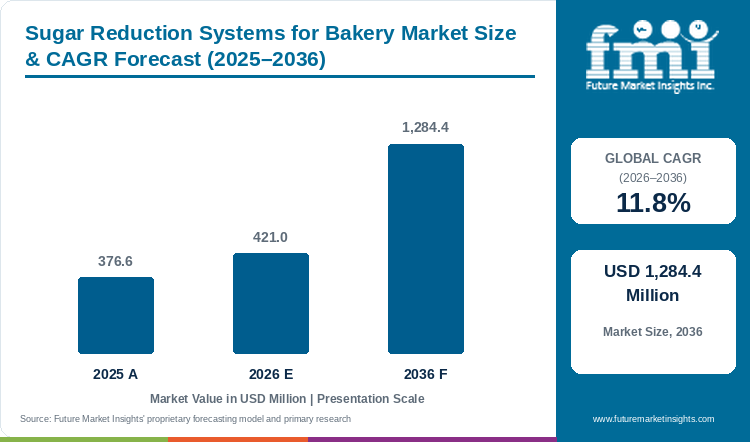
The sugar reduction systems for bakery market demonstrated steady progress from USD 376.6 million in 2025 to USD 421.0 million in 2026, building toward a targeted valuation of USD 1,284.4 million by 2036 at a CAGR of 11.8%.
The global sugar reduction systems for bakery market was valued at USD 376.6 million in 2025 and is estimated to reach USD 421.0 million in 2026. The market is projected to reach USD 1,284.4 million by 2036, expanding at a compound annual growth rate (CAGR) of 11.8% between 2026 and 2036. Fine grades are projected to capture 36.0% of 2026 type demand because micronized particle distributions prevent localized sweetness hotspots in low-dose dough systems. Demand for reduction systems is supported by front-of-pack added-sugar rules and Nutri-Score revisions, which moved sucrose from a taste ingredient to a regulatory liability once cuts passed 30% in commercial doughs [9]. The reformulation burden explains why the category compounds ahead of the bakery ingredients market at 7.0% CAGR, because every sugar cut must rebuild crust browning, crumb softness and water activity that plain sucrose once delivered free [1] [4]. Consolidation now funds that rebuild, as Ingredion announced a recommended all-cash acquisition of Tate & Lyle in June 2026 to unite stevia, texture and sweetening portfolios under one bakery systems roof [19]. BENEO's GLP-1-aligned bakery concepts presented at Fi Europe in December 2025 showed the demand side chasing the same scaffold chemistry [20]. Bakers buy the system that passes label audit without losing the 160-degree Maillard window, and the ingredient houses that price that scaffold retain the reformulation contracts through 2036.
Key Market Trends & Insights
- By type: Fine Grades are projected to capture 36.0% of the Type segment in 2026 because micronized particle distributions prevent localized sweetness hotspots in batters.
- By form: Powder / Dry formulations are estimated to command 48.0% of the Form segment in 2026 as automated flour-scaling hoppers favor free-flowing dry blends.
- By application: Bread & Rolls is expected to concentrate 29.0% of the Application segment in 2026 where high-throughput pan lines require reproducible yeast fermentation.
- By claim: Conventional systems are forecast to generate 50.0% of the Claim segment in 2026 owing to cost-effective bulk replacement under standard nutrition rules.
- By sales channel: Direct to Industrial Bakeries is anticipated to account for 46.0% of the Sales Channel segment in 2026 through co-engineered pilot baking trials.
Regional Highlights
- Top national expansion: The UAE is projected to lead evaluated national markets at a 13.0% CAGR through 2036 under National Nutrition Strategy 2030 packaged-bakery reformulation.
- Broader country progression: Saudi Arabia is expected to expand at a 12.7% CAGR ahead of South Korea at 12.4% and the USA at 12.1%, while Japan is forecast to advance at a 10.7% CAGR.
Market Size & Forecast
Table 1: Market Size and Forecast for the Sugar Reduction Systems for Bakery Market (USD million and CAGR percentage), 2025 to 2036
| Metric | Value |
|---|---|
| 2025 Market Size | USD 376.6 million |
| Estimated Market Size in 2026 | USD 421.0 million |
| Projected Market Size by 2036 | USD 1,284.4 million |
| CAGR, 2026 to 2036 | 11.8% |
| Added Revenue, 2026 to 2036 | USD 863.4 million |
Industrial bakeries cannot swap sucrose one-for-one with high-intensity sweeteners because sucrose provides 15% to 40% of dry batter mass while governing gluten plasticization and starch gelatinization temperatures. Uncompensated removal of bulk sugar leaves doughs sticky and pale while accelerating crumb staling. In March 2025, rheo-fermentation analysis published in Food Research International confirmed that D-allulose and oligosaccharide composite systems achieve 90.92% gas retention and lift dough fermentation height by 79.78% compared with uncompensated sugar-reduced dough [2]. As a result, bakery procurement teams are purchasing co-engineered bulking-and-sweetness blends rather than standalone sugar substitutes.
Formulation-Tonnage and Bakery-Batch Sizing
Table 2: Formulation-Tonnage and Bakery-Batch Sizing for the Sugar Reduction Systems for Bakery Market (USD million and operational ranges), 2025 to 2036
| Metric | 2025 | 2026 | 2036 |
|---|---|---|---|
| Market size (USD million) | 376.6 | 421.0 | 1,284.4 |
| Qualifying system volume (thousand metric tons) | 118.0 to 132.0 | 131.5 to 147.0 | 385.0 to 430.0 |
| Reformulated bakery output supported (million tons) | 1.4 to 1.6 | 1.6 to 1.8 | 4.6 to 5.2 |
| Average system price per kilogram (USD) | 2.9 to 3.2 | 2.9 to 3.2 | 3.0 to 3.3 |
Operational note: System-volume ranges reflect blended bulking fibers and rare sugars with high-potency sweeteners dosed at 8% to 18% of finished bakery dough weight to achieve a 30%+ declared sugar reduction.
Wider clean-label reformulation across multi-plant baking groups has intensified focus on cost-in-use per 1,000 kilograms of finished dough and water-activity control (`aw < 0.85` in shelf-stable cakes). so formulators are pairing chicory oligofructose and soluble corn fiber with polyol sweeteners to preserve humectancy without triggering laxative warning thresholds.
Per Capita & Industrial Bakery Plant Sizing
Table 3: Per Capita and Industrial Bakery Spending Indicators for the Sugar Reduction Systems for Bakery Market (USD), 2025 to 2036
| Metric | 2025 | 2026 | 2036 |
|---|---|---|---|
| World population (billion) | 8.2 | 8.3 | 9.0 |
| Spend per 1,000 people (USD) | 45.9 | 50.7 | 142.7 |
| Annual spend per qualified industrial bakery (USD) | 18,500 to 22,000 | 20,500 to 24,500 | 52,000 to 64,000 |
| Direct-to-bakery contract share (%) | 45.0% to 46.5% | 45.5% to 47.0% | 48.5% to 51.0% |
Table 4: Channel & Segment Revenue Indicators for the Sugar Reduction Systems for Bakery Market (USD and percentages), 2026
| Metric | Value | Institutional Reference Basis |
|---|---|---|
| Market size, 2026 | USD 421.0 million | 2026 global revenue baseline |
| Direct to industrial bakeries revenue, 2026 | USD 193.7 million | 46.0% sales channel segment allocation |
| Powder / Dry form revenue, 2026 | USD 202.1 million | 48.0% form segment allocation |
| Fine Grades type revenue, 2026 | USD 151.6 million | 36.0% type segment allocation |
Uniform sweetness distribution in low-moisture rotary-molded biscuits and laminated pastries requires tight particle-size matching with wheat flour and bakery ingredients and flour improvers. Due to the complexity of tunnel-oven heat transfer, ingredient suppliers operating regional pilot bakeries are able to shorten customer line-qualification cycles from nine months to under twelve weeks.
Analyst Perspective
"A catalog high-intensity sweetener is not the same as a production-ready bakery sugar-reduction system. Suppliers that co-engineer bulk and Maillard browning with water-activity stability on the customer's actual tunnel oven will convert pilot trials into multi-year bulk supply contracts."
- Nandini Roy Choudhury, Principal Analyst at Future Market Insights
How is the sugar reduction systems for bakery market segmented?
The sugar reduction systems for bakery market is segmented by Type, Form, Application, Claim, and Sales Channel. In 2026, Fine Grades is projected at 36.0%, Powder / Dry at 48.0%, Bread & Rolls at 29.0%, Conventional at 50.0%, and Direct to Industrial Bakeries at 46.0%.
By type: Fine Grades, Coarse & Decorative, Organic, and Blends.
By form: Powder / Dry, Liquid, Paste / Semi-Solid, and Granules / Pieces.
By application: Bread & Rolls, Cakes & Muffins, Biscuits & Cookies, Viennoiserie & Pastry, and Other Bakery & Snacks.
By claim: Conventional, Clean Label, Organic, and Non-GMO / Identity Preserved.
By sales channel: Direct to Industrial Bakeries, Ingredient Distributors, Foodservice & Artisan Supply, and Online B2B.
Why do Fine Grades lead Type selection in industrial bakery formulations?
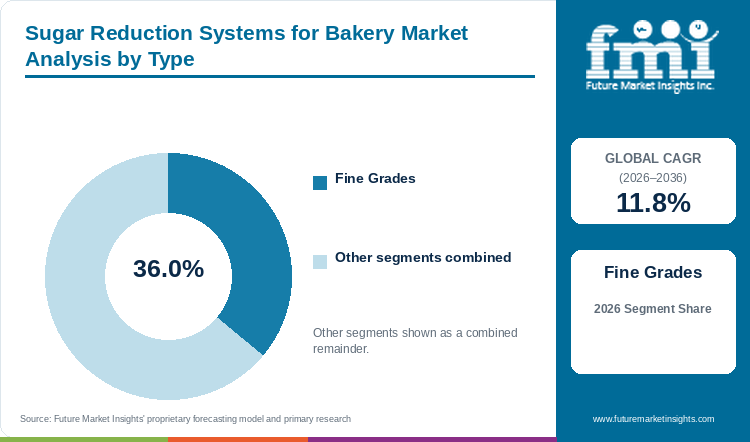
Fine Grades are projected to capture 36.0% of the Type segment in 2026, supported by uniform dry-mix dispersion and smooth creme mouthfeel.
Table 5: Type Share for the Sugar Reduction Systems for Bakery Market (percentage share), 2026
| Type | Share (2026) |
|---|---|
| Fine Grades | 36.0% |
| Other Segments Combined | 64.0%* |
| Total | 100.0% |
*Note: Remaining type segments sum to 100.0% of 2026 bakery sugar-reduction system revenue.
Table 6: Type Leadership and Market Growth for the Sugar Reduction Systems for Bakery Market (segment and CAGR percentage), 2026 to 2036
| Metric | Value |
|---|---|
| Global CAGR (2026 to 2036) | 11.8% |
| Leading Segment | Fine Grades |
Micronized sweetener-and-fiber systems sieved below 150 microns disperse evenly across high-speed planetary mixers and prevent gritty mouthfeel in low-moisture cookie fillings and cake batters. In addition to this, uniform particle geometry stabilizes air-cell incorporation during creaming when formulators co-dose bioconverted stevia with soluble bulking fibers.
- Fine Grades are projected to account for 36.0% of the Type segment in 2026 because controlled particle size eliminates localized sweetness speckling on continuous baking bands.
- Techno-functional gelation research published in Gels in October 2025 confirmed that fine-chain inulin and fructan networks act as dual sugar-and-fat replacers in bakery batters while preserving emulsion stability and soft crumb structure [3].
What keeps Powder / Dry ahead across Form options?
Powder / Dry formulations are estimated to secure 48.0% of the Form segment in 2026, driven by pneumatic silo and dry-premix compatibility.
Commercial bakeries are engineered around gravimetric dry-ingredient micro-dosing hoppers and flour-premix ribbon blenders. so crystalline and spray-dried powders integrate directly into existing dry weigh-up stations without introducing unbudgeted free water or requiring heated syrup holding tanks with crystalline erythritol.
- Powder / Dry options are estimated to command 48.0% of the Form segment in 2026 as dry handling avoids reformulating dough hydration ratios.
- Rheological modeling published in Current Research in Food Science in January 2025 demonstrated that dry soluble dietary fibers govern wheat dough elasticity and starch gelatinization temperatures through hydrogen-bond density and Flory-Huggins water interaction parameters [4].
Why does Bread & Rolls anchor Application demand?
Bread & Rolls is expected to command 29.0% of the Application segment in 2026, reflecting high-volume pan-bread and bun reformulation.
Packaged sandwich breads and hamburger buns with sweet morning rolls represent the highest daily tonnage in industrial baking and face intense retail scrutiny over declared added sugars. Due to yeast-fermentation requirements, reducing sucrose in pan doughs requires fermentable substrate balancing and inulin supplementation so proof times and slice elasticity match full-sugar loaves.
- Bread & Rolls is expected to hold 29.0% of the Application segment in 2026 because high-throughput pan lines generate recurring multi-ton ingredient reorders once validated.
- Functional baking trials published in npj Science of Food in March 2026 showed that replacing sucrose with stevia extract and oat beta-glucan or fenugreek galactomannan fibers lowers non-reducing sugars while inhibiting alpha-amylase by 33.87% and alpha-glucosidase by 42.53% [5].
How does Conventional remain the principal Claim segment?
Conventional formulations are forecast to generate 50.0% of the Claim segment in 2026, owing to broad ingredient eligibility and batch cost control.
Mainstream supermarket bakery brands prioritize achieving a legally compliant 30% sugar reduction and clean sensory parity at the lowest possible batch cost before adding organic or identity-preserved surcharges. Besides this, conventional claim parameters allow food scientists to blend polyols and resistant dextrins with high-potency sweeteners to match sucrose freezing-point depression and crust browning.
- Conventional systems are forecast to account for 50.0% of the Claim segment in 2026 as functional bulk-and-browning performance outweighs specialty sourcing seals in core grocery SKUs.
- Check-All-That-Apply sensory mapping published in the Journal of Food Science in February 2026 across 21 cookie attributes proved that balanced blends of xylitol and monk fruit with thaumatin eliminate sandy and pale defects seen in single-sweetener substitutions [6].
Why does Direct to Industrial Bakeries dominate Sales Channel?
Direct to Industrial Bakeries is anticipated to account for 46.0% of the Sales Channel segment in 2026, reinforced by co-engineered plant trials.
Tier-one commercial bakeries rarely approve a sugar-reduction system from a distributor catalog sheet because oven heat transfer and water activity with shelf-life staling vary by line. Therefore, direct technical partnerships allow ingredient producers to run pilot-scale bakes and validate local nutrition-claim compliance before locking in multi-year bulk tote contracts.
- Direct to Industrial Bakeries is anticipated to capture 46.0% of the Sales Channel segment in 2026 because enterprise baking groups bundle application engineering with bulk ingredient procurement.
- Ingredion achieved Farm Sustainability Assessment (FSA) Silver verification for its global contracted stevia supply chain in April 2025, strengthening direct ESG audit compliance for multinational bakery accounts [7].
What are the drivers, restraints, and opportunities in the sugar reduction systems for bakery market?
In the sugar reduction systems for bakery market, front-of-pack added-sugar rules and Nutri-Score revisions propel reformulation whereas crust-browning loss and crumb hardening restrain adoption and rare-sugar plus prebiotic-fiber blends unlock commercial opportunities.
- Driver: Front-of-pack nutrition labeling proposals and retailer Nutri-Score shelves compel bakeries to cut declared added sugars by 25% to 50%.
- Restraint: Sucrose removal impairs Maillard crust browning and increases crumb hardness while introducing regulatory divergences on allulose and polyols.
- Opportunity: Co-processed rare sugars (D-allulose) and bioconverted Reb M paired with chicory or oat prebiotic fibers restore bulk and moisture in GLP-1-friendly baked goods.
Growth Analysis and Future Potential: Qualitative Demand Catalysts
Regulatory front-of-pack added-sugar disclosures and retailer health-shelf algorithms are converting sugar reduction from a niche diet claim into a core commercial requirement for packaged bakeries. In January 2025, the U.S. Food and Drug Administration proposed mandatory front-of-package nutrition info boxes displaying saturated fat and added sugars (% Daily Value) across packaged foods [8]. Combined with France's March 2025 Nutri-Score algorithm enforcement and South Korea's expanded reduced-sugar bakery categories, these rules push R&D teams to combine naturally derived sweeteners with soluble fibers across commercial bread and biscuit lines.
Risk Assessment of the Sugar Reduction Systems for Bakery Market: Operational and Formulation Friction
Loss of sucrose's non-sweetness structural functions and cross-border regulatory fragmentation represent the primary barriers slowing commercial line conversion. Substitution of sucrose with liquid syrups or unbalanced polyols alters batter viscosity and elevates water activity while shifting thermal browning pathways compared with allulose blends. In April 2025, cake-baking experiments published in the Journal of the Science of Food and Agriculture demonstrated that 100% sucrose substitution with conventional alternative syrups produced visually noticeable crust and crumb color deviations (`Delta E > 3`) with higher baking loss and increased crumb hardness [9]. also while D-allulose enjoys FDA Added Sugars exemption in the USA, it remains pending Novel Food authorization in the European Union and the UK.
Commercial Opportunity Analysis: Formulation Differentiation and Value-Add Formats
Ingredient suppliers can capture higher margins by offering application-specific co-processed systems that pair low-glycemic rare sugars and encapsulated natural sweeteners with prebiotic fibers for diabetic food and weight-management bakery ranges. In June 2026, D-optimal mixture-design trials published in the Journal of the Science of Food and Agriculture showed that spray-dried palmyra palm sap powder encapsulated with maltodextrin and inulin (45:45:10 with gum arabic) produced low-glycemic-index brownies (`GI = 48.66`) achieving 97.5% consumer satisfaction [10]. Suppliers that deliver turnkey powder blends with verified GI and water-activity data shorten bakery R&D cycles and win recurring multi-plant supply tenders.
Sugar Reduction Systems for Bakery Market by Country (2026 to 2036)
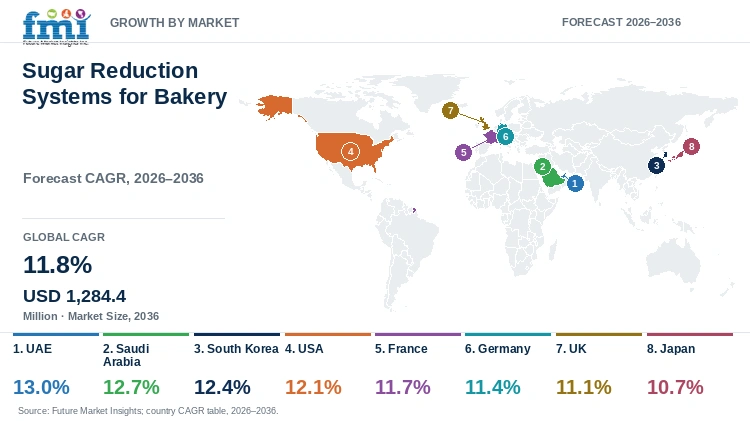
As per FMI, the UAE is projected to lead sugar reduction systems for bakery expansion across evaluated national markets at a 13.0% CAGR through 2036, whereas Japan is forecast to progress at a 10.7% CAGR. Commercial performance across Gulf hospitality hubs and East Asia packaged-bakery markets with North America and Europe retail shelves depends on local sweetener authorization and statutory reduced-sugar claim thresholds.
Table 7: Country CAGR and Primary Growth Levers for the Sugar Reduction Systems for Bakery Market (CAGR percentage and operational drivers), 2026 to 2036
| Country | CAGR (2026 to 2036) | Primary Growth Lever |
|---|---|---|
| UAE | 13.0% | National Nutrition Strategy 2030 reformulation and premium low-sugar packaged pastry demand |
| Saudi Arabia | 12.7% | SFDA high-sugar labeling scrutiny and adult weight-management bakery reformulation |
| South Korea | 12.4% | MFDS reduced-sugars labeling eligibility across castella and packaged cakes |
| USA | 12.1% | FDA allulose Added Sugars exemption and proposed January 2025 front-of-pack nutrition box |
| France | 11.7% | March 2025 updated Nutri-Score decree and Lestrem pilot bakery reformulation infrastructure |
| Germany | 11.4% | BMEL National Reduction and Innovation Strategy and domestic scFOS/inulin fiber engineering |
| UK | 11.1% | HFSS promotional restrictions and FSA authorization of bioconverted Reb M stevia systems |
| Japan | 10.7% | Consumer Affairs Agency comparative nutrient rules and moisture-balanced soft bakery systems |
Source: Future Market Insights analysis
UAE Sugar Reduction Systems for Bakery Market Outlook (2026 to 2036)
The UAE is projected to record a 13.0% CAGR from 2026 to 2036, leading all eight evaluated national markets. Federal reformulation targets under the National Nutrition Strategy 2030 with premium health-positioned pastry demand in Dubai and Abu Dhabi hypermarkets propel commercial adoption. In July 2025, regional dietary attitude research published in Frontiers in Public Health confirmed that 74.19% of Gulf adult respondents view low-calorie sugar substitutes as supportive of metabolic health while favoring natural-origin ingredients [11]. Because high Gulf warehouse temperatures cause caking in hygroscopic syrups, industrial bakeries in the UAE specify free-flowing dry sweetener-and-fiber premixes with verified Halal and Emirates Authority for Standardization and Metrology certificates.
Key takeaway: In the UAE, National Nutrition Strategy 2030 targets and high-heat warehouse logistics are projected to prioritize imported dry clean-label bakery sugar-reduction systems.
Saudi Arabia Sugar Reduction Systems for Bakery Market Outlook (2026 to 2036)
Rapid modernization of industrial pan-bread and biscuit plants with Saudi Food and Drug Authority (SFDA) front-of-pack nutrition scrutiny is accelerating sugar-reduction system trials across Saudi Arabia. Commercial demand for bakery sugar-reduction systems in Saudi Arabia is forecast to expand at a 12.7% CAGR between 2026 and 2036. In May 2026, a cross-sectional epidemiological study of 6,051 adults in Saudi Arabia published in Frontiers in Nutrition documented a strong statistical link between dietary free-sugar intake and adult obesity prevalence [12]. However, long desert freight routes require Riyadh and Jeddah bakeries to select polyol-and-fiber systems that lock in crumb moisture (`aw < 0.85`) without surface stickiness during nationwide grocery distribution.
Key takeaway: In Saudi Arabia, SFDA sugar-labeling oversight and rising adult metabolic health awareness are forecast to accelerate industrial bakery adoption of heat-stable sugar-reduction blends.
South Korea Sugar Reduction Systems for Bakery Market Outlook (2026 to 2036)
Ministry of Food and Drug Safety (MFDS) reduced-sugars labeling rules covering sweet packaged bakery goods such as castella and chiffon cakes create a distinct regulatory catalyst in South Korea. In August 2025, a 525-participant consumer intervention study published in the Journal of Texture Studies demonstrated that front-of-pack reduced-sugar messages on chiffon cakes increased consumer purchase likelihood by 4.502 times (`Hazard Ratio = 4.502, p < 0.05`) [13]. Sales of sugar reduction systems for bakery in South Korea are anticipated to advance at a 12.4% CAGR through 2036. Domestic industrial bakers heavily use crystalline and liquid D-allulose with soluble fibers to preserve soft castella crumb while meeting MFDS claim thresholds.
Key takeaway: In South Korea, MFDS reduced-sugars claim eligibility across cakes and castella is anticipated to drive rapid formulator uptake of allulose and soluble-fiber systems.
USA Sugar Reduction Systems for Bakery Market Outlook (2026 to 2036)
Food and Drug Administration enforcement discretion excluding D-allulose from Total and Added Sugars declarations gives commercial bakeries in the USA a regulatory tool unavailable in the European Union. In January 2025, the FDA proposed requiring a standardized front-of-pack Nutrition Info box displaying Added Sugars (% Daily Value) on packaged foods, intensifying reformulation across pan-bread and cookie plants [8]. Formulation of bioconverted Reb M stevia with allulose and soluble corn fiber enables U.S. bakers to cut declared added sugars by 30% to 50% for keto and GLP-1-aligned grocery shelves, although higher per-kilogram ingredient costs restrain economy bread adoption [14]. Revenue in the USA market is expected to grow at a 12.1% CAGR from 2026 to 2036.
Key takeaway: In the USA, FDA front-of-pack added-sugar proposals and allulose labeling exemptions are expected to anchor multi-plant bakery reformulation contracts.
France Sugar Reduction Systems for Bakery Market Outlook (2026 to 2036)
France is estimated to expand at an 11.7% CAGR from 2026 to 2036, propelled by strict Nutri-Score retail shelf comparisons and domestic starch-and-fiber application centers. In March 2025, Santé publique France confirmed the ministerial signing of the updated Nutri-Score decree that penalizes high sugar density in packaged brioche and viennoiserie while rewarding dietary fiber enrichment [15]. Because European Union Regulation (EC) No 1924/2006 mandates at least a 30% sugar reduction for comparative nutrition claims and restricts unapproved novel sweeteners, industrial bakers in France rely on Roquette's Lestrem laboratories to pair pea starch and soluble fibers with maltitol without losing buttery pastry flakiness across national supermarket bakery aisles.
Key takeaway: In France, the March 2025 Nutri-Score algorithm enforcement and domestic soluble-fiber application centers are estimated to steer viennoiserie and cake reformulation.
Germany Sugar Reduction Systems for Bakery Market Outlook (2026 to 2036)
Domestic chicory-root fiber and isomaltulose refining led by BENEO and Südzucker with federal reformulation monitoring anchors bakery sugar-reduction engineering across Germany. Commercial sales of bakery sugar-reduction systems in Germany are projected to climb at an 11.4% CAGR between 2026 and 2036. In March 2025, the Federal Ministry of Food and Agriculture (BMEL) updated its National Reduction and Innovation Strategy monitoring framework for sugar and salt in processed foods [16]. However, hard-discounter private-label price caps in Germany require ingredient suppliers to demonstrate that short-chain fructooligosaccharides and inulin achieve a 30% sugar reduction and extended crumb softness without inflating unit batch cost across high-speed industrial baking lines.
Key takeaway: In Germany, federal reformulation monitoring and domestic chicory-fiber supply chains are projected to sustain steady adoption in private-label and branded baked goods.
UK Sugar Reduction Systems for Bakery Market Outlook (2026 to 2036)
Statutory High in Fat, Salt and Sugar (HFSS) retail aisle-end and checkout promotional bans make sugar-and-calorie density a direct commercial shelf-access filter for bakeries in the UK. In May 2026, a cross-sectional study led by the University of Oxford in PLoS Medicine found low adherence to voluntary UK sugar and calorie targets across out-of-home dining chains, increasing regulatory pressure on commercial bakery suppliers [17]. UK demand for bakery sugar-reduction systems is slated to progress at an 11.1% CAGR over 2026 to 2036. Following Food Standards Agency authorization of bioconverted Reb M stevia glycosides, UK cake and morning-goods producers pair stevia with prebiotic fibers to regain promotional eligibility.
Key takeaway: In the UK, HFSS retail promotional rules and bioconverted Reb M regulatory access are slated to drive reformulation across cakes and morning goods.
Japan Sugar Reduction Systems for Bakery Market Outlook (2026 to 2036)
High-turnover convenience-store (`konbini`) bakery shelves and strict Consumer Affairs Agency rules separating food additives from comparative nutrient claims govern sweetener selection across Japan. In August 2025, health-economic modeling published in BMC Medicine confirmed how population-level sugar reduction lowers long-term cardiometabolic disease burden in aging societies [18]. Because retail consumers in Japan demand ultra-soft moisture-balanced pan breads (`shokupan`) and delicate castella sponges, commercial bakeries reject polyol blends that leave cooling aftertastes or dry out under chilled display. Commercial revenue in the Japan bakery sugar-reduction systems market is forecast to advance at a 10.7% CAGR from 2026 to 2036 through wider adoption of trehalose and soluble dextrins.
Key takeaway: In Japan, high-turnover convenience-store bakery standards and precise Consumer Affairs Agency claim rules are forecast to favor moisture-retaining rare-sugar and dextrin systems.
Full report country CAGRs cover: North America; Latin America; Western Europe; Eastern Europe; East Asia; South Asia and Pacific; Middle East and Africa.
Who are the notable companies in the sugar reduction systems for bakery market?
Tate & Lyle, Ingredion, Roquette, BENEO, Sudzucker, Nordzucker, ASR Group, Cargill, Ragus, and ADM are the notable companies evaluated in the sugar reduction systems for bakery market.
FMI analysis indicates that the competitive arena divides between integrated sweetness-and-texturizing platforms and specialized prebiotic-fiber processors with conventional industrial sugar reference suppliers. In June 2026, Ingredion Incorporated announced a recommended all-cash acquisition of Tate & Lyle PLC, creating a combined leader uniting PureCircle stevia and rare sugars with functional hydrocolloid and fiber systems [19]. Roquette and BENEO with Südzucker lead in chicory inulin and reduced-sugar fondants, whereas Cargill and ADM offer global polyol and reduced-sugar syrup platforms while Nordzucker and ASR Group with Ragus serve as conventional industrial sugar reference comparators.
- Integrated Sweetness and Formulation Platforms: Tate & Lyle and Ingredion with Cargill and ADM combine high-potency stevia and rare sugars with bulking fibers and pilot bakery engineering.
- Functional Bulking and Fiber Specialists: Roquette and BENEO along with Sudzucker supply chicory oligofructose and soluble fibers with maltitol and reduced-sugar bakery fondants.
- Conventional Bakery Sweetening Reference Suppliers: Nordzucker and ASR Group with Ragus supply baseline beet and cane sugars and functional invert syrups used as industrial benchmarks.
Competitive Benchmarking: Sugar Reduction Systems for Bakery Market
Table 8: Competitive Benchmarking for the Sugar Reduction Systems for Bakery Market (qualitative capability ratings), 2026
| Company | Sugar-Replacing Sweetness | Bulk and Texture Rebuild | Bakery Reformulation Support | Geographic Reach |
|---|---|---|---|---|
| Tate & Lyle | High | High | High | Americas; Europe; Asia-Pacific |
| Ingredion | High | High | High | Americas; Europe; Asia-Pacific |
| Roquette | Medium | High | High | Europe; Americas; Asia-Pacific |
| BENEO | Medium | High | Medium | Europe and international channels |
| Sudzucker | Medium | Medium | Medium | Europe and international customers |
| Nordzucker | Unscored | Unscored | Unscored | Europe and Australia |
| ASR Group | Unscored | Unscored | Unscored | North America and Europe |
| Cargill | High | High | High | Americas; Europe; Asia-Pacific |
| Ragus | Unscored | Unscored | Unscored | UK production and export customers |
| ADM | High | High | High | Americas; Europe; Asia-Pacific |
Scoring basis: Capability ratings for Sugar-Replacing Sweetness evaluate documented stevia and rare-sugar with polyol portfolios designed to replace sucrose sweetness. Bulk and Texture Rebuild and Bakery Reformulation Support rate verified soluble fibers and pilot baking laboratories, while Unscored indicates conventional sugar/syrup suppliers without verified standalone sugar-reduction system lines.
Key Developments in the Sugar Reduction Systems for Bakery Market
- In June 2026, Ingredion Incorporated announced a recommended all-cash acquisition of Tate & Lyle PLC to unite Ingredion's PureCircle stevia and texture portfolio with Tate & Lyle's sweetening and soluble fiber platforms [19].
- In December 2025, BENEO presented weight-management and GLP-1-aligned bakery concepts at Fi Europe 2025 combining short-chain fructooligosaccharides (scFOS) with flavorings with modifying properties to achieve 30%+ sugar reduction [20].
- In May 2025, Roquette completed the acquisition of IFF Pharma Solutions and expanded its global plant-based specialty excipient and functional fiber formulation network [21].
Key Players in the Sugar Reduction Systems for Bakery Market
Integrated Sweetness and Food-Formulation Platforms
- Tate & Lyle
- Ingredion
- Cargill
- ADM
Functional Bulking, Fiber and Reduced-Sugar Specialists
- Roquette
- BENEO
- Sudzucker
Conventional Bakery Sweetening and Procurement Reference Suppliers
- Nordzucker
- ASR Group
- Ragus
Sugar Reduction Systems for Bakery Market - Report Scope
Table 9: Report Scope for the Sugar Reduction Systems for Bakery Market (coverage fields and definitions), 2026 to 2036
| Coverage field | Report scope |
|---|---|
| Market breakdown | Type; Form; Application; Claim; Sales Channel |
| Quantitative Units | USD Million |
| Market Definition | Includes B2B supplier revenue from purpose-designed bakery sugar-reduction ingredients and co-processed ingredient systems (combining high-potency sweeteners, rare sugars, polyols, and functional bulking fibers/starches) sold for lower-sugar bakery formulations. Category Scope Note: Excludes downstream finished bakery goods, unmodified commodity beet/cane sugars, baking machinery, and beverage/confectionery sweetener sales. |
| Regions Covered | North America, Latin America, Western Europe, Eastern Europe, East Asia, South Asia and Pacific, Middle East and Africa |
| Countries Covered | UAE, Saudi Arabia, South Korea, USA, France, Germany, UK, Japan, and additional countries in the full report |
| Key Companies Covered | Tate & Lyle, Ingredion, Roquette, BENEO, Sudzucker, Nordzucker, ASR Group, Cargill, Ragus, ADM |
| Forecast Period | 2026 to 2036 |
| Approach | Primary and secondary research with top-down and bottom-up market triangulation. |
Sugar Reduction Systems for Bakery Market - Research Methodology
Table 10: Research Methodology for the Sugar Reduction Systems for Bakery Market (research methods and approach), 2026 edition
| Method | Approach |
|---|---|
| Primary Research | Structured interviews with industrial bakery R&D directors with sweetener-and-fiber application scientists and regulatory affairs specialists to validate dough inclusion rates (8% to 18% w/w) and per-kilogram system pricing. |
| Secondary Research | Audit of corporate filings (Ingredion, Tate & Lyle, Roquette, Südzucker, Nordzucker, ADM, Cargill), PubMed dough rheology and low-field NMR retrogradation studies, and FDA, EFSA, Santé publique France, BMEL, SFDA, and MFDS regulatory registries. |
| Market Sizing and Forecasting | Top-down bakery ingredient expenditure models reconciled against bottom-up reformulated bakery tonnage and qualifying sugar-reduction system dosing rates from 2026 to 2036. |
| Country Forecasting Model | Econometric country projections weight statutory front-of-pack sugar labeling rules, Nutri-Score and HFSS retail shelf algorithms, allulose/Reb M regulatory approvals, and industrial bakery output across eight national markets. |
| Operational Benchmark Traceability | Formulation-tonnage and plant spending indicators in Tables 2, 3, and 4 trace to Journal of the Science of Food and Agriculture and Food Research International dough-rheology benchmarks and verified industrial bakery trial protocols. |
| Data Triangulation and Validation | Revenue estimates isolate B2B bakery sugar-reduction systems and exclude unmodified commodity beet/cane sugars with standalone flour improvers and finished retail baked goods to prevent double counting. |
Sugar Reduction Systems for Bakery Market by Segments
Sugar Reduction Systems for Bakery Market segmented by Type:
- Fine Grades
- Coarse & Decorative
- Organic
- Blends
Sugar Reduction Systems for Bakery Market segmented by Form:
- Powder / Dry
- Liquid
- Paste / Semi-Solid
- Granules / Pieces
Sugar Reduction Systems for Bakery Market segmented by Application:
- Bread & Rolls
- Cakes & Muffins
- Biscuits & Cookies
- Viennoiserie & Pastry
- Other Bakery & Snacks
Sugar Reduction Systems for Bakery Market segmented by Claim:
- Conventional
- Clean Label
- Organic
- Non-GMO / Identity Preserved
Sugar Reduction Systems for Bakery Market segmented by Sales Channel:
- Direct to Industrial Bakeries
- Ingredient Distributors
- Foodservice & Artisan Supply
- Online B2B
Sugar Reduction Systems for Bakery Market by Region
- North America
- United States
- Canada
- Latin America
- Brazil
- Mexico
- Argentina
- Chile
- Western Europe
- Germany
- France
- United Kingdom
- Italy
- Spain
- Benelux
- Nordics
- Eastern Europe
- Poland
- Czech Republic
- Romania
- Hungary
- East Asia
- China
- Japan
- South Korea
- South Asia and Pacific
- India
- ASEAN
- Australia and New Zealand
- Middle East and Africa
- GCC Countries
- South Africa
- Türkiye
- Israel
Research Sources and Bibliography
- [1] Zhang, Y., Wang, L., & Chen, X. (2025, March 30). Effects of oligosaccharides, sodium carboxymethyl cellulose and d-allulose as a compound improver on the quality of sugar-reduced bread. Journal of the Science of Food and Agriculture, 105(5), 3024-3035 (PubMed PMID 39660575).
- [2] Liu, H., Zhao, M., & Sun, J. (2025, March 10). Effects of oligosaccharides, sodium carboxymethyl cellulose and D-allulose on thermomechanical, rheological, fermentation properties of sugar-reduced dough. Food Research International, 208, 116163 (PubMed PMID 40263830).
- [3] Canazza, E., Grauso, M., Mihaylova, D., & Lante, A. (2025, October 15). Techno-Functional Properties and Applications of Inulin in Food Systems. Gels, 11(10), 829 (PubMed PMID 41149433).
- [4] Rossi, F., Marti, A., & Pagani, M. A. (2025, January 30). Soluble fibres modulate dough rheology and gluten structure via hydrogen bond density and Flory-Huggins water interaction parameter. Current Research in Food Science, 10, 100991 (PubMed PMID 39995469).
- [5] Al-Ghamdi, S., & El-Sayed, M. (2026, March 23). Production of low-calorie biscuits using stevia extract and dietary fibers from oats and fenugreek for functional food applications. npj Science of Food, 10(1), 111 (PubMed PMID 41872196).
- [6] Oliveira, D. C., & Bolini, H. M. A. (2026, February 10). Sensory Characterization of Cookies With Sugar Replacement by Sweeteners Using the Check-All-That-Apply (CATA) Method. Journal of Food Science, 91(2), e70888 (PubMed PMID 41604252).
- [7] Ingredion Incorporated. (2025, April 29). Ingredion Achieves FSA Silver. Ingredion Newsroom.
- [8] U.S. Food and Drug Administration. (2025, January 14). FDA Proposes Requiring At-a-Glance Nutrition Information on the Front of Packaged Foods. U.S. Food and Drug Administration Press Announcements.
- [9] Yildiz, O., & Boyacioglu, M. H. (2025, April 10). Do sugar substitutes affect quality characteristics and HMF levels of cakes? Journal of the Science of Food and Agriculture, 105(8), 4412-4420 (PubMed PMID 40116182).
- [10] Chaiwanichsiri, S., & Laohasongkram, K. (2026, June 25). Palmyra palm (Borassus flabellifer) sap powder as a functional ingredient for the development of low-glycemic index brownies. Journal of the Science of Food and Agriculture, 106(9), 5120-5131 (PubMed PMID 42339978).
- [11] Al-Qahtani, A. M., & Al-Harbi, N. O. (2025, July 16). Consumption patterns and attitudinal insights on artificial sweeteners in Saudi Arabia. Frontiers in Public Health, 13, 1643309 (PubMed PMID 40740366).
- [12] Al-Musharaf, S., & Al-Othman, A. (2026, May 22). Correlation between sugar-sweetened beverage consumption and obesity among adults in Saudi Arabia. Frontiers in Nutrition, 13, 1809303 (PubMed PMID 42253743).
- [13] Wang, Z., Li, H., & Zhou, Y. (2025, August 15). Effects of Reduced-Sugar Messages on Chiffon Cake Ratings and Human Chewing Behavior. Journal of Texture Studies, 56(4), e70033 (PubMed PMID 40717034).
- [14] Awlqadr, F. H., & Saeed, M. N. (2026, September 7). Beyond sweetness: rare sugars as next-generation functional food ingredients for metabolic health, food innovation, and sugar-reduction strategies. Frontiers in Food Science and Technology, 6, 1947889.
- [15] Santé publique France. (2025, March 17). Signature de l’arrêté Nutri-Score : un pas de plus vers une meilleure information nutritionnelle des consommateurs. Santé publique France Actualités.
- [16] Federal Ministry of Food and Agriculture, Germany. (2025, March 24). Nationale Reduktions- und Innovationsstrategie für Zucker, Fette und Salz in Fertigprodukten. Bundesministerium für Ernährung und Landwirtschaft (BMEL).
- [17] Scarborough, P., & Kaur, A. (2026, May 5). Adherence to voluntary UK sugar, salt, and calorie reduction targets in the highest-grossing restaurant chains: A cross-sectional study. PLoS Medicine, 23(5), e1004681 (PubMed PMID 42085343).
- [18] Cobiac, L. J., & Mytton, O. T. (2025, August 27). Population health impacts from the taxation of salt and sugar in the United Kingdom. BMC Medicine, 23(1), 489 (PubMed PMID 40859903).
- [19] Ingredion Incorporated / Tate & Lyle PLC. (2026, June 8). Ingredion Announces Recommended All-Cash Acquisition of Tate & Lyle PLC. Ingredion Incorporated Official Investor Relations.
- [20] BENEO GmbH. (2025, December 2). Weight-Management Solutions at Fi Europe 2025: BENEO Presents Functional Fibres, Plant-Based Proteins and Low-Glycaemic Ingredients. BENEO Newsroom.
- [21] Roquette Frères. (2025, May 1). Completion of IFF Pharma Solutions Acquisition. Roquette Corporate Press Releases.
- [22] Südzucker AG. (2026, April 27). Südzucker Announces Preliminary Figures for Fiscal Year 2025/26. Südzucker Group Press Releases.
- [23] Nordzucker AG. (2026, May 28). Nordzucker 2025/2026 Annual Financial Statements: Consistent Measures in an Extremely Challenging Market Environment. Nordzucker Press Releases.
This bibliography is provided for reader reference and is not exhaustive. The full report contains the complete reference list and detailed citations.
This Report Answers
- How large is the sugar reduction systems for bakery market in 2026 and what is forecast for 2036?
- Which front-of-pack nutrition and Nutri-Score pressures prompt bakeries to reformulate?
- Why do Fine Grades lead the Type segment in 2026?
- Why does Powder / Dry lead the Form segment globally?
- How do growth rates differ across the UAE and Saudi Arabia versus South Korea and the USA?
- Which leading companies supply integrated sweetness-and-bulking bakery systems today?
- What technical and regulatory frictions limit ingredient substitution and supplier switching?
- What should industrial bakeries verify before qualifying a lower-sugar ingredient system?
Frequently Asked Questions
How big is the sugar reduction systems for bakery market in 2026, and what is forecast for 2036?
According to FMI, global sugar reduction systems for bakery revenue is estimated to reach USD 421.0 million in 2026 from USD 376.6 million in 2025. Sales are forecast to hit USD 1,284.4 million by 2036 as commercial bakeries adopt multi-component bulking and sweetening blends.
What is the CAGR for the sugar reduction systems for bakery market from 2026 to 2036?
Future Market Insights projects an 11.8% compound annual growth rate between 2026 and 2036, representing an anticipated USD 863.4 million increase in annual B2B ingredient-system turnover.
Which Type segment leads the sugar reduction systems for bakery market?
Fine Grades are projected to capture 36.0% of the Type segment in 2026 because sub-150-micron particle distributions ensure uniform dry-mix dispersion and smooth creme-filling texture.
Which Form segment leads the sugar reduction systems for bakery market?
Powder / Dry systems are estimated to secure 48.0% of the Form segment in 2026 due to direct compatibility with automated bakery flour-scaling hoppers and dry premixers.
Which country has a notable growth outlook during the assessment period?
The UAE is projected to lead evaluated national expansion at a 13.0% CAGR through 2036, supported by National Nutrition Strategy 2030 targets and premium packaged-pastry reformulation.
Who are the key players in the market?
Tate & Lyle, Ingredion, Roquette, BENEO, Sudzucker, Nordzucker, ASR Group, Cargill, Ragus, and ADM are the notable companies evaluated across specialty sweetener, functional fiber, and industrial bakery reference supply.
Preview the report firsthand - request a free sample
Get SampleGet the brochure for pricing and purchase details.
Get PDFTable of Content
- Key Takeaways
- Market Size and CAGR
- Top Growth Driver
- Fastest Growing Segment
- Leading Region
- Key Companies
- Emerging Opportunities
- Executive Summary
- Global Market Outlook
- Demand-side Trends
- Supply-side Trends
- Technology Roadmap Analysis
- Analysis and Recommendations
- Analyst Perspective (What is happening? Why now? What should investors know?)
- Key Questions Answered
- How large is the market?
- What is the CAGR?
- What are key trends?
- Which region dominates?
- Who are the leaders?
- Market Overview
- Market Coverage / Taxonomy
- Market Definition / Scope / Limitations
- Research Methodology
- Chapter Orientation
- Analytical Lens and Working Hypotheses
- Market Structure, Signals, and Trend Drivers
- Benchmarking and Cross-market Comparability
- Market Sizing, Forecasting, and Opportunity Mapping
- Research Design and Evidence Framework
- Desk Research Programme (Secondary Evidence)
- Expert Input and Fieldwork (Primary Evidence)
- Tooling, Models, and Reference Databases
- Data Engineering and Model Build
- Quality Assurance and Audit Trail
- Market Background
- Market Dynamics (Drivers, Restraints, Opportunity, Trends)
- Scenario Forecast (Optimistic, Likely, Conservative)
- Impact Analysis
- AI Impact
- Sustainability Impact
- Regulatory Impact
- Technology Impact
- Consumer / Buyer Analysis
- Purchase Drivers
- Adoption Barriers
- Buyer Journey
- Opportunity Map Analysis
- Product Life Cycle Analysis
- Supply Chain Analysis
- Investment Feasibility Matrix
- Value Chain Analysis
- PESTLE and Porter's Analysis
- Regulatory Landscape
- Regional Parent Market Outlook
- Production and Consumption Statistics
- Import and Export Statistics
- Global Market Analysis and Forecast, 2021 to 2036
- Historical Market Size Value (USD Million) Analysis, 2021 to 2025
- Current and Future Market Size Value (USD Million) Projections, 2026 to 2036
- Y-o-Y Growth Trend Analysis
- Absolute $ Opportunity Analysis
- Global Market Pricing Analysis, 2021 to 2036
- Global Market Analysis and Forecast, By Type, 2021 to 2036
- Introduction / Key Findings
- Historical Market Size Value (USD Million) Analysis By Type, 2021 to 2025
- Current and Future Market Size Value (USD Million) Analysis and Forecast By Type, 2026 to 2036
- Fine Grades
- Coarse & Decorative
- Organic
- Blends
- Y-o-Y Growth Trend Analysis By Type, 2021 to 2025
- Absolute $ Opportunity Analysis By Type, 2026 to 2036
- Global Market Analysis and Forecast, By Form, 2021 to 2036
- Introduction / Key Findings
- Historical Market Size Value (USD Million) Analysis By Form, 2021 to 2025
- Current and Future Market Size Value (USD Million) Analysis and Forecast By Form, 2026 to 2036
- Powder / Dry
- Liquid
- Paste / Semi-Solid
- Granules / Pieces
- Y-o-Y Growth Trend Analysis By Form, 2021 to 2025
- Absolute $ Opportunity Analysis By Form, 2026 to 2036
- Global Market Analysis and Forecast, By Application, 2021 to 2036
- Introduction / Key Findings
- Historical Market Size Value (USD Million) Analysis By Application, 2021 to 2025
- Current and Future Market Size Value (USD Million) Analysis and Forecast By Application, 2026 to 2036
- Bread & Rolls
- Cakes & Muffins
- Biscuits & Cookies
- Viennoiserie & Pastry
- Other Bakery & Snacks
- Y-o-Y Growth Trend Analysis By Application, 2021 to 2025
- Absolute $ Opportunity Analysis By Application, 2026 to 2036
- Global Market Analysis and Forecast, By Claim, 2021 to 2036
- Introduction / Key Findings
- Historical Market Size Value (USD Million) Analysis By Claim, 2021 to 2025
- Current and Future Market Size Value (USD Million) Analysis and Forecast By Claim, 2026 to 2036
- Conventional
- Clean Label
- Organic
- Non-GMO / Identity Preserved
- Y-o-Y Growth Trend Analysis By Claim, 2021 to 2025
- Absolute $ Opportunity Analysis By Claim, 2026 to 2036
- Global Market Analysis and Forecast, By Sales Channel, 2021 to 2036
- Introduction / Key Findings
- Historical Market Size Value (USD Million) Analysis By Sales Channel, 2021 to 2025
- Current and Future Market Size Value (USD Million) Analysis and Forecast By Sales Channel, 2026 to 2036
- Direct to Industrial Bakeries
- Ingredient Distributors
- Foodservice & Artisan Supply
- Online B2B
- Y-o-Y Growth Trend Analysis By Sales Channel, 2021 to 2025
- Absolute $ Opportunity Analysis By Sales Channel, 2026 to 2036
- Global Market Analysis and Forecast, By Region, 2021 to 2036
- Introduction
- Historical Market Size Value (USD Million) Analysis By Region, 2021 to 2025
- Current Market Size Value (USD Million) Analysis and Forecast By Region, 2026 to 2036
- North America
- Latin America
- Western Europe
- Eastern Europe
- East Asia
- South Asia and Pacific
- Middle East and Africa
- Market Attractiveness Analysis By Region
- North America Market Analysis and Forecast, By Country, 2021 to 2036
- Historical Market Size Value (USD Million) Trend Analysis By Market Taxonomy, 2021 to 2025
- Market Size Value (USD Million) Forecast By Market Taxonomy, 2026 to 2036
- By Country
- United States
- Canada
- By Type
- By Form
- By Application
- By Claim
- By Sales Channel
- By Country
- Market Attractiveness Analysis
- By Country
- By Type
- By Form
- By Application
- By Claim
- By Sales Channel
- Key Takeaways
- Latin America Market Analysis and Forecast, By Country
- Historical Market Size Value (USD Million) Trend Analysis By Market Taxonomy, 2021 to 2025
- Market Size Value (USD Million) Forecast By Market Taxonomy, 2026 to 2036
- By Country
- Brazil
- Mexico
- Argentina
- Chile
- By Type
- By Form
- By Application
- By Claim
- By Sales Channel
- By Country
- Market Attractiveness Analysis
- By Country
- By Type
- By Form
- By Application
- By Claim
- By Sales Channel
- Key Takeaways
- Western Europe Market Analysis and Forecast, By Country
- Historical Market Size Value (USD Million) Trend Analysis By Market Taxonomy, 2021 to 2025
- Market Size Value (USD Million) Forecast By Market Taxonomy, 2026 to 2036
- By Country
- Germany
- France
- United Kingdom
- Italy
- Spain
- Benelux
- Nordics
- By Type
- By Form
- By Application
- By Claim
- By Sales Channel
- By Country
- Market Attractiveness Analysis
- By Country
- By Type
- By Form
- By Application
- By Claim
- By Sales Channel
- Key Takeaways
- Eastern Europe Market Analysis and Forecast, By Country
- Historical Market Size Value (USD Million) Trend Analysis By Market Taxonomy, 2021 to 2025
- Market Size Value (USD Million) Forecast By Market Taxonomy, 2026 to 2036
- By Country
- Poland
- Czech Republic
- Romania
- Hungary
- By Type
- By Form
- By Application
- By Claim
- By Sales Channel
- By Country
- Market Attractiveness Analysis
- By Country
- By Type
- By Form
- By Application
- By Claim
- By Sales Channel
- Key Takeaways
- East Asia Market Analysis and Forecast, By Country
- Historical Market Size Value (USD Million) Trend Analysis By Market Taxonomy, 2021 to 2025
- Market Size Value (USD Million) Forecast By Market Taxonomy, 2026 to 2036
- By Country
- China
- Japan
- South Korea
- By Type
- By Form
- By Application
- By Claim
- By Sales Channel
- By Country
- Market Attractiveness Analysis
- By Country
- By Type
- By Form
- By Application
- By Claim
- By Sales Channel
- Key Takeaways
- South Asia and Pacific Market Analysis and Forecast, By Country
- Historical Market Size Value (USD Million) Trend Analysis By Market Taxonomy, 2021 to 2025
- Market Size Value (USD Million) Forecast By Market Taxonomy, 2026 to 2036
- By Country
- India
- ASEAN
- Australia and New Zealand
- By Type
- By Form
- By Application
- By Claim
- By Sales Channel
- By Country
- Market Attractiveness Analysis
- By Country
- By Type
- By Form
- By Application
- By Claim
- By Sales Channel
- Key Takeaways
- Middle East and Africa Market Analysis and Forecast, By Country
- Historical Market Size Value (USD Million) Trend Analysis By Market Taxonomy, 2021 to 2025
- Market Size Value (USD Million) Forecast By Market Taxonomy, 2026 to 2036
- By Country
- GCC Countries
- South Africa
- Türkiye
- Israel
- By Type
- By Form
- By Application
- By Claim
- By Sales Channel
- By Country
- Market Attractiveness Analysis
- By Country
- By Type
- By Form
- By Application
- By Claim
- By Sales Channel
- Key Takeaways
- Key Countries Market Analysis
- United States
- Pricing Analysis
- Market Share Analysis, 2025
- By Type
- By Form
- By Application
- By Claim
- By Sales Channel
- Canada
- Pricing Analysis
- Market Share Analysis, 2025
- By Type
- By Form
- By Application
- By Claim
- By Sales Channel
- Mexico
- Pricing Analysis
- Market Share Analysis, 2025
- By Type
- By Form
- By Application
- By Claim
- By Sales Channel
- Brazil
- Pricing Analysis
- Market Share Analysis, 2025
- By Type
- By Form
- By Application
- By Claim
- By Sales Channel
- Chile
- Pricing Analysis
- Market Share Analysis, 2025
- By Type
- By Form
- By Application
- By Claim
- By Sales Channel
- Germany
- Pricing Analysis
- Market Share Analysis, 2025
- By Type
- By Form
- By Application
- By Claim
- By Sales Channel
- United Kingdom
- Pricing Analysis
- Market Share Analysis, 2025
- By Type
- By Form
- By Application
- By Claim
- By Sales Channel
- Italy
- Pricing Analysis
- Market Share Analysis, 2025
- By Type
- By Form
- By Application
- By Claim
- By Sales Channel
- Spain
- Pricing Analysis
- Market Share Analysis, 2025
- By Type
- By Form
- By Application
- By Claim
- By Sales Channel
- France
- Pricing Analysis
- Market Share Analysis, 2025
- By Type
- By Form
- By Application
- By Claim
- By Sales Channel
- India
- Pricing Analysis
- Market Share Analysis, 2025
- By Type
- By Form
- By Application
- By Claim
- By Sales Channel
- ASEAN
- Pricing Analysis
- Market Share Analysis, 2025
- By Type
- By Form
- By Application
- By Claim
- By Sales Channel
- Australia and New Zealand
- Pricing Analysis
- Market Share Analysis, 2025
- By Type
- By Form
- By Application
- By Claim
- By Sales Channel
- China
- Pricing Analysis
- Market Share Analysis, 2025
- By Type
- By Form
- By Application
- By Claim
- By Sales Channel
- Japan
- Pricing Analysis
- Market Share Analysis, 2025
- By Type
- By Form
- By Application
- By Claim
- By Sales Channel
- South Korea
- Pricing Analysis
- Market Share Analysis, 2025
- By Type
- By Form
- By Application
- By Claim
- By Sales Channel
- Poland
- Pricing Analysis
- Market Share Analysis, 2025
- By Type
- By Form
- By Application
- By Claim
- By Sales Channel
- Hungary
- Pricing Analysis
- Market Share Analysis, 2025
- By Type
- By Form
- By Application
- By Claim
- By Sales Channel
- Türkiye
- Pricing Analysis
- Market Share Analysis, 2025
- By Type
- By Form
- By Application
- By Claim
- By Sales Channel
- South Africa
- Pricing Analysis
- Market Share Analysis, 2025
- By Type
- By Form
- By Application
- By Claim
- By Sales Channel
- UAE
- Pricing Analysis
- Market Share Analysis, 2025
- By Type
- By Form
- By Application
- By Claim
- By Sales Channel
- Saudi Arabia
- Pricing Analysis
- Market Share Analysis, 2025
- By Type
- By Form
- By Application
- By Claim
- By Sales Channel
- United States
- Market Structure Analysis
- Competition Dashboard
- Competition Benchmarking
- Market Share Analysis of Top Players
- By Regional
- By Type
- By Form
- By Application
- By Claim
- By Sales Channel
- Emerging Startups
- Innovation Benchmarking
- Competition Analysis
- Competition Deep Dive
- Tate & Lyle
- Overview
- Product Portfolio
- Profitability by Market Segments
- Sales Footprint
- Strategy Overview
- Marketing Strategy
- Product Strategy
- Channel Strategy
- Ingredion
- Roquette
- BENEO
- Sudzucker
- Nordzucker
- ASR Group
- Cargill
- Ragus
- ADM
- Tate & Lyle
- Case Studies
- Success Stories
- Recent Developments
- Competition Deep Dive
- Assumptions & Acronyms Used


