

- Market Size (2026)
- USD 183.3 Mn
- Forecast (2036)
- USD 437.9 Mn
- CAGR (2026 to 2036)
- 9.1%
How big is Salt Reduction Systems for Bakery Market in 2026?
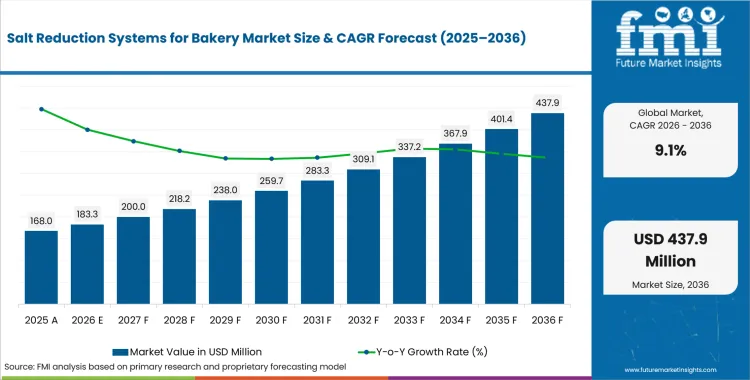
USD 183.3 million in 2026 and USD 437.9 million by 2036 at a 9.1% CAGR.
Demand for salt reduction systems for bakery is projected to expand at 9.1% CAGR between 2026 and 2036, increasing valuation from USD 183.3 million in 2026 to USD 437.9 million by 2036. Bakery teams need lower sodium without losing dough control or familiar flavor. FDA reported in June 2026 that processed and prepared foods account for more than 70% of USA sodium intake. That exposure keeps reformulation on packaged-food development agendas and raises demand for taste modulators that preserve sensory performance at lower salt levels.
The UAE is projected to expand at a 10.4% CAGR compared with 9.2% for the United Kingdom, reflecting different stages of sodium-reduction adoption across bakery markets. UAE bakery and foodservice operators continue to evaluate reformulation opportunities across a wide mix of local and international product formats. UK manufacturers have spent years working against established salt-reduction targets, leaving fewer straightforward reformulation gains available. The UK National Diet and Nutrition Survey reported in June 2025 that adults aged 19 to 64 in the highest income quintile consumed an average of 1,873 milligrams of sodium per day. Continued nutrition monitoring encourages further sodium reduction, but much of the remaining work involves incremental recipe optimization rather than broad formulation changes.
Key Takeaways
- Bakery manufacturers increasingly treat sodium reduction as a formulation project that must preserve taste and production stability across commercial lines.
- By product type, standard grade is estimated to hold 40.0% in 2026 owing to broad recipe compatibility and lower qualification burden.
- Powder - dry is projected to hold 43.0% share in 2026 owing to established dry dosing that simplifies transfer from pilot batches to production lines.
- In 2026, bread & rolls are expected to lead application with 31.0% share because national sodium programs repeatedly target everyday bread products.
- Salt affects flavor and dough behavior together, so deeper reduction can lengthen sensory testing and production-line validation required for commercial approval.
- Some of the key players in this market include Kerry Group, IFF, dsm-firmenich, Puratos, Corbion, Novonesis, AB Enzymes, and Palsgaard.
Analyst Perspective
"Bakery customers should compare sodium-reduction systems by the plant trials needed to reach a stable recipe, not by unit ingredient price alone. The stronger offer lowers sodium while preserving dough control and familiar flavor across repeat production."
- Nandini Roy Choudhury, Principal Consultant, Future Market Insights
How is the salt reduction systems for bakery market segmented?
The market is segmented by product type, form, application, claim, sales channel and region.
Market taxonomy covers product type with standard, premium, organic and clean label grades. Form includes powder - dry, liquid, paste / semi-solid and granules / pieces. Applications include bread & rolls, cakes & muffins, biscuits & cookies, viennoiserie & pastry and other bakery & snacks. Claims cover conventional, clean label, organic and non-GMO / identity preserved. Sales channels include direct industrial supply, ingredient distributors, foodservice and artisan supply and online B2B.
What makes standard grade central to the product type category?
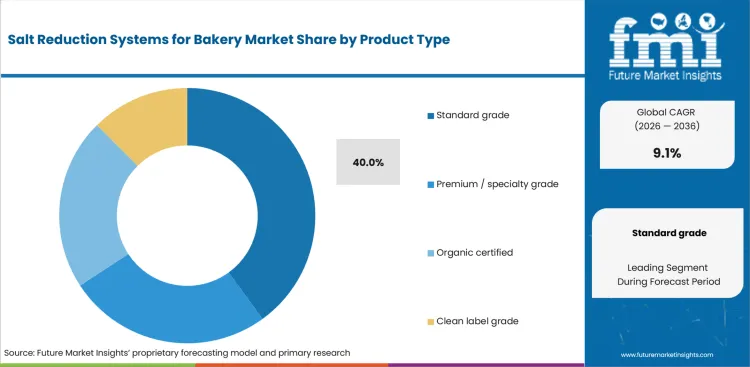
Standard grade fits mainstream industrial renovation as bakeries can use several functional routes without adding certification constraints. The wider formulation range lets R&D teams compare minerals with food enzymes and taste support against the same finished-product brief.
- By product type, standard grade is estimated to hold 40.0% in 2026 owing to broad recipe compatibility and practical qualification requirements.
- Kerry reported in March 2026 that its 2025 technology milestones included next-generation fermentation-derived Tastesense solutions for sugar and salt reduction. The launch gives large bakeries another documented sensory route for reformulation programs that need repeatable flavor performance.
Why does powder - dry lead the form category?
Powder formats match the physical handling systems already used for flour and premixes in industrial bakeries. They also let formulators place minerals beside food emulsifiers inside controlled dry blends without adding liquid storage or pumping steps.
- Powder - dry is set to lead the form category with 43.0% share in 2026 due to dry dosing that supports repeatable scale-up from pilot batches to production lines.
- Palsgaard expanded powdered Emulpals cake-emulsifier production to Brazil in October 2025 and cited regional supply benefits for customers across the Americas. Localized powder manufacturing reduces freight exposure while preserving access to application experts during recipe adjustment.
How do bread & rolls anchor the application category?
Frequent bread consumption keeps sodium reformulation visible across public-health programs that target products consumed at high volume. Salt reduction can alter dough strength and fermentation timing during bread production, making flour improver products relevant to functional recovery.
- By application, bread & rolls are forecast to represent 31.0% in 2026 driven by recurring renovation programs for high-frequency bread products.
- The American Heart Association reported in January 2026 that fully meeting France's bread sodium targets could lower daily salt intake by 0.35 g per person. The modeled effect keeps bread under reformulation pressure while bakeries still need systems that preserve dough behavior and familiar sensory quality.
Why does direct supply lead the sales channel category?
Large bakery programs require technical sign-off across R&D and operations for purchasing to become routine. Direct engagement lets application teams adjust dosage during trials and compare bakery enzymes with other functional components under the customer’s actual process conditions.
- Based on sales channel, direct to industrial bakeries is projected to account for 50.0% in 2026 due to plant trials that require close technical coordination through approval.
- AB Enzymes opened a Curitiba office and baking laboratory in June 2026 to support regional customer trials. The facility shortens the distance between enzyme selection and local bakery testing across recipes that require process-specific adjustment.
What are the drivers, restraints and opportunities in the Salt Reduction Systems for Bakery Market?
Nutrition policy expands bakery reformulation work, while salt-dependent dough performance raises trial cost and integrated functional recovery offers the clearest revenue route.
- Driver: Nutrition targets turn sodium reduction into a measurable product-development brief for industrial bakery teams and brand owners.
- Restraint: Salt removal can disturb flavor and dough performance at the same time, increasing the number of trials needed for commercial approval.
- Opportunity: Integrated formulation support can recover taste and process behavior within one customer validation program instead of separate ingredient projects.
Nutrition targets convert public-health policy into bakery reformulation briefs
FDA stated in June 2025 that its nutrition initiatives include voluntary sodium targets for processed and packaged foods. Clear targets give brand teams a measurable specification for reformulation and make potassium chloride or other reduction routes easier to evaluate against a defined sodium objective. Commercial demand appears when an approved target reaches the bakery development calendar and receives funding for plant validation.
Functional loss raises the cost of deeper sodium reduction
Salt affects dough structure and leavening behavior alongside flavor during lower-sodium reformulation, so bakery teams must validate function under the revised recipe. UK Food Standards Agency guidance published in April 2025 used potassium bicarbonate in a lower-sodium baking powder while preserving expected pancake rise and texture. The example shows why bakery mixes require functional reformulation work for a lower-sodium recipe to reach routine production.
Application laboratories can turn technical complexity into repeatable revenue
Puratos opened a customer innovation center in Budapest in April 2025 with production space and direct co-development support for bakery projects. That model lets technical teams test clean-label ingredients beside other functional components under realistic process conditions before a customer commits to full conversion. Companies that shorten trial cycles can earn broader project value than firms selling a single replacement ingredient without application support.
Which country CAGRs are profiled in the Salt Reduction Systems for Bakery Market?
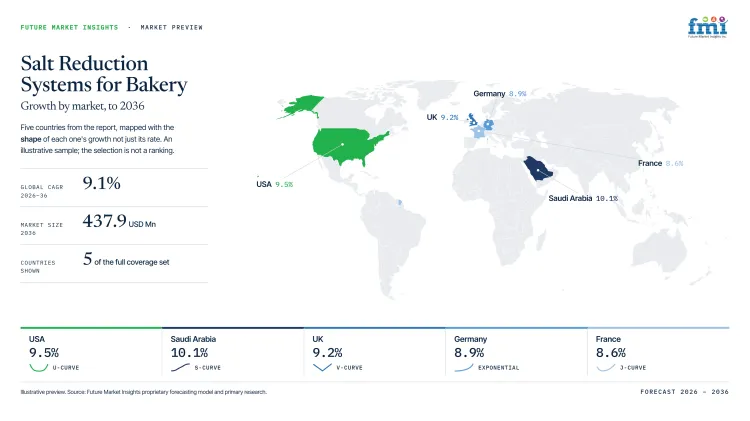
| Country | CAGR |
|---|---|
| UAE | 10.4% |
| Saudi Arabia | 10.1% |
| South Korea | 9.8% |
| USA | 9.5% |
| UK | 9.2% |
How do country-level CAGRs compare in the Salt Reduction Systems for Bakery Market?
The markets span 1.2 percentage points from UAE at 10.4% to UK at 9.2%. Gulf markets form the upper band as nutrition policy reaches industrial foodservice specifications. South Korea follows after broader lower-sodium label eligibility. USA and UK depend on slower residual renovation programs across mature bread portfolios.
- UAE reformulation briefs span imported recipes and hospitality menus under scrutiny.
- Saudi bread rules and high-salt menu disclosures give bakeries a direct compliance route.
- South Korea's bread-label expansion gives manufacturers a defined claim route for reduced-salt packaged foods.
- USA projects depend on voluntary targets and brand-controlled renovation calendars across industrial bakeries.
- UK programs focus on residual sodium cuts following years of retailer-led reformulation.
Commercial priority depends on how quickly each route reaches a qualified recipe. The full report provides country-level CAGR analysis across North America, Latin America, Europe, East Asia, South Asia, Oceania and the Middle East and Africa.
Country-wise Analysis
- UAE industrial bakeries serve retail and hospitality portfolios supplied by local production and imported recipes across a market with wide variation in flour specifications and taste expectations. Salt reduction systems for bakery demand in the UAE is forecast to expand at 10.4% CAGR through 2036, supported by dense foodservice channels that enable rapid customer trials, even though recipe diversity extends qualification timelines. In January 2026, the Emirates News Agency reported that MoHAP’s national nutrition survey found 96.2% of adults exceeded recommended sodium intake, creating a strong policy backdrop for reformulation while rewarding suppliers that can demonstrate dosage consistency across diverse bread formats and commercial specifications.
- Saudi bread producers operate under national nutrition reforms that reduce salt in foods and require calorie disclosure across commercial food channels serving high-volume urban bakery and foodservice accounts. In April 2025, the Ministry of Health confirmed that government nutrition reforms included lower salt content in foods, providing bakery groups with a direct regulatory signal even as familiar taste expectations make deeper reductions more difficult to approve. Salt reduction systems for bakery demand in Saudi Arabia is forecast to rise at 10.1% CAGR through 2036, driven by local technical support that accelerates dosage trials, with broader adoption ultimately depending on maintaining dough performance and acceptable cost-in-use across industrial bread programs.
- South Korean bakery companies operate under nutrient-claim rules tied closely to defined product categories and detailed labeling standards. Adoption of salt reduction systems for bakery in South Korea is estimated to expand at 9.8% CAGR through 2036, bolstered by increasing opportunities to market qualifying lower-sodium products, although manufacturers must preserve expected texture and document composition changes. In October 2025, the Ministry of Food and Drug Safety added seven bread types to sodium-reduction labeling eligibility, enabling formulation suppliers to target those segments more directly, while large bakery chains continue to require site-level validation before standardizing recipes across national production networks.
- USA industrial bakeries manage sodium projects within brand-renovation calendars that require regulatory review and sensory approval as formulas move across multiple production lines nationwide. FDA proposed in January 2025 that most packaged foods display sodium as Low/Med/High within a front-of-package Nutrition Info box, giving bakery brands a visible nutrient benchmark while leaving implementation timing to individual companies. Salt reduction systems for bakery demand in the USA is projected to record 9.5% CAGR during the assessment period, underpinned by expanding prototype and reformulation activity, whereas successful commercialization still hinges on delivering repeatable dough handling and flavor performance during large-scale production.
- UK bakery manufacturers already operate against long-standing salt targets and retailer nutrition programs across mature bread portfolios that have absorbed many of the easiest sodium reductions. Salt reduction systems for bakery sales in the UK are forecast to expand at 9.2% CAGR by 2036, attributable to efforts to capture additional incremental reductions despite a shrinking pool of low-risk formulation changes. The Department of Health and Social Care reported in January 2026 that UK-wide advertising restrictions for less healthy foods had taken effect, adding another incentive for bakery brands to reassess product positioning, while future reformulation gains are likely to depend on preserving taste and texture within tightly managed cost structures.
Who are the notable companies in the Salt Reduction Systems for Bakery Market?
Kerry Group, IFF, dsm-firmenich, Puratos, Corbion, Novonesis, AB Enzymes and Palsgaard are notable companies serving this market.
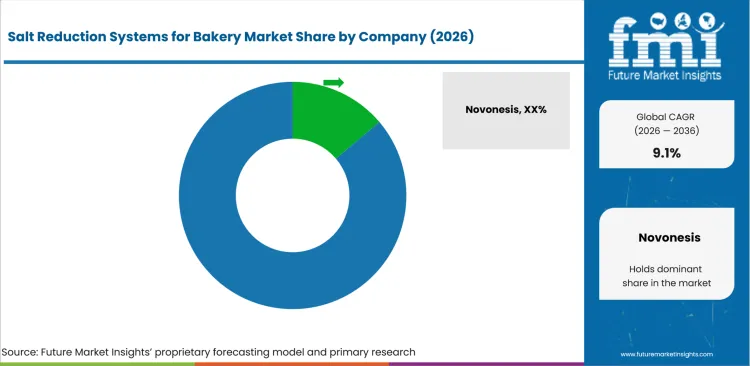
Competition is fragmented across taste modulation, bakery enzymes and functional texture systems. Entry depends on proof that a formulation can lower sodium while holding plant performance. Global reach helps with multinational briefs, but application laboratories and documented bakery trials determine whether a company can support complex renovations. Adjacent food preservatives become relevant when sodium reformulation changes shelf-life performance or shifts the preservation burden inside a finished bread formula.
- Kerry Group, IFF and dsm-firmenich compete with broad taste and bakery technology portfolios supported by customer development facilities.
- Puratos and Corbion focus heavily on bakery formulation support for projects that must preserve texture, preservation performance and sensory quality during recipe renovation.
- Novonesis, AB Enzymes and Palsgaard supply biological or emulsification tools that can address specific process effects inside a wider sodium-reduction system.
Competitive Benchmarking: Salt Reduction Systems for Bakery Market
| Company | Sodium-Reformulation Evidence | Bakery Function Breadth | Application-Support Depth | Geographic Reach |
|---|---|---|---|---|
| Kerry Group | High | High | High | Global |
| IFF | Medium | High | High | Global |
| dsm-firmenich | High | High | High | Global |
| Puratos | Medium | High | High | Global |
| Corbion | Medium | High | High | Global |
| Novonesis | Medium | High | Medium | Global |
| AB Enzymes | Low | Medium | High | Europe, Americas and Asia-Pacific |
| Palsgaard | Low | Medium | High | Europe, Americas, Asia-Pacific and Middle East |
Scoring basis: High sodium-reformulation evidence requires a current official source documenting direct salt or sodium work. Medium requires a current bakery reformulation action addressing functional recovery under nutrition-led recipe changes. Low identifies one documented adjacent bakery function without a direct sodium claim. High bakery breadth requires at least three documented functions while Medium requires two and Low identifies one. High application support requires a dedicated bakery laboratory or formal customer-development center while Medium reflects multi-category application support and Low reflects documented technical service without a dedicated bakery facility. Geographic reach records the regions supported by current company facilities or documented distribution announcements.
Key Developments in the Salt Reduction Systems for Bakery Market
- In August 2025, IFF launched POWERFRESH ACE 2000 for USA industrial bakeries to improve bread softness and resilience across shelf life. The enzyme supports sodium renovation by protecting texture as formulation changes alter functional balance.
- In May 2025, dsm-firmenich opened its Princeton Baking Innovation Center with sodium-reduction flavor modulation and bakery application technologies. The site gives customers one facility for sensory work and production-oriented reformulation trials.
- In April 2025, Corbion launched Verdad Essence WH100 for natural mold inhibition across breads and related bakery products. The development broadens preservation options for sodium projects that also need shelf-life protection without sacrificing taste or texture.
Key Players in the Salt Reduction Systems for Bakery Market
Taste and Multi-Technology Reformulation Platforms
- Kerry Group
- IFF
- dsm-firmenich
Bakery Formulation and Preservation Specialists
- Puratos
- Corbion
Enzyme and Emulsification Specialists
- Novonesis
- AB Enzymes
- Palsgaard
Salt Reduction Systems for Bakery Market - Report Scope
| Coverage field | Report scope |
|---|---|
| Market breakdown | By product type, form, application, claim, sales channel and region. |
| Quantitative Units | USD million. |
| Market Definition | Purpose-designed salt and sodium reduction systems plus bakery formulation technologies sold specifically for sodium reduction. Finished bakery revenue and generic adjacent ingredients outside a sodium-reduction brief are excluded. |
| Regions Covered | North America, Latin America, Western Europe, Eastern Europe, East Asia, South Asia and Pacific and Middle East and Africa. |
| Countries Covered | UAE, Saudi Arabia, South Korea, USA, UK, and 30+ countries included in the full report. |
| Key Companies Profiled | Kerry Group, IFF, dsm-firmenich, Puratos, Corbion, Novonesis, AB Enzymes, Palsgaard. |
| Forecast Period | 2026 to 2036. |
| Approach | Primary and secondary research with market triangulation. |
Salt Reduction Systems for Bakery Market - Research Methodology
| Method | Approach |
|---|---|
| Primary Research | FMI analysts gathered input from manufacturers, service providers, technology developers, distributors, end users, procurement teams, and subject-matter experts. Interviews examined purchasing decisions, product or service evaluation, adoption barriers, approval requirements, pricing considerations, and expectations for technical or commercial support. Respondents were also asked what evidence is required before a trial, pilot, or initial order develops into regular purchasing. |
| Desk Research | Desk research covered government statistics, regulatory publications, trade data, industry associations, technical literature, standards, company filings, product information, and official corporate announcements. Sources were reviewed for relevance, publication date, geographic coverage, and consistency with the defined market scope. Claims relating to performance, applications, approvals, capacity, investment, and commercial activity were retained only when supported by credible public evidence. |
| Market Sizing and Forecasting | The market model combined the baseline value with historical performance, segment structure, pricing and volume indicators, adoption levels, company participation, and country-level demand conditions. Forecast assumptions considered economic activity, investment trends, regulatory developments, technology adoption, purchasing cycles, supply availability, and barriers to wider market use. Segment and regional estimates were reconciled before the final market total was calculated. |
| Data Validation | Estimates were checked against multiple independent indicators, including public data, company activity, trade patterns, industry developments, and findings from primary interviews. Validation also tested whether products, services, applications, and company revenues fell within the defined market boundaries. Adjacent categories, unsupported claims, overlapping revenues, and activities without direct market relevance were excluded to reduce double counting and maintain consistency across segments and countries. |
Salt Reduction Systems for Bakery Market by Segments
Salt Reduction Systems for Bakery Market segmented by Product Type:
- Standard grade
- Premium / specialty grade
- Organic certified
- Clean label grade
Salt Reduction Systems for Bakery Market segmented by Form:
- Powder - dry
- Liquid
- Paste / semi-solid
- Granules / pieces
Salt Reduction Systems for Bakery Market segmented by Application:
- Bread & rolls
- Cakes & muffins
- Biscuits & cookies
- Viennoiserie & pastry
- Other bakery & snacks
Salt Reduction Systems for Bakery Market segmented by Claim:
- Conventional
- Clean label
- Organic
- Non-GMO / identity preserved
Salt Reduction Systems for Bakery Market segmented by Sales Channel:
- Direct to industrial bakeries
- Ingredient distributors
- Foodservice & artisan supply
- Online B2B
Salt Reduction Systems for Bakery Market by Region:
- North America
- United States
- Canada
- Latin America
- Brazil
- Mexico
- Argentina
- Chile
- Rest of Latin America
- Western Europe
- Germany
- France
- United Kingdom
- Italy
- Spain
- Nordics
- Benelux
- Rest of Western Europe
- Eastern Europe
- Poland
- Czech Republic
- Romania
- Hungary
- Rest of Eastern Europe
- East Asia
- China
- Japan
- South Korea
- South Asia and Pacific
- India
- ASEAN
- Australia and New Zealand
- Rest of South Asia and Pacific
- Middle East and Africa
- Kingdom of Saudi Arabia
- Other GCC Countries
- Türkiye
- Israel
- South Africa
- Rest of Middle East and Africa
Research Sources and Bibliography
- USA Food and Drug Administration. (2026, June 3). Know Your Nutrition: Empowering Women to Make Informed Food Choices.
- Department of Health and Social Care. (2026, January 5). Landmark junk food ad ban to protect kids' health.
- Kerry Group. (2026, March 19). Kerry publishes 2025 Annual Report: A year defined by impact, innovation and purpose.
- Palsgaard. (2025, October 8). Palsgaard Brazil begins producing Emulpals cake mix emulsifiers.
- American Heart Association. (2026, January 26). Reducing sodium in everyday foods may yield heart-health benefits across populations.
- AB Enzymes. (2026, June 1). AB Enzymes opens new office and baking lab in Curitiba, Brazil.
- USA Food and Drug Administration. (2025, June 13). FDA’s Nutrition Initiatives.
- Food Standards Agency. (2025, April 3). Pancake reformulation and technical guidance.
- Puratos. (2025, April 30). Puratos has opened its brand-new Innovation Center in Budapest (Hungary).
- Emirates News Agency. (2026, January 6). MoHAP releases National Health and Nutrition Survey 2024-2025.
- Ministry of Health, Saudi Arabia. (2025, April 7). MoH: Average Life Expectancy Rises to 78.8 Years Due to Health Sector Transformation.
- Ministry of Food and Drug Safety, Republic of Korea. (2025, October 20). Amendment to standards and specifications for sodium and sugar reduction labeling.
- USA Food and Drug Administration. (2025, January 14). FDA Proposes Requiring At-a-Glance Nutrition Information on the Front of Packaged Foods.
- Department of Health and Social Care. (2025, June 11). National Diet and Nutrition Survey 2019 to 2023: report.
- IFF. (2025, August 13). IFF launches POWERFRESH ACE 2000, a bread fresh-keeping solution that aces the shelf-life test.
- dsm-firmenich. (2025, May 20). On the rise: dsm-firmenich opens state-of-the-art Princeton Baking Innovation Center in Princeton, NJ.
- Corbion. (2025, April 21). Corbion unveils Verdad Essence WH100: Redefining natural mold inhibition for bakers.
- Puratos. (2025, August 25). Puratos announces two new hubs for food innovation: Montreal and Costa Rica.
- dsm-firmenich. (2025, August 26). dsm-firmenich unveils major plant investments, emphasizing commitment to shaping the future of flavor in India.
- Kerry Group. (2026, February 11). Kerry inaugurates its Customer Co-Creation Center in Medellín and boosts collaborative innovation in the Andean Region.
- AB Enzymes. (2026, May 12). AB Enzymes strengthens presence in Mexico, Central America & the Caribbean.
- Palsgaard. (2025, July 8). Palsgaard inaugurates state-of-the-art application centre in Navi Mumbai to strengthen regional customer support.
- dsm-firmenich. (2025, October 2). dsm-firmenich opens global food innovation center in Delft, the Netherlands to accelerate diet transformation.
- Novonesis. (2025, June 11). Novonesis launches Optiva® LS Prime, helping bakers cut up to 50% added sugar and create more cost-effective baked goods.
- Puratos. (2026, March 10). Puratos to acquire Dawn Foods.
- Corbion. (2025, April 7). Corbion Launches Innovative Egg Replacers to Empower Bakeries Amid Supply Challenges.
- International Flavors & Fragrances Inc. (2026, February 27). Form 10-K for the year ended December 31, 2025.
- Kerry Group. (2025, September 30). Kerry launches Smart Taste to help customers navigate market complexities without compromising on taste.
- Nedmag B.V. (2025, May 16). Novasal: The revolution in sodium reduction has begun!
- Griffith Foods. (2026, March 3). Griffith Foods launches Craveable Impact: Sodium Solutions to address global nutrition recommendations.
- Novonesis. (2025, January 2). The bromate era has faded. Here’s how to make your baked goods healthier and more sustainable.
- DNV Business Assurance Italy S.r.l. (2026, March 19). Management system certificate: Palsgaard A/S (Certificate No. C818630).
This bibliography is provided for reader reference and is not exhaustive. The full report contains the complete reference list and detailed citations.
This Report Answers
- How large is the salt reduction systems for bakery market in 2026 and what value is projected by 2036?
- Which formulation mechanisms are increasing demand for salt reduction systems across industrial bakery production?
- Why do standard grade and powder - dry formats hold leading positions in their respective categories?
- How does bread reformulation differ from sodium reduction in cakes, biscuits and pastry applications?
- Which operational constraints increase the number of trials required before a lower-sodium bakery formula is approved?
- Which five country markets show the strongest profiled CAGR outlook between 2026 and 2036?
- How do the eight profiled companies differ in sodium-reformulation evidence, bakery function breadth and application support?
- Which recent company actions are changing technical support and product-development capacity in bakery reformulation?
Frequently Asked Questions
How big is the Salt Reduction Systems for Bakery Market in 2026?
The salt reduction systems for bakery market is valued at USD 183.3 million in 2026 and is projected to reach USD 437.9 million by 2036. Growth is supported by sodium-reduction targets that require bakeries to preserve taste and process stability.
What is the CAGR of the Salt Reduction Systems for Bakery Market from 2026 to 2036?
The salt reduction systems for bakery market is projected to grow at a CAGR of 9.1% between 2026 and 2036. Expansion is supported by recurring reformulation programs and technical demand for sensory plus dough-function recovery.
Which product type leads the Salt Reduction Systems for Bakery Market?
The standard grade segment is expected to hold 40.0% of the salt reduction systems for bakery market in 2026, driven by broad ingredient flexibility across mainstream industrial renovation. Lower certification burden also shortens qualification across established industrial recipes and routine plant renovation programs.
Which form leads the Salt Reduction Systems for Bakery Market?
The powder - dry segment is expected to hold 43.0% of the salt reduction systems for bakery market in 2026, supported by established dry dosing and premix systems. Repeatable handling also improves transfer from pilot trials into commercial production batches across established dry-ingredient lines.
Which countries are projected to record the highest growth in the Salt Reduction Systems for Bakery Market?
UAE is projected to grow at 10.4% CAGR, followed by Saudi Arabia at 10.1% and South Korea at 9.8% through 2036. Nutrition policy reaches bakery purchasing fastest where formal labels or foodservice rules turn sodium targets into reformulation briefs.
Which companies are active in the Salt Reduction Systems for Bakery Market?
Key companies operating in the market include Kerry Group, IFF, dsm-firmenich, Puratos, Corbion, Novonesis, AB Enzymes, and Palsgaard. Competition centers on taste modulation and bakery enzymes alongside emulsification, preservation expertise and customer application laboratories.
Preview the report firsthand - request a free sample
Get SampleGet the brochure for pricing and purchase details.
Get PDFTable of Content
- Key Takeaways
- Market Size and CAGR
- Top Growth Driver
- Fastest Growing Segment
- Leading Region
- Key Companies
- Emerging Opportunities
- Executive Summary
- Global Market Outlook
- Demand-side Trends
- Supply-side Trends
- Technology Roadmap Analysis
- Analysis and Recommendations
- Analyst Perspective (What is happening? Why now? What should investors know?)
- Key Questions Answered
- How large is the market?
- What is the CAGR?
- What are key trends?
- Which region dominates?
- Who are the leaders?
- Market Overview
- Market Coverage / Taxonomy
- Market Definition / Scope / Limitations
- Research Methodology
- Chapter Orientation
- Analytical Lens and Working Hypotheses
- Market Structure, Signals, and Trend Drivers
- Benchmarking and Cross-market Comparability
- Market Sizing, Forecasting, and Opportunity Mapping
- Research Design and Evidence Framework
- Desk Research Programme (Secondary Evidence)
- Expert Input and Fieldwork (Primary Evidence)
- Tooling, Models, and Reference Databases
- Data Engineering and Model Build
- Quality Assurance and Audit Trail
- Market Background
- Market Dynamics (Drivers, Restraints, Opportunity, Trends)
- Scenario Forecast (Optimistic, Likely, Conservative)
- Impact Analysis
- AI Impact
- Sustainability Impact
- Regulatory Impact
- Technology Impact
- Consumer / Buyer Analysis
- Purchase Drivers
- Adoption Barriers
- Buyer Journey
- Opportunity Map Analysis
- Product Life Cycle Analysis
- Supply Chain Analysis
- Investment Feasibility Matrix
- Value Chain Analysis
- PESTLE and Porter's Analysis
- Regulatory Landscape
- Regional Parent Market Outlook
- Production and Consumption Statistics
- Import and Export Statistics
- Global Market Analysis and Forecast, 2021 to 2036
- Historical Market Size Value (USD Million) Analysis, 2021 to 2025
- Current and Future Market Size Value (USD Million) Projections, 2026 to 2036
- Y-o-Y Growth Trend Analysis
- Absolute $ Opportunity Analysis
- Global Market Pricing Analysis, 2021 to 2036
- Global Market Analysis and Forecast, By Product Type, 2021 to 2036
- Introduction / Key Findings
- Historical Market Size Value (USD Million) Analysis By Product Type, 2021 to 2025
- Current and Future Market Size Value (USD Million) Analysis and Forecast By Product Type, 2026 to 2036
- Standard grade
- Premium / specialty grade
- Organic certified
- Clean label grade
- Standard grade
- Y-o-Y Growth Trend Analysis By Product Type, 2021 to 2025
- Absolute $ Opportunity Analysis By Product Type, 2026 to 2036
- Global Market Analysis and Forecast, By Form, 2021 to 2036
- Introduction / Key Findings
- Historical Market Size Value (USD Million) Analysis By Form, 2021 to 2025
- Current and Future Market Size Value (USD Million) Analysis and Forecast By Form, 2026 to 2036
- Powder / dry
- Liquid
- Paste / semi-solid
- Granules / pieces
- Powder / dry
- Y-o-Y Growth Trend Analysis By Form, 2021 to 2025
- Absolute $ Opportunity Analysis By Form, 2026 to 2036
- Global Market Analysis and Forecast, By Application, 2021 to 2036
- Introduction / Key Findings
- Historical Market Size Value (USD Million) Analysis By Application, 2021 to 2025
- Current and Future Market Size Value (USD Million) Analysis and Forecast By Application, 2026 to 2036
- Bread & rolls
- Cakes & muffins
- Biscuits & cookies
- Viennoiserie & pastry
- Other bakery & snacks
- Bread & rolls
- Y-o-Y Growth Trend Analysis By Application, 2021 to 2025
- Absolute $ Opportunity Analysis By Application, 2026 to 2036
- Global Market Analysis and Forecast, By Claim, 2021 to 2036
- Introduction / Key Findings
- Historical Market Size Value (USD Million) Analysis By Claim, 2021 to 2025
- Current and Future Market Size Value (USD Million) Analysis and Forecast By Claim, 2026 to 2036
- Conventional
- Clean label
- Organic
- Non-GMO / identity preserved
- Conventional
- Y-o-Y Growth Trend Analysis By Claim, 2021 to 2025
- Absolute $ Opportunity Analysis By Claim, 2026 to 2036
- Global Market Analysis and Forecast, By Sales Channel, 2021 to 2036
- Introduction / Key Findings
- Historical Market Size Value (USD Million) Analysis By Sales Channel, 2021 to 2025
- Current and Future Market Size Value (USD Million) Analysis and Forecast By Sales Channel, 2026 to 2036
- Direct to industrial bakeries
- Ingredient distributors
- Foodservice & artisan supply
- Online B2B
- Direct to industrial bakeries
- Y-o-Y Growth Trend Analysis By Sales Channel, 2021 to 2025
- Absolute $ Opportunity Analysis By Sales Channel, 2026 to 2036
- Global Market Analysis and Forecast, By Region, 2021 to 2036
- Introduction
- Historical Market Size Value (USD Million) Analysis By Region, 2021 to 2025
- Current Market Size Value (USD Million) Analysis and Forecast By Region, 2026 to 2036
- North America
- Latin America
- Western Europe
- Eastern Europe
- East Asia
- South Asia and Pacific
- Middle East & Africa
- Market Attractiveness Analysis By Region
- North America Market Analysis and Forecast, By Country, 2021 to 2036
- Historical Market Size Value (USD Million) Trend Analysis By Market Taxonomy, 2021 to 2025
- Market Size Value (USD Million) Forecast By Market Taxonomy, 2026 to 2036
- By Country
- USA
- Canada
- By Product Type
- By Form
- By Application
- By Claim
- By Sales Channel
- By Country
- Market Attractiveness Analysis
- By Country
- By Product Type
- By Form
- By Application
- By Claim
- By Sales Channel
- Key Takeaways
- Latin America Market Analysis and Forecast, By Country
- Historical Market Size Value (USD Million) Trend Analysis By Market Taxonomy, 2021 to 2025
- Market Size Value (USD Million) Forecast By Market Taxonomy, 2026 to 2036
- By Country
- Brazil
- Mexico
- Chile
- Rest of Latin America
- By Product Type
- By Form
- By Application
- By Claim
- By Sales Channel
- By Country
- Market Attractiveness Analysis
- By Country
- By Product Type
- By Form
- By Application
- By Claim
- By Sales Channel
- Key Takeaways
- Western Europe Market Analysis and Forecast, By Country
- Historical Market Size Value (USD Million) Trend Analysis By Market Taxonomy, 2021 to 2025
- Market Size Value (USD Million) Forecast By Market Taxonomy, 2026 to 2036
- By Country
- Germany
- UK
- Italy
- Spain
- France
- Nordic
- BENELUX
- Rest of Western Europe
- By Product Type
- By Form
- By Application
- By Claim
- By Sales Channel
- By Country
- Market Attractiveness Analysis
- By Country
- By Product Type
- By Form
- By Application
- By Claim
- By Sales Channel
- Key Takeaways
- Eastern Europe Market Analysis and Forecast, By Country
- Historical Market Size Value (USD Million) Trend Analysis By Market Taxonomy, 2021 to 2025
- Market Size Value (USD Million) Forecast By Market Taxonomy, 2026 to 2036
- By Country
- Russia
- Poland
- Hungary
- Balkan & Baltic
- Rest of Eastern Europe
- By Product Type
- By Form
- By Application
- By Claim
- By Sales Channel
- By Country
- Market Attractiveness Analysis
- By Country
- By Product Type
- By Form
- By Application
- By Claim
- By Sales Channel
- Key Takeaways
- East Asia Market Analysis and Forecast, By Country
- Historical Market Size Value (USD Million) Trend Analysis By Market Taxonomy, 2021 to 2025
- Market Size Value (USD Million) Forecast By Market Taxonomy, 2026 to 2036
- By Country
- China
- Japan
- South Korea
- By Product Type
- By Form
- By Application
- By Claim
- By Sales Channel
- By Country
- Market Attractiveness Analysis
- By Country
- By Product Type
- By Form
- By Application
- By Claim
- By Sales Channel
- Key Takeaways
- South Asia and Pacific Market Analysis and Forecast, By Country
- Historical Market Size Value (USD Million) Trend Analysis By Market Taxonomy, 2021 to 2025
- Market Size Value (USD Million) Forecast By Market Taxonomy, 2026 to 2036
- By Country
- India
- ASEAN
- Australia & New Zealand
- Rest of South Asia and Pacific
- By Product Type
- By Form
- By Application
- By Claim
- By Sales Channel
- By Country
- Market Attractiveness Analysis
- By Country
- By Product Type
- By Form
- By Application
- By Claim
- By Sales Channel
- Key Takeaways
- Middle East & Africa Market Analysis and Forecast, By Country
- Historical Market Size Value (USD Million) Trend Analysis By Market Taxonomy, 2021 to 2025
- Market Size Value (USD Million) Forecast By Market Taxonomy, 2026 to 2036
- By Country
- Kingdom of Saudi Arabia
- Other GCC Countries
- Türkiye
- South Africa
- Other African Union
- Rest of Middle East & Africa
- By Product Type
- By Form
- By Application
- By Claim
- By Sales Channel
- By Country
- Market Attractiveness Analysis
- By Country
- By Product Type
- By Form
- By Application
- By Claim
- By Sales Channel
- Key Takeaways
- Key Countries Market Analysis
- USA
- Pricing Analysis
- Market Share Analysis, 2025
- By Product Type
- By Form
- By Application
- By Claim
- By Sales Channel
- Canada
- Pricing Analysis
- Market Share Analysis, 2025
- By Product Type
- By Form
- By Application
- By Claim
- By Sales Channel
- Mexico
- Pricing Analysis
- Market Share Analysis, 2025
- By Product Type
- By Form
- By Application
- By Claim
- By Sales Channel
- Brazil
- Pricing Analysis
- Market Share Analysis, 2025
- By Product Type
- By Form
- By Application
- By Claim
- By Sales Channel
- Chile
- Pricing Analysis
- Market Share Analysis, 2025
- By Product Type
- By Form
- By Application
- By Claim
- By Sales Channel
- Germany
- Pricing Analysis
- Market Share Analysis, 2025
- By Product Type
- By Form
- By Application
- By Claim
- By Sales Channel
- UK
- Pricing Analysis
- Market Share Analysis, 2025
- By Product Type
- By Form
- By Application
- By Claim
- By Sales Channel
- Italy
- Pricing Analysis
- Market Share Analysis, 2025
- By Product Type
- By Form
- By Application
- By Claim
- By Sales Channel
- Spain
- Pricing Analysis
- Market Share Analysis, 2025
- By Product Type
- By Form
- By Application
- By Claim
- By Sales Channel
- France
- Pricing Analysis
- Market Share Analysis, 2025
- By Product Type
- By Form
- By Application
- By Claim
- By Sales Channel
- India
- Pricing Analysis
- Market Share Analysis, 2025
- By Product Type
- By Form
- By Application
- By Claim
- By Sales Channel
- ASEAN
- Pricing Analysis
- Market Share Analysis, 2025
- By Product Type
- By Form
- By Application
- By Claim
- By Sales Channel
- Australia & New Zealand
- Pricing Analysis
- Market Share Analysis, 2025
- By Product Type
- By Form
- By Application
- By Claim
- By Sales Channel
- China
- Pricing Analysis
- Market Share Analysis, 2025
- By Product Type
- By Form
- By Application
- By Claim
- By Sales Channel
- Japan
- Pricing Analysis
- Market Share Analysis, 2025
- By Product Type
- By Form
- By Application
- By Claim
- By Sales Channel
- South Korea
- Pricing Analysis
- Market Share Analysis, 2025
- By Product Type
- By Form
- By Application
- By Claim
- By Sales Channel
- Russia
- Pricing Analysis
- Market Share Analysis, 2025
- By Product Type
- By Form
- By Application
- By Claim
- By Sales Channel
- Poland
- Pricing Analysis
- Market Share Analysis, 2025
- By Product Type
- By Form
- By Application
- By Claim
- By Sales Channel
- Hungary
- Pricing Analysis
- Market Share Analysis, 2025
- By Product Type
- By Form
- By Application
- By Claim
- By Sales Channel
- Kingdom of Saudi Arabia
- Pricing Analysis
- Market Share Analysis, 2025
- By Product Type
- By Form
- By Application
- By Claim
- By Sales Channel
- Türkiye
- Pricing Analysis
- Market Share Analysis, 2025
- By Product Type
- By Form
- By Application
- By Claim
- By Sales Channel
- South Africa
- Pricing Analysis
- Market Share Analysis, 2025
- By Product Type
- By Form
- By Application
- By Claim
- By Sales Channel
- USA
- Market Structure Analysis
- Competition Dashboard
- Competition Benchmarking
- Market Share Analysis of Top Players
- By Regional
- By Product Type
- By Form
- By Application
- By Claim
- By Sales Channel
- Emerging Startups
- Innovation Benchmarking
- Competition Analysis
- Competition Deep Dive
- Novonesis
- Overview
- Product Portfolio
- Profitability by Market Segments
- Sales Footprint
- Strategy Overview
- Marketing Strategy
- Product Strategy
- Channel Strategy
- IFF
- Kerry Group
- AB Enzymes
- Amano Enzyme
- Palsgaard
- Corbion
- BASF
- Puratos
- DSM-Firmenich
- Novonesis
- Case Studies
- Success Stories
- Recent Developments
- Competition Deep Dive
- Assumptions & Acronyms Used


