

- Market Size (2026)
- USD 382.3 Mn
- Forecast (2036)
- USD 825.4 Mn
- CAGR (2026 to 2036)
- 8.0%
How big is Sodium Reduction Mineral Salt Blends Market in 2026?
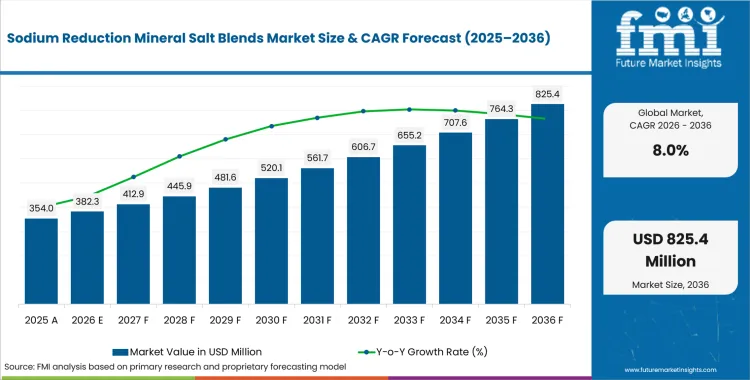
USD 382.3 million in 2026 and USD 825.4 million by 2036 at an 8.0% CAGR.
Sales of sodium reduction mineral salt blends are estimated to rise at 8.0% CAGR through 2036, increasing valuation from USD 382.3 million in 2026 to USD 825.4 million by 2036. Growing public health efforts to reduce dietary sodium intake are encouraging food manufacturers to adopt sodium-reduction strategies and alternative mineral salt systems. The World Health Organization released its revised SHAKE package in May 2026 with reformulation and front-label measures for processed foods. The package gives manufacturers defined reformulation and labeling actions that translate public health goals into measurable recipe requirements. Food manufacturers combine potassium chloride with taste support that controls bitterness and restores expected salt impact across finished recipes. Commercial adoption therefore depends on consistent sensory results and dependable plant performance across repeated production batches.
National rules create different reformulation priorities for manufacturers using the same mineral blend platform across several commercial markets. In January 2025, the United States Food and Drug Administration proposed a front label using three sodium levels described as low, medium and high. The Canadian Food Inspection Agency stated in November 2025 that standard enforcement would apply to new labels from January 1, 2026. United States manufacturers are preparing for a proposed label, but Canadian manufacturers must already meet an active compliance date. Each route changes the reduction target and evidence needed for final recipe approval across national product portfolios. Successful programs connect food and beverage additives with local label calculations and documented sensory acceptance.
Key Takeaways of Sodium Reduction Mineral Salt Blends Market
- Demand grows as national sodium policies convert broad nutrition goals into measurable reformulation targets across packaged food portfolios.
- Mineral is expected to account for 56.0% share in 2026 due to direct sodium chloride replacement across established recipes.
- Bakery is anticipated to capture 24.0% share by application in 2026 reflecting measurable salt targets and complex dough functionality.
- Food manufacturers are projected to represent 17.0% share of end-user demand in 2026 supported by direct control over recipes and production approval.
- Bitterness and processing changes remain significant restraints, requiring application testing for meaningful mineral replacement across each finished product.
- ICL and K+S emphasize food-grade mineral systems; Cargill and ADM support broad formulation work; Tate & Lyle and Kerry address texture; Givaudan and dsm-firmenich specialize in sensory restoration.
Analyst Perspective
"The commercial case for mineral salt blends depends on whether a manufacturer can reduce sodium without changing the product experience or disrupting normal production. Potassium chloride provides a practical replacement route, but bitterness and recipe-specific processing effects limit simple portfolio-wide substitution. Mineral and flavor specialists gain recurring revenue by proving performance in representative batches and maintaining consistent supply across every plant using the approved formula."
- Nandini Roy Choudhury, Principal Analyst, Future Market Insights
How is the Sodium Reduction Mineral Salt Blends Market segmented?
The sodium reduction mineral salt blends industry is segmented by product type, source, application, end user, and region.
Product type covers proteins, fibers, sweeteners, cultures, and flavors that interact with mineral systems during sodium reduction. Source separates plant, microbial, dairy analog, upcycled, and mineral routes according to ingredient origin and formulation role. Application includes bakery, beverages, snacks, infant nutrition, and ready meals with different sensory and processing requirements. End user identifies food manufacturers, beverage manufacturers, foodservice operators, contract manufacturers, and retail brands controlling recurring purchases. Region captures local labeling rules, technical service access, and supply conditions that shape product approval and commercial launch timing. Related clean-label ingredients influence declaration choices across recipes that require recognizable ingredients and consistent commercial positioning.
Why do proteins receive focused attention within the product type category?
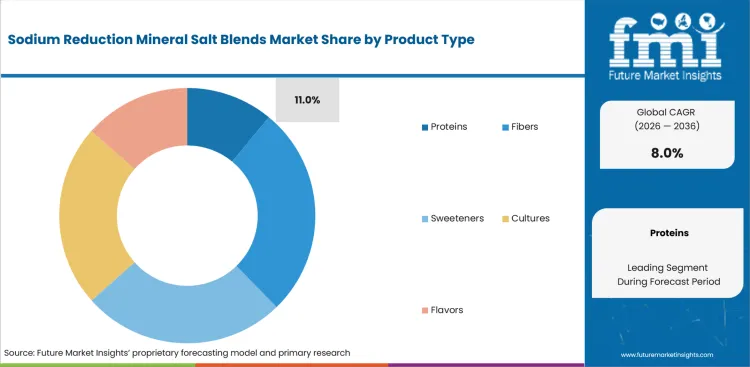
Protein fortification often introduces bitterness and dry texture that become more visible following sodium chloride reduction in familiar snack products. Cargill reported in December 2025 that a protein-fortified tortilla chip used pea protein and Alberger salt to reduce sodium by 45%. The example connects mineral selection with the taste and texture problems created by added protein in a familiar snack format. Developers also evaluate food texturing agents to protect crunch and body across commercial production runs.
- The product type category is forecast to be led by proteins at 11.0% share in 2026 due to expanding protein fortification across familiar foods. The segment requires mineral systems that restore salt impact without increasing bitterness or weakening expected texture. Its position reflects repeated formulation work across snacks and prepared foods rather than simple ingredient substitution.
- Food developers introduce protein-focused blends through bench trials followed by pilot runs under normal heat and hydration conditions. Technical teams compare salt perception and texture against the original recipe across the intended shelf life. A transferable blend platform reduces repeated development across related protein bases and supports consistent launches across several production sites.
How does mineral shape demand within the source category?
Mineral sources provide the ionic function and immediate salt character that define the core replacement system. The World Health Organization issued a lower-sodium salt substitute guideline in January 2025 covering products that often replace sodium chloride with potassium chloride. The guidance confirms the direct role of mineral substitution within sodium reduction strategies and highlights the need for appropriate use. Related savory ingredient systems help rebuild flavor depth and mask mineral off-notes across affected commercial recipes.
- By source, mineral is forecast to represent 56.0% share in 2026 driven by its direct replacement role across established food recipes. Processors measure purity and dissolution against familiar receiving controls used for standard food-grade salts during routine ingredient qualification. Established specifications shorten qualification compared with less familiar routes requiring new handling and sensory procedures.
- Manufacturers select mineral systems according to dissolution behavior and flavor impact within each finished product. Potassium bitterness requires targeted taste modulation rather than a simple weight-for-weight replacement of standard salt. Documented lot consistency and qualified secondary sources reduce repeated testing across factories using the same commercial formulation and approval file.
What makes bakery commercially important within the application category?
Salt controls flavor and dough behavior across bread recipes so reduction affects more than the nutrition panel. Germany reported in March 2025 that industrial bakeries had committed to an average target of 1.1 grams per 100 grams in packaged baked goods. The target creates a measurable development brief for bakery ingredient portfolios and mineral blend systems. Bakeries must protect fermentation timing and dough strength across repeated production schedules using established industrial equipment.
- Bakery is set to lead the application category with 24.0% share in 2026 due to measurable salt targets across bread and savory baked goods. Salt affects yeast activity and dough strength alongside the familiar flavor expected by consumers during routine production. Commercial blends must deliver the reduction target without creating line instability or inconsistent finished texture.
- Industrial bakeries introduce mineral blends through controlled flour trials followed by production tests on established equipment. Technical teams track dough development and fermentation timing together with crumb structure and finished flavor. Compatibility with existing mixers and dosing systems supports broader adoption across facilities using the same base recipe and production controls.
Why are food manufacturers central to the end-user category?
Food manufacturers control recipe approval and label decisions across brands that often share established production lines. Kerry launched Smart Taste in September 2025 and included Tastesense Salt for nutrition and regulatory pressures without sacrificing expected taste. The development shows why large reformulation programs require coordinated mineral and sensory work across several product families. Related clean-labelled additives also influence ingredient declarations and formulation choices across complex national product portfolios.
- Food manufacturers are projected to hold 17.0% share in 2026 owing to their direct authority over recipes and commercial production approval. Food manufacturers compare mineral blends against sensory performance and plant cost across several brands and manufacturing locations. Ingredient companies must support technical files and trial planning through formulation teams and operating facilities.
- Large manufacturers favor blend platforms that support multiple brands without changing the declared ingredient strategy across each national market. Central research teams establish a base formulation and local plants confirm performance with available raw materials and equipment. Responsive application support protects launch schedules and reduces repeated troubleshooting during commercial scale-up across manufacturing locations.
What are the drivers, restraints, and opportunities in the Sodium Reduction Mineral Salt Blends Market?
Measurable sodium policies support reformulation demand, but sensory limits and recipe-specific validation restrict rapid portfolio conversion across packaged food categories.
- Driver: National sodium policies create measurable recipe targets that support funded reformulation across packaged food portfolios.
- Restraint: Mineral replacement can introduce bitterness and process changes that require product-specific validation across commercial production lines.
- Opportunity: Integrated mineral and taste systems shorten reformulation programs across related brands using similar recipes and equipment.
National reformulation targets drive demand by setting measurable sodium thresholds across packaged-food recipes and commercial product development programs. Health Canada reported in June 2025 that interim monitoring of 1,283 labels found only modest progress toward the country’s 2025 sodium targets. The result leaves manufacturers with a measurable gap between current recipes and category targets across several processed food groups. Application teams compare reformulation costs with measurable label improvement before approving each commercial recipe for full-scale production. Validated food flavor enhancers and mineral systems support several brands that must preserve taste during repeated commercial production.
Salt performs sensory and processing functions across many foods, so meaningful mineral replacement requires product-specific validation. In March 2025, Germany stated that reformulation possibilities require product-specific review of technology and food safety alongside sensory quality and consumer acceptance. A mineral blend proven in bread does not automatically perform within cheese or prepared meals under different process conditions. Manufacturers therefore delay broad conversion until pilot batches confirm acceptable taste and stable production under representative conditions.
Promotion restrictions create a commercial opening for formulation platforms that improve nutrient scores across several related recipes. In October 2025, the United Kingdom applied volume-price restrictions to products classified as less healthy under its nutrient model. Mineral blends paired with yeast extract solutions lower sodium and rebuild savory depth across affected food categories. A reusable platform reduces repeated trials and preserves promotional options across package sizes using the same base recipe.
Which country CAGRs are profiled in the sodium reduction mineral salt blends market?
| Country | CAGR |
|---|---|
| India | 10.8% |
| United States | 10.0% |
| Japan | 9.2% |
| France | 8.4% |
| Germany | 7.6% |
| United Kingdom | 6.8% |
How do country-level CAGRs compare in the Sodium Reduction Mineral Salt Blends Market?
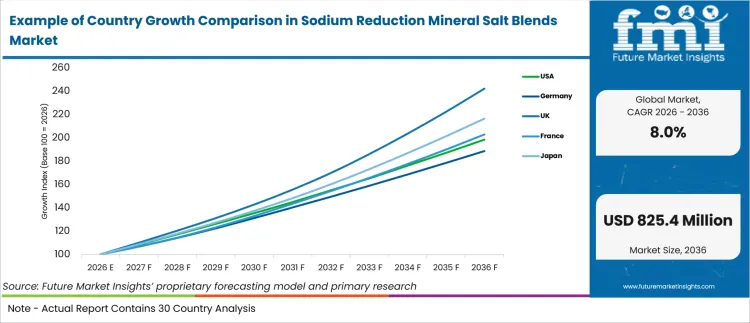
The six-country comparison spans 4.0 percentage points, from India at 10.8% to the United Kingdom at 6.8%. India leads the comparison, followed by the United States at 10.0% and Japan at 9.2%. France, Germany and the United Kingdom record 8.4%, 7.6% and 6.8%, respectively.
- India leads with a CAGR of 10.8%. The market reflects increasing adoption of mineral salt blends designed to reduce sodium levels while maintaining the functional properties required in food formulations.
- The United States follows at 10.0%, 0.8 percentage points below India. Market activity reflects continued use of sodium reduction solutions across food applications where mineral salt blends provide an alternative to conventional sodium chloride.
- Japan records a CAGR of 9.2%, 0.8 percentage points below the United States. Adoption reflects the use of sodium reduction formulations in food products seeking lower sodium content without removing salt functionality.
- France reaches 8.4%, followed by Germany at 7.6% and the United Kingdom at 6.8%. The three markets show a gradual decline in CAGR, with adoption varying across food formulation practices and sodium reduction applications.
The 4.0 percentage point spread indicates different growth rates across the profiled countries. India records the fastest CAGR, while the United Kingdom shows the slowest pace.
Similar CAGRs do not necessarily create identical supplier opportunities across countries. Differences in EV production volumes, semiconductor ecosystems, thermal management design preferences and localization strategies can significantly influence demand for silicon carbide inverter cooling plates. The full report provides country-level CAGR analysis across North America, Latin America, Europe, East Asia, South Asia, Oceania and the Middle East and Africa.
Country-wise Analysis
- Indian packaged food companies serve national brands and regional recipes through production networks with uneven specialist application support. India's sodium reduction mineral salt blends outlook is anticipated to advance at 10.8% CAGR over the assessment period, supported by clearer sodium presentation. Domestic contract manufacturers provide scalable trials for snacks and ready meals across major production centers. FSSAI published a draft amendment in February 2025 proposing that per-serve sodium contribution to recommended dietary allowance appear in bold and larger type. The proposal gives formulation teams a direct reason to model label outcomes during recipe development. Price sensitivity and limited sensory support constrain adoption across smaller factories serving regional value brands.
- United States manufacturers manage large portfolios under federal labeling rules and retailer nutrition strategies across major packaged food categories. By 2036, the United States sodium reduction mineral salt blends market is projected to grow at 10.0% CAGR owing to extensive formulation infrastructure. The FDA estimated in January 2025 that annualized voluntary reformulation costs could range from USD 125 million to USD 377 million. The cost range makes high-volume recipe prioritization and measurable performance targets necessary during commercial budget planning. Application centers and contract facilities enable rapid pilots across several food categories and established production environments. Uncertain final rule timing remains a material friction for national launch schedules and capital allocation.
- Japanese food manufacturers prioritize familiar taste and precise process control across compact facilities serving established national brands. Domestic technical teams support careful sensory validation across prepared foods and other high-volume packaged categories. Adoption of sodium reduction mineral salt blends in Japan is estimated to expand at 9.2% CAGR through 2036, influenced by sustained reduction needs. The Ministry of Health Labour and Welfare reported in December 2025 that average daily salt intake reached 9.6 grams during 2024. The gap above the national seven-gram target maintains public pressure for measurable sodium reduction across prepared foods. Consumer sensitivity to flavor changes can extend validation and delay broader replacement across established product lines.
- French brand owners evaluate recipes through ingredient rules and a nutrition score visible during comparison across retail shelves. Sodium reduction mineral salt blend demand in France is forecast to rise at 8.4% CAGR over the forecast period, shaped by score-sensitive reformulation. France implemented an updated Nutri-Score method in March 2025 that assigns unfavorable points according to salt content. The scoring route gives manufacturers a defined reason to test sodium reduction against package performance. Experienced flavor laboratories support local trials across dairy and prepared foods serving major national retail channels. Texture changes and retailer acceptance can extend commercial validation across high-volume national product lines and established package formats.
- German food processors work within category commitments that define practical salt targets for several processed food groups. Ingredient distributors and technical bakeries support controlled trials across established regional manufacturing networks and production facilities. The German sodium reduction mineral salt blends sector is projected to record 7.6% CAGR during the assessment period, reinforced by formal reduction programs. Germany reported in March 2025 that frozen pizza producers had committed to an average limit of 1.25 grams per 100 grams. The target provides a direct specification for mineral blend trials across industrial recipes and routine production checks. Potassium taste and process changes constrain deeper reductions within price-sensitive product lines and established consumer expectations.
- United Kingdom manufacturers face nutrient profiling rules that affect product promotion and advertising across important commercial channels. Sodium reduction mineral salt blend sales in the United Kingdom are forecast to expand at 6.8% CAGR by 2036, linked to continued reformulation. The Department of Health and Social Care confirmed in January 2026 that the 2004 to 2005 nutrient model remains in current use. Established technical service networks enable controlled trials across bakery and savory product categories serving major retail channels. The model creates a clear screening route for recipes facing promotion or advertising restrictions across commercial channels. Higher blended-system costs than standard salt materially restrict adoption across price-sensitive high-volume packaged food products.
Who are the notable companies in the Sodium Reduction Mineral Salt Blends Market?
ICL, Cargill, ADM, Tate & Lyle, Kerry, K+S, Givaudan, and dsm-firmenich are notable companies serving sodium reduction formulation requirements.
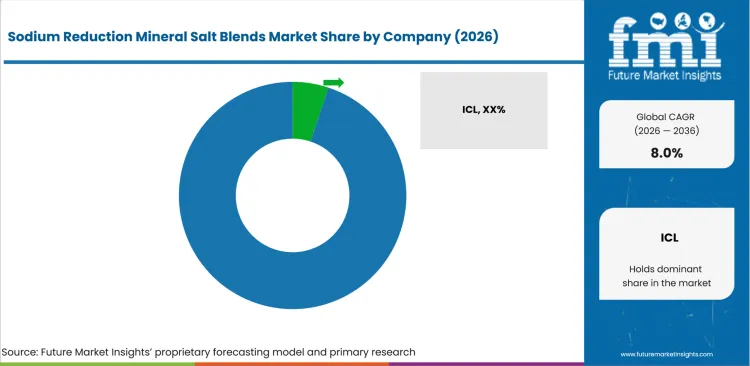
Competition combines mineral specialists with global flavor and food ingredient groups serving distinct sodium reduction requirements. ICL and K+S provide direct mineral expertise through food-grade salt systems and controlled specifications for commercial food processing. Cargill and ADM connect mineral replacement with broader ingredient portfolios and application laboratories serving packaged food manufacturers. Tate & Lyle and Kerry address texture and sensory restoration across finished foods using specialized formulation systems. Givaudan and dsm-firmenich add taste modulation and regional development capacity for complex reformulation programs across several food categories. Manufacturers should compare exact recipe evidence and service coverage rather than relying on corporate scale alone.
- ICL and K+S compete through mineral specification control and direct food processing knowledge across established ingredient channels. Their value increases for manufacturers requiring dependable purity and qualified regional supply across several factories. Consistent specifications reduce repeated validation across plants using the same approved recipe and quality program.
- Cargill and ADM combine sodium reduction with broader savory and protein formulation capabilities across commercial development programs. Their application networks support coordinated testing across several product categories and important regional manufacturing centers. The combined model supports shorter development across programs requiring mineral replacement and sensory repair within the same recipe.
- Tate & Lyle supports sodium reduction through salt-delivery technology, and Kerry provides taste modulation and application support for finished foods. Givaudan and dsm-firmenich add sensory science and regional development capacity across several important food categories. Combined sensory capabilities address bitterness and flavor loss across recipes requiring meaningful sodium reduction during commercial production.
Competitive Benchmarking: Sodium Reduction Mineral Salt Blends Market
| Company | Mineral Replacement and Taste Evidence | Application Testing and Integration Support | Food Manufacturer and Channel Reach | Geographic Reach |
|---|---|---|---|---|
| ICL | High | Medium | High | Global |
| Cargill | High | High | High | North America |
| ADM | High | High | High | Global |
| Tate & Lyle | High | Medium | High | Global |
| Kerry | High | High | High | Global |
| K+S | High | Medium | High | Europe and overseas markets |
| Givaudan | Medium | High | High | Global |
| dsm-firmenich | Medium | High | High | Global |
Key Developments in the Sodium Reduction Mineral Salt Blends Market
- In January 2026, ADM announced a USD 26 million investment in its Erlanger facility to expand reformulation capabilities. The project followed a 2025 expansion of the customer creation and innovation center at the same Kentucky campus. ADM identified lower sodium as a formulation need supported through savory flavors and targeted taste modulation tools. The investment strengthens North American testing capacity for recipes requiring coordinated nutrition and sensory changes across commercial product portfolios.
- In March 2026, Kerry reported the 2025 launch of next-generation fermentation-derived Tastesense solutions for sugar and salt reduction. The company also expanded its customer innovation center network across several regional markets serving food and beverage manufacturers. The launch gives manufacturers newer fermentation-derived tools for restoring salt perception during meaningful mineral replacement across finished recipes. Broader application support shortens validation across related recipes and production locations using comparable process conditions.
- In June 2026, K+S signed an agreement to acquire two evaporated salt production sites in Germany and Poland. The sites produce specialty salts for food and other applications across established European manufacturing and distribution markets. Transaction closing remains subject to customary conditions and is expected during the first quarter of 2027. The announced transaction would widen regional sourcing options for qualified food-grade mineral systems if closing occurs as scheduled.
- In August 2025, dsm-firmenich opened an expanded seasoning plant in Kerala and announced construction of a new Taste facility in Gujarat. The Gujarat plan covers 56,000 square meters and includes liquid compounding together with dry blending and encapsulation. The Kerala expansion increases current capacity, and the Gujarat project adds planned regional manufacturing support from 2027. The investments expand regional capacity for seasoning and encapsulated taste systems used during sodium reduction across several food categories.
Key Players in the Sodium Reduction Mineral Salt Blends Market
Mineral Replacement Providers
- ICL
- K+S
Integrated Ingredient Groups
- Cargill
- ADM
- Tate & Lyle
Taste Modulation Specialists
- Kerry
- Givaudan
- dsm-firmenich
Sodium Reduction Mineral Salt Blends Market - Report Scope
| Coverage field | Report scope |
|---|---|
| Market breakdown | Product type, source, application, end user, and region. |
| Quantitative Units | Revenue in USD Million, CAGR in %. |
| Market Definition | Commercial demand for mineral salt blends formulated to reduce sodium in food and beverage recipes while maintaining required sensory and processing performance. |
| Regions Covered | North America, Latin America, Europe, East Asia, South Asia and Pacific, and Middle East and Africa. |
| Countries Covered | United States, Germany, United Kingdom, France, Japan, India, and 30+ countries. |
| Key Companies Profiled | ICL, Cargill, ADM, Tate & Lyle, Kerry, K+S, Givaudan, and dsm-firmenich. |
| Forecast Period | 2026 to 2036. |
| Approach | Hybrid bottom-up and top-down market sizing supported by primary interviews and official desk research. |
Sodium Reduction Mineral Salt Blends Market - Research Methodology
| Method | Approach |
|---|---|
| Primary Research | FMI analysts gathered input from manufacturers, service providers, technology developers, distributors, end users, procurement teams, and subject-matter experts. Interviews examined purchasing decisions, product or service evaluation, adoption barriers, approval requirements, pricing considerations, and expectations for technical or commercial support. Respondents were also asked what evidence is required before a trial, pilot, or initial order develops into regular purchasing. |
| Desk Research | Desk research covered government statistics, regulatory publications, trade data, industry associations, technical literature, standards, company filings, product information, and official corporate announcements. Sources were reviewed for relevance, publication date, geographic coverage, and consistency with the defined market scope. Claims relating to performance, applications, approvals, capacity, investment, and commercial activity were retained only when supported by credible public evidence. |
| Market Sizing and Forecasting | The market model combined the baseline value with historical performance, segment structure, pricing and volume indicators, adoption levels, company participation, and country-level demand conditions. Forecast assumptions considered economic activity, investment trends, regulatory developments, technology adoption, purchasing cycles, supply availability, and barriers to wider market use. Segment and regional estimates were reconciled before the final market total was calculated. |
| Data Validation | Estimates were checked against multiple independent indicators, including public data, company activity, trade patterns, industry developments, and findings from primary interviews. Validation also tested whether products, services, applications, and company revenues fell within the defined market boundaries. Adjacent categories, unsupported claims, overlapping revenues, and activities without direct market relevance were excluded to reduce double counting and maintain consistency across segments and countries. |
Sodium Reduction Mineral Salt Blends Market by Segments
Sodium Reduction Mineral Salt Blends Market segmented by Product Type:
- Proteins
- Fibers
- Sweeteners
- Cultures
- Flavors
Sodium Reduction Mineral Salt Blends Market segmented by Source:
- Plant
- Microbial
- Dairy Analog
- Upcycled
- Mineral
Sodium Reduction Mineral Salt Blends Market segmented by Application:
- Bakery
- Beverages
- Snacks
- Infant Nutrition
- Ready Meals
Sodium Reduction Mineral Salt Blends Market segmented by End User:
- Food Manufacturers
- Beverage Manufacturers
- Foodservice Operators
- Contract Manufacturers
- Retail Brands
Sodium Reduction Mineral Salt Blends Market by Region:
- North America
- United States
- Canada
- Mexico
- Latin America
- Brazil
- Chile
- Rest of Latin America
- Western Europe
- Germany
- UK
- Italy
- Spain
- France
- Nordic
- BENELUX
- Rest of Western Europe
- Eastern Europe
- Russia
- Poland
- Hungary
- Balkan and Baltic
- Rest of Eastern Europe
- East Asia
- China
- Japan
- South Korea
- South Asia and Pacific
- India
- ASEAN
- Australia and New Zealand
- Rest of South Asia and Pacific
- Middle East and Africa
- Kingdom of Saudi Arabia
- Other GCC Countries
- Turkiye
- South Africa
- Other African Union
- Rest of Middle East and Africa
Research Sources and Bibliography
- World Health Organization. (2026, May 12). WHO launches revamped SHAKE package to help reduce salt intake.
- World Health Organization. (2025, January 27). Use of lower-sodium salt substitutes: WHO guideline.
- USA Food and Drug Administration. (2025, January 14). FDA Proposes Requiring At-a-Glance Nutrition Information on the Front of Packaged Foods.
- USA Food and Drug Administration. (2025, January 16). Food Labeling: Front-of-Package Nutrition Information (Proposed Rule).
- Health Canada. (2026, January 5). Nutrition labelling: Front-of-package nutrition symbol.
- Health Canada. (2025, June 27). Sodium reduction in select processed foods: Interim assessment.
- Canadian Food Inspection Agency. (2025, November 17). Notice to industry - Compliance and enforcement approach for front-of-package nutrition labelling effective January 1, 2026.
- Cargill. (2025, December 4). Why consumers want more protein-and how innovation is rising to meet the demand.
- Federal Ministry of Food and Agriculture. (2025, March 24). Nationale Reduktions- und Innovationsstrategie für Zucker, Fette und Salz in Fertigprodukten.
- Federal Ministry of Food and Agriculture. (2025, March 24). Fragen und Antworten zur Nationalen Reduktions- und Innovationsstrategie.
- Kerry. (2025, September 30). Kerry Launches Smart TasteTM to Help Customers Navigate Market Complexities Without Compromising on Taste.
- Department of Health and Social Care. (2025, October 1). Restricting volume price promotions of HFSS products.
- Food Safety and Standards Authority of India. (2025, February 20). Draft Notification of Food Safety and Standards (Labelling and Display) Amendment Regulations, 2025.
- Ministry of Health, Labour and Welfare. (2025, December 2).
- Légifrance. (2025, March 14). Arrêté du 14 mars 2025 fixant la forme de présentation complémentaire à la déclaration nutritionnelle recommandée par l’Etat en application des articles L. 3232-8 et R. 3232-7 du code de la santé publique.
- Department of Health and Social Care. (2026, January 27). Nutrient profiling model.
- ADM. (2026, January 15). ADM’s $26M Investment in Erlanger Facility Strengthens Capabilities for Growing Reformulation Demand.
- Kerry. (2026, March 19). Kerry publishes 2025 Annual Report: A year defined by impact, innovation and purpose.
- K+S Aktiengesellschaft. (2026, June 2). K+S strengthens its salt division with the acquisition of two sites in Saxony-Anhalt (Germany) and Poland.
- dsm-firmenich. (2025, August 26). dsm-firmenich unveils major plant investments, emphasizing commitment to shaping the future of flavor in India.
This bibliography is provided for reader reference and is not exhaustive. The full report contains the complete reference list and detailed citations.
This Report Answers
- How large is the sodium reduction mineral salt blends market in 2026 and 2036?
- Which policy and formulation pressures support investment in mineral salt replacement?
- Why does mineral account for the notable source share during 2026?
- How does bakery influence application testing and commercial adoption?
- Why are food manufacturers central to end-user demand and recurring purchasing?
- How do profiled country growth rates differ across India and other markets?
- Which companies provide mineral systems and application support for sodium reduction?
- What technical factors limit sodium reduction across established packaged food recipes?
- How should manufacturers compare blend performance across brands and production sites?
Frequently Asked Questions
How big is the Sodium Reduction Mineral Salt Blends Market in 2026?
The sodium reduction mineral salt blends market is valued at USD 382.3 million in 2026 and is forecast to reach USD 825.4 million by 2036, supported by growing national sodium policies that convert public health goals into measurable reformulation targets across packaged food portfolios globally.
What is the CAGR of the Sodium Reduction Mineral Salt Blends Market from 2026 to 2036?
The sodium reduction mineral salt blends market is projected to grow at a CAGR of 8.0% between 2026 and 2036, supported by expanding regulatory reformulation requirements and increasing adoption of potassium chloride-based mineral systems that maintain sensory performance across commercial food production batches.
Which source leads the Sodium Reduction Mineral Salt Blends Market?
Mineral accounts for 56.0% of the sodium reduction mineral salt blends market by source in 2026, driven by its direct sodium chloride replacement role across established food recipes and established dissolution and purity specifications that shorten ingredient qualification compared with less familiar replacement routes.
Why should executives track the sodium reduction mineral salt blends market?
Sodium rules influence package presentation and commercial promotion across several major packaged food categories and national retail channels. Early blend choices directly affect development cost and launch timing across several brands and production locations.
How much will the Sodium Reduction Mineral Salt Blends Market add between 2026 and 2036?
The sodium reduction mineral salt blends market is set to add USD 443.1 million between 2026 and 2036, growing from USD 382.3 million to USD 825.4 million as national sodium policies, nutrient profiling rules, and front-of-pack labeling requirements accelerate mineral blend adoption across bakery, snacks, and prepared food categories worldwide.
Who are the leading companies in the Sodium Reduction Mineral Salt Blends Market?
Leading companies in the sodium reduction mineral salt blends market include ICL, K+S, Cargill, ADM, Tate & Lyle, Kerry, Givaudan, and dsm-firmenich, competing across mineral replacement supply, integrated ingredient formulation, and taste modulation and sensory restoration capabilities for food manufacturers globally.
Preview the report firsthand - request a free sample
Get SampleGet the brochure for pricing and purchase details.
Get PDFTable of Content
- Key Takeaways
- Market Size and CAGR
- Top Growth Driver
- Fastest Growing Segment
- Leading Region
- Key Companies
- Emerging Opportunities
- Executive Summary
- Global Market Outlook
- Demand-side Trends
- Supply-side Trends
- Technology Roadmap Analysis
- Analysis and Recommendations
- Analyst Perspective (What is happening? Why now? What should investors know?)
- Key Questions Answered
- How large is the market?
- What is the CAGR?
- What are key trends?
- Which region dominates?
- Who are the leaders?
- Market Overview
- Market Coverage / Taxonomy
- Market Definition / Scope / Limitations
- Research Methodology
- Chapter Orientation
- Analytical Lens and Working Hypotheses
- Market Structure, Signals, and Trend Drivers
- Benchmarking and Cross-market Comparability
- Market Sizing, Forecasting, and Opportunity Mapping
- Research Design and Evidence Framework
- Desk Research Programme (Secondary Evidence)
- Expert Input and Fieldwork (Primary Evidence)
- Tooling, Models, and Reference Databases
- Data Engineering and Model Build
- Quality Assurance and Audit Trail
- Market Background
- Market Dynamics (Drivers, Restraints, Opportunity, Trends)
- Scenario Forecast (Optimistic, Likely, Conservative)
- Impact Analysis
- AI Impact
- Sustainability Impact
- Regulatory Impact
- Technology Impact
- Consumer / Buyer Analysis
- Purchase Drivers
- Adoption Barriers
- Buyer Journey
- Opportunity Map Analysis
- Product Life Cycle Analysis
- Supply Chain Analysis
- Investment Feasibility Matrix
- Value Chain Analysis
- PESTLE and Porter's Analysis
- Regulatory Landscape
- Regional Parent Market Outlook
- Production and Consumption Statistics
- Import and Export Statistics
- Global Market Analysis and Forecast, 2021 to 2036
- Historical Market Size Value (USD Million) Analysis, 2021 to 2025
- Current and Future Market Size Value (USD Million) Projections, 2026 to 2036
- Y-o-Y Growth Trend Analysis
- Absolute $ Opportunity Analysis
- Global Market Pricing Analysis, 2021 to 2036
- Global Market Analysis and Forecast, By Product Type, 2021 to 2036
- Introduction / Key Findings
- Historical Market Size Value (USD Million) Analysis By Product Type, 2021 to 2025
- Current and Future Market Size Value (USD Million) Analysis and Forecast By Product Type, 2026 to 2036
- Proteins
- Fibers
- Sweeteners
- Cultures
- Flavors
- Proteins
- Y-o-Y Growth Trend Analysis By Product Type, 2021 to 2025
- Absolute $ Opportunity Analysis By Product Type, 2026 to 2036
- Global Market Analysis and Forecast, By Source, 2021 to 2036
- Introduction / Key Findings
- Historical Market Size Value (USD Million) Analysis By Source, 2021 to 2025
- Current and Future Market Size Value (USD Million) Analysis and Forecast By Source, 2026 to 2036
- Mineral
- Microbial
- Dairy Analog
- Upcycled
- Plant
- Mineral
- Y-o-Y Growth Trend Analysis By Source, 2021 to 2025
- Absolute $ Opportunity Analysis By Source, 2026 to 2036
- Global Market Analysis and Forecast, By Application, 2021 to 2036
- Introduction / Key Findings
- Historical Market Size Value (USD Million) Analysis By Application, 2021 to 2025
- Current and Future Market Size Value (USD Million) Analysis and Forecast By Application, 2026 to 2036
- Bakery
- Beverages
- Snacks
- Infant Nutrition
- Ready Meals
- Bakery
- Y-o-Y Growth Trend Analysis By Application, 2021 to 2025
- Absolute $ Opportunity Analysis By Application, 2026 to 2036
- Global Market Analysis and Forecast, By End User, 2021 to 2036
- Introduction / Key Findings
- Historical Market Size Value (USD Million) Analysis By End User, 2021 to 2025
- Current and Future Market Size Value (USD Million) Analysis and Forecast By End User, 2026 to 2036
- Food Manufacturers
- Ingredient Blenders
- Private Label
- Foodservice
- Nutraceutical Brands
- Food Manufacturers
- Y-o-Y Growth Trend Analysis By End User, 2021 to 2025
- Absolute $ Opportunity Analysis By End User, 2026 to 2036
- Global Market Analysis and Forecast, By Region, 2021 to 2036
- Introduction
- Historical Market Size Value (USD Million) Analysis By Region, 2021 to 2025
- Current Market Size Value (USD Million) Analysis and Forecast By Region, 2026 to 2036
- North America
- Latin America
- Western Europe
- Eastern Europe
- East Asia
- South Asia and Pacific
- Middle East & Africa
- Market Attractiveness Analysis By Region
- North America Market Analysis and Forecast, By Country, 2021 to 2036
- Historical Market Size Value (USD Million) Trend Analysis By Market Taxonomy, 2021 to 2025
- Market Size Value (USD Million) Forecast By Market Taxonomy, 2026 to 2036
- By Country
- USA
- Canada
- By Product Type
- By Source
- By Application
- By End User
- By Country
- Market Attractiveness Analysis
- By Country
- By Product Type
- By Source
- By Application
- By End User
- Key Takeaways
- Latin America Market Analysis and Forecast, By Country
- Historical Market Size Value (USD Million) Trend Analysis By Market Taxonomy, 2021 to 2025
- Market Size Value (USD Million) Forecast By Market Taxonomy, 2026 to 2036
- By Country
- Brazil
- Mexico
- Chile
- Rest of Latin America
- By Product Type
- By Source
- By Application
- By End User
- By Country
- Market Attractiveness Analysis
- By Country
- By Product Type
- By Source
- By Application
- By End User
- Key Takeaways
- Western Europe Market Analysis and Forecast, By Country
- Historical Market Size Value (USD Million) Trend Analysis By Market Taxonomy, 2021 to 2025
- Market Size Value (USD Million) Forecast By Market Taxonomy, 2026 to 2036
- By Country
- Germany
- UK
- Italy
- Spain
- France
- Nordic
- BENELUX
- Rest of Western Europe
- By Product Type
- By Source
- By Application
- By End User
- By Country
- Market Attractiveness Analysis
- By Country
- By Product Type
- By Source
- By Application
- By End User
- Key Takeaways
- Eastern Europe Market Analysis and Forecast, By Country
- Historical Market Size Value (USD Million) Trend Analysis By Market Taxonomy, 2021 to 2025
- Market Size Value (USD Million) Forecast By Market Taxonomy, 2026 to 2036
- By Country
- Russia
- Poland
- Hungary
- Balkan & Baltic
- Rest of Eastern Europe
- By Product Type
- By Source
- By Application
- By End User
- By Country
- Market Attractiveness Analysis
- By Country
- By Product Type
- By Source
- By Application
- By End User
- Key Takeaways
- East Asia Market Analysis and Forecast, By Country
- Historical Market Size Value (USD Million) Trend Analysis By Market Taxonomy, 2021 to 2025
- Market Size Value (USD Million) Forecast By Market Taxonomy, 2026 to 2036
- By Country
- China
- Japan
- South Korea
- By Product Type
- By Source
- By Application
- By End User
- By Country
- Market Attractiveness Analysis
- By Country
- By Product Type
- By Source
- By Application
- By End User
- Key Takeaways
- South Asia and Pacific Market Analysis and Forecast, By Country
- Historical Market Size Value (USD Million) Trend Analysis By Market Taxonomy, 2021 to 2025
- Market Size Value (USD Million) Forecast By Market Taxonomy, 2026 to 2036
- By Country
- India
- ASEAN
- Australia & New Zealand
- Rest of South Asia and Pacific
- By Product Type
- By Source
- By Application
- By End User
- By Country
- Market Attractiveness Analysis
- By Country
- By Product Type
- By Source
- By Application
- By End User
- Key Takeaways
- Middle East & Africa Market Analysis and Forecast, By Country
- Historical Market Size Value (USD Million) Trend Analysis By Market Taxonomy, 2021 to 2025
- Market Size Value (USD Million) Forecast By Market Taxonomy, 2026 to 2036
- By Country
- Kingdom of Saudi Arabia
- Other GCC Countries
- Türkiye
- South Africa
- Other African Union
- Rest of Middle East & Africa
- By Product Type
- By Source
- By Application
- By End User
- By Country
- Market Attractiveness Analysis
- By Country
- By Product Type
- By Source
- By Application
- By End User
- Key Takeaways
- Key Countries Market Analysis
- USA
- Pricing Analysis
- Market Share Analysis, 2025
- By Product Type
- By Source
- By Application
- By End User
- Canada
- Pricing Analysis
- Market Share Analysis, 2025
- By Product Type
- By Source
- By Application
- By End User
- Mexico
- Pricing Analysis
- Market Share Analysis, 2025
- By Product Type
- By Source
- By Application
- By End User
- Brazil
- Pricing Analysis
- Market Share Analysis, 2025
- By Product Type
- By Source
- By Application
- By End User
- Chile
- Pricing Analysis
- Market Share Analysis, 2025
- By Product Type
- By Source
- By Application
- By End User
- Germany
- Pricing Analysis
- Market Share Analysis, 2025
- By Product Type
- By Source
- By Application
- By End User
- UK
- Pricing Analysis
- Market Share Analysis, 2025
- By Product Type
- By Source
- By Application
- By End User
- Italy
- Pricing Analysis
- Market Share Analysis, 2025
- By Product Type
- By Source
- By Application
- By End User
- Spain
- Pricing Analysis
- Market Share Analysis, 2025
- By Product Type
- By Source
- By Application
- By End User
- France
- Pricing Analysis
- Market Share Analysis, 2025
- By Product Type
- By Source
- By Application
- By End User
- India
- Pricing Analysis
- Market Share Analysis, 2025
- By Product Type
- By Source
- By Application
- By End User
- ASEAN
- Pricing Analysis
- Market Share Analysis, 2025
- By Product Type
- By Source
- By Application
- By End User
- Australia & New Zealand
- Pricing Analysis
- Market Share Analysis, 2025
- By Product Type
- By Source
- By Application
- By End User
- China
- Pricing Analysis
- Market Share Analysis, 2025
- By Product Type
- By Source
- By Application
- By End User
- Japan
- Pricing Analysis
- Market Share Analysis, 2025
- By Product Type
- By Source
- By Application
- By End User
- South Korea
- Pricing Analysis
- Market Share Analysis, 2025
- By Product Type
- By Source
- By Application
- By End User
- Russia
- Pricing Analysis
- Market Share Analysis, 2025
- By Product Type
- By Source
- By Application
- By End User
- Poland
- Pricing Analysis
- Market Share Analysis, 2025
- By Product Type
- By Source
- By Application
- By End User
- Hungary
- Pricing Analysis
- Market Share Analysis, 2025
- By Product Type
- By Source
- By Application
- By End User
- Kingdom of Saudi Arabia
- Pricing Analysis
- Market Share Analysis, 2025
- By Product Type
- By Source
- By Application
- By End User
- Türkiye
- Pricing Analysis
- Market Share Analysis, 2025
- By Product Type
- By Source
- By Application
- By End User
- South Africa
- Pricing Analysis
- Market Share Analysis, 2025
- By Product Type
- By Source
- By Application
- By End User
- USA
- Market Structure Analysis
- Competition Dashboard
- Competition Benchmarking
- Market Share Analysis of Top Players
- By Regional
- By Product Type
- By Source
- By Application
- By End User
- Emerging Startups
- Innovation Benchmarking
- Competition Analysis
- Competition Deep Dive
- ICL
- Overview
- Product Portfolio
- Profitability by Market Segments
- Sales Footprint
- Strategy Overview
- Marketing Strategy
- Product Strategy
- Channel Strategy
- Cargill
- ADM
- Tate & Lyle
- Kerry
- K+S
- Givaudan
- dsm-firmenich
- ICL
- Case Studies
- Success Stories
- Recent Developments
- Competition Deep Dive
- Assumptions & Acronyms Used


