

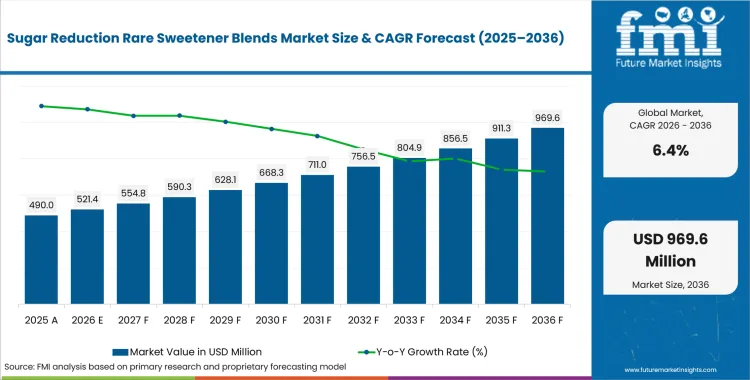
- Market Size (2026)
- USD 521.4 million
- Forecast (2036)
- USD 969.6 million
- CAGR (2026 to 2036)
- 6.4%
How big is Sugar Reduction Rare Sweetener Blends Market in 2026?
USD 521.4 million in 2026 and USD 969.6 million by 2036 at a 6.4% CAGR.
Sales of sugar-reduction rare sweetener blends are estimated to rise at 6.4% CAGR through 2036, increasing valuation from USD 521.4 million in 2026 to USD 969.6 million by 2036, driven by multi-ingredient reformulation across beverages and demanding packaged-food recipes. The proposal increases pressure to test sugar substitutes that reduce added sugar without weakening familiar texture or factory processing performance. Commercial adoption therefore depends on application trials that connect label targets with stable flavor and repeatable production results across finished products.
Regulatory status is another commercial filter as rare sugars do not share one approval route across major food markets. The European Food Safety Authority published its D-allulose opinion in June 2025 and concluded that safety could not be established, primarily because the applicant did not respond to repeated EFSA requests for additional toxicological and human data. The opinion concerns one application and does not reject every rare-sugar route; however it raises the evidence burden for European commercialization. European allulose launches require separate novel-food assessment and stronger applicant evidence. Manufacturers therefore compare blends built around natural sweeteners with allulose or tagatose routes through legal review and recipe trials alongside sourcing checks. Companies with complete regulatory files and regional application support can shorten qualification cycles despite uneven approval pathways and ingredient availability.
Key Takeaways of Sugar Reduction Rare Sweetener Blends Market
- Food manufacturers fund blend trials to reduce added sugar without losing the sweetness profile or processing functions established products require.
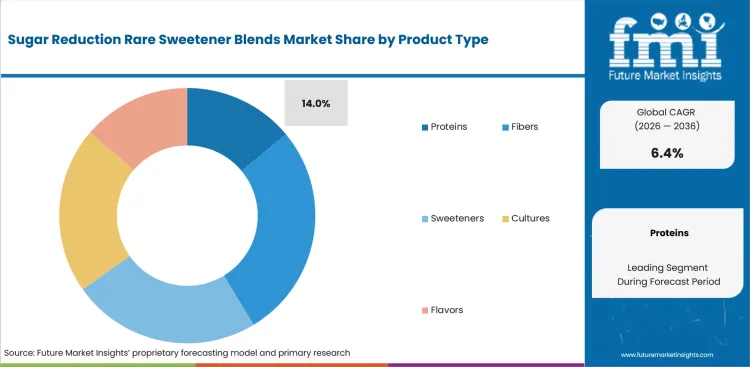
- Proteins are expected to account for 14.0% of product type demand in 2026 as nutrition-focused recipes require controlled sweetness and off-note correction.
- Plant is projected to represent 29.0% share in 2026 through established stevia use and several commercial formulation routes.
- Bakery is anticipated to capture 21.0% of application demand in 2026 owing to moisture and browning requirements across baked products.
- Uneven rare-sugar approvals and extended production trials remain material barriers for companies planning coordinated launches across several countries.
- Competition spans broad ingredient groups and specialist developers that combine rare sweeteners with texture or sensory support for complex reformulation programs.
Analyst Perspective
“A rare sweetener blend earns repeat orders through production evidence rather than sweetness claims alone. Food manufacturers need proof that the system controls aftertaste and restores bulk throughout the intended shelf period. The strongest programs combine legal clearance with local application work and dependable ingredient supply across several product families. A complete program allows one successful plant trial to support related products without restarting every qualification step.”
- Nandini Roy Choudhury, Principal Analyst, Future Market Insights
How is the Sugar Reduction Rare Sweetener Blends Market segmented?
The sugar reduction rare sweetener blends industry is segmented by product type, source, application, end user, and region.
Product type identifies the functional material purchased for a finished blend and separates proteins from fibers, sweeteners, cultures, and flavors. Source distinguishes plant and microbial inputs from dairy analog, upcycled, or mineral routes that carry different production and labeling conditions. Application identifies the recipe environment that determines sweetness intensity, heat stability, moisture control, and texture restoration. End user identifies the organization responsible for formulation approval, production testing, and recurring ingredient contracts across commercial product lines. Region completes the framework through differences in legal status, local distribution, and access to technical support.
What supports proteins within the product type category?
Protein-rich foods expose bitter or metallic notes more clearly as added sugar declines across nutrition bars and cultured products. Sweegen presented no-added-sugar yogurt and reduced-sugar granola at IFT FIRST in July 2025 using newly launched sweet proteins and taste modulators. The prototypes show why protein formulations need coordinated sweetness and flavor correction rather than direct gram-for-gram sugar replacement. Development teams must also confirm that the sweetness curve remains stable through processing and storage across the final product format.
- The product type category is forecast to be led by proteins at 14.0% share in 2026 due to nutrition-focused recipes that require controlled sweetness and off-note correction. Protein products also need blends that preserve familiar flavor without weakening nutrition claims or increasing formulation complexity. Commercial value improves through systems that perform consistently across several protein bases and package formats.
- Nutrition brands screen protein-oriented blends against several bases during dosage and flavor selection for a pilot batch. A blend earns repeat use through reliable off-note masking without weaker protein claims or unstable texture during storage. Commercial risk remains material if performance changes across protein sources and flavor systems during full production or extended shelf testing.
Why does plant shape demand within the source category?
Plant inputs give formulators steviol glycosides that work with bulking or mouthfeel ingredients across reduced-sugar recipes. Repeat manufacturing depends on stable taste quality and dependable supply across qualification batches and recurring orders. Tate & Lyle reported in October 2025 that its Manus partnership created an all-Americas supply route for Reb M stevia ingredients at commercial scale. The route supports blend design through regional availability and lot consistency during repeated production schedules. Food companies also examine traceability during approval of a plant-derived system for recurring manufacturing across commercial production sites.
- By source, plant is forecast to represent 29.0% share in 2026 driven by established stevia use across beverages and bakery products. Plant inputs provide several intensity and labeling options without forcing manufacturers to rebuild the complete formulation for each launch. Commercial advantage depends on consistent lots that preserve sweetness and aftertaste control through repeat manufacturing.
- Food companies combine plant sweeteners with fibers or flavors to tune sweetness onset and lingering notes across each recipe. Regional production reduces supply exposure but does not remove application testing or legal review for the finished blend. Adoption expands through responsive technical support and stable specifications that remain consistent across qualification batches and recurring orders.
How does bakery influence demand within the application category?
Bakery reformulation must restore moisture and browning alongside structure following a reduction in sucrose during commercial baking. Ingredion showcased Italian mochi biscuits with sugar reduction and texture innovation at IFT FIRST in July 2025. The prototype demonstrates why bakery ingredients must combine sweetness with water control and heat-stable texture across commercial oven conditions. Scale-up teams also measure yield and shelf quality during validation of a blend across the intended package format.
- Bakery is projected to hold 21.0% share in 2026 owing to the multiple functions that sucrose performs in baked products. The segment rewards systems that coordinate sweetness with moisture retention and browning through commercial oven cycles. Manufacturers also need stable yield and shelf texture to justify recurring production across high-volume lines.
- Bakers evaluate blends through small production runs that measure spread and color alongside texture across the intended shelf period. Adoption strengthens through formulation ranges that tolerate flour variation and several oven profiles without repeated adjustment. Higher ingredient cost remains a material friction without documented yield or waste improvements that protect finished-product economics.
Why do food manufacturers lead the end user category?
Food manufacturers control recipe approval and plant trials across every product family chosen for sugar reduction. Complex recipes require sweetness and texture support that reflects regional food flavors and established processing methods. Tate & Lyle launched its Sensation formulation tool in Asia-Pacific in September 2025 to accelerate product development through category-specific and geography-specific mouthfeel mapping. The tool gives formulation teams a regional route for matching sweeteners with fibers or proteins during scale-up. Production teams then convert laboratory results into repeatable specifications across commercial lines and related product families.
- Food manufacturers are likely to capture 30.0% share in 2026 attributable to their control over specifications and plant trials. A validated blend can extend across several products following confirmation of sensory performance and operating stability. Portfolio use improves ingredient leverage and reduces repeated qualification work across related commercial product families.
- Manufacturers begin with laboratory samples and expand through pilot batches that establish dosage ranges and processing tolerances. Technical teams favor partners that troubleshoot flavor imbalance and texture loss during scale-up across the intended production line. Commercial approval slows if documentation or batch consistency remains incomplete across the final plant network and product range.
What are the drivers, restraints, and opportunities in the Sugar Reduction Rare Sweetener Blends Market?
Nutrition labeling and recipe performance support reformulation demand; uneven approval routes and production complexity slow qualification. Integrated blend design creates a clear commercial opening.
- Driver: Nutrition labeling and established product specifications create measurable reformulation work across packaged food and beverage portfolios.
- Restraint: Uneven legal status and demanding recipe trials delay coordinated commercialization across several national food markets.
- Opportunity: Integrated systems can combine rare sugars with fibers or proteins and flavor tools to rebuild several sugar functions.
Visible sugar targets give food manufacturers a direct reason to fund reformulation across established beverage and packaged-food portfolios. The UK government reported in November 2025 that affected drinks had cut average sugar content by almost half from 2015 levels. The same release recorded 13.5% growth in volume sales and provides a commercial benchmark for levy-covered categories. The result gives manufacturers a reason to compare low-intensity sweeteners within blends that preserve familiar taste and product economics.
Regulatory uncertainty limits expansion across formulations that include unfamiliar rare sugars and require separate national approval routes. The UK Food Standards Agency listed an allulose novel-food application as undergoing risk assessment in July 2026. Food manufacturers cannot treat that status as legal authorization and must separate ingredient evaluation from launch planning. The delay raises development costs and weakens the commercial value of a blend without a clear approval route.
Integrated formulation support creates an opening for companies that combine sweetness with bulk and mouthfeel alongside flavor correction. Tate & Lyle expanded its BioHarvest collaboration in May 2026 to develop several plant-derived sweetener molecules for different food and beverage categories. The program broadens the ingredient pipeline and gives application teams more options for constructing food texturing agents and sweetness systems around defined recipe needs. Commercial value depends on converting new molecules into stable blends with complete documentation and scalable supply.
Which country CAGRs are profiled in the Sugar Reduction Rare Sweetener Blends Market?
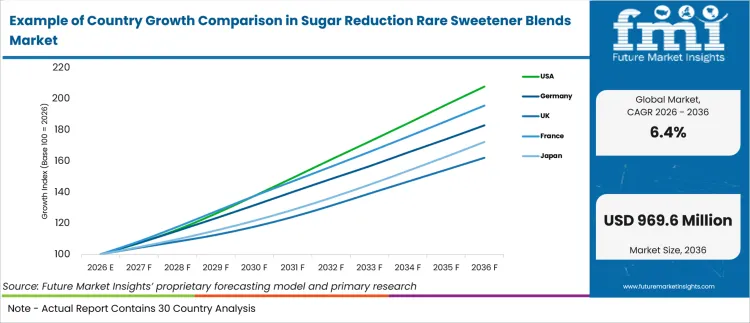
| Country | CAGR |
|---|---|
| India | 8.6% |
| United States | 8.0% |
| United Kingdom | 7.4% |
| Japan | 6.7% |
| France | 6.1% |
| Germany | 5.4% |
How do country-level CAGRs compare in the Sugar Reduction Rare Sweetener Blends Market?
The country comparison spans 3.2 percentage points and reflects different combinations of legal access and manufacturing scale alongside technical-service coverage. India and the United States form the upper group through extensive packaged-food production and broader formulation activity. The United Kingdom and Japan occupy the middle range through demanding legal or sensory review routes. France and Germany show narrower expansion under established nutrition scoring and recurring product-monitoring systems for packaged foods. These rates are FMI market estimates and do not represent official government projections for national ingredient demand.
- India combines expanding packaged-food production with local distribution routes that support early formulation trials across several product categories.
- The United States offers broader rare-sugar records and application laboratories that shorten technical evaluation across large manufacturing networks.
- The United Kingdom combines clear reformulation pressure with novel-food review requirements that can delay less familiar rare sugars.
- Japan applies exacting sensory expectations and maintains active technical research on allulose across health-oriented food development.
- France applies an updated nutrition score that changes the commercial value of simple sugar substitution across packaged-food portfolios.
- Germany uses recurring product monitoring to establish category benchmarks for sugar reduction across established food segments.
Comparable CAGRs can produce different qualification timelines through differences in legal status and local application support. Manufacturers therefore need national regulatory files alongside local trial plans and dependable ingredient routes for each commercial program. The full report provides country-level CAGR analysis across North America and Latin America; Europe and East Asia; South Asia and Oceania; and the Middle East and Africa.
Country-wise Analysis
- Indian food launches require compliance with Food Safety and Standards Authority rules across each sweetener and intended product claim. India's sugar reduction rare sweetener blends outlook is anticipated to advance at 8.6% CAGR over the assessment period, supported by packaged-food reformulation and greater regulatory attention to added sugar disclosure. The authority published a draft labeling amendment in February 2025 that proposed larger bold RDA percentages for added sugar. The proposal increases label visibility for sugar content but remains a draft rather than a completed rule. Ingredient distributors with application laboratories can shorten early recipe testing across bakery and beverage products. Commercial scale-up remains exposed to ingredient clearance and dependable supply across imported or locally sourced specialty components.
- The United States provides established FDA records for permitted sweetener uses across several food categories. The FDA GRAS inventory lists Bonumose D-tagatose as a sweetener and texturizer under a no-questions letter dated October 2021. Sugar reduction rare sweetener blend sales in the United States are forecast to expand at 8.0% CAGR by 2036, underpinned by broad packaged-food production and regional application laboratories. The GRAS record supports legal review but does not replace recipe-specific label assessment or plant validation. Manufacturers can use local laboratories for pilot work and direct ingredient contracts for recurring production. Higher ingredient costs remain material without documented sensory or processing gains across the finished product.
- Great Britain applies formal novel-food requirements to unfamiliar ingredients and England restricts volume promotions for products high in sugar. Sugar reduction rare sweetener blend demand in the United Kingdom is forecast to rise at 7.4% CAGR over the forecast period, reinforced by retail reformulation pressure and established technical channels. Local distributors can support trials with permitted sweeteners and prepare documentation for established food categories. The Department of Health and Social Care published an updated impact assessment for volume promotion restrictions in October 2025. The policy gives retail brands a commercial reason to review sugar levels across promotion-sensitive packaged products. Novel-food timelines remain a material friction for less familiar rare sugars and favor blends with a clear legal route.
- Japanese food companies require careful sensory validation and detailed ingredient documentation across products that emphasize clean taste. Japan's sugar reduction rare sweetener blends sector is projected to record 6.7% CAGR during the assessment period, supported by active allulose evaluation and interest in lower-calorie sweetness. Japan's clinical research registry recorded an allulose food study in March 2025 that examined GLP-1 response in healthy adults. The study supports technical understanding but does not demonstrate broad commercial purchasing across Japanese food manufacturers. Local importers and application teams can translate sensory findings into dosage guidance for established recipes. Imported specialty ingredients and strict aftertaste expectations remain material frictions during recipe validation and commercial production planning.
- French packaged-food companies operate under an updated Nutri-Score algorithm that evaluates sugar and certain sweeteners across product scoring. Service-Public.fr announced the revised algorithm in March 2025 and gave companies two years to update existing labels. Regional formulation laboratories can compare dosage and texture performance across established food categories during structured product trials. Adoption of sugar reduction rare sweetener blends in France is estimated to expand at 6.1% CAGR through 2036, shaped by nutrition scoring and retailer review. The algorithm limits simple substitution strategies and increases the value of complete recipe evaluation across branded product portfolios. Commercial programs therefore need evidence that the final formulation improves both scoring and sensory performance.
- German manufacturers work within a national reformulation program and face retailer expectations for consistent product specifications. Regional application laboratories support pilot production and technical troubleshooting across established German food categories and commercial factory settings. Germany's sugar reduction rare sweetener blends market is estimated to post 5.4% CAGR over the forecast period, enabled by recurring product monitoring and disciplined formulation review. The Max Rubner-Institut reported in July 2026 that its 2025 monitoring examined more than 7,000 finished products. The monitoring program gives manufacturers category benchmarks for setting practical sugar targets across large product portfolios. Commercial expansion remains limited by the need to protect texture and shelf life across industrial production.
Who are the notable companies in the Sugar Reduction Rare Sweetener Blends Market?
Tate & Lyle, Cargill, Ingredion, ADM, Roquette, Bonumose, Sweegen, and Givaudan are notable companies active across rare sweeteners and sugar-reduction formulation.
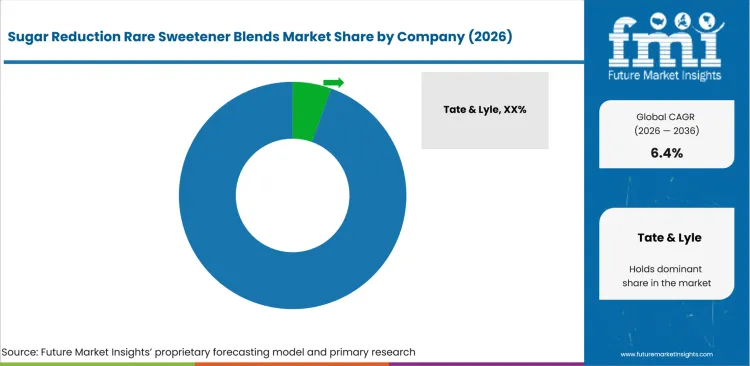
The competitive field combines global ingredient groups such as Tate & Lyle and Cargill with specialists focused on rare sugars and precision sweetness. Ingredion combines stevia with texture systems that address sweetness loss and mouthfeel changes across bakery and nutrition formulations. ADM supports reformulation through nutrition innovation centers across three continents and a portfolio spanning flavors alongside soluble fiber and polyols. Roquette announced NutraStrong verification for NUTRIOSE soluble fibers in February 2026 and added third-party documentation for ingredient qualification. Bonumose develops tagatose for sweetness and bulk restoration across formulations that need more than high-intensity sweeteners. Sweegen provides sweet proteins and taste modulation, and Givaudan contributes sensory correction for complex food and beverage recipes.
- Tate & Lyle and Cargill focus on commercial sweetener access and global application networks across several food categories. Their strongest programs connect ingredient supply with regulatory documentation and prototype work across regional product portfolios.
- Ingredion and ADM combine sweeteners with texture or flavor resources that rebuild functions lost during sugar reduction. Their application teams compare several blend routes through laboratories that support product development and production transfer.
- Roquette contributes soluble fiber systems, and Bonumose supplies a tagatose route for sweetness and bulk restoration.
Competitive Benchmarking: Sugar Reduction Rare Sweetener Blends Market
| Company | Rare Sugar and Sweetener Portfolio | Blend and Sensory Formulation | Application and Scale-Up Support | Geographic Reach |
|---|---|---|---|---|
| Tate & Lyle | High | High | High | Global |
| Cargill | High | High | High | Global |
| Ingredion | High | High | High | Global |
| ADM | Medium | High | High | Global |
| Roquette | Medium | Medium | Medium | Global |
| Bonumose | Medium | Low | Low | North America |
| Sweegen | High | High | High | Global |
| Givaudan | Low | High | High | Global |
Key Developments in the Sugar Reduction Rare Sweetener Blends Market
- In February 2026, Tate & Lyle introduced Yume as a sweetness platform developed with Manus under The Sweetener Alliance. The launch gives food manufacturers a structured route for comparing sweetener technologies through category-specific formulation work. Yume directly supports blend development through a commercial platform that connects sweetness selection with application expertise. The practical value depends on documented performance across the intended recipe and full commercial production process.
- In September 2025, Cargill reported that EverSweet had approvals in the United States and Canada alongside Mexico and the European Union. The company also stated that major food and beverage brands had adopted the precision-fermented sweetener. Broader approval improves availability for blend components that require consistent Reb M and Reb D quality. Multinational programs can use one platform across more regional product plans subject to local formulation review.
- In April 2025, Ingredion achieved Farm Sustainability Assessment Silver performance for its complete stevia supply chain through externally verified PureCircle operations. The development adds documented sourcing evidence during commercial qualification of plant-derived sweetener components and recurring purchasing. Food manufacturers can assess origin controls beside taste performance and batch consistency across recurring ingredient shipments. The recognition does not replace application trials but strengthens the supply record reviewed during commercial approval.
- In October 2025, Givaudan began construction of a liquids production facility near Cincinnati with partial operations scheduled from 2027. The company stated that the site would strengthen North American operations and extend customer reach. Greater regional flavor capacity can support sugar-reduction programs that require rapid sensory iteration and production transfer. Commercial benefit depends on facility completion and successful integration with regional customer development and production services.
Key Players in the Sugar Reduction Rare Sweetener Blends Market
Rare Sugar and Sweetener Leaders
- Tate & Lyle
- Cargill
- Ingredion
Integrated Formulation Suppliers
- ADM
- Roquette
- Givaudan
Specialist Sweetener Innovators
- Bonumose
- Sweegen
Sugar Reduction Rare Sweetener Blends Market - Report Scope
| Coverage field | Report scope |
|---|---|
| Market breakdown | Product type, source, application, end user, and region. |
| Quantitative Units | Revenue in USD Million, CAGR in %. |
| Market Definition | Commercial demand for blended rare sweeteners and supporting ingredients used to reduce sugar while preserving sweetness, texture, bulk, browning, or processing performance. |
| Regions Covered | North America, Latin America, Europe, East Asia, South Asia and Pacific, and Middle East and Africa. |
| Countries Covered | United States, Germany, United Kingdom, France, Japan, India, and 30+ countries. |
| Key Companies Profiled | Tate & Lyle, Cargill, Ingredion, ADM, Roquette, Bonumose, Sweegen, and Givaudan. |
| Forecast Period | 2026 to 2036. |
| Approach | Hybrid bottom-up and top-down market sizing supported by primary interviews and official desk research. |
Sugar Reduction Rare Sweetener Blends Market - Research Methodology
| Method | Approach |
|---|---|
| Primary Research | FMI analysts gathered input from manufacturers, service providers, technology developers, distributors, end users, procurement teams, and subject-matter experts. Interviews examined purchasing decisions, product or service evaluation, adoption barriers, approval requirements, pricing considerations, and expectations for technical or commercial support. Respondents were also asked what evidence is required before a trial, pilot, or initial order develops into regular purchasing. |
| Desk Research | Desk research covered government statistics, regulatory publications, trade data, industry associations, technical literature, standards, company filings, product information, and official corporate announcements. Sources were reviewed for relevance, publication date, geographic coverage, and consistency with the defined market scope. Claims relating to performance, applications, approvals, capacity, investment, and commercial activity were retained only when supported by credible public evidence. |
| Market Sizing and Forecasting | The market model combined the baseline value with historical performance, segment structure, pricing and volume indicators, adoption levels, company participation, and country-level demand conditions. Forecast assumptions considered economic activity, investment trends, regulatory developments, technology adoption, purchasing cycles, supply availability, and barriers to wider market use. Segment and regional estimates were reconciled before the final market total was calculated. |
| Data Validation | Estimates were checked against multiple independent indicators, including public data, company activity, trade patterns, industry developments, and findings from primary interviews. Validation also tested whether products, services, applications, and company revenues fell within the defined market boundaries. Adjacent categories, unsupported claims, overlapping revenues, and activities without direct market relevance were excluded to reduce double counting and maintain consistency across segments and countries. |
Sugar Reduction Rare Sweetener Blends Market by Segments
Sugar Reduction Rare Sweetener Blends Market segmented by Product Type:
- Proteins
- Fibers
- Sweeteners
- Cultures
- Flavors
Sugar Reduction Rare Sweetener Blends Market segmented by Source:
- Plant
- Microbial
- Dairy Analog
- Upcycled
- Mineral
Sugar Reduction Rare Sweetener Blends Market segmented by Application:
- Bakery
- Beverages
- Snacks
- Infant Nutrition
- Ready Meals
Sugar Reduction Rare Sweetener Blends Market segmented by End User:
- Food Manufacturers
- Beverage Manufacturers
- Foodservice Operators
- Contract Manufacturers
- Retail Brands
Sugar Reduction Rare Sweetener Blends Market by Region:
- North America
- United States
- Canada
- Mexico
- Latin America
- Brazil
- Chile
- Rest of Latin America
- Western Europe
- Germany
- UK
- Italy
- Spain
- France
- Nordic
- BENELUX
- Rest of Western Europe
- Eastern Europe
- Russia
- Poland
- Hungary
- Balkan and Baltic
- Rest of Eastern Europe
- East Asia
- China
- Japan
- South Korea
- South Asia and Pacific
- India
- ASEAN
- Australia and New Zealand
- Rest of South Asia and Pacific
- Middle East and Africa
- Kingdom of Saudi Arabia
- Other GCC Countries
- Turkiye
- South Africa
- Other African Union
- Rest of Middle East and Africa
Research Sources and Bibliography
- USA Food and Drug Administration. (2025, January 14). FDA Proposes Requiring At-a-Glance Nutrition Information on the Front of Packaged Foods.
- EFSA Panel on Nutrition, Novel Foods and Food Allergens. (2025, June 5). Safety of D‐allulose as a novel food pursuant to Regulation (EU) 2015/2283.
- Sweegen. (2025, July 14-16). Join Sweegen Taste Blazers at IFT 2025!
- Tate & Lyle. (2025, October 31). One year on: How our stevia Reb M partnership with Manus is benefiting customers.
- Ingredion. (2025, July 22). Ingredion at IFT FIRST 2025 - Connecting texture, health and innovation.
- Tate & Lyle. (2025, September 4). Tate & Lyle launches breakthrough formulation tool In Asia-Pacific to unlock full potential of mouthfeel.
- Tate & Lyle. (2025, July 7). Tate & Lyle debuts expanded portfolio and mouthfeel leadership at IFT FIRST 2025.
- Department of Health and Social Care, & HM Treasury. (2025, November 25). Soft drinks levy extended to protect children and improve health.
- Food Standards Agency. (2026, July 1). Allulose.
- Tate & Lyle. (2026, May 18). Tate & lyle expands collaboration with BioHarvest to accelerate next-generation sweetener innovation.
- Food Safety and Standards Authority of India. (2025, February 17). Draft Notification of Food Safety and Standards (Labelling and Display) Amendment Regulations, 2025.
- USA Food and Drug Administration. (2021, October 21). GRN No. 977: D-tagatose produced via novel enzymatic cascade.
- Department of Health and Social Care. (2025, October 1). Restricting volume price promotions of HFSS products.
- Japan Registry of Clinical Trials. (2025, March 26). Study to Investigate the GLP-1 Secretion-Promoting Effect of Foods Containing Allulose.
- Direction de l’information légale et administrative. (2025, March 20). Ce qu’il faut savoir sur le nouveau Nutri-Score.
- Max Rubner-Institut. (2026, July 17). Ergebnisse des Produktmonitorings 2025 veröffentlicht.
- Tate & Lyle. (2026, February 23). Introducing Yume™: A new standard for sweetness.
- Cargill. (2025, September 26). Cargill’s EverSweet® stevia sweetener named a finalist in the 2025 Global Good Awards Game Changing Innovation of the Year.
- Ingredion. (2025, April 29). PureCircle by Ingredion First to Achieve Farm Sustainability Assessment Silver Performance Level for 100% of Stevia Supply.
- Givaudan. (2025, October 8). Givaudan Taste & Wellbeing breaks ground on new production facility near Cincinnati, Ohio.
- Archer-Daniels-Midland Company. (2026, February 17). Form 10-K for the year ended December 31, 2025.
- Roquette. (2026, February 3). NUTRIOSE® Soluble Fibers: NutraStrong™ Prebiotic Verified.
This bibliography is provided for reader reference and is not exhaustive. The full report contains the complete reference list and detailed citations
This Report Answers
- How large is the sugar reduction rare sweetener blends market in 2026 and 2036?
- Which formulation pressures support demand for rare sweetener blends across food and beverages?
- Why do proteins account for a notable product type share in 2026?
- How does plant sourcing influence blend availability and technical performance?
- Why does bakery create a demanding application route for sugar reduction?
- How do country growth rates differ across India and the United States alongside Europe and Japan?
- Which companies combine sweetener portfolios with formulation and scale-up support?
- What regulatory and sensory barriers limit broader commercial adoption?
- How can manufacturers evaluate blend economics across pilot and production stages?
Frequently Asked Questions
How big is the Sugar Reduction Rare Sweetener Blends Market in 2026?
The sugar reduction rare sweetener blends market is valued at USD 521.4 million in 2026 and is forecast to reach USD 969.6 million by 2036, supported by food manufacturers funding multi-ingredient reformulation programs across beverages and packaged-food recipes that require measurable added sugar reduction without weakening familiar texture or processing performance.
What is the CAGR of the Sugar Reduction Rare Sweetener Blends Market from 2026 to 2036?
The sugar reduction rare sweetener blends market is projected to grow at a CAGR of 6.4% between 2026 and 2036, supported by expanding nutrition labeling requirements, retail reformulation pressure across sugar-levy categories, and growing demand for integrated blend systems that restore sweetness, bulk, and mouthfeel across commercial food production.
Which source leads the Sugar Reduction Rare Sweetener Blends Market?
Plant accounts for 29.0% of the sugar reduction rare sweetener blends market by source in 2026, driven by established stevia use across beverages and bakery products and the availability of several intensity and labeling options that allow manufacturers to reduce sugar without rebuilding complete formulations for each national launch.
How much will the Sugar Reduction Rare Sweetener Blends Market add between 2026 and 2036?
The sugar reduction rare sweetener blends market is set to add USD 448.2 million between 2026 and 2036, growing from USD 521.4 million to USD 969.6 million as front-of-package labeling requirements, nutrition scoring systems, and volume promotion restrictions accelerate rare sweetener blend adoption across packaged food and beverage portfolios worldwide.
Who are the leading companies in the Sugar Reduction Rare Sweetener Blends Market?
Leading companies in the sugar reduction rare sweetener blends market include Tate & Lyle, Cargill, Ingredion, ADM, Roquette, Bonumose, Sweegen, and Givaudan, competing across rare sugar and sweetener portfolios, integrated formulation and texture platforms, and specialist sensory correction capabilities with global application and scale-up support.
Preview the report firsthand - request a free sample
Get SampleGet the brochure for pricing and purchase details.
Get PDFTable of Content
- Key Takeaways
- Market Size and CAGR
- Top Growth Driver
- Fastest Growing Segment
- Leading Region
- Key Companies
- Emerging Opportunities
- Executive Summary
- Global Market Outlook
- Demand-side Trends
- Supply-side Trends
- Technology Roadmap Analysis
- Analysis and Recommendations
- Analyst Perspective (What is happening? Why now? What should investors know?)
- Key Questions Answered
- How large is the market?
- What is the CAGR?
- What are key trends?
- Which region dominates?
- Who are the leaders?
- Market Overview
- Market Coverage / Taxonomy
- Market Definition / Scope / Limitations
- Research Methodology
- Chapter Orientation
- Analytical Lens and Working Hypotheses
- Market Structure, Signals, and Trend Drivers
- Benchmarking and Cross-market Comparability
- Market Sizing, Forecasting, and Opportunity Mapping
- Research Design and Evidence Framework
- Desk Research Programme (Secondary Evidence)
- Expert Input and Fieldwork (Primary Evidence)
- Tooling, Models, and Reference Databases
- Data Engineering and Model Build
- Quality Assurance and Audit Trail
- Market Background
- Market Dynamics (Drivers, Restraints, Opportunity, Trends)
- Scenario Forecast (Optimistic, Likely, Conservative)
- Impact Analysis
- AI Impact
- Sustainability Impact
- Regulatory Impact
- Technology Impact
- Consumer / Buyer Analysis
- Purchase Drivers
- Adoption Barriers
- Buyer Journey
- Opportunity Map Analysis
- Product Life Cycle Analysis
- Supply Chain Analysis
- Investment Feasibility Matrix
- Value Chain Analysis
- PESTLE and Porter's Analysis
- Regulatory Landscape
- Regional Parent Market Outlook
- Production and Consumption Statistics
- Import and Export Statistics
- Global Market Analysis and Forecast, 2021 to 2036
- Historical Market Size Value (USD Million) Analysis, 2021 to 2025
- Current and Future Market Size Value (USD Million) Projections, 2026 to 2036
- Y-o-Y Growth Trend Analysis
- Absolute $ Opportunity Analysis
- Global Market Pricing Analysis, 2021 to 2036
- Global Market Analysis and Forecast, By Product Type, 2021 to 2036
- Introduction / Key Findings
- Historical Market Size Value (USD Million) Analysis By Product Type, 2021 to 2025
- Current and Future Market Size Value (USD Million) Analysis and Forecast By Product Type, 2026 to 2036
- Proteins
- Fibers
- Sweeteners
- Cultures
- Flavors
- Proteins
- Y-o-Y Growth Trend Analysis By Product Type, 2021 to 2025
- Absolute $ Opportunity Analysis By Product Type, 2026 to 2036
- Global Market Analysis and Forecast, By Source, 2021 to 2036
- Introduction / Key Findings
- Historical Market Size Value (USD Million) Analysis By Source, 2021 to 2025
- Current and Future Market Size Value (USD Million) Analysis and Forecast By Source, 2026 to 2036
- Plant
- Microbial
- Dairy Analog
- Upcycled
- Mineral
- Plant
- Y-o-Y Growth Trend Analysis By Source, 2021 to 2025
- Absolute $ Opportunity Analysis By Source, 2026 to 2036
- Global Market Analysis and Forecast, By Application, 2021 to 2036
- Introduction / Key Findings
- Historical Market Size Value (USD Million) Analysis By Application, 2021 to 2025
- Current and Future Market Size Value (USD Million) Analysis and Forecast By Application, 2026 to 2036
- Bakery
- Beverages
- Snacks
- Infant Nutrition
- Ready Meals
- Bakery
- Y-o-Y Growth Trend Analysis By Application, 2021 to 2025
- Absolute $ Opportunity Analysis By Application, 2026 to 2036
- Global Market Analysis and Forecast, By End User, 2021 to 2036
- Introduction / Key Findings
- Historical Market Size Value (USD Million) Analysis By End User, 2021 to 2025
- Current and Future Market Size Value (USD Million) Analysis and Forecast By End User, 2026 to 2036
- Food Manufacturers
- Ingredient Blenders
- Private Label
- Foodservice
- Nutraceutical Brands
- Food Manufacturers
- Y-o-Y Growth Trend Analysis By End User, 2021 to 2025
- Absolute $ Opportunity Analysis By End User, 2026 to 2036
- Global Market Analysis and Forecast, By Region, 2021 to 2036
- Introduction
- Historical Market Size Value (USD Million) Analysis By Region, 2021 to 2025
- Current Market Size Value (USD Million) Analysis and Forecast By Region, 2026 to 2036
- North America
- Latin America
- Western Europe
- Eastern Europe
- East Asia
- South Asia and Pacific
- Middle East & Africa
- Market Attractiveness Analysis By Region
- North America Market Analysis and Forecast, By Country, 2021 to 2036
- Historical Market Size Value (USD Million) Trend Analysis By Market Taxonomy, 2021 to 2025
- Market Size Value (USD Million) Forecast By Market Taxonomy, 2026 to 2036
- By Country
- USA
- Canada
- By Product Type
- By Source
- By Application
- By End User
- By Country
- Market Attractiveness Analysis
- By Country
- By Product Type
- By Source
- By Application
- By End User
- Key Takeaways
- Latin America Market Analysis and Forecast, By Country
- Historical Market Size Value (USD Million) Trend Analysis By Market Taxonomy, 2021 to 2025
- Market Size Value (USD Million) Forecast By Market Taxonomy, 2026 to 2036
- By Country
- Brazil
- Mexico
- Chile
- Rest of Latin America
- By Product Type
- By Source
- By Application
- By End User
- By Country
- Market Attractiveness Analysis
- By Country
- By Product Type
- By Source
- By Application
- By End User
- Key Takeaways
- Western Europe Market Analysis and Forecast, By Country
- Historical Market Size Value (USD Million) Trend Analysis By Market Taxonomy, 2021 to 2025
- Market Size Value (USD Million) Forecast By Market Taxonomy, 2026 to 2036
- By Country
- Germany
- UK
- Italy
- Spain
- France
- Nordic
- BENELUX
- Rest of Western Europe
- By Product Type
- By Source
- By Application
- By End User
- By Country
- Market Attractiveness Analysis
- By Country
- By Product Type
- By Source
- By Application
- By End User
- Key Takeaways
- Eastern Europe Market Analysis and Forecast, By Country
- Historical Market Size Value (USD Million) Trend Analysis By Market Taxonomy, 2021 to 2025
- Market Size Value (USD Million) Forecast By Market Taxonomy, 2026 to 2036
- By Country
- Russia
- Poland
- Hungary
- Balkan & Baltic
- Rest of Eastern Europe
- By Product Type
- By Source
- By Application
- By End User
- By Country
- Market Attractiveness Analysis
- By Country
- By Product Type
- By Source
- By Application
- By End User
- Key Takeaways
- East Asia Market Analysis and Forecast, By Country
- Historical Market Size Value (USD Million) Trend Analysis By Market Taxonomy, 2021 to 2025
- Market Size Value (USD Million) Forecast By Market Taxonomy, 2026 to 2036
- By Country
- China
- Japan
- South Korea
- By Product Type
- By Source
- By Application
- By End User
- By Country
- Market Attractiveness Analysis
- By Country
- By Product Type
- By Source
- By Application
- By End User
- Key Takeaways
- South Asia and Pacific Market Analysis and Forecast, By Country
- Historical Market Size Value (USD Million) Trend Analysis By Market Taxonomy, 2021 to 2025
- Market Size Value (USD Million) Forecast By Market Taxonomy, 2026 to 2036
- By Country
- India
- ASEAN
- Australia & New Zealand
- Rest of South Asia and Pacific
- By Product Type
- By Source
- By Application
- By End User
- By Country
- Market Attractiveness Analysis
- By Country
- By Product Type
- By Source
- By Application
- By End User
- Key Takeaways
- Middle East & Africa Market Analysis and Forecast, By Country
- Historical Market Size Value (USD Million) Trend Analysis By Market Taxonomy, 2021 to 2025
- Market Size Value (USD Million) Forecast By Market Taxonomy, 2026 to 2036
- By Country
- Kingdom of Saudi Arabia
- Other GCC Countries
- Türkiye
- South Africa
- Other African Union
- Rest of Middle East & Africa
- By Product Type
- By Source
- By Application
- By End User
- By Country
- Market Attractiveness Analysis
- By Country
- By Product Type
- By Source
- By Application
- By End User
- Key Takeaways
- Key Countries Market Analysis
- USA
- Pricing Analysis
- Market Share Analysis, 2025
- By Product Type
- By Source
- By Application
- By End User
- Canada
- Pricing Analysis
- Market Share Analysis, 2025
- By Product Type
- By Source
- By Application
- By End User
- Mexico
- Pricing Analysis
- Market Share Analysis, 2025
- By Product Type
- By Source
- By Application
- By End User
- Brazil
- Pricing Analysis
- Market Share Analysis, 2025
- By Product Type
- By Source
- By Application
- By End User
- Chile
- Pricing Analysis
- Market Share Analysis, 2025
- By Product Type
- By Source
- By Application
- By End User
- Germany
- Pricing Analysis
- Market Share Analysis, 2025
- By Product Type
- By Source
- By Application
- By End User
- UK
- Pricing Analysis
- Market Share Analysis, 2025
- By Product Type
- By Source
- By Application
- By End User
- Italy
- Pricing Analysis
- Market Share Analysis, 2025
- By Product Type
- By Source
- By Application
- By End User
- Spain
- Pricing Analysis
- Market Share Analysis, 2025
- By Product Type
- By Source
- By Application
- By End User
- France
- Pricing Analysis
- Market Share Analysis, 2025
- By Product Type
- By Source
- By Application
- By End User
- India
- Pricing Analysis
- Market Share Analysis, 2025
- By Product Type
- By Source
- By Application
- By End User
- ASEAN
- Pricing Analysis
- Market Share Analysis, 2025
- By Product Type
- By Source
- By Application
- By End User
- Australia & New Zealand
- Pricing Analysis
- Market Share Analysis, 2025
- By Product Type
- By Source
- By Application
- By End User
- China
- Pricing Analysis
- Market Share Analysis, 2025
- By Product Type
- By Source
- By Application
- By End User
- Japan
- Pricing Analysis
- Market Share Analysis, 2025
- By Product Type
- By Source
- By Application
- By End User
- South Korea
- Pricing Analysis
- Market Share Analysis, 2025
- By Product Type
- By Source
- By Application
- By End User
- Russia
- Pricing Analysis
- Market Share Analysis, 2025
- By Product Type
- By Source
- By Application
- By End User
- Poland
- Pricing Analysis
- Market Share Analysis, 2025
- By Product Type
- By Source
- By Application
- By End User
- Hungary
- Pricing Analysis
- Market Share Analysis, 2025
- By Product Type
- By Source
- By Application
- By End User
- Kingdom of Saudi Arabia
- Pricing Analysis
- Market Share Analysis, 2025
- By Product Type
- By Source
- By Application
- By End User
- Türkiye
- Pricing Analysis
- Market Share Analysis, 2025
- By Product Type
- By Source
- By Application
- By End User
- South Africa
- Pricing Analysis
- Market Share Analysis, 2025
- By Product Type
- By Source
- By Application
- By End User
- USA
- Market Structure Analysis
- Competition Dashboard
- Competition Benchmarking
- Market Share Analysis of Top Players
- By Regional
- By Product Type
- By Source
- By Application
- By End User
- Emerging Startups
- Innovation Benchmarking
- Competition Analysis
- Competition Deep Dive
- Tate & Lyle
- Overview
- Product Portfolio
- Profitability by Market Segments
- Sales Footprint
- Strategy Overview
- Marketing Strategy
- Product Strategy
- Channel Strategy
- Cargill
- Ingredion
- ADM
- Roquette
- Bonumose
- Sweegen
- Givaudan
- Tate & Lyle
- Case Studies
- Success Stories
- Recent Developments
- Competition Deep Dive
- Assumptions & Acronyms Used


