

- Market Size (2026)
- USD 671.4 Mn
- Forecast (2036)
- USD 2319.8 Mn
- CAGR (2026 to 2036)
- 13.2%
How big is Shelf-Life Extension Systems for Bakery Market in 2026?
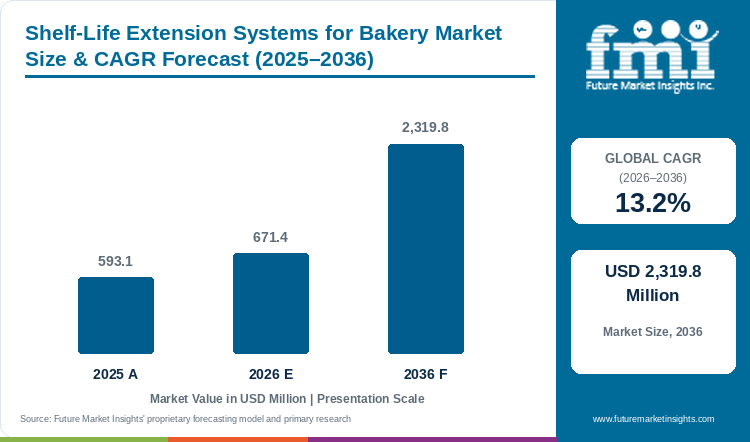
The market was valued at USD 593.1 Million in 2025 and is expected to reach USD 671.4 Million in 2026, with growth at a 13.2% CAGR from 2026 to 2036 taking its value to USD 2,319.8 Million by 2036.
A bakery choosing a shelf-life system first needs to establish why its product becomes unsaleable, since crumb firming can end an acceptable selling period before mold appears, while another recipe may remain soft but spoil microbiologically. Those problems require different interventions tested within the complete recipe and packaging used for distribution. The useful result retains the taste and texture customers expect, allowing industrial buyers to compare the additional ingredient and processing cost with fewer returns or discarded units. That calculation differs between a local fresh-bread route and packaged products delivered to distant stores, and regulatory acceptance also needs review when a recipe moves between markets. Suppliers should explain the function and operating conditions of freshness enzymes, cultured mold-control ingredients or a suitable combination, helping buyers avoid overlapping systems that leave the actual cause of waste unresolved. The forecast covers bakery-directed ingredients and formulated preservation systems, excluding finished baked goods and unrelated packaging or production machinery. [5]
Key Market Trends & Insights
- Standard grade holds 46.0% of product type in 2026, allowing bakeries to apply a consistent qualification process across familiar flour and dough systems.
- Powder / dry holds 38.0% of form in 2026, fitting the weighing and premixing equipment used to incorporate functional ingredients before hydration.
- Bread & rolls hold 34.0% of application in 2026, making crumb firmness and microbial spoilage separate limits to assess in widely distributed staple products.
- Conventional holds 51.0% of claim in 2026, while organic, clean-label and identity-preserved alternatives can narrow inputs or add traceability requirements.
Regional Highlights
- UAE has the highest profiled CAGR at 14.4% during 2026–2036.
- The next two profiled growth rates are Saudi Arabia at 14.1% and South Korea at 13.8% over the same period.
Market Size & Forecast
| Metric | Value |
|---|---|
| 2025 market value | USD 593.1 Million |
| 2026 market estimate | USD 671.4 Million |
| 2036 market forecast | USD 2,319.8 Million |
| Forecast CAGR, 2026–2036 | 13.2% |
The market covers bakery-directed ingredients and formulated systems intended to extend usable product life, including qualifying freshness enzymes, mold-control agents and functional blends. Finished baked goods and unrelated packaging or production equipment are excluded.
Shelf-life systems are selected by bakery products producers against a specific recipe and selling window, not against a universal preservation claim.
Bakery production readiness
| Documented operating context | Source |
|---|---|
| IFF announced POWERFRESH ACE 2000 in August 2025 as a bread fresh-keeping solution. | [1] |
| Corbion introduced Verdad Essence WH 100 in April 2025 as a cultured-wheat solution for bakery preservation. | [2] |
| FSANZ reviewed the first year of mandatory plain-English allergen labelling in March 2025. | [3] |
| Australian authorities reminded food importers about plain-English allergen labelling in October 2025. | [4] |
Analyst Perspective
The useful selling period ends when a bakery product loses the quality customers expect, which may occur through crumb firming as well as microbial spoilage. Suppliers can help buyers choose a suitable system by testing those failure modes separately in the intended recipe, packaging and delivery conditions.
- Nandini Roy Choudhury, Principal Analyst at Future Market Insights
How is the shelf-life extension systems for bakery market segmented?
Product Type covers Standard grade, Premium / specialty grade, Organic certified and Clean label grade. Form covers Powder / dry, Liquid, Paste / semi-solid and Granules / pieces. Application covers Bread & rolls, Cakes & muffins, Biscuits & cookies, Viennoiserie & pastry and Other bakery & snacks. Claim covers Conventional, Clean label, Organic and Non-GMO / identity preserved. Sales Channel covers Direct to industrial bakeries, Ingredient distributors, Foodservice & artisan supply and Online B2B.
In ready-to-eat food, the value of extra shelf life depends on retaining an acceptable product through distribution and the customer’s actual serving routine.
Why does Standard grade lead product type demand?
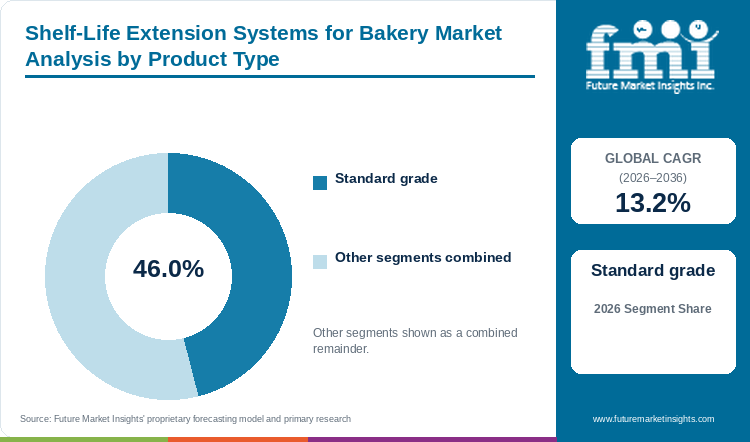
Standard grade: 46.0% of product type in 2026.
Standard-grade systems give bakeries a reproducible function and dosing specification for established recipes, with a common testing procedure helping manufacturers compare results across several bread lines. Each dough still needs assessment through its intended selling period to establish whether mold or texture loss is limiting product life. Premium grades may address a particular sensory requirement, while organic and clean-label options bring additional ingredient or documentation restrictions. A straightforward specification supports repeat purchasing when it resolves the identified problem without requiring unnecessary changes to a working formula.
- The Standard grade segment accounts for 46.0% of product type in 2026.
- Using a common testing procedure across bread lines makes comparison easier without assuming that every recipe fails in the same way.
Why does Powder / dry lead form demand?
Powder / dry: 38.0% of form in 2026.
Powdered systems can be weighed into flour blends or prepared as a premix before hydration using equipment many bakeries already operate, provided the active ingredients disperse evenly at the correct dose. Storage protection and dust controls remain necessary, while liquid, paste or granular forms may suit other acidification and handling requirements. Buyers need to match the form to mixing order and active stability, since convenient storage or weighing cannot compensate for uneven distribution or a preservation mechanism that is unsuitable for the recipe.
- The Powder / dry segment accounts for 38.0% of form in 2026.
- Premixing can simplify dosing but the bakery still needs to confirm even distribution through the finished dough.
What are the drivers, restraints, and opportunities in the shelf-life extension systems for bakery market?
Longer saleable life improves distribution economics
Bread that becomes unsaleable before the end of its delivery route creates losses for the bakery and its retail customers. Slower crumb firming or effective mold control can give stores more time to sell the product at the intended quality. Buyers need to identify which problem is limiting that time. Trials should include normal delivery and storage rather than only laboratory conditions. The added cost of the system can then be weighed against fewer returns and rejected units. This gives the purchase a concrete purpose instead of treating additional shelf life as an end in itself.
Preservation must protect sensory quality
Preservation ingredients need to be tested within the full recipe, hygiene, packaging and storage process, because they cannot correct every production weakness. Reformulation can change flavor and texture as well as labeling, while organic or other specialist claims bring further checks before approval. Assessing mold control and acceptable eating quality separately helps the buyer establish whether the added system resolves the actual loss of saleable product.
Recipe-specific systems can address several spoilage mechanisms
Cultured sugars and fermented wheat or buffered vinegar give developers options to investigate mold control within different labeling requirements. Each has to be tested against the likely spoilage organisms and the recipe’s flavor limits. Suppliers can help by distinguishing microbial protection from softness retention. That makes it easier to select a suitable combination rather than pay for ingredients with overlapping functions. Application work should also check dosage and production throughput. The useful opportunity is a system that protects the actual bakery product without adding more complexity than the avoided waste can justify.
The comparison with frozen baked goods helps buyers separate freezing-based inventory control from ingredient systems used to protect ambient or chilled products.
Which country and market CAGRs are profiled for shelf-life extension systems for bakery?
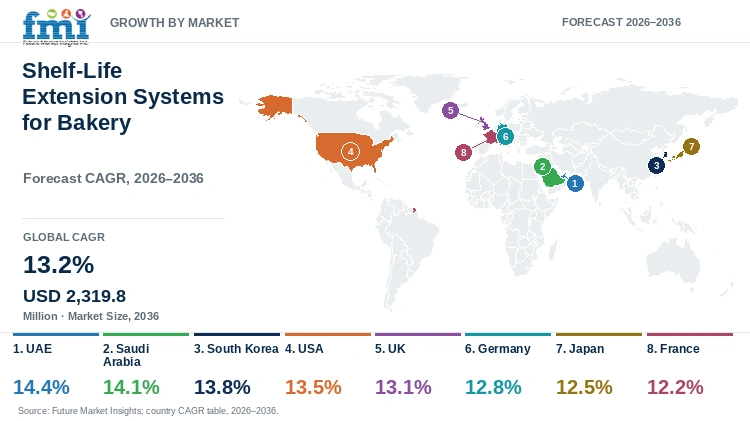
| Country | CAGR |
|---|---|
| UAE | 14.4% |
| Saudi Arabia | 14.1% |
| South Korea | 13.8% |
| USA | 13.5% |
| UK | 13.1% |
| Germany | 12.8% |
| Japan | 12.5% |
| France | 12.2% |
Country-wise Analysis
UAE
- Preservation trials for UAE bakery products need to reproduce the handling conditions encountered along retail or hospitality delivery routes before the product is eaten. The UAE carries the highest profiled forecast at a 14.4% CAGR from 2026 to 2036. Antifungal systems should be assessed alongside texture and flavor near the end of the proposed selling period. Appropriate product documentation remains necessary. A tailored formulation is useful when it protects acceptable servings through that route rather than simply produces a longer result under controlled laboratory storage.
Saudi Arabia
- Saudi bakery buyers must confirm that an ingredient is eligible for the intended use even when it is already sold elsewhere. Saudi Arabia is forecast at a 14.1% CAGR during 2026–2036. Technical trials then need to evaluate flavor as well as mold prevention. The proposed system should be tested in the recipe and channel the bakery actually uses. Buyers can compare fewer rejected units with the added ingredient and process cost. This keeps the decision tied to usable product rather than a supplier’s headline shelf-life result.
South Korea
- South Korean manufacturers need preservation changes to fit both the intended texture and the applicable additive classification. South Korea is forecast at a 13.8% CAGR from 2026 to 2036. A new system may require adjustments in mixing or packaging so production staff should take part in its assessment. Samples near the end of shelf life need to represent what consumers will actually receive. Testing only the ingredient or an ideal laboratory formula would miss those interactions. Approval should follow successful use in the bakery’s own recipe and distribution conditions.
USA
- American bakery buyers need to measure softness and slicing behavior as well as microbial stability. The USA rate is 13.5% CAGR from 2026 to 2036. A longer selling period can widen distribution but the loaf must retain the eating quality that attracts repeat purchases. Trials should include the intended packaging and delivery route so the bakery can compare cost per acceptable loaf after returns and rejects. That comparison is more useful than choosing a system solely because its supplier reports the longest test duration.
UK
- British supermarket supply requires bread to remain acceptable through delivery and store display. The UK forecast is 13.1% CAGR from 2026 to 2036. Suppliers need to assess mold control and satisfactory eating quality separately using the actual recipe and package, since the two can produce different limits on the selling period. A preservation system that controls microbial spoilage while allowing the crumb to become unpleasant may still leave the retailer with unsold stock. Repeatable trials across realistic storage conditions give the bakery a sounder basis for setting its selling window.
Germany
- German local fresh bread and wrapped rolls distributed more widely have different preservation requirements. Germany’s forecast is 12.8% CAGR from 2026 to 2036. Vendors should separate those uses rather than propose a universal long-life formula. Industrial bakers may need a system that can be applied across several lines without changing taste or complicating production. Application support can establish whether formulation is the limiting factor or whether packaging and handling need attention. The added selling period is valuable only when the product still retains the qualities customers expect.
Japan
- Maintaining a soft crumb is a distinct task from preventing mold in Japanese packaged bakery products. Japan is forecast at a 12.5% CAGR from 2026 to 2036. Amano Enzyme describes baking enzymes that affect starch-water interactions and help preserve softness. Buyers still need to establish the appropriate sensory limits for their own recipe. Moisture movement and package performance should be tested together under local factory conditions. A more complex preservation system has little value when the intended small serving loses its desired texture before customers reach the end of the pack.
France
- French producers can distinguish bakery products sold for immediate freshness from packaged ranges intended for wider distribution. France records 12.2% CAGR from 2026 to 2036, the lowest rate among the eight profiles. Shelf-life ingredients should follow that distinction, with targeted enzymes or fermented ingredients considered for packaged recipes where sensory testing and labeling support their use. The aim is to protect recognizable bread qualities along the chosen delivery route. Applying the same formula across every product could obscure the characteristics customers were paying for in the first place.
Who are the notable companies in the shelf-life extension systems for bakery market?
IFF; Novonesis; Corbion; Kerry Group; Puratos
Enzyme and preservation suppliers address different reasons for bakery products becoming unsaleable. A system that slows staling should not be ranked against a mold inhibitor without specifying the customer’s problem. Competition is for a tested role within an approved recipe.
Competitive Benchmarking: Shelf-Life Extension Systems for Bakery Market
| Participant | Commercial focus | Buyer qualification priority |
|---|---|---|
| IFF | Bakery enzyme systems | Softness performance in the intended recipe |
| Novonesis | Baking biotechnology | Enzyme compatibility with processing conditions |
| Corbion | Food preservation systems | Mold control and sensory effects |
| Kerry Group | Taste and preservation ingredients | Recipe-specific shelf-life validation |
| Puratos | Bakery ingredients and applications | Process support and finished-product quality |
Key Developments in the Shelf-Life Extension Systems for Bakery Market
- IFF announced POWERFRESH ACE 2000 in August 2025 as a bread fresh-keeping solution. [1]
- Corbion introduced Verdad Essence WH 100 in April 2025 as a cultured-wheat solution for bakery preservation. [2]
Key Players in the Shelf-Life Extension Systems for Bakery Market
- IFF
- Novonesis
- Corbion
- Kerry Group
- Puratos
Shelf-Life Extension Systems for Bakery Market - Report Scope
| Coverage field | Report scope |
|---|---|
| Market breakdown | Product Type; Form; Application; Claim; Sales Channel; Region |
| Quantitative unit | USD Million |
| Market definition | The market covers bakery-directed ingredients and formulated systems intended to extend usable product life, including qualifying freshness enzymes, mold-control agents and functional blends. Finished baked goods and unrelated packaging or production equipment are excluded. |
| Regions covered | North America; Latin America; Western Europe; Eastern Europe; East Asia; South Asia and Pacific; Middle East and Africa |
| Countries / markets profiled | UAE; Saudi Arabia; South Korea; USA; UK; Germany; Japan; France |
| Key companies profiled | IFF; Novonesis; Corbion; Kerry Group; Puratos |
| Base year / forecast period | 2026 / 2026–2036 |
| Estimate coverage | 2025 and 2026 market estimates; 2036 forecast; segment shares and country / market CAGRs. |
Shelf-Life Extension Systems for Bakery Market - Research Methodology
| Method | Application |
|---|---|
| Market definition | The analysis follows the stated product or service boundary and distinguishes direct category revenue from adjacent activities. |
| Secondary research | Official technical, regulatory, research and company publications provide the documented operating context and recent developments cited in this report. |
| Forecast and segmentation | Market estimates, segment shares and geographic forecasts are presented as analytical estimates within the stated commercial scope. |
| Competitive assessment | Participants are compared by their relevant products or services, commercial role and buyer qualification requirements. |
| Interpretation | The assessment considers purchasing conditions and the scope of the documented product, service or performance claim. |
Shelf-Life Extension Systems for Bakery Market by Segments
Product Type
- Standard grade
- Premium / specialty grade
- Organic certified
- Clean label grade
Form
- Powder / dry
- Liquid
- Paste / semi-solid
- Granules / pieces
Application
- Bread & rolls
- Cakes & muffins
- Biscuits & cookies
- Viennoiserie & pastry
- Other bakery & snacks
Claim
- Conventional
- Clean label
- Organic
- Non-GMO / identity preserved
Sales Channel
- Direct to industrial bakeries
- Ingredient distributors
- Foodservice & artisan supply
- Online B2B
Shelf-Life Extension Systems for Bakery Market by Region
- North America
- United States
- Canada
- Latin America
- Brazil
- Mexico
- Argentina
- Chile
- Western Europe
- Germany
- France
- United Kingdom
- Italy
- Spain
- Benelux
- Nordics
- Eastern Europe
- Poland
- Czech Republic
- Romania
- Hungary
- East Asia
- China
- Japan
- South Korea
- South Asia and Pacific
- India
- ASEAN
- Australia and New Zealand
- Middle East and Africa
- GCC Countries
- South Africa
- Türkiye
- Israel
Research Sources and Bibliography
- [1] IFF. (2025, August 13). POWERFRESH ACE 2000 bread fresh-keeping solution launch.
- [2] Corbion. (2025, April 21). Corbion introduces Verdad Essence WH 100.
- [3] Food Standards Australia New Zealand. (2025, March 5). Plain English Allergen Labelling: One year of clearer, safer food labels.
- [4] Australian Government, Department of Agriculture, Fisheries and Forestry. (2025, October 14). Reminder for importers about plain English allergen labelling.
- [5] Future Market Insights. (2026). Shelf-Life Extension Systems for Bakery Market: Global industry analysis and opportunity assessment, 2026–2036.
This Report Answers
- How large is the shelf-life extension systems for bakery market in 2026?
- What value and CAGR are forecast through 2036?
- Which product type segment leads in 2026?
- Which form segment has the largest share?
- Which profiled country or market has the fastest forecast growth?
- Which participants are covered in the competitive assessment?
Frequently Asked Questions
How large is the shelf-life extension systems for bakery market in 2026?
The market was valued at USD 593.1 Million in 2025 and is expected to reach USD 671.4 Million in 2026.
What value and CAGR are forecast through 2036?
The market is projected to reach USD 2,319.8 Million by 2036, with a 13.2% CAGR during 2026–2036.
Which product type segment leads in 2026?
The Standard grade segment accounts for 46.0% of product type in 2026.
Which form segment has the largest share?
The Powder / dry segment accounts for 38.0% of form in 2026.
Which profiled country or market has the fastest forecast growth?
UAE has the highest profiled CAGR at 14.4% during 2026–2036.
Which participants are covered in the competitive assessment?
The assessment covers IFF, Novonesis, Corbion, Kerry Group and Puratos.
Preview the report firsthand - request a free sample
Get SampleGet the brochure for pricing and purchase details.
Get PDFTable of Content
- Key Takeaways
- Market Size and CAGR
- Top Growth Driver
- Fastest Growing Segment
- Leading Region
- Key Companies
- Emerging Opportunities
- Executive Summary
- Global Market Outlook
- Demand-side Trends
- Supply-side Trends
- Technology Roadmap Analysis
- Analysis and Recommendations
- Analyst Perspective (What is happening? Why now? What should investors know?)
- Key Questions Answered
- How large is the market?
- What is the CAGR?
- What are key trends?
- Which region dominates?
- Who are the leaders?
- Market Overview
- Market Coverage / Taxonomy
- Market Definition / Scope / Limitations
- Research Methodology
- Chapter Orientation
- Analytical Lens and Working Hypotheses
- Market Structure, Signals, and Trend Drivers
- Benchmarking and Cross-market Comparability
- Market Sizing, Forecasting, and Opportunity Mapping
- Research Design and Evidence Framework
- Desk Research Programme (Secondary Evidence)
- Expert Input and Fieldwork (Primary Evidence)
- Tooling, Models, and Reference Databases
- Data Engineering and Model Build
- Quality Assurance and Audit Trail
- Market Background
- Market Dynamics (Drivers, Restraints, Opportunity, Trends)
- Scenario Forecast (Optimistic, Likely, Conservative)
- Impact Analysis
- AI Impact
- Sustainability Impact
- Regulatory Impact
- Technology Impact
- Consumer / Buyer Analysis
- Purchase Drivers
- Adoption Barriers
- Buyer Journey
- Opportunity Map Analysis
- Product Life Cycle Analysis
- Supply Chain Analysis
- Investment Feasibility Matrix
- Value Chain Analysis
- PESTLE and Porter's Analysis
- Regulatory Landscape
- Regional Parent Market Outlook
- Production and Consumption Statistics
- Import and Export Statistics
- Global Market Analysis and Forecast, 2021 to 2036
- Historical Market Size Value (USD Million) Analysis, 2021 to 2025
- Current and Future Market Size Value (USD Million) Projections, 2026 to 2036
- Y-o-Y Growth Trend Analysis
- Absolute $ Opportunity Analysis
- Global Market Pricing Analysis, 2021 to 2036
- Global Market Analysis and Forecast, By Product Type, 2021 to 2036
- Introduction / Key Findings
- Historical Market Size Value (USD Million) Analysis By Product Type, 2021 to 2025
- Current and Future Market Size Value (USD Million) Analysis and Forecast By Product Type, 2026 to 2036
- Standard grade
- Premium / specialty grade
- Organic certified
- Clean label grade
- Y-o-Y Growth Trend Analysis By Product Type, 2021 to 2025
- Absolute $ Opportunity Analysis By Product Type, 2026 to 2036
- Global Market Analysis and Forecast, By Form, 2021 to 2036
- Introduction / Key Findings
- Historical Market Size Value (USD Million) Analysis By Form, 2021 to 2025
- Current and Future Market Size Value (USD Million) Analysis and Forecast By Form, 2026 to 2036
- Powder / dry
- Liquid
- Paste / semi-solid
- Granules / pieces
- Y-o-Y Growth Trend Analysis By Form, 2021 to 2025
- Absolute $ Opportunity Analysis By Form, 2026 to 2036
- Global Market Analysis and Forecast, By Application, 2021 to 2036
- Introduction / Key Findings
- Historical Market Size Value (USD Million) Analysis By Application, 2021 to 2025
- Current and Future Market Size Value (USD Million) Analysis and Forecast By Application, 2026 to 2036
- Bread & rolls
- Cakes & muffins
- Biscuits & cookies
- Viennoiserie & pastry
- Other bakery & snacks
- Y-o-Y Growth Trend Analysis By Application, 2021 to 2025
- Absolute $ Opportunity Analysis By Application, 2026 to 2036
- Global Market Analysis and Forecast, By Claim, 2021 to 2036
- Introduction / Key Findings
- Historical Market Size Value (USD Million) Analysis By Claim, 2021 to 2025
- Current and Future Market Size Value (USD Million) Analysis and Forecast By Claim, 2026 to 2036
- Conventional
- Clean label
- Organic
- Non-GMO / identity preserved
- Y-o-Y Growth Trend Analysis By Claim, 2021 to 2025
- Absolute $ Opportunity Analysis By Claim, 2026 to 2036
- Global Market Analysis and Forecast, By Sales Channel, 2021 to 2036
- Introduction / Key Findings
- Historical Market Size Value (USD Million) Analysis By Sales Channel, 2021 to 2025
- Current and Future Market Size Value (USD Million) Analysis and Forecast By Sales Channel, 2026 to 2036
- Direct to industrial bakeries
- Ingredient distributors
- Foodservice & artisan supply
- Online B2B
- Y-o-Y Growth Trend Analysis By Sales Channel, 2021 to 2025
- Absolute $ Opportunity Analysis By Sales Channel, 2026 to 2036
- Global Market Analysis and Forecast, By Region, 2021 to 2036
- Introduction
- Historical Market Size Value (USD Million) Analysis By Region, 2021 to 2025
- Current Market Size Value (USD Million) Analysis and Forecast By Region, 2026 to 2036
- North America
- Latin America
- Western Europe
- Eastern Europe
- East Asia
- South Asia and Pacific
- Middle East and Africa
- Market Attractiveness Analysis By Region
- North America Market Analysis and Forecast, By Country, 2021 to 2036
- Historical Market Size Value (USD Million) Trend Analysis By Market Taxonomy, 2021 to 2025
- Market Size Value (USD Million) Forecast By Market Taxonomy, 2026 to 2036
- By Country
- United States
- Canada
- By Product Type
- By Form
- By Application
- By Claim
- By Sales Channel
- By Country
- Market Attractiveness Analysis
- By Country
- By Product Type
- By Form
- By Application
- By Claim
- By Sales Channel
- Key Takeaways
- Latin America Market Analysis and Forecast, By Country
- Historical Market Size Value (USD Million) Trend Analysis By Market Taxonomy, 2021 to 2025
- Market Size Value (USD Million) Forecast By Market Taxonomy, 2026 to 2036
- By Country
- Brazil
- Mexico
- Argentina
- Chile
- By Product Type
- By Form
- By Application
- By Claim
- By Sales Channel
- By Country
- Market Attractiveness Analysis
- By Country
- By Product Type
- By Form
- By Application
- By Claim
- By Sales Channel
- Key Takeaways
- Western Europe Market Analysis and Forecast, By Country
- Historical Market Size Value (USD Million) Trend Analysis By Market Taxonomy, 2021 to 2025
- Market Size Value (USD Million) Forecast By Market Taxonomy, 2026 to 2036
- By Country
- Germany
- France
- United Kingdom
- Italy
- Spain
- Benelux
- Nordics
- By Product Type
- By Form
- By Application
- By Claim
- By Sales Channel
- By Country
- Market Attractiveness Analysis
- By Country
- By Product Type
- By Form
- By Application
- By Claim
- By Sales Channel
- Key Takeaways
- Eastern Europe Market Analysis and Forecast, By Country
- Historical Market Size Value (USD Million) Trend Analysis By Market Taxonomy, 2021 to 2025
- Market Size Value (USD Million) Forecast By Market Taxonomy, 2026 to 2036
- By Country
- Poland
- Czech Republic
- Romania
- Hungary
- By Product Type
- By Form
- By Application
- By Claim
- By Sales Channel
- By Country
- Market Attractiveness Analysis
- By Country
- By Product Type
- By Form
- By Application
- By Claim
- By Sales Channel
- Key Takeaways
- East Asia Market Analysis and Forecast, By Country
- Historical Market Size Value (USD Million) Trend Analysis By Market Taxonomy, 2021 to 2025
- Market Size Value (USD Million) Forecast By Market Taxonomy, 2026 to 2036
- By Country
- China
- Japan
- South Korea
- By Product Type
- By Form
- By Application
- By Claim
- By Sales Channel
- By Country
- Market Attractiveness Analysis
- By Country
- By Product Type
- By Form
- By Application
- By Claim
- By Sales Channel
- Key Takeaways
- South Asia and Pacific Market Analysis and Forecast, By Country
- Historical Market Size Value (USD Million) Trend Analysis By Market Taxonomy, 2021 to 2025
- Market Size Value (USD Million) Forecast By Market Taxonomy, 2026 to 2036
- By Country
- India
- ASEAN
- Australia and New Zealand
- By Product Type
- By Form
- By Application
- By Claim
- By Sales Channel
- By Country
- Market Attractiveness Analysis
- By Country
- By Product Type
- By Form
- By Application
- By Claim
- By Sales Channel
- Key Takeaways
- Middle East and Africa Market Analysis and Forecast, By Country
- Historical Market Size Value (USD Million) Trend Analysis By Market Taxonomy, 2021 to 2025
- Market Size Value (USD Million) Forecast By Market Taxonomy, 2026 to 2036
- By Country
- GCC Countries
- South Africa
- Türkiye
- Israel
- By Product Type
- By Form
- By Application
- By Claim
- By Sales Channel
- By Country
- Market Attractiveness Analysis
- By Country
- By Product Type
- By Form
- By Application
- By Claim
- By Sales Channel
- Key Takeaways
- Key Countries Market Analysis
- United States
- Pricing Analysis
- Market Share Analysis, 2025
- By Product Type
- By Form
- By Application
- By Claim
- By Sales Channel
- Canada
- Pricing Analysis
- Market Share Analysis, 2025
- By Product Type
- By Form
- By Application
- By Claim
- By Sales Channel
- Mexico
- Pricing Analysis
- Market Share Analysis, 2025
- By Product Type
- By Form
- By Application
- By Claim
- By Sales Channel
- Brazil
- Pricing Analysis
- Market Share Analysis, 2025
- By Product Type
- By Form
- By Application
- By Claim
- By Sales Channel
- Chile
- Pricing Analysis
- Market Share Analysis, 2025
- By Product Type
- By Form
- By Application
- By Claim
- By Sales Channel
- Germany
- Pricing Analysis
- Market Share Analysis, 2025
- By Product Type
- By Form
- By Application
- By Claim
- By Sales Channel
- United Kingdom
- Pricing Analysis
- Market Share Analysis, 2025
- By Product Type
- By Form
- By Application
- By Claim
- By Sales Channel
- Italy
- Pricing Analysis
- Market Share Analysis, 2025
- By Product Type
- By Form
- By Application
- By Claim
- By Sales Channel
- Spain
- Pricing Analysis
- Market Share Analysis, 2025
- By Product Type
- By Form
- By Application
- By Claim
- By Sales Channel
- France
- Pricing Analysis
- Market Share Analysis, 2025
- By Product Type
- By Form
- By Application
- By Claim
- By Sales Channel
- India
- Pricing Analysis
- Market Share Analysis, 2025
- By Product Type
- By Form
- By Application
- By Claim
- By Sales Channel
- ASEAN
- Pricing Analysis
- Market Share Analysis, 2025
- By Product Type
- By Form
- By Application
- By Claim
- By Sales Channel
- Australia and New Zealand
- Pricing Analysis
- Market Share Analysis, 2025
- By Product Type
- By Form
- By Application
- By Claim
- By Sales Channel
- China
- Pricing Analysis
- Market Share Analysis, 2025
- By Product Type
- By Form
- By Application
- By Claim
- By Sales Channel
- Japan
- Pricing Analysis
- Market Share Analysis, 2025
- By Product Type
- By Form
- By Application
- By Claim
- By Sales Channel
- South Korea
- Pricing Analysis
- Market Share Analysis, 2025
- By Product Type
- By Form
- By Application
- By Claim
- By Sales Channel
- Poland
- Pricing Analysis
- Market Share Analysis, 2025
- By Product Type
- By Form
- By Application
- By Claim
- By Sales Channel
- Hungary
- Pricing Analysis
- Market Share Analysis, 2025
- By Product Type
- By Form
- By Application
- By Claim
- By Sales Channel
- Türkiye
- Pricing Analysis
- Market Share Analysis, 2025
- By Product Type
- By Form
- By Application
- By Claim
- By Sales Channel
- South Africa
- Pricing Analysis
- Market Share Analysis, 2025
- By Product Type
- By Form
- By Application
- By Claim
- By Sales Channel
- UAE
- Pricing Analysis
- Market Share Analysis, 2025
- By Product Type
- By Form
- By Application
- By Claim
- By Sales Channel
- Saudi Arabia
- Pricing Analysis
- Market Share Analysis, 2025
- By Product Type
- By Form
- By Application
- By Claim
- By Sales Channel
- United States
- Market Structure Analysis
- Competition Dashboard
- Competition Benchmarking
- Market Share Analysis of Top Players
- By Regional
- By Product Type
- By Form
- By Application
- By Claim
- By Sales Channel
- Emerging Startups
- Innovation Benchmarking
- Competition Analysis
- Competition Deep Dive
- IFF
- Overview
- Product Portfolio
- Profitability by Market Segments
- Sales Footprint
- Strategy Overview
- Marketing Strategy
- Product Strategy
- Channel Strategy
- Novonesis
- Corbion
- Kerry Group
- Puratos
- IFF
- Case Studies
- Success Stories
- Recent Developments
- Competition Deep Dive
- Assumptions & Acronyms Used


