

- Industry Size (2026)
- USD 353.9 Mn
- Forecast (2036)
- USD 627.5 Mn/li>
- CAGR (2026 to 2036)
- 5.9%
Demand for Bag-In-Box in United Kingdom Forecast and Outlook 2026 to 2036
The bag-in-box market in the United Kingdom is projected to grow from USD 353.9 million in 2026 to USD 627.5 million by 2036, with a CAGR of 5.9%. The cost structure within this market will significantly impact players' performance as material costs and operational efficiency become key factors in pricing strategies. Companies with optimized supply chains are likely to maintain a competitive edge, ensuring cost-effective production processes. Market players that focus on capturing value through strategic pricing control will be positioned for success, as margins become increasingly concentrated.
Shifts in cost dynamics, such as fluctuations in raw material prices or changes in packaging design, will influence pricing power. Firms that can respond to these changes, while maintaining product quality, are expected to sustain profitability. Those prioritizing value capture through differentiation and premium offerings are likely to outperform competitors focused solely on volume.
Quick Stats for the Demand for Bag-In-Box in United Kingdom
- Bag-In-Box in United Kingdom Value (2026): USD 353.9 million
- Bag-In-Box in United Kingdom Forecast Value (2036): USD 627.5 million
- Bag-In-Box in United Kingdom Global Forecast CAGR (2026 to 2036): 5.9%
- Bag-In-Box in United Kingdom Leading Segment: Flexible bag (60% share)
- Key Growth Regions of Bag-In-Box in United Kingdom: England
- Top Players of Bag-In-Box in United Kingdom: Smurfit Kappa, DS Smith, Liquibox, Scholle IPN, Mondi
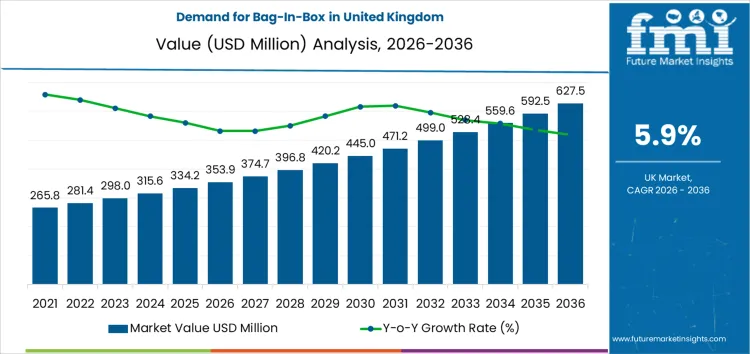
What is the Growth Forecast for Bag-In-Box in United Kingdom through 2036?
The growth forecast for bag-in-box packaging in the United Kingdom through 2036 indicates a consistent upward trend. This growth is expected to be driven by continued advancements in packaging technologies and the increasing demand for sustainable, efficient solutions in sectors like beverages, dairy, and juices. Key drivers include a shift towards bulk packaging for both commercial and consumer applications, with businesses seeking to reduce packaging costs and minimize waste.
As industries explore eco-friendlier alternatives to plastic and glass, Bag-In-Box packaging is poised to see increasing adoption. The continued innovation in material technology, which enhances product protection and extends shelf life, is expected to support this growth. Moreover, the rising focus on reducing transportation and storage costs will further boost the demand for Bag-In-Box solutions.
Key Takeaways for Demand for Bag-In-Box in United Kingdom
| Metric | Value |
|---|---|
| Industry Sales Value (2026) | USD 353.9 million |
| Industry Forecast Value (2036) | USD 627.5 million |
| Industry Forecast CAGR (2026 to 2036) | 5.9% |
Why is Demand for Bag-In-Box in United Kingdom Growing?
Demand for bag-in-box packaging in the United Kingdom has grown significantly due to its efficiency in packaging liquids and bulk products. Initially, this packaging format was largely used for beverages like wine, offering benefits such as longer shelf life after opening and ease of transport. Over time, its application has expanded into other sectors, including juices and liquid foods. This increase in demand can be attributed to its cost-effectiveness and the need for packaging that saves space, reduces waste, and simplifies handling. The growth of e-commerce and the shift toward sustainable packaging options have also contributed to the rising adoption of Bag-In-Box in various industries, aligning with consumer preferences for environmentally friendly solutions.
Looking ahead, the demand for bag-in-box packaging in the United Kingdom is expected to continue growing, with increasing usage in the food and beverage sector, especially in ready-to-drink beverages. The format’s lightweight and space-efficient properties make it an attractive option for both manufacturers and consumers. Additionally, as regulations around single-use plastic packaging become stricter, Bag-In-Box presents an appealing alternative due to its reduced environmental impact. The trend toward more sustainable and cost-effective packaging solutions is likely to drive further growth, particularly as industries seek packaging formats that support efficient logistics and reduce waste in line with environmental goals.
What Are the Key Segments in the Demand for Bag In Box in the United Kingdom?
Demand for Bag In Box in the United Kingdom is shaped by industry use and product type. The analysis focuses on two segments, end use industry and product type, with beverages holding a 36 percent share in end use and flexible bag capturing a 60 percent share in product type. Regional activity is concentrated across England, Scotland, Wales, and Northern Ireland. This overview sets the stage for a deeper discussion of how each segment influences total demand.
What Is the End Use Industry Segment of Demand for Bag In Box in the United Kingdom?
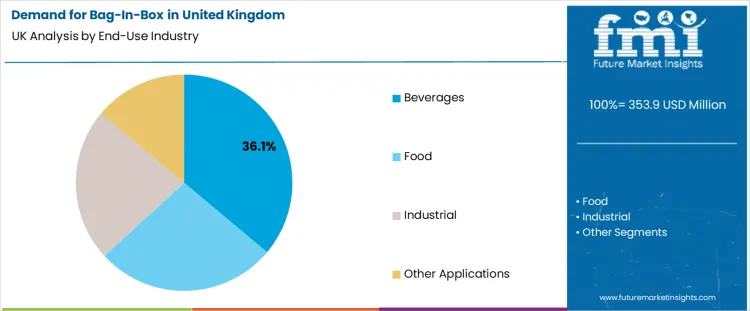
The end use industry segment for Bag In Box in the United Kingdom shows how different sectors drive demand. Beverages hold a leading 36 percent share of total end use. Beverage producers prefer Bag In Box for liquid storage and transport. The format supports bulk dispensing in retail and food service supply chains. Retailers and wholesalers in larger English cities use Bag In Box packaging to reduce handling and speed inventory turnover. Soft drink and wine distributors within Scotland and Wales rely on this packaging to maintain product stability over longer supply routes. Food end use follows beverages but has a lower share in the segment. Food sector companies deploy aseptic or sterile lined bags to extend freshness for sauces, dressings, and liquid ingredients.
Demand in Northern Ireland arises from meat processors and dairy processors that require reliable, sealed packaging to meet storage standards. Industrial applications use multi layer barrier bags where mechanical protection and resistance to dust or chemical exposure matter. Specialty uses and pre formed liners fall under a residual category with limited participation compared to beverages and food. Distribution patterns show volumes move from manufacturing hubs to regional distribution centers spanning the United Kingdom. Investments in filling equipment also influence which end use sectors expand their Bag In Box programs. Producers that install high speed fillers tend to increase purchases of flexible Bag In Box solutions. End use decisions hinge on cost control, product integrity, and the ability to serve broad geography with minimal returns.
What Is the Product Type Segment of Demand for Bag In Box in the United Kingdom?
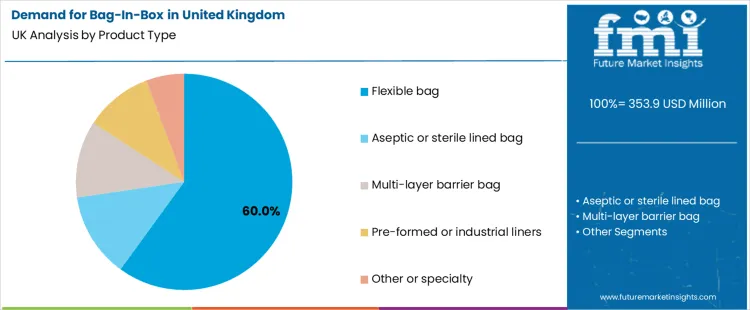
The product type segment for Bag In Box demand in the United Kingdom reflects preferences among packaging formats. Flexible bag holds the primary share at 60 percent. Flexible bag solutions are popular because they adjust to the volume and shape required by beverage and food producers. Beverage companies favor flexible bags for wine and juice products. The pliant nature reduces material use and shipping weight compared to rigid alternatives. UK producers in the Midlands and southern England adopt flexible bags to support regional distribution across retail and horeca channels. Flexible bags also integrate with automated filling lines, which reduces labor demands at production sites.
The remaining 40 percent of product type demand divides across aseptic or sterile lined bags, multi layer barrier bags, pre formed liners, and specialty options. Aseptic bags are used when extended shelf life is critical. Food processors use sterile lined bags in operations that require low microbial risk. Multi layer barrier bags serve industrial needs where oxygen and moisture barriers preserve product integrity. Pre formed liners meet niche needs in certain industrial and food applications where standard formats are inefficient. Specialty bags address unique requirements such as heavy duty use or non standard volume. Across all the United Kingdom regions, flexible bag dominance correlates with overall cost efficiency and broad compatibility with production equipment. Producers adjust usage based on product characteristics, regulatory requirements, and customer expectations for handling and performance. Choices in product type reflect a balance of packaging cost, performance characteristics, and downstream operational needs in distribution and retail placement.
What are the Key Dynamics in the Demand for Bag-In-Box in the United Kingdom?
The demand for bag-in-box packaging in the United Kingdom is expanding, driven by changing consumer preferences and packaging innovation. Increasing interest in sustainable and cost-effective packaging solutions has made this format more popular, particularly in the food and beverage sector. The market is experiencing growth as consumers demand longer shelf life and convenience, with bag-in-box packaging providing both. The wine industry is a major driver, with sales expected to rise, contributing to significant market growth by 2036. Logistics efficiency and sustainability considerations further enhance market prospects.
What are the Key Drivers for the Bag-In-Box Market in the United Kingdom?
Several factors are driving the growth of the bag-in-box packaging market in the United Kingdom. Consumer demand for convenience, sustainability, and value is leading to increased adoption of this format, particularly in beverages like wine. Additionally, the need for packaging that prolongs product freshness has accelerated the use of bag-in-box containers. Logistics optimization, reduced material usage, and the recyclability of this packaging type further support its popularity. Companies in the food and beverage sector are adopting bag-in-box solutions to meet sustainability goals and consumer expectations for functional, eco-friendly packaging.
What are the Restraints for the Bag-In-Box Market in the United Kingdom?
Despite its growth, the bag-in-box market in the United Kingdom faces several challenges. The initial cost of setting up production for this packaging format can be prohibitive for some businesses. Changing regulations surrounding environmental standards also increase compliance costs. Additionally, while bag-in-box packaging is efficient, it may not be suitable for all products, limiting its application in certain segments. The competition from alternative packaging solutions, including rigid containers and glass, poses a challenge to market expansion. Lastly, consumer education on the benefits of bag-in-box packaging remains an ongoing hurdle.
What are the Key Trends in the Bag-In-Box Market in the United Kingdom?
Key trends in the UK’s bag-in-box packaging market include a shift towards sustainability, with an increasing preference for recyclable materials. The wine sector is seeing heightened demand for bag-in-box packaging, driven by both value-conscious and environmentally-minded consumers. Digital transformation is also influencing packaging design, with smart technology being integrated into packaging for enhanced traceability and efficiency. Retailers and manufacturers are prioritizing eco-friendly solutions, responding to both consumer preferences and stricter environmental regulations. The increasing role of e-commerce in product distribution further contributes to the growth of this packaging format.
What is the Country-Wise Demand for Bag-In-Box in the United Kingdom?
The country-wise demand for bag-in-box packaging in the United Kingdom demonstrates distinct growth trends across different regions. England leads the market, benefiting from widespread adoption in the retail and beverage sectors, where eco-friendly and cost-effective solutions are increasingly favored. Scotland, Wales, and Northern Ireland also exhibit growth in demand, though at varying paces. The shift towards sustainability, paired with industry efforts to reduce packaging waste, is influencing market expansion. While England remains the dominant region, all areas show promise for continued growth driven by eco-conscious consumer preferences and evolving packaging standards.
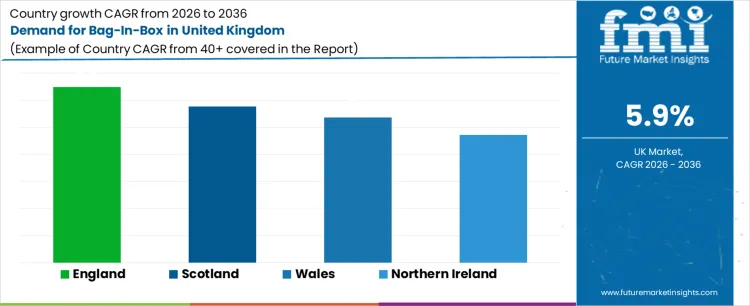
| Country | CAGR (2026 to 2036) |
|---|---|
| England | 6.5% |
| Scotland | 5.8% |
| Wales | 5.4% |
| Northern Ireland | 4.7% |
What Drives the Demand for Bag-In-Box in England?
The demand for bag-in-box in England is projected to grow at a CAGR of 6.5% through 2036. The market's robust growth is fueled by the widespread adoption of sustainable packaging in the beverage and retail sectors. Bag-in-box is seen as an environmentally friendly and cost-efficient alternative, particularly in the wine and juice industries. Consumer demand for eco-conscious packaging and the growing regulatory push for greener solutions are major contributors. As sustainability continues to drive packaging choices, England's bag-in-box market is expected to maintain a strong growth trajectory.
How is the Bag-In-Box Market Performing in Scotland?
Scotland’s demand for bag-in-box packaging is on the rise, projected to grow at a CAGR of 5.8% from 2026 to 2036. This growth is largely driven by the beverage sector, where the demand for sustainable packaging solutions is increasing. As Scottish consumers become more environmentally conscious, businesses are responding by adopting packaging alternatives with a lower environmental impact. While the market share remains smaller compared to England, Scotland is steadily moving towards eco-friendlier packaging solutions. This shift is expected to continue influencing the market’s growth in the coming years.
What are the Growth Drivers for Bag-In-Box in Wales?
In Wales, the demand for bag-in-box is increasing, with a forecasted CAGR of 5.4% through 2036. The region's adoption of sustainable packaging solutions is progressing, particularly in the food and beverage industries. Consumer preferences for cost-effective and environmentally responsible packaging have led to the gradual growth of bag-in-box adoption. Despite a smaller market size compared to England and Scotland, Wales is seeing positive movement towards packaging solutions that align with sustainability goals. This growing awareness of environmental issues is expected to continue fueling the demand for bag-in-box packaging in the region.
What is the Outlook for Bag-In-Box Demand in Northern Ireland?
Northern Ireland is witnessing a steady rise in bag-in-box demand, albeit with a smaller market share compared to other parts of the United Kingdom. With a CAGR of 4.7% expected through 2036, the demand is primarily driven by the beverage industry, particularly for wines and juices. Although the uptake of bag-in-box packaging in Northern Ireland has been slower, growing consumer preference for eco-friendly packaging solutions is expected to propel further adoption. As businesses increasingly align with sustainability trends, Northern Ireland’s bag-in-box market is likely to see gradual growth over the forecast period.
What is the Competitive Landscape for Bag In Box Demand in the United Kingdom?
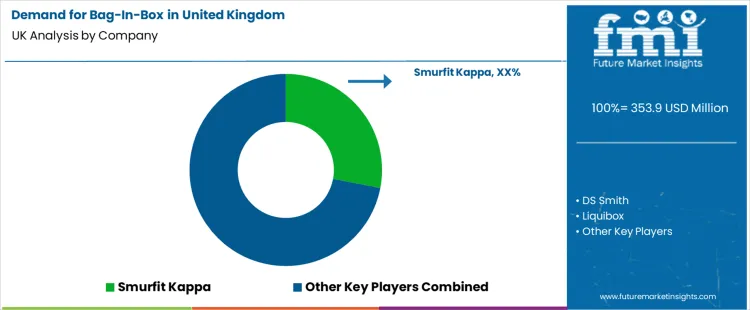
Demand for Bag In Box in the United Kingdom is shaped by a mix of packaging producers competing on service, supply chain reach, and product specification. Smurfit Kappa holds a leading role through extensive packaging networks and tailored solutions for food and beverage supply chains. Production capacity and distribution footprint support widespread availability. DS Smith responds with a focus on integrated packaging systems, aligning Bag In Box offerings with broader folding carton and corrugated lines. Customer engagement programs emphasize technical support and design consultation.
Liquibox positions itself as a specialist supplier. Its offerings are highlighted in product brochures that describe valve options, liner materials, and fill compatibility. This focus on specification detail aims to meet stringent quality requirements from beverage and liquid food manufacturers. Scholle IPN competes with a similar detailed approach, stressing liner integrity and closure system performance in its brochures. Technical literature outlines testing protocols and compliance with hygiene standards required by large contract fillers.
Mondi’s strategy in the United Kingdom highlights flexible packaging combinations that pair Bag In Box with ancillary materials such as corrugated cases. Brochures from Mondi describe material grades, environmental attributes, and compatibility with automated packing systems. Competitive activity among these firms influences demand patterns as buyers assess cost per use, supply reliability, and service responsiveness. Negotiations around contract terms and volume commitments occur frequently, reflecting pressure on lead times and inventory planning.
Demand forecasts from major manufacturers factor in seasonal peaks, particularly in beverage segments that rely on Bag In Box for concentrate distribution. Each company’s presence is reinforced through sales engineering support, with technical briefs and comparison charts used to guide selection. Brochure content acts as a reference during procurement cycles, underscoring specifications and supply terms that appeal to procurement professionals across sectors.
Key Players of the Demand for Bag-In-Box in United Kingdom
- Smurfit Kappa
- DS Smith
- Liquibox
- Scholle IPN
- Mondi
Scope of the Report
| Items | Values |
|---|---|
| Quantitative Units (2026) | USD Million |
| End-Use Industry | Beverages, Food, Industrial, Other Applications, Other or Specialty |
| Product Type | Flexible Bag, Aseptic or Sterile Lined Bag, Multi-Layer Barrier Bag, Pre-formed or Industrial Liners |
| Companies | Smurfit Kappa, DS Smith, Liquibox, Scholle IPN, Mondi |
| Regions Covered | United Kingdom |
| Countries Covered | England, Scotland, Wales, Northern Ireland |
| Additional Attributes | Dollar by sales by end-use industry, product type, and region. Includes market trends towards sustainability, cost-effectiveness, and the role of Bag-In-Box packaging in the beverage, food, and industrial sectors. |
Demand for Bag-In-Box in United Kingdom
End-Use Industry:
- Beverages
- Food
- Industrial
- Other Applications
Product Type:
- Flexible bag
- Aseptic or sterile lined bag
- Multi-layer barrier bag
- Pre-formed or industrial liners
- Other or specialty
Countries:
- England
- Scotland
- Wales
- Northern Ireland
Bibliography
- Smurfit Kappa. (2023). Comprehensive packaging solutions: Smurfit Kappa's leadership in the UK’s Bag-In-Box market.
- DS Smith. (2023). Optimizing packaging efficiency: DS Smith’s role in UK’s Bag-In-Box market expansion.
- Liquibox. (2023). Specialist packaging for liquids: Liquibox’s Bag-In-Box offerings for beverage and liquid food sectors.
- Scholle IPN. (2023). Innovation in liquid packaging: Scholle IPN’s contributions to Bag-In-Box market growth in the UK.
- Mondi. (2023). Flexible packaging solutions: Mondi’s role in the UK Bag-In-Box market growth and sustainability efforts.
Frequently Asked Questions
How big is the demand for bag-in-box in United Kingdom in 2026?
The demand for bag-in-box in United Kingdom is estimated to be valued at USD 353.9 million in 2026.
What will be the size of bag-in-box in United Kingdom in 2036?
The market size for the bag-in-box in United Kingdom is projected to reach USD 627.5 million by 2036.
How much will be the demand for bag-in-box in United Kingdom growth between 2026 and 2036?
The demand for bag-in-box in United Kingdom is expected to grow at a 5.9% CAGR between 2026 and 2036.
What are the key product types in the bag-in-box in United Kingdom?
The key product types in bag-in-box in United Kingdom are beverages, food, industrial and other applications.
Which product type segment is expected to contribute significant share in the bag-in-box in United Kingdom in 2026?
In terms of product type, flexible bag segment is expected to command 60.0% share in the bag-in-box in United Kingdom in 2026.
Preview the report firsthand - request a free sample
Get SampleGet the brochure for pricing and purchase details.
Get PDFTable of Content
- Executive Summary
- UK Market Outlook
- Demand-side Trends
- Supply-side Trends
- Technology Roadmap Analysis
- Analysis and Recommendations
- Market Overview
- Market Coverage / Taxonomy
- Market Definition / Scope / Limitations
- Market Background
- Market Dynamics
- Drivers
- Restraints
- Opportunity
- Trends
- Scenario Forecast
- Demand in Optimistic Scenario
- Demand in Likely Scenario
- Demand in Conservative Scenario
- Opportunity Map Analysis
- Product Life Cycle Analysis
- Supply Chain Analysis
- Investment Feasibility Matrix
- Value Chain Analysis
- PESTLE and Porter’s Analysis
- Regulatory Landscape
- Regional Parent Market Outlook
- Production and Consumption Statistics
- Import and Export Statistics
- Market Dynamics
- UK Market Analysis 2021 to 2025 and Forecast, 2026 to 2036
- Historical Market Size Value (USD Million) Analysis, 2021 to 2025
- Current and Future Market Size Value (USD Million) Projections, 2026 to 2036
- Y-o-Y Growth Trend Analysis
- Absolute $ Opportunity Analysis
- UK Market Pricing Analysis 2021 to 2025 and Forecast 2026 to 2036
- UK Market Analysis 2021 to 2025 and Forecast 2026 to 2036, By End-Use Industry
- Introduction / Key Findings
- Historical Market Size Value (USD Million) Analysis By End-Use Industry , 2021 to 2025
- Current and Future Market Size Value (USD Million) Analysis and Forecast By End-Use Industry , 2026 to 2036
- Beverages
- Food
- Industrial
- Other Applications
- Beverages
- Y-o-Y Growth Trend Analysis By End-Use Industry , 2021 to 2025
- Absolute $ Opportunity Analysis By End-Use Industry , 2026 to 2036
- UK Market Analysis 2021 to 2025 and Forecast 2026 to 2036, By Product Type
- Introduction / Key Findings
- Historical Market Size Value (USD Million) Analysis By Product Type, 2021 to 2025
- Current and Future Market Size Value (USD Million) Analysis and Forecast By Product Type, 2026 to 2036
- Flexible bag
- Aseptic or sterile lined bag
- Multi-layer barrier bag
- Pre-formed or industrial liners
- Other or specialty
- Flexible bag
- Y-o-Y Growth Trend Analysis By Product Type, 2021 to 2025
- Absolute $ Opportunity Analysis By Product Type, 2026 to 2036
- Market Structure Analysis
- Competition Dashboard
- Competition Benchmarking
- Market Share Analysis of Top Players
- By Regional
- By End-Use Industry
- By Product Type
- Competition Analysis
- Competition Deep Dive
- Smurfit Kappa
- Overview
- Product Portfolio
- Profitability by Market Segments (Product/Age /Sales Channel/Region)
- Sales Footprint
- Strategy Overview
- Marketing Strategy
- Product Strategy
- Channel Strategy
- DS Smith
- Liquibox
- Scholle IPN
- Mondi
- Smurfit Kappa
- Competition Deep Dive
- Assumptions & Acronyms Used
- Research Methodology


