

- Industry Size (2026)
- USD 757.6 Mn
- Forecast (2036)
- USD 1099 Mn
- CAGR (2026 to 2036)
- 3.8%
Demand for Computer Keyboard in United Kingdom Forecast and Outlook 2026 to 2036
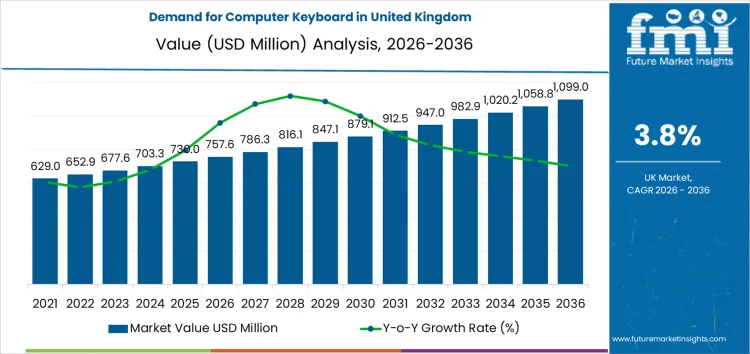
The computer keyboard market in the United Kingdom is projected to reach USD 1,099 million by 2036, growing at a CAGR of 3.8% from USD 757.6 million in 2026. Dominant players in the market defend pricing power by leveraging economies of scale, strong brand recognition, and long-term contracts with distributors. These companies maintain entry barriers through established relationships with key suppliers and significant R&D investments, which allow for continuous product innovation.
New entrants face significant challenges in securing market share without considerable capital investment. Despite this, market fragmentation persists due to the variety of consumer preferences, regional needs, and product niches. Smaller players continue to find opportunities by targeting specific market segments or offering specialized features at competitive prices. Over time, fragmentation could narrow, especially if larger companies pursue aggressive acquisition strategies or expand product offerings to capture a broader customer base.
Quick Stats for the Demand for Computer Keyboard in United Kingdom:
- Computer Keyboard in United Kingdom Value (2026): USD 757.6 million
- Computer Keyboard in United Kingdom Forecast Value (2036): USD 1,099 million
- Computer Keyboard in United Kingdom Global Forecast CAGR (2026 to 2036): 3.8%
- Computer Keyboard in United Kingdom Leading Segment: Standard Keyboards (50% share)
- Key Growth Regions of Computer Keyboard in United Kingdom: England
- Top Players of Computer Keyboard in United Kingdom: Logitech, Microsoft, LENOVO, Chicony Electronics Co., Ltd, Dell Inc.
What is the Growth Forecast for Computer Keyboards in United Kingdom through 2036?
The demand for computer keyboards in the United Kingdom is projected to grow steadily from 2026 to 2031. The market value is expected to increase from USD 757.6 million in 2026 to USD 912.5 million by 2031, reflecting a compound annual growth rate (CAGR) of 3.8%. This growth is driven by the continued integration of technology in both professional and personal settings, with increased demand for high-performance, ergonomic, and customizable keyboards. The shift towards remote work, gaming, and online education continues to support this trend.
The market is expected to be influenced by several key factors, including the growing preference for wireless and compact designs, advancements in ergonomic features, and the rising popularity of mechanical and gaming keyboards. These elements are likely to play a significant role in shaping the future demand for computer keyboards in the UK, with both businesses and consumers prioritizing functionality and user comfort.
Key Takeaways for Demand for Computer Keyboard in United Kingdom
| Metric | Value |
|---|---|
| Industry Sales Value (2026) | USD 757.6 million |
| Industry Forecast Value (2036) | USD 1,099 million |
| Industry Forecast CAGR (2026 to 2036) | 3.8% |
Why is Demand for Computer Keyboards in United Kingdom Growing?
Demand for computer keyboards in the United Kingdom has increased steadily, driven by the growing adoption of personal computing and technology. Historically, keyboards were basic peripherals that accompanied desktop computers, with growth tied to overall PC and laptop sales. In recent years, the demand for computer keyboards has expanded due to the rise in remote work, hybrid office setups, and the increasing use of computers in educational and professional environments. This shift has led to an increase in the variety of keyboards, including ergonomic and wireless models, as users seek comfort and flexibility for extended use. The gaming segment has also contributed to this growth, with demand for specialized keyboards that offer high performance and durability, catering to the expanding gaming community in the UK.
Looking ahead, the demand for computer keyboards in the United Kingdom is expected to continue growing. The rise of digital entertainment, particularly esports, will drive demand for high-quality mechanical and gaming keyboards. Businesses will continue to replace older models and equip flexible workspaces with advanced keyboard solutions. Additionally, as digital literacy continues to rise and dependence on computers remains strong across various sectors, the need for reliable and diverse keyboard types is likely to persist. Wireless, ergonomic, and gaming keyboards are expected to be key drivers of growth, as consumers and businesses alike seek more specialized and comfortable options.
What Are the Key Segments in the Demand for Computer Keyboards in the United Kingdom?
Demand for computer keyboards in the United Kingdom is shaped by type and end user. Standard keyboards hold the largest share in the type segment at 50%, while individuals or consumers dominate the end user segment with 42.6%. Gaming keyboards, ergonomic keyboards, and flexible keyboards also contribute significantly, each serving specialized needs. Key regions in the United Kingdom, such as urban centers and tech hubs, drive these trends, with varying preferences based on use cases and technological advancements.
What Is the Type Segment of Demand for Computer Keyboards in the United Kingdom?
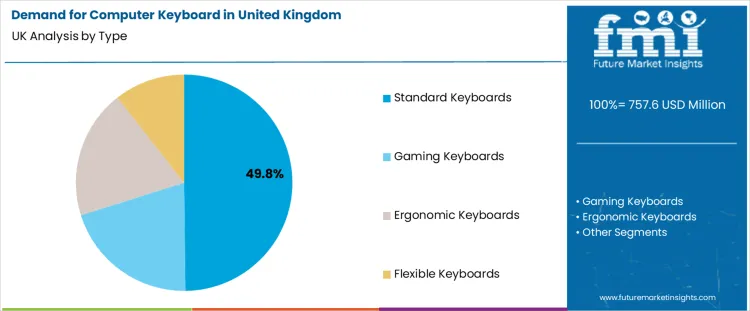
The type segment for computer keyboards in the United Kingdom is primarily led by standard keyboards, which account for 50% of the market share. Standard keyboards continue to be the most widely used option due to their affordability, simplicity, and broad compatibility with most computer systems. They are commonly used by individuals and enterprises for everyday computing needs. Gaming keyboards follow as a significant segment, driven by the increasing popularity of gaming in the United Kingdom.
These keyboards often feature enhanced switches, customizable keys, and backlighting to meet the demands of serious gamers. As gaming culture expands in regions like London and Manchester, demand for specialized keyboards designed to provide precision and comfort during extended play sessions continues to rise. Ergonomic keyboards, which cater to users seeking to reduce strain during long typing sessions, are also seeing growing demand, particularly among professionals and those working in office settings. Flexible keyboards, which are portable and space-saving, serve niche markets such as those requiring keyboards for travel or compact setups. Despite their smaller market share, they are gaining popularity for specific use cases. The growth of these specialized types is influenced by advancements in technology and user preferences for customized, comfort-focused, or performance-oriented features. As users' needs become more diverse, manufacturers are adapting their offerings to accommodate specific requirements in gaming, productivity, and portability.
What Is the End User Segment of Demand for Computer Keyboards in the United Kingdom?
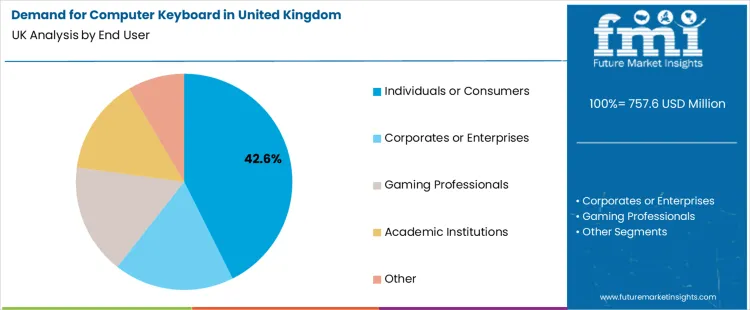
The end user segment for computer keyboards in the United Kingdom is led by individuals or consumers, who account for 42.6% of the market. The demand among individual consumers is primarily driven by the need for everyday computing, ranging from personal use to home office setups. As work-from-home trends and personal computing demand rise, so does the purchase of standard and ergonomic keyboards. Individuals tend to prioritize ease of use and affordability, which makes standard keyboards a popular choice. Corporate or enterprise demand follows, with companies requiring reliable and cost-effective solutions for office environments.
Ergonomic keyboards are particularly favored in these settings, where long hours of typing can lead to strain. Demand is also significant in larger cities, where companies are focusing on employee comfort and productivity. Gaming professionals represent a growing niche within the end user segment, especially as the gaming industry continues to expand in the United Kingdom. Gaming professionals prefer specialized gaming keyboards with customizable keys, mechanical switches, and enhanced durability to improve performance. Academic institutions also represent a noteworthy end user, as schools and universities increasingly equip students and staff with technology for both learning and research purposes. While other end users represent a small portion of the market, the diversity of demands across these sectors demonstrates how different user requirements drive the growth of various keyboard types. These preferences continue to shape the demand for keyboards in the United Kingdom, with factors like ergonomics, performance, and customization being key influencers of choice.
What is Key Dynamics of the Demand for Computer Keyboards in the United Kingdom?
Demand for computer keyboards in the United Kingdom is influenced by a combination of consumer, business, and educational needs. Personal computing remains a staple of everyday work and leisure, with keyboards seen as essential peripherals for desktops and laptops. The growth of hybrid work and remote learning continues to support sales of external keyboards for home offices. Gaming also contributes to demand, as dedicated keyboards are integral to performance gaming setups. Overall, the UK market shows steady demand, shaped by replacement cycles, technological upgrades, and evolving user preferences for comfort, functionality, and durability.
What are the Key Drivers for Computer Keyboard Demand in the United Kingdom?
Several factors drive demand for computer keyboards in the United Kingdom. The persistence of remote and hybrid work arrangements has encouraged individuals and businesses to invest in ergonomic and productivity focused peripherals. Growing interest in gaming has expanded demand for keyboards with advanced features such as mechanical switches, programmable keys, and customizable lighting. Education sector adoption of digital learning tools supports continued purchases across schools and universities. Consumer preference for enhanced typing comfort, wireless connectivity, and compatibility with multiple devices also influences buying behaviour. Together, these factors uphold sustained market activity for computer keyboards.
What are the Restraints on Computer Keyboard Demand in the United Kingdom?
The UK market for computer keyboards faces several restraints. Market saturation of basic keyboard models limits growth potential for volume sales, especially in mature segments. Price sensitivity among consumers may reduce demand for higher end models with advanced features. Supply chain disruptions, including periodic component shortages and logistics constraints, can affect product availability and pricing. Rapid technological changes may shorten product lifecycles, discouraging frequent replacement purchases. Additionally, integrated keyboards in laptops and tablets reduce the need for external keyboards for some users, tempering overall demand in certain market segments.
What are the Key Trends in Computer Keyboard Demand in the United Kingdom?
Key trends in the United Kingdom’s computer keyboard market include a shift toward ergonomic design, with increasing demand for split, adjustable, and padded models that aim to reduce strain during prolonged use. Wireless connectivity options, such as Bluetooth and RF dongles, remain popular as users prioritise clutter free setups. Customisation features, including programmable keys and RGB lighting, are particularly appealing within gaming communities. Mechanical keyboards are gaining traction beyond gaming into general productivity use due to perceived durability and tactile feedback. Sustainability considerations are also emerging, with a growing interest in keyboards built using recycled or eco friendly materials.
What is the Country-Wise Demand for Computer Keyboards in the United Kingdom?
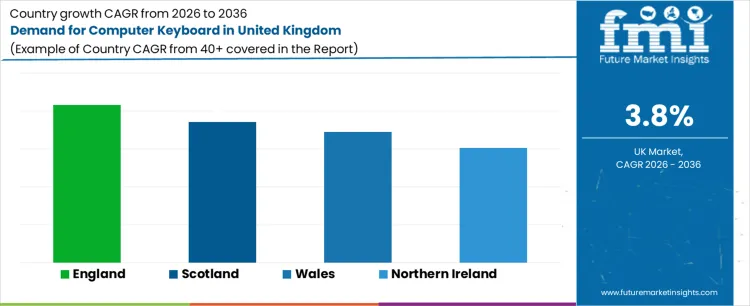
The country-wise demand for computer keyboards in the United Kingdom shows varied growth across its regions. England leads the market, driven by the expanding tech sector, including businesses and consumers' increasing reliance on computers for work and entertainment. Scotland, Wales, and Northern Ireland are also witnessing steady demand, although the pace is slower compared to England. The growing demand for both standard and specialized keyboards, including those used for gaming and professional use, is influencing the market across all regions. While England maintains dominance, the rise in remote working, gaming, and digital education is expected to stimulate further growth in all regions, albeit at different rates.
| Country | CAGR (2026 to 2036) |
|---|---|
| England | 4.2% |
| Scotland | 3.7% |
| Wales | 3.4% |
| Northern Ireland | 3.0% |
What is Driving the Demand for Computer Keyboards in England?
The demand for computer keyboards in England is projected to grow at a CAGR of 4.2% from 2026 to 2036. England's large and diverse market is primarily driven by the widespread use of computers in both professional and personal settings. The continued growth of remote working and online education, accelerated by the pandemic, has led to a sustained demand for computer peripherals such as keyboards. Additionally, the rising popularity of gaming and e-sports has further bolstered the demand for specialized keyboards. Consumers are increasingly seeking ergonomic designs, improved functionality, and customization features. As digital literacy and reliance on technology continue to grow, England’s market for computer keyboards is expected to remain strong. The market is also influenced by ongoing innovations in keyboard technology, such as wireless, mechanical, and gaming keyboards, which cater to both everyday users and tech enthusiasts. These factors are expected to maintain a steady upward trajectory for the demand in England over the next decade.
What is Fueling the Demand for Computer Keyboards in Scotland?
In Scotland, the demand for computer keyboards is expected to grow at a CAGR of 3.7% from 2026 to 2036. The growing adoption of digital technologies in both personal and professional spheres is a key driver for the demand in this region. With more businesses shifting to hybrid or remote working models, the need for reliable computer peripherals, including keyboards, has increased. The gaming industry in Scotland is also playing a role in driving demand for specialized keyboards, as more consumers invest in high-performance gaming setups. Furthermore, educational institutions are increasingly adopting digital learning tools, contributing to the growth of computer keyboard sales. As in other parts of the UK, the demand for ergonomic and customizable keyboards is expected to grow, driven by consumer interest in enhancing comfort and functionality. While the market size remains smaller than in England, the trend towards digitalization and remote working is expected to sustain demand in Scotland in the coming years.
What Are the Growth Drivers for Computer Keyboards in Wales?
The demand for computer keyboards in Wales is projected to grow at a CAGR of 3.4% from 2026 to 2036. As in other regions, the rise of remote work, digital learning, and online entertainment is driving demand for computer peripherals, including keyboards. The gaming market in Wales is seeing steady growth, with an increasing number of consumers seeking high-quality, customizable keyboards to enhance their gaming experience. Similarly, the expanding digital education sector is creating a need for reliable and ergonomic keyboards. Welsh consumers are also showing a growing preference for wireless and mechanical keyboards, which offer enhanced functionality and comfort. The increasing importance of ergonomics in the workplace and at home is prompting more people to invest in keyboards designed to improve comfort during prolonged use. While Wales represents a smaller market compared to England, the increasing digitization and demand for specialized keyboards are expected to contribute to consistent growth in the region over the next decade.
What is the Outlook for Computer Keyboard Demand in Northern Ireland?
In Northern Ireland, the demand for computer keyboards is expected to grow at a CAGR of 3.0% through 2036. The market is relatively smaller compared to other regions of the United Kingdom, but the demand for computer peripherals, including keyboards, is rising steadily. Factors such as the growth in remote working, digital education, and the gaming industry are contributing to this trend. As more businesses and educational institutions in Northern Ireland adopt digital tools, the need for functional and ergonomic computer peripherals continues to rise. The increasing interest in gaming, particularly among younger demographics, is also driving demand for specialized keyboards. While Northern Ireland’s adoption of computer keyboards has been slower than in other parts of the UK, the trend toward digitalization and enhanced comfort features is expected to support steady market growth. As consumer preferences shift towards higher-quality and customizable keyboards, Northern Ireland’s demand for these products is likely to rise in the coming years.
What is the Competitive Landscape for Demand for Computer Keyboards in the United Kingdom?
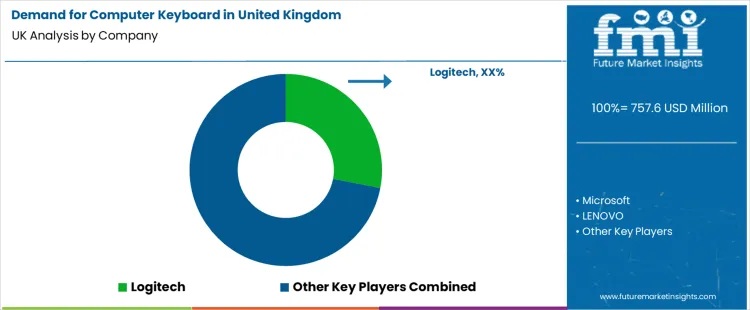
Demand for computer keyboards in the United Kingdom is shaped by offerings from established technology manufacturers and component specialists. Logitech is positioned as a leading supplier, with demand supported by broad portfolio coverage of wired, wireless, and ergonomic models. Product brochures are used by buyers to compare key features, switch types, connectivity options, and compatibility notes. Microsoft’s competitive strategy is evident through documentation that outlines tailored features for productivity, integrated shortcut keys, and accessibility functions. LENOVO participates with keyboards bundled with its laptop lines and as standalone peripherals. Technical sheets from LENOVO describe form factor details, key travel metrics, and durability test results. CHICONY GLOBAL INC. contributes through contracts with original equipment manufacturers and through discrete peripheral lines. Suppliers and distributors reference CHICONY brochures that list switch specifications, interface standards, and certification data. Dell Inc. competes with keyboards that are positioned alongside its desktop and workstation offerings, with product briefs highlighting build quality assessments, warranty terms, and configuration options.
Procurement decisions across corporate, education, and consumer channels in the United Kingdom draw on documented specifications and catalogue data from these companies. Demand is influenced by enterprise standardisation policies and refresh cycles that require documented compatibility with existing systems. Retail buyers and purchasing teams examine brochures for measured performance values, supported drivers, and supported operating systems. Lead time expectations and after sales support terms are communicated through official documentation. Price points are compared alongside documented feature sets and compliance notes. Supply chain reliability is assessed with reference to production capacity and distribution footprint described in supplier materials. Orders are issued against formal tenders where documented product attributes and service terms are recorded. Technical support contacts and update bulletins are maintained according to the documentation provided by each manufacturer. Demand patterns respond to broader shifts in remote work adoption, hardware refresh programs, and procurement guidelines that prioritise documented quality metrics over subjective assessments.
Key Players of the Demand for Computer Keyboard in United Kingdom
- Logitech
- Microsoft
- LENOVO
- CHICONY GLOBAL INC.
- Dell Inc.
Scope of the Report
| Items | Values |
|---|---|
| Quantitative Units (2026) | USD Million |
| Type | Standard Keyboard, Gaming Keyboards, Ergonomic Keyboards, Flexible Keyboards, Other |
| End User | Individuals or Consumers, Corporates or Enterprises, Gaming Professionals, Academic Institutions, Other |
| Connectivity Type | Wired Keyboards, Wireless Keyboards |
| Companies | Logitech, Microsoft, LENOVO, CHICONY GLOBAL INC., Dell Inc. |
| Regions Covered | United Kingdom |
| Countries Covered | England, Scotland, Wales, Northern Ireland |
| Additional Attributes | Dollar by sales by type, end user, connectivity type, and region. Includes market trends towards ergonomics, gaming performance, and the role of keyboards in enhancing productivity and gaming experiences. |
Key Segments of the Demand for Computer Keyboard in United Kingdom
Type:
- Standard Keyboards
- Gaming Keyboards
- Ergonomic Keyboards
- Flexible Keyboards
- Other
End User:
- Individuals or Consumers
- Corporates or Enterprises
- Gaming Professionals
- Academic Institutions
Connectivity Type:
- Wired Keyboards
- Wireless Keyboards
Countries:
- England
- Scotland
- Wales
- Northern Ireland
Bibliography
- Office for National Statistics. (2023). Homeworking trends in the UK: 2023 edition. ONS Analytical Report.
- UK Department for Science, Innovation & Technology. (2024). Digital Economy Outlook for the United Kingdom. UK Government Publications.
- Chartered Institute of Ergonomics & Human Factors. (2024). Ergonomic Hardware Use in UK Workplaces. CIEHF Annual Report.
- Logitech International S.A. (2024). Annual Report 2023–2024. Logitech Investor Relations.
- Microsoft Corporation. (2024). Surface & PC Accessories Market Insights 2024. Microsoft Hardware Division Publication.
Frequently Asked Questions
How big is the demand for computer keyboard in United Kingdom in 2026?
The demand for computer keyboard in United Kingdom is estimated to be valued at USD 757.6 million in 2026.
What will be the size of computer keyboard in United Kingdom in 2036?
The market size for the computer keyboard in United Kingdom is projected to reach USD 1,099.0 million by 2036.
How much will be the demand for computer keyboard in United Kingdom growth between 2026 and 2036?
The demand for computer keyboard in United Kingdom is expected to grow at a 3.8% CAGR between 2026 and 2036.
What are the key product types in the computer keyboard in United Kingdom?
The key product types in computer keyboard in United Kingdom are standard keyboards, gaming keyboards, ergonomic keyboards and flexible keyboards.
Which end user segment is expected to contribute significant share in the computer keyboard in United Kingdom in 2026?
In terms of end user, individuals or consumers segment is expected to command 42.6% share in the computer keyboard in United Kingdom in 2026.
Preview the report firsthand - request a free sample
Get SampleGet the brochure for pricing and purchase details.
Get PDFTable of Content
- Executive Summary
- UK Market Outlook
- Demand-side Trends
- Supply-side Trends
- Technology Roadmap Analysis
- Analysis and Recommendations
- Market Overview
- Market Coverage / Taxonomy
- Market Definition / Scope / Limitations
- Market Background
- Market Dynamics
- Drivers
- Restraints
- Opportunity
- Trends
- Scenario Forecast
- Demand in Optimistic Scenario
- Demand in Likely Scenario
- Demand in Conservative Scenario
- Opportunity Map Analysis
- Product Life Cycle Analysis
- Supply Chain Analysis
- Investment Feasibility Matrix
- Value Chain Analysis
- PESTLE and Porter’s Analysis
- Regulatory Landscape
- Regional Parent Market Outlook
- Production and Consumption Statistics
- Import and Export Statistics
- Market Dynamics
- UK Market Analysis 2021 to 2025 and Forecast, 2026 to 2036
- Historical Market Size Value (USD Million) Analysis, 2021 to 2025
- Current and Future Market Size Value (USD Million) Projections, 2026 to 2036
- Y-o-Y Growth Trend Analysis
- Absolute $ Opportunity Analysis
- UK Market Pricing Analysis 2021 to 2025 and Forecast 2026 to 2036
- UK Market Analysis 2021 to 2025 and Forecast 2026 to 2036, By Type
- Introduction / Key Findings
- Historical Market Size Value (USD Million) Analysis By Type , 2021 to 2025
- Current and Future Market Size Value (USD Million) Analysis and Forecast By Type , 2026 to 2036
- Standard Keyboards
- Gaming Keyboards
- Ergonomic Keyboards
- Flexible Keyboards
- Standard Keyboards
- Y-o-Y Growth Trend Analysis By Type , 2021 to 2025
- Absolute $ Opportunity Analysis By Type , 2026 to 2036
- UK Market Analysis 2021 to 2025 and Forecast 2026 to 2036, By End User
- Introduction / Key Findings
- Historical Market Size Value (USD Million) Analysis By End User, 2021 to 2025
- Current and Future Market Size Value (USD Million) Analysis and Forecast By End User, 2026 to 2036
- Individuals or Consumers
- Corporates or Enterprises
- Gaming Professionals
- Academic Institutions
- Other
- Individuals or Consumers
- Y-o-Y Growth Trend Analysis By End User, 2021 to 2025
- Absolute $ Opportunity Analysis By End User, 2026 to 2036
- UK Market Analysis 2021 to 2025 and Forecast 2026 to 2036, By Connectivity Type
- Introduction / Key Findings
- Historical Market Size Value (USD Million) Analysis By Connectivity Type, 2021 to 2025
- Current and Future Market Size Value (USD Million) Analysis and Forecast By Connectivity Type, 2026 to 2036
- Wired Keyboards
- Wireless Keyboards
- Wired Keyboards
- Y-o-Y Growth Trend Analysis By Connectivity Type, 2021 to 2025
- Absolute $ Opportunity Analysis By Connectivity Type, 2026 to 2036
- Market Structure Analysis
- Competition Dashboard
- Competition Benchmarking
- Market Share Analysis of Top Players
- By Regional
- By Type
- By End User
- By Connectivity Type
- Competition Analysis
- Competition Deep Dive
- Logitech
- Overview
- Product Portfolio
- Profitability by Market Segments (Product/Age /Sales Channel/Region)
- Sales Footprint
- Strategy Overview
- Marketing Strategy
- Product Strategy
- Channel Strategy
- Microsoft
- LENOVO
- CHICONY GLOBAL INC.
- Dell Inc.
- Logitech
- Competition Deep Dive
- Assumptions & Acronyms Used
- Research Methodology


