

- Industry Size (2026)
- USD 198.8 Mn
- Forecast (2036)
- USD 297.3 Mn
- CAGR (2026 to 2036)
- 4.1%
Preoperative Bathing Solutions Outlook in the UK 2026 to 2036
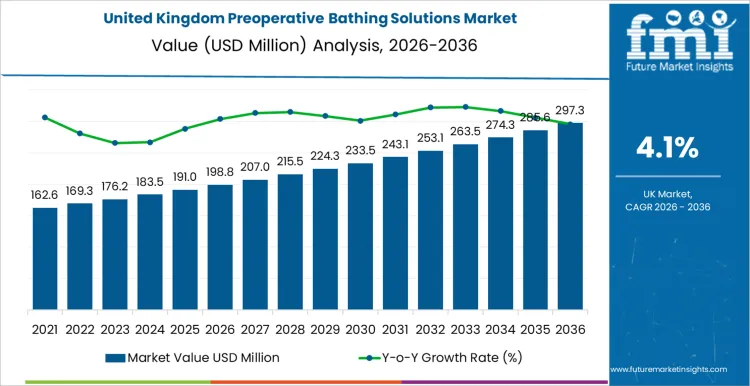
Demand for preoperative bathing solutions in the UK is projected at USD 198.8 million in 2026 and is expected to reach USD 297.3 million by 2036, expanding at a 4.1% CAGR. Demand is shaped by infection prevention planning, perioperative pathway discipline, and the operational need to reduce complications that extend length of stay and disrupt theatre schedules.
Pre-surgery cleansing is treated as a controllable input. Clinical teams focus on timing, coverage, and patient completion. Procurement teams focus on tolerance, ease of use, storage efficiency, and supply continuity across high-volume wards. Product formats that fit routine bathing behaviours gain adoption faster because they reduce confusion for patients and staff.
Quick Stats for Preoperative Bathing Solutions Demand in the UK
- Preoperative Bathing Solutions Valuation in the UK (2026): USD 198.8 million
- Preoperative Bathing Solutions Forecast Valuation in the UK (2036): USD 297.3 million
- Preoperative Bathing Solutions Forecast CAGR 2026 to 2036: 4.1%
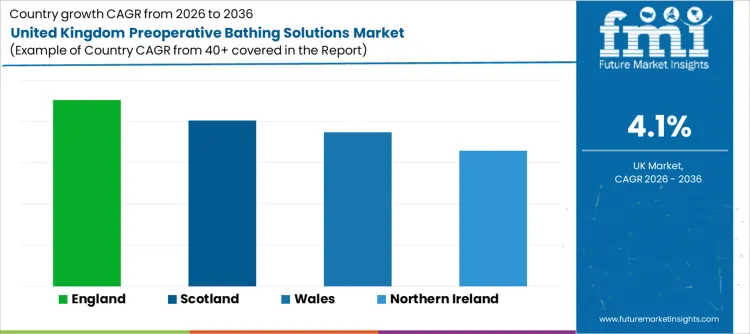
- Leading Regional Growth: England (4.5%)
- Leading Product Type: Bath Solutions/Liquid Soaps (53.5% share)
- Leading End User: Surgical Wards (62.9% share)
- Key Companies Profiled: 3M; Unilever PLC; Medline Industries, Inc.; BD (Becton, Dickinson and Company); Stryker
Preoperative Bathing Solutions Industry in the UK Key Takeaways
| Metric | Value |
|---|---|
| Industry Value (2026) | USD 198.8 million |
| Industry Forecast Value (2036) | USD 297.3 million |
| Forecast CAGR (2026 to 2036) | 4.1% |
Why is the UK Building Consistent Demand for Preoperative Bathing Solutions?
Hospital leaders prioritise repeatable steps that lower avoidable infection risk without adding heavy operating burden. Pre-surgery bathing fits this requirement because it can be standardised through patient instructions and ward routines. NICE guidance on surgical site infection prevention reinforces the role of preoperative measures within pathway design.
Patient adherence remains central. When cleansing steps are unclear, completion rates drop and staff must troubleshoot close to surgery time. Solutions that feel familiar on skin and come with clear usage directions improve completion. Wards also prefer products that can be applied quickly for patients with mobility limitations.
Surveillance and reporting keep surgical site infections visible at leadership level, supporting continuous improvement activity. As teams revisit perioperative protocols, cleansing products are re-evaluated for workflow fit and compliance support. Some providers align product selection with preoperative skin cleansing protocols and hospital infection control planning.
How is Preoperative Bathing Solutions Demand Segmented by Product Type and End User?
Segmentation reflects how providers manage readiness, staff time, and protocol compliance across elective and urgent surgical pathways.
Why do bath solutions and liquid soaps lead demand for standardised pre-surgery routines?
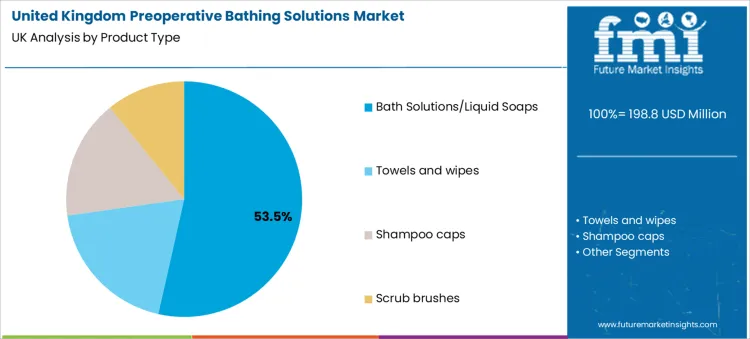
Bath solutions/liquid soaps account for a 53.5% share, making them the leading product type. Their strength is routine fit. Patients understand liquid cleansing and staff can reinforce instructions easily.
Liquid formats support full-body coverage, suit shower-based guidance, and align with ward-assisted bathing when needed. Their role is strengthened by predictable procurement and standardisation across surgical specialties.
How do towels, wipes, shampoo caps, and scrub brushes support bedside preparation and constrained bathing conditions?
Towels and wipes are used when shower access is limited, when mobility constraints require staff-led cleansing, or when rapid preparation is needed. Shampoo caps address hair cleansing needs at bedside in higher-dependency situations.
Scrub brushes are selected where protocols call for structured mechanical action and staff are trained to apply them consistently. These formats succeed when they reduce confusion, limit mess, and protect skin comfort. Product planning in this category often aligns with medical antiseptic use cases across care settings.
Why do surgical wards dominate end-user demand within UK surgical pathways?
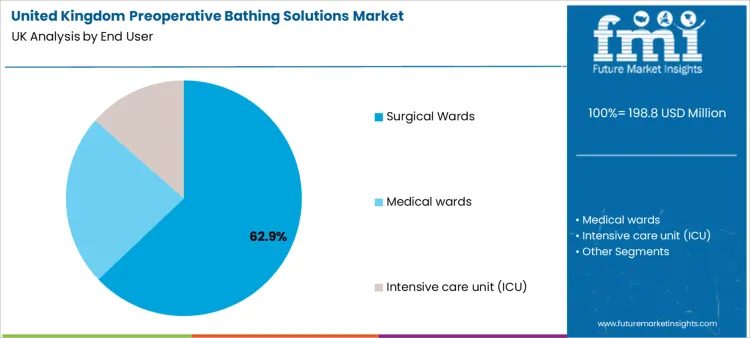
Surgical wards represent a 62.9% share, making them the leading end-user setting. Ward teams own readiness checks, patient education reinforcement, and exception handling when patients arrive without completing home-based cleansing steps.
They need solutions that store easily, apply quickly, and fit daily workload patterns. Medical wards and intensive care units also use these products for hygiene maintenance and urgent procedure readiness, with a focus on speed and tolerance.
What are the Dynamics, Restraints, Opportunities, and Threats Shaping this Space?
Drivers
Surgical site infection prevention remains a clear clinical priority. Providers aim to protect outcomes and reduce unplanned resource drain. Preoperative bathing solutions fit into checklists that are measurable and easier to standardise than complex clinical interventions.
Restraints
Adherence variability is the main constraint. Patient misunderstanding, rushed timelines, and uncomfortable skin feel can reduce completion. Procurement teams also face cost pressure, making it important that products show reliable acceptance and repeatable use.
Opportunities
Solutions that improve compliance create value for providers and suppliers. Clearer instructions, patient-friendly formats, and bedside-ready options support completion for mobility-limited groups. Training materials and implementation support strengthen uptake. Some programmes connect cleansing upgrades with waterless bathing solutions.
Threats
Supply disruption can break protocol consistency. Practice drift can occur if training is not refreshed or if staff rely on local habits. Reputational risk increases when patients perceive guidance as unclear or uncomfortable.
How is Preoperative Bathing Solutions Demand Evolving across Key Regions in the UK?
| Region | CAGR 2026 to 2036 |
|---|---|
| England | 4.5% |
| Scotland | 4.0% |
| Wales | 3.7% |
| Northern Ireland | 3.3% |
Why is England leading growth through scale-led protocol standardisation across surgical services?
England grows at 4.5%, supported by high surgical throughput and large provider networks that formalise perioperative routines. Standard operating procedures and audit cycles promote consistent adoption, strengthening demand for products that can be deployed at scale.
How is Scotland strengthening uptake through governance-led product selection and workflow fit?
Scotland expands at 4.0%, driven by structured procurement and an emphasis on consistent care delivery. Providers prioritise solutions that protect patient comfort while maintaining predictable staff workload.
What is supporting Wales as hospitals focus on patient guidance and compliance reliability?
Wales advances at 3.7%, shaped by the need to improve completion rates through simple instructions and practical formats. Providers focus on reducing avoidable complications that constrain bed availability.
Why is Northern Ireland progressing through measured scaling and protocol-focused purchasing?
Northern Ireland rises at 3.3%, reflecting careful standardisation decisions and staged adoption across surgical care settings. Bedside-friendly formats play a role where mobility limitations influence routine completion.
What Defines the Competitive Landscape for Preoperative Bathing Solutions in the UK?
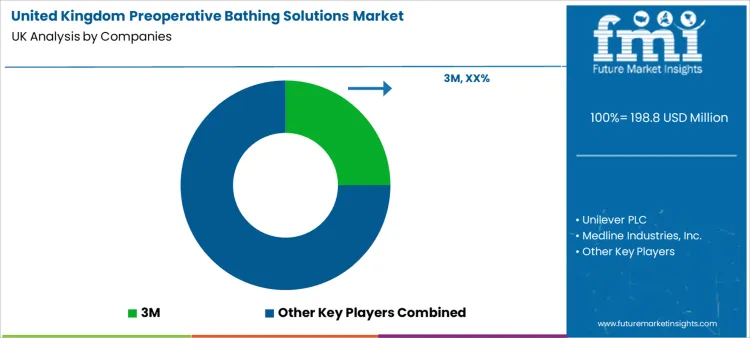
Competition depends on clinical acceptance, supply continuity, protocol support, and implementation readiness. Buyers prioritise suppliers that provide reliable product performance, consistent availability, and practical patient guidance assets. NHS infection prevention expectations also influence standard precautions across care settings. (NHS England)
3M is recognised for infection prevention portfolios that connect perioperative hygiene with wider safety programmes. Unilever PLC brings scale and hygiene formulation expertise. Medline Industries, Inc. supports hospital supply needs through distribution reach.
BD connects hospital procurement pathways through broad clinical product presence. Stryker operates across surgical care environments where perioperative consistency is highly valued. Supplier selection often links to adjacent disinfection purchases such as ready-to-use disinfectant wipes, especially where infection prevention teams aim for aligned protocols across wards and theatres.
Key Industry Participants
- 3M
- Unilever PLC
- Medline Industries, Inc.
- BD (Becton, Dickinson and Company)
- Stryker
Scope of Report
| Items | Values |
|---|---|
| Quantitative Units | USD Million |
| Product Type | Bath Solutions/Liquid Soaps; Towels and wipes; Shampoo caps; Scrub brushes |
| End User | Surgical Wards; Medical wards; Intensive care unit (ICU) |
| Regions Covered | England; Scotland; Wales; Northern Ireland |
| Key Companies Profiled | 3M; Unilever PLC; Medline Industries, Inc.; BD (Becton, Dickinson and Company); Stryker |
Preoperative Bathing Solutions Demand in the UK by Segments
By Product Type
- Bath Solutions/Liquid Soaps
- Towels and wipes
- Shampoo caps
- Scrub brushes
By End User
- Surgical Wards
- Medical wards
- Intensive care unit (ICU)
By Region
- England
- Scotland
- Wales
- Northern Ireland
Bibliography
- National Institute for Health and Care Excellence. (2019). Surgical site infections: prevention and treatment (NG125). National Institute for Health and Care Excellence. Last reviewed May 31, 2023.
- UK Health Security Agency. (2024). Surveillance of surgical site infections in NHS hospitals in England: April 2023 to March 2024. UK Health Security Agency.
- NHS England. (2024). National infection prevention and control manual for England: Chapter 1 standard infection control precautions. NHS England.
- World Health Organization. (2018). Global guidelines for the prevention of surgical site infection (2nd ed.). World Health Organization.
- OneTogether. (2023). Surgical skin preparation: Quality improvement resource. OneTogether.
Frequently Asked Questions
How big is the demand for preoperative bathing solutions in uk in 2026?
The demand for preoperative bathing solutions in uk is estimated to be valued at USD 198.8 million in 2026.
What will be the size of preoperative bathing solutions in uk in 2036?
The market size for the preoperative bathing solutions in uk is projected to reach USD 297.3 million by 2036.
How much will be the demand for preoperative bathing solutions in uk growth between 2026 and 2036?
The demand for preoperative bathing solutions in uk is expected to grow at a 4.1% CAGR between 2026 and 2036.
What are the key product types in the preoperative bathing solutions in uk?
The key product types in preoperative bathing solutions in uk are bath solutions/liquid soaps, towels and wipes, shampoo caps and scrub brushes.
Which end user segment is expected to contribute significant share in the preoperative bathing solutions in uk in 2026?
In terms of end user, surgical wards segment is expected to command 62.9% share in the preoperative bathing solutions in uk in 2026.
Preview the report firsthand - request a free sample
Get SampleGet the brochure for pricing and purchase details.
Get PDFTable of Content
- Executive Summary
- UK Market Outlook
- Demand-side Trends
- Supply-side Trends
- Technology Roadmap Analysis
- Analysis and Recommendations
- Market Overview
- Market Coverage / Taxonomy
- Market Definition / Scope / Limitations
- Market Background
- Market Dynamics
- Drivers
- Restraints
- Opportunity
- Trends
- Scenario Forecast
- Demand in Optimistic Scenario
- Demand in Likely Scenario
- Demand in Conservative Scenario
- Opportunity Map Analysis
- Product Life Cycle Analysis
- Supply Chain Analysis
- Investment Feasibility Matrix
- Value Chain Analysis
- PESTLE and Porter’s Analysis
- Regulatory Landscape
- Regional Parent Market Outlook
- Production and Consumption Statistics
- Import and Export Statistics
- Market Dynamics
- UK Market Analysis 2021 to 2025 and Forecast, 2026 to 2036
- Historical Market Size Value (USD Million) Analysis, 2021 to 2025
- Current and Future Market Size Value (USD Million) Projections, 2026 to 2036
- Y-o-Y Growth Trend Analysis
- Absolute $ Opportunity Analysis
- UK Market Pricing Analysis 2021 to 2025 and Forecast 2026 to 2036
- UK Market Analysis 2021 to 2025 and Forecast 2026 to 2036, By Product Type
- Introduction / Key Findings
- Historical Market Size Value (USD Million) Analysis By Product Type , 2021 to 2025
- Current and Future Market Size Value (USD Million) Analysis and Forecast By Product Type , 2026 to 2036
- Bath Solutions/Liquid Soaps
- Towels and wipes
- Shampoo caps
- Scrub brushes
- Bath Solutions/Liquid Soaps
- Y-o-Y Growth Trend Analysis By Product Type , 2021 to 2025
- Absolute $ Opportunity Analysis By Product Type , 2026 to 2036
- UK Market Analysis 2021 to 2025 and Forecast 2026 to 2036, By End User
- Introduction / Key Findings
- Historical Market Size Value (USD Million) Analysis By End User, 2021 to 2025
- Current and Future Market Size Value (USD Million) Analysis and Forecast By End User, 2026 to 2036
- Surgical Wards
- Medical wards
- Intensive care unit (ICU)
- Surgical Wards
- Y-o-Y Growth Trend Analysis By End User, 2021 to 2025
- Absolute $ Opportunity Analysis By End User, 2026 to 2036
- Market Structure Analysis
- Competition Dashboard
- Competition Benchmarking
- Market Share Analysis of Top Players
- By Regional
- By Product Type
- By End User
- Competition Analysis
- Competition Deep Dive
- 3M
- Overview
- Product Portfolio
- Profitability by Market Segments (Product/Age /Sales Channel/Region)
- Sales Footprint
- Strategy Overview
- Marketing Strategy
- Product Strategy
- Channel Strategy
- Unilever PLC
- Medline Industries, Inc.
- BD (Becton, Dickinson and Companies)
- Stryker
- 3M
- Competition Deep Dive
- Assumptions & Acronyms Used
- Research Methodology


