

- Industry Size (2026)
- USD 128.6 Mn
- Forecast (2036)
- USD 219.1 Mn
- CAGR (2026 to 2036)
- 5.5%
Demand for Tool Holders in United Kingdom Forecast and Outlook 2026 to 2036
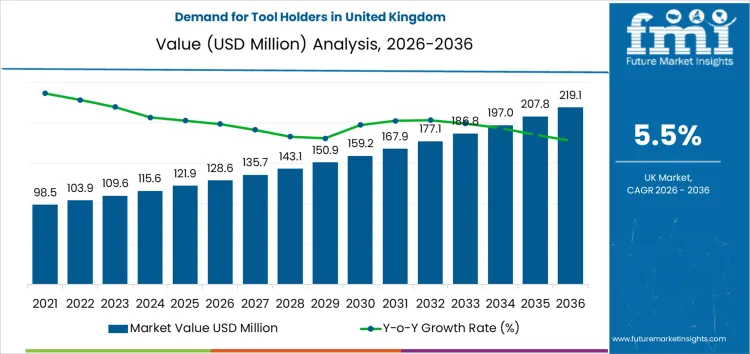
The tool holders market in the United Kingdom is expected to grow from USD 128.6 million in 2026 to USD 219.1 million by 2036, at a CAGR of 5.5%. This space occupies a critical role within the broader manufacturing and machining industry, acting as a foundational component that supports efficient and precise operations. Tool holders influence production accuracy and machine performance, making them essential in industries such as aerospace, automotive, and industrial manufacturing.
Despite being a relatively small segment in comparison to larger machinery markets, it exerts considerable competitive weight due to its integral role in optimizing machine tool usage and minimizing downtime. The market is moderately fragmented, with both established players and specialized suppliers competing for market share. Companies that offer innovative solutions that align with evolving production demands and improve operational efficiency are likely to gain a stronger position, making their presence felt in key industrial sectors.
Quick Stats for the Demand for Tool Holders in United Kingdom:
- Tool Holders in United Kingdom Value (2026): USD 128.6 million
- Tool Holders in United Kingdom Forecast Value (2036): USD 219.1 million
- Tool Holders in United Kingdom Forecast CAGR (2026 to 2036): 5.5%
- Tool Holders in United Kingdom Leading Segment: BT Flange Taper (55% share)
- Key Growth Regions of Tool Holders in United Kingdom: England
- Top Players of Tool Holders in United Kingdom: Guhring KG, Seco Tools AB, Emuge-Franken, NT Tool Corporation, Mapal Group
What is the Growth Forecast for Tool Holders in United Kingdom through 2036?
The demand for tool holders in the United Kingdom is expected to rise from USD 128.6 million in 2026 to USD 219.1 million by 2036, reflecting a compound annual growth rate (CAGR) of 5.5%. Between 2026 and 2031, the market will experience steady growth, increasing from USD 128.6 million to USD 159.2 million. From 2031 to 2036, growth will continue, reaching USD 219.1 million by the end of the forecast period.
The saturation point analysis suggests that the market is approaching a saturation phase, with the growth rate stabilizing over time. As the tool holder market becomes more mature, the demand will continue to increase, but at a slower pace. The highest growth will be seen in the early years of the forecast period, with a slight deceleration as the market reaches its saturation point in later years. However, innovations in design and materials, as well as the increasing demand for high-performance, precision-based solutions, will maintain consistent growth in the market.
Key Takeaways for Demand for Tool Holders in United Kingdom
| Metric | Value |
|---|---|
| Industry Sales Value (2026) | USD 128.6 million |
| Industry Forecast Value (2036) | USD 219.1 million |
| Industry Forecast CAGR (2026 to 2036) | 5.5% |
Why is Demand for Tool Holders in United Kingdom Growing?
Demand for tool holders in the United Kingdom has expanded from earlier levels as manufacturing and precision engineering sectors increased output and modernised production processes. Historically, tool holders were used primarily in basic machining operations where standard clamping and alignment sufficed. Over time, adoption widened as UK manufacturers invested in computer numerical control (CNC) machines and advanced machining centres requiring high precision tool retention systems. Tool holders became critical for ensuring repeatability, accuracy, and reduced vibration during high speed machining, especially in aerospace, automotive, and heavy machinery fabrication.
Domestic engineering firms and subcontractors integrating flexible manufacturing systems encouraged broader uptake of specialised tool holders that matched varied tooling and spindle interfaces. In addition, demand reflected broader equipment replacement cycles and the need to maintain consistent production quality in competitive sectors. Operational drivers such as reduction of setup time and improved tool life supported incremental growth in tool holder use across metalworking shops.
Looking ahead, demand for tool holders in the United Kingdom is expected to continue rising as manufacturers adopt more sophisticated machining technologies and optimise production efficiency. Growth in sectors such as renewable energy equipment, advanced components for defence systems, and precision medical devices will underpin demand for tool holders capable of supporting complex operations and tight tolerances. Continued investment in digital manufacturing and automation will reinforce requirements for high performance clamping solutions that maintain accuracy under varied cutting conditions.
Integration of tool condition monitoring and adaptive machining strategies could also influence specification of advanced tool holder systems. As UK industry seeks to enhance productivity and reduce cycle times, the role of reliable and precise tool holders will remain integral. Incremental advancements in materials and design that improve rigidity and reduce changeover times are likely to attract broader use across diverse machining environments.
What Are the Key Segments in the Demand for Tool Holders in the United Kingdom?
Demand for tool holders in the United Kingdom is influenced by taper type and end-use applications. BT flange taper leads the taper type segment with 55%, while automotive dominates the end-use segment with 35%. Other taper types such as R8, Morse taper, and V-flange taper, along with sectors like aerospace & defense, electronic, and general machining & fabrication, also contribute to the market. These trends reflect the increasing demand for precision tooling solutions in various industrial sectors.
What Is the Taper Type Segment of Demand for Tool Holders in the United Kingdom?
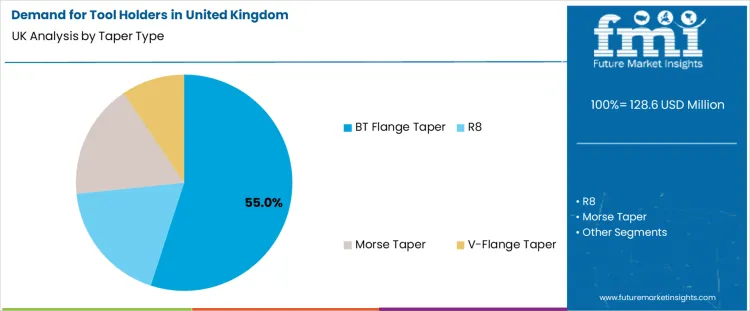
The taper type segment for tool holders in the United Kingdom is led by BT flange taper, which holds a 55% share of the market. BT flange taper tool holders are widely used in CNC (Computer Numerical Control) machines due to their ability to provide a secure and precise connection between the tool and the machine. The design of BT flanges ensures high accuracy and stability, which is critical in industries requiring precise machining, such as automotive and aerospace.
These tool holders are favored for their versatility and compatibility with various machine tools. The R8 taper follows as a smaller but significant segment, particularly in smaller-scale applications. R8 tool holders are commonly used in mills and smaller machines, offering a cost-effective solution for precision machining in industries like electronics and small parts manufacturing. Morse taper tool holders, though representing a smaller portion of the market, are essential in manual machines and certain types of industrial equipment.
These tool holders are known for their robustness and are used primarily in industries where heavy-duty machining is required. V-flange taper tool holders, another niche segment, are used in general machining and fabrication applications where high rigidity and tool stability are required for demanding tasks. The demand for various taper types reflects the need for tailored tooling solutions to meet specific industry requirements, with BT flange taper being the dominant choice due to its widespread use in high-precision machining.
What Is the End Use Segment of Demand for Tool Holders in the United Kingdom?
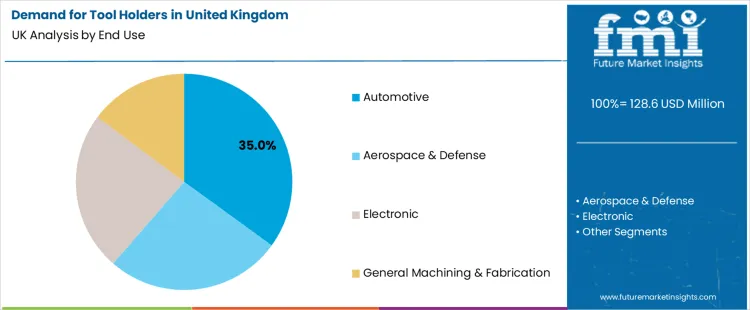
The end-use segment for tool holders in the United Kingdom is primarily dominated by the automotive sector, which accounts for 35% of the market share. The automotive industry relies heavily on precision machining for the production of components such as engine parts, transmission systems, and chassis. Tool holders are critical in these processes, as they ensure accurate and stable tooling during high-volume production. BT flange taper tool holders are particularly popular in automotive manufacturing due to their compatibility with CNC machines, which are extensively used in the production of complex, high-precision automotive parts.
The aerospace and defense sector follows, requiring highly precise and durable tool holders for machining critical components like turbine blades, structural elements, and military equipment. In this sector, tool holders must withstand extreme conditions and maintain high performance, making R8 and Morse taper tool holders suitable for specific applications. The electronic sector also contributes to the market, with tool holders being used for the production of small parts and devices where precision and accuracy are paramount. General machining and fabrication industries, which include manufacturing sectors involved in metalworking and other heavy-duty machining tasks, also represent a significant portion of the market. These industries rely on V-flange taper tool holders for their ability to provide high stability and rigidity during demanding tasks. The diverse end-use applications for tool holders highlight the essential role they play in ensuring high-quality, efficient production across various industrial sectors.
What are the Key Dynamics in the Demand for Tool Holders in the United Kingdom?
Demand for tool holders in the United Kingdom is linked to manufacturing sector activity, machine tool utilisation, and investment in precision machining. Tool holders serve as the interface between cutting tools and machine spindles, affecting machining accuracy, stability, and production efficiency. Industrial segments such as automotive components, aerospace parts, metal fabrication, and general engineering contribute to steady consumption of tool holders. Procurement patterns reflect capital expenditure cycles for CNC machines, planned maintenance schedules, and replacement of worn tooling components to maintain production quality. Demand also aligns with adoption of advanced machining processes that require high-performance tooling systems.
What are the Key Drivers for Tool Holder Demand in the United Kingdom?
Several factors drive demand for tool holders in the United Kingdom. Continued investment in advanced manufacturing and precision engineering supports uptake of high‑quality tooling systems, including modular and quick‑change tool holders. Growth in sectors such as automotive components, aerospace, and industrial equipment manufacturing increases demand for reliable tool holding solutions that improve machining accuracy and reduce cycle times. The shift toward CNC machining and multi‑axis operations elevates requirement for specialised holders compatible with complex machining centres. Focus on reducing scrap rates and improving surface finish quality also reinforces the procurement of precision tool holders in production environments.
What are the Restraints on Tool Holder Demand in the United Kingdom?
Despite ongoing utility, the tool holder market in the United Kingdom faces several restraints. Economic volatility and fluctuating industrial output can defer capital investment in machine tools and associated tooling systems, moderating tool holder purchases. Price sensitivity among small and medium‑sized enterprises may limit uptake of premium or specialised holders in favour of lower‑cost alternatives. Supply chain disruptions affecting raw materials and precision components can delay deliveries and increase procurement lead times. Competition from imported tooling systems with lower unit costs also influences buying decisions. Variability in adoption of advanced machining technologies across sectors may further constrain demand growth.
What are the Key Trends in Tool Holder Demand in the United Kingdom?
Key trends shaping tool holder demand in the United Kingdom include increased preference for modular and quick‑change systems that reduce machine downtime and support flexible manufacturing. High‑precision holders designed for vibration damping and thermal stability are gaining traction in sectors requiring tight tolerances. Integration of tool monitoring and sensor feedback capabilities is becoming more prevalent, enabling predictive maintenance and extended tool life. Manufacturers are also focusing on lightweight, high‑strength materials that improve spindle acceleration and machine performance. Sustainability considerations, such as recycling of carbide and alloy components, are emerging in procurement criteria as part of broader efforts to reduce manufacturing waste.
What is the Country-Wise Demand for Tool Holders in the United Kingdom?
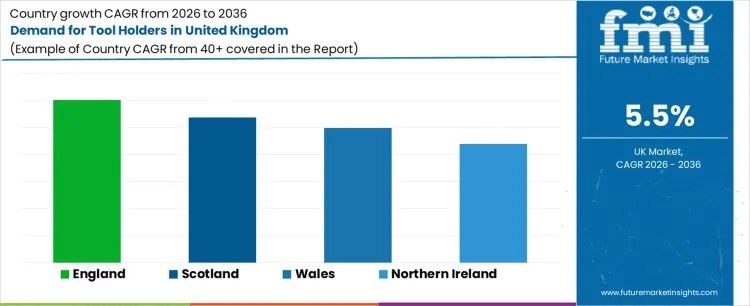
The country-wise demand for tool holders in the United Kingdom shows regional variations, with England leading the market. The demand in England is primarily driven by the strong manufacturing and industrial sectors, where tool holders are essential for ensuring precision and efficiency in machining operations. Scotland, Wales, and Northern Ireland follow, with steady demand fueled by similar needs in the manufacturing and automotive sectors. As industries continue to prioritize automation, efficiency, and precision in production processes, the demand for tool holders is expected to grow across all regions. England remains the dominant market, while the other regions show promising growth in line with industrial trends and the increasing adoption of advanced manufacturing technologies.
| Country | CAGR (2026 to 2036) |
|---|---|
| England | 6.0% |
| Scotland | 5.4% |
| Wales | 5.0% |
| Northern Ireland | 4.4% |
What is Driving the Demand for Tool Holders in England?
The demand for tool holders in England is projected to grow at a CAGR of 6.0% from 2026 to 2036. England’s market is the largest, driven by its expansive manufacturing and industrial sectors. Tool holders play a crucial role in ensuring the precision, stability, and efficiency of machining operations, particularly in the automotive, aerospace, and general manufacturing industries. The growing focus on automation and advanced manufacturing technologies in England is boosting the demand for tool holders, as they are integral to the operation of CNC machines and other automated machinery. The need for higher precision and improved productivity is leading to increased adoption of high-quality, durable tool holders. Additionally, England’s ongoing investments in infrastructure and manufacturing capabilities are expected to further drive the demand for tool holders, making it a key segment in the industrial sector.
How is the Demand for Tool Holders Performing in Scotland?
In Scotland, the demand for tool holders is expected to grow at a CAGR of 5.4% from 2026 to 2036. The growth in demand is driven by the region’s expanding manufacturing sector, which includes industries such as automotive, machinery, and aerospace. As Scottish manufacturers increasingly adopt automation and advanced manufacturing technologies, the need for high-quality tool holders to maintain precision and efficiency is rising. Tool holders are essential in ensuring stable and accurate machining processes, which is crucial in sectors where precision is paramount. The growing focus on improving productivity and reducing operational costs in Scottish industries is expected to sustain steady demand for tool holders. Furthermore, the increasing emphasis on sustainability and efficiency in Scottish manufacturing is further driving the adoption of advanced tool holders that meet these industry needs.
What Are the Growth Drivers for Tool Holders in Wales?
The demand for tool holders in Wales is projected to grow at a CAGR of 5.0% through 2036. The manufacturing sector in Wales is contributing significantly to this demand, particularly in the automotive and general manufacturing industries, where tool holders are essential for efficient machining and precision manufacturing. As Welsh manufacturers seek to improve production efficiency and product quality, the adoption of advanced tool holders is increasing. The growing focus on automation and the need for higher precision in machining processes is driving the demand for tool holders in Wales. Additionally, Wales’ ongoing investments in its industrial sector, coupled with increasing demands for sustainable and cost-effective manufacturing solutions, are expected to fuel further growth in the demand for tool holders over the forecast period.
What is the Outlook for Tool Holders Demand in Northern Ireland?
Northern Ireland’s demand for tool holders is expected to grow at a CAGR of 4.4% from 2026 to 2036. While Northern Ireland represents the smallest market in the United Kingdom, the demand for tool holders is increasing steadily, particularly in the region’s manufacturing and automotive sectors. As industries in Northern Ireland continue to prioritize efficiency and precision in their manufacturing processes, the need for high-quality tool holders is growing. Tool holders are critical in ensuring that machining operations are stable and accurate, especially in industries requiring high levels of precision. The region’s focus on modernizing its manufacturing capabilities and improving production efficiency is expected to drive steady growth in the demand for tool holders. While Northern Ireland’s market is smaller compared to England and Scotland, the continued expansion of manufacturing and automation in the region will contribute to the ongoing demand for tool holders.
What is the Competitive Landscape for Demand for Tool Holders in the United Kingdom?
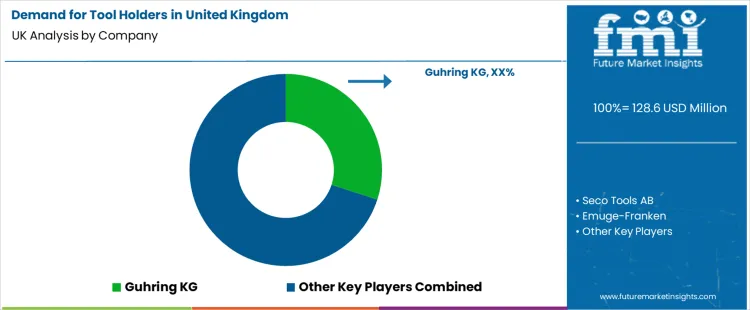
Demand for tool holders in the United Kingdom is driven by machining activity in automotive, aerospace, general engineering, and precision manufacturing sectors. Procurement teams specify tool holders that provide rigidity, repeatability, and accuracy under high speed conditions. Buyers examine product brochures to compare documented run out tolerances, clamping mechanisms, and balance grades. Guhring KG is positioned as a leading supplier with documented offerings covering a wide range of interfaces and geometries. Brochures from Guhring detail interface standards, tool taper accuracy, and recommended operating speeds, serving as reference materials for manufacturing engineers.
Seco Tools AB competes with tool holders that are described in technical literature outlining modular interfaces, coolant delivery options, and compatibility with Seco’s cutter systems. Specification sheets from Seco Tools assist purchasers in aligning tool holder selection with spindle requirements and cutting strategies.
Emuge Franken participates with solutions oriented to high precision threading and drilling applications, supported by product documentation that lists clamping force values, taper sizes, and application notes. NT Tool Corporation supplies tool holders used in turning and milling, with brochures detailing taper styles, pull stud options, and recommended maintenance practices. Mapal Group offers integrated tool systems accompanied by documentation on dynamic balance performance and vibration damping characteristics, referenced by buyers when tightening specification criteria. In the United Kingdom, demand patterns reflect production planning and capacity utilization forecasts.
Buyers weigh documented performance metrics and supply terms found in supplier brochures against production goals and machine tool capabilities. Lead times, service support, and documented assembly instructions are considered during procurement cycles. Technical teams review specification data to ensure compatibility with existing tool management systems, anchoring selection decisions in measurable material and dimensional attributes.
Key Players of the Demand for Tool Holders in United Kingdom
- Guhring KG
- Seco Tools AB
- Emuge-Franken
- NT Tool Corporation
- Mapal Group
Scope of the Report
| Items | Values |
|---|---|
| Quantitative Units (2026) | USD Million |
| Taper Type | R8, Morse Taper, V-Flange Taper, BT Flange Taper |
| End Use | Automotive, Aerospace & Defense, Electronic, General Machining & Fabrication |
| Companies | Guhring KG, Seco Tools AB, Emuge-Franken, NT Tool Corporation, Mapal Group |
| Regions Covered | United Kingdom |
| Countries Covered | England, Scotland, Wales, Northern Ireland |
| Additional Attributes | Dollar by sales by taper type, end use, and region. Includes market trends towards precision, automation, and the role of tool holders in enhancing manufacturing processes across industries. |
Demand for Tool Holders in United Kingdom
Taper Type
- R8
- Morse Taper
- V-Flange Taper
- BT Flange Taper
End Use
- Automotive
- Aerospace & Defense
- Electronic
- General Machining & Fabrication
Countries
- England
- Scotland
- Wales
- Northern Ireland
Bibliography
- Office for National Statistics. (2024, September 19). UK manufacturers’ sales by product: 2023 (PRODCOM). Office for National Statistics.
- Department for Business and Trade. (2025, June 23). Advanced manufacturing sector plan. Government of the United Kingdom.
- HM Revenue & Customs. (2025). UK Trade Info commodity classification: Parts and accessories for machine-tools (HS 8466), including work or tool holders. HM Revenue & Customs.
Frequently Asked Questions
How big is the demand for tool holders in United Kingdom in 2026?
The demand for tool holders in United Kingdom is estimated to be valued at USD 128.6 million in 2026.
What will be the size of tool holders in United Kingdom in 2036?
The market size for the tool holders in United Kingdom is projected to reach USD 219.1 million by 2036.
How much will be the demand for tool holders in United Kingdom growth between 2026 and 2036?
The demand for tool holders in United Kingdom is expected to grow at a 5.5% CAGR between 2026 and 2036.
What are the key product types in the tool holders in United Kingdom?
The key product types in tool holders in United Kingdom are bt flange taper, r8, morse taper and v-flange taper.
Which end use segment is expected to contribute significant share in the tool holders in United Kingdom in 2026?
In terms of end use, automotive segment is expected to command 35.0% share in the tool holders in United Kingdom in 2026.
Preview the report firsthand - request a free sample
Get SampleGet the brochure for pricing and purchase details.
Get PDFTable of Content
- Executive Summary
- UK Market Outlook
- Demand-side Trends
- Supply-side Trends
- Technology Roadmap Analysis
- Analysis and Recommendations
- Market Overview
- Market Coverage / Taxonomy
- Market Definition / Scope / Limitations
- Market Background
- Market Dynamics
- Drivers
- Restraints
- Opportunity
- Trends
- Scenario Forecast
- Demand in Optimistic Scenario
- Demand in Likely Scenario
- Demand in Conservative Scenario
- Opportunity Map Analysis
- Product Life Cycle Analysis
- Supply Chain Analysis
- Investment Feasibility Matrix
- Value Chain Analysis
- PESTLE and Porter’s Analysis
- Regulatory Landscape
- Regional Parent Market Outlook
- Production and Consumption Statistics
- Import and Export Statistics
- Market Dynamics
- UK Market Analysis 2021 to 2025 and Forecast, 2026 to 2036
- Historical Market Size Value (USD Million) Analysis, 2021 to 2025
- Current and Future Market Size Value (USD Million) Projections, 2026 to 2036
- Y-o-Y Growth Trend Analysis
- Absolute $ Opportunity Analysis
- UK Market Pricing Analysis 2021 to 2025 and Forecast 2026 to 2036
- UK Market Analysis 2021 to 2025 and Forecast 2026 to 2036, By Taper Type
- Introduction / Key Findings
- Historical Market Size Value (USD Million) Analysis By Taper Type , 2021 to 2025
- Current and Future Market Size Value (USD Million) Analysis and Forecast By Taper Type , 2026 to 2036
- BT Flange Taper
- R8
- Morse Taper
- V-Flange Taper
- BT Flange Taper
- Y-o-Y Growth Trend Analysis By Taper Type , 2021 to 2025
- Absolute $ Opportunity Analysis By Taper Type , 2026 to 2036
- UK Market Analysis 2021 to 2025 and Forecast 2026 to 2036, By End Use
- Introduction / Key Findings
- Historical Market Size Value (USD Million) Analysis By End Use, 2021 to 2025
- Current and Future Market Size Value (USD Million) Analysis and Forecast By End Use, 2026 to 2036
- Automotive
- Aerospace & Defense
- Electronic
- General Machining & Fabrication
- Automotive
- Y-o-Y Growth Trend Analysis By End Use, 2021 to 2025
- Absolute $ Opportunity Analysis By End Use, 2026 to 2036
- Market Structure Analysis
- Competition Dashboard
- Competition Benchmarking
- Market Share Analysis of Top Players
- By Regional
- By Taper Type
- By End Use
- Competition Analysis
- Competition Deep Dive
- Guhring KG
- Overview
- Product Portfolio
- Profitability by Market Segments (Product/Age /Sales Channel/Region)
- Sales Footprint
- Strategy Overview
- Marketing Strategy
- Product Strategy
- Channel Strategy
- Seco Tools AB
- Emuge-Franken
- NT Tool Corporation
- Mapal Group
- Guhring KG
- Competition Deep Dive
- Assumptions & Acronyms Used
- Research Methodology


