

- Industry Size (2026)
- USD 37.2 Mn
- Forecast (2036)
- USD 60.2 Mn
- CAGR (2026 to 2036)
- 4.9%
Demand for Tool Holders in South Korea Forecast and Outlook 2026 to 2036
The demand for tool holders in South Korea is expected to reach USD 37.2 million in 2026 and grow to USD 60.2 million by 2036, reflecting a 4.9% CAGR. Positioned within the broader manufacturing and automation sectors, tool holders play a crucial role in enhancing the efficiency and precision of machining processes. As a key component in manufacturing systems, they influence the overall performance and uptime of production lines, positioning them as indispensable in industries reliant on high-precision, high-volume outputs, such as automotive and electronics. Competitive weight in this space is driven by the demand for high-quality, durable solutions that can support evolving machining technologies. While the market is fragmented, larger players with a broad product offering and innovation capabilities tend to lead. The space is shaped by steady, long-term demand, with suppliers focusing on customization, material quality, and integration capabilities to gain a competitive edge in an increasingly automated manufacturing environment.
Quick Stats for the Demand for Tool Holders in South Korea
- Tool Holders in South Korea Value (2026): USD 37.2 million
- Tool Holders in South Korea Forecast Value (2036): USD 60.2 million
- Tool Holders in South Korea Global Forecast CAGR (2026 to 2036): 4.9%
- Tool Holders in South Korea Leading Segment: V-Flange Taper (35%)
- Key Growth Regions of Tool Holders in South Korea: Jeju (leading CAGR ~5.9%)
- Top Players of Tool Holders in South Korea: Guhring KG, Seco Tools AB, Emuge-Franken, NT Tool Corporation, Mapal Group
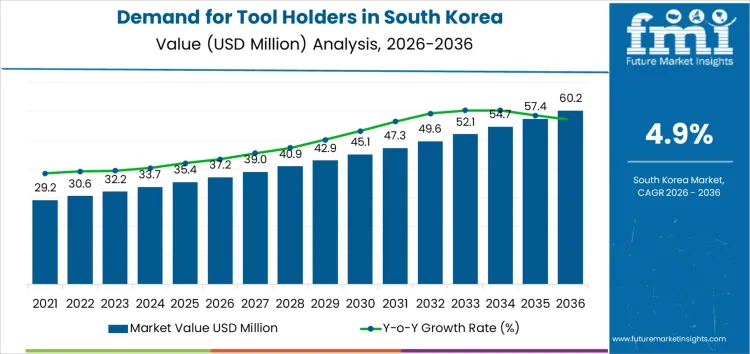
What is the Growth Forecast for the Demand for Tool Holders in South Korea through 2036?
The saturation point analysis for tool holders in South Korea reveals that while the market is expected to grow steadily, the pace of growth will gradually slow as it nears saturation in key industrial segments. Early years (2026-2030) show moderate increases in demand, driven by ongoing investments in manufacturing technology, especially in high-precision sectors like automotive and electronics. The growth momentum continues at a steady pace, with demand steadily rising as industries in South Korea increasingly automate and upgrade their production lines.
By 2036, the market for tool holders is projected to reach USD 60.2 million, reflecting a stable demand trajectory. However, the saturation point is expected to approach toward the latter part of the forecast period. As key industries in South Korea complete their major modernization and automation efforts, the rate of growth will likely stabilize. While incremental demand for tool holders will continue, driven by maintenance and replacement cycles, the market will transition into a mature phase, characterized by slower, more stable growth as the core industries become fully equipped with the necessary tooling solutions.
Key Takeaways for Demand for Tool Holders in South Korea
| Metric | Value |
|---|---|
| Industry Sales Value (2026) | USD 37.2 million |
| Industry Forecast Value (2036) | USD 60.2 million |
| Industry Forecast CAGR (2026 to 2036) | 4.9% |
Why is the Demand for Tool Holders Growing in South Korea?
Demand for tool holders in South Korea reflects the country’s strong manufacturing base, particularly in precision engineering, automotive components, electronics, and machine tools. Tool holders serve as the interface between cutting tools and machine spindles, and their performance directly influences machining accuracy, surface finish, and cycle times. South Korean manufacturers that produce high tolerance parts rely on robust, high precision tool holding systems to meet specifications and maintain production efficiency. As factories pursue tighter tolerances and faster machining rates, procurement teams prioritize holders with stable clamping, minimal run out, and compatibility with advanced CNC platforms. The electronics and semiconductor sectors, where component geometries are intricate and quality demands are high, contribute to sustained interest in tool holders that support micro machining and ultraprecise operations. Supply chain planners also factor in service life and changeover ease when selecting tool holders, as these characteristics affect tooling costs and machine uptime.
Looking ahead, several factors are expected to support continued demand for tool holders in South Korea’s industrial landscape. Investment in automation and smart factories encourages adoption of tooling systems that integrate with flexible manufacturing cells and support rapid tool changes. As industrial automation platforms expand, tool holders that work with robotic tool changers and adaptive control systems become more relevant, linking tooling performance with broader production agility goals. Demand from the automotive sector, including manufacturers of combustion and electric vehicles, sustains machining activity that depends on reliable tool holding solutions to process engine parts, chassis components, and battery housings. Global trends toward near net shape manufacturing and advanced materials, such as high strength alloys and composites, require holders capable of handling higher loads and specialized geometries. Training and technical support from tooling suppliers also influences adoption as engineers evaluate new holder designs that promise improved stability and reduced vibration. These dynamics together contribute to persistent demand for tool holders across South Korea’s machining and production sectors.
What Shapes the Demand for Tool Holders in South Korea?
The demand for tool holders in South Korea is driven by two key factors: taper type and end-use application. V-flange taper tool holders lead the market with a 35% share, while the automotive industry represents the largest end-use sector at 30%. These two segments are essential in determining the overall demand, reflecting the country's robust manufacturing base, particularly in precision engineering and high-tech industries, where tool holders are critical to ensuring precision and efficiency in machining operations.
Why Does V-Flange Taper Hold the Largest Share in Tool Holder Demand?
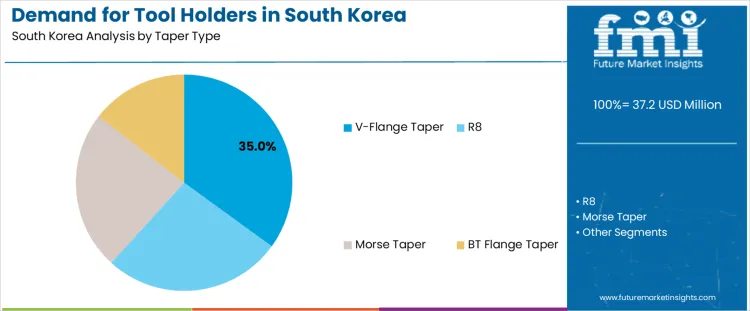
V-flange taper tool holders dominate the market in South Korea, accounting for 35% of the total demand, due to their versatility, stability, and wide applicability in industrial operations. This taper type is commonly used in CNC machines, where high-speed and high-precision cutting are essential. The V-flange taper ensures a secure fit between the tool and machine spindle, reducing the risk of vibration during operation, which is crucial for maintaining machining accuracy and improving tool life. It is particularly favored in industries such as automotive, aerospace, and general machining, where consistent performance and durability are critical. V-flange taper tool holders are also easier to handle and maintain, making them a preferred choice for a range of machining and fabrication processes. As South Korea continues to expand its automotive and manufacturing industries, the demand for these tool holders is likely to grow, driven by the ongoing need for efficient, high-precision machining solutions across various sectors.
Why Does the Automotive Industry Lead the End-Use Demand for Tool Holders?
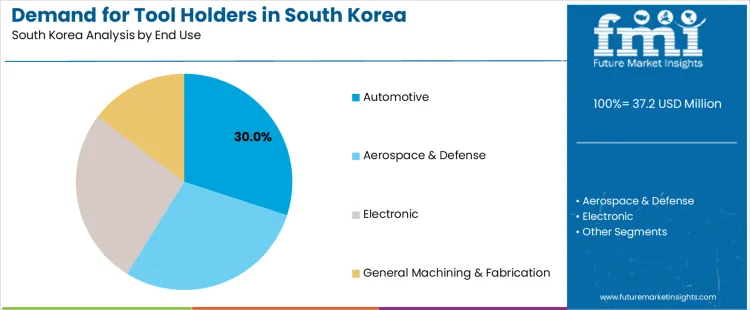
The automotive industry accounts for 30% of the demand for tool holders in South Korea, making it the largest end-use sector. The automotive sector in South Korea is one of the most advanced globally, with a strong focus on mass production, precision engineering, and technological innovation. Tool holders, particularly those with V-flange tapers, play a crucial role in automotive manufacturing, where high-speed machining and tight tolerances are required for components such as engine parts, transmissions, and chassis. The need for robust, reliable, and efficient tool holders in the production of complex automotive components drives the demand in this sector. Additionally, the automotive industry’s emphasis on automation and CNC-driven production lines further fuels the adoption of advanced tool holding solutions. As South Korea’s automotive industry continues to evolve, with increasing investments in electric vehicle production and advanced manufacturing technologies, the demand for high-performance tool holders is expected to remain strong. This sector's continued growth and technological advancements will ensure tool holders remain a critical component in South Korea’s industrial landscape.
What Is the Current Demand for Tool Holders in South Korea?
Demand for tool holders in South Korea is anchored in the manufacturing and machining sectors, where precision and equipment uptime are priorities. Tool holders, which secure cutting tools in milling machines, lathes, and machining centers, are procured by industrial firms that produce automotive parts, electronics components, and heavy machinery. Procurement levels reflect activity in machine tool investments and maintenance cycles of existing equipment. As production facilities emphasize quality and throughput, demand for reliable holders that support tight tolerances and repeatability remains consistent across job shops and large industrial plants.
What Factors Are Driving Demand for Tool Holders in South Korea?
Several factors support demand for tool holders in South Korea. The country’s strong automotive and electronics manufacturing base relies on high precision machining, where optimal tool holding directly influences surface finish and dimensional accuracy. Growth in exports of precision components to global markets sustains investment in advanced machine tools and compatible accessories such as rigid, balanced tool holders. Uptake of high speed and multi axis machining has increased demand for holders that can maintain stability at elevated spindle speeds. Maintenance and repair operations in heavy industries reinforce replacement cycles for worn or damaged holders, fuelling aftermarket demand. Productivity targets and quality standards in industrial production encourage procurement of certified holders from established suppliers.
What Are the Constraints on Demand for Tool Holders in South Korea?
Despite steady uptake, certain constraints influence demand for tool holders in South Korea. Price competition from lower cost imported holders affects market share for domestic suppliers, especially among small and medium sized enterprises with tight cost controls. Fluctuations in raw material costs for tool steel and carbide impact pricing, which can delay purchases or shift preference toward standard rather than high end holders. Adoption of alternative machining technologies, such as additive manufacturing for specific components, may reduce the volume of conventional machining operations in some niches. Inventory management practices and capital budgeting cycles in manufacturing firms also shape the timing and scale of tool holder procurement.
What Trends Are Emerging in South Korea’s Tool Holder Market?
Emerging trends in South Korea’s tool holder market reflect evolving machining requirements and integration with digital systems. There is increased interest in modular and quick change tool holders that reduce setup times and support flexible production lines. Tool holders designed for vibration damping and thermal stability are gaining traction as shops pursue higher precision with demanding materials. Integration with tool monitoring systems and RFID tagging fosters automated tracking of usage and wear, supporting preventive maintenance. Collaboration between machine tool builders and holder manufacturers is advancing optimized solutions tailored to multi axis and high performance machining applications. Sustainability considerations are shaping preferences for durable, long lasting holders that extend service life and reduce waste.
What is the Regional Outlook for the Demand for Tool Holders in South Korea?
The demand for tool holders in South Korea is driven by the growth of manufacturing, automotive, construction, and machinery industries that require precision tools and equipment. Jeju leads the demand, followed by South Gyeongsang, South Jeolla, and North Jeolla. These regions, with their expanding industrial bases, rely heavily on tool holders for efficient manufacturing processes and machine operation. As industries increasingly focus on automation, productivity, and precision in production, the demand for reliable and high-quality tool holders continues to grow, particularly in regions with advanced manufacturing and heavy industries.
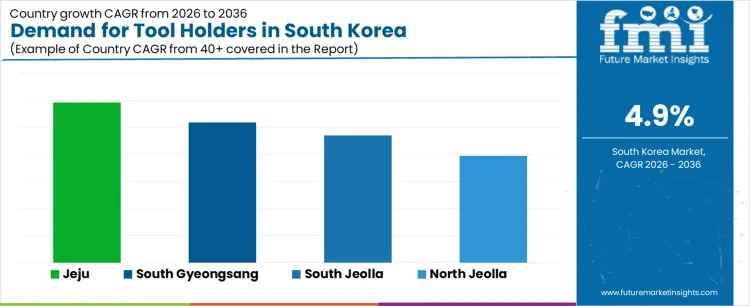
| Province | CAGR (2026-2036) |
|---|---|
| South Gyeongsang | 5.2% |
| North Jeolla | 4.0% |
| South Jeolla | 4.7% |
| Jeju | 5.9% |
What drives the demand for Tool Holders in South Gyeongsang?
South Gyeongsang is projected to experience a CAGR of 5.2% in the demand for tool holders from 2026 to 2036. The province’s significant role in manufacturing, particularly in automotive, shipbuilding, and heavy machinery, is a key factor driving this demand. Tool holders are essential in these industries for ensuring the precise operation of machines and the efficiency of production lines. South Gyeongsang’s industrial hubs, coupled with its growing automation trends, contribute to the increasing adoption of advanced tool holding systems. As the province continues to upgrade its industrial facilities and adopt cutting-edge manufacturing technologies, the need for high-performance tool holders will rise, reinforcing steady demand over the forecast period. Additionally, South Gyeongsang’s focus on precision engineering and quality control further supports the demand for these essential components.
What influences the demand for Tool Holders in North Jeolla?
North Jeolla is expected to see a steady CAGR of 4.0% in tool holder demand from 2026 to 2036. The region's industrial growth, particularly in machinery, automotive, and chemical production, supports the need for efficient and reliable tool holders. North Jeolla’s expanding manufacturing sector, which includes facilities involved in high-volume production, increasingly adopts tool holders for their durability and functionality in machine operations. The growing trend toward industrial automation and the region’s focus on improving manufacturing processes further boosts the demand for these tools. Additionally, North Jeolla’s rising focus on improving product quality and reducing downtime in manufacturing plants contributes to the adoption of advanced tool holding systems. As industries continue to modernize, the demand for tool holders in the region is expected to grow steadily.
What drives the demand for Tool Holders in South Jeolla?
South Jeolla is projected to grow at a CAGR of 4.7% in the demand for tool holders from 2026 to 2036. The region’s strong presence in the automotive, shipbuilding, and machinery manufacturing sectors contributes significantly to this demand. Tool holders are integral in these industries for their role in ensuring the smooth operation of automated systems and machinery. As South Jeolla continues to invest in advanced manufacturing technologies, particularly in precision engineering and automation, the need for high-quality tool holders is expected to rise. The region’s increasing adoption of robotic and automated systems in production lines further supports the demand for efficient tool holders that can maintain precision and reduce production costs. As South Jeolla grows its industrial output, tool holders will remain essential for maintaining operational efficiency and product quality.
Why is Jeju projected to have the highest demand growth for Tool Holders?
Jeju is projected to experience the highest demand growth for tool holders, with a CAGR of 5.9% from 2026 to 2036. The island’s expanding tourism and infrastructure sectors, coupled with rising investments in advanced manufacturing and automation technologies, drive this demand. Jeju's focus on creating a sustainable industrial base and its emphasis on quality manufacturing practices contribute to the increasing adoption of tool holders for machinery and equipment. As the region continues to expand its construction and infrastructure projects, tool holders will be in high demand to support the growing machinery needs. Jeju's increasing shift toward smarter manufacturing solutions, alongside its investment in high-efficiency industrial technologies, further accelerates the growth in tool holder demand. As the island’s industrial capacity expands, demand for precision and high-performance tools will continue to rise, making it the fastest-growing region for tool holders.
How are Competitors Differentiating in the Tool Holder Market in South Korea?
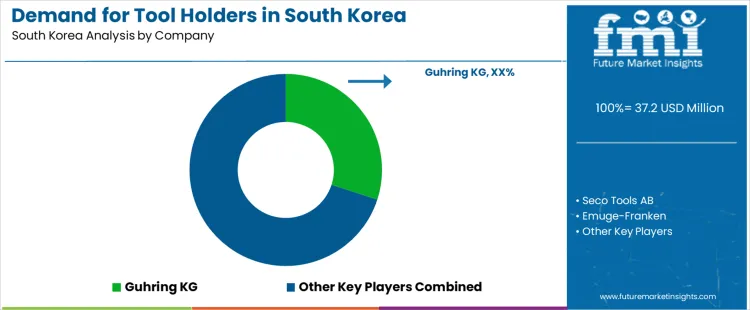
The demand for tool holders in South Korea is increasing due to the growing manufacturing and precision engineering sectors, where tool holders play a crucial role in ensuring optimal performance in machining processes. Guhring KG, the leading player, stands out by offering a broad range of high-precision tool holders designed for various machining applications. Their solutions are known for providing stability, high clamping forces, and excellent concentricity, ensuring reliable and consistent performance. Seco Tools AB competes by providing innovative tool holder solutions that integrate advanced materials and cutting-edge technology, offering high performance for demanding applications in automotive and aerospace industries. Their focus on quick-change systems and durability gives them an edge in high-productivity environments.
Emuge-Franken differentiates itself through its custom tool holders designed for specific applications, particularly for industries requiring high levels of precision, such as medical device manufacturing. Their products are built to reduce vibrations and improve surface finish, offering solutions that enhance machining efficiency and reduce tool wear. NT Tool Corporation focuses on providing tool holders that prioritize versatility and cost-effectiveness, making them ideal for small to medium-sized enterprises that require a balance between performance and affordability. Mapal Group offers tool holders with a strong emphasis on customization and flexibility, catering to a wide range of materials and applications, including high-precision machining for complex geometries. These companies leverage product brochures to highlight the technical specifications of their tool holders, including clamping systems, material compatibility, and ease of use, allowing South Korean manufacturers to choose the best solution based on their specific needs.
Key Players of the Demand for Tool Holders in South Korea
- Guhring KG
- Seco Tools AB
- Emuge-Franken
- NT Tool Corporation
- Mapal Group
Scope of the Report
| Items | Values |
|---|---|
| Quantitative Units (2026) | USD Million |
| Taper Type | V-Flange Taper, R8, Morse Taper, BT Flange Taper |
| End Use | Automotive, Aerospace & Defense, Electronic, General Machining & Fabrication |
| Companies | Guhring KG, Seco Tools AB, Emuge-Franken, NT Tool Corporation, Mapal Group |
| Region Covered | South Korea |
| Provinces Covered | South Gyeongsang, North Jeolla, South Jeolla, Jeju |
| Additional Attributes | Dollar sales by taper type and end use. Growth is driven by the increasing demand for precision tool holders in automotive and aerospace industries. The shift toward more efficient machining processes in general fabrication and electronics also supports demand. |
Demand for Tool Holders in South Korea
Taper Type
- V-Flange Taper
- R8
- Morse Taper
- BT Flange Taper
End Use
- Automotive
- Aerospace & Defense
- Electronic
- General Machining & Fabrication
Provinces
- South Gyeongsang
- North Jeolla
- South Jeolla
- Jeju
Bibliography
- Korea Institute of Industrial Technology. (2024). Advances in precision machining and tooling technologies in South Korea. Korea Institute of Industrial Technology.
- Ministry of Trade, Industry and Energy (Republic of Korea). (2024). Machinery and precision engineering industry trends and export performance. Government of South Korea.
- Korean Statistical Information Service. (2024). Manufacturing output and machinery equipment utilization report. Statistics Korea.
Frequently Asked Questions
How big is the demand for tool holders in south korea in 2026?
The demand for tool holders in south korea is estimated to be valued at USD 37.2 million in 2026.
What will be the size of tool holders in south korea in 2036?
The market size for the tool holders in south korea is projected to reach USD 60.2 million by 2036.
How much will be the demand for tool holders in south korea growth between 2026 and 2036?
The demand for tool holders in south korea is expected to grow at a 4.9% CAGR between 2026 and 2036.
What are the key product types in the tool holders in south korea?
The key product types in tool holders in south korea are v-flange taper, r8, morse taper and bt flange taper.
Which end use segment is expected to contribute significant share in the tool holders in south korea in 2026?
In terms of end use, automotive segment is expected to command 30.0% share in the tool holders in south korea in 2026.
Preview the report firsthand - request a free sample
Get SampleGet the brochure for pricing and purchase details.
Get PDFTable of Content
- Executive Summary
- South Korea Market Outlook
- Demand-side Trends
- Supply-side Trends
- Technology Roadmap Analysis
- Analysis and Recommendations
- Market Overview
- Market Coverage / Taxonomy
- Market Definition / Scope / Limitations
- Market Background
- Market Dynamics
- Drivers
- Restraints
- Opportunity
- Trends
- Scenario Forecast
- Demand in Optimistic Scenario
- Demand in Likely Scenario
- Demand in Conservative Scenario
- Opportunity Map Analysis
- Product Life Cycle Analysis
- Supply Chain Analysis
- Investment Feasibility Matrix
- Value Chain Analysis
- PESTLE and Porter’s Analysis
- Regulatory Landscape
- Regional Parent Market Outlook
- Production and Consumption Statistics
- Import and Export Statistics
- Market Dynamics
- South Korea Market Analysis 2021 to 2025 and Forecast, 2026 to 2036
- Historical Market Size Value (USD Million) Analysis, 2021 to 2025
- Current and Future Market Size Value (USD Million) Projections, 2026 to 2036
- Y-o-Y Growth Trend Analysis
- Absolute $ Opportunity Analysis
- South Korea Market Pricing Analysis 2021 to 2025 and Forecast 2026 to 2036
- South Korea Market Analysis 2021 to 2025 and Forecast 2026 to 2036, By Taper Type
- Introduction / Key Findings
- Historical Market Size Value (USD Million) Analysis By Taper Type , 2021 to 2025
- Current and Future Market Size Value (USD Million) Analysis and Forecast By Taper Type , 2026 to 2036
- V-Flange Taper
- R8
- Morse Taper
- BT Flange Taper
- V-Flange Taper
- Y-o-Y Growth Trend Analysis By Taper Type , 2021 to 2025
- Absolute $ Opportunity Analysis By Taper Type , 2026 to 2036
- South Korea Market Analysis 2021 to 2025 and Forecast 2026 to 2036, By End Use
- Introduction / Key Findings
- Historical Market Size Value (USD Million) Analysis By End Use, 2021 to 2025
- Current and Future Market Size Value (USD Million) Analysis and Forecast By End Use, 2026 to 2036
- Automotive
- Aerospace & Defense
- Electronic
- General Machining & Fabrication
- Automotive
- Y-o-Y Growth Trend Analysis By End Use, 2021 to 2025
- Absolute $ Opportunity Analysis By End Use, 2026 to 2036
- Market Structure Analysis
- Competition Dashboard
- Competition Benchmarking
- Market Share Analysis of Top Players
- By Regional
- By Taper Type
- By End Use
- Competition Analysis
- Competition Deep Dive
- Guhring KG
- Overview
- Product Portfolio
- Profitability by Market Segments (Product/Age /Sales Channel/Region)
- Sales Footprint
- Strategy Overview
- Marketing Strategy
- Product Strategy
- Channel Strategy
- Seco Tools AB
- Emuge-Franken
- NT Tool Corporation
- Mapal Group
- Guhring KG
- Competition Deep Dive
- Assumptions & Acronyms Used
- Research Methodology


