

- Industry Size (2025)
- USD 6.2 Bn
- Forecast (2035)
- USD 11.1 Bn
- CAGR (2025 to 2035)
- 6%
Demand for Concrete Admixture in USA Forecast and Outlook 2025 to 2035
Demand for concrete admixtures in the USA is expected to grow from USD 6.2 billion in 2025 to USD 11.1 billion by 2035, reflecting a compound annual growth rate (CAGR) of 6%. This growth is driven by the increasing demand for high-performance concrete in construction projects, including commercial, residential, and infrastructure developments. Concrete admixtures are essential for improving the properties of concrete, such as workability, durability, strength, and setting time. With the rising focus on sustainable and energy-efficient construction practices, the use of concrete admixtures is expected to rise as they play a critical role in enhancing the performance of concrete and reducing the environmental impact of construction projects.
Growth is supported by technological innovations in admixture formulations, such as self-healing, ultra-high-performance concrete (UHPC), and eco-friendly solutions. Increasing number of construction projects, coupled with the trend toward more durable and sustainable buildings, will contribute to the growth of the concrete admixture market.
Quick Stats of the Demand for Concrete Admixture in USA
- Demand for Concrete Admixture in USA Value (2025): USD 6.2 billion
- Demand for Concrete Admixture in USA Forecast Value (2035): USD 11.1 billion
- Demand for Concrete Admixture in USA Forecast CAGR (2025-2035): 6%
- Demand for Concrete Admixture in USA Leading Application: Residential (46.0%)
- Demand for Concrete Admixture in USA Key Growth Regions: West USA, South USA, Northeast USA, Midwest USA
- Demand for Concrete Admixture in USA Key Players: BASF SE, SIKA AG, GCP Applied Technologies, RPM International Inc, Fosroc International
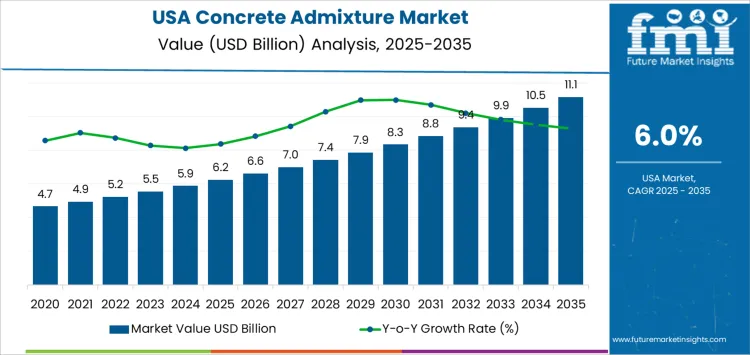
What is the Growth Forecast for the Concrete Admixture Market through 2035?
Growth momentum of the concrete admixture market in the USA shows steady and predictable increases over the forecast period, with an initial phase of stable growth followed by a gradual acceleration. Starting at USD 6.2 billion in 2025, market size increases to USD 6.6 billion in 2026, showing moderate growth in the early years. The market continues to rise steadily, reaching USD 7.0 billion in 2027 and USD 7.4 billion in 2028, driven by ongoing demand for improved concrete formulations across the construction industry.
From 2028 onward, growth accelerates, with market size reaching USD 7.9 billion in 2029, USD 8.3 billion in 2030, and USD 8.8 billion in 2031. Growth reflects rising adoption of advanced concrete admixtures and the increasing emphasis on construction quality, sustainability, and efficiency. By 2035, market size is expected to reach USD 11.1 billion, showing consistent and sustained growth, with demand driven by a combination of new construction projects, infrastructure development, and the increasing need for high-performance concrete solutions.
USA Concrete Admixture Industry Key Takeaways
| Metric | Value |
|---|---|
| Industry Sales Value (2025) | USD 6.2 billion |
| Industry Forecast Value (2035) | USD 11.1 billion |
| Industry Forecast CAGR (2025-2035) | 6% |
Why is the Demand for Concrete Admixture Growing in the USA?
Demand for concrete admixtures in the USA is rising as construction and infrastructure development activity expands across residential, commercial, and public works projects. With extensive renovation of aging infrastructure, bridge building, roadworks, and a surge in new housing and commercial developments, builders increasingly rely on admixtures to improve concrete performance. Admixtures enhance concrete’s workability, strength, durability, and resistance to environmental stress, which are key for long-lasting, safe structures.
Trends toward sustainability, regulatory standards, and demand for high-performance concrete solutions are fueling adoption. Contractors and developers are favouring admixtures that reduce water usage, lower cement content, and enable use of supplementary cementitious materials, helping reduce carbon footprints and comply with stricter environmental and building codes. As construction projects grow in scale and complexity, including high-rise buildings, heavy-duty infrastructure, and precast/ready-mix applications, admixtures such as water reducers, superplasticizers, accelerators, retarders, and air-entraining agents become essential to meet performance, safety, and sustainability requirements.
What Are the Key Segments in Concrete Admixture Market in the USA?
Concrete admixture market in the USA is segmented by type and application. Accelerating admixture leads the product type segment, accounting for 40% of the market share. By application, residential construction holds the largest share, representing 46% of the market. The growing demand for high-performance concrete in residential, infrastructure, and commercial projects is driving the adoption of various concrete admixtures in the USA.
Which Type Drives Concrete Admixture Demand in the USA?
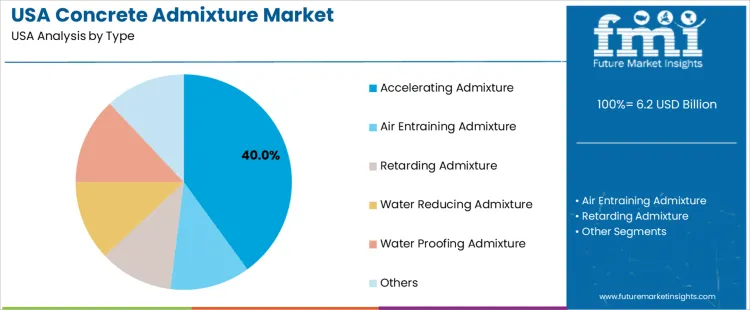
Accelerating admixture is the dominant product type in the concrete admixture market, holding 40% of the market share. These admixtures are used to speed up the setting time of concrete, making them particularly useful in cold weather conditions or when fast curing is required. Accelerating admixtures help improve the early strength development of concrete, reducing construction time and enhancing productivity. The demand for accelerating admixtures is driven by the need for faster construction timelines and the ability to meet tight project schedules. While other admixtures, such as air-entraining, retarding, water-reducing, and waterproofing admixtures, are also widely used, accelerating admixtures remain the most preferred due to their ability to enhance concrete performance and ensure timely project completion.
Which Application Drives Concrete Admixture Demand in the USA?

Residential construction is the largest application for concrete admixtures in the USA, accounting for 46% of the market share. The demand for concrete in residential projects, including single-family homes and apartment buildings, continues to rise, driving the need for high-quality concrete mixes. Concrete admixtures, particularly accelerating and water-reducing admixtures, are crucial in ensuring that concrete meets the required strength, durability, and workability for residential construction.
What is the Demand for Concrete Admixture in USA?
Demand for concrete admixtures in the USA is growing as construction and infrastructure activity continues to increase. Concrete admixtures, which are chemical or mineral additives used in concrete to modify its properties, are becoming essential in residential, commercial, and infrastructure projects. These additives help enhance the strength, durability, and performance of concrete. As need for high-performance concrete rises and building standards become more stringent, the market for concrete admixtures in the USA is expected to expand, driven by both technological advancements and an increasing focus on sustainability.
What are the Drivers of Demand for Concrete Admixture in USA?
Several factors are driving demand for concrete admixtures in the USA. Growth in construction activity, including new buildings, infrastructure projects, and residential developments, requires higher-quality concrete that can withstand environmental factors and provide greater durability. Rise of high-performance concrete, which offers enhanced strength and better resistance to external conditions, encourages the use of specialized admixtures. Shift toward sustainability in construction is promoting the use of admixtures that reduce the environmental impact of concrete, such as reducing water usage and improving the longevity of structures. Innovations in admixture technologies, which enable faster curing and improved workability, are making these products more attractive to contractors.
What are the Restraints on Demand for Concrete Admixture in USA?
Despite rising demand, certain factors are limiting the adoption of concrete admixtures in the USA. One major restraint is the higher cost of admixture-enhanced concrete relative to standard concrete, which can be a barrier for price-sensitive projects. Smaller-scale construction projects with tight budgets may opt for traditional concrete, even if it compromises long-term performance. Variability in the availability and cost of raw materials used in admixtures may lead to price instability, further affecting adoption rates. Some areas of the construction industry may have limited awareness of the benefits of using admixtures, leading to underutilization despite their potential advantages.
What are the Key Trends Influencing Demand for Concrete Admixture in USA?
Several key trends are shaping the demand for concrete admixtures in the USA. One of the most significant trends is the increasing adoption of high-performance and specialty concrete mixes, which require specific admixtures for improved strength, durability, and resistance to environmental stresses. Another trend is the focus on sustainability, with a growing preference for admixtures that reduce the carbon footprint of concrete production or replace traditional cement with more eco-friendly alternatives. There is also an increase in the use of concrete admixtures in modular and precast construction, where faster build times and consistent quality are essential. Rising regulatory standards and the emphasis on safety and performance in construction projects are driving the demand for admixtures to ensure the reliability and longevity of concrete structures.
What is the Regional Demand Outlook for the Concrete Admixture Market in the USA?
The Concrete Admixture market in the USA is projected to grow steadily, with the West USA leading the way at a projected CAGR of 6.9%. South USA follows with a growth rate of 6.2%, while the Northeast USA is expected to grow at 5.5%. The Midwest USA shows more moderate growth with a CAGR of 4.8%. Concrete admixtures, which are used to enhance the properties of concrete, such as improving workability, durability, and strength, are in high demand as the construction industry continues to expand.
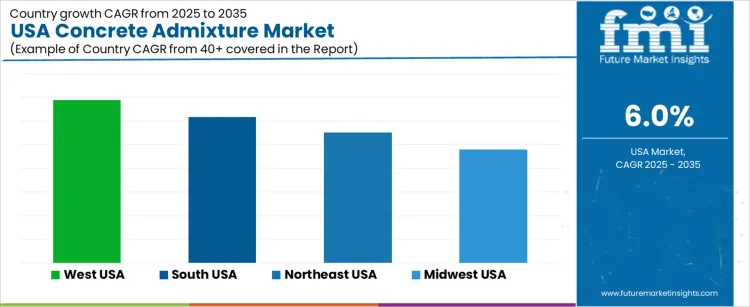
| Region | CAGR (2025-2035) |
|---|---|
| West USA | 6.9% |
| South USA | 6.2% |
| Northeast USA | 5.5% |
| Midwest USA | 4.8% |
What is Driving the Growth of Concrete Admixtures in the West USA?
West USA is projected to experience the highest growth in the Concrete Admixture market, with a projected CAGR of 6.9%. The region’s rapid urbanization, high construction activity, and focus on sustainable building practices are significant drivers of this growth. States like California, Washington, and Oregon have large construction sectors that are increasingly using concrete admixtures to improve the quality and durability of structures. Focus on green construction, energy efficiency, and reducing the environmental impact of buildings is further fueling demand for advanced concrete solutions, including admixtures. Additionally, the region’s focus on infrastructure development, residential and commercial construction, and the need for high-performance concrete in challenging environments are contributing to the adoption of concrete admixtures. As construction projects grow in complexity, the demand for concrete admixtures is expected to continue rising in the West USA.
Why is the Concrete Admixture Market Expanding in South USA?
In South USA, the Concrete Admixture market is projected to grow at a CAGR of 6.2%. The region’s rapidly growing construction industry, particularly in states like Texas, Florida, and Georgia, is a key driver of the increased demand for concrete admixtures. The South USA’s large-scale residential, commercial, and infrastructure projects require high-quality concrete solutions to meet both performance and environmental standards. As construction activity accelerates, builders are increasingly turning to concrete admixtures to improve the strength, workability, and durability of concrete. The region’s expanding focus on energy-efficient buildings and infrastructure upgrades is also contributing to the rise in demand for concrete admixtures. Additionally, the South’s moderate climate and growing population create an ongoing need for durable and cost-effective construction materials, further driving the market for concrete admixtures.
How is the Concrete Admixture Market Growing in Northeast USA?
In Northeast USA, the Concrete Admixture market is projected to grow at a CAGR of 5.5%. The region’s dense population, well-established infrastructure, and large-scale construction projects are contributing to the growing demand for concrete admixtures. Major cities like New York, Boston, and Philadelphia are seeing a rise in urban development and renovation projects, where high-performance concrete is increasingly used to meet specific structural and environmental requirements. The Northeast’s focus on sustainability and the growing adoption of green building standards are also encouraging the use of concrete admixtures to enhance concrete properties such as workability and durability. As the construction industry in the region continues to expand, the demand for advanced concrete solutions, including admixtures, is expected to increase steadily. The growing emphasis on infrastructure renewal, particularly in older urban areas, is further fueling the market for concrete admixtures in the Northeast USA.
What is Contributing to the Growth of Concrete Admixtures in Midwest USA?
In Midwest USA, the Concrete Admixture market is expected to grow at a more moderate rate of 4.8%. The region’s construction activity, while strong, is experiencing slower growth compared to the West and South. However, as infrastructure projects and residential construction continue to be a priority, particularly in states like Illinois, Ohio, and Michigan, there is increasing demand for durable and high-performance concrete. The Midwest’s emphasis on affordable housing, commercial construction, and infrastructure maintenance is driving the growing use of concrete admixtures to improve concrete’s workability and long-term performance. While the growth rate in the Midwest is slower, the continued focus on cost-effective, sustainable building practices and infrastructure upgrades is expected to drive steady demand for concrete admixtures in the region.
What is the Competitive Landscape for Demand for Concrete Admixtures in the USA?
Demand for concrete admixtures in the USA has grown significantly as construction activity expands across residential, commercial, and infrastructure projects. Developers and contractors increasingly rely on admixtures to improve concrete performance, reduce water usage, accelerate setting, enhance workability, and boost durability — especially in demanding applications like highways, bridges, commercial buildings, and multi story housing. As urbanization, infrastructure upgrades, and green building trends rise, the need for high performance, cost effective concrete solutions drives adoption of admixtures.
On the supply side, a small group of global and U.S.-based firms dominate the market. Leading suppliers include BASF SE, SIKA AG, GCP Applied Technologies, RPM International Inc., and Fosroc International. Among these, BASF SE holds a significant share in the U.S. market according to your data. These firms supply a broad portfolio of admixtures — water reducers, plasticizers and superplasticizers, air entraining agents, accelerators/retarders, waterproofing additives, and performance enhancing chemical enhancers suited for diverse concrete applications.
Competition among these suppliers centers on a few critical factors: purity and consistency of chemical blends, compliance with U.S. construction standards and regulations, ability to support high performance and sustainable concrete mixes, supply chain reliability, and technical support for complex projects. Some providers differentiate by offering advanced admixtures that reduce shrinkage, improve freeze thaw resistance, or enable high strength mixes with less cement. Others focus on scalable supply, cost efficiency, and broad distribution networks to serve large-scale construction firms. Suppliers that combine strong R&D, broad product portfolios, supply reliability, and responsiveness to evolving sustainability and performance demands are best positioned to capture growth as U.S. construction and infrastructure development continues.
Key Players of the Concrete Admixture Industry in USA
- BASF SE
- SIKA AG
- GCP Applied Technologies
- RPM International Inc
- Fosroc International
Scope of the Report
| Items | Details |
|---|---|
| Quantitative Units | USD Billion |
| Regions Covered | USA |
| Type | Accelerating Admixture; Air Entraining Admixture; Retarding Admixture; Water Reducing Admixture; Waterproofing Admixture; Others (specialty admixtures) |
| Application | Residential; Infrastructure; Commercial; Industrial |
| Key Companies Profiled | BASF SE; SIKA AG; GCP Applied Technologies; RPM International Inc.; Fosroc International |
| Additional Attributes | Dollar sales by admixture type and application show growing demand especially for water reducing and waterproofing admixtures — driven by increased infrastructure spending, demand for high performance and sustainable concrete, and stricter environmental/building code standards. Residential and infrastructure sectors lead adoption, while commercial and industrial projects also contribute significantly. |
Key Segments in the Demand for Concrete Admixture in USA
Type:
- Accelerating Admixture
- Air Entraining Admixture
- Retarding Admixture
- Water Reducing Admixture
- Water Proofing Admixture
- Others
Application:
- Residential
- Infrastructure
- Commercial
- Industrial
Region:
- Northeast USA
- West USA
- Midwest USA
- South USA
Frequently Asked Questions
How big is the demand for concrete admixture in USA in 2025?
The demand for concrete admixture in USA is estimated to be valued at USD 6.2 billion in 2025.
What will be the size of concrete admixture in USA in 2035?
The market size for the concrete admixture in USA is projected to reach USD 11.1 billion by 2035.
How much will be the demand for concrete admixture in USA growth between 2025 and 2035?
The demand for concrete admixture in USA is expected to grow at a 6.0% CAGR between 2025 and 2035.
What are the key product types in the concrete admixture in USA?
The key product types in concrete admixture in USA are accelerating admixture, air entraining admixture, retarding admixture, water reducing admixture, water proofing admixture and others.
Which application segment is expected to contribute significant share in the concrete admixture in USA in 2025?
In terms of application, residential segment is expected to command 46.0% share in the concrete admixture in USA in 2025.
Preview the report firsthand - request a free sample
Get SampleGet the brochure for pricing and purchase details.
Get PDFTable of Content
- Executive Summary
- USA Market Outlook
- Demand-side Trends
- Supply-side Trends
- Technology Roadmap Analysis
- Analysis and Recommendations
- Market Overview
- Market Coverage / Taxonomy
- Market Definition / Scope / Limitations
- Market Background
- Market Dynamics
- Drivers
- Restraints
- Opportunity
- Trends
- Scenario Forecast
- Demand in Optimistic Scenario
- Demand in Likely Scenario
- Demand in Conservative Scenario
- Opportunity Map Analysis
- Product Life Cycle Analysis
- Supply Chain Analysis
- Investment Feasibility Matrix
- Value Chain Analysis
- PESTLE and Porter’s Analysis
- Regulatory Landscape
- Regional Parent Market Outlook
- Production and Consumption Statistics
- Import and Export Statistics
- Market Dynamics
- USA Market Analysis 2020 to 2024 and Forecast, 2025 to 2035
- Historical Market Size Value (USD Million) Analysis, 2020 to 2024
- Current and Future Market Size Value (USD Million) Projections, 2025 to 2035
- Y-o-Y Growth Trend Analysis
- Absolute $ Opportunity Analysis
- USA Market Pricing Analysis 2020 to 2024 and Forecast 2025 to 2035
- USA Market Analysis 2020 to 2024 and Forecast 2025 to 2035, By Type
- Introduction / Key Findings
- Historical Market Size Value (USD Million) Analysis By Type , 2020 to 2024
- Current and Future Market Size Value (USD Million) Analysis and Forecast By Type , 2025 to 2035
- Accelerating Admixture
- Air Entraining Admixture
- Retarding Admixture
- Water Reducing Admixture
- Water Proofing Admixture
- Others
- Y-o-Y Growth Trend Analysis By Type , 2020 to 2024
- Absolute $ Opportunity Analysis By Type , 2025 to 2035
- USA Market Analysis 2020 to 2024 and Forecast 2025 to 2035, By Application
- Introduction / Key Findings
- Historical Market Size Value (USD Million) Analysis By Application, 2020 to 2024
- Current and Future Market Size Value (USD Million) Analysis and Forecast By Application, 2025 to 2035
- Residential
- Infrastructure
- Commercial
- Industrial
- Y-o-Y Growth Trend Analysis By Application, 2020 to 2024
- Absolute $ Opportunity Analysis By Application, 2025 to 2035
- Market Structure Analysis
- Competition Dashboard
- Competition Benchmarking
- Market Share Analysis of Top Players
- By Regional
- By Type
- By Application
- Competition Analysis
- Competition Deep Dive
- BASF SE
- Overview
- Product Portfolio
- Profitability by Market Segments (Product/Age /Sales Channel/Region)
- Sales Footprint
- Strategy Overview
- Marketing Strategy
- Product Strategy
- Channel Strategy
- SIKA AG
- GCP Applied Technologies
- RPM International Inc
- Fosroc International
- BASF SE
- Competition Deep Dive
- Assumptions & Acronyms Used
- Research Methodology


