

- Industry Size (2025)
- USD 887.8 Mn
- Forecast (2035)
- USD 1408.6 Mn
- CAGR (2025 to 2035)
- 4.7%
Demand for Concrete Admixture in Japan Forecast and Outlook 2025 to 2035
Construction material demand places concrete admixture consumption in Japan at USD 887.8 million in 2025, with expansion projected to USD 1,408.6 million by 2035 at a CAGR of 4.7%. Infrastructure rehabilitation, earthquake-resilient structures, and urban redevelopment programs anchor volume stability across public and private projects. Chemical admixtures for workability control, durability enhancement, and setting regulation support widespread use across residential, commercial, and transportation infrastructure. Kanto, Kinki, and Chubu remain the largest regional consumption zones due to dense urban construction pipelines and continuous renewal of aged building stock. Coastal prefectures show steady uptake tied to port upgrades and marine structures. Key suppliers such as Sika AG, BASF Construction Chemicals, Fosroc, and local producers align portfolios with performance-based formulation demand.
Mix design optimization trends shape dosing precision across ready-mix plants and precast production lines. Water-reducing and superplasticizer variants dominate batch consumption due to labor optimization at construction sites. Cold-weather and high-performance admixtures support winter concreting and high-rise pouring schedules. Domestic raw material sourcing for surfactants and polymer modifiers supports pricing stability across mid-cycle procurement contracts. Export-linked industrial construction supports demand pipelines tied to logistics, warehousing, and manufacturing clusters. Technology-driven batching systems strengthen admixture penetration through automated dosing accuracy. Regional contractors prioritize predictable curing profiles for time-bound infrastructure schedules. Demand outlook reflects stable civil engineering expenditure, long-life concrete design standards, and structured redevelopment programs across metro and regional prefectures through 2035.
Quick Stats of the Concrete Admixture Industry in Japan
- Concrete Admixture Industry in Japan Value (2025): USD 887.8 million
- Concrete Admixture Industry in Japan Forecast Value (2035): USD 1,408.6 million
- Concrete Admixture Industry in Japan Forecast CAGR (2025–2035): 4.7%
- Leading Type in Concrete Admixture Industry in Japan: Accelerating Admixture (40%)
- Key Growth Regions in Concrete Admixture Industry in Japan: Kyushu & Okinawa, Kanto, Kansai
- Top Players in Concrete Admixture Industry in Japan: Denka, Kao Construction Chemicals, BASF SE, SIKA AG, Fosroc International, GCP Applied Technologies, RPM International
What is the Demand Forecast for Concrete Admixture in Japan through 2035?
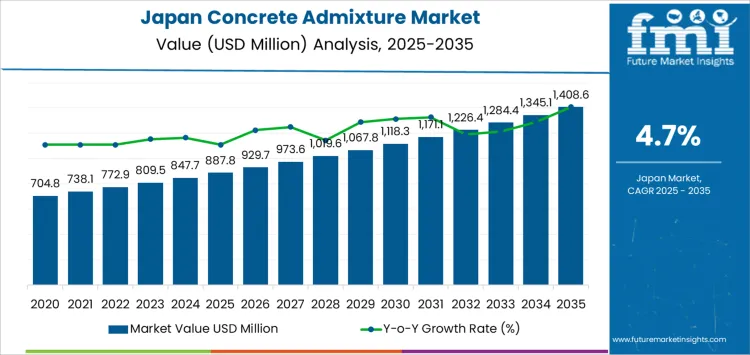
Concrete admixture demand in Japan stands at USD 887.8 million in 2025 and reaches USD 1,067.8 million by 2030, creating a USD 180.0 million value build within five years. The rise from USD 704.8 million in 2020 reflects higher admixture loading per cubic meter as construction specifications tighten for durability, early strength gain, and workability control. Usage intensity is rising across urban high-rise redevelopment, seismic retrofitting programs, and transport infrastructure maintenance. Ready-mix producers remain the central demand conduit as consistent batching accuracy becomes critical for large pours. Growth in this phase is shaped by higher penetration of superplasticizers, shrinkage reducers, and air-entraining systems across standard structural concrete applications.
From 2030 to 2035, demand increases from USD 1,067.8 million to USD 1,408.6 million, adding USD 340.8 million in the later phase. Annual increments widen as public works spending accelerates across coastal protection, tunnels, and bridge rehabilitation programs. Aging concrete assets drive stronger use of corrosion inhibitors and permeability-reducing admixtures to extend service life. Precast manufacturing also contributes to rising volumes as modular construction expands in logistics, healthcare, and data center projects. Material cost inflation lifts admixture value per project while volume growth continues at steady pace.
Concrete Admixture Industry in Japan Key Takeaways
| Metric | Value |
|---|---|
| Industry Value (2025) | USD 887.8 million |
| Forecast Value (2035) | USD 1,408.6 million |
| Forecast CAGR (2025–2035) | 4.7% |
What Is Driving the Demand for Concrete Admixture in Japan?
The demand for concrete admixture in Japan is shaped by seismic construction standards, aging infrastructure renewal, and the high specification requirements of urban development. Japans building codes require precise control of strength, workability, and durability to withstand earthquake stress and long service life. This created deep reliance on admixtures for water reduction, air entrainment, set control, and crack resistance across residential, commercial, and civil engineering projects. Large scale use in tunnels, bridges, coastal defenses, and high rise foundations strengthened demand for performance enhancing additives that stabilize concrete under variable temperature and humidity conditions. Urban congestion also reinforced usage as admixtures allow faster placement, reduced vibration time, and improved flow in dense reinforcement zones.
Future demand for concrete admixture in Japan will be shaped by infrastructure rehabilitation, renewable energy construction, and labor productivity pressure in the construction sector. Repair of expressways, ports, and flood control systems will require specialty admixtures for corrosion resistance and extended durability. Offshore wind foundations, hydrogen facilities, and data centers will add new demand for high performance concrete systems. Labor shortages will further increase reliance on admixtures that improve pumpability and reduce manual finishing time. Barriers include rising raw material costs, conservative specification practices in public projects, and performance variation under recycled aggregate usage. Long term demand will depend on how effectively admixture technologies support faster construction, longer structure life, and compliance with Japans strict safety and durability expectations.
What Is the Demand for Concrete Admixture in Japan by Type and Application?
The demand for concrete admixture in Japan is shaped by dense urban construction, seismic design requirements, and high standards for durability and workability. Accelerating admixture leads by type due to the need for faster setting in congested construction schedules and cold weather placements. Residential leads by application because of continuous housing redevelopment, earthquake resistant retrofitting, and prefabricated concrete use. Procurement is driven by ready mix producers, large contractors, and precast component manufacturers. Import reliance remains present for select chemical additives and formulation components. Substitution pressure exists across admixture blends based on seasonal placement needs. Demand stability is supported by sustained housing renewal and infrastructure maintenance activity.
Why does accelerating admixture dominate the demand for concrete admixture in Japan by type?
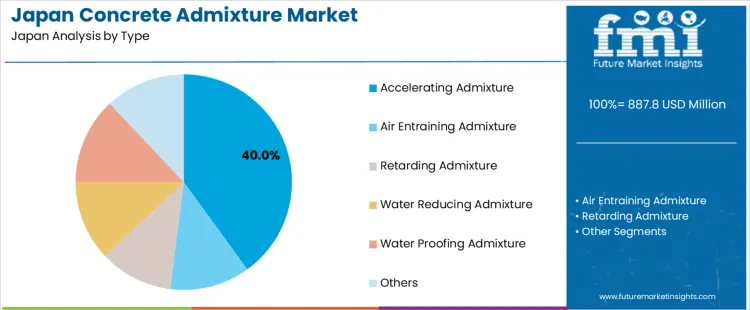
Accelerating admixture accounts for 40% of the demand for concrete admixture in Japan by type, reflecting strong use in fast track construction and cold climate concreting. Consumption intensity is driven by urban night work, tunnel construction, precast element production, and winter placement where early strength gain is required. Usage remains stable because compressed project timelines require predictable setting behavior. Procurement is led by ready mix suppliers and precast yards serving metropolitan projects. Price sensitivity remains moderate because time savings reduce labor and formwork costs. Specification control emphasizes controlled set acceleration, strength development consistency, and compatibility with cement chemistry used in Japan.
Accelerating admixtures also generate steady repeat demand through continuous high rise residential and transport related concrete placements. Repeat utilization remains predictable because most projects follow staged pouring schedules. Buyers favor formulations that maintain slump control while delivering early strength. Margin structure remains controlled under competition among domestic chemical suppliers. Regulatory exposure centers on performance validation and construction material standards. Import reliance persists for select active compounds. Substitution pressure from steam curing exists in precast applications, though accelerating admixtures remain preferred for cast in place concrete requiring faster turnaround.
What drives residential construction to lead the demand for concrete admixture in Japan by application?
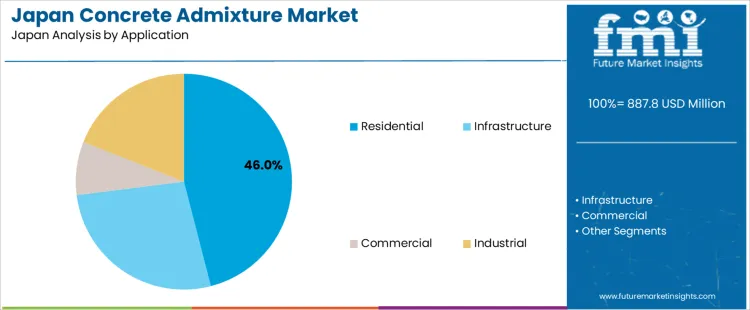
Residential represents 46.0% of the demand for concrete admixture in Japan by application, reflecting continuous rebuilding of housing stock and seismic reinforcement programs. Consumption intensity is driven by apartment complexes, detached housing, and urban regeneration projects that rely on ready mix concrete. Usage remains stable because housing renewal remains a national priority due to aging buildings and disaster resilience requirements. Procurement is dominated by regional contractors and concrete producers supplying neighborhood scale projects. Price sensitivity remains moderate because material performance directly affects construction efficiency and long term durability. Specification control emphasizes workability retention, early strength gains, and crack control under residential pouring conditions.
Residential construction also generates consistent repeat demand through phased redevelopment programs and multi block housing projects. Repeat utilization remains predictable because housing projects proceed in structured pouring sequences. Buyers favor standardized admixture packages that suit general purpose residential mixes. Margin structure remains controlled under competitive bidding and long term supply agreements. Regulatory exposure remains elevated due to seismic code compliance and building quality inspections. Import reliance remains limited for general purpose admixtures. Substitution pressure from alternative building materials exists in low rise construction, though reinforced concrete remains the primary structural choice in dense urban housing.
What Is Driving the Demand for Concrete Admixture in Japan Structural Reliability and Urban Infrastructure Renewal?
Demand for concrete admixture in Japan is shaped by seismic construction standards, urban redevelopment cycles, and durable infrastructure maintenance. High-rise housing, elevated transport corridors, and coastal protection works rely on admixtures to control setting time, flow retention, shrinkage, and long-term strength. Aging bridges, tunnels, and port facilities require repair mortars and corrosion control systems supported by specialty admixtures. Ready-mix producers tune formulations for seasonal humidity swings and long truck transit within dense cities. Demand follows public works budgeting, private condominium renewal, and continuous maintenance programs that prioritize structural performance, workability control, and life-cycle reliability in demanding environmental conditions across metropolitan zones.
How Are Seismic Upgrading Programs Directing Admixture Selection in Japan?
Seismic retrofitting across Japan drives steady demand for high-performance plasticizers, corrosion inhibitors, and crack control additives. Bridge pier jacketing, building column wrapping, and base isolation foundations require controlled flow and rapid strength gain under constrained work windows. Nighttime construction in dense districts raises the value of fast setting and low bleed formulations. Admixtures that stabilize performance under vibration and temperature variation remain preferred. Public infrastructure owners specify performance grades through detailed mix design standards rather than contractor discretion. This regulatory structure channels admixture demand toward validated seismic performance rather than general construction acceleration across transport, utility, and public facility reinforcement projects nationwide.
How Is Ready-Mix Logistics and Urban Density Shaping Daily Admixture Consumption?
Japan dense urban logistics place strict limits on concrete delivery time between batching plant and placement site. Traffic congestion, narrow access roads, and extended pump lines heighten the need for slump retention and controlled hydration. Admixtures that preserve flow without segregation support consistent placing across high-rise floors and deep foundations. Summer heat and winter cold require seasonal adjustment of retarding and accelerating systems. Producers rely on admixture tuning to match narrow placement windows set by municipal permits. Daily consumption links directly to pour scheduling discipline rather than raw cement volume growth across city-based residential and commercial construction projects each year.
What Limits the Pace of Admixture Expansion in Japan Construction Supply Chains?
Concrete admixture demand in Japan faces control from strict material certification, price sensitivity in public bidding, and tight contractor margins. New formulations require extensive field trials and approval within municipal specification frameworks. Raw material cost exposure, especially for polymers and specialty chemicals, pressures stable long-term pricing. Smaller ready-mix operators resist frequent product switching due to dosing system calibration risk. Skilled technical support remains essential for proper application, which concentrates adoption among larger producers. These commercial and technical boundaries slow rapid penetration of novel admixture chemistries despite continuous structural demand across major infrastructure and real estate development programs in urban prefectures.
What is the Demand for Concrete Admixture in Japan by Region?
| Region | CAGR (%) |
|---|---|
| Kyushu & Okinawa | 5.9% |
| Kanto | 5.4% |
| Kansai | 4.8% |
| Chubu | 4.2% |
| Tohoku | 3.7% |
| Rest of Japan | 3.5% |
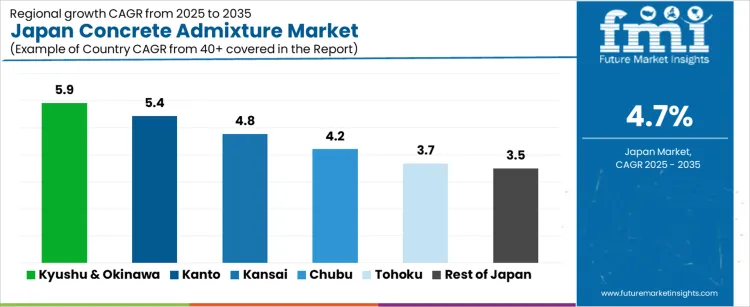
The demand for concrete admixture in Japan is increasing steadily across construction focused regions, with Kyushu and Okinawa leading at a 5.9% CAGR. Growth in this region is supported by port infrastructure upgrades, tourism oriented commercial construction, and public works tied to disaster resilient development. Kanto follows at 5.4%, driven by large scale urban redevelopment, transport infrastructure renewal, and steady demand from high rise residential projects. Kansai records 4.8% growth, reflecting consistent consumption in industrial parks, logistics facilities, and municipal construction. Chubu at 4.2% shows moderate uptake linked to automotive industrial expansions and regional infrastructure maintenance. Tohoku and the Rest of Japan, at 3.7% and 3.5%, reflect slower growth shaped by lower construction intensity, population decline, and longer public project development cycles.
How Is Infrastructure Renewal Supporting Concrete Admixture Demand in Kyushu and Okinawa?
Demand for concrete admixture in Kyushu and Okinawa is advancing at a CAGR of 5.9% through 2035, supported by steady public infrastructure renewal, coastal construction activity, and durability focused concrete formulation needs. Port upgrades, highway rehabilitation, and disaster resilient housing projects form the core demand base. This region shows strong use of water reducing and corrosion inhibiting admixtures due to humid coastal conditions. Growth reflects government funded civil engineering programs, rising precast concrete usage, and stable contractor procurement cycles across transport and public utility projects.
- Coastal construction drives corrosion resistant admixture use
- Public infrastructure projects anchor steady volume demand
- Precast concrete expansion supports specialty additive adoption
- Highway and port upgrades sustain long term consumption
Why Is High Density Urban Construction Driving Admixture Growth in Kanto?
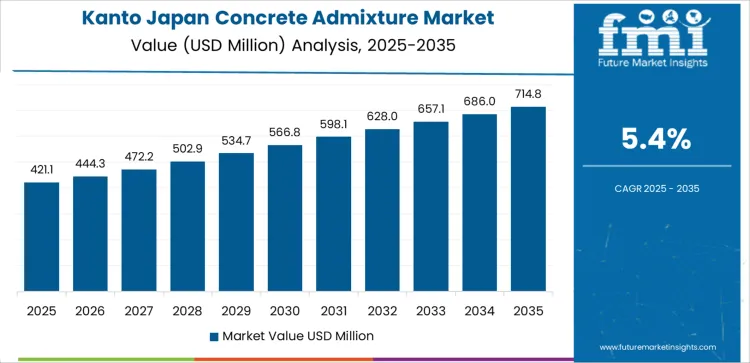
Demand for concrete admixture in Kanto is rising at a CAGR of 5.4% through 2035, driven by large scale commercial redevelopment, residential high rise construction, and continuous urban infrastructure upgrades. Kanto shows strong demand for superplasticizers and early strength enhancers used in fast cycle construction schedules. This region leads in ready mix concrete production and advanced mix design adoption. Growth is supported by megacity transport projects, data center construction, and sustained private sector real estate investment across the urban corridor.
- Commercial redevelopment fuels high volume admixture demand
- Ready mix concrete plants drive technical additive usage
- Fast curing admixtures support accelerated build schedules
- Real estate investment sustains long term material flow
What Is Sustaining Balanced Concrete Admixture Usage Across Kansai?
Demand for concrete admixture in Kansai is progressing at a CAGR of 4.8% through 2035, supported by steady residential construction, municipal infrastructure works, and moderate commercial development across Osaka and Kyoto. Kansai shows balanced usage across water reducers, retarders, and air entraining agents. This region reflects controlled growth without major project concentration shifts. Demand remains anchored in housing renovation, public facility construction, and transport maintenance projects managed through stable municipal investment cycles.
- Municipal infrastructure works support recurring material demand
- Residential renovation sustains consistent admixture consumption
- Balanced additive portfolio supports diverse construction needs
- Public facility upgrades guide stable procurement patterns
How Is Manufacturing Linked Construction Activity Shaping Admixture Demand in Chubu?
Demand for concrete admixture in Chubu is advancing at a CAGR of 4.2% through 2035, supported by factory construction, logistics park development, and steady urban expansion in Aichi. Chubu shows strong linkage between industrial investment cycles and construction material demand. Admixture usage remains focused on strength enhancing and shrinkage reducing formulations for industrial flooring and heavy load structures. Growth reflects steady manufacturing plant upgrades, warehouse construction for automotive supply chains, and continuous infrastructure support around industrial zones.
- Industrial flooring drives demand for strength enhancing additives
- Logistics park construction supports steady volume growth
- Automotive supply chain investment sustains material consumption
- Factory upgrades anchor recurring construction activity
Why Is Public Works Spending Driving Moderate Admixture Growth in Tohoku?
Demand for concrete admixture in Tohoku is advancing at a CAGR of 3.7% through 2035, supported by public works investment, flood control infrastructure, and gradual urban redevelopment focused on resilience. Miyagi anchors regional demand through coastal protection and transport maintenance projects. Tohoku shows limited large scale private construction activity. Admixture demand remains focused on freeze resistant and durability enhancing formulations used for bridges, embankments, and regional highway works.
- Flood control projects drive durability additive usage
- Transport maintenance sustains base level demand
- Public works budgets anchor procurement stability
- Freeze resistant formulations support climatic performance
How Is Small City Development Influencing Concrete Admixture Demand in Rest of Japan?
Demand for concrete admixture in Rest of Japan is advancing at a CAGR of 3.5% through 2035, supported by local road construction, housing development, and basic public facility upgrades. These areas show limited exposure to large commercial construction but steady municipal project pipelines. Admixture usage remains centered on general purpose water reducers and air entraining agents for routine concrete works. Growth remains stable and guided by rural infrastructure support, housing renewal activity, and controlled public spending patterns.
- Local road projects sustain baseline admixture demand
- Housing development supports steady consumption volumes
- General purpose additives dominate regional usage
- Municipal facility upgrades guide material procurement
What Is Driving the Demand for Concrete Admixture in Japan and Which Companies Shape Construction Supply
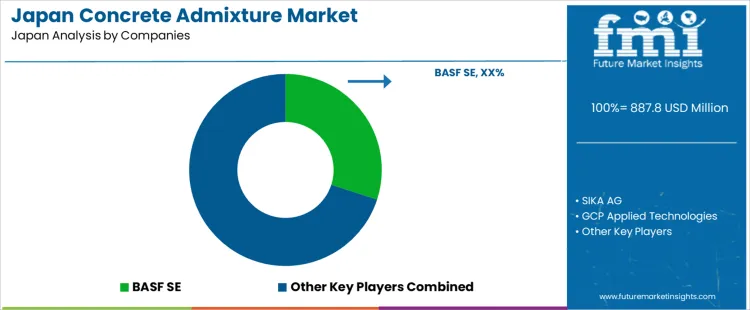
The demand for concrete admixture in Japan is shaped by seismic reinforcement programs, tunnel and bridge maintenance, high rise redevelopment, and strict performance control in ready mix operations. Denka holds a central domestic position through chemical admixtures used in high durability concrete for infrastructure and marine construction. Kao Construction Chemicals supports demand through water reducing agents and workability control systems used in precast and civil engineering projects. BASF SE operates through its Japanese admixture business supporting high performance concrete used in commercial buildings and transport infrastructure. SIKA AG maintains a strong position through shotcrete admixtures, waterproofing systems, and repair mortars supplied to tunneling and underground construction across major regions.
Fosroc International supports selected large civil projects through specialty admixtures used in long span structures and industrial foundations. GCP Applied Technologies participates through imported performance additives used in high specification ready mix operations tied to multinational contractors. RPM International contributes through niche cement modifiers and protective construction chemicals used in repair and rehabilitation work. Procurement in Japan is governed by JIS conformity, slump retention performance, freeze thaw resistance, and chloride control for coastal infrastructure. Buyer preference favors suppliers with domestic production, on-site technical service, and rapid formulation adjustment for seasonal temperature shifts. Demand visibility tracks urban redevelopment budgets, transport corridor upgrades, coastal defense projects, and continued public investment in disaster resilient construction.
Key Players in the Concrete Admixture Industry in Japan
- Siemens Energy
- ITM Power
- Ørsted A/S
- Mitsubishi Heavy Industries
- NEL ASA
Scope of the Report
| Items | Values |
|---|---|
| Quantitative Units (2025) | USD million |
| Type | Accelerating Admixture, Air Entraining Admixture, Retarding Admixture, Water Reducing Admixture, Water Proofing Admixture, Others |
| Application | Residential, Infrastructure, Commercial, Industrial |
| End User | Ready Mix Producers, Contractors, Precast Manufacturers |
| Region | Kyushu & Okinawa, Kanto, Kansai, Chubu, Tohoku, Rest of Japan |
| Countries Covered | Japan |
| Key Companies Profiled | Denka, Kao Construction Chemicals, BASF SE, SIKA AG, Fosroc International, GCP Applied Technologies, RPM International |
| Additional Attributes | Dollar by sales by type and application; Regional CAGR and growth patterns; Urban vs regional consumption dynamics; Usage across seismic retrofitting, high-rise, and coastal projects; Performance-based admixture selection for workability, durability, and early strength; Seasonal and cold-weather placement adaptation; Import reliance for specialty chemical components; Repeat procurement cycles in phased construction and maintenance projects; Regulatory compliance including JIS conformity, slump retention, freeze-thaw resistance, and chloride control; Technical support, on-site formulation adjustment, and batching optimization |
Concrete Admixture Industry in Japan Segmentation
Type:
- Accelerating Admixture
- Air Entraining Admixture
- Retarding Admixture
- Water Reducing Admixture
- Water Proofing Admixture
- Others
Application:
- Residential
- Infrastructure
- Commercial
- Industrial
Region
- Kyushu & Okinawa
- Kanto
- Kansai
- Chubu
- Tohoku
- Rest of Japan
Frequently Asked Questions
How big is the demand for concrete admixture in Japan in 2025?
The demand for concrete admixture in Japan is estimated to be valued at USD 887.8 million in 2025.
What will be the size of concrete admixture in Japan in 2035?
The market size for the concrete admixture in Japan is projected to reach USD 1,408.6 million by 2035.
How much will be the demand for concrete admixture in Japan growth between 2025 and 2035?
The demand for concrete admixture in Japan is expected to grow at a 4.7% CAGR between 2025 and 2035.
What are the key product types in the concrete admixture in Japan?
The key product types in concrete admixture in Japan are accelerating admixture, air entraining admixture, retarding admixture, water reducing admixture, water proofing admixture and others.
Which application segment is expected to contribute significant share in the concrete admixture in Japan in 2025?
In terms of application, residential segment is expected to command 46.0% share in the concrete admixture in Japan in 2025.
Preview the report firsthand - request a free sample
Get SampleGet the brochure for pricing and purchase details.
Get PDFTable of Content
- Executive Summary
- Japan Market Outlook
- Demand-side Trends
- Supply-side Trends
- Technology Roadmap Analysis
- Analysis and Recommendations
- Market Overview
- Market Coverage / Taxonomy
- Market Definition / Scope / Limitations
- Market Background
- Market Dynamics
- Drivers
- Restraints
- Opportunity
- Trends
- Scenario Forecast
- Demand in Optimistic Scenario
- Demand in Likely Scenario
- Demand in Conservative Scenario
- Opportunity Map Analysis
- Product Life Cycle Analysis
- Supply Chain Analysis
- Investment Feasibility Matrix
- Value Chain Analysis
- PESTLE and Porter’s Analysis
- Regulatory Landscape
- Regional Parent Market Outlook
- Production and Consumption Statistics
- Import and Export Statistics
- Market Dynamics
- Japan Market Analysis 2020 to 2024 and Forecast, 2025 to 2035
- Historical Market Size Value (USD Million) Analysis, 2020 to 2024
- Current and Future Market Size Value (USD Million) Projections, 2025 to 2035
- Y-o-Y Growth Trend Analysis
- Absolute $ Opportunity Analysis
- Japan Market Pricing Analysis 2020 to 2024 and Forecast 2025 to 2035
- Japan Market Analysis 2020 to 2024 and Forecast 2025 to 2035, By Type
- Introduction / Key Findings
- Historical Market Size Value (USD Million) Analysis By Type , 2020 to 2024
- Current and Future Market Size Value (USD Million) Analysis and Forecast By Type , 2025 to 2035
- Accelerating Admixture
- Air Entraining Admixture
- Retarding Admixture
- Water Reducing Admixture
- Water Proofing Admixture
- Others
- Y-o-Y Growth Trend Analysis By Type , 2020 to 2024
- Absolute $ Opportunity Analysis By Type , 2025 to 2035
- Japan Market Analysis 2020 to 2024 and Forecast 2025 to 2035, By Application
- Introduction / Key Findings
- Historical Market Size Value (USD Million) Analysis By Application, 2020 to 2024
- Current and Future Market Size Value (USD Million) Analysis and Forecast By Application, 2025 to 2035
- Residential
- Infrastructure
- Commercial
- Industrial
- Y-o-Y Growth Trend Analysis By Application, 2020 to 2024
- Absolute $ Opportunity Analysis By Application, 2025 to 2035
- Market Structure Analysis
- Competition Dashboard
- Competition Benchmarking
- Market Share Analysis of Top Players
- By Regional
- By Type
- By Application
- Competition Analysis
- Competition Deep Dive
- BASF SE
- Overview
- Product Portfolio
- Profitability by Market Segments (Product/Age /Sales Channel/Region)
- Sales Footprint
- Strategy Overview
- Marketing Strategy
- Product Strategy
- Channel Strategy
- SIKA AG
- GCP Applied Technologies
- RPM International Inc
- Fosroc International
- BASF SE
- Competition Deep Dive
- Assumptions & Acronyms Used
- Research Methodology


