

- Industry Size (2026)
- USD 79 Mn
- Forecast (2036)
- USD 136.2 Mn
- CAGR (2026 to 2036)
- 5.6%
Demand for Erythema Treatment in USA Forecast and Outlook 2026 to 2036
The demand for erythema treatment in the USA is expected to grow from USD 79 million in 2026 to USD 136.2 million in 2036, reflecting a 5.60% CAGR over the forecast period. A 10-year growth comparison shows a steady increase in demand for erythema treatment. Starting from USD 60.1 million in 2026, the demand grows gradually year by year, with small incremental increases, such as reaching USD 63.5 million in 2027 and USD 67.1 million in 2028. This steady growth continues through 2029, when demand reaches USD 70.8 million, driven by rising awareness of erythema and the development of more effective treatments.
Quick Stats of the Demand for Erythema Treatment in USA
- Demand for Erythema Treatment in USA Value (2026): USD 79 million
- Demand for Erythema Treatment in USA Forecast Value (2036): USD 136.2 million
- Demand for Erythema Treatment in USA Forecast CAGR (2026-2036): 5.6%
- Demand for Erythema Treatment in USA Leading Drug Type: Corticosteroids
- Demand for Erythema Treatment in USA Key Growth Regions: West USA, South USA, Northeast USA, Midwest USA
- Demand for Erythema Treatment in USA Top Players: Pfizer Inc., Novartis AG, GlaxoSmithKline plc (GSK), AbbVie Inc., Bausch Health Companies Inc.
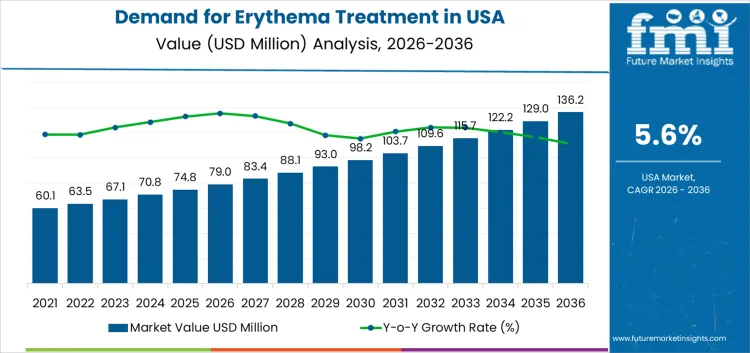
By 2031, the growth accelerates slightly, reaching USD 79.0 million, and then further increases to USD 83.4 million in 2032. The demand continues to rise in the subsequent years, reaching USD 93.0 million in 2034 and USD 98.2 million in 2035. The most significant rise occurs between 2034 and 2036, with demand jumping from USD 122.2 million in 2035 to USD 136.2 million in 2036. This final surge in demand reflects the growing adoption of advanced treatment options, increasing prevalence of erythema, and the rise in consumer awareness and access to treatment. The 10-year growth comparison indicates a steady upward trend with some acceleration in later years.
Demand for Erythema Treatment in USA Key Takeaways
| Metric | Value |
|---|---|
| Demand for Erythema Treatment in USA Value (2026) | USD 79 million |
| Demand for Erythema Treatment in USA Forecast Value (2036) | USD 136.2 million |
| Demand for Erythema Treatment in USA Forecast CAGR (2026-2036) | 5.6% |
Why is the Demand for Erythema Treatment in USA Growing?
The demand for erythema treatment in the USA is growing due to the increasing prevalence of skin conditions that cause redness and inflammation, such as sunburn, acne, rosacea, and allergic reactions. Erythema, the redness of the skin caused by increased blood flow to the capillaries, is commonly seen in various dermatological conditions. As consumers become more aware of the effects of environmental stressors, such as UV exposure and pollution, there is an increasing focus on skin health and treatments for erythema. The rising popularity of skincare routines, combined with the desire for effective treatments for irritated and inflamed skin, is driving demand for erythema therapies.
Key drivers for this growth include the increasing number of individuals suffering from skin conditions like rosacea, which can cause chronic erythema, and the growing emphasis on aesthetic treatments. As people look for solutions to reduce redness and inflammation, both for cosmetic and medical reasons, demand for topical treatments, oral medications, and advanced therapies is on the rise. The expanding availability of over-the-counter products for mild erythema cases and prescription treatments for more severe cases is increasing treatment options for a broader range of consumers.
Technological advancements in dermatological treatments, such as targeted therapies for inflammation and the development of new anti-inflammatory drugs, are further contributing to the demand for erythema treatments. Despite challenges such as the diversity in underlying causes of erythema and the varying effectiveness of treatments, the continued awareness of skin health and the development of innovative therapies are expected to drive steady growth in the demand for erythema treatment in the USA through 2036.
What is the Segment-Wise Analysis of Demand for Erythema Treatment in USA?
Demand for erythema treatment in the USA is segmented by drug type, route of administration, distribution channel, and region. By drug type, corticosteroids lead with 35% of the demand, followed by antihistamines, antibiotics, and calcineurin inhibitors. In terms of route of administration, topical treatments account for 65% of the demand, with oral medications making up the remainder. Regarding distribution channels, online pharmacies, hospital pharmacies, and retail pharmacies are the primary sources. Regionally, demand is distributed across West USA, South USA, Northeast USA, and Midwest USA.
How Does Corticosteroids Lead the Demand for Erythema Treatment in USA?
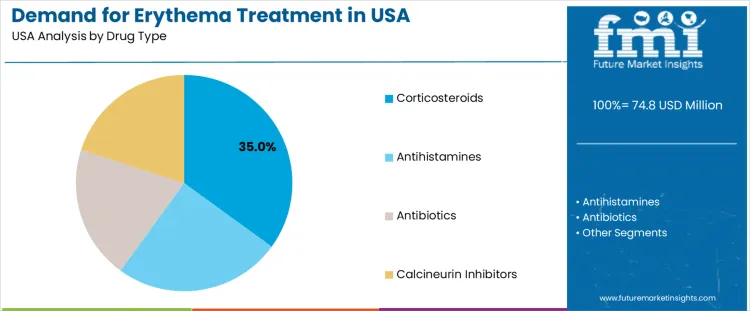
Corticosteroids account for 35% of the demand for erythema treatment in the USA, driven by their ability to reduce inflammation and provide relief from the redness and swelling associated with erythema. As the most commonly prescribed treatment for this condition, corticosteroids are available in various forms, including creams, ointments, and lotions, making them versatile and effective for topical use. Their ability to quickly soothe irritated skin and manage allergic reactions contributes to their widespread use.
Additionally, corticosteroids are often used as part of a multi-pronged treatment approach for erythema, especially when the condition is linked to other dermatological issues or immune system responses. As consumers seek fast, reliable, and effective treatments for erythema, corticosteroids remain a dominant and essential drug in the market, with continued demand expected as awareness of skin conditions rises.
How Does Topical Route of Administration Lead the Demand for Erythema Treatment in USA?
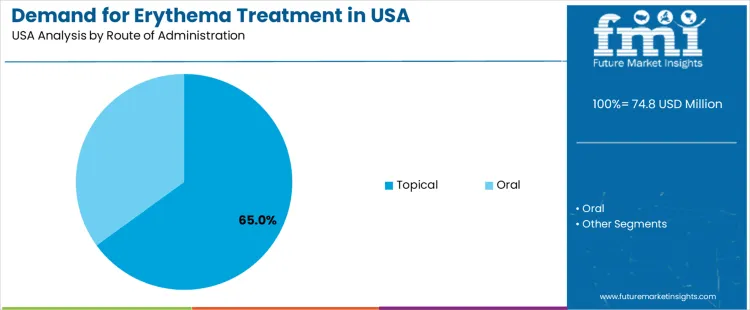
Topical treatments account for 65% of the demand for erythema treatment in the USA, driven by their effectiveness and targeted application. The topical route allows for direct delivery of medications like corticosteroids, antihistamines, and calcineurin inhibitors to the affected skin areas, providing faster relief from the symptoms of erythema, such as redness, swelling, and irritation.
Topical treatments are preferred for localized conditions, as they are easy to apply and generally have fewer systemic side effects compared to oral medications. The growing demand for convenient, non-invasive treatments for dermatological conditions has made topical treatments the most widely used method for managing erythema. As skin conditions continue to be a significant health concern, the demand for topical erythema treatments remains strong, with patients seeking effective, targeted relief for their symptoms.
What are the Key Trends, Drivers and Restraints in Demand for Erythema Treatment in USA?
Erythema, which refers to redness of the skin caused by irritation, inflammation, rosacea, or sun exposure, often requires targeted topical or systemic therapies, laser treatments, or lifestyle management. Drivers include increasing incidence of skin conditions related to environmental stressors, aging populations with sensitive skin, and broader access to dermatology care. Restraints include variability in insurance coverage for dermatologic care, differences in product efficacy and safety perceptions, and the tendency of some individuals to self‑treat mild cases with over‑the‑counter remedies rather than seek professional medical care.
Why is Demand for Erythema Treatment Growing in USA?
Demand for erythema treatment in the USA is growing as more people seek solutions for visible skin redness linked to conditions such as rosacea, dermatitis, acne, and UV damage. Greater awareness of dermatologic health and cosmetic concerns drives patients to consult specialists for effective treatment. The aging population, often with increased skin sensitivity and vascular changes, contributes to higher incidence of erythema. Rising use of social media and beauty influencers has also heightened attention to skin appearance, motivating consumers to seek professional interventions. Moreover, broader health coverage, teledermatology options, and improved access to skincare professionals make treatment more accessible to diverse populations, sustaining growth in demand.
How are Technological and Industry Innovations Driving Erythema Treatment Demand in USA?
Technological innovations are enhancing erythema treatment demand in the USA by improving diagnostic accuracy, treatment effectiveness, and patient experience. Advanced imaging tools and digital dermatology platforms help clinicians assess skin redness and tailor individualized treatment plans. Laser and light‑based therapies, such as pulsed dye lasers and intense pulsed light, offer targeted reduction of redness with minimal downtime, increasing patient interest. Developments in topical formulations, including anti‑inflammatory agents, barrier repair creams, and specialized serums, provide additional non‑invasive options. Telehealth and mobile dermatology apps also expand access to expert care, allowing remote consultation and treatment monitoring. These innovations make erythema treatment more effective, personalized, and accessible.
What are the Key Challenges and Risks That Could Limit Erythema Treatment Demand in USA?
Insurance coverage for dermatologic procedures varies, and out‑of‑pocket costs for advanced therapies like lasers may deter some individuals. Misdiagnosis or delayed diagnosis of underlying causes can lead to ineffective management, reducing confidence in available treatments. Over‑the‑counter products marketed for redness may create unrealistic expectations, leading some consumers to avoid professional care. Access to dermatology specialists remains uneven, particularly in rural areas, limiting treatment opportunities. Certain innovative treatments may carry risks or side effects, requiring clinical oversight that some individuals may not seek or afford. These factors could temper demand growth.
What is the Regional Demand Outlook for Erythema Treatment in USA?
| Region | CAGR (%) |
|---|---|
| West USA | 6.4% |
| South USA | 5.8% |
| Northeast USA | 5.2% |
| Midwest USA | 4.5% |
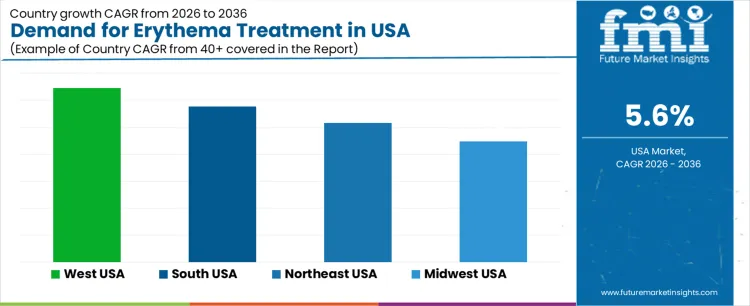
Demand for erythema treatment in the USA is growing steadily, with West USA leading at a 6.4% CAGR, driven by a strong focus on skincare and dermatological care. South USA follows with a 5.8% CAGR, supported by the region’s high levels of sun exposure and growing awareness of skin health. Northeast USA shows a 5.2% CAGR, fueled by an increasing focus on skincare and specialized dermatological services. Midwest USA experiences a 4.5% CAGR, with moderate growth driven by an increasing focus on skin health and the effects of environmental factors.
How is Demand for Erythema Treatment Growing in West USA?
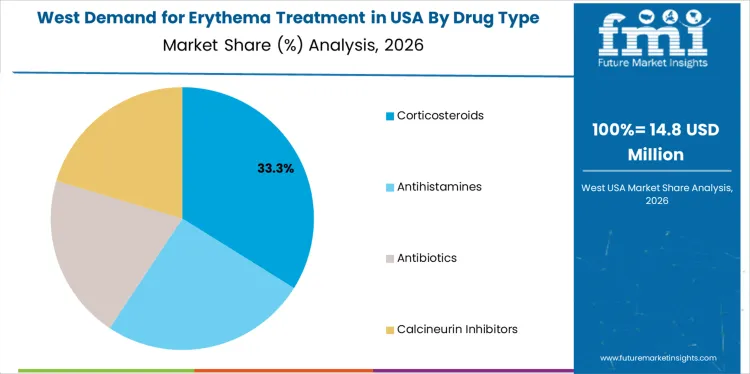
West USA leads the demand for erythema treatment, growing at a 6.4% CAGR. The region’s strong focus on skincare and dermatological care, combined with its large population and emphasis on cosmetic treatments, is driving this growth. States like California, Oregon, and Washington have a high concentration of dermatology clinics and wellness centers where erythema treatments are increasingly popular due to rising awareness of skin conditions and the importance of skincare. The growing use of skincare products, including those aimed at reducing redness, irritation, and inflammation, is contributing to the demand for erythema treatment. As consumers continue to prioritize skin health and the management of conditions such as erythema, the demand for effective and accessible treatment options in West USA is expected to rise steadily.
Why is Demand for Erythema Treatment Rising in South USA?
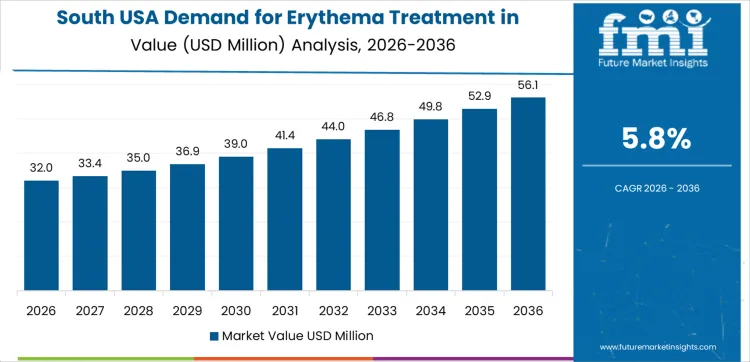
South USA is experiencing steady demand for erythema treatment, with a 5.8% CAGR. The region’s warm climate and high levels of sun exposure contribute to an increased prevalence of skin conditions like erythema. States like Texas, Florida, and Georgia are seeing a rise in dermatological services focused on treating erythema and other skin issues related to sun exposure. As awareness of skincare and the impact of UV radiation on skin health increases, more consumers are seeking effective erythema treatments. The region’s growing healthcare infrastructure and focus on improving skincare treatments also contribute to the increasing demand. As the South continues to experience higher rates of skin conditions due to climate factors, the demand for erythema treatments will remain strong, driven by both preventative care and treatment options.
How is Demand for Erythema Treatment Expanding in Northeast USA?
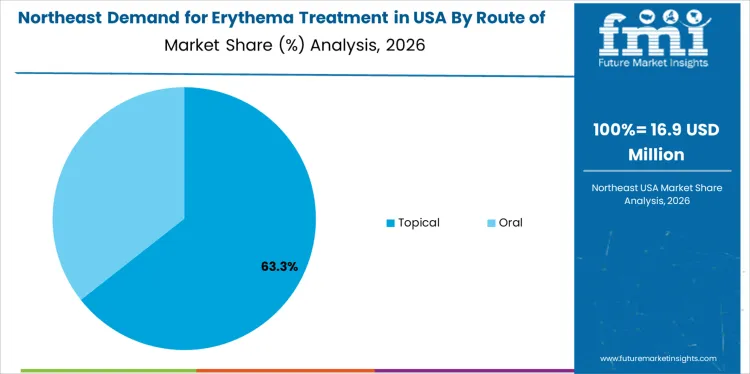
Northeast USA is seeing steady demand for erythema treatment, with a 5.2% CAGR. The region’s strong healthcare infrastructure, particularly in dermatology, contributes to the growth of erythema treatment services. States like New York, Pennsylvania, and Massachusetts have a high number of skincare professionals who specialize in treating various skin conditions, including erythema. As the region's population becomes more aware of the effects of environmental factors, such as cold weather and sun exposure, the demand for erythema treatment is on the rise. Northeast’s increasing focus on preventive skincare, including treatments for redness and irritation, supports the growth of the market. As more people seek treatments to improve skin health and reduce the appearance of erythema, demand for specialized care will continue to expand, particularly in urban centers where access to dermatological services is growing.
Why is Demand for Erythema Treatment Growing in Midwest USA?
Midwest USA is experiencing moderate demand for erythema treatment, with a 4.5% CAGR. The region’s healthcare providers are increasingly focused on managing skin conditions like erythema, particularly as awareness of skin health improves. States like Michigan, Illinois, and Ohio are seeing an uptick in dermatological services, with clinics offering treatments to reduce redness and irritation caused by a variety of factors. The Midwest’s colder climate can also contribute to dry skin, leading to erythema and other related conditions, further increasing demand for treatment options. As consumers become more conscious of the effects of environmental exposure and skincare, the demand for effective erythema treatment is expected to grow steadily. With an increasing number of dermatologists offering specialized care, the market for erythema treatments in the Midwest is expected to continue expanding, particularly as more people seek solutions for improving skin appearance and health.
What is the Competitive Landscape of Erythema Treatment in USA?
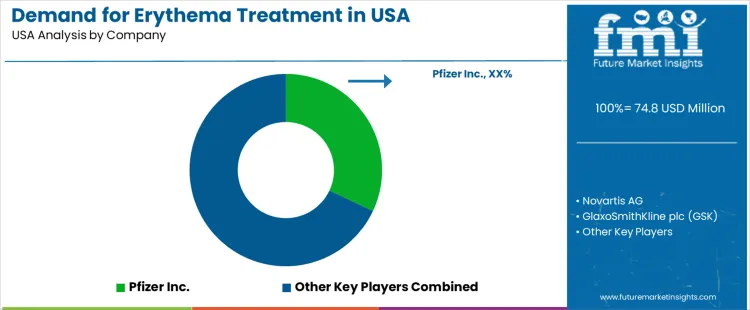
Demand for erythema treatment in the USA is growing as more patients seek effective solutions for managing redness and irritation of the skin, often caused by inflammatory conditions like rosacea, sunburn, or allergic reactions. With increasing awareness of skin conditions and the rising focus on dermatological health, the market for erythema treatments continues to expand. As patients seek targeted treatments for these common skin concerns, pharmaceutical companies are focusing on developing medications that address the root causes of erythema while providing relief from symptoms.
Pfizer Inc. is a leading player in the erythema treatment market, offering a range of dermatological solutions. The company’s strategy centers on providing effective treatments that target inflammation and skin irritation, with a strong emphasis on research and development to expand its portfolio in dermatology. Pfizer’s focus on patient-centered care and innovative therapies positions it as a dominant force in the competitive landscape.
Novartis AG focuses on advancing dermatological therapies with a focus on anti-inflammatory treatments, providing effective options for erythema and other related skin conditions. GlaxoSmithKline offers a range of topical and systemic treatments, leveraging its expertise in dermatology to address redness and irritation. AbbVie Inc. specializes in advanced dermatological medications, offering targeted therapies for conditions like rosacea, a common cause of erythema. Bausch Health Companies Inc. brings a comprehensive portfolio of skin treatments aimed at reducing inflammation and improving skin health.
Key Players in USA Erythema Treatment Demand
- Pfizer Inc.
- Novartis AG
- GlaxoSmithKline plc (GSK)
- AbbVie Inc.
- Bausch Health Companies Inc.
Scope of Report
| Items | Values |
|---|---|
| Quantitative Units (2026) | USD 79 million |
| Key Segments | Corticosteroids, Antihistamines, Antibiotics, Calcineurin Inhibitors |
| Route of Administration | Topical, Oral |
| Distribution Channel | Online Pharmacies, Hospital Pharmacies, Retail Pharmacies |
| Region | West USA, South USA, Northeast USA, Midwest USA |
| Key Players Profiled | Pfizer Inc., Novartis AG, GlaxoSmithKline plc (GSK), AbbVie Inc., Bausch Health Companies Inc. |
| Additional Attributes | Dollar sales by drug type, route of administration, and distribution channel; regional CAGR and growth trends in erythema treatment in the USA |
USA Erythema Treatment Demand by Key Segments
Drug Type:
- Corticosteroids
- Antihistamines
- Antibiotics
- Calcineurin Inhibitors
Route of Administration
- Topical
- Oral
Distribution Channel
- Online Pharmacies
- Hospital Pharmacies
- Retail Pharmacies
Region
- West USA
- South USA
- Northeast USA
- Midwest USA
Frequently Asked Questions
How big is the demand for erythema treatment in USA in 2026?
The demand for erythema treatment in USA is estimated to be valued at USD 79 million in 2026.
What will be the size of erythema treatment in USA in 2036?
The market size for the erythema treatment in USA is projected to reach USD 136.2 million by 2036.
How much will be the demand for erythema treatment in USA growth between 2026 and 2036?
The demand for erythema treatment in USA is expected to grow at a 5.6% CAGR between 2026 and 2036.
What are the key product types in the erythema treatment in USA?
The key product types in erythema treatment in USA are corticosteroids, antihistamines, antibiotics and calcineurin inhibitors.
Which route of administration segment is expected to contribute significant share in the erythema treatment in USA in 2026?
In terms of route of administration, topical segment is expected to command 65.0% share in the erythema treatment in USA in 2026.
Preview the report firsthand - request a free sample
Get SampleGet the brochure for pricing and purchase details.
Get PDFTable of Content
- Executive Summary
- USA Market Outlook
- Demand-side Trends
- Supply-side Trends
- Technology Roadmap Analysis
- Analysis and Recommendations
- Market Overview
- Market Coverage / Taxonomy
- Market Definition / Scope / Limitations
- Market Background
- Market Dynamics
- Drivers
- Restraints
- Opportunity
- Trends
- Scenario Forecast
- Demand in Optimistic Scenario
- Demand in Likely Scenario
- Demand in Conservative Scenario
- Opportunity Map Analysis
- Product Life Cycle Analysis
- Supply Chain Analysis
- Investment Feasibility Matrix
- Value Chain Analysis
- PESTLE and Porter’s Analysis
- Regulatory Landscape
- Regional Parent Market Outlook
- Production and Consumption Statistics
- Import and Export Statistics
- Market Dynamics
- USA Market Analysis 2020 to 2024 and Forecast, 2025 to 2035
- Historical Market Size Value (USD Million) Analysis, 2020 to 2024
- Current and Future Market Size Value (USD Million) Projections, 2025 to 2035
- Y-o-Y Growth Trend Analysis
- Absolute $ Opportunity Analysis
- USA Market Pricing Analysis 2020 to 2024 and Forecast 2025 to 2035
- USA Market Analysis 2020 to 2024 and Forecast 2025 to 2035, By Drug Type
- Introduction / Key Findings
- Historical Market Size Value (USD Million) Analysis By Drug Type , 2020 to 2024
- Current and Future Market Size Value (USD Million) Analysis and Forecast By Drug Type , 2025 to 2035
- Corticosteroids
- Antihistamines
- Antibiotics
- Calcineurin Inhibitors
- Y-o-Y Growth Trend Analysis By Drug Type , 2020 to 2024
- Absolute $ Opportunity Analysis By Drug Type , 2025 to 2035
- USA Market Analysis 2020 to 2024 and Forecast 2025 to 2035, By Route of Administration
- Introduction / Key Findings
- Historical Market Size Value (USD Million) Analysis By Route of Administration, 2020 to 2024
- Current and Future Market Size Value (USD Million) Analysis and Forecast By Route of Administration, 2025 to 2035
- Topical
- Oral
- Y-o-Y Growth Trend Analysis By Route of Administration, 2020 to 2024
- Absolute $ Opportunity Analysis By Route of Administration, 2025 to 2035
- USA Market Analysis 2020 to 2024 and Forecast 2025 to 2035, By Distribution Channel
- Introduction / Key Findings
- Historical Market Size Value (USD Million) Analysis By Distribution Channel, 2020 to 2024
- Current and Future Market Size Value (USD Million) Analysis and Forecast By Distribution Channel, 2025 to 2035
- Online Pharmacies
- Hospital Pharmacies
- Retail Pharmacies
- Y-o-Y Growth Trend Analysis By Distribution Channel, 2020 to 2024
- Absolute $ Opportunity Analysis By Distribution Channel, 2025 to 2035
- Market Structure Analysis
- Competition Dashboard
- Competition Benchmarking
- Market Share Analysis of Top Players
- By Regional
- By Drug Type
- By Route of Administration
- By Distribution Channel
- Competition Analysis
- Competition Deep Dive
- Pfizer Inc.
- Overview
- Product Portfolio
- Profitability by Market Segments (Product/Age /Sales Channel/Region)
- Sales Footprint
- Strategy Overview
- Marketing Strategy
- Product Strategy
- Channel Strategy
- Novartis AG
- GlaxoSmithKline plc (GSK)
- AbbVie Inc.
- Bausch Health Companies Inc.
- Pfizer Inc.
- Competition Deep Dive
- Assumptions & Acronyms Used
- Research Methodology


