

- Industry Size (2026)
- USD 564.2 Mn
- Forecast (2036)
- USD 1259.2 Mn
- CAGR (2026 to 2036)
- 7.1%
Ventilated Balance Enclosure Market Forecast and Outlook 2026 to 2036
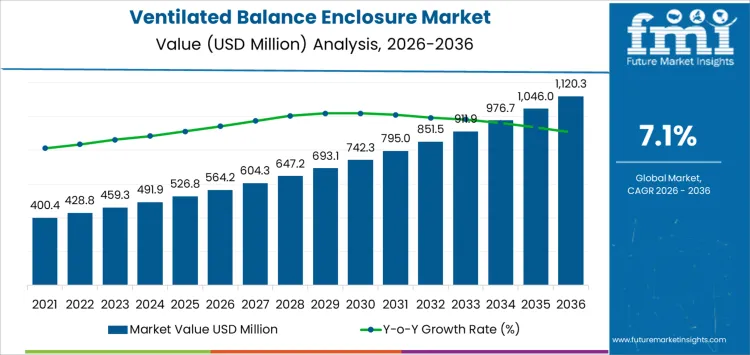
The ventilated balance enclosure market is projected at USD 564.2 million in 2026 and USD 1,259.2 million by 2036, reflecting a 7.10% CAGR. Purchase decisions start from the weighing task rather than from furniture budgets. Powder toxicity class, airflow stability, and balance sensitivity define the performance envelope. Once a method is approved, enclosure size, filter class, and exhaust routing become part of the procedure. Users focus on draft recovery time, access ergonomics, and cleaning effort. Facilities teams review duct paths, noise limits, and room pressure relationships before approval. Integrators often supply enclosures together with balances and vibration control tables.
Demand in this category follows laboratory method changes and room reconfigurations rather than routine replacement cycles. Site acceptance depends on smoke visualization, airflow mapping, and repeatability during door movement. Service coverage matters because filter loading and fan drift affect weighing stability. Fabricators compete on airflow uniformity and build tolerances. Lead times align to lab build schedules. Profit formation follows installation accuracy, low rework, and dependable field support rather than catalog breadth or price driven promotions.
Quick Stats for Ventilated Balance Enclosure Market
- Ventilated Balance Enclosure Market Value (2026): USD 564.2 million
- Ventilated Balance Enclosure Market Forecast Value (2036): USD 1,259.2 million
- Ventilated Balance Enclosure Market Forecast CAGR (2026-2036): 7.1%
- Leading Product Type in Ventilated Balance Enclosure Market: Ducted balance enclosures
- Leading Application in Ventilated Balance Enclosure Market: Pharma and biotech labs
- Key Growth Regions in Ventilated Balance Enclosure Market: Asia Pacific, North America, Europe
- Top Players in Ventilated Balance Enclosure Market: Labconco, Thermo Fisher Scientific, Erlab, Esco, Air Science
What Is the Growth Forecast for the Ventilated Balance Enclosure Market through 2036?
Laboratory workflow design and weighing room safety practice shape demand for the ventilated balance enclosure market more than overall lab construction volume. In 2026, at about USD 564.2 million, purchases concentrate in pharmaceutical quality control, chemical research, and materials testing facilities where powder handling and micro weighing create exposure and contamination risk. Enclosure selection is fixed during lab fit out or major refurbishment programs, which ties demand to capital planning cycles rather than to routine equipment replacement. Utilization rises as more weighing tasks move into controlled enclosures and as audit requirements place tighter limits on open bench handling. The steady increase reflects broader adoption across existing laboratories rather than rapid turnover of installed balances.
Performance verification and service support shape the later phase of the ventilated balance enclosure market. As value approaches roughly USD 1,259.2 million by 2036, buyers focus on airflow stability, vibration control, and ease of cleaning validation. Product development shifts toward larger formats, better integration with analytical balances, and more standardized filter and fan modules. Installation effort increases as facilities demand documented performance testing and ongoing certification. The move from the mid five hundred into the low one point two billion reflects accumulated upgrades across many laboratories rather than a single investment cycle. Suppliers that combine installation competence, predictable performance, and dependable service coverage tend to secure repeat placements in regulated environments.
Ventilated Balance Enclosure Market Key Takeaways
| Metric | Value |
|---|---|
| Market Value (2026) | USD 564.2 million |
| Forecast Value (2036) | USD 1,259.2 million |
| Forecast CAGR 2026 to 2036 | 7.1% |
How Is the Ventilated Balance Enclosure Market Improving Weighing Accuracy and Operator Protection?
Ventilated balance enclosures are used to provide controlled airflow around analytical balances while containing powders and vapors. Laboratories handling active ingredients, fine chemicals, and toxic compounds rely on them to limit exposure without disturbing measurement stability. Earlier setups used open benches or full hoods, which either offered poor containment or created turbulence that affected readings. These enclosures balance inward airflow with low velocity patterns that protect both the operator and the sample. Buyers specify them by face velocity control, vibration isolation, filter configuration, and noise level. Placement follows workflow around sample preparation and transfer points. Performance is judged through containment tests and repeatability of measurements, not through airflow volume alone. Adoption grows where trace weighing and safety requirements intersect in regulated laboratory environments.
Specification and purchasing decisions are led by lab managers, EHS teams, and quality groups because enclosure behavior affects both data integrity and audit outcomes. Earlier purchasing allowed mixed cabinet types, which complicated training and maintenance planning. Current programs aim to standardize footprints, filter formats, and control interfaces across sites. Manufacturers compete on airflow stability, control reliability, and documentation packages rather than cabinet thickness alone. Users evaluate total cost through filter life, downtime during maintenance, and impact on weighing throughput, not purchase price. Integrators add value through site assessment, installation, and airflow verification. Over time, demand follows growth in high potency compounds, tighter occupational exposure limits, and expansion of analytical testing capacity, where accurate weighing and operator protection must be achieved together in routine daily work.
What Factors Are Shaping the Demand for Ventilated Balance Enclosure Market in 2026 by Product Type and Application?
Specification in Ventilated Balance Enclosure Market is determined by containment policy, room ventilation design, and audit requirements rather than by routine laboratory furniture upgrades. Enclosures are selected during laboratory planning and become part of the approved weighing and sample handling workflow. Once airflow concept and exhaust strategy are validated, the enclosure configuration is fixed within the facility qualification file. This links demand to new laboratory builds, refurbishment programs, and requalification cycles. Segment structure reflects differences in exhaust integration, filtration strategy, and service access. Buyers prioritize containment performance, airflow stability, and documentation because enclosure behavior affects both operator safety and analytical integrity.
How Does Product Type Selection Influence Containment Strategy and Facility Integration in the Ventilated Balance Enclosure Market?
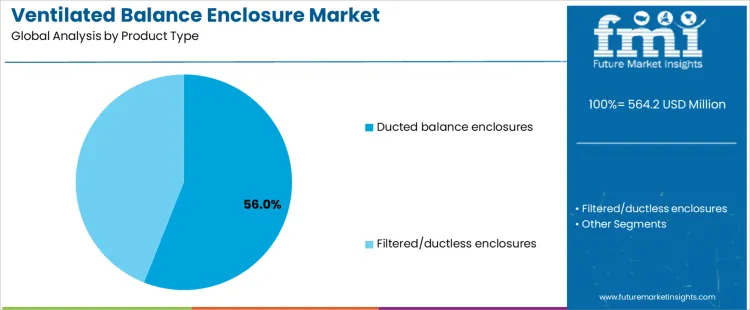
Ducted balance enclosures represent about 56% of demand in the Ventilated Balance Enclosure Market because many laboratories require direct exhaust to maintain consistent containment under variable powder loading conditions. These systems integrate with building ventilation and support predictable airflow behavior across operating ranges. Filtered or ductless enclosures are selected where building exhaust capacity is limited or where relocation flexibility is required, though they introduce filter management and breakthrough monitoring obligations. The two categories differ in installation scope, validation testing, and maintenance planning. Ducted systems impose coordination with facility engineering and periodic airflow certification. Ductless systems shift responsibility toward filter integrity testing and replacement scheduling. Each type establishes distinct inspection routines and operating constraints.
From a compliance and lifecycle cost perspective, product type choice fixes long term obligations. Ducted enclosures concentrate cost in infrastructure connection and airflow verification, yet simplify consumable management. Filtered systems reduce construction work but require ongoing filter qualification, inventory control, and waste handling procedures. Once a laboratory is validated with a specific configuration, changes are avoided because room balance, containment verification, and safety documentation must be revised. Demand by product type therefore follows laboratory ventilation strategy and space planning decisions rather than short term equipment purchasing preferences.
Why Does Application Mix Determine Volume Concentration and Service Expectations in the Ventilated Balance Enclosure Market?

Pharma and biotech laboratories account for about 61% of demand in the Ventilated Balance Enclosure Market because these environments handle potent or sensitive materials under strict occupational exposure and cross contamination controls. Weighing and dispensing activities are frequent and are embedded in regulated workflows, which supports higher enclosure counts per facility. Academic research laboratories operate at smaller scale with more varied materials and project based usage, resulting in lower volumes and more diverse specifications. Service and AMC activities relate to installed base maintenance, filter replacement, and recertification, which does not drive new unit volume but influences supplier selection and lifecycle revenue models.
Application mix also shapes procurement and qualification practice. Regulated laboratories purchase through capital projects with defined user requirement specifications and formal performance qualification. Academic institutions procure through grant funded projects with flexible configurations and staged upgrades. Service demand follows inspection cycles and internal audit schedules rather than expansion plans. The resulting structure concentrates new unit volume in regulated life science facilities while service activity remains distributed across the installed base. Segment shares therefore move with laboratory capacity expansion, regulatory inspection intensity, and research infrastructure investment rather than with short term changes in laboratory workload.
How Is the Ventilated Balance Enclosure Market Being Defined by Weighing Accuracy and Operator Protection?
The Ventilated Balance Enclosure Market is shaped by how laboratories protect both measurement accuracy and staff safety when handling powders and volatile substances. Analytical balances are sensitive to air movement, temperature shifts, and vibration, while many samples also require containment. Buyers therefore focus on airflow stability, containment efficiency, vibration isolation, and ease of cleaning. Selection decisions involve laboratory managers, safety officers, and quality teams. This positions ventilated balance enclosures as precision infrastructure rather than as simple furniture, making performance under real working conditions and documented containment behavior central to purchasing decisions.
How Is Laboratory Standardization Changing Expectations in The Ventilated Balance Enclosure Market?
Many laboratory organizations aim to standardize room layouts and equipment across sites to simplify training and compliance. This is changing expectations in the Ventilated Balance Enclosure Market toward enclosures with consistent dimensions, control layouts, and service procedures. Buyers prefer equipment that fits predefined lab modules and supports repeatable installation and qualification processes. This reduces engineering effort and speeds up room commissioning. As a result, suppliers are evaluated on product family consistency, documentation clarity, and long-term availability rather than on highly customized one-off designs.
Where Is Repeat Installation Demand Being Built in The Ventilated Balance Enclosure Market?
Repeat installation demand is being built in pharmaceutical, chemical, and research facilities that expand capacity in phases or replicate similar laboratories across multiple locations. Each new lab or quality control room typically requires several ventilated balance enclosures. The Ventilated Balance Enclosure Market also benefits from renovation projects where older enclosures or open benches are replaced to improve containment and measurement conditions. There is opportunity for suppliers that become part of standard lab design specifications used by engineering firms and internal facility teams, creating ongoing orders tied to capital project pipelines.
Why Do Capital Budget Competition and Long Equipment Lifetimes Slow Replacement Cycles in The Ventilated Balance Enclosure Market?
Ventilated balance enclosures are durable assets that often remain in service for many years if they continue to meet safety and performance requirements. This limits routine replacement demand. The Ventilated Balance Enclosure Market also competes for capital budgets with core analytical instruments and process equipment, which usually receive higher priority. In many facilities, enclosures are upgraded only during major lab renovations. In addition, installation work can disrupt laboratory operations, which makes organizations cautious about frequent changes. These factors slow purchase cycles and concentrate demand around expansion and refurbishment projects.
What is the Demand for Ventilated Balance Enclosure by Country?
| Country | CAGR |
|---|---|
| USA | 9.5% |
| Brazil | 10.0% |
| China | 10.5% |
| India | 10.7% |
| Germany | 7.7% |
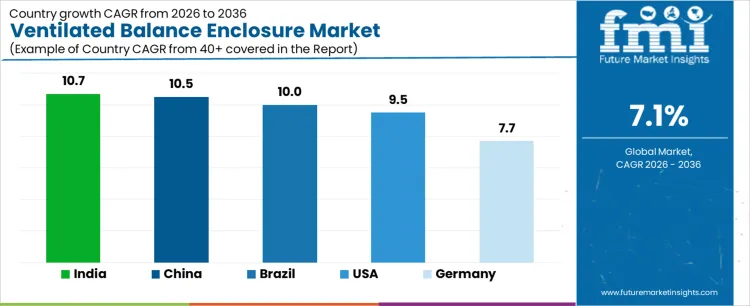
Demand for ventilated balance enclosures is rising as pharmaceutical, chemical, and research laboratories strengthen operator protection and contamination control during weighing and powder handling operations. India leads with a 10.7% CAGR, supported by expansion of drug manufacturing plants, contract research facilities, and quality control laboratories. China follows at 10.5%, driven by growth in chemical and life sciences research and stricter laboratory safety standards. Brazil records 10.0%, reflecting increased investment in regulated laboratories and industrial R&D. The USA grows at 9.5%, shaped by replacement of older enclosures and upgrades in safety compliant lab infrastructure. Germany, at 7.7%, reflects steady but mature demand in a well-established laboratory equipment market.
How Are Laboratory Safety Programs Shaping Demand in the Ventilated Balance Enclosure Market in the United States?
Laboratory safety upgrades and containment protocols keep Ventilated Balance Enclosure Market demand in United States on a 9.5% CAGR path. Procurement decisions sit with lab safety committees and facility engineering teams. Adoption centers on powder handling, pharmaceutical weighing, and hazardous material preparation. Equipment choice emphasizes airflow stability, operator protection, and integration with existing benches. Once a model is approved, deployment expands across multiple rooms and sites. Service coverage and filter replacement logistics affect vendor selection. Import systems serve high containment needs. Local suppliers cover standard laboratory applications. Spending follows lab renovation and capacity expansion schedules. Training and certification programs influence utilization. Replacement cycles remain long. Commercial success depends on inclusion in laboratory standard equipment lists and framework supply agreements rather than isolated purchases.
How Are Private Laboratory Investments Influencing Demand in the Ventilated Balance Enclosure Market in Brazil?
Private laboratory expansion and pharmaceutical compounding growth keep Ventilated Balance Enclosure Market demand in Brazil on a 10% CAGR path. Hospital networks, research labs, and contract testing centers control most purchases. Use cases include hazardous powder weighing and formulation preparation. Equipment selection focuses on containment level, airflow reliability, and ease of cleaning. Import systems dominate higher specification installations. Local distributors manage installation and maintenance. Once a supplier is accepted, rollout extends across affiliated sites. Procurement timing follows new lab openings and modernization projects. Training requirements influence acceptance. Public sector adoption progresses more slowly. Replacement cycles remain long. Commercial success depends on access to large laboratory groups and reference installations rather than broad distributor shelf presence or fragmented clinic level sales.
What Are Industrial and Research Expansion Programs Driving in the Ventilated Balance Enclosure Market in China?
Industrial research growth and laboratory construction keep Ventilated Balance Enclosure Market demand in China on a 10.5% CAGR path. Pharmaceutical plants, chemical labs, and university centers form the main buyer base. Deployment targets hazardous material weighing and formulation work. Domestic manufacturers supply standard enclosures at scale. International brands retain roles in higher containment classes. Procurement follows tender systems and multi year facility plans. Training and certification affect rollout speed. Once approved, models replicate across many labs. Service networks and filter logistics influence uptime. Spending follows plant and campus expansion schedules. Replacement demand remains limited. Commercial success depends on inclusion in institutional equipment catalogs and approved supplier lists rather than selling into small independent laboratories.
Why Are Laboratory Formalization Programs Driving Growth in the Ventilated Balance Enclosure Market in India?
Transition toward regulated laboratories and pharmaceutical manufacturing keeps Ventilated Balance Enclosure Market demand in India on a 10.7% CAGR path. Hospital labs, contract research sites, and formulation plants drive adoption. Equipment choice emphasizes operator safety, airflow control, and ease of maintenance. Import systems serve higher risk applications. Domestic suppliers cover routine laboratory needs. Procurement authority sits with facility engineering and safety teams. Once a platform is approved, rollout follows network expansion. Spending aligns with new lab construction and compliance upgrades. Training requirements influence utilization speed. Service coverage affects uptime planning. Replacement cycles remain long. Commercial success depends on participation in modernization programs and inclusion in preferred supplier lists rather than sales to small standalone laboratories.
How Are Regulation and Standardization Shaping Demand in the Ventilated Balance Enclosure Market in Germany?
Regulatory compliance and laboratory standardization keep Ventilated Balance Enclosure Market demand in Germany on a 7.7% CAGR path. University labs, pharmaceutical plants, and quality control centers control most purchases. Evaluation emphasizes containment performance, documentation, and operator safety. Procurement follows structured technical review and budget cycles. Import suppliers dominate higher specification categories. Once approved, systems deploy across multiple departments. Training and certification programs influence utilization. Service contracts and filter logistics affect uptime planning. Spending aligns with lab modernization and process standardization initiatives. Replacement cycles remain long. Integration with existing furniture and ventilation systems affects model choice. Commercial success depends on guideline alignment and framework access rather than individual researcher preference or isolated laboratory purchases.
How Do Manufacturers Compete for Laboratory Standardization in the Ventilated Balance Enclosure Market?
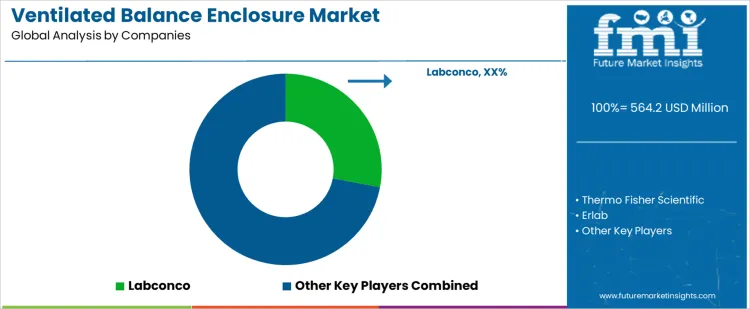
Ventilated balance enclosure selection starts with laboratory workflow mapping and contamination control planning rather than furniture budgeting. Lab managers define powder handling volumes, weighing accuracy needs, airflow class, and room pressure relationships before approving equipment. Labconco, Thermo Fisher Scientific, Erlab, Esco, Air Science compete inside those planning reviews. Once an enclosure type enters room layouts, certification tests and operating procedures anchor that choice. Labconco holds positions in academic and pharmaceutical laboratories with standardized footprints. Thermo Fisher Scientific links enclosures with broader lab furniture and instrumentation programs. Erlab focuses on filtration based containment concepts and compact designs. Esco supplies biosafety and containment focused laboratories. Air Science serves smaller labs and retrofits that need modular units and rapid installation.
Competitive outcomes reflect containment performance, service coverage, and installation discipline rather than headline airflow numbers. Safety officers review face velocity stability, filter loading behavior, vibration impact on weighing, and noise levels during evaluation. Facility teams value units that fit ceiling heights, electrical layouts, and exhaust routing limits. Maintenance groups prefer predictable filter change procedures and accessible service panels. Labconco benefits from long installed base and repeat projects in teaching and research facilities. Thermo Fisher Scientific secures positions where laboratories standardize procurement across multiple rooms. Erlab gains placements where ductless filtration strategies guide building constraints. Esco competes in regulated environments that require certified containment equipment. Air Science wins in cost sensitive installations and space limited rooms. Market positions vary by building age, regulatory oversight, and laboratory operating models.
Key Players in the Ventilated Balance Enclosure Market
- Labconco
- Thermo Fisher Scientific
- Erlab
- Esco
- Air Science
- Others
Scope of the Report
| Items | Values |
|---|---|
| Quantitative Units (2026) | USD Million |
| Product Type | Ducted balance enclosures; Filtered and ductless enclosures |
| Application | Pharma & biotech labs; Academic research |
| End User | Direct sales; Distributors; Service & AMC |
| Region | Asia Pacific; Europe; North America; Latin America; Middle East & Africa |
| Countries Covered | United States, Canada, Mexico, Germany, United Kingdom, France, Italy, Spain, Nordic, BENELUX, China, Japan, South Korea, India, Australia & New Zealand, ASEAN, Brazil, Chile, Saudi Arabia, Turkey, South Africa, Rest of regions |
| Key Companies Profiled | Labconco; Thermo Fisher Scientific; Erlab; Esco; Air Science |
| Additional Attributes | Dollar by sales by product and application, installed base by lab type, ducted versus ductless mix, airflow certification cycles, filter replacement rates, service and AMC coverage, retrofit versus new build installations, room integration constraints, noise and vibration compliance, lead time and installation validation trends |
Ventilated Balance Enclosure Market Segmentation
Product Type:
- Ducted balance enclosures
- Filtered and ductless enclosures
Application:
- Pharma & biotech labs
- Academic research
End User:
- Direct sales
- Distributors
- Service & AMC
Region:
- Asia Pacific
- China
- Japan
- South Korea
- India
- Australia & New Zealand
- ASEAN
- Rest of Asia Pacific
- Europe
- Germany
- United Kingdom
- France
- Italy
- Spain
- Nordic
- BENELUX
- Rest of Europe
- North America
- United States
- Canada
- Mexico
- Latin America
- Brazil
- Chile
- Rest of Latin America
- Middle East & Africa
- Kingdom of Saudi Arabia
- Other GCC Countries
- Turkey
- South Africa
- Other African Union
- Rest of Middle East & Africa
Bibliography
- Occupational Safety and Health Administration. (2023). Controlling occupational exposure to hazardous drugs. U.S. Department of Labor.
- ASHRAE. (2023). ASHRAE handbook: HVAC applications. ASHRAE.
- University of California Office of the President. (2025). Biosafety level 3 laboratory design standards. UCOP.
- ANSI/NSF International. (2024). NSF/ANSI 49–2024: Biosafety cabinetry—Design, construction, performance, and field certification. ANSI/NSF.
- World Health Organization. (2024). Laboratory biosafety manual (4th ed.). World Health Organization.
Frequently Asked Questions
How big is the ventilated balance enclosure market in 2026?
The global ventilated balance enclosure market is estimated to be valued at USD 564.2 million in 2026.
What will be the size of ventilated balance enclosure market in 2036?
The market size for the ventilated balance enclosure market is projected to reach USD 1,120.3 million by 2036.
How much will be the ventilated balance enclosure market growth between 2026 and 2036?
The ventilated balance enclosure market is expected to grow at a 7.1% CAGR between 2026 and 2036.
What are the key product types in the ventilated balance enclosure market?
The key product types in ventilated balance enclosure market are ducted balance enclosures and filtered/ductless enclosures.
Which application segment to contribute significant share in the ventilated balance enclosure market in 2026?
In terms of application, pharma & biotech labs segment to command 61.0% share in the ventilated balance enclosure market in 2026.
Preview the report firsthand - request a free sample
Get SampleGet the brochure for pricing and purchase details.
Get PDFTable of Content
- Executive Summary
- Global Market Outlook
- Demand-side Trends
- Supply-side Trends
- Technology Roadmap Analysis
- Analysis and Recommendations
- Market Overview
- Market Coverage / Taxonomy
- Market Definition / Scope / Limitations
- Market Background
- Market Dynamics
- Drivers
- Restraints
- Opportunity
- Trends
- Scenario Forecast
- Demand in Optimistic Scenario
- Demand in Likely Scenario
- Demand in Conservative Scenario
- Opportunity Map Analysis
- Product Life Cycle Analysis
- Supply Chain Analysis
- Investment Feasibility Matrix
- Value Chain Analysis
- PESTLE and Porter’s Analysis
- Regulatory Landscape
- Regional Parent Market Outlook
- Production and Consumption Statistics
- Import and Export Statistics
- Market Dynamics
- Global Market Analysis 2021 to 2025 and Forecast, 2026 to 2036
- Historical Market Size Value (USD Million) Analysis, 2021 to 2025
- Current and Future Market Size Value (USD Million) Projections, 2026 to 2036
- Y-o-Y Growth Trend Analysis
- Absolute $ Opportunity Analysis
- Global Market Pricing Analysis 2021 to 2025 and Forecast 2026 to 2036
- Global Market Analysis 2021 to 2025 and Forecast 2026 to 2036, By Product Type
- Introduction / Key Findings
- Historical Market Size Value (USD Million) Analysis By Product Type , 2021 to 2025
- Current and Future Market Size Value (USD Million) Analysis and Forecast By Product Type , 2026 to 2036
- Ducted balance enclosures
- Filtered/ductless enclosures
- Ducted balance enclosures
- Y-o-Y Growth Trend Analysis By Product Type , 2021 to 2025
- Absolute $ Opportunity Analysis By Product Type , 2026 to 2036
- Global Market Analysis 2021 to 2025 and Forecast 2026 to 2036, By Application
- Introduction / Key Findings
- Historical Market Size Value (USD Million) Analysis By Application, 2021 to 2025
- Current and Future Market Size Value (USD Million) Analysis and Forecast By Application, 2026 to 2036
- Pharma & biotech labs
- Academic research
- Service & AMC
- Pharma & biotech labs
- Y-o-Y Growth Trend Analysis By Application, 2021 to 2025
- Absolute $ Opportunity Analysis By Application, 2026 to 2036
- Global Market Analysis 2021 to 2025 and Forecast 2026 to 2036, By End User
- Introduction / Key Findings
- Historical Market Size Value (USD Million) Analysis By End User, 2021 to 2025
- Current and Future Market Size Value (USD Million) Analysis and Forecast By End User, 2026 to 2036
- Direct sales
- Distributors
- Direct sales
- Y-o-Y Growth Trend Analysis By End User, 2021 to 2025
- Absolute $ Opportunity Analysis By End User, 2026 to 2036
- Global Market Analysis 2021 to 2025 and Forecast 2026 to 2036, By Region
- Introduction
- Historical Market Size Value (USD Million) Analysis By Region, 2021 to 2025
- Current Market Size Value (USD Million) Analysis and Forecast By Region, 2026 to 2036
- North America
- Latin America
- Western Europe
- Eastern Europe
- East Asia
- South Asia and Pacific
- Middle East & Africa
- Market Attractiveness Analysis By Region
- North America Market Analysis 2021 to 2025 and Forecast 2026 to 2036, By Country
- Historical Market Size Value (USD Million) Trend Analysis By Market Taxonomy, 2021 to 2025
- Market Size Value (USD Million) Forecast By Market Taxonomy, 2026 to 2036
- By Country
- USA
- Canada
- Mexico
- By Product Type
- By Application
- By End User
- By Country
- Market Attractiveness Analysis
- By Country
- By Product Type
- By Application
- By End User
- Key Takeaways
- Latin America Market Analysis 2021 to 2025 and Forecast 2026 to 2036, By Country
- Historical Market Size Value (USD Million) Trend Analysis By Market Taxonomy, 2021 to 2025
- Market Size Value (USD Million) Forecast By Market Taxonomy, 2026 to 2036
- By Country
- Brazil
- Chile
- Rest of Latin America
- By Product Type
- By Application
- By End User
- By Country
- Market Attractiveness Analysis
- By Country
- By Product Type
- By Application
- By End User
- Key Takeaways
- Western Europe Market Analysis 2021 to 2025 and Forecast 2026 to 2036, By Country
- Historical Market Size Value (USD Million) Trend Analysis By Market Taxonomy, 2021 to 2025
- Market Size Value (USD Million) Forecast By Market Taxonomy, 2026 to 2036
- By Country
- Germany
- UK
- Italy
- Spain
- France
- Nordic
- BENELUX
- Rest of Western Europe
- By Product Type
- By Application
- By End User
- By Country
- Market Attractiveness Analysis
- By Country
- By Product Type
- By Application
- By End User
- Key Takeaways
- Eastern Europe Market Analysis 2021 to 2025 and Forecast 2026 to 2036, By Country
- Historical Market Size Value (USD Million) Trend Analysis By Market Taxonomy, 2021 to 2025
- Market Size Value (USD Million) Forecast By Market Taxonomy, 2026 to 2036
- By Country
- Russia
- Poland
- Hungary
- Balkan & Baltic
- Rest of Eastern Europe
- By Product Type
- By Application
- By End User
- By Country
- Market Attractiveness Analysis
- By Country
- By Product Type
- By Application
- By End User
- Key Takeaways
- East Asia Market Analysis 2021 to 2025 and Forecast 2026 to 2036, By Country
- Historical Market Size Value (USD Million) Trend Analysis By Market Taxonomy, 2021 to 2025
- Market Size Value (USD Million) Forecast By Market Taxonomy, 2026 to 2036
- By Country
- China
- Japan
- South Korea
- By Product Type
- By Application
- By End User
- By Country
- Market Attractiveness Analysis
- By Country
- By Product Type
- By Application
- By End User
- Key Takeaways
- South Asia and Pacific Market Analysis 2021 to 2025 and Forecast 2026 to 2036, By Country
- Historical Market Size Value (USD Million) Trend Analysis By Market Taxonomy, 2021 to 2025
- Market Size Value (USD Million) Forecast By Market Taxonomy, 2026 to 2036
- By Country
- India
- ASEAN
- Australia & New Zealand
- Rest of South Asia and Pacific
- By Product Type
- By Application
- By End User
- By Country
- Market Attractiveness Analysis
- By Country
- By Product Type
- By Application
- By End User
- Key Takeaways
- Middle East & Africa Market Analysis 2021 to 2025 and Forecast 2026 to 2036, By Country
- Historical Market Size Value (USD Million) Trend Analysis By Market Taxonomy, 2021 to 2025
- Market Size Value (USD Million) Forecast By Market Taxonomy, 2026 to 2036
- By Country
- Kingdom of Saudi Arabia
- Other GCC Countries
- Turkiye
- South Africa
- Other African Union
- Rest of Middle East & Africa
- By Product Type
- By Application
- By End User
- By Country
- Market Attractiveness Analysis
- By Country
- By Product Type
- By Application
- By End User
- Key Takeaways
- Key Countries Market Analysis
- USA
- Pricing Analysis
- Market Share Analysis, 2025
- By Product Type
- By Application
- By End User
- Canada
- Pricing Analysis
- Market Share Analysis, 2025
- By Product Type
- By Application
- By End User
- Mexico
- Pricing Analysis
- Market Share Analysis, 2025
- By Product Type
- By Application
- By End User
- Brazil
- Pricing Analysis
- Market Share Analysis, 2025
- By Product Type
- By Application
- By End User
- Chile
- Pricing Analysis
- Market Share Analysis, 2025
- By Product Type
- By Application
- By End User
- Germany
- Pricing Analysis
- Market Share Analysis, 2025
- By Product Type
- By Application
- By End User
- UK
- Pricing Analysis
- Market Share Analysis, 2025
- By Product Type
- By Application
- By End User
- Italy
- Pricing Analysis
- Market Share Analysis, 2025
- By Product Type
- By Application
- By End User
- Spain
- Pricing Analysis
- Market Share Analysis, 2025
- By Product Type
- By Application
- By End User
- France
- Pricing Analysis
- Market Share Analysis, 2025
- By Product Type
- By Application
- By End User
- India
- Pricing Analysis
- Market Share Analysis, 2025
- By Product Type
- By Application
- By End User
- ASEAN
- Pricing Analysis
- Market Share Analysis, 2025
- By Product Type
- By Application
- By End User
- Australia & New Zealand
- Pricing Analysis
- Market Share Analysis, 2025
- By Product Type
- By Application
- By End User
- China
- Pricing Analysis
- Market Share Analysis, 2025
- By Product Type
- By Application
- By End User
- Japan
- Pricing Analysis
- Market Share Analysis, 2025
- By Product Type
- By Application
- By End User
- South Korea
- Pricing Analysis
- Market Share Analysis, 2025
- By Product Type
- By Application
- By End User
- Russia
- Pricing Analysis
- Market Share Analysis, 2025
- By Product Type
- By Application
- By End User
- Poland
- Pricing Analysis
- Market Share Analysis, 2025
- By Product Type
- By Application
- By End User
- Hungary
- Pricing Analysis
- Market Share Analysis, 2025
- By Product Type
- By Application
- By End User
- Kingdom of Saudi Arabia
- Pricing Analysis
- Market Share Analysis, 2025
- By Product Type
- By Application
- By End User
- Turkiye
- Pricing Analysis
- Market Share Analysis, 2025
- By Product Type
- By Application
- By End User
- South Africa
- Pricing Analysis
- Market Share Analysis, 2025
- By Product Type
- By Application
- By End User
- USA
- Market Structure Analysis
- Competition Dashboard
- Competition Benchmarking
- Market Share Analysis of Top Players
- By Regional
- By Product Type
- By Application
- By End User
- Competition Analysis
- Competition Deep Dive
- Labconco
- Overview
- Product Portfolio
- Profitability by Market Segments (Product/Age /Sales Channel/Region)
- Sales Footprint
- Strategy Overview
- Marketing Strategy
- Product Strategy
- Channel Strategy
- Thermo Fisher Scientific
- Erlab
- Esco
- Air Science
- Others
- Labconco
- Competition Deep Dive
- Assumptions & Acronyms Used
- Research Methodology


