

- Market Size (2026)
- USD 2.0 Bn
- Forecast (2036)
- USD 2.9 Bn
- CAGR (2026 to 2036)
- 3.8%
How big is the Vitiligo Market in 2026?
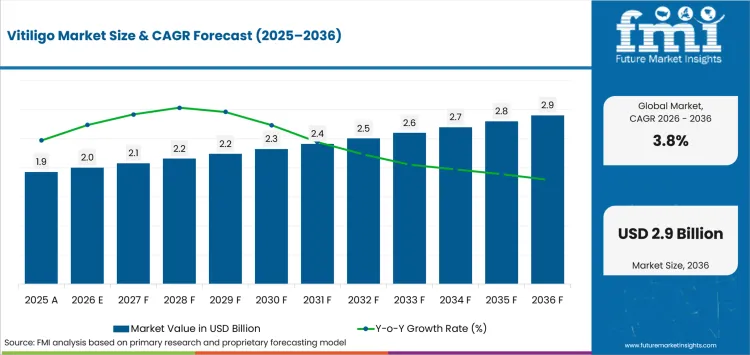
USD 2.0 billion in 2026 and USD 2.9 billion by 2036 at a 3.8% CAGR.
Demand for vitiligo treatment is projected to expand at 3.8% CAGR between 2026 and 2036, increasing valuation from USD 2.0 billion in 2026 to USD 2.9 billion by 2036. Indication-specific immune pathways now give dermatologists measurable facial and total-body repigmentation endpoints for treatment planning. Daily skin coverage and laboratory monitoring impose different burdens across lesion patterns, so route selection directly affects persistence.
Specialist capacity determines whether patients can progress from topical care to repeated light treatment without losing continuity. NICE experts estimated in March 2026 that about half of people referred for phototherapy could commit to a treatment course. The attendance burden favors topical home treatment for eligible lesions, although extensive disease requires equipment-based escalation.
Key Takeaways of Vitiligo Market
- Indication-specific medicines widen treatment choice across nonsegmental vitiligo pathways requiring prolonged repigmentation care and specialist follow-up.
- Topical treatments are projected at 42.0% of treatment-type demand in 2026 as home application supports localized care.
- Nonsegmental vitiligo is estimated to hold around 86.0% share by disease-type in 2026 owing to targeted treatment programs.
- Hospitals are forecast at 48.0% of end-user demand in 2026, supported by coordinated specialist treatment and monitoring.
- Long treatment duration and variable repigmentation weaken persistence as reimbursement and specialist capacity restrict continuous access.
- Incyte Corporation, AbbVie Inc., Pfizer Inc., Teva Pharmaceutical Industries Ltd., STRATA Skin Sciences, Inc., AVITA Medical, Inc., CLINUVEL Pharmaceuticals Ltd. and Alys Pharmaceuticals, Inc. serve commercial, clinical or procedure-based vitiligo pathways.
Analyst Perspective
"Commercial value in vitiligo treatment depends on sustained repigmentation across daily application or repeated light sessions that patients can maintain. The strongest pathway matches body-surface coverage with a manageable route and defines escalation early enough to prevent adherence from deteriorating."
- Anurag Sharma, Principal Consultant, Future Market Insights
How is the Vitiligo Market segmented?
The vitiligo market is segmented by treatment type, disease type, end user, route of administration, distribution channel and region.
Vitiligo market segmentation covers treatment type, disease type, end user, route of administration, distribution channel and region. Treatments cover topical JAK inhibitors or corticosteroids, UVB and excimer phototherapy, oral JAK inhibitors or immunomodulators, melanocyte transplantation and skin grafting. Disease type separates generalized and acrofacial nonsegmental forms from unilateral and bilateral segmental disease categories. End users include hospitals, specialty clinics, aesthetic clinics, research institutes and supervised home healthcare settings. Routes include topical, phototherapy, oral, surgical and combination treatment across hospital, retail, specialty and online pharmacy channels.
How do dermatologists evaluate topical treatments within the treatment type category?
Topical treatment lets dermatologists manage localized lesions at home through indication-specific small molecule inhibitors without recurring light sessions or systemic monitoring.
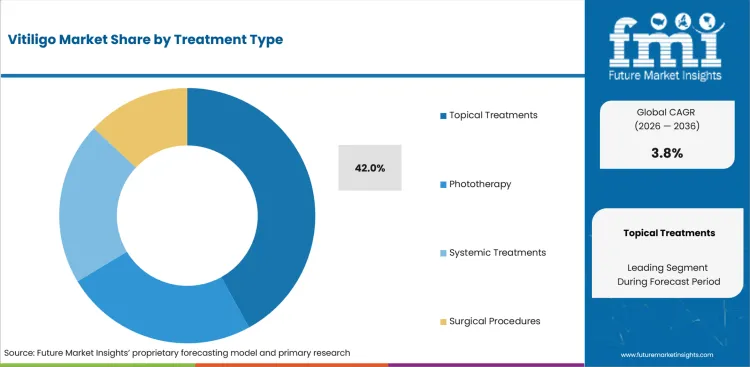
- Topical treatments are set to lead the treatment type with 42.0% share in 2026 due to localized application and established prescribing.
- Daily dosing remains practical if the regimen fits ordinary routines across a prolonged repigmentation course. ClinicalTrials.gov first posted a 36-participant CGB-600 facial vitiligo study in January 2026 with twice-daily gel use for twenty-four weeks. The design ties topical value to consistent coverage across visible lesions throughout the scheduled treatment period.
What makes nonsegmental vitiligo central to the disease type category?
Nonsegmental vitiligo affects several body regions through bilateral or symmetrical patches, so targeted autoimmune disease therapeutics address immune activity beyond one stable lesion.
- By disease type, nonsegmental vitiligo is forecast to represent 86.0% share in 2026 driven by indication-specific programs addressing its autoimmune presentation.
- Large multicountry programs use facial and total-body endpoints across nonsegmental lesion patterns in clinical development. ClinicalTrials.gov updated TRANQUILLO in February 2026 following a Phase 3 ritlecitinib study involving 607 adults and adolescents. The program centers oral development on widespread disease requiring more than localized care across isolated patches.
What role do hospitals play within the end user category?
Hospitals combine dermatologist assessment with pharmacy coordination and dermatology devices for monitored escalation across several treatment modalities.
- Based on end user, hospitals are projected to account for 48.0% in 2026 due to coordinated diagnosis and treatment delivery within referral settings.
- Clinic-based combinations require scheduled phototherapy equipment and supervised medicine across the same treatment course for complex cases. STRATA reported in May 2026 that a multicenter study enrolled 188 children receiving excimer treatment with oral JAK inhibitors. Coordinated schedules help pediatric dermatology teams align excimer visits with oral dosing and response review across specialist care.
How does topical administration influence route selection?
Topical administration delivers medicine directly to affected skin and supports prolonged home treatment through pharmaceutical drug delivery formats suited to manageable lesion coverage.
- By route of administration, topical administration is estimated to hold 45.0% in 2026 owing to practical home use across eligible body sites.
- Topical administration supports repeated self-application across sensitive body sites without routine visits to specialist facilities. ClinicalTrials.gov updated a genital vitiligo study in March 2026 that applied ruxolitinib cream twice daily for forty-eight weeks. The regimen links route convenience with sustained coverage, although extensive disease can require phototherapy or monitored oral treatment.
What are the drivers, restraints and opportunities in the Vitiligo Market?
Driver: Indication-specific medicines extend treatment beyond repurposed topical care. Restraint: Delayed repigmentation and uneven specialist access interrupt continuity. Opportunity: Escalation pathways can match lesion extent with topical, systemic and light-based treatment.
- Driver: Late-stage immune programs extend treatment choice beyond practical topical coverage for patients with widespread lesions.
- Restraint: Slow visible response and limited specialist capacity can interrupt adherence across repeated treatment reviews.
- Opportunity: Clear escalation rules can align lesion extent with timely topical, systemic or light-based care.
Late-stage clinical trials address widespread nonsegmental disease that exceeds practical topical coverage across large body areas. Oral programs can reduce dependence on repeated equipment sessions, but commercial use requires safety monitoring and clear specialist selection.
Visible repigmentation often takes several months, so delayed refills and appointments can erode otherwise effective treatment. Prior authorization and limited dermatology capacity interrupt continuity across topical therapy, laboratory monitoring and recurring phototherapy.
Dermatology networks can use real-world evidence solutions to compare persistence across topical medicine and phototherapy. Service records can identify authorization delays and missed light sessions, helping clinics revise escalation rules during ongoing repigmentation care.
Which country CAGRs are profiled in the Vitiligo Market?
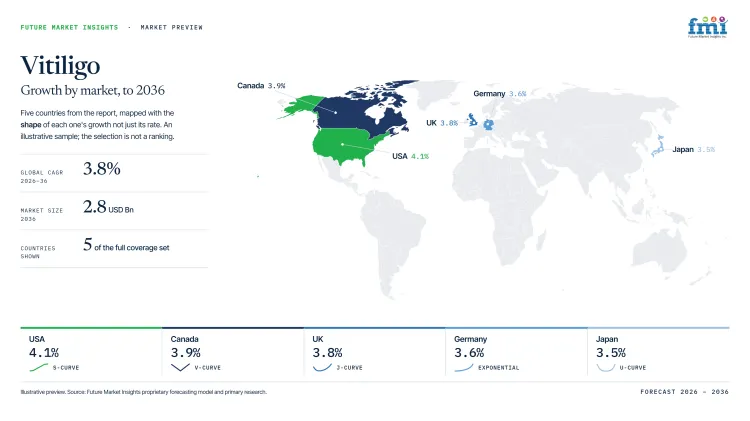
| Country | CAGR |
|---|---|
| South Korea | 4.4% |
| United States | 4.1% |
| Canada | 3.9% |
| United Kingdom | 3.8% |
| Australia | 3.7% |
How do country-level CAGRs compare in the Vitiligo Market?
The country comparison spans 0.7 percentage points and reveals three distinct growth groups across the vitiligo market. South Korea and the United States form the upper tier with a 0.3-point difference, while Canada and the United Kingdom create a closely aligned middle group separated by only 0.1 percentage point. Australia remains at the lower end with a 0.1-point gap from the United Kingdom.
- South Korea leads the comparison at a 4.4% CAGR through 2036, supported by specialist familiarity with topical medicines and supervised light-based treatment across established dermatology networks.
- The United States follows at a 4.1% CAGR, remaining 0.3 percentage points below South Korea. Multiple approved treatment modalities and payer rules influence progression across different stages of care.
- Canada records a 3.9% CAGR, creating a 0.2-percentage-point gap from the United States. National topical authorization combined with provincial reimbursement and referral systems produces varied access conditions.
- The United Kingdom grows at a 3.8% CAGR, only 0.1 percentage point below Canada. National eligibility criteria, secondary-care delivery and defined implementation and funding requirements shape treatment access.
- Australia records a 3.7% CAGR, remaining 0.1 percentage point below the United Kingdom. Specialist phototherapy access through Medicare supports treatment delivery, while repeated attendance and travel distances can constrain access outside metropolitan areas.
Comparable CAGRs can still produce different market conditions. Differences in treatment access, reimbursement rules, specialist availability, referral pathways and phototherapy delivery influence market development across countries. The full report provides country-level CAGR analysis across major regions and individual markets within the vitiligo market.
Country-wise Analysis
- South Korean dermatology centers can sequence topical medicines with narrowband UVB or excimer laser therapy devices across changing lesion patterns and activity levels in different body sites. The KDCA portal updated in May 2026 lists topical and oral medicines alongside phototherapy and epidermal grafting for stable vitiligo. South Korea is estimated to post 4.4% CAGR over the forecast period, supported by specialist networks that combine home treatment with scheduled light-based care. Concentrated urban services support recurring review during prolonged repigmentation, although session frequency and uncertain medicine coverage can weaken continuity for people living beyond major hospitals and dedicated pigment clinics.
- United States specialist centers can combine marketed topical JAK therapy with phototherapy and autologous cell procedures that require different monitoring and appointment schedules during prolonged repigmentation programs. Vitiligo treatment sales in the United States are forecast to expand at 4.1% CAGR by 2036, reinforced by modality breadth across different lesion patterns. FDA records list an August 28, 2025 RECELL supplement decision under the stable vitiligo device classification. Payer authorization and uneven specialist distribution can delay initiation or interrupt follow-up for procedures and repeated phototherapy outside major metropolitan treatment centers with established pharmacy coordination during prolonged repigmentation schedules across care stages.
- Canadian dermatologists work within provincial referral and reimbursement systems that determine how quickly nationally authorized topical treatment reaches patients beyond major urban centers. Health Canada granted Opzelura a notice of compliance on October 11, 2024 for a 1.5% topical ruxolitinib cream. Incyte reported in February 2025 that the authorization covered nonsegmental vitiligo in patients aged twelve years and older, although provincial coverage and dermatology wait times can delay treatment continuity. Adoption of vitiligo treatment in Canada is estimated to expand at 3.9% CAGR through 2036, aided by coordinated specialist and pharmacy pathways that support refills and response review.
- English secondary-care services now have a defined route for eligible ruxolitinib cream following unsuitable or unsuccessful first-line topical treatment across hospital dermatology and pharmacy services. NICE recommended the medicine in March 2026 for nonsegmental vitiligo with facial involvement in people aged twelve years and older under stated criteria. The United Kingdom's vitiligo market outlook is anticipated to advance at 3.8% CAGR over the assessment period, shaped by specialist initiation and hospital pharmacy implementation. National funding supports qualifying patients across a consistent pathway, yet referral delays and local appointment capacity can restrict continuity during repeated response reviews over several months of care.
- Australian dermatology services can provide specialist-supervised UVA or UVB phototherapy through whole-body and hand-foot cabinets under Medicare item 14050 for eligible patients requiring repeated sessions. The Australian vitiligo treatment sector is projected to record 3.7% CAGR during the assessment period, influenced by an established reimbursement route for recurring light treatment. The schedule updated on July 1, 2026 permits no more than 150 treatments within twelve months and includes associated specialist consultations. Trained clinic staff support controlled dose adjustment, although travel distance and frequent attendance reduce practical access for people outside metropolitan dermatology networks across rural or remote communities nationally.
Who are the notable companies in the Vitiligo Market?
Incyte Corporation, AbbVie Inc., Pfizer Inc., Teva Pharmaceutical Industries Ltd., STRATA Skin Sciences, Inc., AVITA Medical, Inc., CLINUVEL Pharmaceuticals Ltd. and Alys Pharmaceuticals, Inc. are the notable companies serving this market.
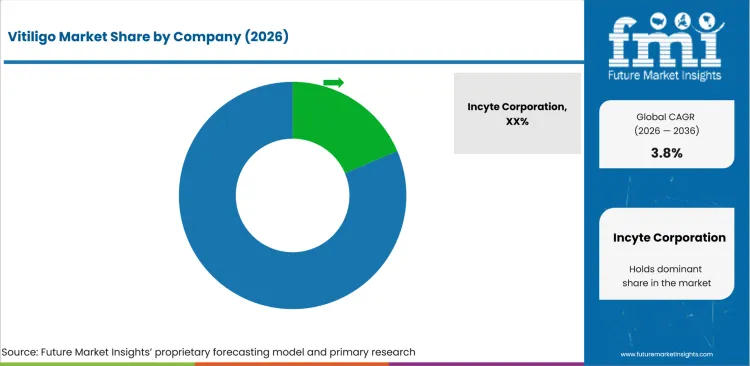
Competition is concentrated around one marketed indication-specific topical medicine and a limited group of late-stage systemic programs. Clinical research organizations support multicountry trials with defined repigmentation endpoints and extended clinical follow-up periods. Companies supplying medical devices compete through clinic placement, maintenance and user training for light-based or cell-processing systems.
- Incyte, AbbVie, Pfizer and Teva compete through targeted immune medicines at commercial, regulatory or clinical stages.
- STRATA and AVITA serve clinic-based excimer or autologous cell pathways that require trained specialists and equipment access.
- CLINUVEL and Alys Pharmaceuticals, Inc. pursue repigmentation programs that remain earlier than established topical or procedure-based pathways.
Competitive Benchmarking: Vitiligo Market
| Company | Exact-market evidence | Commercial readiness | Modality breadth | Geographic Reach |
|---|---|---|---|---|
| Incyte Corporation | High | High | High | United States, European Union and Canada |
| AbbVie Inc. | High | Medium | Medium | Global Phase 3 program and European regulatory review |
| Pfizer Inc. | Medium | Medium | Medium | Global Phase 3 program |
| Teva Pharmaceutical Industries Ltd. | Medium | Medium | Medium | Global clinical development |
| STRATA Skin Sciences, Inc. | High | High | Medium | United States and China distribution |
| AVITA Medical, Inc. | High | Medium | Medium | United States approval; commercial investment paused in 2025 |
| CLINUVEL Pharmaceuticals Ltd. | Medium | Medium | Medium | Europe and North America clinical program |
| Alys Pharmaceuticals, Inc. | Low | Low | Low | Vitiligo program disclosed; geography not specified |
Key Developments in the Vitiligo Market
- In July 2026, Teva advanced TEV-'408 into Phase 2b development for nonsegmental vitiligo following encouraging Phase 1b results. The decision directs quarterly systemic dosing toward patients whose lesion extent makes prolonged topical coverage difficult.
- In June 2026, AbbVie received a positive CHMP opinion for upadacitinib in adult and adolescent nonsegmental vitiligo following the Viti-Up Phase 3 program. The opinion brings a whole-body oral option closer to regulated European use for eligible patients.
- In April 2026, Incyte reported positive STOP-V1 and STOP-V2 Phase 3 results for povorcitinib and planned regulatory applications during the first half of 2027. The program extends its vitiligo position from topical treatment toward oral therapy for broader body involvement.
Key Players in the Vitiligo Market
Commercial and regulatory-stage immune therapies
- Incyte Corporation
- AbbVie Inc.
- Pfizer Inc.
- Teva Pharmaceutical Industries Ltd.
Clinic-based treatment platforms
- STRATA Skin Sciences, Inc.
- AVITA Medical, Inc.
Emerging repigmentation programs
- CLINUVEL Pharmaceuticals Ltd.
- Alys Pharmaceuticals, Inc.
Vitiligo Market - Report Scope
| Coverage field | Report scope |
|---|---|
| Market breakdown | By treatment type, disease type, end user, route of administration, distribution channel and region. |
| Quantitative Units | Revenue in USD billion and CAGR in %. |
| Market Definition | Prescription therapies, phototherapy systems and procedure-based care used to treat and manage vitiligo. |
| Regions Covered | North America, Latin America, Western Europe, Eastern Europe, East Asia, South Asia and Pacific and Middle East and Africa. |
| Countries Covered | South Korea, United States, Canada, United Kingdom, Australia, and 20+ countries included in the full report. |
| Key Companies Profiled | Incyte Corporation, AbbVie Inc., Pfizer Inc., Teva Pharmaceutical Industries Ltd., STRATA Skin Sciences, Inc., AVITA Medical, Inc., CLINUVEL Pharmaceuticals Ltd. and Alys Pharmaceuticals, Inc. |
| Forecast Period | 2026-2036. |
| Approach | Primary and secondary research with market triangulation. |
Vitiligo Market - Research Methodology
| Method | Approach |
|---|---|
| Primary Research | FMI analysts gathered input from manufacturers, service providers, technology developers, distributors, end users, procurement teams, and subject-matter experts. Interviews examined purchasing decisions, product or service evaluation, adoption barriers, approval requirements, pricing considerations, and expectations for technical or commercial support. Respondents were also asked what evidence is required before a trial, pilot, or initial order develops into regular purchasing. |
| Desk Research | Desk research covered government statistics, regulatory publications, trade data, industry associations, technical literature, standards, company filings, product information, and official corporate announcements. Sources were reviewed for relevance, publication date, geographic coverage, and consistency with the defined market scope. Claims relating to performance, applications, approvals, capacity, investment, and commercial activity were retained only when supported by credible public evidence. |
| Market Sizing and Forecasting | The market model combined the baseline value with historical performance, segment structure, pricing and volume indicators, adoption levels, company participation, and country-level demand conditions. Forecast assumptions considered economic activity, investment trends, regulatory developments, technology adoption, purchasing cycles, supply availability, and barriers to wider market use. Segment and regional estimates were reconciled before the final market total was calculated. |
| Data Validation | Estimates were checked against multiple independent indicators, including public data, company activity, trade patterns, industry developments, and findings from primary interviews. Validation also tested whether products, services, applications, and company revenues fell within the defined market boundaries. Adjacent categories, unsupported claims, overlapping revenues, and activities without direct market relevance were excluded to reduce double counting and maintain consistency across segments and countries. |
Vitiligo Market by Segments
Vitiligo Market segmented by treatment type:
- Topical treatments
- Topical JAK inhibitors
- Topical corticosteroids
- Phototherapy
- Narrowband UVB
- Excimer laser
- Systemic treatments
- Oral JAK inhibitors
- Immunomodulators
- Surgical procedures
- Melanocyte transplantation
- Skin grafting
Vitiligo Market segmented by disease type:
- Nonsegmental vitiligo
- Generalized vitiligo
- Acrofacial vitiligo
- Segmental vitiligo
- Unilateral segmental vitiligo
- Bilateral segmental vitiligo
Vitiligo Market segmented by end user:
- Hospitals
- Dermatology departments
- Outpatient hospital clinics
- Dermatology and specialty clinics
- Dermatology clinics
- Specialty skin centers
- Aesthetic clinics
- Laser clinics
- Cosmetic dermatology clinics
- Others
- Research institutes
- Home healthcare settings
Vitiligo Market segmented by route of administration:
- Topical
- Creams
- Ointments and gels
- Phototherapy
- Narrowband UVB
- Excimer light
- Oral
- JAK inhibitors
- Immunomodulatory drugs
- Other routes
- Surgical delivery
- Combination therapies
Vitiligo Market segmented by distribution channel:
- Hospital pharmacies
- Inpatient pharmacies
- Outpatient pharmacies
- Retail pharmacies
- Chain pharmacies
- Independent pharmacies
- Specialty pharmacies
- Dermatology specialty pharmacies
- Specialty drug providers
- Online pharmacies
- Digital pharmacies
- E-commerce platforms
Vitiligo Market by Region:
- North America
- United States
- Canada
- Latin America
- Brazil
- Chile
- Mexico
- Rest of Latin America
- Western Europe
- Germany
- United Kingdom
- Italy
- Spain
- France
- Nordics
- Benelux
- Rest of Western Europe
- Eastern Europe
- Russia
- Poland
- Hungary
- Balkan and Baltic States
- Rest of Eastern Europe
- East Asia
- China
- Japan
- South Korea
- South Asia and Pacific
- India
- ASEAN
- Australia and New Zealand
- Rest of South Asia and Pacific
- Middle East and Africa
- Kingdom of Saudi Arabia
- Other GCC Countries
- Türkiye
- South Africa
- Other African Union Countries
- Rest of Middle East and Africa
Research Sources and Bibliography
- National Institute for Health and Care Excellence. (2026, March 17). Ruxolitinib cream for treating non-segmental vitiligo in people 12 years and over: Committee discussion.
- ClinicalTrials.gov. (2026, January 22). A Proof of Concept, Phase 1 Study of CGB-600 for the Topical Treatment of Non-Segmented Facial Vitiligo.
- ClinicalTrials.gov. (2026, February 27). A 52-Week Study of Ritlecitinib Oral Capsules in Adults and Adolescents With Nonsegmental Vitiligo (Active and Stable) Tranquillo.
- STRATA Skin Sciences, Inc. (2026, May 18). New Peer-Reviewed Publication Confirms Unprecedented Response Rates for STRATA’s Excimer Laser Combined with JAK Inhibitors in Pediatric Vitiligo.
- ClinicalTrials.gov. (2026, March 20). A Study to Assess the Safety and Efficacy of Ruxolitinib Cream in Participants With Genital Vitiligo.
- Korea Disease Control and Prevention Agency. (2026, May 15). 백반증.
- U.S. Food and Drug Administration. (2025, August 28). Premarket Approval (PMA).
- Health Canada. (2024, October 11). Notice of Compliance Information.
- Incyte Corporation. (2025, February 10). Incyte Reports 2024 Fourth Quarter and Year-End Financial Results, Provides 2025 Financial Guidance and Highlights 2025 R&D Milestones.
- National Institute for Health and Care Excellence. (2026, March 17). Ruxolitinib cream for treating non-segmental vitiligo in people 12 years and over: Recommendations.
- Australian Government Department of Health and Aged Care. (2026, July 1). Medicare Benefits Schedule - Item 14050.
- Incyte Corporation. (2026, April 28). Incyte Reports First Quarter 2026 Financial Results and Provides Business Updates.
- AbbVie Inc. (2026, June 29). AbbVie Receives Positive CHMP Opinion for Upadacitinib (RINVOQ®) for the Treatment of Adults and Adolescents with Non-segmental Vitiligo.
- Teva Pharmaceutical Industries Ltd. (2026, July 7). Teva to Advance Its Anti-IL-15 Antibody, Designed for Quarterly Dosing, Into Phase 2b Development in Vitiligo, Following Encouraging Phase 1b Results.
- STRATA Skin Sciences, Inc. (2026, June 25). STRATA Skin Sciences Announces Exclusive Distribution Partnership with EKPAC Healthcare to Reestablish XTRAC® Leadership in China.
- AVITA Medical, Inc. (2025, August 8). Form 10-Q for the quarterly period ended June 30, 2025.
- CLINUVEL Pharmaceuticals Ltd. (2025, May 7). CLINUVEL recruits 200 patients in Phase III vitiligo trial CUV105.
- Alys Pharmaceuticals, Inc. (2025, March 27). Alys Pharmaceuticals Announces Dosing of First Patient in Phase IIa Trial of ALY-101 for Alopecia Areata.
This bibliography supports the retained article claims and the full report contains the complete reference list with detailed citations.
This Report Answers
- How large is the vitiligo market in 2026 and 2036?
- Which treatment conditions support demand across topical and phototherapy pathways?
- Which treatment type accounts for the approved 2026 share?
- How does disease type shape commercial treatment selection?
- Why do hospitals remain central to coordinated vitiligo care?
- How do country growth rates differ across profiled markets?
- Which companies provide commercial, clinical and procedure-based vitiligo treatment pathways?
- What limits sustained treatment adoption across different care settings?
Frequently Asked Questions
How big is the Vitiligo Market in 2026?
Around USD 2.0 billion represents the vitiligo market value in 2026 across prescription medicines, phototherapy systems and procedure-based treatment. The vitiligo market is forecast to reach USD 2.8 billion by 2036 as targeted therapies widen specialist choice and sustained follow-up supports recurring treatment.
What is the CAGR of the Vitiligo Market from 2026 to 2036?
A 3.8% CAGR is projected for the vitiligo market between 2026 and 2036 across assessed treatment pathways. The vitiligo market expands as targeted immune programs support broader sequencing, although long repigmentation timelines and specialist capacity restrict consistent treatment continuity.
Which treatment type leads the Vitiligo Market?
Topical treatments account for 42.0% of treatment-type demand within the vitiligo market during 2026 across localized treatment pathways. The vitiligo market favors home application for eligible lesions, although larger treated areas increase daily burden and encourage escalation toward light-based or systemic care.
Which segment is growing fastest in the Vitiligo Market?
From 2026 to 2036, systemic treatments are expected to expand fastest within the vitiligo market treatment-type category. The vitiligo market gains from late-stage oral programs addressing extensive nonsegmental disease, although safety monitoring and regulatory review determine the pace of commercial adoption.
Who are the key companies in the Vitiligo Market?
Companies shaping the vitiligo market through commercial, clinical or procedure-based pathways include Incyte, AbbVie, Pfizer, Teva, STRATA Skin Sciences, AVITA Medical, CLINUVEL and Alys Pharmaceuticals, Inc. The vitiligo market remains concentrated around one approved indication-specific topical medicine, several systemic programs and clinic-based systems requiring specialist delivery.
Preview the report firsthand - request a free sample
Get SampleGet the brochure for pricing and purchase details.
Get PDFTable of Content
- Key Takeaways
- Market Size and CAGR
- Top Growth Driver
- Fastest Growing Segment
- Leading Region
- Key Companies
- Emerging Opportunities
- Executive Summary
- Global Market Outlook
- Demand-side Trends
- Supply-side Trends
- Technology Roadmap Analysis
- Analysis and Recommendations
- Analyst Perspective (What is happening? Why now? What should investors know?)
- Key Questions Answered
- How large is the market?
- What is the CAGR?
- What are key trends?
- Which region dominates?
- Who are the leaders?
- Market Overview
- Market Coverage / Taxonomy
- Market Definition / Scope / Limitations
- Research Methodology
- Chapter Orientation
- Analytical Lens and Working Hypotheses
- Market Structure, Signals, and Trend Drivers
- Benchmarking and Cross-market Comparability
- Market Sizing, Forecasting, and Opportunity Mapping
- Research Design and Evidence Framework
- Desk Research Programme (Secondary Evidence)
- Expert Input and Fieldwork (Primary Evidence)
- Tooling, Models, and Reference Databases
- Data Engineering and Model Build
- Quality Assurance and Audit Trail
- Market Background
- Market Dynamics (Drivers, Restraints, Opportunity, Trends)
- Scenario Forecast (Optimistic, Likely, Conservative)
- Impact Analysis
- AI Impact
- Sustainability Impact
- Regulatory Impact
- Technology Impact
- Consumer / Buyer Analysis
- Purchase Drivers
- Adoption Barriers
- Buyer Journey
- Opportunity Map Analysis
- Product Life Cycle Analysis
- Supply Chain Analysis
- Investment Feasibility Matrix
- Value Chain Analysis
- PESTLE and Porter's Analysis
- Regulatory Landscape
- Regional Parent Market Outlook
- Production and Consumption Statistics
- Import and Export Statistics
- Global Market Analysis and Forecast, 2021 to 2036
- Historical Market Size Value (USD Billion) Analysis, 2021 to 2025
- Current and Future Market Size Value (USD Billion) Projections, 2026 to 2036
- Y-o-Y Growth Trend Analysis
- Absolute $ Opportunity Analysis
- Global Market Pricing Analysis, 2021 to 2036
- Global Market Analysis and Forecast, By Treatment Type, 2021 to 2036
- Introduction / Key Findings
- Historical Market Size Value (USD Billion) Analysis By Treatment Type, 2021 to 2025
- Current and Future Market Size Value (USD Billion) Analysis and Forecast By Treatment Type, 2026 to 2036
- Topical Treatments
- Topical JAK Inhibitors
- Topical Corticosteroids
- Phototherapy
- Narrowband UVB
- Excimer Laser
- Systemic Treatments
- Oral JAK Inhibitors
- Immunomodulators
- Surgical Procedures
- Melanocyte Transplantation
- Skin Grafting
- Topical Treatments
- Y-o-Y Growth Trend Analysis By Treatment Type, 2021 to 2025
- Absolute $ Opportunity Analysis By Treatment Type, 2026 to 2036
- Global Market Analysis and Forecast, By Disease Type, 2021 to 2036
- Introduction / Key Findings
- Historical Market Size Value (USD Billion) Analysis By Disease Type, 2021 to 2025
- Current and Future Market Size Value (USD Billion) Analysis and Forecast By Disease Type, 2026 to 2036
- Nonsegmental Vitiligo
- Generalized Vitiligo
- Acrofacial Vitiligo
- Segmental Vitiligo
- Unilateral Segmental Vitiligo
- Bilateral Segmental Vitiligo
- Nonsegmental Vitiligo
- Y-o-Y Growth Trend Analysis By Disease Type, 2021 to 2025
- Absolute $ Opportunity Analysis By Disease Type, 2026 to 2036
- Global Market Analysis and Forecast, By End User, 2021 to 2036
- Introduction / Key Findings
- Historical Market Size Value (USD Billion) Analysis By End User, 2021 to 2025
- Current and Future Market Size Value (USD Billion) Analysis and Forecast By End User, 2026 to 2036
- Hospitals
- Dermatology Departments
- Outpatient Hospital Clinics
- Dermatology & Specialty Clinics
- Dermatology Clinics
- Specialty Skin Centers
- Aesthetic Clinics
- Laser Clinics
- Cosmetic Dermatology Clinics
- Others
- Research Institutes
- Home Healthcare Settings
- Hospitals
- Y-o-Y Growth Trend Analysis By End User, 2021 to 2025
- Absolute $ Opportunity Analysis By End User, 2026 to 2036
- Global Market Analysis and Forecast, By Route of Administration, 2021 to 2036
- Introduction / Key Findings
- Historical Market Size Value (USD Billion) Analysis By Route of Administration, 2021 to 2025
- Current and Future Market Size Value (USD Billion) Analysis and Forecast By Route of Administration, 2026 to 2036
- Topical
- Creams
- Ointments & Gels
- Phototherapy
- Narrowband UVB
- Excimer Light
- Oral
- JAK Inhibitors
- Immunomodulatory Drugs
- Other Routes
- Surgical Delivery
- Combination Therapies
- Topical
- Y-o-Y Growth Trend Analysis By Route of Administration, 2021 to 2025
- Absolute $ Opportunity Analysis By Route of Administration, 2026 to 2036
- Global Market Analysis and Forecast, By Distribution Channel, 2021 to 2036
- Introduction / Key Findings
- Historical Market Size Value (USD Billion) Analysis By Distribution Channel, 2021 to 2025
- Current and Future Market Size Value (USD Billion) Analysis and Forecast By Distribution Channel, 2026 to 2036
- Hospital Pharmacies
- Inpatient Pharmacies
- Outpatient Pharmacies
- Retail Pharmacies
- Chain Pharmacies
- Independent Pharmacies
- Specialty Pharmacies
- Dermatology Specialty Pharmacies
- Specialty Drug Providers
- Online Pharmacies
- Digital Pharmacies
- E-commerce Platforms
- Hospital Pharmacies
- Y-o-Y Growth Trend Analysis By Distribution Channel, 2021 to 2025
- Absolute $ Opportunity Analysis By Distribution Channel, 2026 to 2036
- Global Market Analysis and Forecast, By Region, 2021 to 2036
- Introduction
- Historical Market Size Value (USD Billion) Analysis By Region, 2021 to 2025
- Current Market Size Value (USD Billion) Analysis and Forecast By Region, 2026 to 2036
- North America
- Latin America
- Western Europe
- Eastern Europe
- East Asia
- South Asia and Pacific
- Middle East & Africa
- Market Attractiveness Analysis By Region
- North America Market Analysis and Forecast, By Country, 2021 to 2036
- Historical Market Size Value (USD Billion) Trend Analysis By Market Taxonomy, 2021 to 2025
- Market Size Value (USD Billion) Forecast By Market Taxonomy, 2026 to 2036
- By Country
- USA
- Canada
- By Treatment Type
- By Disease Type
- By End User
- By Route of Administration
- By Distribution Channel
- By Country
- Market Attractiveness Analysis
- By Country
- By Treatment Type
- By Disease Type
- By End User
- By Route of Administration
- By Distribution Channel
- Key Takeaways
- Latin America Market Analysis and Forecast, By Country
- Historical Market Size Value (USD Billion) Trend Analysis By Market Taxonomy, 2021 to 2025
- Market Size Value (USD Billion) Forecast By Market Taxonomy, 2026 to 2036
- By Country
- Brazil
- Mexico
- Chile
- Rest of Latin America
- By Treatment Type
- By Disease Type
- By End User
- By Route of Administration
- By Distribution Channel
- By Country
- Market Attractiveness Analysis
- By Country
- By Treatment Type
- By Disease Type
- By End User
- By Route of Administration
- By Distribution Channel
- Key Takeaways
- Western Europe Market Analysis and Forecast, By Country
- Historical Market Size Value (USD Billion) Trend Analysis By Market Taxonomy, 2021 to 2025
- Market Size Value (USD Billion) Forecast By Market Taxonomy, 2026 to 2036
- By Country
- Germany
- UK
- Italy
- Spain
- France
- Nordic
- BENELUX
- Rest of Western Europe
- By Treatment Type
- By Disease Type
- By End User
- By Route of Administration
- By Distribution Channel
- By Country
- Market Attractiveness Analysis
- By Country
- By Treatment Type
- By Disease Type
- By End User
- By Route of Administration
- By Distribution Channel
- Key Takeaways
- Eastern Europe Market Analysis and Forecast, By Country
- Historical Market Size Value (USD Billion) Trend Analysis By Market Taxonomy, 2021 to 2025
- Market Size Value (USD Billion) Forecast By Market Taxonomy, 2026 to 2036
- By Country
- Russia
- Poland
- Hungary
- Balkan & Baltic
- Rest of Eastern Europe
- By Treatment Type
- By Disease Type
- By End User
- By Route of Administration
- By Distribution Channel
- By Country
- Market Attractiveness Analysis
- By Country
- By Treatment Type
- By Disease Type
- By End User
- By Route of Administration
- By Distribution Channel
- Key Takeaways
- East Asia Market Analysis and Forecast, By Country
- Historical Market Size Value (USD Billion) Trend Analysis By Market Taxonomy, 2021 to 2025
- Market Size Value (USD Billion) Forecast By Market Taxonomy, 2026 to 2036
- By Country
- China
- Japan
- South Korea
- By Treatment Type
- By Disease Type
- By End User
- By Route of Administration
- By Distribution Channel
- By Country
- Market Attractiveness Analysis
- By Country
- By Treatment Type
- By Disease Type
- By End User
- By Route of Administration
- By Distribution Channel
- Key Takeaways
- South Asia and Pacific Market Analysis and Forecast, By Country
- Historical Market Size Value (USD Billion) Trend Analysis By Market Taxonomy, 2021 to 2025
- Market Size Value (USD Billion) Forecast By Market Taxonomy, 2026 to 2036
- By Country
- India
- ASEAN
- Australia & New Zealand
- Rest of South Asia and Pacific
- By Treatment Type
- By Disease Type
- By End User
- By Route of Administration
- By Distribution Channel
- By Country
- Market Attractiveness Analysis
- By Country
- By Treatment Type
- By Disease Type
- By End User
- By Route of Administration
- By Distribution Channel
- Key Takeaways
- Middle East & Africa Market Analysis and Forecast, By Country
- Historical Market Size Value (USD Billion) Trend Analysis By Market Taxonomy, 2021 to 2025
- Market Size Value (USD Billion) Forecast By Market Taxonomy, 2026 to 2036
- By Country
- Kingdom of Saudi Arabia
- Other GCC Countries
- Türkiye
- South Africa
- Other African Union
- Rest of Middle East & Africa
- By Treatment Type
- By Disease Type
- By End User
- By Route of Administration
- By Distribution Channel
- By Country
- Market Attractiveness Analysis
- By Country
- By Treatment Type
- By Disease Type
- By End User
- By Route of Administration
- By Distribution Channel
- Key Takeaways
- Key Countries Market Analysis
- USA
- Pricing Analysis
- Market Share Analysis, 2025
- By Treatment Type
- By Disease Type
- By End User
- By Route of Administration
- By Distribution Channel
- Canada
- Pricing Analysis
- Market Share Analysis, 2025
- By Treatment Type
- By Disease Type
- By End User
- By Route of Administration
- By Distribution Channel
- Mexico
- Pricing Analysis
- Market Share Analysis, 2025
- By Treatment Type
- By Disease Type
- By End User
- By Route of Administration
- By Distribution Channel
- Brazil
- Pricing Analysis
- Market Share Analysis, 2025
- By Treatment Type
- By Disease Type
- By End User
- By Route of Administration
- By Distribution Channel
- Chile
- Pricing Analysis
- Market Share Analysis, 2025
- By Treatment Type
- By Disease Type
- By End User
- By Route of Administration
- By Distribution Channel
- Germany
- Pricing Analysis
- Market Share Analysis, 2025
- By Treatment Type
- By Disease Type
- By End User
- By Route of Administration
- By Distribution Channel
- UK
- Pricing Analysis
- Market Share Analysis, 2025
- By Treatment Type
- By Disease Type
- By End User
- By Route of Administration
- By Distribution Channel
- Italy
- Pricing Analysis
- Market Share Analysis, 2025
- By Treatment Type
- By Disease Type
- By End User
- By Route of Administration
- By Distribution Channel
- Spain
- Pricing Analysis
- Market Share Analysis, 2025
- By Treatment Type
- By Disease Type
- By End User
- By Route of Administration
- By Distribution Channel
- France
- Pricing Analysis
- Market Share Analysis, 2025
- By Treatment Type
- By Disease Type
- By End User
- By Route of Administration
- By Distribution Channel
- India
- Pricing Analysis
- Market Share Analysis, 2025
- By Treatment Type
- By Disease Type
- By End User
- By Route of Administration
- By Distribution Channel
- ASEAN
- Pricing Analysis
- Market Share Analysis, 2025
- By Treatment Type
- By Disease Type
- By End User
- By Route of Administration
- By Distribution Channel
- Australia & New Zealand
- Pricing Analysis
- Market Share Analysis, 2025
- By Treatment Type
- By Disease Type
- By End User
- By Route of Administration
- By Distribution Channel
- China
- Pricing Analysis
- Market Share Analysis, 2025
- By Treatment Type
- By Disease Type
- By End User
- By Route of Administration
- By Distribution Channel
- Japan
- Pricing Analysis
- Market Share Analysis, 2025
- By Treatment Type
- By Disease Type
- By End User
- By Route of Administration
- By Distribution Channel
- South Korea
- Pricing Analysis
- Market Share Analysis, 2025
- By Treatment Type
- By Disease Type
- By End User
- By Route of Administration
- By Distribution Channel
- Russia
- Pricing Analysis
- Market Share Analysis, 2025
- By Treatment Type
- By Disease Type
- By End User
- By Route of Administration
- By Distribution Channel
- Poland
- Pricing Analysis
- Market Share Analysis, 2025
- By Treatment Type
- By Disease Type
- By End User
- By Route of Administration
- By Distribution Channel
- Hungary
- Pricing Analysis
- Market Share Analysis, 2025
- By Treatment Type
- By Disease Type
- By End User
- By Route of Administration
- By Distribution Channel
- Kingdom of Saudi Arabia
- Pricing Analysis
- Market Share Analysis, 2025
- By Treatment Type
- By Disease Type
- By End User
- By Route of Administration
- By Distribution Channel
- Türkiye
- Pricing Analysis
- Market Share Analysis, 2025
- By Treatment Type
- By Disease Type
- By End User
- By Route of Administration
- By Distribution Channel
- South Africa
- Pricing Analysis
- Market Share Analysis, 2025
- By Treatment Type
- By Disease Type
- By End User
- By Route of Administration
- By Distribution Channel
- USA
- Market Structure Analysis
- Competition Dashboard
- Competition Benchmarking
- Market Share Analysis of Top Players
- By Regional
- By Treatment Type
- By Disease Type
- By End User
- By Route of Administration
- By Distribution Channel
- Emerging Startups
- Innovation Benchmarking
- Competition Analysis
- Competition Deep Dive
- Incyte Corporation
- Overview
- Product Portfolio
- Profitability by Market Segments
- Sales Footprint
- Strategy Overview
- Marketing Strategy
- Product Strategy
- Channel Strategy
- AbbVie Inc.
- Pfizer Inc.
- Bristol Myers Squibb
- AstraZeneca PLC
- Roche Holding AG
- STRATA Skin Sciences
- Teva Pharmaceutical Industries Ltd.
- Amgen Inc.
- Alys Pharmaceuticals
- Others
- Incyte Corporation
- Case Studies
- Success Stories
- Recent Developments
- Competition Deep Dive
- Assumptions & Acronyms Used


