

- Industry Size (2026)
- USD 2326.5 Mn
- Forecast (2036)
- USD 3250.2 Mn
- CAGR (2026 to 2036)
- 3.4%
Washer Pumps and Spray Nozzles Market Forecast and Outlook 2026 to 2036
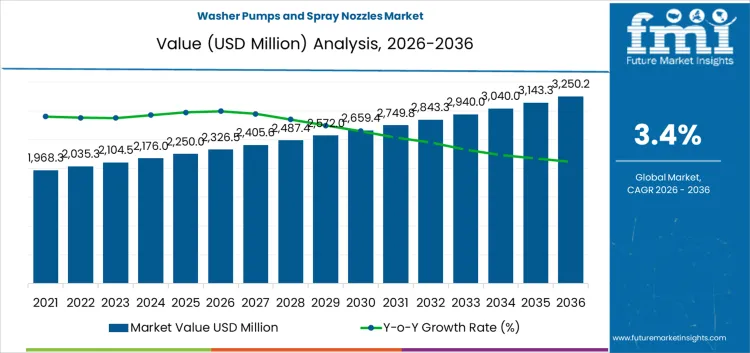
The washer pumps and spray nozzles market is valued at USD 2,326.5 million in 2026 and is forecasted to reach USD 3,250.2 million by 2036, expanding at a CAGR of 3.4%. Value formation is anchored in the mandatory role of washer systems within vehicle visibility and safety frameworks rather than optional comfort features. Every passenger vehicle, commercial vehicle, and off-highway platform incorporates washer pumps and nozzles to maintain windshield, rear glass, and headlamp clarity under contamination from dust, insects, salt, and road spray. Demand stability reflects regulatory visibility requirements, inspection compliance, and operational necessity rather than discretionary design upgrades.
Between 2026 and 2036, demand evolution is driven by functional tightening instead of volume-led expansion. Increased integration of cameras, sensors, and advanced driver assistance systems elevates precision requirements for spray targeting, pressure consistency, and response timing. Climatic exposure, including freezing temperatures, fine dust, and high humidity, shapes material selection and pump durability standards without altering the fundamental system architecture. Replacement demand remains governed by clogging, motor wear, hose degradation, and fluid chemistry interaction over service life. OEM sourcing prioritizes reliability, noise control, and packaging compatibility within constrained front-end modules. Growth remains maintenance-oriented and compliance-driven, with limited sensitivity to short-term vehicle production cycles or feature-based differentiation.
Quick Stats for Washer Pumps and Spray Nozzles Market
- Washer Pumps and Spray Nozzles Market Value (2026): USD 2,326.5 million
- Washer Pumps and Spray Nozzles Market Forecast Value (2036): USD 3,250.2 million
- Washer Pumps and Spray Nozzles Market Forecast CAGR 2026 to 2036: 3.4%
- Leading Product Category by Demand Share: Washer Pumps
- Fastest-Growing Countries: China, Brazil, USA, South Korea, Germany
- Top Players in Global Demand: Valeo, Denso, Bosch, Continental, Marelli, HELLA, Trico, Mitsuba, Aptiv, Hyundai Mobis
Washer Pumps and Spray Nozzles Market Key Takeaways
| Metric | Value |
|---|---|
| Market Value (2026) | USD 2,326.5 million |
| Market Forecast Value (2036) | USD 3,250.2 million |
| Forecast CAGR 2026 to 2036 | 3.4% |
Why is the Demand for Washer Pumps and Spray Nozzles Growing?
Demand for washer pumps and spray nozzles is rising as vehicle manufacturers and fleet operators require reliable systems to maintain clear visibility on windshields, rear windows, and headlamps under varied driving conditions. Engineers specify pumps and nozzles that deliver consistent fluid distribution, pressure performance, and resistance to environmental exposure because clear sight lines are critical for safe operation. Procurement teams evaluate material quality, flow rate accuracy, and compatibility with washer fluid chemistries to ensure components align with vehicle water management systems. Regulatory standards for safety and vehicle equipment performance influence selection of certified parts that meet wash pattern criteria without interfering with aerodynamics.
Maintenance planners prioritize solutions that support predictable wear life and simplify service procedures to reduce downtime in repair facilities serving passenger vehicles, commercial fleets, and off-highway equipment. Growth in mixed weather zones and increased travel activity reinforces uptake of high-quality pumps and nozzles that perform under temperature extremes and particulate exposure. System integrators coordinate selection with existing HVAC and sensor systems to support windshield sensors and camera cleaning functionality. Workshops and parts distributors maintain inventory of replacement units that match engineering specifications to support scheduled maintenance intervals. These technical and operational priorities support sustained adoption of washer pumps and spray nozzle solutions across evolving mobility segments.
How Are the Segments Classified in the Washer Pumps and Spray Nozzles Market?
Demand for washer pumps and spray nozzles is shaped by visibility safety requirements, all-weather vehicle operation, and regulatory standards for windshield cleaning performance. System reliability affects driver awareness during adverse weather and road contamination events. Adoption aligns with vehicle production growth, platform standardization, and integration of advanced cleaning features. Component selection prioritizes flow consistency, clog resistance, and compatibility with washer fluids. Segment classification reflects differentiation by product role, vehicle application, and functional feature set. Structure highlights how component function, vehicle duty profile, and feature integration influence specification priorities, installation scale, and usage intensity across automotive platforms.
Which Product Category Represents the Largest Share of Demand?
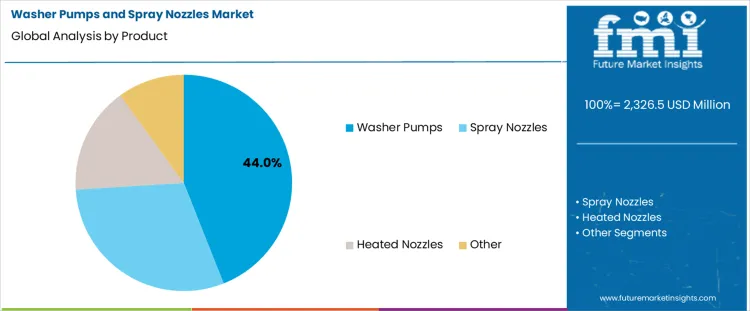
Washer pumps hold 44.0%, representing the largest share among product categories due to central role in fluid delivery. Pumps generate required pressure to distribute washer fluid across nozzles under varied operating conditions. Continuous activation during cleaning cycles increases durability and performance requirements. Design emphasis includes motor reliability, consistent flow output, and resistance to contamination. Spray nozzles distribute fluid with defined patterns and angles supporting coverage efficiency. Heated nozzles address cold climate operation with targeted functionality. Product segmentation reflects dominance of pressure-generating components where operational reliability under frequent use remains essential.
Key Points:
- Washer pumps enable pressurized fluid delivery.
- Durability supports repeated activation cycles.
- Other products manage distribution and climate-specific needs.
Which Vehicle Segment Accounts for the Highest Share of Demand?
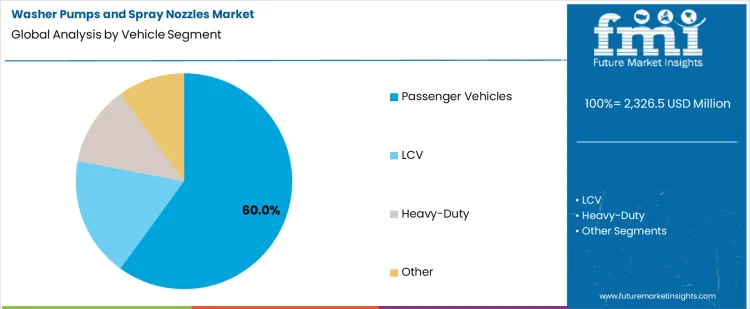
Passenger vehicles hold 60.0%, representing the largest share among vehicle segments using washer pumps and spray nozzles. High production volumes and daily usage frequency sustain consistent component demand. Visibility expectations and safety norms reinforce reliable windshield cleaning systems. Standardized vehicle platforms support scalable integration across models. Light commercial and heavy-duty vehicles operate under harsher conditions with lower unit volumes. Other vehicle types contribute limited aggregate usage. Vehicle segmentation reflects concentration of component consumption within passenger-focused platforms emphasizing safety, comfort, and regulatory compliance.
Key Points:
- Passenger vehicles drive high installation volumes.
- Safety expectations reinforce system reliability.
- Other segments face different duty and usage profiles.
Which Feature Level Drives the Largest Share of Demand?
Standard configurations hold 52.0%, representing the largest share among feature levels due to simplicity and cost efficiency. These systems provide consistent cleaning performance without added thermal or spray complexity. Integration aligns with baseline vehicle electrical architectures and maintenance practices. Fleet and mass-market vehicles favor proven designs minimizing service requirements. Heated or anti-icing features address cold climate operation with added components. Multi-jet designs improve coverage precision with higher complexity. Feature segmentation reflects preference for dependable, scalable solutions meeting core visibility needs across high-volume vehicle production.
Key Points:
- Standard systems balance performance and cost control.
- Simple designs support maintenance efficiency.
- Advanced features address climate or coverage enhancements.
What are the Key Dynamics in the Washer Pumps and Spray Nozzles Market?
Demand for washer pumps and spray nozzles reflects functional requirements for windshield and headlamp cleaning systems in road vehicles. Adoption spans passenger vehicles, commercial vehicles, and off-highway equipment across OEM and replacement channels. Global scope aligns with vehicle safety norms and visibility maintenance needs. Usage centers on electric pumps and precision nozzles integrated with fluid reservoirs, tubing, and electronic control systems.
How do visibility safety requirements and vehicle design integration shape adoption?
Clear windshield visibility remains essential for driver safety under rain, dust, insects, and road debris exposure. Demand increases as safety regulations mandate effective washer systems for front and rear glazing. Modern vehicle designs integrate compact pumps supporting variable spray pressure and intermittent operation. Nozzle design influences spray pattern accuracy, fluid efficiency, and coverage consistency. Adoption strengthens where headlamp washers support advanced lighting systems requiring clean optical surfaces. Integration with driver assistance systems reinforces need for reliable washer activation under sensor-detected conditions. Cold climate operation drives demand for freeze-resistant components. OEMs prioritize standardized modules compatible with platform-wide electrical architectures.
How do cost sensitivity, durability, and environmental constraints influence market scalability?
Component pricing remains sensitive in high-volume vehicle segments with aggressive cost targets. Demand sensitivity rises where washer systems are perceived as low-differentiation components. Pump motor durability affects failure rates due to frequent cycling and fluid contamination. Nozzle clogging from debris or mineral buildup impacts long-term performance. Environmental regulations restrict washer fluid formulations, influencing material compatibility. Packaging constraints limit nozzle placement flexibility in aerodynamic designs. Aftermarket competition pressures margins with low-cost alternatives. Supply chain dependence on small electric motors and molded plastics constrains rapid scaling during demand surges.
How Is Demand for Washer Pumps and Spray Nozzles Evolving Globally?
Demand for washer pumps and spray nozzles is expanding globally due to safety visibility requirements, vehicle utilization intensity, and maintenance-led replacement across passenger and commercial fleets. Consumption aligns with windshield cleaning frequency, climate exposure, and integration with advanced driver assistance camera systems. Electrification and sensor proliferation increase precision and reliability requirements for spray patterns and pump performance. Aftermarket replacement remains material where mileage accumulation is high. Growth rates in China at 4.4%, Brazil at 4.3%, USA at 3.2%, South Korea at 3.0%, and Germany at 2.9% indicate steady expansion driven by safety compliance, operating conditions, and lifecycle servicing needs.
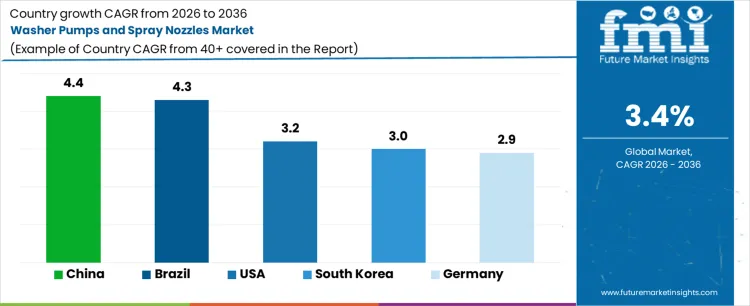
| Country | CAGR (%) |
|---|---|
| China | 4.4% |
| Brazil | 4.3% |
| USA | 3.2% |
| South Korea | 3.0% |
| Germany | 2.9% |
What Is Supporting Washer Pump and Nozzle Demand Growth in China?
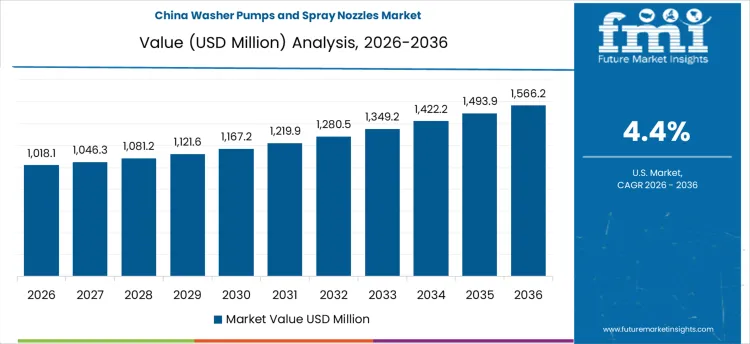
Washer pump and spray nozzle demand in China is growing at a CAGR of 4.4%, supported by high vehicle utilization and urban traffic conditions. Frequent stop-start driving increases windshield contamination from dust and emissions. OEMs integrate higher-capacity pumps to ensure consistent spray under varied temperatures. Expansion of camera-based driver assistance systems increases demand for precise nozzle targeting. Domestic vehicle production sustains OEM fitment volumes. Inspection regimes and maintenance practices encourage timely replacement. Growth remains maintenance-led, reflecting operating intensity and safety expectations rather than rapid vehicle population expansion.
- High urban pollution increasing cleaning frequency
- Integration with camera-based driver assistance systems
- Stable OEM demand from domestic vehicle production
- Inspection-driven maintenance and replacement cycles
Why Is Brazil Experiencing Steady Expansion in Washer System Demand?
Operating environment conditions shape washer pump and spray nozzle demand in Brazil, expanding at a CAGR of 4.3%. Dust, insects, and road debris increase windshield soiling during long routes. Heavy rainfall variability requires reliable spray performance for visibility. Fleet usage in logistics and public transport sustains frequent washer activation. Heat exposure affects pump durability and hose integrity, increasing replacement needs. Demand growth reflects environmental exposure and maintenance requirements rather than growth in new vehicle registrations.
- Dust and debris increasing windshield contamination
- Rainfall variability requiring reliable spray coverage
- High utilization in logistics and public transport fleets
- Heat exposure affecting component durability
How Is the USA Sustaining Demand for Washer Pumps and Spray Nozzles?
Washer pump and spray nozzle demand in the USA is expanding at a CAGR of 3.2%, driven by high mileage accumulation and safety visibility priorities. Diverse climates expose washer systems to freezing, heat, and road salt. Integration with advanced driver assistance cameras increases precision requirements. Fleet operators prioritize preventive replacement to avoid visibility-related incidents. Aftermarket demand dominates due to long vehicle service life. Growth remains measured, aligned with maintenance cycles rather than expansion in vehicle production.
- Climate diversity stressing washer system components
- Integration with ADAS camera cleaning functions
- Preventive maintenance to ensure visibility safety
- Strong aftermarket replacement demand
What Factors Are Shaping Washer System Demand in South Korea?
Urban density and technology integration influence washer pump and spray nozzle demand in South Korea, growing at a CAGR of 3.0%. Frequent urban driving increases exposure to fine dust and road spray. High adoption of camera and sensor systems elevates nozzle accuracy requirements. Strong maintenance discipline moderates replacement frequency. Manufacturing and port logistics sustain steady vehicle utilization. Demand growth reflects technology standardization and scheduled servicing rather than accelerated fleet expansion.
- Urban fine dust increasing washer usage frequency
- High penetration of camera and sensor systems
- Strong preventive maintenance practices
- Manufacturing and port logistics vehicle utilization
Why Is Germany Showing Controlled Growth in Washer Pump Demand?
Engineering standards and disciplined maintenance define washer pump and spray nozzle demand in Germany, expanding at a CAGR of 2.9%. High-quality components extend service intervals, moderating replacement frequency. Road safety standards emphasize clear visibility under adverse weather. Integration with headlamp and camera washer systems influences specification. Preventive servicing creates predictable replacement demand. Growth remains controlled, reflecting mature vehicle fleets and efficiency-focused maintenance rather than increased vehicle deployment.
- High component quality extending service life
- Safety standards emphasizing visibility performance
- Integration with headlamp and camera washers
- Predictable preventive maintenance cycles
What is the competitive landscape of demand for the washer pumps and spray nozzles market globally?
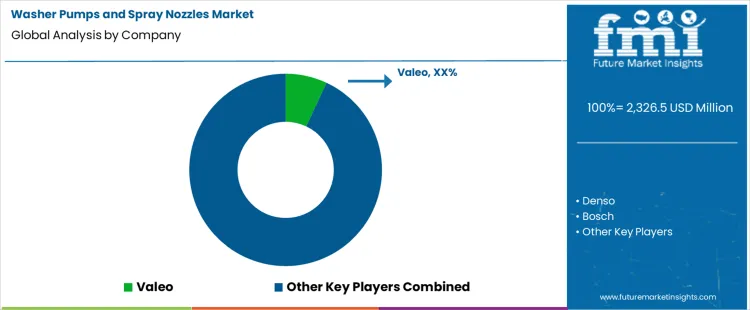
Demand for washer pumps and spray nozzles is driven by global vehicle production, safety regulations for visibility components, and growth of advanced driver assistance systems requiring reliable windshield and camera cleaning. Buyers evaluate flow rate performance, noise levels, corrosion resistance, spray pattern consistency, and integration with vehicle electrical and fluid systems. Procurement teams prioritize suppliers with strong OEM qualifications, robust quality systems, global manufacturing footprints, and timely delivery to support assembly lines. Trend in the global market reflects increased demand for multi-function washer systems, integration with heated nozzles, and performance under diverse climatic conditions to enhance visibility and safety.
Valeo holds leading positioning through a broad portfolio of washer pumps and spray nozzle assemblies used by multiple global OEMs supported by extensive engineering and service networks. Denso supports demand with high-efficiency pump systems and precision nozzles aligned with stringent automotive durability and performance standards. Bosch participates with washer system components and integrated solutions optimized for reliability and fluid management compatibility. Continental supplies washer pumps and nozzle modules with strong emphasis on quality and integration with camera and sensor cleaning systems. HELLA contributes visibility-enhancing components including spray nozzles and pumping systems used across passenger and commercial vehicles. Competitive differentiation depends on pump reliability, spray accuracy, corrosion resistance, ease of integration, and ability to meet diverse OEM specifications.
Key Players in the Washer Pumps and Spray Nozzles Market
- Valeo
- Denso
- Bosch
- Continental
- Marelli
- HELLA
- Trico
- Mitsuba
- Aptiv
- Hyundai Mobis
Scope of the Report
| Items | Values |
|---|---|
| Quantitative Units | USD million |
| Product | Washer Pumps; Spray Nozzles; Heated Nozzles; Other |
| Vehicle Segment | Passenger Vehicles; LCV; Heavy-Duty; Other |
| Feature | Standard; Heated or Anti-Icing; Multi-Jet; Other |
| Sales Channel | OEM Line-Fit; Dealer or OES; Independent Aftermarket; Other |
| Regions Covered | Asia Pacific, Europe, North America, Latin America, Middle East & Africa |
| Countries Covered | China, Brazil, USA, South Korea, Germany, and 40+ countries |
| Key Companies Profiled | Valeo; Denso; Bosch; Continental; Marelli; HELLA; Trico; Mitsuba; Aptiv; Hyundai Mobis |
| Additional Attributes | Dollar sales by product and vehicle segment; adoption trends for heated and multi-jet washer solutions supporting ADAS camera and sensor cleanliness; flow rate consistency, spray pattern accuracy, and freeze resistance performance metrics; integration with headlamp washing and rear-view camera cleaning systems; durability under chemical exposure, clog resistance, and NVH considerations; aftermarket replacement frequency and serviceability; compliance with visibility and safety regulations and OEM validation requirements influencing washer pump and nozzle specification. |
Washer Pumps and Spray Nozzles Market by Segment
By Product:
- Washer Pumps
- Spray Nozzles
- Heated Nozzles
- Other
By Vehicle Segment:
- Passenger Vehicles
- LCV
- Heavy-Duty
- Other
By Feature:
- Standard
- Heated or Anti-Icing
- Multi-Jet
- Other
By Sales Channel:
- OEM Line-Fit
- Dealer or OES
- Independent Aftermarket
- Other
Region:
- Asia Pacific
- China
- Japan
- South Korea
- India
- Australia & New Zealand
- ASEAN
- Rest of Asia Pacific
- Europe
- Germany
- United Kingdom
- France
- Italy
- Spain
- Nordic
- BENELUX
- Rest of Europe
- North America
- United States
- Canada
- Mexico
- Latin America
- Brazil
- Chile
- Rest of Latin America
- Middle East & Africa
- Kingdom of Saudi Arabia
- Other GCC Countries
- Turkey
- South Africa
- Other African Union
- Rest of Middle East & Africa
Bibliography
- European Commission. (2023). Regulation (EU) 2019/2144 of the European Parliament and of the Council on type-approval requirements for motor vehicles and visibility-related safety systems (as amended and implemented in stages from 2022 onward, with enforcement phases active during 2023-2024). Official Journal of the European Union.
- United Nations Economic Commission for Europe. (2023). UNECE Regulation No. 48: Uniform provisions concerning the approval of vehicles with regard to the installation of lighting and light-signalling devices (including requirements for headlamp cleaning systems). United Nations.
- National Highway Traffic Safety Administration. (2024). Federal Motor Vehicle Safety Standards: Lamps, reflective devices, and associated equipment (49 CFR §571; latest revisions and interpretations in force during 2024). USA Department of Transportation.
- International Organization for Standardization. (2023). ISO 13296: Road vehicles — Washer systems — Performance requirements and test methods. ISO Standards Publications..
Frequently Asked Questions
How big is the washer pumps and spray nozzles market in 2026?
The global washer pumps and spray nozzles market is estimated to be valued at USD 2,326.5 million in 2026.
What will be the size of washer pumps and spray nozzles market in 2036?
The market size for the washer pumps and spray nozzles market is projected to reach USD 3,250.2 million by 2036.
How much will be the washer pumps and spray nozzles market growth between 2026 and 2036?
The washer pumps and spray nozzles market is expected to grow at a 3.4% CAGR between 2026 and 2036.
What are the key product types in the washer pumps and spray nozzles market?
The key product types in washer pumps and spray nozzles market are washer pumps, spray nozzles, heated nozzles and other.
Which vehicle segment segment to contribute significant share in the washer pumps and spray nozzles market in 2026?
In terms of vehicle segment, passenger vehicles segment to command 60.0% share in the washer pumps and spray nozzles market in 2026.
Preview the report firsthand - request a free sample
Get SampleGet the brochure for pricing and purchase details.
Get PDFTable of Content
- Executive Summary
- Global Market Outlook
- Demand-side Trends
- Supply-side Trends
- Technology Roadmap Analysis
- Analysis and Recommendations
- Market Overview
- Market Coverage / Taxonomy
- Market Definition / Scope / Limitations
- Market Background
- Market Dynamics
- Drivers
- Restraints
- Opportunity
- Trends
- Scenario Forecast
- Demand in Optimistic Scenario
- Demand in Likely Scenario
- Demand in Conservative Scenario
- Opportunity Map Analysis
- Product Life Cycle Analysis
- Supply Chain Analysis
- Investment Feasibility Matrix
- Value Chain Analysis
- PESTLE and Porter’s Analysis
- Regulatory Landscape
- Regional Parent Market Outlook
- Production and Consumption Statistics
- Import and Export Statistics
- Market Dynamics
- Global Market Analysis 2021 to 2025 and Forecast, 2026 to 2036
- Historical Market Size Value (USD Million) Analysis, 2021 to 2025
- Current and Future Market Size Value (USD Million) Projections, 2026 to 2036
- Y-o-Y Growth Trend Analysis
- Absolute $ Opportunity Analysis
- Global Market Pricing Analysis 2021 to 2025 and Forecast 2026 to 2036
- Global Market Analysis 2021 to 2025 and Forecast 2026 to 2036, By Product
- Introduction / Key Findings
- Historical Market Size Value (USD Million) Analysis By Product , 2021 to 2025
- Current and Future Market Size Value (USD Million) Analysis and Forecast By Product , 2026 to 2036
- Washer Pumps
- Spray Nozzles
- Heated Nozzles
- Other
- Washer Pumps
- Y-o-Y Growth Trend Analysis By Product , 2021 to 2025
- Absolute $ Opportunity Analysis By Product , 2026 to 2036
- Global Market Analysis 2021 to 2025 and Forecast 2026 to 2036, By Vehicle Segment
- Introduction / Key Findings
- Historical Market Size Value (USD Million) Analysis By Vehicle Segment, 2021 to 2025
- Current and Future Market Size Value (USD Million) Analysis and Forecast By Vehicle Segment, 2026 to 2036
- Passenger Vehicles
- LCV
- Heavy-Duty
- Other
- Passenger Vehicles
- Y-o-Y Growth Trend Analysis By Vehicle Segment, 2021 to 2025
- Absolute $ Opportunity Analysis By Vehicle Segment, 2026 to 2036
- Global Market Analysis 2021 to 2025 and Forecast 2026 to 2036, By Feature
- Introduction / Key Findings
- Historical Market Size Value (USD Million) Analysis By Feature, 2021 to 2025
- Current and Future Market Size Value (USD Million) Analysis and Forecast By Feature, 2026 to 2036
- Standard
- Heated or Anti-Icing
- Multi-Jet
- Other
- Standard
- Y-o-Y Growth Trend Analysis By Feature, 2021 to 2025
- Absolute $ Opportunity Analysis By Feature, 2026 to 2036
- Global Market Analysis 2021 to 2025 and Forecast 2026 to 2036, By Sales Channel
- Introduction / Key Findings
- Historical Market Size Value (USD Million) Analysis By Sales Channel, 2021 to 2025
- Current and Future Market Size Value (USD Million) Analysis and Forecast By Sales Channel, 2026 to 2036
- OEM Line-Fit
- Dealer or OES
- Independent Aftermarket
- Other
- OEM Line-Fit
- Y-o-Y Growth Trend Analysis By Sales Channel, 2021 to 2025
- Absolute $ Opportunity Analysis By Sales Channel, 2026 to 2036
- Global Market Analysis 2021 to 2025 and Forecast 2026 to 2036, By Region
- Introduction
- Historical Market Size Value (USD Million) Analysis By Region, 2021 to 2025
- Current Market Size Value (USD Million) Analysis and Forecast By Region, 2026 to 2036
- North America
- Latin America
- Western Europe
- Eastern Europe
- East Asia
- South Asia and Pacific
- Middle East & Africa
- Market Attractiveness Analysis By Region
- North America Market Analysis 2021 to 2025 and Forecast 2026 to 2036, By Country
- Historical Market Size Value (USD Million) Trend Analysis By Market Taxonomy, 2021 to 2025
- Market Size Value (USD Million) Forecast By Market Taxonomy, 2026 to 2036
- By Country
- USA
- Canada
- Mexico
- By Product
- By Vehicle Segment
- By Feature
- By Sales Channel
- By Country
- Market Attractiveness Analysis
- By Country
- By Product
- By Vehicle Segment
- By Feature
- By Sales Channel
- Key Takeaways
- Latin America Market Analysis 2021 to 2025 and Forecast 2026 to 2036, By Country
- Historical Market Size Value (USD Million) Trend Analysis By Market Taxonomy, 2021 to 2025
- Market Size Value (USD Million) Forecast By Market Taxonomy, 2026 to 2036
- By Country
- Brazil
- Chile
- Rest of Latin America
- By Product
- By Vehicle Segment
- By Feature
- By Sales Channel
- By Country
- Market Attractiveness Analysis
- By Country
- By Product
- By Vehicle Segment
- By Feature
- By Sales Channel
- Key Takeaways
- Western Europe Market Analysis 2021 to 2025 and Forecast 2026 to 2036, By Country
- Historical Market Size Value (USD Million) Trend Analysis By Market Taxonomy, 2021 to 2025
- Market Size Value (USD Million) Forecast By Market Taxonomy, 2026 to 2036
- By Country
- Germany
- UK
- Italy
- Spain
- France
- Nordic
- BENELUX
- Rest of Western Europe
- By Product
- By Vehicle Segment
- By Feature
- By Sales Channel
- By Country
- Market Attractiveness Analysis
- By Country
- By Product
- By Vehicle Segment
- By Feature
- By Sales Channel
- Key Takeaways
- Eastern Europe Market Analysis 2021 to 2025 and Forecast 2026 to 2036, By Country
- Historical Market Size Value (USD Million) Trend Analysis By Market Taxonomy, 2021 to 2025
- Market Size Value (USD Million) Forecast By Market Taxonomy, 2026 to 2036
- By Country
- Russia
- Poland
- Hungary
- Balkan & Baltic
- Rest of Eastern Europe
- By Product
- By Vehicle Segment
- By Feature
- By Sales Channel
- By Country
- Market Attractiveness Analysis
- By Country
- By Product
- By Vehicle Segment
- By Feature
- By Sales Channel
- Key Takeaways
- East Asia Market Analysis 2021 to 2025 and Forecast 2026 to 2036, By Country
- Historical Market Size Value (USD Million) Trend Analysis By Market Taxonomy, 2021 to 2025
- Market Size Value (USD Million) Forecast By Market Taxonomy, 2026 to 2036
- By Country
- China
- Japan
- South Korea
- By Product
- By Vehicle Segment
- By Feature
- By Sales Channel
- By Country
- Market Attractiveness Analysis
- By Country
- By Product
- By Vehicle Segment
- By Feature
- By Sales Channel
- Key Takeaways
- South Asia and Pacific Market Analysis 2021 to 2025 and Forecast 2026 to 2036, By Country
- Historical Market Size Value (USD Million) Trend Analysis By Market Taxonomy, 2021 to 2025
- Market Size Value (USD Million) Forecast By Market Taxonomy, 2026 to 2036
- By Country
- India
- ASEAN
- Australia & New Zealand
- Rest of South Asia and Pacific
- By Product
- By Vehicle Segment
- By Feature
- By Sales Channel
- By Country
- Market Attractiveness Analysis
- By Country
- By Product
- By Vehicle Segment
- By Feature
- By Sales Channel
- Key Takeaways
- Middle East & Africa Market Analysis 2021 to 2025 and Forecast 2026 to 2036, By Country
- Historical Market Size Value (USD Million) Trend Analysis By Market Taxonomy, 2021 to 2025
- Market Size Value (USD Million) Forecast By Market Taxonomy, 2026 to 2036
- By Country
- Kingdom of Saudi Arabia
- Other GCC Countries
- Turkiye
- South Africa
- Other African Union
- Rest of Middle East & Africa
- By Product
- By Vehicle Segment
- By Feature
- By Sales Channel
- By Country
- Market Attractiveness Analysis
- By Country
- By Product
- By Vehicle Segment
- By Feature
- By Sales Channel
- Key Takeaways
- Key Countries Market Analysis
- USA
- Pricing Analysis
- Market Share Analysis, 2025
- By Product
- By Vehicle Segment
- By Feature
- By Sales Channel
- Canada
- Pricing Analysis
- Market Share Analysis, 2025
- By Product
- By Vehicle Segment
- By Feature
- By Sales Channel
- Mexico
- Pricing Analysis
- Market Share Analysis, 2025
- By Product
- By Vehicle Segment
- By Feature
- By Sales Channel
- Brazil
- Pricing Analysis
- Market Share Analysis, 2025
- By Product
- By Vehicle Segment
- By Feature
- By Sales Channel
- Chile
- Pricing Analysis
- Market Share Analysis, 2025
- By Product
- By Vehicle Segment
- By Feature
- By Sales Channel
- Germany
- Pricing Analysis
- Market Share Analysis, 2025
- By Product
- By Vehicle Segment
- By Feature
- By Sales Channel
- UK
- Pricing Analysis
- Market Share Analysis, 2025
- By Product
- By Vehicle Segment
- By Feature
- By Sales Channel
- Italy
- Pricing Analysis
- Market Share Analysis, 2025
- By Product
- By Vehicle Segment
- By Feature
- By Sales Channel
- Spain
- Pricing Analysis
- Market Share Analysis, 2025
- By Product
- By Vehicle Segment
- By Feature
- By Sales Channel
- France
- Pricing Analysis
- Market Share Analysis, 2025
- By Product
- By Vehicle Segment
- By Feature
- By Sales Channel
- India
- Pricing Analysis
- Market Share Analysis, 2025
- By Product
- By Vehicle Segment
- By Feature
- By Sales Channel
- ASEAN
- Pricing Analysis
- Market Share Analysis, 2025
- By Product
- By Vehicle Segment
- By Feature
- By Sales Channel
- Australia & New Zealand
- Pricing Analysis
- Market Share Analysis, 2025
- By Product
- By Vehicle Segment
- By Feature
- By Sales Channel
- China
- Pricing Analysis
- Market Share Analysis, 2025
- By Product
- By Vehicle Segment
- By Feature
- By Sales Channel
- Japan
- Pricing Analysis
- Market Share Analysis, 2025
- By Product
- By Vehicle Segment
- By Feature
- By Sales Channel
- South Korea
- Pricing Analysis
- Market Share Analysis, 2025
- By Product
- By Vehicle Segment
- By Feature
- By Sales Channel
- Russia
- Pricing Analysis
- Market Share Analysis, 2025
- By Product
- By Vehicle Segment
- By Feature
- By Sales Channel
- Poland
- Pricing Analysis
- Market Share Analysis, 2025
- By Product
- By Vehicle Segment
- By Feature
- By Sales Channel
- Hungary
- Pricing Analysis
- Market Share Analysis, 2025
- By Product
- By Vehicle Segment
- By Feature
- By Sales Channel
- Kingdom of Saudi Arabia
- Pricing Analysis
- Market Share Analysis, 2025
- By Product
- By Vehicle Segment
- By Feature
- By Sales Channel
- Turkiye
- Pricing Analysis
- Market Share Analysis, 2025
- By Product
- By Vehicle Segment
- By Feature
- By Sales Channel
- South Africa
- Pricing Analysis
- Market Share Analysis, 2025
- By Product
- By Vehicle Segment
- By Feature
- By Sales Channel
- USA
- Market Structure Analysis
- Competition Dashboard
- Competition Benchmarking
- Market Share Analysis of Top Players
- By Regional
- By Product
- By Vehicle Segment
- By Feature
- By Sales Channel
- Competition Analysis
- Competition Deep Dive
- Valeo
- Overview
- Product Portfolio
- Profitability by Market Segments (Product/Age /Sales Channel/Region)
- Sales Footprint
- Strategy Overview
- Marketing Strategy
- Product Strategy
- Channel Strategy
- Denso
- Bosch
- Continental
- Marelli
- HELLA
- Trico
- Mitsuba
- Aptiv
- Hyundai Mobis
- Valeo
- Competition Deep Dive
- Assumptions & Acronyms Used
- Research Methodology


