

- Market Size (2026)
- USD 0.67 Bn
- Forecast (2036)
- USD 2.61 Bn
- CAGR (2026 to 2036)
- 14.6%
How big is the wire-free RTK satellite navigation robotic mowers market in 2026?
USD 0.67 billion in 2026 and USD 2.61 billion by 2036 at a 14.6% CAGR.
The wire-free RTK satellite navigation robotic mowers industry value is forecast to grow from USD 0.52 billion in 2025 to USD 2.61 billion by 2036 at 14.6% CAGR. Residential Lawns are forecast to represent 68.0% share in 2026 because premium homeowners form the first conversion pool. Private Base systems are expected to hold 55.0% share in 2026 due to local correction control.
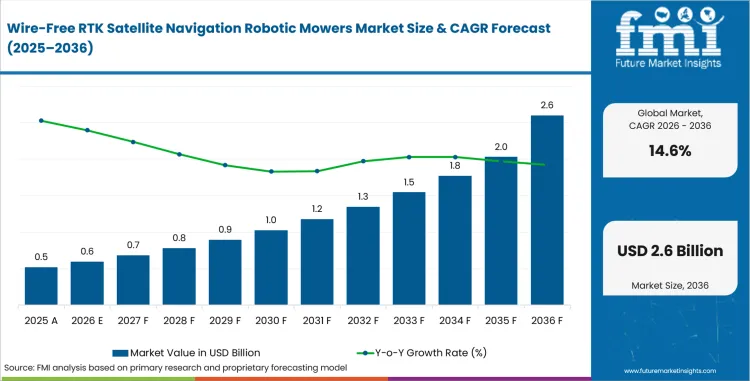
Wire-Free RTK Satellite Navigation Robotic Mowers Market Overview: Size and Forecast
- 2026 Market Size: USD 0.67 billion
- 2036 Market Size: USD 2.61 billion
- Forecast CAGR: 14.6% from 2026 to 2036
- Leading End Use: Residential Lawns
- Residential Lawns Share in 2026: 68.0%
- Leading Signal Setup: Private Base
- Private Base Share in 2026: 55.0%
- Fastest-growing Country: India
- India CAGR: 19.1% by 2036
Summary of the Wire-Free RTK Satellite Navigation Robotic Mowers Market
The wire-free RTK satellite navigation robotic mowers market is moving from early adopter demand into a dealer-supported equipment category. Growth is supported by boundary-wire avoidance, labor pressure, and larger residential lawns that justify premium mowing automation.
- Demand and Growth Drivers
- Boundary-wire replacement remains the central demand driver as buyers avoid trenching, wire breaks, and repeat installation visits.
- Commercial grounds are testing autonomous mowing because predictable machine runtime can reduce routine crew dependence.
- Hybrid RTK Vision products reduce return risk in yards where trees and walls weaken satellite reception.
- Product and Segment View
- Residential Lawns are projected to hold 68.0% share in 2026 because premium homeowners are the first mass-market conversion pool.
- Private Base is estimated to capture 55.0% share in 2026 as estates, sports fields, and larger lawns prefer local correction control.
- RTK GNSS is forecast to represent 47.0% share in 2026 because buyers associate satellite correction with predictable virtual boundaries.
- Geography and Competitive Outlook
- India is projected to record 19.1% CAGR by 2036 as premium gated communities and managed campuses adopt from a small base.
- China is expected to expand at 18.4% CAGR by 2036 as domestic suppliers scale RTK and vision-enabled designs.
- Husqvarna and Kress compete through dealer-backed correction support, professional turf credibility, and service-led setup.
- Segway Navimow, Mammotion, Greenworks, Ambrogio, and Sunseeker compete through hybrid positioning, app mapping, and online discovery.
- Analyst Opinion
- Nikhil Kaitwade, Associate Vice President at FMI, observes, “This market is less a mower replacement story and more a navigation reliability story. Buyers are paying for trust in the boundary. A lower-priced robot that loses its map near trees creates service calls and returns. A premium robot that holds a clean route across mixed lawns gives dealers a repeatable sales case. Suppliers with RTK correction depth, vision fallback, and trained service channels should earn stronger margins than firms competing only on battery size.”
Market outlook is determined by larger garden bases, measurable grounds-labor pressure, and growing comfort with service robots. The International Federation of Robotics reported in October 2025 that consumer service robot sales grew 11% to close to 20 million units in 2024, with domestic tasks forming the largest consumer robot use group. The U.S. Bureau of Labor Statistics projected 171,600 average annual openings for grounds maintenance workers from 2024 to 2034. The Royal Horticultural Society mapped 20.6 million domestic gardens in Great Britain in 2025, showing a large addressable lawn-care base for compact wire-free products.
Which factors support expansion in the wire-free RTK satellite navigation robotic mowers market?
Finished RTK mower revenue and service-backed navigation confidence support market value across residential and commercial channels.
- Market value is supported by finished mower revenue before correction services and accessories add incremental sales.
- Supplier pricing reflects RTK receivers, reference stations, vision sensors, app mapping, and after-sales service.
- Revenue improves as brands convert boundary-wire users into virtual-boundary buyers with lower setup friction.
- Retail trust rises when dealers can verify signal quality and explain failure points before installation.
Why is the wire-free RTK satellite navigation robotic mowers market growing?
Boundary-wire avoidance is moving robotic mowing from installation-heavy projects toward app-defined lawn care.
Adoption is strengthening because buyers can compare app-mapped setup, connected diagnostics, and dealer-backed correction coverage before purchase. The Federal Communications Commission reported in May 2025 that 110 million homes and small businesses, or 95%, had access to terrestrial fixed 100/20 Mbps service. This connectivity base supports app onboarding, remote updates, and network correction checks. Suppliers that verify coverage before sale can reduce callbacks and protect premium pricing as virtual-boundary mowing scales from open lawns into shaded properties.
How is the wire-free RTK satellite navigation robotic mowers market segmented?
The wire-free RTK satellite navigation robotic mowers industry is segmented by navigation architecture, signal setup, end use, sales channel, and lawn capacity.
- Residential Lawns are expected to capture 68.0% share in 2026 due to homeowner conversion from buried-wire installations.
- Private Base systems are anticipated to hold 55.0% share in 2026 since larger lawns and sports turf prefer local correction reliability.
- RTK GNSS is projected to secure 47.0% share in 2026 because correction-based positioning remains the clearest proof of wire-free control.
- Specialty Dealers are forecast to represent 40.0% share in 2026 because setup confidence shapes premium mower purchases.
- Small Lawns are projected to account for 38.0% share in 2026 as compact RTK and hybrid models widen the entry pool.
Which end use leads the wire-free RTK robotic mowers market?
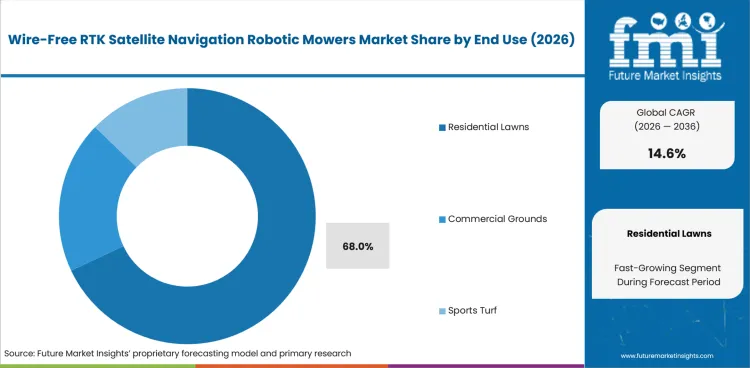
- Residential Lawns are forecast to account for 68.0% share in 2026 as premium homeowners adopt app-based mapping first.
- Commercial Grounds gain value where campuses and hotels need repeat mowing with lower routine labor dependence.
Which signal setup leads the wire-free RTK robotic mowers market?
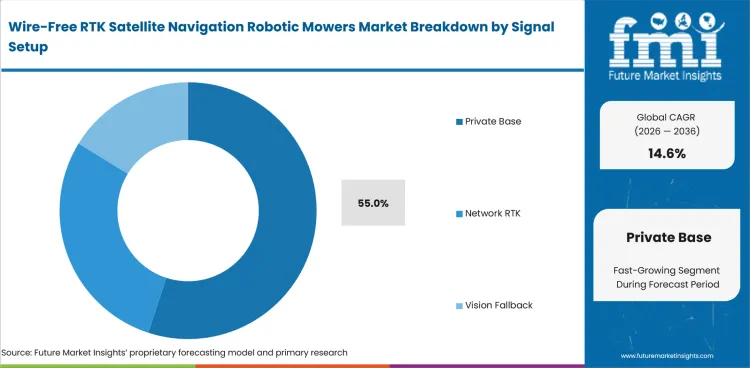
- Private Base systems are anticipated to hold 55.0% share in 2026 as defined properties prefer site-level correction control.
- Network RTK creates a service-backed route where suppliers can remove property antennas and monetize coverage.
Why does RTK GNSS lead the navigation architecture segment?
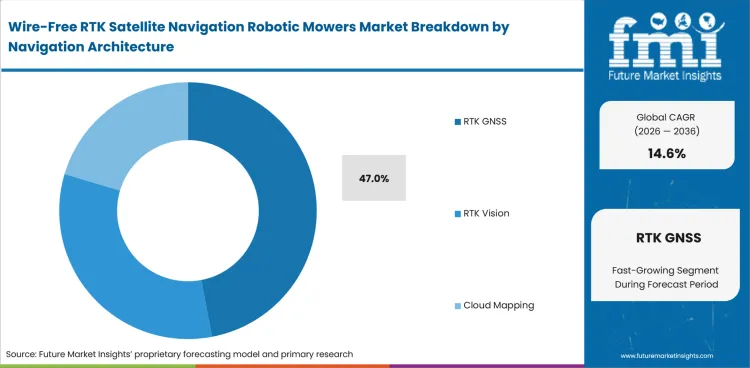
- RTK GNSS is projected to account for 47.0% share in 2026 because buyers connect satellite correction with virtual-boundary reliability.
- RTK Vision gains share where cameras support mowing near trees, walls, and narrow passages.
Which sales channel leads the wire-free RTK robotic mowers market?
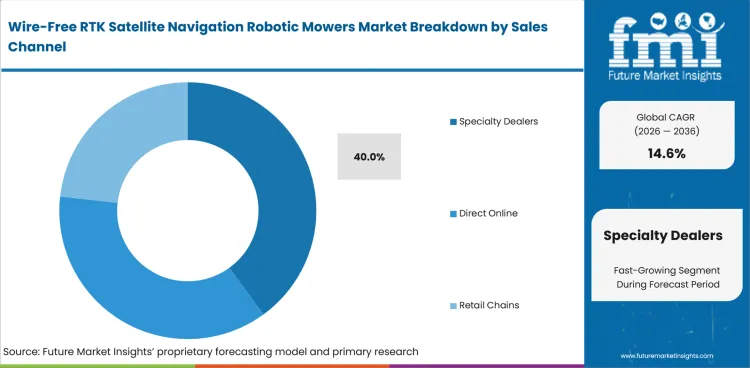
- Specialty Dealers are expected to represent 40.0% share in 2026 because RTK setup depends on site checks and user training.
- Direct Online keeps a strong role for compact models where yards are open and setup is simpler.
Which lawn capacity leads the wire-free RTK robotic mowers market?
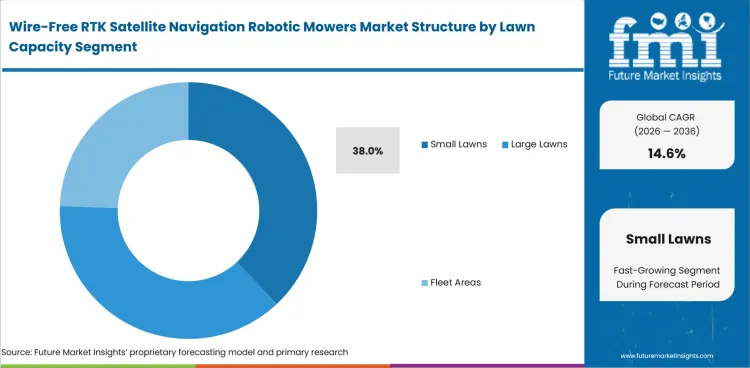
- Small Lawns are projected to hold 38.0% share in 2026 as compact models bring RTK into lower-capacity homes.
- Large Lawns attract higher revenue per unit because battery capacity, sensing, and service support are priced into the sale.
What are the driver, restraints, and opportunities in the wire-free RTK satellite navigation robotic mowers market?
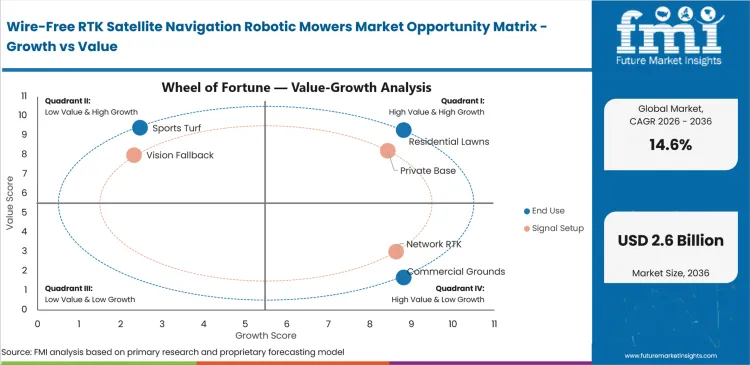
Boundary-wire replacement and labor pressure support market expansion while signal-shadow risk and service economics limit easier adoption.
- Driver: Boundary-wire removal shortens setup work and lowers the first installation barrier for premium homeowners.
- Restraint: Trees, walls, narrow passages, and biodiversity-sensitive mowing calendars can reduce site suitability.
- Opportunity: Network RTK services can create recurring coverage revenue when suppliers bundle correction support with mower sales.
Boundary-Wire Replacement Demand Outlook
Demand outlook is moving toward homeowners and facility managers who want reliable virtual boundaries before they compare blade systems or battery runtime. Residential construction remains a practical demand base, as the U.S. Census Bureau reported 1,313,000 privately owned housing completions at a seasonally adjusted annual rate in May 2026. New homes, premium community landscaping, and larger suburban properties give dealers a measurable route for positioning app-mapped mowing as a lower-friction alternative to buried-wire installation.
Signal-Shadow and Safety Restraint Analysis
Restraint analysis remains linked to trust in electric outdoor equipment, site screening, and installer guidance before autonomous mowing reaches wider households. The U.S. Consumer Product Safety Commission said about 217,500 RYOBI battery-powered mowers were recalled in February 2025 due to a connector overheating hazard. This reinforces why buyers expect dealer checks, safe charging guidance, and clear product support before trusting higher-priced autonomous mower platforms.
Network RTK Service Opportunity and Decision-driver Analysis
Opportunity is strongest where suppliers can connect RTK correction, fallback sensing, and service assurance into one buyer-facing promise. Service automation is becoming easier to explain, as the International Federation of Robotics reported almost 200,000 professional service robots sold in 2024, a 9% increase from the prior year. Buyers respond better when suppliers convert correction coverage into measurable uptime rather than promising wire-free mowing through hardware claims alone.
Which countries are growing fastest in the wire-free RTK satellite navigation robotic mowers market?
India 19.1% CAGR, China 18.4% CAGR, United States 17.0% CAGR, South Korea 16.2% CAGR, Germany 13.1% CAGR, United Kingdom 12.7% CAGR, France 12.5% CAGR, and Japan 10.9% CAGR through 2036.
.webp "Top Country Growth Comparison Wire Free Rtk Satellite Navigation Robotic Mowers Market Cagr (2026 2036)")
| Country | CAGR |
|---|---|
| India | 19.1% |
| China | 18.4% |
| United States | 17.0% |
| South Korea | 16.2% |
| Germany | 13.1% |
| United Kingdom | 12.7% |
| France | 12.5% |
| Japan | 10.9% |
Source: Future Market Insights, 2026.
How do country-level CAGRs compare in the wire-free RTK satellite navigation robotic mowers market?
India leads country growth while Japan records the most cautious expansion outlook among profiled markets.
- India is forecast to record 19.1% CAGR by 2036 due to a small base and premium managed-property demand.
- China is projected to grow at 18.4% CAGR by 2036 as domestic RTK mower suppliers scale lower-cost designs.
- The United States is expected to expand at 17.0% CAGR by 2036 through large-lawn economics and labor pressure.
- South Korea is estimated to rise at 16.2% CAGR by 2036 with managed apartment and facility landscapes supporting trials.
- Germany is projected to post 13.1% CAGR by 2036 as dealer credibility and premium garden equipment demand support adoption.
- The United Kingdom is forecast to grow at 12.7% CAGR by 2036 through compact-garden demand and retail education.
- France is expected to advance at 12.5% CAGR by 2036 as residential gardens and public green-space maintenance create demand pockets.
- Japan is forecast to grow at 10.9% CAGR by 2036 because compact lawns limit high-capacity unit demand.
How fast is the wire-free RTK satellite navigation robotic mowers market growing in India?
A 19.1% CAGR through 2036 reflects low current penetration, managed-community landscaping, and premium housing adoption.
Country Market Snapshot Table
| Parameter | Value |
|---|---|
| Market Size in 2025 (Value) | USD 15.1 million |
| Market Size in 2026 (Value) | USD 18.0 million |
| Market Forecast in 2036 (Value) | USD 103.4 million |
| CAGR (2026 to 2036) | 19.1% |
| Years Considered | 2021 to 2036 |
| Base Year | 2025 |
| Forecast Period | 2026 to 2036 |
| Units Considered | Value (USD million) |
| Leading Sub-Region | Bengaluru gated communities and premium villa clusters |
India Wire-Free RTK Satellite Navigation Robotic Mowers Market Outlook
India demand is forming around premium gated communities, private villas, hospitality lawns, and smart township projects. Buyers remain highly service-sensitive because RTK mower setup needs mapping support and after-sales response.
Adoption should stay concentrated in high-income urban corridors before mass retail develops. Suppliers that combine installer training with app-based setup guidance should be better placed than brands relying on online sales alone.
Key Growth Drivers
- Smart-city landscaping programs give property managers a wider automation reference point. The Press Information Bureau reported that 94% of Smart Cities Mission projects were completed as of May 9, 2025.
- Connected-home familiarity supports app-mapped mower trial among younger buyers. The Ministry of Statistics and Programme Implementation reported rural internet use of 92.7% among people aged 15 to 29 in 2025.
- Premium gated communities create early demand for quiet mower operation and predictable common-area maintenance.
- Hotel landscapes and private clubs can test wire-free mowing where manual upkeep costs are easier to track.
Key Restraints
- Public greening budgets can focus on urban forests before private mower automation. The Ministry of Environment, Forest and Climate Change described a target of 1,000 Nagar Vans and Vatikas through 2026 to 2027.
- Price sensitivity limits mass adoption because RTK models remain premium products compared with manual lawn services.
- Importer-led service networks can slow replacement parts availability outside major cities.
What makes India unique
India is unique because adoption begins from a small base and concentrates in managed premium properties before mass residential use.
Key Companies
- Yarbo India distribution partners
- Husqvarna India private channels
- Segway Navimow India online sellers
- Mammotion India resellers
- Kress India distribution partners
- Greenworks India online channels
- Local landscaping automation integrators
Sales & Marketing Channels
- Premium landscaping contractors
- Smart township facility managers
- Direct online stores
- Specialty garden equipment sellers
- Hospitality-property procurement
- Villa-community installers
Country Segment Breakdown Table
| Segment | Sub-Segments |
|---|---|
| By Navigation Architecture | RTK GNSS · RTK Vision · RTK UWB · Cloud Mapping |
| By Signal Setup | Private Base · Network RTK · Vision Fallback |
| By End Use | Residential Lawns · Commercial Grounds · Sports Turf |
| By Sales Channel | Specialty Dealers · Direct Online · Retail Chains · Integrators |
| By Lawn Capacity | Small Lawns · Large Lawns · Fleet Areas |
| Key Sub-Regions Covered, Market Adoption Corridors | Bengaluru · Mumbai · Delhi NCR · Pune · Hyderabad · Chennai |
Frequently Asked Questions
How fast is India wire-free RTK satellite navigation robotic mowers market growing?
Demand in India is projected to expand at 19.1% CAGR from 2026 to 2036 due to country-specific adoption drivers.
Who leads India wire-free RTK satellite navigation robotic mowers market?
Yarbo India distribution partners, Husqvarna India private channels, and Segway Navimow India online sellers compete through dealer reach, product availability, and service support.
What is driving adoption in India wire-free RTK satellite navigation robotic mowers market?
Premium property management and installer-backed setup are moving early buyers toward wire-free robotic mowing.
What is the wire-free RTK satellite navigation robotic mowers market outlook in China?
An 18.4% CAGR through 2036 is supported by urban green-space investment, domestic robotics supply, and export-ready mower design.
Country Market Snapshot Table
| Parameter | Value |
|---|---|
| Market Size in 2025 (Value) | USD 77.7 million |
| Market Size in 2026 (Value) | USD 92.0 million |
| Market Forecast in 2036 (Value) | USD 498.1 million |
| CAGR (2026 to 2036) | 18.4% |
| Years Considered | 2021 to 2036 |
| Base Year | 2025 |
| Forecast Period | 2026 to 2036 |
| Units Considered | Value (USD million) |
| Leading Sub-Region | Yangtze River Delta and Greater Bay Area villa corridors |
China Wire-Free RTK Satellite Navigation Robotic Mowers Market Outlook
China demand is shaped by domestic robotic mower manufacturing and premium villa-community landscaping. Local suppliers can test product designs at home while scaling export versions for Europe and North America.
The market still depends on education because many urban households have limited private lawn area. Commercial sites, campuses, and managed residential landscapes provide stronger early demand than small apartments.
Key Growth Drivers
- Urbanization widens the managed-landscape base for automated upkeep. The National Bureau of Statistics reported an urbanization rate of 67.00% for permanent residents at the end of 2024.
- City greening gives autonomous mowing a larger public-space context. The State Council reported 43.49% green coverage of built-up urban areas at the end of 2024.
- Domestic robotics suppliers can lower entry prices as RTK mower production moves closer to export supply chains.
- Villa communities and resort landscapes create demand pockets for wire-free products that avoid buried-wire installation.
Key Restraints
- Uneven land-use density limits private-lawn conversion in dense cities. The State Council reported 110,200 square kilometers of urban development boundary areas across 683 cities.
- Budget buyers can delay adoption when lower-cost non-RTK robotic mowers remain available through online channels.
- Signal reliability near high-rise structures can create service pressure for satellite-guided models.
What makes China unique
China is unique because domestic manufacturing scale can reduce product cost while dense urban housing limits private-lawn volume.
Key Companies
- Segway Navimow
- Mammotion
- Sunseeker Robotics
- Yarbo Technology
- Dreame Technology
- ECOVACS Robotics
- Greenworks China
Sales & Marketing Channels
- Domestic e-commerce platforms
- Robotics retailers
- Villa-community installers
- Commercial landscaping contractors
- Export distributors
- Smart-home channels
Country Segment Breakdown Table
| Segment | Sub-Segments |
|---|---|
| By Navigation Architecture | RTK GNSS · RTK Vision · RTK UWB · Cloud Mapping |
| By Signal Setup | Private Base · Network RTK · Vision Fallback |
| By End Use | Residential Lawns · Commercial Grounds · Sports Turf |
| By Sales Channel | Specialty Dealers · Direct Online · Retail Chains · Integrators |
| By Lawn Capacity | Small Lawns · Large Lawns · Fleet Areas |
| Key Sub-Regions Covered, Market Adoption Corridors | Yangtze River Delta · Greater Bay Area · Beijing-Tianjin-Hebei · Chengdu-Chongqing · Hainan · Shandong |
Frequently Asked Questions
How fast is China wire-free RTK satellite navigation robotic mowers market growing?
Demand in China is projected to expand at 18.4% CAGR from 2026 to 2036 due to country-specific adoption drivers.
Who leads China wire-free RTK satellite navigation robotic mowers market?
Segway Navimow, Mammotion, and Sunseeker Robotics compete through dealer reach, product availability, and service support.
What is driving adoption in China wire-free RTK satellite navigation robotic mowers market?
Domestic robotics supply and managed villa landscapes are moving buyers toward app-mapped mower formats.
What is the wire-free RTK satellite navigation robotic mowers market outlook in the United States?
A 17.0% CAGR through 2036 is supported by large lawns, dealer service depth, and measurable grounds-maintenance labor pressure.
Country Market Snapshot Table
| Parameter | Value |
|---|---|
| Market Size in 2025 (Value) | USD 153.8 million |
| Market Size in 2026 (Value) | USD 180.0 million |
| Market Forecast in 2036 (Value) | USD 865.2 million |
| CAGR (2026 to 2036) | 17.0% |
| Years Considered | 2021 to 2036 |
| Base Year | 2025 |
| Forecast Period | 2026 to 2036 |
| Units Considered | Value (USD million) |
| Leading Sub-Region | Sun Belt and Midwest suburban lawn corridors |
United States Wire-Free RTK Satellite Navigation Robotic Mowers Market Outlook
United States demand is shaped by large suburban lawns and a clear payback comparison against recurring mowing services. Buyers often discover the category online but still need dealer screening for trees, slopes, and reference-station placement.
Commercial grounds add a second route because schools, campuses, and golf facilities need predictable cut schedules. Suppliers that combine parts support with quick mapping assistance should hold better channel confidence.
Key Growth Drivers
- Large-lawn households support higher-capacity RTK mower adoption as new suburban housing keeps outdoor equipment decisions active. The U.S. Census Bureau reported 1,442,000 privately owned housing units authorized by building permits at a seasonally adjusted annual rate in April 2026.
- Landscaping labor pressure keeps autonomous mowing visible for contractors that need predictable cutting schedules and lower routine crew dependence. The U.S. Bureau of Labor Statistics projected 788,700 annual openings across building and grounds cleaning occupations from 2024 to 2034.
- Dealer-backed setup helps premium buyers confirm signal quality before installation and reduces direct-online return risk.
- Golf courses and institutional sites create higher-value trials because uptime and cut consistency matter more than base mower price.
Key Restraints
- Connected setup can still fail at edge properties where weaker service limits app onboarding and remote diagnostics. The Federal Communications Commission reported that about 75% of all residential fixed connections had speeds of at least 100/20 Mbps in June 2025.
- Dense tree cover in older suburbs can interrupt satellite reception and raise service calls.
- Direct online buyers can misjudge slope, corridor width, and antenna placement without a site review.
What makes United States unique
United States is unique because lawn size and labor cost make wire-free RTK mowing a payback product.
Key Companies
- Husqvarna Professional Products Inc.
- Greenworks North America LLC
- Kress North America
- Segway Navimow U.S.
- Mammotion U.S.
- Sunseeker U.S.
- STIHL Inc.
Sales & Marketing Channels
- Specialty outdoor power equipment dealers
- Big-box retail channels
- Direct online stores
- Landscaping contractor referrals
- Golf and sports turf distributors
- Smart-home installer partnerships
Country Segment Breakdown Table
| Segment | Sub-Segments |
|---|---|
| By Navigation Architecture | RTK GNSS · RTK Vision · RTK UWB · Cloud Mapping |
| By Signal Setup | Private Base · Network RTK · Vision Fallback |
| By End Use | Residential Lawns · Commercial Grounds · Sports Turf |
| By Sales Channel | Specialty Dealers · Direct Online · Retail Chains · Integrators |
| By Lawn Capacity | Small Lawns · Large Lawns · Fleet Areas |
| Key Sub-Regions Covered, Market Adoption Corridors | Texas · Florida · Georgia · Ohio · Pennsylvania · California |
Frequently Asked Questions
How fast is United States wire-free RTK satellite navigation robotic mowers market growing?
Demand in United States is projected to expand at 17.0% CAGR from 2026 to 2036 due to country-specific adoption drivers.
Who leads United States wire-free RTK satellite navigation robotic mowers market?
Husqvarna Professional Products Inc., Greenworks North America LLC, and Kress North America compete through dealer reach, product availability, and service support.
What is driving adoption in United States wire-free RTK satellite navigation robotic mowers market?
Large residential lawns and contractor service economics are moving buyers toward autonomous mowing trials.
How is the wire-free RTK satellite navigation robotic mowers market performing in South Korea?
A 16.2% CAGR through 2036 reflects apartment-community landscaping, digital facility management, and interest in compact automation.
Country Market Snapshot Table
| Parameter | Value |
|---|---|
| Market Size in 2025 (Value) | USD 20.7 million |
| Market Size in 2026 (Value) | USD 24.0 million |
| Market Forecast in 2036 (Value) | USD 107.7 million |
| CAGR (2026 to 2036) | 16.2% |
| Years Considered | 2021 to 2036 |
| Base Year | 2025 |
| Forecast Period | 2026 to 2036 |
| Units Considered | Value (USD million) |
| Leading Sub-Region | Seoul Capital Area and planned apartment communities |
South Korea Wire-Free RTK Satellite Navigation Robotic Mowers Market Outlook
South Korea demand is concentrated in managed residential communities, institutional campuses, and resort properties. The consumer base is digitally ready, but private lawn ownership is more limited than in the United States or Germany.
Suppliers need service partnerships because buyers expect quick support and neat app integration. Compact RTK Vision models should work better than large-lawn products in dense metropolitan settings.
Key Growth Drivers
- Managed housing creates a defined route for shared landscape automation. Statistics Korea reported that apartments accounted for 53.9% of housing units in 2024.
- Smart-city procurement strengthens acceptance of connected maintenance tools. The Ministry of Land, Infrastructure and Transport selected eight projects under its 2024 smart-city planning and solution program.
- Resort and campus landscapes provide trial sites where mowing schedules can be centralized.
- High smartphone familiarity supports app-based mapping and remote monitoring in premium residential projects.
Key Restraints
- Municipal budgets can prioritize broader environmental programs over turf automation. South Korea’s Ministry of Environment set 2024 spending and funds at 14.4567 trillion won.
- Small private outdoor areas reduce the buyer pool for large-capacity wire-free mowers.
- Service expectations are high and can penalize brands without fast local repair capability.
What makes South Korea unique
South Korea is unique because managed housing and compact urban layouts make shared-landscape use more important than individual lawn ownership.
Key Companies
- Kyungjin Landscaping Technology
- Daedong Mobility channels
- Husqvarna Korea distributors
- Segway Navimow Korea sellers
- Mammotion Korea resellers
- Sunseeker Korea channels
- Local facility-management integrators
Sales & Marketing Channels
- Apartment facility managers
- Landscape maintenance contractors
- Direct online channels
- Smart-home retail channels
- Resort-property procurement
- Municipal pilot channels
Country Segment Breakdown Table
| Segment | Sub-Segments |
|---|---|
| By Navigation Architecture | RTK GNSS · RTK Vision · RTK UWB · Cloud Mapping |
| By Signal Setup | Private Base · Network RTK · Vision Fallback |
| By End Use | Residential Lawns · Commercial Grounds · Sports Turf |
| By Sales Channel | Specialty Dealers · Direct Online · Retail Chains · Integrators |
| By Lawn Capacity | Small Lawns · Large Lawns · Fleet Areas |
| Key Sub-Regions Covered, Market Adoption Corridors | Seoul Capital Area · Busan · Incheon · Daegu · Daejeon · Jeju |
Frequently Asked Questions
How fast is South Korea wire-free RTK satellite navigation robotic mowers market growing?
Demand in South Korea is projected to expand at 16.2% CAGR from 2026 to 2036 due to country-specific adoption drivers.
Who leads South Korea wire-free RTK satellite navigation robotic mowers market?
Kyungjin Landscaping Technology, Daedong Mobility channels, and Husqvarna Korea distributors compete through dealer reach, product availability, and service support.
What is driving adoption in South Korea wire-free RTK satellite navigation robotic mowers market?
Apartment-community landscaping and compact facility upkeep are moving buyers toward shared-landscape automation.
How is the wire-free RTK satellite navigation robotic mowers market performing in Germany?
A 13.1% CAGR through 2036 reflects premium garden equipment demand, online comparison behavior, and high technical scrutiny.
Country Market Snapshot Table
| Parameter | Value |
|---|---|
| Market Size in 2025 (Value) | USD 61.9 million |
| Market Size in 2026 (Value) | USD 70.0 million |
| Market Forecast in 2036 (Value) | USD 239.7 million |
| CAGR (2026 to 2036) | 13.1% |
| Years Considered | 2021 to 2036 |
| Base Year | 2025 |
| Forecast Period | 2026 to 2036 |
| Units Considered | Value (USD million) |
| Leading Sub-Region | Bavaria, Baden-Wuerttemberg, and North Rhine-Westphalia garden corridors |
Germany Wire-Free RTK Satellite Navigation Robotic Mowers Market Outlook
Germany demand is guided by buyers who compare mechanical credibility, warranty terms, data use, and dealer service before purchase. RTK accuracy messaging works better when it is backed by installation support.
Premium residential demand should favor brands that explain connected-device data handling and after-sales coverage. Products with clear software support and reliable edge behavior should gain more durable acceptance.
Key Growth Drivers
- Online comparison supports premium mower discovery. Destatis reported that 83% of people aged 16 to 74 in Germany bought or ordered goods or services online in 2024.
- Homeownership among families supports higher-value garden equipment purchases. The 2022 Census reported that 12.4 million families in Germany lived in their own home.
- Dealer demonstration culture helps buyers test RTK setup before committing to premium mower prices.
- European engineering expectations reward brands that document safety, accuracy, service, and software support.
Key Restraints
- Biodiversity scrutiny can reduce tolerance for uniform short lawns. The European Environment Agency reported in 2025 that a quarter of species in Germany were endangered.
- Connected-device data expectations can slow purchase decisions when app telemetry and GPS storage are unclear.
- Dense trees and complex garden edges can weaken satellite-based mowing routes in older residential areas.
What makes Germany unique
Germany is unique because product-data transparency and mechanical credibility matter as much as wire-free setup.
Key Companies
- Kress Germany
- Husqvarna Deutschland GmbH
- STIGA GmbH
- Alfred Kaercher SE & Co. KG garden channels
- AL-KO Gardentech
- Ambrogio Germany distributors
- Segway Navimow Germany
Sales & Marketing Channels
- Specialist outdoor power equipment dealers
- Dealer-led demonstrations
- Direct online stores
- Garden equipment retailers
- Commercial landscaper networks
- European e-commerce marketplaces
Country Segment Breakdown Table
| Segment | Sub-Segments |
|---|---|
| By Navigation Architecture | RTK GNSS · RTK Vision · RTK UWB · Cloud Mapping |
| By Signal Setup | Private Base · Network RTK · Vision Fallback |
| By End Use | Residential Lawns · Commercial Grounds · Sports Turf |
| By Sales Channel | Specialty Dealers · Direct Online · Retail Chains · Integrators |
| By Lawn Capacity | Small Lawns · Large Lawns · Fleet Areas |
| Key Sub-Regions Covered, Market Adoption Corridors | Bavaria · Baden-Wuerttemberg · North Rhine-Westphalia · Lower Saxony · Hesse · Berlin-Brandenburg |
Frequently Asked Questions
How fast is Germany wire-free RTK satellite navigation robotic mowers market growing?
Demand in Germany is projected to expand at 13.1% CAGR from 2026 to 2036 due to country-specific adoption drivers.
Who leads Germany wire-free RTK satellite navigation robotic mowers market?
Kress Germany, Husqvarna Deutschland GmbH, and STIGA GmbH compete through dealer reach, product availability, and service support.
What is driving adoption in Germany wire-free RTK satellite navigation robotic mowers market?
Dealer credibility and premium garden-equipment comparison are moving buyers toward verified RTK mower setups.
How fast is the wire-free RTK satellite navigation robotic mowers market growing in the United Kingdom?
A 12.7% CAGR through 2036 reflects compact garden stock, strong retail discovery, and demand for low-installation mowing.
Country Market Snapshot Table
| Parameter | Value |
|---|---|
| Market Size in 2025 (Value) | USD 48.8 million |
| Market Size in 2026 (Value) | USD 55.0 million |
| Market Forecast in 2036 (Value) | USD 181.8 million |
| CAGR (2026 to 2036) | 12.7% |
| Years Considered | 2021 to 2036 |
| Base Year | 2025 |
| Forecast Period | 2026 to 2036 |
| Units Considered | Value (USD million) |
| Leading Sub-Region | South East England and national garden retail corridors |
United Kingdom Wire-Free RTK Satellite Navigation Robotic Mowers Market Outlook
United Kingdom demand is led by small and medium gardens where buyers want simple mapping rather than high-acreage performance. The category suits homeowners who already compare robotic mowers through garden centers and online stores.
Brands need clear language around narrow passages, boundary behavior, and wildlife-friendly mowing calendars. Compact RTK and RTK Vision models should gain better acceptance than estate-sized units.
Key Growth Drivers
- Compact domestic garden stock gives RTK products a wide entry pool. The Royal Horticultural Society mapped 25.8 million gardens across Great Britain in 2025.
- Connected retail supports app-based mower comparison before store visits. Ofcom reported that 95% of UK adults had access to the internet at home in 2025.
- Garden centers and outdoor equipment dealers provide hands-on education for buyers replacing wire-only robots.
- Lower-capacity RTK models can reduce the price gap with older boundary-wire robotic mowers.
Key Restraints
- Biodiversity rules can change mowing expectations in new developments and make wildlife-friendly cutting calendars more important. GOV.UK guidance says developers must deliver 10% biodiversity net gain under the English framework updated in 2026.
- Small irregular gardens reduce the benefit of high-capacity commercial RTK models. The Royal Horticultural Society reported an average domestic private garden size of 244 m2 in Great Britain in 2025.
- Narrow passages and older garden layouts can make virtual-boundary setup more difficult.
What makes United Kingdom unique
United Kingdom is unique because compact gardens reward clean edge handling rather than larger acreage alone.
Key Companies
- Husqvarna UK Ltd.
- Kress UK
- STIGA UK
- Ambrogio Robot UK distributors
- Segway Navimow UK sellers
- Mammotion UK resellers
- Garden Machinery Direct channels
Sales & Marketing Channels
- Garden centers
- Outdoor power equipment dealer networks
- Direct online stores
- Landscape contractor referrals
- Retail chain showrooms
- Local installer partnerships
Country Segment Breakdown Table
| Segment | Sub-Segments |
|---|---|
| By Navigation Architecture | RTK GNSS · RTK Vision · RTK UWB · Cloud Mapping |
| By Signal Setup | Private Base · Network RTK · Vision Fallback |
| By End Use | Residential Lawns · Commercial Grounds · Sports Turf |
| By Sales Channel | Specialty Dealers · Direct Online · Retail Chains · Integrators |
| By Lawn Capacity | Small Lawns · Large Lawns · Fleet Areas |
| Key Sub-Regions Covered, Market Adoption Corridors | South East England · Greater London · West Midlands · North West England · Scotland Central Belt · Wales urban corridors |
Frequently Asked Questions
How fast is United Kingdom wire-free RTK satellite navigation robotic mowers market growing?
Demand in United Kingdom is projected to expand at 12.7% CAGR from 2026 to 2036 due to country-specific adoption drivers.
Who leads United Kingdom wire-free RTK satellite navigation robotic mowers market?
Husqvarna UK Ltd., Kress UK, and STIGA UK compete through dealer reach, product availability, and service support.
What is driving adoption in United Kingdom wire-free RTK satellite navigation robotic mowers market?
Compact gardens and garden-center education are moving buyers toward lower-capacity wire-free products.
How is the wire-free RTK satellite navigation robotic mowers market developing in France?
A 12.5% CAGR through 2036 reflects residential garden demand, municipal green-space care, and premium suburban adoption.
Country Market Snapshot Table
| Parameter | Value |
|---|---|
| Market Size in 2025 (Value) | USD 40.0 million |
| Market Size in 2026 (Value) | USD 45.0 million |
| Market Forecast in 2036 (Value) | USD 146.1 million |
| CAGR (2026 to 2036) | 12.5% |
| Years Considered | 2021 to 2036 |
| Base Year | 2025 |
| Forecast Period | 2026 to 2036 |
| Units Considered | Value (USD million) |
| Leading Sub-Region | Ile-de-France, Auvergne-Rhone-Alpes, and Mediterranean residential corridors |
France Wire-Free RTK Satellite Navigation Robotic Mowers Market Outlook
France demand is split between private garden owners and service-led public or hospitality landscapes. Buyers value quiet operation, simple setup, and flexible calendars that fit biodiversity-sensitive mowing.
Dealer education remains important because garden sizes and public maintenance rules vary by region. Brands that combine low-noise operation with strong obstacle detection should gain buyer trust.
Key Growth Drivers
- Urban green-space maintenance keeps mowing automation visible. Insee reported in 2025 that 50.3% of residents in large urban centers had access to a park or garden of at least 0.1 hectare within 300 meters.
- Online retail strengthens early product comparison for robotic mowers. Fevad reported that French e-commerce sales reached 196.4 billion euros in 2025.
- Garden-center retail gives robotic mower brands a familiar route for homeowner education.
- Hotels and leisure properties can test wire-free mowing where quiet operation and repeat cut schedules matter.
Key Restraints
- Land-use pressure can narrow private-lawn expansion in some areas. France’s official environment portal reported that artificialized soils represented 8.3% of the national surface area.
- Reduced-mowing programs can limit frequent cutting in biodiversity-sensitive public green spaces.
- Mixed garden sizes make capacity planning harder for dealers and installers.
What makes France unique
France is unique because public green-space access and biodiversity mowing policy affect how robotic mowing is positioned.
Key Companies
- Husqvarna France
- STIGA France
- Kress France
- Ambrogio France distributors
- Segway Navimow France
- Mammotion France resellers
- Etesia SAS
Sales & Marketing Channels
- Garden-center retail
- Specialist outdoor power equipment dealers
- Online direct channels
- Municipal procurement paths
- Hotel and leisure-property managers
- Landscaping contractor referrals
Country Segment Breakdown Table
| Segment | Sub-Segments |
|---|---|
| By Navigation Architecture | RTK GNSS · RTK Vision · RTK UWB · Cloud Mapping |
| By Signal Setup | Private Base · Network RTK · Vision Fallback |
| By End Use | Residential Lawns · Commercial Grounds · Sports Turf |
| By Sales Channel | Specialty Dealers · Direct Online · Retail Chains · Integrators |
| By Lawn Capacity | Small Lawns · Large Lawns · Fleet Areas |
| Key Sub-Regions Covered, Market Adoption Corridors | Ile-de-France · Auvergne-Rhone-Alpes · Provence-Alpes-Cote d Azur · Occitanie · Nouvelle-Aquitaine · Grand Est |
Frequently Asked Questions
How fast is France wire-free RTK satellite navigation robotic mowers market growing?
Demand in France is projected to expand at 12.5% CAGR from 2026 to 2036 due to country-specific adoption drivers.
Who leads France wire-free RTK satellite navigation robotic mowers market?
Husqvarna France, STIGA France, and Kress France compete through dealer reach, product availability, and service support.
What is driving adoption in France wire-free RTK satellite navigation robotic mowers market?
Residential garden owners and hospitality landscapes are moving buyers toward quiet app-defined mowing.
What is the wire-free RTK satellite navigation robotic mowers market forecast for Japan?
A 10.9% CAGR through 2036 reflects compact lawns, aging-workforce pressure, and service-led automation demand.
Country Market Snapshot Table
| Parameter | Value |
|---|---|
| Market Size in 2025 (Value) | USD 32.5 million |
| Market Size in 2026 (Value) | USD 36.0 million |
| Market Forecast in 2036 (Value) | USD 101.3 million |
| CAGR (2026 to 2036) | 10.9% |
| Years Considered | 2021 to 2036 |
| Base Year | 2025 |
| Forecast Period | 2026 to 2036 |
| Units Considered | Value (USD million) |
| Leading Sub-Region | Tokyo, Kansai, and facility-management corridors |
Japan Wire-Free RTK Satellite Navigation Robotic Mowers Market Outlook
Japan demand is not acreage-led. It is shaped by compact gardens, facility landscapes, and buyer expectations around safety, quiet operation, and service response.
Distributor support matters because online-only products face a higher barrier in a market that expects maintenance discipline. Compact RTK Vision products should be better placed than large estate models.
Key Growth Drivers
- Aging demographics support automation trials in facility maintenance. The Cabinet Office reported that Japan’s population aged 65 and over reached 36.24 million in 2024.
- Urban green transformation supports new maintenance thinking in dense cities. Japan’s Ministry of Land, Infrastructure, Transport and Tourism states that about 50% of national CO2 emissions are attributable to urban activities.
- Urban green-space policy gives municipalities and developers a reason to review maintenance practices.
- Compact hybrid navigation suits small lawns and complex edges better than large estate-only RTK designs.
Key Restraints
- Household demographic change can narrow the long-term detached-home upgrade pool. The Statistics Bureau of Japan reported that the child population fell to 13.83 million in 2024.
- Limited private lawn area reduces the payback case for high-capacity RTK models.
- High service expectations raise entry barriers for brands without Japanese distributor support.
What makes Japan unique
Japan is unique because compact automation credibility matters more than large-acreage volume.
Key Companies
- Yamabiko Corporation distribution channels
- Husqvarna Zenoah Co. Ltd.
- STIHL Japan K.K.
- Segway Navimow Japan sellers
- Mammotion Japan resellers
- STIGA Japan distributors
- Local facility-maintenance integrators
Sales & Marketing Channels
- Local outdoor power equipment distributors
- Facility-management suppliers
- Online direct stores
- Garden equipment retailers
- Commercial property managers
- Municipal pilot channels
Country Segment Breakdown Table
| Segment | Sub-Segments |
|---|---|
| By Navigation Architecture | RTK GNSS · RTK Vision · RTK UWB · Cloud Mapping |
| By Signal Setup | Private Base · Network RTK · Vision Fallback |
| By End Use | Residential Lawns · Commercial Grounds · Sports Turf |
| By Sales Channel | Specialty Dealers · Direct Online · Retail Chains · Integrators |
| By Lawn Capacity | Small Lawns · Large Lawns · Fleet Areas |
| Key Sub-Regions Covered, Market Adoption Corridors | Tokyo · Osaka · Yokohama · Nagoya · Fukuoka · Sapporo |
Frequently Asked Questions
How fast is Japan wire-free RTK satellite navigation robotic mowers market growing?
Demand in Japan is projected to expand at 10.9% CAGR from 2026 to 2036 due to country-specific adoption drivers.
Who leads Japan wire-free RTK satellite navigation robotic mowers market?
Yamabiko Corporation distribution channels, Husqvarna Zenoah Co. Ltd., and STIHL Japan K.K. compete through dealer reach, product availability, and service support.
What is driving adoption in Japan wire-free RTK satellite navigation robotic mowers market?
Facility-maintenance needs and compact hybrid navigation are moving buyers toward safety-focused automation.
Who are the leading companies in the wire-free RTK satellite navigation robotic mowers market?
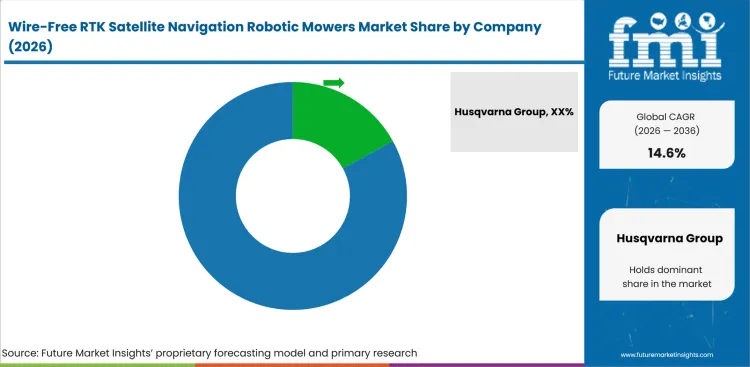
Husqvarna Group, Kress, Segway Navimow, Mammotion, and Greenworks Tools.
- Established outdoor power equipment companies hold an advantage through dealer service, warranty depth, and professional turf relationships.
- Navigation-led challengers gain attention by combining RTK correction, vision fallback, and app mapping for open residential lawns.
- Regional suppliers can win where installation partners explain signal checks, slope limits, and local repair support before purchase.
- Retail-ready brands compete through lower setup friction, clear lawn-capacity claims, and strong spare-parts availability.
The market is competitive as buyers judge wire-free mowing by boundary confidence rather than blade hardware alone. Husqvarna has the strongest professional channel position through EPOS products, dealer training, and a broad boundary-wire-free range. Kress adds value through satellite-guided mower positioning and its dealer network. Segway Navimow and Mammotion compete with app-led setup, hybrid sensing, and correction-service messaging for large residential lawns.
Service execution has become a competitive separator as RTK mowers move into shaded yards, estates, and commercial grounds. Brands with trained installers can reduce return risk by screening satellite visibility and fallback behavior before sale. Greenworks, STIGA, and Ambrogio build credibility through outdoor power equipment relationships, while Sunseeker and Yarbo appeal to buyers needing flexible automation and terrain-focused support.
Smaller and regional players can win through local landscaping partnerships and faster support response. Suppliers that combine validated positioning, spare-parts access, and dealer education should gain more durable listings than brands relying only on lower prices. Companies best positioned to win will be those that convert wire-free setup into predictable mowing performance across mixed lawns, commercial sites, and service-backed property accounts.
How do top wire-free RTK satellite navigation robotic mowers companies compare?
Husqvarna leads on dealer-backed wire-free breadth while Kress, Segway Navimow, and Mammotion compete on correction coverage and hybrid positioning.
| Company | Relevance to Market Title | Navigation and Positioning Depth | Wire-Free Portfolio | Dealer and Service Support | Channel Reach | Geographic Footprint |
|---|---|---|---|---|---|---|
| Husqvarna Group | Very High | Very Strong | Very Strong | Very Strong | Very Strong | Global |
| Kress | Very High | Strong | Strong | Very Strong | Strong | Europe and United States |
| Segway Navimow | Very High | Very Strong | Very Strong | Moderate to Strong | Strong | Global |
| Mammotion | Very High | Very Strong | Strong | Moderate to Strong | Strong | United States and Europe |
| Greenworks Tools | High | Moderate | Strong | Strong | Strong | North America and Europe |
| Ambrogio Robot | High | Strong | Strong | Strong | Moderate | Europe |
| Sunseeker Robotics | High | Strong | Strong | Moderate | Strong | Global and China |
| STIGA | High | Moderate | Strong | Strong | Strong | Europe |
| Worx Landroid | Moderate | Moderate | Moderate | Strong | Strong | Global |
| Yarbo Technology | Moderate to High | Strong | Moderate | Moderate | Moderate | North America |
Source: Future Market Insights competitive analysis, 2026.
Who are the key players in the wire-free RTK satellite navigation robotic mowers market?
Husqvarna Group, Kress, Segway Navimow, Mammotion, and Greenworks Tools are listed with Ambrogio Robot and Sunseeker Robotics among other suppliers.
Key global companies leading the wire-free RTK satellite navigation robotic mowers market include:
- Husqvarna Group
- Kress
- Segway Navimow
- Mammotion
- Greenworks Tools
- Ambrogio Robot
- Sunseeker Robotics
- STIGA
- Worx Landroid
- Yarbo Technology
Key Developments in Wire-Free RTK Satellite Navigation Robotic Mowers Market
- In February 2025, Husqvarna Group introduced 13 new boundary-wire-free robotic lawnmowers for the 2025 season, expanding its wire-free range to 24 models across residential and professional customers.
- In November 2025, Segway Navimow announced the U.S. launch of its X3 Series for large-yard robotic mowing, emphasizing automated lawn care, AI obstacle avoidance, and open API support.
- In May 2026, Mammotion expanded its iNavi NetRTK service information for the U.S. market, supporting selected 2026 LUBA 3 AWD models and compatible 2025 mower lines.
Key Players in the Wire-Free RTK Satellite Navigation Robotic Mowers Market
Global Outdoor Power Equipment Groups
- Husqvarna Group
- Greenworks Tools
- STIGA
- Kress
Navigation-Focused Robotic Mower Specialists
- Segway Navimow
- Mammotion
- Sunseeker Robotics
- Ambrogio Robot
Regional and Emerging Automation Suppliers
- Worx Landroid
- Yarbo Technology
- Yamabiko Corporation channels
- Local facility-maintenance integrators
Wire-Free RTK Satellite Navigation Robotic Mowers Market - Report Scope
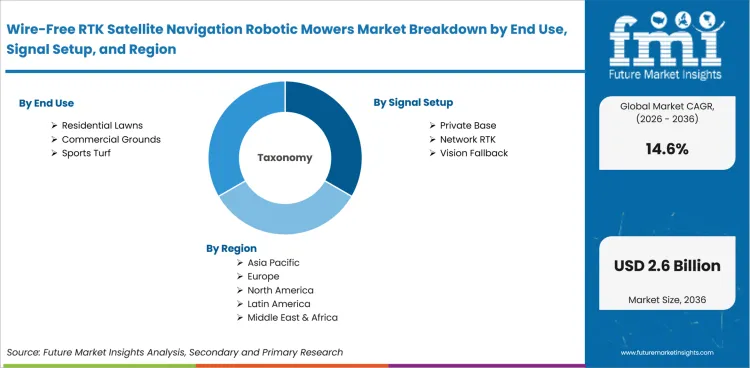
| Item | Value |
|---|---|
| Market size by 2036 | USD 2.61 billion |
| Growth rate | 14.6% CAGR from 2026 to 2036 |
| Forecast period | 2026 to 2036 |
| Base year value (2025) | USD 0.52 billion |
| By navigation architecture | RTK GNSS, RTK Vision, RTK UWB, Cloud Mapping |
| By signal setup | Private Base, Network RTK, Vision Fallback |
| By end use | Residential Lawns, Commercial Grounds, Sports Turf |
| By sales channel | Specialty Dealers, Direct Online, Retail Chains, Integrators |
| By lawn capacity | Small Lawns, Large Lawns, Fleet Areas |
| Regions covered | North America, Latin America, Europe, East Asia, South Asia and Pacific, Middle East and Africa |
| Countries covered | United States, United Kingdom, Germany, France, Japan, China, South Korea, India |
| Key companies profiled | Husqvarna, Kress, Segway Navimow, Mammotion, Greenworks, Ambrogio, Sunseeker, STIGA |
| Approach | Bottom-up product-boundary approach using eligible RTK mower revenue, SKU audits, channel presence, retail price bands, and country-level adoption indicators |
Source: Future Market Insights, 2026.
Wire-Free RTK Satellite Navigation Robotic Mowers Market Breakdown by Navigation Architecture, Signal Setup, End Use, Sales Channel, Lawn Capacity, and Region
Wire-Free RTK Satellite Navigation Robotic Mowers Market Segmented by Navigation Architecture
- RTK GNSS
- RTK Vision
- RTK UWB
- Cloud Mapping
Wire-Free RTK Satellite Navigation Robotic Mowers Market Segmented by Signal Setup
- Private Base
- Network RTK
- Vision Fallback
Wire-Free RTK Satellite Navigation Robotic Mowers Market Segmented by End Use
- Residential Lawns
- Commercial Grounds
- Sports Turf
Wire-Free RTK Satellite Navigation Robotic Mowers Market Segmented by Sales Channel
- Specialty Dealers
- Direct Online
- Retail Chains
- Integrators
Wire-Free RTK Satellite Navigation Robotic Mowers Market Segmented by Lawn Capacity
- Small Lawns
- Large Lawns
- Fleet Areas
Wire-Free RTK Satellite Navigation Robotic Mowers Market by Region
- North America
- Latin America
- Europe
- East Asia
- South Asia and Pacific
- Middle East and Africa
Research Sources and Bibliography
- U.S. Consumer Product Safety Commission. (2025, February 6). TTI Outdoor Power Equipment recalls RYOBI battery-powered mowers due to fire hazard.
- U.S. Census Bureau. (2026, June 17). Monthly new residential construction, May 2026. U.S. Department of Commerce.
- U.S. Census Bureau. (2026, May 21). Monthly new residential construction, April 2026. U.S. Department of Commerce.
- U.S. Bureau of Labor Statistics. (2025, August 28). Building and grounds cleaning occupations: Occupational outlook handbook. U.S. Department of Labor.
- Federal Communications Commission. (2026, May). Internet access services: Status as of June 30, 2025. FCC.
- U.S. Bureau of Labor Statistics. (2025, September 4). Grounds maintenance workers: Occupational outlook handbook. U.S. Department of Labor.
- Federal Communications Commission. (2025, May 20). Broadband Data Collection shows access to high-speed internet services. FCC.
- Royal Horticultural Society. (2025, October 21). First AI mapping of UK gardens reveals disparity in access and need for better provision. Royal Horticultural Society.
- International Federation of Robotics. (2025, October 7). World Robotics 2025 report - Service robots. IFR.
- Ofcom. (2025, December 10). Online Nation 2025 report. Office of Communications.
- Department for Environment, Food and Rural Affairs. (2026, June 2). Understanding biodiversity net gain. GOV.UK.
- Federal Statistical Office of Germany. (2025, January 14). Eight out of ten internet users shop online. Destatis.
- Federal Statistical Office of Germany. (2024, July 15). 2022 Census: 57% of families living in their own home. Destatis.
- European Environment Agency. (2025, September 28). Germany country profile: Europe’s environment 2025. EEA.
- Institut national de la statistique et des études économiques. (2025, April 16). Unequal access to green spaces in major urban centres. Insee.
- Fédération du e-commerce et de la vente à distance. (2026, February 6). French e-commerce reached 196.4 billion euros in 2025. Fevad.
- Notre-environnement. (2025, July 8). Artificialized soils and land-use pressure in France. Government of France.
- Cabinet Office of Japan. (2025, June 5). Annual report on the ageing society: FY2025 summary. Government of Japan.
- Ministry of Land, Infrastructure, Transport and Tourism. (2024, May). Green transformation for sustainable urban development. Government of Japan.
- Statistics Bureau of Japan. (2025, September). Statistical handbook of Japan 2025. Ministry of Internal Affairs and Communications.
- National Bureau of Statistics of China. (2025, February 28). Statistical communiqué of the People’s Republic of China on the 2024 national economic and social development. Government of China.
- State Council of the People’s Republic of China. (2025, June 19). China issues white paper on green development progress. State Council Information Office.
- State Council of the People’s Republic of China. (2024, April 10). Urban development boundaries set for 683 cities. State Council.
- Statistics Korea. (2025, July 29). 2024 Population and Housing Census register-based census. Republic of Korea.
- Ministry of Land, Infrastructure and Transport. (2024, May 24). 2024 Smart City Planning and Solution Expansion Project selection. Republic of Korea.
- Ministry of Environment. (2024, January 25). 2024 major policy and budget. Republic of Korea.
- Press Information Bureau. (2025, June 24). 10 years of Smart Cities Mission. Government of India.
- Ministry of Statistics and Programme Implementation. (2025, May 29). Results of comprehensive modular survey: Telecom, 2025. Government of India.
- Ministry of Environment, Forest and Climate Change. (2025, March). Annual report 2024-25. Government of India.
- Husqvarna Group. (2025, February 6). Husqvarna Group introduces its largest launch in history with 13 new boundary wire-free robotic lawnmowers. Husqvarna Group.
- Segway Navimow. (2025, November 6). Segway Navimow X3 Series launches in US: Robotic mowing for large yards. Segway Navimow.
- Mammotion. (2026, May 21). No RTK antenna: Mammotion iNavi service (NetRTK) comes to the U.S. Mammotion.
This bibliography is provided for reader reference and uses government, regulator, official company, and institutional publications.
Wire-Free RTK Satellite Navigation Robotic Mowers Market - Scope & Definition
| Attribute | Detail |
|---|---|
| Market Definition | Robotic lawn mowers that use RTK satellite navigation or RTK hybrid navigation to mow without a buried boundary wire |
| Functions Covered | Virtual boundary creation, autonomous mowing, RTK correction, app mapping, obstacle detection, and fleet route support |
| Applications Covered | Residential lawns, commercial grounds, hotel landscapes, sports turf, campuses, municipal green spaces, and institutional lawns |
| End-Use Industries | Residential lawn care, commercial landscaping, sports turf management, hospitality, municipal maintenance, and facility management |
| Grades Covered | Small-lawn units, large-lawn units, fleet-capable models, private-base systems, and network RTK-supported systems |
| Inclusions | Commercially sold RTK GNSS, RTK Vision, RTK UWB, Cloud Mapping, Private Base, Network RTK, and Vision Fallback robotic mowing systems |
| Exclusions | Walk-behind mowers, ride-on mowers without autonomous RTK navigation, wire-only robotic mowers, agricultural robots, pool robots, and non-mowing smart garden devices |
Wire-Free RTK Satellite Navigation Robotic Mowers Market - Research Methodology
| Method | Description |
|---|---|
| Primary Research | FMI analyst interviews with robotic mower dealers, turf managers, specialty retailers, landscaping contractors, and premium homeowners across key markets |
| Desk Research | Review of official product pages, company announcements, occupational data, green-space policy sources, and verified outdoor maintenance evidence |
| Market Sizing & Forecasting | Bottom-up product-boundary approach using SKU audits, price bands, supplier availability, lawn-capacity splits, and country adoption indicators |
| Data Validation | Cross-verification using labor indicators, garden-area evidence, supplier launch timing, verified RTK-capable models, and channel availability checks |
This Report Answers
- Market size estimates for 2026 and forecasts through 2036 for the wire-free RTK satellite navigation robotic mowers market.
- Insights across regional and country-level markets with country CAGR comparisons.
- Analysis of demand drivers, signal reliability limits, product adoption patterns, and purchase behavior.
- Evaluation of navigation architecture, signal setup, end-use, sales channel, and lawn-capacity segmentation.
- Assessment of RTK GNSS, RTK Vision, Private Base, Network RTK, and Vision Fallback positioning.
- Identification of opportunities across network correction services, fleet software, and commercial grounds.
- Evaluation of company launches and competitive positioning among Husqvarna, Kress, Segway Navimow, Mammotion, Greenworks, Ambrogio, and Sunseeker.
- Country-level growth analysis covering India, China, United States, South Korea, Germany, United Kingdom, France, and Japan.
- Assessment of official statistics and company developments that support demand analysis.
- Delivery of clean market definitions, inclusions, exclusions, methodology, and segmentation coverage.
Frequently Asked Questions
What is the wire-free RTK satellite navigation robotic mowers market size in 2026?
The wire-free RTK satellite navigation robotic mowers market size is anticipated to reach USD 0.67 billion in 2026.
What is the wire-free RTK satellite navigation robotic mowers market forecast for 2036?
The industry revenue is predicted to reach USD 2.61 billion by 2036 as RTK correction and hybrid sensing expand adoption.
What is the wire-free RTK satellite navigation robotic mowers market CAGR?
The sector is projected to expand at 14.6% CAGR from 2026 to 2036.
What segment leads the wire-free RTK satellite navigation robotic mowers market?
Residential Lawns are likely to capture 68.0% share in 2026 due to homeowner conversion from buried-wire installations.
What country grows fastest in the wire-free RTK satellite navigation robotic mowers market?
India is set to record 19.1% CAGR by 2036 due to low penetration and premium managed-property demand.
Preview the report firsthand - request a free sample
Get SampleGet the brochure for pricing and purchase details.
Get PDFTable of Content
- Executive Summary
- Global Market Outlook
- Demand to side Trends
- Supply to side Trends
- Technology Roadmap Analysis
- Analysis and Recommendations
- Market Overview
- Market Coverage / Taxonomy
- Market Definition / Scope / Limitations
- Research Methodology
- Chapter Orientation
- Analytical Lens and Working Hypotheses
- Market Structure, Signals, and Trend Drivers
- Benchmarking and Cross-market Comparability
- Market Sizing, Forecasting, and Opportunity Mapping
- Research Design and Evidence Framework
- Desk Research Programme (Secondary Evidence)
- Company Annual and Sustainability Reports
- Peer-reviewed Journals and Academic Literature
- Corporate Websites, Product Literature, and Technical Notes
- Earnings Decks and Investor Briefings
- Statutory Filings and Regulatory Disclosures
- Technical White Papers and Standards Notes
- Trade Journals, Industry Magazines, and Analyst Briefs
- Conference Proceedings, Webinars, and Seminar Materials
- Government Statistics Portals and Public Data Releases
- Press Releases and Reputable Media Coverage
- Specialist Newsletters and Curated Briefings
- Sector Databases and Reference Repositories
- FMI Internal Proprietary Databases and Historical Market Datasets
- Subscription Datasets and Paid Sources
- Social Channels, Communities, and Digital Listening Inputs
- Additional Desk Sources
- Expert Input and Fieldwork (Primary Evidence)
- Primary Modes
- Qualitative Interviews and Expert Elicitation
- Quantitative Surveys and Structured Data Capture
- Blended Approach
- Why Primary Evidence is Used
- Field Techniques
- Interviews
- Surveys
- Focus Groups
- Observational and In-context Research
- Social and Community Interactions
- Stakeholder Universe Engaged
- C-suite Leaders
- Board Members
- Presidents and Vice Presidents
- R&D and Innovation Heads
- Technical Specialists
- Domain Subject-matter Experts
- Scientists
- Physicians and Other Healthcare Professionals
- Governance, Ethics, and Data Stewardship
- Research Ethics
- Data Integrity and Handling
- Primary Modes
- Tooling, Models, and Reference Databases
- Desk Research Programme (Secondary Evidence)
- Data Engineering and Model Build
- Data Acquisition and Ingestion
- Cleaning, Normalisation, and Verification
- Synthesis, Triangulation, and Analysis
- Quality Assurance and Audit Trail
- Market Background
- Market Dynamics
- Drivers
- Restraints
- Opportunity
- Trends
- Scenario Forecast
- Demand in Optimistic Scenario
- Demand in Likely Scenario
- Demand in Conservative Scenario
- Opportunity Map Analysis
- Product Life Cycle Analysis
- Supply Chain Analysis
- Investment Feasibility Matrix
- Value Chain Analysis
- PESTLE and Porter’s Analysis
- Regulatory Landscape
- Regional Parent Market Outlook
- Production and Consumption Statistics
- Import and Export Statistics
- Market Dynamics
- Global Market Analysis 2021 to 2025 and Forecast, 2026 to 2036
- Historical Market Size Value (USD Million) Analysis, 2021 to 2025
- Current and Future Market Size Value (USD Million) Projections, 2026 to 2036
- Y to o to Y Growth Trend Analysis
- Absolute $ Opportunity Analysis
- Global Market Pricing Analysis 2021 to 2025 and Forecast 2026 to 2036
- Global Market Analysis 2021 to 2025 and Forecast 2026 to 2036, By End Use
- Introduction / Key Findings
- Historical Market Size Value (USD Million) Analysis By End Use , 2021 to 2025
- Current and Future Market Size Value (USD Million) Analysis and Forecast By End Use , 2026 to 2036
- Residential Lawns
- Commercial Grounds
- Sports Turf
- Residential Lawns
- Y to o to Y Growth Trend Analysis By End Use , 2021 to 2025
- Absolute $ Opportunity Analysis By End Use , 2026 to 2036
- Global Market Analysis 2021 to 2025 and Forecast 2026 to 2036, By Signal Setup
- Introduction / Key Findings
- Historical Market Size Value (USD Million) Analysis By Signal Setup, 2021 to 2025
- Current and Future Market Size Value (USD Million) Analysis and Forecast By Signal Setup, 2026 to 2036
- Private Base
- Network RTK
- Vision Fallback
- Private Base
- Y to o to Y Growth Trend Analysis By Signal Setup, 2021 to 2025
- Absolute $ Opportunity Analysis By Signal Setup, 2026 to 2036
- Global Market Analysis 2021 to 2025 and Forecast 2026 to 2036, By Navigation Architecture
- Introduction / Key Findings
- Historical Market Size Value (USD Million) Analysis By Navigation Architecture, 2021 to 2025
- Current and Future Market Size Value (USD Million) Analysis and Forecast By Navigation Architecture, 2026 to 2036
- RTK GNSS
- RTK Vision
- Cloud Mapping
- RTK GNSS
- Y to o to Y Growth Trend Analysis By Navigation Architecture, 2021 to 2025
- Absolute $ Opportunity Analysis By Navigation Architecture, 2026 to 2036
- Global Market Analysis 2021 to 2025 and Forecast 2026 to 2036, By Sales Channel
- Introduction / Key Findings
- Historical Market Size Value (USD Million) Analysis By Sales Channel, 2021 to 2025
- Current and Future Market Size Value (USD Million) Analysis and Forecast By Sales Channel, 2026 to 2036
- Specialty Dealers
- Direct Online
- Retail Chains
- Specialty Dealers
- Y to o to Y Growth Trend Analysis By Sales Channel, 2021 to 2025
- Absolute $ Opportunity Analysis By Sales Channel, 2026 to 2036
- Global Market Analysis 2021 to 2025 and Forecast 2026 to 2036, By Lawn Capacity
- Introduction / Key Findings
- Historical Market Size Value (USD Million) Analysis By Lawn Capacity, 2021 to 2025
- Current and Future Market Size Value (USD Million) Analysis and Forecast By Lawn Capacity, 2026 to 2036
- Small Lawns
- Large Lawns
- Fleet Areas
- Small Lawns
- Y to o to Y Growth Trend Analysis By Lawn Capacity, 2021 to 2025
- Absolute $ Opportunity Analysis By Lawn Capacity, 2026 to 2036
- Global Market Analysis 2021 to 2025 and Forecast 2026 to 2036, By Region
- Introduction
- Historical Market Size Value (USD Million) Analysis By Region, 2021 to 2025
- Current Market Size Value (USD Million) Analysis and Forecast By Region, 2026 to 2036
- North America
- Latin America
- Western Europe
- Eastern Europe
- East Asia
- South Asia and Pacific
- Middle East & Africa
- Market Attractiveness Analysis By Region
- North America Market Analysis 2021 to 2025 and Forecast 2026 to 2036, By Country
- Historical Market Size Value (USD Million) Trend Analysis By Market Taxonomy, 2021 to 2025
- Market Size Value (USD Million) Forecast By Market Taxonomy, 2026 to 2036
- By Country
- USA
- Canada
- Mexico
- By End Use
- By Signal Setup
- By Navigation Architecture
- By Sales Channel
- By Lawn Capacity
- By Country
- Market Attractiveness Analysis
- By Country
- By End Use
- By Signal Setup
- By Navigation Architecture
- By Sales Channel
- By Lawn Capacity
- Key Takeaways
- Latin America Market Analysis 2021 to 2025 and Forecast 2026 to 2036, By Country
- Historical Market Size Value (USD Million) Trend Analysis By Market Taxonomy, 2021 to 2025
- Market Size Value (USD Million) Forecast By Market Taxonomy, 2026 to 2036
- By Country
- Brazil
- Chile
- Rest of Latin America
- By End Use
- By Signal Setup
- By Navigation Architecture
- By Sales Channel
- By Lawn Capacity
- By Country
- Market Attractiveness Analysis
- By Country
- By End Use
- By Signal Setup
- By Navigation Architecture
- By Sales Channel
- By Lawn Capacity
- Key Takeaways
- Western Europe Market Analysis 2021 to 2025 and Forecast 2026 to 2036, By Country
- Historical Market Size Value (USD Million) Trend Analysis By Market Taxonomy, 2021 to 2025
- Market Size Value (USD Million) Forecast By Market Taxonomy, 2026 to 2036
- By Country
- Germany
- UK
- Italy
- Spain
- France
- Nordic
- BENELUX
- Rest of Western Europe
- By End Use
- By Signal Setup
- By Navigation Architecture
- By Sales Channel
- By Lawn Capacity
- By Country
- Market Attractiveness Analysis
- By Country
- By End Use
- By Signal Setup
- By Navigation Architecture
- By Sales Channel
- By Lawn Capacity
- Key Takeaways
- Eastern Europe Market Analysis 2021 to 2025 and Forecast 2026 to 2036, By Country
- Historical Market Size Value (USD Million) Trend Analysis By Market Taxonomy, 2021 to 2025
- Market Size Value (USD Million) Forecast By Market Taxonomy, 2026 to 2036
- By Country
- Russia
- Poland
- Hungary
- Balkan & Baltic
- Rest of Eastern Europe
- By End Use
- By Signal Setup
- By Navigation Architecture
- By Sales Channel
- By Lawn Capacity
- By Country
- Market Attractiveness Analysis
- By Country
- By End Use
- By Signal Setup
- By Navigation Architecture
- By Sales Channel
- By Lawn Capacity
- Key Takeaways
- East Asia Market Analysis 2021 to 2025 and Forecast 2026 to 2036, By Country
- Historical Market Size Value (USD Million) Trend Analysis By Market Taxonomy, 2021 to 2025
- Market Size Value (USD Million) Forecast By Market Taxonomy, 2026 to 2036
- By Country
- China
- Japan
- South Korea
- By End Use
- By Signal Setup
- By Navigation Architecture
- By Sales Channel
- By Lawn Capacity
- By Country
- Market Attractiveness Analysis
- By Country
- By End Use
- By Signal Setup
- By Navigation Architecture
- By Sales Channel
- By Lawn Capacity
- Key Takeaways
- South Asia and Pacific Market Analysis 2021 to 2025 and Forecast 2026 to 2036, By Country
- Historical Market Size Value (USD Million) Trend Analysis By Market Taxonomy, 2021 to 2025
- Market Size Value (USD Million) Forecast By Market Taxonomy, 2026 to 2036
- By Country
- India
- ASEAN
- Australia & New Zealand
- Rest of South Asia and Pacific
- By End Use
- By Signal Setup
- By Navigation Architecture
- By Sales Channel
- By Lawn Capacity
- By Country
- Market Attractiveness Analysis
- By Country
- By End Use
- By Signal Setup
- By Navigation Architecture
- By Sales Channel
- By Lawn Capacity
- Key Takeaways
- Middle East & Africa Market Analysis 2021 to 2025 and Forecast 2026 to 2036, By Country
- Historical Market Size Value (USD Million) Trend Analysis By Market Taxonomy, 2021 to 2025
- Market Size Value (USD Million) Forecast By Market Taxonomy, 2026 to 2036
- By Country
- Kingdom of Saudi Arabia
- Other GCC Countries
- Turkiye
- South Africa
- Other African Union
- Rest of Middle East & Africa
- By End Use
- By Signal Setup
- By Navigation Architecture
- By Sales Channel
- By Lawn Capacity
- By Country
- Market Attractiveness Analysis
- By Country
- By End Use
- By Signal Setup
- By Navigation Architecture
- By Sales Channel
- By Lawn Capacity
- Key Takeaways
- Key Countries Market Analysis
- USA
- Pricing Analysis
- Market Share Analysis, 2025
- By End Use
- By Signal Setup
- By Navigation Architecture
- By Sales Channel
- By Lawn Capacity
- Canada
- Pricing Analysis
- Market Share Analysis, 2025
- By End Use
- By Signal Setup
- By Navigation Architecture
- By Sales Channel
- By Lawn Capacity
- Mexico
- Pricing Analysis
- Market Share Analysis, 2025
- By End Use
- By Signal Setup
- By Navigation Architecture
- By Sales Channel
- By Lawn Capacity
- Brazil
- Pricing Analysis
- Market Share Analysis, 2025
- By End Use
- By Signal Setup
- By Navigation Architecture
- By Sales Channel
- By Lawn Capacity
- Chile
- Pricing Analysis
- Market Share Analysis, 2025
- By End Use
- By Signal Setup
- By Navigation Architecture
- By Sales Channel
- By Lawn Capacity
- Germany
- Pricing Analysis
- Market Share Analysis, 2025
- By End Use
- By Signal Setup
- By Navigation Architecture
- By Sales Channel
- By Lawn Capacity
- UK
- Pricing Analysis
- Market Share Analysis, 2025
- By End Use
- By Signal Setup
- By Navigation Architecture
- By Sales Channel
- By Lawn Capacity
- Italy
- Pricing Analysis
- Market Share Analysis, 2025
- By End Use
- By Signal Setup
- By Navigation Architecture
- By Sales Channel
- By Lawn Capacity
- Spain
- Pricing Analysis
- Market Share Analysis, 2025
- By End Use
- By Signal Setup
- By Navigation Architecture
- By Sales Channel
- By Lawn Capacity
- France
- Pricing Analysis
- Market Share Analysis, 2025
- By End Use
- By Signal Setup
- By Navigation Architecture
- By Sales Channel
- By Lawn Capacity
- India
- Pricing Analysis
- Market Share Analysis, 2025
- By End Use
- By Signal Setup
- By Navigation Architecture
- By Sales Channel
- By Lawn Capacity
- ASEAN
- Pricing Analysis
- Market Share Analysis, 2025
- By End Use
- By Signal Setup
- By Navigation Architecture
- By Sales Channel
- By Lawn Capacity
- Australia & New Zealand
- Pricing Analysis
- Market Share Analysis, 2025
- By End Use
- By Signal Setup
- By Navigation Architecture
- By Sales Channel
- By Lawn Capacity
- China
- Pricing Analysis
- Market Share Analysis, 2025
- By End Use
- By Signal Setup
- By Navigation Architecture
- By Sales Channel
- By Lawn Capacity
- Japan
- Pricing Analysis
- Market Share Analysis, 2025
- By End Use
- By Signal Setup
- By Navigation Architecture
- By Sales Channel
- By Lawn Capacity
- South Korea
- Pricing Analysis
- Market Share Analysis, 2025
- By End Use
- By Signal Setup
- By Navigation Architecture
- By Sales Channel
- By Lawn Capacity
- Russia
- Pricing Analysis
- Market Share Analysis, 2025
- By End Use
- By Signal Setup
- By Navigation Architecture
- By Sales Channel
- By Lawn Capacity
- Poland
- Pricing Analysis
- Market Share Analysis, 2025
- By End Use
- By Signal Setup
- By Navigation Architecture
- By Sales Channel
- By Lawn Capacity
- Hungary
- Pricing Analysis
- Market Share Analysis, 2025
- By End Use
- By Signal Setup
- By Navigation Architecture
- By Sales Channel
- By Lawn Capacity
- Kingdom of Saudi Arabia
- Pricing Analysis
- Market Share Analysis, 2025
- By End Use
- By Signal Setup
- By Navigation Architecture
- By Sales Channel
- By Lawn Capacity
- Turkiye
- Pricing Analysis
- Market Share Analysis, 2025
- By End Use
- By Signal Setup
- By Navigation Architecture
- By Sales Channel
- By Lawn Capacity
- South Africa
- Pricing Analysis
- Market Share Analysis, 2025
- By End Use
- By Signal Setup
- By Navigation Architecture
- By Sales Channel
- By Lawn Capacity
- USA
- Market Structure Analysis
- Competition Dashboard
- Competition Benchmarking
- Market Share Analysis of Top Players
- By Regional
- By End Use
- By Signal Setup
- By Navigation Architecture
- By Sales Channel
- By Lawn Capacity
- Competition Analysis
- Competition Deep Dive
- Husqvarna Group
- Overview
- Product Portfolio
- Profitability by Market Segments (Product/Age /Sales Channel/Region)
- Sales Footprint
- Strategy Overview
- Marketing Strategy
- Product Strategy
- Channel Strategy
- Kress
- Segway Navimow
- Mammotion
- Greenworks Tools
- Ambrogio Robot
- Sunseeker Robotics
- Husqvarna Group
- Competition Deep Dive
- Assumptions & Acronyms Used


