

- Market Size (2026)
- USD 420.0 Mn
- Forecast (2036)
- USD 881.9 Mn
- CAGR (2026 to 2036)
- 7.7%
Women’s Greens Supplement Market Size, Market Forecast and Outlook By FMI
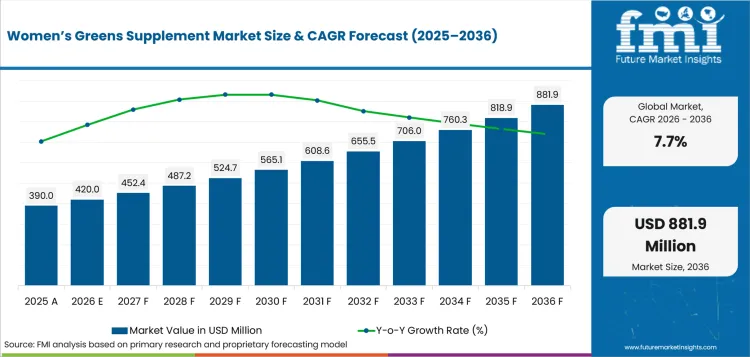
The women’s greens supplement market reached USD 390.0 million in 2025 and is estimated at USD 420.0 million in 2026. The market is projected to reach USD 881.9 million by 2036 at 7.7% CAGR. Greens powders is projected to account for 61.0% share in 2026, while adult wellness products contribute 48.2% share as brands prioritize repeat daily use and cleaner label architecture. Female wellness positioned greens blends are moving from general daily nutrition into benefit-led routines for digestion and life stage wellness.
Key Takeaways, Market Size, and Forecast
- 2026 Market Size: USD 420.0 million
- 2036 Market Size: USD 881.9 million
- Forecast CAGR: 7.7% from 2026 to 2036
- Leading Product Form: Greens Powders
- Greens Powders Share in 2026: 61.0%
- Leading Consumer Life Stage: Adult Wellness
- Adult Wellness Share in 2026: 48.2%
- Fastest-growing Country: Saudi Arabia
- Saudi Arabia CAGR: 9.3% by 2036
Summary of Women’s Greens Supplement Market
- Demand and Growth Drivers
- Women-focused greens brands are building repeat use around digestion and skin support claims.
- Powder and stick-pack formats are gaining shelf space because they carry more ingredient depth than capsules.
- Private label and CMO programs are expanding as retailers seek benefit-led blends with cleaner claim language.
- Product and Segment View
- Greens powders are forecast to represent 61.0% share in 2026 due to daily scoop routines and higher perceived ingredient value.
- Adult wellness products are projected to hold 48.2% share in 2026 as brands address routine nutrition before pregnancy or menopause claims.
- Digestive balance is expected to secure 34.5% share in 2026, supported by bloating and gut-comfort positioning.
- Geography and Competitive Outlook
- Saudi Arabia is projected to record 9.3% CAGR by 2036, backed by premium wellness retail and a young female population base.
- South Korea is expected to expand at 8.6% CAGR by 2036 through beauty-linked nutrition and regulated health functional food retail.
- Companies such as Bloom Nutrition and AG1 focus on brand reach and daily routine positioning, while Bactolac supports private label powder manufacturing.
- HUM Nutrition and Ritual focus on women’s wellness credibility and ingredient transparency.
- Analyst Opinion
- Nandini Roy Choudhury, Principal Consultant for Food and Beverage at FMI, observes, “I see women’s greens supplements turning into a routine category only when brands explain the benefit without overclaiming. The winner is not the longest ingredient panel. The winner is the blend that can show why digestive balance, micronutrients, and flavor discipline belong in one daily scoop.”
- Women’s Greens Supplement Market Value Analysis
- Market value is expected to be driven by revenue from finished, women-positioned greens supplements, with retailer services and wellness coaching anticipated to contribute additional, separate income streams.
- Supplier pricing is anticipated to reflect factors such as ingredient count, documented probiotic strains, flavor systems, packaging formats, and the level of testing support provided.
- Revenue is expected to strengthen as initial greens supplement trials convert into repeat subscriptions and sustained pantry replenishment cycles.
- Retail trust is anticipated to increase when labeling clearly communicates digestive, energy, and skin support benefits while avoiding any implication of disease treatment.
Commercial interest is shifting toward powders that explain what each ingredient does and why it belongs in a daily routine. The Centers for Disease Control and Prevention National Center for Health Statistics reported in May 2026 that 66.1% of United States women aged 20 and older used any dietary supplement during August 2021 to August 2023. Retailers and women-focused brands are using that supplement habit as the base for greens blends with digestive balance and quality documentation.
Why is the Women’s Greens Supplement Market Growing?
- Female buyers are using greens products as daily routines for digestion, energy, and skin support instead of single-ingredient supplementation.
- Brands are combining vegetable powders with probiotics, B vitamins, and prebiotic fibers so the product feels closer to a daily wellness system.
- Retailers are asking for clearer claim discipline because women’s wellness products sit near regulated supplement and natural health product categories.
The women’s greens supplement market is expected to rise as brands position greens blends around routine energy support and digestive comfort for female supplement users. CDC NCHS reported in May 2026 that 66.1% of USA women age 20 and older used a dietary supplement during August 2021 to August 2023. That higher use base gives women-focused greens brands a stronger starting point than mass wellness powders. Free Soul Greens shows the product logic through a women-specific formula with 21 superfoods and no added sugar. The brand’s 2025 consumer survey also reported that 93.0% of users felt more digestive ease after 14 days. Buyers are therefore expected to compare these products by taste and gut comfort before ingredient count. They will also check whether the brand explains nutrient relevance without turning the product into a medical claim. The category is expanding from general green supplement routines into products built around female benefit language.
Market Segmentation Analysis
- Greens powders are projected to secure 61.0% share in 2026, led by daily scoop routines and a higher capacity for vegetable and probiotic ingredients.
- Digestive balance is anticipated to hold 34.5% share in 2026 because bloating and gut-comfort language converts more directly at online checkout.
- Cereal grasses are expected to capture 41.8% share in 2026 due to familiar wheatgrass and barley grass claims.
- Adult wellness is forecast to represent 48.2% share in 2026, guided by routine nutrition before life stage claims narrow the audience.
- Direct online channels are projected to account for 38.6% share in 2026, reflected by subscription offers and social-commerce education.
- DTC brands are expected to hold 42.3% share in 2026 because they can test benefits and creator-led messaging faster than conventional retail.
Insights into Women’s Greens Supplement Market by Product Form
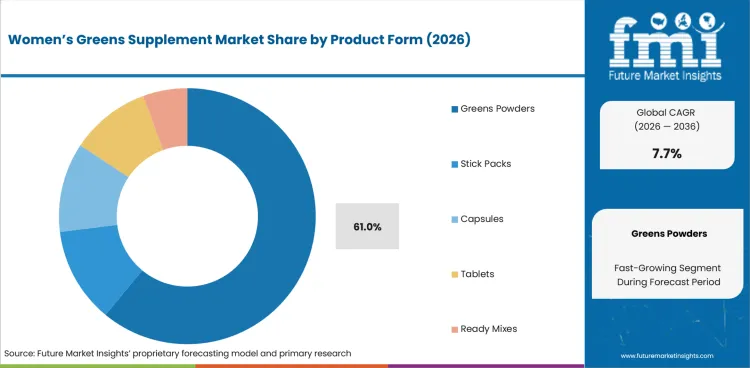
- Greens powders are forecast to account for 61.0% share in 2026, influenced by one-scoop routines and higher formulation space for vegetables.
- Stick packs gain use when women carry supplements to work, gyms, or travel settings where tubs are less convenient.
Insights into Women’s Greens Supplement Market by Benefit Positioning
- Digestive balance is projected to hold 34.5% share in 2026, guided by bloating and gut-comfort claims that shoppers understand quickly.
- Skin support adds premium positioning when brands connect antioxidants, vitamin C, and fruit extracts without using medical language.
Insights into Women’s Greens Supplement Market by Ingredient Base
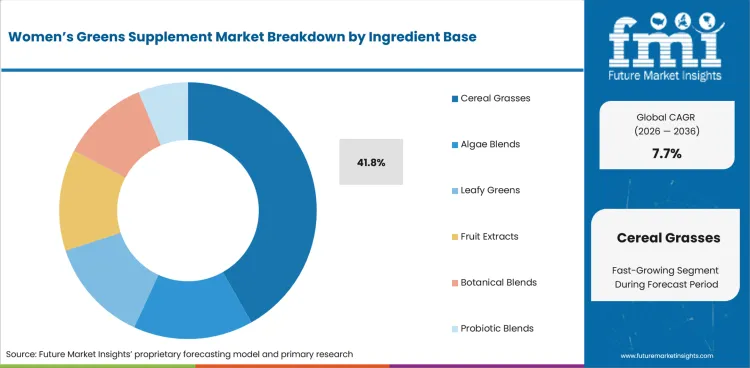
- Cereal grasses are expected to represent 41.8% share in 2026 due to wheatgrass and barley grass familiarity.
- Probiotic blends gain value when suppliers disclose strain identity and quality checks instead of only stating colony counts.
Insights into Women’s Greens Supplement Market by Consumer Life Stage
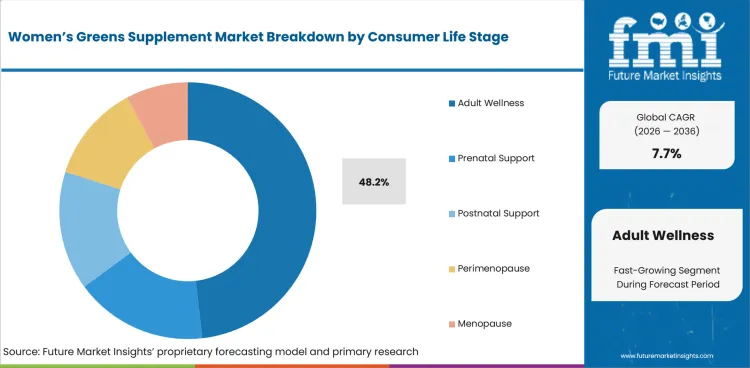
- Adult wellness is anticipated to capture 48.2% share in 2026 as the largest buyer pool seeks daily nutrition without life stage limits.
- Menopause products grow from a smaller base when brands connect greens with digestive and energy support for women over 40.
Insights into Women’s Greens Supplement Market by Sales Channel
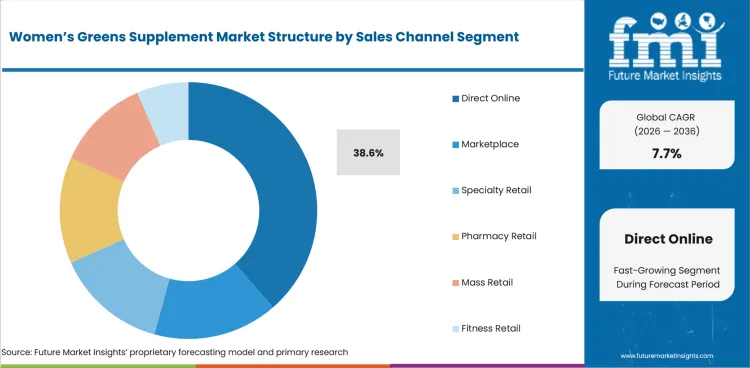
- Direct online is forecast to account for 38.6% share in 2026 because subscription programs lower replenishment friction.
- Pharmacy retail builds credibility when supplement labels show responsible claim language and clear ingredient disclosures.
Insights into Women’s Greens Supplement Market by Buyer Type
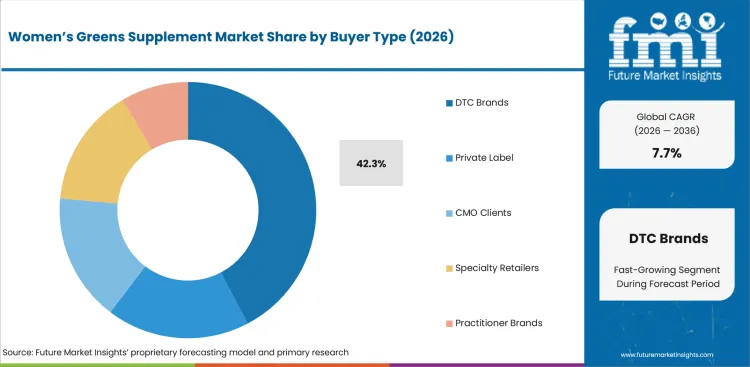
- DTC brands are projected to hold 42.3% share in 2026 as creator-led education supports benefit explanation before purchase.
- CMO clients expand the private label base when retailers need custom flavors, stick packs, and lower minimum production runs.
Women’s Greens Supplement Market Drivers, Restraints, and Opportunities
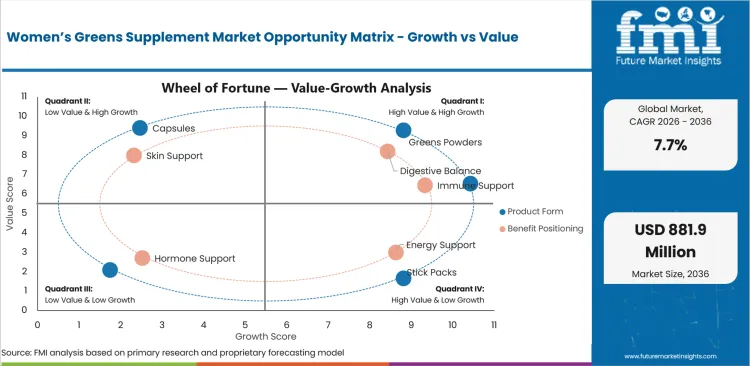
- Driver: Women already use supplements at a high rate, giving greens brands a clear base for daily routine conversion.
- Restraint: Regulators can challenge disease-like claims, especially when products imply hormone or fertility outcomes.
- Opportunity: Stick packs and private label programs can open travel, workplace, and pharmacy channels for women-focused greens blends.
Female Supplement Use Creates a Ready Routine Base
Women’s greens supplements are gaining from a larger female supplement routine rather than from isolated trial behavior. CDC NCHS reported in May 2026 that 66.1% of USA women age 20 and older used a dietary supplement during August 2021 to August 2023. That baseline matters because women-focused greens powders can be positioned as daily nutrition support tied to energy, digestion and general wellness without asking buyers to adopt a new category.
Microbial Safety Proof Is Now a Buyer Gate
Quality assurance is a significant restraint because women’s greens formulas often combine botanicals and algae with fibers and digestive ingredients in one powder. FDA reported in January 2026 that Live it Up Super Greens was linked to 45 illnesses across 21 states and 12 hospitalizations. The outbreak shows why retailers may demand microbial testing, lot traceability and finished-product records before approving women’s greens products. Brands without those files can lose buyer confidence even when taste and claim positioning are strong.
Personalized Wellness Claims Can Improve Repeat Use
Opportunity is present with products that make women-specific positioning practical rather than ornamental. CRN reported in October 2024 that 91.0% of supplement users said supplements are essential to maintaining health and 71.0% showed loyalty to chosen brands. This supports repeat purchase when women’s greens products explain a simple daily purpose and deliver a predictable sensory experience. Suppliers can gain by pairing taste masking and digestive comfort with clear ingredient logic for women’s wellness buyers. Digestive positioning also links women’s greens blends with probiotic supplements when formulations use named strains and quality controls.
Analysis of Women’s Greens Supplement Market by Key Countries
.webp "Top Country Growth Comparison Womens Greens Supplement Market Cagr (2026 2036)")
| Country | CAGR |
|---|---|
| United States | 8.1% |
| Canada | 7.4% |
| United Kingdom | 7.1% |
| Germany | 6.6% |
| Saudi Arabia | 9.3% |
| South Korea | 8.6% |
| Australia | 6.8% |
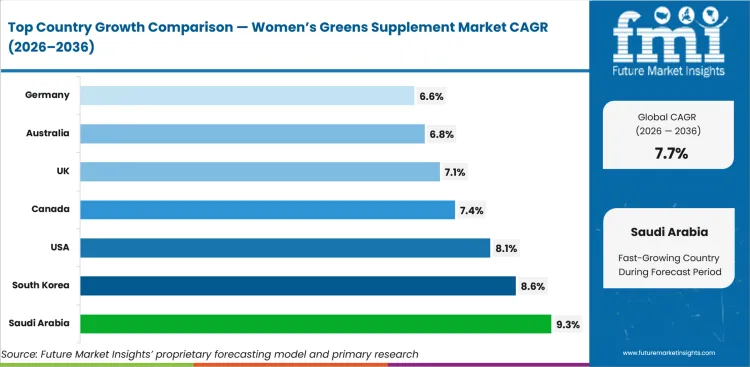
Source: Future Market Insights, 2026.
Women’s Greens Supplement Market CAGR Analysis by Country
- The United States is projected to record 8.1% CAGR through 2036, supported by high female supplement use and large direct online subscription channels.
- Canada is expected to expand at 7.4% CAGR through 2036, guided by natural health product licensing and pharmacy-facing supplement retail.
- The United Kingdom is forecast to grow at 7.1% CAGR through 2036, shaped by supplement guidance and national online wellness channels.
- Germany is expected to advance at 6.6% CAGR through 2036, reflecting stricter EU food supplement rules and drugstore-led retail caution.
- Saudi Arabia is projected to rise at 9.3% CAGR through 2036, attributable to premium wellness retail and a young female population base.
- South Korea is forecast at 8.6% CAGR through 2036, driven by health functional food registration and beauty-linked nutrition habits.
- Australia is expected to post 6.8% CAGR through 2036, supported by pharmacy-led supplement purchasing and listed medicine controls.
Sales Outlook for Women’s Greens Supplement Market in the United States
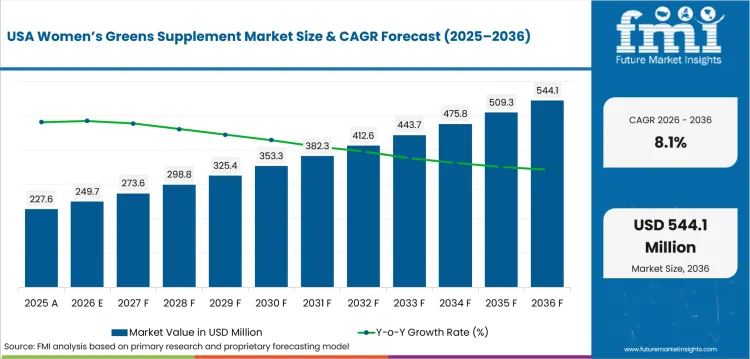
Largest value base · 2026 to 2036
Country Market Snapshot Table
| Parameter | Value |
|---|---|
| Market Size in 2025 (Value) | USD 132.1 million |
| Market Size in 2026 (Value) | USD 142.8 million |
| Market Forecast in 2036 (Value) | USD 311.2 million |
| CAGR (2026 to 2036) | 8.1% |
| Years Considered | 2021 to 2036 |
| Base Year | 2025 |
| Forecast Period | 2026 to 2036 |
| Units Considered | Value (USD million) |
| Leading Sub-Region | South Atlantic and national online supplement corridors |
United States demand is shaped by high supplement use and large direct online wellness channels. Women-focused greens brands can build wider reach because social commerce, subscriptions, and national retailers already carry adjacent powders and probiotics. Suppliers with flavor testing and claim review support are better placed to win repeat listings.
Buyer behavior is centered on routine convenience and plain benefit explanation. Digestive balance, low sugar taste, and ingredient transparency matter more than oversized formulas. The channel mix favors brands that can support monthly replenishment and still pass retailer label checks.
Key Growth Drivers
- Female supplement routines give women-positioned greens a large base. Centers for Disease Control and Prevention National Center for Health Statistics reported that 66.1% of women aged 20 and older used any dietary supplement during August 2021 to August 2023.
- Subscription programs help brands convert first tubs into replenishment cycles across online stores.
- Retail shelf review supports products that explain digestive and energy claims without disease language.
- CMO availability supports private label entry through powder blending, stick packs, and turnkey flavor systems.
Key Restraints
- Price per serving can limit repeat buying when formulas add probiotics, enzymes, and multiple extracts.
- Pregnancy and hormone language needs careful review because supplement claims cannot imply treatment outcomes.
- Crowded online search results can raise acquisition cost for smaller women-focused brands.
What makes United States unique
United States is unique due to high female supplement use, national DTC scale, and a large base of supplement CMOs.
Key Companies
- Bloom Nutrition
- AG1
- HUM Nutrition Inc.
- Ritual
- Nature Made
- MegaFood
- Bactolac Pharmaceutical, Inc.
Sales & Marketing Channels
- Brand websites
- Subscription programs
- Marketplace stores
- Pharmacy counters
- Specialty wellness retail
- Fitness retail
- CMO private label supply
Country Segment Breakdown Table
| Segment | Sub-Segments |
|---|---|
| By Product Form | Greens Powders · Stick Packs · Capsules · Tablets · Ready Mixes |
| By Benefit Positioning | Digestive Balance · Energy Support · Skin Support · Hormone Support · Immune Support |
| By Ingredient Base | Cereal Grasses · Algae Blends · Leafy Greens · Fruit Extracts · Botanical Blends · Probiotic Blends |
| By Consumer Life Stage | Adult Wellness · Prenatal Support · Postnatal Support · Perimenopause · Menopause |
| By Sales Channel | Direct Online · Marketplace · Specialty Retail · Pharmacy Retail · Mass Retail · Fitness Retail |
| By Buyer Type | DTC Brands · Private Label · CMO Clients · Specialty Retailers · Practitioner Brands |
| Key Sub-Regions Covered, Urban Wellness Channels | California · Texas · New York · Florida · Illinois · Pacific Northwest |
Market Taxonomy and Sub-Regions Covered
Frequently Asked Questions
How fast is United States women’s greens supplement market growing?
United States is expected to expand at 8.1% CAGR from 2026 to 2036, supported by its local supplement channel structure.
Who leads United States women’s greens supplement market?
Bloom Nutrition, AG1, HUM Nutrition Inc., and Ritual compete through local wellness credibility and channel access.
What is driving adoption in United States women’s greens supplement market?
Digestive balance, daily energy support, and cleaner label review are moving women-focused greens blends into routine supplement use.
Demand Outlook for Women’s Greens Supplement Market in Canada
Licensed natural health product route · 2026 to 2036
Country Market Snapshot Table
| Parameter | Value |
|---|---|
| Market Size in 2025 (Value) | USD 25.4 million |
| Market Size in 2026 (Value) | USD 27.3 million |
| Market Forecast in 2036 (Value) | USD 55.7 million |
| CAGR (2026 to 2036) | 7.4% |
| Years Considered | 2021 to 2036 |
| Base Year | 2025 |
| Forecast Period | 2026 to 2036 |
| Units Considered | Value (USD million) |
| Leading Sub-Region | Ontario and British Columbia natural health channels |
Canadian buyers compare greens products through natural health product rules and pharmacy credibility. Health Canada licensing gives retailers a clearer filter for products that enter the formal channel. This makes documentation and approved label language a practical route to shelf access.
Female wellness brands in Canada need benefit language that works in both online and pharmacy settings. Natural health product numbers can reduce shopper doubt when products include botanicals or probiotics. The channel implication is a slower but more trusted route into repeat use.
Key Growth Drivers
- Natural health product licensing helps formal retail channels sort eligible supplement products. Health Canada stated in March 2026 that natural health products include vitamins, minerals, herbal remedies, probiotics, and other products regulated under the Natural Health Products Regulations.
- The female population base supports women-focused wellness positioning across pharmacy and online channels.
- Cross-border brand familiarity from the United States supports trial among buyers already aware of greens powders.
- Pharmacy staff can support clearer product explanation for ingredient-heavy formulas.
Key Restraints
- License review can slow launch timing when products contain botanical blends or new combinations.
- Bilingual labels add cost and approval complexity for smaller DTC entrants.
- High shipping costs can reduce subscription retention outside major urban corridors.
What makes Canada unique
Canada is unique due to natural health product licensing and pharmacy trust across women’s wellness categories.
Key Companies
- Jamieson Wellness Inc.
- AOR Inc.
- Webber Naturals
- CanPrev Natural Health Products Ltd.
- SISU
- Natural Factors Nutritional Products Ltd.
- Flora Manufacturing & Distributing Ltd.
Sales & Marketing Channels
- Brand websites
- Subscription programs
- Marketplace stores
- Pharmacy counters
- Specialty wellness retail
- Fitness retail
- CMO private label supply
Country Segment Breakdown Table
| Segment | Sub-Segments |
|---|---|
| By Product Form | Greens Powders · Stick Packs · Capsules · Tablets · Ready Mixes |
| By Benefit Positioning | Digestive Balance · Energy Support · Skin Support · Hormone Support · Immune Support |
| By Ingredient Base | Cereal Grasses · Algae Blends · Leafy Greens · Fruit Extracts · Botanical Blends · Probiotic Blends |
| By Consumer Life Stage | Adult Wellness · Prenatal Support · Postnatal Support · Perimenopause · Menopause |
| By Sales Channel | Direct Online · Marketplace · Specialty Retail · Pharmacy Retail · Mass Retail · Fitness Retail |
| By Buyer Type | DTC Brands · Private Label · CMO Clients · Specialty Retailers · Practitioner Brands |
| Key Sub-Regions Covered, Urban Wellness Channels | Ontario · Quebec · British Columbia · Alberta · Manitoba · Saskatchewan |
Market Taxonomy and Sub-Regions Covered
Frequently Asked Questions
How fast is Canada women’s greens supplement market growing?
Canada is expected to expand at 7.4% CAGR from 2026 to 2036, supported by its local supplement channel structure.
Who leads Canada women’s greens supplement market?
Jamieson Wellness Inc., AOR Inc., Webber Naturals, and CanPrev Natural Health Products Ltd. compete through local wellness credibility and channel access.
What is driving adoption in Canada women’s greens supplement market?
Digestive balance, daily energy support, and cleaner label review are moving women-focused greens blends into routine supplement use.
Growth Outlook for Women’s Greens Supplement Market in the United Kingdom
Label-controlled wellness channel · 2026 to 2036
Country Market Snapshot Table
| Parameter | Value |
|---|---|
| Market Size in 2025 (Value) | USD 31.4 million |
| Market Size in 2026 (Value) | USD 33.6 million |
| Market Forecast in 2036 (Value) | USD 66.7 million |
| CAGR (2026 to 2036) | 7.1% |
| Years Considered | 2021 to 2036 |
| Base Year | 2025 |
| Forecast Period | 2026 to 2036 |
| Units Considered | Value (USD million) |
| Leading Sub-Region | London and national pharmacy retail networks |
United Kingdom demand is built around online wellness discovery and retailer caution on food supplement claims. Government supplement guidance keeps vitamin, mineral, and botanicals language under defined rules. Buyers therefore look for simple labels and dosage clarity before comparing flavors.
Women’s wellness products can scale through pharmacy, specialty retail, and DTC channels when brands avoid unclear hormone or detox claims. The country’s online health audience supports quick testing of flavors and stick packs. Faster volume depends on claims that remain easy for retailers to approve.
Key Growth Drivers
- Food supplement rules give retailers a clear basis for compliant category review. The United Kingdom Department of Health and Social Care published nutrition legislation information in February 2024 covering food supplements and related rules.
- Online wellness brands can test female benefit language quickly before wider retail distribution.
- Pharmacy and specialty health stores provide a route for products with clearer ingredient explanations.
- Low sugar and digestive language helps greens blends move beyond basic vegetable powder claims.
Key Restraints
- Regulatory caution can limit wording around hormone balance and detox positioning.
- Powder formats need taste discipline because buyers compare greens with capsules and gummies.
- Retailer onboarding can take longer when products use many botanicals in one formula.
What makes United Kingdom unique
United Kingdom is unique due to food supplement guidance, national wellness retail, and high DTC testing speed.
Key Companies
- Holland & Barrett International Limited
- Wild Nutrition Limited
- Free Soul
- Myvitamins
- Healthspan Limited
- Vitabiotics Ltd.
- Nutravita Limited
Sales & Marketing Channels
- Brand websites
- Subscription programs
- Marketplace stores
- Pharmacy counters
- Specialty wellness retail
- Fitness retail
- CMO private label supply
Country Segment Breakdown Table
| Segment | Sub-Segments |
|---|---|
| By Product Form | Greens Powders · Stick Packs · Capsules · Tablets · Ready Mixes |
| By Benefit Positioning | Digestive Balance · Energy Support · Skin Support · Hormone Support · Immune Support |
| By Ingredient Base | Cereal Grasses · Algae Blends · Leafy Greens · Fruit Extracts · Botanical Blends · Probiotic Blends |
| By Consumer Life Stage | Adult Wellness · Prenatal Support · Postnatal Support · Perimenopause · Menopause |
| By Sales Channel | Direct Online · Marketplace · Specialty Retail · Pharmacy Retail · Mass Retail · Fitness Retail |
| By Buyer Type | DTC Brands · Private Label · CMO Clients · Specialty Retailers · Practitioner Brands |
| Key Sub-Regions Covered, Urban Wellness Channels | London · Manchester · Birmingham · Scotland · Wales · Northern Ireland |
Market Taxonomy and Sub-Regions Covered
Frequently Asked Questions
How fast is United Kingdom women’s greens supplement market growing?
United Kingdom is expected to expand at 7.1% CAGR from 2026 to 2036, supported by its local supplement channel structure.
Who leads United Kingdom women’s greens supplement market?
Holland & Barrett International Limited, Wild Nutrition Limited, Free Soul, and Myvitamins compete through local wellness credibility and channel access.
What is driving adoption in United Kingdom women’s greens supplement market?
Digestive balance, daily energy support, and cleaner label review are moving women-focused greens blends into routine supplement use.
Sales Analysis for Women’s Greens Supplement Market in Germany
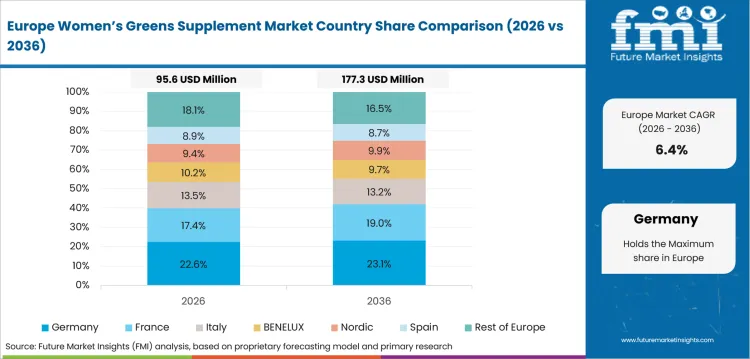
EU supplement compliance center · 2026 to 2036
Country Market Snapshot Table
| Parameter | Value |
|---|---|
| Market Size in 2025 (Value) | USD 27.6 million |
| Market Size in 2026 (Value) | USD 29.4 million |
| Market Forecast in 2036 (Value) | USD 55.7 million |
| CAGR (2026 to 2036) | 6.6% |
| Years Considered | 2021 to 2036 |
| Base Year | 2025 |
| Forecast Period | 2026 to 2036 |
| Units Considered | Value (USD million) |
| Leading Sub-Region | North Rhine-Westphalia and southern drugstore clusters |
Germany is a compliance-sensitive country where drugstores and pharmacies influence supplement credibility. EU-level rules shape how vitamins, minerals, botanicals, and claims reach shoppers. Suppliers need documentation before buyers accept a women-focused greens product into formal retail.
Category planning in Germany also reflects wider EU dietary supplements rules that influence retailer review. Consumer purchasing is practical and price aware. Products with short claims, clean taste, and transparent ingredient lists are easier to place than blends built around broad wellness language. If label guidance becomes clearer for botanicals, specialty greens formulas can gain wider retail access.
Key Growth Drivers
- EU food supplement rules support more consistent review across vitamin and mineral products. European Food Safety Authority explained in January 2026 that food supplements are regulated as foods under harmonized EU legislation.
- Drugstore scale gives compliant greens blends a practical route to repeat household purchase.
- German buyers often compare price per serving before trial, which rewards formulas with focused benefit design.
- Private label retailers can use women’s greens blends to extend existing vitamin and mineral shelves.
Key Restraints
- Botanical claim review can slow products that imply hormone or detox effects.
- Premium powder pricing can limit sales when capsules and tablets remain cheaper per day.
- Retailers may require additional supplier documents for blends using algae, enzymes, and probiotics.
What makes Germany unique
Germany is unique due to EU food supplement compliance, drugstore reach, and cautious buyer review.
Key Companies
- Doppelherz
- Orthomol pharmazeutische Vertriebs GmbH
- Sunday Natural Products GmbH
- Pure Encapsulations Germany
- IronMaxx Nutrition GmbH
- Queisser Pharma GmbH & Co. KG
- Nu3 GmbH
Sales & Marketing Channels
- Brand websites
- Subscription programs
- Marketplace stores
- Pharmacy counters
- Specialty wellness retail
- Fitness retail
- CMO private label supply
Country Segment Breakdown Table
| Segment | Sub-Segments |
|---|---|
| By Product Form | Greens Powders · Stick Packs · Capsules · Tablets · Ready Mixes |
| By Benefit Positioning | Digestive Balance · Energy Support · Skin Support · Hormone Support · Immune Support |
| By Ingredient Base | Cereal Grasses · Algae Blends · Leafy Greens · Fruit Extracts · Botanical Blends · Probiotic Blends |
| By Consumer Life Stage | Adult Wellness · Prenatal Support · Postnatal Support · Perimenopause · Menopause |
| By Sales Channel | Direct Online · Marketplace · Specialty Retail · Pharmacy Retail · Mass Retail · Fitness Retail |
| By Buyer Type | DTC Brands · Private Label · CMO Clients · Specialty Retailers · Practitioner Brands |
| Key Sub-Regions Covered, Urban Wellness Channels | North Rhine-Westphalia · Bavaria · Baden-Wurttemberg · Hesse · Berlin · Hamburg |
Market Taxonomy and Sub-Regions Covered
Frequently Asked Questions
How fast is Germany women’s greens supplement market growing?
Germany is expected to expand at 6.6% CAGR from 2026 to 2036, supported by its local supplement channel structure.
Who leads Germany women’s greens supplement market?
Doppelherz, Orthomol pharmazeutische Vertriebs GmbH, Sunday Natural Products GmbH, and Pure Encapsulations Germany compete through local wellness credibility and channel access.
What is driving adoption in Germany women’s greens supplement market?
Digestive balance, daily energy support, and cleaner label review are moving women-focused greens blends into routine supplement use.
Opportunity Analysis for Women’s Greens Supplement Market in Saudi Arabia
Fastest-growing country market · 2026 to 2036
Country Market Snapshot Table
| Parameter | Value |
|---|---|
| Market Size in 2025 (Value) | USD 13.4 million |
| Market Size in 2026 (Value) | USD 14.7 million |
| Market Forecast in 2036 (Value) | USD 35.8 million |
| CAGR (2026 to 2036) | 9.3% |
| Years Considered | 2021 to 2036 |
| Base Year | 2025 |
| Forecast Period | 2026 to 2036 |
| Units Considered | Value (USD million) |
| Leading Sub-Region | Riyadh and Jeddah premium wellness corridors |
Saudi Arabia demand is driven by to premium wellness retail and a young female consumer base. Urban pharmacy chains and online marketplaces are expanding the product shelf for vitamins and daily wellness products. Suppliers with Arabic labels and halal-aware ingredient files have a country-specific advantage.
Women’s greens blends fit the country’s beauty, energy, and digestive wellness themes when claims stay within supplement rules. Premium retail can support higher price points than mass channels. The buyer implication is clear packaging, credible imported brands, and local distributor support.
Key Growth Drivers
- A young female population supports wellness and beauty nutrition positioning. General Authority for Statistics Saudi Arabia reported in 2024 that females aged 15 to 34 accounted for 35.7% of Saudi females.
- Premium pharmacy networks give imported women’s wellness supplements a formal route to urban buyers.
- Arabic label adaptation can help brands reduce purchase hesitation in pharmacy and online channels.
- Halal-sensitive ingredient review supports suppliers that can document capsules, enzymes, flavors, and processing aids.
Key Restraints
- Imported powder products can face higher shelf prices because of freight, distributor margins, and pack-size weight.
- Regulatory review can delay launches when claims are not adjusted for local supplement rules.
- Taste profiles may need localization to reduce repeat-use friction in daily powder routines.
What makes Saudi Arabia unique
Saudi Arabia is unique due to premium wellness retail, young female demographics, and halal-aware product review.
Key Companies
- Nahdi Medical Company
- Dawa Group
- Cigalah Healthcare
- Pharma Pharmaceutical Industries
- Tamer Healthcare
- Tamimi Markets Wellness
- iHerb Saudi Channel
Sales & Marketing Channels
- Brand websites
- Subscription programs
- Marketplace stores
- Pharmacy counters
- Specialty wellness retail
- Fitness retail
- CMO private label supply
Country Segment Breakdown Table
| Segment | Sub-Segments |
|---|---|
| By Product Form | Greens Powders · Stick Packs · Capsules · Tablets · Ready Mixes |
| By Benefit Positioning | Digestive Balance · Energy Support · Skin Support · Hormone Support · Immune Support |
| By Ingredient Base | Cereal Grasses · Algae Blends · Leafy Greens · Fruit Extracts · Botanical Blends · Probiotic Blends |
| By Consumer Life Stage | Adult Wellness · Prenatal Support · Postnatal Support · Perimenopause · Menopause |
| By Sales Channel | Direct Online · Marketplace · Specialty Retail · Pharmacy Retail · Mass Retail · Fitness Retail |
| By Buyer Type | DTC Brands · Private Label · CMO Clients · Specialty Retailers · Practitioner Brands |
| Key Sub-Regions Covered, Urban Wellness Channels | Riyadh · Jeddah · Dammam · Makkah · Madinah · Eastern Province |
Market Taxonomy and Sub-Regions Covered
Frequently Asked Questions
How fast is Saudi Arabia women’s greens supplement market growing?
Saudi Arabia is expected to expand at 9.3% CAGR from 2026 to 2036, supported by its local supplement channel structure.
Who leads Saudi Arabia women’s greens supplement market?
Nahdi Medical Company, Dawa Group, Cigalah Healthcare, and Pharma Pharmaceutical Industries compete through local wellness credibility and channel access.
What is driving adoption in Saudi Arabia women’s greens supplement market?
Digestive balance, daily energy support, and cleaner label review are moving women-focused greens blends into routine supplement use.
Demand Analysis for Women’s Greens Supplement Market in South Korea
Beauty and digestive wellness route · 2026 to 2036
Country Market Snapshot Table
| Parameter | Value |
|---|---|
| Market Size in 2025 (Value) | USD 21.3 million |
| Market Size in 2026 (Value) | USD 23.1 million |
| Market Forecast in 2036 (Value) | USD 52.7 million |
| CAGR (2026 to 2036) | 8.6% |
| Years Considered | 2021 to 2036 |
| Base Year | 2025 |
| Forecast Period | 2026 to 2036 |
| Units Considered | Value (USD million) |
| Leading Sub-Region | Seoul metropolitan health functional food channels |
South Korea demand is shaped by health functional food registration and beauty-linked nutrition habits. Buyers expect products to explain function, safety, and brand credibility before trial. This gives women-focused greens blends a route through digestive balance, skin support, and daily energy claims.
Domestic and imported brands compete in a market that values function language and pack design. Greens blends can gain traction when they sit near probiotics and beauty supplements. Growth above the global average reflects stronger consumer readiness for functional food formats.
Key Growth Drivers
- Health functional food scale supports women-focused supplement entry. United States Department of Agriculture Foreign Agricultural Service reported in April 2026 that the Republic of Korea health functional food sector reached 5.07 trillion Korean won in 2024.
- Beauty-linked nutrition creates a practical route for greens blends with antioxidant and skin support positioning.
- Registered functional claims help retailers explain products without relying on vague wellness language.
- Imported brand familiarity supports premium powder trial among urban online shoppers.
Key Restraints
- Function claim rules can limit brands that use unrecognized benefit wording.
- High product turnover can shorten shelf life for smaller imported brands without local marketing support.
- Taste and texture expectations are strict, making flavor localization important for repeat use.
What makes South Korea unique
South Korea is unique due to regulated health functional food retail and beauty-linked nutrition routines.
Key Companies
- Korea Ginseng Corp.
- Chong Kun Dang Healthcare
- CJ Wellcare
- Maeil Health Nutrition
- Daesang Wellife
- Amorepacific Wellness
- GC Wellbeing
Sales & Marketing Channels
- Brand websites
- Subscription programs
- Marketplace stores
- Pharmacy counters
- Specialty wellness retail
- Fitness retail
- CMO private label supply
Country Segment Breakdown Table
| Segment | Sub-Segments |
|---|---|
| By Product Form | Greens Powders · Stick Packs · Capsules · Tablets · Ready Mixes |
| By Benefit Positioning | Digestive Balance · Energy Support · Skin Support · Hormone Support · Immune Support |
| By Ingredient Base | Cereal Grasses · Algae Blends · Leafy Greens · Fruit Extracts · Botanical Blends · Probiotic Blends |
| By Consumer Life Stage | Adult Wellness · Prenatal Support · Postnatal Support · Perimenopause · Menopause |
| By Sales Channel | Direct Online · Marketplace · Specialty Retail · Pharmacy Retail · Mass Retail · Fitness Retail |
| By Buyer Type | DTC Brands · Private Label · CMO Clients · Specialty Retailers · Practitioner Brands |
| Key Sub-Regions Covered, Urban Wellness Channels | Seoul · Busan · Incheon · Daegu · Daejeon · Gyeonggi |
Market Taxonomy and Sub-Regions Covered
Frequently Asked Questions
How fast is South Korea women’s greens supplement market growing?
South Korea is expected to expand at 8.6% CAGR from 2026 to 2036, supported by its local supplement channel structure.
Who leads South Korea women’s greens supplement market?
Korea Ginseng Corp., Chong Kun Dang Healthcare, CJ Wellcare, and Maeil Health Nutrition compete through local wellness credibility and channel access.
What is driving adoption in South Korea women’s greens supplement market?
Digestive balance, daily energy support, and cleaner label review are moving women-focused greens blends into routine supplement use.
Opportunity Outlook for Women’s Greens Supplement Market in Australia
Pharmacy-led supplement market · 2026 to 2036
Country Market Snapshot Table
| Parameter | Value |
|---|---|
| Market Size in 2025 (Value) | USD 18.1 million |
| Market Size in 2026 (Value) | USD 19.3 million |
| Market Forecast in 2036 (Value) | USD 37.3 million |
| CAGR (2026 to 2036) | 6.8% |
| Years Considered | 2021 to 2036 |
| Base Year | 2025 |
| Forecast Period | 2026 to 2036 |
| Units Considered | Value (USD million) |
| Leading Sub-Region | New South Wales and Victoria pharmacy corridors |
Australia has a pharmacy-led supplement culture with clear controls for listed complementary medicines. Brands need to show lawful supply routes and visible compliance marks where applicable. That makes credibility and retailer education more important than broad online claims.
Women’s greens blends benefit from a high adult female supplement base and a health retail network that already supports vitamins, minerals, probiotics, and herbal products. Products with low sugar claims and clear daily use directions can hold attention. The constraint is price sensitivity when powders exceed familiar tablet budgets. Australian buyers often compare greens powders with daily vitamin and mineral supplement routines before accepting a higher price per serving.
Key Growth Drivers
- Adult female supplement use provides a clear commercial base. Australian Bureau of Statistics reported in September 2025 that 43.7% of adult females took dietary supplements in 2023.
- Pharmacy and health retail channels can explain greens blends beside vitamins and probiotics.
- Listed medicine controls reward brands that maintain clear safety and label files.
- Domestic wellness brands can use local trust to compete against imported greens powders.
Key Restraints
- Premium tub formats can face budget limits when consumers compare them with tablets and capsules.
- Listed medicine rules require compliant labels and may constrain broad benefit language.
- Long-distance logistics can raise replenishment cost for imported powders and stick packs.
What makes Australia unique
Australia is unique due to pharmacy-led supplement purchasing and high adult female supplement use.
Key Companies
- Blackmores Limited
- Swisse Wellness Pty Ltd
- JSHealth Vitamins
- The Healthy Chef
- Naturopathica Australia
- Life-Space Group Pty Ltd
- Pharmacare Laboratories Pty Ltd
Sales & Marketing Channels
- Brand websites
- Subscription programs
- Marketplace stores
- Pharmacy counters
- Specialty wellness retail
- Fitness retail
- CMO private label supply
Country Segment Breakdown Table
| Segment | Sub-Segments |
|---|---|
| By Product Form | Greens Powders · Stick Packs · Capsules · Tablets · Ready Mixes |
| By Benefit Positioning | Digestive Balance · Energy Support · Skin Support · Hormone Support · Immune Support |
| By Ingredient Base | Cereal Grasses · Algae Blends · Leafy Greens · Fruit Extracts · Botanical Blends · Probiotic Blends |
| By Consumer Life Stage | Adult Wellness · Prenatal Support · Postnatal Support · Perimenopause · Menopause |
| By Sales Channel | Direct Online · Marketplace · Specialty Retail · Pharmacy Retail · Mass Retail · Fitness Retail |
| By Buyer Type | DTC Brands · Private Label · CMO Clients · Specialty Retailers · Practitioner Brands |
| Key Sub-Regions Covered, Urban Wellness Channels | Sydney · Melbourne · Brisbane · Perth · Adelaide · Canberra |
Market Taxonomy and Sub-Regions Covered
Frequently Asked Questions
How fast is Australia women’s greens supplement market growing?
Australia is expected to expand at 6.8% CAGR from 2026 to 2036, supported by its local supplement channel structure.
Who leads Australia women’s greens supplement market?
Blackmores Limited, Swisse Wellness Pty Ltd, JSHealth Vitamins, and The Healthy Chef compete through local wellness credibility and channel access.
What is driving adoption in Australia women’s greens supplement market?
Digestive balance, daily energy support, and cleaner label review are moving women-focused greens blends into routine supplement use.
Competitive Landscape and Strategic Positioning
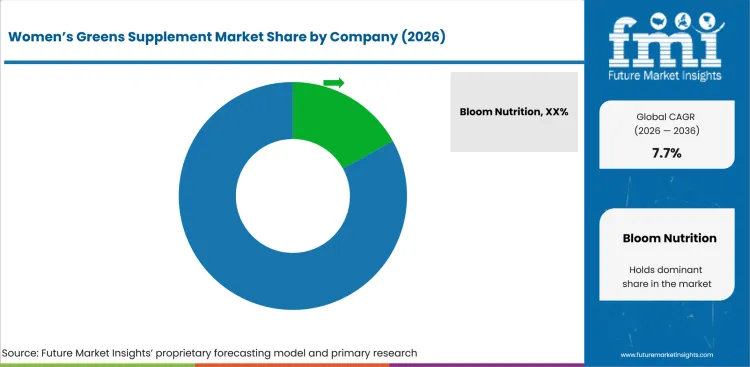
Brand competition is centered on women-specific benefit architecture, flavor repeatability, and trust signals. Bloom Nutrition competes through social commerce reach and accessible daily greens positioning. AG1 competes through broad daily nutrition and probiotic upgrades. HUM Nutrition and Ritual focus on women’s wellness credibility and ingredient explanation.
The supplier base also overlaps with herbal supplement formulation because many women’s greens blends include botanicals such as milk thistle, adaptogenic herbs, or antioxidant extracts.
CMO selection is becoming more important as retailers ask for cleaner labels, stick-pack options, stability checks, and lower sugar flavor systems. Bactolac Pharmaceutical, Inc. is relevant because it supports powder manufacturing, packaging formats, and custom formulations. Smaller brands are more exposed when they lack finished product testing and retailer-ready documentation.
Life stage brands compare greens blends with the menopause supplement space when women over 40 become the core buyer group.
Key Companies in Women’s Greens Supplement Market
Brand-led Formulators
- Bloom Nutrition
- AG1
- Organifi LLC
Evidence-led Daily Nutrition Brands
- Ritual
- Nature Made
- MegaFood
Women’s Wellness Specialists
- HUM Nutrition Inc.
- Free Soul
- JSHealth Vitamins
CMO and Private Label Manufacturers
- Bactolac Pharmaceutical, Inc.
- Makers Nutrition LLC
- Vitaquest International LLC
Competitive Benchmarking
| Company | Women’s Benefit Architecture | Greens Powder and Stick-Pack Capability | Quality and Testing Proof | Retail and Subscription Reach |
|---|---|---|---|---|
| Bloom Nutrition | Female-focused greens and bloat positioning | Powder tubs and flavor-led trial | Retail and social proof files | DTC, mass retail, and creator reach |
| AG1 | Daily foundational nutrition with probiotics | Powder and travel packs | NSF and ingredient testing cues | Subscription and international online reach |
| HUM Nutrition Inc. | Women’s wellness and digestive routines | Capsules with adjacent greens support | RD-reviewed education and app tools | DTC and specialty retail |
| Ritual | Traceable nutrient positioning | Capsules and synbiotic adjacency | Supplier transparency and testing files | DTC subscription |
| Bactolac Pharmaceutical, Inc. | Custom formula support for brands | Powders, stick packs, and private label | cGMP manufacturing and packaging files | B2B CMO supply |
Source: Future Market Insights, 2026.
Key Developments
- In March 2024, Nature Made introduced Zero Sugar Gummies across multivitamin, vitamin C, vitamin D3, vitamin B12, and melatonin formats, which showed how supplement brands were reducing added sugar in routine products.
- In March 2026, Nature Made launched SuperGreens and Digestive Enzymes, with SuperGreens Powder containing one cup of vegetables per serving and added digestive health ingredients.
- In May 2025, AG1 introduced AG1 Next Gen with five clinically studied probiotic strains and added vitamins and minerals.
- In August 2025, AG1 introduced Tropical, Berry, and Citrus flavors, which showed how flavor variety is being used to support repeat powder consumption.
Key Players
Brand-led Formulators
- Bloom Nutrition
- AG1
- Organifi LLC
Evidence-led Daily Nutrition Brands
- Ritual
- Nature Made
- MegaFood
Women’s Wellness Specialists
- HUM Nutrition Inc.
- Free Soul
- JSHealth Vitamins
CMO and Private Label Manufacturers
- Bactolac Pharmaceutical, Inc.
- Makers Nutrition LLC
- Vitaquest International LLC
Women’s Greens Supplement Market - Report Scope
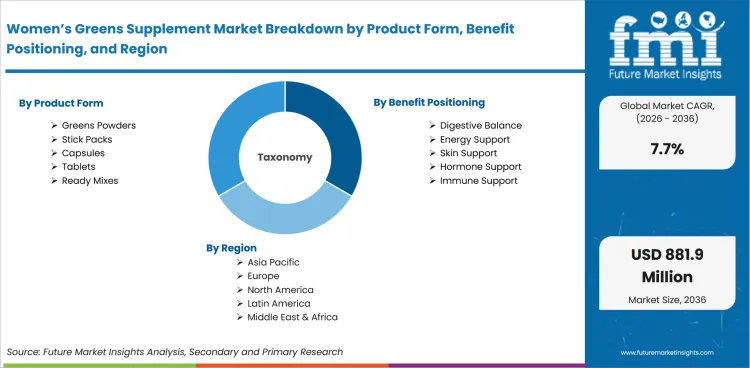
| Item | Value |
|---|---|
| Market size by 2036 | USD 881.9 million |
| Growth rate | 7.7% CAGR from 2026 to 2036 |
| Forecast period | 2026 to 2036 |
| Base year value (2025) | USD 390.0 million |
| 2026 value | USD 420.0 million |
| By product form | Greens powders, stick packs, capsules, tablets, ready mixes |
| By benefit positioning | Digestive balance, energy support, skin support, hormone support, immune support |
| By ingredient base | Cereal grasses, algae blends, leafy greens, fruit extracts, botanical blends, probiotic blends |
| By consumer life stage | Adult wellness, prenatal support, postnatal support, perimenopause, menopause |
| By sales channel | Direct online, marketplace, specialty retail, pharmacy retail, mass retail, fitness retail |
| By buyer type | DTC brands, private label, CMO clients, specialty retailers, practitioner brands |
| Regions covered | North America, Europe, GCC, East Asia, Oceania, Rest of World |
| Countries covered | United States, Canada, United Kingdom, Germany, Saudi Arabia, South Korea, Australia |
| Key companies profiled | Bloom Nutrition, AG1, Organifi LLC, Ritual, Nature Made, MegaFood, HUM Nutrition Inc., Free Soul, JSHealth Vitamins, Bactolac Pharmaceutical Inc., Makers Nutrition LLC, Vitaquest International LLC |
| Approach | Bottom-up product-boundary approach using eligible SKU revenue, retail pricing, subscription presence, women-focused positioning, product form depth, benefit claim structure, ingredient base, channel activity, and country-level supplement adoption |
Women’s Greens Supplement Market - Scope & Definition
| Attribute | Detail |
|---|---|
| Market Definition | Finished powdered and non-powdered greens blends positioned for female wellness, including vegetable powders, cereal grasses, algae, fruit extracts, botanical blends, vitamins, minerals, probiotics, prebiotics, and digestive enzymes |
| Functions Covered | Digestive balance, energy support, skin support, hormone support, immune support, daily greens intake, female wellness support, and routine supplement use |
| Applications Covered | Greens powders, stick packs, capsules, tablets, ready mixes, digestive balance blends, skin support blends, energy support blends, and life stage wellness products |
| End-Use Industries | Dietary supplements, women’s wellness, functional nutrition, pharmacy wellness, direct-to-consumer nutrition, specialty health retail, and supplement contract manufacturing |
| Product Forms Covered | Greens powders, stick packs, capsules, tablets, and ready mixes |
| Inclusions | All commercially available women-positioned greens supplements across product form, benefit positioning, ingredient base, consumer life stage, sales channel, and buyer type, including products for adult wellness, prenatal adjacency, postnatal support, perimenopause, and menopause adjacency |
| Exclusions | Ordinary vegetable powders sold only as food ingredients, finished juices, smoothies, frozen desserts, meal replacements, sports protein powders without women-focused greens positioning, prescription products, disease treatment products, clinical nutrition formulas, and generic multivitamins without greens blend positioning |
Women’s Greens Supplement Market - Research Methodology
| Method | Description |
|---|---|
| Primary Research | FMI analyst interviews with women’s wellness brands, greens supplement suppliers, supplement contract manufacturers, pharmacy buyers, specialty health retailers, direct-to-consumer brands, and private label developers across key markets |
| Desk Research | Review of public data from Centers for Disease Control and Prevention National Center for Health Statistics, United States Food and Drug Administration, Health Canada, European Food Safety Authority, Food Standards Agency, General Authority for Statistics Saudi Arabia, and official company releases related to women’s supplement use and greens product positioning |
| Market Sizing & Forecasting | Bottom-up product-boundary approach using eligible SKU revenue, retail pricing, subscription presence, product form segmentation, benefit positioning, ingredient base, sales channel mix, buyer type, and country-level supplement adoption |
| Data Validation | Cross-verification using female supplement use evidence, natural health product regulation, food supplement guidance, active supplier portfolios, direct online channel activity, pharmacy retail presence, country population structure, and finished greens supplement availability across leading countries |
Women’s Greens Supplement Market by Segments
By Product Form
- Greens Powders
- Stick Packs
- Capsules
- Tablets
- Ready Mixes
By Benefit Positioning
- Digestive Balance
- Energy Support
- Skin Support
- Hormone Support
- Immune Support
By Ingredient Base
- Cereal Grasses
- Algae Blends
- Leafy Greens
- Fruit Extracts
- Botanical Blends
- Probiotic Blends
By Consumer Life Stage
- Adult Wellness
- Prenatal Support
- Postnatal Support
- Perimenopause
- Menopause
By Sales Channel
- Direct Online
- Marketplace
- Specialty Retail
- Pharmacy Retail
- Mass Retail
- Fitness Retail
By Buyer Type
- DTC Brands
- Private Label
- CMO Clients
- Specialty Retailers
- Practitioner Brands
By Region
- North America
- Europe
- GCC
- East Asia
- Oceania
- Rest of World
Research Sources and Bibliography
- Australian Bureau of Statistics. (2025, September 5). Dietary supplements, 2023.
- Centers for Disease Control and Prevention National Center for Health Statistics. (2026, May). Dietary supplement use in the United States: 2021 to 2023.
- Council for Responsible Nutrition. (2024, October 29). Three quarters of Americans use dietary supplements according to new CRN Consumer Survey.
- European Food Safety Authority. (2026, January 6). Food supplements.
- Food Standards Agency. (2026, January 20). Food supplements: consumer guidance.
- General Authority for Statistics Saudi Arabia. (2024, March). Saudi Women Report 2024.
- Ministry of Food and Drug Safety Republic of Korea. (2025, September). Health functional food labeling information.
- United Kingdom Department of Health and Social Care. (2024, February 20). Nutrition legislation information sheet.
- United States Food and Drug Administration. (2024, April 3). New dietary ingredient notification master files for dietary supplements: Draft guidance for industry.
- United States Department of Agriculture Foreign Agricultural Service. (2026, April 6). Korea health functional food market brief.
- Nutrabolt. (2024, January 17). Nutrabolt leads investment round for Bloom Nutrition.
- Nutrabolt. (2025, September 9). Nutrabolt and Bloom Nutrition expand strategic partnership.
- AG1. (2025, May 4). Meet AG1 Next Gen.
- AG1. (2025, August 5). Introducing AG1 Flavors: Tropical, Berry, and Citrus.
- Pharmavite LLC. (2026, March 3). Nature Made continues expansion of its gut health offerings with the launch of SuperGreens and Digestive Enzymes.
- Pharmavite LLC. (2024, July 12). MegaFood leans into women’s expertise with the launch of The MegaWell Collective.
- AG1. (2025, October 24). Raising the bar on probiotic testing: From CFUs to dPCR.
This Report Answers
- How large is the women’s greens supplement market in 2026 and how much value is projected by 2036?
- Which product form and benefit position account for the highest share of 2026 revenue?
- Why are digestive balance and daily energy claims central to women-focused greens products?
- Which seven countries offer the clearest commercial signal for suppliers and investors?
- How do DTC brands, pharmacy channels, and CMOs compete in women-positioned greens blends?
- Which formulation, channel, and compliance barriers can slow repeat purchase through 2036?
Frequently Asked Questions
How big is the women’s greens supplement market in 2026?
The women’s greens supplement market is estimated at USD 420.0 million in 2026 and is projected to reach USD 881.9 million by 2036.
What is the CAGR for women’s greens supplements?
The market is forecast to expand at 7.7% CAGR from 2026 to 2036, led by digestive balance positioning and direct online subscription sales.
Which product form leads the market?
Greens powders lead the market with 61.0% share in 2026 because one scoop can carry more vegetables, probiotics, and micronutrients than capsules.
Which country grows fastest?
Saudi Arabia is projected to grow fastest at 9.3% CAGR through 2036 due to premium wellness retail and a young female population base.
Preview the report firsthand - request a free sample
Get SampleGet the brochure for pricing and purchase details.
Get PDF

