

- Industry Size (2025)
- USD 5.8 Bn
- Forecast (2035)
- USD 14.0 Bn
- CAGR (2025 to 2035)
- 9.2%
asia pacific waterproofing chemicals market Size, Market Forecast and Outlook By FMI
Asia Pacific waterproofing chemicals market is expected to expand from USD 5.8 billion in 2025 to USD 14.0 billion by 2035. The market is anticipated to register a 9.2% CAGR during the forecast period. Direct sales are likely to lead with about 45.0% share, while bitumen membranes are projected to hold around 40.0% share.
Summary of the Asia Pacific Waterproofing Chemicals Market
- Demand and Expansion Drivers
- Urban construction supports adoption as buildings and infrastructure need longer service life.
- Climate resilience priorities increase use of waterproofing products in exposed structures.
- Green building standards encourage low-VOC and solvent-free waterproofing formulations.
- Project complexity strengthens direct sales as contractors need technical support during application.
- Product and Segment View
- Bitumen membranes are expected to lead due to durability and cost-effective moisture protection.
- Polyurethane coatings are likely to remain preferred for seamless coverage and chemical resistance.
- Direct sales should stay ahead because large construction projects require application guidance.
- Distributors remain important as regional contractors need faster availability and local stock access.
- Geography and Competitive Outlook
- China is expected to remain important due to large construction and infrastructure activity.
- India is likely to expand as urban projects increase waterproofing product use.
- Southeast Asian countries should gain traction through commercial and infrastructure spending.
- BASF and Sika compete through product depth and contractor support.
- Analyst Opinion
- Nikhil Kaitwade, Principal Consultant at FMI states: “Asia Pacific waterproofing chemicals demand is linked to construction quality and infrastructure durability. Contractors prefer products that reduce leakage risk and extend asset life. Bitumen membranes remain useful because they balance cost and proven performance. Polyurethane coatings gain preference in complex surfaces needing seamless protection. Suppliers with technical service and low-emission formulations will strengthen project approval.”
- Asia Pacific Waterproofing Chemicals Market Value Analysis
- Bitumen membranes serve projects needing durable and cost-effective moisture barriers.
- Polyurethane coatings support complex surfaces where seamless protection and flexibility matter.
- Direct sales improve conversion as manufacturers guide contractors through application requirements.
- Infrastructure projects create steady use as bridges and transport assets need water resistance.
- Low-VOC formulations gain relevance as green building standards influence material selection.
Analyzing Asia Pacific Waterproofing Chemicals Market by Top Investment Segments
Dominant Waterproofing Solutions in Asia Pacific: Bitumen Membranes and Polyurethane Coatings
In the Asia Pacific region, the waterproofing chemicals market is largely driven by two main segments: bitumen membranes and polyurethane coatings, which together hold about 70% of the market share. Bitumen membranes command around 40% share due to their proven durability, water resistance, and cost-effectiveness. Widely used in residential, commercial, and infrastructure projects, bitumen membranes protect structures from moisture damage and extend their lifespan.
Leading manufacturers such as Sika, BASF, and Mapei offer advanced membrane and coating systems. Polymer-modified bitumen membranes like SBS (Styrene-Butadiene-Styrene) and APP (Atactic Polypropylene) enhance flexibility, temperature resistance, and crack-bridging capability, making them suitable for harsh climatic conditions. Their increasing use in large-scale projects like roads, bridges, and tunnels-supported by government urban development initiatives in countries such as China and India-is propelling market growth.
Polyurethane coatings hold roughly 30% of the market and are favored for their seamless, liquid-applied coverage, flexibility, and excellent chemical resistance. Companies such as BASF, Sika, and Mapei supply polyurethane waterproofing products used on high-traffic surfaces and complex architectural structures, including industrial facilities, basements, and parking garages. Innovations such as fast-curing formulations (e.g., BASF’s MasterSeal PU) and nanotechnology-enhanced products improve application ease and durability, encouraging wider adoption across the region.
Sales Channel Analysis of Asia Pacific Waterproofing Chemicals Market
In the Asia Pacific waterproofing chemicals market, direct sales dominate, accounting for about 45% of the market share. Leading manufacturers such as BASF, Sika, and Pidilite Industries use this channel to maintain close relationships with large construction companies and infrastructure developers.
Through direct sales, these companies can provide tailored waterproofing solutions, offer technical training, and ensure correct product application on complex projects like commercial buildings, highways, and transport networks. This hands-on approach allows for better management of project-specific requirements and helps build strong customer loyalty, particularly for high-performance products that require expert guidance.
On the other hand, distributors and wholesalers hold approximately 25% of the market share. Companies including W.R. Grace & Co., H.B. Fuller, and Pidilite Industries rely on these intermediaries to reach smaller contractors, local retailers, and regional markets across countries such as India, Southeast Asia, and Australia.
Distributors offer essential services such as logistics support, inventory management, and faster product availability, making it easier for manufacturers to penetrate remote and fragmented markets where direct sales may not be feasible or cost-effective. This dual-channel strategy allows waterproofing chemical producers to maximize market coverage and meet diverse customer needs across the region.
Challenges and Opportunities
Challenges
Regulatory Compliance
The waterproofing chemical manufacturers face one of the biggest challenges in terms of navigating the various environmental and safety-related regulations that are often based on regional and international standards.
Countries in the Asia Pacific region are implementing strict guidelines for chemical formulations to deliver solutions that meet sustainability and health-specific requirements. Adhering to these regulations entails ongoing investments in research, development, and certification processes, which poses one of the primary challenges for market participants.
High Material Costs
The high cost of modern waterproofing materials, especially the environmentally friendly ones and high-performance varieties, is still a major concern in the industry and among customers. Such materials typically require expensive raw ingredients that are infeasible for price-sensitive markets.
Skilled Labour Shortages
Waterproofing chemicals require precise application, but many markets face a shortage of trained applicators. Poor surface preparation and incorrect product use can reduce performance and increase repair risk.
Opportunities
Technological Innovations
Innovative waterproofing materials development, such as smart coatings that respond to environmental factors and self-healing waterproofing solutions, opens new growth opportunities. These innovations can increase building longevity and reduce long-term maintenance costs.
Sustainability Trends
The rise in the trend of sustainable construction methods has resulted in a demand for waterproofing solutions that comply with green building certifications. This trend will serve as a huge opportunity for manufacturers who are specifically dealing in biodegradable, non-toxic and energy efficient waterproofing chemicals.
Infrastructure Expansion
Due to strong investments from many countries in the Asia Pacific region in the modernization of infrastructure, there is an increased demand for waterproofing chemicals. The demand for efficient waterproofing solutions will only increase over the next decade, due to large scale infrastructure projects such as highways, bridges, tunnels and public transport systems.
Country-Wise Analysis
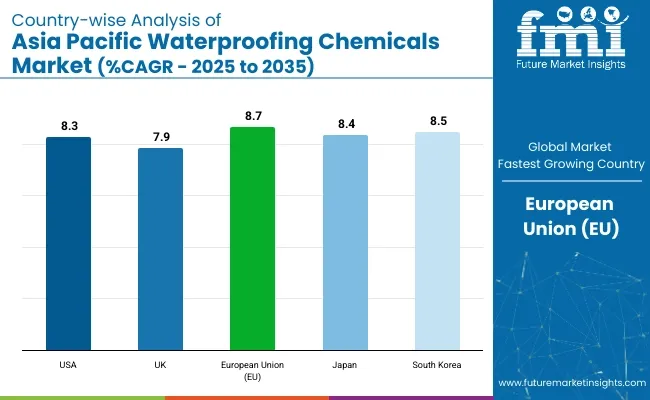
China
China remains a major demand center for waterproofing chemicals because urban redevelopment, transport infrastructure, industrial facilities, and high-rise construction require durable moisture protection. Contractors use bitumen membranes for cost-effective roof and basement applications, while polyurethane and acrylic coatings gain use on complex surfaces that need seamless coverage.
Public infrastructure upgrades, metro expansion, logistics facilities, and commercial real estate continue to support demand for products with stronger crack-bridging, chemical resistance, and low-VOC performance. Manufacturers with local technical teams and applicator training are better placed to win large project specifications.
| Country | CAGR (2025 to 2035) |
|---|---|
| China | 8.7% |
India
India is expected to remain one of the most active Asia Pacific markets as housing, metro rail, highways, airports, commercial real estate, and industrial projects increase demand for roof, basement, bridge, and tunnel waterproofing. Monsoon exposure and leakage-related repair costs make product reliability a practical buying factor for contractors and developers.
Direct sales and distributor networks both matter in India. Large infrastructure and commercial projects need technical guidance from manufacturers, while regional contractors depend on local stock availability and applicator support. Low-VOC coatings and polymer-modified membranes are gaining relevance as green-building and durability requirements become more visible.
| Country | CAGR (2025 to 2035) |
|---|---|
| India | 8.5% |
Malaysia
Malaysia demand is supported by tropical rainfall, commercial construction, industrial facilities, and transport infrastructure that require reliable roof, facade, basement, and deck protection. Liquid-applied coatings and membranes are used where contractors need seamless coverage and faster application on complex surfaces.
Project owners are placing more attention on lifecycle cost, water ingress prevention, and compliance with sustainable building requirements. Suppliers that combine product availability with site-level application support are expected to hold stronger positions with contractors and developers.
| Country | CAGR (2025 to 2035) |
|---|---|
| Malaysia | 7.9% |
Japan
Technological innovation, earthquake-resistant construction, and the increasing adoption of energy-efficient building materials are driving steady growth in Japan waterproofing chemicals demand. As natural disasters including typhoons, extreme rain, and earthquakes have been common in Japan, there is great demand for advanced waterproofing solutions that are also improving structural durability and resilience.
The phenomenon has spurred Japan’s urban construction sector, encouraged high-rise buildings, commercial centers, and smart infrastructure projects to adopt polyurethane coatings, EPDM membranes and polymer-based waterproofing solutions.
Vinyl’s construction, chemical corrosion and final finishing features have been further promoting the market growth from the government's focus on infrastructure modernization and disaster-resistant construction.
Moreover, the growth of Japan’s smart city and real estate initiatives has also fuelled the demand for eco-friendly waterproofing chemicals, particularly low-maintenance and long-lasting materials. Moreover, with its robust industrial base, especially in the automotive and electronics sectors, Japan is witnessing opportunities for specialized waterproofing solutions in factories, storage and production plants.
| Country | CAGR (2025 to 2035) |
|---|---|
| Japan | 8.4% |
South Korea
The South Korean waterproofing chemicals market is growing steadily due to urbanisation activities, government investments towards smart cities and adoption towards more sustainable building materials.
The booming residential and commercial construction industry of South Korea is also augmenting the demand for durable waterproofing solutions such as polyurethane coating, elastomeric membranes, and acrylic sealants. Demand for low-VOC and recyclable waterproofing products is on the rise within the country, a response to the focus on lowering carbon emissions from the construction industry.
South Korea’s waterproofing chemicals market is expanding steadily over the forecast period due to government-oriented infrastructure modernization and growing consumer preference for energy-efficient buildings.
| Country | CAGR (2025 to 2035) |
|---|---|
| South Korea | 8.5% |
Competitive Outlook
The increasing demand for infrastructure development, urbanization and sustainable construction materials are the primary factors that drive the Asia Pacific waterproofing chemicals market. By employing advanced polymer-based waterproofing solutions, low-VOC environmentally friendly coatings, and AI-driven performance monitoring within the materials, companies are increasing waterproofing effectiveness, structural longevity, and energy efficiency.
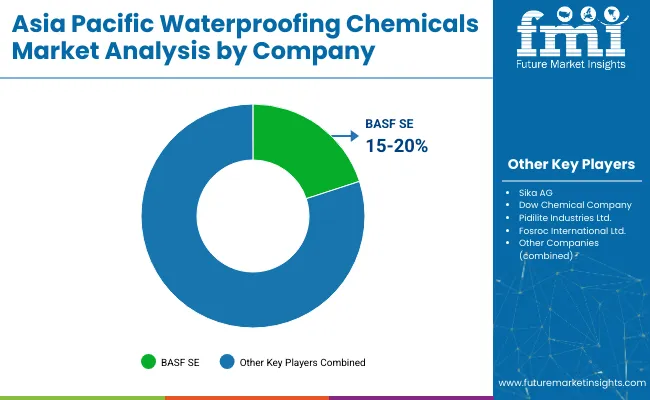
Global chemical manufacturers, as well as regional products, contribute to the innovation of waterproofing membranes (membrane systems- sheets, membranes, etc.), sealants and liquid applied coatings to the market.
Report Scope Table - Asia Pacific Waterproofing Chemicals Market
| Report Attributes | Details |
|---|---|
| Current Total Market Size (2025) | USD 5.8 billion |
| Projected Market Size (2035) | USD 14.0 billion |
| CAGR (2025 to 2035) | 9.2% |
| Base Year for Estimation | 2024 |
| Historical Period | 2020 to 2024 |
| Projections Period | 2025 to 2035 |
| Quantitative Units | USD billion for value and thousand metric tons for volume |
| Technology Types Analyzed (Segment 1) | Membrane Type, Coatings, Injection Grouting, Integral System |
| Sales Channels Analyzed (Segment 2) | Direct Sales, Retail Stores, Distributors and Wholesalers, Online, DIY |
| End Users Analyzed (Segment 3) | Commercial Sector, Residential Sector, Infrastructure Sector, Industrial Sector, Others |
| Regions Covered | Asia Pacific |
| Countries Covered | China, India, Japan, South Korea, Australia, New Zealand, Indonesia, Vietnam, Thailand, Malaysia, Philippines |
| Key Players influencing the Asia Pacific Waterproofing Chemicals Market | BASF SE, Mapei S.p.A., Wacker Chemie AG, Akzo Nobel N.V., Evonik Industries, Sika AG, W.R. Grace and Company, H.B. Fuller, Pidilite Industries Limited, Jiahua Chemicals Inc. |
| Additional Attributes | Technological advancements in sustainable waterproofing solutions, Adoption of liquid applied membranes and crystalline waterproofing systems, DIY and e-commerce growth in residential applications, Public-private investments in smart cities and infrastructure projects driving chemical demand |
| Customization and Pricing | Customization and Pricing Available on Request |
Asia Pacific Waterproofing Chemicals Market Segmentation
By Technology Type:
- Membrane Type
- Coatings
- Injection Grouting
- Integral System
By Sales Channel:
- Direct Sales
- Retail Stores
- Distributors and Wholesalers
- Online
- DIY
By End User:
- Commercial Sector
- Residential Sector
- Infrastructure Sector
- Industrial Sector
- Others
By Country:
- China
- Japan
- South Korea
- Malaysia
- India
Frequently Asked Questions
How big was the Asia Pacific Waterproofing Chemicals Market in 2025?
The Asia Pacific Waterproofing Chemicals Market was valued at USD 5.8 billion in 2025.
What value is forecast for the Asia Pacific Waterproofing Chemicals Market by 2035?
The market is forecast to reach USD 14.0 billion by 2035, implying a 9.2% CAGR from 2025 to 2035.
What is expected to drive Asia Pacific waterproofing chemicals demand?
Urban construction, infrastructure upgrades, climate resilience, and stricter durability requirements are expected to increase use of waterproofing chemicals across residential, commercial, industrial, and transport projects.
Which countries are expected to contribute strongly to market growth?
China, India, Japan, South Korea, and Malaysia are expected to be important country markets within Asia Pacific.
Which technology type is expected to lead the market?
Membrane type is expected to lead, with bitumen membranes remaining important because of durability, cost effectiveness, and broad use in roofing, basement, and infrastructure applications.
Preview the report firsthand - request a free sample
Get SampleGet the brochure for pricing and purchase details.
Get PDFTable of Content
- Executive Summary
- Industry Introduction, including Taxonomy and Market Definition
- Waterproofing Chemicals Market Trends and Success Factors, including Macro-economic Factors, Market Dynamics, and Recent Industry Developments
- Market Demand Analysis 2020 to 2024 and Forecast 2025 to 2035, including Historical Analysis and Future Projections
- Market Analysis 2020 to 2024 and Forecast 2025 to 2035
- Technology Type
- Sales Channel
- End User
- Market Analysis 2020 to 2024 and Forecast 2025 to 2035, By Technology Type
- Membrane Type
- Coatings
- Injection Grouting
- Integral System
- Market Analysis 2020 to 2024 and Forecast 2025 to 2035, By Sales Channel
- Direct Sales
- Retail Stores
- Distributors and Wholesalers
- Online
- DIY
- Market Analysis 2020 to 2024 and Forecast 2025 to 2035, By End User
- Commercial Sector
- Residential Sector
- Infrastructure Sector
- Industrial Sector
- Others
- Market Analysis 2020 to 2024 and Forecast 2025 to 2035, By Country
- China
- Japan
- South Korea
- Malaysia
- India
- China Sales Analysis 2020 to 2024 and Forecast 2025 to 2035, by Key Segments and Countries
- Japan Sales Analysis 2020 to 2024 and Forecast 2025 to 2035, by Key Segments and Countries
- South Korea Sales Analysis 2020 to 2024 and Forecast 2025 to 2035, by Key Segments and Countries
- Malaysia Sales Analysis 2020 to 2024 and Forecast 2025 to 2035, by Key Segments and Countries
- India Sales Analysis 2020 to 2024 and Forecast 2025 to 2035, by Key Segments and Countries
- Sales Forecast 2025 to 2035 by Technology Type, Sales Channel, and End User for Key Asia Pacific Countries
- Competition Outlook, including Market Structure Analysis, Company Share Analysis by Key Players, and Competition Dashboard
- Company Profile
- BASF SE
- Mapei S.p.A.
- Wacker Chemie AG
- Akzo Nobel N.V.
- Evonik Industries
- Sika AG
- W.R. Grace and Company
- H.B. Fuller
- Pidilite Industries Limited
- Jiahua Chemicals Inc.


